Review of Semiconductor Physics
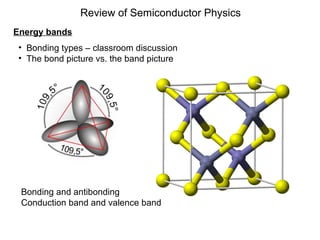
Energy bands
• Bonding types – classroom discussion
• The bond picture vs. the band picture
Bonding and antibonding
Conduction band and valence band
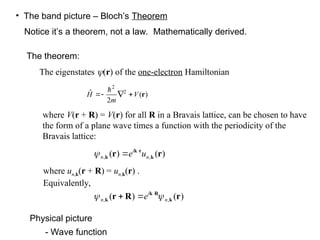
• The band picture – Bloch’s Theorem
Notice it’s a theorem, not a law. Mathematically derived.
The theorem:
Physical picture
The eigenstates (r) of the one-electron Hamiltonian
where V(r + R) = V(r) for all R in a Bravais lattice, can be chosen to have
the form of a plane wave times a function with the periodicity of the
Bravais lattice:
)
(
)
( ,
, r
r k
r
k
k n
i
n u
e 


where un,k(r + R) = un,k(r) .
Equivalently,
)
(
)
( ,
, r
R
r k
R
k
k n
i
n e 
 


- Wave function
)
(
2
ˆ 2
2
r
V
m
H 




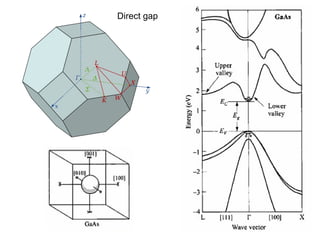
Direct gap
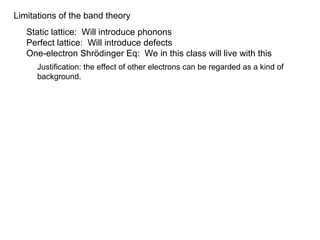
Limitations of the band theory
Static lattice: Will introduce phonons
Perfect lattice: Will introduce defects
One-electron Shrödinger Eq: We in this class will live with this
Justification: the effect of other electrons can be regarded as a kind of
background.
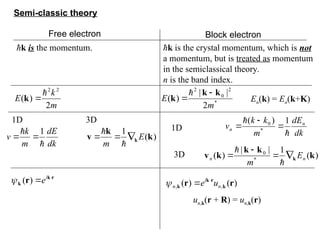
Semi-classic theory
Free electron Block electron
ħk is the momentum. ħk is the crystal momentum, which is not
a momentum, but is treated as momentum
in the semiclassical theory.
n is the band index.
m
k
E
2
)
(
2
2


k *
2
0
2
2
|
|
)
(
m
E
k
k
k



En(k) = En(k+K)
1D
dk
dE
m
k
v

 1

 )
(
1
k
k
v k E
m





3D
dk
dE
m
k
k
v n
n

 1
)
(
*
0



)
(
1
|
|
)
( *
0
k
k
k
k
v k n
n E
m






1D
3D
r
k
k r 
 i
e
)
(
 )
(
)
( ,
, r
r k
r
k
k n
i
n u
e 


un,k(r + R) = un,k(r)
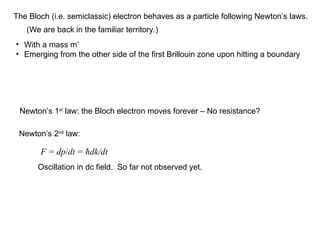
The Bloch (i.e. semiclassic) electron behaves as a particle following Newton’s laws.
(We are back in the familiar territory.)
• With a mass m*
• Emerging from the other side of the first Brillouin zone upon hitting a boundary
Newton’s 1st
law: the Bloch electron moves forever – No resistance?
Oscillation in dc field. So far not observed yet.
Newton’s 2nd
law:
F = dp/dt = ħdk/dt
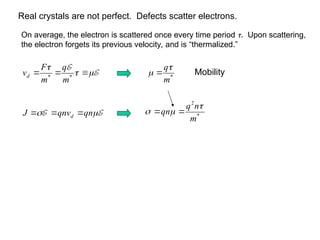
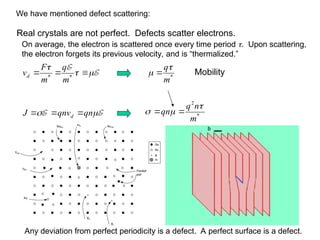
Real crystals are not perfect. Defects scatter electrons.
On average, the electron is scattered once every time period . Upon scattering,
the electron forgets its previous velocity, and is “thermalized.”
E
E





 *
*
m
q
m
F
vd *
m
q
 
E
E 
 qn
qnv
J d 

 *
2
m
n
q
qn


 

Mobility
Review of Semiconductor Physics
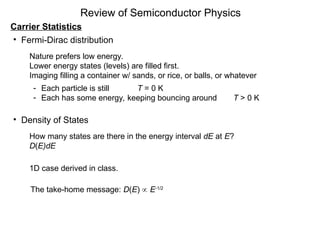
Carrier Statistics
• Fermi-Dirac distribution
Nature prefers low energy.
Lower energy states (levels) are filled first.
Imaging filling a container w/ sands, or rice, or balls, or whatever
- Each particle is still T = 0 K
- Each has some energy, keeping bouncing around T > 0 K
• Density of States
How many states are there in the energy interval dE at E?
D(E)dE
1D case derived in class.
The take-home message: D(E)  E1/2
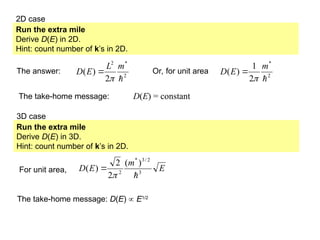
2D case
Run the extra mile
Derive D(E) in 2D.
Hint: count number of k’s in 2D.
The answer: 2
*
2
2
)
(

m
L
E
D

 Or, for unit area 2
*
2
1
)
(

m
E
D


The take-home message: D(E) = constant
3D case
Run the extra mile
Derive D(E) in 3D.
Hint: count number of k’s in 2D.
For unit area, E
m
E
D 3
2
/
3
*
2
)
(
2
2
)
(



The take-home message: D(E)  E1/2
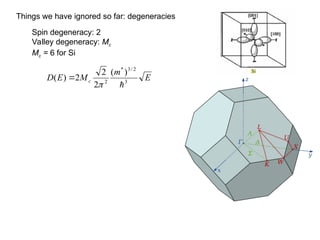
Things we have ignored so far: degeneracies
Spin degeneracy: 2
Valley degeneracy: Mc
Mc = 6 for Si
E
m
M
E
D c 3
2
/
3
*
2
)
(
2
2
2
)
(



Total number of carriers per volume (carrier density, carrier concentration)
Run the extra mile
Derive the electron density n.
Hint: Fermi-Dirac distribution approximated by Boltzmann distribution.
Results for n and p are given.
Doping
One way to manipulate carrier density is doping.
Doping shifts the Fermi level.
np = ni
2
p is the total number of states NOT occupied.
Before we talk about device, what are semiconductors anyway?
Why can we modulate their properties by orders of magnitude?
Classroom discussion
Real crystals are not perfect. Defects scatter electrons.
On average, the electron is scattered once every time period . Upon scattering,
the electron forgets its previous velocity, and is “thermalized.”
E
E





 *
*
m
q
m
F
vd *
m
q
 
E
E 
 qn
qnv
J d 

 *
2
m
n
q
qn


 

Mobility
We have mentioned defect scattering:
Any deviation from perfect periodicity is a defect. A perfect surface is a defect.
Phonons
Static lattice approximation
Atoms vibrate
Harmonic approximation
Vibration quantized
Each quantum is a phonon.
Similar to the photon: E = ħ, p = ħk
Phonons scatter carriers, too.
The higher the temperature, the worse phonon scattering.
You can use the temperature dependence of conductivity or mobility to determine
the contributions of various scattering mechanisms.
Alloys
Compounds, alloys, heterostructures
InP, GaAs, …, SiC
InxGa1-xAsyP1-y, …, SixGe1-x
Epitaxy
Band structure of alloys
Topics
• Review of Semiconductor physics
- Crystal structure, band structures, band structure modification by alloys,
heterostructurs, and strain
- Carrier statistics
- Scattering, defects, phonons, mobility, transport in heterostructures
• Device concepts
- MOSFETs, MESFETs, MODFETs, TFTs
- Heterojunction bipolar transistors (HBT)
- Semiconductor processing
- Photodiodes, LEDs, semiconductor lasers
- (optional) resonant tunneling devices, quantum interference devices,
single electron transistors, quantum dot computing, ...
- Introduction to nanoelectronics
We will discuss heterostructures in the context of devices.
More discussions on semiconductor physics will be embedded in the device
context.
semiconductors with physical science.ppt

  • 1.
    Review of SemiconductorPhysics Energy bands • Bonding types – classroom discussion • The bond picture vs. the band picture Bonding and antibonding Conduction band and valence band
  • 2.
    • The bandpicture – Bloch’s Theorem Notice it’s a theorem, not a law. Mathematically derived. The theorem: Physical picture The eigenstates (r) of the one-electron Hamiltonian where V(r + R) = V(r) for all R in a Bravais lattice, can be chosen to have the form of a plane wave times a function with the periodicity of the Bravais lattice: ) ( ) ( , , r r k r k k n i n u e    where un,k(r + R) = un,k(r) . Equivalently, ) ( ) ( , , r R r k R k k n i n e      - Wave function ) ( 2 ˆ 2 2 r V m H     
  • 3.
  • 4.
    Limitations of theband theory Static lattice: Will introduce phonons Perfect lattice: Will introduce defects One-electron Shrödinger Eq: We in this class will live with this Justification: the effect of other electrons can be regarded as a kind of background.
  • 5.
    Semi-classic theory Free electronBlock electron ħk is the momentum. ħk is the crystal momentum, which is not a momentum, but is treated as momentum in the semiclassical theory. n is the band index. m k E 2 ) ( 2 2   k * 2 0 2 2 | | ) ( m E k k k    En(k) = En(k+K) 1D dk dE m k v   1   ) ( 1 k k v k E m      3D dk dE m k k v n n   1 ) ( * 0    ) ( 1 | | ) ( * 0 k k k k v k n n E m       1D 3D r k k r   i e ) (  ) ( ) ( , , r r k r k k n i n u e    un,k(r + R) = un,k(r)
  • 6.
    The Bloch (i.e.semiclassic) electron behaves as a particle following Newton’s laws. (We are back in the familiar territory.) • With a mass m* • Emerging from the other side of the first Brillouin zone upon hitting a boundary Newton’s 1st law: the Bloch electron moves forever – No resistance? Oscillation in dc field. So far not observed yet. Newton’s 2nd law: F = dp/dt = ħdk/dt
  • 7.
    Real crystals arenot perfect. Defects scatter electrons. On average, the electron is scattered once every time period . Upon scattering, the electron forgets its previous velocity, and is “thermalized.” E E       * * m q m F vd * m q   E E   qn qnv J d    * 2 m n q qn      Mobility
  • 8.
    Review of SemiconductorPhysics Carrier Statistics • Fermi-Dirac distribution Nature prefers low energy. Lower energy states (levels) are filled first. Imaging filling a container w/ sands, or rice, or balls, or whatever - Each particle is still T = 0 K - Each has some energy, keeping bouncing around T > 0 K • Density of States How many states are there in the energy interval dE at E? D(E)dE 1D case derived in class. The take-home message: D(E)  E1/2
  • 9.
    2D case Run theextra mile Derive D(E) in 2D. Hint: count number of k’s in 2D. The answer: 2 * 2 2 ) (  m L E D   Or, for unit area 2 * 2 1 ) (  m E D   The take-home message: D(E) = constant 3D case Run the extra mile Derive D(E) in 3D. Hint: count number of k’s in 2D. For unit area, E m E D 3 2 / 3 * 2 ) ( 2 2 ) (    The take-home message: D(E)  E1/2
  • 10.
    Things we haveignored so far: degeneracies Spin degeneracy: 2 Valley degeneracy: Mc Mc = 6 for Si E m M E D c 3 2 / 3 * 2 ) ( 2 2 2 ) (   
  • 11.
    Total number ofcarriers per volume (carrier density, carrier concentration) Run the extra mile Derive the electron density n. Hint: Fermi-Dirac distribution approximated by Boltzmann distribution. Results for n and p are given. Doping One way to manipulate carrier density is doping. Doping shifts the Fermi level. np = ni 2 p is the total number of states NOT occupied.
  • 12.
    Before we talkabout device, what are semiconductors anyway? Why can we modulate their properties by orders of magnitude? Classroom discussion Classroom discussion
  • 13.
    Real crystals arenot perfect. Defects scatter electrons. On average, the electron is scattered once every time period . Upon scattering, the electron forgets its previous velocity, and is “thermalized.” E E       * * m q m F vd * m q   E E   qn qnv J d    * 2 m n q qn      Mobility We have mentioned defect scattering: Any deviation from perfect periodicity is a defect. A perfect surface is a defect.
  • 14.
    Phonons Static lattice approximation Atomsvibrate Harmonic approximation Vibration quantized Each quantum is a phonon. Similar to the photon: E = ħ, p = ħk Phonons scatter carriers, too. The higher the temperature, the worse phonon scattering. You can use the temperature dependence of conductivity or mobility to determine the contributions of various scattering mechanisms.
  • 15.
    Alloys Compounds, alloys, heterostructures InP,GaAs, …, SiC InxGa1-xAsyP1-y, …, SixGe1-x Epitaxy Band structure of alloys
  • 16.
    Topics • Review ofSemiconductor physics - Crystal structure, band structures, band structure modification by alloys, heterostructurs, and strain - Carrier statistics - Scattering, defects, phonons, mobility, transport in heterostructures • Device concepts - MOSFETs, MESFETs, MODFETs, TFTs - Heterojunction bipolar transistors (HBT) - Semiconductor processing - Photodiodes, LEDs, semiconductor lasers - (optional) resonant tunneling devices, quantum interference devices, single electron transistors, quantum dot computing, ... - Introduction to nanoelectronics We will discuss heterostructures in the context of devices. More discussions on semiconductor physics will be embedded in the device context.