Questionnaire Analysis
Benjamin Okema Year 13 Coursework
To gain a better understanding of the my
target audience it is essential for me to know
which demographics I am going to be aiming
for. The data shows me that the majority of
thriller film consumers are male (62.50%)
which emulates the demographics that real
distribution companies already aim when
they market their products for the thriller
genre. 37.50% of the audience were female
who make up less of the target audience in
comparison to men which is what I predicted
before conducting my research.
From the data collected it is clear that
87.50% of the audience are 18 or
under which means that my media
product must be able to appeal to a
younger target audience. I predicted
this result because I know how
teenagers are drawn to films that are
scary. I’m not surprised that the target
audience as a whole were between
the ages of 18-34 year olds because
despite a falling trend in the number
of cinemagoers this young target
audience of adolescents consume the
most media such as films.
The data shows me that most
individuals are informed about new
films from TV advertisements (TV
slots). Perhaps this is because
channels often rely on advertising
to generate revenue or it might be
that younger audiences spend more
time watching Television therefore
this is one of the best ways of
getting the target audience to go
see a new film. Also, TV slots are
short therefore this will allow sneak
peeks to be shown to a massive
pool of viewers.
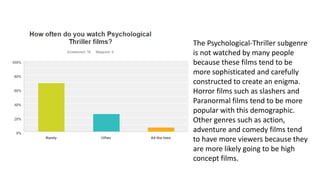
The Psychological-Thriller subgenre
is not watched by many people
because these films tend to be
more sophisticated and carefully
constructed to create an enigma.
Horror films such as slashers and
Paranormal films tend to be more
popular with this demographic.
Other genres such as action,
adventure and comedy films tend
to have more viewers because they
are more likely going to be high
concept films.
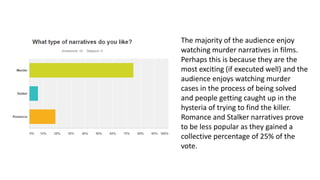
The majority of the audience enjoy
watching murder narratives in films.
Perhaps this is because they are the
most exciting (if executed well) and the
audience enjoys watching murder
cases in the process of being solved
and people getting caught up in the
hysteria of trying to find the killer.
Romance and Stalker narratives prove
to be less popular as they gained a
collective percentage of 25% of the
vote.
In order for me to visualise existing
consumer habits I asked my target
audience about their favourite thriller
films. Films such as ‘Inception’, ‘Gone
girl’ and ‘Taken’ came up. All of these
films were successful in the Box Office.
What my target audience found most
interesting about these films was “The
editing”, the “storyline” and “the plot
twist”. This is an indication of how
important the post-production is in the
construction of this genre.
The responses show that the target audience
expects to see props such as guns, knives,
drugs and dark rooms as part of the
iconography for the psychological thriller
genre. These are mostly likely going to be
props that the target audience has seen in
other thriller films.
The data response indicates that there is a strong
preference for a dark colour scheme to be used for
the poster. The dark colours scheme may reflect the
dark and sinister themes of the thriller genre and
realistically this colour scheme would be most
suitable for the genre. Challenging the conventions
may send the wrong signals to the target audience
because one of the ways that I will know if my
product is successful is for the target audience to be
able to identify the genre of the film.
• The data shows us that the
people enjoy seeing the use of
flashbacks and cliff hangers in
the thriller films. 31.25% of the
people that took part in the
survey voted for the use of cliff
hangers because this would be
most suitable and effective for
the genre because it would
create the sense of mystery
which will make the audience
members want more of the
narrative.
81.25% of the participants of the
survey voted that the main image of
a film poster is what made the
advertisement effective. This means
that I would have to focus on
constructing my poster to make it
engaging while reflecting the genre
of the film through the use of codes
and conventions. Less than 20% of
people thought that the title and
colour scheme were what made the
posters effective.

Questionnaire analysis

  • 1.
  • 2.
    To gain abetter understanding of the my target audience it is essential for me to know which demographics I am going to be aiming for. The data shows me that the majority of thriller film consumers are male (62.50%) which emulates the demographics that real distribution companies already aim when they market their products for the thriller genre. 37.50% of the audience were female who make up less of the target audience in comparison to men which is what I predicted before conducting my research.
  • 3.
    From the datacollected it is clear that 87.50% of the audience are 18 or under which means that my media product must be able to appeal to a younger target audience. I predicted this result because I know how teenagers are drawn to films that are scary. I’m not surprised that the target audience as a whole were between the ages of 18-34 year olds because despite a falling trend in the number of cinemagoers this young target audience of adolescents consume the most media such as films.
  • 4.
    The data showsme that most individuals are informed about new films from TV advertisements (TV slots). Perhaps this is because channels often rely on advertising to generate revenue or it might be that younger audiences spend more time watching Television therefore this is one of the best ways of getting the target audience to go see a new film. Also, TV slots are short therefore this will allow sneak peeks to be shown to a massive pool of viewers.
  • 5.
    The Psychological-Thriller subgenre isnot watched by many people because these films tend to be more sophisticated and carefully constructed to create an enigma. Horror films such as slashers and Paranormal films tend to be more popular with this demographic. Other genres such as action, adventure and comedy films tend to have more viewers because they are more likely going to be high concept films.
  • 6.
    The majority ofthe audience enjoy watching murder narratives in films. Perhaps this is because they are the most exciting (if executed well) and the audience enjoys watching murder cases in the process of being solved and people getting caught up in the hysteria of trying to find the killer. Romance and Stalker narratives prove to be less popular as they gained a collective percentage of 25% of the vote.
  • 7.
    In order forme to visualise existing consumer habits I asked my target audience about their favourite thriller films. Films such as ‘Inception’, ‘Gone girl’ and ‘Taken’ came up. All of these films were successful in the Box Office. What my target audience found most interesting about these films was “The editing”, the “storyline” and “the plot twist”. This is an indication of how important the post-production is in the construction of this genre.
  • 8.
    The responses showthat the target audience expects to see props such as guns, knives, drugs and dark rooms as part of the iconography for the psychological thriller genre. These are mostly likely going to be props that the target audience has seen in other thriller films.
  • 9.
    The data responseindicates that there is a strong preference for a dark colour scheme to be used for the poster. The dark colours scheme may reflect the dark and sinister themes of the thriller genre and realistically this colour scheme would be most suitable for the genre. Challenging the conventions may send the wrong signals to the target audience because one of the ways that I will know if my product is successful is for the target audience to be able to identify the genre of the film.
  • 10.
    • The datashows us that the people enjoy seeing the use of flashbacks and cliff hangers in the thriller films. 31.25% of the people that took part in the survey voted for the use of cliff hangers because this would be most suitable and effective for the genre because it would create the sense of mystery which will make the audience members want more of the narrative.
  • 11.
    81.25% of theparticipants of the survey voted that the main image of a film poster is what made the advertisement effective. This means that I would have to focus on constructing my poster to make it engaging while reflecting the genre of the film through the use of codes and conventions. Less than 20% of people thought that the title and colour scheme were what made the posters effective.