Target Audience
Research Results
Michelle Grace
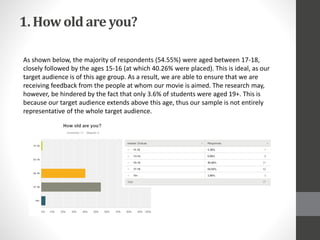
1. How old are you?
As shown below, the majority of respondents (54.55%) were aged between 17-18,
closely followed by the ages 15-16 (at which 40.26% were placed). This is ideal, as our
target audience is of this age group. As a result, we are able to ensure that we are
receiving feedback from the people at whom our movie is aimed. The research may,
however, be hindered by the fact that only 3.6% of students were aged 19+. This is
because our target audience extends above this age, thus our sample is not entirely
representative of the whole target audience.
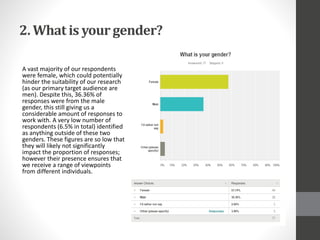
2. What is your gender?
A vast majority of our respondents
were female, which could potentially
hinder the suitability of our research
(as our primary target audience are
men). Despite this, 36.36% of
responses were from the male
gender, this still giving us a
considerable amount of responses to
work with. A very low number of
respondents (6.5% in total) identified
as anything outside of these two
genders. These figures are so low that
they will likely not significantly
impact the proportion of responses;
however their presence ensures that
we receive a range of viewpoints
from different individuals.
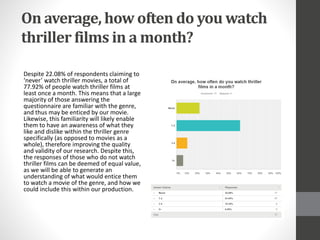
On average, how often do you watch
thriller films in a month?
Despite 22.08% of respondents claiming to
‘never’ watch thriller movies, a total of
77.92% of people watch thriller films at
least once a month. This means that a large
majority of those answering the
questionnaire are familiar with the genre,
and thus may be enticed by our movie.
Likewise, this familiarity will likely enable
them to have an awareness of what they
like and dislike within the thriller genre
specifically (as opposed to movies as a
whole), therefore improving the quality
and validity of our research. Despite this,
the responses of those who do not watch
thriller films can be deemed of equal value,
as we will be able to generate an
understanding of what would entice them
to watch a movie of the genre, and how we
could include this within our production.
4.Isthereanythingyouparticularlyliketo seein
thrillerfilms(ifyou watchthem)?
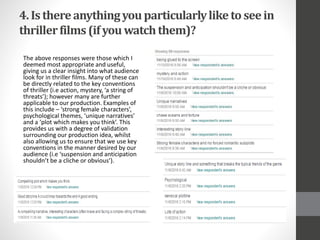
The above responses were those which I
deemed most appropriate and useful,
giving us a clear insight into what audience
look for in thriller films. Many of these can
be directly related to the key conventions
of thriller (i.e action, mystery, ‘a string of
threats’); however many are further
applicable to our production. Examples of
this include – ‘strong female characters’,
psychological themes, ‘unique narratives’
and a ‘plot which makes you think’. This
provides us with a degree of validation
surrounding our production idea, whilst
also allowing us to ensure that we use key
conventions in the manner desired by our
audience (i.e ‘suspension and anticipation
shouldn’t be a cliche or obvious’).
5.Is thereanythingyoudisliketoseeinthriller
movies(ifyouwatchthem)?
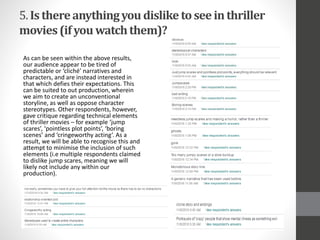
As can be seen within the above results,
our audience appear to be tired of
predictable or ‘cliché’ narratives and
characters, and are instead interested in
that which defies their expectations. This
can be suited to out production, wherein
we aim to create an unconventional
storyline, as well as oppose character
stereotypes. Other respondents, however,
gave critique regarding technical elements
of thriller movies – for example ‘jump
scares’, ‘pointless plot points’, ‘boring
scenes’ and ‘cringeworthy acting’. As a
result, we will be able to recognise this and
attempt to minimise the inclusion of such
elements (i.e multiple respondents claimed
to dislike jump scares, meaning we will
likely not include any within our
production).
6.Do youpreferfilmswithasimpleorcomplex
storyline?
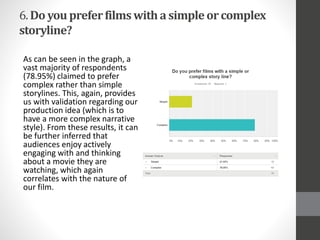
As can be seen in the graph, a
vast majority of respondents
(78.95%) claimed to prefer
complex rather than simple
storylines. This, again, provides
us with validation regarding our
production idea (which is to
have a more complex narrative
style). From these results, it can
be further inferred that
audiences enjoy actively
engaging with and thinking
about a movie they are
watching, which again
correlates with the nature of
our film.
7.How long(onaverage)afterafilmstartsdoes it
takeyouto decidewhetheryou wanttocontinue
watching?
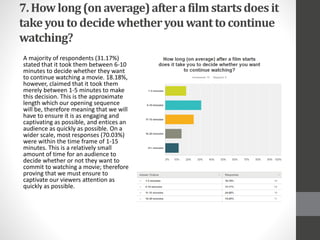
A majority of respondents (31.17%)
stated that it took them between 6-10
minutes to decide whether they want
to continue watching a movie. 18.18%,
however, claimed that it took them
merely between 1-5 minutes to make
this decision. This is the approximate
length which our opening sequence
will be, therefore meaning that we will
have to ensure it is as engaging and
captivating as possible, and entices an
audience as quickly as possible. On a
wider scale, most responses (70.03%)
were within the time frame of 1-15
minutes. This is a relatively small
amount of time for an audience to
decide whether or not they want to
commit to watching a movie; therefore
proving that we must ensure to
captivate our viewers attention as
quickly as possible.
8.Whatmakesa characterinafilmstandoutto
you?Whatmakestheminteresting?
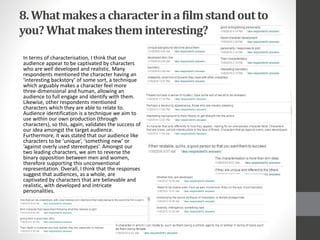
In terms of characterisation, I think that our
audience appear to be captivated by characters
who are well developed and realistic. Many
respondents mentioned the character having an
‘interesting backstory’ of some sort, a technique
which arguably makes a character feel more
three-dimensional and human, allowing an
audience to full engage and identify with them.
Likewise, other respondents mentioned
characters which they are able to relate to.
Audience identification is a technique we aim to
use within our own production (through
characters), so this, again, validates the success of
our idea amongst the target audience.
Furthermore, it was stated that our audience like
characters to be ‘unique’, ‘something new’ or
‘against overly used stereotypes’. Amongst our
two leading characters, we aim to reverse the
binary opposition between men and women,
therefore supporting this unconventional
representation. Overall, I think that the responses
suggest that audiences, as a whole, are
captivated by characters that are believable and
realistic, with developed and intricate
personalities.
9. If you have one,what is your favourite
thrillerfilm and why?
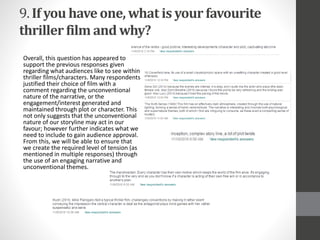
Overall, this question has appeared to
support the previous responses given
regarding what audiences like to see within
thriller films/characters. Many respondents
justified their choice of film with a
comment regarding the unconventional
nature of the narrative, or the
engagement/interest generated and
maintained through plot or character. This
not only suggests that the unconventional
nature of our storyline may act in our
favour; however further indicates what we
need to include to gain audience approval.
From this, we will be able to ensure that
we create the required level of tension (as
mentioned in multiple responses) through
the use of an engaging narrative and
unconventional themes.
10.Whattypeofthemesdoyouliketoseeinathrillerfilm,
ifany?Pleaseplacethethemesinorder1-6(1beingmost
desirable6beingleastdesirable)
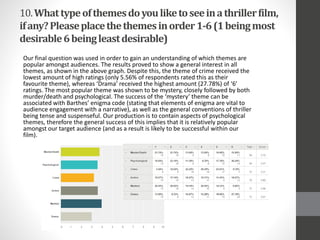
Our final question was used in order to gain an understanding of which themes are
popular amongst audiences. The results proved to show a general interest in all
themes, as shown in the above graph. Despite this, the theme of crime received the
lowest amount of high ratings (only 5.56% of respondents rated this as their
favourite theme), whereas ‘Drama’ received the highest amount (27.78%) of ‘6’
ratings. The most popular theme was shown to be mystery, closely followed by both
murder/death and psychological. The success of the ‘mystery’ theme can be
associated with Barthes’ enigma code (stating that elements of enigma are vital to
audience engagement with a narrative), as well as the general conventions of thriller
being tense and suspenseful. Our production is to contain aspects of psychological
themes, therefore the general success of this implies that it is relatively popular
amongst our target audience (and as a result is likely to be successful within our
film).

Target audience research results

  • 1.
  • 2.
    1. How oldare you? As shown below, the majority of respondents (54.55%) were aged between 17-18, closely followed by the ages 15-16 (at which 40.26% were placed). This is ideal, as our target audience is of this age group. As a result, we are able to ensure that we are receiving feedback from the people at whom our movie is aimed. The research may, however, be hindered by the fact that only 3.6% of students were aged 19+. This is because our target audience extends above this age, thus our sample is not entirely representative of the whole target audience.
  • 3.
    2. What isyour gender? A vast majority of our respondents were female, which could potentially hinder the suitability of our research (as our primary target audience are men). Despite this, 36.36% of responses were from the male gender, this still giving us a considerable amount of responses to work with. A very low number of respondents (6.5% in total) identified as anything outside of these two genders. These figures are so low that they will likely not significantly impact the proportion of responses; however their presence ensures that we receive a range of viewpoints from different individuals.
  • 4.
    On average, howoften do you watch thriller films in a month? Despite 22.08% of respondents claiming to ‘never’ watch thriller movies, a total of 77.92% of people watch thriller films at least once a month. This means that a large majority of those answering the questionnaire are familiar with the genre, and thus may be enticed by our movie. Likewise, this familiarity will likely enable them to have an awareness of what they like and dislike within the thriller genre specifically (as opposed to movies as a whole), therefore improving the quality and validity of our research. Despite this, the responses of those who do not watch thriller films can be deemed of equal value, as we will be able to generate an understanding of what would entice them to watch a movie of the genre, and how we could include this within our production.
  • 5.
    4.Isthereanythingyouparticularlyliketo seein thrillerfilms(ifyou watchthem)? Theabove responses were those which I deemed most appropriate and useful, giving us a clear insight into what audience look for in thriller films. Many of these can be directly related to the key conventions of thriller (i.e action, mystery, ‘a string of threats’); however many are further applicable to our production. Examples of this include – ‘strong female characters’, psychological themes, ‘unique narratives’ and a ‘plot which makes you think’. This provides us with a degree of validation surrounding our production idea, whilst also allowing us to ensure that we use key conventions in the manner desired by our audience (i.e ‘suspension and anticipation shouldn’t be a cliche or obvious’).
  • 6.
    5.Is thereanythingyoudisliketoseeinthriller movies(ifyouwatchthem)? As canbe seen within the above results, our audience appear to be tired of predictable or ‘cliché’ narratives and characters, and are instead interested in that which defies their expectations. This can be suited to out production, wherein we aim to create an unconventional storyline, as well as oppose character stereotypes. Other respondents, however, gave critique regarding technical elements of thriller movies – for example ‘jump scares’, ‘pointless plot points’, ‘boring scenes’ and ‘cringeworthy acting’. As a result, we will be able to recognise this and attempt to minimise the inclusion of such elements (i.e multiple respondents claimed to dislike jump scares, meaning we will likely not include any within our production).
  • 7.
    6.Do youpreferfilmswithasimpleorcomplex storyline? As canbe seen in the graph, a vast majority of respondents (78.95%) claimed to prefer complex rather than simple storylines. This, again, provides us with validation regarding our production idea (which is to have a more complex narrative style). From these results, it can be further inferred that audiences enjoy actively engaging with and thinking about a movie they are watching, which again correlates with the nature of our film.
  • 8.
    7.How long(onaverage)afterafilmstartsdoes it takeyoutodecidewhetheryou wanttocontinue watching? A majority of respondents (31.17%) stated that it took them between 6-10 minutes to decide whether they want to continue watching a movie. 18.18%, however, claimed that it took them merely between 1-5 minutes to make this decision. This is the approximate length which our opening sequence will be, therefore meaning that we will have to ensure it is as engaging and captivating as possible, and entices an audience as quickly as possible. On a wider scale, most responses (70.03%) were within the time frame of 1-15 minutes. This is a relatively small amount of time for an audience to decide whether or not they want to commit to watching a movie; therefore proving that we must ensure to captivate our viewers attention as quickly as possible.
  • 9.
    8.Whatmakesa characterinafilmstandoutto you?Whatmakestheminteresting? In termsof characterisation, I think that our audience appear to be captivated by characters who are well developed and realistic. Many respondents mentioned the character having an ‘interesting backstory’ of some sort, a technique which arguably makes a character feel more three-dimensional and human, allowing an audience to full engage and identify with them. Likewise, other respondents mentioned characters which they are able to relate to. Audience identification is a technique we aim to use within our own production (through characters), so this, again, validates the success of our idea amongst the target audience. Furthermore, it was stated that our audience like characters to be ‘unique’, ‘something new’ or ‘against overly used stereotypes’. Amongst our two leading characters, we aim to reverse the binary opposition between men and women, therefore supporting this unconventional representation. Overall, I think that the responses suggest that audiences, as a whole, are captivated by characters that are believable and realistic, with developed and intricate personalities.
  • 10.
    9. If youhave one,what is your favourite thrillerfilm and why? Overall, this question has appeared to support the previous responses given regarding what audiences like to see within thriller films/characters. Many respondents justified their choice of film with a comment regarding the unconventional nature of the narrative, or the engagement/interest generated and maintained through plot or character. This not only suggests that the unconventional nature of our storyline may act in our favour; however further indicates what we need to include to gain audience approval. From this, we will be able to ensure that we create the required level of tension (as mentioned in multiple responses) through the use of an engaging narrative and unconventional themes.
  • 11.
    10.Whattypeofthemesdoyouliketoseeinathrillerfilm, ifany?Pleaseplacethethemesinorder1-6(1beingmost desirable6beingleastdesirable) Our final questionwas used in order to gain an understanding of which themes are popular amongst audiences. The results proved to show a general interest in all themes, as shown in the above graph. Despite this, the theme of crime received the lowest amount of high ratings (only 5.56% of respondents rated this as their favourite theme), whereas ‘Drama’ received the highest amount (27.78%) of ‘6’ ratings. The most popular theme was shown to be mystery, closely followed by both murder/death and psychological. The success of the ‘mystery’ theme can be associated with Barthes’ enigma code (stating that elements of enigma are vital to audience engagement with a narrative), as well as the general conventions of thriller being tense and suspenseful. Our production is to contain aspects of psychological themes, therefore the general success of this implies that it is relatively popular amongst our target audience (and as a result is likely to be successful within our film).