Question seven - Looking back at your preliminary task,
what do you feel you have learnt in the progression
from it to the full product?
Planning -
I did more planning and preparation for my final piece
than I did for the preliminary task. This is because my
final piece had to include more therefore I needed to
have more knowledge overall, such as different camera
angles, more editing techniques and features on Premier
Pro, as well as what the audience expected to see in a
thriller setting and mise-en-scene. After researching
more into the thriller conventions, audience
expectations and various aspects of other thriller
films I felt very confident going onto filming my final
piece compared to when I filmed my preliminary task.
Camera angles -
In my preliminary task, the brief was to include camera
angles such as an establishing shot and match on
action. Because we had less to focus on than we do with
making our final production, as a group we focused on
getting them in as much as we could.
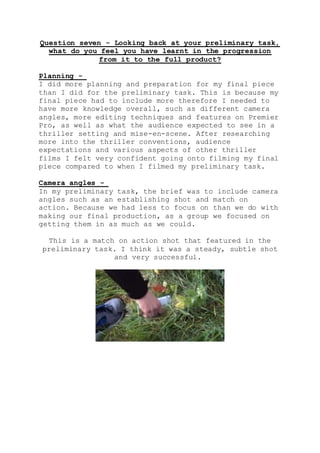
This is a match on action shot that featured in the
preliminary task. I think it was a steady, subtle shot
and very successful.
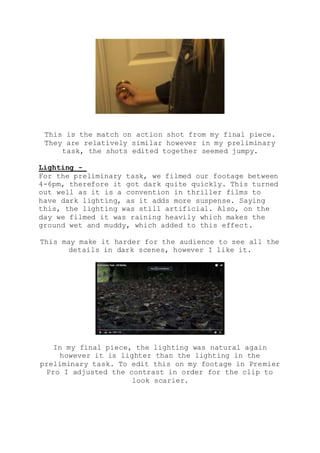
This is the match on action shot from my final piece.
They are relatively similar however in my preliminary
task, the shots edited together seemed jumpy.
Lighting -
For the preliminary task, we filmed our footage between
4-6pm, therefore it got dark quite quickly. This turned
out well as it is a convention in thriller films to
have dark lighting, as it adds more suspense. Saying
this, the lighting was still artificial. Also, on the
day we filmed it was raining heavily which makes the
ground wet and muddy, which added to this effect.
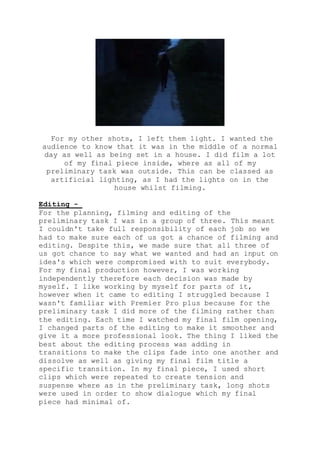
This may make it harder for the audience to see all the
details in dark scenes, however I like it.
In my final piece, the lighting was natural again
however it is lighter than the lighting in the
preliminary task. To edit this on my footage in Premier
Pro I adjusted the contrast in order for the clip to
look scarier.
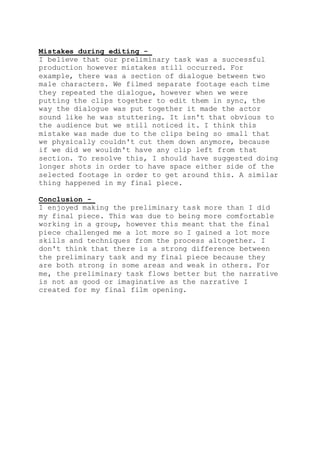
For my other shots, I left them light. I wanted the
audience to know that it was in the middle of a normal
day as well as being set in a house. I did film a lot
of my final piece inside, where as all of my
preliminary task was outside. This can be classed as
artificial lighting, as I had the lights on in the
house whilst filming.
Editing -
For the planning, filming and editing of the
preliminary task I was in a group of three. This meant
I couldn't take full responsibility of each job so we
had to make sure each of us got a chance of filming and
editing. Despite this, we made sure that all three of
us got chance to say what we wanted and had an input on
idea's which were compromised with to suit everybody.
For my final production however, I was working
independently therefore each decision was made by
myself. I like working by myself for parts of it,
however when it came to editing I struggled because I
wasn't familiar with Premier Pro plus because for the
preliminary task I did more of the filming rather than
the editing. Each time I watched my final film opening,
I changed parts of the editing to make it smoother and
give it a more professional look. The thing I liked the
best about the editing process was adding in
transitions to make the clips fade into one another and
dissolve as well as giving my final film title a
specific transition. In my final piece, I used short
clips which were repeated to create tension and
suspense where as in the preliminary task, long shots
were used in order to show dialogue which my final
piece had minimal of.
Mistakes during editing -
I believe that our preliminary task was a successful
production however mistakes still occurred. For
example, there was a section of dialogue between two
male characters. We filmed separate footage each time
they repeated the dialogue, however when we were
putting the clips together to edit them in sync, the
way the dialogue was put together it made the actor
sound like he was stuttering. It isn't that obvious to
the audience but we still noticed it. I think this
mistake was made due to the clips being so small that
we physically couldn't cut them down anymore, because
if we did we wouldn't have any clip left from that
section. To resolve this, I should have suggested doing
longer shots in order to have space either side of the
selected footage in order to get around this. A similar
thing happened in my final piece.
Conclusion -
I enjoyed making the preliminary task more than I did
my final piece. This was due to being more comfortable
working in a group, however this meant that the final
piece challenged me a lot more so I gained a lot more
skills and techniques from the process altogether. I
don't think that there is a strong difference between
the preliminary task and my final piece because they
are both strong in some areas and weak in others. For
me, the preliminary task flows better but the narrative
is not as good or imaginative as the narrative I
created for my final film opening.

Question seven

  • 1.
    Question seven -Looking back at your preliminary task, what do you feel you have learnt in the progression from it to the full product? Planning - I did more planning and preparation for my final piece than I did for the preliminary task. This is because my final piece had to include more therefore I needed to have more knowledge overall, such as different camera angles, more editing techniques and features on Premier Pro, as well as what the audience expected to see in a thriller setting and mise-en-scene. After researching more into the thriller conventions, audience expectations and various aspects of other thriller films I felt very confident going onto filming my final piece compared to when I filmed my preliminary task. Camera angles - In my preliminary task, the brief was to include camera angles such as an establishing shot and match on action. Because we had less to focus on than we do with making our final production, as a group we focused on getting them in as much as we could. This is a match on action shot that featured in the preliminary task. I think it was a steady, subtle shot and very successful.
  • 2.
    This is thematch on action shot from my final piece. They are relatively similar however in my preliminary task, the shots edited together seemed jumpy. Lighting - For the preliminary task, we filmed our footage between 4-6pm, therefore it got dark quite quickly. This turned out well as it is a convention in thriller films to have dark lighting, as it adds more suspense. Saying this, the lighting was still artificial. Also, on the day we filmed it was raining heavily which makes the ground wet and muddy, which added to this effect. This may make it harder for the audience to see all the details in dark scenes, however I like it. In my final piece, the lighting was natural again however it is lighter than the lighting in the preliminary task. To edit this on my footage in Premier Pro I adjusted the contrast in order for the clip to look scarier.
  • 3.
    For my othershots, I left them light. I wanted the audience to know that it was in the middle of a normal day as well as being set in a house. I did film a lot of my final piece inside, where as all of my preliminary task was outside. This can be classed as artificial lighting, as I had the lights on in the house whilst filming. Editing - For the planning, filming and editing of the preliminary task I was in a group of three. This meant I couldn't take full responsibility of each job so we had to make sure each of us got a chance of filming and editing. Despite this, we made sure that all three of us got chance to say what we wanted and had an input on idea's which were compromised with to suit everybody. For my final production however, I was working independently therefore each decision was made by myself. I like working by myself for parts of it, however when it came to editing I struggled because I wasn't familiar with Premier Pro plus because for the preliminary task I did more of the filming rather than the editing. Each time I watched my final film opening, I changed parts of the editing to make it smoother and give it a more professional look. The thing I liked the best about the editing process was adding in transitions to make the clips fade into one another and dissolve as well as giving my final film title a specific transition. In my final piece, I used short clips which were repeated to create tension and suspense where as in the preliminary task, long shots were used in order to show dialogue which my final piece had minimal of.
  • 4.
    Mistakes during editing- I believe that our preliminary task was a successful production however mistakes still occurred. For example, there was a section of dialogue between two male characters. We filmed separate footage each time they repeated the dialogue, however when we were putting the clips together to edit them in sync, the way the dialogue was put together it made the actor sound like he was stuttering. It isn't that obvious to the audience but we still noticed it. I think this mistake was made due to the clips being so small that we physically couldn't cut them down anymore, because if we did we wouldn't have any clip left from that section. To resolve this, I should have suggested doing longer shots in order to have space either side of the selected footage in order to get around this. A similar thing happened in my final piece. Conclusion - I enjoyed making the preliminary task more than I did my final piece. This was due to being more comfortable working in a group, however this meant that the final piece challenged me a lot more so I gained a lot more skills and techniques from the process altogether. I don't think that there is a strong difference between the preliminary task and my final piece because they are both strong in some areas and weak in others. For me, the preliminary task flows better but the narrative is not as good or imaginative as the narrative I created for my final film opening.