Final Evaluation For The
Opening Sequence
Noli Cavolli
Task
My group was set a task to create an
opening sequence in a particular film genre.
The sequence was to be a maximum of two
minutes.
What it is about
My group chose the genre of sports
drama, which is about a boy with a
talent for football, which has not been
discovered yet, and he works as a
mechanic in a garage. We chose the
title ‘Kick’ as this reflects what the
opening sequence is about.
Roles
During a group discussion we allocated
different roles to those. There were only
three of us so we each took responsibility for
several roles. My main role was as director,
cameraman and co-editor.
Conventions
To find out more about how we could make an
engaging opening sequence in this genre we
watched a number of opening sequence that
related to this. For example ‘Goal’ and ‘Soccer
Le Kids’. In ‘Goal’ the opening shots involved a
boy doing lots of football tricks in his bedroom,
which we thought we would apply to our
sequence. As our actor is a talented footballer
we chose a number of skills for him to perform
which we would film to create an effective
opening sequence of shots.
Research & Ideas
When we had done some research we made a
mind map of ideas with everything we needed
to cover such as: location, music, mise-en-
scene, shots and roles for each member of the
group. We then made a storyboard, which gave
us a clear idea of the sequence of shots we
needed rather than just randomly
experimenting with ideas. Very little Dialogue
was in the opening sequence. This is because
we wanted to tell the story visually with a
soundtrack.
Ideas
Storyboard One
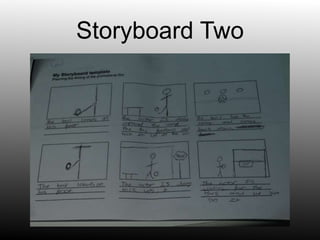
Storyboard Two
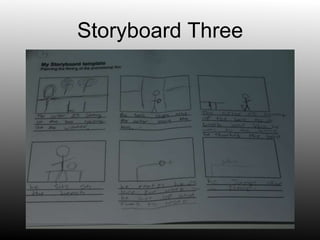
Storyboard Three
Storyboard Four
Locations
When we had all agreed on the structure for the
opening sequence we then started to look for a
perfect location and start filming. As our
character is a garage mechanic we wanted to
choose an appropriate location, which would
reflect his working-class background. One idea
was to have him walking to work through a park
but we didn’t think this would give the urban
feel that we needed. We therefore chose to film
him at a bus stop, which we all felt worked
really well.
Trying Out Different Shots/One
As we started filming at the bus stop all the shots are very close-
up and rough and focused on the ball and footwork. When the
bus arrives we do a whole shot of his face and therefore delay
revealing who this character is. We want the audience to be
impressed by his talented football skills and assume that he is a
professional footballer. When the camera reveals his face and
clothes they see that this is in fact an ordinary young man
waiting at a bus stop.
Trying Out Different Shots/Two
As he waits for the bus we have the actor performing kick-ups
and as soon as he sees the bus he catches the ball underneath
his jumper in a very slick move. While we were filming two
elderly ladies were also at the bus stop so this was a perfect
chance to include them in the shot. Our actor moves away from
the door and invites them to go first with a gesture and a
welcoming smile. This was entirely improvised and we feel it
gives the sequence more character and introduces some
humour to the piece.
Trying Out Different
Shots/Three
When I was satisfied with the result of the bus scene,
before leaving the bus I wanted a scenes of the actor
leaving the bus. I went where the exit of the bus was and
we got prepared for the final scenes. When we watch
over the footage we came to conclusion that everything
was flawless however for the final shot of the actor
leaving the bus was to fast. We started to fix the problem
in Premier Pro by slowing down the footage. It took a
wile to fix it but at the end it works out really well.
Trying Out Different Shots/Four
Once the actor left the bus, we carried on with the next
scene. This involved him doing kick-ups towards a
bench. Once he sat down, we thought it would be
effective to set the camera behind the actor. In a different
frame, we displayed the actor approaching the bench
and sitting down. I was concerned that our different angle
shots were becoming repetitive, so I came up with a
different idea. In order for the audience to really see the
film from the protagonist’s perspective, we filmed the
shot from a first person viewpoint.
Trying Out Different Shots/Five
We wanted to get a shot where the actor is grabbing his overalls,
however when shooting this we went back to the footage and we notes
that the footage was to short and fast. As we have fixed this kind of
problem once we knew what we had to do, which it to slow down the
time. By accident we slowed the time a lot and we actually liked it. We
decided to keep the timing as how we left it and I think that this has to
be my favrot scene.
Trying Out Different Shots/Six
We wanted the audience to be intrigued by what the
actor was cleaning, and what he does for a living.
Therefore, we recording a short close-up shot of the
actor’s hand. After a few seconds we continued with
a medium shot. This scene was important for the
audience to understand the piece and the character.
Showing the actor working suggests that he is
wasting his talent.
Trying out Different
Shots/Seven
As this was the ending scene we wanted to end it in a way that
will make the audience feel that the actors dreams has been
smashed. So we came up with the idea that the camera would
be stetted up towards the bins and the actors boss walking away
from the camera and towards the bins. Then there is a clos up
shot of the bin and the actors boss throwing the ball in the bin.
Which by then the music ends with the ball going in the bin. I
think that this set up work really well and how this lets the
audience to think of what will happen next to the actor if he will
stay working as a garage cleaner or a football star.
Equipment
As the cameraman it was clear that I had to use a
DLSR camera (ESO600D Canon) to produce a
better quality of film and also it would mount onto a
tripod. All the filming took place using the tripod
apart from filming in the bus, which was difficult to
use because of the cramped space. I therefore
decided to make it hand-held and I am pleased with
the quality of the result.
Feedback
After looking at more opening title sequences of sport
films such as Goal, and talking to our audience, we
thought our original idea would not engage the audience
enough and it would give too much away for an opening
title sequence. We have rethought our idea where there
will be lots of shorts close ups of the boy doing lots of
different football skills, not giving his identity away. This
creates enigma and will make the audience want to carry
on watching the film.
Conclusion
All in all, I personally believe our opening sequence has
stuck to the conventions of the sports genre and the
drama genre. Also we have followed the opening
sequence convention and that I fell that I can speak for
my grope that we are really impressive with our
opening sequence and it has been a grate making it
The Final Opening Sequence

Evaluation Q4

  • 1.
    Final Evaluation ForThe Opening Sequence Noli Cavolli
  • 2.
    Task My group wasset a task to create an opening sequence in a particular film genre. The sequence was to be a maximum of two minutes.
  • 3.
    What it isabout My group chose the genre of sports drama, which is about a boy with a talent for football, which has not been discovered yet, and he works as a mechanic in a garage. We chose the title ‘Kick’ as this reflects what the opening sequence is about.
  • 4.
    Roles During a groupdiscussion we allocated different roles to those. There were only three of us so we each took responsibility for several roles. My main role was as director, cameraman and co-editor.
  • 5.
    Conventions To find outmore about how we could make an engaging opening sequence in this genre we watched a number of opening sequence that related to this. For example ‘Goal’ and ‘Soccer Le Kids’. In ‘Goal’ the opening shots involved a boy doing lots of football tricks in his bedroom, which we thought we would apply to our sequence. As our actor is a talented footballer we chose a number of skills for him to perform which we would film to create an effective opening sequence of shots.
  • 6.
    Research & Ideas Whenwe had done some research we made a mind map of ideas with everything we needed to cover such as: location, music, mise-en- scene, shots and roles for each member of the group. We then made a storyboard, which gave us a clear idea of the sequence of shots we needed rather than just randomly experimenting with ideas. Very little Dialogue was in the opening sequence. This is because we wanted to tell the story visually with a soundtrack.
  • 7.
  • 8.
  • 9.
  • 10.
  • 11.
  • 12.
    Locations When we hadall agreed on the structure for the opening sequence we then started to look for a perfect location and start filming. As our character is a garage mechanic we wanted to choose an appropriate location, which would reflect his working-class background. One idea was to have him walking to work through a park but we didn’t think this would give the urban feel that we needed. We therefore chose to film him at a bus stop, which we all felt worked really well.
  • 13.
    Trying Out DifferentShots/One As we started filming at the bus stop all the shots are very close- up and rough and focused on the ball and footwork. When the bus arrives we do a whole shot of his face and therefore delay revealing who this character is. We want the audience to be impressed by his talented football skills and assume that he is a professional footballer. When the camera reveals his face and clothes they see that this is in fact an ordinary young man waiting at a bus stop.
  • 14.
    Trying Out DifferentShots/Two As he waits for the bus we have the actor performing kick-ups and as soon as he sees the bus he catches the ball underneath his jumper in a very slick move. While we were filming two elderly ladies were also at the bus stop so this was a perfect chance to include them in the shot. Our actor moves away from the door and invites them to go first with a gesture and a welcoming smile. This was entirely improvised and we feel it gives the sequence more character and introduces some humour to the piece.
  • 15.
    Trying Out Different Shots/Three WhenI was satisfied with the result of the bus scene, before leaving the bus I wanted a scenes of the actor leaving the bus. I went where the exit of the bus was and we got prepared for the final scenes. When we watch over the footage we came to conclusion that everything was flawless however for the final shot of the actor leaving the bus was to fast. We started to fix the problem in Premier Pro by slowing down the footage. It took a wile to fix it but at the end it works out really well.
  • 16.
    Trying Out DifferentShots/Four Once the actor left the bus, we carried on with the next scene. This involved him doing kick-ups towards a bench. Once he sat down, we thought it would be effective to set the camera behind the actor. In a different frame, we displayed the actor approaching the bench and sitting down. I was concerned that our different angle shots were becoming repetitive, so I came up with a different idea. In order for the audience to really see the film from the protagonist’s perspective, we filmed the shot from a first person viewpoint.
  • 17.
    Trying Out DifferentShots/Five We wanted to get a shot where the actor is grabbing his overalls, however when shooting this we went back to the footage and we notes that the footage was to short and fast. As we have fixed this kind of problem once we knew what we had to do, which it to slow down the time. By accident we slowed the time a lot and we actually liked it. We decided to keep the timing as how we left it and I think that this has to be my favrot scene.
  • 18.
    Trying Out DifferentShots/Six We wanted the audience to be intrigued by what the actor was cleaning, and what he does for a living. Therefore, we recording a short close-up shot of the actor’s hand. After a few seconds we continued with a medium shot. This scene was important for the audience to understand the piece and the character. Showing the actor working suggests that he is wasting his talent.
  • 19.
    Trying out Different Shots/Seven Asthis was the ending scene we wanted to end it in a way that will make the audience feel that the actors dreams has been smashed. So we came up with the idea that the camera would be stetted up towards the bins and the actors boss walking away from the camera and towards the bins. Then there is a clos up shot of the bin and the actors boss throwing the ball in the bin. Which by then the music ends with the ball going in the bin. I think that this set up work really well and how this lets the audience to think of what will happen next to the actor if he will stay working as a garage cleaner or a football star.
  • 20.
    Equipment As the cameramanit was clear that I had to use a DLSR camera (ESO600D Canon) to produce a better quality of film and also it would mount onto a tripod. All the filming took place using the tripod apart from filming in the bus, which was difficult to use because of the cramped space. I therefore decided to make it hand-held and I am pleased with the quality of the result.
  • 21.
    Feedback After looking atmore opening title sequences of sport films such as Goal, and talking to our audience, we thought our original idea would not engage the audience enough and it would give too much away for an opening title sequence. We have rethought our idea where there will be lots of shorts close ups of the boy doing lots of different football skills, not giving his identity away. This creates enigma and will make the audience want to carry on watching the film.
  • 22.
    Conclusion All in all,I personally believe our opening sequence has stuck to the conventions of the sports genre and the drama genre. Also we have followed the opening sequence convention and that I fell that I can speak for my grope that we are really impressive with our opening sequence and it has been a grate making it
  • 23.