Question 3 What kind of media institution might distribute your media product and why?
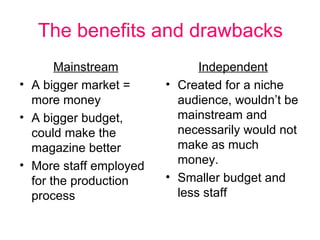
Magazines are nearly always produced in order to attract audiences for advertisers to increase revenue.  I generally think publishers have a say in what magazines they publish and whether they like or agree with the content and style of the magazine. However, some are just in it for the money and don’t care what’s in the magazine as long as its something that will sell plenty of copies.
Who does publish most magazines? There is a bit of difference between major and independent distribution strategies of magazines in the UK.  Major companies like Frontline are definitely more mainstream by selling and distributing loads of its partner’s titles. Frontlines partners are BBC, Bauer and Haymarket and they sell and distribute their magazines for them.  These magazines (or products) will be things like Heat and TV Quick.  The independent distribution is a lot different where as their strategy is selling to a few specialists’ shops rather than a supermarket chain and a few people working in an office than a larger corporation.
Core messages of the magazine My magazine has a message that classical music doesn’t have to be completely out of reach for young people and its not that geeky – its slowly merging itself into the mainstream market. The fact that magazines like Classic FM are produced to appeal to a niche audience shows that maybe the messages of these magazines are wrong – they should not be so segmented and be made more widely appealing to different people.
Independent publishing I think it would be extremely hard for me to be able to make Crescendo successful without a mainstream publisher, it just wouldn’t make any money whatsoever. However, some magazines do extremely well with an independent publisher, not matter how controversial its content might be, it’s the niche audience – whether its big enough and whether the content is what they want.
The benefits and drawbacks Mainstream A bigger market = more money A bigger budget, could make the magazine better More staff employed for the production process Independent Created for a niche audience, wouldn’t be mainstream and necessarily would not make as much money. Smaller budget and less staff
However… With an independent publisher, you would have more creative freedom for the content of your magazine and personally, I think that would swing me towards independent publishing.
Multi-platform consumption I feel that my magazine would do well on both the printed magazine and if I had a website because then my audience, being younger people, would be more inclined to visit my magazine’s website knowing about the different functions I would have like for example audio clips.  It’s a music magazine so it would really work to have audio clips of new artists on the website, so the readers can also experience classical music rather than just read about it

Question 3 Evaluation

  • 1.
    Question 3 Whatkind of media institution might distribute your media product and why?
  • 2.
    Magazines are nearlyalways produced in order to attract audiences for advertisers to increase revenue. I generally think publishers have a say in what magazines they publish and whether they like or agree with the content and style of the magazine. However, some are just in it for the money and don’t care what’s in the magazine as long as its something that will sell plenty of copies.
  • 3.
    Who does publishmost magazines? There is a bit of difference between major and independent distribution strategies of magazines in the UK. Major companies like Frontline are definitely more mainstream by selling and distributing loads of its partner’s titles. Frontlines partners are BBC, Bauer and Haymarket and they sell and distribute their magazines for them. These magazines (or products) will be things like Heat and TV Quick. The independent distribution is a lot different where as their strategy is selling to a few specialists’ shops rather than a supermarket chain and a few people working in an office than a larger corporation.
  • 4.
    Core messages ofthe magazine My magazine has a message that classical music doesn’t have to be completely out of reach for young people and its not that geeky – its slowly merging itself into the mainstream market. The fact that magazines like Classic FM are produced to appeal to a niche audience shows that maybe the messages of these magazines are wrong – they should not be so segmented and be made more widely appealing to different people.
  • 5.
    Independent publishing Ithink it would be extremely hard for me to be able to make Crescendo successful without a mainstream publisher, it just wouldn’t make any money whatsoever. However, some magazines do extremely well with an independent publisher, not matter how controversial its content might be, it’s the niche audience – whether its big enough and whether the content is what they want.
  • 6.
    The benefits anddrawbacks Mainstream A bigger market = more money A bigger budget, could make the magazine better More staff employed for the production process Independent Created for a niche audience, wouldn’t be mainstream and necessarily would not make as much money. Smaller budget and less staff
  • 7.
    However… With anindependent publisher, you would have more creative freedom for the content of your magazine and personally, I think that would swing me towards independent publishing.
  • 8.
    Multi-platform consumption Ifeel that my magazine would do well on both the printed magazine and if I had a website because then my audience, being younger people, would be more inclined to visit my magazine’s website knowing about the different functions I would have like for example audio clips. It’s a music magazine so it would really work to have audio clips of new artists on the website, so the readers can also experience classical music rather than just read about it