WHAT ARE LITERARYDEVICES?
Literary devices are ways of taking writing beyond its
straightforward, literal meaning. They help guide the reader
in how to read the piece.
METAPHOR
A metaphor isa statement in which two
objects, often unrelated, are compared to
each other.
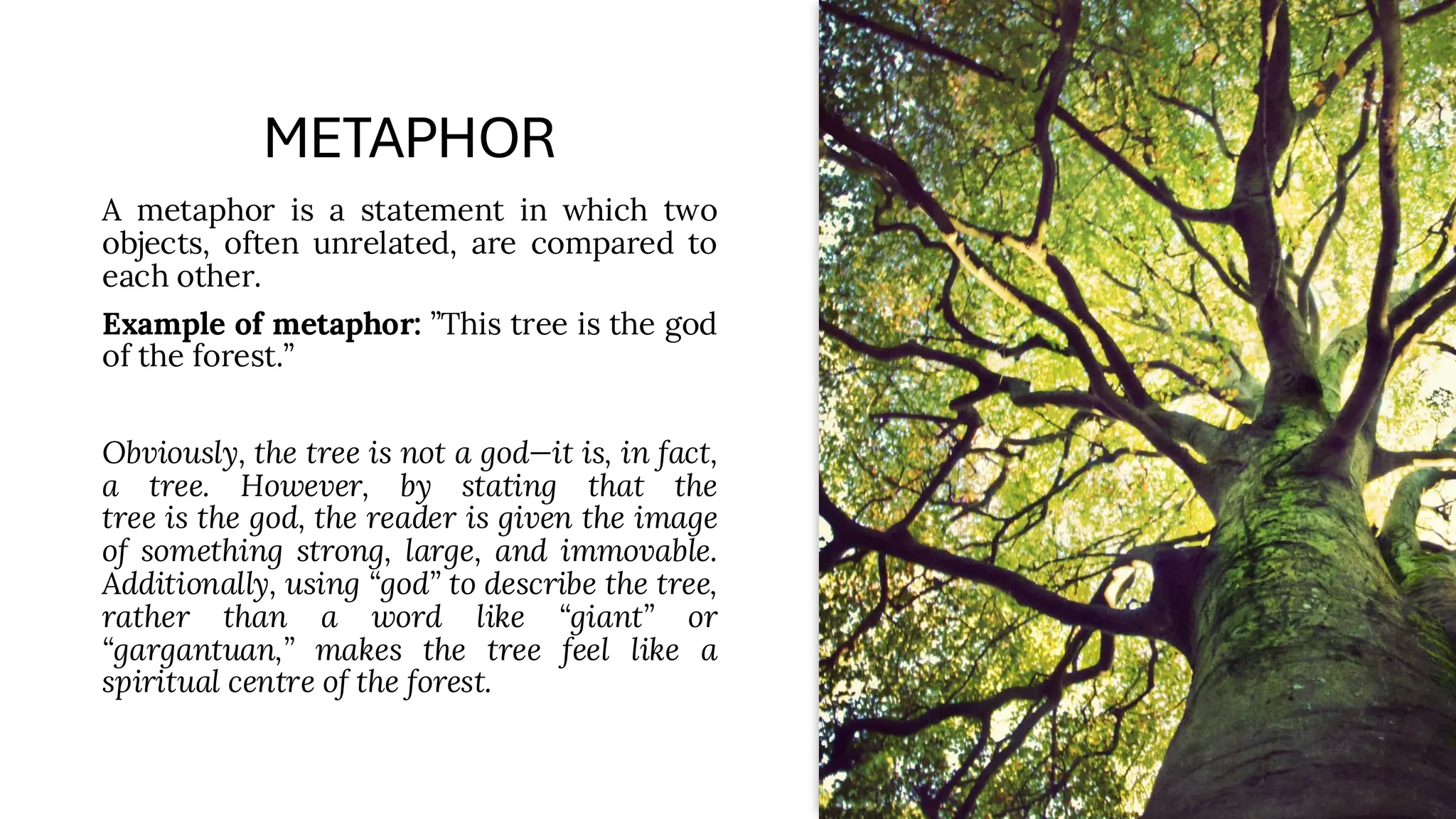
Example of metaphor: ”This tree is the god
of the forest.”
Obviously, the tree is not a god—it is, in fact,
a tree. However, by stating that the
tree is the god, the reader is given the image
of something strong, large, and immovable.
Additionally, using “god” to describe the tree,
rather than a word like “giant” or
“gargantuan,” makes the tree feel like a
spiritual centre of the forest.
5.
METAPHOR
Metaphors allow thewriter to pack multiple descriptions
and images into one short sentence. The metaphor has
much more weight and value than a direct description. If
the writer chose to describe the tree as “the large,
spiritual centre of the forest,” the reader won’t
understand the full importance of the tree’s size and
scope.
6.
METAPHOR
• The grandfather’sclock is king of the family room furniture.
• The grandfather’s clock became a death knell for her childhood.
• The grandfather’s clock had the face of an estranged lover.
Let’s address what each of these metaphors accomplish. The first metaphor
shows us the clock’s size and importance; the second metaphor shows us
the clock’s ominous presence, focusing on its sound; the third metaphor
treats the clock as forlorn and solitary.
7.
METAPHOR
• Metaphors relyon the suspension of disbelief—in other
words, the reader knows they’re being lied to but
accepts it anyway.
• Metaphors can be imaginative—magical, even!—but they
must be relevant.
• The metaphor is much more “complete” than the simile.
8.
METAPHOR
Use of metaphors:
•As verbs: ”The song ignited his lust but snuffed out her interest.”
• As adjectives and adverbs: ”Her carnivorous brush ate up the
canvas.”
• As prepositional phrases: ”The old man considered the scene with
a blue-white vulture’s eye.”
• As appositives or modifiers: ”On the stairs he stood, a gawking
scarecrow.”
9.
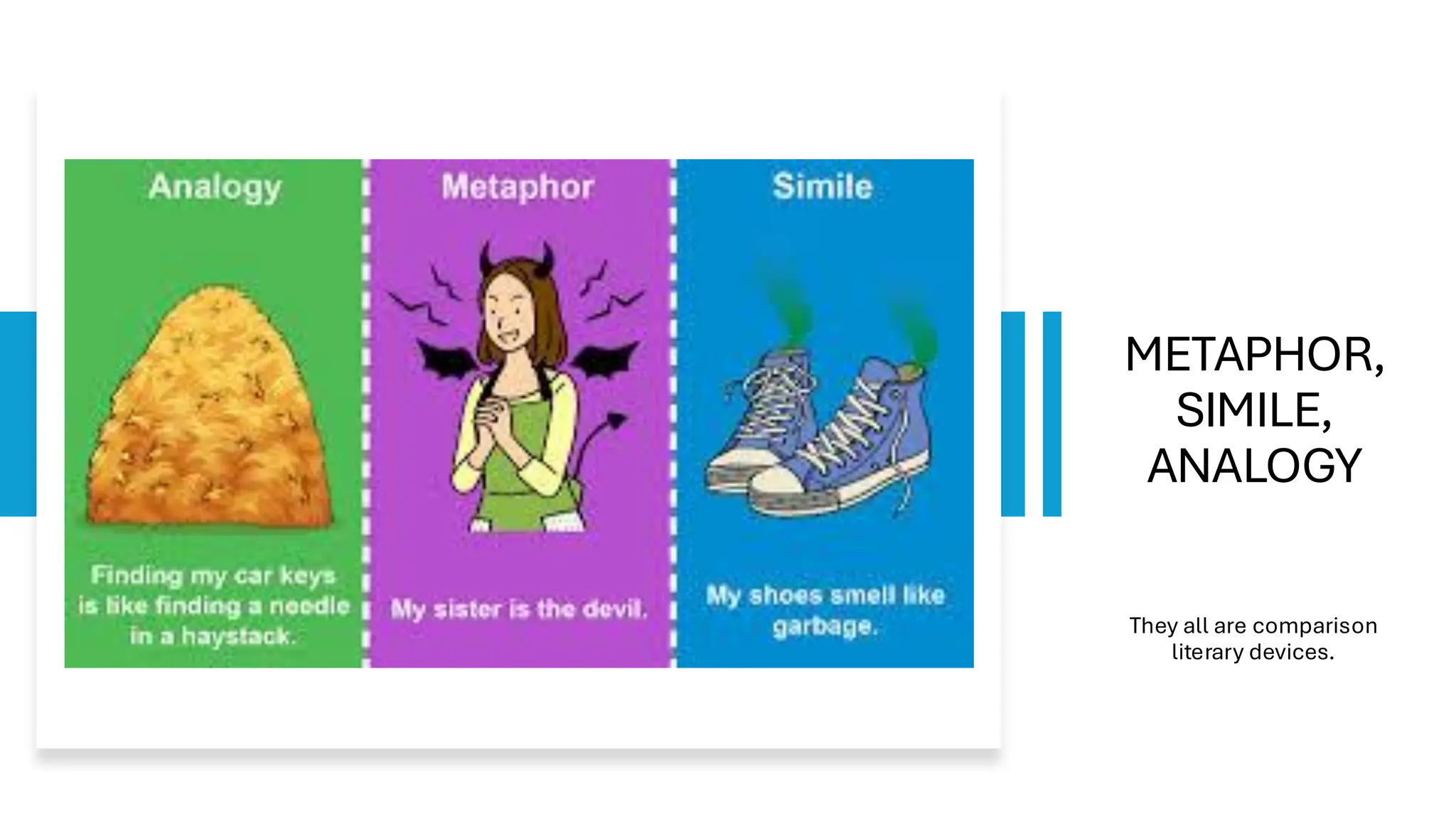
SIMILE
Similes, also knownas indirect comparisons, are similar in
construction to metaphors, but they imply a different meaning.
Like metaphors, two unrelated objects are being compared to
each other. Unlike a metaphor, the comparison relies on the
words “like” or “as”, or another comparative preposition.
Example of simile: ”This tree is like the god of the forest.”
OR: “This tree acts as the god of the forest.”
10.
SIMILE
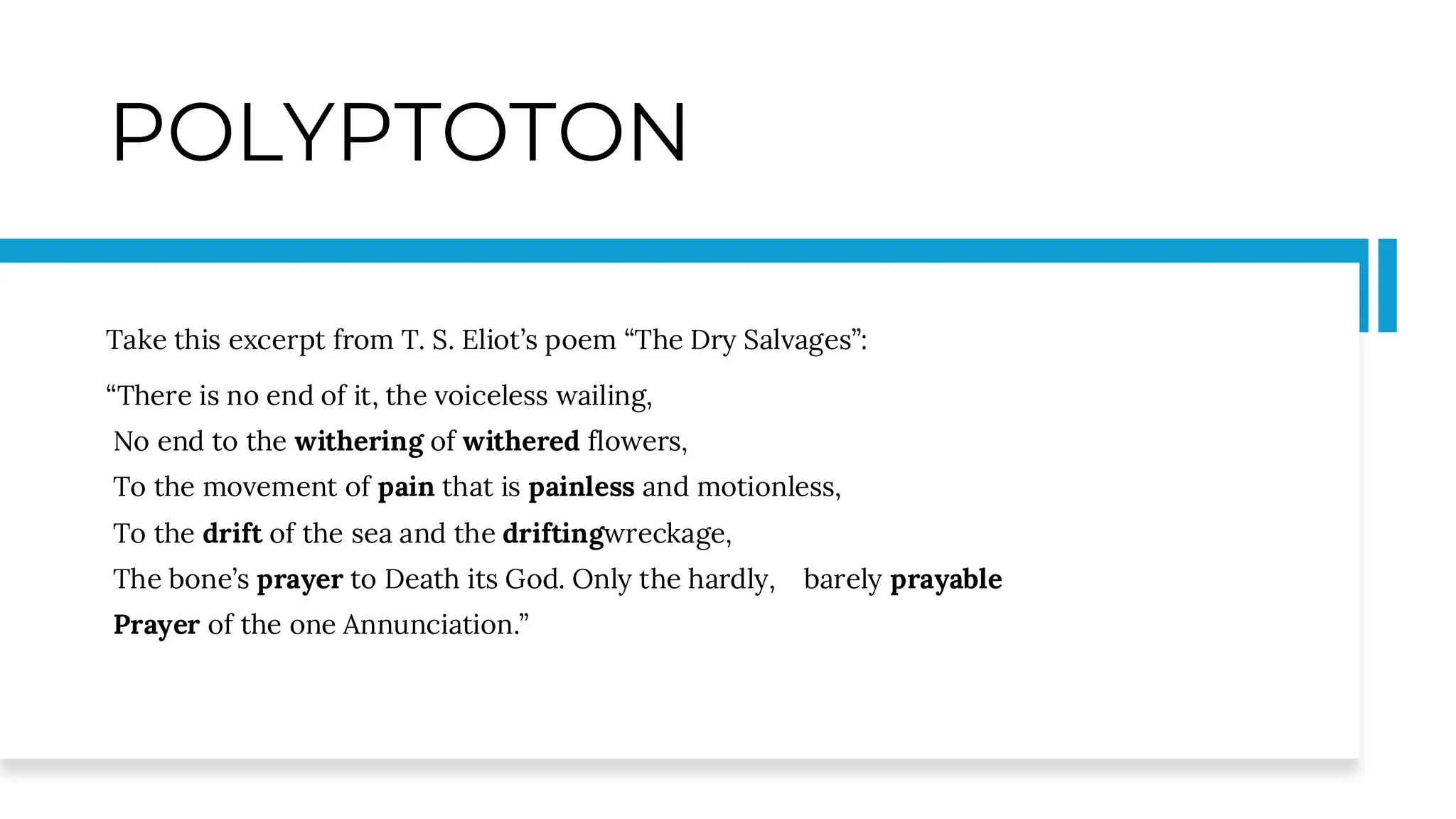
• My catis as loud as Yankee Stadium.
• My cat is soft and fluffy, like a teddy bear.
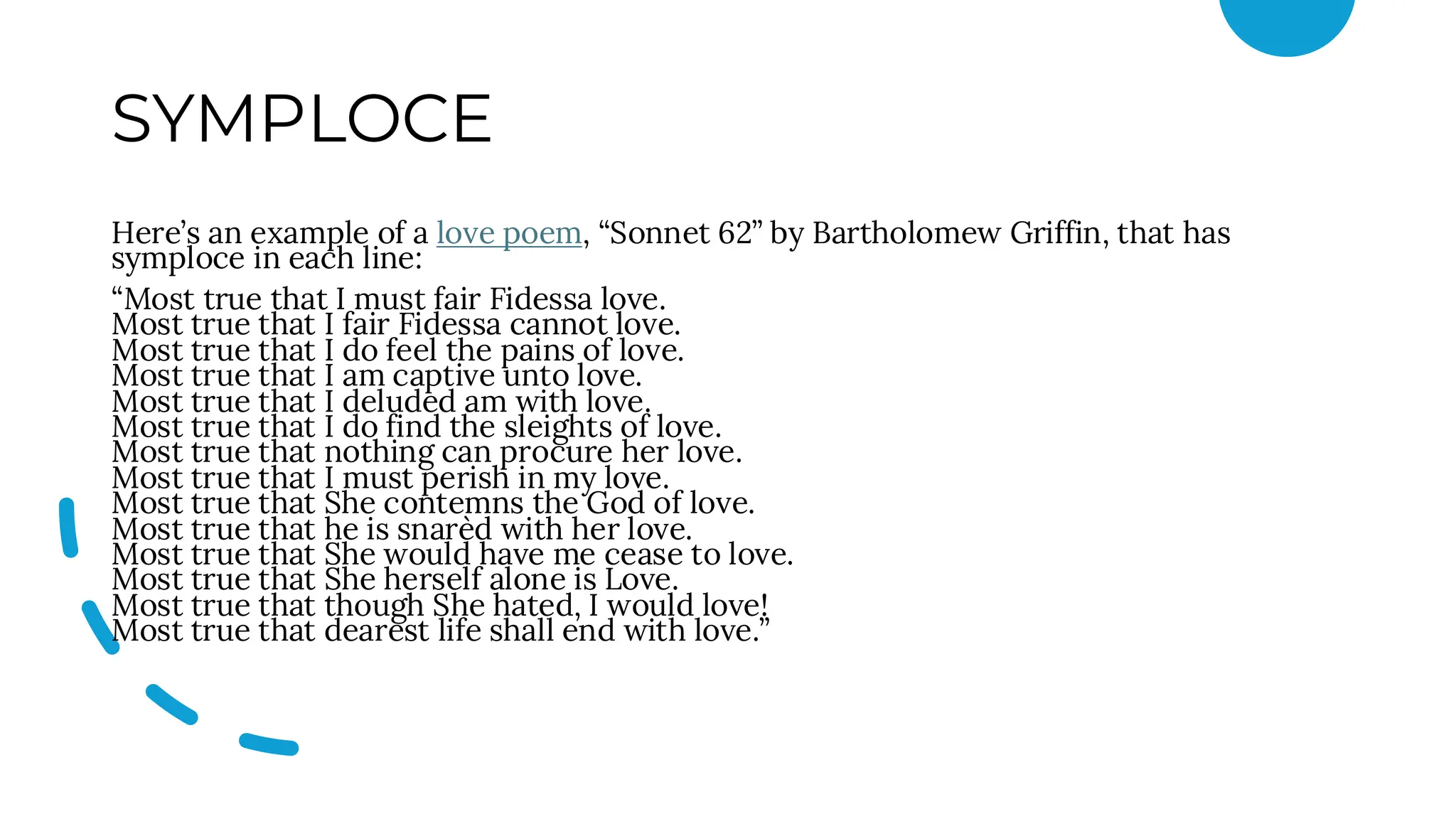
• My cat destroys furniture the way bulldozers destroy
buildings.
These similes offer very different descriptions yet coexist
quite peacefully in my cat—who is, in fact, loud and soft
and destructive.
11.
WHAT IS THEDIFFERENCE BETWEEN A SIMILE AND A METAPHOR?
The obvious difference between these two common literary devices
is that a simile uses “like” or “as,” whereas a metaphor never uses
these comparison words.
12.
ANALOGY
An analogy isan argumentative comparison: it compares two unalike
things to advance an argument. Specifically, it argues that two things have
equal weight, whether that weight be emotional, philosophical, or even
literal. Because analogical literary devices operate on comparison, it can
be considered a form of metaphor.
For example:
• “Making pasta is as easy as one, two, three.”
• “Gordon Ramsay is to cooking as Meryl Streep is to acting.”
13.
ANALOGY
An analogy hastwo purposes:
• The identification of a shared relationship.
• The use of something familiar to describe something
unfamiliar.
14.
ANALOGY
In other formsof creative writing, analogies aren’t as formulaic but
can still prove to be powerful literary devices. In fact, you probably
know this one:
“That which we call a rose / By any other name would smell as
sweet” —Romeo & Juliet by William Shakespeare
To put this into the modern language of an analogy, Shakespeare is
saying “a rose with no name smells as a rose with a name does.” The
name “rose” does not affect whether or not the flower smells good.
15.
ANALOGY
• Finding anew species of fish is like finding a needle in a
haystack.
• “That which we call a rose / By any other name would
smell as sweet” —Romeo and Juliet by William
Shakespeare
• As cold water is to a thirsty soul,
So is good news from a far country.
—Proverbs 25:25
16.
SIMILE VS. METAPHORVS. ANALOGY
Metaphor: Time is a thief.
Simile: Time is like a thief.
Analogy: Time is like a thief in that thieves steal physical objects and time
steals moments of our lives.
Metaphor: Joe is a pig.
Simile: Joe is as dirty as a pig.
Analogy: Joe's sense of personal hygiene is on the same level as a pig that
rolls around in dirt and mud all day.
17.
IMAGERY
• Imagery canbe both literal and
figurative, and it relies on the interplay
of language and sensation to create a
sharper image in your brain.
• Imagery is what it sounds like—the use
of figurative language to describe
something. In fact, we’ve already seen
imagery in action through the previous
literary devices: by describing the tree
as a “god”, the tree looks large and
sturdy in the reader’s mind.
18.
IMAGERY
• Imagery doesn’tjust involve visual
descriptions; the best writers use
imagery to appeal to all five
senses. By appealing to the
reader’s sense of sight, sound,
touch, taste, and smell, writing
will create a vibrant world for
readers to live and breathe in.
19.
IMAGERY
Sight imagery: Thetree spread its
gigantic, sun-flecked shoulders.
Sound imagery: The forest was
hushed, resounding with echoes of
the tree’s stoic silence.
Touch imagery: The tree felt
smooth as sandstone.
Taste imagery: The tree’s leaves
tasted bitter, like unroasted coffee
beans.
Smell imagery: As we approached
the tree, the air around it smelled
crisp and precise.
20.
IMAGERY
There are twoother, less discussed types of imagery:
organic and kinesthetic imagery. Organic imagery refers
to descriptions of internal sensations—things happening
within the body. Kinesthetic imagery is imagery of motion
and movement—think of the sensations one might feel
when running against the wind.
21.
IMAGERY
Organic imagery: Thetree felt its xylem collapse at the
news. (This is also an example of personification, since
trees can’t “feel” the way people feel.)
Kinesthetic imagery: The tree cooled down as its own
leaves rushed against its bark.
22.
SYMBOLISM
• Symbolism combinesa lot of the ideas presented in
metaphor and imagery. Essentially, a symbol is the use of
an object to represent a concept—it’s kind of like a
metaphor, except more concise!
• Symbols are everywhere in the English language, and we
often use these common literary devices in speech and
design without realizing it.
23.
SYMBOLISM
A few verycommonly used symbols
include:
• “Peace” represented by a white dove.
• “Love” represented by a red rose.
• “Conformity” represented by sheep.
• “Idea” represented by a light bulb
switching on.
24.
PERSONIFICATION
• Personification, givinghuman
attributes to nonhuman objects, is a
powerful way to foster empathy in
your readers.
• Think about personification as if it’s a
specific type of imagery. You can
describe a nonhuman object through
the five senses, and do so by giving it
human descriptions. You can even
impute thoughts and emotions—
mental events—to a nonhuman or even
nonliving thing.
25.
PERSONIFICATION
• Personification (usingsight): The car ran
a marathon down the highway.
• Personification (using sound): The car
coughed, hacked, and spluttered.
• Personification (using touch): The car
was smooth as a baby’s bottom.
• Personification (using taste): The car
tasted the bitter asphalt.
• Personification (using smell): The car
needed a cold shower.
• Personification (using mental
events):The car remembered its first
owner fondly.
26.
HYPERBOLE
Hyperbole refers toany sort of
exaggerated description or statement. We
use hyperbole all the time in the English
language, and you’ve probably heard
someone say things like:
• “I’ve been waiting a billion years for this.”
• “I’m so hungry I could eat a horse.”
• “I feel like a million bucks.”
• “You are the king of the kitchen.”
27.
HYPERBOLE
None of theexamples mentioned above
should be interpreted literally: there are
no kings in the kitchen, and I doubt
anyone can eat an entire horse in one
sitting. This common literary device allows
us to compare our emotions to something
extreme, giving the reader a sense of how
intensely we feel something in the
moment.
28.
IRONY
• Irony iswhen the writer describes
something by using opposite language.
As a real-life example, if someone is
having a bad day, they might say they’re
doing “greaaaaaat”, clearly implying that
they’re actually doing quite un-greatly.
Or a story’s narrator might write:
“Like most bureaucrats, she felt a
boundless love for her job, and was eager
to share that good feeling with others.”
29.
IRONY
In other words,irony highlights the difference between “what seems to
be” and “what is.”
In literature, irony can describe dialogue, but it also describes
ironic situations: situations that proceed in ways that are elaborately
contrary to what one would expect.
A clear example of this is in The Wizard of Oz. All of the characters
already have what they are looking for, so when they go to the wizard
and discover that they all have brains, hearts, etc., their petition—making
a long, dangerous journey to beg for what they already have—is deeply
ironic.
30.
JUXTAPOSITION
Juxtaposition refers tothe
placement of contrasting ideas next
to each other, often to produce an
ironic or thought-provoking effect.
Writers use juxtaposition in both
poetry and prose, though this
common literary device looks
slightly different within each realm
of literature.
31.
JUXTAPOSITION
A famous examplecomes from the
opening A Tale of Two Cities by
Charles Dickens:
“It was the best of times, it was the
worst of time.”
Dickens opens his novel by situating
his characters into a world of
contrasts, which is apt for the
extreme wealth disparities pre-
French Revolution.
32.
PARADOX
A paradox isa juxtaposition of contrasting ideas that, while
seemingly impossible, actually reveals a deeper truth. One of
the trickier literary devices, paradoxes are powerful tools for
deconstructing binaries and challenging the reader’s beliefs.
A simple paradox example comes to us from Ancient Rome:
Catullus 85 (translated from Latin)
“I hate and I love. Why I do this, perhaps you ask.
I know not, but I feel it happening and I am tortured.”
33.
PARADOX
Often, “hate” and“love” are assumed to be opposing forces.
How is it possible for the speaker to both hate and love the
object of his affection? The poem doesn’t answer this, merely
telling us that the speaker is “tortured,” but the fact that these
binary forces coexist in the speaker is a powerful paradox.
Catullus 85 asks the reader to consider the absoluteness of
feelings like hate and love, since both seem to torment the
speaker equally.
34.
PARADOX
Another paradox examplecomes from Oscar Wilde’s The
Importance of Being Earnest.
“To be natural is such a very difficult pose to keep up.”
Here, “natural” and “pose” are conflicting ideas. Someone who
poses assumes an unnatural state of being, whereas a natural
pose seems effortless and innate. Despite these contrasting
ideas, Wilde is exposing a deeper truth: to seem natural is
often to keep up appearances, and seeming natural often
requires the same work as assuming any other pose.
35.
ALLUSION
Allusion is justa fancy word for a literary reference; when a
writer alludes to something, they are either directly or
indirectly referring to another, commonly-known piece of art
or literature.
The most frequently-alluded to work is probably the Bible.
Many colloquial phrases and ideas stem from it, since many
themes and images from the Bible present themselves in
popular works, as well as throughout Western culture.
36.
ALLUSION
Any of thefollowing ideas, for example, are Biblical allusions:
• Referring to a kind stranger as a Good Samaritan.
• Describing an ideal place as Edenic, or the Garden of Eden.
• Saying someone “turned the other cheek” when they were
passive in the face of adversity.
• When something is described as lasting “40 days and 40
nights,” in reference to the flood of Noah’s Ark.
37.
ALLUSION
• Of course,allusion literary devices aren’t just Biblical. You might
describe a woman as being as beautiful as the Mona Lisa, or you
might call a man as stoic as Hemingway.
• Allusions appeal to common experiences: they are metaphors in
their own right, as we understand what it means to describe an
ideal place as Edenic.
• Like the other common literary devices, allusions are often
metaphors, images, and/or hyperboles. And, like other literary
devices, allusions also have their own sub-categories.
38.
ALLEGORY
An allegory isa story whose sole purpose is to represent an abstract
concept or idea. As such, allegories are sometimes extended
allusions, but the two common literary devices have their
differences.
39.
ALLEGORY
For example, GeorgeOrwell’s Animal Farm is an allegory for the
deterioration of Communism during the early establishment of the
U.S.S.R. The farm was founded on a shared goal of overthrowing the
farming elite and establishing an equitable society, but this society
soon declines. Animal Farm mirrors the Bolshevik Revolution, the
overthrow of the Russian aristocracy, Lenin’s death, Stalin’s
execution of Trotsky, and the nation’s dissolution into an amoral,
authoritarian police state. Thus, Animal Farm is an allegory/allusion
to the U.S.S.R.
40.
EKPHRASIS
Ekphrasis refers toa poem or story that is directly inspired by
another piece of art. Ekphrastic literature often describes another
piece of art.
Ekphrasis can be considered a direct allusion because it borrows
language and images from other artwork.
41.
ONOMATOPOEIA
An onomatopoeia isa word that
sounds like the noise it describes.
Conveying both a playfulness of
language and a serious
representation of everyday
sounds, onomatopoeias draw the
reader into the sensations of the
story itself.
42.
ONOMATOPOEIA
Onomatopoeia words aremost often used in poetry and in comic
books, though they certainly show up in works of prose as well.
Some onomatopoeias can be found in the dictionary, such as
“murmur,” “gargle,” and “rumble,” “click,” and “vroom.” However,
writers make up onomatopoeia words all the time, so while the word
“ptoo” definitely sounds like a person spitting, you won’t find it in
Merriam Webster’s.
43.
ONOMATOPOEIA
Here’s an onomatopoeiaexample, from the poem “Honky Tonk in
Cleveland, Ohio” by Carl Sandburg.
“It’s a jazz affair, drum crashes and cornet razzes.
The trombone pony neighs and the tuba jackass snorts.
The banjo tickles and titters too awful.
The chippies talk about the funnies in the papers.
The cartoonists weep in their beer.”
44.
PUN
• A punis a literary device that plays with the sounds and meanings of
words to produce new, often humorous ideas. For example, let’s say
you used too much butter in your recipe, and it ruined the dish. You
might joke that you were “outside the margarine of error,” which is a
play on the words “margin of error.”
• Puns have a rich literary history, and famous writers like
Shakespeare and Charles Dickens, as well as famous texts like The
Bible, have used puns to add depth and gravity to their words.
ANADIPLOSIS
• Anadiplosis iswhen a word or phrase is repeated in successive
clauses. Usually, the phrase shows up at the end of one clause and
the beginning of the next.
• You’ll find anadiplosis often in classic literature, and this device is
especially prevalent in the Bible.
Take this excerpt from the Book of Genesis (1:1-2):
“In the beginning God created the heaven and the earth. And the
earth was without form, and void.”
47.
ANAPHORA
For the mostpart, anaphora is an example of repetition in poetry. This
device involves the repeated use of a word or phrase at the beginning of
each line in a poem, or each sentence in prose.
• In prose, consider this sentence from the novel Farewell, My Lovely by
Raymond Chandler:
“I needed a drink, I needed a lot of life insurance, I needed a vacation, I
needed a home in the country. What I had was a coat, a hat, and a gun.”
48.
ANTANACLASIS
One word canhave many different meanings, especially in the
English language. Did you know that the word “set” has 430
different usages described in the Oxford English Dictionary?
Antanaclasis harnesses this facet of language so that each
repetition of words has a different meaning.
49.
ANTANACLASIS
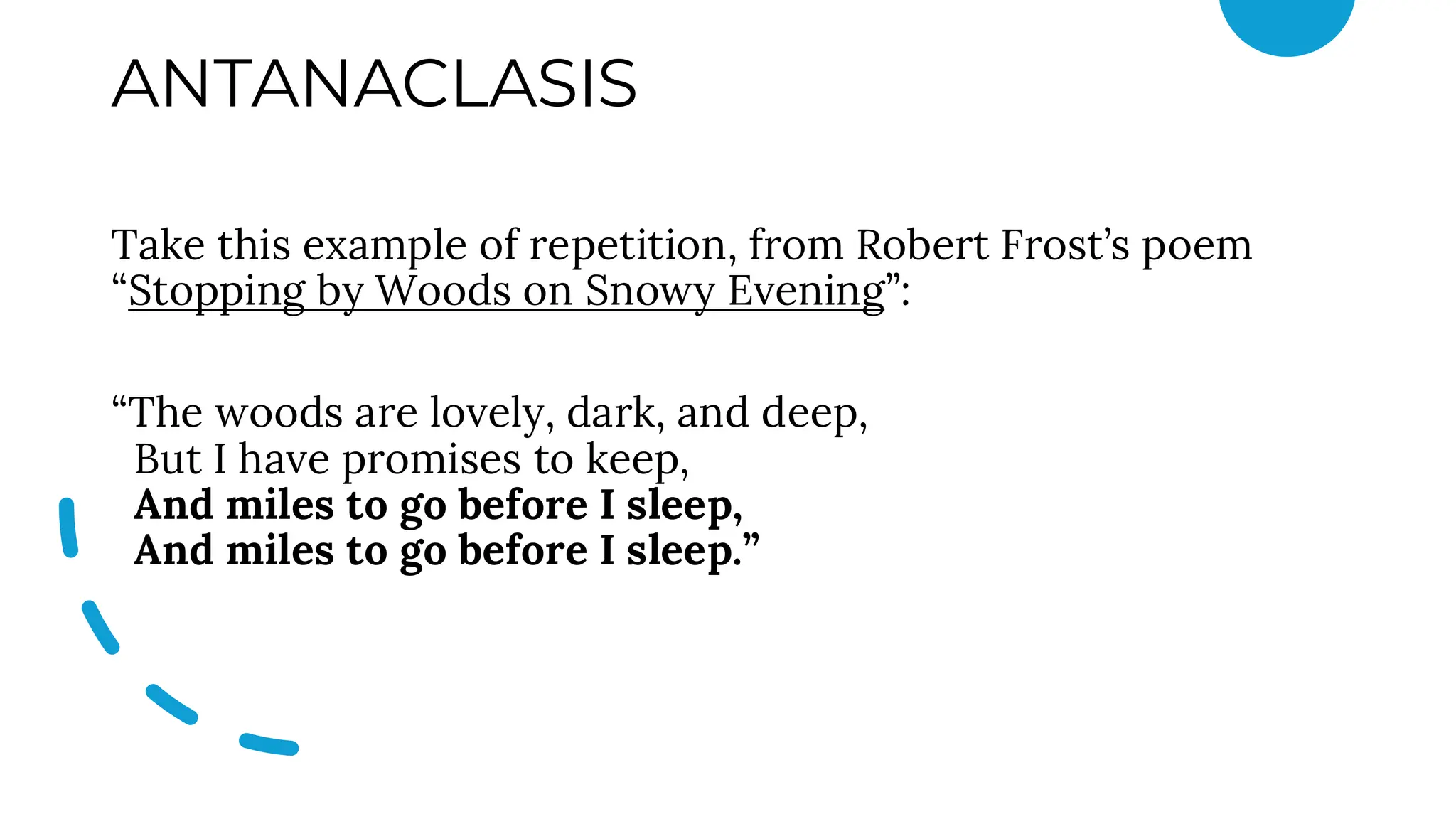
Take this exampleof repetition, from Robert Frost’s poem
“Stopping by Woods on Snowy Evening”:
“The woods are lovely, dark, and deep,
But I have promises to keep,
And miles to go before I sleep,
And miles to go before I sleep.”
50.
ANTANACLASIS
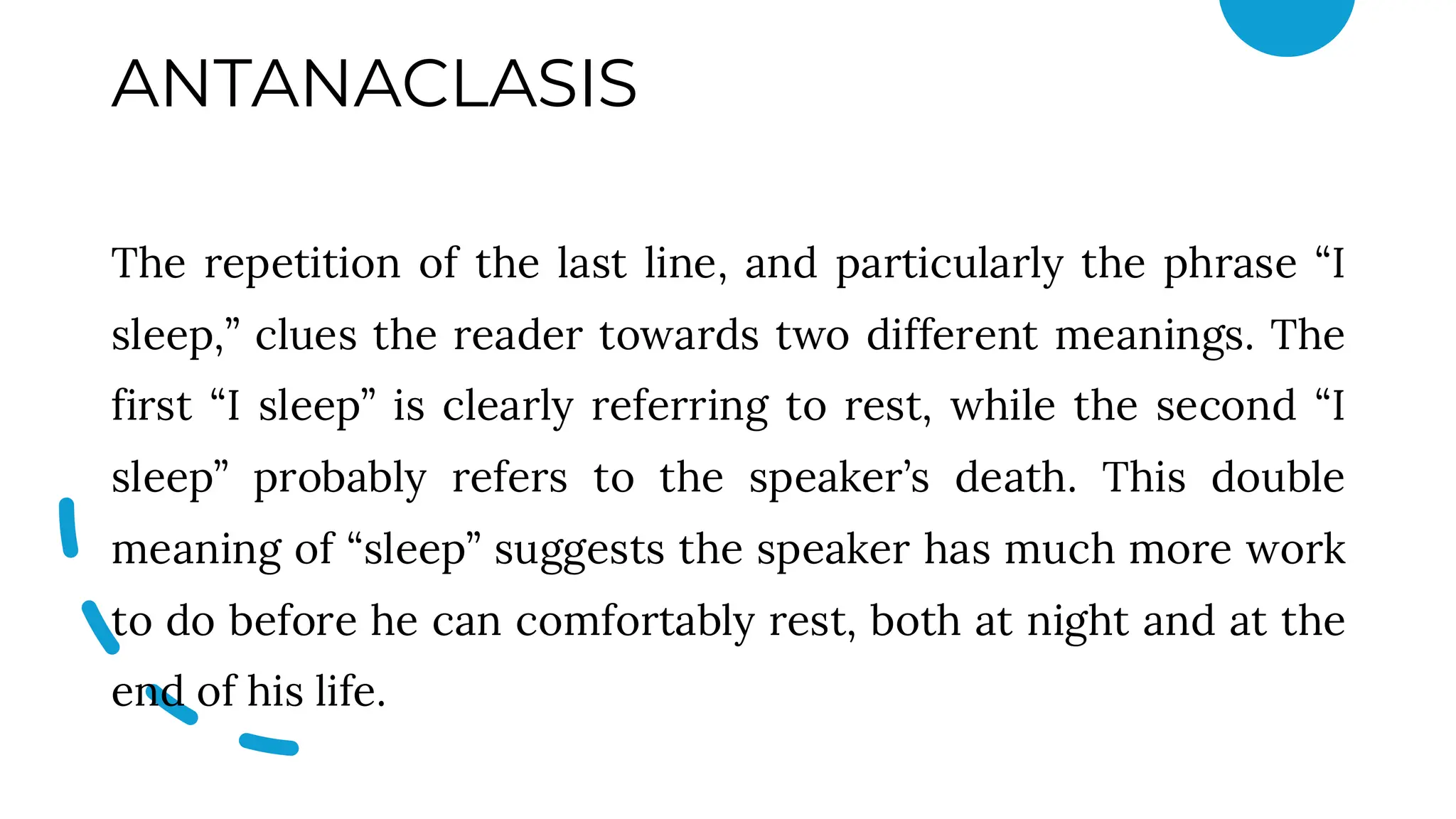
The repetition ofthe last line, and particularly the phrase “I
sleep,” clues the reader towards two different meanings. The
first “I sleep” is clearly referring to rest, while the second “I
sleep” probably refers to the speaker’s death. This double
meaning of “sleep” suggests the speaker has much more work
to do before he can comfortably rest, both at night and at the
end of his life.
51.
ANTIMETABOLE
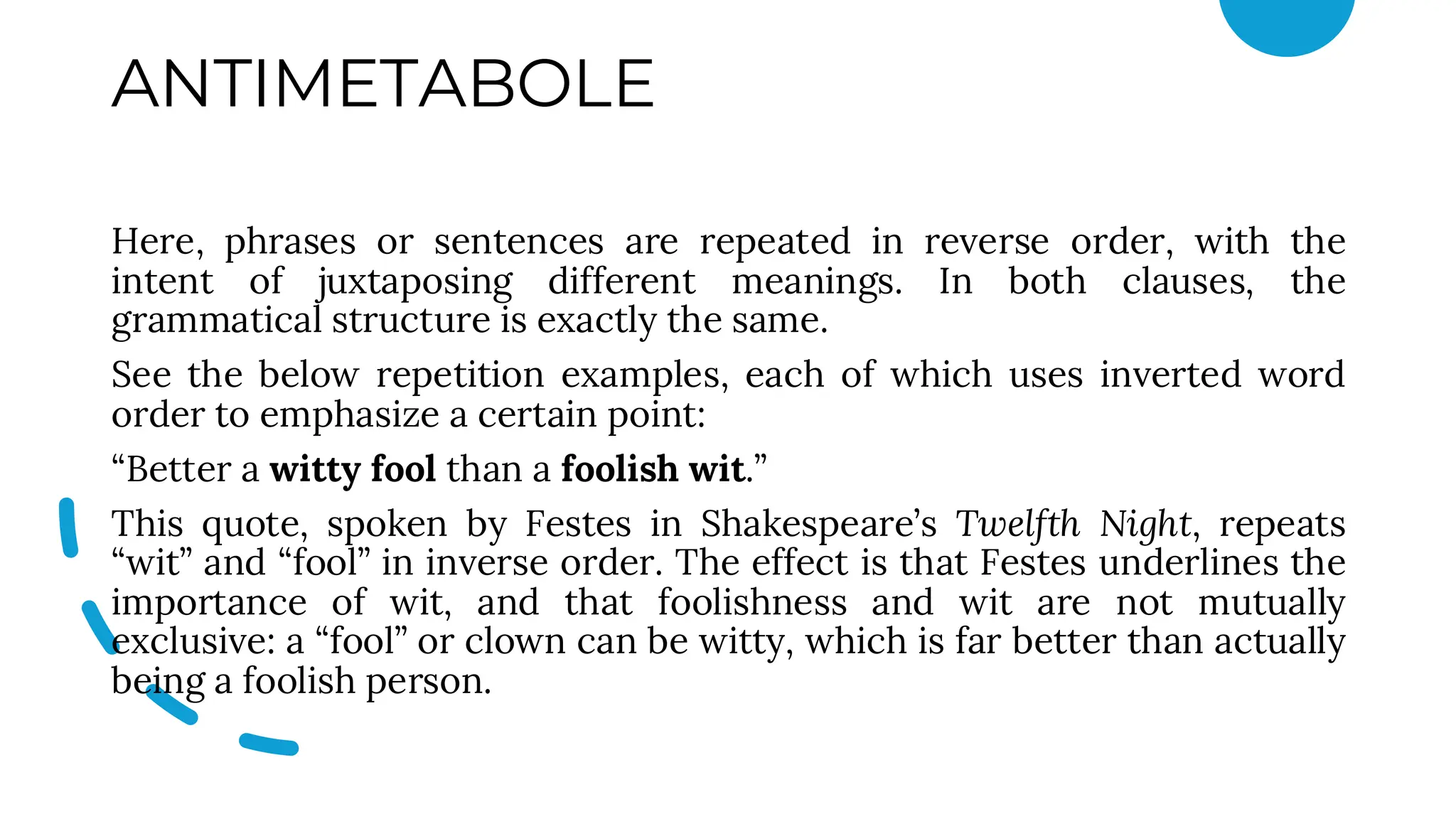
Here, phrases orsentences are repeated in reverse order, with the
intent of juxtaposing different meanings. In both clauses, the
grammatical structure is exactly the same.
See the below repetition examples, each of which uses inverted word
order to emphasize a certain point:
“Better a witty fool than a foolish wit.”
This quote, spoken by Festes in Shakespeare’s Twelfth Night, repeats
“wit” and “fool” in inverse order. The effect is that Festes underlines the
importance of wit, and that foolishness and wit are not mutually
exclusive: a “fool” or clown can be witty, which is far better than actually
being a foolish person.
52.
ANTIMETABOLE
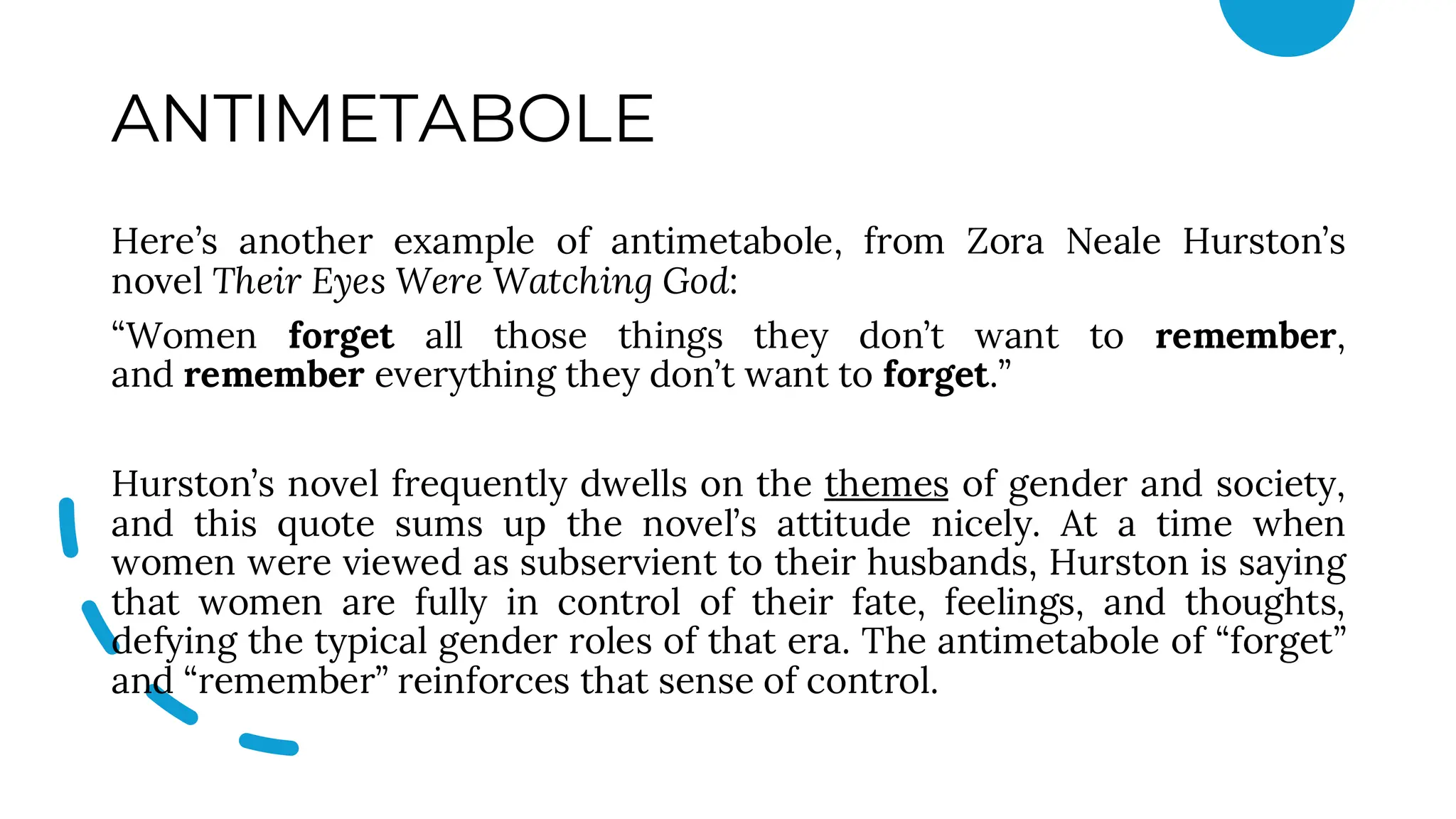
Here’s another exampleof antimetabole, from Zora Neale Hurston’s
novel Their Eyes Were Watching God:
“Women forget all those things they don’t want to remember,
and remember everything they don’t want to forget.”
Hurston’s novel frequently dwells on the themes of gender and society,
and this quote sums up the novel’s attitude nicely. At a time when
women were viewed as subservient to their husbands, Hurston is saying
that women are fully in control of their fate, feelings, and thoughts,
defying the typical gender roles of that era. The antimetabole of “forget”
and “remember” reinforces that sense of control.
53.
ANTISTROPHE
Antistrophe—also known as
epistropheor epiphora—is the
successive repetition of a word or
phrase at the end of lines or clauses.
Like anaphora, the effect of
antistrophe is the emphasis of a
recurring idea.
54.
ANTISTROPHE
You’ll find anexample of antistrophe in the short poem “We Real Cool” by
Gwendolyn Brooks:
”The Pool Players.
Seven at the Golden Shovel.
We real cool. We
Left school. We
Lurk late. We
Strike straight. We
Sing sin. We
Thin gin. We
Jazz June. We
Die soon.”
55.
ANTISTROPHE
The word “We”starts each sentence, but ends each line—except the last
line. This repetition emphasizes two things. First, it shows the reader the
speaker’s lack of identity: he can only identify as a weak “we,” and that
“we” centers itself around youthful rebellion.
Second, it highlights the poet’s attitude towards the boys. There is no
“we” after the phrase “die soon,” which underscores the poem’s finality
and the poet’s belief that the boys will ruin their own lives.
56.
CHIASMUS
• Chiasmus, likeantimetabole, is the repetition of a phrase in
reverse order. By inverting a phrase, the writer juxtaposes
different or opposite meanings.
• Unlike antimetabole, a chiasmus does not have to invert a
phrase grammatically. The two clauses can have different
lengths and structures. As such, antimetabole is often
viewed as a stricter form of chiasmus.
57.
CHIASMUS
The following example,from Shakespeare’s Macbeth, is an
example of both chiasmus and antimetabole, because each
inverted clause preserves the same grammatical structure:
“Fair is foul and foul is fair.”
58.
CHIASMUS
Now, this nextquote, from Aeschylus, is an example of
chiasmus, but not of antimetabole, because each inverted
clause has a different grammatical structure:
“It is not the oath that makes us believe the man,
but the man the oath.”
To summarize: a chiasmus is also an antimetabole, but not
every antimetabole is a chiasmus.
59.
EPANALEPSIS
Epanalepsis refers torepetition of a word or phrase at the
beginning and end of a line, clause, or sentence. This is a
feature of some other types of repetition—chiasmus and
antimetabole, in particular, will often feature an epanalepsis.
This repetition device is just as useful for poets and
storytellers as it is for rhetoricians.
60.
EPANALEPSIS
• “Beloved ismine; she is Beloved.” —Beloved by Toni Morrison
• “Possessed by what we now no more possessed.” —”The Gift
Outright” by Robert Frost
• “Nothing can be created out of nothing.” —Lucretius
• “Music I heard with you was more than music.
And bread I broke with you was more than bread.” —“Bread and
Music” by Conrad Aiken
• “Mankind must put an end to war or war will put an end to
mankind.” —John F. Kennedy
61.
EPIMONE
Epimone, a devicemost often used in dialogue, occurs when the
speaker repeats themselves for the purpose of dwelling on a point.
This repetition doesn’t contribute anything new to the speaker’s
argument, but it often shows us how the speaker truly feels.
62.
EPIMONE
• Here’s anexample from Romeo & Juliet:
NURSE
“O woe! O woeful, woeful, woeful day.
Most lamentable day, most woeful day
That ever, ever, I did yet behold!
O day, O day, O day, O hateful day.
Never was seen so black a day as this.
O woeful day, O woeful day.”
63.
EPIZEUXIS
• Epizeuxis, alsoknown as diacope, is the repetition of words in quick
succession.
• There are countless examples of epizeuxis in the poem “The Bells”
by Edgar Allan Poe. Each stanza ends with some variation of the
following:
“To the tintinnabulation that so musically wells
From the bells, bells, bells, bells,
Bells, bells, bells—
From the jingling and the tinkling of the bells.”
64.
POLYPTOTON
• Polyptoton isthe use of two or more words that, though different,
share the same root. The words “bare & barely” have the same root;
so do the word pairs “battle & embattled” and “lunar & lunatic.”
• Polyptoton was a common facet of Latin and Greek poetry, since
one word has hundreds of forms in each language. However,
modern literature has examples of polyptoton, too.
65.
POLYPTOTON
Take this excerptfrom T. S. Eliot’s poem “The Dry Salvages”:
“There is no end of it, the voiceless wailing,
No end to the withering of withered flowers,
To the movement of pain that is painless and motionless,
To the drift of the sea and the driftingwreckage,
The bone’s prayer to Death its God. Only the hardly, barely prayable
Prayer of the one Annunciation.”
66.
SYMPLOCE
Symploce occurs whena writer uses both anaphora
and antistrophe at the same time. By using symploce,
the writer highlights nuances of meaning and the
differences between the two repeating phrases.
Because symploce happens at both the beginning and
end of a line or sentence, it most often occurs as
repetition in poetry.
67.
SYMPLOCE
Here’s an exampleof a love poem, “Sonnet 62” by Bartholomew Griffin, that has
symploce in each line:
“Most true that I must fair Fidessa love.
Most true that I fair Fidessa cannot love.
Most true that I do feel the pains of love.
Most true that I am captive unto love.
Most true that I deluded am with love.
Most true that I do find the sleights of love.
Most true that nothing can procure her love.
Most true that I must perish in my love.
Most true that She contemns the God of love.
Most true that he is snarèd with her love.
Most true that She would have me cease to love.
Most true that She herself alone is Love.
Most true that though She hated, I would love!
Most true that dearest life shall end with love.”
68.
WHAT IS THEEFFECT OF REPETITION?
• Emphasize key themes and ideas.
• Underscore the relationship between ideas.
• Emulate sounds and experiences.
• Invert ideas for emphasis.
• Juxtapose ideas to challenge the reader.
• Reveal or enhance the author’s writing style.
• Play with multiple meanings and ambiguities.
• Situate an important setting in the text, both figuratively and literally.
• Suggest a character’s interiority.
69.
PARALLELISM (PARALLEL PLOTS)
Parallelismrefers to the plotting of events that are similarly
constructed but altogether separate. Sometimes these parallels
develop on accident, but they are powerful tools for highlighting
important events and themes.
A surprising example of parallelism comes in the form of the Harry
Potter series. As an infant, Harry is almost killed by Voldemort but is
protected by his mother’s love. Eighteen years later, Harry must die
in order to defeat Voldemort, thus shouldering the burden of love
himself.
70.
FOIL CHARACTERS
A foilrefers to any two characters who are “opposites” of each
other. These oppositions are often conceptual in nature: one
character may be even-keeled and mild, like Benvolio in Romeo &
Juliet, while another character may be quick-tempered and
pugnacious, like Tybalt.
Foil characters help establish important themes and binaries in
your work. Because Shakespeare wrote Benvolio and Tybalt as foils,
one of the themes in Romeo & Juliet is that of retribution: is it better
to fight for honor or turn the other cheek for love?
71.
DICTION
You’ll often hearthat “diction” is just a fancy term for “word
choice.” While this is true, it’s also reductive, and it doesn’t
capture the full importance of select words in your story.
Diction is one of the most important literary devices in prose,
as every prose writer will use it.
72.
MOOD
The mood ofa story or passage refers to the overall emotional
tone it invokes. When writers craft a mood in their work,
they’re heightening the experience of their story by putting
you in the characters’ shoes. Since mood requires using the
right words throughout a scene, mood can be considered an
extended form of diction.
73.
FORESHADOWING
• Foreshadowing isa powerful literary device in fiction, drawing readers
ever-closer to the story’s climax. A foreshadow refers to any time the
writer hints towards later events in the story, often underscoring the
story’s suspense and conflict.
• Sometimes foreshadowing is obvious, and sometimes you don’t notice
it until rereading the story. For example, the foreshadowing in Harry
Potter makes it fairly obvious that Harry will have to die. Once the idea
of horcruxes, or “split souls,” was introduced in the books, it was only a
matter of time before readers connected these horcruxes to the
psychic connection Harry shared with Voldemort. His mission—to die
and be reincarnated—becomes fairly obvious as the heptalogy comes
to a close.
74.
FORESHADOWING
• Sometimes foreshadowingis much more discreet. In Jane
Eyre, for example, it’s clear that many of the people in Jane’s
life are keeping secrets from her. Rochester doesn’t let
anyone know about his previous marriage but it gets alluded
to several times, and St. John is reluctant to admit that he
does not actually love Jane, foreshadowing Jane’s return to
Rochester. All of this combines to reinforce Jane’s uncertain
place in the world and the journey she must take to settle
down.
75.
IN MEDIA RES
Fromthe Latin “In the middle of things,” In Media Res is one
of the literary devices in prose chiefly concerned with plot. In
Media Res refers to writing a story starting from the middle;
by throwing the reader into the center of events, the reader’s
interest piques, and the storytelling bounces between
flashback and present day.
76.
IN MEDIA RES
•Both fiction and nonfiction writers can use In Media Res,
provided it makes sense to do so. For example, Margaret
Atwood’s A Handmaid’s Tale begins in the middle of a dystopian
society. Atwood leads us through the society’s establishment and
the narrator’s capture, but all of this is in flashback, because the
focus is on navigating the narrator’s escape from this evil world.
• In Media Res applies well here, because the reader feels the full
intensity of this dystopia from its start. Writers who are writing
stories in either alternate worlds or very private worlds may
benefit from this literary device in fiction, as it helps keep the
reader interested and attentive.
77.
DRAMATIC IRONY
• Dramaticirony is a literary device in prose in which the audience
understands more about the situation than the story’s characters
do. This is an especially important literary device in fiction, as it
often motivates the reader to keep reading.
• We often see dramatic irony in stories which involve multiple
points-of-view. For example, the audience knows that Juliet is
still alive, but when Romeo discovers her seemingly dead body,
he kills himself in grief. How ironic, then, for Juliet to wake up to
her lover’s passing, only to kill herself in equal grief. By using
dramatic irony in the story, Shakespeare points towards the
haphazardness of young love.
78.
VIGNETTE
• A vignette(vin-yet) refers to a passage of prose that’s primarily
descriptive, rather than plot-driven. Vignettes throw the reader into
the scene and emotion, often building the mood of the story and
developing the character’s lens. They are largely poetic passages with
little plot advancement, but the flourishes of a well-written vignette
can highlight your writing style and the story’s emotions.
• The story snippets we’ve included are striking examples of vignettes.
They don’t advance the plot, but they push the reader into the story’s
mood. Additionally, the prose style itself is emotive and poetic,
examining the nuances of life’s existential questions.
79.
FLASHBACK
A flashback refersto any interruption in the story where the
narration goes back in time. The reader may need information
from previous events in order to understand the present-day
story, and flashbacks drop the reader into the scene itself.
80.
FLASHBACK
• Flashbacks areoften used in stories that begin In Media Res, such as The
Handmaid’s Tale. While the main plot of the story focuses on the narrator’s
struggles against Gilead, this narration frequently alternates with
explanations for how Gilead established itself. The reader gets to see the
bombing of Congress, the forced immigration of POC, and the
environmental/fertility crisis which gives context for Gilead’s fearmongering.
We also experience the narrator’s separation from her daughter and husband,
supplying readers with the story’s highly emotive world.
81.
SOLILOQUY
• Soliloquy comesfrom the Latin for self (sol) and talking (loquy), and
self-talking describes a soliloquy perfectly. A soliloquy is a long speech
with no audience in the story. Soliloquies are synonymous with
monologues, though a soliloquy is usually a brief passage in a chapter,
and often much more poetic.
• As a literary device in prose, soliloquy offers insight into the
characters’ emotions. Soliloquy doesn’t have to be in dialogue, it can
also take the form of private thoughts, but a soliloquy must be an
extended conversation with oneself that exposes the character’s own
feelings and ideas.
•
82.
SOLILOQUY
Shakespeare’s plays aboundwith soliloquies. Here’s an example,
pulled from Scene II Act II of Romeo and Juliet:
“But soft, what light through yonder window breaks?
It is the East, and Juliet is the sun.
Arise, fair sun, and kill the envious moon,
Who is already sick and pale with grief
That thou, her maid, art far more fair than she.”
Romeo isn’t talking to anyone in particular, but no matter: his
soliloquy is rife with emotion and metaphor, and one can’t help but
blush when he expresses how his love for Juliet makes her like the
sun to him.
83.
DIALOGUE LITERARY DEVICES
theart of storytelling
the art of storytelling
Writing dialogue in a story requires us to step into the
minds of our characters. When our characters speak, they
should speak as fully developed human beings, complete
with their own linguistic quirks and unique pronunciations.
Indeed, dialogue writing is essential to the art of
storytelling. In real life, we learn about other people
through their ideas and the words they use to express
them. It is much the same for dialogue in fiction.
84.
WHAT IS DIALOGUEIN A STORY?
• Dialogue refers to any direct communication from one or more characters in
the text. This communication is almost always verbal, except for instances of
inner dialogue, where the character is speaking to themselves.
• In works of Fantasy or Science Fiction, characters might communicate with
each other telepathically or through non-human means. This would also
count as dialogue in a story.
• The importance of dialogue in a story cannot be overstated. The words that
characters speak act as windows into their psyches: we can learn lots about
people by what they say, as well as what they omit.
• Additionally, dialogue allows for the exchange of information, which will
advance the story’s plot. Any story that involves conflict between two or more
people must involve dialogue, or else the story will never reach its climax and
resolution.
85.
INNER DIALOGUE
• Innerdialogue is a form of communication in which a character
speaks with themselves. This is, essentially, a form of monologue
or soliloquy. Inner dialogue allows the reader to view the
character’s thoughts as they happen, transcribing their doubts,
ideas, and emotions onto the page.
• Inner dialogue can also be a memory or reminiscence, even if the
character is not consciously speaking to themselves. If the
narrator shows us a memory that the character is currently
thinking about, then that character is still offering something to
the narrative by means of unspoken conversation.
86.
INDIRECT DIALOGUE
• Indirectdialogue is dialogue, summarized. It is not put in
quotes or italics; rather, it neatly sums up what a character
said, without going into detail.
• In other words, we don’t get to see how the character said
something, we are only told what they said. This is useful for
when the information is better summarized than told in
excruciating details, because the narrator wants to get to
the important dialogue, the dialogue that introduces new
information or reveals important aspects of the character’s
personality.
87.
INDIRECT DIALOGUE
Haruki Murakamigives us a great example in Kafka on the
Shore:
“I tell her that I’m actually fifteen, in junior high, that I stole
my father’s money and ran away from my home in Nakano
Ward in Tokyo. That I’m staying in a hotel in Takamatsu and
spending my days reading at a library. That all of a sudden I
found myself collapsed outside a shrine, covered in blood.
Everything. Well, almost everything. Not the important stuff I
can’t talk about.”
COLLOQUIALISM
A colloquialism isa word or phrase that’s specific to a
language, geographical region, and/or historical period.
Mostly used in informal speech, colloquialisms will rarely
show up in the boardroom or the courtroom, but they pop up
all the time in casual conversation.
We often use colloquialisms without realizing it. Take, for
example, the shopping cart. Someone in the U.S. Northeast
might call it a “cart,” while someone in the South might call it
a “buggy.”
90.
COLLOQUIALISM
In fact, colloquialismsabound in the history of the English
language. When it rains but the sun is out, a native Floridian might
call it a sunshower. A Wisconsinite will call a water fountain a
“bubbler.” In the 1950s, a small child might have been called an
“ankle-biter.” Nowadays, a New Yorker might describe cold
weather as being “brick outside.” (Yes, brick.)
Colloquialisms help define a character’s geographic background
and historical time period. They also help signify when the
character feels comfortable and informal, versus when they are
speaking in an uncomfortable or professional situation.
91.
VERNACULAR
Vernacular refers tolanguage that is simple and
commonplace. When a character’s speech is unadorned and
everyday, they are speaking in vernacular, using words that
can be understood by every person in that character’s time
period. (A colloquialism is often an example of vernacular.)
The opposite of vernacular would be dialect, which is speech
that is tailored to a specific setting, and is therefore not
commonplace or universally understood.
92.
DIALECT
• A dialectis a type of speech reserved for a particular time period,
geographical location, social class, group of people, or other
specific setting. It is language that the entire population might
not comprehend, as it uses words, phrases, and grammatical
decisions that aren’t universally understood.
• Here’s an example of modern day vernacular. The same sentence
has been rewritten as though it were spoken by someone with a
Southern dialect.
• Vernacular: I am craving some coleslaw and a soft drink.
• Southern Dialect: I’m fixin’ for some slaw and soda pop.
93.
SLANG
A slang isa word or phrase that is not part of conventional
language usage, but which is still used in everyday speech.
Generally, younger generations coin slang words, as well as
queer communities and communities of color. (Some of the
terms below started in AAVE, or African American Vernacular
English.) Those words then become dictionary entries when
the word has circulated long enough in popular usage. Slang is
a form of colloquialism, as well as a form of dialect, because
slang terms are not universally understood and are often
associated with a specific age group in a specific region.
94.
SLANG
Some recent examplesof slang words and phrases include:
• No cap—“no lie.”
• Boots—this is a sort of grammatical intensifier, placed after the thing being
intensified. “I’m hungry, boots” is basically the same as “I’m so hungry.”
• Bop—a catchy or irresistible song.
• Drip—a particularly fashionable or interesting style of clothes.
• It’s sending me—“that’s hilarious.”
• Periodt—a more “final” use of the word “period” when a salient point has been
made.
• Snatched—used when someone’s fashion is impeccable. In the case of
someone’s waist size, snatched refers to an hourglass figure.
95.
SLANG
• Pressed—“stressed” or“annoyed.”
• Slaps—“exceptionally good.”
• Stan—stan is a portmanteau of “stalker fan,” but really what
it means is that you enjoy something intensely or
obsessively. You “stan” a song or a movie, for example.
• Werk—a term to describe something done exceedingly well.
If you’re dancing tremendously, I might just yell “werk!”
• Wig—when something shocks, excites, or moves you, just say
“wig.”
96.
JARGON
• Jargon isa word or phrase that is specific to a profession or
industry. Usually, a jargon word intentionally obfuscates the
meaning of what it represents, as the word is meant to be
understood solely by people within a certain profession.
• Often, people let jargon slip from their tongues without
realizing the word is inaccessible. For example, a doctor
might tell their friend they have rhinitis, rather than a
seasonal allergy.
97.
IDIOM
• An idiomis a phrase that is specifically understood by
speakers of a certain language, and which has a figurative
meaning that differs from its literal one. Idioms are
incredibly hard to translate, because the meaning conveyed
by the idiom does not appear within the words themselves.
• For example, a common idiom in the United States is to say
someone is “under the weather” when they’re feeling ill.
98.
IDIOM
An idiom canalso reveal regionality, as some idioms are only
spoken in certain dialects. For example, when it rains while
the sun is shining, a common idiom in the South is that “the
devil is beating his wife.” This phrase is understood in other
parts of the U.S. and might have its roots in folklore, but it is
primarily spoken by people in the American South.
99.
PROVERB
• A proverbis a short, oft-repeated saying that bears a wise and
powerful message. Proverbs are often based on common sense
advice, but they use metaphors and symbols to convey that
advice, prompting the listener to place themselves in the world of
the proverb.
• For example, a common English proverb is “a bird in the hand is
worth two in the bush.” This means that it’s better to take away
modest gains than to sacrifice those gains for something that may
be unobtainable. Sacrificing the bird in your hand for two birds
which may be impossible to own is a risky endeavour.
100.
NEOLOGISM
• A neologismis a coined word that describes something new.
Some neologisms are coined by authors themselves—
Shakespeare, for example, coined over 2,000 words, many of
which we use today. “Baseless,” “footfall,” and “murkiest” come
from The Tempest, just one of Shakespeare’s many plays and
poems.
• Nowadays, most neologisms describe advancements in
technology, medicine, and society. “Doomscrolling,” for example,
describes the act of consuming large quantities of negative news,
often to the detriment of one’s mental health.
101.
NEOLOGISM
Other modern-day neologismsinclude:
• Google (as a verb: to google something)
• Crowdsourcing
• Noob
• Staycation
• Webinar
• Vlogging
• Malware
• Podcast
• Ghosting
102.
EUPHEMISM
• A euphemismis the substitution of one word for another,
more innocuous word. We often use euphemisms in place of
words and phrases that are sexual, uncomfortable, or
otherwise taboo.
• For example, when someone dies, you might hear their
family member say “they kicked the bucket.” Or, if someone
were unemployed but didn’t want to say it, they might say
they are “between jobs” or “searching for better
opportunities.”
103.
WORD PLAY
Word play,also written as wordplay, word-play, or a play on
words, is when a writer experiments with the sounds,
definitions, and/or construction of words to produce new
and interesting meanings. In other words, the writer is
twisting language to say something unexpected, with the
intent of entertaining or provoking the reader.
104.
ANTHIMERIA
• Anthimeria isa type of word play in which a word is employed
using a different part of speech than what is typically associated
with that word. (For reference, the parts of speech are: nouns,
verbs, adjectives, adverbs, pronouns, articles, interjections,
conjunctions, and prepositions.)
• Most commonly, a writer using anthimeria will make a verb a
noun (nominalization), or make a noun a verb (verbification). It
would be much harder to employ this device using other parts of
speech: using an adjective as a pronoun, for example, would be
difficult to read, even for the reader familiar with anthimeria.
105.
ANTHIMERIA
NOUNS TO VERBS
“Thethunder would not peace at my bidding.”
—From King Lear, (IV, vi.) by Shakespeare
“I’ll unhair thy head.”
—From Antony and Cleopatra (II, v.) by Shakespeare
106.
ANTHIMERIA
VERBS TO NOUNS
Weuse verbs as nouns all the time in everyday conversation.
If you “hashtag” something on social media, you’re using the
noun hashtag as a verb.
107.
ANTHIMERIA
NOUNS AND VERBSTO ADJECTIVES
“The parishioners about here,” continued Mrs. Day, not looking at any
living being, but snatching up the brown delf tea-things, “are the
laziest, gossipest, poachest, jailest set of any ever I came among.”
—From Under the Greenwood Tree by Thomas Hardy
108.
DOUBLE ENTENDRE
A doubleentendre is a form of word play in which a word or phrase
is used ambiguously, meaning the reader can interpret it in multiple
ways. A double entendre usually has a literal meaning and a
figurative meaning, with both meanings interacting with each other
in some surprising or unusual way.
109.
DOUBLE ENTENDRE
“Marriage isa fine institution, but I’m not ready for an institution.”
—Mae West, quoted in The 2,548 Best Things Anybody Ever Said by
Robert Byrne
The repeated use of “institution” suggests a double meaning. While
marriage is, literally, an institution, West is also suggesting that
marriage is an institution in a different sense—like a prison or a
psychiatric hospital, one that she’s not ready to commit to.
110.
DOUBLE ENTENDRE
“On thecontrary, Aunt Augusta, I’ve now realized for the first time in my life the vital
importance of being Earnest.”
—The Importance of Being Earnest, A Trivial Comedy for Serious People by Oscar Wilde
In Oscar Wilde’s play, the protagonist Jack Worthing leads a double life: to his lover in
the countryside, he’s Jack, while he’s Ernest to his lover in the city. The play follows
this character’s deceptions, as well as his realization of the necessity of being true to
himself. Thus, in this final line of the play, Jack realizes the importance of being
“earnest,” a pun and double entendre on “Ernest.”
111.
KENNING
The kenning isa type of metaphor that was popular among medieval
poets. It is a phrase, usually two nouns, that describes something
figuratively, often using words only somewhat related to the object
being described.
A kenning is constructed with a “base word” and a “determinant.” The
base word has a metaphoric relationship with the object being
described, and the determinant modifies the base word.
112.
KENNING
At some pointin the text of Beowulf, the following kennings occur:
• Battle shirt — armour.
• Battle sweat — blood.
• Earth hall — burial mound.
• Helmet bearer — warrior.
• Raven harvest — corpse.
• Ring giver — king.
• Sail road — the sea.
• Sea cloth — sail.
• Sky candle — the sun.
• Sword sleep — death.
113.
MALAPROPISM
• A malapropismis a device primarily used in dialogue. It is
employed when the correct word in a sentence is replaced with a
similar-sounding word or phrase that has an entirely different
meaning.
• For example, the word “assimilation” sounds a lot like the phrase “a
simulation.” Employing a malapropism, I might have a character
say “Everything is programmed. We all live in assimilation.”
114.
METALEPSIS
Metalepsis is theuse of a figure of speech in a new or surprising
context, creating multiple layers of meaning. In other words, the
writer takes a figure of speech and employs it metaphorically, using
that figure of speech to reference something that is otherwise
unspoken.
115.
METALEPSIS
“Was this theface that launched a thousand ships and burnt the
topless towers of Ilium?”
—Dr. Faustus by Christopher Marlowe
Here, the face in question is that of Helen of Troy, the most
beautiful woman in the world (according to The Iliad and the
Odyssey). Helen is claimed by Paris, a prince of Troy, and when he
takes Helen home with him, it incites the Trojan war—thus the
references to a thousand ships and the towers of Ilium. So, the face
refers to Helen, and Faustus describes the beauty of that face
tangentially, referencing the magnitude of the Trojan War.
116.
METALEPSIS
“And I alsohave given you cleanness of teeth in all your cities.”
—The Book of Amos (4:6)
In this Biblical passage, the phrase “cleanness of teeth” is actually
referencing hunger. By having nothing to eat, the people have
nothing to stain their teeth with. Thus, the figurative image of clean
teeth becomes a metalepsis for starvation.
117.
OXYMORON
• An oxymoronis a self-contradictory phrase. It is usually just two
words long, with each word’s definition contrasting the other
one’s, despite the apparent meaning of the words themselves. It is
a play on words because opposing meanings are juxtaposed to
form a new, seemingly-impossible idea.
• A common example of this is the phrase “virtual reality.” Well, if
it’s virtual, then it isn’t reality, just a simulation of a new reality.
Nonetheless, we employ those words together all the time, and in
fact, the juxtaposition of these incompatible terms creates a new,
interesting meaning.
118.
OXYMORON
Oxymorons occur allthe time in everyday speech. “Same
difference,” “Only option,” “live recording,” and even the genre
“magical realism.” In any of these examples, a new meaning
forms from the placement of these incongruous words.
119.
OXYMORON
Here are afew examples from literature:
“Parting is such sweet sorrow.”
—Romeo and Juliet (II; ii), by Shakespeare
“No light; but rather darkness visible.”
—Paradise Lost by John Milton
“Their traitorous trueness, and their loyal deceit.”
—“The Hound of Heaven” by Francis Thompson
120.
PALINDROME
A palindrome isa word or phrase that is spelled the exact
same forwards and backwards (excluding spaces). The word
“racecar,” for example, is spelled the same in both directions.
So is the phrase “Able was I ere I saw Elba.” So is the sentence
“A man, a plan, a canal, Panama.”
121.
PARAPROSDOKIAN
A paraprosdokian isa play on words where the writer diverts
from the expected ending of a sentence. In other words, the
writer starts a sentence with a predictable ending, but then
supplies a new, unexpected ending that complicates the
original meanings of the words and surprises the reader.
122.
PARAPROSDOKIAN
Here’s an examplesentence:
“Is there anything that mankind can’t accomplish? We’ve
been to the moon, eradicated polio, and made grapes that
taste like cotton candy.”
This last clause is a paraprosdokian: the reader expects the
list to contain great, life-altering achievements, but ending
the list with something a bit more trivial, like cotton candy
grapes, is a humorous and unexpected twist.
123.
PARAPROSDOKIAN
With the paraprosdokian,writers contort the expected endings of sentences to create
surprising juxtapositions, playing with both words and sentence structures. Here are a
few literary examples, with the paraprosdokian in bold:
“We clutch our bellies and roll on the floor. When I say this, it should mean laughter,
not poison.”
—“Litany in Which Certain Things Are Crossed Out” by Richard Siken
“By the time you swear you’re his,
Shivering and sighing,
And he vows his passion is
Infinite, undying—
Lady, make a note of this:
One of you is lying.”
—“Unfortunate Coincidence” by Dorothy Parker
124.
PORTMANTEAU
• A portmanteauis a word which combines two distinct words
in both sound and meaning. “Smog,” for example, is a
portmanteau of both “smoke” and “fog,” because both the
sounds of the words are combined as well as the definition of
each word.
• The portmanteau has become a popular marketing tactic in
recent years. A portmanteau is also, often, an example of a
neologism—a coined word for which new language is
necessary to describe new things.
125.
PORTMANTEAU
Here are afew portmanteaus that have recently entered the English lexicon:
• Fanzine (fan + magazine)
• Telethon (telephone + marathon)
• Camcorder (camera + recorder)
• Blog (web + log)
• Vlog (video + blog)
• Staycation (stay + vacation)
• Bromance (brother + romance)
• Webinar (web + seminar)
• Hangry (hungry + angry)
• Cosplay (costume + play)
126.
SPOONERISM
• A spoonerismis a play on words in which the initial sounds
of two neighbouring words are swapped. For instance, the
phrase “blushing crow” is a spoonerism of “crushing blow.”
• Often, spoonerisms are slips of the tongue. We might
confuse our syllables when we speak, which is a natural
result of our brains’ relationships to language.
• Spoonerisms can be literary examples of a play on words.
But they’re also just ways to have fun with language.
127.
GRAMATICAL PARALLELISM
Parallelism isa stylistic device where a sentence is composed
of equally weighted items. In essence, parallel structure allows
form to echo content.
When poets and prose stylists effectively employ grammatical
parallelism, they strengthen the connections between ideas
and objects, embedding relationships in syntax.
128.
GRAMATICAL PARALLELISM
Here’s asimple example: On Sunday, we walked through the park,
ate fried pickles, and saw a Broadway show.
There are three clauses with parallel structure here:
• walked through the park,
• ate fried pickles,
• saw a Broadway show.
“Walked,” “ate,” and “saw” are all past tense verbs, and they start
each successive clause in the sentence. So, each clause has the
same grammatical structure, giving the sentence parallelism.
129.
RHETORICAL PARALLELISM
Rhetorical parallelismcreates sentence components of equal
weight to emphasize similarity and contrast. Typically, it’s a
sentence with 2 or 3 components, each of which are written
with similar or parallel syntactic structure.
Here’s an example of rhetorical parallelism:
• “That’s one small step for man, one giant leap for mankind.”
—Neil Armstrong
130.
RHETORICAL PARALLELISM
Here aresome other rhetorical parallelism examples:
“Ask not what your country can do for you—ask what you can
do for your country.” —John F. Kennedy
“Falseness lasts an hour, and truth lasts till the end of time.” —
Arabic Proverb
“As Caesar loved me, I weep for him; as he was fortunate, I
rejoice at it; as he was valiant, I honour him; but, as he was
ambitious, I slew him.” —Brutus in Julius Caesar (III.ii) by
William Shakespeare
131.
SYNTHETIC PARALLELISM
Synthetic parallelismis a poetic structure that advances a
thought. It presents ideas of equal weight to make a certain
argument, usually a moral one.
Here’s an example, from Proverbs 21:27.
“The sacrifice of the wicked is an abomination;
how much more when he brings it with evil intent.”
In this quote, the two elements—“the sacrifice of the wicked”
and “brings it with evil intent”—are both immoral actions. By
placing these ideas next to each other, the quote amplifies its
idea by amplifying what’s immoral.
132.
ANTITHETICAL PARALLELISM
Antithetical parallelismuses the same sentence structure as
synthetic, but it highlights differences. Take, for example, Proverbs
19:16.
“He who obeys instructions guards his life,
but he who is contemptuous of his ways will die.”
The two ideas—“obedience” versus “contempt”—are equally
weighted, but opposed in such a way that one action is regarded in
much higher esteem. “But” is the operant word highlighting
contrast, and when it comes to parallelism in the Bible, attention to
comparison words helps us understand how different ideas are
being compared.
133.
SYNONYMOUS PARALLELISM
Synonymous parallelismis simply the repetition of similar ideas with
different words. This repetition may appear redundant, but it’s done
with the purpose of amplifying an idea and making it multifaceted.
Take the below example, from Psalm 120:2.
“Save me, O Lord, from lying lips
and from deceitful tongues.”
“Lying lips” and “deceitful tongues” are clearly synonymous.
TYPES OF RHETORICALDEVICES
• Rhetorical appeals—Devices that appeal directly to the reader’s
feelings, thoughts, morals, and sense of time. You may have already
heard of them: ethos, logos, pathos, and kairos.
• Syntactical devices—Devices that use sentence structures to
communicate or simplify complex ideas.
• Argumentative rhetorical devices—Devices whose structures are
conducive to the advancement of a certain argument.
• Emphatic rhetorical devices—Devices that underscore or emphasize
certain ideas.
• Stylistic rhetorical devices—Devices that use word playand diction to
advance an argument.
136.
RHETORICAL APPEALS: KAIROS,ETHOS, LOGOS, PATHOS
The following common rhetorical devices appeal directly to
the reader’s sensibilities.
Many master rhetoricians will advance arguments that appeal
to multiple sensibilities at the same time.
137.
KAIROS—APPEAL TO TIME
Specifically,kairos is an appeal to immediacy, to a sense of “in this
moment.” When employed ethically, kairos convinces the audience that we
must act immediately for the better good. For example, Martin Luther King
once said: “Go back to Mississippi, go back to Alabama, go back to South
Carolina, go back to Georgia, go back to Louisiana, go back to the slums
and ghettos of our Northern cities, knowing that somehow this situation
can and will be changed.”
King’s call for radical optimism in the face of racism and oppression was a
call to action: now is the time that we change our situation of segregation.
138.
ETHOS—APPEAL TO ETHICSAND CREDIBILITY
Ethos is a device which appeals to two different senses:
1.The credibility of the speaker. Why should I trust this person’s
arguments?
2.The ethics of the argument. How can I trust the ethical good in this
argument?
139.
LOGOS—APPEAL TO LOGIC
Logosemploys reason or logic to convince the audience of a certain
argument. Logos will often be the backbone of an argument,
particularly among rhetoricians who have actually thought through
the logic of the ideas they’re advancing. (If an argument relies too
heavily on pathos or kairos, that argument will often be poorly
thought through, or else be trying to achieve nefarious ends.)
140.
LOGOS—APPEAL TO LOGIC
Thereare two primary forms of logos: inductive reasoning and
deductive reasoning.
• Inductive Reasoning: Drawing predictions from specific claims.
For example, a specific claim might be “I have to wear a scarf every
winter.” To make this a predictions, you might say “This winter, I
will also wear a scarf.”
• Deductive Reasoning: Drawing specific conclusions from general
claims. For example, a general claim might be “All birds have
feathers.” To take this to a specific conclusion, you might note that
“an emu has feathers. Therefore, an emu is a bird.”
141.
LOGOS—APPEAL TO LOGIC
Anotherway to think about this: inductive reasoning makes
predictions based on existing data, whereas deductive
reasoning makes conclusions based on existing data. Both forms of
argument are valid in different ways, and both are equally prone to
being false or manipulated.
142.
PATHOS—APPEAL TO FEELING
•Pathos is an appeal to the feelings of the audience. The author
employs pathos when the writing tries to evoke a particular
emotion, especially for the purposes of advancing an argument.
• Pathos is a common facet of all literature, since literature tries to
connect the reader to our greater shared humanity. This can only
happen on the levels of the symbolic: images, feelings, and the like.
143.
SYNTACTIC RHETORICAL DEVICESLIST
The following common rhetorical
devices are employed to draw
attention to a certain idea by playing
with sentence structure. The English
language can be toyed with in many
different ways, and master
rhetoricians know how to use syntax
to their advantage through the
following devices.
144.
ANACOLUTHON—INTERRUPTIONS IN GRAMMATICAL
FLOW
•An anacoluthon occurs when the writer employs different
grammatical structures in the same sentence. This device is
a grammatical discontinuity—the syntax of the sentence changes,
often alongside an abrupt change in topic.
• Both poets and rhetoricians use this device to highlight important
ideas. Poets, and prose poets in particular, will use the device to
replicate the disjointed nature of thoughts, as our brains naturally
think and feel incoherently.
ANTITHESIS—
PARALLEL
JUXTAPOSITION
OF OPPOSITE
IDEAS
A lotof common phrases in the English
language rely on antithesis. You may have
recently heard one of the following phrases:
• Go big or go home.
• Get busy living or get busy dying.
• No pain, no gain.
• No guts, no glory.
• If you fail to plan, then you plan to fail.
• Out of sight, out of mind.
• Hope for the best; prepare for the worst.
• Easy come, easy go.
147.
ASYNDETON—ABSENCE OF CONJUNCTIONS
Awriter employs asyndeton when they don’t use conjunctions
to separate clauses. This has the effect of making the
sentence move quicker, while also making the sentence feel
sharp and directed. For example:
• With conjunctions (polysyndeton): “Swift and concise and
pointed, the sentence makes you think and moves your heart
and compels you to action.”
• Without conjunctions (asyndeton): “Swift, concise, pointed,
the sentence makes you think, moves your heart, compels
you to action.”
148.
HYPALLAGE—SYNTACTIC AND SEMANTICSPLIT
IN A MODIFIER
Hypallage occurs when the author uses a modifier (usually a
single adjective) to describe something semantically, rather
than syntactically.
149.
HYPALLAGE—SYNTACTIC AND SEMANTICSPLIT IN A MODIFIER
“Dulce et Decorum Est” by Wilfred Owen:
“Gas! GAS! Quick, boys!—An ecstasy of fumbling
Fitting the clumsy helmets just in time,
But someone still was yelling out and stumbling
And flound’ring like a man in fire or lime.—”
So, the word “clumsy” is modifying the word “helmets.” This is
occurring on a syntactic level. However, “clumsy”
isn’t describing the helmets, it’s actually describing the boys
fumbling to put them on during World War I.
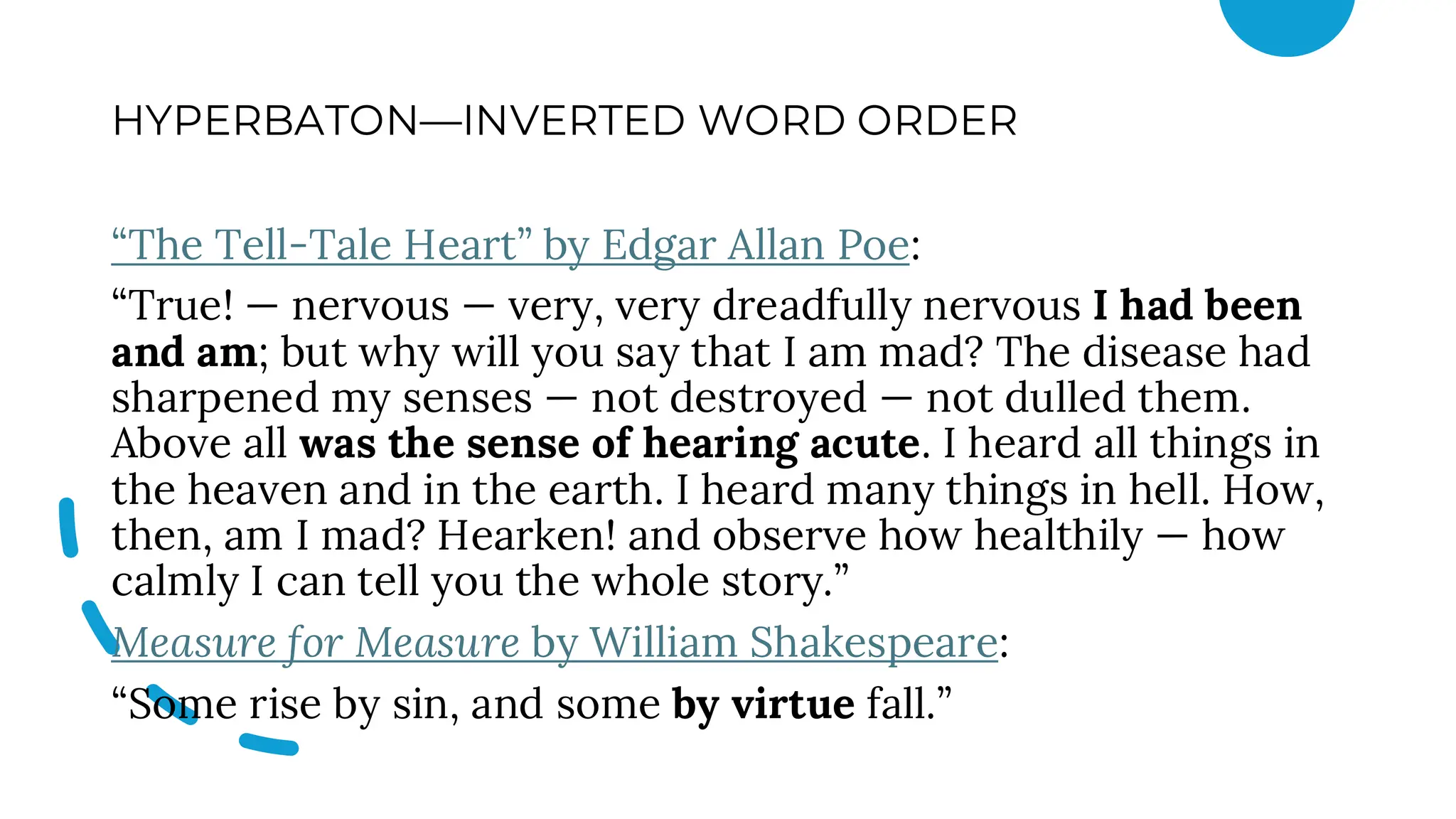
150.
HYPERBATON—INVERTED WORD ORDER
Ahyperbaton occurs when the writer writes a sentence in an
unusual order, in order to emphasize the most salient aspect
of the sentence. It is also called anastrophe. Rhetoricians may
use this device for emphasis, and poets will certainly use it to
preserve the rhythm and flow of a poem’s line.
151.
HYPERBATON—INVERTED WORD ORDER
“TheTell-Tale Heart” by Edgar Allan Poe:
“True! — nervous — very, very dreadfully nervous I had been
and am; but why will you say that I am mad? The disease had
sharpened my senses — not destroyed — not dulled them.
Above all was the sense of hearing acute. I heard all things in
the heaven and in the earth. I heard many things in hell. How,
then, am I mad? Hearken! and observe how healthily — how
calmly I can tell you the whole story.”
Measure for Measure by William Shakespeare:
“Some rise by sin, and some by virtue fall.”
152.
HYPOTAXIS—HIERARCHICAL SENTENCE STRUCTURE
Ahypotactic sentence is one that has dependent, or
subordinate, clauses. This creates a hierarchical relationship
in the sentence: the most important part of the sentence is
the clause that can exist independently, while the subordinate
clauses, which are less important, still modify and sharpen the
message of the sentence.
153.
HYPOTAXIS—HIERARCHICAL
SENTENCE STRUCTURE
Here’s anexample—from Simone Weil’s Waiting for God. The
sentences containing hypotaxis are bolded.
“The beauty of the world is the mouth of a labyrinth. The unwary
individual who on entering takes a few steps is soon unable to
find the opening. Worn out, with nothing to eat or drink, in the
dark, separated from his dear ones, and from everything he loves
and is accustomed to, he walks on without knowing anything or
hoping anything, incapable even of discovering whether he is
really going forward or merely turning round on the same
spot. But this affliction is as nothing compared with the danger
threatening him.”
154.
PARATAXIS—EQUALLY WEIGHTED SENTENCECOMPONENTS
In opposition to hypotaxis, parataxis is the use of equally
weighted sentences or clauses in succession to one another.
Parataxis requires short, simple sentences and clauses. You
can identify this device by an absence of subordinating
conjunctions—words that make a clause subordinate, like
“although” or “because” or “if.”
155.
PARATAXIS—EQUALLY WEIGHTED
SENTENCE COMPONENTS
Parataxisplays an important role in the following excerpt from Sula, by
Toni Morrison:
“Twenty-two years old, weak, hot, frightened, not daring to acknowledge
the fact that he didn’t know who or what he was … with no past, no
language, no tribe, no source, no address book, no comb, no pencil, no
clock, no pocket handkerchief, no rug, no bed, no can opener, no faded
postcard, no soap, no key, no tobacco pouch, no soiled underwear and
nothing nothing nothing to do … he was sure of one thing only: the
unchecked monstrosity of his hands…”
156.
POLYSYNDETON—SUCCESSION OF COORDINATING
CONJUNCTIONS
Polysyndetonis the opposite of asyndeton. A sentence with
polysyndeton uses coordinating conjunctions (usually “and,”
sometimes “or” or “nor”) to join a series of clauses, which serves to
quicken the pace of the sentence itself.
157.
POLYSYNDETON—SUCCESSION OF COORDINATINGCONJUNCTIONS
Polysyndeton is prominent in these first two stanzas from the poem “It’s
What Happens, Sometimes, in October” by Angel Gonzalez:
“When nothing occurs,
and summer is gone,
and leaves start to fall off the trees,
and the cold rusts the edges of rivers,
and slows down the flow of waters;
when the sky seems a violent sea,
and birds swap landscapes,
and words sound more and more distant,
like whispers strewn by the wind.”
158.
SYNESIS—“SENSE” OVER SYNTAX
Asynesis occurs when a sentence lacks grammatical
agreement, for the purpose of highlighting an agreement in
“sense.”
This is easier demonstrated than defined. See the below
excerpt from Shakespeare’s King Lear:
KING LEAR
“I will have such revenges on you both,
That all the world shall–I will do such things,
What they are, yet I know not…”
159.
SYNESIS—“SENSE” OVER SYNTAX
•“Revenges,” here, is grammatically incorrect. The word
should be singular, because it should agree, grammatically
and syntactically, with “I.” One does not typically carry out
“revenges,” and it’s actually rare to see that word in the
plural.
• But, in this instance, it is correct logically. Lear is promising
revenge on two people, and he might even be promising a
different kind of revenge on each person. So, while the
sentence is wrong in grammar, it is correct in sense.
160.
ARGUMENTATIVE RHETORICAL DEVICES
Thefollowing common rhetorical devices are employed
to convince the audience of something. Some of these
devices are earnest, sincere, and logical; others are more
manipulative.
161.
ACCISMUS—FEIGNED INDIFFERENCE
Accismus isa form of irony in which the speaker pretends not
to desire something that they actually desire. They might do
this so as not to scare off the person offering it, or to conceal
that their entire motivation rests on this one thing.
For example, in Shakespeare’s Julius Caesar (I.ii), Caesar
pretends not to want the crown of Rome.
162.
ANECDOTE—STORY-BASED EVIDENCE
• Ananecdote is a short, pithy story, utilized to demonstrate a
key point in an argument. Anecdotes are often funny, but
can be serious, too.
• The teller of the anecdote must not get too lost in the story
that they lose track of their own argument; but they must
also demonstrate their point clearly and emphatically.
163.
ANTANAGOGE—DEFLECTION BY COUNTERALLEGATION
• An antanagoge refers to a deflection in which, instead of answering a
question or defending a point, the speaker makes a counter allegation.
For example, if I charged you with “eating all the Oreos,” you might reply
that I “ate all the pecan pie last week.” (It’s true; I did.)
• Antanagoge can also be employed syntactically. If you raise a claim and
then answer that claim with an opposing sentiment, you have used
antanagoge. For example, the phrase “when life gives you lemons,
make lemonade.” The first clause is negative, the responding clause is
positive.
164.
APORIA—FEIGNED UNCERTAINTY
• Anaporia occurs when the writer expresses uncertainty or
doubt, with the intention of raising a certain argument and
exploring it. This uncertainty is usually feigned, as the writer
pretends to be uncertain so that they can enumerate their
argument and ideas.
• Aporia is also a concept in philosophy, referring to
irresolvable knots or logical impasses in a text.
165.
BDELYGMIA—LITANY OF INSULTS
•Despite its weird and satisfying spelling, bdelygmia describes
something neither weird nor satisfying: insults.
• Specifically, bdelygmia is a litany of insults directed towards
an opponent or someone with opposing ideas. It is
sometimes called abominatio, is always a form of ad
hominem, and it uses strong language to appeal to pathos.
166.
BDELYGMIA—LITANY OF INSULTS
•At its cutest, bdelygmia is levied against the
perceived antagonist of a story, such as this excerpt
from How the Grinch Stole Christmas by Dr. Seuss:
“You’re a foul one, Mr. Grinch, You’re a nasty wasty skunk,
Your heart is full of unwashed socks, your soul is full of gunk,
Mr. Grinch. The three words that best describe you are as
follows, and I quote, “Stink, stank, stunk!””
167.
ENTHYMEME—DEDUCTIVE REASONING WITHAN UNSTATED
PREMISE
An enthymeme is a kind of syllogism, or logical deduction, in
which one of the premises is unstated.
A syllogism is a logical deduction from two premises. The
classic example goes like this:
1.All men are mortal
2.Socrates is a man
3.Therefore, Socrates is mortal
168.
ENTHYMEME
• 1 and2 are the premises. 3 is the conclusion. To turn this into an
enthymeme, just remove one of the premises (1 or 2). Once you
do that, you’ll see that the argument still makes sense (after all,
no one would doubt the truth of any of these statements), but it’s
not logically complete, since one of its essential premises is
missing.
• In practice, nearly all arguments depend on one or more
enthymemes – after all, we have to assume that the audience
already knows that all men are mortal, so it would be a waste of
time to state it explicitly if you were trying to persuade them of
this syllogism.
169.
ENTHYMEME
Enthymeme is alsoa common feature of political rhetoric. For example, watch
out for cases where someone is attacking a politician using a “dirty word” like
anarchist, socialist, imperialist, or Nazi. This is almost always hyperbole, but it’s
also enthymeme. Here’s a typical example:
“Governor Johnson wants to reduce government regulation and oversight.”
“Therefore, Governor Johnson is an anarchist.”
The hidden premise, of course, is that anyone who reduces government
regulation is an anarchist (or, to put it another way, that such reduction is
tantamount to anarchy). This hidden premise is obviously false – at the very
least, it’s a gross oversimplification – and so the argument is unpersuasive.
170.
HYPOPHORA—RAISING AND ANSWERINGA QUESTION
Also known as antipophora or anthypophora, hypophora is
when the writer asks a question and immediately answers it.
This rhetorical strategy allows the writer to raise a new topic,
and it also invites the audience to participate in the work,
since asking questions (even rhetorical questions) makes the
audience feel engaged.
171.
PROCATALEPSIS—RAISING AND RESPONDINGTO REBUTTAL
Procatalepsis is the act of raising a possible rebuttal to your
argument, in order to address it right away. It strengthens the
argument by addressing criticism and predicting what the
opponent might say. As long as that rebuttal is properly
addressed, this device can greatly enhance the ethos of an
argument. Like hypophora, procatalepsis can also create
surprising transitions in literary texts.
172.
PROCATALEPSIS—RAISING AND RESPONDINGTO REBUTTAL
Frederick Douglass used procatalepsis in his 1846 “Appeal to the
British People.” See below:
“I may be asked, why I am so anxious to bring this subject before
the British public—why I do not confine my efforts to the United
States? My answer is, first, that slavery is the common enemy of
mankind, and all mankind should be made acquainted with its
abominable character. My next answer is, that the slave is a man,
and, as such, is entitled to your sympathy as a brother. All the
feelings, all the susceptibilities, all the capacities, which you have,
he has. He is a part of the human family.”
173.
EMPHATIC RHETORICAL DEVICES
Thefollowing common rhetorical devices are employed
to emphasize a certain idea. Many of these devices take
ideas to their logical extreme, or else use repetition to
make an argument stick.
174.
ADYNATON—EXTREME HYPERBOLE
A hyperboleis an exaggeration. Adynaton is an extreme
exaggeration—a hyperbole so out there that it’s beyond
impossible. An adynaton might be employed for comic effect,
or it might be evidence of the speaker’s extreme feelings.
Here’s an example: the poem “The Cow Speaks to the Child”
by Evan Gill Smith:
“Some philosophers grow ulcers
from eating loneliness.
There’s not much we know.”
175.
AMPLIFICATION—DRAWING ATTENTION TOIDEAS
The amplification rhetorical device uses superfluous words,
embellishments, and unnecessary additions to draw attention
towards a particular idea which might otherwise escape the
reader’s attention.
176.
AMPLIFICATION—DRAWING
ATTENTION TO IDEAS
Here’san example, from The Twits by Roald Dahl. The amplifications have been
bolded, so you can see how they’re highlighting the core idea.
“If a person has ugly thoughts, it begins to show on the face. And when that person
has ugly thoughts every day, every week, every year, the face gets uglier and
uglier until you can hardly bear to look at it.A person who has good thoughts
cannot ever be ugly. You can have a wonky nose and a crooked mouth and a
double chin and stick-out teeth, but if you have good thoughts it will shine out of
your face like sunbeams and you will always look lovely.”
Notice how the bolded additions aren’t adding anything “new” to the original ideas,
but they help demonstrate, through imagery and example, a necessary concept for
the reader to understand.
177.
ANTIPHRASIS—USING WORDS OPPOSITEOF THEIR
MEANINGS
Antiphrasis is the use of words to mean the opposite of their
dictionary definitions. For example, if you fell down on the asphalt,
and I said “Nice going, ballerina!”, that would be antiphrasis—I
do not think that was “nice going,” and I certainly don’t think you’re a
ballerina.
Antiphrasis is the operating mechanism for things like irony,
sarcasm, satire, and sometimes even euphemism and litotes.
178.
ASTERISMOS—CALLING ATTENTION WITH
INTRODUCTORYWORDS
• Asterismos is when you call attention to an idea with an
introductory word or phrase. Behold! Alas! Hark! Listen. Hey….
Notice, I say to you!
• We use asterismos all the time in daily conversation, and you might
notice it used when writers try to capture colloquial speech in
their work.
179.
ASTERISMOS—CALLING ATTENTION WITH
INTRODUCTORYWORDS
Here’s one example, from Mark Twain’s The Adventures of
Huckleberry Finn:
“Well, looky here, boss, dey’s sumfn wrong, dey is. Is I me, or who is
I? Is I heah, or whah is I? Now dat’s what I wants to know.”
180.
LITOTES—THE RHETORICAL DOUBLENEGATIVE
A litotes is a double negative for rhetorical emphasis. It is a form of
pleonasm (defined elsewhere in this article) because it requires the
addition of extra words to convey a certain point. By expressing
something positive using a double negative, the writer makes the
audience think a little harder, adding weight behind the feeling that
the double negative expresses.
181.
LITOTES—THE RHETORICAL
DOUBLE NEGATIVE
Hereare some common expressions in the English vernacular that use Litotes:
• Not bad!
• I don’t hate it.
• I can’t disagree.
• Not uncommon.
• Not cheap.
• Hardly difficult.
• It has not gone unnoticed.
• It’s not the worst!
182.
MEIOSIS—WITTY UNDERSTATEMENT
• Ameiosis gives the impression that something is less
important than it actually is. This understatement creates
dramatic effect, because the reader knows that the thing
described actually has profound importance.
Understatement is considered a form of hyperbole.
• As with other rhetorical devices where what’s said differs
from what’s meant, meiosis makes the reader slow down and
think about what’s being spoken. The ironic dissonance
between what’s said and what’s meant emphasizes the true
meanings of the words themselves.
183.
METANOIA—IMMEDIATE SELF-CORRECTION
• Whena writer backtracks or modifies something they just wrote,
they use the device metanoia. This is not erasing and rewriting
something—it is acknowledging the thing just written, and
correcting it with a new, more accurate meaning. This immediate
self-correction emphasizes the correction itself, making it stick
in the reader’s brain.
• Additionally, metanoia mimics the way that we talk in real life.
Employing rhetorical devices like this tactically can help build
trust and ethos with the audience.
• Metanoia can be used to strengthen an argument, soften it, or
make it more precise.
184.
METANOIA—IMMEDIATE SELF-CORRECTION
Here’s anexample of the device, from The Great Gatsby by F.
Scott Fitgerald:
“It was Gatsby’s mansion. Or rather, as I did not yet know Mr.
Gatsby, it was a mansion inhabited by a gentleman of that
name.”
The narrator’s self-correction indicates that he knows things
now that he did not know before. Thus, this metanoia is also
an example of foreshadowing, because it suggests we are
about to learn much more about the owner of this mansion.
185.
PARALIPSIS—PERFORMATIVE REFUSAL TOSPEAK ON A TOPIC
• Paralipsis is a form of raising a topic by pretending not to
want to speak on that topic. In everyday speech, you might
say something like “I can’t stand my mother-in-law’s
perfume. Not to mention her drinking problem…”
• That “not to mention” reveals the thing that you actually
want to mention the most. Paralipsis is a form of irony and
antiphrasis, because it’s emphasizing the thing that the
writer pretends not to want emphasized.
186.
OVERSTATEMENT—INTENTIONAL EXAGGERATION
• Anoverstatement—a device in which the writer intentionally
exaggerates something to illustrate a point. While
overstatements often add a sense of humour to the writing,
poets in particular might use this device for strong,
evocative emotions and imagery.
187.
OVERSTATEMENT—INTENTIONAL
EXAGGERATION
Here’s an example,from the poem “100 Bells” by Tarfia
Faizullah (which also has great examples of parataxis):
”I locked the door. I did not die. I did
not die. I shaved my head. Until the horns
I knew were there were visible.
This is, of course, a metaphor. The speaker probably doesn’t
believe they actually have horns nestled beneath their hair. But,
this visceral overstatement still rings true to the reader—
it feels painful, intimate, real, true.
An overstatement is often another literary device, too, such as a
metaphor or simile or hyperbole.
188.
TMESIS—A WORD ORPHRASE EMBEDDED IN ANOTHER WORD OR
PHRASE
A tmesis (yes, spelled that way) is a word or phrase embedded in another
word or phrase, usually for emphatic effect. It typically reflects the ways
we speak to one another.
Some examples of tmesis in everyday speech include:
• That’s a whole nother story.
• Leave it any old where you like.
• This is fan-bloody-tastic. (Typical of British English.)
• Ned Flanders in The Simpsons: “Well-diddly-elcome!”
• Barney Stinson in How I Met Your Mother: “Legen-wait for it-dary”.
189.
STYLISTIC RHETORICAL DEVICES
Thefollowing common rhetorical devices are employed to
make the writing memorable. Stylistic writing can prove both
persuasive and compelling, sticking in the audience’s mind
long after the final sentence.
190.
ADNOMINATION—WORDS WITH REPEATINGROOTS
A single root word can produce many words in the contemporary English lexicon. For example,
the latin “facere,” which means “to make” or “to bring forth,” has spawned a bunch of English
words. Some examples:
• Infect
• Defect
• Perfect
• Prefect
• Confetti
• Confection
• Effect
• Affect
• Trifecta
191.
ADNOMINATION—WORDS WITH
REPEATING ROOTS
Adnominationis the use of two or more words that share
similar roots in a sentence. By doing this, the writer makes
something about the sentence memorable. This is a rhetorical
device useful for both rhetoricians and for marketers.
Here’s an example from the poem “The Choice” by Franz
Wright (which repeats the prefix “some”):
“Someone in Hell is sitting beside you on the train.
Somebody burning unnoticed walks past in the street.”
192.
APOSIOPESIS—THE UNFINISHED SENTENCE
Anaposiopesis occurs when the speaker leaves their sentence
unfinished. Doing so forces the audience to use their
imaginations and “fill in the blank,” which makes the speaker’s
message more impactful—provided it’s clear what the speaker
implies.
193.
CIRCUMLOCUTION—UNNECESSARY WORDINESS
• Circumlocution(also known as periphrasis) is the use of
extraneous words to describe something that could be
described concisely.
• At its most useful, a circumlocution helps define words, so
you’ll see this device employed in dictionary entries. It’s also
common for language learners to use circumlocution when
they don’t have a strong vocabulary—for example, saying “my
mother’s sister” if you don’t know the word “aunt.”
194.
DYSPHEMISM—LANGUAGE THAT’S DEROGATORYINSTEAD OF NEUTRAL
A dysphemism is the opposite of a euphemism. When you use
words derogatorily, particularly when a neutral word or phrase
already exists, you are employing dysphemism—a device
sometimes used alongside bdelygmia.
For example:
• Euphemism: It’s time for Number Two.
• Neutral term: I need to use the restroom.
• Dysphemism: I’ve gotta shit.
So, most insults, swear words, and vulgarities are dysphemisms.
195.
ELLIPSIS—OMISSION OF WORDS
•Ellipsis is the omission of words from a sentence,
encouraging the reader to “fill in the blank.” Aposiopesis is a
form of ellipsis, but an ellipsis can happen anywhere in the
text, and is much more open in terms of subject matter.
• Ellipsis is a useful tool in the art of concise writing. It can
also add ambiguity, particularly in literary works, if the
writer wants to imply but not outright state something
occurring in the story.
196.
ISOCOLON—PARALLELISM WITH ANEQUAL NUMBER
OF WORDS OR SYLLABLES
A writer uses isocolon when they write a parallel sentence in
which each element has the same number of words or
syllables. This device is naturally built into certain other
rhetorical devices, such as antithesis (“go big or go home!”),
and it’s also built into poetry forms like iambic pentameter.
197.
ISOCOLON—PARALLELISM WITH ANEQUAL
NUMBER OF WORDS OR SYLLABLES
• Same number of words:
“I came, I saw, I conquered. (Veni, vidi, vici.)” —Julius Caesar, in a letter to the
Roman Senate.
• Same number of syllables:
“I’ll give my jewels for a set of beads,
My gorgeous palace for a hermitage,
My gay apparel for an almsman’s gown,
My figured goblets for a dish of wood.”
—Iambic pentameter from Richard II by William Shakespeare.
198.
PLEONASM—INTENTIONAL REDUNDANCY
• Itis typically used to emphasize a certain idea or draw attention to
it, though it can also add a sense of urgency and intensity to
language, so long as it’s employed properly.
• Pleonasm is very similar to tautology, which is when you use
different words that have the same meanings side by side. The only
difference is that a pleonasm is any sort of rhetorical
magniloquence.
199.
PLEONASM—INTENTIONAL
REDUNDANCY
Some phrases inthe English language are inherently pleonastic/tautological. You
might have said or heard recently:
• I saw it with my own two eyes. (You can just say “my.” The “two” is redundant, too.)
• Can I have a chai tea? (“Chai” literally means “tea.”)
• I’ll have the tuna fish for supper. (Just “tuna” communicates the same idea.)
• It may be possible.
• I got a free gift!
• Under false pretenses.
• PIN Number (PIN stands for Personal Identification Number.)
• ATM Machine (ATM stands for Automatic Teller Machine.)