WEEK 1- CNF (GUIDED LESSONS)- LITERARY GENRES
“A critical consciousness of both rhetorical purposes and ideological
effects of generic forms”-Devitt, 2004
LITERATURE Can be classified into five categories
PROSEFICTION-isanimaginarystory,usuallywrittendownthat
someonetellsineverydaynatural language.
POETRY-isaliteraryareawheretheevocativeandaestheticqualitiesof
languagearebroughtoutin lieu or together with the language's
apparent meaning
DRAMA-aliteraryworkthatisdesignedtobeactedoutonastageand
performedbyactorsbeforean audience.
NONFICTION- refers to any kind of prose writing that is based on
facts, well-written prose that deals with real people, things events
and places.
CreativeNonfiction-agenre of writingthatusesliterarystylesand
techniquestocreatefactually accurate narratives.
UNDERSTANDING PROSE, POETRY AND DRAMA
POETRY Poetry is typically reserved for expressing something special in an
artistic way.
-The language of poetry tends to be more expressive or decorated, with
comparison, andrhyme rhythm, contributing to a different sound and feel.
-Ideas are contained in lines that may or may not be in sentences.
Lines are arranged in stanzas Poetry uses line breaks for various
reasons -- to follow a formatted rhythm or to emphasize an idea.
Lines can runextremely long or be as short asa word or letter
-Traditionally, the first letter of every line is capitalized but many modern
poets choose not to follow this rule strictly.
-The shape of the poetry can vary depending on line strength and intent of
the poet.
UNDERSTANDING PROSE, POETRY AND DRAMA
DRAMA
-story intended to be acted out on a stage.
-divided into two categories
1. Tragedy - is of the oldest form of drama. The theme usually
revolves around the ruins of a dynasty downfall of a man,
emotional betrayals moral setback, personal loss, death,
denials
2. Comedy - is lighter tone than tragedy and provides a happy
ending.
IDENTIFYINGELEMENTSOFTHEDIFFERENTGENRES
interpretative skills involve learning to examine and analyze the
literary elements and techniques that works together in a text. Here
are some of the following techniques.
MEANING
Ask these questions to help you identify and understand meaning.
1. What is the work about? what is the theme?
2. What effect or impression does the work have on the reader?
3. What is the argument or summary of the work?
4. What is the writer's intent?
FORM
Askthesequestionstohelpyouidentifyandunderstandtheform.
1. How has the writer organized the literary work to achieve the effect or
express the meaning?
2. How is the work structured or planned? As prose or poetry? As topics
or scenes As a long narrative, several short stories, or episodes?
3. Into what genre could the work be placed?
4. Whatmethodoforganizationorpatternofdevelopmentwasused
withinthestructure of thework?
VOICE AND TONE
Askthesequestionstohelpyouidentifyandunderstandvoiceandtone.
1. Who is telling the story?
2. How is the speaker or narrator characterized or his character
revealed? By action or by description/expressed or implied?
3. From what perspective is the story told? By a person outside of
the story or by someone actually involved in the narrative?
4. Is the speaker (the one telling the story) and the author or writer
of the work the same person?
5. If the writer and the speaker are two different individuals, are their
attitudestowardthesubject, events, and readers the same or
different? What is the author's attitude toward the material,
subject, or theme?
6. What is the author's attitude toward the material, subject, or
theme?
7. What is the speaker's attitude (if different from the author's) toward
the material, subject, or theme? Toward the reader?
8. Isthetoneplayful?Serious?Angry?Formal?Pleading?Joyful?
9. What is the atmosphere of the work (the way in which the mood,
setting, and feeling blend together to convey the prevailing tone)?
CHARACTER AND CHARACTERIZATION
Ask these questions to help you identify and understand character and
characterization.
1. Who are the people in the work?
2. How do dialogue (what he or she says) and action (what he or
she does) reveal a character's personality traits?
3. Is there a principal character?
4. What is the character's motivation?
5. Is the character's personality revealed directly by
the speaker telling the reader or indirectly by the
character's own words and deeds (requiring the reader to
come to conclusions about the character based on
dialogue and action)?
6. In a non-narrative work, how would you
characterize the speaker or the writer? How would you
characterize the work itself?
LANGUAGE ( USES AND MEANING )
Askthesequestionstohelpyouidentifyandunderstandlanguage.
1. Does the selection include any imagery (the use of sensory
images to represent someone or something)?
2. What figures of speech does the writer use, and what effect
do they have on the meaning of the selection?
3. How does the writer use diction (word choice) to convey
meaning?
4. What is the impact of the words, phrases, and lines as they are
used in the selection?
5. Did the writer intend the words used to convey the meaning
normally assigned to those words (denotations)?
6. Did the writer intend that some words would imply additional,
associatedmeaningsforthereader (connotations)?
7. What is the significance of those implications to the meaning
of the selection and the intent of the writer?
8. How does the use of denotation, connotation and syntax (how
the words are structured and grouped to form meaningful
thought units) relate to the style of the selection?
9. Does the language of the selection include any elements of
propaganda?
WEEK 2- CNF (GUIDED LESSONS)- CREATING PICTURES THROUGH WORDS
Poetry is literature that evokes a concentrated imaginative awareness of experience
or a specific emotional response through language chosen and arranged for its
meaning, sound, and rhythm.
Haiku
The haiku (or hokku) is an ancient form of Japanese poetry that has become very
popular all over the world. Renowned for its small size, haikus consist of just three
lines (tercet); the first and third lines have five syllables, whereas the second has
seven. Haikus don’t have to rhyme and are usually written to evoke a particular
mood or instance.
Free verse is a popular style of modern poetry, and as its name suggests there is a
fair amount of freedom when it comes to writing a poem like this. Free verse can
rhyme or not, it can have as many lines or stanzas as the poet wants, and it can be
about anything you like! So, while free verse may sound simple enough, the lack of
rules makes this form of poetry tricky to master!
Sonnet
This very old form of poetry was made famous by none other than William
Shakespeare, but the sonnet actually originated in 13th century Italy where it was
perfected by the poet Petrarch. The word ‘sonnet’ is derived from the Italian word
‘sonnetto’ which means ‘little song’. Traditionally, sonnets are made up of 14 lines
and usually deal with love. As a rule, Petrarchan (Italian) sonnets follow an ABBA
ABBA CDE CDE rhyme scheme, whereas Shakespearean (English) sonnets are
typically ABAB CDCD EFEF GG. But of course, rules are made to be broken!
Acrostic
Like haikus, you’re likely to encounter acrostic poems at school! But that doesn’t
mean they’re boring – in fact, far from it! This type of poetry spells out a name,
word, phrase, or message with the first letter of each line of the poem. It can rhyme
or not, and typically the word spelled out, lays down the theme of the poem. Why
not try it with the silliest word you can think of – it can be really fun!
Villanelle
The villanelle is another very old form of poetry that came from France and has lots
of rules. It is made up of 19 lines; five stanzas of three lines (tercet) each and a final
stanza of four lines (quatrain). As you can see from the rhymescheme; ABA ABA ABA
ABA ABA ABAA, this type of poem only has two rhyming sounds. Plus, there is a lot
of repetition throughout the villanelle. Line one will be repeated in lines six, 12, and
18; and line three will be repeated in lines nine, 15 and 19. So although this takes
out the extra work of having to write 19 individual lines, the real challenge is tomake
meaning out of those repeated lines!
Limerick
Limericks are funny (and sometimes rude!) poems which were made popular by
Edward Lear in the 19th century. They have a set rhyme scheme of AABBA, with lines
one, two and five all being longer in length than lines three and four.
Ode
The ode is one of the oldest forms of poetry and believed to have come from ancient
Greece. Yep – yonks ago! The word ‘ode’ is derived from the Greek word ‘aeidein’
which means ‘to sing or chant’, and these poems were originally performed with a
musical instrument. An ode is typically written to praise a person, event, or thing
(you could write an ode to your pet or favorite food!) and they are usually quite
short in length.
An elegy doesn’t have rules like some of the other forms of poetry but it does have
a set subject: death – eek! They are usually written about a loved one who has
passed away, but can also be written about a a group of people, too. Although they
can sound sad, elegies often end on a hopeful note,
Ballad
The ballad is another old and traditional form of poetry that typically tells a dramatic
or emotional story. They came from Europe in the late MiddleAges and were initially
passed down from one generation to another, and often with music. Ballads do have
a set form; they are typically four lines (quatrain) and have a rhyme scheme of ABAB
or ABCB. However, this form is looser than others so can be modified to suit a
writer’s (that’s you!) needs. Most modern pop songs you hear nowadays can be
referred to as ballads!
IMPORTANT TERMS IN POETRY
Stanza - a set amount of lines in poetry grouped together by their length, meter or
rhyme scheme.
Couplet - a two-line stanza.
Tercet - a three-line stanza.
Quatrain - a four-line stanza.
Cinquain - a five-line stanza.
Sestet - a six-line stanza.
Meter - the pattern of stressed syllables (long-sounding) and unstressed syllables
(short-sounding) in poetry.
Rhyme scheme - the pattern of rhyme that comes at the end of each line or verse.
Syllable - the single, unbroken sound of a spoken or written word.
SOUND DEVICES IN POETRY
ALLITERATION IN POETRY
Alliteration is a term for repeated letter sounds (usually consonants, but not
always) at the stressed part of two or more words. One example is “glowing
golden grains.” Another word for alliteration is an initial rhyme or head rhyme.
ASSONANCE IN POETRY
Like alliteration, assonance is the repetition of sounds in multiple words.
Assonance describes repeated vowel sounds in the middle of words with
different consonant end sounds. You can see the absence in the phrase “faded
gray waves.”
CONSONANCE IN POETRY
It’s tricky to tell the difference between alliteration and consonance. While
alliteration occurs at the stressed syllable in each word, consonance can happen
anywhere, especially at the end of a word. When consonance happens at the end
of the word along with assonance, it’s a rhyme.
ONOMATOPOEIA IN POETRY
Bang! Zip! Screech! Sound words that are written out are known as
onomatopoeia. Poetry uses onomatopoeia for both sensory language and
short, choppy lines.
REPETITION IN POETRY
Repeating a word in a poem may not make sense until you read it out loud.
Repetition allows the speaker to emphasize a particular word and cause a desired
sound in a poem.
RHYME IN POETRY
Even people who don’t read much poetry can recognize a rhyme. Rhyming words
have the same sound repeated at the end of a line. Many poems, such as free
verse poems, don’t use a particular rhyme scheme.
RHYTHM IN POETRY
The rhythm of a poem is its beat. It marks the accented syllables as well
as the downbeats. You can track a poem’s rhythm by its feet and meter.
WEEK 3- CNF (GUIDED LESSONS)CREATING REALITY THROUGH FICTION
“Lola Basyang” is the pen name of Severino Reyes, founder and editor of the
Tagalog magazine Liwayway. In 1925, Reyes started writing "Kuwento ni Lola
Basyang" for the magazine using the pen name. He wrote more than 400 Lola
Basyang stories about kings and kingdoms, love and hate, and strange enchanted
places.
Fiction is literature created from the imagination, not presented as fact, though it
may be based on a true story or situation. Types of literature in the fiction genre
include the novel, short story, and novella. The word is from the Latin fictiō, “the
act of making, fashioning, or molding.”Fiction may be either written or oral.
Although not all fiction is necessarily artistic, fictionis largely perceived as a form of
art or entertainment. The ability to create fiction and other artistic works is
considered to be a fundamental aspect of human culture, one of the defining
characteristics of humanity.
So, how does a writer write fiction? Characters, setting, plot, conflict, point of view,
and theme are six key elements for writing fiction.
CHARACTERS
Characters are the people, animals, or aliens in the story. Readers come to know
the characters through what they say, what they think, and how they act.
SETTING
The setting is where and when the story
takes place. It includes the following:
• The immediate surroundings of the
characters such as props in a scene:
trees, furniture, food, inside of a
house or car, etc.
• The time of day such as morning,
afternoon, or night.
• The weather such as cloudy, sunny,
windy, snow, or rain, etc.
• The time of year, particularly the
seasons: fall, winter, summer,
spring.
• The historical period such as what
century or decade the story takes
place.
• The geographical location including
the city, state, country, and possibly
even the universe, if the writer is
writing science fiction.
Setting can function as a main force that the characters encounter, such as a
tornado or flood, or a setting can play a minor role such as setting the mood.
Oftentimes, the setting can reveal something about the main character as
he/she functions in that place and time period.
PLOT
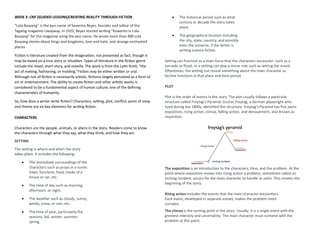
Plot is the order of events in the story. The plot usually follows a particular
structure called Freytag’s Pyramid. Gustav Freytag, a German playwright who
lived during the 1800s, identified this structure. Freytag’s Pyramid has five parts:
exposition, rising action, climax, falling action, and denouement, also known as
resolution.
The exposition is an introduction to the characters, time, and the problem. At the
point where exposition moves into rising action a problem, sometimes called an
inciting incident, occurs for the main character to handle or solve. This creates the
beginning of the story.
Rising action includes the events that the main character encounters.
Each event, developed in separate scenes, makes the problem more
complex.
The climax is the turning point in the story. Usually, it is a single event with the
greatest intensity and uncertainty. The main character must contend with the
problem at this point.
Falling action includes the events that unfold after the climax. This usually
creates an emotional response from the reader.
Denouement or resolution provides closure to the story. It ties up
loose ends in the story.
Conflict
Conflict is the struggle between two entities. In story writing the main character,
also known as the protagonist, encounters a conflict with the antagonist, which
is an adversary. The conflict maybe one of six kinds:
● Character vs. character
● Character vs. nature or natural forces
● Character vs. society or culture
● Character vs. machine or technology
● Character vs. God
● Character vs himself or herself
Point of View
Stories are generally told in one of two points of views:
● First-person point of view
● Third-person point of view
First-person point of view means that one of the characters in the
story will narrate–give an account–of the story. The narrator may
be the protagonist, the main character. Writing in the first-person
point of view brings the readers closer to the story. They can read it
as if they are the character because personal pronouns like I, me,
my, we, us, and our are used.
The third-person point of view means that the narrator is not in
the story. The third-person narrator is not a character. Third-
person point of view can be done two ways:
● Third-person limited
● Third-person omniscient
Third-person limited means that the narrator limits him/herself by
being able to be in one thought. Whereas, third-person omniscient
means the narrator has unlimited ability to be in various
character’s thoughts. Writing in the third-person point of view
removes readers from the story because of the pronouns he, she,
it, him, her, his, hers, they, them, and theirs.
Theme
A theme is not the plot of the story. It is the underlying truth that is being
conveyed in the story. Themes can be universal, meaning they are understood by
readers no matter what culture or country the readers are in. Common themes
include coming of age, circle of life, prejudice, greed, good vs. evil beating the
odds, etc.
WEEK 4- CNF (GUIDED LESSONS)WORDS I ACTION
Dramatic Literature, the texts of plays that can be read, as distinct from being seen
and heard in performance.
General Characteristics of Drama
Dramatic Expression
The language of drama can range between great extremes: on the one hand, an
intensely theatrical and ritualistic manner and, on the other, an almost exact
reproduction of real life of the kind commonly associated with motion picture
and television drama.
DRAMATIC STRUCTURE
The elements of a play do not combine naturally to create a dramatic experience
but, rather, are made to work together through the structure of a play, a major
factor in the total impact of the experience. A playwright will determine the
shape of a play in part according to the conditions in which it will be performed:
how long should it take to engage an audience’s interest and sustain it?
Drama as an Expression of a Culture
In spite of the wide divergencies in purpose and convention of plays as diverse
as the popular Kabuki of Japan and the coterie comedies of the Restoration in
England, a Javanese puppet play and a modern social drama by the American
dramatist Arthur Miller, all forms of dramatic literature have some points in
common. Differences between plays arise from differences in conditions of
performance, in local conventions, in the purpose of theatre within the
community, and in cultural history. Of these, the cultural background is the most
important, if the most elusive. It is cultural difference that makes the drama of
the East immediately distinguishable from that of the West.
Elements of Drama
Theme
The theme of a play refers to its central idea. It can either be clearly stated
through dialog or action, or can be inferred after watching the entire
performance. The theme is the philosophy that forms the base of the story or a
moral lesson that the characters learn. It is the message that the play gives to
the audience.
Plot
The order of events occurring in a play make its plot. Essentially, the plot is the
story that the play narrates. The entertainment value of a play depends largely
on the sequence of events in the story. The connection between the events and
the characters in them form an integral part of the plot. What the characters do,
how they interact, the course of their lives as narrated by the story, and what
happens to them in the end, constitutes the plot. A struggle between two
individuals, the relation between them, a struggle with self, a dilemma, or any
form of conflict of one character with himself or another character in the play,
goes into forming the story’s plot.
Characters
The characters that form a part of the story are interwoven with the plot of the
drama. Each character in a play has a personality of its own and a set of
principles and beliefs. Actors in the play have the responsibility of bringing the
characters to life. The main character in the play who the audience identifies
with, is the protagonist. He/she represents the theme of the play. The character
that the protagonist conflicts with, is the antagonist or villain. While some
characters play an active role throughout the story, some are only meant to take
the story forward and some others appear only in certain parts of the story and
may or may not have a significant role in it.
Dialogue
The story of a play is taken forward by means of dialogs. The story is narrated to
the audiences through the interaction between the play’s characters, which is in
the form of dialogs. The contents of the dialogs and the quality of their delivery
have a major role to play in the impact that the play has on the audiences. It is
through the dialogs between characters that the story can be understood. They
are important in revealing the personalities of the characters. The words used,
the accent, tone, pattern of speech, and even the pauses in speech, say a lot
about the character and help reveal not just his personality, but also his social
status, past, and family background as given by the play.
Setting
The time and place where a story is set is one of its important parts. The era or
time in which the incidents in the play take place, influence the characters in
their appearance and personalities. The time setting may affect the central
theme of the play, the issues raised (if any), the conflict, and the interactions
between the characters. The historical and social context of the play is also
defined by the time and place where it is set. The time period and the location in
which the story is set, affect the play’s staging. Costumes and makeup, the
backgrounds and the furniture used, the visuals (colors and kind of lighting), and
the sound are among the important elements of a play that dictate how the
story is translated into a stage performance.
Performance
It is another important element of drama, as the impact that a story has on the
audience is largely affected by the performances of the actors. When a written
play is transformed into a stage performance, the actors cast for different roles,
the way they portray the characters assigned to them, and the way their
performances are directed are some important factors that determine the play’s
impact. Whether an actor’s appearance (includes what he wears and how he
carries himself on stage) suits the role he is playing, and how well he portrays
the character’s personality are determinants of how well the play would be
taken by the audiences.
Visual Element
While the dialog and music are the audible aspects of drama, the visual element
deals with the scenes, costumes, and special effects used in it. The visual
element of drama, also known as the spectacle, renders a visual appeal to the
stage setup. The costumes and makeup must suit the characters. Besides, it is
important for the scenes to be dramatic enough to hold the audiences to their
seats. The special effects used in a play should accentuate the portion or
character of the story that is being highlighted.
The structure of the story comprises the way in which it is dramatized. How well
the actors play their roles and the story’s framework constitute the structure of
drama. Direction is an essential constituent of a play. A well-directed story is
more effective. Stagecraft defines how the play is presented to the audiences.
The use and organization of stage properties and the overall setting of a play are
a part of stagecraft, which is a key element of drama.
Symbols
are often used to give hints of the future events in the story. They complement
the other elements of a scene and make it more effective. The use of contrasts
adds to the dramatic element of a play. It could be in the form of contrasting
colors, contrasting backdrops, an interval of silence followed by that of activity
and noise, or a change in the pace of the story.
There is a lot of established research about the positive influences from drama,
theatre and the performing arts, especially on young people. The benefits are
physical, emotional, social, and they help to develop a healthy appreciation of
culture and the arts.
• Self-Confidence Aspects of performing arts, especially improvisation,
helps young people to understand how to appraise situations, think
outside the box and be more confident going into unfamiliar situations.
Students learn to trust their ideas and abilities. Confidence gained from
learning performing arts skills applies to school, career, and life.
• Imagination Being creative and learning to make creative choices helps
students to be better at thinking of new ideas, allowing them to view
the world around them in new ways. Einstein said, “Imagination is more
important than knowledge.”
• Empathy - Understanding characters, roles and the subtext of plays and
musicals allows students to relate better to different situations,
backgrounds, and cultures. It encourages them to show compassion and
tolerance for others.
• Cooperation - Theatre is a collaboration of different players and in
many cases the quality of any performance reliance on an ensemble
performance. Combining the creative ideas and the abilities of all
participants is required for the best outcomes. This requires all those
taking part to engage in discussions, feedback, rehearsing, and the
performance.
WEEK 5- CNF (GUIDED LESSONS)SOME FICTION ABOUT FACTS
Fiction is fabricated and based on the author’s imagination. Short
stories, novels, myths, legends, and fairy tales are all considered fiction.
While settings, plot points, and characters in fiction are sometimes
based on real-life events or people, writers use such things as jumping
off points for their stories.
Nonfiction, by contrast, is factual and reports on true events. Histories,
biographies, journalism, and essays are all considered nonfiction.
Usually, nonfiction has a higher standard to uphold than fiction. A few
smatterings of fact in a work of fiction does not make it true, while a few
fabrications in a nonfiction work can force that story to lose all
credibility.
Dramatic Expression
The language of drama can range between great extremes: on the
one hand, an intensely theatrical and ritualistic manner and, on
the other, an almost exact reproduction of real life of the kind
commonly associated with motion picture and television drama.
-Examples of Well-Known Literary Fiction Novels
-The Great Gatsby (F. Scott Fitzgerald)
-Giovanni’s Room (James Baldwin)
-O Pioneers! (Willa Cather)
-Invisible Man (Ralph Ellison)
-The Handmaid’s Tale (Margaret Atwood)
-War and Peace (Leo Tolstoy)
-Brave New World (Aldous Huxley)
-One Hundred Years of Solitude (Gabriel Garcia Marquez)
-Slaughterhouse-Five (Kurt Vonnegut, Jr.)
-Moby Dick (Herman Melville)
-Their Eyes Were Watching God (Zora Neale Hurston)
-Adam Bede (George Eliot)
-To Kill a Mockingbird (Harper Lee)
-Ulysses (James Joyce)
-To the Lighthouse (Virginia Woolf)
-Americanah (Chimamanda Ngozi Adichie)
-the stranger (Albert Camus)
-Beloved (Toni Morrison)
-Crime and Punishment (Fyodor Dostoyevsky)
-Things Fall Apart (Chinua Achebe)
Specific Types of Nonfiction
-Academic paper
-Academic publishing
-Almanac
-Autobiography
-Biography
-Blueprint
-Book report
-Creative nonfiction
-Design document
-Diagram
-Diary
-Dictionary
-Factual television (e.g. television documentaries)
-Encyclopedia
-Essay
-Guides and manuals
-Handbook
-History
-Journal
-Journalism
-Letter
-Letter collection
-Literary criticism
-Memoir
-Natural history

CREATIVE NON-FICTION FOR GRADE 12 STUDENTS

  • 1.
    WEEK 1- CNF(GUIDED LESSONS)- LITERARY GENRES “A critical consciousness of both rhetorical purposes and ideological effects of generic forms”-Devitt, 2004 LITERATURE Can be classified into five categories PROSEFICTION-isanimaginarystory,usuallywrittendownthat someonetellsineverydaynatural language. POETRY-isaliteraryareawheretheevocativeandaestheticqualitiesof languagearebroughtoutin lieu or together with the language's apparent meaning DRAMA-aliteraryworkthatisdesignedtobeactedoutonastageand performedbyactorsbeforean audience. NONFICTION- refers to any kind of prose writing that is based on facts, well-written prose that deals with real people, things events and places. CreativeNonfiction-agenre of writingthatusesliterarystylesand techniquestocreatefactually accurate narratives. UNDERSTANDING PROSE, POETRY AND DRAMA POETRY Poetry is typically reserved for expressing something special in an artistic way. -The language of poetry tends to be more expressive or decorated, with comparison, andrhyme rhythm, contributing to a different sound and feel. -Ideas are contained in lines that may or may not be in sentences. Lines are arranged in stanzas Poetry uses line breaks for various reasons -- to follow a formatted rhythm or to emphasize an idea. Lines can runextremely long or be as short asa word or letter -Traditionally, the first letter of every line is capitalized but many modern poets choose not to follow this rule strictly. -The shape of the poetry can vary depending on line strength and intent of the poet. UNDERSTANDING PROSE, POETRY AND DRAMA DRAMA -story intended to be acted out on a stage. -divided into two categories 1. Tragedy - is of the oldest form of drama. The theme usually revolves around the ruins of a dynasty downfall of a man, emotional betrayals moral setback, personal loss, death, denials 2. Comedy - is lighter tone than tragedy and provides a happy ending. IDENTIFYINGELEMENTSOFTHEDIFFERENTGENRES interpretative skills involve learning to examine and analyze the literary elements and techniques that works together in a text. Here are some of the following techniques. MEANING Ask these questions to help you identify and understand meaning. 1. What is the work about? what is the theme? 2. What effect or impression does the work have on the reader? 3. What is the argument or summary of the work? 4. What is the writer's intent? FORM Askthesequestionstohelpyouidentifyandunderstandtheform. 1. How has the writer organized the literary work to achieve the effect or express the meaning? 2. How is the work structured or planned? As prose or poetry? As topics or scenes As a long narrative, several short stories, or episodes? 3. Into what genre could the work be placed? 4. Whatmethodoforganizationorpatternofdevelopmentwasused withinthestructure of thework? VOICE AND TONE Askthesequestionstohelpyouidentifyandunderstandvoiceandtone. 1. Who is telling the story? 2. How is the speaker or narrator characterized or his character revealed? By action or by description/expressed or implied? 3. From what perspective is the story told? By a person outside of the story or by someone actually involved in the narrative? 4. Is the speaker (the one telling the story) and the author or writer of the work the same person? 5. If the writer and the speaker are two different individuals, are their attitudestowardthesubject, events, and readers the same or
  • 2.
    different? What isthe author's attitude toward the material, subject, or theme? 6. What is the author's attitude toward the material, subject, or theme? 7. What is the speaker's attitude (if different from the author's) toward the material, subject, or theme? Toward the reader? 8. Isthetoneplayful?Serious?Angry?Formal?Pleading?Joyful? 9. What is the atmosphere of the work (the way in which the mood, setting, and feeling blend together to convey the prevailing tone)? CHARACTER AND CHARACTERIZATION Ask these questions to help you identify and understand character and characterization. 1. Who are the people in the work? 2. How do dialogue (what he or she says) and action (what he or she does) reveal a character's personality traits? 3. Is there a principal character? 4. What is the character's motivation? 5. Is the character's personality revealed directly by the speaker telling the reader or indirectly by the character's own words and deeds (requiring the reader to come to conclusions about the character based on dialogue and action)? 6. In a non-narrative work, how would you characterize the speaker or the writer? How would you characterize the work itself? LANGUAGE ( USES AND MEANING ) Askthesequestionstohelpyouidentifyandunderstandlanguage. 1. Does the selection include any imagery (the use of sensory images to represent someone or something)? 2. What figures of speech does the writer use, and what effect do they have on the meaning of the selection? 3. How does the writer use diction (word choice) to convey meaning? 4. What is the impact of the words, phrases, and lines as they are used in the selection? 5. Did the writer intend the words used to convey the meaning normally assigned to those words (denotations)? 6. Did the writer intend that some words would imply additional, associatedmeaningsforthereader (connotations)? 7. What is the significance of those implications to the meaning of the selection and the intent of the writer? 8. How does the use of denotation, connotation and syntax (how the words are structured and grouped to form meaningful thought units) relate to the style of the selection? 9. Does the language of the selection include any elements of propaganda?
  • 3.
    WEEK 2- CNF(GUIDED LESSONS)- CREATING PICTURES THROUGH WORDS Poetry is literature that evokes a concentrated imaginative awareness of experience or a specific emotional response through language chosen and arranged for its meaning, sound, and rhythm. Haiku The haiku (or hokku) is an ancient form of Japanese poetry that has become very popular all over the world. Renowned for its small size, haikus consist of just three lines (tercet); the first and third lines have five syllables, whereas the second has seven. Haikus don’t have to rhyme and are usually written to evoke a particular mood or instance. Free verse is a popular style of modern poetry, and as its name suggests there is a fair amount of freedom when it comes to writing a poem like this. Free verse can rhyme or not, it can have as many lines or stanzas as the poet wants, and it can be about anything you like! So, while free verse may sound simple enough, the lack of rules makes this form of poetry tricky to master! Sonnet This very old form of poetry was made famous by none other than William Shakespeare, but the sonnet actually originated in 13th century Italy where it was perfected by the poet Petrarch. The word ‘sonnet’ is derived from the Italian word ‘sonnetto’ which means ‘little song’. Traditionally, sonnets are made up of 14 lines and usually deal with love. As a rule, Petrarchan (Italian) sonnets follow an ABBA ABBA CDE CDE rhyme scheme, whereas Shakespearean (English) sonnets are typically ABAB CDCD EFEF GG. But of course, rules are made to be broken! Acrostic Like haikus, you’re likely to encounter acrostic poems at school! But that doesn’t mean they’re boring – in fact, far from it! This type of poetry spells out a name, word, phrase, or message with the first letter of each line of the poem. It can rhyme or not, and typically the word spelled out, lays down the theme of the poem. Why not try it with the silliest word you can think of – it can be really fun! Villanelle The villanelle is another very old form of poetry that came from France and has lots of rules. It is made up of 19 lines; five stanzas of three lines (tercet) each and a final stanza of four lines (quatrain). As you can see from the rhymescheme; ABA ABA ABA ABA ABA ABAA, this type of poem only has two rhyming sounds. Plus, there is a lot of repetition throughout the villanelle. Line one will be repeated in lines six, 12, and 18; and line three will be repeated in lines nine, 15 and 19. So although this takes out the extra work of having to write 19 individual lines, the real challenge is tomake meaning out of those repeated lines! Limerick Limericks are funny (and sometimes rude!) poems which were made popular by Edward Lear in the 19th century. They have a set rhyme scheme of AABBA, with lines one, two and five all being longer in length than lines three and four. Ode The ode is one of the oldest forms of poetry and believed to have come from ancient Greece. Yep – yonks ago! The word ‘ode’ is derived from the Greek word ‘aeidein’ which means ‘to sing or chant’, and these poems were originally performed with a musical instrument. An ode is typically written to praise a person, event, or thing (you could write an ode to your pet or favorite food!) and they are usually quite short in length. An elegy doesn’t have rules like some of the other forms of poetry but it does have a set subject: death – eek! They are usually written about a loved one who has passed away, but can also be written about a a group of people, too. Although they can sound sad, elegies often end on a hopeful note, Ballad The ballad is another old and traditional form of poetry that typically tells a dramatic or emotional story. They came from Europe in the late MiddleAges and were initially passed down from one generation to another, and often with music. Ballads do have a set form; they are typically four lines (quatrain) and have a rhyme scheme of ABAB or ABCB. However, this form is looser than others so can be modified to suit a writer’s (that’s you!) needs. Most modern pop songs you hear nowadays can be referred to as ballads! IMPORTANT TERMS IN POETRY Stanza - a set amount of lines in poetry grouped together by their length, meter or rhyme scheme. Couplet - a two-line stanza. Tercet - a three-line stanza. Quatrain - a four-line stanza. Cinquain - a five-line stanza. Sestet - a six-line stanza. Meter - the pattern of stressed syllables (long-sounding) and unstressed syllables
  • 4.
    (short-sounding) in poetry. Rhymescheme - the pattern of rhyme that comes at the end of each line or verse. Syllable - the single, unbroken sound of a spoken or written word. SOUND DEVICES IN POETRY ALLITERATION IN POETRY Alliteration is a term for repeated letter sounds (usually consonants, but not always) at the stressed part of two or more words. One example is “glowing golden grains.” Another word for alliteration is an initial rhyme or head rhyme. ASSONANCE IN POETRY Like alliteration, assonance is the repetition of sounds in multiple words. Assonance describes repeated vowel sounds in the middle of words with different consonant end sounds. You can see the absence in the phrase “faded gray waves.” CONSONANCE IN POETRY It’s tricky to tell the difference between alliteration and consonance. While alliteration occurs at the stressed syllable in each word, consonance can happen anywhere, especially at the end of a word. When consonance happens at the end of the word along with assonance, it’s a rhyme. ONOMATOPOEIA IN POETRY Bang! Zip! Screech! Sound words that are written out are known as onomatopoeia. Poetry uses onomatopoeia for both sensory language and short, choppy lines. REPETITION IN POETRY Repeating a word in a poem may not make sense until you read it out loud. Repetition allows the speaker to emphasize a particular word and cause a desired sound in a poem. RHYME IN POETRY Even people who don’t read much poetry can recognize a rhyme. Rhyming words have the same sound repeated at the end of a line. Many poems, such as free verse poems, don’t use a particular rhyme scheme. RHYTHM IN POETRY The rhythm of a poem is its beat. It marks the accented syllables as well as the downbeats. You can track a poem’s rhythm by its feet and meter.
  • 5.
    WEEK 3- CNF(GUIDED LESSONS)CREATING REALITY THROUGH FICTION “Lola Basyang” is the pen name of Severino Reyes, founder and editor of the Tagalog magazine Liwayway. In 1925, Reyes started writing "Kuwento ni Lola Basyang" for the magazine using the pen name. He wrote more than 400 Lola Basyang stories about kings and kingdoms, love and hate, and strange enchanted places. Fiction is literature created from the imagination, not presented as fact, though it may be based on a true story or situation. Types of literature in the fiction genre include the novel, short story, and novella. The word is from the Latin fictiō, “the act of making, fashioning, or molding.”Fiction may be either written or oral. Although not all fiction is necessarily artistic, fictionis largely perceived as a form of art or entertainment. The ability to create fiction and other artistic works is considered to be a fundamental aspect of human culture, one of the defining characteristics of humanity. So, how does a writer write fiction? Characters, setting, plot, conflict, point of view, and theme are six key elements for writing fiction. CHARACTERS Characters are the people, animals, or aliens in the story. Readers come to know the characters through what they say, what they think, and how they act. SETTING The setting is where and when the story takes place. It includes the following: • The immediate surroundings of the characters such as props in a scene: trees, furniture, food, inside of a house or car, etc. • The time of day such as morning, afternoon, or night. • The weather such as cloudy, sunny, windy, snow, or rain, etc. • The time of year, particularly the seasons: fall, winter, summer, spring. • The historical period such as what century or decade the story takes place. • The geographical location including the city, state, country, and possibly even the universe, if the writer is writing science fiction. Setting can function as a main force that the characters encounter, such as a tornado or flood, or a setting can play a minor role such as setting the mood. Oftentimes, the setting can reveal something about the main character as he/she functions in that place and time period. PLOT Plot is the order of events in the story. The plot usually follows a particular structure called Freytag’s Pyramid. Gustav Freytag, a German playwright who lived during the 1800s, identified this structure. Freytag’s Pyramid has five parts: exposition, rising action, climax, falling action, and denouement, also known as resolution. The exposition is an introduction to the characters, time, and the problem. At the point where exposition moves into rising action a problem, sometimes called an inciting incident, occurs for the main character to handle or solve. This creates the beginning of the story. Rising action includes the events that the main character encounters. Each event, developed in separate scenes, makes the problem more complex. The climax is the turning point in the story. Usually, it is a single event with the greatest intensity and uncertainty. The main character must contend with the problem at this point.
  • 6.
    Falling action includesthe events that unfold after the climax. This usually creates an emotional response from the reader. Denouement or resolution provides closure to the story. It ties up loose ends in the story. Conflict Conflict is the struggle between two entities. In story writing the main character, also known as the protagonist, encounters a conflict with the antagonist, which is an adversary. The conflict maybe one of six kinds: ● Character vs. character ● Character vs. nature or natural forces ● Character vs. society or culture ● Character vs. machine or technology ● Character vs. God ● Character vs himself or herself Point of View Stories are generally told in one of two points of views: ● First-person point of view ● Third-person point of view First-person point of view means that one of the characters in the story will narrate–give an account–of the story. The narrator may be the protagonist, the main character. Writing in the first-person point of view brings the readers closer to the story. They can read it as if they are the character because personal pronouns like I, me, my, we, us, and our are used. The third-person point of view means that the narrator is not in the story. The third-person narrator is not a character. Third- person point of view can be done two ways: ● Third-person limited ● Third-person omniscient Third-person limited means that the narrator limits him/herself by being able to be in one thought. Whereas, third-person omniscient means the narrator has unlimited ability to be in various character’s thoughts. Writing in the third-person point of view removes readers from the story because of the pronouns he, she, it, him, her, his, hers, they, them, and theirs. Theme A theme is not the plot of the story. It is the underlying truth that is being conveyed in the story. Themes can be universal, meaning they are understood by readers no matter what culture or country the readers are in. Common themes include coming of age, circle of life, prejudice, greed, good vs. evil beating the odds, etc.
  • 7.
    WEEK 4- CNF(GUIDED LESSONS)WORDS I ACTION Dramatic Literature, the texts of plays that can be read, as distinct from being seen and heard in performance. General Characteristics of Drama Dramatic Expression The language of drama can range between great extremes: on the one hand, an intensely theatrical and ritualistic manner and, on the other, an almost exact reproduction of real life of the kind commonly associated with motion picture and television drama. DRAMATIC STRUCTURE The elements of a play do not combine naturally to create a dramatic experience but, rather, are made to work together through the structure of a play, a major factor in the total impact of the experience. A playwright will determine the shape of a play in part according to the conditions in which it will be performed: how long should it take to engage an audience’s interest and sustain it? Drama as an Expression of a Culture In spite of the wide divergencies in purpose and convention of plays as diverse as the popular Kabuki of Japan and the coterie comedies of the Restoration in England, a Javanese puppet play and a modern social drama by the American dramatist Arthur Miller, all forms of dramatic literature have some points in common. Differences between plays arise from differences in conditions of performance, in local conventions, in the purpose of theatre within the community, and in cultural history. Of these, the cultural background is the most important, if the most elusive. It is cultural difference that makes the drama of the East immediately distinguishable from that of the West. Elements of Drama Theme The theme of a play refers to its central idea. It can either be clearly stated through dialog or action, or can be inferred after watching the entire performance. The theme is the philosophy that forms the base of the story or a moral lesson that the characters learn. It is the message that the play gives to the audience. Plot The order of events occurring in a play make its plot. Essentially, the plot is the story that the play narrates. The entertainment value of a play depends largely on the sequence of events in the story. The connection between the events and the characters in them form an integral part of the plot. What the characters do, how they interact, the course of their lives as narrated by the story, and what happens to them in the end, constitutes the plot. A struggle between two individuals, the relation between them, a struggle with self, a dilemma, or any form of conflict of one character with himself or another character in the play, goes into forming the story’s plot. Characters The characters that form a part of the story are interwoven with the plot of the drama. Each character in a play has a personality of its own and a set of principles and beliefs. Actors in the play have the responsibility of bringing the characters to life. The main character in the play who the audience identifies with, is the protagonist. He/she represents the theme of the play. The character that the protagonist conflicts with, is the antagonist or villain. While some characters play an active role throughout the story, some are only meant to take the story forward and some others appear only in certain parts of the story and may or may not have a significant role in it. Dialogue The story of a play is taken forward by means of dialogs. The story is narrated to the audiences through the interaction between the play’s characters, which is in the form of dialogs. The contents of the dialogs and the quality of their delivery have a major role to play in the impact that the play has on the audiences. It is through the dialogs between characters that the story can be understood. They are important in revealing the personalities of the characters. The words used, the accent, tone, pattern of speech, and even the pauses in speech, say a lot about the character and help reveal not just his personality, but also his social status, past, and family background as given by the play. Setting The time and place where a story is set is one of its important parts. The era or time in which the incidents in the play take place, influence the characters in their appearance and personalities. The time setting may affect the central theme of the play, the issues raised (if any), the conflict, and the interactions between the characters. The historical and social context of the play is also defined by the time and place where it is set. The time period and the location in which the story is set, affect the play’s staging. Costumes and makeup, the backgrounds and the furniture used, the visuals (colors and kind of lighting), and
  • 8.
    the sound areamong the important elements of a play that dictate how the story is translated into a stage performance. Performance It is another important element of drama, as the impact that a story has on the audience is largely affected by the performances of the actors. When a written play is transformed into a stage performance, the actors cast for different roles, the way they portray the characters assigned to them, and the way their performances are directed are some important factors that determine the play’s impact. Whether an actor’s appearance (includes what he wears and how he carries himself on stage) suits the role he is playing, and how well he portrays the character’s personality are determinants of how well the play would be taken by the audiences. Visual Element While the dialog and music are the audible aspects of drama, the visual element deals with the scenes, costumes, and special effects used in it. The visual element of drama, also known as the spectacle, renders a visual appeal to the stage setup. The costumes and makeup must suit the characters. Besides, it is important for the scenes to be dramatic enough to hold the audiences to their seats. The special effects used in a play should accentuate the portion or character of the story that is being highlighted. The structure of the story comprises the way in which it is dramatized. How well the actors play their roles and the story’s framework constitute the structure of drama. Direction is an essential constituent of a play. A well-directed story is more effective. Stagecraft defines how the play is presented to the audiences. The use and organization of stage properties and the overall setting of a play are a part of stagecraft, which is a key element of drama. Symbols are often used to give hints of the future events in the story. They complement the other elements of a scene and make it more effective. The use of contrasts adds to the dramatic element of a play. It could be in the form of contrasting colors, contrasting backdrops, an interval of silence followed by that of activity and noise, or a change in the pace of the story. There is a lot of established research about the positive influences from drama, theatre and the performing arts, especially on young people. The benefits are physical, emotional, social, and they help to develop a healthy appreciation of culture and the arts. • Self-Confidence Aspects of performing arts, especially improvisation, helps young people to understand how to appraise situations, think outside the box and be more confident going into unfamiliar situations. Students learn to trust their ideas and abilities. Confidence gained from learning performing arts skills applies to school, career, and life. • Imagination Being creative and learning to make creative choices helps students to be better at thinking of new ideas, allowing them to view the world around them in new ways. Einstein said, “Imagination is more important than knowledge.” • Empathy - Understanding characters, roles and the subtext of plays and musicals allows students to relate better to different situations, backgrounds, and cultures. It encourages them to show compassion and tolerance for others. • Cooperation - Theatre is a collaboration of different players and in many cases the quality of any performance reliance on an ensemble performance. Combining the creative ideas and the abilities of all participants is required for the best outcomes. This requires all those taking part to engage in discussions, feedback, rehearsing, and the performance.
  • 9.
    WEEK 5- CNF(GUIDED LESSONS)SOME FICTION ABOUT FACTS Fiction is fabricated and based on the author’s imagination. Short stories, novels, myths, legends, and fairy tales are all considered fiction. While settings, plot points, and characters in fiction are sometimes based on real-life events or people, writers use such things as jumping off points for their stories. Nonfiction, by contrast, is factual and reports on true events. Histories, biographies, journalism, and essays are all considered nonfiction. Usually, nonfiction has a higher standard to uphold than fiction. A few smatterings of fact in a work of fiction does not make it true, while a few fabrications in a nonfiction work can force that story to lose all credibility. Dramatic Expression The language of drama can range between great extremes: on the one hand, an intensely theatrical and ritualistic manner and, on the other, an almost exact reproduction of real life of the kind commonly associated with motion picture and television drama. -Examples of Well-Known Literary Fiction Novels -The Great Gatsby (F. Scott Fitzgerald) -Giovanni’s Room (James Baldwin) -O Pioneers! (Willa Cather) -Invisible Man (Ralph Ellison) -The Handmaid’s Tale (Margaret Atwood) -War and Peace (Leo Tolstoy) -Brave New World (Aldous Huxley) -One Hundred Years of Solitude (Gabriel Garcia Marquez) -Slaughterhouse-Five (Kurt Vonnegut, Jr.) -Moby Dick (Herman Melville) -Their Eyes Were Watching God (Zora Neale Hurston) -Adam Bede (George Eliot) -To Kill a Mockingbird (Harper Lee) -Ulysses (James Joyce) -To the Lighthouse (Virginia Woolf) -Americanah (Chimamanda Ngozi Adichie) -the stranger (Albert Camus) -Beloved (Toni Morrison) -Crime and Punishment (Fyodor Dostoyevsky) -Things Fall Apart (Chinua Achebe) Specific Types of Nonfiction -Academic paper -Academic publishing -Almanac -Autobiography -Biography -Blueprint -Book report -Creative nonfiction -Design document -Diagram -Diary -Dictionary -Factual television (e.g. television documentaries) -Encyclopedia -Essay -Guides and manuals -Handbook -History -Journal -Journalism -Letter -Letter collection -Literary criticism -Memoir -Natural history