QUANTUM
NETWORKING
INTRODUCING QUANTUM NETWORKING
QUANTUM
The word refers to the smallest discrete unit of something or a physical
quantity.
NETWORKING
Networking refers to the practice of connecting devices or systems to enable
communication and resource sharing
QUANTUM NETWORKING
An emerging field that integrates principles of quantum mechanics with
networking technology to enable secure and efficient communication and computation.
IMPORTANT TERMS
QUANTUM STATES
It refers to the state of a quantum system, describes the properties and
characteristics of a quantum system such as position , momentum, spin or polarization of
particles
QUBITS
Qubits are the fundamental units of quantum information in quantum
networking.
Their unique property of superposition and entanglement pave the way for
secure communication and faster computation
CONCEPT OF QUANTUM SUPERPOSITION
QUANTUM SUPERPOSITION
Fundamental principle of quantum mechanics that describes the ability of quantum
systems to exist in multiple states simultaneously.
APPLICATIONS
In quantum computing qubits in superposition can perform multiple calculations
simultaneously making it way faster.
In quantum communication superposition allows for secure transmission of quantum
information using protocols like QKD
CONCEPT OF QUANTUM ENTANGLEMENT
ENTANGLEMENT
A phenomenon in quantum mechanics where the quantum states of two
or more particles become correlated in such a way that the state of one
particle is dependent on the state of another, regardless of the distance
between them
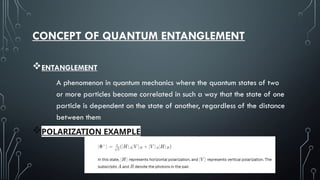
POLARIZATION EXAMPLE
QUANTUM COMPUTATION AND COMMUNICATION
QUANTUM COMPUTING
A revolutionary approach to computation that leverages the principles of quantum
mechanics to perform calculations.
Quantum networking plays a crucial role in quantum computing by enabling the
connection and communication between multiple quantum processors or quantum computing
nodes.
QUANTUM COMMUNICATION
Qubits are used to encode and transmit quantum information in quantum communication
protocols also enables exchange of qubits and entangled states over quantum channels
HARDWARE REQUIRED
A hardware quantum network refers to a physical infrastructure that enables the
transmission and processing of quantum information between multiple nodes.
Unlike classical networks that rely on classical bits to transmit information,
quantum networks utilize quantum bits or qubits to encode and process
information.
COMPONENTS OF QUANTUM NETWORK
A quantum network depends on two main components:
Quantum processor node
There are different implementations for quantum processor nodes. Among these
implementations are nitrogen-vacancy (NV) centers in diamond. These NV centers are a
defect in the diamond crystal, where a carbon atom is replaced by a nitrogen atom and an
adjacent empty site - a vacancy.
Interface to link two or more nodes
A tiny defect in a diamond, and this defect is called an NV (Nitrogen-Vacancy) center
Light emitted by NV centers can be used as the interface to link two or more nodes.
HARDWARES
Quantum Nodes: These are the endpoints of the quantum network where qubits are generated, manipulated,
and measured. Quantum nodes can be physical systems such as atoms, ions, photons, or superconducting circuits.
Quantum Channels: These are the mediums through which qubits are transmitted between quantum nodes.
Quantum channels can be optical fibers, free space, or even exotic physical systems such as superconducting
transmission lines.
Quantum Repeaters: Quantum signals tend to degrade as they travel through a quantum channel due to noise
and loss. Quantum repeaters are devices or protocols that enable the extension of the range of quantum
communication by mitigating these effects. They are crucial for building long-distance quantum networks.
Quantum Memory: Quantum information is fragile and can be easily lost due to decoherence. Quantum
memory devices store qubits for a certain period, allowing them to be retrieved later. Quantum memory is
essential for various quantum communication and quantum computing protocols.
Quantum Switches and Interfaces: These components allow for the routing and manipulation of quantum
information within the network. They enable the creation of complex quantum communication protocols and
networks.
ENTANGLEMENT
It’s the phenomenon when two quantum systems become linked and share data. For example,
two entangled particles share properties such as spin, polarization and conservation. Any
change in the basic quantum characteristics of one particle requires an immediate and
predictable change in the other particle, regardless of the distance between them.
Example, two entangled photons spinning in a singlet state. The conservation principle states
the total spin of an entangled group must be zero. The two photons have opposite spin
orientations and maintain a total spin momentum of zero. If one photon starts spinning from
down to up, the other switches from up to down to keep the total spin momentum at zero.
Quantum bits (qubits) entangled with each other can transmit data. If a qubit at one end of
the network changes state, the entangled qubit at the other end of the network instantly
reflects the correlated changes. Bits of data are communicated by observing these changes.
METHODS TO CONNECT END NODES
• The end nodes on a quantum network house quantum processors that generate
and receive qubits. They might also have some quantum memory capacity.
Methods quantum networking uses to connect end nodes:
1.)Direct connection : Sending entangled photon beams in free space to connect
endpoints without using a physical medium.
2.)Indirect connection : This method commonly uses optical fibers and specialized
optical switches to connect end nodes. Entangled photons travel through the
fibers, which maintains the quantum states of the qubits carrying data.
• For longer distances, specialized quantum repeaters move traffic along
multiple, hops.
HOW INFORMATION FLOWS
• Repeaters enable end-to-end communications via a chain of quantum key
distribution (QKD) events. These events give the end nodes a securely generated
and transmitted encryption key that is also known to one of the intervening
repeaters.
• These repeaters perform a quantum operation(called a Bell measurement)on
pairs of qubits to entangle them, so changes in one are reflected in the other. A
transmitting end node creates a pair of entangled qubits, holding one and sending
the other through the repeater network. A repeater entangles the incoming qubit
with one of a pair it has generated internally. Any changes in the state of the qubit
from the transmitting end node are reflected in the state of the qubit from the
repeater. The second repeater qubit travels to the next repeater in line, and the
process repeats and extends the entanglement until the qubit reaches the receiving
end node. At that point, changes in the qubit held on a transmitting node result in
changes in the sent qubit on the receiving node, enabling information to flow.
ARCHITECHTURE OF QUANTUM NETWORK
DIFFERENT TOPOLOGIES IN QUANTUM NETWORK
1. Point-to-point quantum links: These are the simplest type of quantum network, consisting of two or
more devices that are directly connected by a quantum channel. Point-to-point links can be used for
tasks such as quantum key distribution and quantum teleportation.
2. Quantum repeater networks: Quantum repeaters are devices that amplify and regenerate
quantum signals as they travel long distances, enabling quantum communication to extend beyond
the limits of direct point-to-point links. Quantum repeaters can be used to create a network of
interconnected quantum devices.
3. Quantum memories: Quantum memories are devices that can store and retrieve quantum
information for later use..
4. Entanglement swapping networks: Entanglement swapping is a process by which two separate
pairs of entangled particles can be used to create a new entangled pair. Entanglement swapping
networks enable the creation of complex entangled states across multiple quantum devices.
5. Hybrid classical-quantum networks: Hybrid networks combine classical and quantum devices to
enable the transmission and processing of both classical and quantum information.
CRYPTOGRAPHY
Cryptography is literally the art of "secret writing". It is used to secure
communication by protecting the confidentiality and integrity of messages and
sensitive data. Without it, anyone could read a message or forge a private
conversation. Messages are made secret by transforming them from "plaintext"
into "ciphertext" using a cipher and performing the process of encryption.
Decryption turns scrambled and unreadable ciphertext back into plaintext .When
cryptographers talk about a "key", they are referring to a shared secret that
controls the ability to hide and un-hide information. There are two types of
cryptography that are often referred to as "symmetric key" and "public key"
SYMMETRIC-KEY CRYPTOGRAPHY
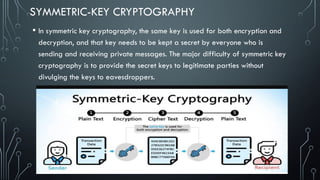
• In symmetric key cryptography, the same key is used for both encryption and
decryption, and that key needs to be kept a secret by everyone who is
sending and receiving private messages. The major difficulty of symmetric key
cryptography is to provide the secret keys to legitimate parties without
divulging the keys to eavesdroppers.
ASYMMETRIC ENCRYPTION
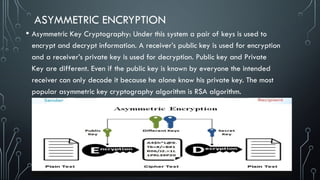
• Asymmetric Key Cryptography: Under this system a pair of keys is used to
encrypt and decrypt information. A receiver’s public key is used for encryption
and a receiver’s private key is used for decryption. Public key and Private
Key are different. Even if the public key is known by everyone the intended
receiver can only decode it because he alone know his private key. The most
popular asymmetric key cryptography algorithm is RSA algorithm.
QUANTUM CRYPTOGRAPHY
• Quantum computing threatens the basic goal of secure, authentic
communication because in being able to do certain kinds of computations that
conventional computers cannot, cryptographic keys can be broken quickly by
a quantum computer and this allows an eavesdropper to listen into private
communications and pretend to be someone whom they are not. Quantum
computers accomplish this by quickly reverse calculating or guessing secret
cryptographic keys, a task that is considered very hard and improbable for a
conventional computer . A quantum computer cannot break all types of
cryptographic keys and some cryptographic algorithms in use today are also
safe to use in a world of widespread quantum computing. The following
sections will describe which types of cryptography are safe from quantum
attacks and which ciphers, protocols and security systems are most vulnerable.
BENEFITS OF QUANTUM NETWORKING
INCREASED COMPUTING POWER
OPTIMIZED UPTIME AND RELIABILTIY
BETTER OVERALL EFFICIENCY
EASIER DEVELOPMENT
MORE EFFECTIVE ERROR CORRECTION
ENHANCED SCALABILITY
APPLICATIONS OF QUANTUM NETWORKING
Secure Communication
Quantum Internet
Quantum Key Distribution
Quantum Teleportation
Quantum Sensor Network
Distributed Quantum Computing
Quantum Clock Synchronization
Quantum Enhanced Imaging
DRAWBACKS
Fragile nature of quantum information
Complex manipulation
Slow communication
Scalability issues
High costs
Complex integrations
FUTURE PLANS
Large-scale enterprises and organizations are interested in quantum networking
to enable optimized computing and fast communication and address complex
problems . It will take years for quantum networks to operate commercially at
affordable prices like current computer networks. In the next few decades,
several sectors like IT, space, research, healthcare and retail can attain fast
communication and high-performance computing with quantum networking.
Major quantum network projects and QKD protocols implemented :
DARPA Quantum Network 2001 Hierarchical network in Wuhu, China 2009
SECOCQ QKD network in Vienna 2003
Tokyo QKD network 2009 Geneva area network ( Swiss Quantum ) 2010
CURRENT STATUS
In 2022, Researchers at the Jinan Institute of Quantum Technology
demonstrated quantum entanglement between two memory devices located at
12.5 km apart from each other.
In 2024, researchers in the U.K and Germany produced, stored and
retrieved quantum information using quantum memory. This involved
interfacing a quantum dot photon source and a quantum memory.
ADITYA ARYAN SINGH (22BCS007)
ANURAG YADAV (22BCS019)
ARYAN CHAUHAN (22BCS025)
DEV ADITYA GAUTAM (22BCS033)
DHRUV BAJPAI (22BCS034)

QUANTUM_NETWORKING.pptx a ppt on quantum networking

  • 1.
  • 2.
    INTRODUCING QUANTUM NETWORKING QUANTUM Theword refers to the smallest discrete unit of something or a physical quantity. NETWORKING Networking refers to the practice of connecting devices or systems to enable communication and resource sharing QUANTUM NETWORKING An emerging field that integrates principles of quantum mechanics with networking technology to enable secure and efficient communication and computation.
  • 3.
    IMPORTANT TERMS QUANTUM STATES Itrefers to the state of a quantum system, describes the properties and characteristics of a quantum system such as position , momentum, spin or polarization of particles QUBITS Qubits are the fundamental units of quantum information in quantum networking. Their unique property of superposition and entanglement pave the way for secure communication and faster computation
  • 4.
    CONCEPT OF QUANTUMSUPERPOSITION QUANTUM SUPERPOSITION Fundamental principle of quantum mechanics that describes the ability of quantum systems to exist in multiple states simultaneously. APPLICATIONS In quantum computing qubits in superposition can perform multiple calculations simultaneously making it way faster. In quantum communication superposition allows for secure transmission of quantum information using protocols like QKD
  • 5.
    CONCEPT OF QUANTUMENTANGLEMENT ENTANGLEMENT A phenomenon in quantum mechanics where the quantum states of two or more particles become correlated in such a way that the state of one particle is dependent on the state of another, regardless of the distance between them POLARIZATION EXAMPLE
  • 6.
    QUANTUM COMPUTATION ANDCOMMUNICATION QUANTUM COMPUTING A revolutionary approach to computation that leverages the principles of quantum mechanics to perform calculations. Quantum networking plays a crucial role in quantum computing by enabling the connection and communication between multiple quantum processors or quantum computing nodes. QUANTUM COMMUNICATION Qubits are used to encode and transmit quantum information in quantum communication protocols also enables exchange of qubits and entangled states over quantum channels
  • 7.
    HARDWARE REQUIRED A hardwarequantum network refers to a physical infrastructure that enables the transmission and processing of quantum information between multiple nodes. Unlike classical networks that rely on classical bits to transmit information, quantum networks utilize quantum bits or qubits to encode and process information.
  • 8.
    COMPONENTS OF QUANTUMNETWORK A quantum network depends on two main components: Quantum processor node There are different implementations for quantum processor nodes. Among these implementations are nitrogen-vacancy (NV) centers in diamond. These NV centers are a defect in the diamond crystal, where a carbon atom is replaced by a nitrogen atom and an adjacent empty site - a vacancy. Interface to link two or more nodes A tiny defect in a diamond, and this defect is called an NV (Nitrogen-Vacancy) center Light emitted by NV centers can be used as the interface to link two or more nodes.
  • 9.
    HARDWARES Quantum Nodes: Theseare the endpoints of the quantum network where qubits are generated, manipulated, and measured. Quantum nodes can be physical systems such as atoms, ions, photons, or superconducting circuits. Quantum Channels: These are the mediums through which qubits are transmitted between quantum nodes. Quantum channels can be optical fibers, free space, or even exotic physical systems such as superconducting transmission lines. Quantum Repeaters: Quantum signals tend to degrade as they travel through a quantum channel due to noise and loss. Quantum repeaters are devices or protocols that enable the extension of the range of quantum communication by mitigating these effects. They are crucial for building long-distance quantum networks. Quantum Memory: Quantum information is fragile and can be easily lost due to decoherence. Quantum memory devices store qubits for a certain period, allowing them to be retrieved later. Quantum memory is essential for various quantum communication and quantum computing protocols. Quantum Switches and Interfaces: These components allow for the routing and manipulation of quantum information within the network. They enable the creation of complex quantum communication protocols and networks.
  • 10.
    ENTANGLEMENT It’s the phenomenonwhen two quantum systems become linked and share data. For example, two entangled particles share properties such as spin, polarization and conservation. Any change in the basic quantum characteristics of one particle requires an immediate and predictable change in the other particle, regardless of the distance between them. Example, two entangled photons spinning in a singlet state. The conservation principle states the total spin of an entangled group must be zero. The two photons have opposite spin orientations and maintain a total spin momentum of zero. If one photon starts spinning from down to up, the other switches from up to down to keep the total spin momentum at zero. Quantum bits (qubits) entangled with each other can transmit data. If a qubit at one end of the network changes state, the entangled qubit at the other end of the network instantly reflects the correlated changes. Bits of data are communicated by observing these changes.
  • 11.
    METHODS TO CONNECTEND NODES • The end nodes on a quantum network house quantum processors that generate and receive qubits. They might also have some quantum memory capacity. Methods quantum networking uses to connect end nodes: 1.)Direct connection : Sending entangled photon beams in free space to connect endpoints without using a physical medium. 2.)Indirect connection : This method commonly uses optical fibers and specialized optical switches to connect end nodes. Entangled photons travel through the fibers, which maintains the quantum states of the qubits carrying data. • For longer distances, specialized quantum repeaters move traffic along multiple, hops.
  • 12.
    HOW INFORMATION FLOWS •Repeaters enable end-to-end communications via a chain of quantum key distribution (QKD) events. These events give the end nodes a securely generated and transmitted encryption key that is also known to one of the intervening repeaters. • These repeaters perform a quantum operation(called a Bell measurement)on pairs of qubits to entangle them, so changes in one are reflected in the other. A transmitting end node creates a pair of entangled qubits, holding one and sending the other through the repeater network. A repeater entangles the incoming qubit with one of a pair it has generated internally. Any changes in the state of the qubit from the transmitting end node are reflected in the state of the qubit from the repeater. The second repeater qubit travels to the next repeater in line, and the process repeats and extends the entanglement until the qubit reaches the receiving end node. At that point, changes in the qubit held on a transmitting node result in changes in the sent qubit on the receiving node, enabling information to flow.
  • 13.
  • 14.
    DIFFERENT TOPOLOGIES INQUANTUM NETWORK 1. Point-to-point quantum links: These are the simplest type of quantum network, consisting of two or more devices that are directly connected by a quantum channel. Point-to-point links can be used for tasks such as quantum key distribution and quantum teleportation. 2. Quantum repeater networks: Quantum repeaters are devices that amplify and regenerate quantum signals as they travel long distances, enabling quantum communication to extend beyond the limits of direct point-to-point links. Quantum repeaters can be used to create a network of interconnected quantum devices. 3. Quantum memories: Quantum memories are devices that can store and retrieve quantum information for later use.. 4. Entanglement swapping networks: Entanglement swapping is a process by which two separate pairs of entangled particles can be used to create a new entangled pair. Entanglement swapping networks enable the creation of complex entangled states across multiple quantum devices. 5. Hybrid classical-quantum networks: Hybrid networks combine classical and quantum devices to enable the transmission and processing of both classical and quantum information.
  • 15.
    CRYPTOGRAPHY Cryptography is literallythe art of "secret writing". It is used to secure communication by protecting the confidentiality and integrity of messages and sensitive data. Without it, anyone could read a message or forge a private conversation. Messages are made secret by transforming them from "plaintext" into "ciphertext" using a cipher and performing the process of encryption. Decryption turns scrambled and unreadable ciphertext back into plaintext .When cryptographers talk about a "key", they are referring to a shared secret that controls the ability to hide and un-hide information. There are two types of cryptography that are often referred to as "symmetric key" and "public key"
  • 16.
    SYMMETRIC-KEY CRYPTOGRAPHY • Insymmetric key cryptography, the same key is used for both encryption and decryption, and that key needs to be kept a secret by everyone who is sending and receiving private messages. The major difficulty of symmetric key cryptography is to provide the secret keys to legitimate parties without divulging the keys to eavesdroppers.
  • 17.
    ASYMMETRIC ENCRYPTION • AsymmetricKey Cryptography: Under this system a pair of keys is used to encrypt and decrypt information. A receiver’s public key is used for encryption and a receiver’s private key is used for decryption. Public key and Private Key are different. Even if the public key is known by everyone the intended receiver can only decode it because he alone know his private key. The most popular asymmetric key cryptography algorithm is RSA algorithm.
  • 18.
    QUANTUM CRYPTOGRAPHY • Quantumcomputing threatens the basic goal of secure, authentic communication because in being able to do certain kinds of computations that conventional computers cannot, cryptographic keys can be broken quickly by a quantum computer and this allows an eavesdropper to listen into private communications and pretend to be someone whom they are not. Quantum computers accomplish this by quickly reverse calculating or guessing secret cryptographic keys, a task that is considered very hard and improbable for a conventional computer . A quantum computer cannot break all types of cryptographic keys and some cryptographic algorithms in use today are also safe to use in a world of widespread quantum computing. The following sections will describe which types of cryptography are safe from quantum attacks and which ciphers, protocols and security systems are most vulnerable.
  • 20.
    BENEFITS OF QUANTUMNETWORKING INCREASED COMPUTING POWER OPTIMIZED UPTIME AND RELIABILTIY BETTER OVERALL EFFICIENCY EASIER DEVELOPMENT MORE EFFECTIVE ERROR CORRECTION ENHANCED SCALABILITY
  • 21.
    APPLICATIONS OF QUANTUMNETWORKING Secure Communication Quantum Internet Quantum Key Distribution Quantum Teleportation Quantum Sensor Network Distributed Quantum Computing Quantum Clock Synchronization Quantum Enhanced Imaging
  • 22.
    DRAWBACKS Fragile nature ofquantum information Complex manipulation Slow communication Scalability issues High costs Complex integrations
  • 23.
    FUTURE PLANS Large-scale enterprisesand organizations are interested in quantum networking to enable optimized computing and fast communication and address complex problems . It will take years for quantum networks to operate commercially at affordable prices like current computer networks. In the next few decades, several sectors like IT, space, research, healthcare and retail can attain fast communication and high-performance computing with quantum networking. Major quantum network projects and QKD protocols implemented : DARPA Quantum Network 2001 Hierarchical network in Wuhu, China 2009 SECOCQ QKD network in Vienna 2003 Tokyo QKD network 2009 Geneva area network ( Swiss Quantum ) 2010
  • 24.
    CURRENT STATUS In 2022,Researchers at the Jinan Institute of Quantum Technology demonstrated quantum entanglement between two memory devices located at 12.5 km apart from each other. In 2024, researchers in the U.K and Germany produced, stored and retrieved quantum information using quantum memory. This involved interfacing a quantum dot photon source and a quantum memory.
  • 25.
    ADITYA ARYAN SINGH(22BCS007) ANURAG YADAV (22BCS019) ARYAN CHAUHAN (22BCS025) DEV ADITYA GAUTAM (22BCS033) DHRUV BAJPAI (22BCS034)