IOT ARCHITECTURE AND
COMPONENTS
NAME:VIKRAM
ROLL NO:14
SUBJECT:IOT
COURSE:MCA
TEACHER:KRANTI SIR
COLLEGE:SR UNIVERSITY
WHAT IS IOT
 The term IoT, or Internet of Things,
refers to the collective network of
connected devices and the technology
that facilitates communication
between devices and the cloud, as
well as between the devices
themselves.
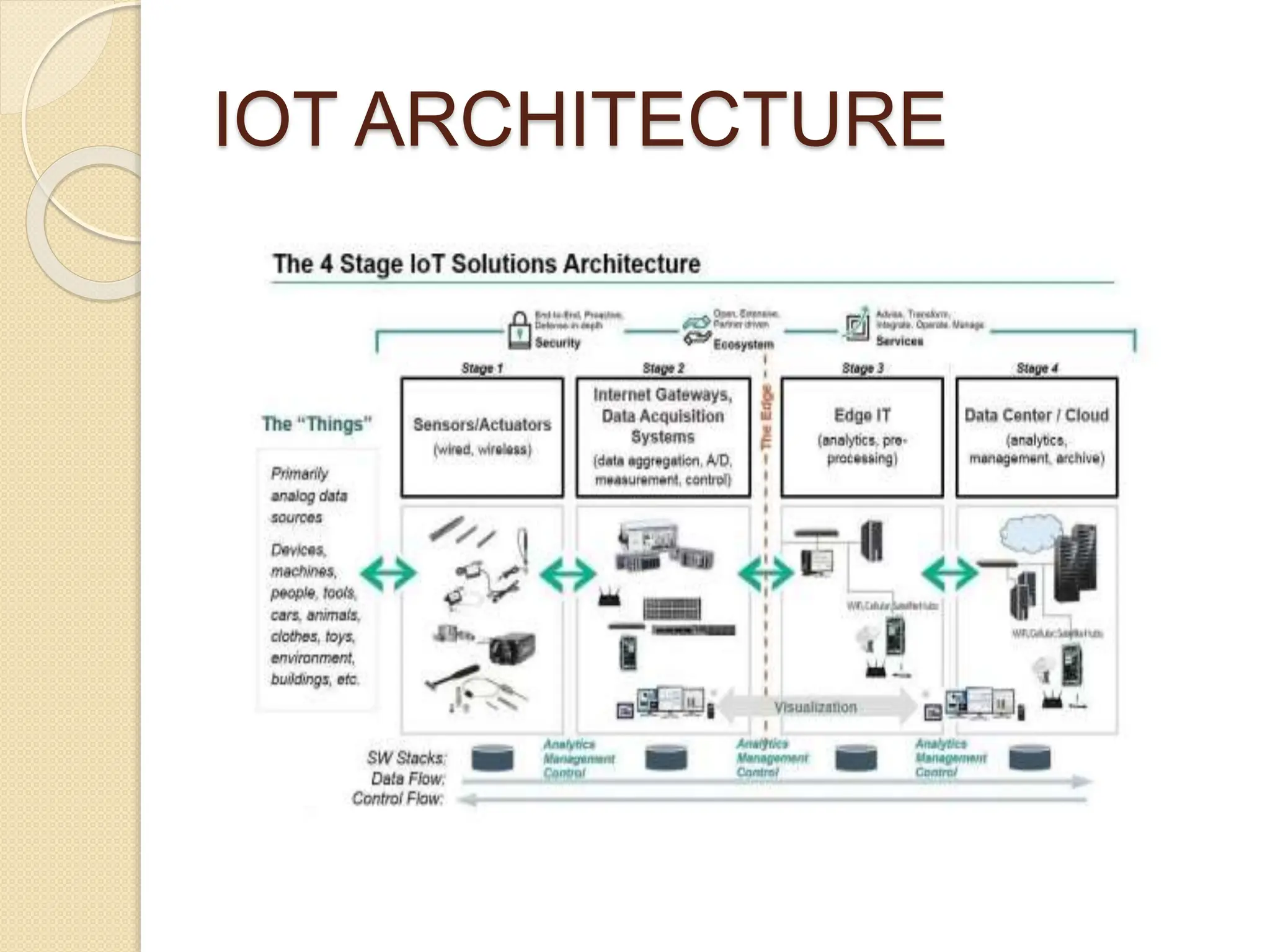
IOT ARCHITECTURE
STAGES OF IOT
 Sensors/actuators: Sensors collect data from the environment
or object under measurement and turn it into useful data
 The Internet gateway :The data from the sensors starts in
analog form. That data needs to be aggregated and
converted into digital streams for further processing
downstream. DAS perform these data aggregation and
conversion functions. EX:WIFI,LAN,INTERNET.
 Edge IT: Once IoT data has been digitized and aggregated,
it's ready to cross into the realm of IT. However, the data may
require further processing before it enters the data center.
This is where edge IT systems, which perform more analysis,
come into play.
 The data center and cloud :Data that needs more in-depth
processing, and where feedback doesn't have to be
immediate, gets forwarded to physical data center or cloud-
based systems, where more powerful IT systems can
analyze, manage, and securely store the data.
IOT COMPONENTS
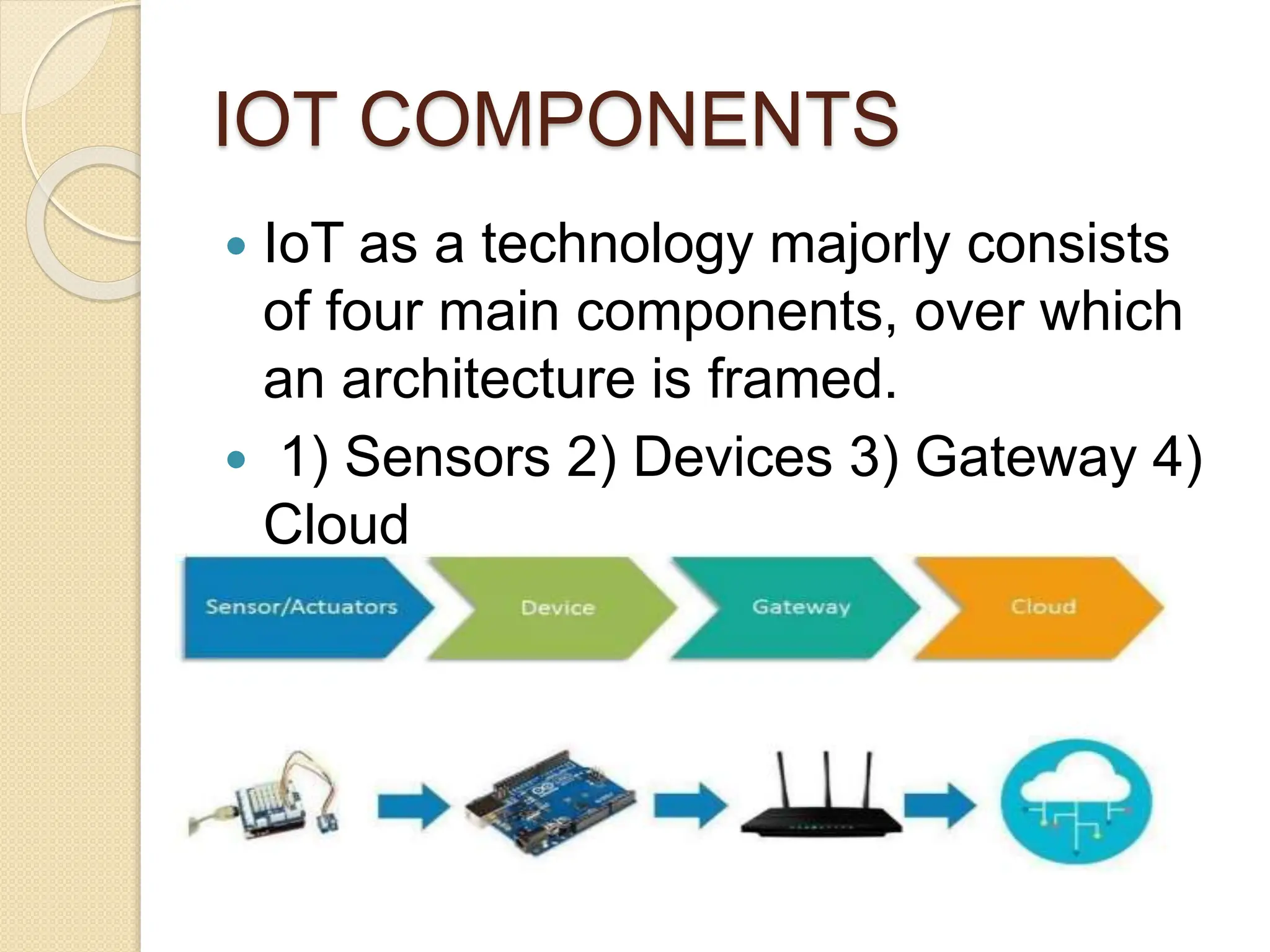
 IoT as a technology majorly consists
of four main components, over which
an architecture is framed.
 1) Sensors 2) Devices 3) Gateway 4)
Cloud
 SENSOR : There are a wide range of
IoT sensors used to detect and
measure various physical phenomena
such as heat and pressure.
 DEVICES : IoT devices are pieces of hardware,
such as sensors, actuators,gadgets,appliances, or
machines, that are programmed for certain
applications and can transmit data over the internet
or other networks
 GATEWAY:An IoT gateway is a centralized hub
that connects IoT devices and sensors to cloud-
based computing and data processing. Modern IoT
gateways often allow bidirectional data flow
between the cloud and IoT devices.
 CLOUD:An IoT cloud is a massive network
that supports IoT devices and applications.
This includes the underlying infrastructure,
servers and storage, needed for real-time
operations and processing.
CONCLUSION
By this we can conclude that with the
Help of iot devices we can interact them
Without physical and can operate them
Remotely or with voice command.
This will help reduce time consumption
And power saving also.
internet of  things(Architecture and components).pptx

internet of things(Architecture and components).pptx

  • 1.
    IOT ARCHITECTURE AND COMPONENTS NAME:VIKRAM ROLLNO:14 SUBJECT:IOT COURSE:MCA TEACHER:KRANTI SIR COLLEGE:SR UNIVERSITY
  • 2.
    WHAT IS IOT The term IoT, or Internet of Things, refers to the collective network of connected devices and the technology that facilitates communication between devices and the cloud, as well as between the devices themselves.
  • 3.
  • 4.
    STAGES OF IOT Sensors/actuators: Sensors collect data from the environment or object under measurement and turn it into useful data  The Internet gateway :The data from the sensors starts in analog form. That data needs to be aggregated and converted into digital streams for further processing downstream. DAS perform these data aggregation and conversion functions. EX:WIFI,LAN,INTERNET.  Edge IT: Once IoT data has been digitized and aggregated, it's ready to cross into the realm of IT. However, the data may require further processing before it enters the data center. This is where edge IT systems, which perform more analysis, come into play.  The data center and cloud :Data that needs more in-depth processing, and where feedback doesn't have to be immediate, gets forwarded to physical data center or cloud- based systems, where more powerful IT systems can analyze, manage, and securely store the data.
  • 5.
    IOT COMPONENTS  IoTas a technology majorly consists of four main components, over which an architecture is framed.  1) Sensors 2) Devices 3) Gateway 4) Cloud
  • 6.
     SENSOR :There are a wide range of IoT sensors used to detect and measure various physical phenomena such as heat and pressure.
  • 7.
     DEVICES :IoT devices are pieces of hardware, such as sensors, actuators,gadgets,appliances, or machines, that are programmed for certain applications and can transmit data over the internet or other networks
  • 8.
     GATEWAY:An IoTgateway is a centralized hub that connects IoT devices and sensors to cloud- based computing and data processing. Modern IoT gateways often allow bidirectional data flow between the cloud and IoT devices.
  • 9.
     CLOUD:An IoTcloud is a massive network that supports IoT devices and applications. This includes the underlying infrastructure, servers and storage, needed for real-time operations and processing.
  • 10.
    CONCLUSION By this wecan conclude that with the Help of iot devices we can interact them Without physical and can operate them Remotely or with voice command. This will help reduce time consumption And power saving also.