Quantum
Learning
Jean-
Christophe
Lavocat
Definitions
Hadamard
Impatient
Learning
Amplitude
Amplification
Majority
Problem
Quantum Learning
Quantum perceptron
Jean-Christophe Lavocat
David Meyer, Mathematics Department UCSD
La Jolla
July 6, 2009
Quantum
Learning
Jean-
Christophe
Lavocat
Definitions
Hadamard
Impatient
Learning
Amplitude
Amplification
Majority
Problem
Table of Content
1 Definitions
2 Hadamard
3 Impatient Learning
4 Amplitude Amplification
5 Majority Problem
Quantum
Learning
Jean-
Christophe
Lavocat
Definitions
Hadamard
Impatient
Learning
Amplitude
Amplification
Majority
Problem
Definitions
Boolean Concepts
Definition
Concept : a concept is a map c : X → Z2 define on a discret set X.
Extension (of the concept) : support of c−1
(1) ⊂ X
We call Bn (where n ∈ N) the set of boolean functions :
{0,1}n
→ {0,1}
Concept : a function of Bn
Concept class : a subset of Bn. We note C a concept class
Quantum
Learning
Jean-
Christophe
Lavocat
Definitions
Hadamard
Impatient
Learning
Amplitude
Amplification
Majority
Problem
Definitions
Oracles
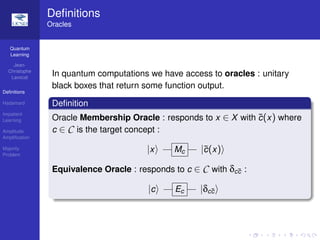
In quantum computations we have access to oracles : unitary
black boxes that return some function output.
Definition
Oracle Membership Oracle : responds to x ∈ X with ¯c(x) where
c ∈ C is the target concept :
|x Mc |¯c(x)
Equivalence Oracle : responds to c ∈ C with δc¯c :
|c Ec |δc¯c
Quantum
Learning
Jean-
Christophe
Lavocat
Definitions
Hadamard
Impatient
Learning
Amplitude
Amplification
Majority
Problem
Definitions
Exact Learning
Define the teacher as the membership oracle, the protocol is the
agreement about admissible queries and possible answers.
Definition : Exact Learning
A concept class C is learnable according to the protocol P if there
is a learning algorithm L such that, ∀f ∈ C and for any teacher Tf ,
L outputs a circuit h with probability 2/3 such that :
∀x ∈ Zn
2 h(x) = f(x)
Quantum
Learning
Jean-
Christophe
Lavocat
Definitions
Hadamard
Impatient
Learning
Amplitude
Amplification
Majority
Problem
Formalization of Quantum Learning Algorithms
Quantum Information Properties
Properties
∀U ∈ Un, U |x,b = |x,b ⊕f(x) we have :
U |x |− = (−1)f(x)
|x |−
We know that : H =
1
√
2
1 1
1 −1
= H
H|0 =
|0 +|1
√
2
H⊗n
|0...0 =
1
√
2n ∑
x∈Zn
2
|x
Quantum
Learning
Jean-
Christophe
Lavocat
Definitions
Hadamard
Impatient
Learning
Amplitude
Amplification
Majority
Problem
Table of Content
1 Definitions
2 Hadamard
3 Impatient Learning
4 Amplitude Amplification
5 Majority Problem
Quantum
Learning
Jean-
Christophe
Lavocat
Definitions
Hadamard
Impatient
Learning
Amplitude
Amplification
Majority
Problem
Bernstein and Vazirani’s Algorithm
Description of the Problem
Problem
We take a ∈ Zn
2. We have an oracle that returns a.x mod 2.
We study the following family of concept classes BVn
:
BVn
= {pa : Zn
2 → Z2|pa(x) = a.x mod 2}
We try to find a given an access to the oracle matrix.
Classically the complexity is : Ω(n)
Theorem
The search can be performed with only one query to the oracle :
H⊗n
UaH⊗n
|0 = |a
Quantum
Learning
Jean-
Christophe
Lavocat
Definitions
Hadamard
Impatient
Learning
Amplitude
Amplification
Majority
Problem
Bernstein and Vazirani’s Algorithm
Proof of the result
Proof.
We will consider concept classes such as : |X| = |C|. We then
have the following membership query matrix AC whose column c
is : (AC )_c = Uc
1
|X| ∑
x∈X
|x .
Therefore :
UaH⊗n
|0 = (UBV )c
1
√
2n ∑
x∈X
|x
xa
= (ABV )xa =
(−1)x.a
√
2n
We recognize H⊗n
. So finally:
H⊗n
(ABV )a = (H⊗n
ABV )a = (H⊗n
H⊗n
)a = Ia = |a
Quantum
Learning
Jean-
Christophe
Lavocat
Definitions
Hadamard
Impatient
Learning
Amplitude
Amplification
Majority
Problem
Bernstein and Vazirani’s Algorithm
Restriction of the result
This result is true only for the Hadamard concept classes ( where
the membership query matrix is an Orthogonal matrix with entries
±1 ).
For the Grover’s Search the membership oracle is :
Gn
= {δa : Zn
2 → Z2|δa(x) = δax }
Classically the complexity is : Ω(n) As :
(ABV )xa =
(−1)δxa
√
2n
=
1
√
N
NF†
|0 0|F −2I xa
Not unitary, and then, not part of Hadamard Class
Quantum
Learning
Jean-
Christophe
Lavocat
Definitions
Hadamard
Impatient
Learning
Amplitude
Amplification
Majority
Problem
Table of Content
1 Definitions
2 Hadamard
3 Impatient Learning
4 Amplitude Amplification
5 Majority Problem
Quantum
Learning
Jean-
Christophe
Lavocat
Definitions
Hadamard
Impatient
Learning
Amplitude
Amplification
Majority
Problem
Impatient Learning
Context
Context
1-query complexity is not always reached.
Question : How well is it possible to do with just a simple query?
Problem : If we can make any unitary transformation after a single
query, how do we maximize the probability that a measurement
returns |a ?
Quantum
Learning
Jean-
Christophe
Lavocat
Definitions
Hadamard
Impatient
Learning
Amplitude
Amplification
Majority
Problem
Impatient Learning
Measurement maximization
Measurement
We have a quantum system whose state is in the set of unit
vectors {|vi |i ∈ ZN}.
The task is to perform a measurement that maximize the
probability of correctly guessing which state the system was in
before the measurement was made.
If we use a basis {|ei |i ∈ ZN}, the probability to measure |ei
given a state |v before the measurement is : | v|ei |2
If we assume the system has been prepared in the state {|xi },
the quantity we want to improve is :
∑
i=1..N
| vi |ei |2
Quantum
Learning
Jean-
Christophe
Lavocat
Definitions
Hadamard
Impatient
Learning
Amplitude
Amplification
Majority
Problem
Impatient Learning
Algebras manipulations
Matrices optimization
In the third part of the article, they describe how to maximize the
measurement of a state.
Before making the measurement on the matrix A we can apply a
unitary matrix. We consider the matrices B ∼ A
(∃S ∈ U(n), B = SA)
If we use the diagonal projection (∀M ∈ Mn,∃U,V orthogonal and
d(M) diagonal such that : M = Ud(M)V):
||M||2 = max
i
d(M)ii
Equivalently, we try to maximize the quantity ||d(B)||2 over
{B|B ∼ A}.
Quantum
Learning
Jean-
Christophe
Lavocat
Definitions
Hadamard
Impatient
Learning
Amplitude
Amplification
Majority
Problem
Impatient Learning
Algebras manipulations
Result
The main result is : for any inversible matrix A with a
decomposition A = S−1
B (S: unitary, B:positive hermitian), the
closest point to In in the U(N)-orbit of A is B.
Bd(B) = d(B)B†
(1)
In order to find such a B we can use the square root of the Gram
matrix of A : G = A†
A. One can prove that there is always a unitary
matrix such that :
√
G = SA
Quantum
Learning
Jean-
Christophe
Lavocat
Definitions
Hadamard
Impatient
Learning
Amplitude
Amplification
Majority
Problem
Impatient Learning
Algorithm
Impatient Learning : Algorithm
In order to have the correct answer with the most probable
measurement :
Prepare the query register in an equal superposition of state
F†
|0
Query the membership oracle (the cth
column of AC is
UC F†
|0
Apply a unitary transformation SC such that BC = SC AC
satisfies (1)
Measure the resulting state SC F†
|0 in the computational
basis
Success probability
For initial equal superposition of states, it is optimal, and the
probability of learning is |(BC )¯c¯c|2
Quantum
Learning
Jean-
Christophe
Lavocat
Definitions
Hadamard
Impatient
Learning
Amplitude
Amplification
Majority
Problem
Table of Content
1 Definitions
2 Hadamard
3 Impatient Learning
4 Amplitude Amplification
5 Majority Problem
Quantum
Learning
Jean-
Christophe
Lavocat
Definitions
Hadamard
Impatient
Learning
Amplitude
Amplification
Majority
Problem
Amplitude Amplification
Context
Context
Single membership query does not provide enough information to
learn with a probability close to 1.
We will try to apply quantum amplification techniques invented by
Brassard & Høyer to increase the probability.
Quantum
Learning
Jean-
Christophe
Lavocat
Definitions
Hadamard
Impatient
Learning
Amplitude
Amplification
Majority
Problem
Amplitude Amplification
Theorem
Theorem (Brassard, Høyer, Mosca, Tapp - 2002)
ξ ∈ X a concept. H1 is the subspace spanned by the extension of
ξ, (ξ−1
(1)).
Π is the projection on H1. For any unitary transformation W, let
p(W) = |ΠW |0 |2
(propability that the state W |0 be in the
subspace of the extension).
If p(W) > 0 we set θ2
= p(W) (0 < θ π/2).
Applying the unitary transformation WUδ0
W†
Uξ amplifies the
probability of measuring the state in H1 :
p((WUδ0
W†
Uξ)m
W) max{1 −p(W),p(W)}
where m =
π
4θ
−
1
2
(nearest integer)
Quantum
Learning
Jean-
Christophe
Lavocat
Definitions
Hadamard
Impatient
Learning
Amplitude
Amplification
Majority
Problem
Amplitude Amplification
Application
If we let ξ = δc, H1 = span{|c } and Wc = ScUcF†
Amplified Impatient Learning : Algorithm
In order to have the correct answer with the most probable
measurement :
Prepare the query register in an equal superposition of state
F†
|0
Query the membership oracle (the cth
column of AC is
UC F†
|0 )
Apply a unitary transformation SC (we get :
SC UcF†
|0 = WC |0 )
Apply m times WC Uδ0
W
†
C Uδc
(with sin θ = |(BC )¯c¯c|)
Measure the resulting state SC F†
|0 in the computational
basis
Quantum
Learning
Jean-
Christophe
Lavocat
Definitions
Hadamard
Impatient
Learning
Amplitude
Amplification
Majority
Problem
Amplitude Amplification
Complexity
Theorem
For problems with BC having constant diagonal s, amplified
learning suceeds with probability max 1 −s2
,s2
.
The sample complexity is then 2m +1 = O(1).
However we use also the equivalence oracle (m queries).
Quantum
Learning
Jean-
Christophe
Lavocat
Definitions
Hadamard
Impatient
Learning
Amplitude
Amplification
Majority
Problem
Table of Content
1 Definitions
2 Hadamard
3 Impatient Learning
4 Amplitude Amplification
5 Majority Problem
Quantum
Learning
Jean-
Christophe
Lavocat
Definitions
Hadamard
Impatient
Learning
Amplitude
Amplification
Majority
Problem
Majority Problem
Context
Context
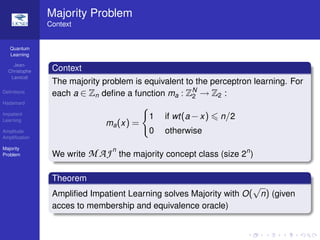
The majority problem is equivalent to the perceptron learning. For
each a ∈ Zn define a function ma : ZN
2 → Z2 :
ma(x) =
1 if wt(a −x) n/2
0 otherwise
We write M AJn
the majority concept class (size 2n
)
Theorem
Amplified Impatient Learning solves Majority with O(
√
n) (given
acces to membership and equivalence oracle)
Quantum
Learning
Jean-
Christophe
Lavocat
Definitions
Hadamard
Impatient
Learning
Amplitude
Amplification
Majority
Problem
Majority Problem
Case : N odd
Case N odd
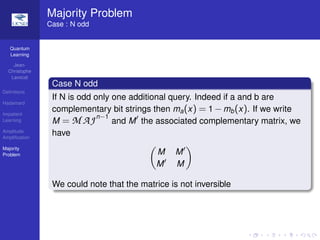
If N is odd only one additional query. Indeed if a and b are
complementary bit strings then ma(x) = 1 −mb(x). If we write
M = M AJn−1
and M the associated complementary matrix, we
have
M M
M M
We could note that the matrice is not inversible
Quantum
Learning
Jean-
Christophe
Lavocat
Definitions
Hadamard
Impatient
Learning
Amplitude
Amplification
Majority
Problem
Majority Problem
Zn
2 group algebra
Decomposition in X matrices
By induction on n we can see that the matrices representation of
Zn
2 could be decomposed as :
M = ∑
x∈Zn
2
vx Xx
where Xx
= Xx1...xn
= Xx1
⊗...⊗Xxn
and where |v = ∑
x∈Zn
2
vx |x
M is symmetric and has a constant diagonal.
Diagonalization with H
If M ∈ Zn
2 , M is diagonalized by H (Z=HXH).
Quantum
Learning
Jean-
Christophe
Lavocat
Definitions
Hadamard
Impatient
Learning
Amplitude
Amplification
Majority
Problem
Majority Problem
Norm maximization
Norm maximization
We can show that the query matrix of the Majority problem is part
of the Zn
2 group algebra.
If c is a given concept, we call ϕ(c −x) = ϕ(b) = Θ(n/2 −wt(b))
(Heaviside function). We have
AC =
1
√
2n ∑
b∈Zn
2
(−1)ϕ(b)
Xb
and thus, the eigenvalues are :
λc =
1
√
2n ∑
b∈Zn
2
(−1)ϕ(b)
(−1)b.c
Quantum
Learning
Jean-
Christophe
Lavocat
Definitions
Hadamard
Impatient
Learning
Amplitude
Amplification
Majority
Problem
Majority Problem
Norm maximization
Norm maximization
Calling λn,k = λc the eigenvalue of any c ∈ Zn
2 of weight k. Using
standard combinatorial techniques we have :
λn,k =
−(−1)k/2
√
2n
1.3...(k−1)
(n−1).(n−3)...(n−k+1))) if k is even
λn,k−1 if k is odd
Thus, if n is even, the smallest eigenvalue is :
|λn,n/2| =
−(−1)√
2n
n/2
n/4
if n ≡ 0 mod 4
− 2√
2n
(n−2)/2
(n−2)/4
if n ≡ 2 mod 4
Quantum
Learning
Jean-
Christophe
Lavocat
Definitions
Hadamard
Impatient
Learning
Amplitude
Amplification
Majority
Problem
Majority Problem
Norm maximization
Norm maximization
Using Stirling’s formule ( n! ∼
√
2πn
n
e
n
) we have :
|λn,n/2| lim
−−−→n→∞
1/
√
n
The eigenvalues’ average, s, is then Ω(1/
√
n).
Result
So the claimed result is proved :
The quantum query complexity of Majority is O(1/s) = O(
√
n)

Quantum Search and Quantum Learning