A System F accounting for scalars
            arXiv:0903.3741          


 Pablo Arrighi and Alejandro Díaz-Caro


             Université de Grenoble

     Laboratoire d'Informatique de Grenoble


    November 19th, 2009. PPS (Paris)
Motivation               Linear-Algebraic    λ-Calculus   System F            The scalar type system                    Conclusions and future work


Global context

                                                                                                                    1
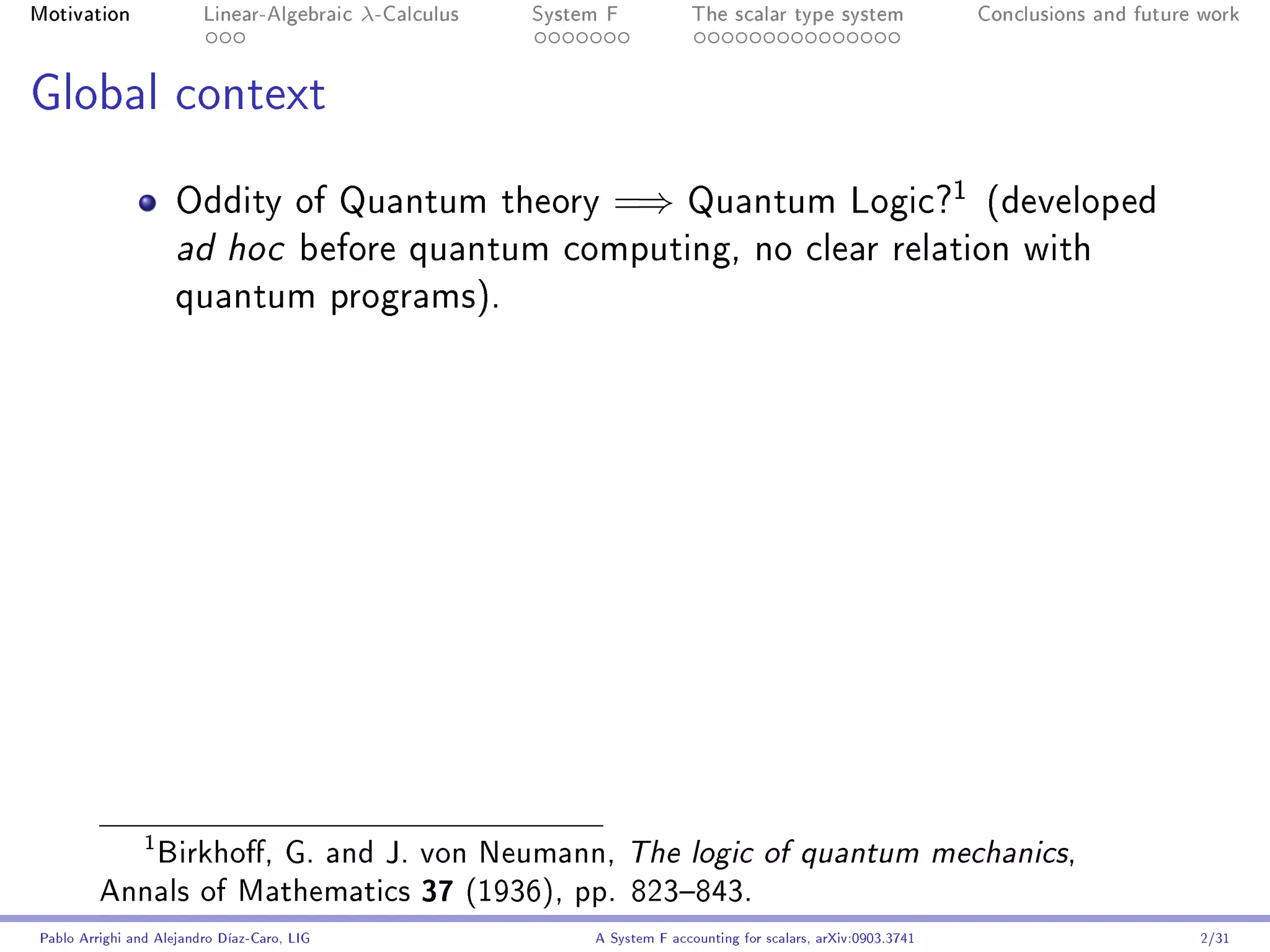
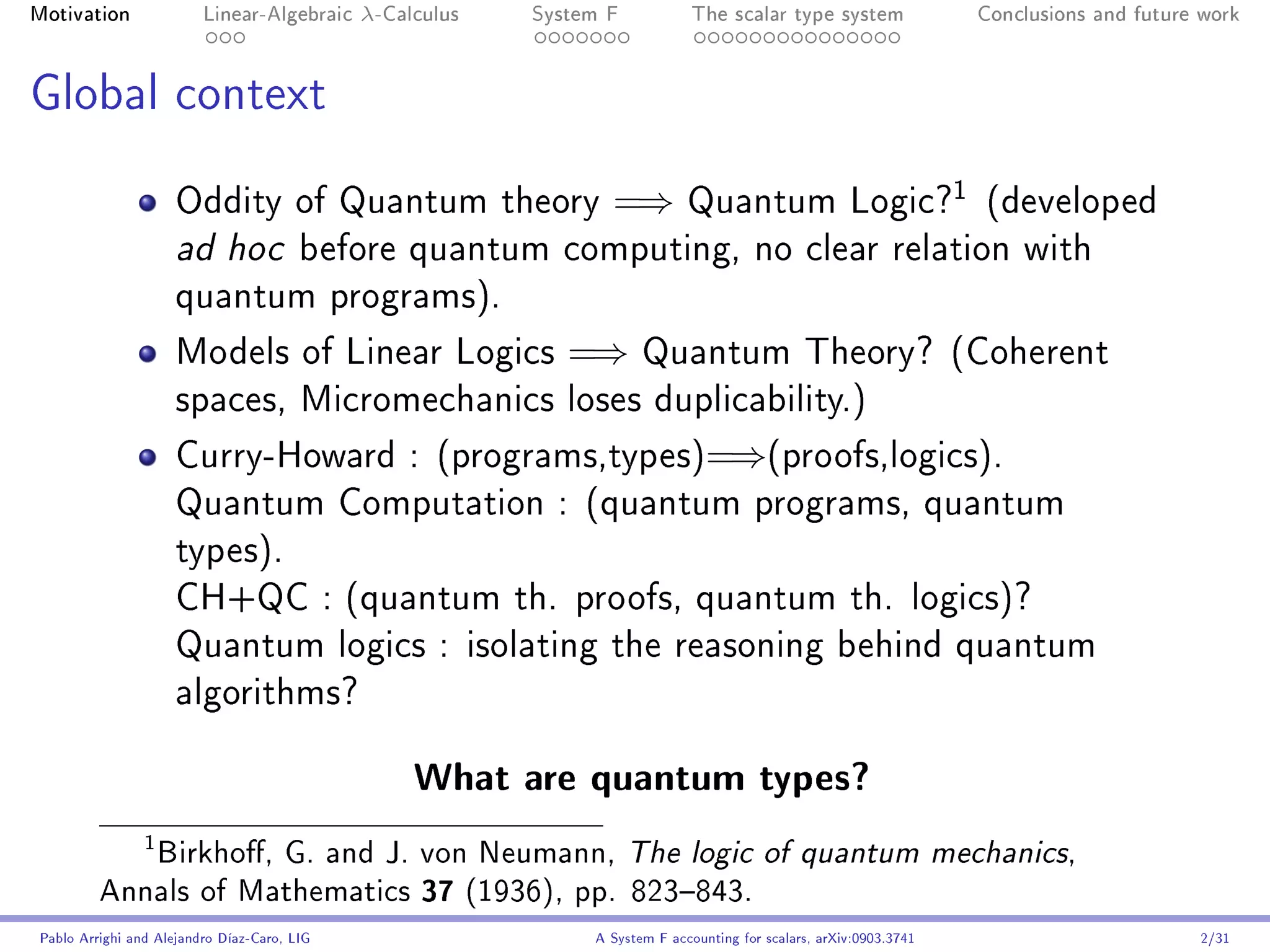
                     Oddity of Quantum theory                    =⇒          Quantum Logic?                             (developed
                     ad hoc             before quantum computing, no clear relation with
                     quantum programs).


            Birkho, G. and J. von Neumann, The logic of quantum mechanics,
                1


         Annals of Mathematics 37 (1936), pp. 823843.
Pablo Arrighi and Alejandro Díaz-Caro, LIG                     A System F accounting for scalars, arXiv:0903.3741                             2/31
Motivation               Linear-Algebraic    λ-Calculus   System F            The scalar type system                    Conclusions and future work


Global context

                                                                                                                    1
                     Oddity of Quantum theory                    =⇒          Quantum Logic?                             (developed
                     ad hoc             before quantum computing, no clear relation with
                     quantum programs).

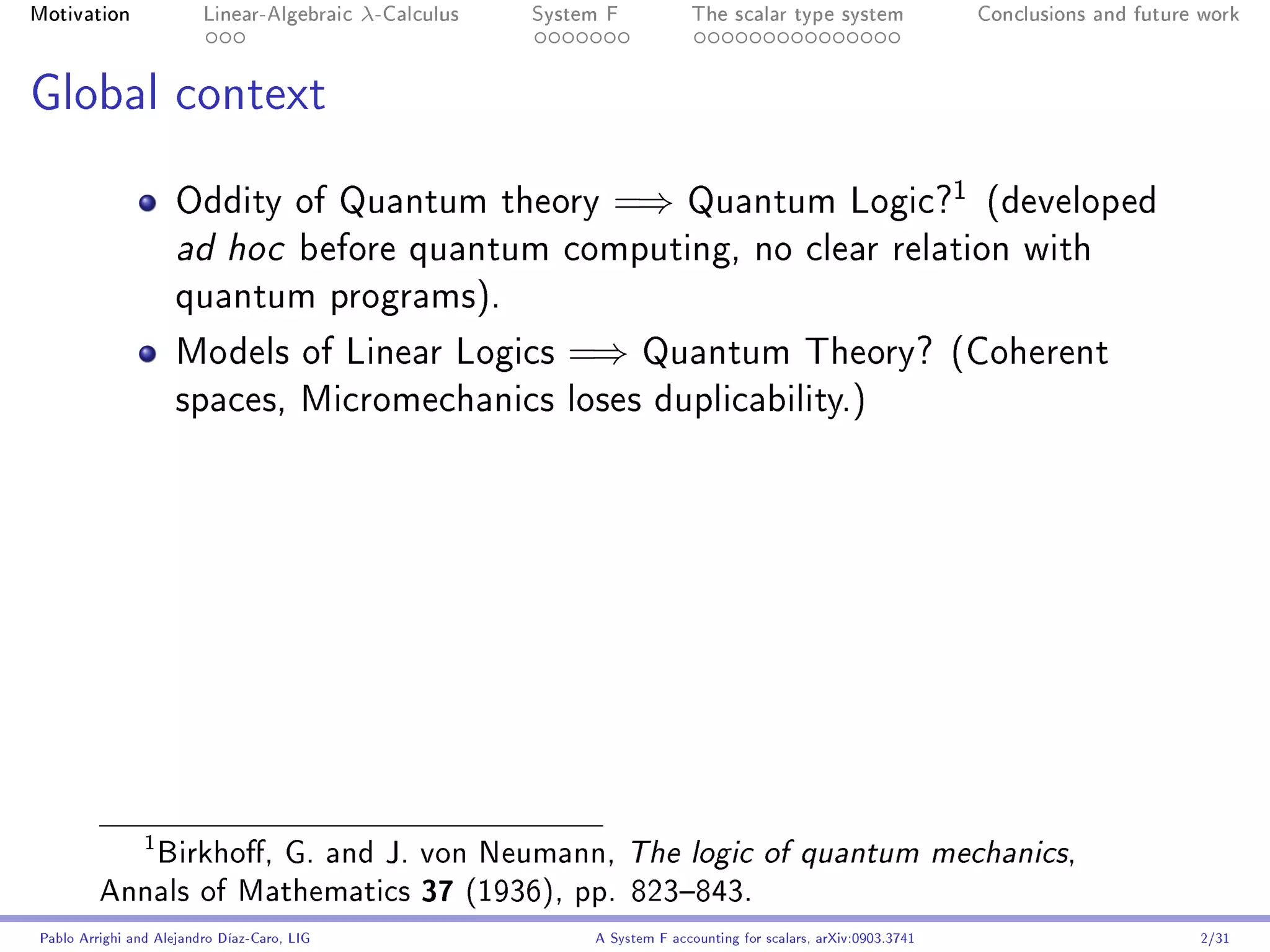
                     Models of Linear Logics                 =⇒       Quantum Theory? (Coherent
                     spaces, Micromechanics loses duplicability.)


            Birkho, G. and J. von Neumann, The logic of quantum mechanics,
                1


         Annals of Mathematics 37 (1936), pp. 823843.
Pablo Arrighi and Alejandro Díaz-Caro, LIG                     A System F accounting for scalars, arXiv:0903.3741                             2/31
Motivation               Linear-Algebraic    λ-Calculus   System F            The scalar type system                    Conclusions and future work


Global context

                                                                                                                    1
                     Oddity of Quantum theory                    =⇒          Quantum Logic?                             (developed
                     ad hoc             before quantum computing, no clear relation with
                     quantum programs).

                     Models of Linear Logics                 =⇒       Quantum Theory? (Coherent
                     spaces, Micromechanics loses duplicability.)

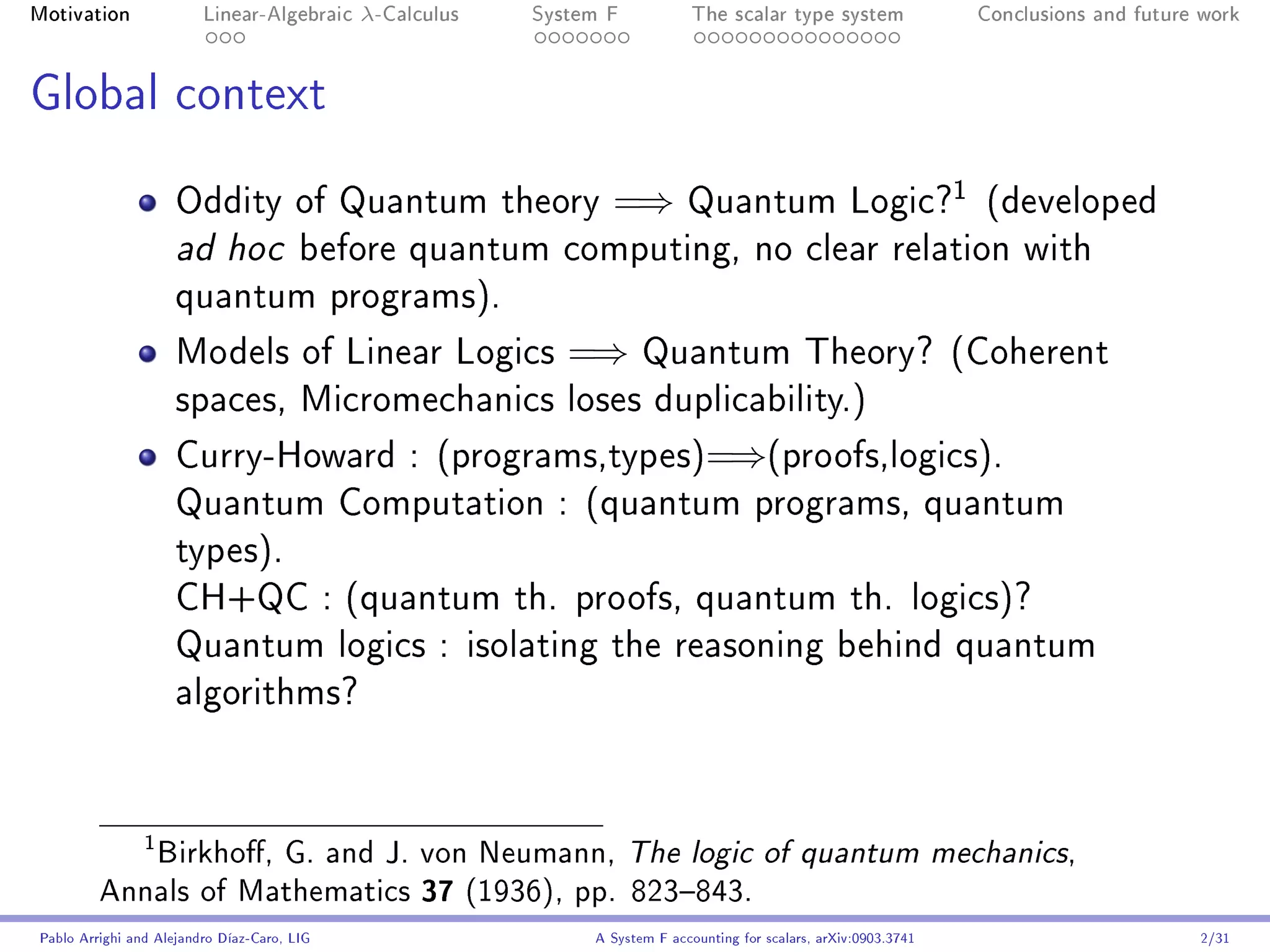
                     Curry-Howard : (programs,types)=⇒(proofs,logics).
                     Quantum Computation : (quantum programs, quantum
                     types).
                     CH+QC : (quantum th. proofs, quantum th. logics)?
                     Quantum logics : isolating the reasoning behind quantum
                     algorithms?


            Birkho, G. and J. von Neumann, The logic of quantum mechanics,
                1


         Annals of Mathematics 37 (1936), pp. 823843.
Pablo Arrighi and Alejandro Díaz-Caro, LIG                     A System F accounting for scalars, arXiv:0903.3741                             2/31
Motivation               Linear-Algebraic    λ-Calculus   System F            The scalar type system                    Conclusions and future work


Global context

                                                                                                                    1
                     Oddity of Quantum theory                    =⇒          Quantum Logic?                             (developed
                     ad hoc             before quantum computing, no clear relation with
                     quantum programs).

                     Models of Linear Logics                 =⇒       Quantum Theory? (Coherent
                     spaces, Micromechanics loses duplicability.)

                     Curry-Howard : (programs,types)=⇒(proofs,logics).
                     Quantum Computation : (quantum programs, quantum
                     types).
                     CH+QC : (quantum th. proofs, quantum th. logics)?
                     Quantum logics : isolating the reasoning behind quantum
                     algorithms?


                                                  What are quantum types?
            Birkho, G. and J. von Neumann, The logic of quantum mechanics,
                1


         Annals of Mathematics 37 (1936), pp. 823843.
Pablo Arrighi and Alejandro Díaz-Caro, LIG                     A System F accounting for scalars, arXiv:0903.3741                             2/31
Motivation               Linear-Algebraic    λ-Calculus   System F            The scalar type system                Conclusions and future work


Quantum theory


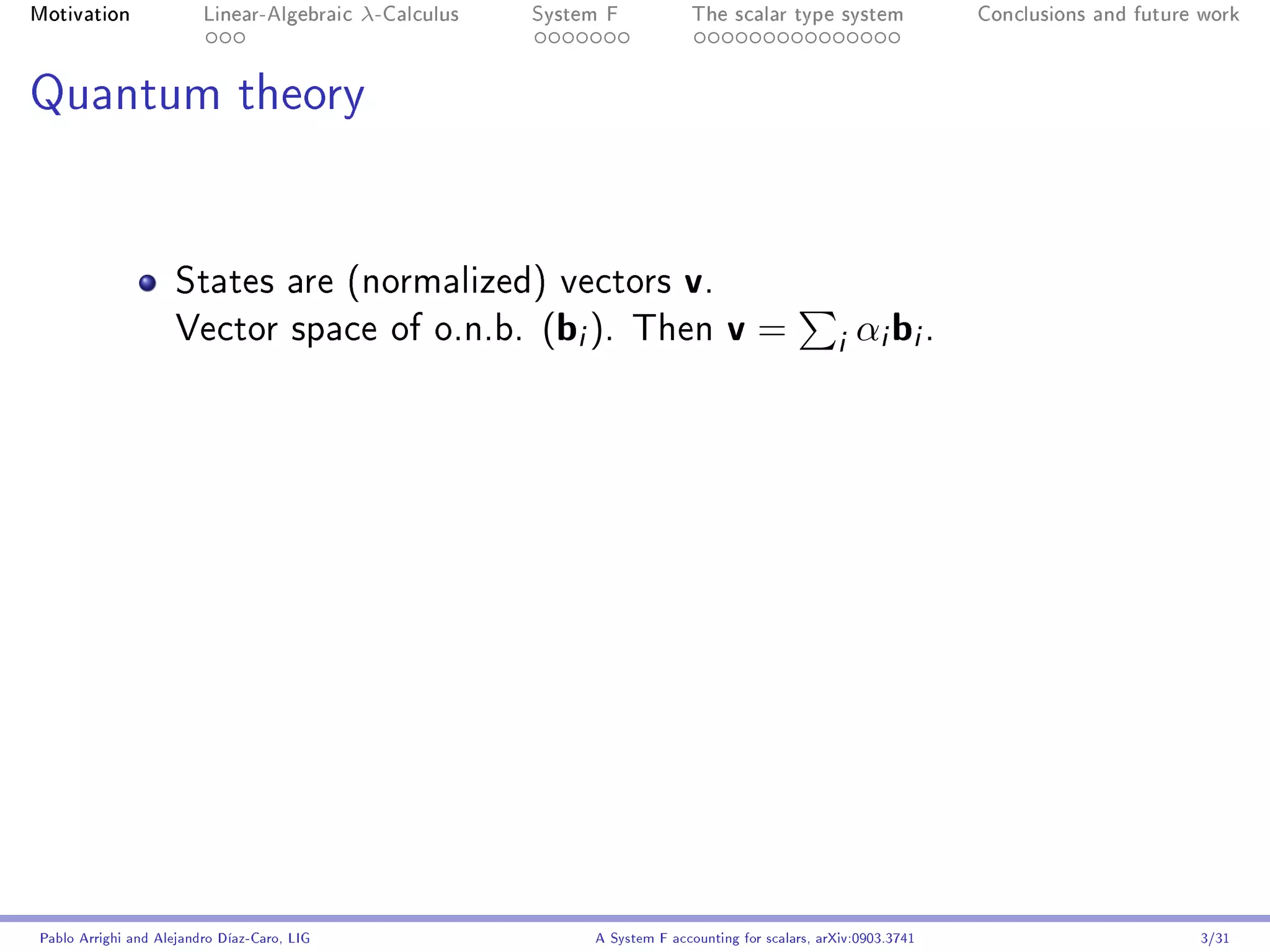
                     States are (normalized) vectors                        v.
                     Vector space of o.n.b.               (bi ).     Then          v=               i αi bi .


Pablo Arrighi and Alejandro Díaz-Caro, LIG                     A System F accounting for scalars, arXiv:0903.3741                         3/31
Motivation               Linear-Algebraic    λ-Calculus   System F            The scalar type system                Conclusions and future work


Quantum theory


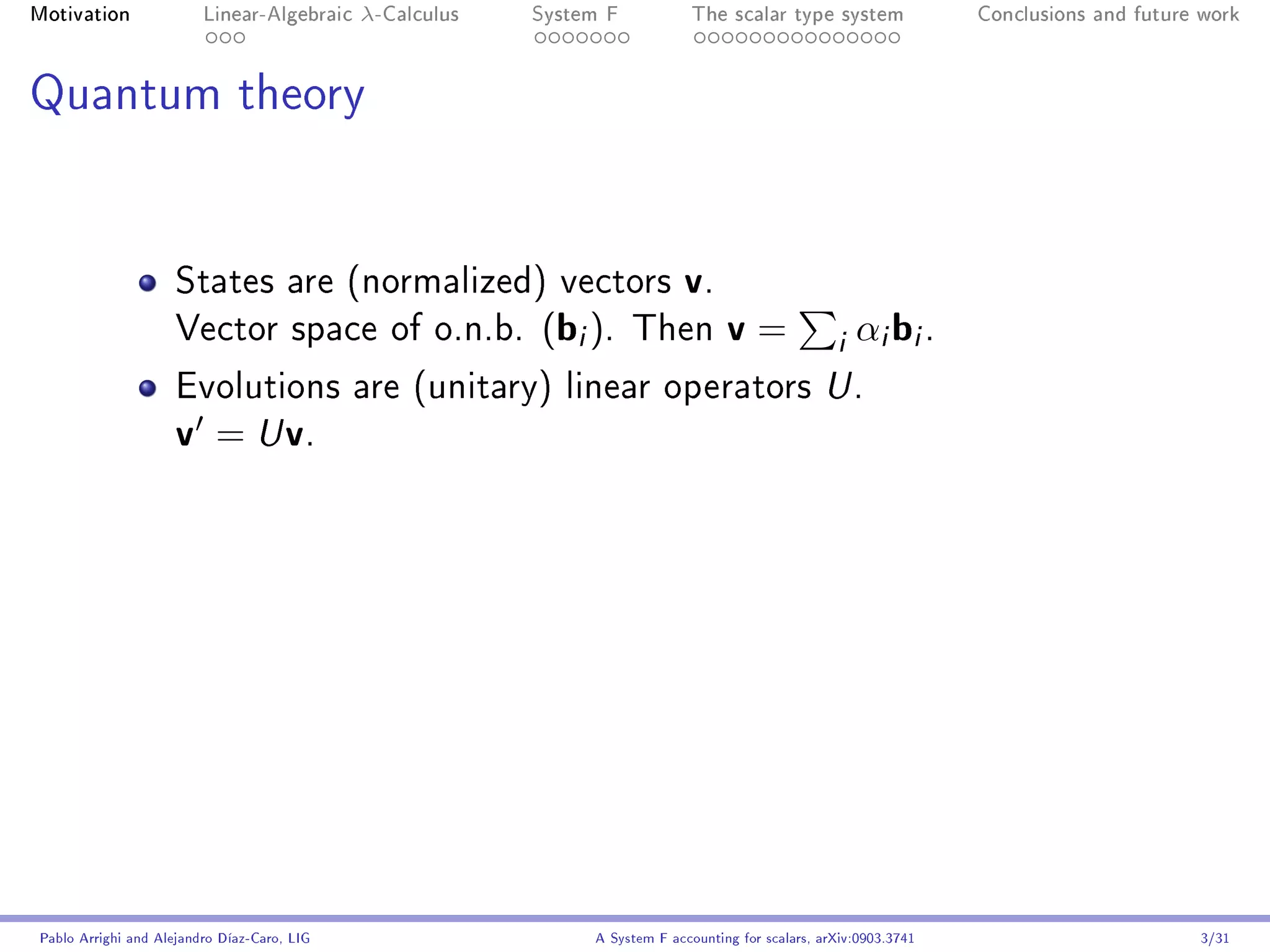
                     States are (normalized) vectors                        v.
                     Vector space of o.n.b.               (bi ).     Then          v=               i αi bi .
                     Evolutions are (unitary) linear operators U .
                     v = U v.


Pablo Arrighi and Alejandro Díaz-Caro, LIG                     A System F accounting for scalars, arXiv:0903.3741                         3/31
Motivation               Linear-Algebraic    λ-Calculus   System F            The scalar type system                Conclusions and future work


Quantum theory


                     States are (normalized) vectors                        v.
                     Vector space of o.n.b.               (bi ).     Then          v=               i αi bi .
                     Evolutions are (unitary) linear operators U .
                     v = U v.
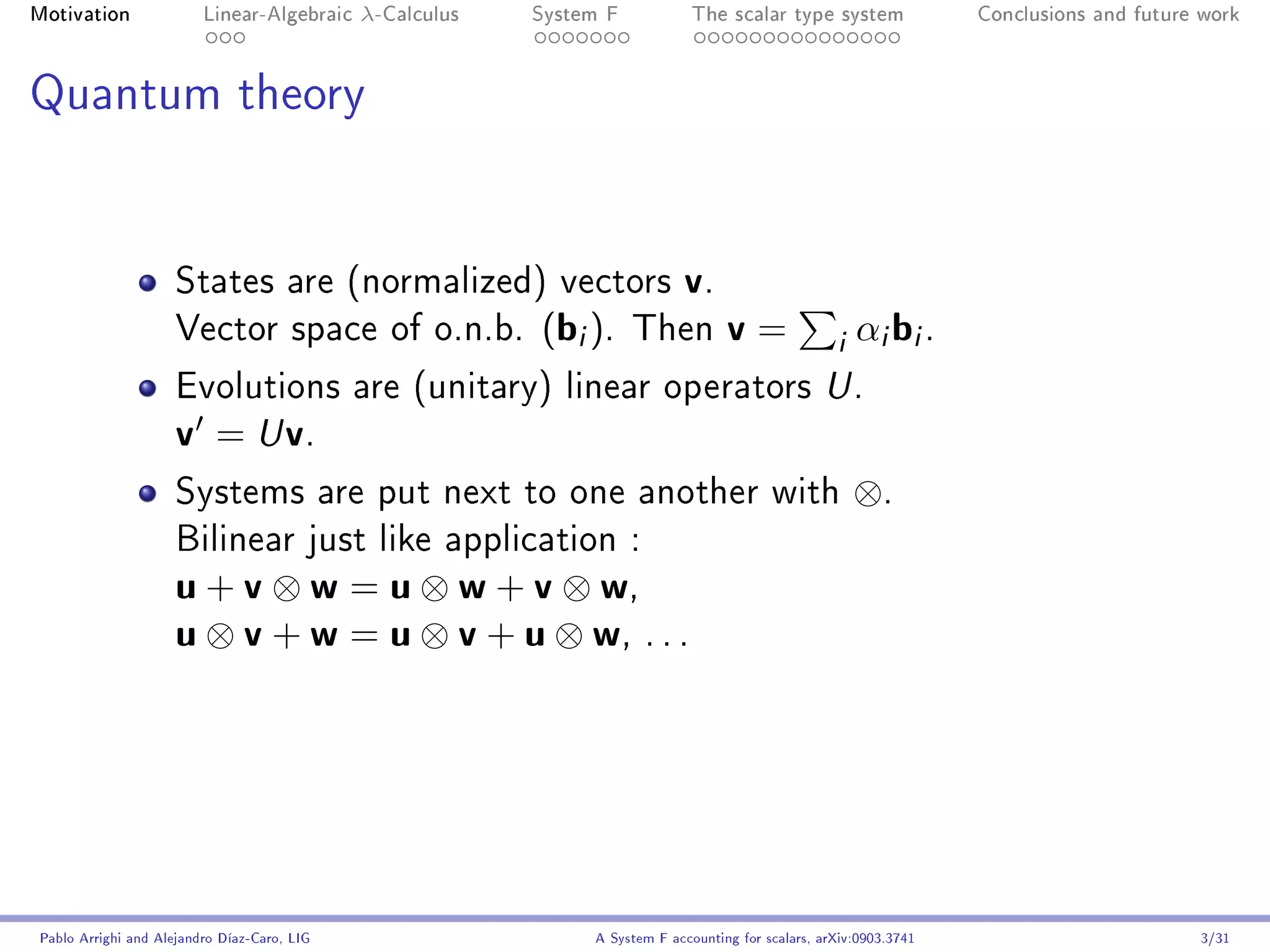
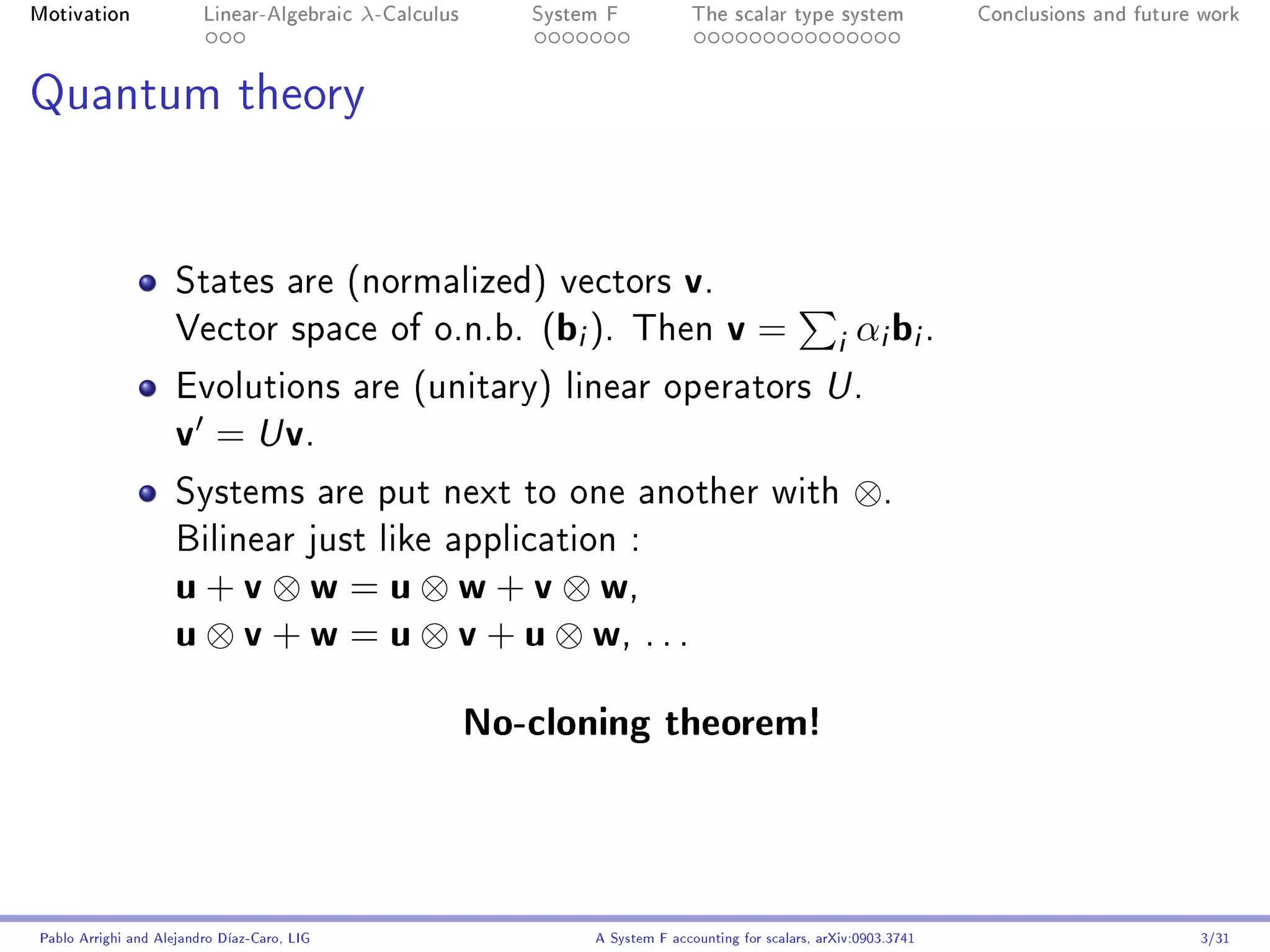
                     Systems are put next to one another with                                          ⊗.
                     Bilinear just like application :
                     u + v ⊗ w = u ⊗ w + v ⊗ w,
                     u ⊗ v + w = u ⊗ v + u ⊗ w, . . .


Pablo Arrighi and Alejandro Díaz-Caro, LIG                     A System F accounting for scalars, arXiv:0903.3741                         3/31
Motivation               Linear-Algebraic    λ-Calculus      System F            The scalar type system                Conclusions and future work


Quantum theory


                     States are (normalized) vectors                           v.
                     Vector space of o.n.b.                   (bi ).    Then          v=               i αi bi .
                     Evolutions are (unitary) linear operators U .
                     v = U v.
                     Systems are put next to one another with                                             ⊗.
                     Bilinear just like application :
                     u + v ⊗ w = u ⊗ w + v ⊗ w,
                     u ⊗ v + w = u ⊗ v + u ⊗ w, . . .
                                                          No-cloning theorem!


Pablo Arrighi and Alejandro Díaz-Caro, LIG                        A System F accounting for scalars, arXiv:0903.3741                         3/31
Motivation               Linear-Algebraic    λ-Calculus        System F                  The scalar type system              Conclusions and future work


No-cloning theorem


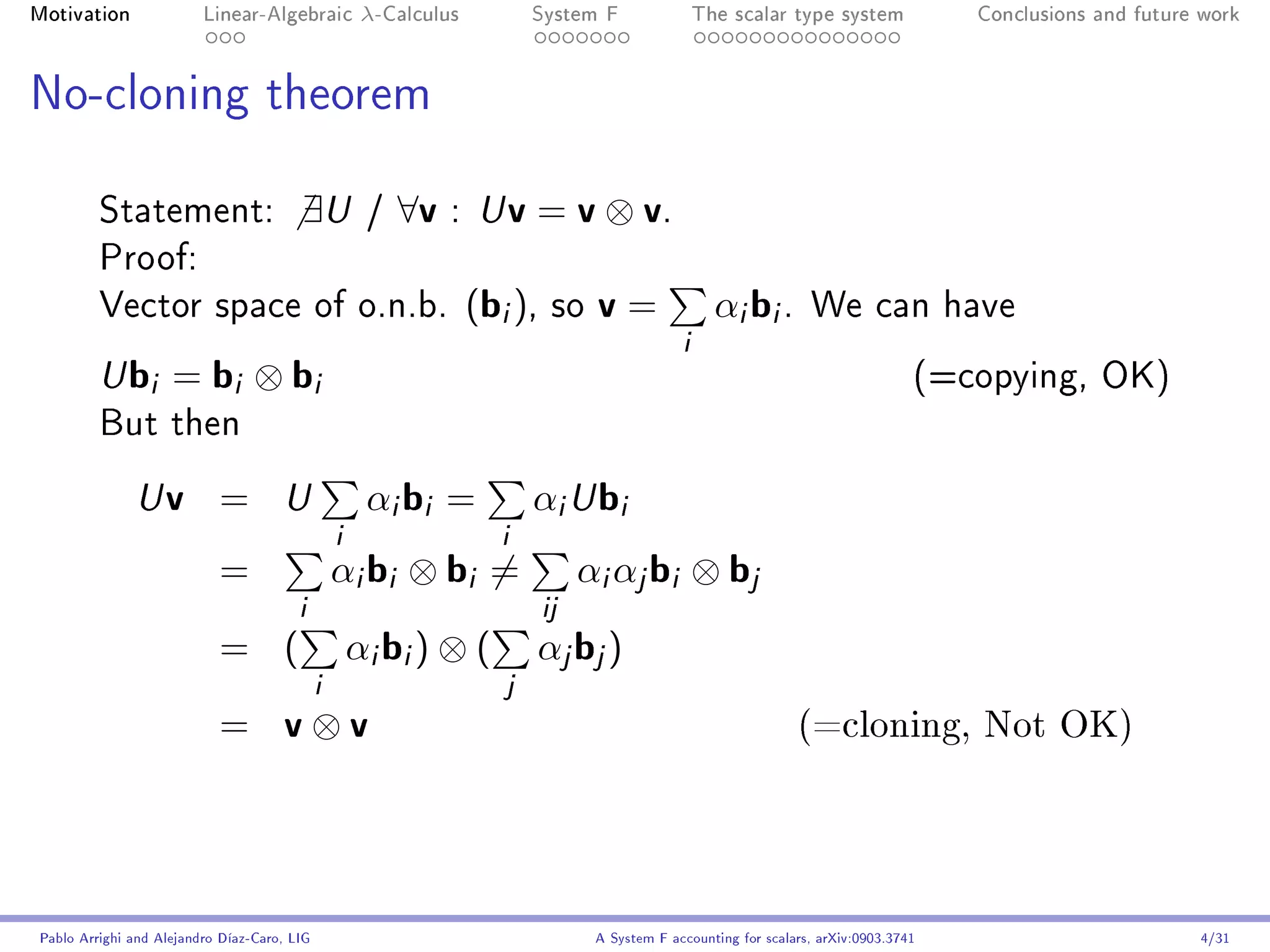
         Statement:                     ∃U   /   ∀v   : U    v = v ⊗ v.
         Proof:
         Vector space of o.n.b.                           (bi ),   so   v=                 αi bi .       We can have
                                                                                     i
         U   bi = bi ⊗ bi                                                                                                (=copying, OK)
         But then

              U    v =               αi bi = αi U bi
                                     U
                                  i          i
                           =      αi bi ⊗ bi = αi αj bi ⊗ bj
                              i                 ij
                           = ( αi bi ) ⊗ ( αj bj )
                                i             j
                           = v⊗v                                                                       (=cloning, Not OK)


Pablo Arrighi and Alejandro Díaz-Caro, LIG                              A System F accounting for scalars, arXiv:0903.3741                         4/31
Motivation               Linear-Algebraic    λ-Calculus        System F                  The scalar type system              Conclusions and future work


No-cloning theorem


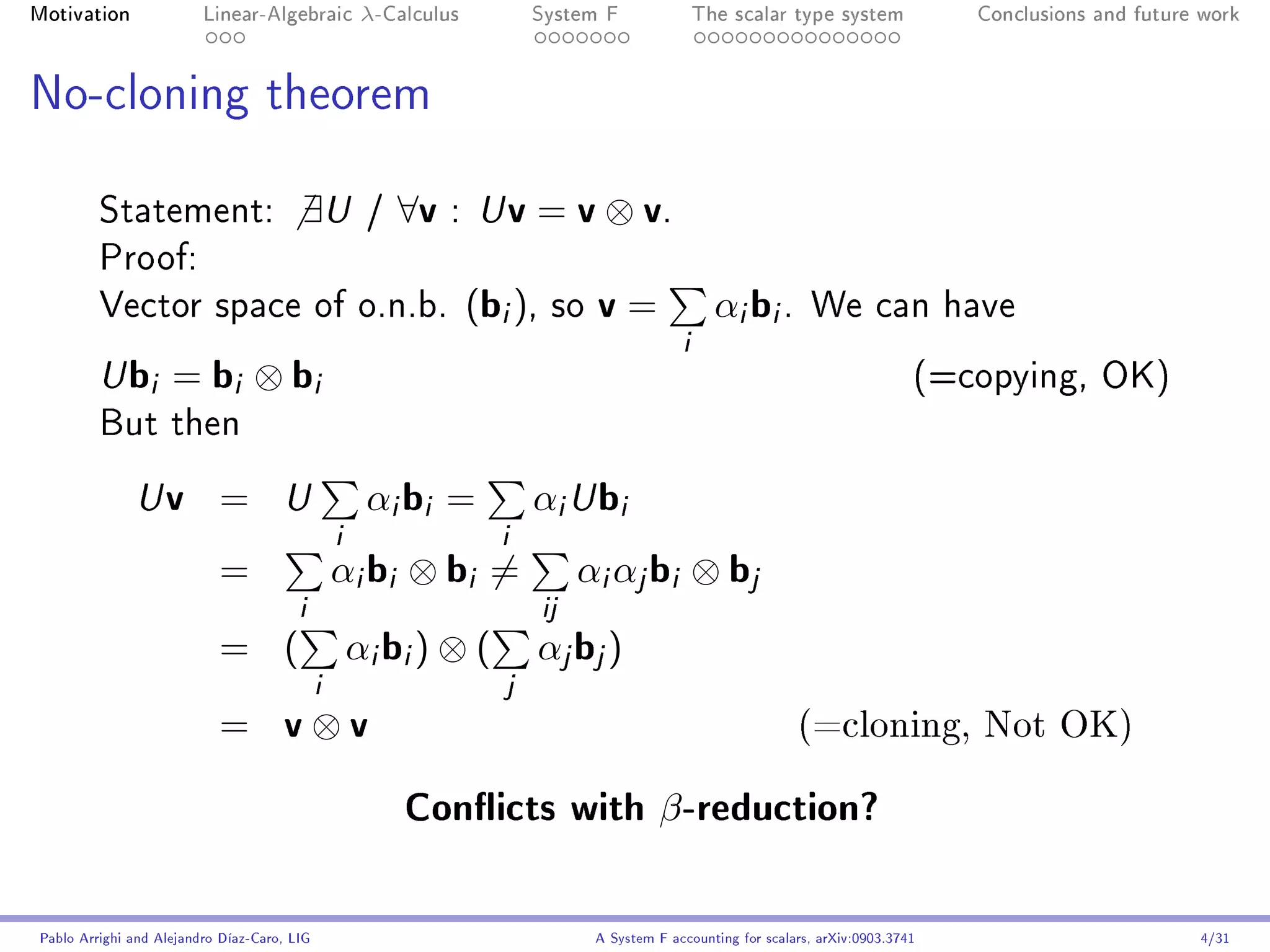
         Statement:                     ∃U   /   ∀v   : U    v = v ⊗ v.
         Proof:
         Vector space of o.n.b.                           (bi ),   so   v=                 αi bi .       We can have
                                                                                     i
         U   bi = bi ⊗ bi                                                                                                (=copying, OK)
         But then

              U    v =               αi bi = αi U bi
                                     U
                                  i          i
                           =      αi bi ⊗ bi = αi αj bi ⊗ bj
                              i                 ij
                           = ( αi bi ) ⊗ ( αj bj )
                                i             j
                           = v⊗v                                                                       (=cloning, Not OK)

                                                 Conicts with β -reduction?

Pablo Arrighi and Alejandro Díaz-Caro, LIG                              A System F accounting for scalars, arXiv:0903.3741                         4/31
Motivation               Linear-Algebraic    λ-Calculus   System F            The scalar type system                Conclusions and future work


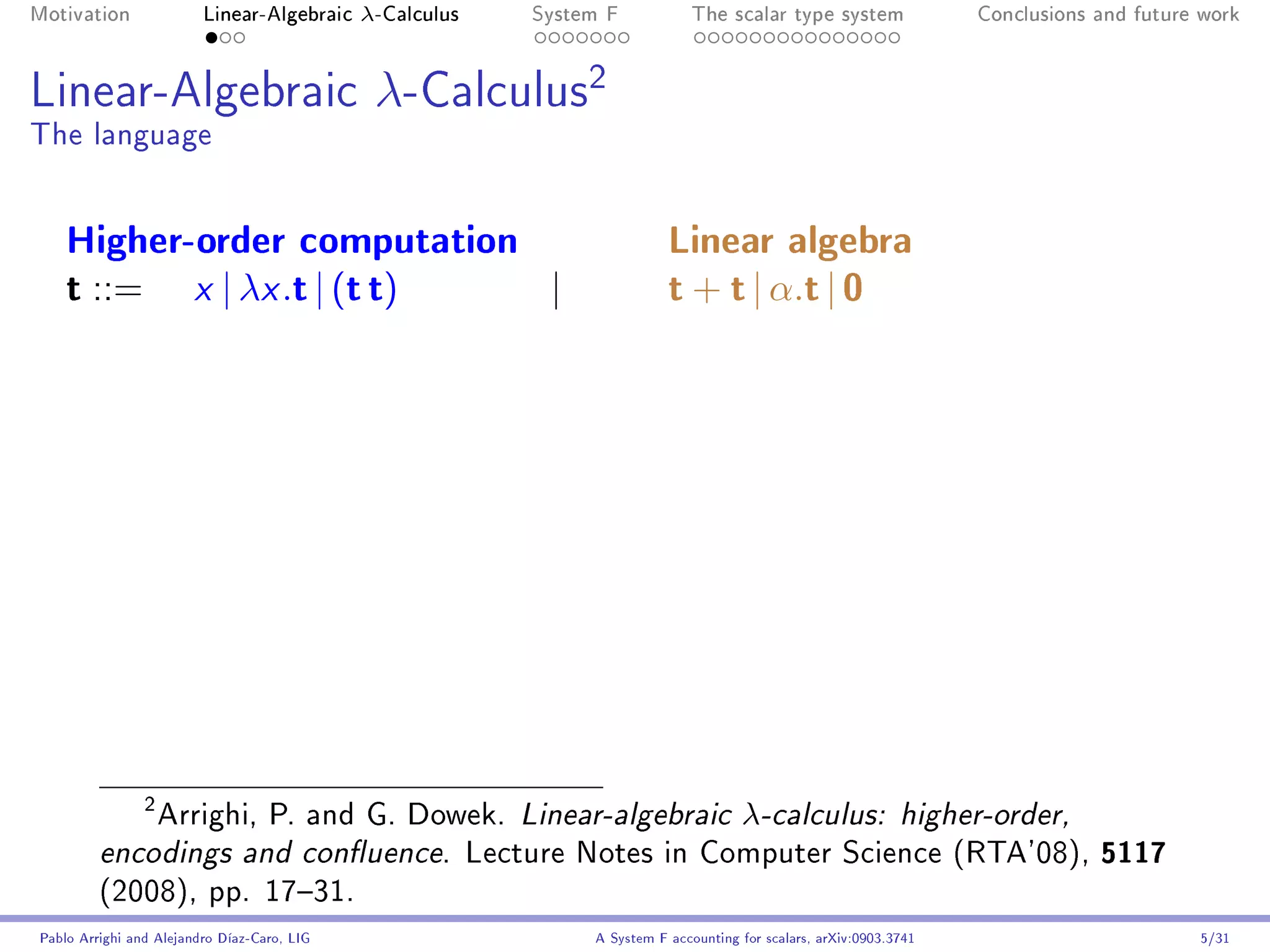
Linear-Algebraic                              λ-Calculus2
The language


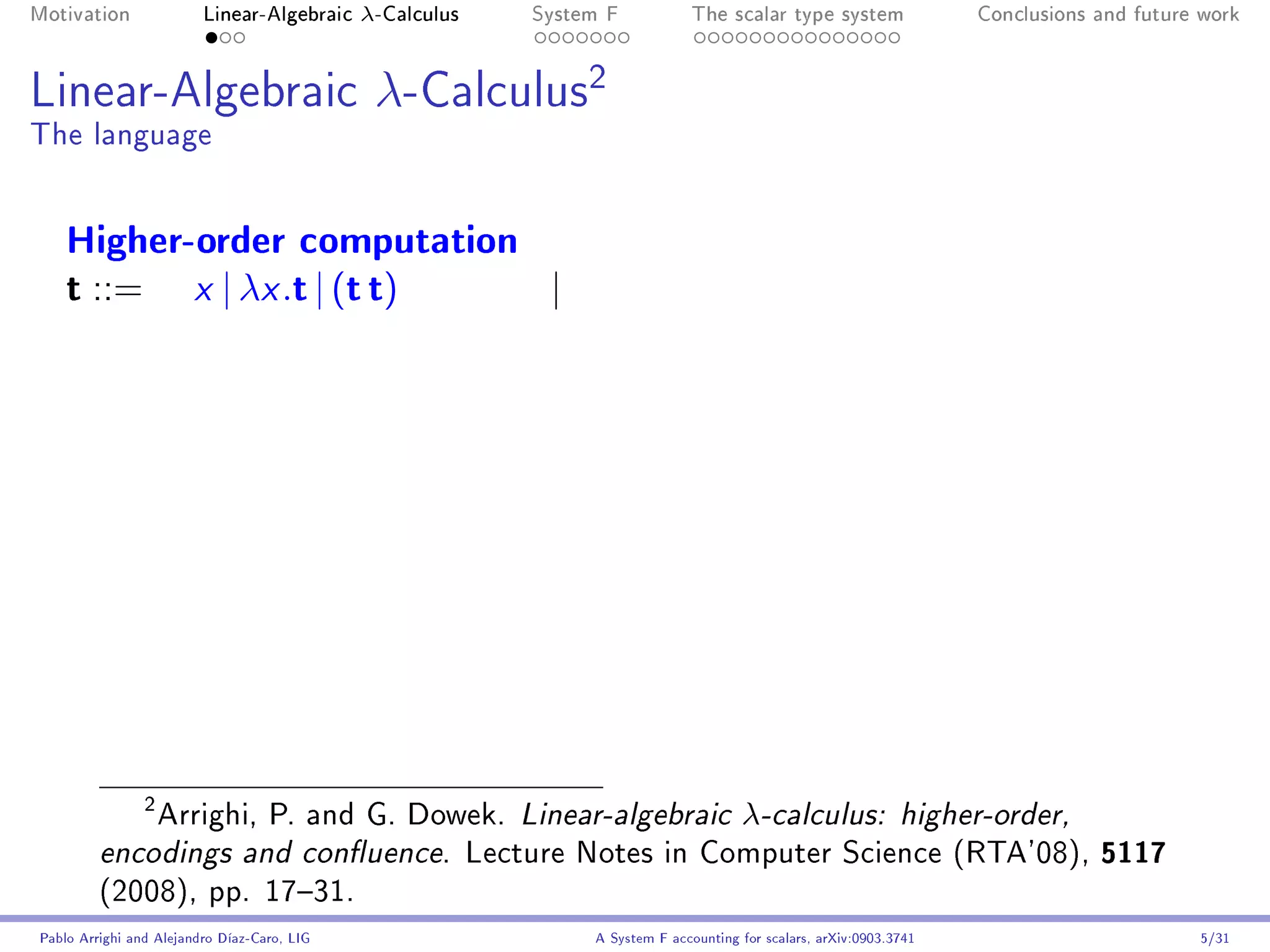
    Higher-order computation
    t ::= x | λx .t | (t t)  |


             Arrighi, P. and G. Dowek. Linear-algebraic λ-calculus: higher-order,
                2


         encodings and conuence. Lecture Notes in Computer Science (RTA'08), 5117
         (2008), pp. 1731.
Pablo Arrighi and Alejandro Díaz-Caro, LIG                     A System F accounting for scalars, arXiv:0903.3741                         5/31
Motivation               Linear-Algebraic    λ-Calculus   System F            The scalar type system                Conclusions and future work


Linear-Algebraic                              λ-Calculus2
The language


    Higher-order computation                                              Linear algebra
    t ::= x | λx .t | (t t)  |                                            t + t | α.t | 0


             Arrighi, P. and G. Dowek. Linear-algebraic λ-calculus: higher-order,
                2


         encodings and conuence. Lecture Notes in Computer Science (RTA'08), 5117
         (2008), pp. 1731.
Pablo Arrighi and Alejandro Díaz-Caro, LIG                     A System F accounting for scalars, arXiv:0903.3741                         5/31
Motivation               Linear-Algebraic    λ-Calculus   System F            The scalar type system                Conclusions and future work


Linear-Algebraic                              λ-Calculus2
The language


    Higher-order computation                                              Linear algebra
    t ::= x | λx .t | (t t)  |                                            t + t | α.t | 0
               λx .t b → t[b/x ] (∗)
    (*)      b an abstraction or a
    variable.


             Arrighi, P. and G. Dowek. Linear-algebraic λ-calculus: higher-order,
                2


         encodings and conuence. Lecture Notes in Computer Science (RTA'08), 5117
         (2008), pp. 1731.
Pablo Arrighi and Alejandro Díaz-Caro, LIG                     A System F accounting for scalars, arXiv:0903.3741                         5/31
Motivation               Linear-Algebraic    λ-Calculus   System F            The scalar type system                Conclusions and future work


Linear-Algebraic                              λ-Calculus2
The language


    Higher-order computation                                              Linear algebra
    t ::= x | λx .t | (t t)  |                                            t + t | α.t | 0
               λx .t b → t[b/x ] (∗)                                                  Elementary rules such as

    (*)      b an abstraction or a                                                    u + 0 → u and
                                                                                      α.(u + v) → α.u + α.v.
    variable.
                                                                                      Factorisation rules such as
    (**) u closed normal.                                                             α.u + β.u → (α + β).u.                        (**)
    (***) u and u + v closed normal.
                                                                                      Application rules such as
                                                                                      u (v + w) → (u v) + (u w).
                                                                                      (***)


             Arrighi, P. and G. Dowek. Linear-algebraic λ-calculus: higher-order,
                2


         encodings and conuence. Lecture Notes in Computer Science (RTA'08), 5117
         (2008), pp. 1731.
Pablo Arrighi and Alejandro Díaz-Caro, LIG                     A System F accounting for scalars, arXiv:0903.3741                         5/31
Motivation               Linear-Algebraic    λ-Calculus   System F            The scalar type system                Conclusions and future work


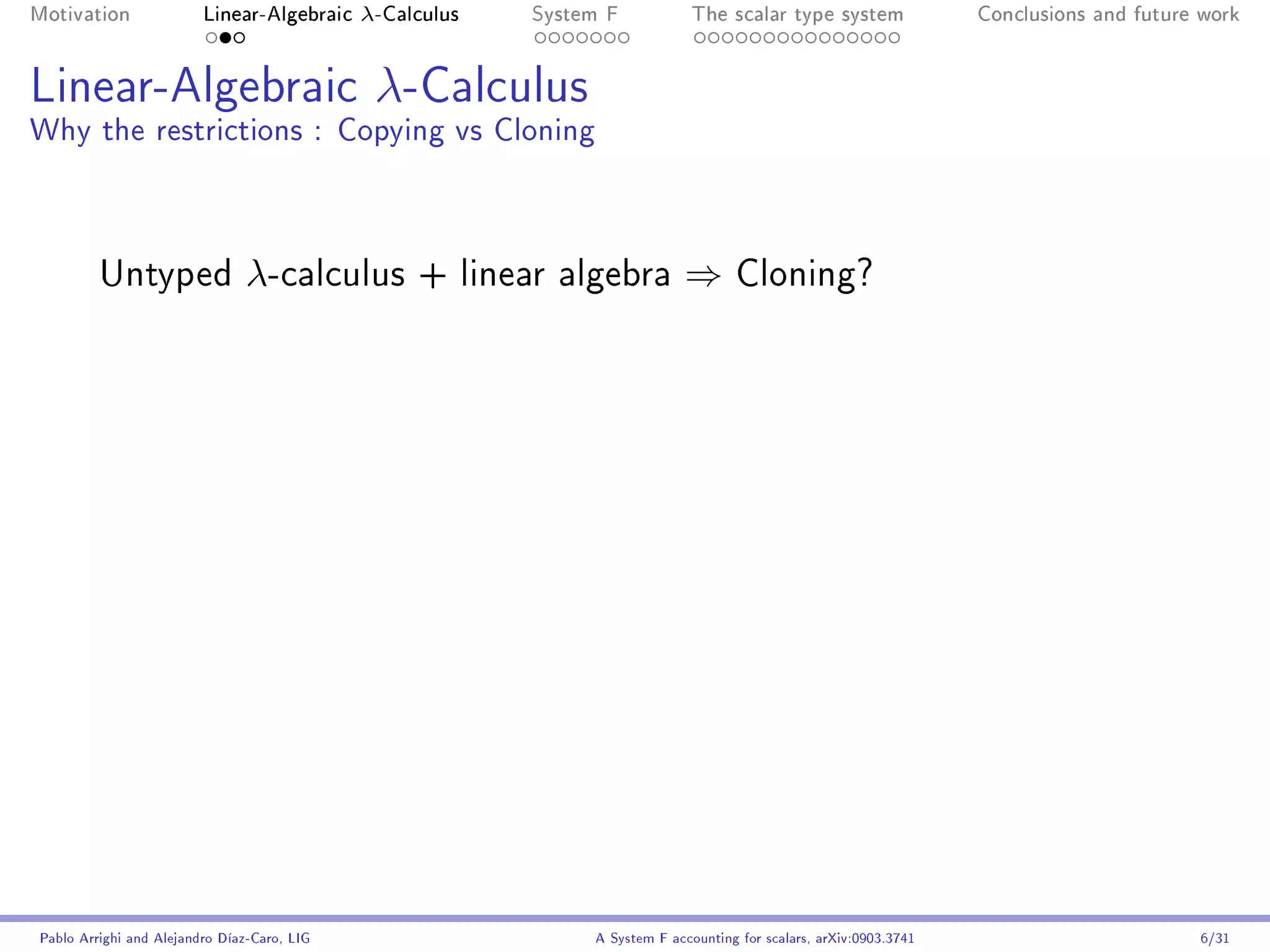
Linear-Algebraic λ-Calculus
Why the restrictions : Copying vs Cloning


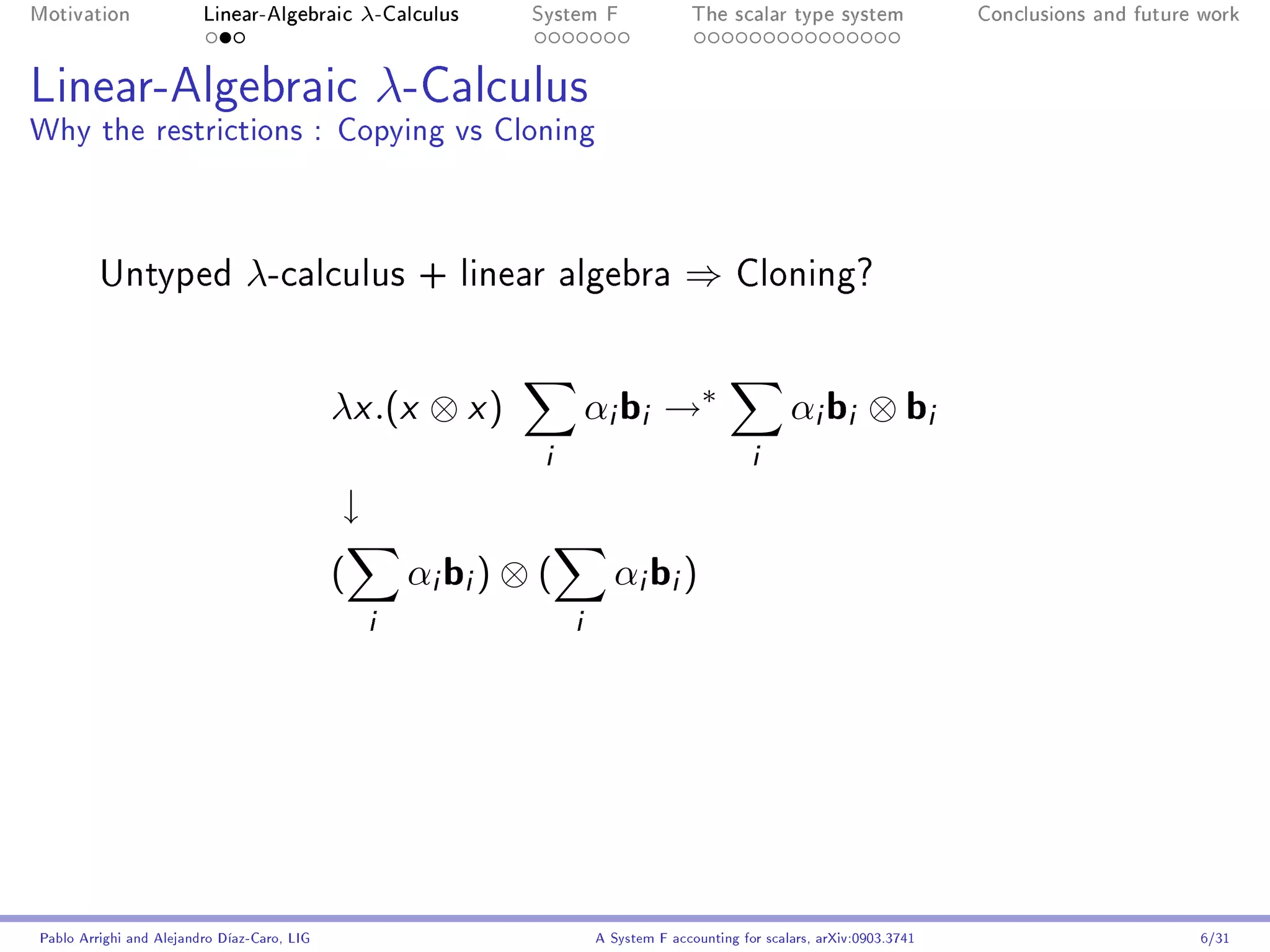
         Untyped                λ-calculus        + linear algebra          ⇒       Cloning?


Pablo Arrighi and Alejandro Díaz-Caro, LIG                     A System F accounting for scalars, arXiv:0903.3741                         6/31
Motivation               Linear-Algebraic        λ-Calculus   System F                The scalar type system                Conclusions and future work


Linear-Algebraic λ-Calculus
Why the restrictions : Copying vs Cloning


         Untyped                λ-calculus            + linear algebra              ⇒       Cloning?


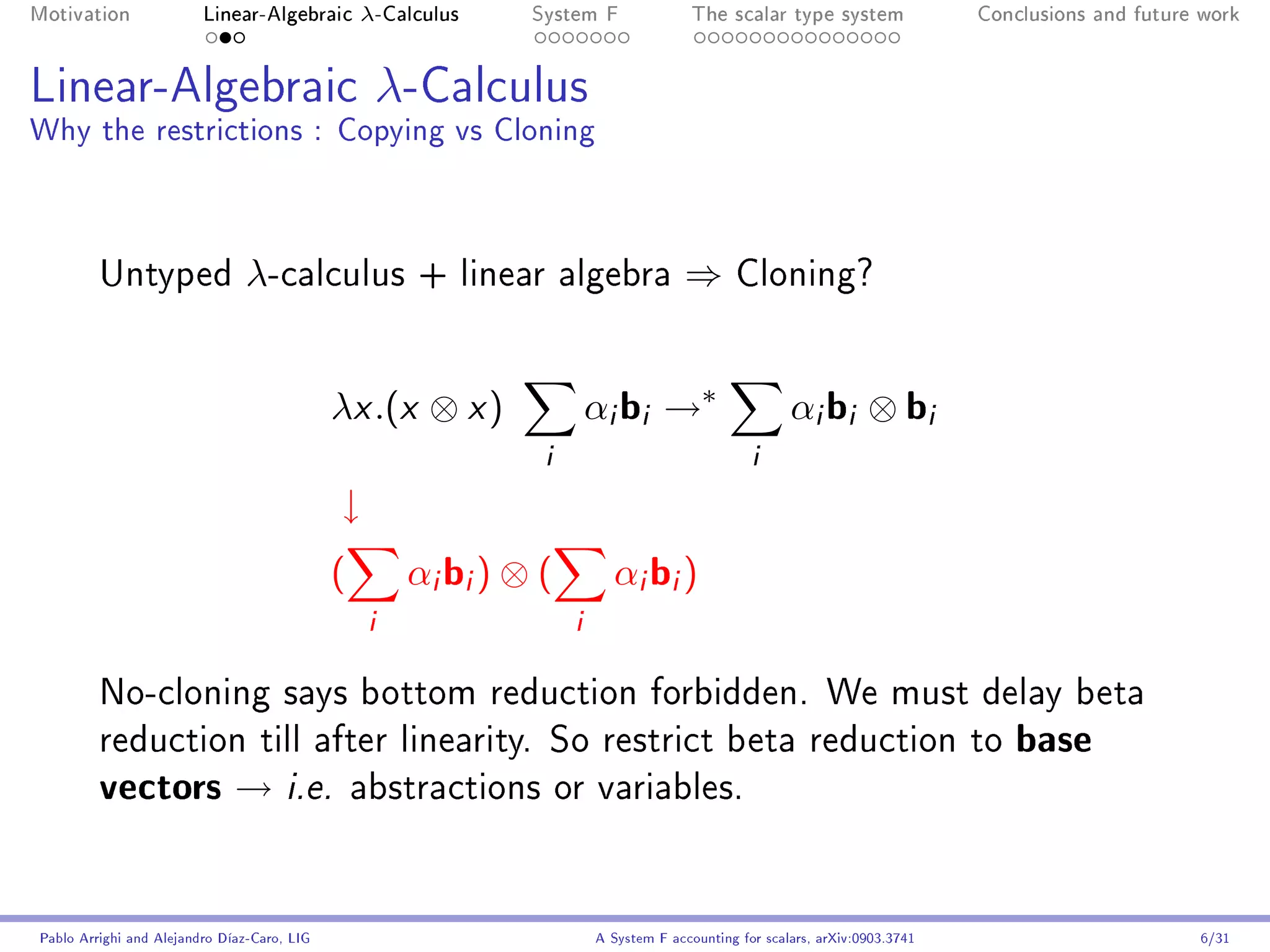
                                             λx .(x ⊗ x )              αi bi →∗                      αi bi ⊗ bi
                                                               i                               i
                                             ↓
                                             (       αi bi ) ⊗ (         αi bi )
                                                 i                 i


Pablo Arrighi and Alejandro Díaz-Caro, LIG                             A System F accounting for scalars, arXiv:0903.3741                         6/31
Motivation               Linear-Algebraic        λ-Calculus    System F                The scalar type system                Conclusions and future work


Linear-Algebraic λ-Calculus
Why the restrictions : Copying vs Cloning


         Untyped                λ-calculus            + linear algebra               ⇒       Cloning?


                                             λx .(x ⊗ x )               αi bi →∗                      αi bi ⊗ bi
                                                                i                               i
                                             ↓
                                             (        αi bi ) ⊗ (         αi bi )
                                                  i                 i
         No-cloning says bottom reduction forbidden. We must delay beta
         reduction till after linearity. So restrict beta reduction to                                                          base
         vectors → i.e.                          abstractions or variables.


Pablo Arrighi and Alejandro Díaz-Caro, LIG                              A System F accounting for scalars, arXiv:0903.3741                         6/31
Motivation               Linear-Algebraic    λ-Calculus   System F            The scalar type system                Conclusions and future work


Linear-Algebraic λ-Calculus
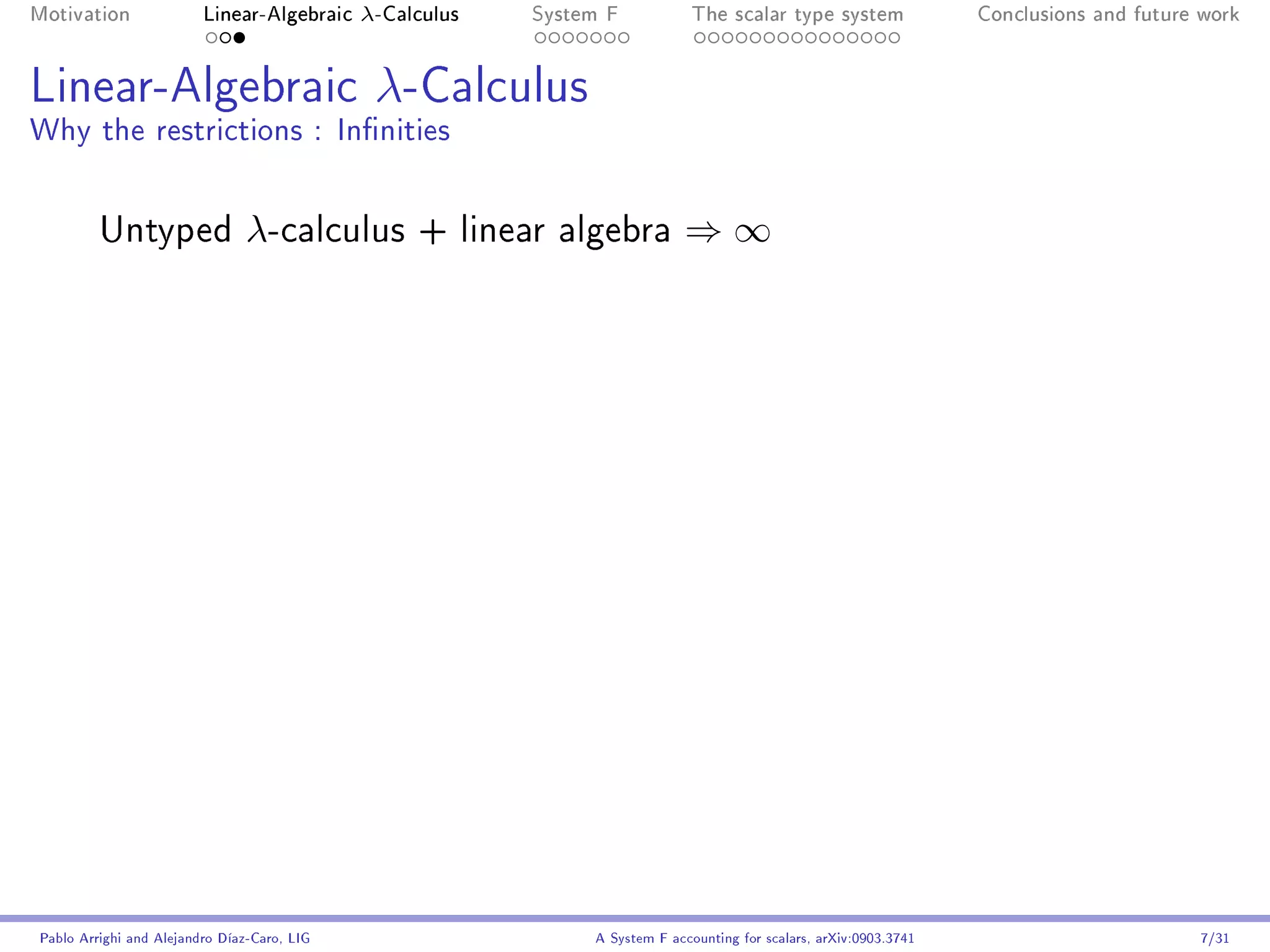
Why the restrictions : Innities


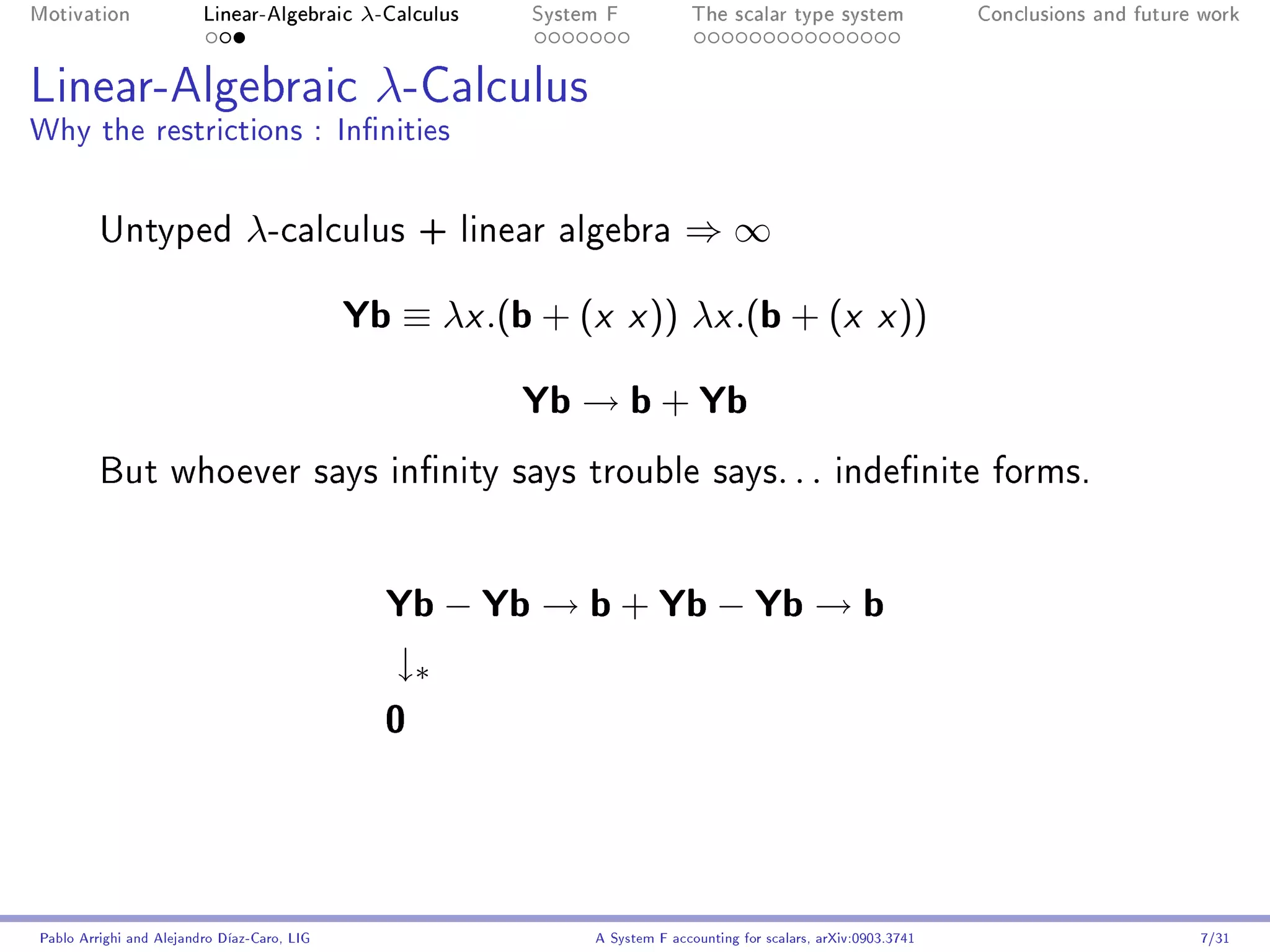
         Untyped                λ-calculus        + linear algebra          ⇒∞


Pablo Arrighi and Alejandro Díaz-Caro, LIG                     A System F accounting for scalars, arXiv:0903.3741                         7/31
Motivation               Linear-Algebraic     λ-Calculus   System F            The scalar type system                Conclusions and future work


Linear-Algebraic λ-Calculus
Why the restrictions : Innities


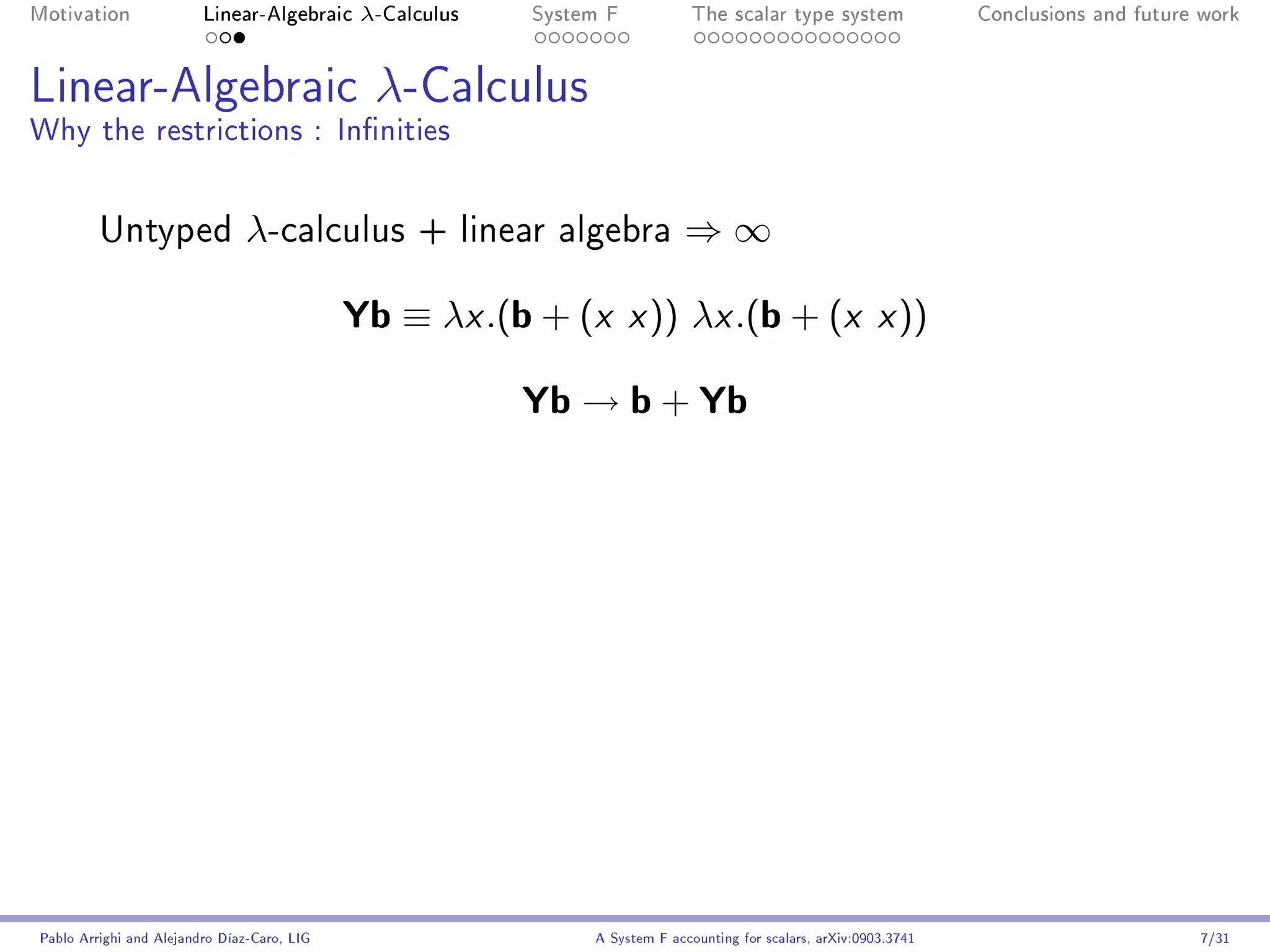
         Untyped                λ-calculus         + linear algebra          ⇒∞

                                             Yb ≡ λx .(b + (x x )) λx .(b + (x x ))
                                                           Yb → b + Yb


Pablo Arrighi and Alejandro Díaz-Caro, LIG                      A System F accounting for scalars, arXiv:0903.3741                         7/31
Motivation               Linear-Algebraic     λ-Calculus   System F            The scalar type system                Conclusions and future work


Linear-Algebraic λ-Calculus
Why the restrictions : Innities


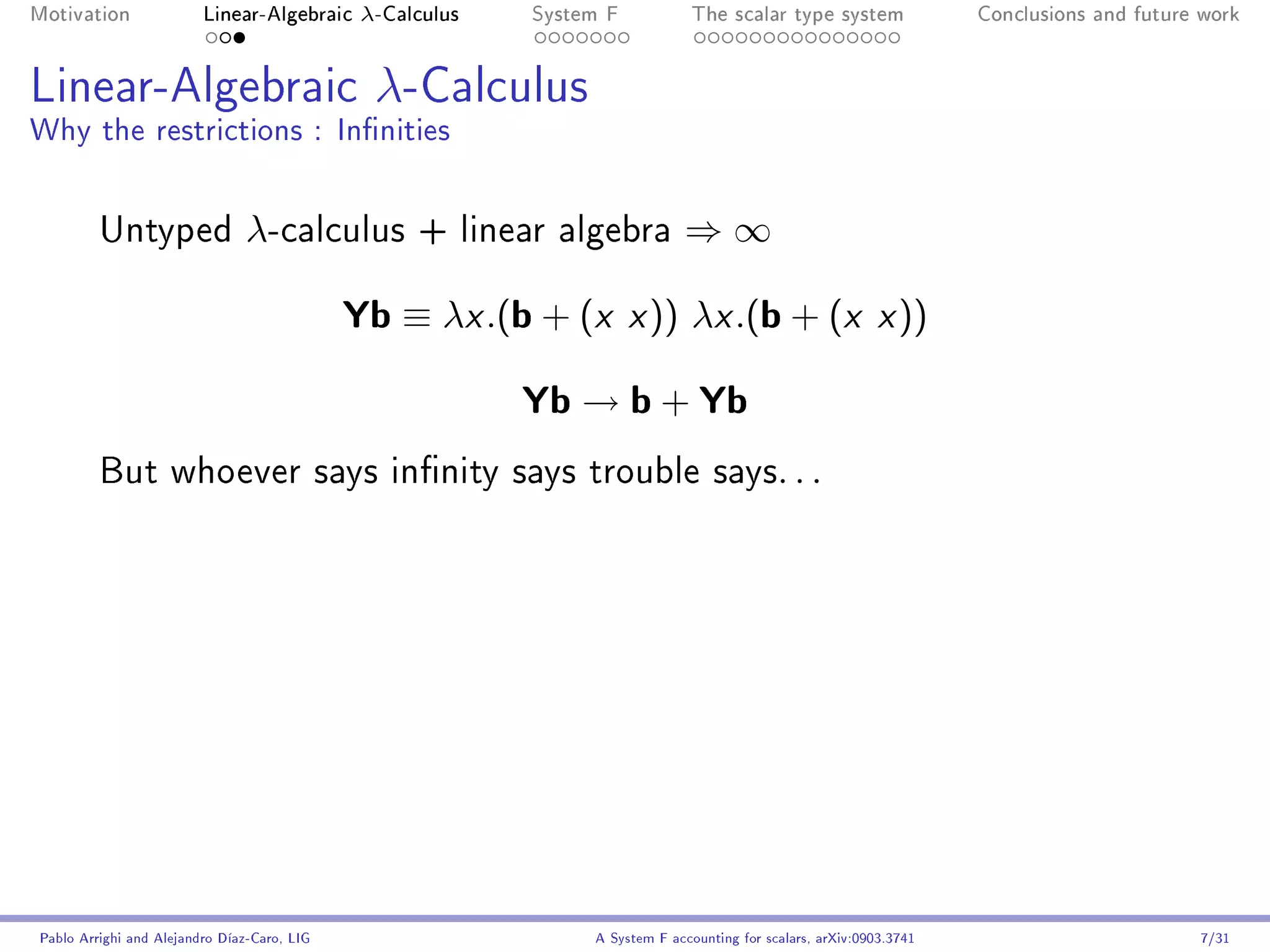
         Untyped                λ-calculus         + linear algebra          ⇒∞

                                             Yb ≡ λx .(b + (x x )) λx .(b + (x x ))
                                                           Yb → b + Yb
         But whoever says innity says trouble says. . .


Pablo Arrighi and Alejandro Díaz-Caro, LIG                      A System F accounting for scalars, arXiv:0903.3741                         7/31
Motivation               Linear-Algebraic     λ-Calculus   System F            The scalar type system                Conclusions and future work


Linear-Algebraic λ-Calculus
Why the restrictions : Innities


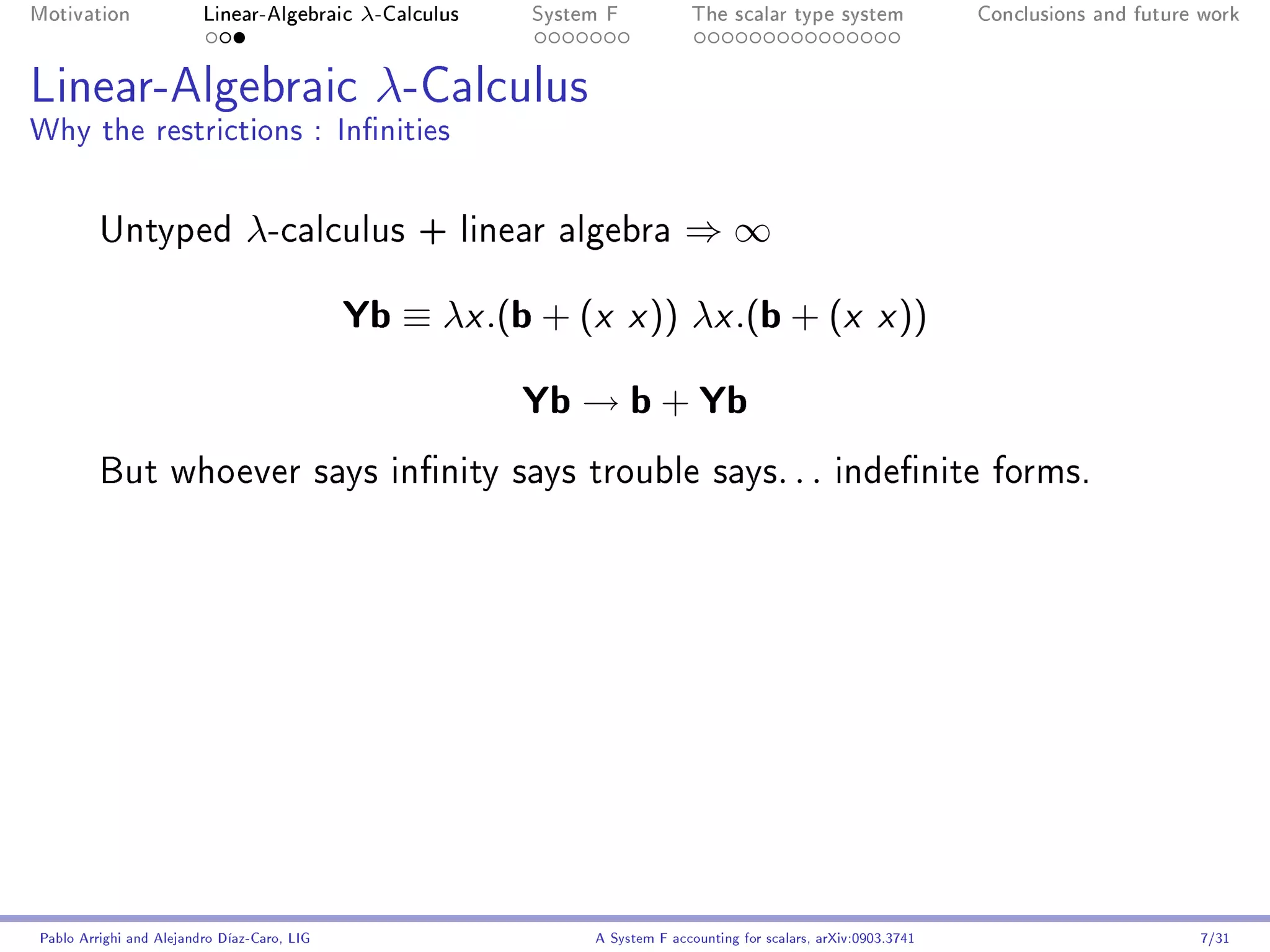
         Untyped                λ-calculus         + linear algebra          ⇒∞

                                             Yb ≡ λx .(b + (x x )) λx .(b + (x x ))
                                                           Yb → b + Yb
         But whoever says innity says trouble says. . . indenite forms.


Pablo Arrighi and Alejandro Díaz-Caro, LIG                      A System F accounting for scalars, arXiv:0903.3741                         7/31
Motivation               Linear-Algebraic     λ-Calculus   System F            The scalar type system                Conclusions and future work


Linear-Algebraic λ-Calculus
Why the restrictions : Innities


         Untyped                λ-calculus          + linear algebra         ⇒∞

                                             Yb ≡ λx .(b + (x x )) λx .(b + (x x ))
                                                           Yb → b + Yb
         But whoever says innity says trouble says. . . indenite forms.


                                                Yb − Yb → b + Yb − Yb → b
                                                 ↓∗
                                                0


Pablo Arrighi and Alejandro Díaz-Caro, LIG                      A System F accounting for scalars, arXiv:0903.3741                         7/31
Motivation               Linear-Algebraic     λ-Calculus   System F            The scalar type system                Conclusions and future work


Linear-Algebraic λ-Calculus
Why the restrictions : Innities


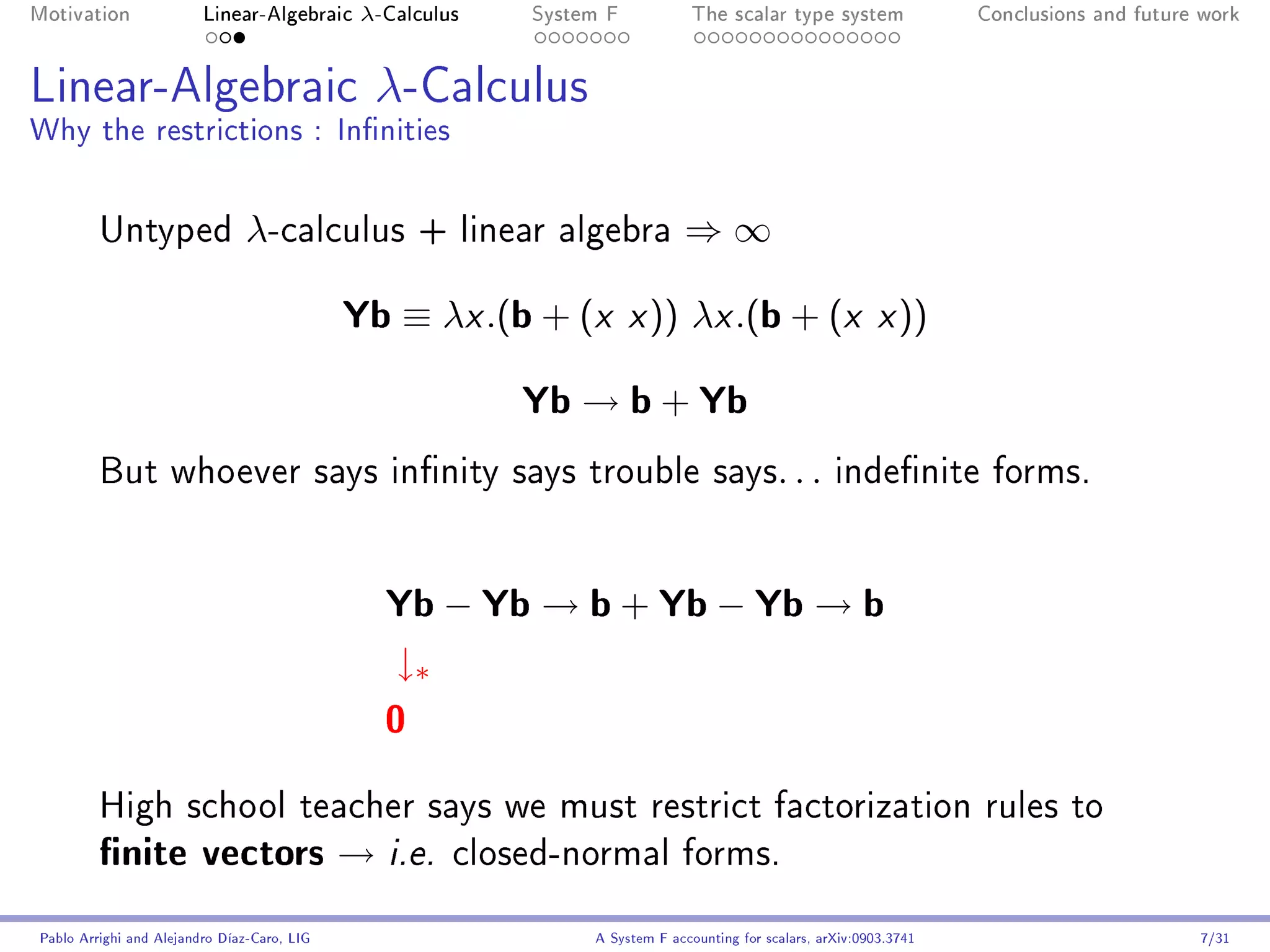
         Untyped                λ-calculus          + linear algebra         ⇒∞

                                             Yb ≡ λx .(b + (x x )) λx .(b + (x x ))
                                                           Yb → b + Yb
         But whoever says innity says trouble says. . . indenite forms.


                                                Yb − Yb → b + Yb − Yb → b
                                                 ↓∗
                                                0
         High school teacher says we must restrict factorization rules to
         nite vectors → i.e.                          closed-normal forms.


Pablo Arrighi and Alejandro Díaz-Caro, LIG                      A System F accounting for scalars, arXiv:0903.3741                         7/31
Motivation               Linear-Algebraic     λ-Calculus       System F            The scalar type system                    Conclusions and future work


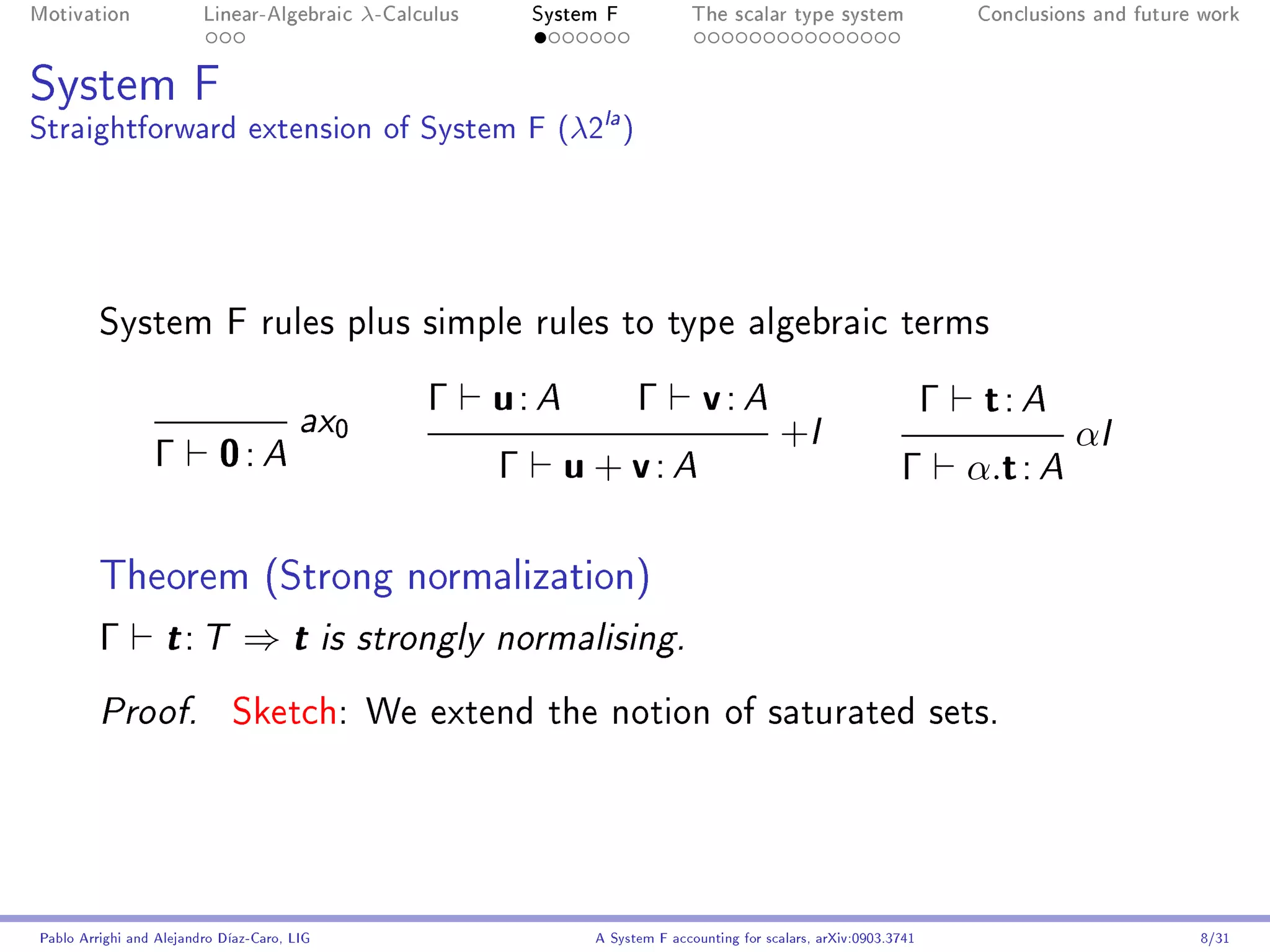
System F
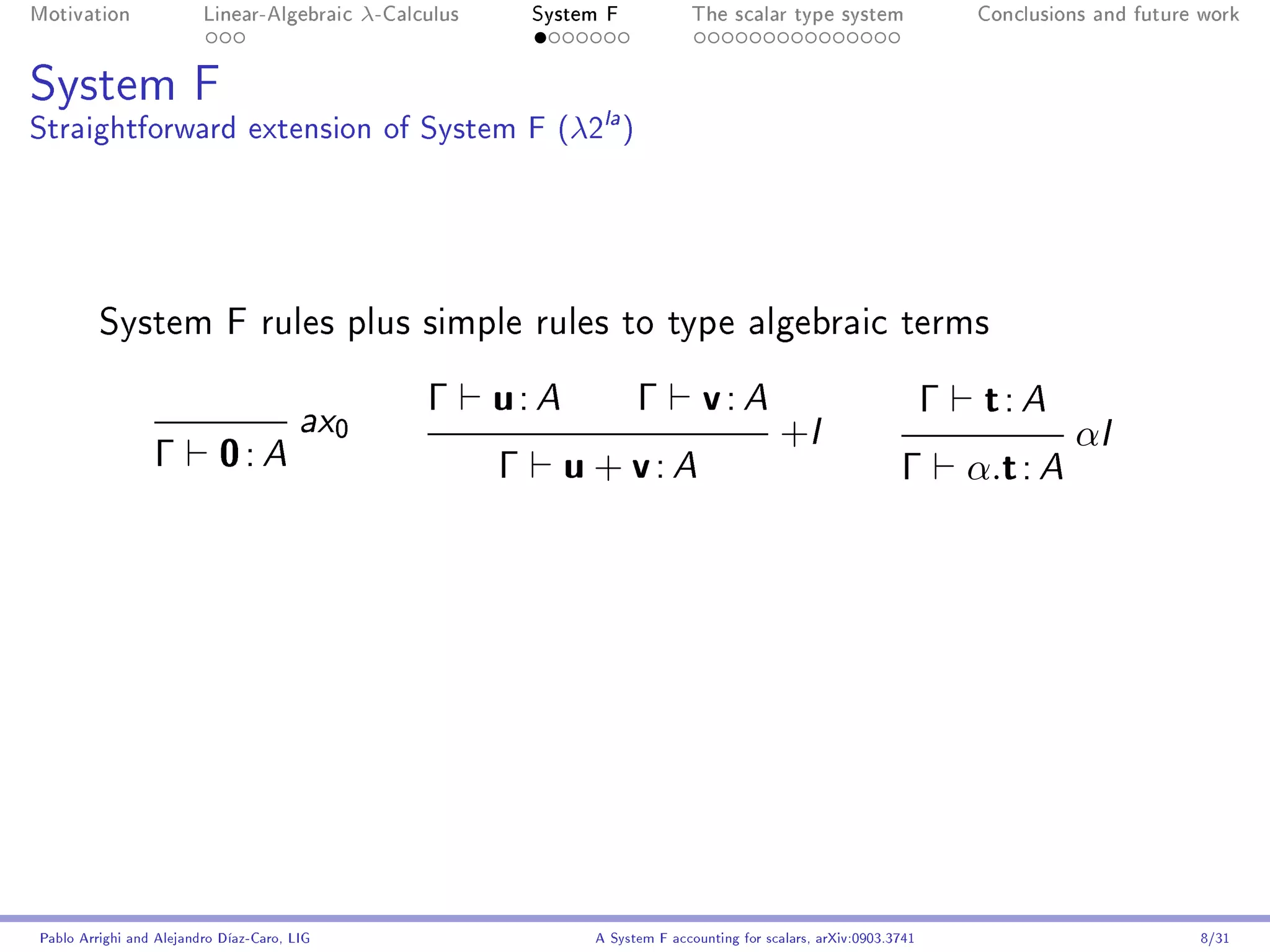
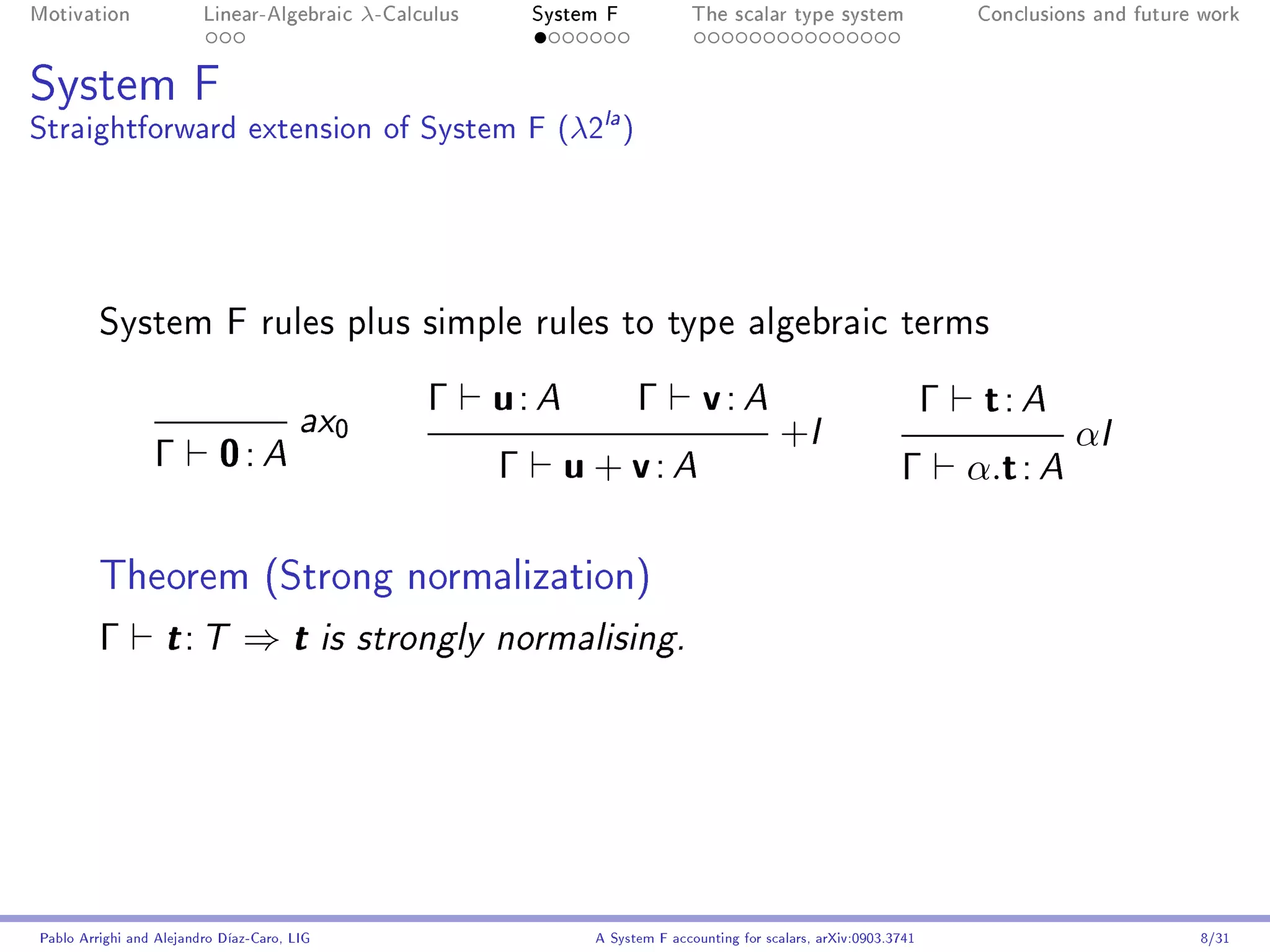
Straightforward extension of System F (λ2la )


         System F rules plus simple rules to type algebraic terms


                                        ax0
                                                    Γ      u: A           Γ         v: A                                 Γ    t: A
                                                                                                +I                                     αI
                 Γ         0: A                            Γ      u + v: A                                         Γ         α.t : A


Pablo Arrighi and Alejandro Díaz-Caro, LIG                          A System F accounting for scalars, arXiv:0903.3741                             8/31
Motivation               Linear-Algebraic      λ-Calculus       System F            The scalar type system                    Conclusions and future work


System F
Straightforward extension of System F (λ2la )


         System F rules plus simple rules to type algebraic terms


                                        ax0
                                                     Γ      u: A           Γ         v: A                                 Γ    t: A
                                                                                                 +I                                     αI
                 Γ         0: A                             Γ      u + v: A                                         Γ         α.t : A

         Theorem (Strong normalization)
         Γ         t: T        ⇒t            is strongly normalising.


Pablo Arrighi and Alejandro Díaz-Caro, LIG                           A System F accounting for scalars, arXiv:0903.3741                             8/31
Motivation               Linear-Algebraic      λ-Calculus       System F            The scalar type system                    Conclusions and future work


System F
Straightforward extension of System F (λ2la )


         System F rules plus simple rules to type algebraic terms


                                        ax0
                                                     Γ      u: A           Γ         v: A                                 Γ    t: A
                                                                                                 +I                                     αI
                 Γ         0: A                             Γ      u + v: A                                         Γ         α.t : A

         Theorem (Strong normalization)
         Γ         t: T        ⇒t            is strongly normalising.


         Proof.              Sketch: We extend the notion of saturated sets.


Pablo Arrighi and Alejandro Díaz-Caro, LIG                           A System F accounting for scalars, arXiv:0903.3741                             8/31
Motivation               Linear-Algebraic    λ-Calculus   System F            The scalar type system                Conclusions and future work


System F
Strong normalization of λ2la

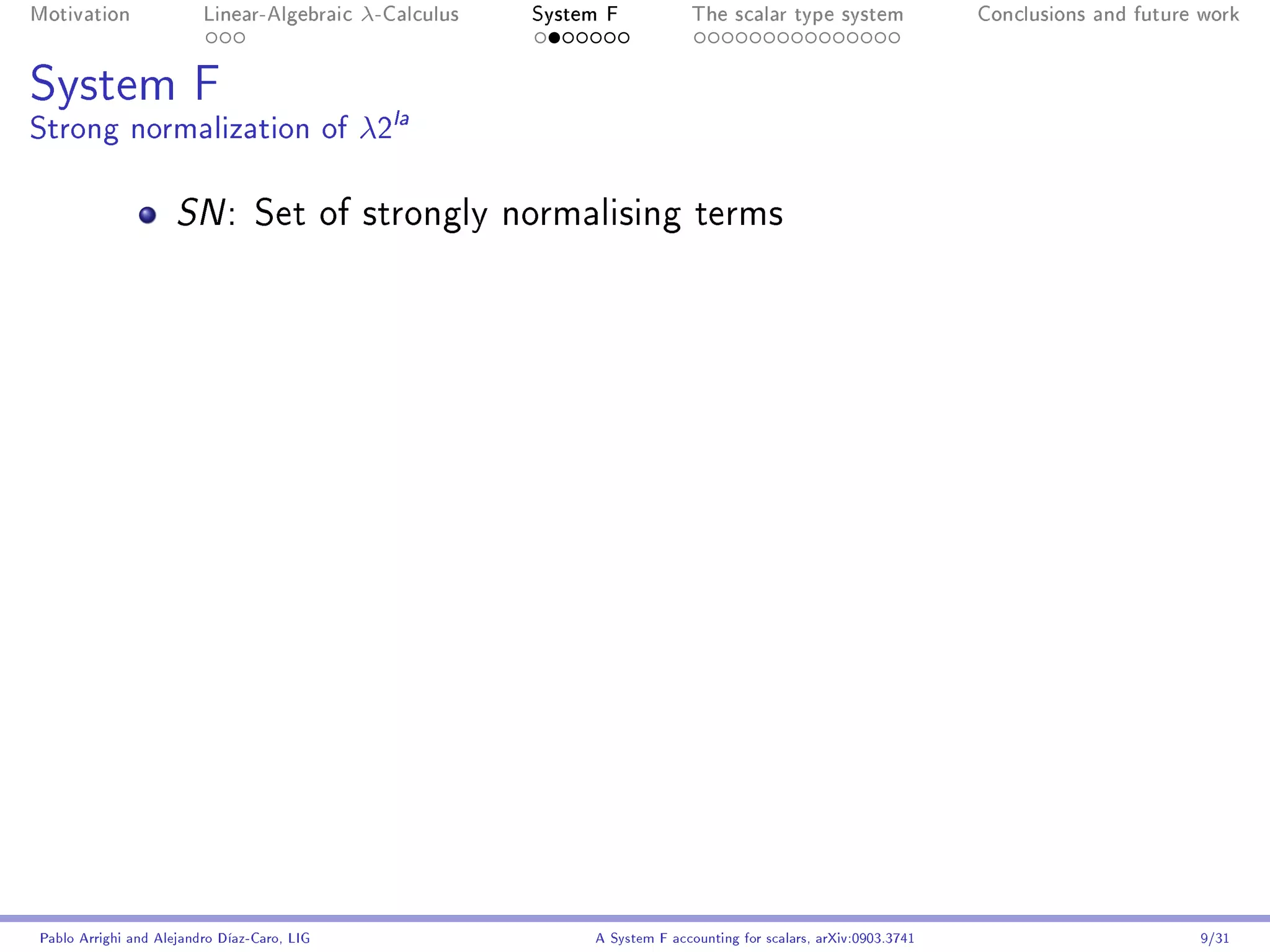
                     SN :        Set of strongly normalising terms


Pablo Arrighi and Alejandro Díaz-Caro, LIG                     A System F accounting for scalars, arXiv:0903.3741                         9/31
Motivation               Linear-Algebraic     λ-Calculus       System F             The scalar type system               Conclusions and future work


System F
Strong normalization of λ2la

                     SN :        Set of strongly normalising terms
                     A subset X               ∈ SN         is saturated if
                          1     ∀n ≥ 0, (((x t1 ) . . . ) tn ) ∈ X where ti ∈ SN ;
                                        →
                                        −                        →
                                                                 −
                          2     v[b/x ] t ∈ X ⇒ (λx v) b t ∈ X ;
                          3     t, u ∈ X ⇒ t + u ∈ X ;
                          4     ∀α, t ∈ X ⇒ α.t ∈ X ;
                          5     ∀i ∈ I , ((ui w1 ) . . . wn ) ∈ X ⇒                                      u   i    w1 . . . w ∈ X ;
                                                                                                                                n
                                                                                                i   ∈I

                          6     ∀i ∈ I , (u wi ) ∈ X ⇒ u                            w i      ∈ X;
                                                                           i   ∈I
                          7     α.((t1 t2 ) . . . tn ) ∈ X ⇔ ((t1 t2 ) . . . α.tk ) . . . tn ∈ X (1 ≤ k ≤ n);
                          8     0 ∈ X;
                                 →
                                 −                 →
                                                   −
                          9     ∀ t ∈ SN , (0 t ) ∈ X ;
                         10
                                   → ∈ SN , (t 0) → ∈ X .
                                   −
                                ∀t, u                    −u
                                       X     stable by construction and anti-reduction


Pablo Arrighi and Alejandro Díaz-Caro, LIG                          A System F accounting for scalars, arXiv:0903.3741                         9/31
Motivation               Linear-Algebraic     λ-Calculus       System F             The scalar type system               Conclusions and future work


System F
Strong normalization of λ2la

                     SN :        Set of strongly normalising terms
                     A subset X               ∈ SN         is saturated if
                          1     ∀n ≥ 0, (((x t1 ) . . . ) tn ) ∈ X where ti ∈ SN ;
                                        →
                                        −                        →
                                                                 −
                          2     v[b/x ] t ∈ X ⇒ (λx v) b t ∈ X ;
                          3     t, u ∈ X ⇒ t + u ∈ X ;
                          4     ∀α, t ∈ X ⇒ α.t ∈ X ;
                          5     ∀i ∈ I , ((ui w1 ) . . . wn ) ∈ X ⇒                                      u   i    w1 . . . w ∈ X ;
                                                                                                                                n
                                                                                                i   ∈I

                          6     ∀i ∈ I , (u wi ) ∈ X ⇒ u                            w i      ∈ X;
                                                                           i   ∈I
                          7     α.((t1 t2 ) . . . tn ) ∈ X ⇔ ((t1 t2 ) . . . α.tk ) . . . tn ∈ X (1 ≤ k ≤ n);
                          8     0 ∈ X;
                                 →
                                 −                 →
                                                   −
                          9     ∀ t ∈ SN , (0 t ) ∈ X ;
                         10
                                   → ∈ SN , (t 0) → ∈ X .
                                   −
                                ∀t, u                    −u
                                       X     stable by construction and anti-reduction

                     SAT          is the set of all saturated sets
Pablo Arrighi and Alejandro Díaz-Caro, LIG                          A System F accounting for scalars, arXiv:0903.3741                         9/31
Motivation               Linear-Algebraic    λ-Calculus   System F            The scalar type system                Conclusions and future work


System F
Strong normalization of λ2la (II)


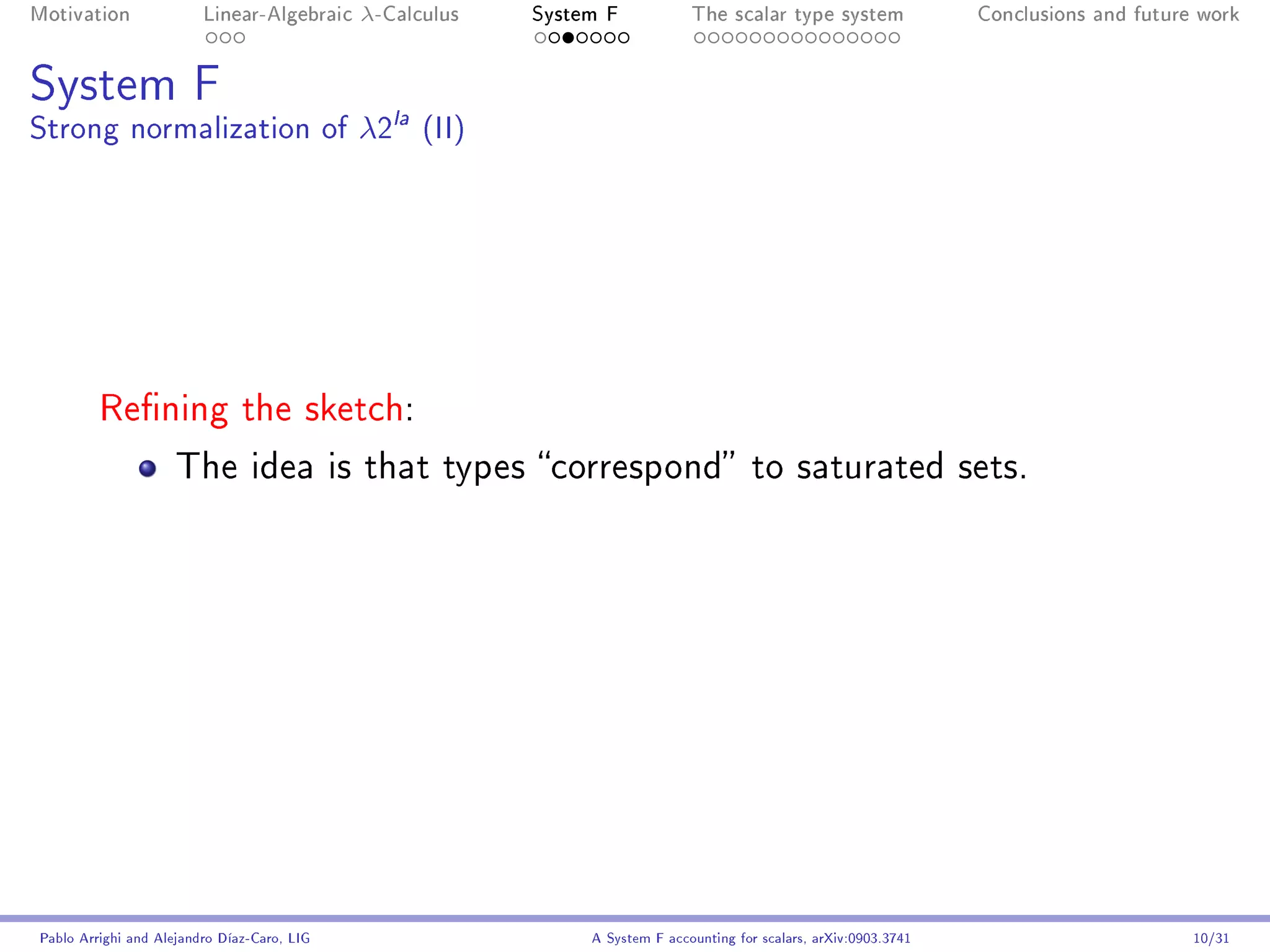
         Rening the sketch:

                     The idea is that types correspond to saturated sets.


Pablo Arrighi and Alejandro Díaz-Caro, LIG                     A System F accounting for scalars, arXiv:0903.3741                         10/31
Motivation               Linear-Algebraic    λ-Calculus   System F            The scalar type system                Conclusions and future work


System F
Strong normalization of λ2la (II)


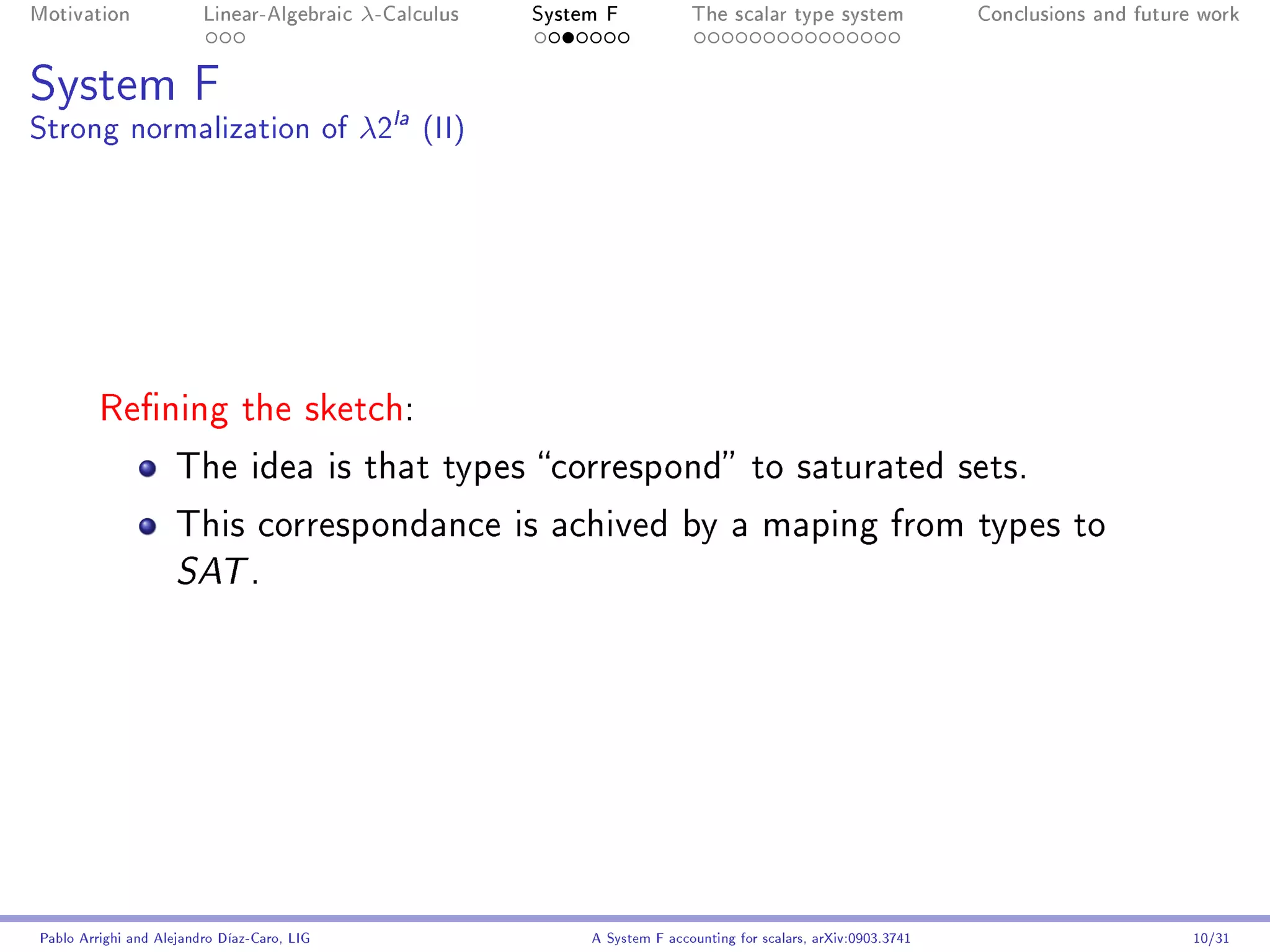
         Rening the sketch:

                     The idea is that types correspond to saturated sets.

                     This correspondance is achived by a maping from types to
                     SAT .


Pablo Arrighi and Alejandro Díaz-Caro, LIG                     A System F accounting for scalars, arXiv:0903.3741                         10/31
Motivation               Linear-Algebraic    λ-Calculus        System F            The scalar type system                Conclusions and future work


System F
Strong normalization of λ2la (III)


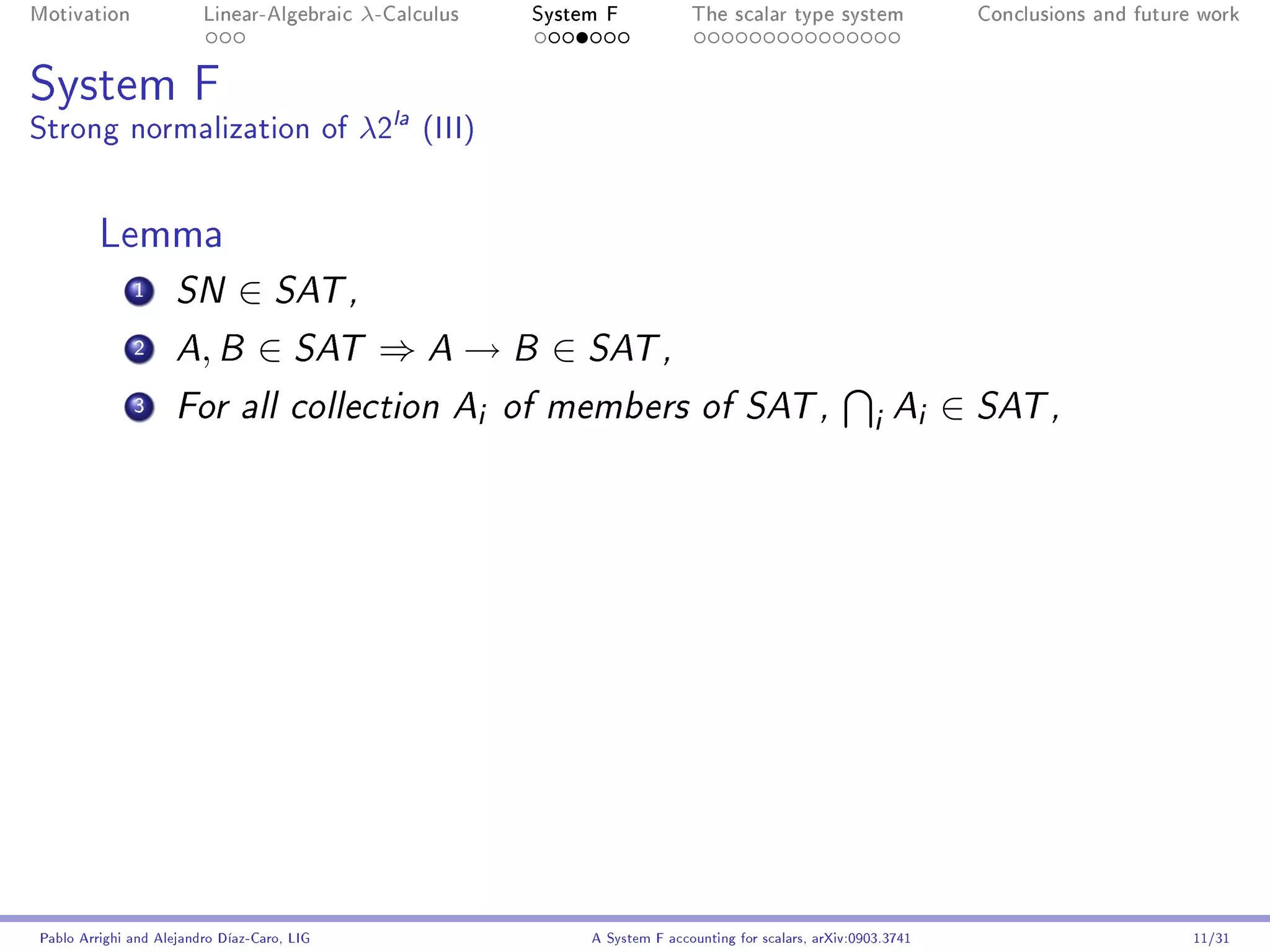
         Lemma
              1      SN       ∈ SAT ,
              2      A B ,       ∈ SAT ⇒ A → B ∈ SAT ,
              3      For all collection A                 i   of members of SAT ,
                                                                                                                i Ai ∈ SAT ,


Pablo Arrighi and Alejandro Díaz-Caro, LIG                          A System F accounting for scalars, arXiv:0903.3741                         11/31
Motivation               Linear-Algebraic    λ-Calculus        System F            The scalar type system                Conclusions and future work


System F
Strong normalization of λ2la (III)


         Lemma
              1      SN       ∈ SAT ,
              2      A B ,       ∈ SAT ⇒ A → B ∈ SAT ,
              3      For all collection A                 i   of members of SAT ,
                                                                                                                i Ai ∈ SAT ,

         Denition (Mapping)
                     [[X ]]ξ = ξ(X )                      (where    ξ(·) : TVar → SAT )
                     [[A → B ]]ξ = [[A]]ξ → [[B ]]ξ
                     [[∀X .T ]]ξ =              Y ∈SAT [[T ]]ξ(X :=Y )


Pablo Arrighi and Alejandro Díaz-Caro, LIG                          A System F accounting for scalars, arXiv:0903.3741                         11/31
Motivation               Linear-Algebraic    λ-Calculus        System F            The scalar type system                Conclusions and future work


System F
Strong normalization of λ2la (III)


         Lemma
              1      SN       ∈ SAT ,
              2      A B ,       ∈ SAT ⇒ A → B ∈ SAT ,
              3      For all collection A                 i   of members of SAT ,
                                                                                                                i Ai ∈ SAT ,

         Denition (Mapping)
                     [[X ]]ξ = ξ(X )                      (where    ξ(·) : TVar → SAT )
                     [[A → B ]]ξ = [[A]]ξ → [[B ]]ξ
                     [[∀X .T ]]ξ =              Y ∈SAT [[T ]]ξ(X :=Y )

         Lemma
         Given a valuation                     ξ , [[T ]]ξ ∈ SAT

Pablo Arrighi and Alejandro Díaz-Caro, LIG                          A System F accounting for scalars, arXiv:0903.3741                         11/31
Motivation               Linear-Algebraic     λ-Calculus      System F            The scalar type system                Conclusions and future work


System F
Strong normalization of λ2la (IV)


         Denition ( )
         For       Γ = x1 : A1 , . . . , xn : An , Γ                 t: T        means that                    ∀ξ ,

                                             x1   ∈ [[A1 ]]ξ , . . . xn ∈ [[An ]]ξ ⇒ t ∈ [[T ]]ξ


Pablo Arrighi and Alejandro Díaz-Caro, LIG                         A System F accounting for scalars, arXiv:0903.3741                         12/31
Motivation               Linear-Algebraic     λ-Calculus      System F            The scalar type system                  Conclusions and future work


System F
Strong normalization of λ2la (IV)


         Denition ( )
         For       Γ = x1 : A1 , . . . , xn : An , Γ                 t: T        means that                    ∀ξ ,

                                             x1   ∈ [[A1 ]]ξ , . . . xn ∈ [[An ]]ξ ⇒ t ∈ [[T ]]ξ

         Rening the sketch: Prove that                               Γ         t: T ⇒ Γ t: T
         We prove this by induction on the derivation of                                                      Γ         t: T   (In fact
         the denition of                           is slightly dierent to strengthen the induction
         hypothesis)


Pablo Arrighi and Alejandro Díaz-Caro, LIG                         A System F accounting for scalars, arXiv:0903.3741                           12/31
Motivation               Linear-Algebraic    λ-Calculus   System F            The scalar type system                Conclusions and future work


System F
Strong normalization of λ2la (V)


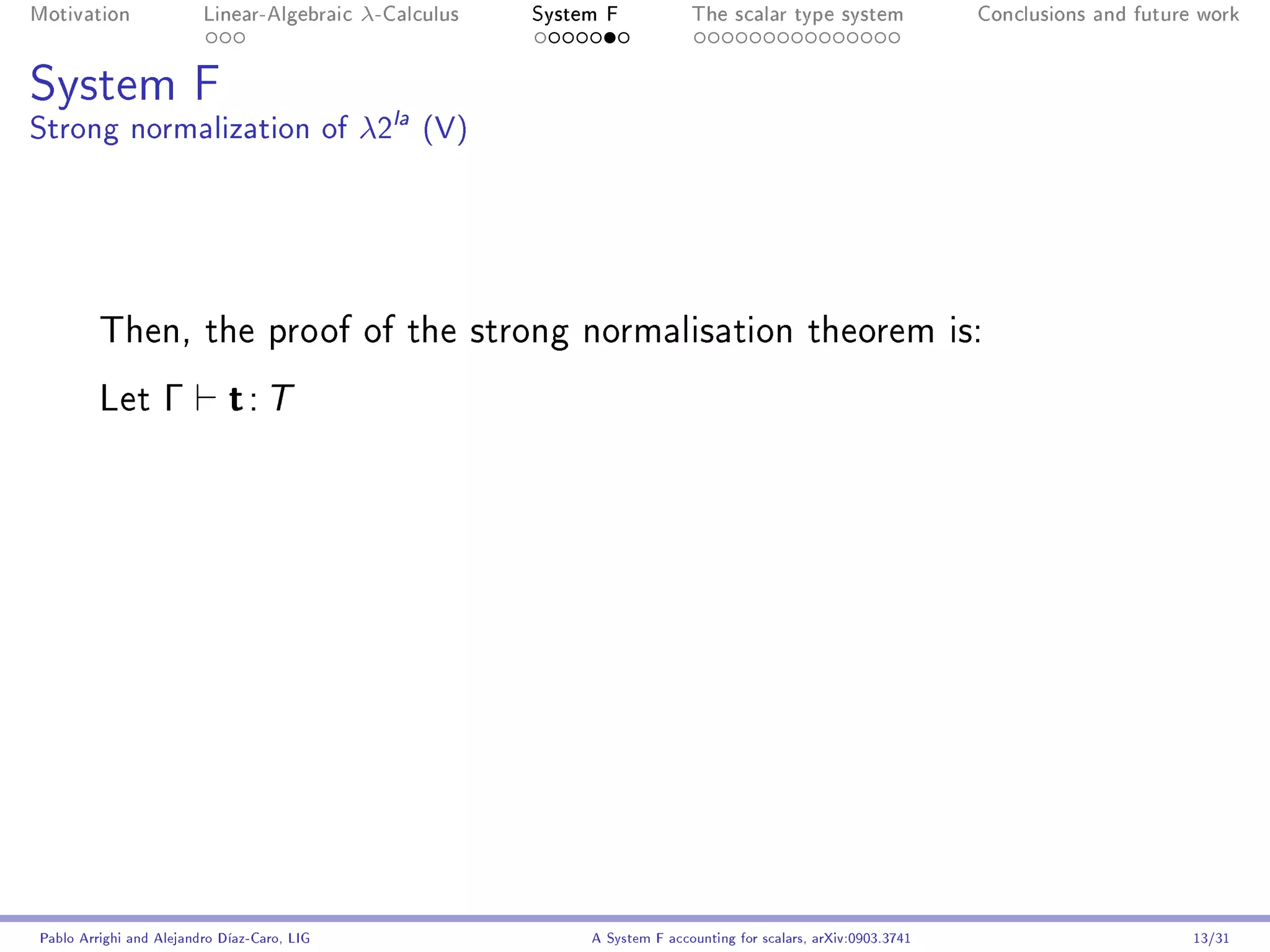
         Then, the proof of the strong normalisation theorem is:

         Let       Γ         t: T


Pablo Arrighi and Alejandro Díaz-Caro, LIG                     A System F accounting for scalars, arXiv:0903.3741                         13/31
Motivation               Linear-Algebraic    λ-Calculus   System F            The scalar type system                Conclusions and future work


System F
Strong normalization of λ2la (V)


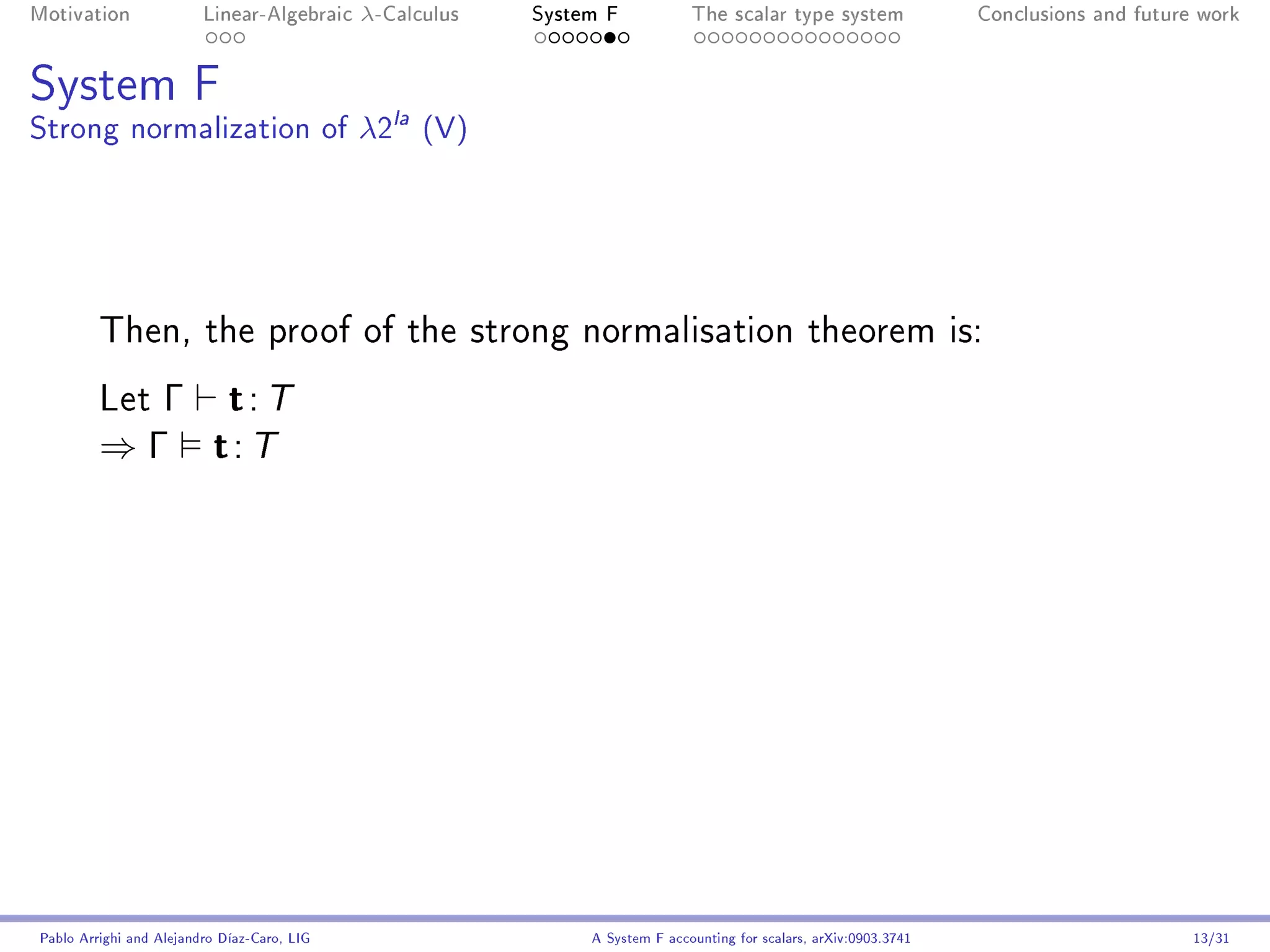
         Then, the proof of the strong normalisation theorem is:

         Let Γ t: T
         ⇒ Γ t: T


Pablo Arrighi and Alejandro Díaz-Caro, LIG                     A System F accounting for scalars, arXiv:0903.3741                         13/31
Motivation               Linear-Algebraic    λ-Calculus   System F            The scalar type system                Conclusions and future work


System F
Strong normalization of λ2la (V)


         Then, the proof of the strong normalisation theorem is:

         Let Γ  t: T
         ⇒ Γ t: T
         ⇒ If ∀(xi : Ai ) ∈ Γ, xi ∈ [[Ai ]]ξ                   then        t ∈ [[T ]]ξ


Pablo Arrighi and Alejandro Díaz-Caro, LIG                     A System F accounting for scalars, arXiv:0903.3741                         13/31
Motivation               Linear-Algebraic    λ-Calculus       System F              The scalar type system                Conclusions and future work


System F
Strong normalization of λ2la (V)


         Then, the proof of the strong normalisation theorem is:

         Let Γ  t: T
         ⇒ Γ t: T
         ⇒ If ∀(xi : Ai ) ∈ Γ, xi ∈ [[Ai ]]ξ                         then        t ∈ [[T ]]ξ
         Note that

                     x i ∈ [[Ai ]]ξ          because      [[Ai ]]ξ   is saturated,


Pablo Arrighi and Alejandro Díaz-Caro, LIG                           A System F accounting for scalars, arXiv:0903.3741                         13/31
Motivation               Linear-Algebraic    λ-Calculus       System F              The scalar type system                Conclusions and future work


System F
Strong normalization of λ2la (V)


         Then, the proof of the strong normalisation theorem is:

         Let Γ  t: T
         ⇒ Γ t: T
         ⇒ If ∀(xi : Ai ) ∈ Γ, xi ∈ [[Ai ]]ξ                         then        t ∈ [[T ]]ξ
         Note that

                     x i ∈ [[Ai ]]ξ          because      [[Ai ]]ξ   is saturated,

                     then        t is strong normalising because [[T ]]ξ ⊆ SN


Pablo Arrighi and Alejandro Díaz-Caro, LIG                           A System F accounting for scalars, arXiv:0903.3741                         13/31
Motivation               Linear-Algebraic    λ-Calculus   System F            The scalar type system                Conclusions and future work


System F
Linear-Algebraic λ-Calculus with λ2la


    Higher-order computation                                              Linear algebra
    t ::= x | λx .t | (t t)  |                                            t + t | α.t | 0
               λx .t b → t[b/x ] (∗)                                                  Elementary rules such as

    (*)      b an abstraction or a variable.                                          u + 0 → u and
                                                                                      α.(u + v) → α.u + α.v.
                                                                                      Factorisation rules such as
                                                                                      α.u + β.u → (α + β).u.
                                                                                      Application rules such as
                                                                                      u (v + w) → (u v) + (u w).


Pablo Arrighi and Alejandro Díaz-Caro, LIG                     A System F accounting for scalars, arXiv:0903.3741                         14/31
Motivation               Linear-Algebraic    λ-Calculus   System F            The scalar type system                Conclusions and future work


System F
Linear-Algebraic λ-Calculus with λ2la


    Higher-order computation                                              Linear algebra
    t ::= x | λx .t | (t t)  |                                            t + t | α.t | 0
               λx .t b → t[b/x ] (∗)                                                  Elementary rules such as

    (*)      b an abstraction or a variable.                                          u + 0 → u and
                                                                                      α.(u + v) → α.u + α.v.
    Every typable term is strong
    normalizing                                                                       Factorisation rules such as
                                                                                      α.u + β.u → (α + β).u.
                                                                                      Application rules such as
                                                                                      u (v + w) → (u v) + (u w).


Pablo Arrighi and Alejandro Díaz-Caro, LIG                     A System F accounting for scalars, arXiv:0903.3741                         14/31
Motivation               Linear-Algebraic    λ-Calculus   System F            The scalar type system                Conclusions and future work


System F
Linear-Algebraic λ-Calculus with λ2la


    Higher-order computation                                              Linear algebra
    t ::= x | λx .t | (t t)  |                                            t + t | α.t | 0
               λx .t b → t[b/x ] (∗)                                                  Elementary rules such as

    (*)      b an abstraction or a variable.                                          u + 0 → u and
                                                                                      α.(u + v) → α.u + α.v.
    Every typable term is strong
    normalizing                                                                       Factorisation rules such as

    Hence            Yb is no typable!                                                α.u + β.u → (α + β).u.
                                                                                      Application rules such as
                                                                                      u (v + w) → (u v) + (u w).


Pablo Arrighi and Alejandro Díaz-Caro, LIG                     A System F accounting for scalars, arXiv:0903.3741                         14/31
Motivation               Linear-Algebraic    λ-Calculus   System F            The scalar type system                Conclusions and future work


System F
Linear-Algebraic λ-Calculus with λ2la


    Higher-order computation                                              Linear algebra
    t ::= x | λx .t | (t t)  |                                            t + t | α.t | 0
               λx .t b → t[b/x ] (∗)                                                  Elementary rules such as

    (*)      b an abstraction or a variable.                                          u + 0 → u and
                                                                                      α.(u + v) → α.u + α.v.
    Every typable term is strong
    normalizing                                                                       Factorisation rules such as

    Hence  Yb is no typable!                                                          α.u + β.u → (α + β).u.
    t − t → 0 always, so it is not                                                    Application rules such as
    necesary to reduce t rst. we can                                                 u (v + w) → (u v) + (u w).
    remove the closed-normal
    restrictions!


Pablo Arrighi and Alejandro Díaz-Caro, LIG                     A System F accounting for scalars, arXiv:0903.3741                         14/31
Motivation               Linear-Algebraic      λ-Calculus   System F            The scalar type system                Conclusions and future work


The scalar type system
Grammar


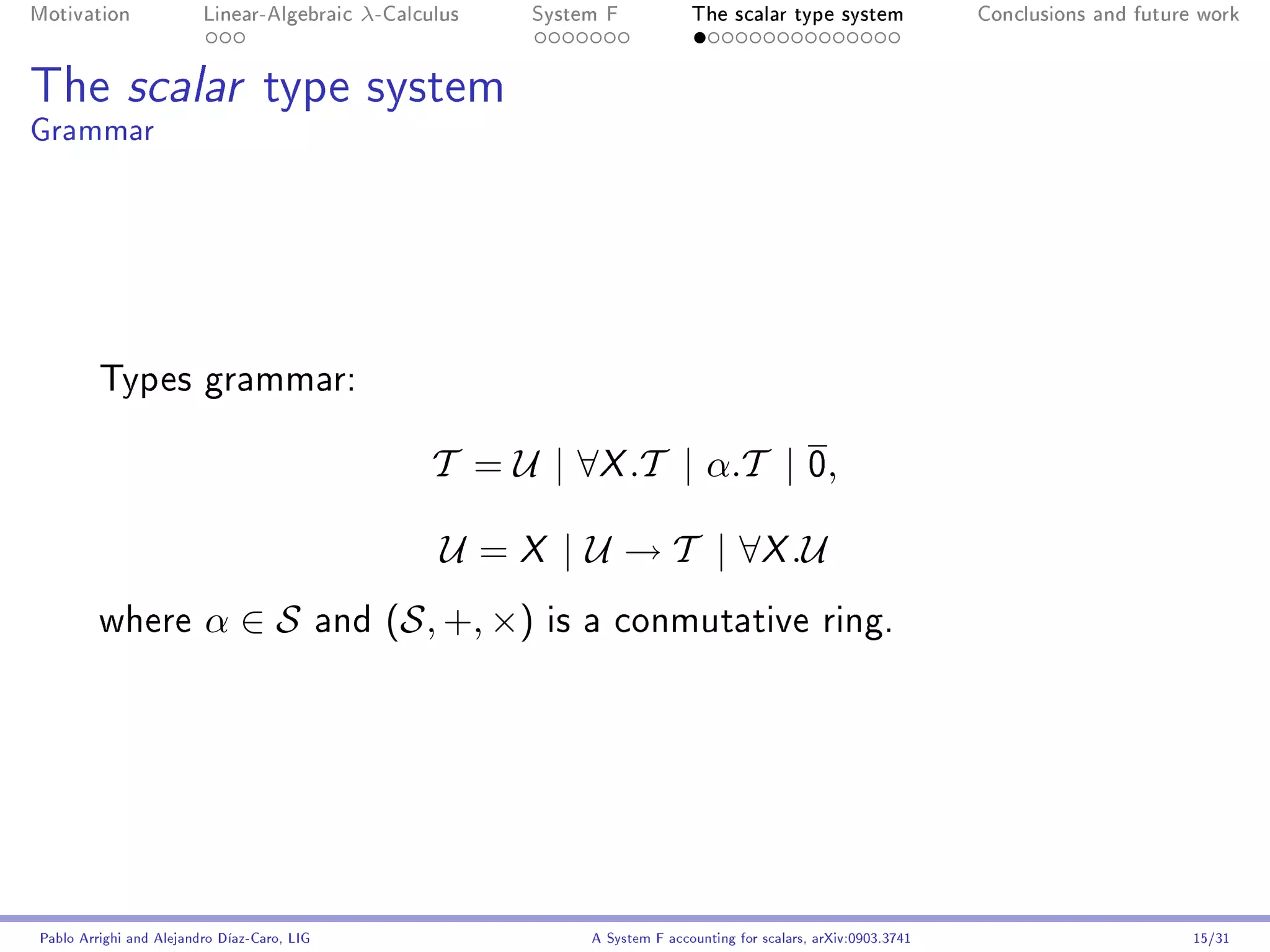
         Types grammar:


                                                      T = U | ∀X .T | α.T | 0,

                                                       U = X | U → T | ∀X .U
         where           α∈S                 and   (S, +, ×)   is a conmutative ring.


Pablo Arrighi and Alejandro Díaz-Caro, LIG                       A System F accounting for scalars, arXiv:0903.3741                         15/31
Motivation               Linear-Algebraic    λ-Calculus          System F               The scalar type system                  Conclusions and future work


The scalar type system
Type inference rules


                                                                                          ax U [ ]
                                                              Γ, x : U         x   :U

             Γ         u: U → T                           Γ      v: U                                   Γ, x : U              t: T
                                                                               →E                                                     → I [U ]
                            Γ        (u v) : T                                                      Γ         λx t : U → T

                 Γ        u : ∀X .T                                            Γ         u: T
                                             ∀E [X := U ]                                                ∀I [X ] with           X    ∈ FV (Γ)
                                                                                                                                     /
              Γ        u : T [U /X ]                                       Γ        u : ∀X .T


Pablo Arrighi and Alejandro Díaz-Caro, LIG                               A System F accounting for scalars, arXiv:0903.3741                           16/31
Motivation               Linear-Algebraic    λ-Calculus          System F               The scalar type system                    Conclusions and future work


The scalar type system
Type inference rules


                                                                                          ax U [ ]
                                                              Γ, x : U         x   :U

             Γ         u: U → T                           Γ      v: U                                   Γ, x : U               t: T
                                                                               →E                                                       → I [U ]
                            Γ        (u v) : T                                                      Γ         λx t : U → T

                 Γ        u : ∀X .T                                            Γ         u: T
                                             ∀E [X := U ]                                                ∀I [X ] with             X   ∈ FV (Γ)
                                                                                                                                      /
              Γ        u : T [U /X ]                                       Γ        u : ∀X .T

                                             Γ       u: T            Γ          v: T                                   Γ        u: T
                                   ax0                                                           +I                                       αI
              Γ        0: T                      Γ     u + v: T                                                   Γ           α.u : T


Pablo Arrighi and Alejandro Díaz-Caro, LIG                               A System F accounting for scalars, arXiv:0903.3741                             16/31
Motivation               Linear-Algebraic     λ-Calculus          System F               The scalar type system                    Conclusions and future work


The scalar type system
Type inference rules


                                                                                           ax U [ ]
                                                               Γ, x : U         x   :U

             Γ         u : α.(U → T )                      Γ      v : β.U                                Γ, x : U               t: T
                                                                                →E                                                       → I [U ]
                            Γ        (u v) : (α × β).T                                               Γ         λx t : U → T

                 Γ        u : ∀X .T                                             Γ         u: T
                                              ∀E [X := U ]                                                ∀I [X ] with             X    ∈ FV (Γ)
                                                                                                                                        /
              Γ        u : T [U /X ]                                        Γ        u : ∀X .T

                                              Γ       u : α.T         Γ          v : β.T                                Γ        u: T
                                   ax                                                            +I
                                        0                                                                                                  sI   [α]
               Γ         0: 0                     Γ     u + v : (α + β).T                                          Γ           α.u : α.T

         Where U                 ∈U          and types in contexts are are in                                    U.

Pablo Arrighi and Alejandro Díaz-Caro, LIG                                A System F accounting for scalars, arXiv:0903.3741                             17/31
Motivation               Linear-Algebraic    λ-Calculus   System F            The scalar type system                Conclusions and future work


The scalar type system
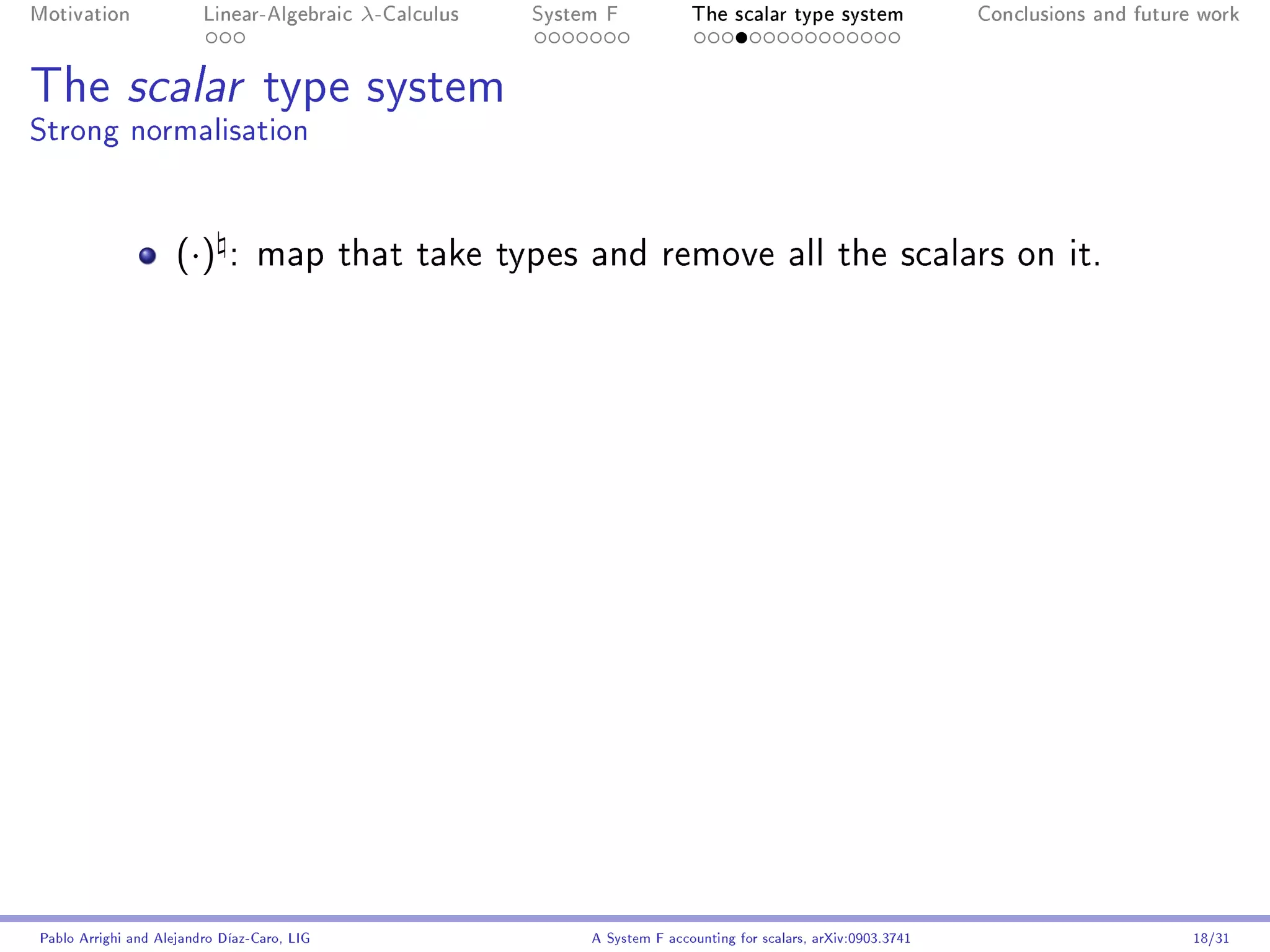
Strong normalisation


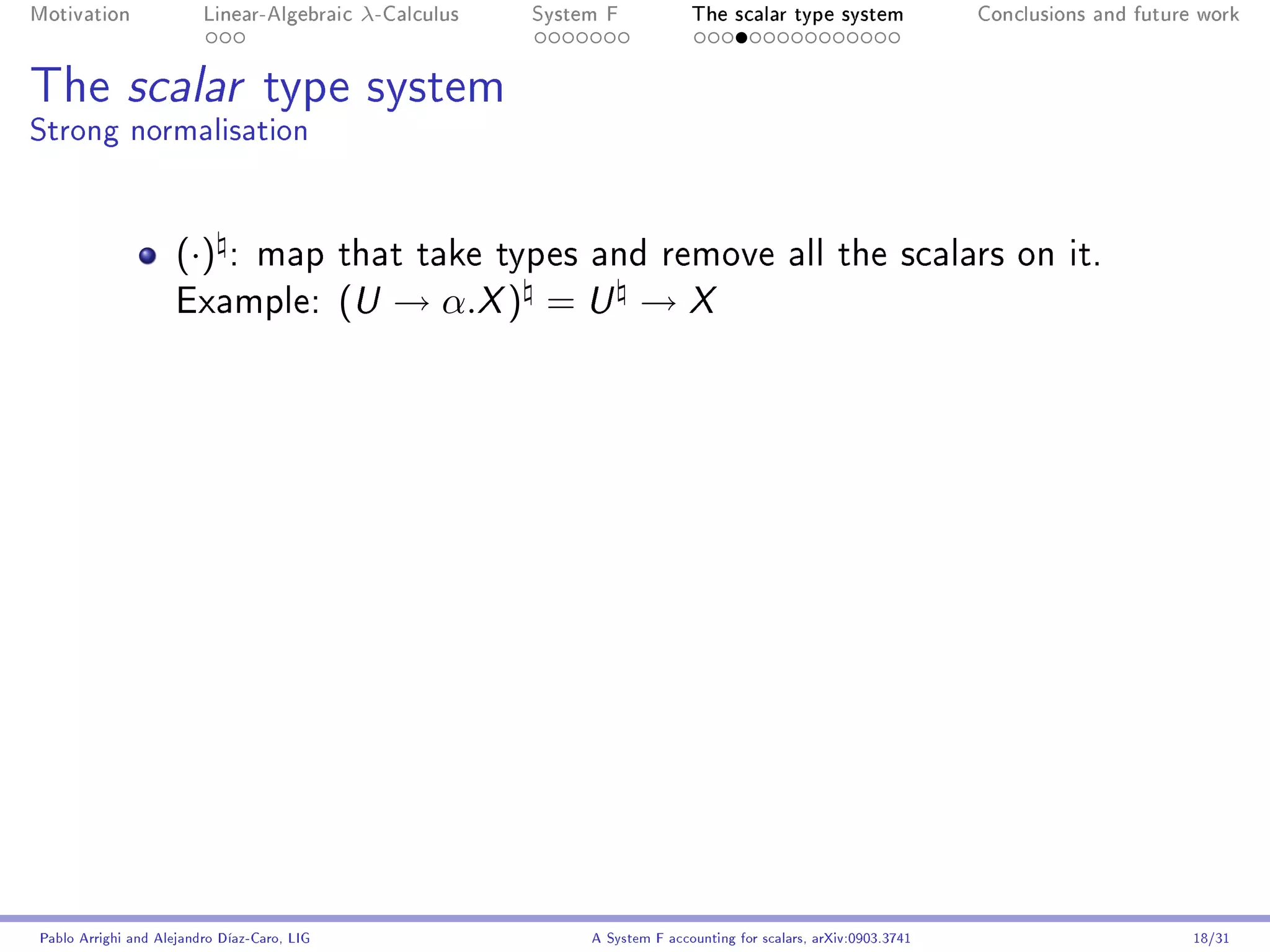
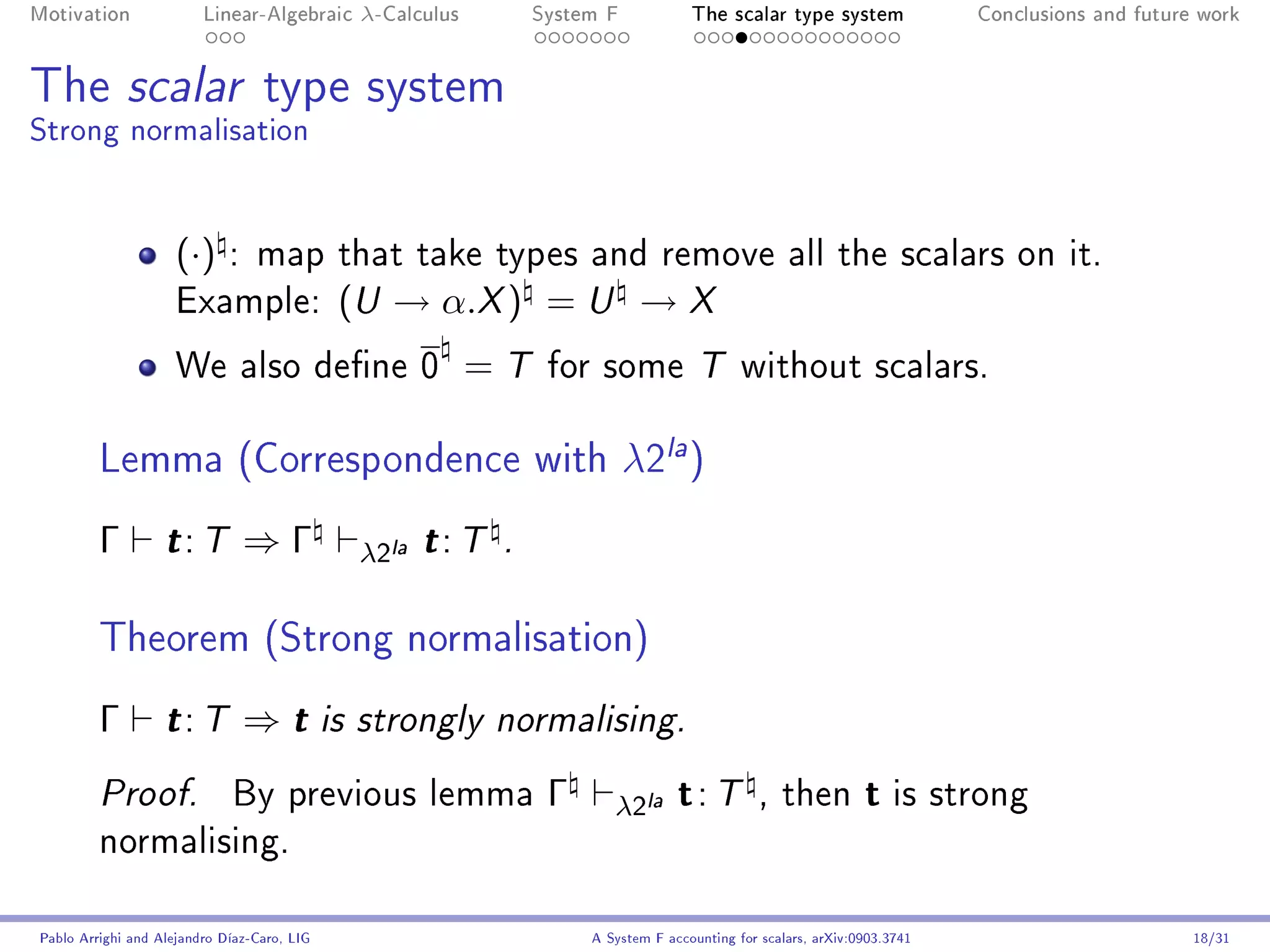
                     (·)     : map that take types and remove all the scalars on it.


Pablo Arrighi and Alejandro Díaz-Caro, LIG                     A System F accounting for scalars, arXiv:0903.3741                         18/31
Motivation               Linear-Algebraic     λ-Calculus   System F            The scalar type system                Conclusions and future work


The scalar type system
Strong normalisation


                     (·)     : map that take types and remove all the scalars on it.
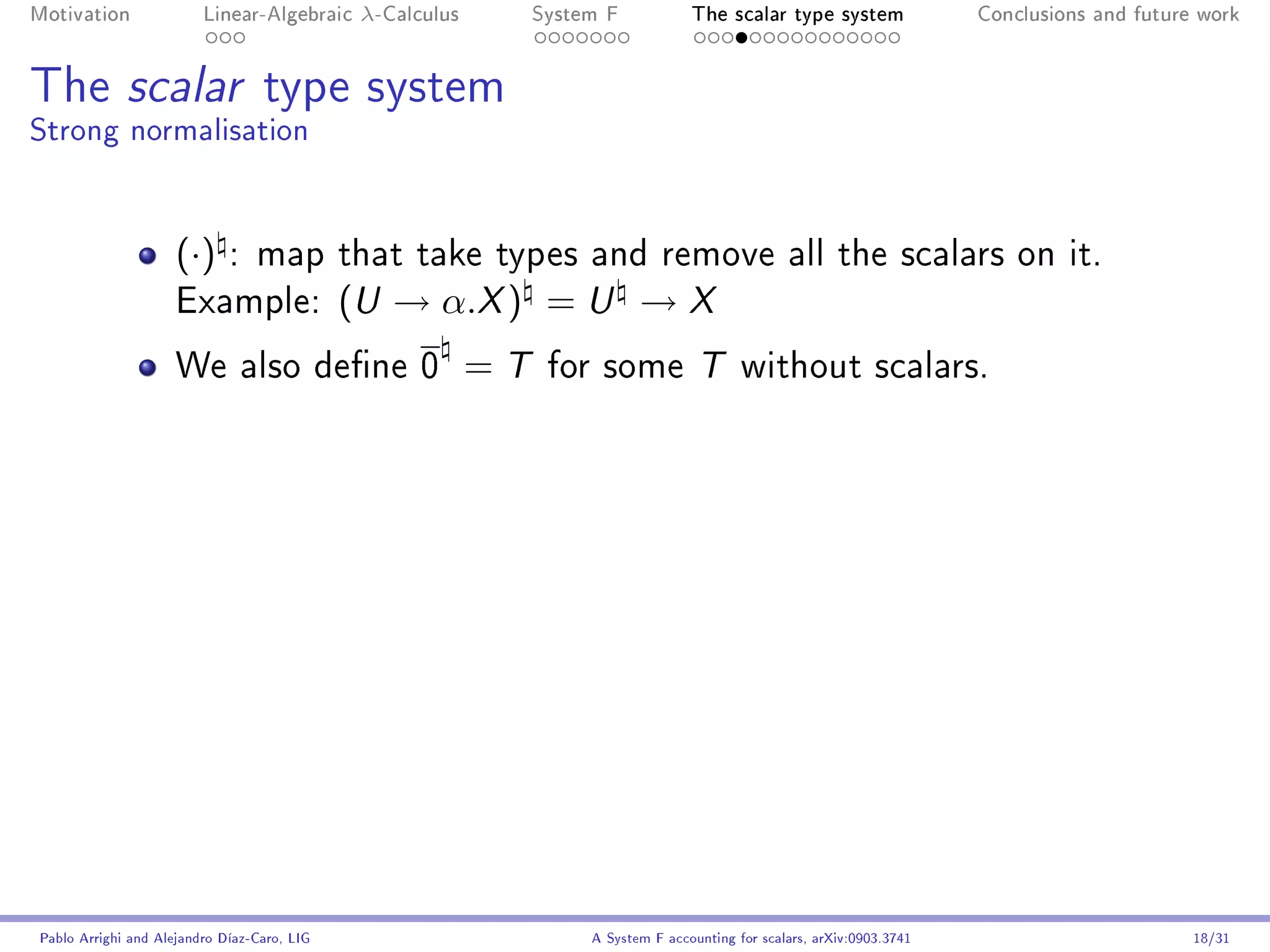
                     Example:                (U → α.X ) = U → X


Pablo Arrighi and Alejandro Díaz-Caro, LIG                      A System F accounting for scalars, arXiv:0903.3741                         18/31
Motivation               Linear-Algebraic     λ-Calculus        System F            The scalar type system                Conclusions and future work


The scalar type system
Strong normalisation


                     (·)     : map that take types and remove all the scalars on it.
                     Example:                (U → α.X ) = U → X
                     We also dene 0                       =T    for some T without scalars.


Pablo Arrighi and Alejandro Díaz-Caro, LIG                           A System F accounting for scalars, arXiv:0903.3741                         18/31
Motivation               Linear-Algebraic     λ-Calculus        System F            The scalar type system                Conclusions and future work


The scalar type system
Strong normalisation


                     (·)     : map that take types and remove all the scalars on it.
                     Example:                (U → α.X ) = U → X
                     We also dene 0                       =T    for some T without scalars.


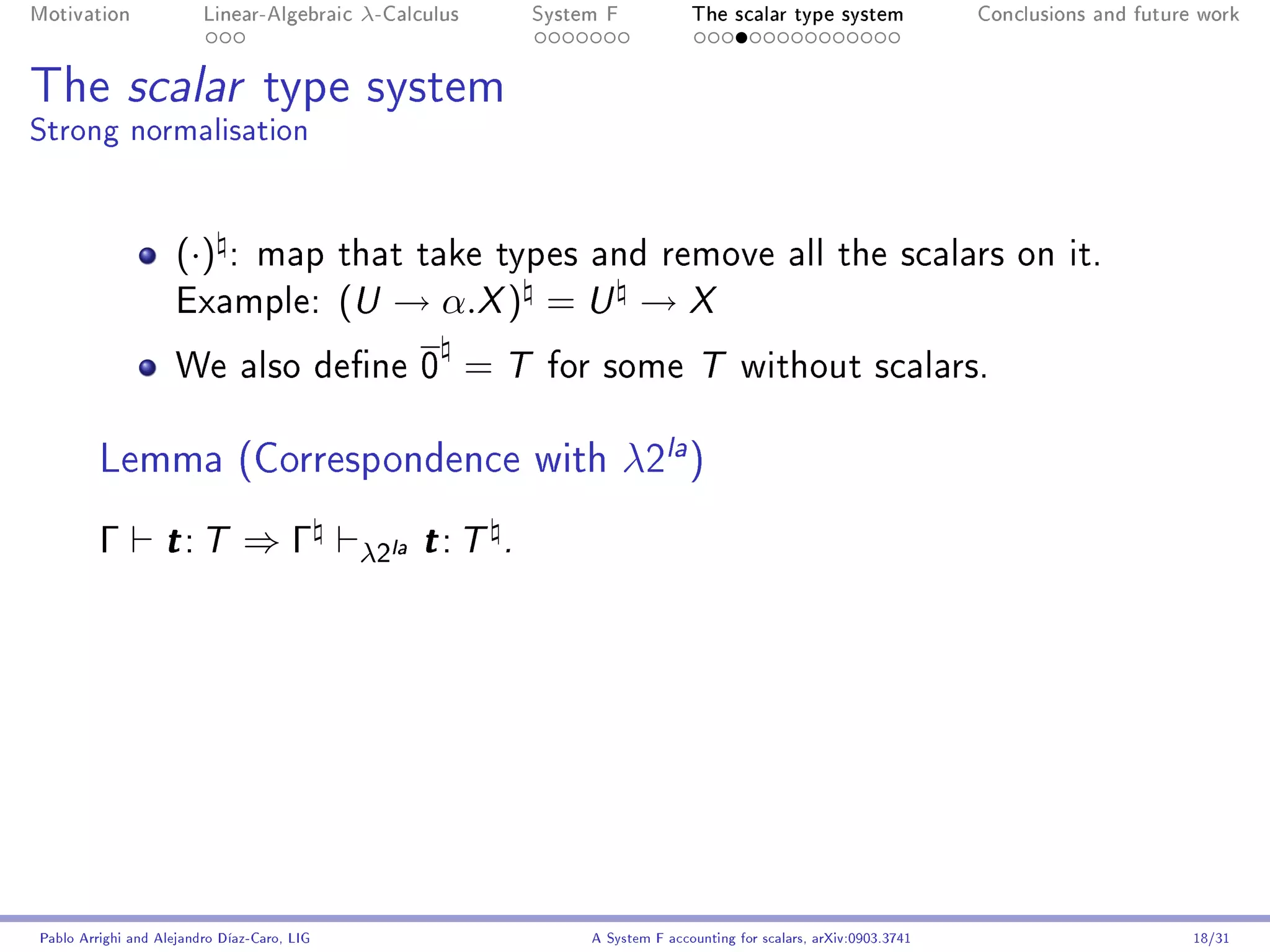
         Lemma (Correspondence with λ2la )
         Γ         t: T        ⇒Γ             λ2la t : T    .


Pablo Arrighi and Alejandro Díaz-Caro, LIG                           A System F accounting for scalars, arXiv:0903.3741                         18/31
Motivation               Linear-Algebraic      λ-Calculus        System F            The scalar type system                Conclusions and future work


The scalar type system
Strong normalisation


                     (·)     : map that take types and remove all the scalars on it.
                     Example:                 (U → α.X ) = U → X
                     We also dene 0                        =T    for some T without scalars.


         Lemma (Correspondence with λ2la )
         Γ         t: T        ⇒Γ              λ2la t : T    .


         Theorem (Strong normalisation)
         Γ         t: T        ⇒t            is strongly normalising.


         Proof.              By previous lemma                    Γ      λ2la      t: T         , then          t is strong
         normalising.


Pablo Arrighi and Alejandro Díaz-Caro, LIG                            A System F accounting for scalars, arXiv:0903.3741                         18/31
Motivation               Linear-Algebraic    λ-Calculus        System F            The scalar type system                Conclusions and future work


The scalar type system
Subject reduction


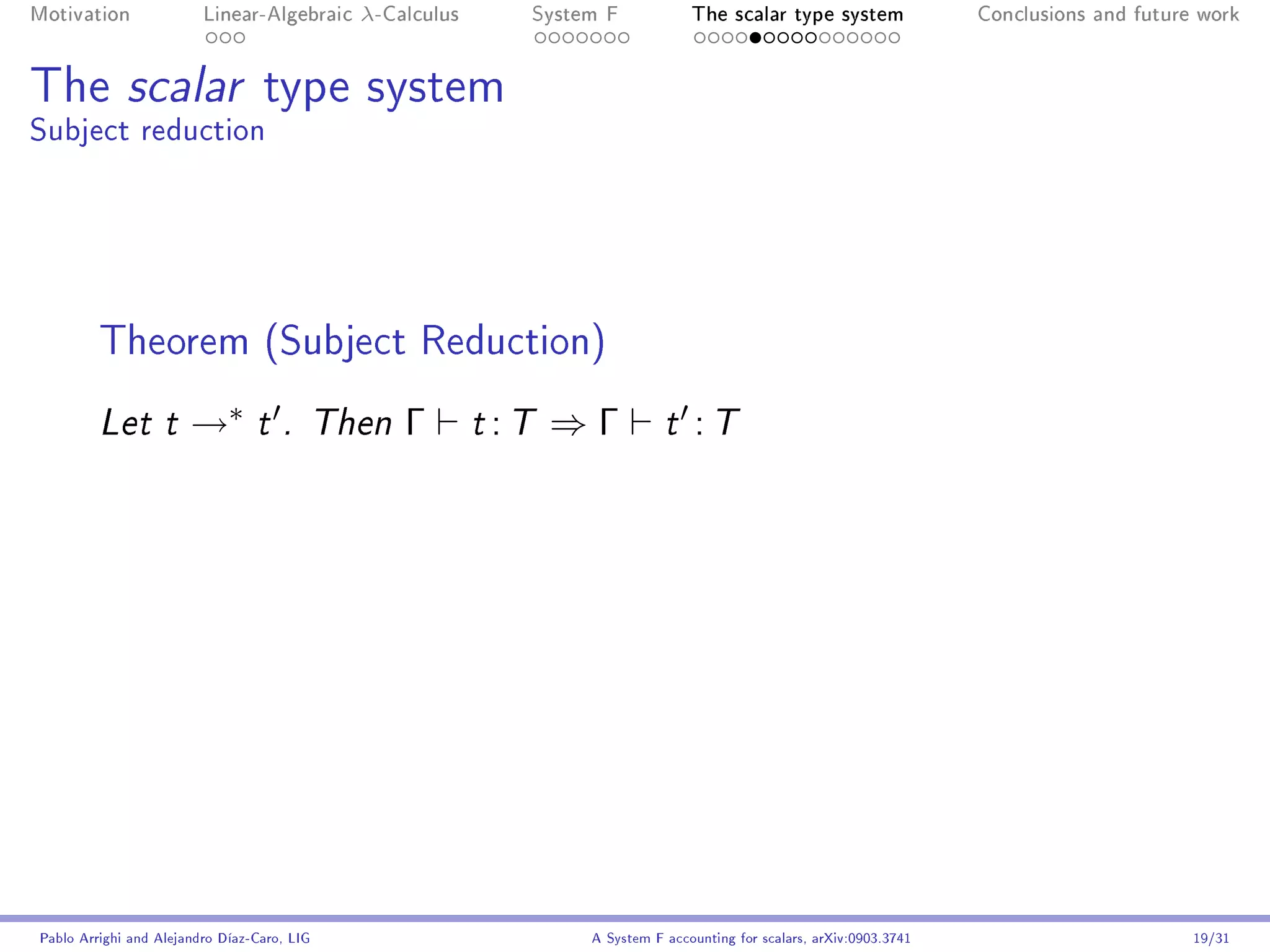
         Theorem (Subject Reduction)
         Let t         →∗        t . Then        Γ        t   :T ⇒ Γ           t    :T


Pablo Arrighi and Alejandro Díaz-Caro, LIG                          A System F accounting for scalars, arXiv:0903.3741                         19/31
Motivation               Linear-Algebraic    λ-Calculus        System F            The scalar type system                Conclusions and future work


The scalar type system
Subject reduction


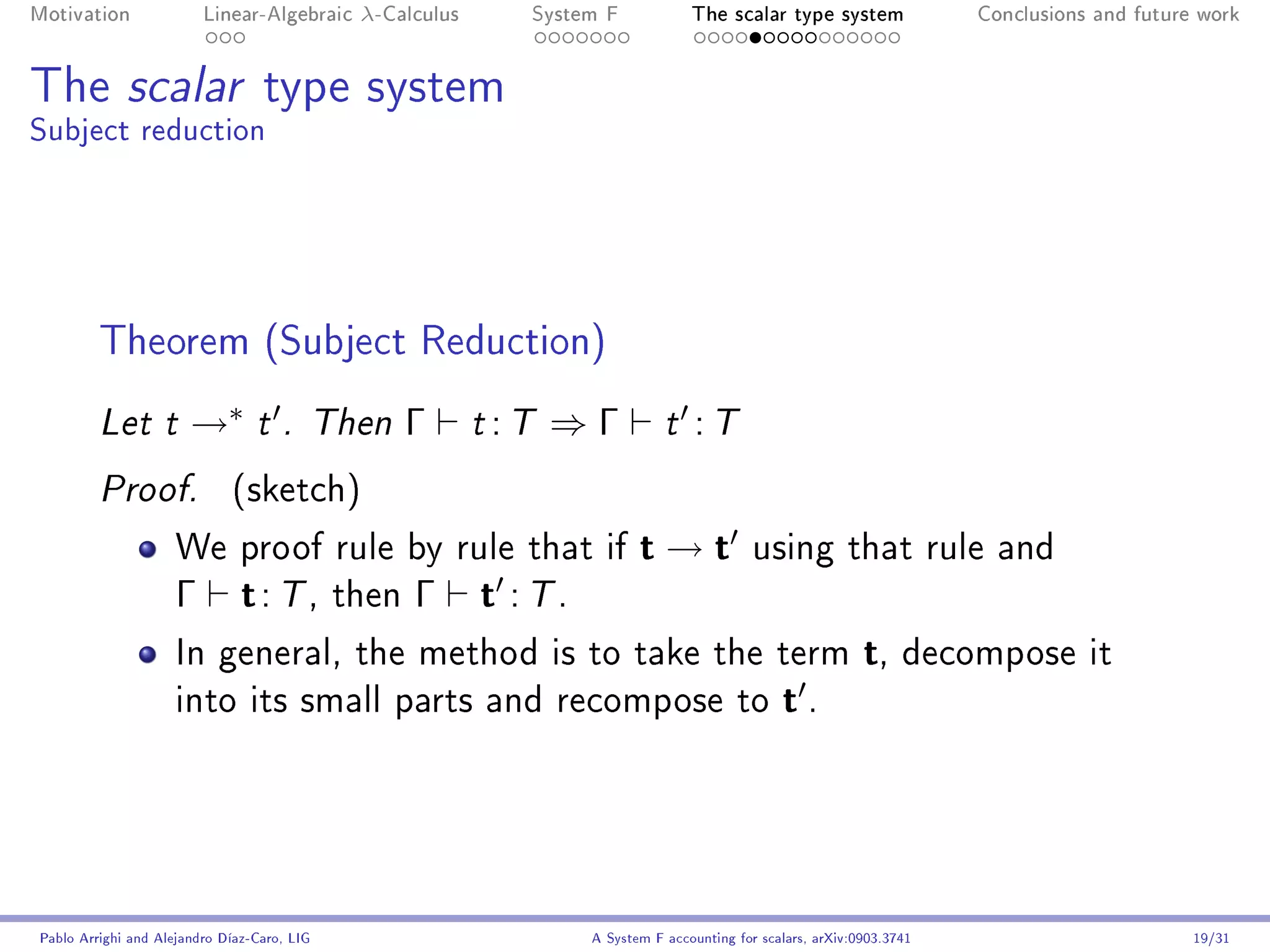
         Theorem (Subject Reduction)
         Let t         →∗        t . Then        Γ        t   :T ⇒ Γ           t    :T
         Proof.              (sketch)

                     We proof rule by rule that if                         t→t               using that rule and
                     Γ         t : T , then Γ t : T .
                     In general, the method is to take the term                                               t, decompose it
                     into its small parts and recompose to                                       t.


Pablo Arrighi and Alejandro Díaz-Caro, LIG                          A System F accounting for scalars, arXiv:0903.3741                         19/31
Motivation               Linear-Algebraic    λ-Calculus   System F            The scalar type system                Conclusions and future work


The scalar type system
Subject reduction proof: example (I)


         To show a rule as example, we need some auxiliary lemmas and
         denitions:


Pablo Arrighi and Alejandro Díaz-Caro, LIG                     A System F accounting for scalars, arXiv:0903.3741                         20/31
Motivation               Linear-Algebraic     λ-Calculus        System F            The scalar type system                Conclusions and future work


The scalar type system
Subject reduction proof: example (I)


         To show a rule as example, we need some auxiliary lemmas and
         denitions:
         Order:

                     Write A                 B   if either
                                B     ≡ ∀X .A or
                                A     ≡ ∀X .C and          B   ≡ C [U /X ] for some                     U     ∈ U.
                     ≥     is the reexive and transitive closure of                                          .


Pablo Arrighi and Alejandro Díaz-Caro, LIG                           A System F accounting for scalars, arXiv:0903.3741                         20/31
Motivation                Linear-Algebraic    λ-Calculus        System F            The scalar type system                    Conclusions and future work


The scalar type system
Subject reduction proof: example (I)


         To show a rule as example, we need some auxiliary lemmas and
         denitions:
         Order:

                     Write A                 B    if either
                                B     ≡ ∀X .A or
                                A     ≡ ∀X .C and          B   ≡ C [U /X ] for some                     U     ∈ U.
                     ≥     is the reexive and transitive closure of                                          .
         Instuition of this denition:
         Types in the numerator of


                      Γ         t: A                                                                        Γ             t : ∀X .C
                                              ∀I   with    X   ∈ FV (Γ)
                                                               /                          or                                           ∀E
                 Γ         t : ∀X .A                                                                     Γ          t : C [U /X ]
         are greater than the types in the denominator.


Pablo Arrighi and Alejandro Díaz-Caro, LIG                           A System F accounting for scalars, arXiv:0903.3741                             20/31
Motivation               Linear-Algebraic    λ-Calculus   System F            The scalar type system                Conclusions and future work


The scalar type system
Subject reduction proof: example (II)

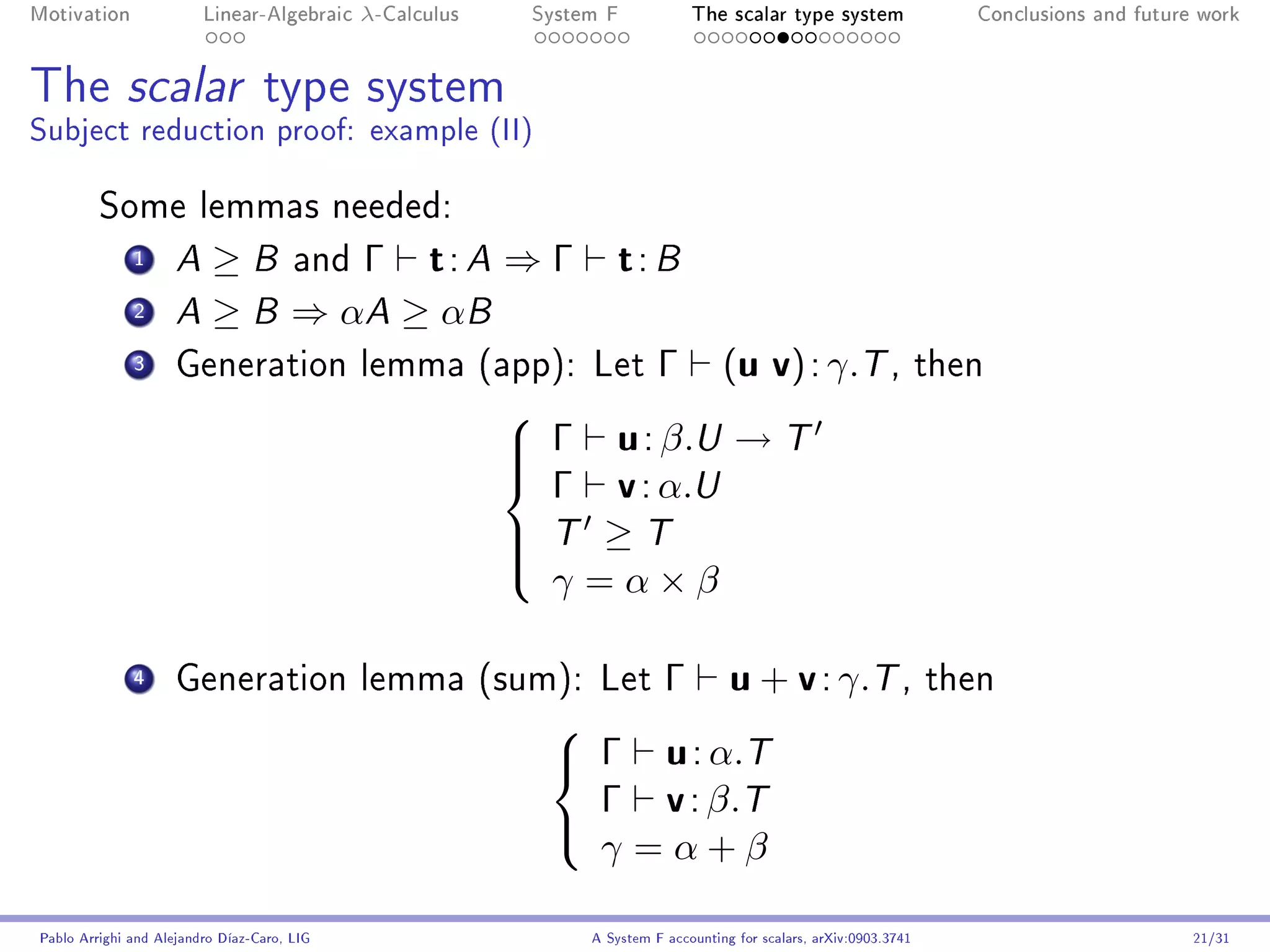
         Some lemmas needed:


Pablo Arrighi and Alejandro Díaz-Caro, LIG                     A System F accounting for scalars, arXiv:0903.3741                         21/31
Motivation               Linear-Algebraic    λ-Calculus   System F            The scalar type system                Conclusions and future work


The scalar type system
Subject reduction proof: example (II)

         Some lemmas needed:
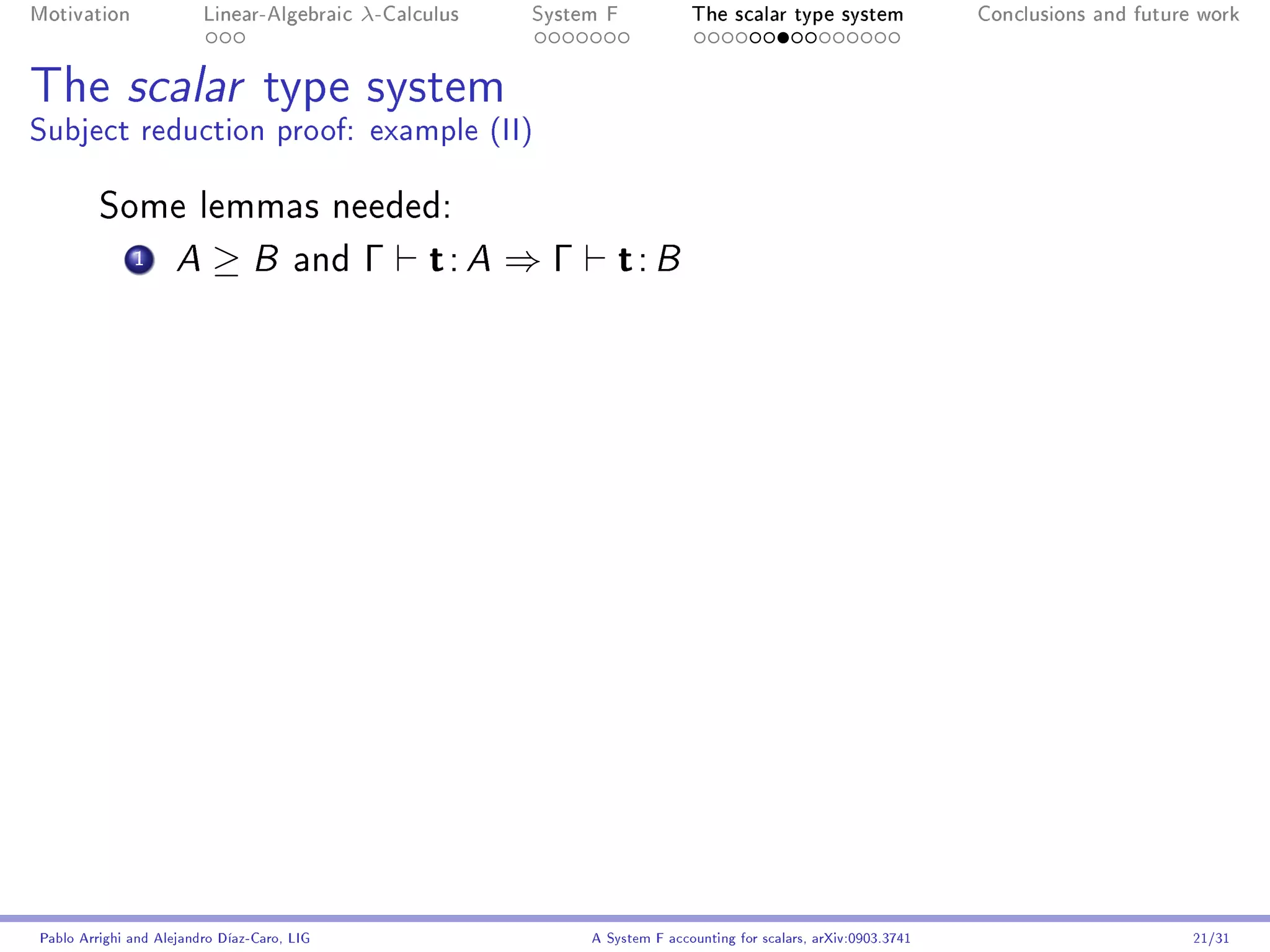
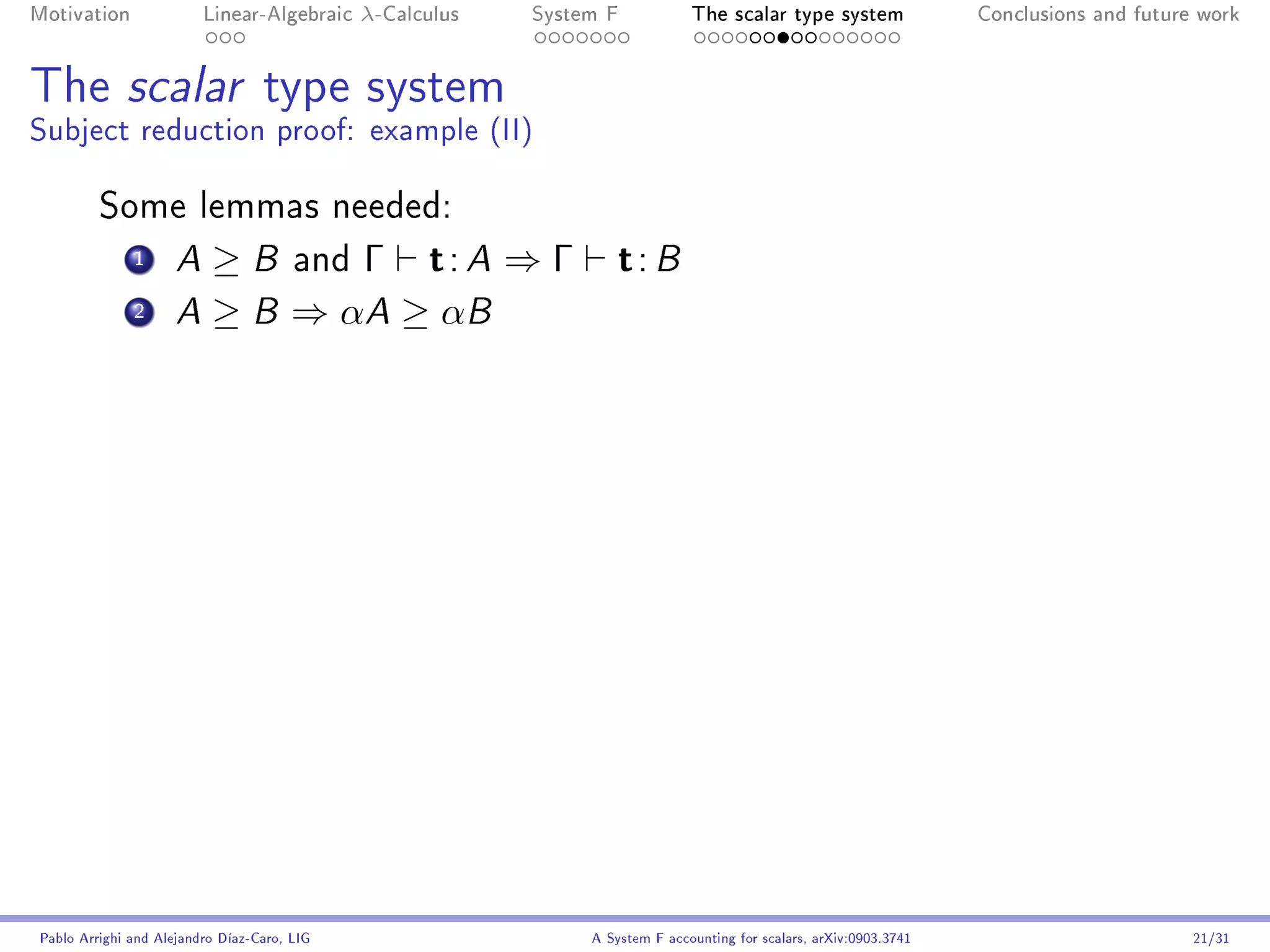
              1      A    ≥B           and   Γ     t: A ⇒ Γ t: B


Pablo Arrighi and Alejandro Díaz-Caro, LIG                     A System F accounting for scalars, arXiv:0903.3741                         21/31
Motivation               Linear-Algebraic    λ-Calculus   System F            The scalar type system                Conclusions and future work


The scalar type system
Subject reduction proof: example (II)

         Some lemmas needed:
              1      A ≥ B and Γ t : A ⇒ Γ                         t: B
              2      A ≥ B ⇒ αA ≥ αB


Pablo Arrighi and Alejandro Díaz-Caro, LIG                     A System F accounting for scalars, arXiv:0903.3741                         21/31
Motivation               Linear-Algebraic    λ-Calculus    System F            The scalar type system                   Conclusions and future work


The scalar type system
Subject reduction proof: example (II)

         Some lemmas needed:
              1      A ≥ B and Γ t : A ⇒ Γ                          t: B
              2      A ≥ B ⇒ αA ≥ αB

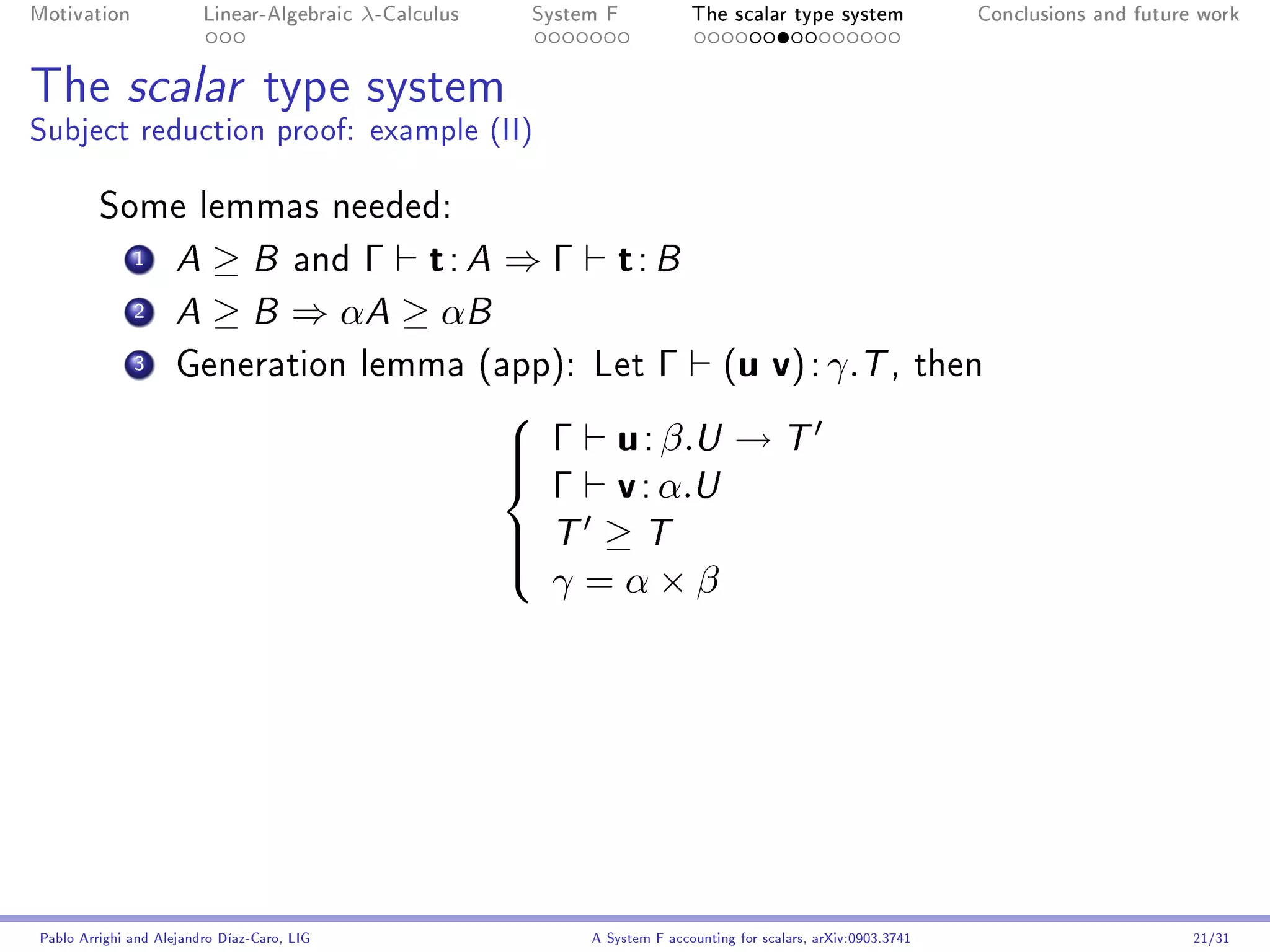
              3      Generation lemma (app): Let                          Γ         (u v) : γ.T ,                    then


                                                           Γ u : β.U → T
                                                          

                                                            Γ v : α.U
                                                          
                                                          
                                                           T ≥ T
                                                          
                                                            γ =α×β
                                                          


Pablo Arrighi and Alejandro Díaz-Caro, LIG                      A System F accounting for scalars, arXiv:0903.3741                            21/31
Motivation               Linear-Algebraic    λ-Calculus    System F            The scalar type system                   Conclusions and future work


The scalar type system
Subject reduction proof: example (II)

         Some lemmas needed:
              1      A ≥ B and Γ t : A ⇒ Γ                          t: B
              2      A ≥ B ⇒ αA ≥ αB

              3      Generation lemma (app): Let                          Γ         (u v) : γ.T ,                    then


                                                           Γ u : β.U → T
                                                          

                                                            Γ v : α.U
                                                          
                                                          
                                                           T ≥ T
                                                          
                                                            γ =α×β
                                                          


              4      Generation lemma (sum): Let                 Γ u + v : γ.T ,                                     then


                                                             Γ u : α.T
                                                            

                                                              Γ v : β.T
                                                              γ =α+β
                                                            

Pablo Arrighi and Alejandro Díaz-Caro, LIG                      A System F accounting for scalars, arXiv:0903.3741                            21/31
Motivation               Linear-Algebraic     λ-Calculus   System F            The scalar type system                Conclusions and future work


The scalar type system
Subject reduction proof: example (III)


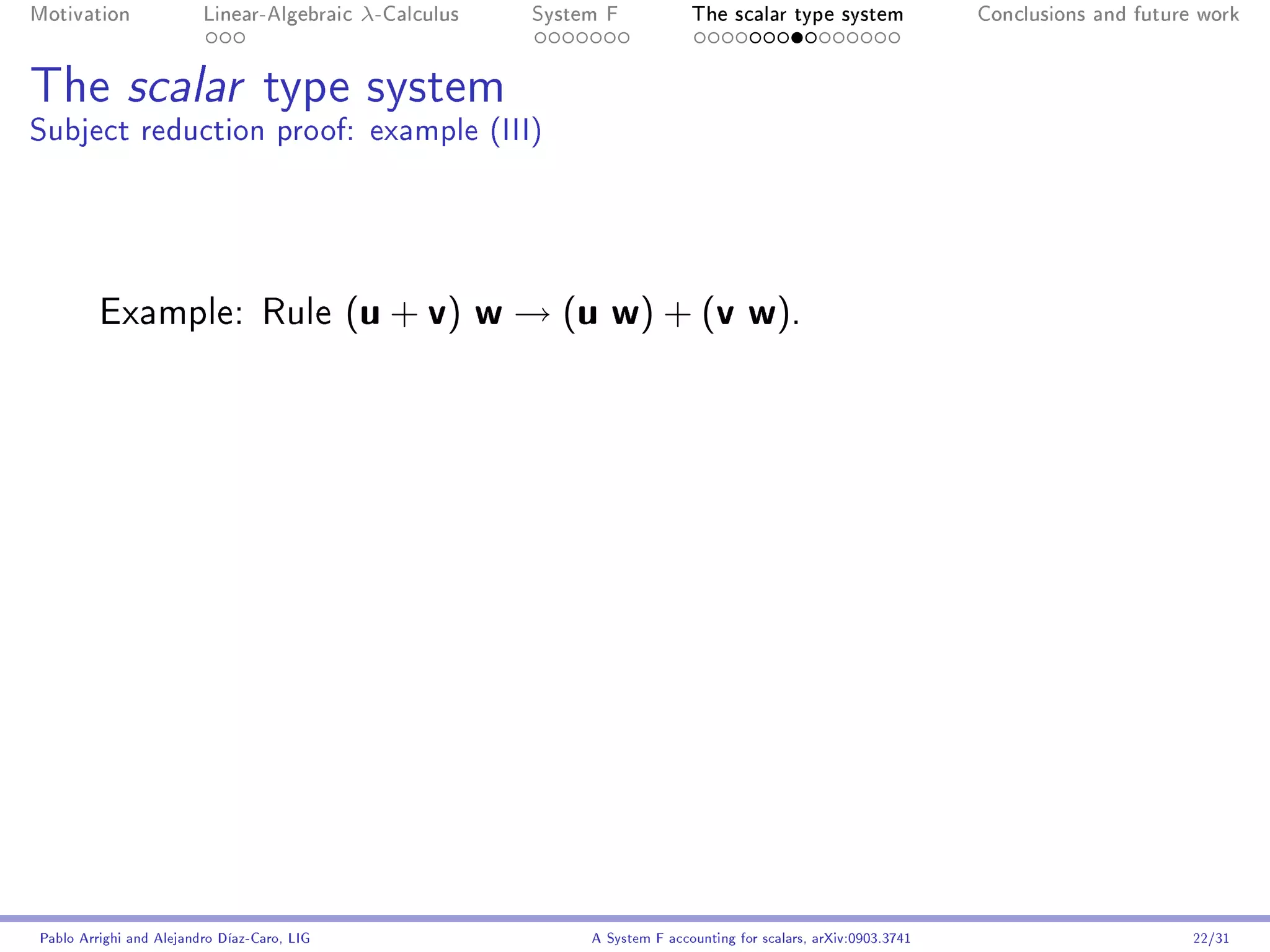
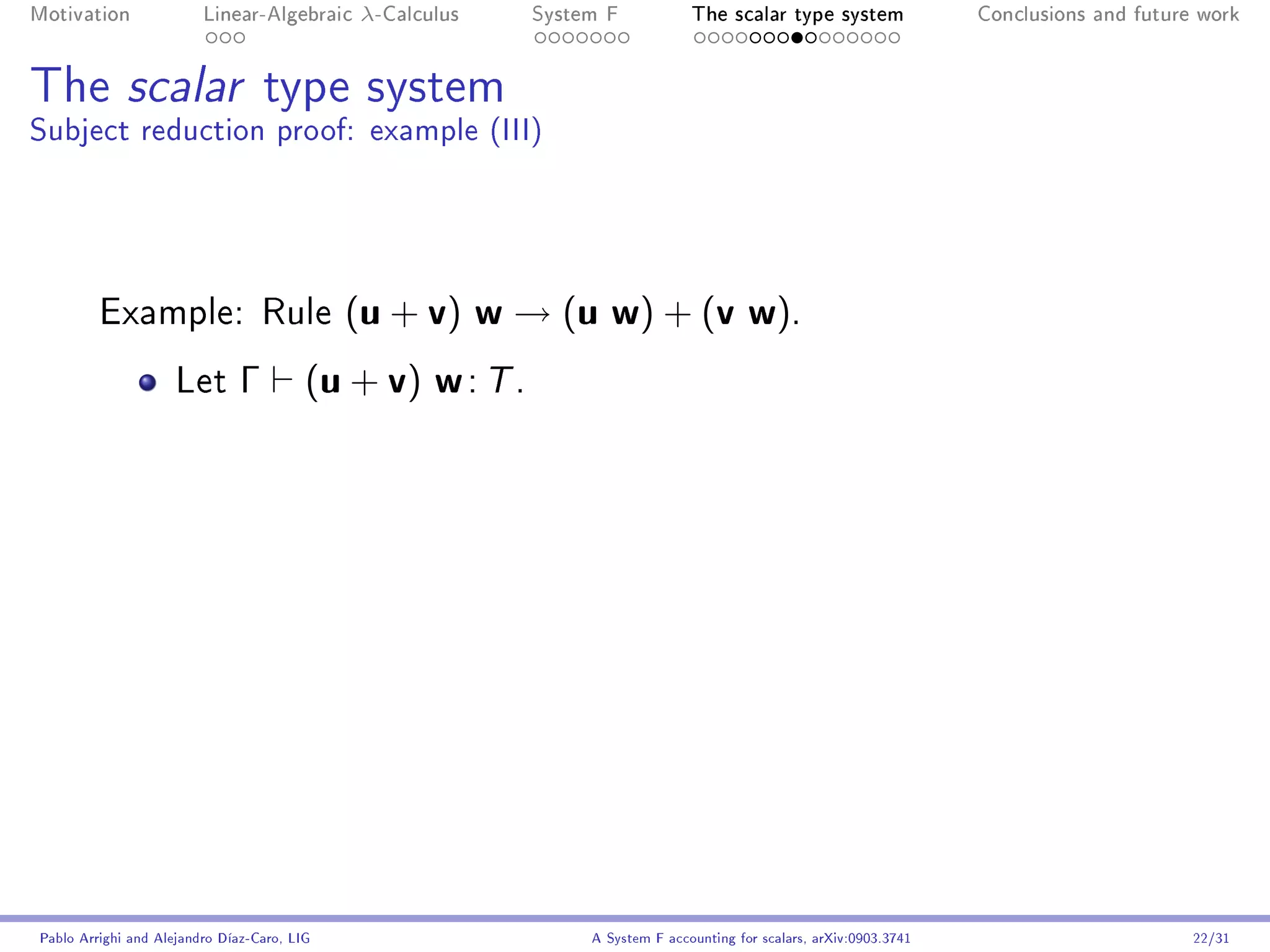
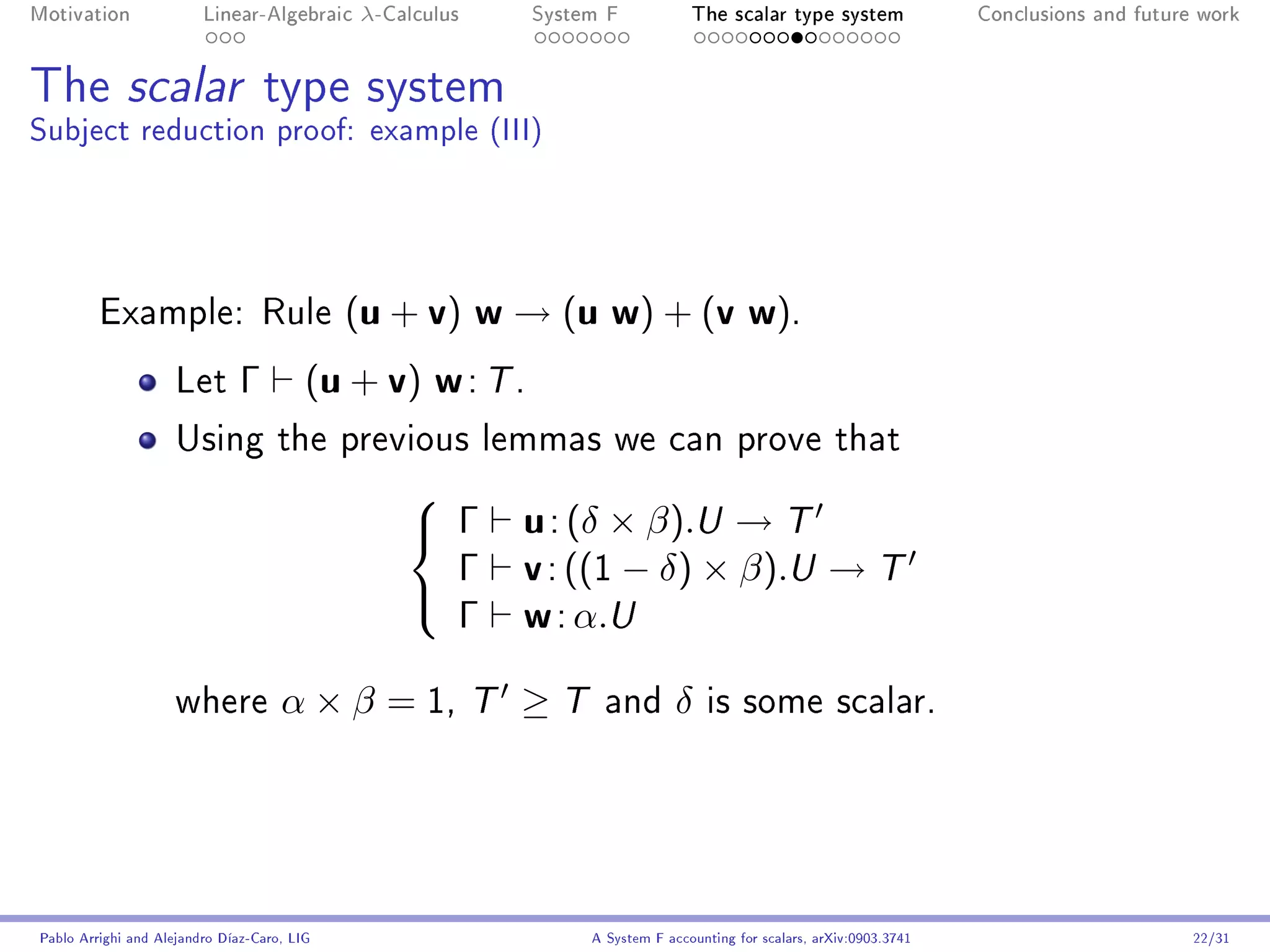
         Example: Rule                       ( u + v) w → ( u w ) + ( v w ) .


Pablo Arrighi and Alejandro Díaz-Caro, LIG                      A System F accounting for scalars, arXiv:0903.3741                         22/31
Motivation               Linear-Algebraic     λ-Calculus   System F            The scalar type system                Conclusions and future work


The scalar type system
Subject reduction proof: example (III)


         Example: Rule                       ( u + v) w → ( u w ) + ( v w ) .
                     Let       Γ         (u + v) w : T .


Pablo Arrighi and Alejandro Díaz-Caro, LIG                      A System F accounting for scalars, arXiv:0903.3741                         22/31
Motivation               Linear-Algebraic     λ-Calculus       System F            The scalar type system                Conclusions and future work


The scalar type system
Subject reduction proof: example (III)


         Example: Rule                       ( u + v) w → ( u w ) + ( v w ) .
                     Let       Γ         (u + v) w : T .
                     Using the previous lemmas we can prove that


                                                               u : (δ × β).U → T
                                                  
                                                   Γ
                                                    Γ          v : ((1 − δ) × β).U → T
                                                    Γ          w : α.U
                                                  

                     where           α × β = 1,            T   ≥T     and        δ   is some scalar.


Pablo Arrighi and Alejandro Díaz-Caro, LIG                          A System F accounting for scalars, arXiv:0903.3741                         22/31
Motivation               Linear-Algebraic        λ-Calculus   System F            The scalar type system                 Conclusions and future work


The scalar type system
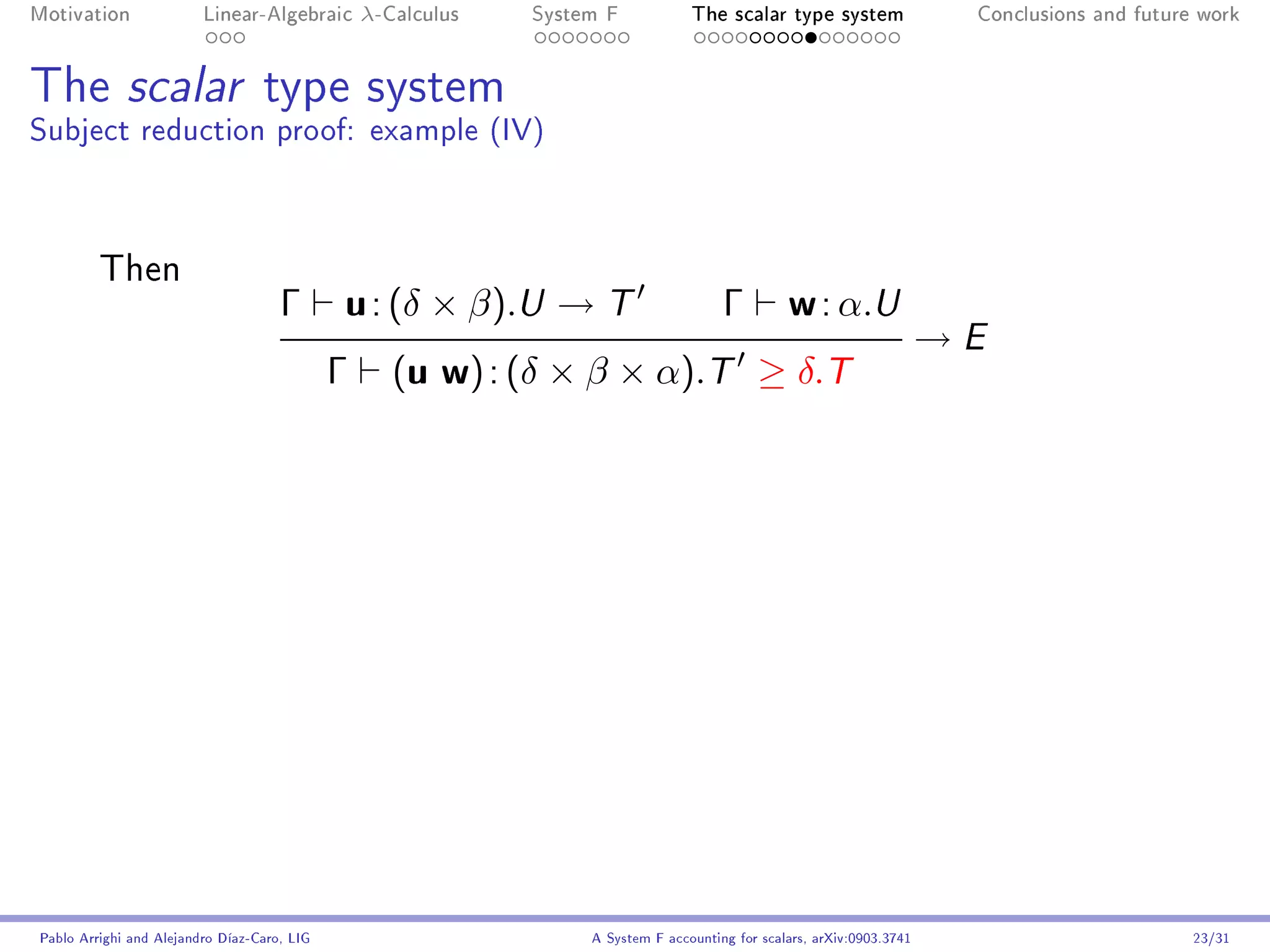
Subject reduction proof: example (IV)


         Then
                                     Γ       u : (δ × β).U → T                         Γ         w : α.U
                                                                                                                        →E
                                             Γ      (u w) : (δ × β × α).T ≥ δ.T


Pablo Arrighi and Alejandro Díaz-Caro, LIG                         A System F accounting for scalars, arXiv:0903.3741                          23/31
Motivation               Linear-Algebraic        λ-Calculus   System F            The scalar type system                 Conclusions and future work


The scalar type system
Subject reduction proof: example (IV)


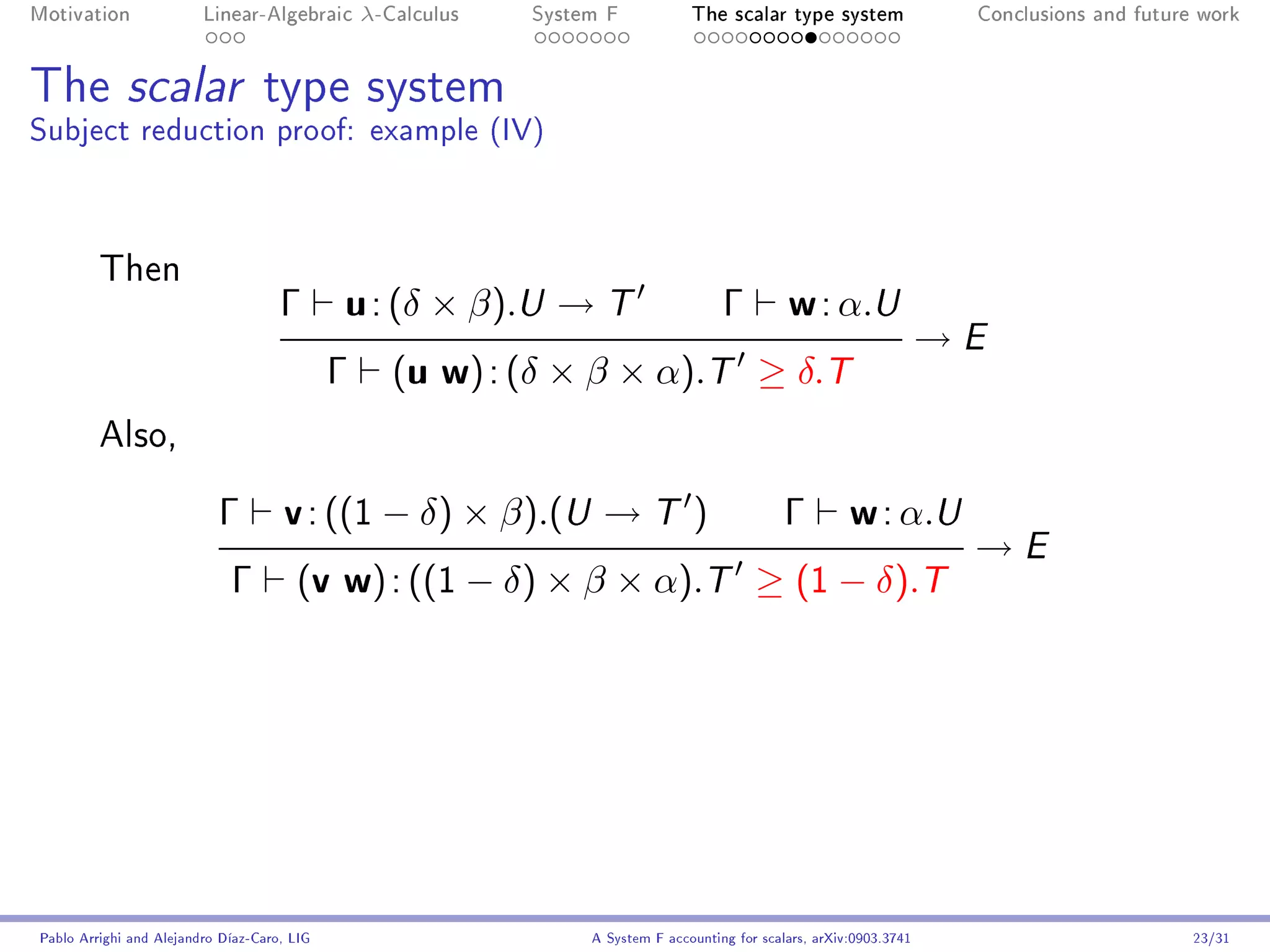
         Then
                                     Γ       u : (δ × β).U → T                         Γ         w : α.U
                                                                                                                        →E
                                             Γ      (u w) : (δ × β × α).T ≥ δ.T
         Also,


                           Γ         v : ((1 − δ) × β).(U → T )                                  Γ         w : α.U
                                                                                                                         →E
                             Γ         (v w) : ((1 − δ) × β × α).T ≥ (1 − δ).T


Pablo Arrighi and Alejandro Díaz-Caro, LIG                         A System F accounting for scalars, arXiv:0903.3741                          23/31
Motivation               Linear-Algebraic        λ-Calculus   System F            The scalar type system                  Conclusions and future work


The scalar type system
Subject reduction proof: example (IV)


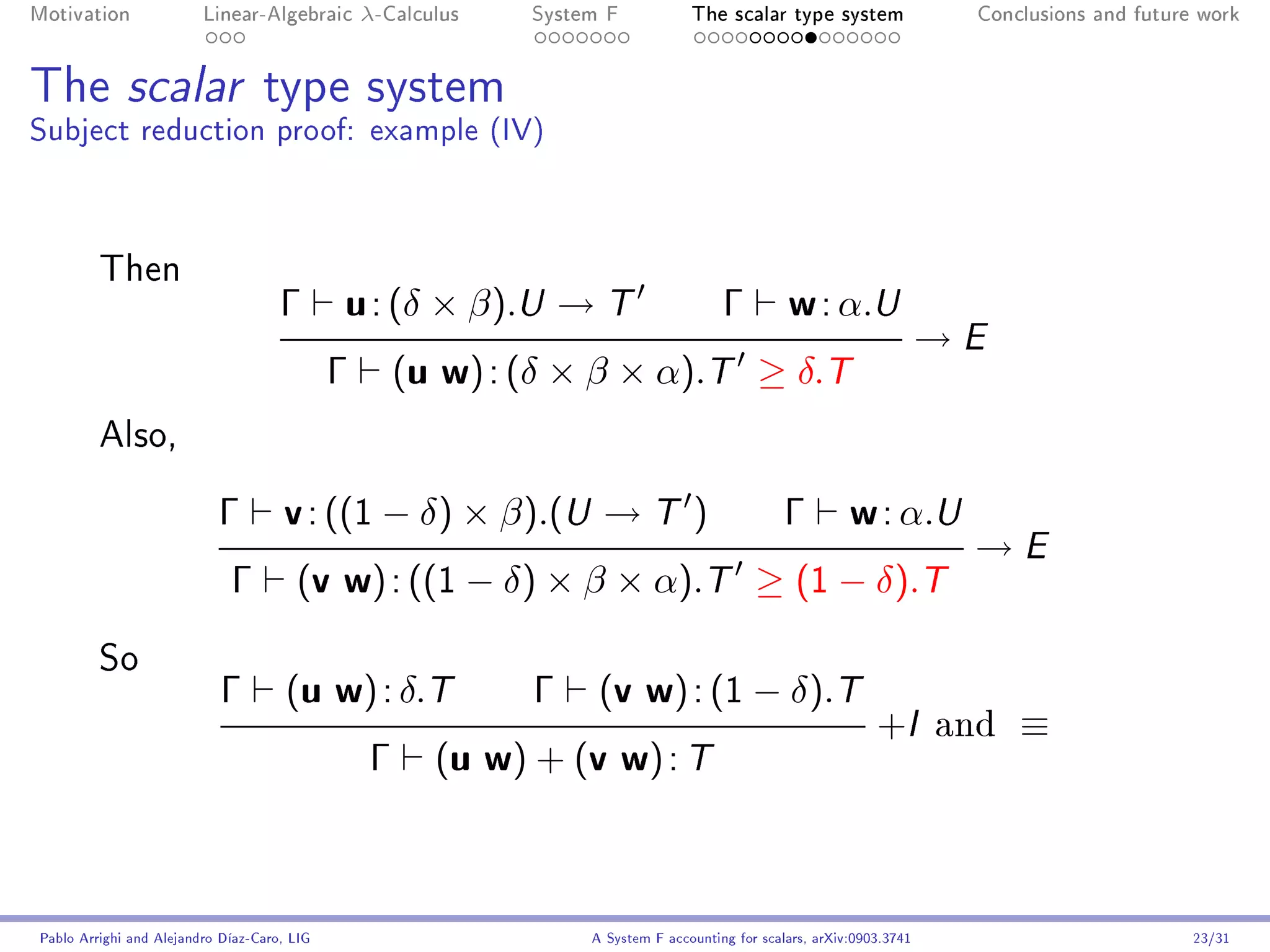
         Then
                                     Γ       u : (δ × β).U → T                         Γ         w : α.U
                                                                                                                        →E
                                             Γ        (u w) : (δ × β × α).T ≥ δ.T
         Also,


                           Γ         v : ((1 − δ) × β).(U → T )                                  Γ         w : α.U
                                                                                                                         →E
                             Γ         (v w) : ((1 − δ) × β × α).T ≥ (1 − δ).T

         So
                            Γ         (u w) : δ.T             Γ     (v w) : (1 − δ).T
                                                                                                               +I       and   ≡
                                                  Γ     (u w) + (v w) : T


Pablo Arrighi and Alejandro Díaz-Caro, LIG                         A System F accounting for scalars, arXiv:0903.3741                           23/31
Motivation               Linear-Algebraic    λ-Calculus   System F            The scalar type system                Conclusions and future work


The scalar type system
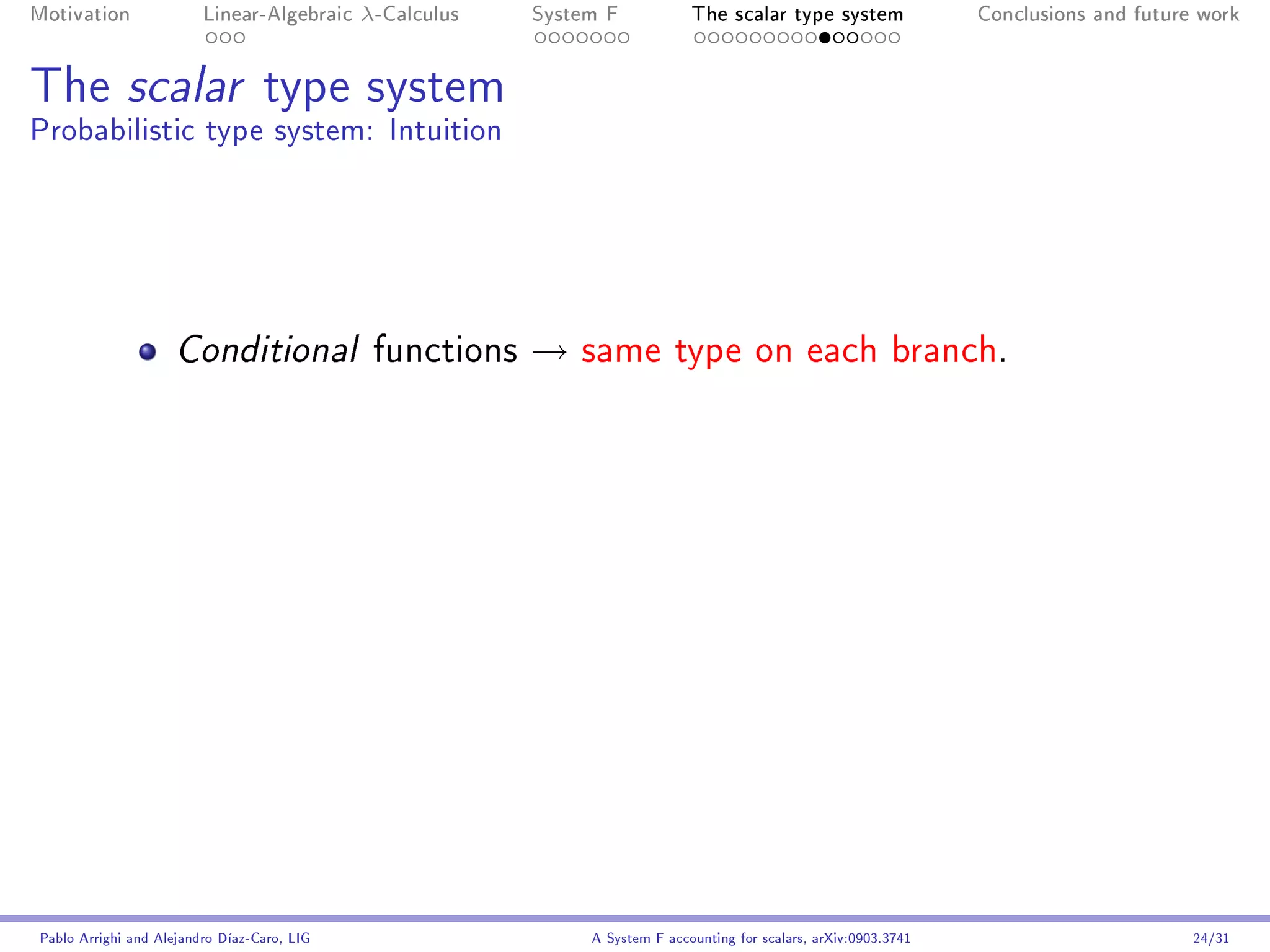
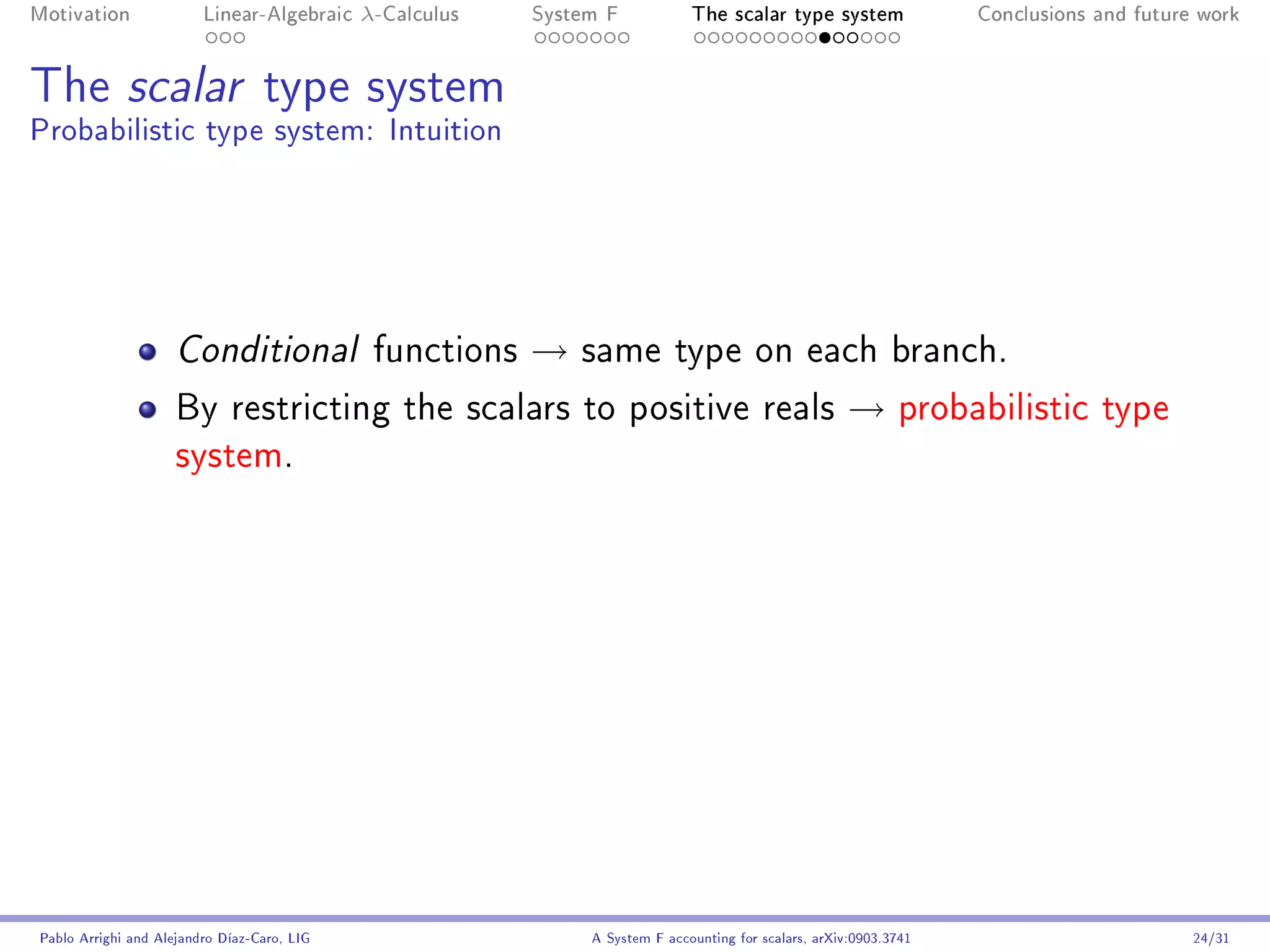
Probabilistic type system: Intuition


                     Conditional              functions   →   same type on each branch.


Pablo Arrighi and Alejandro Díaz-Caro, LIG                     A System F accounting for scalars, arXiv:0903.3741                         24/31
Motivation               Linear-Algebraic    λ-Calculus   System F            The scalar type system                Conclusions and future work


The scalar type system
Probabilistic type system: Intuition


                     Conditional              functions   →   same type on each branch.

                     By restricting the scalars to positive reals                                     →       probabilistic type
                     system.


Pablo Arrighi and Alejandro Díaz-Caro, LIG                     A System F accounting for scalars, arXiv:0903.3741                         24/31
Motivation               Linear-Algebraic    λ-Calculus   System F            The scalar type system                Conclusions and future work


The scalar type system
Probabilistic type system: Intuition


                     Conditional              functions   →   same type on each branch.

                     By restricting the scalars to positive reals                                     →       probabilistic type
                     system.

                     For example, one can type functions such as

                                  λx {x [ 1 .(true + false)] [ 4 .true + 3 .false]} : B → B
                                          2
                                                               1
                                                                         4

                     with the type system serving as a guarantee that the function
                     conserves probabilities summing to one.


Pablo Arrighi and Alejandro Díaz-Caro, LIG                     A System F accounting for scalars, arXiv:0903.3741                         24/31
Motivation               Linear-Algebraic    λ-Calculus   System F            The scalar type system                Conclusions and future work


The scalar type system
Probabilistic type system: Formalisation


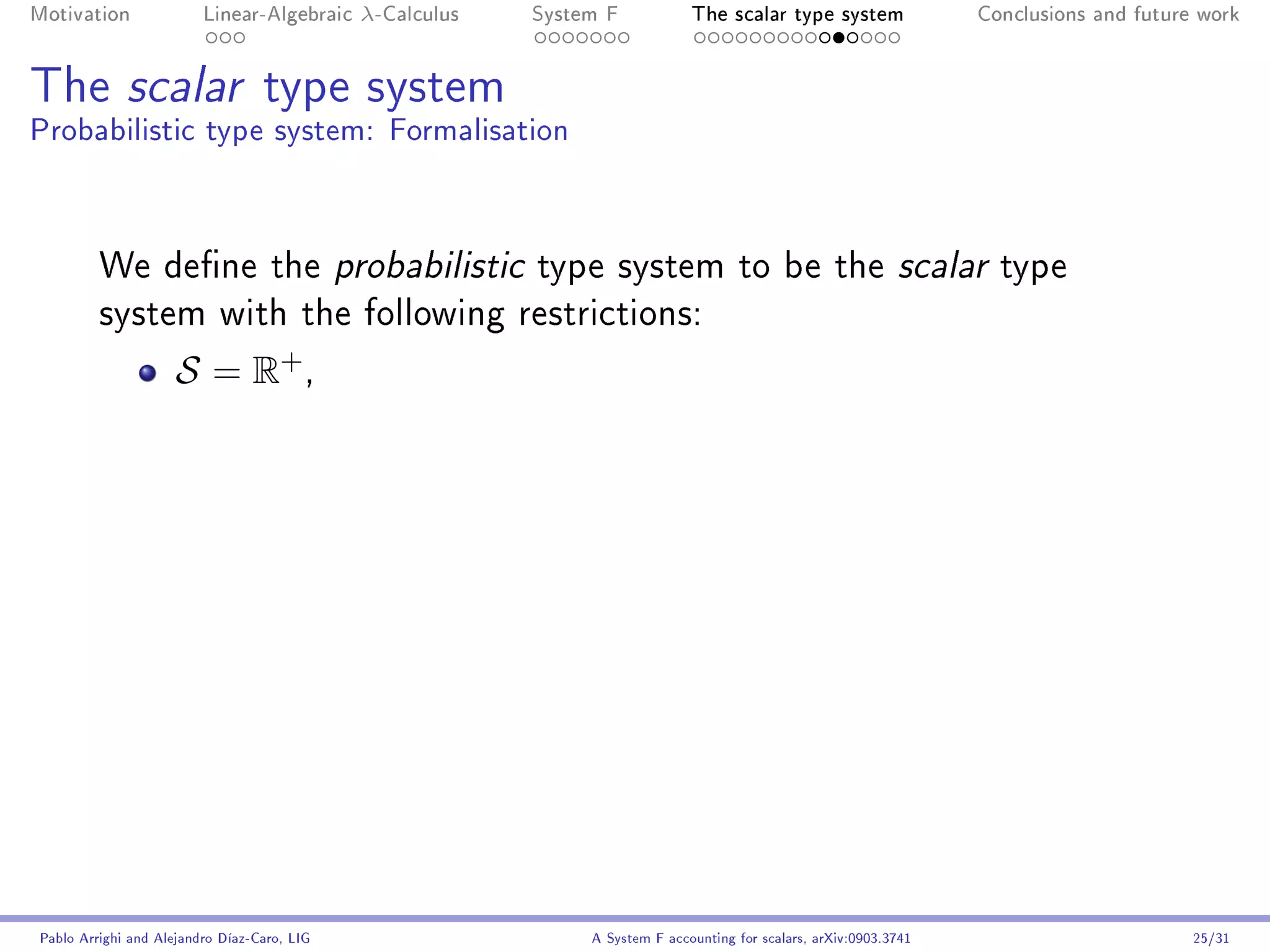
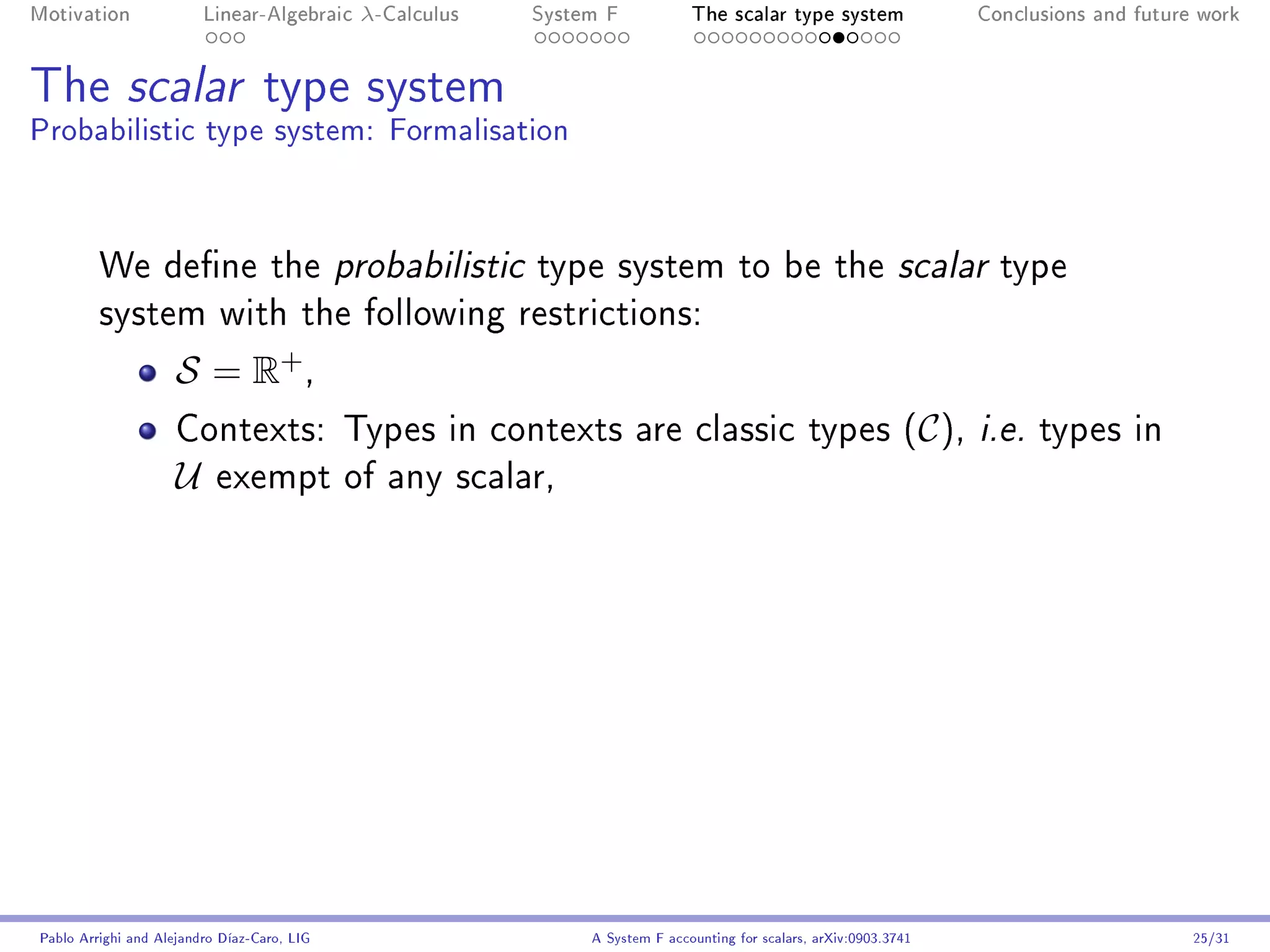
         We dene the probabilistic type system to be the scalar type
         system with the following restrictions:


Pablo Arrighi and Alejandro Díaz-Caro, LIG                     A System F accounting for scalars, arXiv:0903.3741                         25/31
Motivation               Linear-Algebraic    λ-Calculus   System F            The scalar type system                Conclusions and future work


The scalar type system
Probabilistic type system: Formalisation


         We dene the probabilistic type system to be the scalar type
         system with the following restrictions:

                     S = R+ ,


Pablo Arrighi and Alejandro Díaz-Caro, LIG                     A System F accounting for scalars, arXiv:0903.3741                         25/31
Motivation               Linear-Algebraic    λ-Calculus   System F            The scalar type system                Conclusions and future work


The scalar type system
Probabilistic type system: Formalisation


         We dene the probabilistic type system to be the scalar type
         system with the following restrictions:

                     S = R+ ,
                     Contexts: Types in contexts are classic types (C ), i.e. types in
                     U     exempt of any scalar,


Pablo Arrighi and Alejandro Díaz-Caro, LIG                     A System F accounting for scalars, arXiv:0903.3741                         25/31
Motivation               Linear-Algebraic    λ-Calculus      System F            The scalar type system                Conclusions and future work


The scalar type system
Probabilistic type system: Formalisation


         We dene the probabilistic type system to be the scalar type
         system with the following restrictions:

                     S = R+ ,
                     Contexts: Types in contexts are classic types (C ), i.e. types in
                     U     exempt of any scalar,

                     We change the rule                   ∀E   to

                                                     Γ     t : ∀X .T
                                                                              ∀E        with         C     ∈C
                                                   Γ      t : T [C /X ]


Pablo Arrighi and Alejandro Díaz-Caro, LIG                        A System F accounting for scalars, arXiv:0903.3741                         25/31
Motivation               Linear-Algebraic    λ-Calculus      System F            The scalar type system                Conclusions and future work


The scalar type system
Probabilistic type system: Formalisation


         We dene the probabilistic type system to be the scalar type
         system with the following restrictions:

                     S = R+ ,
                     Contexts: Types in contexts are classic types (C ), i.e. types in
                     U     exempt of any scalar,

                     We change the rule                   ∀E   to

                                                     Γ     t : ∀X .T
                                                                              ∀E        with         C     ∈C
                                                   Γ      t : T [C /X ]

                     The nal conclusion must be classic.


Pablo Arrighi and Alejandro Díaz-Caro, LIG                        A System F accounting for scalars, arXiv:0903.3741                         25/31
Motivation               Linear-Algebraic    λ-Calculus   System F            The scalar type system                Conclusions and future work


The scalar type system
Probabilistic type system: Proof

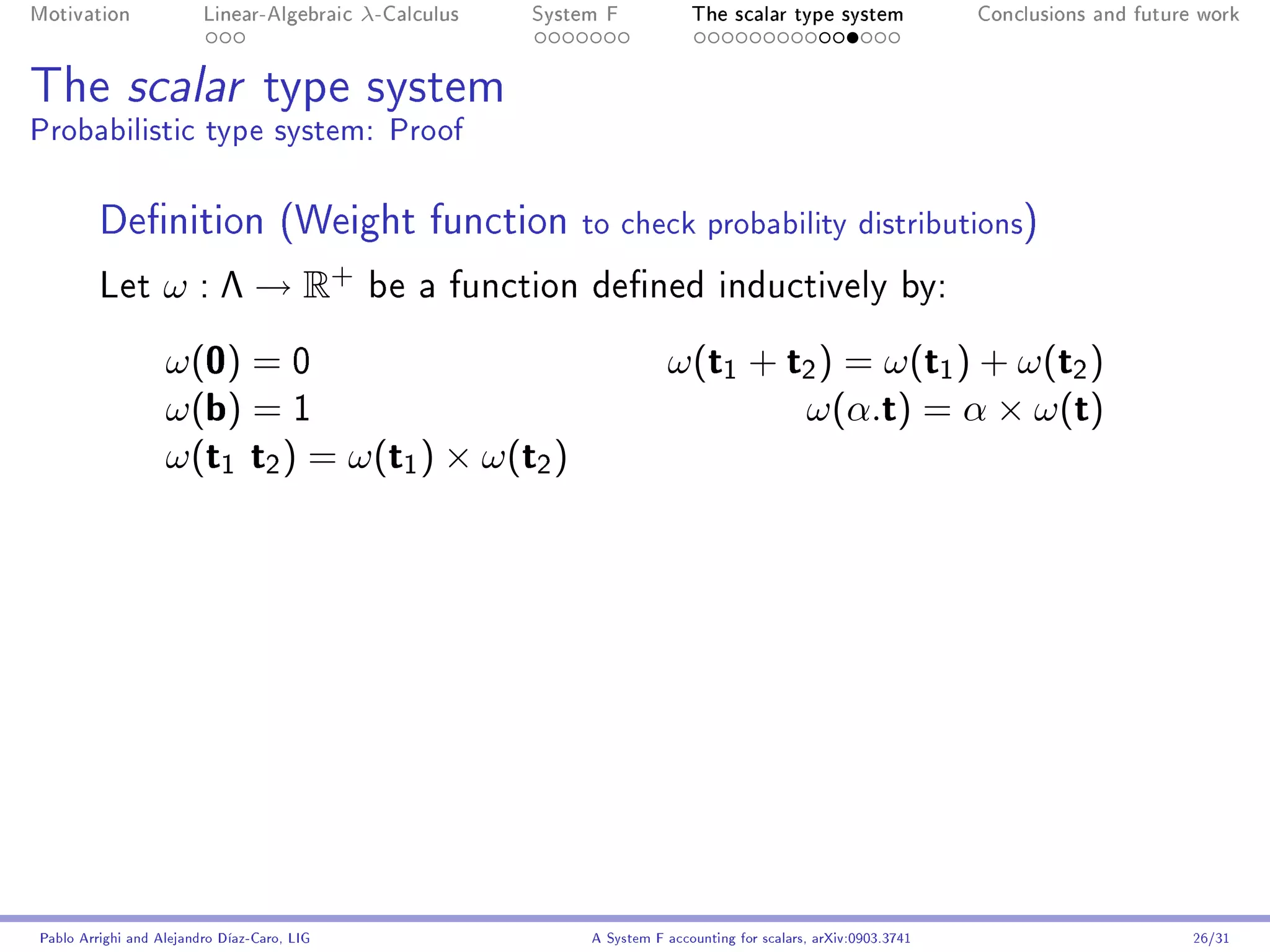
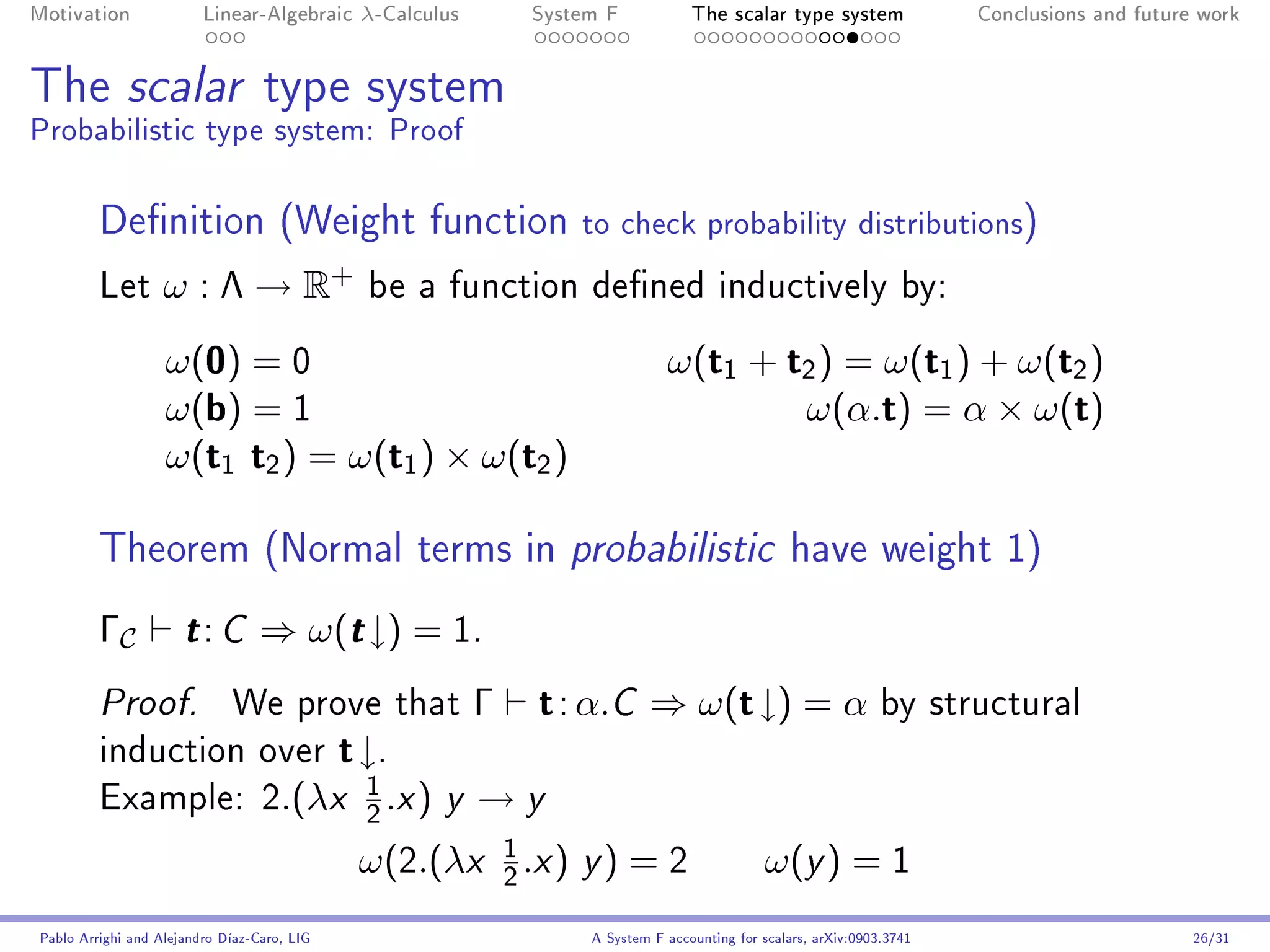
         Denition (Weight function                           to check probability distributions)
         Let       ω : Λ → R+                be a function dened inductively by:

                   ω(0) = 0                                               ω(t1 + t2 ) = ω(t1 ) + ω(t2 )
                   ω(b) = 1                                                       ω(α.t) = α × ω(t)
                   ω(t1 t2 ) = ω(t1 ) × ω(t2 )


Pablo Arrighi and Alejandro Díaz-Caro, LIG                     A System F accounting for scalars, arXiv:0903.3741                         26/31
Motivation               Linear-Algebraic     λ-Calculus       System F            The scalar type system                Conclusions and future work


The scalar type system
Probabilistic type system: Proof

         Denition (Weight function                                to check probability distributions)
         Let       ω : Λ → R+                  be a function dened inductively by:

                   ω(0) = 0                                                    ω(t1 + t2 ) = ω(t1 ) + ω(t2 )
                   ω(b) = 1                                                            ω(α.t) = α × ω(t)
                   ω(t1 t2 ) = ω(t1 ) × ω(t2 )

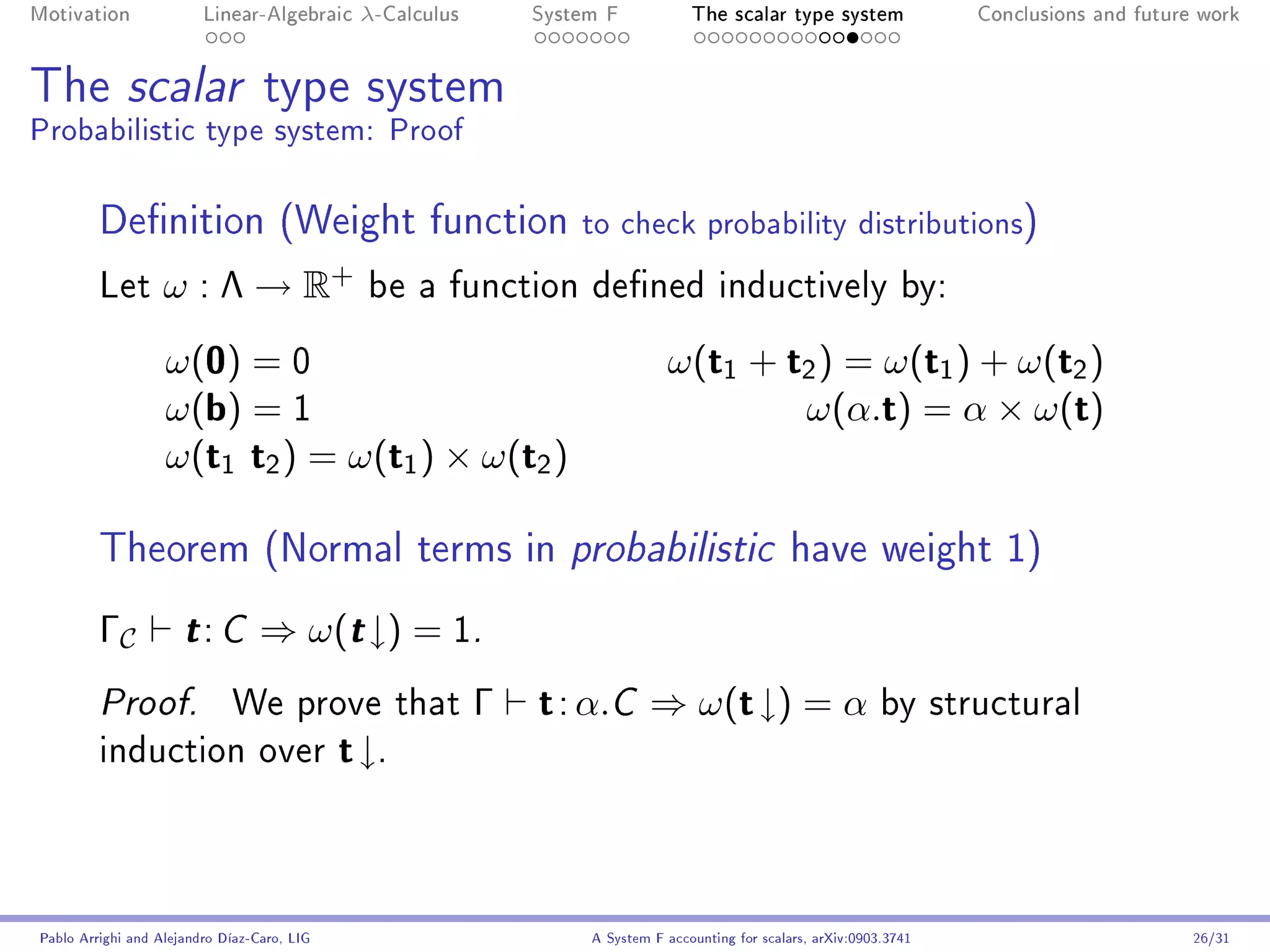
         Theorem (Normal terms in probabilistic have weight 1)
         ΓC           t: C        ⇒ ω(t ↓) = 1.
         Proof.              We prove that                 Γ   t : α.C ⇒ ω(t ↓) = α by structural
         induction over                      t ↓.


Pablo Arrighi and Alejandro Díaz-Caro, LIG                          A System F accounting for scalars, arXiv:0903.3741                         26/31
Motivation               Linear-Algebraic     λ-Calculus          System F            The scalar type system                Conclusions and future work


The scalar type system
Probabilistic type system: Proof

         Denition (Weight function                                   to check probability distributions)
         Let       ω : Λ → R+                  be a function dened inductively by:

                   ω(0) = 0                                                       ω(t1 + t2 ) = ω(t1 ) + ω(t2 )
                   ω(b) = 1                                                               ω(α.t) = α × ω(t)
                   ω(t1 t2 ) = ω(t1 ) × ω(t2 )

         Theorem (Normal terms in probabilistic have weight 1)
         ΓC           t: C        ⇒ ω(t ↓) = 1.
         Proof.              We prove that                    Γ   t : α.C ⇒ ω(t ↓) = α by structural
         induction over                      t ↓.
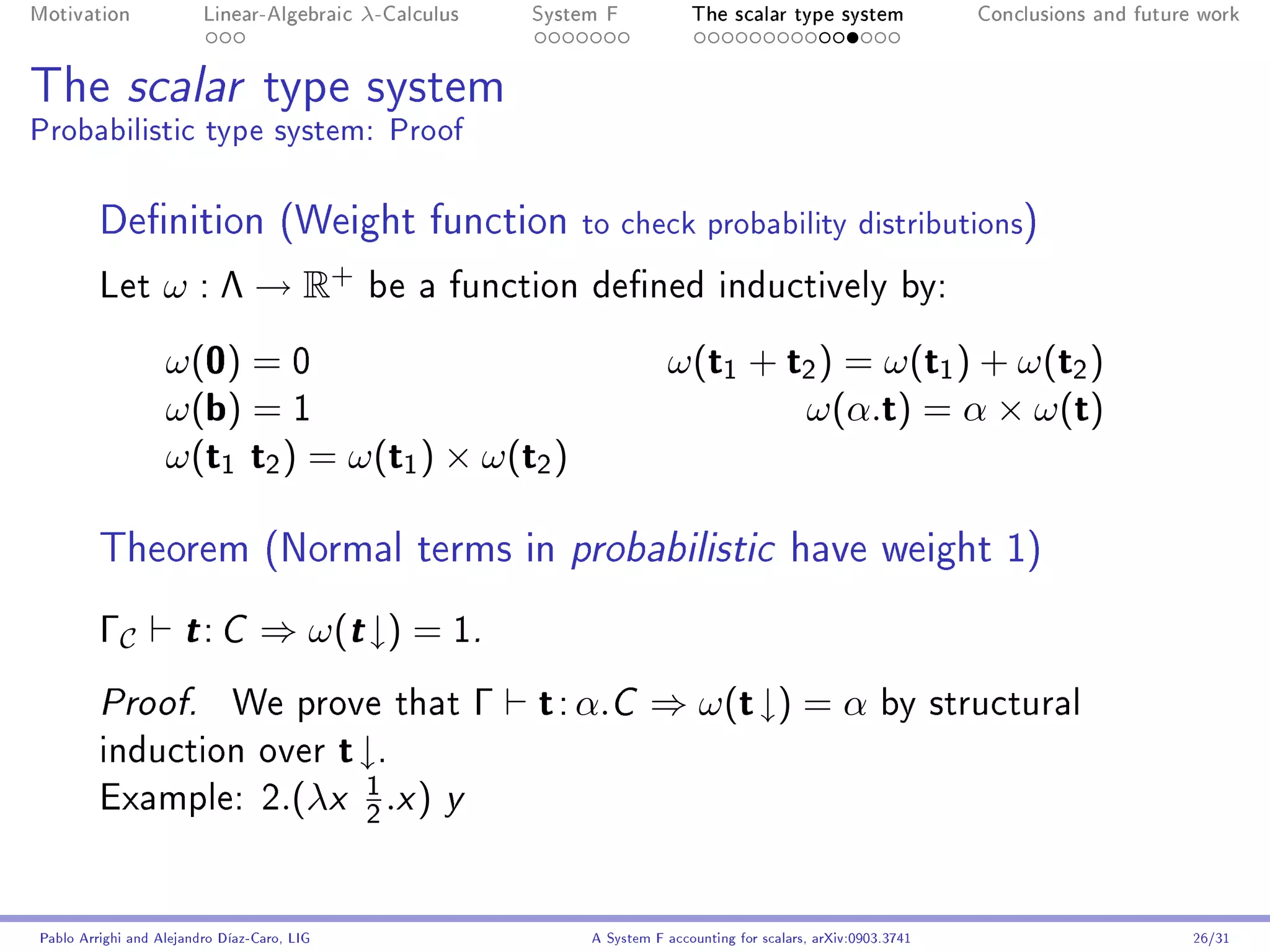
                                               1
         Example: 2.(λx                            .x )   y
                                               2


Pablo Arrighi and Alejandro Díaz-Caro, LIG                             A System F accounting for scalars, arXiv:0903.3741                         26/31
Motivation               Linear-Algebraic     λ-Calculus              System F            The scalar type system                Conclusions and future work


The scalar type system
Probabilistic type system: Proof

         Denition (Weight function                                       to check probability distributions)
         Let       ω : Λ → R+                  be a function dened inductively by:

                   ω(0) = 0                                                           ω(t1 + t2 ) = ω(t1 ) + ω(t2 )
                   ω(b) = 1                                                                   ω(α.t) = α × ω(t)
                   ω(t1 t2 ) = ω(t1 ) × ω(t2 )

         Theorem (Normal terms in probabilistic have weight 1)
         ΓC           t: C        ⇒ ω(t ↓) = 1.
         Proof.              We prove that                    Γ        t : α.C ⇒ ω(t ↓) = α by structural
         induction over                      t ↓.
                                               1
         Example: 2.(λx                            .x )   y
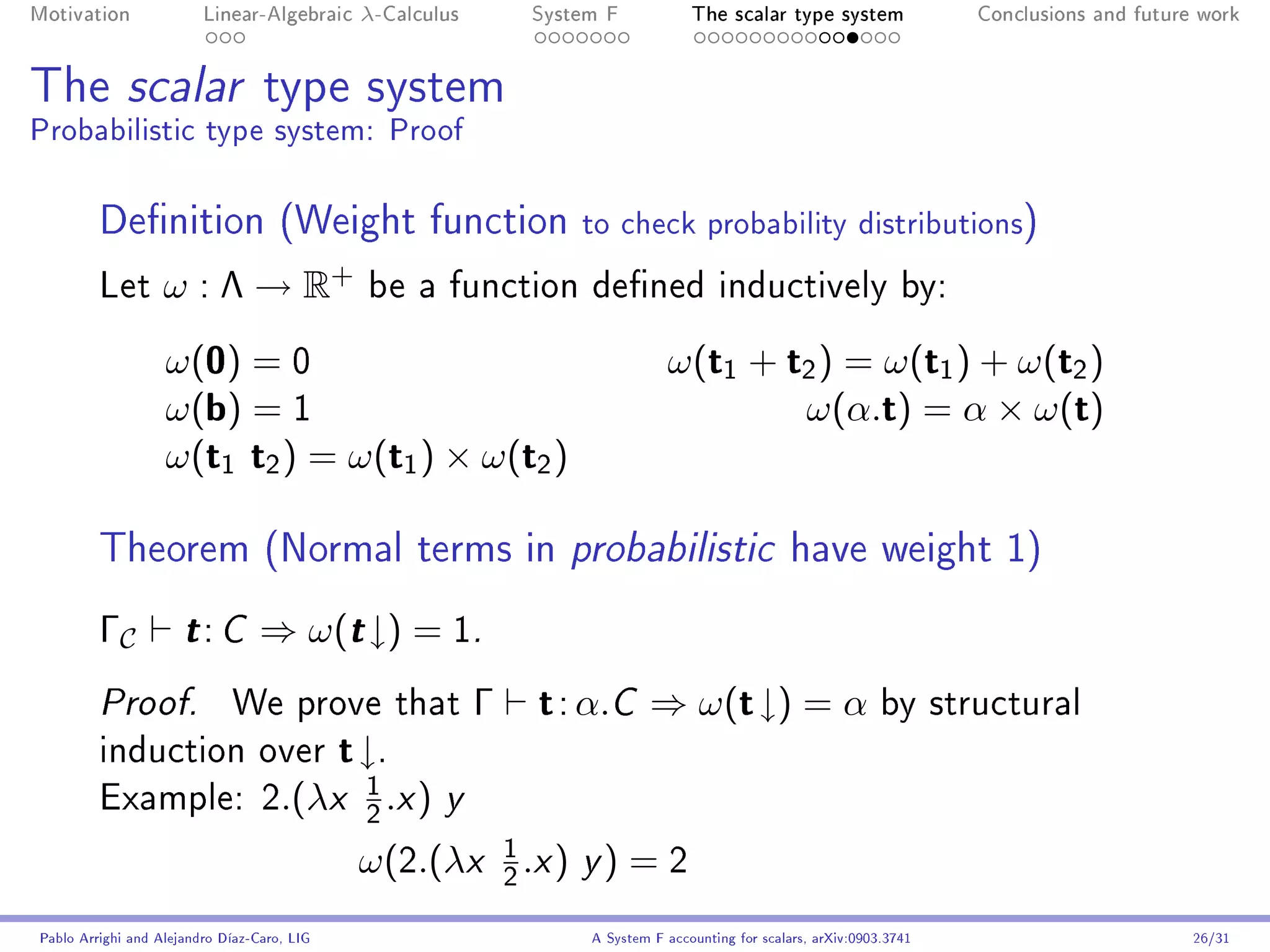
                                               2

                                                                  1
                                              ω(2.(λx             2
                                                                      .x ) y ) = 2
Pablo Arrighi and Alejandro Díaz-Caro, LIG                                 A System F accounting for scalars, arXiv:0903.3741                         26/31
Motivation               Linear-Algebraic     λ-Calculus              System F            The scalar type system                Conclusions and future work


The scalar type system
Probabilistic type system: Proof

         Denition (Weight function                                       to check probability distributions)
         Let       ω : Λ → R+                  be a function dened inductively by:

                   ω(0) = 0                                                           ω(t1 + t2 ) = ω(t1 ) + ω(t2 )
                   ω(b) = 1                                                                   ω(α.t) = α × ω(t)
                   ω(t1 t2 ) = ω(t1 ) × ω(t2 )

         Theorem (Normal terms in probabilistic have weight 1)
         ΓC           t: C        ⇒ ω(t ↓) = 1.
         Proof.              We prove that                    Γ        t : α.C ⇒ ω(t ↓) = α by structural
         induction over                      t ↓.
                                               1
         Example: 2.(λx
                                               2
                                                   .x )   y   →y
                                                                  1
                                              ω(2.(λx             2
                                                                      .x ) y ) = 2                    ω(y ) = 1
Pablo Arrighi and Alejandro Díaz-Caro, LIG                                 A System F accounting for scalars, arXiv:0903.3741                         26/31
Motivation               Linear-Algebraic    λ-Calculus        System F            The scalar type system                    Conclusions and future work


The scalar type system
Logical content: No-cloning theorem (I)


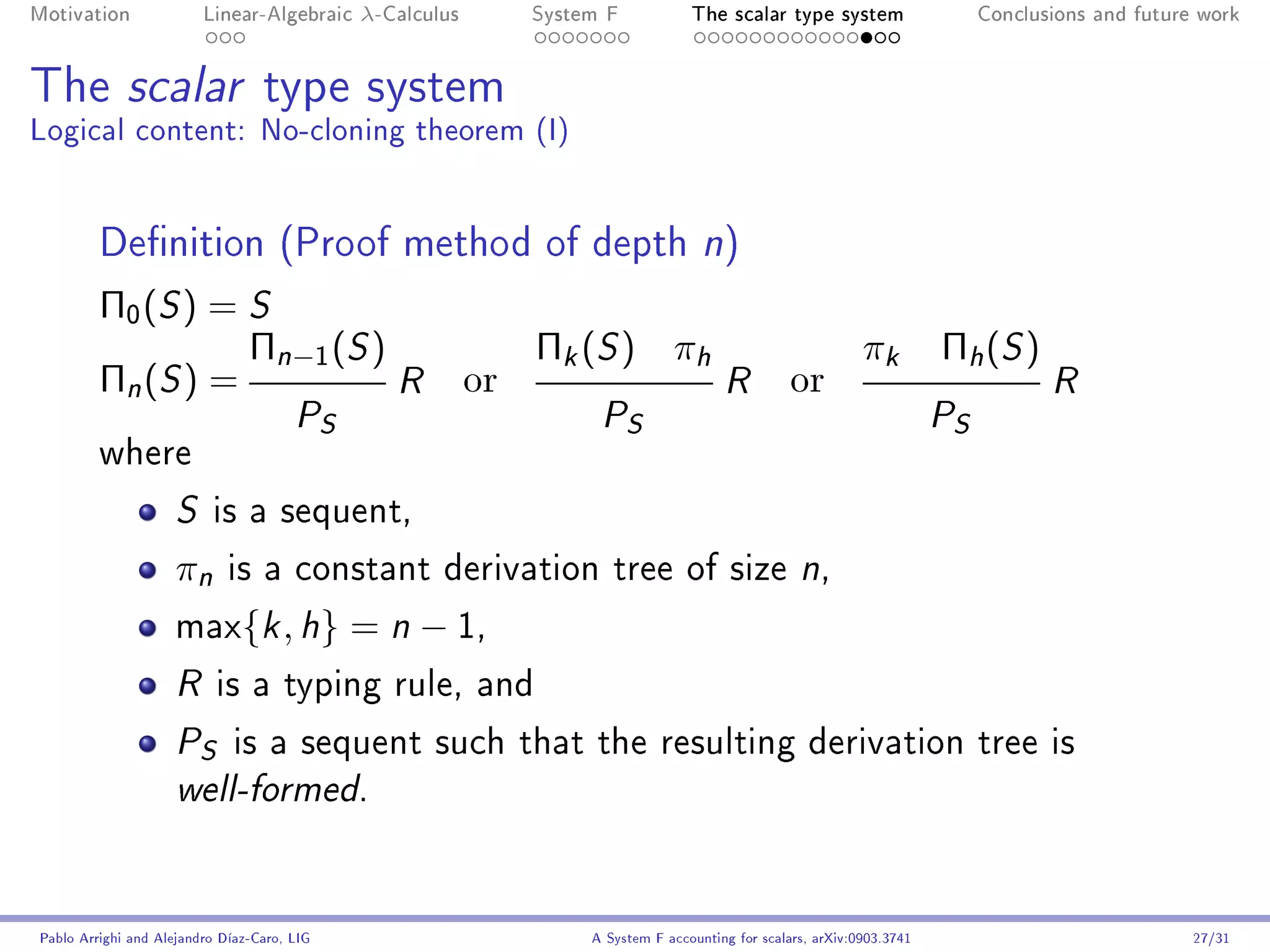
         Denition (Proof method of depth n)
         Π0 (S ) = S
                   Πn−1 (S )                                   Πk (S ) πh                                     πk         Πh ( S )
         Πn (S ) =           R                            or                            R          or                               R
                     PS                                              P    S                                              S
                                                                                                                         P
         where

                     S    is a sequent,

                     πn      is a constant derivation tree of size n,

                     max{k , h}              = n − 1,
                     R     is a typing rule, and

                     P   S    is a sequent such that the resulting derivation tree is
                     well-formed.


Pablo Arrighi and Alejandro Díaz-Caro, LIG                          A System F accounting for scalars, arXiv:0903.3741                             27/31
Motivation               Linear-Algebraic    λ-Calculus        System F            The scalar type system                      Conclusions and future work


The scalar type system
Logical content: No-cloning theorem (I)


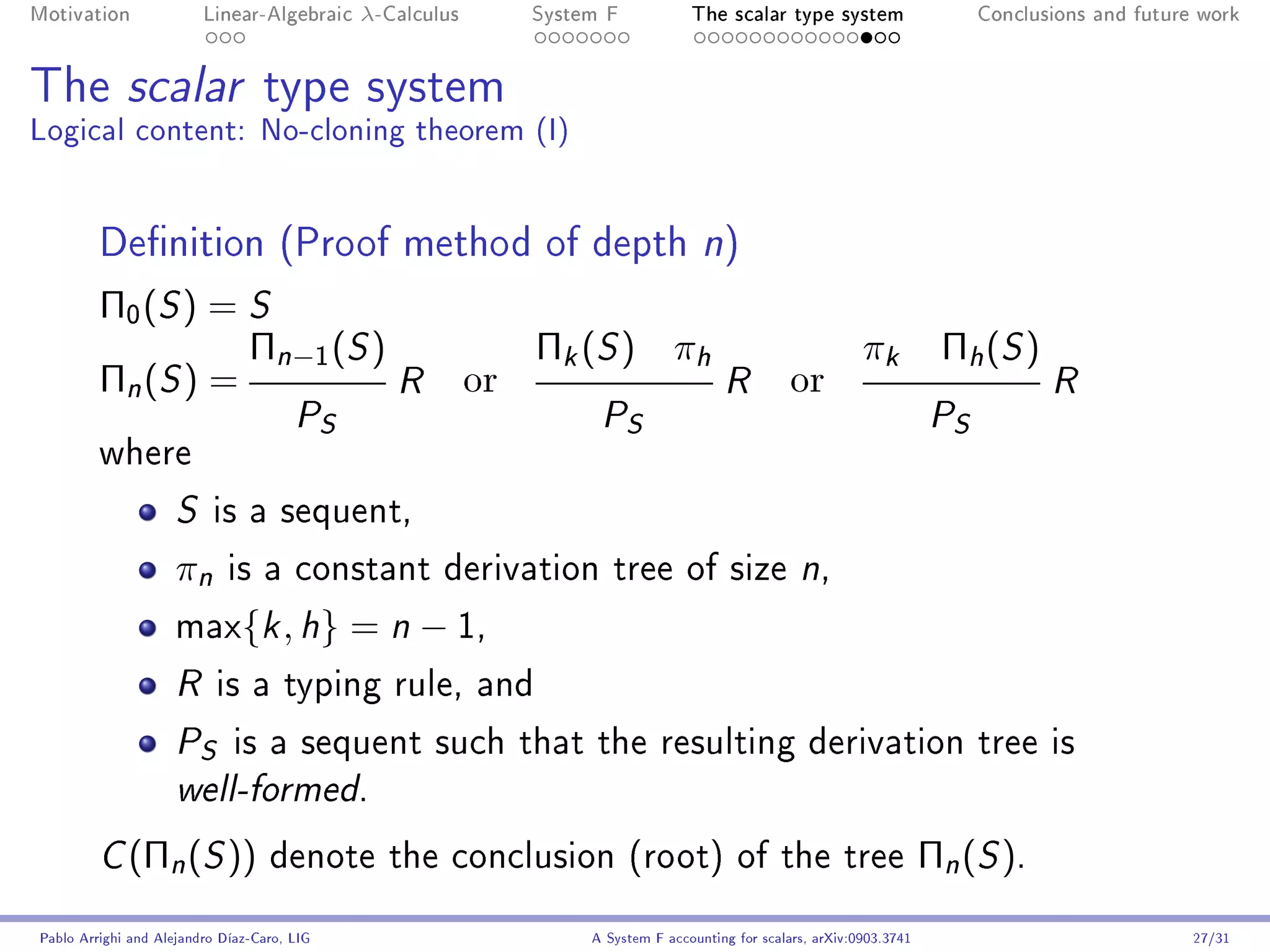
         Denition (Proof method of depth n)
         Π0 (S ) = S
                   Πn−1 (S )                                   Πk (S ) πh                                     πk          Πh ( S )
         Πn (S ) =           R                            or                            R          or                                 R
                     PS                                              P    S                                              P S
         where

                     S    is a sequent,

                     πn      is a constant derivation tree of size n,

                     max{k , h}              = n − 1,
                     R     is a typing rule, and

                     P   S    is a sequent such that the resulting derivation tree is
                     well-formed.


         C   (Πn (S ))             denote the conclusion (root) of the tree                                              Πn (S ).
Pablo Arrighi and Alejandro Díaz-Caro, LIG                          A System F accounting for scalars, arXiv:0903.3741                               27/31
Motivation               Linear-Algebraic    λ-Calculus   System F            The scalar type system                Conclusions and future work


The scalar type system
Logical content: No-cloning theorem (II)


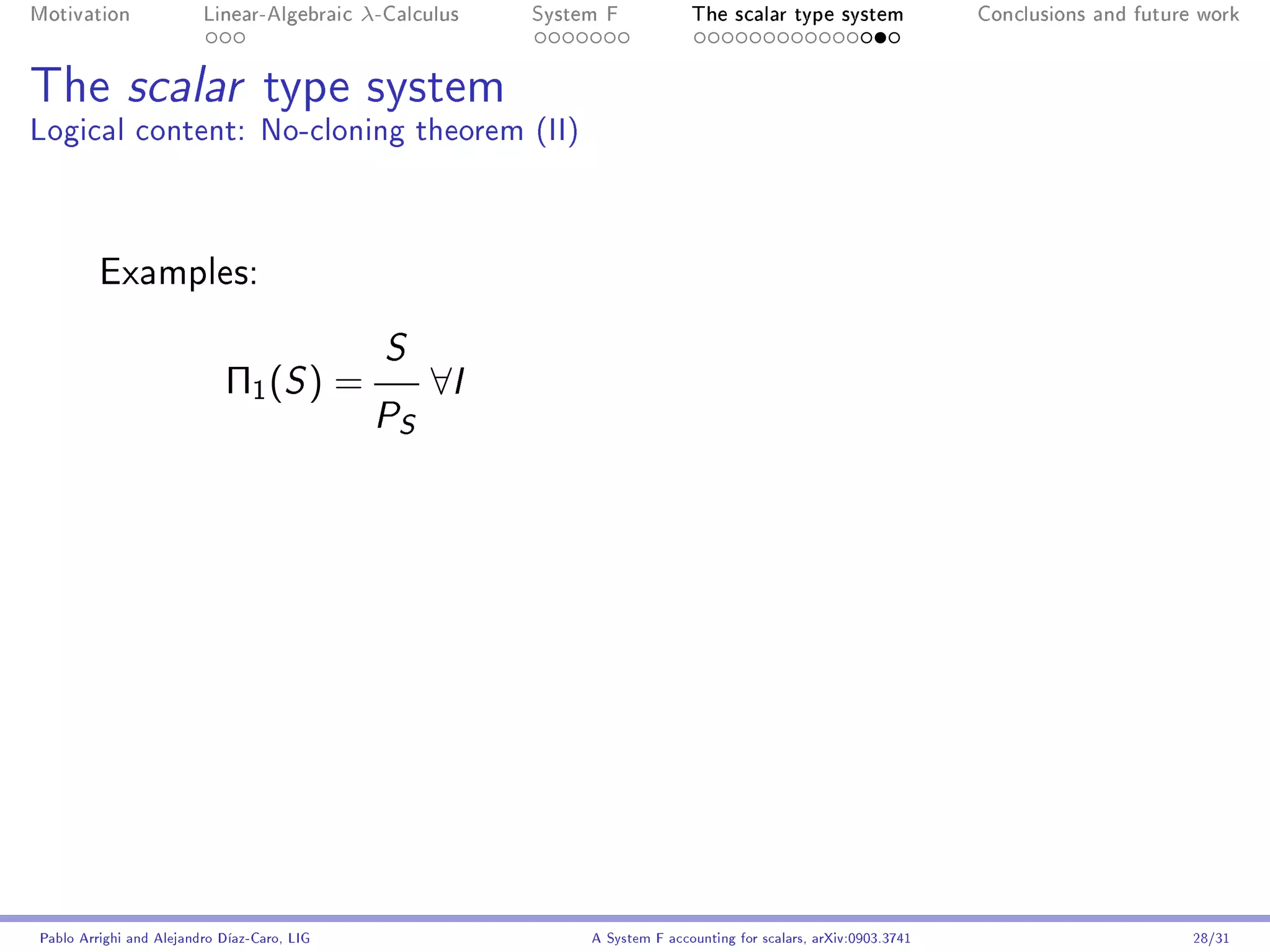
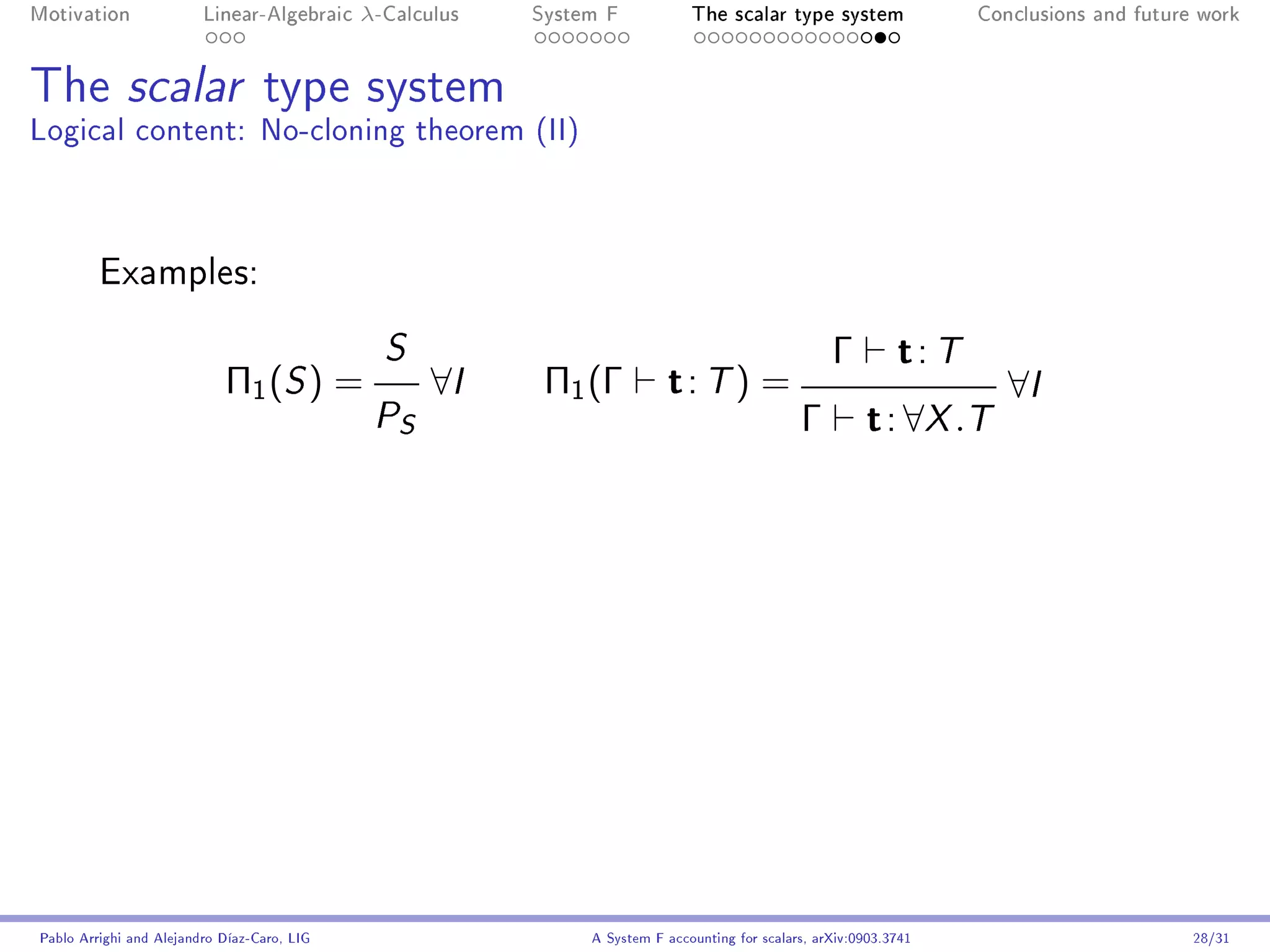
         Examples:

                                               S
                            Π1 ( S ) =              ∀I
                                              P S


Pablo Arrighi and Alejandro Díaz-Caro, LIG                     A System F accounting for scalars, arXiv:0903.3741                         28/31
Motivation               Linear-Algebraic    λ-Calculus   System F            The scalar type system                 Conclusions and future work


The scalar type system
Logical content: No-cloning theorem (II)


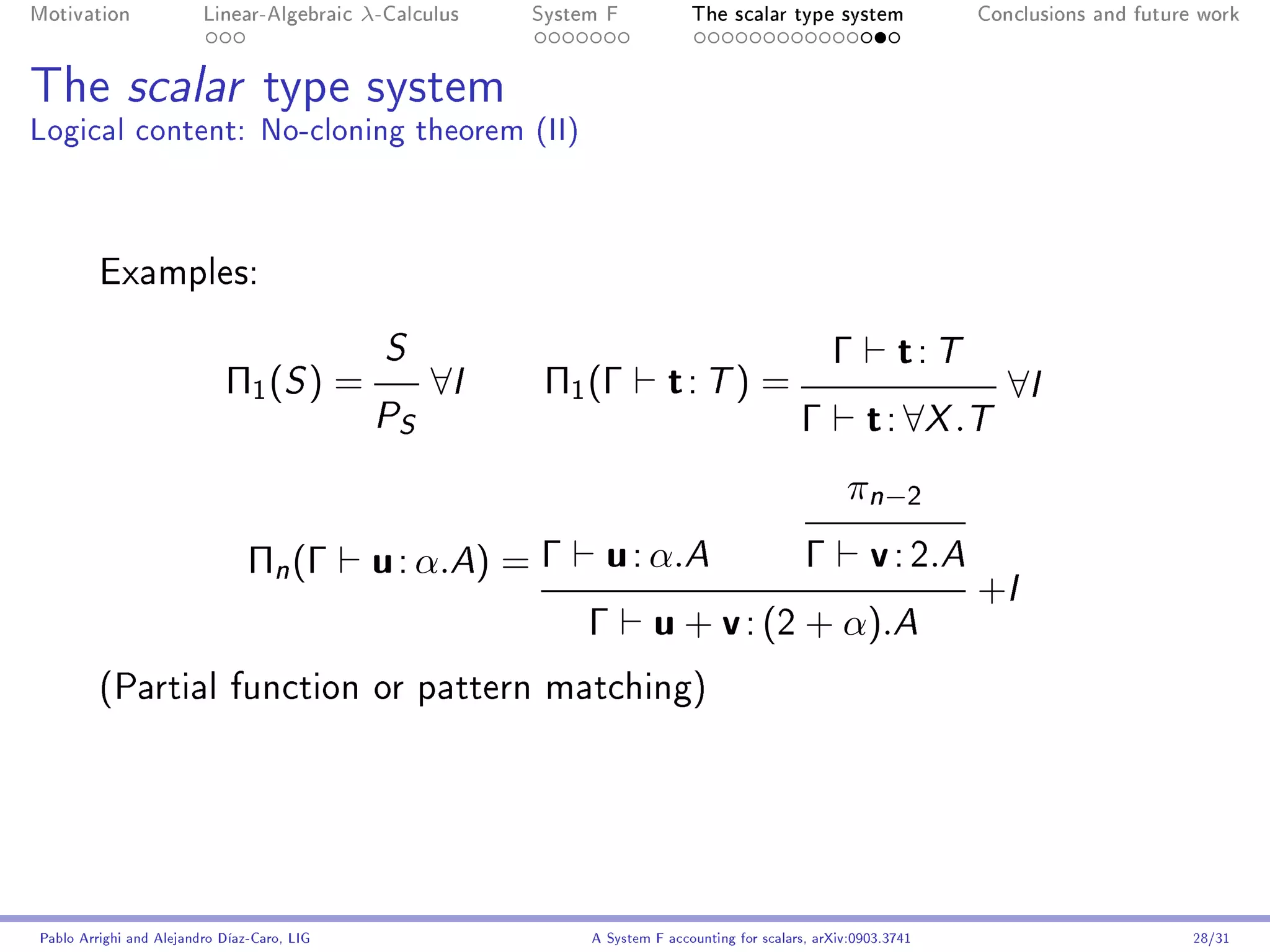
         Examples:

                                               S                                                    Γ         t: T
                            Π1 ( S ) =              ∀I     Π1 (Γ          t: T) =                                       ∀I
                                              P S                                              Γ         t : ∀X .T


Pablo Arrighi and Alejandro Díaz-Caro, LIG                     A System F accounting for scalars, arXiv:0903.3741                          28/31
Motivation               Linear-Algebraic    λ-Calculus   System F            The scalar type system                 Conclusions and future work


The scalar type system
Logical content: No-cloning theorem (II)


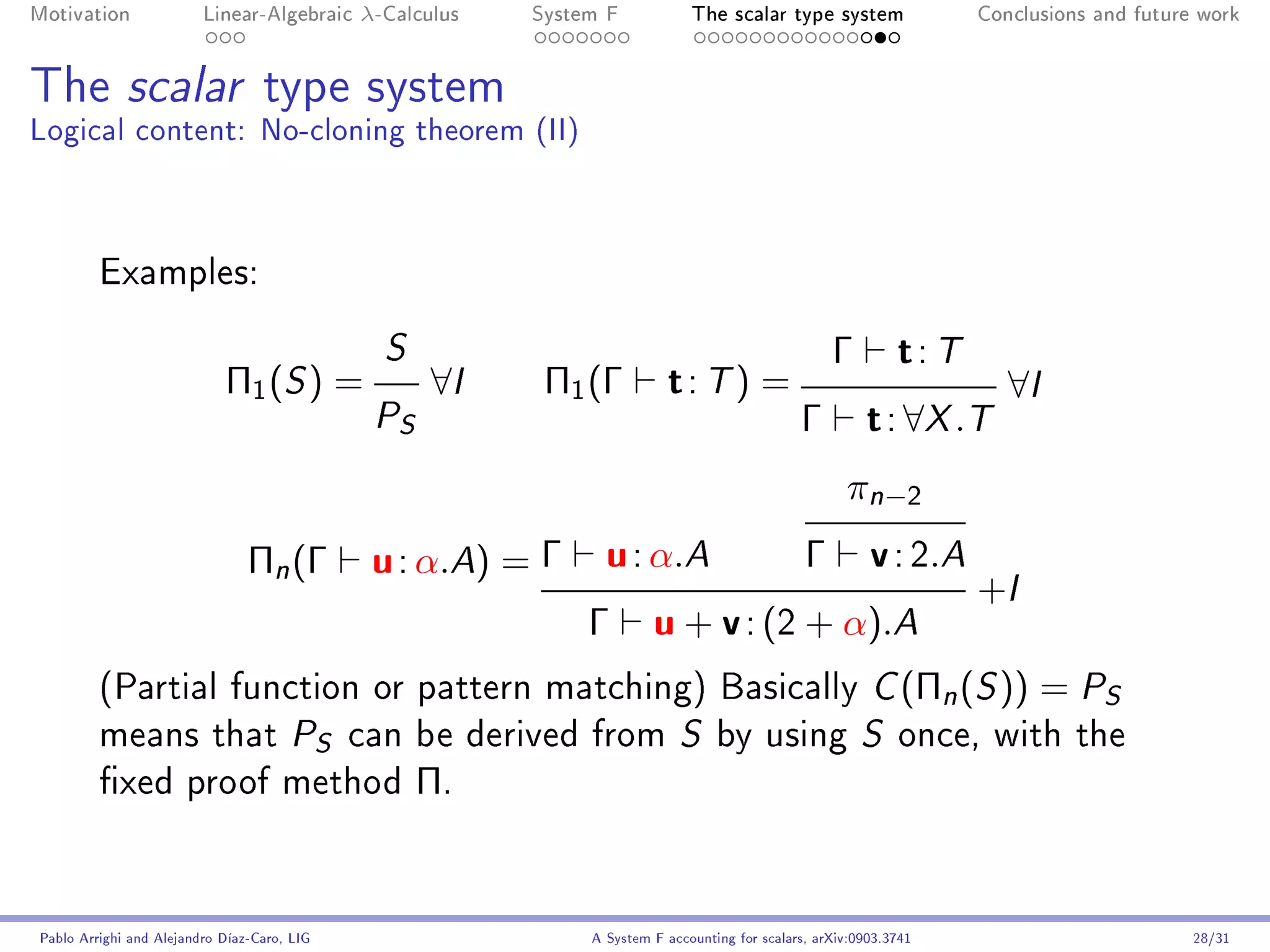
         Examples:

                                               S                                                    Γ         t: T
                            Π1 ( S ) =              ∀I     Π1 (Γ          t: T) =                                       ∀I
                                              P S                                              Γ         t : ∀X .T
                                                                                                      π n −2
                                Πn (Γ         u : α.A) = Γ u : α.A      Γ v : 2.A
                                                                                  +I
                                                           Γ u + v : (2 + α).A
         (Partial function or pattern matching)


Pablo Arrighi and Alejandro Díaz-Caro, LIG                     A System F accounting for scalars, arXiv:0903.3741                          28/31
Motivation               Linear-Algebraic    λ-Calculus   System F            The scalar type system                 Conclusions and future work


The scalar type system
Logical content: No-cloning theorem (II)


         Examples:

                                               S                                                    Γ         t: T
                            Π1 ( S ) =              ∀I     Π1 (Γ          t: T) =                                       ∀I
                                              P S                                              Γ         t : ∀X .T
                                                                                                      π n −2
                                Πn (Γ         u : α.A) = Γ u : α.A      Γ v : 2.A
                                                                                  +I
                                                           Γ u + v : (2 + α).A
         (Partial function or pattern matching) Basically C (Πn (S ))                                                      = PS
         means that PS can be derived from S by using S once, with the
         xed proof method                          Π.


Pablo Arrighi and Alejandro Díaz-Caro, LIG                     A System F accounting for scalars, arXiv:0903.3741                          28/31
Motivation               Linear-Algebraic    λ-Calculus   System F            The scalar type system                Conclusions and future work


The scalar type system
Logical content: No-cloning theorem (III)


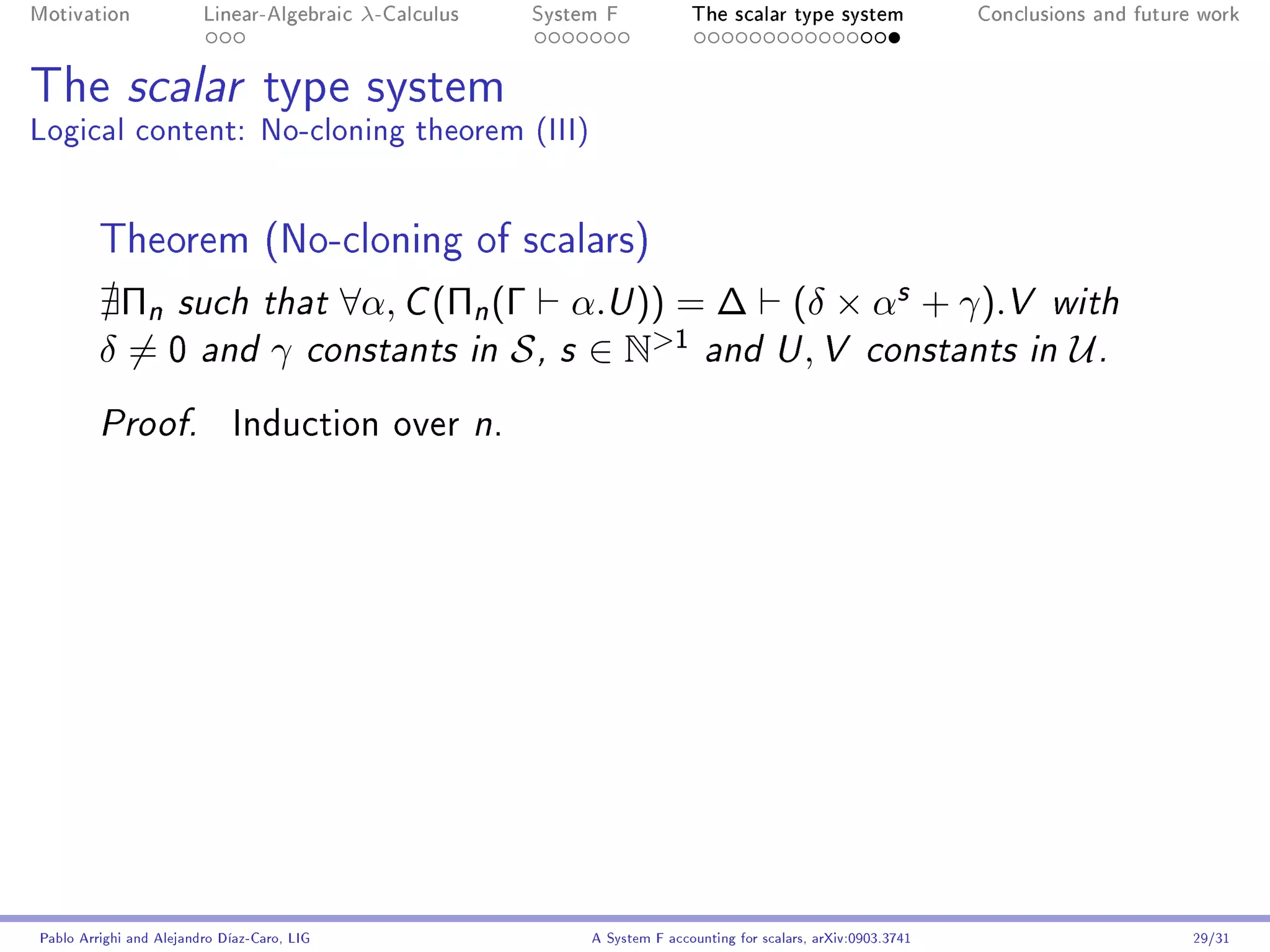
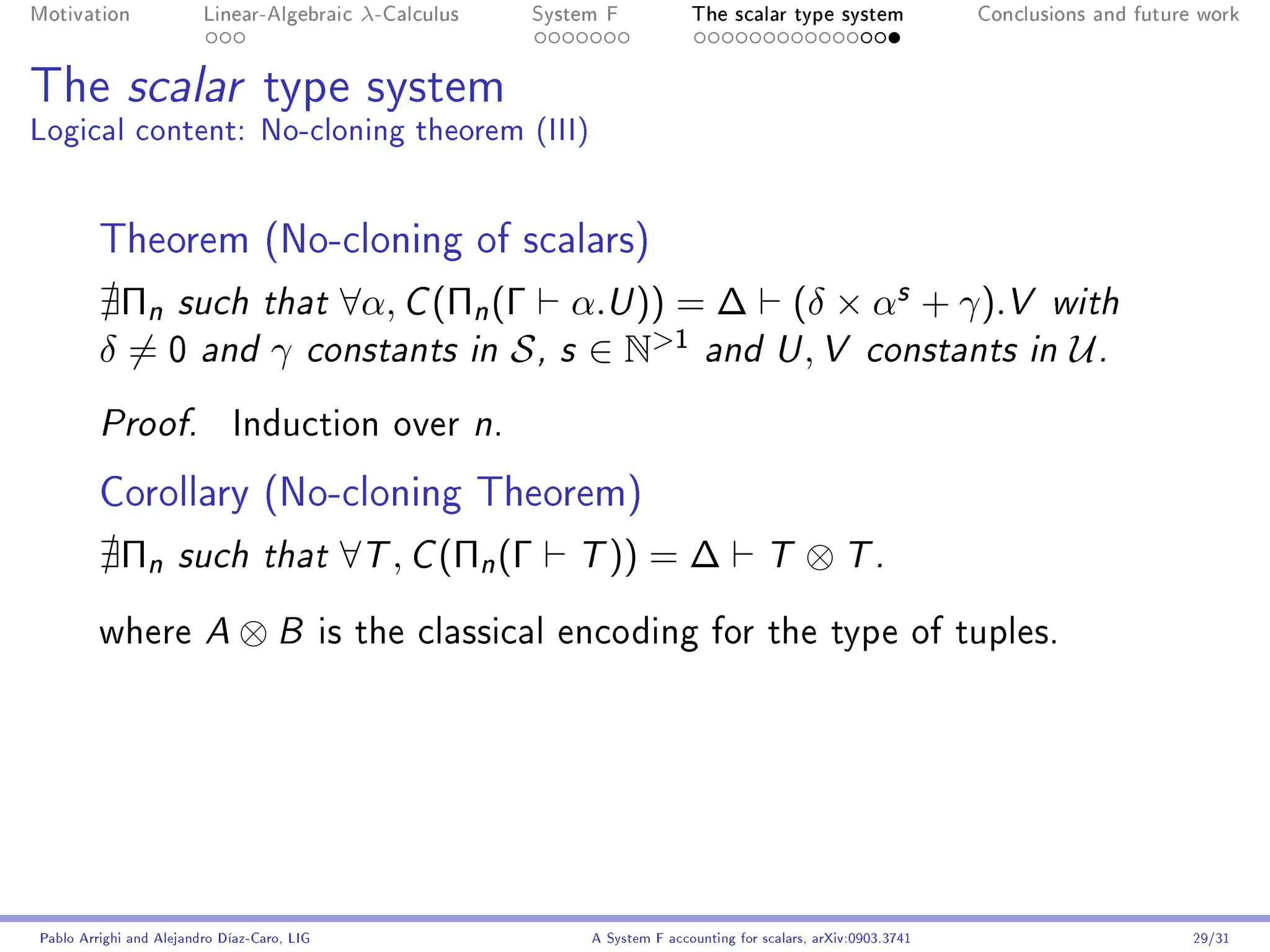
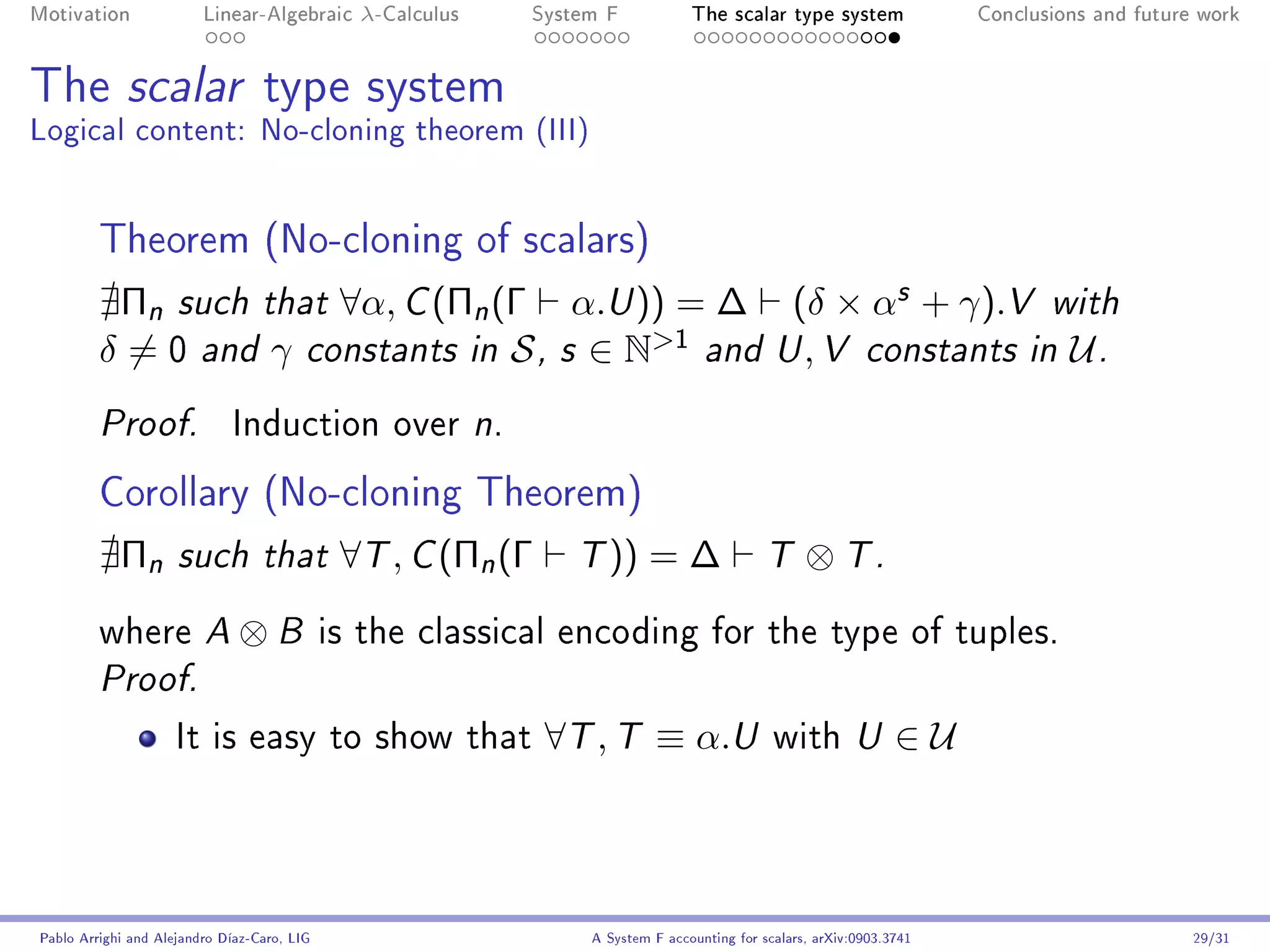
         Theorem (No-cloning of scalars)
          Πn such that ∀α, C (Πn (Γ α.U )) = ∆ (δ × αs + γ).V with
         δ = 0 and γ constants in S , s ∈ N1 and U , V constants in U .
         Proof.              Induction over n.


Pablo Arrighi and Alejandro Díaz-Caro, LIG                     A System F accounting for scalars, arXiv:0903.3741                         29/31
Motivation               Linear-Algebraic      λ-Calculus   System F            The scalar type system                Conclusions and future work


The scalar type system
Logical content: No-cloning theorem (III)


         Theorem (No-cloning of scalars)
          Πn such that ∀α, C (Πn (Γ α.U )) = ∆ (δ × αs + γ).V with
         δ = 0 and γ constants in S , s ∈ N1 and U , V constants in U .
         Proof.              Induction over n.

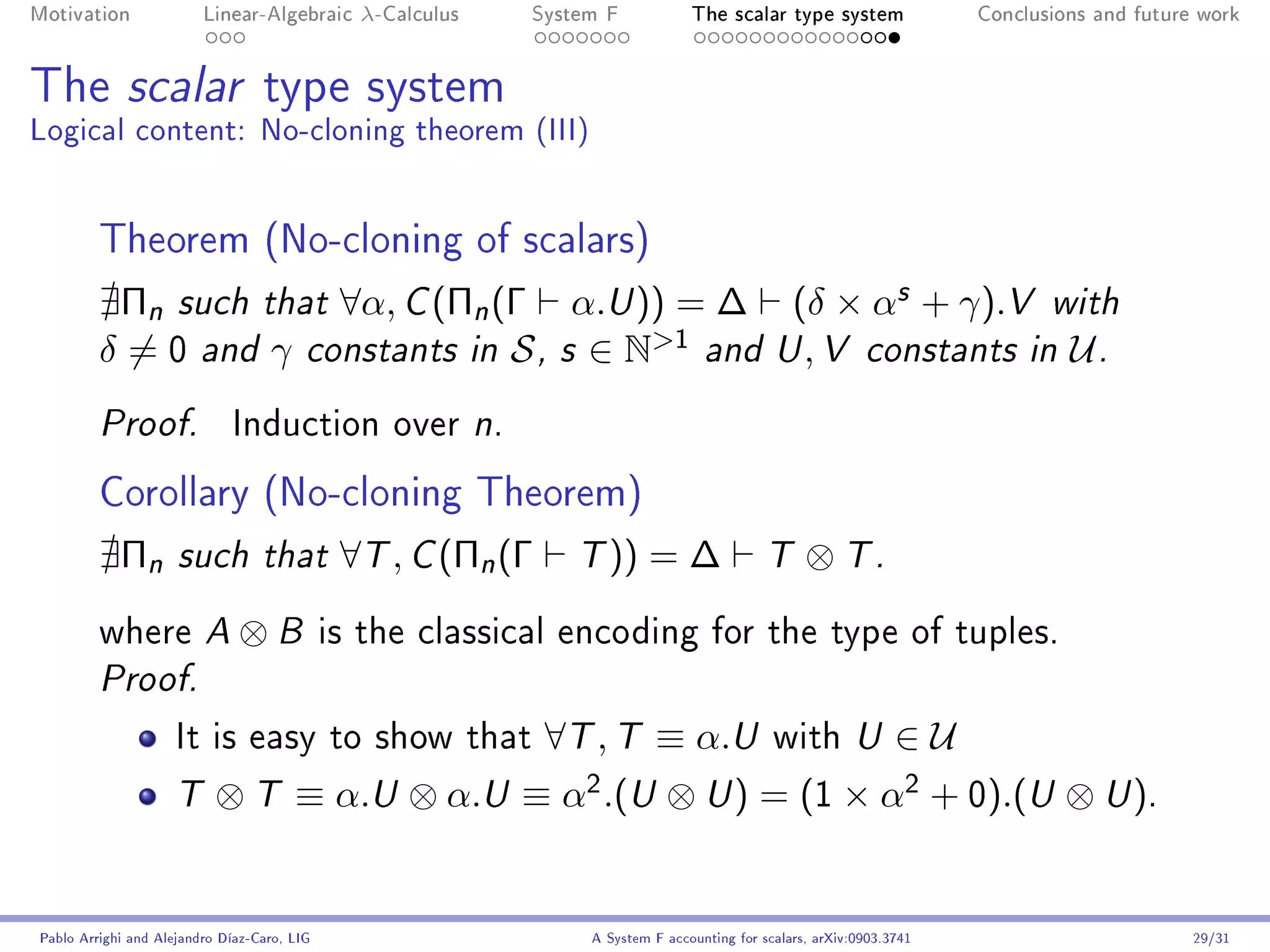
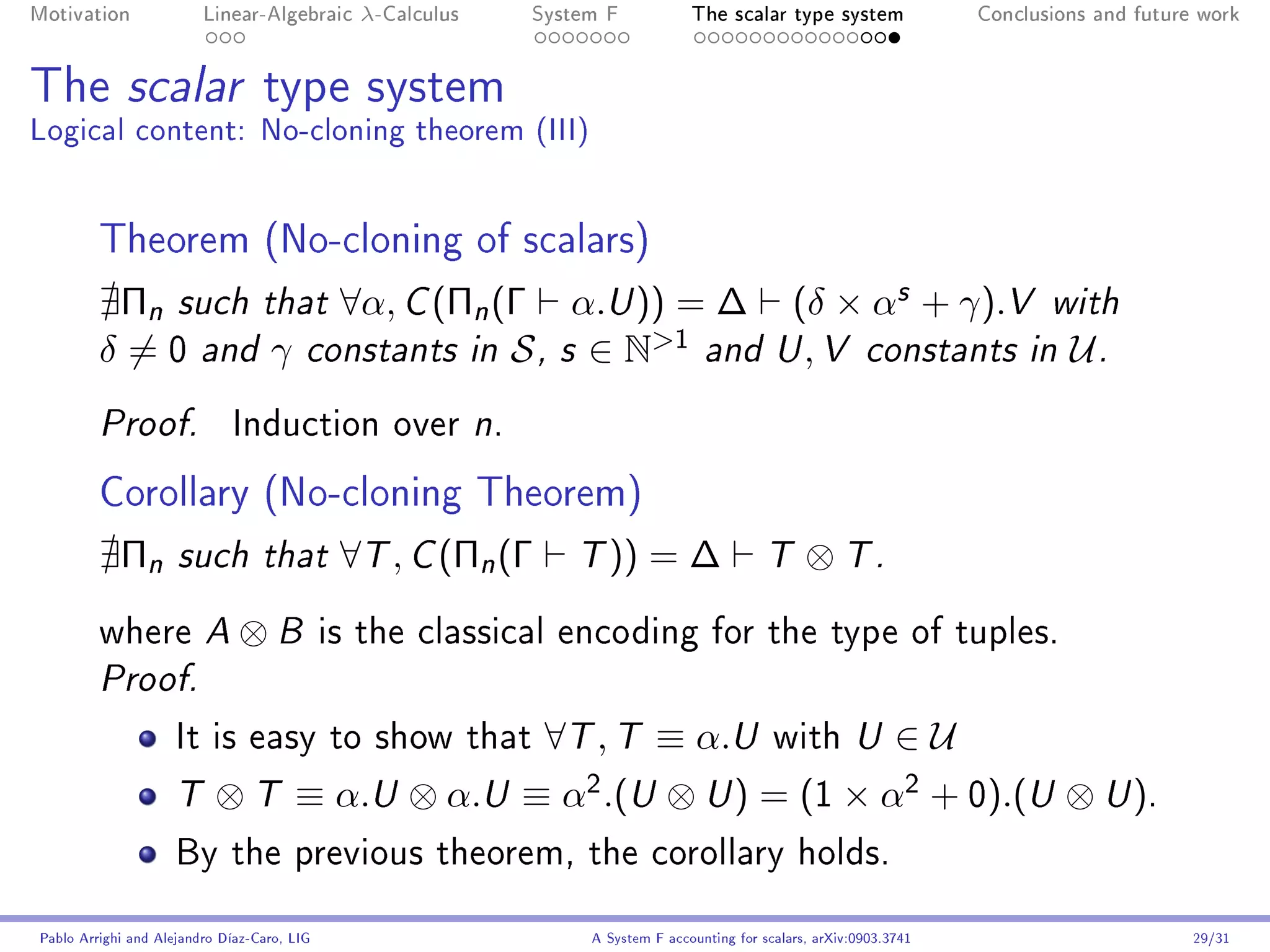
         Corollary (No-cloning Theorem)
            Πn       such that                ∀T , C (Πn (Γ     T   )) = ∆                  T     ⊗ T.
         where A              ⊗B             is the classical encoding for the type of tuples.


Pablo Arrighi and Alejandro Díaz-Caro, LIG                       A System F accounting for scalars, arXiv:0903.3741                         29/31
Motivation               Linear-Algebraic      λ-Calculus   System F            The scalar type system                Conclusions and future work


The scalar type system
Logical content: No-cloning theorem (III)


         Theorem (No-cloning of scalars)
          Πn such that ∀α, C (Πn (Γ α.U )) = ∆ (δ × αs + γ).V with
         δ = 0 and γ constants in S , s ∈ N1 and U , V constants in U .
         Proof.              Induction over n.

         Corollary (No-cloning Theorem)
            Πn       such that                ∀T , C (Πn (Γ     T   )) = ∆                  T     ⊗ T.
         where A              ⊗B             is the classical encoding for the type of tuples.
         Proof.

                     It is easy to show that                  ∀T , T ≡ α.U                   with U             ∈U


Pablo Arrighi and Alejandro Díaz-Caro, LIG                       A System F accounting for scalars, arXiv:0903.3741                         29/31
Motivation               Linear-Algebraic      λ-Calculus   System F            The scalar type system                Conclusions and future work


The scalar type system
Logical content: No-cloning theorem (III)


         Theorem (No-cloning of scalars)
          Πn such that ∀α, C (Πn (Γ α.U )) = ∆ (δ × αs + γ).V with
         δ = 0 and γ constants in S , s ∈ N1 and U , V constants in U .
         Proof.              Induction over n.

         Corollary (No-cloning Theorem)
            Πn       such that                ∀T , C (Πn (Γ     T    )) = ∆                 T     ⊗ T.
         where A              ⊗B             is the classical encoding for the type of tuples.
         Proof.

                     It is easy to show that                  ∀T , T ≡ α.U                   with U             ∈U
                     T     ⊗ T ≡ α.U ⊗ α.U ≡ α .(U ⊗ U ) = (1 × α2 + 0).(U ⊗ U ).
                                                                 2


Pablo Arrighi and Alejandro Díaz-Caro, LIG                       A System F accounting for scalars, arXiv:0903.3741                         29/31
Motivation               Linear-Algebraic      λ-Calculus   System F            The scalar type system                Conclusions and future work


The scalar type system
Logical content: No-cloning theorem (III)


         Theorem (No-cloning of scalars)
          Πn such that ∀α, C (Πn (Γ α.U )) = ∆ (δ × αs + γ).V with
         δ = 0 and γ constants in S , s ∈ N1 and U , V constants in U .
         Proof.              Induction over n.

         Corollary (No-cloning Theorem)
            Πn       such that                ∀T , C (Πn (Γ     T    )) = ∆                 T     ⊗ T.
         where A              ⊗B             is the classical encoding for the type of tuples.
         Proof.

                     It is easy to show that                  ∀T , T ≡ α.U                   with U             ∈U
                     T     ⊗ T ≡ α.U ⊗ α.U ≡ α .(U ⊗ U ) = (1 × α2 + 0).(U ⊗ U ).
                                                                 2


                     By the previous theorem, the corollary holds.


Pablo Arrighi and Alejandro Díaz-Caro, LIG                       A System F accounting for scalars, arXiv:0903.3741                         29/31
Motivation               Linear-Algebraic    λ-Calculus   System F            The scalar type system                 Conclusions and future work


The scalar type system
Summary of contributions


                     S.N. : Simplied the Linear-algebraic                                  λ-calculus              by lifting
                     most restrictions. S.R. OK.


Pablo Arrighi and Alejandro Díaz-Caro, LIG                     A System F accounting for scalars, arXiv:0903.3741                          30/31
Motivation               Linear-Algebraic    λ-Calculus   System F            The scalar type system                 Conclusions and future work


The scalar type system
Summary of contributions


                     S.N. : Simplied the Linear-algebraic                                  λ-calculus              by lifting
                     most restrictions. S.R. OK.

                     Scalar          type system : types keep track of the `amount of a
                     type' by holding sum of amplitudes of terms of that types.


Pablo Arrighi and Alejandro Díaz-Caro, LIG                     A System F accounting for scalars, arXiv:0903.3741                          30/31
Motivation               Linear-Algebraic    λ-Calculus   System F            The scalar type system                 Conclusions and future work


The scalar type system
Summary of contributions


                     S.N. : Simplied the Linear-algebraic                                  λ-calculus              by lifting
                     most restrictions. S.R. OK.

                     Scalar          type system : types keep track of the `amount of a
                     type' by holding sum of amplitudes of terms of that types.

                     =⇒         probabilistic type system, yielding a higher-order
                     probabilistic            λ-calculus.


Pablo Arrighi and Alejandro Díaz-Caro, LIG                     A System F accounting for scalars, arXiv:0903.3741                          30/31
Motivation               Linear-Algebraic    λ-Calculus   System F            The scalar type system                Conclusions and future work


The scalar type system
Polemics, future work


Pablo Arrighi and Alejandro Díaz-Caro, LIG                     A System F accounting for scalars, arXiv:0903.3741                         31/31
Motivation               Linear-Algebraic    λ-Calculus   System F            The scalar type system                Conclusions and future work


The scalar type system
Polemics, future work


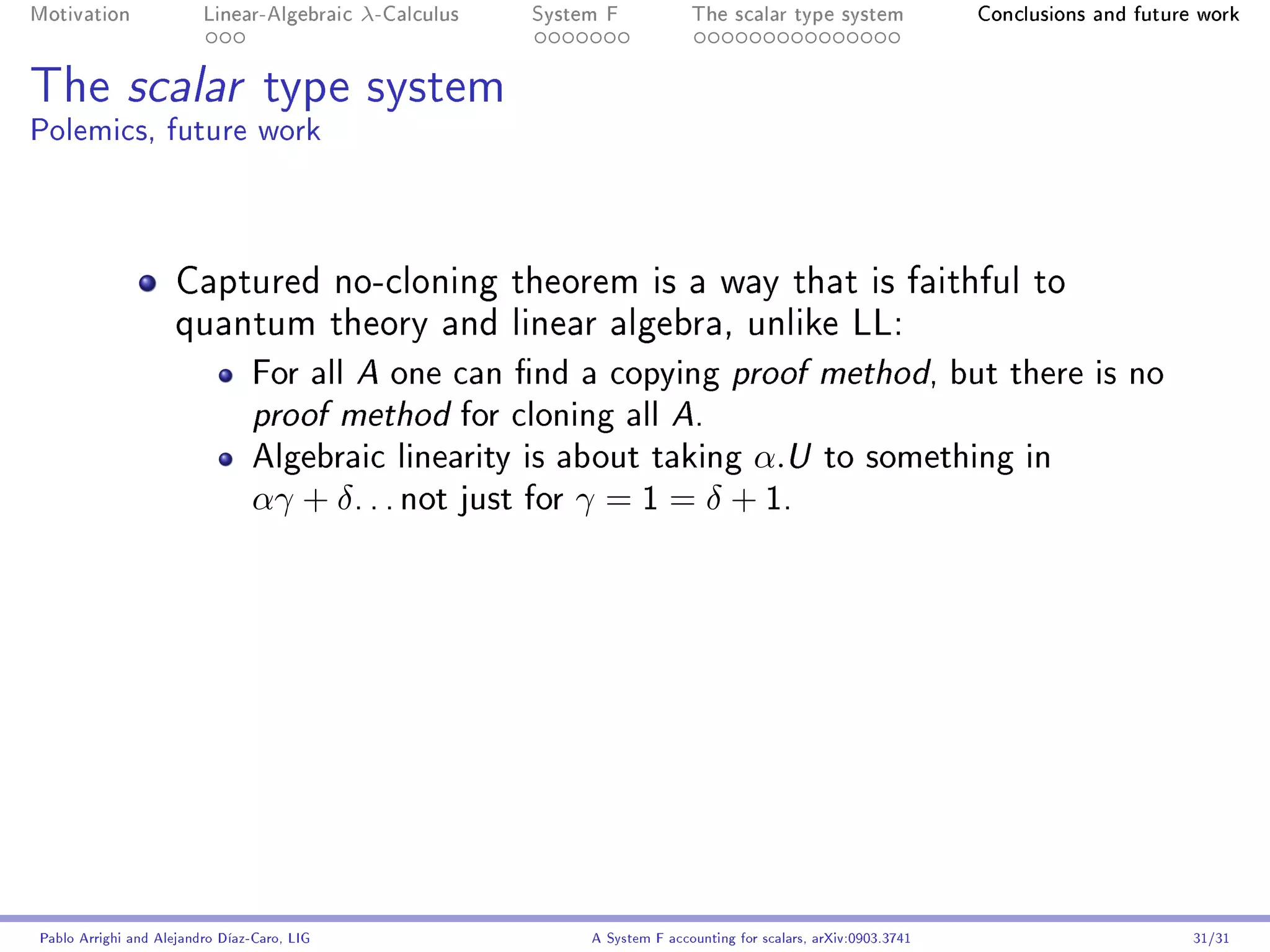
                     Captured no-cloning theorem is a way that is faithful to
                     quantum theory and linear algebra, unlike LL:
                                For all     one can nd a copying proof method, but there is no
                                             A

                                proof method     for cloning all A.
                                Algebraic linearity is about taking α.U to something in
                                αγ + δ . . . not just for γ = 1 = δ + 1.


Pablo Arrighi and Alejandro Díaz-Caro, LIG                     A System F accounting for scalars, arXiv:0903.3741                         31/31
Motivation               Linear-Algebraic    λ-Calculus   System F            The scalar type system                Conclusions and future work


The scalar type system
Polemics, future work


                     Captured no-cloning theorem is a way that is faithful to
                     quantum theory and linear algebra, unlike LL:
                                For all     one can nd a copying proof method, but there is no
                                             A

                                proof method     for cloning all A.
                                Algebraic linearity is about taking α.U to something in
                                αγ + δ . . . not just for γ = 1 = δ + 1.
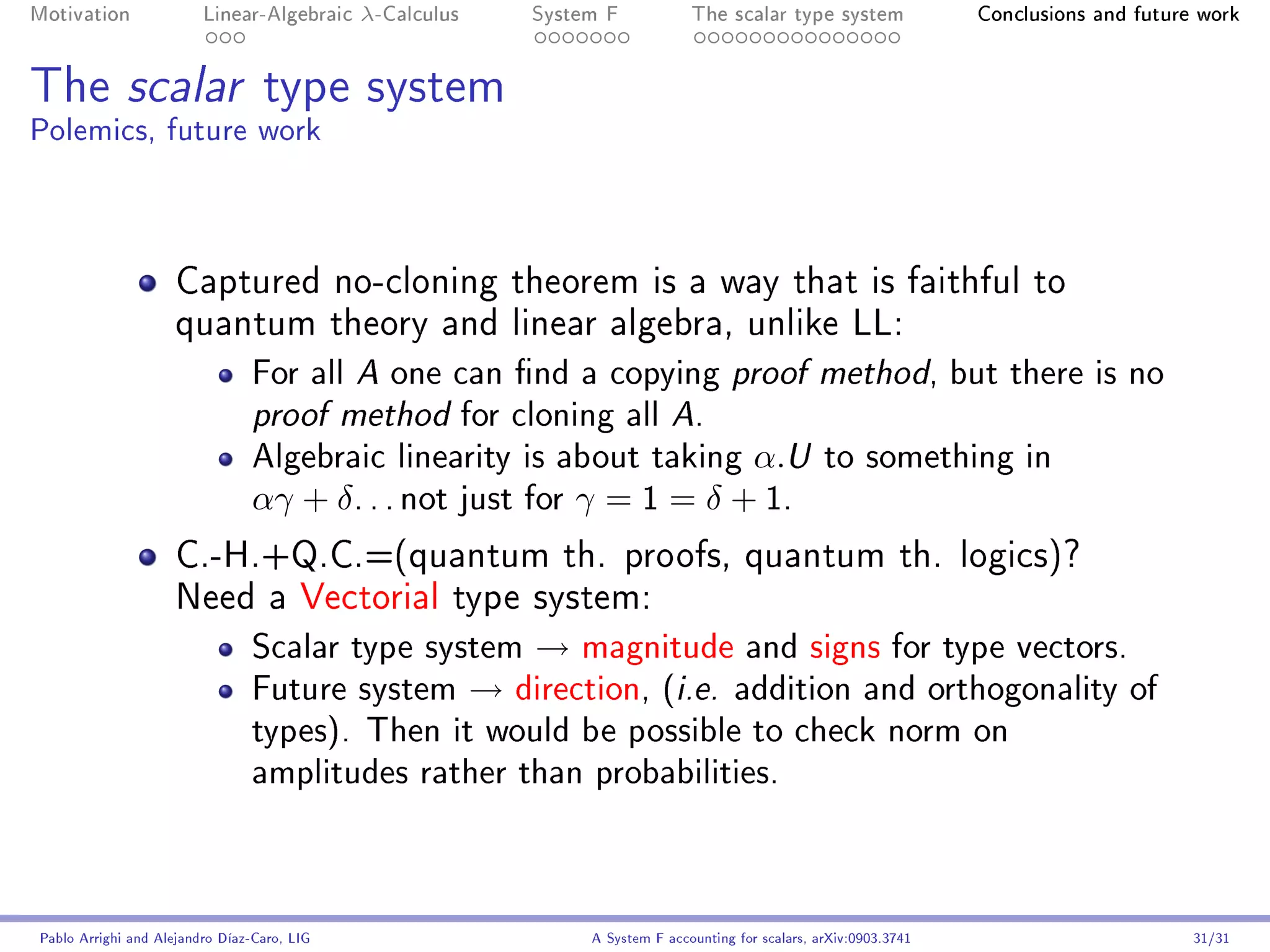
                     C.-H.+Q.C.=(quantum th. proofs, quantum th. logics)?
                     Need a Vectorial type system:
                                Scalar type system → magnitude and signs for type vectors.
                                Future system → direction, (i.e. addition and orthogonality of
                                types). Then it would be possible to check norm on
                                amplitudes rather than probabilities.


Pablo Arrighi and Alejandro Díaz-Caro, LIG                     A System F accounting for scalars, arXiv:0903.3741                         31/31

A System F accounting for scalars

  • 1.
    A System Faccounting for scalars arXiv:0903.3741 Pablo Arrighi and Alejandro Díaz-Caro Université de Grenoble Laboratoire d'Informatique de Grenoble November 19th, 2009. PPS (Paris)
  • 2.
    Motivation Linear-Algebraic λ-Calculus System F The scalar type system Conclusions and future work Global context 1 Oddity of Quantum theory =⇒ Quantum Logic? (developed ad hoc before quantum computing, no clear relation with quantum programs). Birkho, G. and J. von Neumann, The logic of quantum mechanics, 1 Annals of Mathematics 37 (1936), pp. 823843. Pablo Arrighi and Alejandro Díaz-Caro, LIG A System F accounting for scalars, arXiv:0903.3741 2/31
  • 3.
    Motivation Linear-Algebraic λ-Calculus System F The scalar type system Conclusions and future work Global context 1 Oddity of Quantum theory =⇒ Quantum Logic? (developed ad hoc before quantum computing, no clear relation with quantum programs). Models of Linear Logics =⇒ Quantum Theory? (Coherent spaces, Micromechanics loses duplicability.) Birkho, G. and J. von Neumann, The logic of quantum mechanics, 1 Annals of Mathematics 37 (1936), pp. 823843. Pablo Arrighi and Alejandro Díaz-Caro, LIG A System F accounting for scalars, arXiv:0903.3741 2/31
  • 4.
    Motivation Linear-Algebraic λ-Calculus System F The scalar type system Conclusions and future work Global context 1 Oddity of Quantum theory =⇒ Quantum Logic? (developed ad hoc before quantum computing, no clear relation with quantum programs). Models of Linear Logics =⇒ Quantum Theory? (Coherent spaces, Micromechanics loses duplicability.) Curry-Howard : (programs,types)=⇒(proofs,logics). Quantum Computation : (quantum programs, quantum types). CH+QC : (quantum th. proofs, quantum th. logics)? Quantum logics : isolating the reasoning behind quantum algorithms? Birkho, G. and J. von Neumann, The logic of quantum mechanics, 1 Annals of Mathematics 37 (1936), pp. 823843. Pablo Arrighi and Alejandro Díaz-Caro, LIG A System F accounting for scalars, arXiv:0903.3741 2/31
  • 5.
    Motivation Linear-Algebraic λ-Calculus System F The scalar type system Conclusions and future work Global context 1 Oddity of Quantum theory =⇒ Quantum Logic? (developed ad hoc before quantum computing, no clear relation with quantum programs). Models of Linear Logics =⇒ Quantum Theory? (Coherent spaces, Micromechanics loses duplicability.) Curry-Howard : (programs,types)=⇒(proofs,logics). Quantum Computation : (quantum programs, quantum types). CH+QC : (quantum th. proofs, quantum th. logics)? Quantum logics : isolating the reasoning behind quantum algorithms? What are quantum types? Birkho, G. and J. von Neumann, The logic of quantum mechanics, 1 Annals of Mathematics 37 (1936), pp. 823843. Pablo Arrighi and Alejandro Díaz-Caro, LIG A System F accounting for scalars, arXiv:0903.3741 2/31
  • 6.
    Motivation Linear-Algebraic λ-Calculus System F The scalar type system Conclusions and future work Quantum theory States are (normalized) vectors v. Vector space of o.n.b. (bi ). Then v= i αi bi . Pablo Arrighi and Alejandro Díaz-Caro, LIG A System F accounting for scalars, arXiv:0903.3741 3/31
  • 7.
    Motivation Linear-Algebraic λ-Calculus System F The scalar type system Conclusions and future work Quantum theory States are (normalized) vectors v. Vector space of o.n.b. (bi ). Then v= i αi bi . Evolutions are (unitary) linear operators U . v = U v. Pablo Arrighi and Alejandro Díaz-Caro, LIG A System F accounting for scalars, arXiv:0903.3741 3/31
  • 8.
    Motivation Linear-Algebraic λ-Calculus System F The scalar type system Conclusions and future work Quantum theory States are (normalized) vectors v. Vector space of o.n.b. (bi ). Then v= i αi bi . Evolutions are (unitary) linear operators U . v = U v. Systems are put next to one another with ⊗. Bilinear just like application : u + v ⊗ w = u ⊗ w + v ⊗ w, u ⊗ v + w = u ⊗ v + u ⊗ w, . . . Pablo Arrighi and Alejandro Díaz-Caro, LIG A System F accounting for scalars, arXiv:0903.3741 3/31
  • 9.
    Motivation Linear-Algebraic λ-Calculus System F The scalar type system Conclusions and future work Quantum theory States are (normalized) vectors v. Vector space of o.n.b. (bi ). Then v= i αi bi . Evolutions are (unitary) linear operators U . v = U v. Systems are put next to one another with ⊗. Bilinear just like application : u + v ⊗ w = u ⊗ w + v ⊗ w, u ⊗ v + w = u ⊗ v + u ⊗ w, . . . No-cloning theorem! Pablo Arrighi and Alejandro Díaz-Caro, LIG A System F accounting for scalars, arXiv:0903.3741 3/31
  • 10.
    Motivation Linear-Algebraic λ-Calculus System F The scalar type system Conclusions and future work No-cloning theorem Statement: ∃U / ∀v : U v = v ⊗ v. Proof: Vector space of o.n.b. (bi ), so v= αi bi . We can have i U bi = bi ⊗ bi (=copying, OK) But then U v = αi bi = αi U bi U i i = αi bi ⊗ bi = αi αj bi ⊗ bj i ij = ( αi bi ) ⊗ ( αj bj ) i j = v⊗v (=cloning, Not OK) Pablo Arrighi and Alejandro Díaz-Caro, LIG A System F accounting for scalars, arXiv:0903.3741 4/31
  • 11.
    Motivation Linear-Algebraic λ-Calculus System F The scalar type system Conclusions and future work No-cloning theorem Statement: ∃U / ∀v : U v = v ⊗ v. Proof: Vector space of o.n.b. (bi ), so v= αi bi . We can have i U bi = bi ⊗ bi (=copying, OK) But then U v = αi bi = αi U bi U i i = αi bi ⊗ bi = αi αj bi ⊗ bj i ij = ( αi bi ) ⊗ ( αj bj ) i j = v⊗v (=cloning, Not OK) Conicts with β -reduction? Pablo Arrighi and Alejandro Díaz-Caro, LIG A System F accounting for scalars, arXiv:0903.3741 4/31
  • 12.
    Motivation Linear-Algebraic λ-Calculus System F The scalar type system Conclusions and future work Linear-Algebraic λ-Calculus2 The language Higher-order computation t ::= x | λx .t | (t t) | Arrighi, P. and G. Dowek. Linear-algebraic λ-calculus: higher-order, 2 encodings and conuence. Lecture Notes in Computer Science (RTA'08), 5117 (2008), pp. 1731. Pablo Arrighi and Alejandro Díaz-Caro, LIG A System F accounting for scalars, arXiv:0903.3741 5/31
  • 13.
    Motivation Linear-Algebraic λ-Calculus System F The scalar type system Conclusions and future work Linear-Algebraic λ-Calculus2 The language Higher-order computation Linear algebra t ::= x | λx .t | (t t) | t + t | α.t | 0 Arrighi, P. and G. Dowek. Linear-algebraic λ-calculus: higher-order, 2 encodings and conuence. Lecture Notes in Computer Science (RTA'08), 5117 (2008), pp. 1731. Pablo Arrighi and Alejandro Díaz-Caro, LIG A System F accounting for scalars, arXiv:0903.3741 5/31
  • 14.
    Motivation Linear-Algebraic λ-Calculus System F The scalar type system Conclusions and future work Linear-Algebraic λ-Calculus2 The language Higher-order computation Linear algebra t ::= x | λx .t | (t t) | t + t | α.t | 0 λx .t b → t[b/x ] (∗) (*) b an abstraction or a variable. Arrighi, P. and G. Dowek. Linear-algebraic λ-calculus: higher-order, 2 encodings and conuence. Lecture Notes in Computer Science (RTA'08), 5117 (2008), pp. 1731. Pablo Arrighi and Alejandro Díaz-Caro, LIG A System F accounting for scalars, arXiv:0903.3741 5/31
  • 15.
    Motivation Linear-Algebraic λ-Calculus System F The scalar type system Conclusions and future work Linear-Algebraic λ-Calculus2 The language Higher-order computation Linear algebra t ::= x | λx .t | (t t) | t + t | α.t | 0 λx .t b → t[b/x ] (∗) Elementary rules such as (*) b an abstraction or a u + 0 → u and α.(u + v) → α.u + α.v. variable. Factorisation rules such as (**) u closed normal. α.u + β.u → (α + β).u. (**) (***) u and u + v closed normal. Application rules such as u (v + w) → (u v) + (u w). (***) Arrighi, P. and G. Dowek. Linear-algebraic λ-calculus: higher-order, 2 encodings and conuence. Lecture Notes in Computer Science (RTA'08), 5117 (2008), pp. 1731. Pablo Arrighi and Alejandro Díaz-Caro, LIG A System F accounting for scalars, arXiv:0903.3741 5/31
  • 16.
    Motivation Linear-Algebraic λ-Calculus System F The scalar type system Conclusions and future work Linear-Algebraic λ-Calculus Why the restrictions : Copying vs Cloning Untyped λ-calculus + linear algebra ⇒ Cloning? Pablo Arrighi and Alejandro Díaz-Caro, LIG A System F accounting for scalars, arXiv:0903.3741 6/31
  • 17.
    Motivation Linear-Algebraic λ-Calculus System F The scalar type system Conclusions and future work Linear-Algebraic λ-Calculus Why the restrictions : Copying vs Cloning Untyped λ-calculus + linear algebra ⇒ Cloning? λx .(x ⊗ x ) αi bi →∗ αi bi ⊗ bi i i ↓ ( αi bi ) ⊗ ( αi bi ) i i Pablo Arrighi and Alejandro Díaz-Caro, LIG A System F accounting for scalars, arXiv:0903.3741 6/31
  • 18.
    Motivation Linear-Algebraic λ-Calculus System F The scalar type system Conclusions and future work Linear-Algebraic λ-Calculus Why the restrictions : Copying vs Cloning Untyped λ-calculus + linear algebra ⇒ Cloning? λx .(x ⊗ x ) αi bi →∗ αi bi ⊗ bi i i ↓ ( αi bi ) ⊗ ( αi bi ) i i No-cloning says bottom reduction forbidden. We must delay beta reduction till after linearity. So restrict beta reduction to base vectors → i.e. abstractions or variables. Pablo Arrighi and Alejandro Díaz-Caro, LIG A System F accounting for scalars, arXiv:0903.3741 6/31
  • 19.
    Motivation Linear-Algebraic λ-Calculus System F The scalar type system Conclusions and future work Linear-Algebraic λ-Calculus Why the restrictions : Innities Untyped λ-calculus + linear algebra ⇒∞ Pablo Arrighi and Alejandro Díaz-Caro, LIG A System F accounting for scalars, arXiv:0903.3741 7/31
  • 20.
    Motivation Linear-Algebraic λ-Calculus System F The scalar type system Conclusions and future work Linear-Algebraic λ-Calculus Why the restrictions : Innities Untyped λ-calculus + linear algebra ⇒∞ Yb ≡ λx .(b + (x x )) λx .(b + (x x )) Yb → b + Yb Pablo Arrighi and Alejandro Díaz-Caro, LIG A System F accounting for scalars, arXiv:0903.3741 7/31
  • 21.
    Motivation Linear-Algebraic λ-Calculus System F The scalar type system Conclusions and future work Linear-Algebraic λ-Calculus Why the restrictions : Innities Untyped λ-calculus + linear algebra ⇒∞ Yb ≡ λx .(b + (x x )) λx .(b + (x x )) Yb → b + Yb But whoever says innity says trouble says. . . Pablo Arrighi and Alejandro Díaz-Caro, LIG A System F accounting for scalars, arXiv:0903.3741 7/31
  • 22.
    Motivation Linear-Algebraic λ-Calculus System F The scalar type system Conclusions and future work Linear-Algebraic λ-Calculus Why the restrictions : Innities Untyped λ-calculus + linear algebra ⇒∞ Yb ≡ λx .(b + (x x )) λx .(b + (x x )) Yb → b + Yb But whoever says innity says trouble says. . . indenite forms. Pablo Arrighi and Alejandro Díaz-Caro, LIG A System F accounting for scalars, arXiv:0903.3741 7/31
  • 23.
    Motivation Linear-Algebraic λ-Calculus System F The scalar type system Conclusions and future work Linear-Algebraic λ-Calculus Why the restrictions : Innities Untyped λ-calculus + linear algebra ⇒∞ Yb ≡ λx .(b + (x x )) λx .(b + (x x )) Yb → b + Yb But whoever says innity says trouble says. . . indenite forms. Yb − Yb → b + Yb − Yb → b ↓∗ 0 Pablo Arrighi and Alejandro Díaz-Caro, LIG A System F accounting for scalars, arXiv:0903.3741 7/31
  • 24.
    Motivation Linear-Algebraic λ-Calculus System F The scalar type system Conclusions and future work Linear-Algebraic λ-Calculus Why the restrictions : Innities Untyped λ-calculus + linear algebra ⇒∞ Yb ≡ λx .(b + (x x )) λx .(b + (x x )) Yb → b + Yb But whoever says innity says trouble says. . . indenite forms. Yb − Yb → b + Yb − Yb → b ↓∗ 0 High school teacher says we must restrict factorization rules to nite vectors → i.e. closed-normal forms. Pablo Arrighi and Alejandro Díaz-Caro, LIG A System F accounting for scalars, arXiv:0903.3741 7/31
  • 25.
    Motivation Linear-Algebraic λ-Calculus System F The scalar type system Conclusions and future work System F Straightforward extension of System F (λ2la ) System F rules plus simple rules to type algebraic terms ax0 Γ u: A Γ v: A Γ t: A +I αI Γ 0: A Γ u + v: A Γ α.t : A Pablo Arrighi and Alejandro Díaz-Caro, LIG A System F accounting for scalars, arXiv:0903.3741 8/31
  • 26.
    Motivation Linear-Algebraic λ-Calculus System F The scalar type system Conclusions and future work System F Straightforward extension of System F (λ2la ) System F rules plus simple rules to type algebraic terms ax0 Γ u: A Γ v: A Γ t: A +I αI Γ 0: A Γ u + v: A Γ α.t : A Theorem (Strong normalization) Γ t: T ⇒t is strongly normalising. Pablo Arrighi and Alejandro Díaz-Caro, LIG A System F accounting for scalars, arXiv:0903.3741 8/31
  • 27.
    Motivation Linear-Algebraic λ-Calculus System F The scalar type system Conclusions and future work System F Straightforward extension of System F (λ2la ) System F rules plus simple rules to type algebraic terms ax0 Γ u: A Γ v: A Γ t: A +I αI Γ 0: A Γ u + v: A Γ α.t : A Theorem (Strong normalization) Γ t: T ⇒t is strongly normalising. Proof. Sketch: We extend the notion of saturated sets. Pablo Arrighi and Alejandro Díaz-Caro, LIG A System F accounting for scalars, arXiv:0903.3741 8/31
  • 28.
    Motivation Linear-Algebraic λ-Calculus System F The scalar type system Conclusions and future work System F Strong normalization of λ2la SN : Set of strongly normalising terms Pablo Arrighi and Alejandro Díaz-Caro, LIG A System F accounting for scalars, arXiv:0903.3741 9/31
  • 29.
    Motivation Linear-Algebraic λ-Calculus System F The scalar type system Conclusions and future work System F Strong normalization of λ2la SN : Set of strongly normalising terms A subset X ∈ SN is saturated if 1 ∀n ≥ 0, (((x t1 ) . . . ) tn ) ∈ X where ti ∈ SN ; → − → − 2 v[b/x ] t ∈ X ⇒ (λx v) b t ∈ X ; 3 t, u ∈ X ⇒ t + u ∈ X ; 4 ∀α, t ∈ X ⇒ α.t ∈ X ; 5 ∀i ∈ I , ((ui w1 ) . . . wn ) ∈ X ⇒ u i w1 . . . w ∈ X ; n i ∈I 6 ∀i ∈ I , (u wi ) ∈ X ⇒ u w i ∈ X; i ∈I 7 α.((t1 t2 ) . . . tn ) ∈ X ⇔ ((t1 t2 ) . . . α.tk ) . . . tn ∈ X (1 ≤ k ≤ n); 8 0 ∈ X; → − → − 9 ∀ t ∈ SN , (0 t ) ∈ X ; 10 → ∈ SN , (t 0) → ∈ X . − ∀t, u −u X stable by construction and anti-reduction Pablo Arrighi and Alejandro Díaz-Caro, LIG A System F accounting for scalars, arXiv:0903.3741 9/31
  • 30.
    Motivation Linear-Algebraic λ-Calculus System F The scalar type system Conclusions and future work System F Strong normalization of λ2la SN : Set of strongly normalising terms A subset X ∈ SN is saturated if 1 ∀n ≥ 0, (((x t1 ) . . . ) tn ) ∈ X where ti ∈ SN ; → − → − 2 v[b/x ] t ∈ X ⇒ (λx v) b t ∈ X ; 3 t, u ∈ X ⇒ t + u ∈ X ; 4 ∀α, t ∈ X ⇒ α.t ∈ X ; 5 ∀i ∈ I , ((ui w1 ) . . . wn ) ∈ X ⇒ u i w1 . . . w ∈ X ; n i ∈I 6 ∀i ∈ I , (u wi ) ∈ X ⇒ u w i ∈ X; i ∈I 7 α.((t1 t2 ) . . . tn ) ∈ X ⇔ ((t1 t2 ) . . . α.tk ) . . . tn ∈ X (1 ≤ k ≤ n); 8 0 ∈ X; → − → − 9 ∀ t ∈ SN , (0 t ) ∈ X ; 10 → ∈ SN , (t 0) → ∈ X . − ∀t, u −u X stable by construction and anti-reduction SAT is the set of all saturated sets Pablo Arrighi and Alejandro Díaz-Caro, LIG A System F accounting for scalars, arXiv:0903.3741 9/31
  • 31.
    Motivation Linear-Algebraic λ-Calculus System F The scalar type system Conclusions and future work System F Strong normalization of λ2la (II) Rening the sketch: The idea is that types correspond to saturated sets. Pablo Arrighi and Alejandro Díaz-Caro, LIG A System F accounting for scalars, arXiv:0903.3741 10/31
  • 32.
    Motivation Linear-Algebraic λ-Calculus System F The scalar type system Conclusions and future work System F Strong normalization of λ2la (II) Rening the sketch: The idea is that types correspond to saturated sets. This correspondance is achived by a maping from types to SAT . Pablo Arrighi and Alejandro Díaz-Caro, LIG A System F accounting for scalars, arXiv:0903.3741 10/31
  • 33.
    Motivation Linear-Algebraic λ-Calculus System F The scalar type system Conclusions and future work System F Strong normalization of λ2la (III) Lemma 1 SN ∈ SAT , 2 A B , ∈ SAT ⇒ A → B ∈ SAT , 3 For all collection A i of members of SAT , i Ai ∈ SAT , Pablo Arrighi and Alejandro Díaz-Caro, LIG A System F accounting for scalars, arXiv:0903.3741 11/31
  • 34.
    Motivation Linear-Algebraic λ-Calculus System F The scalar type system Conclusions and future work System F Strong normalization of λ2la (III) Lemma 1 SN ∈ SAT , 2 A B , ∈ SAT ⇒ A → B ∈ SAT , 3 For all collection A i of members of SAT , i Ai ∈ SAT , Denition (Mapping) [[X ]]ξ = ξ(X ) (where ξ(·) : TVar → SAT ) [[A → B ]]ξ = [[A]]ξ → [[B ]]ξ [[∀X .T ]]ξ = Y ∈SAT [[T ]]ξ(X :=Y ) Pablo Arrighi and Alejandro Díaz-Caro, LIG A System F accounting for scalars, arXiv:0903.3741 11/31
  • 35.
    Motivation Linear-Algebraic λ-Calculus System F The scalar type system Conclusions and future work System F Strong normalization of λ2la (III) Lemma 1 SN ∈ SAT , 2 A B , ∈ SAT ⇒ A → B ∈ SAT , 3 For all collection A i of members of SAT , i Ai ∈ SAT , Denition (Mapping) [[X ]]ξ = ξ(X ) (where ξ(·) : TVar → SAT ) [[A → B ]]ξ = [[A]]ξ → [[B ]]ξ [[∀X .T ]]ξ = Y ∈SAT [[T ]]ξ(X :=Y ) Lemma Given a valuation ξ , [[T ]]ξ ∈ SAT Pablo Arrighi and Alejandro Díaz-Caro, LIG A System F accounting for scalars, arXiv:0903.3741 11/31
  • 36.
    Motivation Linear-Algebraic λ-Calculus System F The scalar type system Conclusions and future work System F Strong normalization of λ2la (IV) Denition ( ) For Γ = x1 : A1 , . . . , xn : An , Γ t: T means that ∀ξ , x1 ∈ [[A1 ]]ξ , . . . xn ∈ [[An ]]ξ ⇒ t ∈ [[T ]]ξ Pablo Arrighi and Alejandro Díaz-Caro, LIG A System F accounting for scalars, arXiv:0903.3741 12/31
  • 37.
    Motivation Linear-Algebraic λ-Calculus System F The scalar type system Conclusions and future work System F Strong normalization of λ2la (IV) Denition ( ) For Γ = x1 : A1 , . . . , xn : An , Γ t: T means that ∀ξ , x1 ∈ [[A1 ]]ξ , . . . xn ∈ [[An ]]ξ ⇒ t ∈ [[T ]]ξ Rening the sketch: Prove that Γ t: T ⇒ Γ t: T We prove this by induction on the derivation of Γ t: T (In fact the denition of is slightly dierent to strengthen the induction hypothesis) Pablo Arrighi and Alejandro Díaz-Caro, LIG A System F accounting for scalars, arXiv:0903.3741 12/31
  • 38.
    Motivation Linear-Algebraic λ-Calculus System F The scalar type system Conclusions and future work System F Strong normalization of λ2la (V) Then, the proof of the strong normalisation theorem is: Let Γ t: T Pablo Arrighi and Alejandro Díaz-Caro, LIG A System F accounting for scalars, arXiv:0903.3741 13/31
  • 39.
    Motivation Linear-Algebraic λ-Calculus System F The scalar type system Conclusions and future work System F Strong normalization of λ2la (V) Then, the proof of the strong normalisation theorem is: Let Γ t: T ⇒ Γ t: T Pablo Arrighi and Alejandro Díaz-Caro, LIG A System F accounting for scalars, arXiv:0903.3741 13/31
  • 40.
    Motivation Linear-Algebraic λ-Calculus System F The scalar type system Conclusions and future work System F Strong normalization of λ2la (V) Then, the proof of the strong normalisation theorem is: Let Γ t: T ⇒ Γ t: T ⇒ If ∀(xi : Ai ) ∈ Γ, xi ∈ [[Ai ]]ξ then t ∈ [[T ]]ξ Pablo Arrighi and Alejandro Díaz-Caro, LIG A System F accounting for scalars, arXiv:0903.3741 13/31
  • 41.
    Motivation Linear-Algebraic λ-Calculus System F The scalar type system Conclusions and future work System F Strong normalization of λ2la (V) Then, the proof of the strong normalisation theorem is: Let Γ t: T ⇒ Γ t: T ⇒ If ∀(xi : Ai ) ∈ Γ, xi ∈ [[Ai ]]ξ then t ∈ [[T ]]ξ Note that x i ∈ [[Ai ]]ξ because [[Ai ]]ξ is saturated, Pablo Arrighi and Alejandro Díaz-Caro, LIG A System F accounting for scalars, arXiv:0903.3741 13/31
  • 42.
    Motivation Linear-Algebraic λ-Calculus System F The scalar type system Conclusions and future work System F Strong normalization of λ2la (V) Then, the proof of the strong normalisation theorem is: Let Γ t: T ⇒ Γ t: T ⇒ If ∀(xi : Ai ) ∈ Γ, xi ∈ [[Ai ]]ξ then t ∈ [[T ]]ξ Note that x i ∈ [[Ai ]]ξ because [[Ai ]]ξ is saturated, then t is strong normalising because [[T ]]ξ ⊆ SN Pablo Arrighi and Alejandro Díaz-Caro, LIG A System F accounting for scalars, arXiv:0903.3741 13/31
  • 43.
    Motivation Linear-Algebraic λ-Calculus System F The scalar type system Conclusions and future work System F Linear-Algebraic λ-Calculus with λ2la Higher-order computation Linear algebra t ::= x | λx .t | (t t) | t + t | α.t | 0 λx .t b → t[b/x ] (∗) Elementary rules such as (*) b an abstraction or a variable. u + 0 → u and α.(u + v) → α.u + α.v. Factorisation rules such as α.u + β.u → (α + β).u. Application rules such as u (v + w) → (u v) + (u w). Pablo Arrighi and Alejandro Díaz-Caro, LIG A System F accounting for scalars, arXiv:0903.3741 14/31
  • 44.
    Motivation Linear-Algebraic λ-Calculus System F The scalar type system Conclusions and future work System F Linear-Algebraic λ-Calculus with λ2la Higher-order computation Linear algebra t ::= x | λx .t | (t t) | t + t | α.t | 0 λx .t b → t[b/x ] (∗) Elementary rules such as (*) b an abstraction or a variable. u + 0 → u and α.(u + v) → α.u + α.v. Every typable term is strong normalizing Factorisation rules such as α.u + β.u → (α + β).u. Application rules such as u (v + w) → (u v) + (u w). Pablo Arrighi and Alejandro Díaz-Caro, LIG A System F accounting for scalars, arXiv:0903.3741 14/31
  • 45.
    Motivation Linear-Algebraic λ-Calculus System F The scalar type system Conclusions and future work System F Linear-Algebraic λ-Calculus with λ2la Higher-order computation Linear algebra t ::= x | λx .t | (t t) | t + t | α.t | 0 λx .t b → t[b/x ] (∗) Elementary rules such as (*) b an abstraction or a variable. u + 0 → u and α.(u + v) → α.u + α.v. Every typable term is strong normalizing Factorisation rules such as Hence Yb is no typable! α.u + β.u → (α + β).u. Application rules such as u (v + w) → (u v) + (u w). Pablo Arrighi and Alejandro Díaz-Caro, LIG A System F accounting for scalars, arXiv:0903.3741 14/31
  • 46.
    Motivation Linear-Algebraic λ-Calculus System F The scalar type system Conclusions and future work System F Linear-Algebraic λ-Calculus with λ2la Higher-order computation Linear algebra t ::= x | λx .t | (t t) | t + t | α.t | 0 λx .t b → t[b/x ] (∗) Elementary rules such as (*) b an abstraction or a variable. u + 0 → u and α.(u + v) → α.u + α.v. Every typable term is strong normalizing Factorisation rules such as Hence Yb is no typable! α.u + β.u → (α + β).u. t − t → 0 always, so it is not Application rules such as necesary to reduce t rst. we can u (v + w) → (u v) + (u w). remove the closed-normal restrictions! Pablo Arrighi and Alejandro Díaz-Caro, LIG A System F accounting for scalars, arXiv:0903.3741 14/31
  • 47.
    Motivation Linear-Algebraic λ-Calculus System F The scalar type system Conclusions and future work The scalar type system Grammar Types grammar: T = U | ∀X .T | α.T | 0, U = X | U → T | ∀X .U where α∈S and (S, +, ×) is a conmutative ring. Pablo Arrighi and Alejandro Díaz-Caro, LIG A System F accounting for scalars, arXiv:0903.3741 15/31
  • 48.
    Motivation Linear-Algebraic λ-Calculus System F The scalar type system Conclusions and future work The scalar type system Type inference rules ax U [ ] Γ, x : U x :U Γ u: U → T Γ v: U Γ, x : U t: T →E → I [U ] Γ (u v) : T Γ λx t : U → T Γ u : ∀X .T Γ u: T ∀E [X := U ] ∀I [X ] with X ∈ FV (Γ) / Γ u : T [U /X ] Γ u : ∀X .T Pablo Arrighi and Alejandro Díaz-Caro, LIG A System F accounting for scalars, arXiv:0903.3741 16/31
  • 49.
    Motivation Linear-Algebraic λ-Calculus System F The scalar type system Conclusions and future work The scalar type system Type inference rules ax U [ ] Γ, x : U x :U Γ u: U → T Γ v: U Γ, x : U t: T →E → I [U ] Γ (u v) : T Γ λx t : U → T Γ u : ∀X .T Γ u: T ∀E [X := U ] ∀I [X ] with X ∈ FV (Γ) / Γ u : T [U /X ] Γ u : ∀X .T Γ u: T Γ v: T Γ u: T ax0 +I αI Γ 0: T Γ u + v: T Γ α.u : T Pablo Arrighi and Alejandro Díaz-Caro, LIG A System F accounting for scalars, arXiv:0903.3741 16/31
  • 50.
    Motivation Linear-Algebraic λ-Calculus System F The scalar type system Conclusions and future work The scalar type system Type inference rules ax U [ ] Γ, x : U x :U Γ u : α.(U → T ) Γ v : β.U Γ, x : U t: T →E → I [U ] Γ (u v) : (α × β).T Γ λx t : U → T Γ u : ∀X .T Γ u: T ∀E [X := U ] ∀I [X ] with X ∈ FV (Γ) / Γ u : T [U /X ] Γ u : ∀X .T Γ u : α.T Γ v : β.T Γ u: T ax +I 0 sI [α] Γ 0: 0 Γ u + v : (α + β).T Γ α.u : α.T Where U ∈U and types in contexts are are in U. Pablo Arrighi and Alejandro Díaz-Caro, LIG A System F accounting for scalars, arXiv:0903.3741 17/31
  • 51.
    Motivation Linear-Algebraic λ-Calculus System F The scalar type system Conclusions and future work The scalar type system Strong normalisation (·) : map that take types and remove all the scalars on it. Pablo Arrighi and Alejandro Díaz-Caro, LIG A System F accounting for scalars, arXiv:0903.3741 18/31
  • 52.
    Motivation Linear-Algebraic λ-Calculus System F The scalar type system Conclusions and future work The scalar type system Strong normalisation (·) : map that take types and remove all the scalars on it. Example: (U → α.X ) = U → X Pablo Arrighi and Alejandro Díaz-Caro, LIG A System F accounting for scalars, arXiv:0903.3741 18/31
  • 53.
    Motivation Linear-Algebraic λ-Calculus System F The scalar type system Conclusions and future work The scalar type system Strong normalisation (·) : map that take types and remove all the scalars on it. Example: (U → α.X ) = U → X We also dene 0 =T for some T without scalars. Pablo Arrighi and Alejandro Díaz-Caro, LIG A System F accounting for scalars, arXiv:0903.3741 18/31
  • 54.
    Motivation Linear-Algebraic λ-Calculus System F The scalar type system Conclusions and future work The scalar type system Strong normalisation (·) : map that take types and remove all the scalars on it. Example: (U → α.X ) = U → X We also dene 0 =T for some T without scalars. Lemma (Correspondence with λ2la ) Γ t: T ⇒Γ λ2la t : T . Pablo Arrighi and Alejandro Díaz-Caro, LIG A System F accounting for scalars, arXiv:0903.3741 18/31
  • 55.
    Motivation Linear-Algebraic λ-Calculus System F The scalar type system Conclusions and future work The scalar type system Strong normalisation (·) : map that take types and remove all the scalars on it. Example: (U → α.X ) = U → X We also dene 0 =T for some T without scalars. Lemma (Correspondence with λ2la ) Γ t: T ⇒Γ λ2la t : T . Theorem (Strong normalisation) Γ t: T ⇒t is strongly normalising. Proof. By previous lemma Γ λ2la t: T , then t is strong normalising. Pablo Arrighi and Alejandro Díaz-Caro, LIG A System F accounting for scalars, arXiv:0903.3741 18/31
  • 56.
    Motivation Linear-Algebraic λ-Calculus System F The scalar type system Conclusions and future work The scalar type system Subject reduction Theorem (Subject Reduction) Let t →∗ t . Then Γ t :T ⇒ Γ t :T Pablo Arrighi and Alejandro Díaz-Caro, LIG A System F accounting for scalars, arXiv:0903.3741 19/31
  • 57.
    Motivation Linear-Algebraic λ-Calculus System F The scalar type system Conclusions and future work The scalar type system Subject reduction Theorem (Subject Reduction) Let t →∗ t . Then Γ t :T ⇒ Γ t :T Proof. (sketch) We proof rule by rule that if t→t using that rule and Γ t : T , then Γ t : T . In general, the method is to take the term t, decompose it into its small parts and recompose to t. Pablo Arrighi and Alejandro Díaz-Caro, LIG A System F accounting for scalars, arXiv:0903.3741 19/31
  • 58.
    Motivation Linear-Algebraic λ-Calculus System F The scalar type system Conclusions and future work The scalar type system Subject reduction proof: example (I) To show a rule as example, we need some auxiliary lemmas and denitions: Pablo Arrighi and Alejandro Díaz-Caro, LIG A System F accounting for scalars, arXiv:0903.3741 20/31
  • 59.
    Motivation Linear-Algebraic λ-Calculus System F The scalar type system Conclusions and future work The scalar type system Subject reduction proof: example (I) To show a rule as example, we need some auxiliary lemmas and denitions: Order: Write A B if either B ≡ ∀X .A or A ≡ ∀X .C and B ≡ C [U /X ] for some U ∈ U. ≥ is the reexive and transitive closure of . Pablo Arrighi and Alejandro Díaz-Caro, LIG A System F accounting for scalars, arXiv:0903.3741 20/31
  • 60.
    Motivation Linear-Algebraic λ-Calculus System F The scalar type system Conclusions and future work The scalar type system Subject reduction proof: example (I) To show a rule as example, we need some auxiliary lemmas and denitions: Order: Write A B if either B ≡ ∀X .A or A ≡ ∀X .C and B ≡ C [U /X ] for some U ∈ U. ≥ is the reexive and transitive closure of . Instuition of this denition: Types in the numerator of Γ t: A Γ t : ∀X .C ∀I with X ∈ FV (Γ) / or ∀E Γ t : ∀X .A Γ t : C [U /X ] are greater than the types in the denominator. Pablo Arrighi and Alejandro Díaz-Caro, LIG A System F accounting for scalars, arXiv:0903.3741 20/31
  • 61.
    Motivation Linear-Algebraic λ-Calculus System F The scalar type system Conclusions and future work The scalar type system Subject reduction proof: example (II) Some lemmas needed: Pablo Arrighi and Alejandro Díaz-Caro, LIG A System F accounting for scalars, arXiv:0903.3741 21/31
  • 62.
    Motivation Linear-Algebraic λ-Calculus System F The scalar type system Conclusions and future work The scalar type system Subject reduction proof: example (II) Some lemmas needed: 1 A ≥B and Γ t: A ⇒ Γ t: B Pablo Arrighi and Alejandro Díaz-Caro, LIG A System F accounting for scalars, arXiv:0903.3741 21/31
  • 63.
    Motivation Linear-Algebraic λ-Calculus System F The scalar type system Conclusions and future work The scalar type system Subject reduction proof: example (II) Some lemmas needed: 1 A ≥ B and Γ t : A ⇒ Γ t: B 2 A ≥ B ⇒ αA ≥ αB Pablo Arrighi and Alejandro Díaz-Caro, LIG A System F accounting for scalars, arXiv:0903.3741 21/31
  • 64.
    Motivation Linear-Algebraic λ-Calculus System F The scalar type system Conclusions and future work The scalar type system Subject reduction proof: example (II) Some lemmas needed: 1 A ≥ B and Γ t : A ⇒ Γ t: B 2 A ≥ B ⇒ αA ≥ αB 3 Generation lemma (app): Let Γ (u v) : γ.T , then  Γ u : β.U → T  Γ v : α.U    T ≥ T  γ =α×β  Pablo Arrighi and Alejandro Díaz-Caro, LIG A System F accounting for scalars, arXiv:0903.3741 21/31
  • 65.
    Motivation Linear-Algebraic λ-Calculus System F The scalar type system Conclusions and future work The scalar type system Subject reduction proof: example (II) Some lemmas needed: 1 A ≥ B and Γ t : A ⇒ Γ t: B 2 A ≥ B ⇒ αA ≥ αB 3 Generation lemma (app): Let Γ (u v) : γ.T , then  Γ u : β.U → T  Γ v : α.U    T ≥ T  γ =α×β  4 Generation lemma (sum): Let Γ u + v : γ.T , then  Γ u : α.T  Γ v : β.T γ =α+β  Pablo Arrighi and Alejandro Díaz-Caro, LIG A System F accounting for scalars, arXiv:0903.3741 21/31
  • 66.
    Motivation Linear-Algebraic λ-Calculus System F The scalar type system Conclusions and future work The scalar type system Subject reduction proof: example (III) Example: Rule ( u + v) w → ( u w ) + ( v w ) . Pablo Arrighi and Alejandro Díaz-Caro, LIG A System F accounting for scalars, arXiv:0903.3741 22/31
  • 67.
    Motivation Linear-Algebraic λ-Calculus System F The scalar type system Conclusions and future work The scalar type system Subject reduction proof: example (III) Example: Rule ( u + v) w → ( u w ) + ( v w ) . Let Γ (u + v) w : T . Pablo Arrighi and Alejandro Díaz-Caro, LIG A System F accounting for scalars, arXiv:0903.3741 22/31
  • 68.
    Motivation Linear-Algebraic λ-Calculus System F The scalar type system Conclusions and future work The scalar type system Subject reduction proof: example (III) Example: Rule ( u + v) w → ( u w ) + ( v w ) . Let Γ (u + v) w : T . Using the previous lemmas we can prove that u : (δ × β).U → T   Γ Γ v : ((1 − δ) × β).U → T Γ w : α.U  where α × β = 1, T ≥T and δ is some scalar. Pablo Arrighi and Alejandro Díaz-Caro, LIG A System F accounting for scalars, arXiv:0903.3741 22/31
  • 69.
    Motivation Linear-Algebraic λ-Calculus System F The scalar type system Conclusions and future work The scalar type system Subject reduction proof: example (IV) Then Γ u : (δ × β).U → T Γ w : α.U →E Γ (u w) : (δ × β × α).T ≥ δ.T Pablo Arrighi and Alejandro Díaz-Caro, LIG A System F accounting for scalars, arXiv:0903.3741 23/31
  • 70.
    Motivation Linear-Algebraic λ-Calculus System F The scalar type system Conclusions and future work The scalar type system Subject reduction proof: example (IV) Then Γ u : (δ × β).U → T Γ w : α.U →E Γ (u w) : (δ × β × α).T ≥ δ.T Also, Γ v : ((1 − δ) × β).(U → T ) Γ w : α.U →E Γ (v w) : ((1 − δ) × β × α).T ≥ (1 − δ).T Pablo Arrighi and Alejandro Díaz-Caro, LIG A System F accounting for scalars, arXiv:0903.3741 23/31
  • 71.
    Motivation Linear-Algebraic λ-Calculus System F The scalar type system Conclusions and future work The scalar type system Subject reduction proof: example (IV) Then Γ u : (δ × β).U → T Γ w : α.U →E Γ (u w) : (δ × β × α).T ≥ δ.T Also, Γ v : ((1 − δ) × β).(U → T ) Γ w : α.U →E Γ (v w) : ((1 − δ) × β × α).T ≥ (1 − δ).T So Γ (u w) : δ.T Γ (v w) : (1 − δ).T +I and ≡ Γ (u w) + (v w) : T Pablo Arrighi and Alejandro Díaz-Caro, LIG A System F accounting for scalars, arXiv:0903.3741 23/31
  • 72.
    Motivation Linear-Algebraic λ-Calculus System F The scalar type system Conclusions and future work The scalar type system Probabilistic type system: Intuition Conditional functions → same type on each branch. Pablo Arrighi and Alejandro Díaz-Caro, LIG A System F accounting for scalars, arXiv:0903.3741 24/31
  • 73.
    Motivation Linear-Algebraic λ-Calculus System F The scalar type system Conclusions and future work The scalar type system Probabilistic type system: Intuition Conditional functions → same type on each branch. By restricting the scalars to positive reals → probabilistic type system. Pablo Arrighi and Alejandro Díaz-Caro, LIG A System F accounting for scalars, arXiv:0903.3741 24/31
  • 74.
    Motivation Linear-Algebraic λ-Calculus System F The scalar type system Conclusions and future work The scalar type system Probabilistic type system: Intuition Conditional functions → same type on each branch. By restricting the scalars to positive reals → probabilistic type system. For example, one can type functions such as λx {x [ 1 .(true + false)] [ 4 .true + 3 .false]} : B → B 2 1 4 with the type system serving as a guarantee that the function conserves probabilities summing to one. Pablo Arrighi and Alejandro Díaz-Caro, LIG A System F accounting for scalars, arXiv:0903.3741 24/31
  • 75.
    Motivation Linear-Algebraic λ-Calculus System F The scalar type system Conclusions and future work The scalar type system Probabilistic type system: Formalisation We dene the probabilistic type system to be the scalar type system with the following restrictions: Pablo Arrighi and Alejandro Díaz-Caro, LIG A System F accounting for scalars, arXiv:0903.3741 25/31
  • 76.
    Motivation Linear-Algebraic λ-Calculus System F The scalar type system Conclusions and future work The scalar type system Probabilistic type system: Formalisation We dene the probabilistic type system to be the scalar type system with the following restrictions: S = R+ , Pablo Arrighi and Alejandro Díaz-Caro, LIG A System F accounting for scalars, arXiv:0903.3741 25/31
  • 77.
    Motivation Linear-Algebraic λ-Calculus System F The scalar type system Conclusions and future work The scalar type system Probabilistic type system: Formalisation We dene the probabilistic type system to be the scalar type system with the following restrictions: S = R+ , Contexts: Types in contexts are classic types (C ), i.e. types in U exempt of any scalar, Pablo Arrighi and Alejandro Díaz-Caro, LIG A System F accounting for scalars, arXiv:0903.3741 25/31
  • 78.
    Motivation Linear-Algebraic λ-Calculus System F The scalar type system Conclusions and future work The scalar type system Probabilistic type system: Formalisation We dene the probabilistic type system to be the scalar type system with the following restrictions: S = R+ , Contexts: Types in contexts are classic types (C ), i.e. types in U exempt of any scalar, We change the rule ∀E to Γ t : ∀X .T ∀E with C ∈C Γ t : T [C /X ] Pablo Arrighi and Alejandro Díaz-Caro, LIG A System F accounting for scalars, arXiv:0903.3741 25/31
  • 79.
    Motivation Linear-Algebraic λ-Calculus System F The scalar type system Conclusions and future work The scalar type system Probabilistic type system: Formalisation We dene the probabilistic type system to be the scalar type system with the following restrictions: S = R+ , Contexts: Types in contexts are classic types (C ), i.e. types in U exempt of any scalar, We change the rule ∀E to Γ t : ∀X .T ∀E with C ∈C Γ t : T [C /X ] The nal conclusion must be classic. Pablo Arrighi and Alejandro Díaz-Caro, LIG A System F accounting for scalars, arXiv:0903.3741 25/31
  • 80.
    Motivation Linear-Algebraic λ-Calculus System F The scalar type system Conclusions and future work The scalar type system Probabilistic type system: Proof Denition (Weight function to check probability distributions) Let ω : Λ → R+ be a function dened inductively by: ω(0) = 0 ω(t1 + t2 ) = ω(t1 ) + ω(t2 ) ω(b) = 1 ω(α.t) = α × ω(t) ω(t1 t2 ) = ω(t1 ) × ω(t2 ) Pablo Arrighi and Alejandro Díaz-Caro, LIG A System F accounting for scalars, arXiv:0903.3741 26/31
  • 81.
    Motivation Linear-Algebraic λ-Calculus System F The scalar type system Conclusions and future work The scalar type system Probabilistic type system: Proof Denition (Weight function to check probability distributions) Let ω : Λ → R+ be a function dened inductively by: ω(0) = 0 ω(t1 + t2 ) = ω(t1 ) + ω(t2 ) ω(b) = 1 ω(α.t) = α × ω(t) ω(t1 t2 ) = ω(t1 ) × ω(t2 ) Theorem (Normal terms in probabilistic have weight 1) ΓC t: C ⇒ ω(t ↓) = 1. Proof. We prove that Γ t : α.C ⇒ ω(t ↓) = α by structural induction over t ↓. Pablo Arrighi and Alejandro Díaz-Caro, LIG A System F accounting for scalars, arXiv:0903.3741 26/31
  • 82.
    Motivation Linear-Algebraic λ-Calculus System F The scalar type system Conclusions and future work The scalar type system Probabilistic type system: Proof Denition (Weight function to check probability distributions) Let ω : Λ → R+ be a function dened inductively by: ω(0) = 0 ω(t1 + t2 ) = ω(t1 ) + ω(t2 ) ω(b) = 1 ω(α.t) = α × ω(t) ω(t1 t2 ) = ω(t1 ) × ω(t2 ) Theorem (Normal terms in probabilistic have weight 1) ΓC t: C ⇒ ω(t ↓) = 1. Proof. We prove that Γ t : α.C ⇒ ω(t ↓) = α by structural induction over t ↓. 1 Example: 2.(λx .x ) y 2 Pablo Arrighi and Alejandro Díaz-Caro, LIG A System F accounting for scalars, arXiv:0903.3741 26/31
  • 83.
    Motivation Linear-Algebraic λ-Calculus System F The scalar type system Conclusions and future work The scalar type system Probabilistic type system: Proof Denition (Weight function to check probability distributions) Let ω : Λ → R+ be a function dened inductively by: ω(0) = 0 ω(t1 + t2 ) = ω(t1 ) + ω(t2 ) ω(b) = 1 ω(α.t) = α × ω(t) ω(t1 t2 ) = ω(t1 ) × ω(t2 ) Theorem (Normal terms in probabilistic have weight 1) ΓC t: C ⇒ ω(t ↓) = 1. Proof. We prove that Γ t : α.C ⇒ ω(t ↓) = α by structural induction over t ↓. 1 Example: 2.(λx .x ) y 2 1 ω(2.(λx 2 .x ) y ) = 2 Pablo Arrighi and Alejandro Díaz-Caro, LIG A System F accounting for scalars, arXiv:0903.3741 26/31
  • 84.
    Motivation Linear-Algebraic λ-Calculus System F The scalar type system Conclusions and future work The scalar type system Probabilistic type system: Proof Denition (Weight function to check probability distributions) Let ω : Λ → R+ be a function dened inductively by: ω(0) = 0 ω(t1 + t2 ) = ω(t1 ) + ω(t2 ) ω(b) = 1 ω(α.t) = α × ω(t) ω(t1 t2 ) = ω(t1 ) × ω(t2 ) Theorem (Normal terms in probabilistic have weight 1) ΓC t: C ⇒ ω(t ↓) = 1. Proof. We prove that Γ t : α.C ⇒ ω(t ↓) = α by structural induction over t ↓. 1 Example: 2.(λx 2 .x ) y →y 1 ω(2.(λx 2 .x ) y ) = 2 ω(y ) = 1 Pablo Arrighi and Alejandro Díaz-Caro, LIG A System F accounting for scalars, arXiv:0903.3741 26/31
  • 85.
    Motivation Linear-Algebraic λ-Calculus System F The scalar type system Conclusions and future work The scalar type system Logical content: No-cloning theorem (I) Denition (Proof method of depth n) Π0 (S ) = S Πn−1 (S ) Πk (S ) πh πk Πh ( S ) Πn (S ) = R or R or R PS P S S P where S is a sequent, πn is a constant derivation tree of size n, max{k , h} = n − 1, R is a typing rule, and P S is a sequent such that the resulting derivation tree is well-formed. Pablo Arrighi and Alejandro Díaz-Caro, LIG A System F accounting for scalars, arXiv:0903.3741 27/31
  • 86.
    Motivation Linear-Algebraic λ-Calculus System F The scalar type system Conclusions and future work The scalar type system Logical content: No-cloning theorem (I) Denition (Proof method of depth n) Π0 (S ) = S Πn−1 (S ) Πk (S ) πh πk Πh ( S ) Πn (S ) = R or R or R PS P S P S where S is a sequent, πn is a constant derivation tree of size n, max{k , h} = n − 1, R is a typing rule, and P S is a sequent such that the resulting derivation tree is well-formed. C (Πn (S )) denote the conclusion (root) of the tree Πn (S ). Pablo Arrighi and Alejandro Díaz-Caro, LIG A System F accounting for scalars, arXiv:0903.3741 27/31
  • 87.
    Motivation Linear-Algebraic λ-Calculus System F The scalar type system Conclusions and future work The scalar type system Logical content: No-cloning theorem (II) Examples: S Π1 ( S ) = ∀I P S Pablo Arrighi and Alejandro Díaz-Caro, LIG A System F accounting for scalars, arXiv:0903.3741 28/31
  • 88.
    Motivation Linear-Algebraic λ-Calculus System F The scalar type system Conclusions and future work The scalar type system Logical content: No-cloning theorem (II) Examples: S Γ t: T Π1 ( S ) = ∀I Π1 (Γ t: T) = ∀I P S Γ t : ∀X .T Pablo Arrighi and Alejandro Díaz-Caro, LIG A System F accounting for scalars, arXiv:0903.3741 28/31
  • 89.
    Motivation Linear-Algebraic λ-Calculus System F The scalar type system Conclusions and future work The scalar type system Logical content: No-cloning theorem (II) Examples: S Γ t: T Π1 ( S ) = ∀I Π1 (Γ t: T) = ∀I P S Γ t : ∀X .T π n −2 Πn (Γ u : α.A) = Γ u : α.A Γ v : 2.A +I Γ u + v : (2 + α).A (Partial function or pattern matching) Pablo Arrighi and Alejandro Díaz-Caro, LIG A System F accounting for scalars, arXiv:0903.3741 28/31
  • 90.
    Motivation Linear-Algebraic λ-Calculus System F The scalar type system Conclusions and future work The scalar type system Logical content: No-cloning theorem (II) Examples: S Γ t: T Π1 ( S ) = ∀I Π1 (Γ t: T) = ∀I P S Γ t : ∀X .T π n −2 Πn (Γ u : α.A) = Γ u : α.A Γ v : 2.A +I Γ u + v : (2 + α).A (Partial function or pattern matching) Basically C (Πn (S )) = PS means that PS can be derived from S by using S once, with the xed proof method Π. Pablo Arrighi and Alejandro Díaz-Caro, LIG A System F accounting for scalars, arXiv:0903.3741 28/31
  • 91.
    Motivation Linear-Algebraic λ-Calculus System F The scalar type system Conclusions and future work The scalar type system Logical content: No-cloning theorem (III) Theorem (No-cloning of scalars) Πn such that ∀α, C (Πn (Γ α.U )) = ∆ (δ × αs + γ).V with δ = 0 and γ constants in S , s ∈ N1 and U , V constants in U . Proof. Induction over n. Pablo Arrighi and Alejandro Díaz-Caro, LIG A System F accounting for scalars, arXiv:0903.3741 29/31
  • 92.
    Motivation Linear-Algebraic λ-Calculus System F The scalar type system Conclusions and future work The scalar type system Logical content: No-cloning theorem (III) Theorem (No-cloning of scalars) Πn such that ∀α, C (Πn (Γ α.U )) = ∆ (δ × αs + γ).V with δ = 0 and γ constants in S , s ∈ N1 and U , V constants in U . Proof. Induction over n. Corollary (No-cloning Theorem) Πn such that ∀T , C (Πn (Γ T )) = ∆ T ⊗ T. where A ⊗B is the classical encoding for the type of tuples. Pablo Arrighi and Alejandro Díaz-Caro, LIG A System F accounting for scalars, arXiv:0903.3741 29/31
  • 93.
    Motivation Linear-Algebraic λ-Calculus System F The scalar type system Conclusions and future work The scalar type system Logical content: No-cloning theorem (III) Theorem (No-cloning of scalars) Πn such that ∀α, C (Πn (Γ α.U )) = ∆ (δ × αs + γ).V with δ = 0 and γ constants in S , s ∈ N1 and U , V constants in U . Proof. Induction over n. Corollary (No-cloning Theorem) Πn such that ∀T , C (Πn (Γ T )) = ∆ T ⊗ T. where A ⊗B is the classical encoding for the type of tuples. Proof. It is easy to show that ∀T , T ≡ α.U with U ∈U Pablo Arrighi and Alejandro Díaz-Caro, LIG A System F accounting for scalars, arXiv:0903.3741 29/31
  • 94.
    Motivation Linear-Algebraic λ-Calculus System F The scalar type system Conclusions and future work The scalar type system Logical content: No-cloning theorem (III) Theorem (No-cloning of scalars) Πn such that ∀α, C (Πn (Γ α.U )) = ∆ (δ × αs + γ).V with δ = 0 and γ constants in S , s ∈ N1 and U , V constants in U . Proof. Induction over n. Corollary (No-cloning Theorem) Πn such that ∀T , C (Πn (Γ T )) = ∆ T ⊗ T. where A ⊗B is the classical encoding for the type of tuples. Proof. It is easy to show that ∀T , T ≡ α.U with U ∈U T ⊗ T ≡ α.U ⊗ α.U ≡ α .(U ⊗ U ) = (1 × α2 + 0).(U ⊗ U ). 2 Pablo Arrighi and Alejandro Díaz-Caro, LIG A System F accounting for scalars, arXiv:0903.3741 29/31
  • 95.
    Motivation Linear-Algebraic λ-Calculus System F The scalar type system Conclusions and future work The scalar type system Logical content: No-cloning theorem (III) Theorem (No-cloning of scalars) Πn such that ∀α, C (Πn (Γ α.U )) = ∆ (δ × αs + γ).V with δ = 0 and γ constants in S , s ∈ N1 and U , V constants in U . Proof. Induction over n. Corollary (No-cloning Theorem) Πn such that ∀T , C (Πn (Γ T )) = ∆ T ⊗ T. where A ⊗B is the classical encoding for the type of tuples. Proof. It is easy to show that ∀T , T ≡ α.U with U ∈U T ⊗ T ≡ α.U ⊗ α.U ≡ α .(U ⊗ U ) = (1 × α2 + 0).(U ⊗ U ). 2 By the previous theorem, the corollary holds. Pablo Arrighi and Alejandro Díaz-Caro, LIG A System F accounting for scalars, arXiv:0903.3741 29/31
  • 96.
    Motivation Linear-Algebraic λ-Calculus System F The scalar type system Conclusions and future work The scalar type system Summary of contributions S.N. : Simplied the Linear-algebraic λ-calculus by lifting most restrictions. S.R. OK. Pablo Arrighi and Alejandro Díaz-Caro, LIG A System F accounting for scalars, arXiv:0903.3741 30/31
  • 97.
    Motivation Linear-Algebraic λ-Calculus System F The scalar type system Conclusions and future work The scalar type system Summary of contributions S.N. : Simplied the Linear-algebraic λ-calculus by lifting most restrictions. S.R. OK. Scalar type system : types keep track of the `amount of a type' by holding sum of amplitudes of terms of that types. Pablo Arrighi and Alejandro Díaz-Caro, LIG A System F accounting for scalars, arXiv:0903.3741 30/31
  • 98.
    Motivation Linear-Algebraic λ-Calculus System F The scalar type system Conclusions and future work The scalar type system Summary of contributions S.N. : Simplied the Linear-algebraic λ-calculus by lifting most restrictions. S.R. OK. Scalar type system : types keep track of the `amount of a type' by holding sum of amplitudes of terms of that types. =⇒ probabilistic type system, yielding a higher-order probabilistic λ-calculus. Pablo Arrighi and Alejandro Díaz-Caro, LIG A System F accounting for scalars, arXiv:0903.3741 30/31
  • 99.
    Motivation Linear-Algebraic λ-Calculus System F The scalar type system Conclusions and future work The scalar type system Polemics, future work Pablo Arrighi and Alejandro Díaz-Caro, LIG A System F accounting for scalars, arXiv:0903.3741 31/31
  • 100.
    Motivation Linear-Algebraic λ-Calculus System F The scalar type system Conclusions and future work The scalar type system Polemics, future work Captured no-cloning theorem is a way that is faithful to quantum theory and linear algebra, unlike LL: For all one can nd a copying proof method, but there is no A proof method for cloning all A. Algebraic linearity is about taking α.U to something in αγ + δ . . . not just for γ = 1 = δ + 1. Pablo Arrighi and Alejandro Díaz-Caro, LIG A System F accounting for scalars, arXiv:0903.3741 31/31
  • 101.
    Motivation Linear-Algebraic λ-Calculus System F The scalar type system Conclusions and future work The scalar type system Polemics, future work Captured no-cloning theorem is a way that is faithful to quantum theory and linear algebra, unlike LL: For all one can nd a copying proof method, but there is no A proof method for cloning all A. Algebraic linearity is about taking α.U to something in αγ + δ . . . not just for γ = 1 = δ + 1. C.-H.+Q.C.=(quantum th. proofs, quantum th. logics)? Need a Vectorial type system: Scalar type system → magnitude and signs for type vectors. Future system → direction, (i.e. addition and orthogonality of types). Then it would be possible to check norm on amplitudes rather than probabilities. Pablo Arrighi and Alejandro Díaz-Caro, LIG A System F accounting for scalars, arXiv:0903.3741 31/31