The LabPQR Color Space

                            Giordano B. Beretta

                          Print Production Automation Lab
                           Hewlett-Packard Laboratories
                                 Palo Alto, California


                                 8 April 2010


G. Beretta (HP Labs)              LabPQR Overview           8 April 2010   1 / 35
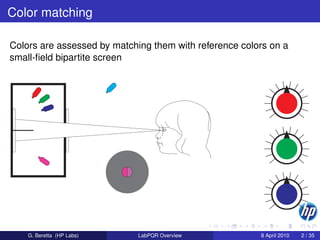
Color matching

Colors are assessed by matching them with reference colors on a
small-field bipartite screen


    G. Beretta (HP Labs)     LabPQR Overview            8 April 2010   2 / 35
Color-matching functions
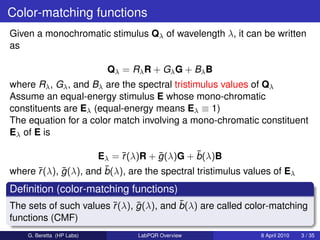
Given a monochromatic stimulus Qλ of wavelength λ, it can be written
as

                           Qλ = Rλ R + Gλ G + Bλ B
where Rλ , Gλ , and Bλ are the spectral tristimulus values of Qλ
Assume an equal-energy stimulus E whose mono-chromatic
constituents are Eλ (equal-energy means Eλ ≡ 1)
The equation for a color match involving a mono-chromatic constituent
Eλ of E is

                           r        ¯         ¯
                     Eλ = ¯(λ)R + g (λ)G + b(λ)B
      r     ¯          ¯
where ¯(λ), g (λ), and b(λ), are the spectral tristimulus values of Eλ
Definition (color-matching functions)
                        r     ¯          ¯
The sets of such values ¯(λ), g (λ), and b(λ) are called color-matching
functions (CMF)
    G. Beretta (HP Labs)         LabPQR Overview             8 April 2010   3 / 35
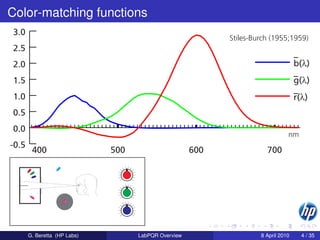
Color-matching functions
3.0
                                                            Stiles-Burch (1955;1959)
2.5
2.0                                                                                 b(λ)
1.5                                                                                 g(λ)
1.0                                                                                 r(λ)
0.5
0.0
                                                                                nm
-0.5
        400                   500                     600              700


       G. Beretta (HP Labs)         LabPQR Overview                  8 April 2010     4 / 35
CIE 1931 standard colorimetric observer
We want to build an instrument delivering results valid for the group of
normal trichromats (95% of population); since

                           R=k       Pλ¯(λ)dλ
                                       r

                           G=k          ¯
                                     Pλ g (λ)dλ

                           B=k          ¯
                                     Pλ b(λ)dλ

an ideal observer can be defined by specifying values for the
color-matching functions
Definition (CIE 1931 standard colorimetric observer)
The Commission Internationale de l’Éclairage (CIE) has recommended
                       ¯      ¯      ¯
such tables containing x (λ), y (λ), z (λ) for λ ∈ [360nm, 830nm] in 1nm
steps
    G. Beretta (HP Labs)       LabPQR Overview               8 April 2010   5 / 35
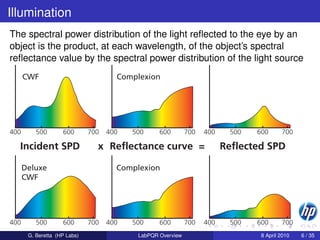
Illumination
The spectral power distribution of the light reflected to the eye by an
object is the product, at each wavelength, of the object’s spectral
reflectance value by the spectral power distribution of the light source
      CWF                             Complexion


400       500       600       700   400   500     600        700   400     500   600      700

  Incident SPD                  x Reflectance curve =                    Reflected SPD

      Deluxe                          Complexion
      CWF


400       500       600       700   400   500     600        700   400     500   600      700
       G. Beretta (HP Labs)                LabPQR Overview                        8 April 2010   6 / 35
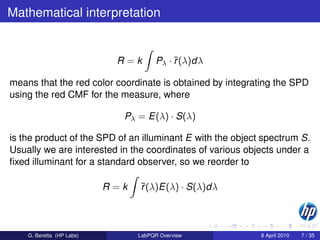
Mathematical interpretation


                            R=k        Pλ · ¯(λ)dλ
                                            r

means that the red color coordinate is obtained by integrating the SPD
using the red CMF for the measure, where

                             Pλ = E(λ) · S(λ)

is the product of the SPD of an illuminant E with the object spectrum S.
Usually we are interested in the coordinates of various objects under a
fixed illuminant for a standard observer, so we reorder to

                           R=k   ¯(λ)E(λ) · S(λ)dλ
                                 r


    G. Beretta (HP Labs)         LabPQR Overview            8 April 2010   7 / 35
Discretization

In practice, the CMF are given as a table with 1nm steps, and
instruments measure at steps of 1, 4, 10, 20nm etc., so in reality this is
a summation [for red R]:

            R=k            ¯(λ)E(λ)S(λ)dλ ≈ k
                           r                           ¯(λi )E(λi )S(λi )∆λ
                                                       r

The integration resp. summation is over the visible range [380, 780]nm,
but in practice it is often over [380, 730]nm for n = 36 samples
    Instead of doing color science with measure theory, we can do it
    with simple linear algebra
    In 1991 H. Joel Trussell has made available a comprehensive
    MatLab library and several key papers for color scientists
    Since then, spectral color science is mostly done with linear
    algebra

    G. Beretta (HP Labs)             LabPQR Overview                    8 April 2010   8 / 35
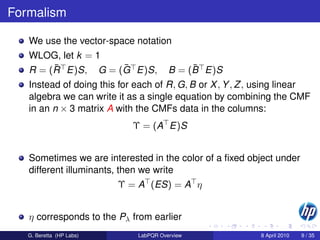
Formalism

   We use the vector-space notation
   WLOG, let k = 1
        ¯           ¯
   R = (R E)S, G = (G E)S,                  ¯
                                       B = (B E)S
   Instead of doing this for each of R, G, B or X , Y , Z , using linear
   algebra we can write it as a single equation by combining the CMF
   in an n × 3 matrix A with the CMFs data in the columns:
                            Υ = (A E)S


   Sometimes we are interested in the color of a fixed object under
   different illuminants, then we write
                          Υ = A (ES) = A η


   η corresponds to the Pλ from earlier
   G. Beretta (HP Labs)      LabPQR Overview               8 April 2010   9 / 35
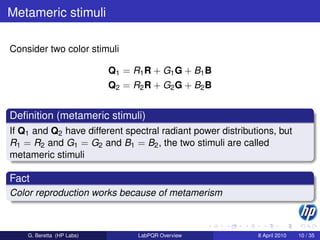
Metameric stimuli

Consider two color stimuli

                           Q1 = R1 R + G1 G + B1 B
                           Q2 = R2 R + G2 G + B2 B


Definition (metameric stimuli)
If Q1 and Q2 have different spectral radiant power distributions, but
R1 = R2 and G1 = G2 and B1 = B2 , the two stimuli are called
metameric stimuli

Fact
Color reproduction works because of metamerism


    G. Beretta (HP Labs)         LabPQR Overview            8 April 2010   10 / 35
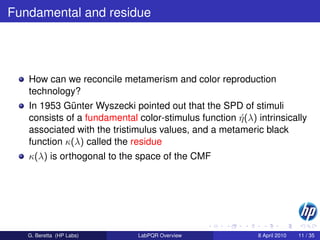
Fundamental and residue


   How can we reconcile metamerism and color reproduction
   technology?
   In 1953 Günter Wyszecki pointed out that the SPD of stimuli
   consists of a fundamental color-stimulus function η (λ) intrinsically
                                                     ´
   associated with the tristimulus values, and a metameric black
   function κ(λ) called the residue
   κ(λ) is orthogonal to the space of the CMF


   G. Beretta (HP Labs)       LabPQR Overview              8 April 2010   11 / 35
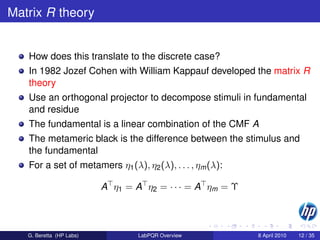
Matrix R theory


   How does this translate to the discrete case?
   In 1982 Jozef Cohen with William Kappauf developed the matrix R
   theory
   Use an orthogonal projector to decompose stimuli in fundamental
   and residue
   The fundamental is a linear combination of the CMF A
   The metameric black is the difference between the stimulus and
   the fundamental
   For a set of metamers η1 (λ), η2 (λ), . . . , ηm (λ):

                          A η1 = A η2 = · · · = A ηm = Υ


   G. Beretta (HP Labs)           LabPQR Overview          8 April 2010   12 / 35
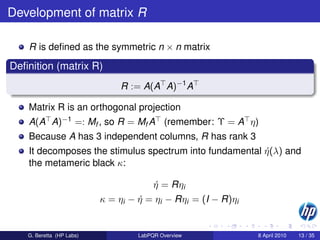
Development of matrix R

    R is defined as the symmetric n × n matrix

Definition (matrix R)
                              R := A(A A)−1 A

    Matrix R is an orthogonal projection
    A(A A)−1 =: Mf , so R = Mf A (remember: Υ = A η)
    Because A has 3 independent columns, R has rank 3
    It decomposes the stimulus spectrum into fundamental η (λ) and
                                                         ´
    the metameric black κ:

                                        η = Rηi
                                        ´
                          κ = ηi − η = ηi − Rηi = (I − R)ηi
                                   ´


   G. Beretta (HP Labs)            LabPQR Overview            8 April 2010   13 / 35
Corollaries


   Metameric black has tristimulus value zero

                                A κ = [0, 0, 0]

   η = Rηi means that any group of metamers has a common
   ´
   fundamental η , but different residues κ
               ´
   Inversely, a stimulus spectrum can be expressed as

                          ηi = η + κ = Rηi + (I − R)ηi
                               ´

   i.e., the stimulus spectrum can be reconstructed if the
   fundamental metamer and metameric black are known
   Why is this useful?


   G. Beretta (HP Labs)         LabPQR Overview          8 April 2010   14 / 35
G. Beretta (HP Labs)   LabPQR Overview   8 April 2010   15 / 35
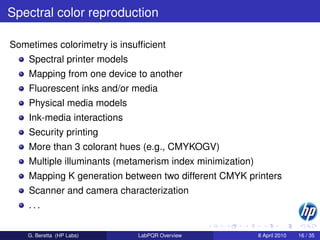
Spectral color reproduction

Sometimes colorimetry is insufficient
    Spectral printer models
    Mapping from one device to another
    Fluorescent inks and/or media
    Physical media models
    Ink-media interactions
    Security printing
    More than 3 colorant hues (e.g., CMYKOGV)
    Multiple illuminants (metamerism index minimization)
    Mapping K generation between two different CMYK printers
    Scanner and camera characterization
    ...


    G. Beretta (HP Labs)      LabPQR Overview              8 April 2010   16 / 35
Reducing the data


    Storing a multidimensional vector for each pixel is expensive
    Can we project on a lower-dimensional vector space?
    Yes, because the spectra are relatively smooth
    Popular technique: principal component analysis
    Due to the usually smooth spectra, the dimension can be quite
    low: between 5 and 8
We have known how to deal with this for decades, it just requires
linearly more processing


    G. Beretta (HP Labs)      LabPQR Overview             8 April 2010   17 / 35
The hard problem

   We would like to use an ICC type workflow also for spectral
   imaging
   Colorimetric workflow:
                                  profile connection
               image                                       3-hue printer
                                        space


   The killer is the LUT used in the PCS:
            bands in      bands out    levels per band   size [bytes]
                   3         6                     17             30K
                   6         6                     17          145M
                   9         6                     17          700G
                 31          6                     17      8 · 1027 G

   G. Beretta (HP Labs)          LabPQR Overview             8 April 2010   18 / 35
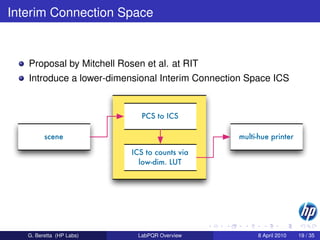
Interim Connection Space


   Proposal by Mitchell Rosen et al. at RIT
   Introduce a lower-dimensional Interim Connection Space ICS


                              PCS to ICS

         scene                                   multi-hue printer

                           ICS to counts via
                             low-dim. LUT


   G. Beretta (HP Labs)     LabPQR Overview           8 April 2010   19 / 35
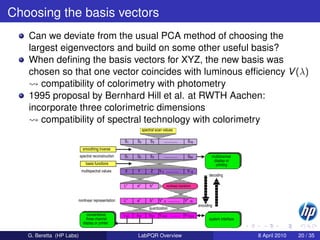
Choosing the basis vectors
   Can we deviate from the usual PCA method of choosing the
   largest eigenvectors and build on some other useful basis?
   When defining the basis vectors for XYZ, the new basis was
   chosen so that one vector coincides with luminous efficiency V (λ)
      compatibility of colorimetry with photometry
   1995 proposal by Bernhard Hill et al. at RWTH Aachen:
   incorporate three colorimetric dimensions
      compatibility of spectral technology with colorimetry
                                                                    spectral scan values

                                                     S1      S2          S3          ..............        S16
                            smoothing inverse
                          spectral reconstruction    S1     S2           S3          ..............        S64             multichannel
                                                                                                                            display or
                              basis functions                                                                                printing
                           multispectral values      X       Y           Z      V 4 .............          V 16
                                                                                                                          decoding

                                                    L*      a*           b*              nonlinear transform


                      nonlinear representation      L*      a*           b*     V*   4    ............   V*   16
                                                                                                                    encoding
                                                                        quantization
                               conventional         L bit   a bit       b bit   V 4,bit ..........       V 16,bit
                              three channel                                                                               system interface
                            display or printer


   G. Beretta (HP Labs)                                      LabPQR Overview                                                                 8 April 2010   20 / 35
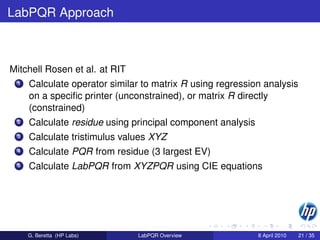
LabPQR Approach


Mitchell Rosen et al. at RIT
 1   Calculate operator similar to matrix R using regression analysis
     on a specific printer (unconstrained), or matrix R directly
     (constrained)
 2   Calculate residue using principal component analysis
 3   Calculate tristimulus values XYZ
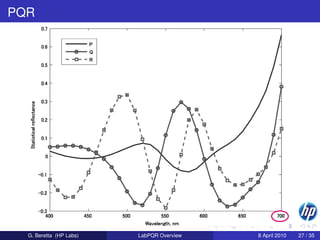
 4   Calculate PQR from residue (3 largest EV)
 5   Calculate LabPQR from XYZPQR using CIE equations


     G. Beretta (HP Labs)      LabPQR Overview              8 April 2010   21 / 35
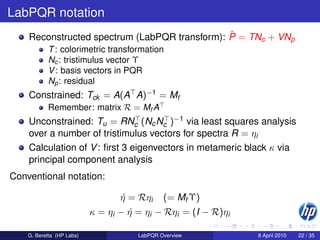
LabPQR notation
                                               ˆ
    Reconstructed spectrum (LabPQR transform): P = TNc + VNp
           T : colorimetric transformation
           Nc : tristimulus vector Υ
           V : basis vectors in PQR
           Np : residual
    Constrained: Tck = A(A A)−1 = Mf
           Remember: matrix R = Mf A
    Unconstrained: Tu = RNc (Nc Nc )−1 via least squares analysis
    over a number of tristimulus vectors for spectra R = ηi
    Calculation of V : first 3 eigenvectors in metameric black κ via
    principal component analysis
Conventional notation:

                                  η = Rηi
                                  ´           (= Mf Υ)
                           κ = ηi − η = ηi − Rηi = (I − R)ηi
                                    ´

    G. Beretta (HP Labs)              LabPQR Overview          8 April 2010   22 / 35
LabPQR gamut


  G. Beretta (HP Labs)   LabPQR Overview   8 April 2010   23 / 35
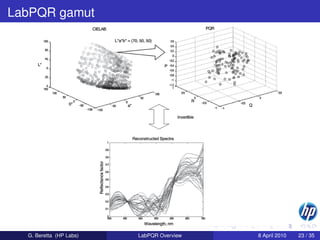
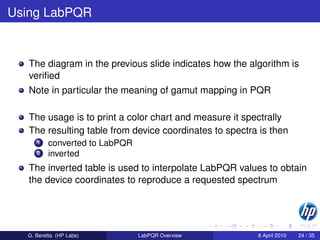
Using LabPQR


   The diagram in the previous slide indicates how the algorithm is
   verified
   Note in particular the meaning of gamut mapping in PQR

   The usage is to print a color chart and measure it spectrally
   The resulting table from device coordinates to spectra is then
     1   converted to LabPQR
     2   inverted
   The inverted table is used to interpolate LabPQR values to obtain
   the device coordinates to reproduce a requested spectrum


  G. Beretta (HP Labs)         LabPQR Overview           8 April 2010   24 / 35
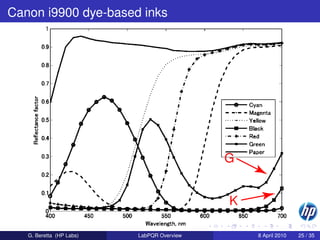
Canon i9900 dye-based inks


                                            G


                                            K

   G. Beretta (HP Labs)   LabPQR Overview       8 April 2010   25 / 35
Caveats


   Green and black dyes tend to have an increasing reflectance in
   the far red
   Paper brighteners act in the blue range
   RIT work: [400, 700]nm for n = 31 samples
   Most real world data: [380, 730]nm for n = 36 samples
   Visible range: [380, 780]nm
   The range has a strong effect on the principal components


   G. Beretta (HP Labs)     LabPQR Overview            8 April 2010   26 / 35
PQR


  G. Beretta (HP Labs)   LabPQR Overview   8 April 2010   27 / 35
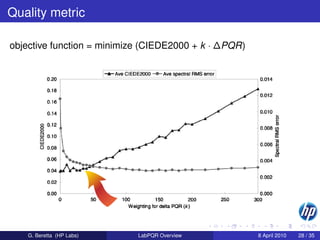
Quality metric

objective function = minimize (CIEDE2000 + k · ∆PQR)


    G. Beretta (HP Labs)    LabPQR Overview            8 April 2010   28 / 35
Accuracy of Matrix R vs. unconstrained


   What price in loss of accuracy do we pay for compatibility
   conventional metamerism theory?
          Constrained model depends only on CMF
          Unconstrained model additionally depends on device
   Based on simulations (no LUT),
          the constrained model is more accurate in general
          for a single fixed printer, the unconstrained method allows the use
          of less principal components: LabPQ
   Short spectral range [400, 700]nm caused problems with green ink


   G. Beretta (HP Labs)          LabPQR Overview                8 April 2010   29 / 35
Summary


 1   Conventional ICC workflow is based on colorimetry
 2   A spectral workflow can can solve many more problems
            proof printing
            fluorescence
            metamerism
            ...
 3   LabPQR is low-dimensional and compatible with colorimetry


     G. Beretta (HP Labs)    LabPQR Overview            8 April 2010   30 / 35
Bibliography I

   Henry R. Kang.
   Computational Color Technology.
   SPIE, Bellingham, 2006.
   Bernhard Hill.
   The history of multispectral imaging at Aachen University of
   Technology.
   Web Document, May 2002.
   http://www.ite.rwth-aachen.de/Inhalt/Documents/
   Hill/AachenMultispecHistory.pdf.
   Thomas Keusen and Werner Praefcke.
   Multispectral color system with an encoding format compatible with
   the conventional tristimulus model.
   In IS&T/SID Third Color Imaging Conference, pages 112–114,
   1995.

   G. Beretta (HP Labs)     LabPQR Overview             8 April 2010   31 / 35
Bibliography II

   Mitchell R. Rosen and Ohta Noboru.
   Spectral color processing using an interim connection space.
   In IS&T/SID Eleventh Color Imaging Conference, pages 187–192,
   2003.
   Maxim W. Derhak and Mitchell R. Rosen.
   Spectral colorimetry using LabPQR —- an interim connection
   space.
   In IS&T/SID Twelfth Color Imaging Conference, pages 246–250,
   2004.
   Mitchell R. Rosen and Maxim W. Derhak.
   Spectral gamuts and spectral gamut mapping.
   In Mitchell R. Rosen, Francisco H. Imai, and Shoji Tominaga,
   editors, Spectral Imaging: Eighth International Symposium on
   Multispectral Color Science, volume 6062, pages
   60620K–1–60620K–11, 2006.
   G. Beretta (HP Labs)     LabPQR Overview             8 April 2010   32 / 35
Bibliography III


   Maxim W. Derhak and Mitchell R. Rosen.
   Spectral colorimetry using LabPQR: An interim connection space.
   Journal of Imaging Science and Technology, 50(1):53—63, 2006.
   Shohei Tsutsumi, Mitchell R. Rosen, and Roy S. Berns.
   Spectral gamut mapping using LabPQR.
   Journal of Imaging Science and Technology, 51(6):473—485,
   2007.
   Shohei Tsutsumi, Mitchell R. Rosen, and Roy S. Berns.
   Spectral color reproduction using an interim connection
   space-based lookup table.
   Journal of Imaging Science, 52(4):040201–040201–13, 2008.


   G. Beretta (HP Labs)     LabPQR Overview            8 April 2010   33 / 35
Bibliography IV


   Shohei Tsutsumi, Mitchell R. Rosen, and Roy S. Berns.
   Spectral color management using interim connection spaces
   based on spectral decomposition.
   Color Research & Application, 33(4):282–299, August 2008.


   G. Beretta (HP Labs)    LabPQR Overview            8 April 2010   34 / 35
Discussion
 http://www.hpl.hp.com/personal/Giordano_Beretta/


   G. Beretta (HP Labs)    LabPQR Overview          8 April 2010   35 / 35

The LabPQR Color Space

  • 1.
    The LabPQR ColorSpace Giordano B. Beretta Print Production Automation Lab Hewlett-Packard Laboratories Palo Alto, California 8 April 2010 G. Beretta (HP Labs) LabPQR Overview 8 April 2010 1 / 35
  • 2.
    Color matching Colors areassessed by matching them with reference colors on a small-field bipartite screen G. Beretta (HP Labs) LabPQR Overview 8 April 2010 2 / 35
  • 3.
    Color-matching functions Given amonochromatic stimulus Qλ of wavelength λ, it can be written as Qλ = Rλ R + Gλ G + Bλ B where Rλ , Gλ , and Bλ are the spectral tristimulus values of Qλ Assume an equal-energy stimulus E whose mono-chromatic constituents are Eλ (equal-energy means Eλ ≡ 1) The equation for a color match involving a mono-chromatic constituent Eλ of E is r ¯ ¯ Eλ = ¯(λ)R + g (λ)G + b(λ)B r ¯ ¯ where ¯(λ), g (λ), and b(λ), are the spectral tristimulus values of Eλ Definition (color-matching functions) r ¯ ¯ The sets of such values ¯(λ), g (λ), and b(λ) are called color-matching functions (CMF) G. Beretta (HP Labs) LabPQR Overview 8 April 2010 3 / 35
  • 4.
    Color-matching functions 3.0 Stiles-Burch (1955;1959) 2.5 2.0 b(λ) 1.5 g(λ) 1.0 r(λ) 0.5 0.0 nm -0.5 400 500 600 700 G. Beretta (HP Labs) LabPQR Overview 8 April 2010 4 / 35
  • 5.
    CIE 1931 standardcolorimetric observer We want to build an instrument delivering results valid for the group of normal trichromats (95% of population); since R=k Pλ¯(λ)dλ r G=k ¯ Pλ g (λ)dλ B=k ¯ Pλ b(λ)dλ an ideal observer can be defined by specifying values for the color-matching functions Definition (CIE 1931 standard colorimetric observer) The Commission Internationale de l’Éclairage (CIE) has recommended ¯ ¯ ¯ such tables containing x (λ), y (λ), z (λ) for λ ∈ [360nm, 830nm] in 1nm steps G. Beretta (HP Labs) LabPQR Overview 8 April 2010 5 / 35
  • 6.
    Illumination The spectral powerdistribution of the light reflected to the eye by an object is the product, at each wavelength, of the object’s spectral reflectance value by the spectral power distribution of the light source CWF Complexion 400 500 600 700 400 500 600 700 400 500 600 700 Incident SPD x Reflectance curve = Reflected SPD Deluxe Complexion CWF 400 500 600 700 400 500 600 700 400 500 600 700 G. Beretta (HP Labs) LabPQR Overview 8 April 2010 6 / 35
  • 7.
    Mathematical interpretation R=k Pλ · ¯(λ)dλ r means that the red color coordinate is obtained by integrating the SPD using the red CMF for the measure, where Pλ = E(λ) · S(λ) is the product of the SPD of an illuminant E with the object spectrum S. Usually we are interested in the coordinates of various objects under a fixed illuminant for a standard observer, so we reorder to R=k ¯(λ)E(λ) · S(λ)dλ r G. Beretta (HP Labs) LabPQR Overview 8 April 2010 7 / 35
  • 8.
    Discretization In practice, theCMF are given as a table with 1nm steps, and instruments measure at steps of 1, 4, 10, 20nm etc., so in reality this is a summation [for red R]: R=k ¯(λ)E(λ)S(λ)dλ ≈ k r ¯(λi )E(λi )S(λi )∆λ r The integration resp. summation is over the visible range [380, 780]nm, but in practice it is often over [380, 730]nm for n = 36 samples Instead of doing color science with measure theory, we can do it with simple linear algebra In 1991 H. Joel Trussell has made available a comprehensive MatLab library and several key papers for color scientists Since then, spectral color science is mostly done with linear algebra G. Beretta (HP Labs) LabPQR Overview 8 April 2010 8 / 35
  • 9.
    Formalism We use the vector-space notation WLOG, let k = 1 ¯ ¯ R = (R E)S, G = (G E)S, ¯ B = (B E)S Instead of doing this for each of R, G, B or X , Y , Z , using linear algebra we can write it as a single equation by combining the CMF in an n × 3 matrix A with the CMFs data in the columns: Υ = (A E)S Sometimes we are interested in the color of a fixed object under different illuminants, then we write Υ = A (ES) = A η η corresponds to the Pλ from earlier G. Beretta (HP Labs) LabPQR Overview 8 April 2010 9 / 35
  • 10.
    Metameric stimuli Consider twocolor stimuli Q1 = R1 R + G1 G + B1 B Q2 = R2 R + G2 G + B2 B Definition (metameric stimuli) If Q1 and Q2 have different spectral radiant power distributions, but R1 = R2 and G1 = G2 and B1 = B2 , the two stimuli are called metameric stimuli Fact Color reproduction works because of metamerism G. Beretta (HP Labs) LabPQR Overview 8 April 2010 10 / 35
  • 11.
    Fundamental and residue How can we reconcile metamerism and color reproduction technology? In 1953 Günter Wyszecki pointed out that the SPD of stimuli consists of a fundamental color-stimulus function η (λ) intrinsically ´ associated with the tristimulus values, and a metameric black function κ(λ) called the residue κ(λ) is orthogonal to the space of the CMF G. Beretta (HP Labs) LabPQR Overview 8 April 2010 11 / 35
  • 12.
    Matrix R theory How does this translate to the discrete case? In 1982 Jozef Cohen with William Kappauf developed the matrix R theory Use an orthogonal projector to decompose stimuli in fundamental and residue The fundamental is a linear combination of the CMF A The metameric black is the difference between the stimulus and the fundamental For a set of metamers η1 (λ), η2 (λ), . . . , ηm (λ): A η1 = A η2 = · · · = A ηm = Υ G. Beretta (HP Labs) LabPQR Overview 8 April 2010 12 / 35
  • 13.
    Development of matrixR R is defined as the symmetric n × n matrix Definition (matrix R) R := A(A A)−1 A Matrix R is an orthogonal projection A(A A)−1 =: Mf , so R = Mf A (remember: Υ = A η) Because A has 3 independent columns, R has rank 3 It decomposes the stimulus spectrum into fundamental η (λ) and ´ the metameric black κ: η = Rηi ´ κ = ηi − η = ηi − Rηi = (I − R)ηi ´ G. Beretta (HP Labs) LabPQR Overview 8 April 2010 13 / 35
  • 14.
    Corollaries Metameric black has tristimulus value zero A κ = [0, 0, 0] η = Rηi means that any group of metamers has a common ´ fundamental η , but different residues κ ´ Inversely, a stimulus spectrum can be expressed as ηi = η + κ = Rηi + (I − R)ηi ´ i.e., the stimulus spectrum can be reconstructed if the fundamental metamer and metameric black are known Why is this useful? G. Beretta (HP Labs) LabPQR Overview 8 April 2010 14 / 35
  • 15.
    G. Beretta (HPLabs) LabPQR Overview 8 April 2010 15 / 35
  • 16.
    Spectral color reproduction Sometimescolorimetry is insufficient Spectral printer models Mapping from one device to another Fluorescent inks and/or media Physical media models Ink-media interactions Security printing More than 3 colorant hues (e.g., CMYKOGV) Multiple illuminants (metamerism index minimization) Mapping K generation between two different CMYK printers Scanner and camera characterization ... G. Beretta (HP Labs) LabPQR Overview 8 April 2010 16 / 35
  • 17.
    Reducing the data Storing a multidimensional vector for each pixel is expensive Can we project on a lower-dimensional vector space? Yes, because the spectra are relatively smooth Popular technique: principal component analysis Due to the usually smooth spectra, the dimension can be quite low: between 5 and 8 We have known how to deal with this for decades, it just requires linearly more processing G. Beretta (HP Labs) LabPQR Overview 8 April 2010 17 / 35
  • 18.
    The hard problem We would like to use an ICC type workflow also for spectral imaging Colorimetric workflow: profile connection image 3-hue printer space The killer is the LUT used in the PCS: bands in bands out levels per band size [bytes] 3 6 17 30K 6 6 17 145M 9 6 17 700G 31 6 17 8 · 1027 G G. Beretta (HP Labs) LabPQR Overview 8 April 2010 18 / 35
  • 19.
    Interim Connection Space Proposal by Mitchell Rosen et al. at RIT Introduce a lower-dimensional Interim Connection Space ICS PCS to ICS scene multi-hue printer ICS to counts via low-dim. LUT G. Beretta (HP Labs) LabPQR Overview 8 April 2010 19 / 35
  • 20.
    Choosing the basisvectors Can we deviate from the usual PCA method of choosing the largest eigenvectors and build on some other useful basis? When defining the basis vectors for XYZ, the new basis was chosen so that one vector coincides with luminous efficiency V (λ) compatibility of colorimetry with photometry 1995 proposal by Bernhard Hill et al. at RWTH Aachen: incorporate three colorimetric dimensions compatibility of spectral technology with colorimetry spectral scan values S1 S2 S3 .............. S16 smoothing inverse spectral reconstruction S1 S2 S3 .............. S64 multichannel display or basis functions printing multispectral values X Y Z V 4 ............. V 16 decoding L* a* b* nonlinear transform nonlinear representation L* a* b* V* 4 ............ V* 16 encoding quantization conventional L bit a bit b bit V 4,bit .......... V 16,bit three channel system interface display or printer G. Beretta (HP Labs) LabPQR Overview 8 April 2010 20 / 35
  • 21.
    LabPQR Approach Mitchell Rosenet al. at RIT 1 Calculate operator similar to matrix R using regression analysis on a specific printer (unconstrained), or matrix R directly (constrained) 2 Calculate residue using principal component analysis 3 Calculate tristimulus values XYZ 4 Calculate PQR from residue (3 largest EV) 5 Calculate LabPQR from XYZPQR using CIE equations G. Beretta (HP Labs) LabPQR Overview 8 April 2010 21 / 35
  • 22.
    LabPQR notation ˆ Reconstructed spectrum (LabPQR transform): P = TNc + VNp T : colorimetric transformation Nc : tristimulus vector Υ V : basis vectors in PQR Np : residual Constrained: Tck = A(A A)−1 = Mf Remember: matrix R = Mf A Unconstrained: Tu = RNc (Nc Nc )−1 via least squares analysis over a number of tristimulus vectors for spectra R = ηi Calculation of V : first 3 eigenvectors in metameric black κ via principal component analysis Conventional notation: η = Rηi ´ (= Mf Υ) κ = ηi − η = ηi − Rηi = (I − R)ηi ´ G. Beretta (HP Labs) LabPQR Overview 8 April 2010 22 / 35
  • 23.
    LabPQR gamut G. Beretta (HP Labs) LabPQR Overview 8 April 2010 23 / 35
  • 24.
    Using LabPQR The diagram in the previous slide indicates how the algorithm is verified Note in particular the meaning of gamut mapping in PQR The usage is to print a color chart and measure it spectrally The resulting table from device coordinates to spectra is then 1 converted to LabPQR 2 inverted The inverted table is used to interpolate LabPQR values to obtain the device coordinates to reproduce a requested spectrum G. Beretta (HP Labs) LabPQR Overview 8 April 2010 24 / 35
  • 25.
    Canon i9900 dye-basedinks G K G. Beretta (HP Labs) LabPQR Overview 8 April 2010 25 / 35
  • 26.
    Caveats Green and black dyes tend to have an increasing reflectance in the far red Paper brighteners act in the blue range RIT work: [400, 700]nm for n = 31 samples Most real world data: [380, 730]nm for n = 36 samples Visible range: [380, 780]nm The range has a strong effect on the principal components G. Beretta (HP Labs) LabPQR Overview 8 April 2010 26 / 35
  • 27.
    PQR G.Beretta (HP Labs) LabPQR Overview 8 April 2010 27 / 35
  • 28.
    Quality metric objective function= minimize (CIEDE2000 + k · ∆PQR) G. Beretta (HP Labs) LabPQR Overview 8 April 2010 28 / 35
  • 29.
    Accuracy of MatrixR vs. unconstrained What price in loss of accuracy do we pay for compatibility conventional metamerism theory? Constrained model depends only on CMF Unconstrained model additionally depends on device Based on simulations (no LUT), the constrained model is more accurate in general for a single fixed printer, the unconstrained method allows the use of less principal components: LabPQ Short spectral range [400, 700]nm caused problems with green ink G. Beretta (HP Labs) LabPQR Overview 8 April 2010 29 / 35
  • 30.
    Summary 1 Conventional ICC workflow is based on colorimetry 2 A spectral workflow can can solve many more problems proof printing fluorescence metamerism ... 3 LabPQR is low-dimensional and compatible with colorimetry G. Beretta (HP Labs) LabPQR Overview 8 April 2010 30 / 35
  • 31.
    Bibliography I Henry R. Kang. Computational Color Technology. SPIE, Bellingham, 2006. Bernhard Hill. The history of multispectral imaging at Aachen University of Technology. Web Document, May 2002. http://www.ite.rwth-aachen.de/Inhalt/Documents/ Hill/AachenMultispecHistory.pdf. Thomas Keusen and Werner Praefcke. Multispectral color system with an encoding format compatible with the conventional tristimulus model. In IS&T/SID Third Color Imaging Conference, pages 112–114, 1995. G. Beretta (HP Labs) LabPQR Overview 8 April 2010 31 / 35
  • 32.
    Bibliography II Mitchell R. Rosen and Ohta Noboru. Spectral color processing using an interim connection space. In IS&T/SID Eleventh Color Imaging Conference, pages 187–192, 2003. Maxim W. Derhak and Mitchell R. Rosen. Spectral colorimetry using LabPQR —- an interim connection space. In IS&T/SID Twelfth Color Imaging Conference, pages 246–250, 2004. Mitchell R. Rosen and Maxim W. Derhak. Spectral gamuts and spectral gamut mapping. In Mitchell R. Rosen, Francisco H. Imai, and Shoji Tominaga, editors, Spectral Imaging: Eighth International Symposium on Multispectral Color Science, volume 6062, pages 60620K–1–60620K–11, 2006. G. Beretta (HP Labs) LabPQR Overview 8 April 2010 32 / 35
  • 33.
    Bibliography III Maxim W. Derhak and Mitchell R. Rosen. Spectral colorimetry using LabPQR: An interim connection space. Journal of Imaging Science and Technology, 50(1):53—63, 2006. Shohei Tsutsumi, Mitchell R. Rosen, and Roy S. Berns. Spectral gamut mapping using LabPQR. Journal of Imaging Science and Technology, 51(6):473—485, 2007. Shohei Tsutsumi, Mitchell R. Rosen, and Roy S. Berns. Spectral color reproduction using an interim connection space-based lookup table. Journal of Imaging Science, 52(4):040201–040201–13, 2008. G. Beretta (HP Labs) LabPQR Overview 8 April 2010 33 / 35
  • 34.
    Bibliography IV Shohei Tsutsumi, Mitchell R. Rosen, and Roy S. Berns. Spectral color management using interim connection spaces based on spectral decomposition. Color Research & Application, 33(4):282–299, August 2008. G. Beretta (HP Labs) LabPQR Overview 8 April 2010 34 / 35
  • 35.
    Discussion http://www.hpl.hp.com/personal/Giordano_Beretta/ G. Beretta (HP Labs) LabPQR Overview 8 April 2010 35 / 35