Quantum Computing
Abhishek Jaisingh - 14114002
Akshay Nirwan - 14114005
Amandeep - 14114008
Amit Saharan - 14114010
Tirth Patel - 14114036
Department of Computer Science and Engineering
Indian Institute of Technology Roorkee, INDIA
abhi2254015@gmail.com
akshaynirwan@gmail.com
amanp1151@gmail.com
amitsaharan099@gmail.com
tirth.tp.97@gmail.com
October 6, 2016
Abstract
Shrinking transistors have powered 50 years of advances in comput-
ingbut now other ways must be found to make computers more capable.
Quantum Computing offers a significant speedup in the way comput-
ing is performed.This document aims to give a basic introduction to
the subject of quantum computing and various ideas, techniques and
concepts associated with it.
Keywords: qubit, superposition, coherence, entanglement, quantum
gates.
1 Introduction
Quantum Computing is the merge of Computer Science and Quantum Physics.
1
1.1 Principles
It is based on the principle of Quantum theory which deals with the world
of atoms and the smaller subatomic particles inside them.
1.2 Qubits
Qubits are the basis of Quantum Computing . They can have value of 0 or
1 or both simultaneously.
1.3 Operating Environment
Quantum Computes work in an environment where temperature is 150 times
colder than interstellar space. They are also sheilded to nulify the effect of
earth’s magnetic field. There operating pressure is also very low.
2 History
In 1982 , Feynman gave idea of
3 Why Quantum Computing
pp
4 Background
Provide literature survey and historical notes.
Refer to papers like this: Collard and Standaert [?].
5 Quantum Computing Concepts
5.1 Quantum Superposition
5.1.1 Introduction
Quantum superposition is a fundamental principle of quantum mechanics.
It states that, much like waves in classical physics, any two (or more) quan-
tum states can be added together (”superposed”) and the result will be
another valid quantum state; and conversely, that every quantum state can
2
be represented as a sum of two or more other distinct states. Mathemati-
cally, it refers to a property of solutions to the Schrdinger equation; since
the Schrdinger equation is linear, any linear combination of solutions will
also be a solution. Another example is a quantum logical qubit state, as
used in quantum information processing, which is a linear superposition of
the ”basis states” |0 and |1 .
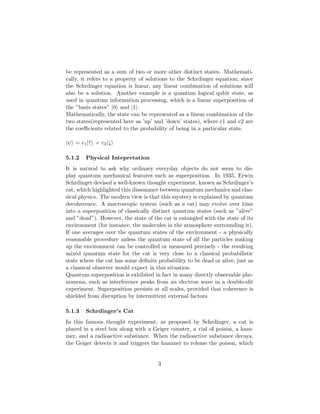
Mathematically, the state can be represented as a linear combination of the
two states(represented here as ’up’ and ’down’ states), where c1 and c2 are
the coecients related to the probability of being in a particular state.
|ψ = c1|↑ + c2|↓
5.1.2 Physical Intepretation
It is natural to ask why ordinary everyday objects do not seem to dis-
play quantum mechanical features such as superposition. In 1935, Erwin
Schrdinger devised a well-known thought experiment, known as Schrdinger’s
cat, which highlighted this dissonance between quantum mechanics and clas-
sical physics. The modern view is that this mystery is explained by quantum
decoherence. A macroscopic system (such as a cat) may evolve over time
into a superposition of classically distinct quantum states (such as ”alive”
and ”dead”). However, the state of the cat is entangled with the state of its
environment (for instance, the molecules in the atmosphere surrounding it).
If one averages over the quantum states of the environment - a physically
reasonable procedure unless the quantum state of all the particles making
up the environment can be controlled or measured precisely - the resulting
mixed quantum state for the cat is very close to a classical probabilistic
state where the cat has some denite probability to be dead or alive, just as
a classical observer would expect in this situation.
Quantum superposition is exhibited in fact in many directly observable phe-
nomena, such as interference peaks from an electron wave in a double-slit
experiment. Superposition persists at all scales, provided that coherence is
shielded from disruption by intermittent external factors.
5.1.3 Schrdinger’s Cat
In this famous thought experiment, as proposed by Schrdinger, a cat is
placed in a steel box along with a Geiger counter, a vial of poison, a ham-
mer, and a radioactive substance. When the radioactive substance decays,
the Geiger detects it and triggers the hammer to release the poison, which
3
subsequently kills the cat. The radioactive decay is a random process, and
there is no way to predict when it will happen. Physicists say the atom
exists in a state known as a superpositionboth decayed and not decayed at
the same time.
Until the box is opened, an observer doesn’t know whether the cat is alive
or deadbecause the cat’s fate is intrinsically tied to whether or not the atom
has decayed and the cat would, as Schrdinger put it, be ”living and dead in
equal parts” until it is observed.
In other words, until the box was opened, the cat’s state is completely un-
known and therefore, the cat is considered to be both alive and dead at
the same time until it is observed. But once the box is opened the cat is
definitely in one and only one state, either ’dead’ or ’alive’.
5.1.4 Copenhagen Interpretation
The most commonly held interpretation of quantum mechanics is the Copen-
hagen interpretation. In the Copenhagen interpretation, a system stops be-
ing a superposition of states and becomes either one or the other when an
observation takes place. This thought experiment makes apparent the fact
that the nature of measurement, or observation, is not well-dened in this
interpretation. The experiment can be interpreted to mean that while the
box is closed, the system simultaneously exists in a superposition of the
states ”decayed nucleus/dead cat” and ”undecayed nucleus/living cat”, and
that only when the box is opened and an observation performed does the
wave function collapse into one of the two states.
5.1.5 Many worlds Interpretation
In the many-worlds interpretation, both alive and dead states of the cat
persist after the box is opened, but are decoherent from each other. In
other words, when the box is opened, the observer and the possibly-dead
cat split into an observer looking at a box with a dead cat, and an observer
looking at a box with a live cat. But since the dead and alive states are
decoherent, there is no effective communication or interaction between them.
5.2 Quantum Entanglement
5.2.1 Introduction
Quantum entanglement is a physical phenomenon that occurs when pairs or
groups of particles are generated or interact in ways such that the quantum
4
state of each particle cannot be described independently of the others, even
when the particles are separated by a large distance instead, a quantum
state must be described for the system as a whole.
Measurements of physical properties such as position, momentum, spin, and
polarization, performed on entangled particles are found to be appropriately
correlated. For example, if a pair of particles are generated in such a way
that their total spin is known to be zero, and one particle is found to have
clockwise spin on a certain axis, the spin of the other particle, measured
on the same axis, will be found to be counterclockwise, as to be expected
due to their entanglement. However, this behavior gives rise to paradoxical
effects: any measurement of a property of a particle can be seen as acting
on that particle (e.g., by collapsing a number of superposed states) and will
change the original quantum property by some unknown amount; and in
the case of entangled particles, such a measurement will be on the entangled
system as a whole. It thus appears that one particle of an entangled pair
”knows” what measurement has been performed on the other, and with what
outcome, even though there is no known means for such information to be
communicated between the particles, which at the time of measurement may
be separated by arbitrarily large distances.
5.2.2 Meaning of Entanglement
An entangled system is dened to be one whose quantum state cannot be
factored as a product of states of its local constituents; that is to say, they
are not individual particles but are an inseparable whole. In entanglement,
one constituent cannot be fully described without considering the other(s).
Note that the state of a composite system is always expressible as a sum,
or superposition, of products of states of local constituents; it is entangled
if this sum necessarily has more than one term.
Quantum systems can become entangled through various types of interac-
tions. For some ways in which entanglement may be achieved for experi-
mental purposes, see the section below on methods. Entanglement is broken
when the entangled particles decohere through interaction with the environ-
ment; for example, when a measurement is made.[31] As an example of
entanglement: a subatomic particle decays into an entangled pair of other
particles. The decay events obey the various conservation laws, and as a
result, the measurement outcomes of one daughter particle must be highly
correlated with the measurement outcomes of the other daughter particle
(so that the total momenta, angular momenta, energy, and so forth remains
roughly the same before and after this process). For instance, a spin-zero
5
particle could decay into a pair of spin- particles. Since the total spin be-
fore and after this decay must be zero (conservation of angular momentum),
whenever the rst particle is measured to be spin up on some axis, the other,
when measured on the same axis, is always found to be spin down. (This
is called the spin anti-correlated case; and if the prior probabilities for mea-
suring each spin are equal, the pair is said to be in the singlet state.)
The special property of entanglement can be better observed if we separate
the said two particles. Let’s put one of them in IIT Roorkee and the other
in MIT (think about this as a thought experiment, not an actual one). Now,
if we measure a particular characteristic of one of these particles (say, for
example, spin), get a result, and then measure the other particle using the
same criterion (spin along the same axis), we nd that the result of the mea-
surement of the second particle will match (in a complementary sense) the
result of the measurement of the rst particle, in that they will be opposite
in their values.
5.2.3 Paradox
The paradox is that a measurement made on either of the particles appar-
ently collapses the state of the entire entangled system and does so in-
stantaneously, before any information about the measurement result could
have been communicated to the other particle (assuming that information
cannot travel faster than light) and hence assured the ”proper” outcome of
the measurement of the other part of the entangled pair. In the quantum
formalism, the result of a spin measurement on one of the particles is a
collapse into a state in which each particle has a denite spin (either up or
down) along the axis of measurement. The outcome is taken to be random,
with each possibility having a probability of 50%. However, if both spins are
measured along the same axis, they are found to be anti-correlated. This
means that the random outcome of the measurement made on one particle
seems to have been transmitted to the other, so that it can make the ”right
choice” when it too is measured.
6 Operations on Qubits
Quantum computing studies theoretical computation systems (quantum com-
puters) that make direct use of quantum-mechanical phenomena, such as
superposition and entanglement, to perform operations on data. Quantum
computers are different from binary digital electronic computers based on
transistors. Whereas common digital computing requires that the data are
6
encoded into binary digits (bits), quantum computation uses quantum bits
(qubits). Therefore operations are performed differently on qubits than on
classical bits.
6.1 Representation of a Qubit
6.2 Qubit Registers
6.3 Quantum Gates
6.3.1 Hadamard Gate
6.3.2 Phase Gate
6.4 Quantum Gates Network
7 Applications of Quantum Computing
7.1 Optimization
Imagine you are building a house, and have a list of things you want to
have in your house, but you cant afford everything on your list because
you are constrained by a budget. What you really want to work out is the
combination of items which gives you the best value for your money. This
is an example of a optimization problem, where you are trying to nd the
best combination of things given some constraints. Typically, these are very
hard problems to solve because of the huge number of possible combinations.
With just 270 on/off switches, there are more possible combinations than
atoms in the universe! These types of optimization problems exist in many
different domains - systems design, mission planning, airline scheduling, fi-
nancial analysis, web search, cancer radiotherapy and many more. They are
some of the most complex problems in the world, with potentially enormous
benets to businesses, people and science if optimal solutions can be readily
computed.
7.2 Encryption
Current Encryption methods work by factorization of number.The facotriza-
tion is feasible for classical computers as long as the number is smaller.Current
encryption numbers can be as long as 400 digits but to factorize them would
take billion years for current computers,which a quantum computer with
equal performance as modern computers can solve in seconds by doing par-
allel computations.
7
7.3 Ultra-Secure Communication
It is possible to transmit information without signal path through quantum
teleportation.There is no way to intercept the path and extract the infor-
mation because there is no actual path.In this way the communication can
be made ultra-secure.
7.4 Protein Folding
The quantum computer can be used to explore the possible folding cong-
urations of these interesting molecules. With an astronomical number of
possible structural arrangements, protein folding is an enormously complex
computational problem.
8 Challenges
Quantum computing is a new and promising technology with the potential of
exponentially powerful computation - if only a large-scale one can be built.
There are several challenges in building a large-scale quantum computer.
8.1 Prevention of Decoherence
1024 -qubit machines is the most advanced till this date.Since all the atoms
interact with each other .The diculty with building large words is too much
quantum interaction or decoherence which can alter the quantum informa-
tion stored in qubits.
8.2 Operating Conditions
Quantum states are fragile ,so the bits should often operate in low temper-
ature to ensure less interaction.
8.3 Verication and Error correction
If the complete state of qubits can not be measured precisely, verication
becomes dicult. Imagine verifying an operation that is expected to not
always get the same answer, but only an answer with a particular probabil-
ity! .Finally, errors occur much more often than with classical computing,
making error correction the dominant task that quantum architectures need
to perform well.
8
8.4 Machine Size
Current machines are too large to be of practical use to everyday work.
9 Methodologies
10 Future perspectives
References
[1] B. Collard and F.-X. Standaert, A statistical saturation attack against
the block cipher PRESENT, CT-RSA 2009, 195–210.
9

Quantum Computing Report

  • 1.
    Quantum Computing Abhishek Jaisingh- 14114002 Akshay Nirwan - 14114005 Amandeep - 14114008 Amit Saharan - 14114010 Tirth Patel - 14114036 Department of Computer Science and Engineering Indian Institute of Technology Roorkee, INDIA abhi2254015@gmail.com akshaynirwan@gmail.com amanp1151@gmail.com amitsaharan099@gmail.com tirth.tp.97@gmail.com October 6, 2016 Abstract Shrinking transistors have powered 50 years of advances in comput- ingbut now other ways must be found to make computers more capable. Quantum Computing offers a significant speedup in the way comput- ing is performed.This document aims to give a basic introduction to the subject of quantum computing and various ideas, techniques and concepts associated with it. Keywords: qubit, superposition, coherence, entanglement, quantum gates. 1 Introduction Quantum Computing is the merge of Computer Science and Quantum Physics. 1
  • 2.
    1.1 Principles It isbased on the principle of Quantum theory which deals with the world of atoms and the smaller subatomic particles inside them. 1.2 Qubits Qubits are the basis of Quantum Computing . They can have value of 0 or 1 or both simultaneously. 1.3 Operating Environment Quantum Computes work in an environment where temperature is 150 times colder than interstellar space. They are also sheilded to nulify the effect of earth’s magnetic field. There operating pressure is also very low. 2 History In 1982 , Feynman gave idea of 3 Why Quantum Computing pp 4 Background Provide literature survey and historical notes. Refer to papers like this: Collard and Standaert [?]. 5 Quantum Computing Concepts 5.1 Quantum Superposition 5.1.1 Introduction Quantum superposition is a fundamental principle of quantum mechanics. It states that, much like waves in classical physics, any two (or more) quan- tum states can be added together (”superposed”) and the result will be another valid quantum state; and conversely, that every quantum state can 2
  • 3.
    be represented asa sum of two or more other distinct states. Mathemati- cally, it refers to a property of solutions to the Schrdinger equation; since the Schrdinger equation is linear, any linear combination of solutions will also be a solution. Another example is a quantum logical qubit state, as used in quantum information processing, which is a linear superposition of the ”basis states” |0 and |1 . Mathematically, the state can be represented as a linear combination of the two states(represented here as ’up’ and ’down’ states), where c1 and c2 are the coefficients related to the probability of being in a particular state. |ψ = c1|↑ + c2|↓ 5.1.2 Physical Intepretation It is natural to ask why ordinary everyday objects do not seem to dis- play quantum mechanical features such as superposition. In 1935, Erwin Schrdinger devised a well-known thought experiment, known as Schrdinger’s cat, which highlighted this dissonance between quantum mechanics and clas- sical physics. The modern view is that this mystery is explained by quantum decoherence. A macroscopic system (such as a cat) may evolve over time into a superposition of classically distinct quantum states (such as ”alive” and ”dead”). However, the state of the cat is entangled with the state of its environment (for instance, the molecules in the atmosphere surrounding it). If one averages over the quantum states of the environment - a physically reasonable procedure unless the quantum state of all the particles making up the environment can be controlled or measured precisely - the resulting mixed quantum state for the cat is very close to a classical probabilistic state where the cat has some definite probability to be dead or alive, just as a classical observer would expect in this situation. Quantum superposition is exhibited in fact in many directly observable phe- nomena, such as interference peaks from an electron wave in a double-slit experiment. Superposition persists at all scales, provided that coherence is shielded from disruption by intermittent external factors. 5.1.3 Schrdinger’s Cat In this famous thought experiment, as proposed by Schrdinger, a cat is placed in a steel box along with a Geiger counter, a vial of poison, a ham- mer, and a radioactive substance. When the radioactive substance decays, the Geiger detects it and triggers the hammer to release the poison, which 3
  • 4.
    subsequently kills thecat. The radioactive decay is a random process, and there is no way to predict when it will happen. Physicists say the atom exists in a state known as a superpositionboth decayed and not decayed at the same time. Until the box is opened, an observer doesn’t know whether the cat is alive or deadbecause the cat’s fate is intrinsically tied to whether or not the atom has decayed and the cat would, as Schrdinger put it, be ”living and dead in equal parts” until it is observed. In other words, until the box was opened, the cat’s state is completely un- known and therefore, the cat is considered to be both alive and dead at the same time until it is observed. But once the box is opened the cat is definitely in one and only one state, either ’dead’ or ’alive’. 5.1.4 Copenhagen Interpretation The most commonly held interpretation of quantum mechanics is the Copen- hagen interpretation. In the Copenhagen interpretation, a system stops be- ing a superposition of states and becomes either one or the other when an observation takes place. This thought experiment makes apparent the fact that the nature of measurement, or observation, is not well-defined in this interpretation. The experiment can be interpreted to mean that while the box is closed, the system simultaneously exists in a superposition of the states ”decayed nucleus/dead cat” and ”undecayed nucleus/living cat”, and that only when the box is opened and an observation performed does the wave function collapse into one of the two states. 5.1.5 Many worlds Interpretation In the many-worlds interpretation, both alive and dead states of the cat persist after the box is opened, but are decoherent from each other. In other words, when the box is opened, the observer and the possibly-dead cat split into an observer looking at a box with a dead cat, and an observer looking at a box with a live cat. But since the dead and alive states are decoherent, there is no effective communication or interaction between them. 5.2 Quantum Entanglement 5.2.1 Introduction Quantum entanglement is a physical phenomenon that occurs when pairs or groups of particles are generated or interact in ways such that the quantum 4
  • 5.
    state of eachparticle cannot be described independently of the others, even when the particles are separated by a large distance instead, a quantum state must be described for the system as a whole. Measurements of physical properties such as position, momentum, spin, and polarization, performed on entangled particles are found to be appropriately correlated. For example, if a pair of particles are generated in such a way that their total spin is known to be zero, and one particle is found to have clockwise spin on a certain axis, the spin of the other particle, measured on the same axis, will be found to be counterclockwise, as to be expected due to their entanglement. However, this behavior gives rise to paradoxical effects: any measurement of a property of a particle can be seen as acting on that particle (e.g., by collapsing a number of superposed states) and will change the original quantum property by some unknown amount; and in the case of entangled particles, such a measurement will be on the entangled system as a whole. It thus appears that one particle of an entangled pair ”knows” what measurement has been performed on the other, and with what outcome, even though there is no known means for such information to be communicated between the particles, which at the time of measurement may be separated by arbitrarily large distances. 5.2.2 Meaning of Entanglement An entangled system is defined to be one whose quantum state cannot be factored as a product of states of its local constituents; that is to say, they are not individual particles but are an inseparable whole. In entanglement, one constituent cannot be fully described without considering the other(s). Note that the state of a composite system is always expressible as a sum, or superposition, of products of states of local constituents; it is entangled if this sum necessarily has more than one term. Quantum systems can become entangled through various types of interac- tions. For some ways in which entanglement may be achieved for experi- mental purposes, see the section below on methods. Entanglement is broken when the entangled particles decohere through interaction with the environ- ment; for example, when a measurement is made.[31] As an example of entanglement: a subatomic particle decays into an entangled pair of other particles. The decay events obey the various conservation laws, and as a result, the measurement outcomes of one daughter particle must be highly correlated with the measurement outcomes of the other daughter particle (so that the total momenta, angular momenta, energy, and so forth remains roughly the same before and after this process). For instance, a spin-zero 5
  • 6.
    particle could decayinto a pair of spin- particles. Since the total spin be- fore and after this decay must be zero (conservation of angular momentum), whenever the first particle is measured to be spin up on some axis, the other, when measured on the same axis, is always found to be spin down. (This is called the spin anti-correlated case; and if the prior probabilities for mea- suring each spin are equal, the pair is said to be in the singlet state.) The special property of entanglement can be better observed if we separate the said two particles. Let’s put one of them in IIT Roorkee and the other in MIT (think about this as a thought experiment, not an actual one). Now, if we measure a particular characteristic of one of these particles (say, for example, spin), get a result, and then measure the other particle using the same criterion (spin along the same axis), we find that the result of the mea- surement of the second particle will match (in a complementary sense) the result of the measurement of the first particle, in that they will be opposite in their values. 5.2.3 Paradox The paradox is that a measurement made on either of the particles appar- ently collapses the state of the entire entangled system and does so in- stantaneously, before any information about the measurement result could have been communicated to the other particle (assuming that information cannot travel faster than light) and hence assured the ”proper” outcome of the measurement of the other part of the entangled pair. In the quantum formalism, the result of a spin measurement on one of the particles is a collapse into a state in which each particle has a definite spin (either up or down) along the axis of measurement. The outcome is taken to be random, with each possibility having a probability of 50%. However, if both spins are measured along the same axis, they are found to be anti-correlated. This means that the random outcome of the measurement made on one particle seems to have been transmitted to the other, so that it can make the ”right choice” when it too is measured. 6 Operations on Qubits Quantum computing studies theoretical computation systems (quantum com- puters) that make direct use of quantum-mechanical phenomena, such as superposition and entanglement, to perform operations on data. Quantum computers are different from binary digital electronic computers based on transistors. Whereas common digital computing requires that the data are 6
  • 7.
    encoded into binarydigits (bits), quantum computation uses quantum bits (qubits). Therefore operations are performed differently on qubits than on classical bits. 6.1 Representation of a Qubit 6.2 Qubit Registers 6.3 Quantum Gates 6.3.1 Hadamard Gate 6.3.2 Phase Gate 6.4 Quantum Gates Network 7 Applications of Quantum Computing 7.1 Optimization Imagine you are building a house, and have a list of things you want to have in your house, but you cant afford everything on your list because you are constrained by a budget. What you really want to work out is the combination of items which gives you the best value for your money. This is an example of a optimization problem, where you are trying to find the best combination of things given some constraints. Typically, these are very hard problems to solve because of the huge number of possible combinations. With just 270 on/off switches, there are more possible combinations than atoms in the universe! These types of optimization problems exist in many different domains - systems design, mission planning, airline scheduling, fi- nancial analysis, web search, cancer radiotherapy and many more. They are some of the most complex problems in the world, with potentially enormous benefits to businesses, people and science if optimal solutions can be readily computed. 7.2 Encryption Current Encryption methods work by factorization of number.The facotriza- tion is feasible for classical computers as long as the number is smaller.Current encryption numbers can be as long as 400 digits but to factorize them would take billion years for current computers,which a quantum computer with equal performance as modern computers can solve in seconds by doing par- allel computations. 7
  • 8.
    7.3 Ultra-Secure Communication Itis possible to transmit information without signal path through quantum teleportation.There is no way to intercept the path and extract the infor- mation because there is no actual path.In this way the communication can be made ultra-secure. 7.4 Protein Folding The quantum computer can be used to explore the possible folding cong- urations of these interesting molecules. With an astronomical number of possible structural arrangements, protein folding is an enormously complex computational problem. 8 Challenges Quantum computing is a new and promising technology with the potential of exponentially powerful computation - if only a large-scale one can be built. There are several challenges in building a large-scale quantum computer. 8.1 Prevention of Decoherence 1024 -qubit machines is the most advanced till this date.Since all the atoms interact with each other .The diculty with building large words is too much quantum interaction or decoherence which can alter the quantum informa- tion stored in qubits. 8.2 Operating Conditions Quantum states are fragile ,so the bits should often operate in low temper- ature to ensure less interaction. 8.3 Verication and Error correction If the complete state of qubits can not be measured precisely, verication becomes dicult. Imagine verifying an operation that is expected to not always get the same answer, but only an answer with a particular probabil- ity! .Finally, errors occur much more often than with classical computing, making error correction the dominant task that quantum architectures need to perform well. 8
  • 9.
    8.4 Machine Size Currentmachines are too large to be of practical use to everyday work. 9 Methodologies 10 Future perspectives References [1] B. Collard and F.-X. Standaert, A statistical saturation attack against the block cipher PRESENT, CT-RSA 2009, 195–210. 9