Advances in Physics Theories and Applications                                                                              www.iiste.org
ISSN 2224-719X (Paper) ISSN 2225-0638 (Online)
Vol 6, 2012


Decohering Environment And Coupled Quantum States And
   Internal Resonance In Coupled Spin Systems And The
Conflict Between Quantum Gate Operation And Decoupling
               A Cormorant-Barnacle Model
                        *1
                          Dr K N Prasanna Kumar, 2Prof B S Kiranagi And 3Prof C S Bagewadi

           *1
             Dr K N Prasanna Kumar, Post doctoral researcher, Dr KNP Kumar has three PhD’s, one each in Mathematics,
       Economics and Political science and a D.Litt. in Political Science, Department of studies in Mathematics, Kuvempu
                  University, Shimoga, Karnataka, India Correspondence Mail id : drknpkumar@gmail.com


       2
       Prof B S Kiranagi, UGC Emeritus Professor (Department of studies in Mathematics), Manasagangotri, University
                                                     of Mysore, Karnataka, India

            3
                Prof C S Bagewadi, Chairman , Department of studies in Mathematics and Computer science, Jnanasahyadri
                                Kuvempu university, Shankarghatta, Shimoga district, Karnataka, India


ABSTRACT
 Quantum decoherence in all its locus of essence, and expression is the loss of coherence or ordering
of the phase angles between the components of a system in a quantum superposition. Detrimental
ramifications, and pernicious implications of this dephasing leads to classical or probabilistically
additive behavior. Quantum decoherence gives the appearance of wave function collapse (the
reduction of the physical possibilities into a single possibility as seen by an observer. Here it is to be
noted that perception is not the reality and what you see is not what you see ;what you do not see is
what you do not see; what you see is what you do not see ;and what you do not see is what you
see.)… Thus in all its wide ranging manifestations, it justifies the propositional subsistence and
corporeal reality that justifies the framework and intuition of classical physics as an acceptable
approximation: decoherence is the mechanism by which the classical limit emerges out of a
perceptual field of quantum starting point and it determines the location of the quantum-classical
boundary. Decoherence occurs when a system interacts with its environment in
a thermodynamically irreversible way. This prevents transitive states, substantive sub states and
determinate orientation different elements in the quantum superposition of the system and
environment's wavefunction from interfering with each other. Decoherence has been a subject of
active research since the 1980s. Decoherence can be viewed as the principal frontier of diurnal
dynamics that results in loss of information from a system into the environment (often modeled as
a heat bath), since every system is loosely coupled with the energetic state of its surroundings, with
particularistic predicational pronouncements. . Viewed in isolation, the system's dynamics are non-
unitary (although the combined system plus environment evolves in a unitary fashion). Thus, the
dynamics of the system aphorism and anecdote of the system alone are irreversible. As with any
coupling, entanglements are generated in its theme and potentialities between the system and
environment, which have the effect of sharing quantum information with—or transferring it to—
the surroundings. It is a blatant and flagrant misconception that collapse of wave function is
attributable and ascribable to wave function collapse; Decoherence does not generate actual wave
function collapse. It only provides an explanation for the appearance of the wavefunction collapse,
as the quantum nature of the system "leaks" into the environment. So, the wave function collapse is
the figment of the observer’s imagination, product of puerile prognostication and resultant
orientationality of his phantasmagoria. One cannot have the apodictic knowledge of reality that is;
components of the wavefunction are decoupled from a coherent system, and acquire phases from
their immediate surroundings. A total superposition of the global or universal wavefunction still
exists (and remains coherent at the global level), but its ultimate fate remains an interpretational
issue. This is a very important pharisaical provenience and plagenetious precocity with all the
disembodied resemblances of the system in total form; specifically, decoherence does not attempt


                                                                     24
Advances in Physics Theories and Applications                                                    www.iiste.org
ISSN 2224-719X (Paper) ISSN 2225-0638 (Online)
Vol 6, 2012

to explain the measurement problem. Rather, decoherence provides an explanation for the
transition of the system to a mixture of states that seem to correspond to those states observers
perceive. Moreover, our observation tells us that this mixture looks like a proper quantum
ensemble in a measurement situation, as we observe that measurements lead to the "realization" of
precisely one state in the "ensemble".Decoherence represents a challenge for the practical
realization of quantum computers, since they are expected to rely heavily on the undisturbed
evolution of quantum coherences. Simply put; they require that coherent states be preserved and
that decoherence is managed, in order to actually perform quantum computation. In the following
we give a model for decoherence of the environment, coupled quantum states, at determinate and
differential levels ,internal resonance in coupled spin systems, and the conflict in the Quantum state
operations and decoupling.

KEY WORDS Coupled quantum states, Quantum mechanics

INTRODUCTION:

Quantum Coupling is an effect in quantum mechanics in which two or more quantum systems are
bound such that a change in one of thequantum states in one of the systems will cause an
instantaneous change in all of the bound systems. It is a state similar to quantum entanglement but
whereas quantum entanglement can take place over long distances quantum coupling is restricted
to quantum scales.

Trapped ion quantum computers utilize the quantum coupling effect by suspending particles
representing qubits in an array of ion traps. These particles are then induced into a state of
quantum coupling by using optical pumping by a laser. Information can be stored in this state by
coupling two or more qubits. While the individual particles may fluctuate their values, the quantum
states of the two qubits remain locked in relation to each other, via Coulomb force. Any action by
one of the coupled ions instantaneously alters the other to maintain the relative value. This allows
the computer to hold information despite the instability of the individual particles.

In benzene, C6H6, the charges of the individual carbon atoms exhibit coupling. There are
three double bonds and three single bonds in alternating positions around the ring. The
measurement of the energy in any individual bond will result in a puzzling result resembling an
impossible "one and a half bond". This is because the bonds are in a quantum superposition of
double and single bonds at any particular bond position. The coupling effect causes the charge at all
points on the ring to be altered when a bond at any one point is altered, in order to maintain
the relative charge between atoms. This results in an illusionary "bond and a half" bond between all
6 carbon atoms.

REVIEW STUDY: Nonequilibrium Dynamics of Coupled Quantum Systems (See G. Flores-Hidalgo,
Rudnei O. Ramos)

The nonequilibrium dynamics of coupled quantum oscillators subject to different time dependent
quenches are analyzed in the context of the Liouville’s-von Neumann approach. Authors consider
models of quantum oscillators in interaction that are exactly soluble in the cases of both sudden and
smooth quenches. The time evolution of number densities and the final equilibration distribution
for the problem of a quantum oscillator coupled to an infinity set of other oscillators (a bath) are
explicitly worked out.

Recovering classical dynamics from coupled quantum systems through continuous measurement
(See Shohini Ghose, Paul M. Alsing, Ivan H. Deutsch, Tanmoy Bhattacharya, Salman Habib, and Kurt
Jacobs)

Continuous measurement in the quantum to classical transition has a role to play for a system with


                                                     25
Advances in Physics Theories and Applications                                                     www.iiste.org
ISSN 2224-719X (Paper) ISSN 2225-0638 (Online)
Vol 6, 2012

coupled internal (spin) and external (motional) degrees of freedom. Even when the measured
motional degree of freedom can be treated classically, entanglement between spin and motion
causes strong measurement back action on the quantum spin subsystem so that classical
trajectories are not recovered in this mixed quantum-classical regime. The measurement can
extract localized quantum trajectories that behave classically only when the internal action also
becomes large relative to h-bar.

Coupled Quantum Dots

Coherent optical manipulation of triplet-singlet states in coupled quantum                       dots"
Hakan E. Tureci, A. Imamoglu and J.M. Taylor, Phys. Rev. B 75: Art. No. 235313 (2007)

A system of two coupled quantum dots (sometimes called an “artificial molecule”) represents the
most basic example of a quantum system interacting with another quantum system. As such, these
structures could be used to study fundamental quantum mechanical effects such as entanglement
and decoherence. Some Physicists have recently used coupled quantum dots to demonstrate
conditional dynamics, whereby the quantum state of one system controls the evolution of the state
of another quantum system.

"Strong electron-hole exchange in coherently coupled quantum dots"(S. Falt, M. Atature, Hakan E.
Tureci, Y. Zhao, A. Badolato, A. Imamoglu, Phys. Rev. Lett. 100, 106401 (2008))

The structures HERE are grown by embedding two layers of self-assembled quantum dots, typically
separated by 5-20 nm, inside a single heterostructures. Dots in the top layer tend to form directly
on top of dots in the bottom layer because of the strain field produced by the latter, resulting in
stacks of vertically coupled dots. Optical manipulation of the dynamics of an individual stack, is
done so that the probability that one quantum dot makes a transition to an optically excited state is
controlled by the presence or absence of an optical excitation in the neighboring dot. The
interaction between the two dots is mediated by the tunnel coupling between optically excited
states and can be optically gated by applying a laser field of the right frequency. This interaction
mechanism could form the basis of an optically effected controlled-phase gate between two solid-
state qubits.

Authors also talk about the study of the conditional coupling between electrons or hole spins in
separate quantum dots and to demonstrate conditional coherent quantum dynamics. In parallel,
study quantum dot pairs where the exchange interaction gives rise to spin singlet and triplet
ground states that are delocalized over the two dots. Such entangled states could be used to define
two-level systems that are more robust against the nuclear spin decoherence and that can be
manipulated using resonant optical excitations.

Coherent electron–phonon coupling in tailored quantum systems (See P. Roulleau, S. Baer, T. Choi, F.
Molitor, J. Güttinger, T. Müller, S. Dröscher, K. Ensslin & T. IhnAffiliationsContributions)

The coupling between a two-level system and its environment leads to decoherence. Within the
context of coherent manipulation of electronic or quasiparticle states in nanostructures, it is crucial
to understand the sources of decoherence. Here authors study the effect of electron–phonon
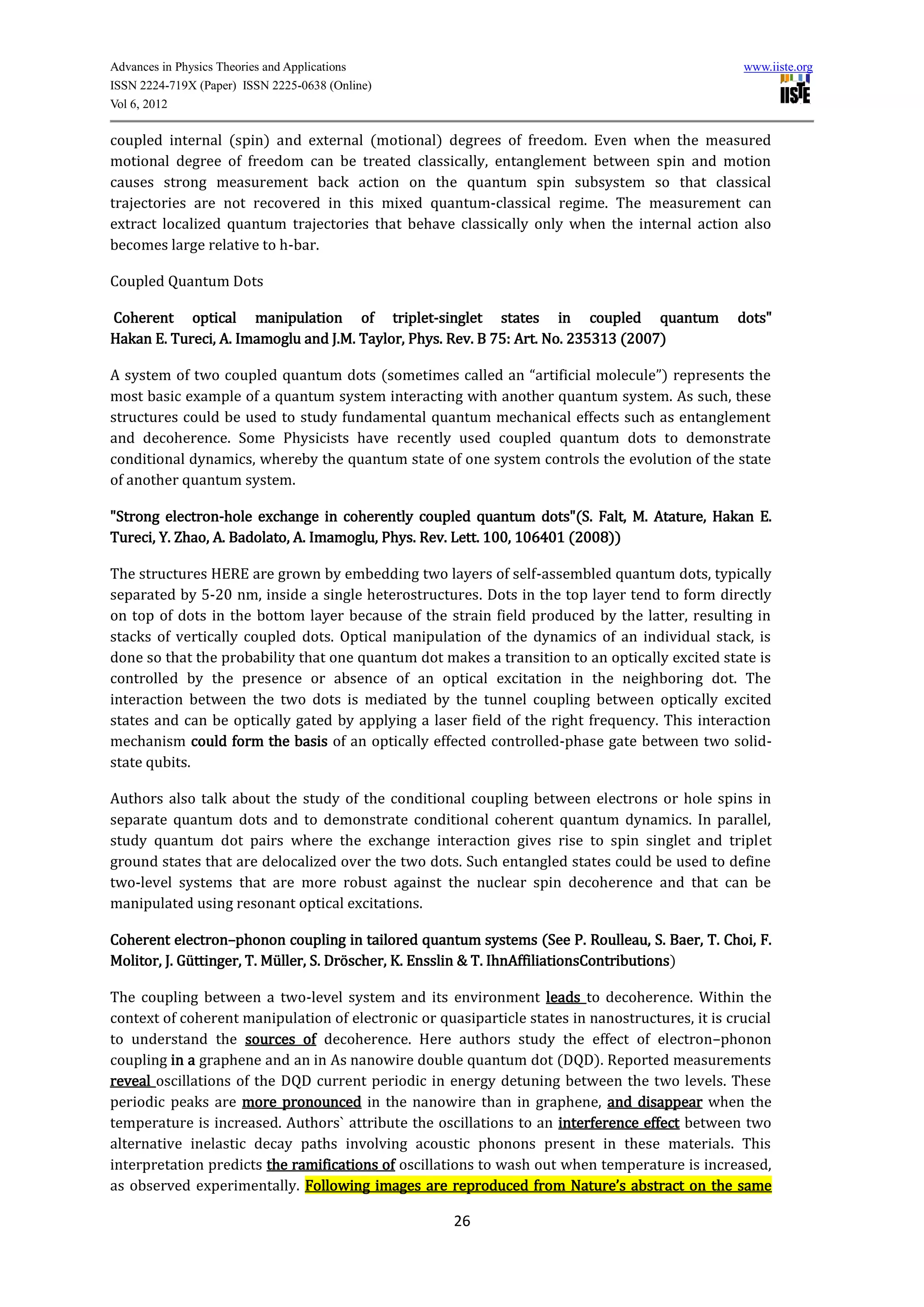
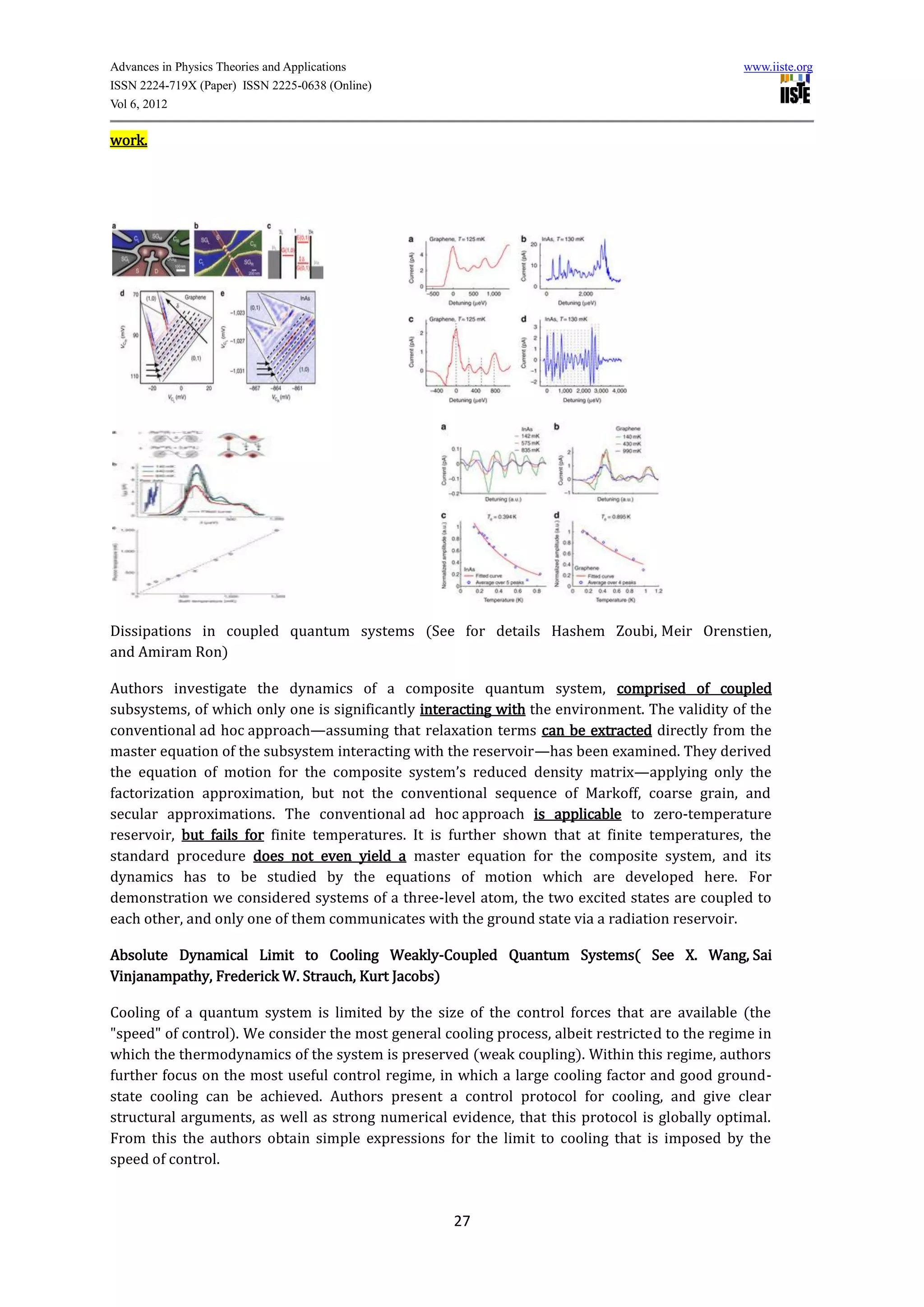
coupling in a graphene and an in As nanowire double quantum dot (DQD). Reported measurements
reveal oscillations of the DQD current periodic in energy detuning between the two levels. These
periodic peaks are more pronounced in the nanowire than in graphene, and disappear when the
temperature is increased. Authors` attribute the oscillations to an interference effect between two
alternative inelastic decay paths involving acoustic phonons present in these materials. This
interpretation predicts the ramifications of oscillations to wash out when temperature is increased,
as observed experimentally. Following images are reproduced from Nature’s abstract on the same

                                                     26
Advances in Physics Theories and Applications                                                   www.iiste.org
ISSN 2224-719X (Paper) ISSN 2225-0638 (Online)
Vol 6, 2012

work.


Dissipations in coupled quantum systems (See for details Hashem Zoubi, Meir Orenstien,
and Amiram Ron)

Authors investigate the dynamics of a composite quantum system, comprised of coupled
subsystems, of which only one is significantly interacting with the environment. The validity of the
conventional ad hoc approach—assuming that relaxation terms can be extracted directly from the
master equation of the subsystem interacting with the reservoir—has been examined. They derived
the equation of motion for the composite system’s reduced density matrix—applying only the
factorization approximation, but not the conventional sequence of Markoff, coarse grain, and
secular approximations. The conventional ad hoc approach is applicable to zero-temperature
reservoir, but fails for finite temperatures. It is further shown that at finite temperatures, the
standard procedure does not even yield a master equation for the composite system, and its
dynamics has to be studied by the equations of motion which are developed here. For
demonstration we considered systems of a three-level atom, the two excited states are coupled to
each other, and only one of them communicates with the ground state via a radiation reservoir.

Absolute Dynamical Limit to Cooling Weakly-Coupled Quantum Systems( See X. Wang, Sai
Vinjanampathy, Frederick W. Strauch, Kurt Jacobs)

Cooling of a quantum system is limited by the size of the control forces that are available (the
"speed" of control). We consider the most general cooling process, albeit restricted to the regime in
which the thermodynamics of the system is preserved (weak coupling). Within this regime, authors
further focus on the most useful control regime, in which a large cooling factor and good ground-
state cooling can be achieved. Authors present a control protocol for cooling, and give clear
structural arguments, as well as strong numerical evidence, that this protocol is globally optimal.
From this the authors obtain simple expressions for the limit to cooling that is imposed by the
speed of control.


                                                    27
Advances in Physics Theories and Applications                                                      www.iiste.org
ISSN 2224-719X (Paper) ISSN 2225-0638 (Online)
Vol 6, 2012

'Return to equilibrium' for weakly coupled quantum systems: a simple polymer expansion (SeeW. De
Roeck, A. Kupiainen)

Recently, several authors studied small quantum systems weakly coupled to free boson or fermion
fields at positive temperature. All the approaches we are aware of employ complex deformations of
Liouvillians or Mourre theory (the infinitesimal version of the former). Authors present an
approach based on polymer expansions of statistical mechanics. Despite the fact that approach is
rudimentary in its thematic and discursive form, elementary, results are slightly sharper than those
contained in the literature up to now. Authors show that, whenever the small quantum system is
known to admit a Markov approximation (Pauli master equation emph{aka} Lindblad equation) in
the weak coupling limit, and the Markov approximation is exponentially mixing, then the weakly
coupled system approaches a unique invariant state that is perturbatively close to its Markov
approximation.

Decoherence-protected quantum gates for a hybrid solid-state spin register (T. van der SAR, Z. H.
Wang, M. S. Blok, H. Bernien, T. H. Taminiau, D.M. Toyli, D. A. Lidar, D. D. Awschalom, R. Hanson, V. V.
Dobrovitski)

Protecting the dynamics of coupled quantum systems from decoherence by the environment is a key
challenge for solid-state quantum information processing. An idle qubit can be efficiently insulated
from the outside world via dynamical decoupling, as has recently been demonstrated for individual
solid-state qubits. However, protection of qubit coherence during a multi-qubit gate poses a non-
trivial problem: in general the decoupling disrupts the inter-qubit dynamics, and hence conflicts
with gate operation. This problem is particularly CARDINAL, salient for hybrid systems, wherein
different types of qubits evolve and decohere at vastly different rates. Here Authors present the
integration of dynamical decoupling into quantum gates for a paradigmatic hybrid system, the
electron-nuclear spin register. Design harnesses the internal resonance in the coupled-spin system
to resolve the conflict between gate operation and decoupling. Authors experimentally demonstrate
these gates on a two-qubit register in diamond operating at room temperature. Quantum
tomography reveals that the qubits involved in the gate operation are protected as accurately as idle
qubits. Illustration and exemplary notification is made about the proposed design by Grover's
quantum search algorithm, achieving fidelities above 90% even though the execution time exceeds
the electron spin dephasing time by two orders of magnitude. Results directly enable decoherence-
protected interface gates between different types of promising solid-state qubits. Ultimately,
quantum gates with integrated decoupling may enable reaching the accuracy threshold for fault-
tolerant quantum information processing with solid-state devices.

Stark tuning spin qubits in diamond for quantum optical networks (Victor Acosta , Charles Santori ,
Andrei Faraon , Zhihong Huang , Kai-Mei Fu , Alastair Stacey , David Simpson , Timothy Karle , Brant
Gibson , Liam McGuiness, Kumaravelu Ganesan , Snjezana Tomljenovic-hanic , Andrew Greentree ,
Steven Prawer , Raymond Beausoleil)

Integrated diamond networks based on cavity-coupled spin impurities offer a promising platform
for scalable quantum computing. A key ingredient for this technology involves heralding
entanglement by interfering indistinguishable photons emitted by pairs of identical spin qubits.
Here the demonstration of the authors bear ample testimony and infallible observatory to the
required control over the internal level structure of nitrogen-vacancy (NV) centers located within
100 nm of the diamond surface using the DC Stark effect. By varying the voltages applied to
lithographically-defined metal electrodes, we tune the zero-phonon emission wavelength of a single
NV center over a range of $sim $0.5 nm. Using high-resolution emission spectroscopy direct
observation is done of electrical tuning of the relative strengths of spin-altering lambda transitions
to arbitrary values. Under resonant excitation, dynamic feedback is applied to stabilize the optical

                                                      28
Advances in Physics Theories and Applications                                                        www.iiste.org
ISSN 2224-719X (Paper) ISSN 2225-0638 (Online)
Vol 6, 2012

transition against spectral diffusion. Progress on application of gated control to single NV centers
coupled to single-crystal diamond photonic crystal cavities and other nanophotonics structures are
presented.

NUCLEAR SPUN RELAXATION STUDIES IN MULTIPLE SPIN SYSTEMS( B. D. NAGESWARA RAO)

Nuclear spin relaxation in multiple spin systems in diamagnetic liquids, studied by the techniques of
high-resolution nuclear magnetic double resonance and T1-measurements, is discussed. The
principle of the double resonance method along with features of strong and weak irradiation
spectra and in homogeneity effects are given. The information obtainable on relaxation mechanisms
is presented, including a discussion of the isotropic random field model, its applicability and
limitations in relation to intermolecular dipolar interactions. Scalar coupling with quadrupole nuclei
and symmetry features of relaxation effects are also considered. T1-measurements are discussed
with emphasis on cross-relaxation effects, multiple exponential relaxation decays and their analysis.
It is pointed out that even for systems dominated by a single exponential decay mode the dipolar
relaxation rate is not usually a linear superposition of the intermolecular and intermolecular
contributions.

It has been generally recognized that the study of nuclear spin relaxation is a simple but powerful
tool for probing the micro dynamical behaviour in liquids since the relaxation parameters are often
direct measures of various types of correlation times for fluctuations in molecular orientation,
angular velocity, position and so on16. In practice, for liquids containing several spins per molecule
the determination and analysis of the relaxation parameters are usually complicated, owing to,
among other causes, the multiplicity and line width variations in the resonance spectra that arise
from the chemical environments of the spins7, and the cross-relaxation effects and internal motions
that arise from their geometrical arrangement91t.

Quantum gate operation in the presence of decoherence.FromDecoherence-protected quantum gates
for a hybrid solid-state spins register (T. van der Sar, Z. H. Wang, M. S. Blok,H. Bernien, T. H. aminiau,
D. M. Toyli, D. A. Lidar, D. D. Awschalom,R. Hanson & V. V. Dobrovitski)


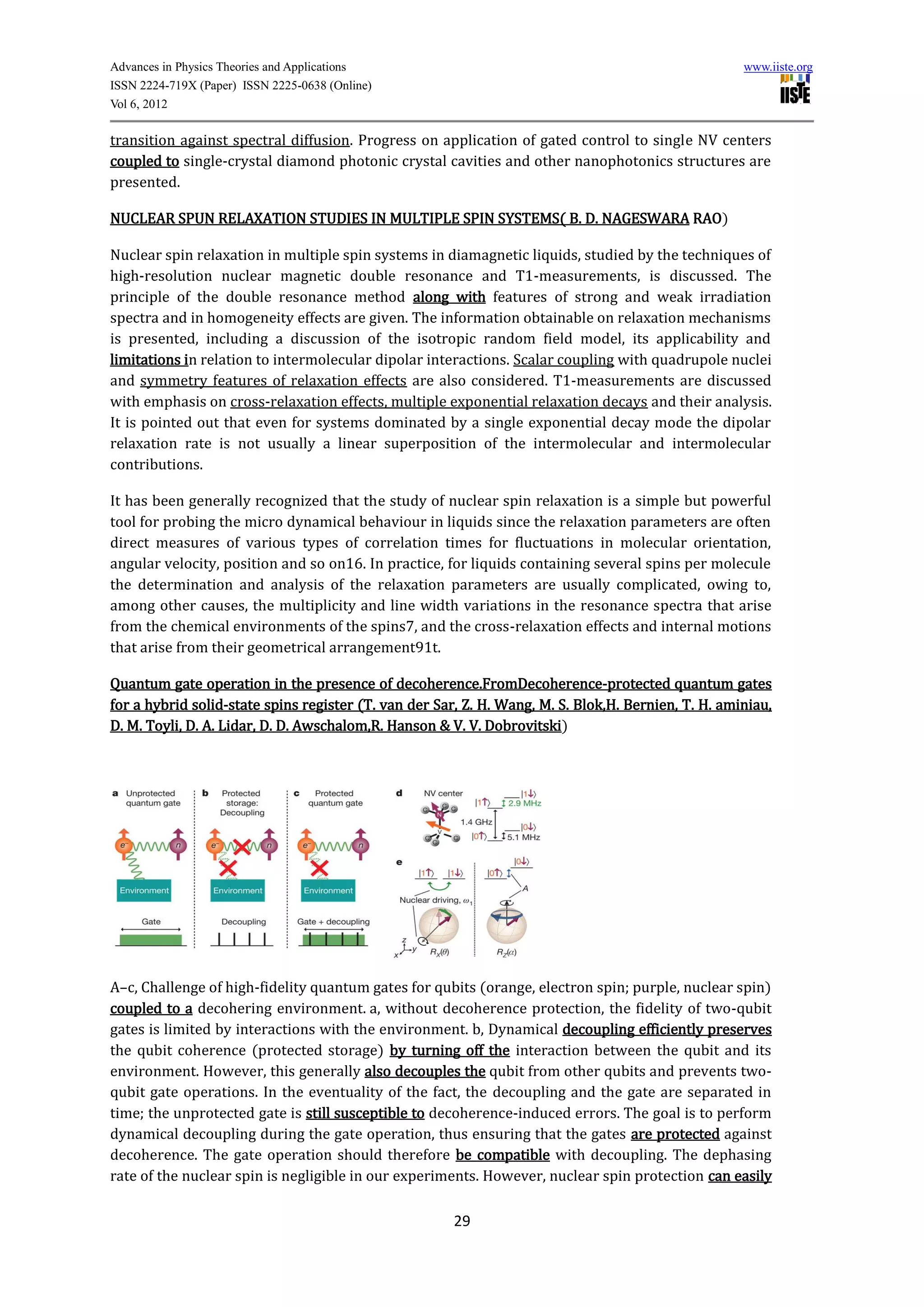
A–c, Challenge of high-fidelity quantum gates for qubits (orange, electron spin; purple, nuclear spin)
coupled to a decohering environment. a, without decoherence protection, the fidelity of two-qubit
gates is limited by interactions with the environment. b, Dynamical decoupling efficiently preserves
the qubit coherence (protected storage) by turning off the interaction between the qubit and its
environment. However, this generally also decouples the qubit from other qubits and prevents two-
qubit gate operations. In the eventuality of the fact, the decoupling and the gate are separated in
time; the unprotected gate is still susceptible to decoherence-induced errors. The goal is to perform
dynamical decoupling during the gate operation, thus ensuring that the gates are protected against
decoherence. The gate operation should therefore be compatible with decoupling. The dephasing
rate of the nuclear spin is negligible in our experiments. However, nuclear spin protection can easily

                                                       29
Advances in Physics Theories and Applications                                                      www.iiste.org
ISSN 2224-719X (Paper) ISSN 2225-0638 (Online)
Vol 6, 2012

be incorporated using another layer of decoupling. d, The two-qubit system used in this work: a
nitrogen–vacancy (NV) colour centre in diamond carries an electron spin S = 1 (orange) coupled to
a 14N nuclear spin I = 1 (purple). The states of the electronic qubit, |0 and |1 , are split by 1.4 GHz
in an external field B0 = 510 G. The states |0↑ and |0↓ are split by 5.1 MHz owing to nuclear
quadrupole and Zeeman interactions. The hyperfine coupling yields an additional splitting, such
that the levels |1↑ and |1↓ are separated by 2.9 MHz. The Rabi driving is applied in resonance
with this transition. e, Dynamics of the electron–nuclear spin system in the limit                     ,
visualized in a coordinate frame that rotates with frequency 1.4 GHz in the electron spin subspace
and frequency 2.9 MHz in the nuclear spin subspace. In this frame, the states |1↑ and |1↓ have the
same energy. The Rabi driving field, which is directed along the x axis, coherently rotates the
nuclear spin if the electronic qubit is in |1 (the resulting rotation around the x axis by angle θ is
denotedRX (θ)). However, the Rabi driving is negligible for the states |0↑ and |0↓ , which differ in
energy by A = 2π × 2.16 MHz. The phase accumulation between |0↑ and |0↓ corresponds to a
coherent rotation of the nuclear spin around the z axis with frequency A (denoted RZ (α),
where α is the rotation angle).

Decoherence-protected quantum gates for a hybrid solid-state spin register (T. van der Sar, Z. H.
Wang M. S. Blok, H. Bernien, T. H. Taminiau, D. M. Toyli, D. A. Lidar, D. D. Awschalom, R. Hanson& V. V.
Dobrovitski)

Protection of qubit coherence during a multi-qubit gate is a non-trivial problem. Decoupling
disrupts the interqubit dynamics and hence conflicts with gate operation. This problem is
particularly salient for hybrid systems, in which different types of qubit evolve and decohere at very
different rates. Authors make a through presentation of the integration of dynamical decoupling
into quantum gates for a standard hybrid system, the electron–nuclear spin register. Design
harnesses the internal resonance in the coupled-spin system to resolve the conflict between gate
operation and decoupling. Authors experimentally demonstrate these gates using a two-qubit
register in diamond operating at room temperature.

ESSENTIAL PREDICATIONS AND INTERFACIAL INTERFERENCE OF MATTER AND ANTIMATTER:A
NECESSARY PRELUDE FOR DECOUPLING AND DECOHERENCE IN ENVIRONMENT:

Physicists at the Stanford Linear Accelerator Center (SLAC) in California and the High Energy
Accelerator Research Organization (KEK) in Japan are colliding particles and anti-particles at high
energies to study minute differences between the ways matter and antimatter interact. Their goal is
to contribute to our understanding of the workings of the universe at its largest and smallest scales,
from revealing the origin of matter shortly after the Big Bang, to uncovering the secrets of
elementary particles and their interactions.

 After decades of particle physics experiments, we now know that every type of particle has a
corresponding antimatter particle, called an anti-particle. A particle and its anti-particle are
identical in almost every way - they have the same mass, for example - but they have opposite
charges. The existence of the positron, the positively charged anti-particle of the negative electron,
was first hypothesized by Dirac in 1928. Its existence was experimentally proven in 1933 by
Anderson, who received the 1936 Nobel Prize for this achievement. Since then, physicists have
discovered the anti-particles of all the known elementary particles, and have even been able to
combine positrons with antiprotons to make antihydrogen "antiatoms".


                                                      30
Advances in Physics Theories and Applications                                                     www.iiste.org
ISSN 2224-719X (Paper) ISSN 2225-0638 (Online)
Vol 6, 2012

Matter and antimatter are created together.


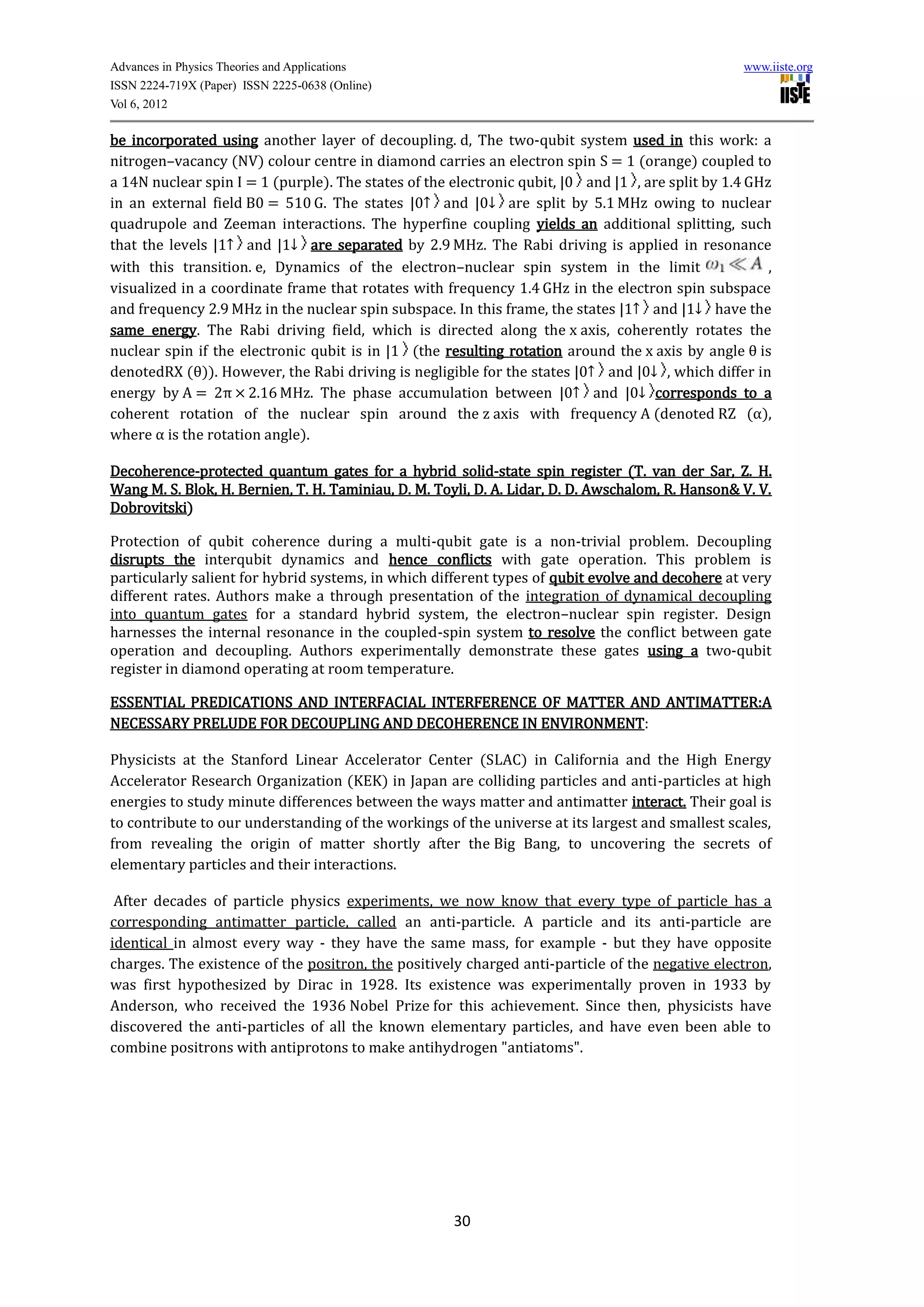
Fig 1. Particles and antiparticles (such as the pair highlighted in pink) are created in pairs from the
energy released by the collision of fast-moving particles with atoms in a bubble chamber. Since
particles and antiparticles have opposite electrical charges, they curl in opposite directions in the
magnetic field applied to the chamber.

From the physicists' point of view, what is strange about antimatter is that we don't see more of it.
When we collide high-energy particles in accelerators, their energy is converted into equal amounts
of matter and antimatter particles (according to Einstein's famous formula, the energy (E) it takes
to create matter and antimatter of total mass (m) is E=mc^2).

For example, you can see matter and antimatter particles created in the bubble chamber photo on
the left. The photo shows many bubble tracks generated by charged particles passing through
superheated liquid. Due to the magnetic field applied to the chamber, positive particles curl to the
right and negative particles curl to the left. The two curled tracks highlighted in pink show an
electron-positron pair created by the collision of a gamma ray photon (a highly energetic particle of
light) with an atom in the chamber, in a process called pair production.

Where did all the antimatter go?

Since we see matter and antimatter created in equal amounts in particle experiments, we expect that
shortly after the Big Bang, when the universe was extremely dense and hot, equal amounts of matter
and antimatter were created from the available energy. The obvious question is, therefore, where did
the antimatter go?.

One survivor for every billion.

Based on numerous astronomical observations and the results of particle physics and nuclear
physics experiments, we deduce that all the matter in the universe today is only about a billionth of
the amount of matter that existed during the very early universe. As the universe expanded and
cooled, almost every matter particle collided with an antimatter particle, and the two turned into
two photons - gamma ray particles - in a process called annihilation, the opposite of pair
production. But roughly a billionth of the matter particles survived, and it is those particles that
now make the galaxies, stars, planets, and all living things on Earth, including our own bodies.

The universe and the particles.

The survival of a small fraction of the matter particles indicates that, unlike what we wrote above,
matter and antimatter are not exactly identical. There is a small difference between the ways they
interact. This difference between matter and antimatter was first observed in particle accelerators
in 1964 in an experiment for which Cronin and Fitch were awarded the 1980 Nobel Prize, and its
connection to the existence of matter in the universe was realized in 1967 by Sakharov.

Physicists call this difference CP violation. Jargon, but it just means that if you are conducting a
particular experiment on particles, from which you deduce a certain theory of the laws of physics,

                                                     31
Advances in Physics Theories and Applications                                                     www.iiste.org
ISSN 2224-719X (Paper) ISSN 2225-0638 (Online)
Vol 6, 2012

then conducting the same experiment on anti-particles would lead you to deduce different laws. The
only way to end up with a consistent set of physical laws is to incorporate the matter-antimatter
difference into your theory. Because this difference is small, conducting any old experiment would
not reveal it. For example, if your experiment involves gravity, you would find that apples are
attracted by massive bodies like the earth, and that anti-apples are also attracted by massive bodies.
So gravity affects matter and antimatter identically, and this experiment would not reveal CP
violation. A much more sophisticated experiment is required.

Sophisticated experiment

The new generation of experiments at SLAC and KEK, called BaBar and Belle, offer new tools with
which to probe the nature of CP violation, hopefully shedding light on what happened a tiny fraction
of a second after the Big Bang, and expanding our understanding of elementary particles and their
interactions. These experiments work as follows: an accelerator accelerates electrons and positrons
to high energies. They are then "stored" in bunches of about a hundred billion particles each,
running around in a circular accelerator called a storage ring at about 0.99997 of the speed of light.
Electrons are made to go one way, and positrons go the other way, so that the bunches cross
through each other every time they go around the ring.

Making quarks

On some bunch crossings, a positron and an electron come close enough to collide, and the high
energy that they have been given by the accelerator turns into a new particle & anti-particle pair: a
B meson and its anti-particle, called a B-bar meson (mesons are particles composed of a quarkand
an anti-quark). These mesons undergo radioactive decay within about a picosecond (a trillionth of a
second). Because they are quite heavy - their mass is about five times that of the proton - they can
decay in numerous ways into different combinations of lighter particles.

Physicists have built a living-room size detector (see pictures) around the collision point in order to
detect the lighter particles which are produced in the decay of the two mesons. These detectors
allow them to identify the types of particles produced, measure their momenta and energies, and
trace them to their points of origin to within less than a 10th of a millimeter.

The huge amounts of data collected by the detectors is stored in large databases and analyzed by
computer "farms" with many hundreds of computers. Together, BaBar and Belle have produced
almost 300 million B mason & B-bar meson pairs, and physicists around the world are hard at work
analyzing the mountains of data and publishing their results. 300 million is a large number, but
when it comes to some CP violation measurements, it can be barely enough.

Measuring CP violation

Physicists detect differences between matter and antimatter and determine the strength of CP
violation by measuring the ways the B and the B-bar decay. For example, decays into particular sets
of particles exhibit a peculiar time structure which is different for B and B-bar decays.

To expose this behavior, the physicists conduct the following analysis:

First, they select "events" in which they see one of the heavy mesons undergoing the desired decay.
This is done by looking at all particle signatures in the detector and determining which
combinations of particles may have been produced in the decay of interest, given the constraints
imposed by Einstein's theory of relativity.

Next, they analyze the decay products of the other meson to determine whether it was a B or a B-

                                                     32
Advances in Physics Theories and Applications                                                     www.iiste.org
ISSN 2224-719X (Paper) ISSN 2225-0638 (Online)
Vol 6, 2012

bar. This process is called "tagging", and it makes use of the fact that B-bar meson decay tends to
produce a certain particle, such as an electron, whereas the decay of a B usually produces the
corresponding anti-particle, such as a positron.

Third, by measuring the points of origin of the decay products of the two mesons, they can find the
distance between them, which is typically about a quarter of a millimeter. They divide this distance
by the velocity with which the mesons move, to obtain the difference between their decay times,
known as dt, which is typically about a picosecond.

Finally, they plot the number of events observed in different ranges of dt.

                                  Fig 2. The difference between the red and the blue lines shows the
                                  difference in how a particle and its antiparticle behave. This is CP
                                  violation, and indicates that matter and anti-matter are not exactly
                                  opposites.

Observation template:

A plot appears to the left, with events in which the other Meson was "tagged" as a B shown in red,
and those in which it was "tagged" as a B-bar shown in blue. You can see that the plots are not the
same: events with a B tag tend to have a larger dt than events with a B-bar tag. This subtle
difference is exactly what we are looking for: this is CP violation, observed for the first time in
almost four decades!

Using their results, BaBar and Belle have measured with high precision a parameter called sin(2
beta), which describes part of the mechanism thought to be responsible for CP violation. According
to our understanding of particle physics, if sin (2 beta) had been equal to zero, there would have
been no CP violation, and matter and antimatter would have been identical. Recalling that the
difference between matter and antimatter is necessary for the existence of matter in the universe
today, a zero value for sin (2 beta) would have meant that the universe would have been a totally
different place, with no stars or planets, not even people to ponder the mysteries of the universe
and the underlying laws of physics.

Particle physicists are motivated to study CP violation both because it's an interesting phenomenon
in its own right and because it is intimately related to the universe as a whole and to our very
existence within it.

What next?

Having measured sin(2 beta), BaBar and Belle are now collecting more data about B and B-bar
decays and measuring more CP violation parameters, to improve our understanding of the
difference between matter and antimatter.

More data is coming from other experiments as well. Physicists at the CDFand D0 experiments
in Fermilab are also studying the decays of B mesons produced in collisions of protons with anti-
protons. Additional experiments using the Large Hadron Collider at CERN, which will produce B
mesons copiously by colliding protons with protons at even higher energies, are scheduled to begin
operation in a few years.

There are many open questions that these experiments seek to address. Some of the most intriguing
questions are prompted by the fact that the matter-antimatter difference we see in the laboratory
appears too small to be solely responsible for all the matter in the universe today. This suggests that
there may be additional differences between matter and antimatter, additional sources of CP


                                                       33
Advances in Physics Theories and Applications                                                                                   www.iiste.org
ISSN 2224-719X (Paper) ISSN 2225-0638 (Online)
Vol 6, 2012

violation that we have not been able to detect yet, but which could have played an important role
during the very early universe, when most matter and antimatter annihilated and a small fraction of
the matter survived.

Physicists are searching for these unknown CP violation effects. We never know what exactly this
quest will yield, but as has always been the case in the history of particle physics, we expect to learn
a great deal about nature in the process. ( For more details Please see Abner Soffer of Colorado
State University)

NOTATION :

Coupled Quantum Systems And Decohering Environment:

    : Category One Of Coupled Quantum System

    : Category Two Of Coupled Quantum System

    : Category Three Of Coupled Quantum System

    : Category One Of Decohering Environment

    : Category Two Of Decohering Environment

    :Category Three Of Decohering Environment

Conflict Between Quantum Gate Operation And Decoupling And Internal Resonance In Coupled
Spin Systems: Module Numbered Two:

    : Category One Of Conflict Between Quantum Gate Operation And Decoupling

    : Category Two Of Conflict Between Quantum Gate Operation And Decoupling

    : Category Three Conflict Between Quantum Gate Operation And Decoupling

    : Category One Of Internal Resonance In Coupled Spin Systems

    : Category Two Of Internal Resonance In Coupled Spin Systems

    : Category Three Of Internal Resonance In Coupled Spin Systems

(   )( ) , (        )( ) , (    )( ) , (             )( ) , (      )( ) , (      )( ) (          )( ) , (   )( ) , (   )(   )


(   )( ) , (        )( ) , (   )( ) : are Accentuation coefficients

(   )( ) , (        )( ) , (    )( ) , (             )( ) , (      )( ) , (      )( ) , (        )( ) , (   )( ) , (   )( ) ,

(   )( ) , (        )( ) , (   )(   )
                                        are Dissipation coefficients

Governing Equations of The System Decohering Environment And Coupled Quantum Systems:
The differential system of this model is now

     =(        )(    )
                               [(       )(       )
                                                        (       )( ) (        , )]                                                        1

     =(        )(    )
                               [(       )(       )
                                                        (       )( ) (        , )]                                                        2

     =(        )(    )
                               [(       )(       )
                                                        (       )( ) (        , )]                                                        3

    =(         )(    )
                               [(       )(   )
                                                       (        )( ) ( , )]                                                               4


                                                                                            34
Advances in Physics Theories and Applications                                                                                               www.iiste.org
ISSN 2224-719X (Paper) ISSN 2225-0638 (Online)
Vol 6, 2012


      =(        )(   )
                              [(    )(    )
                                                    (       )( ) ( , )]                                                                               5


      =(        )(   )
                              [(    )(    )
                                                    (       )( ) ( , )]                                                                               6

  (    )( ) (        , ) = First augmentation factor                                                                                                  7

  (   )( ) ( , ) = First detritions factor                                                                                                            8

Governing Equations of the System Conflict Between Quantum Gate Operations And Decoupling
And Internal Resonance In Coupled Spin Systems:

The differential system of this model is now

      =(        )(   )
                               [(   )(        )
                                                        (    )( ) (       , )]                                                                        9


      =(        )(   )
                               [(   )(        )
                                                        (    )( ) (       , )]                                                                       10

      =(        )(   )
                               [(   )(        )
                                                        (    )( ) (       , )]                                                                       11


      =(        )(   )
                              [(    )(    )
                                                    (       )( ) ((       ), )]                                                                      12


      =(        )(   )
                              [(    )(    )
                                                    (       )( ) ((       ), )]                                                                      13

      =(        )(   )
                              [(    )(    )
                                                    (       )( ) ((       ), )]                                                                      14

  (    )( ) (        , ) = First augmentation factor                                                                                                 15

  (   )( ) ((            ), ) = First detritions factor                                                                                              16

Coupled Quantum Systems And Decohering Environment And The Conflict Between Quantum
Gate Operation And Decoupling And Internal Resonance In Coupled Spin Systems - The Final
Governing Equations

      =(        )(   )
                               [(    )(       )
                                                    (       )( ) (    , )            (        )(   , )(
                                                                                                            , ) ]                                    17


      =(        )(   )
                               [(    )(       )
                                                    (       )( ) (    , )            (        )(   , )(
                                                                                                            , ) ]                                    18


      =(        )(   )
                               [(    )(       )
                                                    (       )( ) (    , )            (        )(   , )(
                                                                                                            , ) ]                                    19


Where (     )( ) ( , ) , (                    )( ) (         , ) ,(           )( ) (          , ) are first augmentation coefficients for            20
category 1, 2 and 3

  ( )( , ) ( , ) , (                 )(           , )(
                                                            , ) ,     (        )(    , )(
                                                                                                   , ) are second augmentation coefficients          21
for category 1, 2 and 3

      =(        )(   )
                              [(    )(    )
                                                    (       )( ) ( , )         (         )(   , )(
                                                                                                          , ) ]                                      22


      =(        )(   )
                              [(    )(    )
                                                    (       )( ) ( , )           (       )(   , )(
                                                                                                          , ) ]                                      23


      =(        )(   )
                              [(    )(    )
                                                    (       )( ) ( , )         (         )(   , )(
                                                                                                          , ) ]                                      24


Where     (          )( ) ( , ) ,     (             )( ) ( , ) ,          (      )( ) ( , ) are first detrition coefficients for category            25
1, 2 and 3

                                                                                          35
Advances in Physics Theories and Applications                                                                                                                                            www.iiste.org
ISSN 2224-719X (Paper) ISSN 2225-0638 (Online)
Vol 6, 2012


   ( )( , ) ( , ) ,                                 (            )(      , )(
                                                                                       , ) , (                    )(   , )(
                                                                                                                                          , ) are second augmentation coefficients for
category 1, 2 and 3

             =(            )(   )
                                              [(            )(       )
                                                                           (           )( ) (            , )           (          )(      , )(
                                                                                                                                                    , ) ]                                         26


             =(            )(   )
                                              [(            )(       )
                                                                           (           )( ) (            , )           (          )(      , )(
                                                                                                                                                    , ) ]                                         27


             =(            )(   )
                                              [(            )(       )
                                                                           (           )( ) (            , )           (          )(      , )(
                                                                                                                                                    , ) ]                                         28


Where     ( )( ) ( , ) ,                                          (            )( ) (            , ) ,            (          )( ) (              , ) are first augmentation coefficients          29
for category 1, 2 and 3

   ( )( , ) ( , ) ,                                 (            )(       , )(
                                                                                           , ) ,         (         )(      , )(
                                                                                                                                           , ) are second detrition coefficients for
category 1, 2 and 3

             =(        )(       )
                                              [(            )(   )
                                                                          (           )( ) (           , )             (         )(       , )(
                                                                                                                                                  , ) ]                                           30


             =(        )(       )
                                              [(            )(   )
                                                                          (           )( ) (           , )             (         )(       , )(
                                                                                                                                                  , ) ]                                           31


             =(        )(       )
                                              [(            )(   )
                                                                          (           )( ) (           , )             (         )(       , )(
                                                                                                                                                  , ) ]                                           32


Where     ( )( ) ( , ) , ( )( ) (                                                                    , ) ,         (          )( ) (              , ) are first detrition coefficients for        33
category 1, 2 and 3
   ( )( , ) ( , ) , ( )( , ) ( , ) ,                                                            (        )(    , )(
                                                                                                                            , ) are second detrition coefficients for category
1, 2 and 3
Where we suppose

(A)               ( )( ) , ( )( ) , (                           )( ) , ( )( ) , ( )( ) , (                             )(    )
                                                                                                                                       0,                                                         34
         , = 1 ,14,15
(B)               The functions (                           )( ) , (              )( ) are positive continuous increasing and bounded.
Definition of ( )( ) , ( )( ) :
         (     )( ) (            , )          ( )(          )
                                                                         ( ̂          )(   )


     (        )( ) ( , )                  ( )(          )
                                                                 ( )(             )
                                                                                            ( ̂        )(     )


(C)                                   (       )( ) (              , ) = ( )(                     )                                                                                                35

     lim               (        )( ) ( , ) = ( )(                             )


Definition of ( ̂                         )( ) , ( ̂              )( ) :

                Where                              ( ̂           )( ) , ( ̂                )( ) , ( )( ) , ( )(                       )
                                                                                                                                                      are            positive        constants

                  and               = 1 ,14,15
They satisfy Lipschitz condition:                                                                                                                                                                 36
                                                                                                                                                     )( )
    |(        )( ) (            , )       (        )( ) (                , )|           (̂            )( ) |                          |      ( ̂

                                                                                                                                             )( )
|(           )( ) ( , )               (       )( ) ( , )|                         (̂           )( ) ||                  ||        ( ̂


With            the             Lipschitz               condition,                         we         place            a         restriction              on   the   behavior   of   functions
(        )( ) (            , )        and (              )( ) (                , ) .(                , ) and (                        , ) are points belonging to the interval


                                                                                                                             36
Advances in Physics Theories and Applications                                                                                                                                                  www.iiste.org
ISSN 2224-719X (Paper) ISSN 2225-0638 (Online)
Vol 6, 2012


[( ̂       )( ) , ( ̂             )( ) ] . It is to be noted that (                                       )( ) (         , ) is uniformly continuous. In the eventuality of
the fact, that if ( ̂                       )(   )
                                                         = 1 then the function (                                )( ) (              , ) , the first augmentation coefficient would
be absolutely continuous.
Definition of ( ̂                         )( ) , ( ̂              )( ) :                                                                                                                                   37
(D)              ( ̂         )( ) , ( ̂              )( ) , are positive constants
          ( )( )             ( )( )
                       ,                             1
        ( ̂ )( )           ( ̂ )( )

    Definition of ( ̂ )( ) , ( ̂                                   )( ) :                                                                                                                                  38
(E)              There                exists                  two           constants                     ( ̂ )      ( )
                                                                                                                                    and          ( ̂   )   ( )
                                                                                                                                                                    which     together         with
( ̂        )( ) , ( ̂            )( ) , ( ̂ )(                )
                                                                        ( ̂           )(   )
                                                                                                                               and                                the                   constants
( )( ) , ( )( ) , ( )( ) , ( )( ) , ( )( ) , ( )( ) , = 1 ,14,15,
        satisfy the inequalities
                    ( )(     )
                                      ( )(           )
                                                                  ( ̂        )(   )
                                                                                               ( ̂ )( ) ( ̂                    )(   )
                                                                                                                                             1
( ̂      )( )

                    ( )(      )
                                          ( )(           )
                                                                  (̂         )(   )
                                                                                               ( ̂         )(   )
                                                                                                                     (̂         )(      )
                                                                                                                                              1
( ̂      )( )

Where we suppose

(F)              ( )( ) , ( )( ) , (                          )( ) , ( )( ) , ( )( ) , (                        )(   )
                                                                                                                               0,           , = 16,1 ,1                                                    39

(G)              The functions (                             )( ) , (        )( ) are positive continuous increasing and bounded.                                                                          40

Definition of (p )( ) , (r )( ) :
                                                                            ( )
(       )( ) (       , )           ( )(          )
                                                              ( ̂       )                                                                                                                                  41

    (     )( ) ( , )                  ( )(           )
                                                               ( )(      )
                                                                                  ( ̂            )(   )                                                                                                    42

(H)              lim              (         )( ) (                , ) = ( )(               )                                                                                                               43

lim             (     )( ) ((               ), ) = ( )(                      )                                                                                                                             44

Definition of ( ̂                         )( ) , ( ̂              )( ) :

Where ( ̂                  )( ) , ( ̂            )( ) , ( )( ) , ( )( ) are positive constants and                                                         = 16,1 ,1
They satisfy Lipschitz condition:

                                                                                                                                            )( )
|(       )( ) (        , )            (      )( ) (               , )|           (̂            )( ) |                      |        ( ̂                                                                    45

                                                                                                                                                                 )( )
|(       )( ) ((           ), )             (        )( ) ((             ), )|                 (̂         )( ) ||(         )            (    ) ||      ( ̂                                                 46

With the Lipschitz condition, we place a restriction on the behavior of functions (                                                                                                  )( ) (        , )
and(        )( ) (           , ) .(                  , ) and (                   , ) are points belonging to the interval [( ̂                                          )( ) , ( ̂    )( ) ] . It is
to be noted that (                        )( ) (              , ) is uniformly continuous. In the eventuality of the fact, that if ( ̂                                                        )(   )
                                                                                                                                                                                                       =
1 then the function                              (           )( ) (         , ) , the SECOND augmentation coefficient would be absolutely
continuous.
    Definition of ( ̂                       )( ) , ( ̂              )( ) :

(I)              ( ̂         )( ) , ( ̂              )( ) , are positive constants                                                                                                                         47


                                                                                                                     37
Advances in Physics Theories and Applications                                                                                                                                                                        www.iiste.org
ISSN 2224-719X (Paper) ISSN 2225-0638 (Online)
Vol 6, 2012

        ( )( )               ( )( )
                       ,                    1
      ( ̂ )( )             ( ̂ )( )

Definition of ( ̂ )( ) , ( ̂                                )( ) :
There              exists                  two                          constants                         ( ̂ )(                )
                                                                                                                                             and            ( ̂       )(     )
                                                                                                                                                                                       which                   together
with                       ( ̂       )( ) , ( ̂             )( ) , ( ̂ )(                  )
                                                                                                      ( ̂                  )(   )
                                                                                                                                                       and                        the                      constants
( )( ) , ( )( ) , ( )( ) , ( )( ) , ( )( ) , ( )( ) , = 16,1 ,1 ,
 satisfy the inequalities
              ( )(           )
                                    ( )(        )
                                                            ( ̂                 )(   )
                                                                                           ( ̂ )( ) ( ̂                             )(   )
                                                                                                                                                 1                                                                            48
( ̂    )( )

                  ( )(       )
                                    ( )(        )
                                                            (̂                  )(    )
                                                                                               ( ̂        )(           )
                                                                                                                           (̂        )(      )
                                                                                                                                                   1                                                                          49
( ̂    )( )

Theorem 1: if the conditions IN THE FOREGOING above are fulfilled, there exists a solution satisfying                                                                                                                         50
the conditions
Definition of                     (0) , (0) :
                                 ( ) ( ̂        )( )
      ( )         ( ̂ )                                     ,                      (0) =                   0
                                  ) ( ̂     )( )
    ( )       ( ̂           )(                                  ,                    (0) =                     0
if the conditions IN THE FOREGOING above are fulfilled, there exists a solution satisfying the                                                                                                                                51
conditions
Definition of                     (0) , (0)
                                  ) ( ̂     )( )
      ( )         ( ̂ )(                                    ,                   (0) =                     0
                                  ) ( ̂     )( )
    ( )       ( ̂           )(                                  ,                  (0) =                   077
PROOF:                                                                                                                                                                                                                        52
                                          ( )
Consider operator                                    defined on the space of sextuples of continuous functions                                                                                     ,
which satisfy
    (0) =              ,     (0) =              ,                       ( ̂ )( ) ,                         ( ̂                 )( ) ,                                                                                         53

                                                        ) ( ̂               )( )
0           ( )                    ( ̂ )(                                                                                                                                                                                     54

                                                        ) ( ̂               )( )
0           ( )                    ( ̂      )(                                                                                                                                                                                55

By                                                                                                                                                                                                                            56
    ̅ ( )=                       ∫ [(       )(          )
                                                                    (       (      ))      ((             )(       )
                                                                                                                                    )( ) (         (   (     ) ), (     ) ))           (    (   ) )]       (    )

    ̅ ( )=                       ∫ [(           )(      )
                                                                    (       (      ))      ((         )(       )
                                                                                                                           (        )( ) (         (    (     ) ), (       ) ))         (   (   ) )]       (     )
                                                                                                                                                                                                                              57

    ̅ ( )=                       ∫ [(       )(          )
                                                                    (       (    ))       ((         )(        )
                                                                                                                           (        )( ) (         (   (     ) ), (     ) ))           (    (   ) )]       (    )
                                                                                                                                                                                                                              58

̅ ( )=                       ∫ [(          )(       )
                                                             (          (       ))        ((         )(    )
                                                                                                                           (        )( ) ( (       (       ) ), (     ) ))         (    (   ) )]       (   )
                                                                                                                                                                                                                              59

̅ ( )=                       ∫ [(          )(       )
                                                             (          (       ))        ((         )(    )
                                                                                                                           (        )( ) ( (       (       ) ), (     ) ))         (    (   ) )]       (   )
                                                                                                                                                                                                                              60

̅
T (t) = T                    ∫ [(          )(       )
                                                            (       (           ))        ((         )(    )
                                                                                                                           (        )( ) ( (       (       ) ), (     ) ))        (    (    ) )]       (   )
                                                                                                                                                                                                                              61

Where         (    )       is the integrand that is integrated over an interval (0, )
                                          ( )
Consider operator                                    defined on the space of sextuples of continuous functions                                                                                     ,


                                                                                                                               38
Advances in Physics Theories and Applications                                                                                                                                                                       www.iiste.org
ISSN 2224-719X (Paper) ISSN 2225-0638 (Online)
Vol 6, 2012

which satisfy

    (0) =           ,        (0) =                   ,                   ( ̂ )( ) ,                          ( ̂          )( ) ,                                                                                             62

                                                         ) ( ̂               )( )
0        ( )                       ( ̂ )(                                                                                                                                                                                    63

                                                         ) ( ̂               )( )
0       ( )                       ( ̂           )(                                                                                                                                                                           64

By                                                                                                                                                                                                                           65
    ̅ ( )=                    ∫ [(               )(          )
                                                                      (      (        ))       ((        )(      )
                                                                                                                                  )( ) (          (    (     ) ), (     ) ))       (   (     ) )]       (       )

    ̅ ( )=                   ∫ [(               )(       )
                                                                     (       (        ))   ((           )(   )
                                                                                                                     (            )( ) (          (    (     ) ), (     ) ))       (   (     ) )]       (       )
                                                                                                                                                                                                                             66

    ̅ ( )=                   ∫ [(               )(       )
                                                                     (       (        ))   ((           )(   )
                                                                                                                     (            )( ) (          (    (     ) ), (     ) ))       (   (     ) )]       (       )
                                                                                                                                                                                                                             67

̅ ( )=                       ∫ [(               )(       )
                                                                  (      (       ))        ((           )(   )
                                                                                                                     (            )( ) ( (        (        ) ), (     ) ))     (   (       ) )]     (       )
                                                                                                                                                                                                                             68

̅ ( )=                       ∫ [(               )(       )
                                                                  (      (       ))        ((           )(   )
                                                                                                                     (            )( ) ( (        (        ) ), (     ) ))     (   (       ) )]     (       )
                                                                                                                                                                                                                             69

̅ ( )=                       ∫ [(               )(       )
                                                                  (      (       ))        ((           )(   )
                                                                                                                     (            )( ) ( (        (        ) ), (     ) ))     (   (       ) )]     (       )
                                                                                                                                                                                                                             70

Where       (   )       is the integrand that is integrated over an interval (0, )
                                                ( )                                                                                                                                                                          71
(a)          The operator                                    maps the space of functions satisfying CONCATENATED EQUATIONS into
itself .Indeed it is obvious that
                                                                                                ) ( ̂            )( ) (
      ( )                     ∫ [(               )( ) (                          ( ̂ )(                                       )   )]        (     )    =
                                                             (        )( ) ( ̂ )( )                          )( )
        (1      (            )(   )
                                        )                                           ( (̂                                   1)
                                                                     ( ̂ )( )

From which it follows that                                                                                                                                                                                                   72
                                                                                                                                       (̂       )( )
                                                                 (           )( )                                                 (                          )
                                  ( ̂       )( )                                            ̂ )(
(     ( )                )                                                            ) [((
                                                                                                         )
                                                                                                                          )                                         ( ̂ )( ) ]
                                                                 ( ̂         )(


(     ) is as defined in the statement of theorem 1
Analogous inequalities hold also for                                                       ,        ,        ,       ,
                                                     ( )
(b)          The operator                                        maps the space of functions satisfying GLOBAL EQUATIONS into
itself .Indeed it is obvious that
                                                                                                ) ( ̂            )( ) (
      ( )                     ∫ [(               )( ) (                          ( ̂ )(                                       )   )]        (     )    =                                                                     73

                                                             (        )( ) ( ̂ )( )                          )( )
        (1      (            )(   )
                                        )                                           ( (̂                                   1)
                                                                     ( ̂ )( )

From which it follows that                                                                                                                                                                                                   74
                                                                                                                                       (̂       )( )
                                                                  (  )( )                                                         (                          )
                                  ( ̂       )( )                                               ̂ )(
(     ( )                )                                                [((                            )
                                                                                                                          )                                         ( ̂ )( ) ]
                                                                 ( ̂ )( )


Analogous inequalities hold also for                                                       ,        ,        ,       ,

                                                           ( )( )                       ( )( )                                                                                                                               75
It is now sufficient to take                                                      ,                      1 and to choose
                                                         ( ̂ )( )                     ( ̂ )( )

( ̂ )( ) and ( ̂                      )(    )
                                                large to have


                                                                                                                         39
Advances in Physics Theories and Applications                                                                                                                                                                                       www.iiste.org
ISSN 2224-719X (Paper) ISSN 2225-0638 (Online)
Vol 6, 2012

                                                                                                    (̂           )( )                                                                                                                        76
                                                                                                (                                )
 ( )( )
         [( ̂                   )   ( )
                                                (( ̂ )(               )
                                                                                     )                                               ]           ( ̂ )(           )
( ̂ )( )


                                                                          (̂       )( )                                                                                                                                                      77
                                                                  (                                 )
 ( )( )
         [((               ̂         )   ( )
                                                            )                                                    ( ̂            )    ( )
                                                                                                                                           ]        ( ̂       )   ( )
( ̂ )( )


                                                                     ( )
In order that the operator                                                 transforms the space of sextuples of functions                                                                                ,       satisfying GLOBAL
EQUATIONS into itself
                                     ( )                                                                                                                                                                                                     78
The operator                                   is a contraction with respect to the metric
            ( )        ( )                 ( )          ( )
    ((            ,             ), (              ,             )) =
                               ( )
                                     ( )               ( )
                                                                ( )|           (̂       )( )                                ( )
                                                                                                                                     ( )             ( )
                                                                                                                                                           ( )|            (̂       )( )
                       |                                                                            ,               |

Indeed if we denote                                                                                                                                                                                                                          79
Definition of ̃ , ̃ :                                 ( ̃, ̃ ) =                    ( )
                                                                                            ( , )
It results
     ( )          ̃ ( )|                                              ( )                ( )                (̂          )( ) (                 (̂        )( ) (
|̃                                       ∫(            )( ) |                                   |                                        )                            )
                                                                                                                                                                                (   )

                                ( )               ( )            (̂        )( )                         (̂         )( )
∫ (            )( ) |                                   |                           (       )                               (        )


                       ( )                            ( )              ( )              (̂          )( ) (                  (̂           )( ) (
(         )( ) (                ,    (     ) )|                                |                                    )                                )


    ( )                              ( )                                                        ( )                                      (̂      )( ) (               (̂    )( ) (
          |(          )( ) (               ,    (      ))         (            )( ) (                   ,    (      ) )|
                                                                                                                                                             )                             )
                                                                                                                                                                                                 (           )

Where          (        )      represents integrand that is integrated over the interval 0, t
From the hypotheses it follows
     ( )              ( )            (̂         )( )                                                                                                                                                                                         80
|                           |

               ((               )(    )
                                                (           )(   )
                                                                           ( ̂ )(               )
                                                                                                            ( ̂ )( ) ( ̂ )( ) ) ((                                        ( )
                                                                                                                                                                                ,   ( )        ( )
                                                                                                                                                                                                     ,       ( )
                                                                                                                                                                                                                   ))
(̂        )( )

And analogous inequalities for                                                                          . Taking into account the hypothesis the result follows
Remark 1: The fact that we supposed (                                                                        )( ) and (                          )( ) depending also on t can be considered as not                                           81
conformal with the reality, however we have put this hypothesis ,in order that we can postulate condition
                                                                                                                                                                                    ) (̂       )( )                          ) (̂   )( )
necessary to prove the uniqueness of the solution bounded by ( ̂ )(                                                                                                                                                 ( ̂ )(
respectively of                            .
If instead of proving the existence of the solution on                                                                                            , we have to prove it only on a compact then it
suffices to consider that (                                                )( ) and (                        )( ) , = 1 ,14,15 depend only on T                                                                  and respectively on
    (                                     ) and hypothesis can replaced by a usual Lipschitz condition.
Remark 2: There does not exist any                                                              where                       ( )=0                                ( )=0                                                                       82
From 19 to 24 it results
                                [ ∫ {(          )( ) (           )( ) (            ( (      ) ), (          ) )}                )]
     ( )                                                                                                                (
                                                                                                                                             0

     ( )                       ( (        )( ) )
                                                            0 for t                     0
Definition of (( ̂ )                                  ( )
                                                            ) , (( ̂ )                  ( )
                                                                                                )                   (( ̂ )( ) ) :                                                                                                            83


                                                                                                                                               40
Advances in Physics Theories and Applications                                                                                                                                                             www.iiste.org
ISSN 2224-719X (Paper) ISSN 2225-0638 (Online)
Vol 6, 2012

Remark 3: if                            is bounded, the same property have also                                                                                       . indeed if

            ( ̂ )( ) it follows                                           (( ̂ )( ) )                          (             )(   )
                                                                                                                                                and by integrating

            (( ̂ )( ) ) =                                    2(             )( ) (( ̂ )( ) ) (                                    )(    )


In the same way , one can obtain
            (( ̂ )( ) ) =                                    2(             )( ) (( ̂ )( ) ) (                                     )(   )


If                               is bounded, the same property follows for                                                                  ,              and               ,    respectively.
Remark 4: If                                   bounded, from below, the same property holds for                                                                                               . The proof is       84
analogous with the preceding one. An analogous property is true if                                                                                                   is bounded from below.
                                                                                                                                            ( )
Remark 5: If T                            is bounded from below and lim                                                          ((     )         ( ( ), )) = (                   )( ) then           .            85
Definition of ( )( ) and                                     :
Indeed let                  be so that for
(      )(   )
                    (           )( ) ( ( ), )                         ,          ( )             ( )(          )


Then                         (          )( ) ( )(        )
                                                                                  which leads to                                                                                                                   86

                (       )( ) ( )( )
            (                             ) (1                        )                                   If we take t such that                                          =      it results

                (       )( ) ( )( )
            (                             ),           =                     By taking now                                        sufficiently small one sees that T                           is unbounded.

The same property holds for                                               if lim                (         )( ) ( ( ), ) = (                                 )(   )


We now state a more precise theorem about the behaviors at infinity of the solutions OF THE GLOBAL
SYSTEM
                                                         ( )( )                    ( )( )                                                                                                                          87
It is now sufficient to take                                                 ,                                1 and to choose
                                                       ( ̂ )( )                  ( ̂ )( )

( ̂ )(          )
                                ( ̂       )(   )
                                                   large to have
                                                                                           (̂       )( )                                                                                                           88
                                                                                       (                           )
 ( )( )
         [( ̂               )( )
                                          (( ̂ )(            )
                                                                            )                                          ]          ( ̂ )(          )
( ̂ )( )


                                                                 (̂        )( )                                                                                                                                    89
                                                           (                               )
 (   )( )
           [((          ̂        )( )
                                                   )                                                ( ̂            )   ( )
                                                                                                                             ]        ( ̂         )   ( )
(̂    )( )


                                                             ( )
In order that the operator                                         transforms the space of sextuples of functions                                                                 ,    satisfying GLOBAL
EQUATIONS into itself
                                  ( )                                                                                                                                                                              90
The operator                            is a contraction with respect to the metric

    (((         )( ) , (             )( ) ), ((              )( ) , (             )( ) )) =
                            ( )
                                  ( )          ( )
                                                       ( )|           (̂     )( )                              ( )
                                                                                                                       ( )              ( )
                                                                                                                                                ( )|        (̂        )( )
                    |                                                                  ,                  |

Indeed if we denote                                                                                                                                                                                                91
Definition of ̃ , ̃ :                                  ( ̃, ̃ )=                                ( )
                                                                                                      (        ,             )
It results                                                                                                                                                                                                         92
     ( )        ̃ ( )|                                         ( )               ( )            (̂        )( ) (                 (̂     )( ) (
|̃                                   ∫(        )( ) |                                  |                                   )                           )
                                                                                                                                                                 (    )


                                                                                                                                 41
Advances in Physics Theories and Applications                                                                                                                                                                              www.iiste.org
ISSN 2224-719X (Paper) ISSN 2225-0638 (Online)
Vol 6, 2012

                                  ( )                     ( )            (̂       )( ) (                (̂           )( ) (
∫ (             )( ) |                                          |                               )                                  )


                         ( )                                ( )               ( )           (̂       )( ) (                   (̂       )( ) (
(         )( ) (                  ,       (        ) )|                               |                               )                              )


    ( )                                   ( )                                                       ( )                                (̂       )( ) (           (̂   )( ) (
          |(            )( ) (                     ,    (   ))            (           )( ) (              ,    (      ) )|
                                                                                                                                                             )                   )
                                                                                                                                                                                       (       )

Where               (     )   represents integrand that is integrated over the interval 0,
From the hypotheses it follows
           )(       )
                              (               )( ) |e       (̂           )( )                                                                                                                                                       93
|(

               ((                 )(          )
                                                        (           )(   )
                                                                                  ( ̂ )(
                                                                                    A               )
                                                                                                              ( ̂ )( ) ( ̂ )( ) )d (((                                )( ) , (       )(    )
                                                                                                                                                                                                   (   )( ) , (   )( ) ))
(̂        )( )

And analogous inequalities for G and T . Taking into account the hypothesis the result follows

Remark 1: The fact that we supposed (                                                                          )( ) and (                      )( ) depending also on t can be considered as not                                    94
conformal with the reality, however we have put this hypothesis ,in order that we can postulate condition
                                                                                                                                                                               ̂     )( )                              ̂   )( )
necessary to prove the uniqueness of the solution bounded by ( ̂ )( ) e(                                                                                                                       and ( ̂       )( ) e(
respectively of                                     .
If instead of proving the existence of the solution on                                                                                          , we have to prove it only on a compact then it
                                                                                   ( )                             ( )
suffices to consider that (                                                       )        and (               )          , = 16,1 ,1 depend only on T                                             and respectively on
(         )(and not on t) and hypothesis can replaced by a usual Lipschitz condition.
Remark 2: There does not exist any t where G (t) = 0 and T (t) = 0                                                                                                                                                                  95
From 19 to 24 it results
                                                        )( ) (           )( ) (
G (t)                   G e[          ∫ {(                                                ( (    ) ), (       ) )}        (   )]
                                                                                                                                           0
                                                  )( ) )
T (t)               T e(              (
                                                                    0 for t                 0
Definition of (( ̂ )( ) ) , (( ̂ )( ) ) and (( ̂ )( ) ) :
                 M             M               M                                                                                                                                                                                    96

Remark 3: if G                                     is bounded, the same property have also G                                                                 and G       . indeed if

G              ( ̂ )( ) it follows
                 M                                                                        (( ̂ )( ) )
                                                                                             M                                (            )( ) G          and by integrating

G              (( ̂ )( ) ) = G
                  M                                                           2(           )( ) (( ̂ )( ) ) (
                                                                                                   M                                           )(    )


In the same way , one can obtain
G              (( ̂ )( ) ) = G
                  M                                                           2(           )( ) (( ̂ )( ) ) (
                                                                                                   M                                            )(   )


If G           or G                   is bounded, the same property follows for G                                                                         ,G       and G       ,G          respectively.
Remark 4: If G                                          is bounded, from below, the same property holds for G and G                                                                                      . The proof is             97
analogous with the preceding one. An analogous property is true if G is bounded from below.
Remark 5: If T                                          is bounded from below and lim                                                      ((            )( ) ((      )(t), t)) = (                )( ) then T              .       98
Definition of ( )( ) and                                                      :
Indeed let t be so that for t                                                      t
(         )(    )
                         (            )( ) ((                   )(t), t)                    , T (t)                   ( )(             )


Then                                  (            )( ) ( ) (             )
                                                                                          T which leads to                                                                                                                          99

                    (     )( ) ( )( )
T              (                                        ) (1             e            )         T e                  If we take t such that e                              =         it results


                                                                                                                                            42
Advances in Physics Theories and Applications                                                                                                                                                                                                              www.iiste.org
ISSN 2224-719X (Paper) ISSN 2225-0638 (Online)
Vol 6, 2012

                      (             )( ) ( )( )                                                                                                                                                                                                                    100
T                 (                                    ),             = log                   By taking now                                         sufficiently small one sees that T is unbounded.

The same property holds for T                                                              if lim                   (         )( ) ((                       )(t), t) = (                    )(    )


We now state a more precise theorem about the behaviors at infinity of the solutions
Behavior of the solutions OF THE GLOBAL SYSTEM:                                                                                                                                                                                                                    101
Theorem 2: If we denote and define
Definition of ( )( ) , ( )( ) , ( )( ) , ( )( ) :
(a)                             )( ) , ( )( ) , ( )( ) , ( )(                                             )
                                                                                                                   four constants satisfying
    ( )(               )
                                         (         )(      )
                                                                     (            )(   )
                                                                                                 (             )( ) (          , )                  (            )( ) (               , )                 ( )(          )


        ( )(           )
                                          (          )(    )
                                                                     (            )(   )
                                                                                                 (             )( ) ( , )                   (               )( ) ( , )                          ( )(           )


Definition of ( )( ) , ( )( ) , (                                                           )( ) , (               )( ) ,     ( )
                                                                                                                                    ,       ( )
                                                                                                                                                        :                                                                                                          102
(b)                        By                 ( )(         )
                                                                     0 , ( )(                )
                                                                                                          0 and respectively (                                               )(   )
                                                                                                                                                                                       0,(                )(       )
                                                                                                                                                                                                                            0 the roots of                  the

equations (                                  )( ) (        ( )
                                                                 )             ( )(           ) ( )
                                                                                                                    (         )(    )
                                                                                                                                        = 0 and (                                  )( ) (       ( )
                                                                                                                                                                                                      )                ( )(      ) ( )
                                                                                                                                                                                                                                             (    )(   )
                                                                                                                                                                                                                                                           =0
Definition of ( ̅ )( ) , , ( ̅ )( ) , ( ̅ )( ) , ( ̅ )( ) :                                                                                                                                                                                                        103
    By ( ̅ )(                   )
                                             0 , ( ̅ )(          )
                                                                              0 and                  respectively ( ̅ )(                                    )
                                                                                                                                                                         0 , ( ̅ )(         )
                                                                                                                                                                                                      0 the                 roots of the equations

(            )( ) (             ( )
                                      )            ( )(          ) ( )
                                                                                       (             )(    )
                                                                                                                   = 0 and (                        )( ) (               ( )
                                                                                                                                                                               )       ( )(               ) ( )
                                                                                                                                                                                                                             (     )(    )
                                                                                                                                                                                                                                             =0
Definition of (                                      )( ) , (                )( ) , ( )( ) , ( )( ) , ( )( ) :-                                                                                                                                                    104
(c)                        If we define (                             )( ) , (               )( ) , ( )( ) , ( )(                               )
                                                                                                                                                             by
                           ( )                       ( )                     ( )                         ( )                       ( )
            (         )              =( )                  ,(            )            =( )                     ,          ( )                       ( )(                 )


             (            )(    )
                                     = ( )( ) , (                         )(      )
                                                                                       = ( ̅ )( ) ,                       ( )(          )
                                                                                                                                                    ( )(                 )
                                                                                                                                                                                   ( ̅ )( ) ,

            and ( )(                         )
                                                 =

    (                )(     )
                                = ( )( ) , (                          )(      )
                                                                                  = ( )( ) ,                            ( ̅ )(      )
                                                                                                                                                ( )(                 )


and analogously                                                                                                                                                                                                                                                    105
                           ( )                       ( )                  ( )                            ( )                       ( )                           ( )
             ( )                    =(             )        ,( )                   =(                )         ,        (      )                    ( )
             ( )(               )
                                    =(             )( ) , ( )(                )
                                                                                   = ( ̅ )( ) ,                         (     )(    )
                                                                                                                                                    (           )(   )
                                                                                                                                                                                  ( ̅ )( ) ,

            and (                   )(   )
                                              =

    (             )(       )
                                =(               )( ) , ( )(              )
                                                                              =(             )( ) ,                ( ̅ )(      )
                                                                                                                                            (           )(      )
                                                                                                                                                                     where (                )( ) , ( ̅ )(                )


are defined respectively
Then the solution of GLOBAL CONCATENATED EQUATIONS satisfies the inequalities                                                                                                                                                                                      106
                 ((        )( ) (                )( ) )                                                    (       )( )
                                                                              ( )
where ( )( ) is defined
                                         ((      )( ) (              )( ) )                                                                     (           )( )
                                                                                                  ( )
        (        )( )                                                                                               (       )( )

                                (         )( )                                         ((        )( ) (              )( ) )                 (           )( )                                (    )( )                                                              107
(                                                                            [                                                                                       ]                                                       ( )
    (           )( ) ((         )( ) (               )( ) (           )( ) )

                 (         )( )                                 (        )( )                    (         )( )                                 (           )( )
                                                                                                                                                                         )
(           )( ) ((        )( ) (                 )( ) )


                                                                                                                                                    43
Advances in Physics Theories and Applications                                                                                                                                                                          www.iiste.org
ISSN 2224-719X (Paper) ISSN 2225-0638 (Online)
Vol 6, 2012


            (        )( )                                                           ((        )( ) (              )( ) )                                                                                                       108
                                                 ( )
                             (        )( )                                                                            ((       )( ) (                )( ) )                                                                    109
                                                                  ( )
(     )( )                                                                           (        )( )

             (           )( )                                     (       )( )                      (           )( )                                  (        )( )                                                            110
                                                      [                                                                    ]                                                           ( )
(     )( ) ((            )( ) (                )( ) )

                         (        )( )                                               ((        )( ) (                 )( ) )                     (        )( )                            (   )( )
                                                                         [                                                                                           ]
(     )( ) ((            )( ) (                )( ) (             )( ) )

Definition of ( )( ) , ( )( ) , (                                                             )( ) , (                )( ) :-                                                                                                  111
Where ( )(                         )
                                       =(                 )( ) (                    )(    )
                                                                                                     (            )(       )


                     ( )(              )
                                           =(                 )(      )
                                                                                 (             )(       )


                         (       )(        )
                                               =(                 )( ) (             )(       )
                                                                                                            (         )(       )


                     (           )(    )
                                               =(             )(       )
                                                                                    (          )(       )


Behavior of the solutions of GLOBAL EQUATIONS                                                                                                                                                                                  112
If we denote and define
Definition of (                                  )( ) , (                     )( ) , ( )( ) , ( )( ) :                                                                                                                         113
                                  ( )                     ( )                       ( )                     ( )
(d)                           )            ,(         )               ,( )                ,( )                            four constants satisfying
    (       )(       )
                                       (         )(       )
                                                                      (             )(    )
                                                                                                     (            )( ) (T , )                             (              )( ) (T , )                  (   )(   )               114

    ( )(             )
                                      (          )(   )
                                                                      (          )(       )
                                                                                                    (            )( ) ((                     ), )              (            )( ) ((           ), )        ( )(     )           115

Definition of ( )( ) , ( )( ) , (                                                              )( ) , (                )( ) :                                                                                                  116

By ( )(                      )
                                           0 , ( )(               )
                                                                               0 and respectively (                                          )(       )
                                                                                                                                                                0 ,(             )(   )
                                                                                                                                                                                              0 the roots

(e)                      of        the equations (                                        )( ) (                ( )
                                                                                                                      )             (        )(      ) ( )
                                                                                                                                                                         (        )(      )
                                                                                                                                                                                              =0                               117

and (                    )( ) (            ( )
                                                 )            ( )(               ) ( )
                                                                                                        (             )(       )
                                                                                                                                   = 0 and                                                                                     118

Definition of ( ̅ )( ) , , ( ̅ )( ) , ( ̅ )( ) , ( ̅ )( ) :                                                                                                                                                                    119

By ( ̅ )(                )
                                      0 , ( ̅ )(              )
                                                                              0 and respectively ( ̅ )(                                               )
                                                                                                                                                                0 , ( ̅ )(            )
                                                                                                                                                                                              0 the                            120

roots of the equations (                                                   )( ) (             ( )
                                                                                                    )             (            )(    ) ( )
                                                                                                                                                          (            )(    )
                                                                                                                                                                                 =0                                            121

and (                    )( ) (            ( )
                                                 )            ( )(               ) ( )
                                                                                                        (             )(       )
                                                                                                                                   =0                                                                                          122

Definition of (                                  )( ) , (                      )( ) , ( )( ) , ( )( ) :-                                                                                                                       123

(f)                      If we define (                                )( ) , (                   )( ) , ( )( ) , ( )(                                    )
                                                                                                                                                                   by                                                          124

(       )(       )
                     = ( )( ) , (                             )(          )
                                                                              = ( )( ) ,                              ( )(               )
                                                                                                                                                  ( )(             )                                                           125

(       )(       )
                     = ( )( ) , (                             )(       )
                                                                              = ( ̅ )( ) ,                            ( )(           )
                                                                                                                                                 ( )(            )
                                                                                                                                                                             ( ̅ )( ) ,                                        126

        and ( )(                           )
                                               =

    (            )(      )
                              = ( )( ) , (                             )(       )
                                                                                    = ( )( ) ,                                 ( ̅ )(        )
                                                                                                                                                          ( )(           )                                                     127

and analogously                                                                                                                                                                                                                128
        ( )                                ( )                ( )                             ( )                                  ( )                        ( )
(       )            =(               )          ,( )                     =(              )         ,             (            )              (           )
( )(             )
                     =(                )( ) , ( )(                    )
                                                                              = ( ̅ )( ) ,                        (            )(    )
                                                                                                                                                 (        )(     )
                                                                                                                                                                             ( ̅ )( ) ,


                                                                                                                                                           44
Advances in Physics Theories and Applications                                                                                                                                                                                                 www.iiste.org
ISSN 2224-719X (Paper) ISSN 2225-0638 (Online)
Vol 6, 2012


and (                    )(     )
                                    =

(           )(       )
                         = ( )( ) , ( )(                             )
                                                                          =(            )( ) ,                  ( ̅ )(            )
                                                                                                                                          (           )(     )                                                                                        129

Then the solution of GLOBAL EQUATIONS satisfies the inequalities                                                                                                                                                                                      130
                          )( ) (                 )( ) )                                                              )( )
    G e((                                                                     ( )             G e(
( )( ) is defined
                                                 )( ) (           )( ) )                                                                                   )( )
                      G             e((                                                              ( )                           G           e(                                                                                                     131
        (        )( )                                                                                                (        )( )

                              (     )( )                                                ((       )( ) (                  )( ) )                   (     )( )                            (       )( )                                                  132
(                                                                               [e                                                        e                       ]        G e                              G ( )
    (        )( ) ((            )( ) (               )( ) (              )( ) )

               (    )( )                                                 )( )                                 )( )                                         )( )
                                                            e(                           e       (
                                                                                                                                  G e             (
                                                                                                                                                                  )
(           )( ) (( )( ) (                        )( ) )

                         )( )                                                           )( ) (                 )( ) )                                                                                                                                 133
T e(                                               ( )           T e((
                                     )( )                                                                                    )( ) (           )( ) )
             T             e(                                 ( )                             T               e((                                                                                                                                     134
(       )( )                                                                      (      )( )

                 (        )( )                               (           )( )                    (            )( )                            (         )( )                                                                                          135
                                                        [e                               e                           ]          T e                                            ( )
(       )( ) ((           )( ) (                 )( ) )

                          (         )( )                                                     )( ) (              )( ) )                               )( )                                 )( )
                                                                     [e((                                                             e   (
                                                                                                                                                             ]         T e         (
(       )( ) ((           )( ) (                 )( ) (       )( ) )

Definition of ( )( ) , ( )( ) , (R )( ) , (R )( ) :-                                                                                                                                                                                                  136

Where ( )(                           )
                                             =(            )( ) (                 )(    )
                                                                                                  (             )(       )                                                                                                                            137
                         ( )(            )
                                                 =(         )(       )
                                                                                (           )(       )


(           )(   )
                         =(                  )( ) ( ) (          )
                                                                              (         )(       )


                         (R )(           )
                                                 =(          )(      )
                                                                                  (          )(      )


PROOF : From GLOBAL EQUATIONS we obtain                                                                                                                                                                                                               138
    ( )
              =(                    )(       )
                                                     ((          )(       )
                                                                                    (            )(       )
                                                                                                                     (         )( ) (                 , ))             (        )( ) (              , )    ( )
                                                                                                                                                                                                                        (   )(   ) ( )


                                             ( )                           ( )
Definition of                                        :-                             =

It follows
                                                                                                                                          ( )
        ((               )( ) (          ( )
                                                 )          ( )(              ) ( )
                                                                                                     (          )( ) )                                           ((        )( ) (       ( )
                                                                                                                                                                                                )         ( )(          ) ( )
                                                                                                                                                                                                                                 (       )( ) )

From which one obtains
Definition of ( ̅ )( ) , ( )( ) :-

(a)                       For 0                    ( )(          )
                                                                         =                    ( )(               )
                                                                                                                             ( ̅ )(       )


                                                                                   [ (                   )( ) ((         )( ) (       )( ) ) ]
              ( )                        (       )( ) ( )( ) (                )( )                                                                                                          (     )( ) (         )( )
                         ( )                                                            )( ) ((           )( ) (             )( ) ) ]
                                                                                                                                                             ,        ( )(      )
                                                                                                                                                                                       =
                                                                  [ (                                                                                                                       (     )( ) (         )( )
                                                           ( )( )

                                                                                             it follows ( )(                              )             ( )
                                                                                                                                                                 ( )           ( )(         )


In the same manner , we get                                                                                                                                                                                                                           139
                                                        [ (                                  )( )((̅ )( ) (̅ )( ) ) ]
                               (̅ )( ) ( ̅ )( ) (̅ )( )                                                                                                                             (̅ )( ) (             )( )
    ( )
             ( )                                                                )( )((̅ )( ) (̅ )( ) ) ]
                                                                                                                                                       , ( ̅ )(            )
                                                                                                                                                                               =
                                                            [ (                                                                                                                     (      )( ) (̅ )( )
                                                   ( ̅ )( )


                                                                                                                                                       45
Advances in Physics Theories and Applications                                                                                                                                                                      www.iiste.org
ISSN 2224-719X (Paper) ISSN 2225-0638 (Online)
Vol 6, 2012


    From which we deduce ( )(                                            )                 ( )
                                                                                                 ( )              ( ̅ )(          )


(b)                 If 0              ( )(            )
                                                                ( )(         )
                                                                                  =                       ( ̅ )(         )
                                                                                                                              we find like in the previous case,                                                               140

                                                                          [ (              )( ) ((        )( ) (             )( ) ) ]
                              (       )( ) ( )( ) (                  )( )
       ( )(          )
                                                        [ (                  )( ) ((        )( ) (            )( ) ) ]
                                                                                                                                               ( )
                                                                                                                                                       ( )
                                                 ( )( )

                                     [ (                               )( )((̅ )( ) (̅ )( ) ) ]
            (̅ )( ) ( ̅ )( ) (̅ )( )
                                       [ (                    )( )((̅ )( ) (̅ )( ) ) ]
                                                                                                                              ( ̅ )(      )
                              ( ̅ )( )

                                                                                                                                                                                                                               141
(c)                 If 0              ( )(            )
                                                                ( ̅ )(       )
                                                                                           ( )(           )
                                                                                                              =                   , we obtain

                                                                               [ (                                )( ) ((̅ )( ) (̅ )( )) ]
                                                      (̅ )( ) ( ̅ )( ) (̅ )( )
    ( )(        )            ( )
                                      ( )                                      [ (               )( ) ((̅ )( ) (̅ )( )) ]
                                                                                                                                                             ( )(    )
                                                                      ( ̅ )( )

And so with the notation of the first part of condition (c) , we have
                                      ( )
Definition of                               ( ) :-
                                                                                                                   ( )
(      )(   )             ( )
                                   ( )            (             )( ) ,            ( )
                                                                                           ( )=
                                                                                                                   ( )

In a completely analogous way, we obtain
                                      ( )
Definition of                               ( ) :-
                                                                                                              ( )
(      )(   )            ( )
                                  ( )            ( )( ) ,                        ( )
                                                                                       ( )=
                                                                                                              ( )

Now, using this result and replacing it in CONCATENATED SYSTEM OF EQUATIONS we get easily
the result stated in the theorem.
Particular case :
If (        )(       )
                         =(             )( ) ,                       ( )(         )
                                                                                       = ( )(                 )
                                                                                                                   and in this case ( )(                         )
                                                                                                                                                                     = ( ̅ )(        )
                                                                                                                                                                                         if in addition ( )(           )
                                                                                                                                                                                                                           =
( )( ) then                   ( )
                                       ( ) = ( )( ) and as a consequence                                                                  ( ) = ( )(             )
                                                                                                                                                                          ( ) this also defines ( )(               )
                                                                                                                                                                                                                       for
the special case
Analogously if (                                 )(    )
                                                              =(         )( ) ,                      ( )(           )
                                                                                                                         = ( )( ) and then
(      )(   )
                    = ( ̅ )( ) if in addition (                                             )(       )
                                                                                                         = ( )(                  )
                                                                                                                                       then            ( )=(         )(    )
                                                                                                                                                                                 ( ) This is an important
consequence of the relation between ( )( ) and ( ̅ )( ) , and definition of (                                                                                                  )( ) .
PROOF : From GLOBAL EQUATIONS we obtain (PLEASE REFER PART ONE OF THE PAPER)                                                                                                                                                   142
    ( )
          =(             )(       )
                                            ((             )(    )
                                                                         (            )(    )
                                                                                                      (           )( ) (T , t))                    (     )( ) (T , t)          ( )
                                                                                                                                                                                          (      )(   ) ( )


                                  ( )                             ( )                                                                                                                                                          143
Definition of                               :-                           =

It follows                                                                                                                                                                                                                     144
                                                                                                                                 ( )
      ((            )( ) (        ( )
                                        )             (        )(    ) ( )
                                                                                       (             )( ) )                                   ((        )( ) (   ( )
                                                                                                                                                                       )        ( )(          ) ( )
                                                                                                                                                                                                       (      )( ) )

From which one obtains                                                                                                                                                                                                         145
Definition of ( ̅ )( ) , ( )( ) :-

(d)                 For 0               ( )(              )
                                                              =                  ( )(            )
                                                                                                              ( ̅ )(         )


                                                                                                                                        46
Advances in Physics Theories and Applications                                                                                                                                                                                       www.iiste.org
ISSN 2224-719X (Paper) ISSN 2225-0638 (Online)
Vol 6, 2012

                                                                           [ (              )( ) ((        )( ) (            )( ) ) ]
          ( )                   (        )( ) ( )( ) (                )( )                                                                                                   (       )( ) (          )( )
                 ( )                                                         )( ) ((            )( ) (         )( ) ) ]
                                                                                                                                                ,     ( )(      )
                                                                                                                                                                    =
                                                          [ (                                                                                                                (       )( ) (          )( )
                                                   ( )( )

it follows ( )(                          )             ( )
                                                              ( )         ( )(              )


    In the same manner , we get                                                                                                                                                                                                              146
                                                   [ (                             )( ) ((̅ )( ) (̅ )( ) ) ]
                          (̅ )( ) ( ̅ )( ) (̅ )( )                                                                                                                  (̅ )( ) (                 )( )
    ( )
          ( )                                                          )( ) ((̅ )( ) (̅ )( ) ) ]
                                                                                                                                           , ( ̅ )(        )
                                                                                                                                                               =
                                                      [ (                                                                                                           (        )( ) (̅ )( )
                                             ( ̅ )( )

    From which we deduce ( )(                                             )                 ( )
                                                                                                    ( )            ( ̅ )(       )


(e)                  If 0               ( )(           )
                                                                ( )(          )
                                                                                   =                       ( ̅ )(        )
                                                                                                                              we find like in the previous case,                                                                             147

                                                                           [ (              )( ) ((        )( ) (        )( ) ) ]
                                (       )( ) ( )( ) (                 )( )
       ( )(           )
                                                          [ (                )( ) ((            )( ) (         )( ) ) ]
                                                                                                                                                    ( )
                                                                                                                                                          ( )
                                                   ( )( )

                                      [ (                               )( ) ((̅ )( ) (̅ )( ) ) ]
             (̅ )( ) ( ̅ )( ) (̅ )( )
                                         [ (                  )( ) ((̅ )( ) (̅ )( ) ) ]
                                                                                                                              ( ̅ )(        )
                                ( ̅ )( )


(f)                  If 0               ( )(           )
                                                                ( ̅ )(        )
                                                                                           ( )(            )
                                                                                                               =               , we obtain                                                                                                   148

                                                                               [ (                              )( )((̅ )( ) (̅ )( ) ) ]
                                                      (̅ )( ) ( ̅ )( ) (̅ )( )
    ( )(         )            ( )
                                        ( )                                     [ (                  )( )((̅ )( ) (̅ )( ) ) ]
                                                                                                                                                                ( )(             )
                                                                       ( ̅ )( )

And so with the notation of the first part of condition (c) , we have
                                        ( )
Definition of                                 ( ) :-                                                                                                                                                                                         149
                                                                                                                   ( )
(      )(    )               ( )
                                    ( )               (        )( ) ,                 ( )
                                                                                            ( )=
                                                                                                                   ( )

In a completely analogous way, we obtain                                                                                                                                                                                                     150
                                        ( )
Definition of                                 ( ) :-
                                                                                                               ( )
(      )(    )              ( )
                                    ( )            ( )( ) ,                       ( )
                                                                                           ( )=
                                                                                                               ( )

Now, using this result and replacing it in GLOBAL SOLUTIONS we get easily the result stated in the
theorem.
Particular case :                                                                                                                                                                                                                            151
If (         )(       )
                          =(                 )( ) ,                   ( )(         )
                                                                                           =(             )(   )
                                                                                                                    and in this case ( )(                                   )
                                                                                                                                                                                 = ( ̅ )(            )
                                                                                                                                                                                                         if in addition ( )(         )
                                                                                                                                                                                                                                         =
( )( ) then                      ( )
                                         ( ) = ( )( ) and as a consequence                                                                 ( ) = ( )(                   )
                                                                                                                                                                                  ( )
                                                      ( )                     ( )                                  ( )                     ( )
Analogously if (                                  )           =(          )            ,              ( )                =( )                       and then
(      )(    )
                     = ( ̅ )( ) if in addition (                                                )(    )
                                                                                                          = ( )(               )
                                                                                                                                       then            ( )=(                     )(   )
                                                                                                                                                                                                ( ) This is an important
                                                                                                     ( )                           ( )
consequence of the relation between ( )                                                                        and ( ̅ )
We can prove the following                                                                                                                                                                                                                   152
                                                  ( )                        ( )
Theorem 3: If (                               )                   (       )            are independent on , and the conditions
(         )( ) (            )(      )
                                              (            )( ) (         )(       )
                                                                                                0
(         )( ) (            )(      )
                                              (            )( ) (         )(       )
                                                                                                (         )( ) (              )(       )
                                                                                                                                            (         )( ) (                )(   )
                                                                                                                                                                                          (          )( ) (        )(   )
                                                                                                                                                                                                                                0
            ( )                 ( )                         ( )            ( )
(      )          (         )                 (           )       (      )                   0,
(      )( ) (               )(      )
                                              (           )( ) (         )(       )
                                                                                            (             )( ) (         )(        )
                                                                                                                                           (         )( ) (         )(       )
                                                                                                                                                                                      (        )( ) (         )(   )
                                                                                                                                                                                                                            0
            (             )( ) , (            )( ) as defined are satisfied , then the system

                                                                                                                                           47
Advances in Physics Theories and Applications                                                                                                                                                                                         www.iiste.org
ISSN 2224-719X (Paper) ISSN 2225-0638 (Online)
Vol 6, 2012


If (        )(         )
                                      (         )( ) are independent on t , and the conditions

(      )( ) (                   )(    )
                                                 (            )( ) (                  )(    )
                                                                                                     0                                                                                                                                        153

(      )( ) (                   )(    )
                                                 (            )( ) (                  )(    )
                                                                                                     (         )( ) (             )(       )
                                                                                                                                                  (        )( ) (                )(   )
                                                                                                                                                                                               (     )( ) (          )(   )
                                                                                                                                                                                                                                  0

(      )( ) (                  )(    )
                                             (            )( ) (                   )(      )
                                                                                                     0,

(      )( ) (                  )(    )
                                             (            )( ) (                   )(      )
                                                                                                     (         )( ) (            )(    )
                                                                                                                                                 (       )( ) (              )(   )
                                                                                                                                                                                          (        )( ) (      )(    )
                                                                                                                                                                                                                              0
                           ( )                      ( )
           (               )        ,(          )         as defined are satisfied , then the system
(      )(      )
                                     [(          )(       )
                                                                      (           )( ) (                 )]             = 0                                                                                                                   154

(      )(      )
                                     [(          )(       )
                                                                      (           )( ) (                 )]             = 0                                                                                                                   155

(      )(      )
                                     [(          )(       )
                                                                      (           )( ) (                 )]             = 0                                                                                                                   156

(      )(   )
                                     (           )(   )
                                                                      (           )( ) ( )                      = 0                                                                                                                           157

(      )(   )
                                     (           )(   )
                                                                      (           )( ) ( )                      = 0                                                                                                                           158

(      )(   )
                                     (           )(   )
                                                                      (           )( ) ( )                      = 0                                                                                                                           159

has a unique positive solution , which is an equilibrium solution for the system

(      )(      )
                                     [(          )(       )
                                                                      (           )( ) (                 )]             = 0                                                                                                                   160

(      )(      )
                                     [(          )(       )
                                                                      (           )( ) (                 )]             = 0                                                                                                                   161

(      )(      )
                                     [(          )(       )
                                                                      (           )( ) (                 )]             = 0                                                                                                                   162

(      )(   )
                                     (           )(   )
                                                                      (           )( ) (             )              = 0                                                                                                                       163

(      )(   )
                                     (           )(   )
                                                                      (           )( ) (             )              = 0                                                                                                                       164

(      )(   )
                                     (           )(   )
                                                                      (           )( ) (             )              = 0                                                                                                                       165

has a unique positive solution , which is an equilibrium solution for the GLOBAL SYSTEM

Proof:                                                                                                                                                                                                                                        166
(a) Indeed the first two equations have a nontrivial solution                                                                                                  ,             if
    ( )=(                       )( ) (               )(       )
                                                                          (           )( ) (              )(    )
                                                                                                                         (        )( ) (                )( ) (           )        (        )( ) (           )( ) (        )
           ( )                                  ( )
(      )           (           )(           )         (           )=0
(a)                 Indeed the first two equations have a nontrivial solution                                                                                                ,            if                                                  167


F(         )=(                       )( ) (           )(          )
                                                                              (            )( ) (             )(    )
                                                                                                                             (         )( ) (            )( ) (              )        (        )( ) (        )( ) (           )
           ( )                                  ( )
(      )           (           )(           )         (           )=0
Definition and uniqueness of T                                                                  :-                                                                                                                                            168
                                                                                                                                                                   ( )
After hypothesis                                 (0)                  0, ( )                     0 and the functions (                                         )         (        ) being increasing, it follows that
there exists a unique                                                             for which                     (        ) = 0. With this value , we obtain from the three first
equations
                                (         )( )                                                                               (        )( )
       =                                                                          ,                      =
               [(              )( ) (            )( ) (           )]                                           [(        )( ) (                )( ) (     )]


                                                                                                                                               48
Advances in Physics Theories and Applications                                                                                                                                                     www.iiste.org
ISSN 2224-719X (Paper) ISSN 2225-0638 (Online)
Vol 6, 2012

Definition and uniqueness of T                                                            :-                                                                                                              169
                                                                                                                                                         ( )
After hypothesis                             (0)                0, ( )                        0 and the functions (                                 )          (   ) being increasing, it follows that
there exists a unique T                                                      for which                    (T ) = 0. With this value , we obtain from the three first
equations
                         (    )( )                                                                                       (    )( )                                                                        170
        =                                                                     ,                     =
                 [(     )( ) (     )( ) (                       )]                                        [(            )( ) (     )( ) (          )]

(c)                   By the same argument, the equations(CONCATENATED SET OF THE GLOBAL SYSTEM)                                                                                                          171
admit solutions                             ,              if
                                ( )                  ( )
    ( )=(                   )         (          )                   (            )( ) (            )(    )


[(       )( ) (             )( ) ( )                  (              )( ) (              )( ) ( )] (                           )( ) ( )(           )( ) ( ) = 0
Where in (                            ,          ,          ),                ,              must be replaced by their values from 96. It is easy to see that                                      is a
decreasing function in                                           taking into account the hypothesis                                                       (0)       0, ( )      0 it follows that there
exists a unique                             such that (                              )=0
(d)                   By the same argument, the equations (SOLUTIONAL EQUATIONS OF THE GLOBAL                                                                                                             172
EQUATIONS) admit solutions                                                               ,           if


    (        )=(                 )( ) (               )(    )
                                                                         (          )( ) (               )(       )


[(       )( ) (             )( ) (               )          (            )( ) (               )( ) (                  )] (            )( ) (       )(          )( ) (    )=0
Where in (                      )(           ,         ,                 ),          ,              must be replaced by their values from 96. It is easy to see that                                 is   173
a decreasing function in                                                     taking into account the hypothesis                                                    (0)   0, ( )      0 it follows that
there exists a unique G                                    such that ((                                  ) )=0
Finally we obtain the unique solution                                                                                                                                                                     174
        given by (                         )=0,                              given by (                               ) = 0 and
                        (        )( )                                                                         (         )( )
        =                                                                ,               =
             [(        )( ) (              )( ) (           )]                                 [(         )( ) (               )( ) (     )]

                        (        )( )                                                                     (            )( )
        =                                                                ,               =
             [(        )( ) (              )( ) (      )]                                      [(        )( ) (               )( )(     )]

Obviously, these values represent an equilibrium solution THE GLOBAL SYSTEM


G       given by ((                              ) ) = 0 , T given by (T ) = 0 and                                                                                                                        175

                         (   )( )                                                                           (   )( )                                                                                      176
G       =                                                                , G              =
             [(        )( ) (     )( ) (                    )]                                 [(         )( ) (     )( ) (                  )]

                          (   )( )                                                                                       (   )( )                                                                         177
T       =                                                                         , T           =
             [(        )( ) (    )( ) ((                    ) )]                                     [(               )( ) (    )( ) ((           ) )]

Obviously, these values represent an equilibrium solution of THE GLOBAL SYSTEM

ASYMPTOTIC STABILITY ANALYSIS                                                                                                                                                                             178
Theorem 4:                                 If the conditions of the previous theorem are satisfied and if the functions
(       )(   )
                            (         )(    )
                                                  Belong to                         ( )
                                                                                          (          ) then the above equilibrium point is asymptotically stable.
Proof: Denote
Definition of                        ,           :-


                                                                                                                                        49
Advances in Physics Theories and Applications                                                                                                                                                                    www.iiste.org
ISSN 2224-719X (Paper) ISSN 2225-0638 (Online)
Vol 6, 2012

     =                                                 ,            =
     (       )( )                                                                       (       )( )
                         (        )=(                           )(      )
                                                                                ,                         (                )=

Then taking into account equations GLOBAL EQUATIONS and neglecting the terms of power 2, we
obtain

         =               ((           )(       )
                                                               (            )( ) )                        (                )(       )
                                                                                                                                                          (           )(    )                                            179

         =               ((           )(       )
                                                               (            )( ) )                        (                )(       )
                                                                                                                                                          (           )(    )                                            180

         =               ((           )(       )
                                                               (            )( ) )                        (                )(       )
                                                                                                                                                          (           )(    )                                            181

         =               ((           )(       )
                                                           (            )( ) )                            (            )(       )
                                                                                                                                                         ∑            (     (        )( )            )                   182

         =               ((           )(       )
                                                           (            )( ) )                            (            )(       )
                                                                                                                                                         ∑            (     (        )( )            )                   183

         =               ((           )(       )
                                                           (            )( ) )                            (            )(       )
                                                                                                                                                         ∑            (     (        )( )            )                   184

If the conditions of the previous theorem are satisfied and if the functions (a )( ) and (b )(                                                                                                           )
                                                                                                                                                                                                             Belong to
 ( )
         (           ) then the above equilibrium point is asymptotically stable
Denote
Definition of                              ,               :-
G =G                                                   ,T =T                                                                                                                                                             185

 (       )( )                                                                       (       )( )                                                                                                                         186
                 (T ) = (                                  )(       )
                                                                            ,                        ((                    ) )=

taking into account equations (SOLUTIONAL EQUATIONS TO THE GLOBAL EQUATIONS) and                                                                                                                                         187
neglecting the terms of power 2, we obtain

         =               ((           )(       )
                                                            (               )( ) )                        (                )(       )
                                                                                                                                                          (           )( ) G                                             188

         =               ((           )(       )
                                                            (               )( ) )                        (                )(       )
                                                                                                                                                          (           )( ) G                                             189

         =               ((           )(       )
                                                            (               )( ) )                        (                )(       )
                                                                                                                                                          (           )( ) G                                             190

         =               ((           )(       )
                                                           (            )( ) )                            (            )(       )
                                                                                                                                                         ∑            (     (        )( ) T          )                   192

         =               ((           )(       )
                                                           (            )( ) )                            (            )(       )
                                                                                                                                                         ∑            (     (        )( ) T          )                   193

         =               ((           )(       )
                                                           (            )( ) )                            (            )(       )
                                                                                                                                                         ∑            (     (        )( ) T          )                   194

The characteristic equation of this system is                                                                                                                                                                            195
(( )(        )
                         (        )(           )
                                                           (            )( ) ) (( )(                      )
                                                                                                                       (            )(          )
                                                                                                                                                         (           )( ) )

[((( )(              )
                              (            )(          )
                                                                    (           )( ) )(                   )(       )
                                                                                                                                            (            )( ) (             )(      )
                                                                                                                                                                                                )]

((( )(           )
                             (         )(          )
                                                                (           )( ) )          (       ),(        )                    (               )(    )
                                                                                                                                                                 (    ),(       )           )

     ((( )(              )
                                  (                )(      )
                                                                        (           )( ) )(                   )(       )
                                                                                                                                                (         )( ) (                )(      )
                                                                                                                                                                                                 )

((( )(           )
                             (         )(          )
                                                                (           )( ) )          (       ),(        )                        (           )(       )
                                                                                                                                                                 (    ),(        )          )

((( )( ) )                        ((                   )(       )
                                                                            (           )(      )
                                                                                                          (                )(   )
                                                                                                                                                (         )( ) ) ( ) ( ) )


                                                                                                                                                                     50
Advances in Physics Theories and Applications                                                                                                                                                   www.iiste.org
ISSN 2224-719X (Paper) ISSN 2225-0638 (Online)
Vol 6, 2012


((( )( ) )                   ((               )(      )
                                                                   (        )(   )
                                                                                            (           )(   )
                                                                                                                          (           )( ) ) ( ) ( ) )

     ((( )( ) )                   ((                  )(       )
                                                                        (        )(    )
                                                                                                    (        )(       )
                                                                                                                                  (            )( ) ) ( ) ( ) ) (        )(    )


     (( )(       )
                             (        )(      )
                                                           (           )( ) ) ((                )( ) (                )(      )
                                                                                                                                                    (       )( ) (    )( ) (       )(   )
                                                                                                                                                                                            )

((( )(       )
                         (        )(      )
                                                      (            )( ) )    (        ),(       )                 (           )(      )
                                                                                                                                              (     ),(    )     ) =0


+
(( )(    )
                     (           )(   )
                                                  (            )( ) ) (( )(                 )
                                                                                                        (         )(      )
                                                                                                                                      (            )( ) )

[((( )(          )
                         (            )(      )
                                                          (            )( ) )(              )( ) G                    (            )( ) (                 )( ) G )]

((( )(       )
                         (        )(      )
                                                      (            )( ) )    (        ),(       )T                (           )(      )
                                                                                                                                              (     ),(    )T    )

     ((( )(          )
                             (            )(      )
                                                              (         )( ) )(                 )( ) G                    (            )( ) (              )( ) G )

((( )(       )
                         (        )(      )
                                                      (            )( ) )    (        ),(       )T                (           )(          )
                                                                                                                                               (    ),(     )T   )

((( )( ) )                   ((               )(      )
                                                                   (        )(   )
                                                                                            (           )(    )
                                                                                                                          (            )( ) ) ( ) ( ) )

     ((( )( ) )                   ((                  )(      )
                                                                       (         )(   )
                                                                                                 (           )(   )
                                                                                                                              (               )( ) ) ( )( ) )

     ((( )( ) )                   ((                  )(       )
                                                                        (        )(    )
                                                                                                    (        )(       )
                                                                                                                                  (            )( ) ) ( ) ( ) ) (        )( ) G

     (( )(       )
                             (        )(      )
                                                           (           )( ) ) ((                )( ) (                )( ) G                        (       )( ) (    )( ) (       )( ) G )

((( )(       )
                         (        )(      )
                                                      (            )( ) )    (        ),(       )T                (           )(      )
                                                                                                                                              (     ),(    )T    ) =0

And as one sees, all the coefficients are positive. It follows that all the roots have negative real part, and
this proves the theorem.


Acknowledgments:
The introduction is a collection of information from various articles, Books, News Paper reports, Home
Pages Of authors, Article Abstracts, NASA PAGES FOR FIGURES, STANFORD ENCYCLOPEDIA,
NATURE review articles, Face Book appraisals for the common man, ask a physicist column, Journal
Reviews, the internet including Wikipedia. We acknowledge all authors who have contributed to the
same. In the eventuality of the fact that there has been any act of omission on the part of the authors, We
regret with great deal of compunction, contrition, and remorse. As Newton said, it is only because erudite
and eminent people allowed one to piggy ride on their backs; probably an attempt has been made to look
slightly further. Once again, it is stated that the references are only illustrative and not comprehensive

                                                                                                                  REFERENCES

2.     A Haimovici: “On the growth of a two species ecological system divided on age groups”. Tensor,
       Vol 37 (1982),Commemoration volume dedicated to Professor Akitsugu Kawaguchi on his 80 th
       birthday

3.     Fritjof Capra: “The web of life” Flamingo, Harper Collins See "Dissipative structures” pages 172-188

4.     Heylighen F. (2001): "The Science of Self-organization and Adaptivity", in L. D. Kiel, (ed) .
       Knowledge      Management, Organizational Intelligence and Learning, and Complexity, in: The
       Encyclopedia of Life Support Systems ((EOLSS), (Eolss Publishers, Oxford) [http://www.eolss.net


                                                                                                                                                  51
Advances in Physics Theories and Applications                                                         www.iiste.org
ISSN 2224-719X (Paper) ISSN 2225-0638 (Online)
Vol 6, 2012

5.    Matsui, T, H. Masunaga, S. M. Kreidenweis, R. A. Pielke Sr., W.-K. Tao, M. Chin, and Y. J
      Kaufman (2006), “Satellite-based assessment of marine low cloud variability associated with
      aerosol, atmospheric stability, and the diurnal cycle”, J. Geophys. Res., 111, D17204,
      doi:10.1029/2005JD006097

6.    Stevens, B, G. Feingold, W.R. Cotton and R.L. Walko, “Elements of the microphysical structure of
      numerically simulated nonprecipitating stratocumulus” J. Atmos. Sci., 53, 980-1006

7.    Feingold, G, Koren, I; Wang, HL; Xue, HW; Brewer, WA (2010), “Precipitation-generated
      oscillations in open cellular cloud fields” Nature, 466 (7308) 849-852, doi: 10.1038/nature09314,
      Published 12-Aug 2010

8.    R Wood “The rate of loss of cloud droplets by coalescence in warm clouds” J.Geophys. Res., 111,
      doi: 10.1029/2006JD007553, 2006

9.    H. Rund, “The Differential Geometry of Finsler Spaces”, Grund. Math. Wiss. Springer-Verlag,
      Berlin, 1959

10. A. Dold, “Lectures on Algebraic Topology”, 1972, Springer-Verlag

11.    S Levin “Some Mathematical questions in Biology vii ,Lectures on Mathematics in life sciences, vol
      8” The American Mathematical society, Providence , Rhode island 1976

12.   Davies, Paul (1986), The Forces of Nature, Cambridge Univ. Press 2nd ed.
13.   Feynman, Richard (1967), The Character of Physical Law, MIT Press, ISBN 0-262-56003-8
14.   Schumm, Bruce A. (2004), Deep Down Things, Johns Hopkins University Press
15.    Weinberg, Steven (1993), The First Three Minutes: A Modern View of the Origin of the Universe,
      Basic Books, ISBN 0-465-02437-8
16.   Weinberg, Steven (1994), Dreams of a Final Theory, Basic Books, ISBN 0-679-74408-8
17.   Padmanabhan, T. (1998), After The First Three Minutes: The Story of Our Universe, Cambridge
      Univ. Press, ISBN 0-521-62972-1
18.   Perkins, Donald H. (2000), Introduction to High Energy Physics, Cambridge Univ. Press, ISBN 0-
      521-62196-8
19.   Riazuddin (December 29, 2009). "Non-standard interactions". NCP 5th Particle Physics
      Sypnoisis (Islamabad: Riazuddin, Head of High-Energy Theory Group at National Center for
      Physics) 1 (1): 1–25. Retrieved Saturday, March 19, 2011.
20.   Nielsen, M. A. & Chuang, I. L. Quantum Computation and Quantum Information(Cambridge Univ.
      Press, 2000).
21.   Ladd, T. D. et al. Quantum computers. Nature 464, 45–53 (2010).
22.   Viola, L., Lloyd, S. & Knill, E. Universal control of decoupled quantum systems. Phys.Rev. Lett. 83,
      4888–4891 (1999).
23.   de Lange, G., Wang, Z. H., Riste`, D., Dobrovitski, V. V. & Hanson, R. UniversalDynamical
      decoupling of a single solid-state spin from a spin bath. Science 330,60–63 (2010).
24.   Ryan, C. A., Hodges, J. S. & Cory, D. G. Robust decoupling techniques to extendquantum coherence
      in diamond. Phys. Rev. Lett. 105, 200402 (2010).
25.   Barthel, C., Medford, J., Marcus, C. M., Hanson, M. P. & Gossard, A. C. Interlaced dynamical
      decoupling and coherent operation of a singlet-triplet qubit. Phys. Rev. Lett. 105, 266808 (2010).
26.   Naydenov, B. et al. Dynamical decoupling of a single-electron spin at room temperature. Phys. Rev.
      B 83, 081201 (2011).
27.   Bluhm, H. et al. Dephasing time of GaAs electron-spin qubits coupled to a nuclear bath exceeding
      200ms. Nature Phys. 7, 109–113 (2011).
28.   Bylander, J. et al. Noise spectroscopy through dynamical decoupling with a Superconducting flux
      qubit. Nature Phys. 7, 565–570 (2011).
29.   West, J. R., Lidar, D. A., Fong, B. H. & Gyure, M. F. High fidelity quantum gates via dynamical
      decoupling. Phys. Rev. Lett. 105, 230503 (2010).
30.   Ng, K.-H., Lidar, D. A. & Preskill, J. Combining dynamical decoupling with fault tolerant quantum
      computation. Phys. Rev. A 84, 012305 (2011).
31.   Childress, L. et al. Coherent dynamics of coupled electron and nuclear spin qubits in diamond.
      Science 314, 281–285 (2006).
32.   Childress, L., Taylor, J. M., Sorensen, A. S. & Lukin, M. D. Fault-tolerant quantum communication

                                                        52
Advances in Physics Theories and Applications                                                        www.iiste.org
ISSN 2224-719X (Paper) ISSN 2225-0638 (Online)
Vol 6, 2012

    based on solid-state photon emitters. Phys. Rev. Lett. 96, 070504 (2006).
33. Morton, J. J. L. et al. Solid-state quantum memory using the P nuclear spin. Nature 455, 1085–1088
    (2008).
34. Neumann, P. et al. Multipartite entanglement among single spins in diamond. Science 320, 1326–
    1329 (2008).
35. Jiang, L. et al. Repetitive readout of a single electronic spin via quantum logic with nuclear spin
    ancillae. Science 326, 267–272 (2009).
36. Kubo, Y. et al. Strong coupling of a spin ensemble to a superconducting resonator.Phys. Rev. Lett.
    105, 140502 (2010).18. Rabl, P. et al. A quantum spin transducer based on nanoelectromechanical
    resonator arrays. Nature Phys. 6, 602–608 (2010).
37. Fuchs, G. D., Burkard, G., Klimov, P. & Awschalom, D. D. A quantum memory intrinsic to single
    nitrogen–vacancy centres in diamond. Nature Phys. 7, 789–793 (2011).
38. Arcizet, O. et al. A single nitrogen-vacancy defect coupled to a nanomechanical oscillator. Nature
    Phys. 7, 879–883 (2011).
39. Cappellaro, P., Viola, L. & Ramanathan, C. Coherent-state transfer via highly mixed quantum spin
    chain. Phys. Rev. A 83, 032304 (2011).
40. Yao, N. Y. et al. Scalable architecture for a room temperature solid-state quantum processor. Nature
    Commun. (in the press); preprint at Æ http://arxiv.org/abs/1012.2864æ (2010).
41. Biercuk, M. J. et al. Optimized dynamical decoupling in a model quantummemory Nature 458, 996–
    1000 (2009).
42. Sagi, Y., Almog, I. & Davidson, N. Process tomography of dynamical decoupling in a dense cold
    atomic ensemble. Phys. Rev. Lett. 105, 053201 (2010).
43. Du, J. et al. Preserving electron spin coherence in solids by optimal dynamical decoupling. Nature
    461, 1265–1268 (2009).
44. Hanson, R., Dobrovitski, V. V., Feiguin, A. E., Gywat, O. & Awschalom, D. D. Coherent dynamics
    of a single spin interacting with an adjustable spin bath. Science 320, 352–355 (2008).
45. Smeltzer, B., McIntyre, J. & Childress, L. Robust control of individual nuclear spins in diamond.
    Phys. Rev. A 80, 050302 (2009).
46. Steiner, M., Neumann, P., Beck, J., Jelezko, F. & Wrachtrup, J. Universal enhancement of the optical
    readout fidelity of single electron spins at nitrogen vacancy centers in diamond. Phys. Rev. B 81,
    035205 (2010).
47. DiCarlo, L. et al. Demonstration of two-qubit algorithms with a superconducting quantum processor.
    Nature 460, 240–244 (2009).
48. Bermudez, A., Jelezko, F., Plenio, M. B. & Retzker, A. Electron-mediated nuclear spin interactions
    between distant NV centers. Phys. Rev. Lett. 107, 150503 (2011).


First Author: 1Mr. K. N.Prasanna Kumar has three doctorates one each in Mathematics, Economics, Political
Science. Thesis was based on Mathematical Modeling. He was recently awarded D.litt. for his work on
‘Mathematical Models in Political Science’--- Department of studies in Mathematics, Kuvempu University,
Shimoga, Karnataka, India Corresponding Author:drknpkumar@gmail.com

Second Author: 2Prof. B.S Kiranagi is the Former Chairman of the Department of Studies in Mathematics,
Manasa Gangotri and present Professor Emeritus of UGC in the Department. Professor Kiranagi has guided over
25 students and he has received many encomiums and laurels for his contribution to Co homology Groups and
Mathematical Sciences. Known for his prolific writing, and one of the senior most Professors of the country, he
has over 150 publications to his credit. A prolific writer and a prodigious thinker, he has to his credit several
books on Lie Groups, Co Homology Groups, and other mathematical application topics, and excellent
publication history.-- UGC Emeritus Professor (Department of studies in Mathematics), Manasagangotri,
University of Mysore, Karnataka, India

Third Author: 3Prof. C.S. Bagewadi is the present Chairman of Department of Mathematics and Department
of Studies in Computer Science and has guided over 25 students. He has published articles in both national and
international journals. Professor Bagewadi specializes in Differential Geometry and its wide-ranging
ramifications. He has to his credit more than 159 research papers. Several Books on Differential Geometry,
Differential Equations are coauthored by him--- Chairman, Department of studies in Mathematics and Computer
science, Jnanasahyadri Kuvempu University, Shankarghatta, Shimoga district, Karnataka, India


                                                       53
This academic article was published by The International Institute for Science,
Technology and Education (IISTE). The IISTE is a pioneer in the Open Access
Publishing service based in the U.S. and Europe. The aim of the institute is
Accelerating Global Knowledge Sharing.

More information about the publisher can be found in the IISTE’s homepage:
http://www.iiste.org


The IISTE is currently hosting more than 30 peer-reviewed academic journals and
collaborating with academic institutions around the world. Prospective authors of
IISTE journals can find the submission instruction on the following page:
http://www.iiste.org/Journals/

The IISTE editorial team promises to the review and publish all the qualified
submissions in a fast manner. All the journals articles are available online to the
readers all over the world without financial, legal, or technical barriers other than
those inseparable from gaining access to the internet itself. Printed version of the
journals is also available upon request of readers and authors.

IISTE Knowledge Sharing Partners

EBSCO, Index Copernicus, Ulrich's Periodicals Directory, JournalTOCS, PKP Open
Archives Harvester, Bielefeld Academic Search Engine, Elektronische
Zeitschriftenbibliothek EZB, Open J-Gate, OCLC WorldCat, Universe Digtial
Library , NewJour, Google Scholar

Decohering environment and coupled quantum states and internal resonance in coupled spin systems

  • 1.
    Advances in PhysicsTheories and Applications www.iiste.org ISSN 2224-719X (Paper) ISSN 2225-0638 (Online) Vol 6, 2012 Decohering Environment And Coupled Quantum States And Internal Resonance In Coupled Spin Systems And The Conflict Between Quantum Gate Operation And Decoupling A Cormorant-Barnacle Model *1 Dr K N Prasanna Kumar, 2Prof B S Kiranagi And 3Prof C S Bagewadi *1 Dr K N Prasanna Kumar, Post doctoral researcher, Dr KNP Kumar has three PhD’s, one each in Mathematics, Economics and Political science and a D.Litt. in Political Science, Department of studies in Mathematics, Kuvempu University, Shimoga, Karnataka, India Correspondence Mail id : drknpkumar@gmail.com 2 Prof B S Kiranagi, UGC Emeritus Professor (Department of studies in Mathematics), Manasagangotri, University of Mysore, Karnataka, India 3 Prof C S Bagewadi, Chairman , Department of studies in Mathematics and Computer science, Jnanasahyadri Kuvempu university, Shankarghatta, Shimoga district, Karnataka, India ABSTRACT Quantum decoherence in all its locus of essence, and expression is the loss of coherence or ordering of the phase angles between the components of a system in a quantum superposition. Detrimental ramifications, and pernicious implications of this dephasing leads to classical or probabilistically additive behavior. Quantum decoherence gives the appearance of wave function collapse (the reduction of the physical possibilities into a single possibility as seen by an observer. Here it is to be noted that perception is not the reality and what you see is not what you see ;what you do not see is what you do not see; what you see is what you do not see ;and what you do not see is what you see.)… Thus in all its wide ranging manifestations, it justifies the propositional subsistence and corporeal reality that justifies the framework and intuition of classical physics as an acceptable approximation: decoherence is the mechanism by which the classical limit emerges out of a perceptual field of quantum starting point and it determines the location of the quantum-classical boundary. Decoherence occurs when a system interacts with its environment in a thermodynamically irreversible way. This prevents transitive states, substantive sub states and determinate orientation different elements in the quantum superposition of the system and environment's wavefunction from interfering with each other. Decoherence has been a subject of active research since the 1980s. Decoherence can be viewed as the principal frontier of diurnal dynamics that results in loss of information from a system into the environment (often modeled as a heat bath), since every system is loosely coupled with the energetic state of its surroundings, with particularistic predicational pronouncements. . Viewed in isolation, the system's dynamics are non- unitary (although the combined system plus environment evolves in a unitary fashion). Thus, the dynamics of the system aphorism and anecdote of the system alone are irreversible. As with any coupling, entanglements are generated in its theme and potentialities between the system and environment, which have the effect of sharing quantum information with—or transferring it to— the surroundings. It is a blatant and flagrant misconception that collapse of wave function is attributable and ascribable to wave function collapse; Decoherence does not generate actual wave function collapse. It only provides an explanation for the appearance of the wavefunction collapse, as the quantum nature of the system "leaks" into the environment. So, the wave function collapse is the figment of the observer’s imagination, product of puerile prognostication and resultant orientationality of his phantasmagoria. One cannot have the apodictic knowledge of reality that is; components of the wavefunction are decoupled from a coherent system, and acquire phases from their immediate surroundings. A total superposition of the global or universal wavefunction still exists (and remains coherent at the global level), but its ultimate fate remains an interpretational issue. This is a very important pharisaical provenience and plagenetious precocity with all the disembodied resemblances of the system in total form; specifically, decoherence does not attempt 24
  • 2.
    Advances in PhysicsTheories and Applications www.iiste.org ISSN 2224-719X (Paper) ISSN 2225-0638 (Online) Vol 6, 2012 to explain the measurement problem. Rather, decoherence provides an explanation for the transition of the system to a mixture of states that seem to correspond to those states observers perceive. Moreover, our observation tells us that this mixture looks like a proper quantum ensemble in a measurement situation, as we observe that measurements lead to the "realization" of precisely one state in the "ensemble".Decoherence represents a challenge for the practical realization of quantum computers, since they are expected to rely heavily on the undisturbed evolution of quantum coherences. Simply put; they require that coherent states be preserved and that decoherence is managed, in order to actually perform quantum computation. In the following we give a model for decoherence of the environment, coupled quantum states, at determinate and differential levels ,internal resonance in coupled spin systems, and the conflict in the Quantum state operations and decoupling. KEY WORDS Coupled quantum states, Quantum mechanics INTRODUCTION: Quantum Coupling is an effect in quantum mechanics in which two or more quantum systems are bound such that a change in one of thequantum states in one of the systems will cause an instantaneous change in all of the bound systems. It is a state similar to quantum entanglement but whereas quantum entanglement can take place over long distances quantum coupling is restricted to quantum scales. Trapped ion quantum computers utilize the quantum coupling effect by suspending particles representing qubits in an array of ion traps. These particles are then induced into a state of quantum coupling by using optical pumping by a laser. Information can be stored in this state by coupling two or more qubits. While the individual particles may fluctuate their values, the quantum states of the two qubits remain locked in relation to each other, via Coulomb force. Any action by one of the coupled ions instantaneously alters the other to maintain the relative value. This allows the computer to hold information despite the instability of the individual particles. In benzene, C6H6, the charges of the individual carbon atoms exhibit coupling. There are three double bonds and three single bonds in alternating positions around the ring. The measurement of the energy in any individual bond will result in a puzzling result resembling an impossible "one and a half bond". This is because the bonds are in a quantum superposition of double and single bonds at any particular bond position. The coupling effect causes the charge at all points on the ring to be altered when a bond at any one point is altered, in order to maintain the relative charge between atoms. This results in an illusionary "bond and a half" bond between all 6 carbon atoms. REVIEW STUDY: Nonequilibrium Dynamics of Coupled Quantum Systems (See G. Flores-Hidalgo, Rudnei O. Ramos) The nonequilibrium dynamics of coupled quantum oscillators subject to different time dependent quenches are analyzed in the context of the Liouville’s-von Neumann approach. Authors consider models of quantum oscillators in interaction that are exactly soluble in the cases of both sudden and smooth quenches. The time evolution of number densities and the final equilibration distribution for the problem of a quantum oscillator coupled to an infinity set of other oscillators (a bath) are explicitly worked out. Recovering classical dynamics from coupled quantum systems through continuous measurement (See Shohini Ghose, Paul M. Alsing, Ivan H. Deutsch, Tanmoy Bhattacharya, Salman Habib, and Kurt Jacobs) Continuous measurement in the quantum to classical transition has a role to play for a system with 25
  • 3.
    Advances in PhysicsTheories and Applications www.iiste.org ISSN 2224-719X (Paper) ISSN 2225-0638 (Online) Vol 6, 2012 coupled internal (spin) and external (motional) degrees of freedom. Even when the measured motional degree of freedom can be treated classically, entanglement between spin and motion causes strong measurement back action on the quantum spin subsystem so that classical trajectories are not recovered in this mixed quantum-classical regime. The measurement can extract localized quantum trajectories that behave classically only when the internal action also becomes large relative to h-bar. Coupled Quantum Dots Coherent optical manipulation of triplet-singlet states in coupled quantum dots" Hakan E. Tureci, A. Imamoglu and J.M. Taylor, Phys. Rev. B 75: Art. No. 235313 (2007) A system of two coupled quantum dots (sometimes called an “artificial molecule”) represents the most basic example of a quantum system interacting with another quantum system. As such, these structures could be used to study fundamental quantum mechanical effects such as entanglement and decoherence. Some Physicists have recently used coupled quantum dots to demonstrate conditional dynamics, whereby the quantum state of one system controls the evolution of the state of another quantum system. "Strong electron-hole exchange in coherently coupled quantum dots"(S. Falt, M. Atature, Hakan E. Tureci, Y. Zhao, A. Badolato, A. Imamoglu, Phys. Rev. Lett. 100, 106401 (2008)) The structures HERE are grown by embedding two layers of self-assembled quantum dots, typically separated by 5-20 nm, inside a single heterostructures. Dots in the top layer tend to form directly on top of dots in the bottom layer because of the strain field produced by the latter, resulting in stacks of vertically coupled dots. Optical manipulation of the dynamics of an individual stack, is done so that the probability that one quantum dot makes a transition to an optically excited state is controlled by the presence or absence of an optical excitation in the neighboring dot. The interaction between the two dots is mediated by the tunnel coupling between optically excited states and can be optically gated by applying a laser field of the right frequency. This interaction mechanism could form the basis of an optically effected controlled-phase gate between two solid- state qubits. Authors also talk about the study of the conditional coupling between electrons or hole spins in separate quantum dots and to demonstrate conditional coherent quantum dynamics. In parallel, study quantum dot pairs where the exchange interaction gives rise to spin singlet and triplet ground states that are delocalized over the two dots. Such entangled states could be used to define two-level systems that are more robust against the nuclear spin decoherence and that can be manipulated using resonant optical excitations. Coherent electron–phonon coupling in tailored quantum systems (See P. Roulleau, S. Baer, T. Choi, F. Molitor, J. Güttinger, T. Müller, S. Dröscher, K. Ensslin & T. IhnAffiliationsContributions) The coupling between a two-level system and its environment leads to decoherence. Within the context of coherent manipulation of electronic or quasiparticle states in nanostructures, it is crucial to understand the sources of decoherence. Here authors study the effect of electron–phonon coupling in a graphene and an in As nanowire double quantum dot (DQD). Reported measurements reveal oscillations of the DQD current periodic in energy detuning between the two levels. These periodic peaks are more pronounced in the nanowire than in graphene, and disappear when the temperature is increased. Authors` attribute the oscillations to an interference effect between two alternative inelastic decay paths involving acoustic phonons present in these materials. This interpretation predicts the ramifications of oscillations to wash out when temperature is increased, as observed experimentally. Following images are reproduced from Nature’s abstract on the same 26
  • 4.
    Advances in PhysicsTheories and Applications www.iiste.org ISSN 2224-719X (Paper) ISSN 2225-0638 (Online) Vol 6, 2012 work. Dissipations in coupled quantum systems (See for details Hashem Zoubi, Meir Orenstien, and Amiram Ron) Authors investigate the dynamics of a composite quantum system, comprised of coupled subsystems, of which only one is significantly interacting with the environment. The validity of the conventional ad hoc approach—assuming that relaxation terms can be extracted directly from the master equation of the subsystem interacting with the reservoir—has been examined. They derived the equation of motion for the composite system’s reduced density matrix—applying only the factorization approximation, but not the conventional sequence of Markoff, coarse grain, and secular approximations. The conventional ad hoc approach is applicable to zero-temperature reservoir, but fails for finite temperatures. It is further shown that at finite temperatures, the standard procedure does not even yield a master equation for the composite system, and its dynamics has to be studied by the equations of motion which are developed here. For demonstration we considered systems of a three-level atom, the two excited states are coupled to each other, and only one of them communicates with the ground state via a radiation reservoir. Absolute Dynamical Limit to Cooling Weakly-Coupled Quantum Systems( See X. Wang, Sai Vinjanampathy, Frederick W. Strauch, Kurt Jacobs) Cooling of a quantum system is limited by the size of the control forces that are available (the "speed" of control). We consider the most general cooling process, albeit restricted to the regime in which the thermodynamics of the system is preserved (weak coupling). Within this regime, authors further focus on the most useful control regime, in which a large cooling factor and good ground- state cooling can be achieved. Authors present a control protocol for cooling, and give clear structural arguments, as well as strong numerical evidence, that this protocol is globally optimal. From this the authors obtain simple expressions for the limit to cooling that is imposed by the speed of control. 27
  • 5.
    Advances in PhysicsTheories and Applications www.iiste.org ISSN 2224-719X (Paper) ISSN 2225-0638 (Online) Vol 6, 2012 'Return to equilibrium' for weakly coupled quantum systems: a simple polymer expansion (SeeW. De Roeck, A. Kupiainen) Recently, several authors studied small quantum systems weakly coupled to free boson or fermion fields at positive temperature. All the approaches we are aware of employ complex deformations of Liouvillians or Mourre theory (the infinitesimal version of the former). Authors present an approach based on polymer expansions of statistical mechanics. Despite the fact that approach is rudimentary in its thematic and discursive form, elementary, results are slightly sharper than those contained in the literature up to now. Authors show that, whenever the small quantum system is known to admit a Markov approximation (Pauli master equation emph{aka} Lindblad equation) in the weak coupling limit, and the Markov approximation is exponentially mixing, then the weakly coupled system approaches a unique invariant state that is perturbatively close to its Markov approximation. Decoherence-protected quantum gates for a hybrid solid-state spin register (T. van der SAR, Z. H. Wang, M. S. Blok, H. Bernien, T. H. Taminiau, D.M. Toyli, D. A. Lidar, D. D. Awschalom, R. Hanson, V. V. Dobrovitski) Protecting the dynamics of coupled quantum systems from decoherence by the environment is a key challenge for solid-state quantum information processing. An idle qubit can be efficiently insulated from the outside world via dynamical decoupling, as has recently been demonstrated for individual solid-state qubits. However, protection of qubit coherence during a multi-qubit gate poses a non- trivial problem: in general the decoupling disrupts the inter-qubit dynamics, and hence conflicts with gate operation. This problem is particularly CARDINAL, salient for hybrid systems, wherein different types of qubits evolve and decohere at vastly different rates. Here Authors present the integration of dynamical decoupling into quantum gates for a paradigmatic hybrid system, the electron-nuclear spin register. Design harnesses the internal resonance in the coupled-spin system to resolve the conflict between gate operation and decoupling. Authors experimentally demonstrate these gates on a two-qubit register in diamond operating at room temperature. Quantum tomography reveals that the qubits involved in the gate operation are protected as accurately as idle qubits. Illustration and exemplary notification is made about the proposed design by Grover's quantum search algorithm, achieving fidelities above 90% even though the execution time exceeds the electron spin dephasing time by two orders of magnitude. Results directly enable decoherence- protected interface gates between different types of promising solid-state qubits. Ultimately, quantum gates with integrated decoupling may enable reaching the accuracy threshold for fault- tolerant quantum information processing with solid-state devices. Stark tuning spin qubits in diamond for quantum optical networks (Victor Acosta , Charles Santori , Andrei Faraon , Zhihong Huang , Kai-Mei Fu , Alastair Stacey , David Simpson , Timothy Karle , Brant Gibson , Liam McGuiness, Kumaravelu Ganesan , Snjezana Tomljenovic-hanic , Andrew Greentree , Steven Prawer , Raymond Beausoleil) Integrated diamond networks based on cavity-coupled spin impurities offer a promising platform for scalable quantum computing. A key ingredient for this technology involves heralding entanglement by interfering indistinguishable photons emitted by pairs of identical spin qubits. Here the demonstration of the authors bear ample testimony and infallible observatory to the required control over the internal level structure of nitrogen-vacancy (NV) centers located within 100 nm of the diamond surface using the DC Stark effect. By varying the voltages applied to lithographically-defined metal electrodes, we tune the zero-phonon emission wavelength of a single NV center over a range of $sim $0.5 nm. Using high-resolution emission spectroscopy direct observation is done of electrical tuning of the relative strengths of spin-altering lambda transitions to arbitrary values. Under resonant excitation, dynamic feedback is applied to stabilize the optical 28
  • 6.
    Advances in PhysicsTheories and Applications www.iiste.org ISSN 2224-719X (Paper) ISSN 2225-0638 (Online) Vol 6, 2012 transition against spectral diffusion. Progress on application of gated control to single NV centers coupled to single-crystal diamond photonic crystal cavities and other nanophotonics structures are presented. NUCLEAR SPUN RELAXATION STUDIES IN MULTIPLE SPIN SYSTEMS( B. D. NAGESWARA RAO) Nuclear spin relaxation in multiple spin systems in diamagnetic liquids, studied by the techniques of high-resolution nuclear magnetic double resonance and T1-measurements, is discussed. The principle of the double resonance method along with features of strong and weak irradiation spectra and in homogeneity effects are given. The information obtainable on relaxation mechanisms is presented, including a discussion of the isotropic random field model, its applicability and limitations in relation to intermolecular dipolar interactions. Scalar coupling with quadrupole nuclei and symmetry features of relaxation effects are also considered. T1-measurements are discussed with emphasis on cross-relaxation effects, multiple exponential relaxation decays and their analysis. It is pointed out that even for systems dominated by a single exponential decay mode the dipolar relaxation rate is not usually a linear superposition of the intermolecular and intermolecular contributions. It has been generally recognized that the study of nuclear spin relaxation is a simple but powerful tool for probing the micro dynamical behaviour in liquids since the relaxation parameters are often direct measures of various types of correlation times for fluctuations in molecular orientation, angular velocity, position and so on16. In practice, for liquids containing several spins per molecule the determination and analysis of the relaxation parameters are usually complicated, owing to, among other causes, the multiplicity and line width variations in the resonance spectra that arise from the chemical environments of the spins7, and the cross-relaxation effects and internal motions that arise from their geometrical arrangement91t. Quantum gate operation in the presence of decoherence.FromDecoherence-protected quantum gates for a hybrid solid-state spins register (T. van der Sar, Z. H. Wang, M. S. Blok,H. Bernien, T. H. aminiau, D. M. Toyli, D. A. Lidar, D. D. Awschalom,R. Hanson & V. V. Dobrovitski) A–c, Challenge of high-fidelity quantum gates for qubits (orange, electron spin; purple, nuclear spin) coupled to a decohering environment. a, without decoherence protection, the fidelity of two-qubit gates is limited by interactions with the environment. b, Dynamical decoupling efficiently preserves the qubit coherence (protected storage) by turning off the interaction between the qubit and its environment. However, this generally also decouples the qubit from other qubits and prevents two- qubit gate operations. In the eventuality of the fact, the decoupling and the gate are separated in time; the unprotected gate is still susceptible to decoherence-induced errors. The goal is to perform dynamical decoupling during the gate operation, thus ensuring that the gates are protected against decoherence. The gate operation should therefore be compatible with decoupling. The dephasing rate of the nuclear spin is negligible in our experiments. However, nuclear spin protection can easily 29
  • 7.
    Advances in PhysicsTheories and Applications www.iiste.org ISSN 2224-719X (Paper) ISSN 2225-0638 (Online) Vol 6, 2012 be incorporated using another layer of decoupling. d, The two-qubit system used in this work: a nitrogen–vacancy (NV) colour centre in diamond carries an electron spin S = 1 (orange) coupled to a 14N nuclear spin I = 1 (purple). The states of the electronic qubit, |0 and |1 , are split by 1.4 GHz in an external field B0 = 510 G. The states |0↑ and |0↓ are split by 5.1 MHz owing to nuclear quadrupole and Zeeman interactions. The hyperfine coupling yields an additional splitting, such that the levels |1↑ and |1↓ are separated by 2.9 MHz. The Rabi driving is applied in resonance with this transition. e, Dynamics of the electron–nuclear spin system in the limit  , visualized in a coordinate frame that rotates with frequency 1.4 GHz in the electron spin subspace and frequency 2.9 MHz in the nuclear spin subspace. In this frame, the states |1↑ and |1↓ have the same energy. The Rabi driving field, which is directed along the x axis, coherently rotates the nuclear spin if the electronic qubit is in |1 (the resulting rotation around the x axis by angle θ is denotedRX (θ)). However, the Rabi driving is negligible for the states |0↑ and |0↓ , which differ in energy by A = 2π × 2.16 MHz. The phase accumulation between |0↑ and |0↓ corresponds to a coherent rotation of the nuclear spin around the z axis with frequency A (denoted RZ (α), where α is the rotation angle). Decoherence-protected quantum gates for a hybrid solid-state spin register (T. van der Sar, Z. H. Wang M. S. Blok, H. Bernien, T. H. Taminiau, D. M. Toyli, D. A. Lidar, D. D. Awschalom, R. Hanson& V. V. Dobrovitski) Protection of qubit coherence during a multi-qubit gate is a non-trivial problem. Decoupling disrupts the interqubit dynamics and hence conflicts with gate operation. This problem is particularly salient for hybrid systems, in which different types of qubit evolve and decohere at very different rates. Authors make a through presentation of the integration of dynamical decoupling into quantum gates for a standard hybrid system, the electron–nuclear spin register. Design harnesses the internal resonance in the coupled-spin system to resolve the conflict between gate operation and decoupling. Authors experimentally demonstrate these gates using a two-qubit register in diamond operating at room temperature. ESSENTIAL PREDICATIONS AND INTERFACIAL INTERFERENCE OF MATTER AND ANTIMATTER:A NECESSARY PRELUDE FOR DECOUPLING AND DECOHERENCE IN ENVIRONMENT: Physicists at the Stanford Linear Accelerator Center (SLAC) in California and the High Energy Accelerator Research Organization (KEK) in Japan are colliding particles and anti-particles at high energies to study minute differences between the ways matter and antimatter interact. Their goal is to contribute to our understanding of the workings of the universe at its largest and smallest scales, from revealing the origin of matter shortly after the Big Bang, to uncovering the secrets of elementary particles and their interactions. After decades of particle physics experiments, we now know that every type of particle has a corresponding antimatter particle, called an anti-particle. A particle and its anti-particle are identical in almost every way - they have the same mass, for example - but they have opposite charges. The existence of the positron, the positively charged anti-particle of the negative electron, was first hypothesized by Dirac in 1928. Its existence was experimentally proven in 1933 by Anderson, who received the 1936 Nobel Prize for this achievement. Since then, physicists have discovered the anti-particles of all the known elementary particles, and have even been able to combine positrons with antiprotons to make antihydrogen "antiatoms". 30
  • 8.
    Advances in PhysicsTheories and Applications www.iiste.org ISSN 2224-719X (Paper) ISSN 2225-0638 (Online) Vol 6, 2012 Matter and antimatter are created together. Fig 1. Particles and antiparticles (such as the pair highlighted in pink) are created in pairs from the energy released by the collision of fast-moving particles with atoms in a bubble chamber. Since particles and antiparticles have opposite electrical charges, they curl in opposite directions in the magnetic field applied to the chamber. From the physicists' point of view, what is strange about antimatter is that we don't see more of it. When we collide high-energy particles in accelerators, their energy is converted into equal amounts of matter and antimatter particles (according to Einstein's famous formula, the energy (E) it takes to create matter and antimatter of total mass (m) is E=mc^2). For example, you can see matter and antimatter particles created in the bubble chamber photo on the left. The photo shows many bubble tracks generated by charged particles passing through superheated liquid. Due to the magnetic field applied to the chamber, positive particles curl to the right and negative particles curl to the left. The two curled tracks highlighted in pink show an electron-positron pair created by the collision of a gamma ray photon (a highly energetic particle of light) with an atom in the chamber, in a process called pair production. Where did all the antimatter go? Since we see matter and antimatter created in equal amounts in particle experiments, we expect that shortly after the Big Bang, when the universe was extremely dense and hot, equal amounts of matter and antimatter were created from the available energy. The obvious question is, therefore, where did the antimatter go?. One survivor for every billion. Based on numerous astronomical observations and the results of particle physics and nuclear physics experiments, we deduce that all the matter in the universe today is only about a billionth of the amount of matter that existed during the very early universe. As the universe expanded and cooled, almost every matter particle collided with an antimatter particle, and the two turned into two photons - gamma ray particles - in a process called annihilation, the opposite of pair production. But roughly a billionth of the matter particles survived, and it is those particles that now make the galaxies, stars, planets, and all living things on Earth, including our own bodies. The universe and the particles. The survival of a small fraction of the matter particles indicates that, unlike what we wrote above, matter and antimatter are not exactly identical. There is a small difference between the ways they interact. This difference between matter and antimatter was first observed in particle accelerators in 1964 in an experiment for which Cronin and Fitch were awarded the 1980 Nobel Prize, and its connection to the existence of matter in the universe was realized in 1967 by Sakharov. Physicists call this difference CP violation. Jargon, but it just means that if you are conducting a particular experiment on particles, from which you deduce a certain theory of the laws of physics, 31
  • 9.
    Advances in PhysicsTheories and Applications www.iiste.org ISSN 2224-719X (Paper) ISSN 2225-0638 (Online) Vol 6, 2012 then conducting the same experiment on anti-particles would lead you to deduce different laws. The only way to end up with a consistent set of physical laws is to incorporate the matter-antimatter difference into your theory. Because this difference is small, conducting any old experiment would not reveal it. For example, if your experiment involves gravity, you would find that apples are attracted by massive bodies like the earth, and that anti-apples are also attracted by massive bodies. So gravity affects matter and antimatter identically, and this experiment would not reveal CP violation. A much more sophisticated experiment is required. Sophisticated experiment The new generation of experiments at SLAC and KEK, called BaBar and Belle, offer new tools with which to probe the nature of CP violation, hopefully shedding light on what happened a tiny fraction of a second after the Big Bang, and expanding our understanding of elementary particles and their interactions. These experiments work as follows: an accelerator accelerates electrons and positrons to high energies. They are then "stored" in bunches of about a hundred billion particles each, running around in a circular accelerator called a storage ring at about 0.99997 of the speed of light. Electrons are made to go one way, and positrons go the other way, so that the bunches cross through each other every time they go around the ring. Making quarks On some bunch crossings, a positron and an electron come close enough to collide, and the high energy that they have been given by the accelerator turns into a new particle & anti-particle pair: a B meson and its anti-particle, called a B-bar meson (mesons are particles composed of a quarkand an anti-quark). These mesons undergo radioactive decay within about a picosecond (a trillionth of a second). Because they are quite heavy - their mass is about five times that of the proton - they can decay in numerous ways into different combinations of lighter particles. Physicists have built a living-room size detector (see pictures) around the collision point in order to detect the lighter particles which are produced in the decay of the two mesons. These detectors allow them to identify the types of particles produced, measure their momenta and energies, and trace them to their points of origin to within less than a 10th of a millimeter. The huge amounts of data collected by the detectors is stored in large databases and analyzed by computer "farms" with many hundreds of computers. Together, BaBar and Belle have produced almost 300 million B mason & B-bar meson pairs, and physicists around the world are hard at work analyzing the mountains of data and publishing their results. 300 million is a large number, but when it comes to some CP violation measurements, it can be barely enough. Measuring CP violation Physicists detect differences between matter and antimatter and determine the strength of CP violation by measuring the ways the B and the B-bar decay. For example, decays into particular sets of particles exhibit a peculiar time structure which is different for B and B-bar decays. To expose this behavior, the physicists conduct the following analysis: First, they select "events" in which they see one of the heavy mesons undergoing the desired decay. This is done by looking at all particle signatures in the detector and determining which combinations of particles may have been produced in the decay of interest, given the constraints imposed by Einstein's theory of relativity. Next, they analyze the decay products of the other meson to determine whether it was a B or a B- 32
  • 10.
    Advances in PhysicsTheories and Applications www.iiste.org ISSN 2224-719X (Paper) ISSN 2225-0638 (Online) Vol 6, 2012 bar. This process is called "tagging", and it makes use of the fact that B-bar meson decay tends to produce a certain particle, such as an electron, whereas the decay of a B usually produces the corresponding anti-particle, such as a positron. Third, by measuring the points of origin of the decay products of the two mesons, they can find the distance between them, which is typically about a quarter of a millimeter. They divide this distance by the velocity with which the mesons move, to obtain the difference between their decay times, known as dt, which is typically about a picosecond. Finally, they plot the number of events observed in different ranges of dt. Fig 2. The difference between the red and the blue lines shows the difference in how a particle and its antiparticle behave. This is CP violation, and indicates that matter and anti-matter are not exactly opposites. Observation template: A plot appears to the left, with events in which the other Meson was "tagged" as a B shown in red, and those in which it was "tagged" as a B-bar shown in blue. You can see that the plots are not the same: events with a B tag tend to have a larger dt than events with a B-bar tag. This subtle difference is exactly what we are looking for: this is CP violation, observed for the first time in almost four decades! Using their results, BaBar and Belle have measured with high precision a parameter called sin(2 beta), which describes part of the mechanism thought to be responsible for CP violation. According to our understanding of particle physics, if sin (2 beta) had been equal to zero, there would have been no CP violation, and matter and antimatter would have been identical. Recalling that the difference between matter and antimatter is necessary for the existence of matter in the universe today, a zero value for sin (2 beta) would have meant that the universe would have been a totally different place, with no stars or planets, not even people to ponder the mysteries of the universe and the underlying laws of physics. Particle physicists are motivated to study CP violation both because it's an interesting phenomenon in its own right and because it is intimately related to the universe as a whole and to our very existence within it. What next? Having measured sin(2 beta), BaBar and Belle are now collecting more data about B and B-bar decays and measuring more CP violation parameters, to improve our understanding of the difference between matter and antimatter. More data is coming from other experiments as well. Physicists at the CDFand D0 experiments in Fermilab are also studying the decays of B mesons produced in collisions of protons with anti- protons. Additional experiments using the Large Hadron Collider at CERN, which will produce B mesons copiously by colliding protons with protons at even higher energies, are scheduled to begin operation in a few years. There are many open questions that these experiments seek to address. Some of the most intriguing questions are prompted by the fact that the matter-antimatter difference we see in the laboratory appears too small to be solely responsible for all the matter in the universe today. This suggests that there may be additional differences between matter and antimatter, additional sources of CP 33
  • 11.
    Advances in PhysicsTheories and Applications www.iiste.org ISSN 2224-719X (Paper) ISSN 2225-0638 (Online) Vol 6, 2012 violation that we have not been able to detect yet, but which could have played an important role during the very early universe, when most matter and antimatter annihilated and a small fraction of the matter survived. Physicists are searching for these unknown CP violation effects. We never know what exactly this quest will yield, but as has always been the case in the history of particle physics, we expect to learn a great deal about nature in the process. ( For more details Please see Abner Soffer of Colorado State University) NOTATION : Coupled Quantum Systems And Decohering Environment: : Category One Of Coupled Quantum System : Category Two Of Coupled Quantum System : Category Three Of Coupled Quantum System : Category One Of Decohering Environment : Category Two Of Decohering Environment :Category Three Of Decohering Environment Conflict Between Quantum Gate Operation And Decoupling And Internal Resonance In Coupled Spin Systems: Module Numbered Two: : Category One Of Conflict Between Quantum Gate Operation And Decoupling : Category Two Of Conflict Between Quantum Gate Operation And Decoupling : Category Three Conflict Between Quantum Gate Operation And Decoupling : Category One Of Internal Resonance In Coupled Spin Systems : Category Two Of Internal Resonance In Coupled Spin Systems : Category Three Of Internal Resonance In Coupled Spin Systems ( )( ) , ( )( ) , ( )( ) , ( )( ) , ( )( ) , ( )( ) ( )( ) , ( )( ) , ( )( ) ( )( ) , ( )( ) , ( )( ) : are Accentuation coefficients ( )( ) , ( )( ) , ( )( ) , ( )( ) , ( )( ) , ( )( ) , ( )( ) , ( )( ) , ( )( ) , ( )( ) , ( )( ) , ( )( ) are Dissipation coefficients Governing Equations of The System Decohering Environment And Coupled Quantum Systems: The differential system of this model is now =( )( ) [( )( ) ( )( ) ( , )] 1 =( )( ) [( )( ) ( )( ) ( , )] 2 =( )( ) [( )( ) ( )( ) ( , )] 3 =( )( ) [( )( ) ( )( ) ( , )] 4 34
  • 12.
    Advances in PhysicsTheories and Applications www.iiste.org ISSN 2224-719X (Paper) ISSN 2225-0638 (Online) Vol 6, 2012 =( )( ) [( )( ) ( )( ) ( , )] 5 =( )( ) [( )( ) ( )( ) ( , )] 6 ( )( ) ( , ) = First augmentation factor 7 ( )( ) ( , ) = First detritions factor 8 Governing Equations of the System Conflict Between Quantum Gate Operations And Decoupling And Internal Resonance In Coupled Spin Systems: The differential system of this model is now =( )( ) [( )( ) ( )( ) ( , )] 9 =( )( ) [( )( ) ( )( ) ( , )] 10 =( )( ) [( )( ) ( )( ) ( , )] 11 =( )( ) [( )( ) ( )( ) (( ), )] 12 =( )( ) [( )( ) ( )( ) (( ), )] 13 =( )( ) [( )( ) ( )( ) (( ), )] 14 ( )( ) ( , ) = First augmentation factor 15 ( )( ) (( ), ) = First detritions factor 16 Coupled Quantum Systems And Decohering Environment And The Conflict Between Quantum Gate Operation And Decoupling And Internal Resonance In Coupled Spin Systems - The Final Governing Equations =( )( ) [( )( ) ( )( ) ( , ) ( )( , )( , ) ] 17 =( )( ) [( )( ) ( )( ) ( , ) ( )( , )( , ) ] 18 =( )( ) [( )( ) ( )( ) ( , ) ( )( , )( , ) ] 19 Where ( )( ) ( , ) , ( )( ) ( , ) ,( )( ) ( , ) are first augmentation coefficients for 20 category 1, 2 and 3 ( )( , ) ( , ) , ( )( , )( , ) , ( )( , )( , ) are second augmentation coefficients 21 for category 1, 2 and 3 =( )( ) [( )( ) ( )( ) ( , ) ( )( , )( , ) ] 22 =( )( ) [( )( ) ( )( ) ( , ) ( )( , )( , ) ] 23 =( )( ) [( )( ) ( )( ) ( , ) ( )( , )( , ) ] 24 Where ( )( ) ( , ) , ( )( ) ( , ) , ( )( ) ( , ) are first detrition coefficients for category 25 1, 2 and 3 35
  • 13.
    Advances in PhysicsTheories and Applications www.iiste.org ISSN 2224-719X (Paper) ISSN 2225-0638 (Online) Vol 6, 2012 ( )( , ) ( , ) , ( )( , )( , ) , ( )( , )( , ) are second augmentation coefficients for category 1, 2 and 3 =( )( ) [( )( ) ( )( ) ( , ) ( )( , )( , ) ] 26 =( )( ) [( )( ) ( )( ) ( , ) ( )( , )( , ) ] 27 =( )( ) [( )( ) ( )( ) ( , ) ( )( , )( , ) ] 28 Where ( )( ) ( , ) , ( )( ) ( , ) , ( )( ) ( , ) are first augmentation coefficients 29 for category 1, 2 and 3 ( )( , ) ( , ) , ( )( , )( , ) , ( )( , )( , ) are second detrition coefficients for category 1, 2 and 3 =( )( ) [( )( ) ( )( ) ( , ) ( )( , )( , ) ] 30 =( )( ) [( )( ) ( )( ) ( , ) ( )( , )( , ) ] 31 =( )( ) [( )( ) ( )( ) ( , ) ( )( , )( , ) ] 32 Where ( )( ) ( , ) , ( )( ) ( , ) , ( )( ) ( , ) are first detrition coefficients for 33 category 1, 2 and 3 ( )( , ) ( , ) , ( )( , ) ( , ) , ( )( , )( , ) are second detrition coefficients for category 1, 2 and 3 Where we suppose (A) ( )( ) , ( )( ) , ( )( ) , ( )( ) , ( )( ) , ( )( ) 0, 34 , = 1 ,14,15 (B) The functions ( )( ) , ( )( ) are positive continuous increasing and bounded. Definition of ( )( ) , ( )( ) : ( )( ) ( , ) ( )( ) ( ̂ )( ) ( )( ) ( , ) ( )( ) ( )( ) ( ̂ )( ) (C) ( )( ) ( , ) = ( )( ) 35 lim ( )( ) ( , ) = ( )( ) Definition of ( ̂ )( ) , ( ̂ )( ) : Where ( ̂ )( ) , ( ̂ )( ) , ( )( ) , ( )( ) are positive constants and = 1 ,14,15 They satisfy Lipschitz condition: 36 )( ) |( )( ) ( , ) ( )( ) ( , )| (̂ )( ) | | ( ̂ )( ) |( )( ) ( , ) ( )( ) ( , )| (̂ )( ) || || ( ̂ With the Lipschitz condition, we place a restriction on the behavior of functions ( )( ) ( , ) and ( )( ) ( , ) .( , ) and ( , ) are points belonging to the interval 36
  • 14.
    Advances in PhysicsTheories and Applications www.iiste.org ISSN 2224-719X (Paper) ISSN 2225-0638 (Online) Vol 6, 2012 [( ̂ )( ) , ( ̂ )( ) ] . It is to be noted that ( )( ) ( , ) is uniformly continuous. In the eventuality of the fact, that if ( ̂ )( ) = 1 then the function ( )( ) ( , ) , the first augmentation coefficient would be absolutely continuous. Definition of ( ̂ )( ) , ( ̂ )( ) : 37 (D) ( ̂ )( ) , ( ̂ )( ) , are positive constants ( )( ) ( )( ) , 1 ( ̂ )( ) ( ̂ )( ) Definition of ( ̂ )( ) , ( ̂ )( ) : 38 (E) There exists two constants ( ̂ ) ( ) and ( ̂ ) ( ) which together with ( ̂ )( ) , ( ̂ )( ) , ( ̂ )( ) ( ̂ )( ) and the constants ( )( ) , ( )( ) , ( )( ) , ( )( ) , ( )( ) , ( )( ) , = 1 ,14,15, satisfy the inequalities ( )( ) ( )( ) ( ̂ )( ) ( ̂ )( ) ( ̂ )( ) 1 ( ̂ )( ) ( )( ) ( )( ) (̂ )( ) ( ̂ )( ) (̂ )( ) 1 ( ̂ )( ) Where we suppose (F) ( )( ) , ( )( ) , ( )( ) , ( )( ) , ( )( ) , ( )( ) 0, , = 16,1 ,1 39 (G) The functions ( )( ) , ( )( ) are positive continuous increasing and bounded. 40 Definition of (p )( ) , (r )( ) : ( ) ( )( ) ( , ) ( )( ) ( ̂ ) 41 ( )( ) ( , ) ( )( ) ( )( ) ( ̂ )( ) 42 (H) lim ( )( ) ( , ) = ( )( ) 43 lim ( )( ) (( ), ) = ( )( ) 44 Definition of ( ̂ )( ) , ( ̂ )( ) : Where ( ̂ )( ) , ( ̂ )( ) , ( )( ) , ( )( ) are positive constants and = 16,1 ,1 They satisfy Lipschitz condition: )( ) |( )( ) ( , ) ( )( ) ( , )| (̂ )( ) | | ( ̂ 45 )( ) |( )( ) (( ), ) ( )( ) (( ), )| (̂ )( ) ||( ) ( ) || ( ̂ 46 With the Lipschitz condition, we place a restriction on the behavior of functions ( )( ) ( , ) and( )( ) ( , ) .( , ) and ( , ) are points belonging to the interval [( ̂ )( ) , ( ̂ )( ) ] . It is to be noted that ( )( ) ( , ) is uniformly continuous. In the eventuality of the fact, that if ( ̂ )( ) = 1 then the function ( )( ) ( , ) , the SECOND augmentation coefficient would be absolutely continuous. Definition of ( ̂ )( ) , ( ̂ )( ) : (I) ( ̂ )( ) , ( ̂ )( ) , are positive constants 47 37
  • 15.
    Advances in PhysicsTheories and Applications www.iiste.org ISSN 2224-719X (Paper) ISSN 2225-0638 (Online) Vol 6, 2012 ( )( ) ( )( ) , 1 ( ̂ )( ) ( ̂ )( ) Definition of ( ̂ )( ) , ( ̂ )( ) : There exists two constants ( ̂ )( ) and ( ̂ )( ) which together with ( ̂ )( ) , ( ̂ )( ) , ( ̂ )( ) ( ̂ )( ) and the constants ( )( ) , ( )( ) , ( )( ) , ( )( ) , ( )( ) , ( )( ) , = 16,1 ,1 , satisfy the inequalities ( )( ) ( )( ) ( ̂ )( ) ( ̂ )( ) ( ̂ )( ) 1 48 ( ̂ )( ) ( )( ) ( )( ) (̂ )( ) ( ̂ )( ) (̂ )( ) 1 49 ( ̂ )( ) Theorem 1: if the conditions IN THE FOREGOING above are fulfilled, there exists a solution satisfying 50 the conditions Definition of (0) , (0) : ( ) ( ̂ )( ) ( ) ( ̂ ) , (0) = 0 ) ( ̂ )( ) ( ) ( ̂ )( , (0) = 0 if the conditions IN THE FOREGOING above are fulfilled, there exists a solution satisfying the 51 conditions Definition of (0) , (0) ) ( ̂ )( ) ( ) ( ̂ )( , (0) = 0 ) ( ̂ )( ) ( ) ( ̂ )( , (0) = 077 PROOF: 52 ( ) Consider operator defined on the space of sextuples of continuous functions , which satisfy (0) = , (0) = , ( ̂ )( ) , ( ̂ )( ) , 53 ) ( ̂ )( ) 0 ( ) ( ̂ )( 54 ) ( ̂ )( ) 0 ( ) ( ̂ )( 55 By 56 ̅ ( )= ∫ [( )( ) ( ( )) (( )( ) )( ) ( ( ( ) ), ( ) )) ( ( ) )] ( ) ̅ ( )= ∫ [( )( ) ( ( )) (( )( ) ( )( ) ( ( ( ) ), ( ) )) ( ( ) )] ( ) 57 ̅ ( )= ∫ [( )( ) ( ( )) (( )( ) ( )( ) ( ( ( ) ), ( ) )) ( ( ) )] ( ) 58 ̅ ( )= ∫ [( )( ) ( ( )) (( )( ) ( )( ) ( ( ( ) ), ( ) )) ( ( ) )] ( ) 59 ̅ ( )= ∫ [( )( ) ( ( )) (( )( ) ( )( ) ( ( ( ) ), ( ) )) ( ( ) )] ( ) 60 ̅ T (t) = T ∫ [( )( ) ( ( )) (( )( ) ( )( ) ( ( ( ) ), ( ) )) ( ( ) )] ( ) 61 Where ( ) is the integrand that is integrated over an interval (0, ) ( ) Consider operator defined on the space of sextuples of continuous functions , 38
  • 16.
    Advances in PhysicsTheories and Applications www.iiste.org ISSN 2224-719X (Paper) ISSN 2225-0638 (Online) Vol 6, 2012 which satisfy (0) = , (0) = , ( ̂ )( ) , ( ̂ )( ) , 62 ) ( ̂ )( ) 0 ( ) ( ̂ )( 63 ) ( ̂ )( ) 0 ( ) ( ̂ )( 64 By 65 ̅ ( )= ∫ [( )( ) ( ( )) (( )( ) )( ) ( ( ( ) ), ( ) )) ( ( ) )] ( ) ̅ ( )= ∫ [( )( ) ( ( )) (( )( ) ( )( ) ( ( ( ) ), ( ) )) ( ( ) )] ( ) 66 ̅ ( )= ∫ [( )( ) ( ( )) (( )( ) ( )( ) ( ( ( ) ), ( ) )) ( ( ) )] ( ) 67 ̅ ( )= ∫ [( )( ) ( ( )) (( )( ) ( )( ) ( ( ( ) ), ( ) )) ( ( ) )] ( ) 68 ̅ ( )= ∫ [( )( ) ( ( )) (( )( ) ( )( ) ( ( ( ) ), ( ) )) ( ( ) )] ( ) 69 ̅ ( )= ∫ [( )( ) ( ( )) (( )( ) ( )( ) ( ( ( ) ), ( ) )) ( ( ) )] ( ) 70 Where ( ) is the integrand that is integrated over an interval (0, ) ( ) 71 (a) The operator maps the space of functions satisfying CONCATENATED EQUATIONS into itself .Indeed it is obvious that ) ( ̂ )( ) ( ( ) ∫ [( )( ) ( ( ̂ )( ) )] ( ) = ( )( ) ( ̂ )( ) )( ) (1 ( )( ) ) ( (̂ 1) ( ̂ )( ) From which it follows that 72 (̂ )( ) ( )( ) ( ) ( ̂ )( ) ̂ )( ( ( ) ) ) [(( ) ) ( ̂ )( ) ] ( ̂ )( ( ) is as defined in the statement of theorem 1 Analogous inequalities hold also for , , , , ( ) (b) The operator maps the space of functions satisfying GLOBAL EQUATIONS into itself .Indeed it is obvious that ) ( ̂ )( ) ( ( ) ∫ [( )( ) ( ( ̂ )( ) )] ( ) = 73 ( )( ) ( ̂ )( ) )( ) (1 ( )( ) ) ( (̂ 1) ( ̂ )( ) From which it follows that 74 (̂ )( ) ( )( ) ( ) ( ̂ )( ) ̂ )( ( ( ) ) [(( ) ) ( ̂ )( ) ] ( ̂ )( ) Analogous inequalities hold also for , , , , ( )( ) ( )( ) 75 It is now sufficient to take , 1 and to choose ( ̂ )( ) ( ̂ )( ) ( ̂ )( ) and ( ̂ )( ) large to have 39
  • 17.
    Advances in PhysicsTheories and Applications www.iiste.org ISSN 2224-719X (Paper) ISSN 2225-0638 (Online) Vol 6, 2012 (̂ )( ) 76 ( ) ( )( ) [( ̂ ) ( ) (( ̂ )( ) ) ] ( ̂ )( ) ( ̂ )( ) (̂ )( ) 77 ( ) ( )( ) [(( ̂ ) ( ) ) ( ̂ ) ( ) ] ( ̂ ) ( ) ( ̂ )( ) ( ) In order that the operator transforms the space of sextuples of functions , satisfying GLOBAL EQUATIONS into itself ( ) 78 The operator is a contraction with respect to the metric ( ) ( ) ( ) ( ) (( , ), ( , )) = ( ) ( ) ( ) ( )| (̂ )( ) ( ) ( ) ( ) ( )| (̂ )( ) | , | Indeed if we denote 79 Definition of ̃ , ̃ : ( ̃, ̃ ) = ( ) ( , ) It results ( ) ̃ ( )| ( ) ( ) (̂ )( ) ( (̂ )( ) ( |̃ ∫( )( ) | | ) ) ( ) ( ) ( ) (̂ )( ) (̂ )( ) ∫ ( )( ) | | ( ) ( ) ( ) ( ) ( ) (̂ )( ) ( (̂ )( ) ( ( )( ) ( , ( ) )| | ) ) ( ) ( ) ( ) (̂ )( ) ( (̂ )( ) ( |( )( ) ( , ( )) ( )( ) ( , ( ) )| ) ) ( ) Where ( ) represents integrand that is integrated over the interval 0, t From the hypotheses it follows ( ) ( ) (̂ )( ) 80 | | (( )( ) ( )( ) ( ̂ )( ) ( ̂ )( ) ( ̂ )( ) ) (( ( ) , ( ) ( ) , ( ) )) (̂ )( ) And analogous inequalities for . Taking into account the hypothesis the result follows Remark 1: The fact that we supposed ( )( ) and ( )( ) depending also on t can be considered as not 81 conformal with the reality, however we have put this hypothesis ,in order that we can postulate condition ) (̂ )( ) ) (̂ )( ) necessary to prove the uniqueness of the solution bounded by ( ̂ )( ( ̂ )( respectively of . If instead of proving the existence of the solution on , we have to prove it only on a compact then it suffices to consider that ( )( ) and ( )( ) , = 1 ,14,15 depend only on T and respectively on ( ) and hypothesis can replaced by a usual Lipschitz condition. Remark 2: There does not exist any where ( )=0 ( )=0 82 From 19 to 24 it results [ ∫ {( )( ) ( )( ) ( ( ( ) ), ( ) )} )] ( ) ( 0 ( ) ( ( )( ) ) 0 for t 0 Definition of (( ̂ ) ( ) ) , (( ̂ ) ( ) ) (( ̂ )( ) ) : 83 40
  • 18.
    Advances in PhysicsTheories and Applications www.iiste.org ISSN 2224-719X (Paper) ISSN 2225-0638 (Online) Vol 6, 2012 Remark 3: if is bounded, the same property have also . indeed if ( ̂ )( ) it follows (( ̂ )( ) ) ( )( ) and by integrating (( ̂ )( ) ) = 2( )( ) (( ̂ )( ) ) ( )( ) In the same way , one can obtain (( ̂ )( ) ) = 2( )( ) (( ̂ )( ) ) ( )( ) If is bounded, the same property follows for , and , respectively. Remark 4: If bounded, from below, the same property holds for . The proof is 84 analogous with the preceding one. An analogous property is true if is bounded from below. ( ) Remark 5: If T is bounded from below and lim (( ) ( ( ), )) = ( )( ) then . 85 Definition of ( )( ) and : Indeed let be so that for ( )( ) ( )( ) ( ( ), ) , ( ) ( )( ) Then ( )( ) ( )( ) which leads to 86 ( )( ) ( )( ) ( ) (1 ) If we take t such that = it results ( )( ) ( )( ) ( ), = By taking now sufficiently small one sees that T is unbounded. The same property holds for if lim ( )( ) ( ( ), ) = ( )( ) We now state a more precise theorem about the behaviors at infinity of the solutions OF THE GLOBAL SYSTEM ( )( ) ( )( ) 87 It is now sufficient to take , 1 and to choose ( ̂ )( ) ( ̂ )( ) ( ̂ )( ) ( ̂ )( ) large to have (̂ )( ) 88 ( ) ( )( ) [( ̂ )( ) (( ̂ )( ) ) ] ( ̂ )( ) ( ̂ )( ) (̂ )( ) 89 ( ) ( )( ) [(( ̂ )( ) ) ( ̂ ) ( ) ] ( ̂ ) ( ) (̂ )( ) ( ) In order that the operator transforms the space of sextuples of functions , satisfying GLOBAL EQUATIONS into itself ( ) 90 The operator is a contraction with respect to the metric ((( )( ) , ( )( ) ), (( )( ) , ( )( ) )) = ( ) ( ) ( ) ( )| (̂ )( ) ( ) ( ) ( ) ( )| (̂ )( ) | , | Indeed if we denote 91 Definition of ̃ , ̃ : ( ̃, ̃ )= ( ) ( , ) It results 92 ( ) ̃ ( )| ( ) ( ) (̂ )( ) ( (̂ )( ) ( |̃ ∫( )( ) | | ) ) ( ) 41
  • 19.
    Advances in PhysicsTheories and Applications www.iiste.org ISSN 2224-719X (Paper) ISSN 2225-0638 (Online) Vol 6, 2012 ( ) ( ) (̂ )( ) ( (̂ )( ) ( ∫ ( )( ) | | ) ) ( ) ( ) ( ) (̂ )( ) ( (̂ )( ) ( ( )( ) ( , ( ) )| | ) ) ( ) ( ) ( ) (̂ )( ) ( (̂ )( ) ( |( )( ) ( , ( )) ( )( ) ( , ( ) )| ) ) ( ) Where ( ) represents integrand that is integrated over the interval 0, From the hypotheses it follows )( ) ( )( ) |e (̂ )( ) 93 |( (( )( ) ( )( ) ( ̂ )( A ) ( ̂ )( ) ( ̂ )( ) )d ((( )( ) , ( )( ) ( )( ) , ( )( ) )) (̂ )( ) And analogous inequalities for G and T . Taking into account the hypothesis the result follows Remark 1: The fact that we supposed ( )( ) and ( )( ) depending also on t can be considered as not 94 conformal with the reality, however we have put this hypothesis ,in order that we can postulate condition ̂ )( ) ̂ )( ) necessary to prove the uniqueness of the solution bounded by ( ̂ )( ) e( and ( ̂ )( ) e( respectively of . If instead of proving the existence of the solution on , we have to prove it only on a compact then it ( ) ( ) suffices to consider that ( ) and ( ) , = 16,1 ,1 depend only on T and respectively on ( )(and not on t) and hypothesis can replaced by a usual Lipschitz condition. Remark 2: There does not exist any t where G (t) = 0 and T (t) = 0 95 From 19 to 24 it results )( ) ( )( ) ( G (t) G e[ ∫ {( ( ( ) ), ( ) )} ( )] 0 )( ) ) T (t) T e( ( 0 for t 0 Definition of (( ̂ )( ) ) , (( ̂ )( ) ) and (( ̂ )( ) ) : M M M 96 Remark 3: if G is bounded, the same property have also G and G . indeed if G ( ̂ )( ) it follows M (( ̂ )( ) ) M ( )( ) G and by integrating G (( ̂ )( ) ) = G M 2( )( ) (( ̂ )( ) ) ( M )( ) In the same way , one can obtain G (( ̂ )( ) ) = G M 2( )( ) (( ̂ )( ) ) ( M )( ) If G or G is bounded, the same property follows for G ,G and G ,G respectively. Remark 4: If G is bounded, from below, the same property holds for G and G . The proof is 97 analogous with the preceding one. An analogous property is true if G is bounded from below. Remark 5: If T is bounded from below and lim (( )( ) (( )(t), t)) = ( )( ) then T . 98 Definition of ( )( ) and : Indeed let t be so that for t t ( )( ) ( )( ) (( )(t), t) , T (t) ( )( ) Then ( )( ) ( ) ( ) T which leads to 99 ( )( ) ( )( ) T ( ) (1 e ) T e If we take t such that e = it results 42
  • 20.
    Advances in PhysicsTheories and Applications www.iiste.org ISSN 2224-719X (Paper) ISSN 2225-0638 (Online) Vol 6, 2012 ( )( ) ( )( ) 100 T ( ), = log By taking now sufficiently small one sees that T is unbounded. The same property holds for T if lim ( )( ) (( )(t), t) = ( )( ) We now state a more precise theorem about the behaviors at infinity of the solutions Behavior of the solutions OF THE GLOBAL SYSTEM: 101 Theorem 2: If we denote and define Definition of ( )( ) , ( )( ) , ( )( ) , ( )( ) : (a) )( ) , ( )( ) , ( )( ) , ( )( ) four constants satisfying ( )( ) ( )( ) ( )( ) ( )( ) ( , ) ( )( ) ( , ) ( )( ) ( )( ) ( )( ) ( )( ) ( )( ) ( , ) ( )( ) ( , ) ( )( ) Definition of ( )( ) , ( )( ) , ( )( ) , ( )( ) , ( ) , ( ) : 102 (b) By ( )( ) 0 , ( )( ) 0 and respectively ( )( ) 0,( )( ) 0 the roots of the equations ( )( ) ( ( ) ) ( )( ) ( ) ( )( ) = 0 and ( )( ) ( ( ) ) ( )( ) ( ) ( )( ) =0 Definition of ( ̅ )( ) , , ( ̅ )( ) , ( ̅ )( ) , ( ̅ )( ) : 103 By ( ̅ )( ) 0 , ( ̅ )( ) 0 and respectively ( ̅ )( ) 0 , ( ̅ )( ) 0 the roots of the equations ( )( ) ( ( ) ) ( )( ) ( ) ( )( ) = 0 and ( )( ) ( ( ) ) ( )( ) ( ) ( )( ) =0 Definition of ( )( ) , ( )( ) , ( )( ) , ( )( ) , ( )( ) :- 104 (c) If we define ( )( ) , ( )( ) , ( )( ) , ( )( ) by ( ) ( ) ( ) ( ) ( ) ( ) =( ) ,( ) =( ) , ( ) ( )( ) ( )( ) = ( )( ) , ( )( ) = ( ̅ )( ) , ( )( ) ( )( ) ( ̅ )( ) , and ( )( ) = ( )( ) = ( )( ) , ( )( ) = ( )( ) , ( ̅ )( ) ( )( ) and analogously 105 ( ) ( ) ( ) ( ) ( ) ( ) ( ) =( ) ,( ) =( ) , ( ) ( ) ( )( ) =( )( ) , ( )( ) = ( ̅ )( ) , ( )( ) ( )( ) ( ̅ )( ) , and ( )( ) = ( )( ) =( )( ) , ( )( ) =( )( ) , ( ̅ )( ) ( )( ) where ( )( ) , ( ̅ )( ) are defined respectively Then the solution of GLOBAL CONCATENATED EQUATIONS satisfies the inequalities 106 (( )( ) ( )( ) ) ( )( ) ( ) where ( )( ) is defined (( )( ) ( )( ) ) ( )( ) ( ) ( )( ) ( )( ) ( )( ) (( )( ) ( )( ) ) ( )( ) ( )( ) 107 ( [ ] ( ) ( )( ) (( )( ) ( )( ) ( )( ) ) ( )( ) ( )( ) ( )( ) ( )( ) ) ( )( ) (( )( ) ( )( ) ) 43
  • 21.
    Advances in PhysicsTheories and Applications www.iiste.org ISSN 2224-719X (Paper) ISSN 2225-0638 (Online) Vol 6, 2012 ( )( ) (( )( ) ( )( ) ) 108 ( ) ( )( ) (( )( ) ( )( ) ) 109 ( ) ( )( ) ( )( ) ( )( ) ( )( ) ( )( ) ( )( ) 110 [ ] ( ) ( )( ) (( )( ) ( )( ) ) ( )( ) (( )( ) ( )( ) ) ( )( ) ( )( ) [ ] ( )( ) (( )( ) ( )( ) ( )( ) ) Definition of ( )( ) , ( )( ) , ( )( ) , ( )( ) :- 111 Where ( )( ) =( )( ) ( )( ) ( )( ) ( )( ) =( )( ) ( )( ) ( )( ) =( )( ) ( )( ) ( )( ) ( )( ) =( )( ) ( )( ) Behavior of the solutions of GLOBAL EQUATIONS 112 If we denote and define Definition of ( )( ) , ( )( ) , ( )( ) , ( )( ) : 113 ( ) ( ) ( ) ( ) (d) ) ,( ) ,( ) ,( ) four constants satisfying ( )( ) ( )( ) ( )( ) ( )( ) (T , ) ( )( ) (T , ) ( )( ) 114 ( )( ) ( )( ) ( )( ) ( )( ) (( ), ) ( )( ) (( ), ) ( )( ) 115 Definition of ( )( ) , ( )( ) , ( )( ) , ( )( ) : 116 By ( )( ) 0 , ( )( ) 0 and respectively ( )( ) 0 ,( )( ) 0 the roots (e) of the equations ( )( ) ( ( ) ) ( )( ) ( ) ( )( ) =0 117 and ( )( ) ( ( ) ) ( )( ) ( ) ( )( ) = 0 and 118 Definition of ( ̅ )( ) , , ( ̅ )( ) , ( ̅ )( ) , ( ̅ )( ) : 119 By ( ̅ )( ) 0 , ( ̅ )( ) 0 and respectively ( ̅ )( ) 0 , ( ̅ )( ) 0 the 120 roots of the equations ( )( ) ( ( ) ) ( )( ) ( ) ( )( ) =0 121 and ( )( ) ( ( ) ) ( )( ) ( ) ( )( ) =0 122 Definition of ( )( ) , ( )( ) , ( )( ) , ( )( ) :- 123 (f) If we define ( )( ) , ( )( ) , ( )( ) , ( )( ) by 124 ( )( ) = ( )( ) , ( )( ) = ( )( ) , ( )( ) ( )( ) 125 ( )( ) = ( )( ) , ( )( ) = ( ̅ )( ) , ( )( ) ( )( ) ( ̅ )( ) , 126 and ( )( ) = ( )( ) = ( )( ) , ( )( ) = ( )( ) , ( ̅ )( ) ( )( ) 127 and analogously 128 ( ) ( ) ( ) ( ) ( ) ( ) ( ) =( ) ,( ) =( ) , ( ) ( ) ( )( ) =( )( ) , ( )( ) = ( ̅ )( ) , ( )( ) ( )( ) ( ̅ )( ) , 44
  • 22.
    Advances in PhysicsTheories and Applications www.iiste.org ISSN 2224-719X (Paper) ISSN 2225-0638 (Online) Vol 6, 2012 and ( )( ) = ( )( ) = ( )( ) , ( )( ) =( )( ) , ( ̅ )( ) ( )( ) 129 Then the solution of GLOBAL EQUATIONS satisfies the inequalities 130 )( ) ( )( ) ) )( ) G e(( ( ) G e( ( )( ) is defined )( ) ( )( ) ) )( ) G e(( ( ) G e( 131 ( )( ) ( )( ) ( )( ) (( )( ) ( )( ) ) ( )( ) ( )( ) 132 ( [e e ] G e G ( ) ( )( ) (( )( ) ( )( ) ( )( ) ) ( )( ) )( ) )( ) )( ) e( e ( G e ( ) ( )( ) (( )( ) ( )( ) ) )( ) )( ) ( )( ) ) 133 T e( ( ) T e(( )( ) )( ) ( )( ) ) T e( ( ) T e(( 134 ( )( ) ( )( ) ( )( ) ( )( ) ( )( ) ( )( ) 135 [e e ] T e ( ) ( )( ) (( )( ) ( )( ) ) ( )( ) )( ) ( )( ) ) )( ) )( ) [e(( e ( ] T e ( ( )( ) (( )( ) ( )( ) ( )( ) ) Definition of ( )( ) , ( )( ) , (R )( ) , (R )( ) :- 136 Where ( )( ) =( )( ) ( )( ) ( )( ) 137 ( )( ) =( )( ) ( )( ) ( )( ) =( )( ) ( ) ( ) ( )( ) (R )( ) =( )( ) ( )( ) PROOF : From GLOBAL EQUATIONS we obtain 138 ( ) =( )( ) (( )( ) ( )( ) ( )( ) ( , )) ( )( ) ( , ) ( ) ( )( ) ( ) ( ) ( ) Definition of :- = It follows ( ) (( )( ) ( ( ) ) ( )( ) ( ) ( )( ) ) (( )( ) ( ( ) ) ( )( ) ( ) ( )( ) ) From which one obtains Definition of ( ̅ )( ) , ( )( ) :- (a) For 0 ( )( ) = ( )( ) ( ̅ )( ) [ ( )( ) (( )( ) ( )( ) ) ] ( ) ( )( ) ( )( ) ( )( ) ( )( ) ( )( ) ( ) )( ) (( )( ) ( )( ) ) ] , ( )( ) = [ ( ( )( ) ( )( ) ( )( ) it follows ( )( ) ( ) ( ) ( )( ) In the same manner , we get 139 [ ( )( )((̅ )( ) (̅ )( ) ) ] (̅ )( ) ( ̅ )( ) (̅ )( ) (̅ )( ) ( )( ) ( ) ( ) )( )((̅ )( ) (̅ )( ) ) ] , ( ̅ )( ) = [ ( ( )( ) (̅ )( ) ( ̅ )( ) 45
  • 23.
    Advances in PhysicsTheories and Applications www.iiste.org ISSN 2224-719X (Paper) ISSN 2225-0638 (Online) Vol 6, 2012 From which we deduce ( )( ) ( ) ( ) ( ̅ )( ) (b) If 0 ( )( ) ( )( ) = ( ̅ )( ) we find like in the previous case, 140 [ ( )( ) (( )( ) ( )( ) ) ] ( )( ) ( )( ) ( )( ) ( )( ) [ ( )( ) (( )( ) ( )( ) ) ] ( ) ( ) ( )( ) [ ( )( )((̅ )( ) (̅ )( ) ) ] (̅ )( ) ( ̅ )( ) (̅ )( ) [ ( )( )((̅ )( ) (̅ )( ) ) ] ( ̅ )( ) ( ̅ )( ) 141 (c) If 0 ( )( ) ( ̅ )( ) ( )( ) = , we obtain [ ( )( ) ((̅ )( ) (̅ )( )) ] (̅ )( ) ( ̅ )( ) (̅ )( ) ( )( ) ( ) ( ) [ ( )( ) ((̅ )( ) (̅ )( )) ] ( )( ) ( ̅ )( ) And so with the notation of the first part of condition (c) , we have ( ) Definition of ( ) :- ( ) ( )( ) ( ) ( ) ( )( ) , ( ) ( )= ( ) In a completely analogous way, we obtain ( ) Definition of ( ) :- ( ) ( )( ) ( ) ( ) ( )( ) , ( ) ( )= ( ) Now, using this result and replacing it in CONCATENATED SYSTEM OF EQUATIONS we get easily the result stated in the theorem. Particular case : If ( )( ) =( )( ) , ( )( ) = ( )( ) and in this case ( )( ) = ( ̅ )( ) if in addition ( )( ) = ( )( ) then ( ) ( ) = ( )( ) and as a consequence ( ) = ( )( ) ( ) this also defines ( )( ) for the special case Analogously if ( )( ) =( )( ) , ( )( ) = ( )( ) and then ( )( ) = ( ̅ )( ) if in addition ( )( ) = ( )( ) then ( )=( )( ) ( ) This is an important consequence of the relation between ( )( ) and ( ̅ )( ) , and definition of ( )( ) . PROOF : From GLOBAL EQUATIONS we obtain (PLEASE REFER PART ONE OF THE PAPER) 142 ( ) =( )( ) (( )( ) ( )( ) ( )( ) (T , t)) ( )( ) (T , t) ( ) ( )( ) ( ) ( ) ( ) 143 Definition of :- = It follows 144 ( ) (( )( ) ( ( ) ) ( )( ) ( ) ( )( ) ) (( )( ) ( ( ) ) ( )( ) ( ) ( )( ) ) From which one obtains 145 Definition of ( ̅ )( ) , ( )( ) :- (d) For 0 ( )( ) = ( )( ) ( ̅ )( ) 46
  • 24.
    Advances in PhysicsTheories and Applications www.iiste.org ISSN 2224-719X (Paper) ISSN 2225-0638 (Online) Vol 6, 2012 [ ( )( ) (( )( ) ( )( ) ) ] ( ) ( )( ) ( )( ) ( )( ) ( )( ) ( )( ) ( ) )( ) (( )( ) ( )( ) ) ] , ( )( ) = [ ( ( )( ) ( )( ) ( )( ) it follows ( )( ) ( ) ( ) ( )( ) In the same manner , we get 146 [ ( )( ) ((̅ )( ) (̅ )( ) ) ] (̅ )( ) ( ̅ )( ) (̅ )( ) (̅ )( ) ( )( ) ( ) ( ) )( ) ((̅ )( ) (̅ )( ) ) ] , ( ̅ )( ) = [ ( ( )( ) (̅ )( ) ( ̅ )( ) From which we deduce ( )( ) ( ) ( ) ( ̅ )( ) (e) If 0 ( )( ) ( )( ) = ( ̅ )( ) we find like in the previous case, 147 [ ( )( ) (( )( ) ( )( ) ) ] ( )( ) ( )( ) ( )( ) ( )( ) [ ( )( ) (( )( ) ( )( ) ) ] ( ) ( ) ( )( ) [ ( )( ) ((̅ )( ) (̅ )( ) ) ] (̅ )( ) ( ̅ )( ) (̅ )( ) [ ( )( ) ((̅ )( ) (̅ )( ) ) ] ( ̅ )( ) ( ̅ )( ) (f) If 0 ( )( ) ( ̅ )( ) ( )( ) = , we obtain 148 [ ( )( )((̅ )( ) (̅ )( ) ) ] (̅ )( ) ( ̅ )( ) (̅ )( ) ( )( ) ( ) ( ) [ ( )( )((̅ )( ) (̅ )( ) ) ] ( )( ) ( ̅ )( ) And so with the notation of the first part of condition (c) , we have ( ) Definition of ( ) :- 149 ( ) ( )( ) ( ) ( ) ( )( ) , ( ) ( )= ( ) In a completely analogous way, we obtain 150 ( ) Definition of ( ) :- ( ) ( )( ) ( ) ( ) ( )( ) , ( ) ( )= ( ) Now, using this result and replacing it in GLOBAL SOLUTIONS we get easily the result stated in the theorem. Particular case : 151 If ( )( ) =( )( ) , ( )( ) =( )( ) and in this case ( )( ) = ( ̅ )( ) if in addition ( )( ) = ( )( ) then ( ) ( ) = ( )( ) and as a consequence ( ) = ( )( ) ( ) ( ) ( ) ( ) ( ) Analogously if ( ) =( ) , ( ) =( ) and then ( )( ) = ( ̅ )( ) if in addition ( )( ) = ( )( ) then ( )=( )( ) ( ) This is an important ( ) ( ) consequence of the relation between ( ) and ( ̅ ) We can prove the following 152 ( ) ( ) Theorem 3: If ( ) ( ) are independent on , and the conditions ( )( ) ( )( ) ( )( ) ( )( ) 0 ( )( ) ( )( ) ( )( ) ( )( ) ( )( ) ( )( ) ( )( ) ( )( ) ( )( ) ( )( ) 0 ( ) ( ) ( ) ( ) ( ) ( ) ( ) ( ) 0, ( )( ) ( )( ) ( )( ) ( )( ) ( )( ) ( )( ) ( )( ) ( )( ) ( )( ) ( )( ) 0 ( )( ) , ( )( ) as defined are satisfied , then the system 47
  • 25.
    Advances in PhysicsTheories and Applications www.iiste.org ISSN 2224-719X (Paper) ISSN 2225-0638 (Online) Vol 6, 2012 If ( )( ) ( )( ) are independent on t , and the conditions ( )( ) ( )( ) ( )( ) ( )( ) 0 153 ( )( ) ( )( ) ( )( ) ( )( ) ( )( ) ( )( ) ( )( ) ( )( ) ( )( ) ( )( ) 0 ( )( ) ( )( ) ( )( ) ( )( ) 0, ( )( ) ( )( ) ( )( ) ( )( ) ( )( ) ( )( ) ( )( ) ( )( ) ( )( ) ( )( ) 0 ( ) ( ) ( ) ,( ) as defined are satisfied , then the system ( )( ) [( )( ) ( )( ) ( )] = 0 154 ( )( ) [( )( ) ( )( ) ( )] = 0 155 ( )( ) [( )( ) ( )( ) ( )] = 0 156 ( )( ) ( )( ) ( )( ) ( ) = 0 157 ( )( ) ( )( ) ( )( ) ( ) = 0 158 ( )( ) ( )( ) ( )( ) ( ) = 0 159 has a unique positive solution , which is an equilibrium solution for the system ( )( ) [( )( ) ( )( ) ( )] = 0 160 ( )( ) [( )( ) ( )( ) ( )] = 0 161 ( )( ) [( )( ) ( )( ) ( )] = 0 162 ( )( ) ( )( ) ( )( ) ( ) = 0 163 ( )( ) ( )( ) ( )( ) ( ) = 0 164 ( )( ) ( )( ) ( )( ) ( ) = 0 165 has a unique positive solution , which is an equilibrium solution for the GLOBAL SYSTEM Proof: 166 (a) Indeed the first two equations have a nontrivial solution , if ( )=( )( ) ( )( ) ( )( ) ( )( ) ( )( ) ( )( ) ( ) ( )( ) ( )( ) ( ) ( ) ( ) ( ) ( )( ) ( )=0 (a) Indeed the first two equations have a nontrivial solution , if 167 F( )=( )( ) ( )( ) ( )( ) ( )( ) ( )( ) ( )( ) ( ) ( )( ) ( )( ) ( ) ( ) ( ) ( ) ( )( ) ( )=0 Definition and uniqueness of T :- 168 ( ) After hypothesis (0) 0, ( ) 0 and the functions ( ) ( ) being increasing, it follows that there exists a unique for which ( ) = 0. With this value , we obtain from the three first equations ( )( ) ( )( ) = , = [( )( ) ( )( ) ( )] [( )( ) ( )( ) ( )] 48
  • 26.
    Advances in PhysicsTheories and Applications www.iiste.org ISSN 2224-719X (Paper) ISSN 2225-0638 (Online) Vol 6, 2012 Definition and uniqueness of T :- 169 ( ) After hypothesis (0) 0, ( ) 0 and the functions ( ) ( ) being increasing, it follows that there exists a unique T for which (T ) = 0. With this value , we obtain from the three first equations ( )( ) ( )( ) 170 = , = [( )( ) ( )( ) ( )] [( )( ) ( )( ) ( )] (c) By the same argument, the equations(CONCATENATED SET OF THE GLOBAL SYSTEM) 171 admit solutions , if ( ) ( ) ( )=( ) ( ) ( )( ) ( )( ) [( )( ) ( )( ) ( ) ( )( ) ( )( ) ( )] ( )( ) ( )( )( ) ( ) = 0 Where in ( , , ), , must be replaced by their values from 96. It is easy to see that is a decreasing function in taking into account the hypothesis (0) 0, ( ) 0 it follows that there exists a unique such that ( )=0 (d) By the same argument, the equations (SOLUTIONAL EQUATIONS OF THE GLOBAL 172 EQUATIONS) admit solutions , if ( )=( )( ) ( )( ) ( )( ) ( )( ) [( )( ) ( )( ) ( ) ( )( ) ( )( ) ( )] ( )( ) ( )( )( ) ( )=0 Where in ( )( , , ), , must be replaced by their values from 96. It is easy to see that is 173 a decreasing function in taking into account the hypothesis (0) 0, ( ) 0 it follows that there exists a unique G such that (( ) )=0 Finally we obtain the unique solution 174 given by ( )=0, given by ( ) = 0 and ( )( ) ( )( ) = , = [( )( ) ( )( ) ( )] [( )( ) ( )( ) ( )] ( )( ) ( )( ) = , = [( )( ) ( )( ) ( )] [( )( ) ( )( )( )] Obviously, these values represent an equilibrium solution THE GLOBAL SYSTEM G given by (( ) ) = 0 , T given by (T ) = 0 and 175 ( )( ) ( )( ) 176 G = , G = [( )( ) ( )( ) ( )] [( )( ) ( )( ) ( )] ( )( ) ( )( ) 177 T = , T = [( )( ) ( )( ) (( ) )] [( )( ) ( )( ) (( ) )] Obviously, these values represent an equilibrium solution of THE GLOBAL SYSTEM ASYMPTOTIC STABILITY ANALYSIS 178 Theorem 4: If the conditions of the previous theorem are satisfied and if the functions ( )( ) ( )( ) Belong to ( ) ( ) then the above equilibrium point is asymptotically stable. Proof: Denote Definition of , :- 49
  • 27.
    Advances in PhysicsTheories and Applications www.iiste.org ISSN 2224-719X (Paper) ISSN 2225-0638 (Online) Vol 6, 2012 = , = ( )( ) ( )( ) ( )=( )( ) , ( )= Then taking into account equations GLOBAL EQUATIONS and neglecting the terms of power 2, we obtain = (( )( ) ( )( ) ) ( )( ) ( )( ) 179 = (( )( ) ( )( ) ) ( )( ) ( )( ) 180 = (( )( ) ( )( ) ) ( )( ) ( )( ) 181 = (( )( ) ( )( ) ) ( )( ) ∑ ( ( )( ) ) 182 = (( )( ) ( )( ) ) ( )( ) ∑ ( ( )( ) ) 183 = (( )( ) ( )( ) ) ( )( ) ∑ ( ( )( ) ) 184 If the conditions of the previous theorem are satisfied and if the functions (a )( ) and (b )( ) Belong to ( ) ( ) then the above equilibrium point is asymptotically stable Denote Definition of , :- G =G ,T =T 185 ( )( ) ( )( ) 186 (T ) = ( )( ) , (( ) )= taking into account equations (SOLUTIONAL EQUATIONS TO THE GLOBAL EQUATIONS) and 187 neglecting the terms of power 2, we obtain = (( )( ) ( )( ) ) ( )( ) ( )( ) G 188 = (( )( ) ( )( ) ) ( )( ) ( )( ) G 189 = (( )( ) ( )( ) ) ( )( ) ( )( ) G 190 = (( )( ) ( )( ) ) ( )( ) ∑ ( ( )( ) T ) 192 = (( )( ) ( )( ) ) ( )( ) ∑ ( ( )( ) T ) 193 = (( )( ) ( )( ) ) ( )( ) ∑ ( ( )( ) T ) 194 The characteristic equation of this system is 195 (( )( ) ( )( ) ( )( ) ) (( )( ) ( )( ) ( )( ) ) [((( )( ) ( )( ) ( )( ) )( )( ) ( )( ) ( )( ) )] ((( )( ) ( )( ) ( )( ) ) ( ),( ) ( )( ) ( ),( ) ) ((( )( ) ( )( ) ( )( ) )( )( ) ( )( ) ( )( ) ) ((( )( ) ( )( ) ( )( ) ) ( ),( ) ( )( ) ( ),( ) ) ((( )( ) ) (( )( ) ( )( ) ( )( ) ( )( ) ) ( ) ( ) ) 50
  • 28.
    Advances in PhysicsTheories and Applications www.iiste.org ISSN 2224-719X (Paper) ISSN 2225-0638 (Online) Vol 6, 2012 ((( )( ) ) (( )( ) ( )( ) ( )( ) ( )( ) ) ( ) ( ) ) ((( )( ) ) (( )( ) ( )( ) ( )( ) ( )( ) ) ( ) ( ) ) ( )( ) (( )( ) ( )( ) ( )( ) ) (( )( ) ( )( ) ( )( ) ( )( ) ( )( ) ) ((( )( ) ( )( ) ( )( ) ) ( ),( ) ( )( ) ( ),( ) ) =0 + (( )( ) ( )( ) ( )( ) ) (( )( ) ( )( ) ( )( ) ) [((( )( ) ( )( ) ( )( ) )( )( ) G ( )( ) ( )( ) G )] ((( )( ) ( )( ) ( )( ) ) ( ),( )T ( )( ) ( ),( )T ) ((( )( ) ( )( ) ( )( ) )( )( ) G ( )( ) ( )( ) G ) ((( )( ) ( )( ) ( )( ) ) ( ),( )T ( )( ) ( ),( )T ) ((( )( ) ) (( )( ) ( )( ) ( )( ) ( )( ) ) ( ) ( ) ) ((( )( ) ) (( )( ) ( )( ) ( )( ) ( )( ) ) ( )( ) ) ((( )( ) ) (( )( ) ( )( ) ( )( ) ( )( ) ) ( ) ( ) ) ( )( ) G (( )( ) ( )( ) ( )( ) ) (( )( ) ( )( ) G ( )( ) ( )( ) ( )( ) G ) ((( )( ) ( )( ) ( )( ) ) ( ),( )T ( )( ) ( ),( )T ) =0 And as one sees, all the coefficients are positive. It follows that all the roots have negative real part, and this proves the theorem. Acknowledgments: The introduction is a collection of information from various articles, Books, News Paper reports, Home Pages Of authors, Article Abstracts, NASA PAGES FOR FIGURES, STANFORD ENCYCLOPEDIA, NATURE review articles, Face Book appraisals for the common man, ask a physicist column, Journal Reviews, the internet including Wikipedia. We acknowledge all authors who have contributed to the same. In the eventuality of the fact that there has been any act of omission on the part of the authors, We regret with great deal of compunction, contrition, and remorse. As Newton said, it is only because erudite and eminent people allowed one to piggy ride on their backs; probably an attempt has been made to look slightly further. Once again, it is stated that the references are only illustrative and not comprehensive REFERENCES 2. A Haimovici: “On the growth of a two species ecological system divided on age groups”. Tensor, Vol 37 (1982),Commemoration volume dedicated to Professor Akitsugu Kawaguchi on his 80 th birthday 3. Fritjof Capra: “The web of life” Flamingo, Harper Collins See "Dissipative structures” pages 172-188 4. Heylighen F. (2001): "The Science of Self-organization and Adaptivity", in L. D. Kiel, (ed) . Knowledge Management, Organizational Intelligence and Learning, and Complexity, in: The Encyclopedia of Life Support Systems ((EOLSS), (Eolss Publishers, Oxford) [http://www.eolss.net 51
  • 29.
    Advances in PhysicsTheories and Applications www.iiste.org ISSN 2224-719X (Paper) ISSN 2225-0638 (Online) Vol 6, 2012 5. Matsui, T, H. Masunaga, S. M. Kreidenweis, R. A. Pielke Sr., W.-K. Tao, M. Chin, and Y. J Kaufman (2006), “Satellite-based assessment of marine low cloud variability associated with aerosol, atmospheric stability, and the diurnal cycle”, J. Geophys. Res., 111, D17204, doi:10.1029/2005JD006097 6. Stevens, B, G. Feingold, W.R. Cotton and R.L. Walko, “Elements of the microphysical structure of numerically simulated nonprecipitating stratocumulus” J. Atmos. Sci., 53, 980-1006 7. Feingold, G, Koren, I; Wang, HL; Xue, HW; Brewer, WA (2010), “Precipitation-generated oscillations in open cellular cloud fields” Nature, 466 (7308) 849-852, doi: 10.1038/nature09314, Published 12-Aug 2010 8. R Wood “The rate of loss of cloud droplets by coalescence in warm clouds” J.Geophys. Res., 111, doi: 10.1029/2006JD007553, 2006 9. H. Rund, “The Differential Geometry of Finsler Spaces”, Grund. Math. Wiss. Springer-Verlag, Berlin, 1959 10. A. Dold, “Lectures on Algebraic Topology”, 1972, Springer-Verlag 11. S Levin “Some Mathematical questions in Biology vii ,Lectures on Mathematics in life sciences, vol 8” The American Mathematical society, Providence , Rhode island 1976 12. Davies, Paul (1986), The Forces of Nature, Cambridge Univ. Press 2nd ed. 13. Feynman, Richard (1967), The Character of Physical Law, MIT Press, ISBN 0-262-56003-8 14. Schumm, Bruce A. (2004), Deep Down Things, Johns Hopkins University Press 15. Weinberg, Steven (1993), The First Three Minutes: A Modern View of the Origin of the Universe, Basic Books, ISBN 0-465-02437-8 16. Weinberg, Steven (1994), Dreams of a Final Theory, Basic Books, ISBN 0-679-74408-8 17. Padmanabhan, T. (1998), After The First Three Minutes: The Story of Our Universe, Cambridge Univ. Press, ISBN 0-521-62972-1 18. Perkins, Donald H. (2000), Introduction to High Energy Physics, Cambridge Univ. Press, ISBN 0- 521-62196-8 19. Riazuddin (December 29, 2009). "Non-standard interactions". NCP 5th Particle Physics Sypnoisis (Islamabad: Riazuddin, Head of High-Energy Theory Group at National Center for Physics) 1 (1): 1–25. Retrieved Saturday, March 19, 2011. 20. Nielsen, M. A. & Chuang, I. L. Quantum Computation and Quantum Information(Cambridge Univ. Press, 2000). 21. Ladd, T. D. et al. Quantum computers. Nature 464, 45–53 (2010). 22. Viola, L., Lloyd, S. & Knill, E. Universal control of decoupled quantum systems. Phys.Rev. Lett. 83, 4888–4891 (1999). 23. de Lange, G., Wang, Z. H., Riste`, D., Dobrovitski, V. V. & Hanson, R. UniversalDynamical decoupling of a single solid-state spin from a spin bath. Science 330,60–63 (2010). 24. Ryan, C. A., Hodges, J. S. & Cory, D. G. Robust decoupling techniques to extendquantum coherence in diamond. Phys. Rev. Lett. 105, 200402 (2010). 25. Barthel, C., Medford, J., Marcus, C. M., Hanson, M. P. & Gossard, A. C. Interlaced dynamical decoupling and coherent operation of a singlet-triplet qubit. Phys. Rev. Lett. 105, 266808 (2010). 26. Naydenov, B. et al. Dynamical decoupling of a single-electron spin at room temperature. Phys. Rev. B 83, 081201 (2011). 27. Bluhm, H. et al. Dephasing time of GaAs electron-spin qubits coupled to a nuclear bath exceeding 200ms. Nature Phys. 7, 109–113 (2011). 28. Bylander, J. et al. Noise spectroscopy through dynamical decoupling with a Superconducting flux qubit. Nature Phys. 7, 565–570 (2011). 29. West, J. R., Lidar, D. A., Fong, B. H. & Gyure, M. F. High fidelity quantum gates via dynamical decoupling. Phys. Rev. Lett. 105, 230503 (2010). 30. Ng, K.-H., Lidar, D. A. & Preskill, J. Combining dynamical decoupling with fault tolerant quantum computation. Phys. Rev. A 84, 012305 (2011). 31. Childress, L. et al. Coherent dynamics of coupled electron and nuclear spin qubits in diamond. Science 314, 281–285 (2006). 32. Childress, L., Taylor, J. M., Sorensen, A. S. & Lukin, M. D. Fault-tolerant quantum communication 52
  • 30.
    Advances in PhysicsTheories and Applications www.iiste.org ISSN 2224-719X (Paper) ISSN 2225-0638 (Online) Vol 6, 2012 based on solid-state photon emitters. Phys. Rev. Lett. 96, 070504 (2006). 33. Morton, J. J. L. et al. Solid-state quantum memory using the P nuclear spin. Nature 455, 1085–1088 (2008). 34. Neumann, P. et al. Multipartite entanglement among single spins in diamond. Science 320, 1326– 1329 (2008). 35. Jiang, L. et al. Repetitive readout of a single electronic spin via quantum logic with nuclear spin ancillae. Science 326, 267–272 (2009). 36. Kubo, Y. et al. Strong coupling of a spin ensemble to a superconducting resonator.Phys. Rev. Lett. 105, 140502 (2010).18. Rabl, P. et al. A quantum spin transducer based on nanoelectromechanical resonator arrays. Nature Phys. 6, 602–608 (2010). 37. Fuchs, G. D., Burkard, G., Klimov, P. & Awschalom, D. D. A quantum memory intrinsic to single nitrogen–vacancy centres in diamond. Nature Phys. 7, 789–793 (2011). 38. Arcizet, O. et al. A single nitrogen-vacancy defect coupled to a nanomechanical oscillator. Nature Phys. 7, 879–883 (2011). 39. Cappellaro, P., Viola, L. & Ramanathan, C. Coherent-state transfer via highly mixed quantum spin chain. Phys. Rev. A 83, 032304 (2011). 40. Yao, N. Y. et al. Scalable architecture for a room temperature solid-state quantum processor. Nature Commun. (in the press); preprint at Æ http://arxiv.org/abs/1012.2864æ (2010). 41. Biercuk, M. J. et al. Optimized dynamical decoupling in a model quantummemory Nature 458, 996– 1000 (2009). 42. Sagi, Y., Almog, I. & Davidson, N. Process tomography of dynamical decoupling in a dense cold atomic ensemble. Phys. Rev. Lett. 105, 053201 (2010). 43. Du, J. et al. Preserving electron spin coherence in solids by optimal dynamical decoupling. Nature 461, 1265–1268 (2009). 44. Hanson, R., Dobrovitski, V. V., Feiguin, A. E., Gywat, O. & Awschalom, D. D. Coherent dynamics of a single spin interacting with an adjustable spin bath. Science 320, 352–355 (2008). 45. Smeltzer, B., McIntyre, J. & Childress, L. Robust control of individual nuclear spins in diamond. Phys. Rev. A 80, 050302 (2009). 46. Steiner, M., Neumann, P., Beck, J., Jelezko, F. & Wrachtrup, J. Universal enhancement of the optical readout fidelity of single electron spins at nitrogen vacancy centers in diamond. Phys. Rev. B 81, 035205 (2010). 47. DiCarlo, L. et al. Demonstration of two-qubit algorithms with a superconducting quantum processor. Nature 460, 240–244 (2009). 48. Bermudez, A., Jelezko, F., Plenio, M. B. & Retzker, A. Electron-mediated nuclear spin interactions between distant NV centers. Phys. Rev. Lett. 107, 150503 (2011). First Author: 1Mr. K. N.Prasanna Kumar has three doctorates one each in Mathematics, Economics, Political Science. Thesis was based on Mathematical Modeling. He was recently awarded D.litt. for his work on ‘Mathematical Models in Political Science’--- Department of studies in Mathematics, Kuvempu University, Shimoga, Karnataka, India Corresponding Author:drknpkumar@gmail.com Second Author: 2Prof. B.S Kiranagi is the Former Chairman of the Department of Studies in Mathematics, Manasa Gangotri and present Professor Emeritus of UGC in the Department. Professor Kiranagi has guided over 25 students and he has received many encomiums and laurels for his contribution to Co homology Groups and Mathematical Sciences. Known for his prolific writing, and one of the senior most Professors of the country, he has over 150 publications to his credit. A prolific writer and a prodigious thinker, he has to his credit several books on Lie Groups, Co Homology Groups, and other mathematical application topics, and excellent publication history.-- UGC Emeritus Professor (Department of studies in Mathematics), Manasagangotri, University of Mysore, Karnataka, India Third Author: 3Prof. C.S. Bagewadi is the present Chairman of Department of Mathematics and Department of Studies in Computer Science and has guided over 25 students. He has published articles in both national and international journals. Professor Bagewadi specializes in Differential Geometry and its wide-ranging ramifications. He has to his credit more than 159 research papers. Several Books on Differential Geometry, Differential Equations are coauthored by him--- Chairman, Department of studies in Mathematics and Computer science, Jnanasahyadri Kuvempu University, Shankarghatta, Shimoga district, Karnataka, India 53
  • 31.
    This academic articlewas published by The International Institute for Science, Technology and Education (IISTE). The IISTE is a pioneer in the Open Access Publishing service based in the U.S. and Europe. The aim of the institute is Accelerating Global Knowledge Sharing. More information about the publisher can be found in the IISTE’s homepage: http://www.iiste.org The IISTE is currently hosting more than 30 peer-reviewed academic journals and collaborating with academic institutions around the world. Prospective authors of IISTE journals can find the submission instruction on the following page: http://www.iiste.org/Journals/ The IISTE editorial team promises to the review and publish all the qualified submissions in a fast manner. All the journals articles are available online to the readers all over the world without financial, legal, or technical barriers other than those inseparable from gaining access to the internet itself. Printed version of the journals is also available upon request of readers and authors. IISTE Knowledge Sharing Partners EBSCO, Index Copernicus, Ulrich's Periodicals Directory, JournalTOCS, PKP Open Archives Harvester, Bielefeld Academic Search Engine, Elektronische Zeitschriftenbibliothek EZB, Open J-Gate, OCLC WorldCat, Universe Digtial Library , NewJour, Google Scholar