Learner experiences of online learning
   in a blended learning situation:
  Different cohorts, different needs


  Benjamin Kehrwald
  University of South Australia
  Peter Rawlins
  Massey University
  Mary Simpson
  University of Otago
Context
•   4 year undergraduate Education program
•   Redeveloped in response to a program review
•   5 year re-development process
•   New conceptual framework
•   New delivery framework
    – From 3 parallel delivery offerings to a blend
    – More extensive use of online learning as an
      enhancement
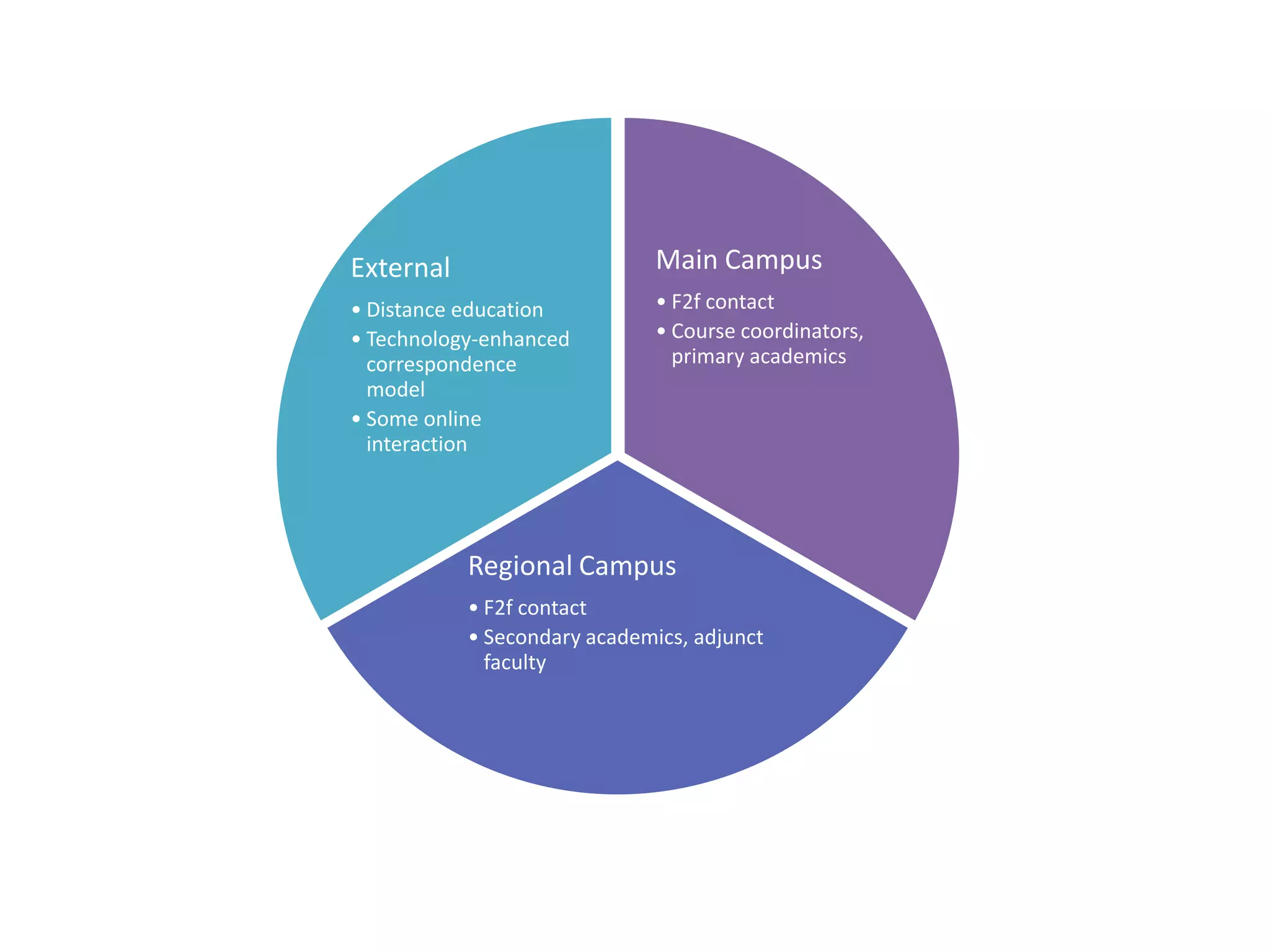
External                      Main Campus
• Distance education          • F2f contact
• Technology-enhanced         • Course coordinators,
  correspondence                primary academics
  model
• Some online
  interaction


           Regional Campus
           • F2f contact
           • Secondary academics, adjunct
             faculty
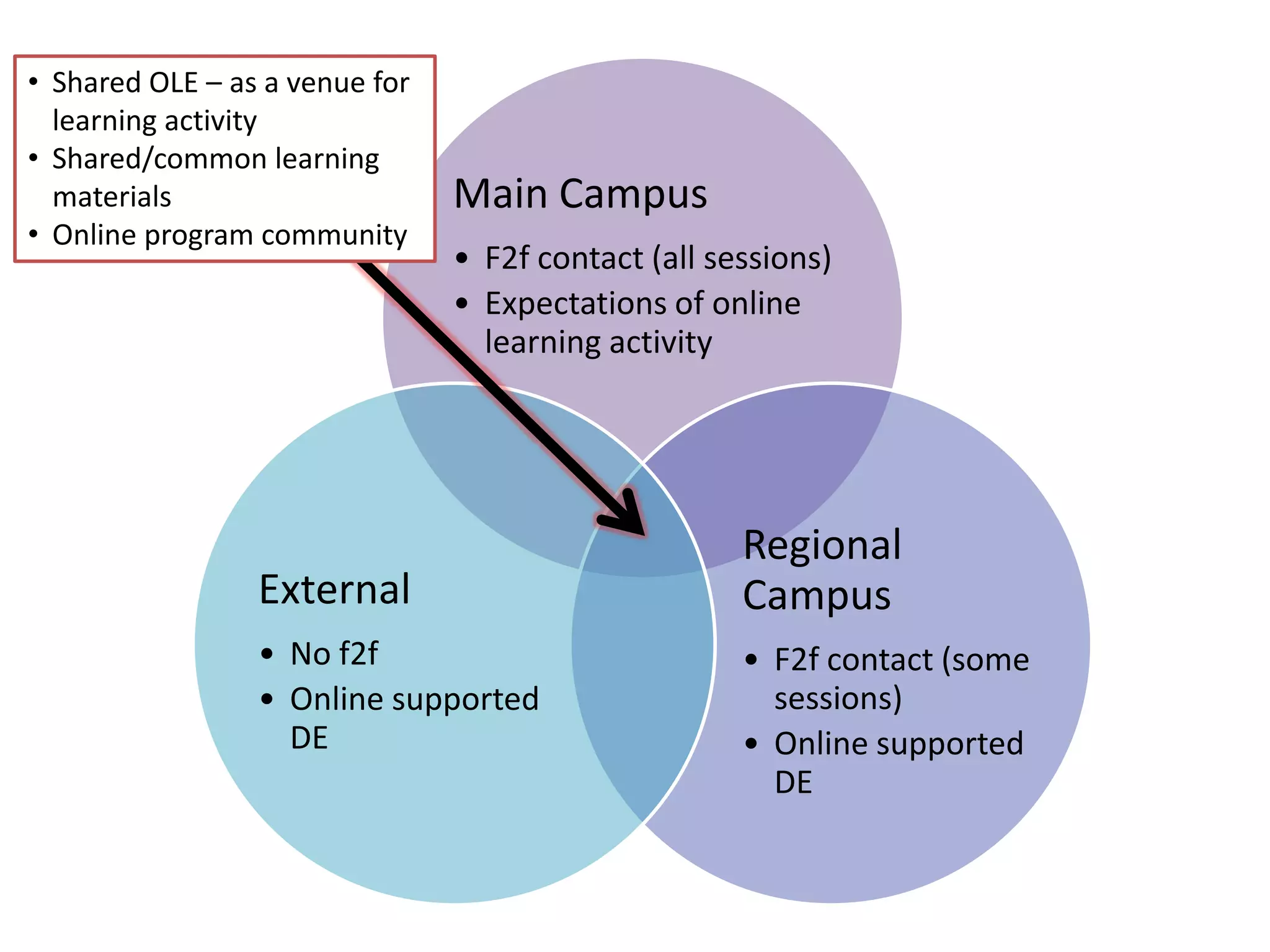
• Shared OLE – as a venue for
  learning activity
• Shared/common learning
  materials                     Main Campus
• Online program community
                                • F2f contact (all sessions)
                                • Expectations of online
                                  learning activity


                                                     Regional
                 External                            Campus
                 • No f2f                            • F2f contact (some
                 • Online supported                    sessions)
                   DE                                • Online supported
                                                       DE
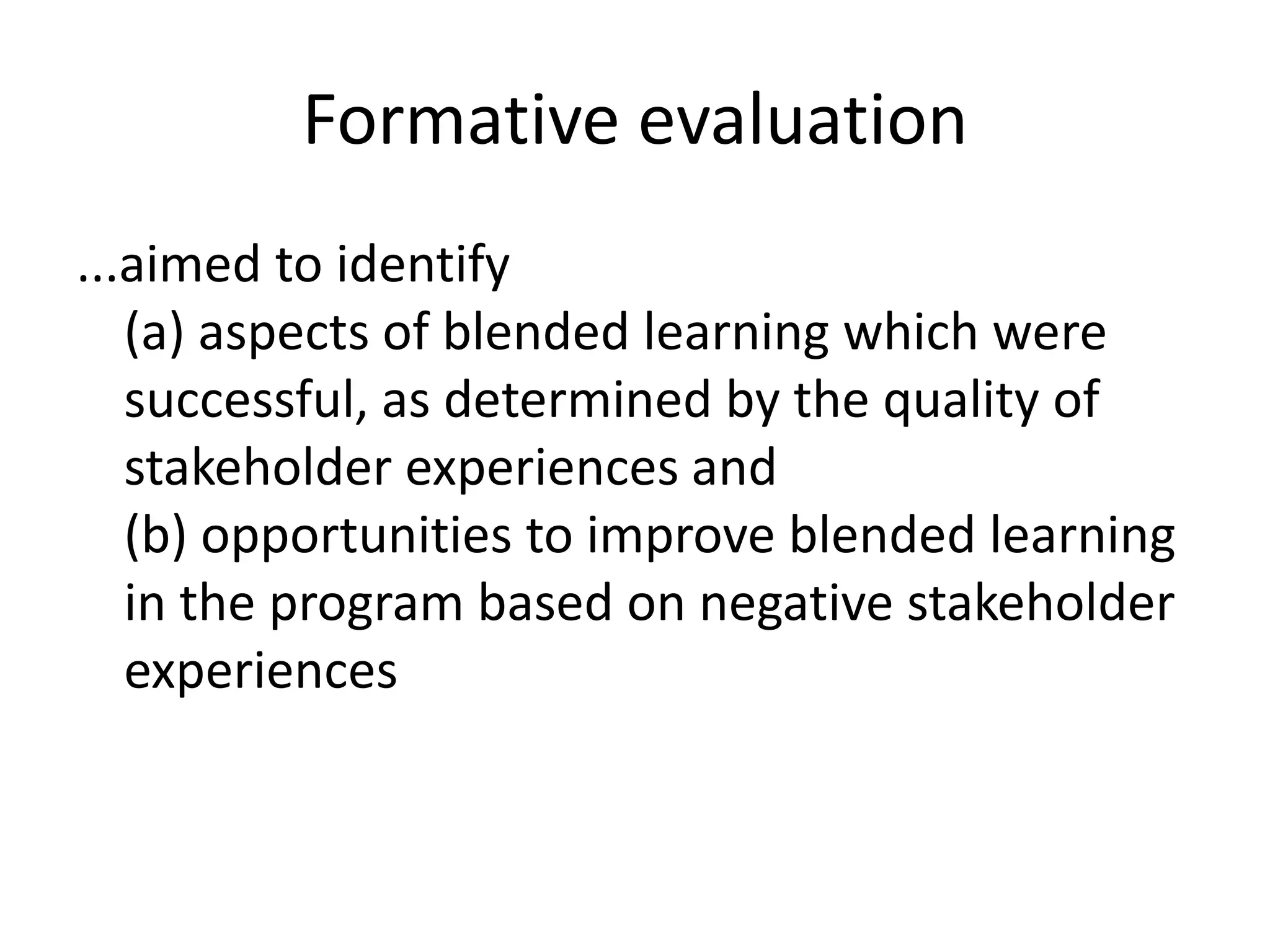
Formative evaluation
...aimed to identify
   (a) aspects of blended learning which were
   successful, as determined by the quality of
   stakeholder experiences and
   (b) opportunities to improve blended learning
   in the program based on negative stakeholder
   experiences
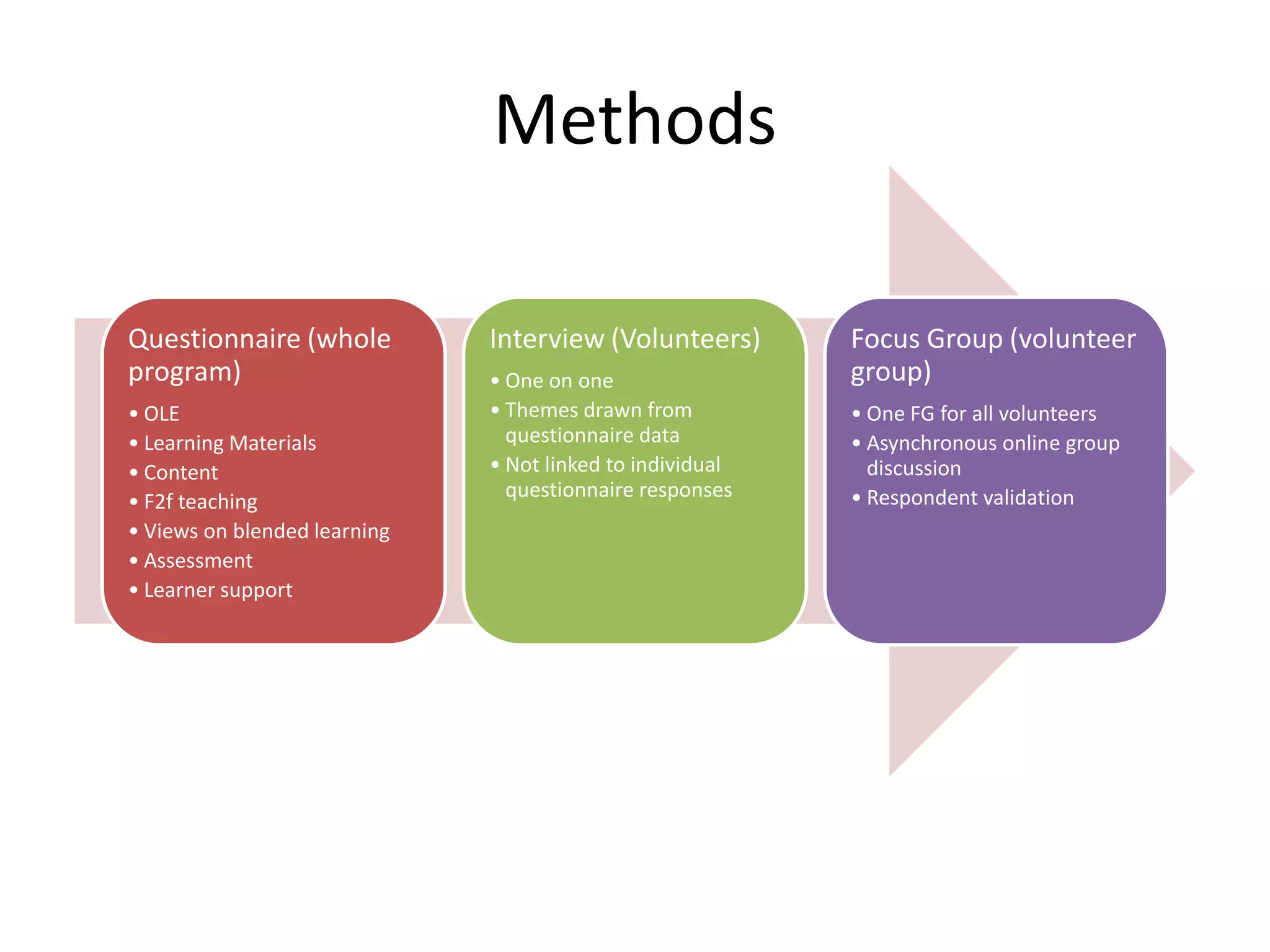
Methods

Questionnaire (whole          Interview (Volunteers)       Focus Group (volunteer
program)                      • One on one                 group)
• OLE                         • Themes drawn from          • One FG for all volunteers
• Learning Materials            questionnaire data         • Asynchronous online group
• Content                     • Not linked to individual     discussion
                                questionnaire responses    • Respondent validation
• F2f teaching
• Views on blended learning
• Assessment
• Learner support
Findings
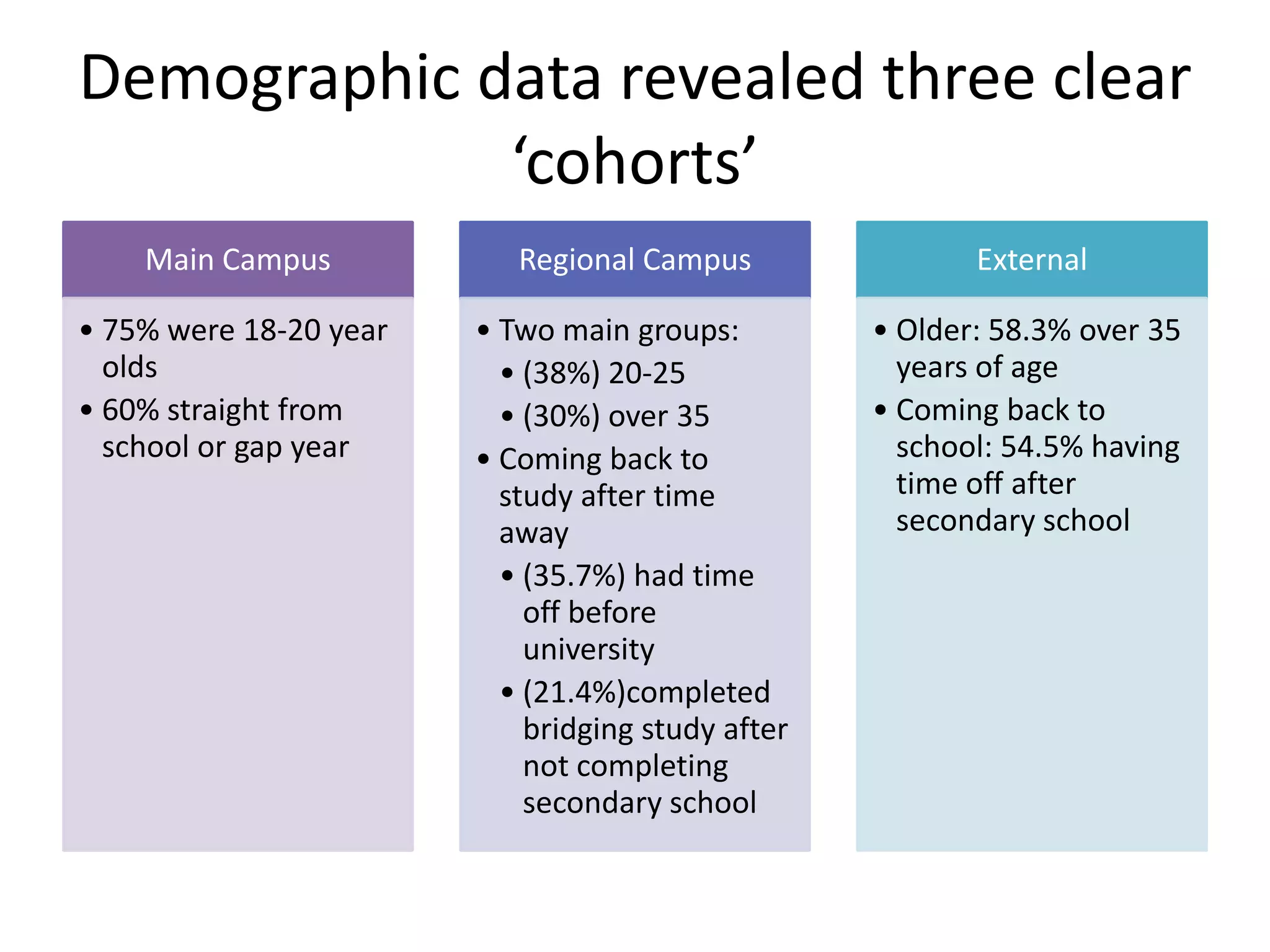
Demographic data revealed three clear
             ‘cohorts’
    Main Campus            Regional Campus                External

• 75% were 18-20 year   • Two main groups:         • Older: 58.3% over 35
  olds                    • (38%) 20-25              years of age
• 60% straight from       • (30%) over 35          • Coming back to
  school or gap year    • Coming back to             school: 54.5% having
                          study after time           time off after
                          away                       secondary school
                          • (35.7%) had time
                            off before
                            university
                          • (21.4%)completed
                            bridging study after
                            not completing
                            secondary school
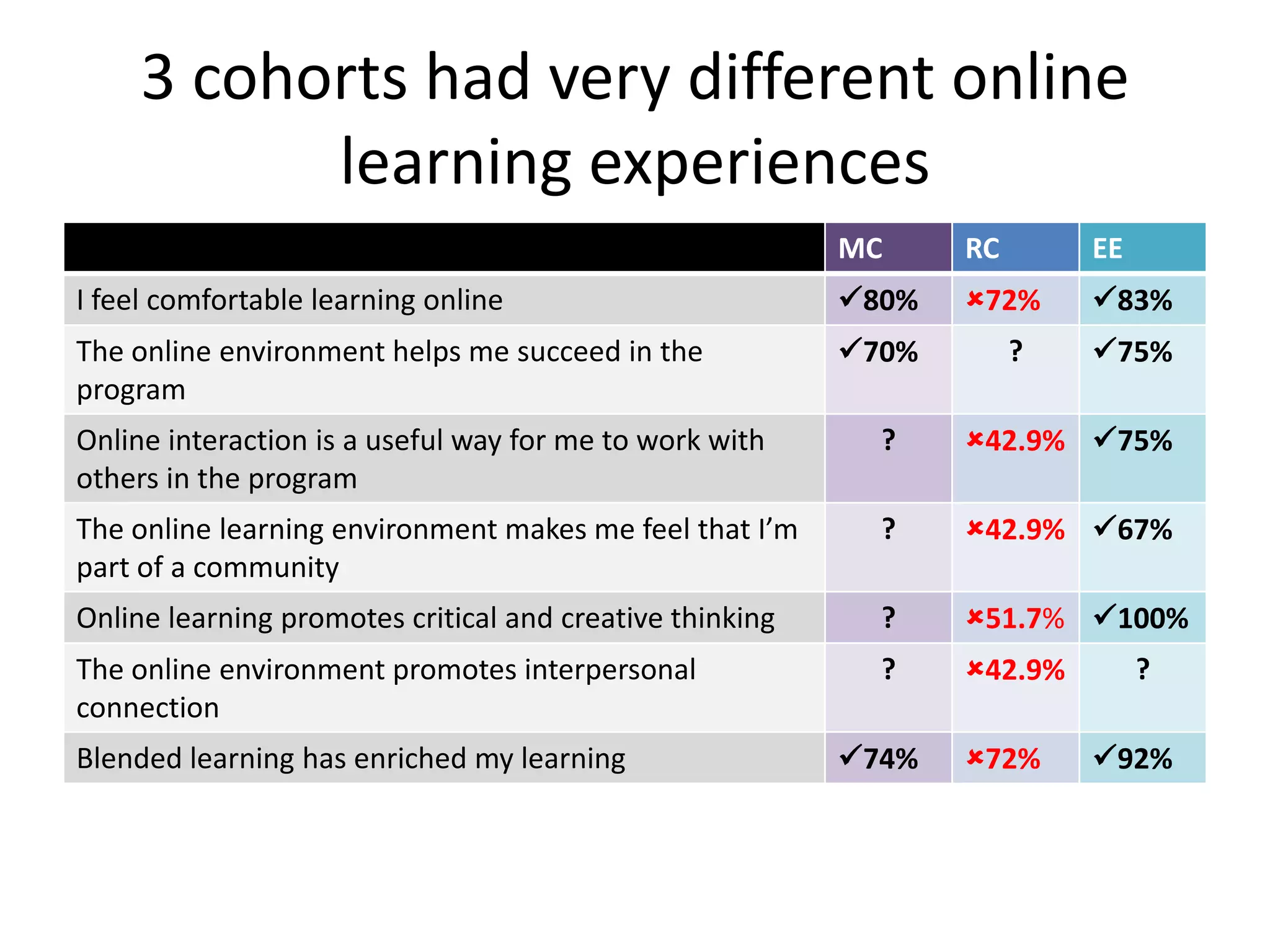
3 cohorts had very different online
           learning experiences
                                                          MC     RC       EE
I feel comfortable learning online                        80%   72%     83%
The online environment helps me succeed in the            70%        ?   75%
program
Online interaction is a useful way for me to work with      ?    42.9% 75%
others in the program
The online learning environment makes me feel that I’m      ?    42.9% 67%
part of a community
Online learning promotes critical and creative thinking     ?    51.7% 100%
The online environment promotes interpersonal               ?    42.9%        ?
connection
Blended learning has enriched my learning                 74%   72%     92%
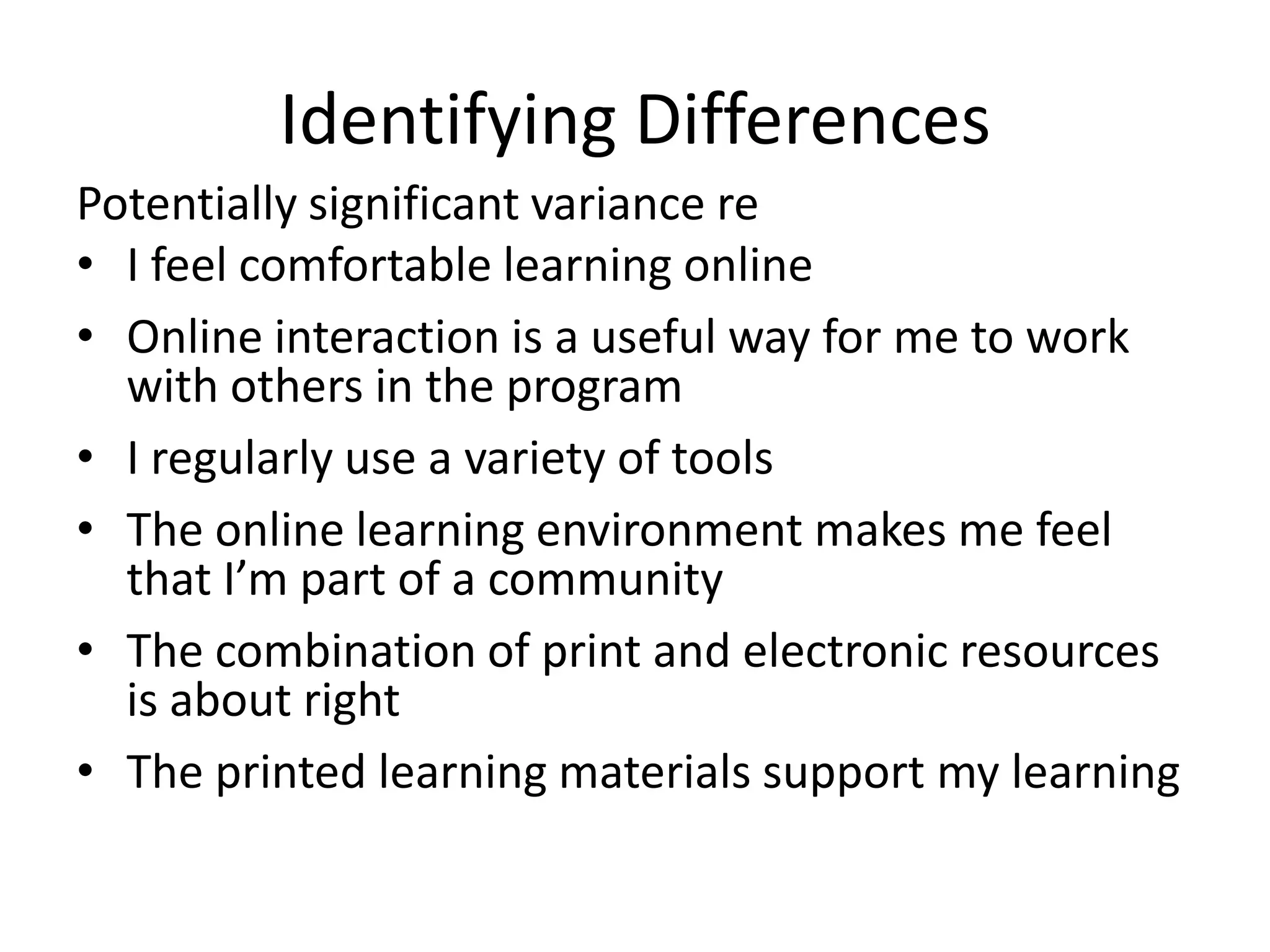
Identifying Differences
Potentially significant variance re
• I feel comfortable learning online
• Online interaction is a useful way for me to work
  with others in the program
• I regularly use a variety of tools
• The online learning environment makes me feel
  that I’m part of a community
• The combination of print and electronic resources
  is about right
• The printed learning materials support my learning
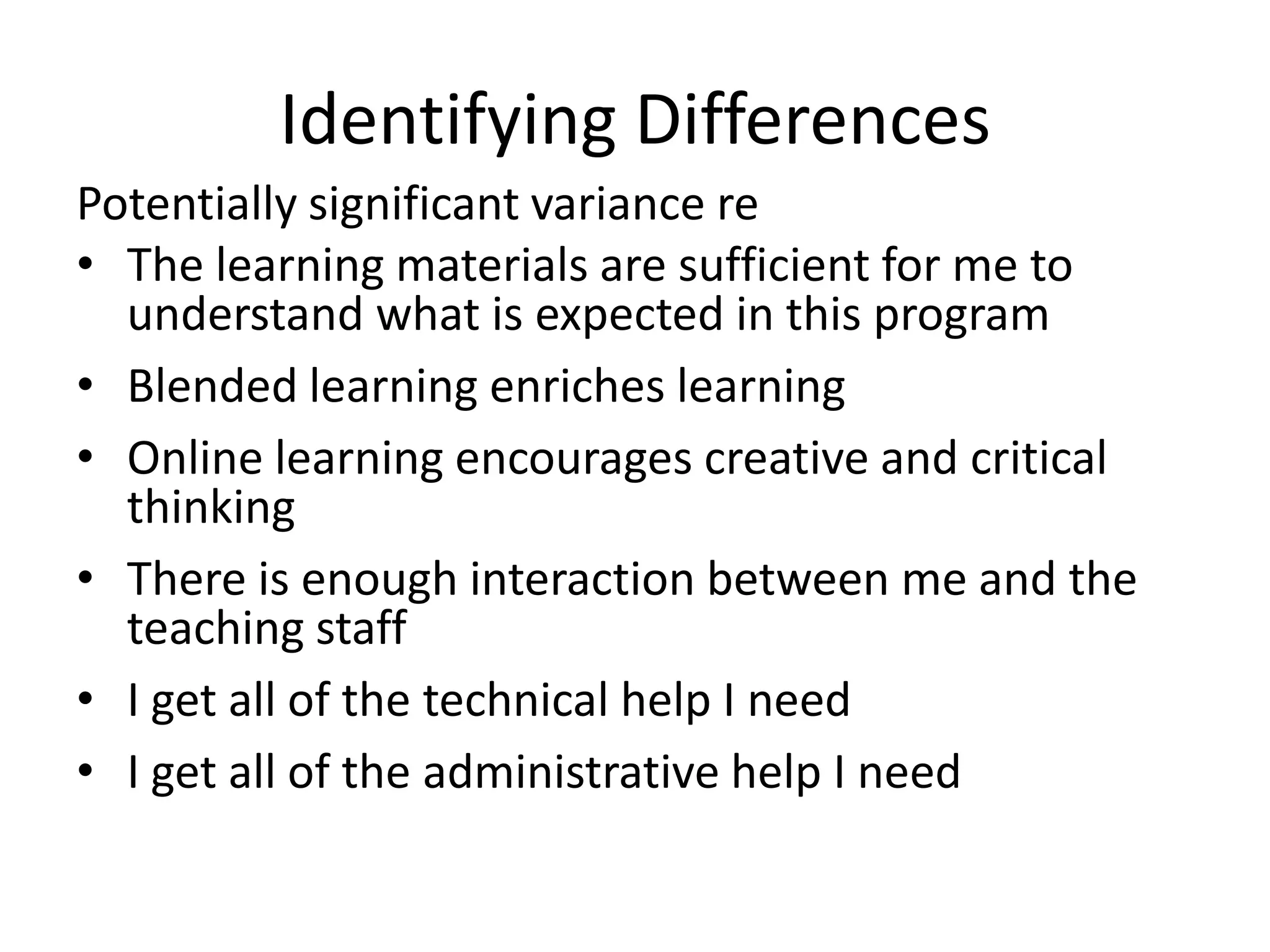
Identifying Differences
Potentially significant variance re
• The learning materials are sufficient for me to
  understand what is expected in this program
• Blended learning enriches learning
• Online learning encourages creative and critical
  thinking
• There is enough interaction between me and the
  teaching staff
• I get all of the technical help I need
• I get all of the administrative help I need
Main Campus


     mostly ‘as expected’-
     -Responses were not
       radically different
       within this cohort
        from the means
            (overall)
Regional Campus
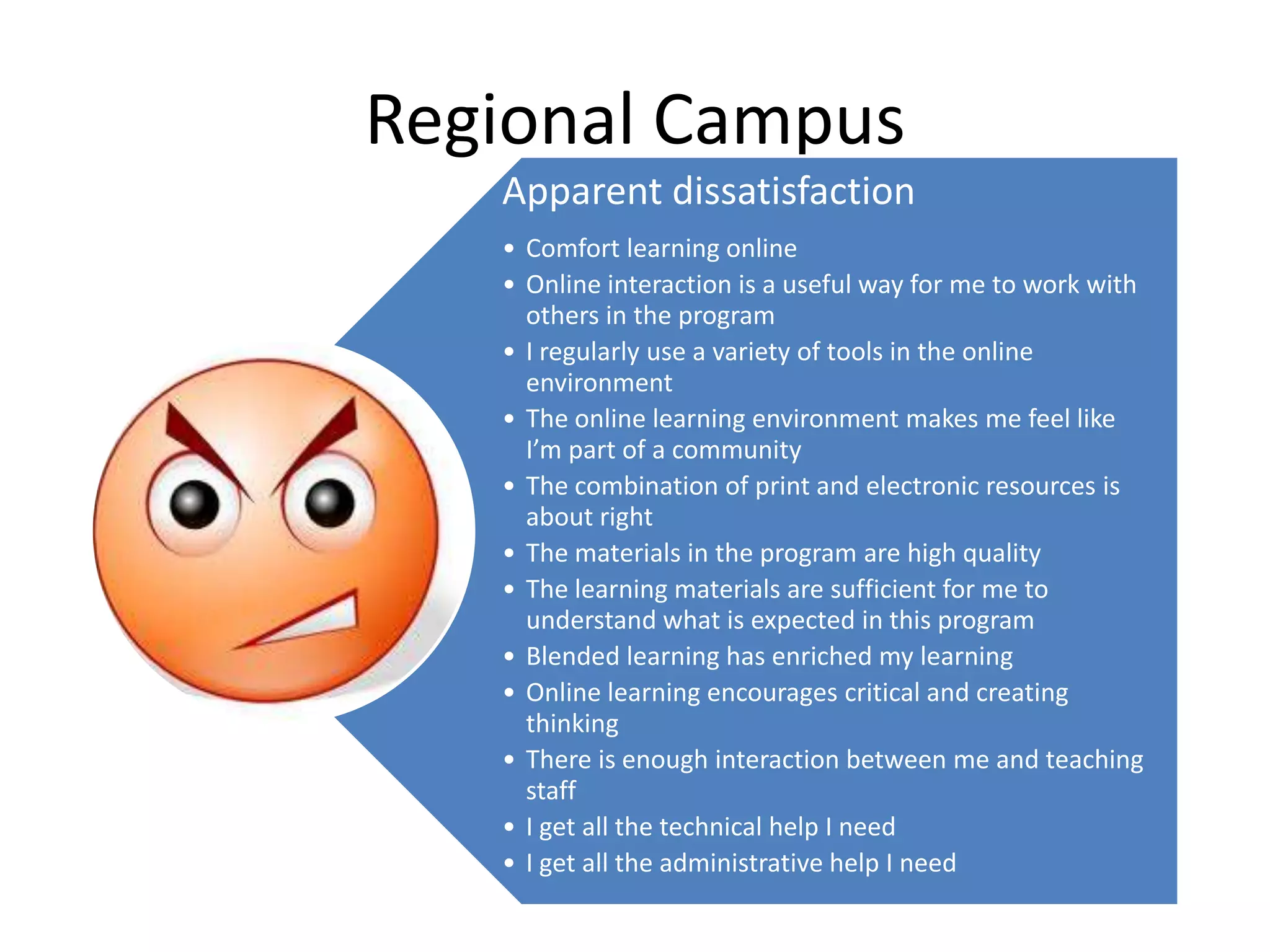
   Apparent dissatisfaction
   • Comfort learning online
   • Online interaction is a useful way for me to work with
     others in the program
   • I regularly use a variety of tools in the online
     environment
   • The online learning environment makes me feel like
     I’m part of a community
   • The combination of print and electronic resources is
     about right
   • The materials in the program are high quality
   • The learning materials are sufficient for me to
     understand what is expected in this program
   • Blended learning has enriched my learning
   • Online learning encourages critical and creating
     thinking
   • There is enough interaction between me and teaching
     staff
   • I get all the technical help I need
   • I get all the administrative help I need
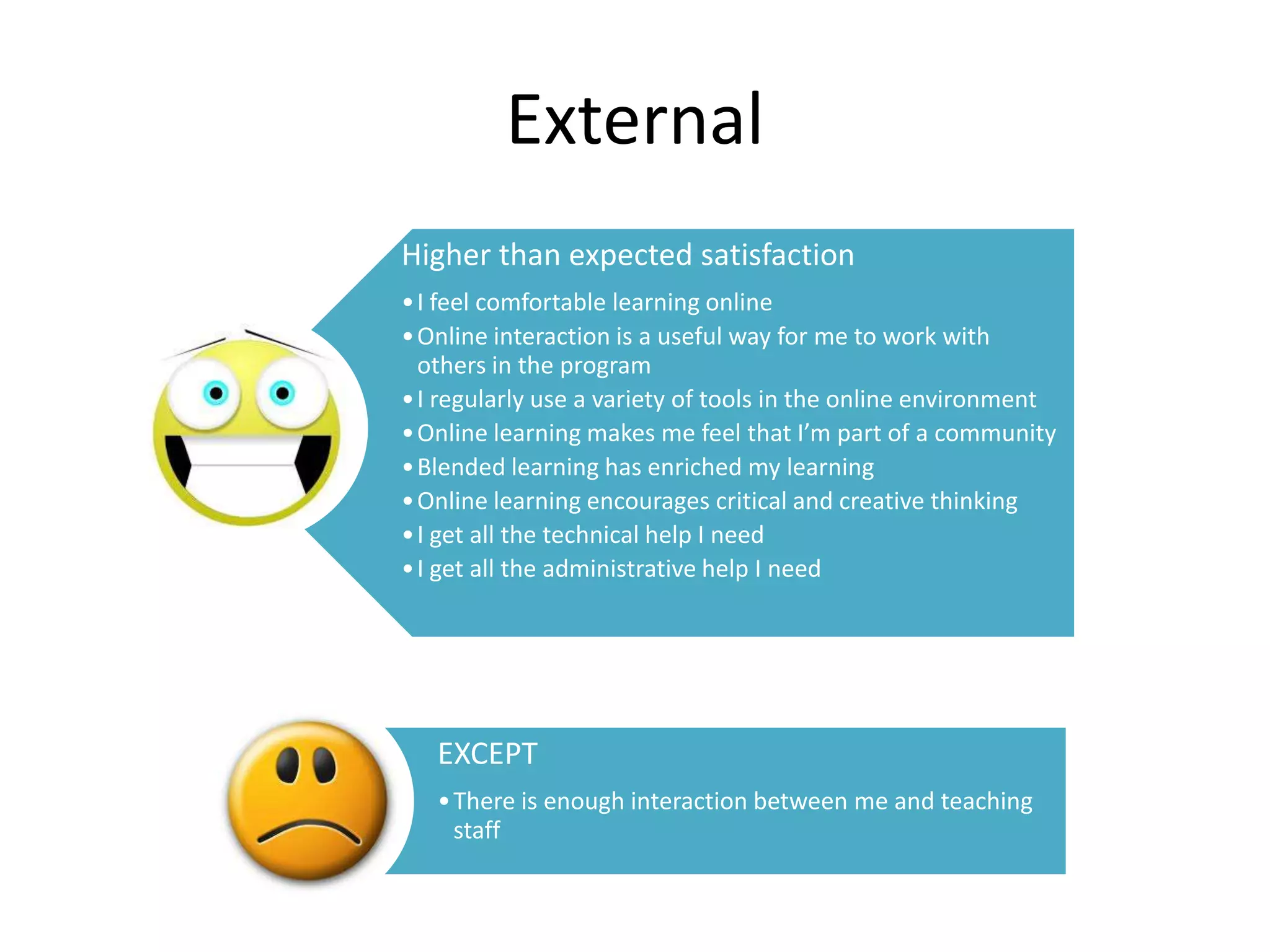
External
Higher than expected satisfaction
• I feel comfortable learning online
• Online interaction is a useful way for me to work with
  others in the program
• I regularly use a variety of tools in the online environment
• Online learning makes me feel that I’m part of a community
• Blended learning has enriched my learning
• Online learning encourages critical and creative thinking
• I get all the technical help I need
• I get all the administrative help I need


   EXCEPT
   • There is enough interaction between me and teaching
     staff
Notable contrasts:
1. Between Regional Campus and other modes in general
2. Between Regional Campus and the Main Campus on
   –   comfort with online learning,
   –   regular use of a variety of online tools,
   –   views of the combination of print and electronic materials,
   –   views on the quality of the materials,
   –   the extent to which the materials are ‘sufficient for me to
       understand what is expected in this program’,
   –   blended learning has enriched my learning,
   –   the interaction between learners and teaching staff,
   –   technical help and administrative help
3. Between External students and others re: the comfort
   with and use of online learning
• Are the differences in experience
How do we      between the cohorts due to
               differences in their needs, wants and
make sense     expectations?...
             • or due to differences in the blend of
 of this?      the program which was offered to
               them?


             • How does this inform design and
What have      development going forward?
             • How does it inform teaching? Learner
   we          support?

learned?
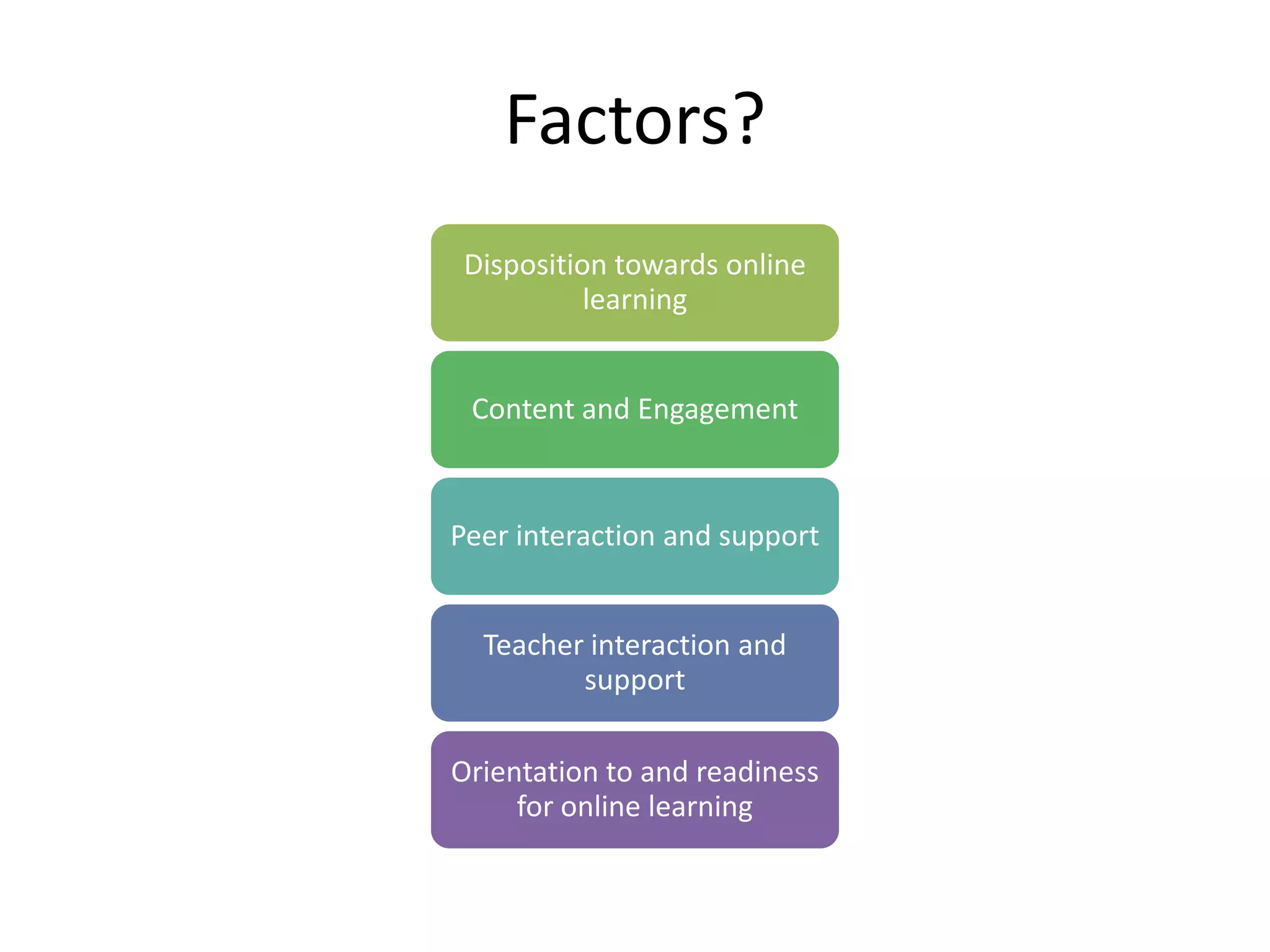
Factors?
 Disposition towards online
           learning


 Content and Engagement


Peer interaction and support


  Teacher interaction and
         support

Orientation to and readiness
     for online learning
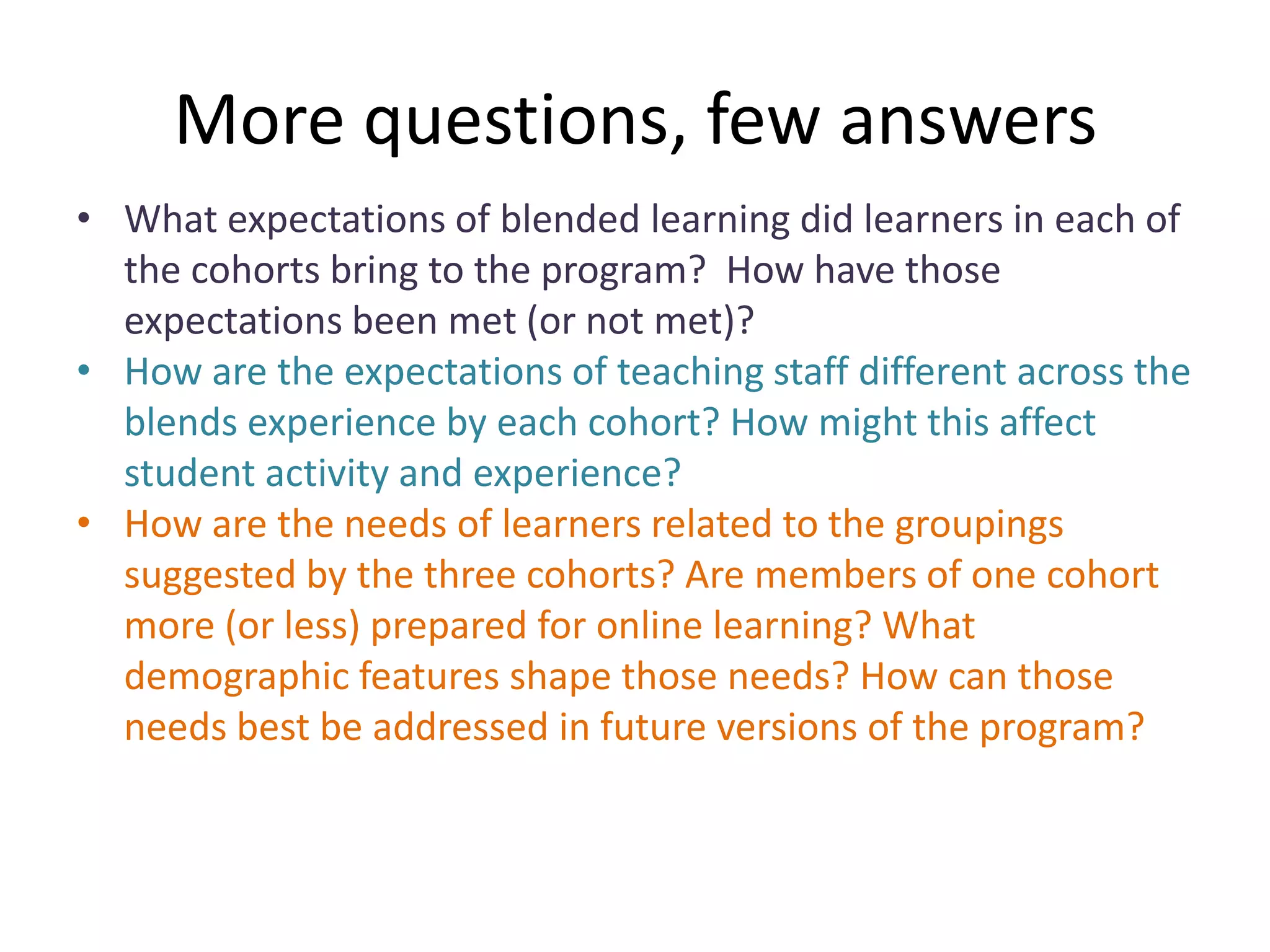
More questions, few answers
• What expectations of blended learning did learners in each of
  the cohorts bring to the program? How have those
  expectations been met (or not met)?
• How are the expectations of teaching staff different across the
  blends experience by each cohort? How might this affect
  student activity and experience?
• How are the needs of learners related to the groupings
  suggested by the three cohorts? Are members of one cohort
  more (or less) prepared for online learning? What
  demographic features shape those needs? How can those
  needs best be addressed in future versions of the program?
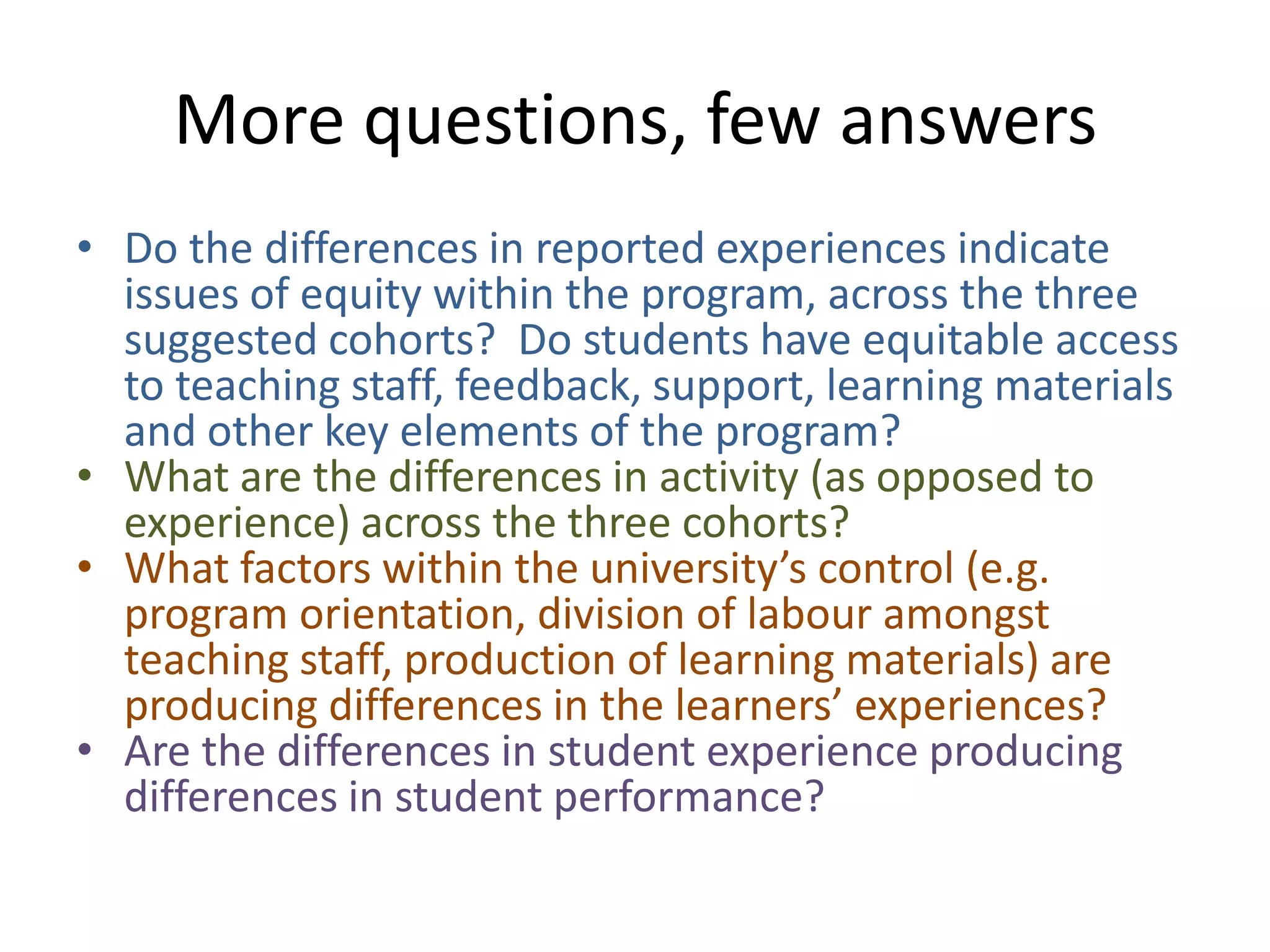
More questions, few answers
• Do the differences in reported experiences indicate
  issues of equity within the program, across the three
  suggested cohorts? Do students have equitable access
  to teaching staff, feedback, support, learning materials
  and other key elements of the program?
• What are the differences in activity (as opposed to
  experience) across the three cohorts?
• What factors within the university’s control (e.g.
  program orientation, division of labour amongst
  teaching staff, production of learning materials) are
  producing differences in the learners’ experiences?
• Are the differences in student experience producing
  differences in student performance?
Questions?


Thank you
ben.kehrwald@unisa.edu.au

Kehrwald Asciilte2011 Final

  • 1.
    Learner experiences ofonline learning in a blended learning situation: Different cohorts, different needs Benjamin Kehrwald University of South Australia Peter Rawlins Massey University Mary Simpson University of Otago
  • 2.
    Context • 4 year undergraduate Education program • Redeveloped in response to a program review • 5 year re-development process • New conceptual framework • New delivery framework – From 3 parallel delivery offerings to a blend – More extensive use of online learning as an enhancement
  • 3.
    External Main Campus • Distance education • F2f contact • Technology-enhanced • Course coordinators, correspondence primary academics model • Some online interaction Regional Campus • F2f contact • Secondary academics, adjunct faculty
  • 4.
    • Shared OLE– as a venue for learning activity • Shared/common learning materials Main Campus • Online program community • F2f contact (all sessions) • Expectations of online learning activity Regional External Campus • No f2f • F2f contact (some • Online supported sessions) DE • Online supported DE
  • 5.
    Formative evaluation ...aimed toidentify (a) aspects of blended learning which were successful, as determined by the quality of stakeholder experiences and (b) opportunities to improve blended learning in the program based on negative stakeholder experiences
  • 6.
    Methods Questionnaire (whole Interview (Volunteers) Focus Group (volunteer program) • One on one group) • OLE • Themes drawn from • One FG for all volunteers • Learning Materials questionnaire data • Asynchronous online group • Content • Not linked to individual discussion questionnaire responses • Respondent validation • F2f teaching • Views on blended learning • Assessment • Learner support
  • 7.
  • 8.
    Demographic data revealedthree clear ‘cohorts’ Main Campus Regional Campus External • 75% were 18-20 year • Two main groups: • Older: 58.3% over 35 olds • (38%) 20-25 years of age • 60% straight from • (30%) over 35 • Coming back to school or gap year • Coming back to school: 54.5% having study after time time off after away secondary school • (35.7%) had time off before university • (21.4%)completed bridging study after not completing secondary school
  • 9.
    3 cohorts hadvery different online learning experiences MC RC EE I feel comfortable learning online 80% 72% 83% The online environment helps me succeed in the 70% ? 75% program Online interaction is a useful way for me to work with ? 42.9% 75% others in the program The online learning environment makes me feel that I’m ? 42.9% 67% part of a community Online learning promotes critical and creative thinking ? 51.7% 100% The online environment promotes interpersonal ? 42.9% ? connection Blended learning has enriched my learning 74% 72% 92%
  • 10.
    Identifying Differences Potentially significantvariance re • I feel comfortable learning online • Online interaction is a useful way for me to work with others in the program • I regularly use a variety of tools • The online learning environment makes me feel that I’m part of a community • The combination of print and electronic resources is about right • The printed learning materials support my learning
  • 11.
    Identifying Differences Potentially significantvariance re • The learning materials are sufficient for me to understand what is expected in this program • Blended learning enriches learning • Online learning encourages creative and critical thinking • There is enough interaction between me and the teaching staff • I get all of the technical help I need • I get all of the administrative help I need
  • 12.
    Main Campus mostly ‘as expected’- -Responses were not radically different within this cohort from the means (overall)
  • 13.
    Regional Campus Apparent dissatisfaction • Comfort learning online • Online interaction is a useful way for me to work with others in the program • I regularly use a variety of tools in the online environment • The online learning environment makes me feel like I’m part of a community • The combination of print and electronic resources is about right • The materials in the program are high quality • The learning materials are sufficient for me to understand what is expected in this program • Blended learning has enriched my learning • Online learning encourages critical and creating thinking • There is enough interaction between me and teaching staff • I get all the technical help I need • I get all the administrative help I need
  • 14.
    External Higher than expectedsatisfaction • I feel comfortable learning online • Online interaction is a useful way for me to work with others in the program • I regularly use a variety of tools in the online environment • Online learning makes me feel that I’m part of a community • Blended learning has enriched my learning • Online learning encourages critical and creative thinking • I get all the technical help I need • I get all the administrative help I need EXCEPT • There is enough interaction between me and teaching staff
  • 15.
    Notable contrasts: 1. BetweenRegional Campus and other modes in general 2. Between Regional Campus and the Main Campus on – comfort with online learning, – regular use of a variety of online tools, – views of the combination of print and electronic materials, – views on the quality of the materials, – the extent to which the materials are ‘sufficient for me to understand what is expected in this program’, – blended learning has enriched my learning, – the interaction between learners and teaching staff, – technical help and administrative help 3. Between External students and others re: the comfort with and use of online learning
  • 16.
    • Are thedifferences in experience How do we between the cohorts due to differences in their needs, wants and make sense expectations?... • or due to differences in the blend of of this? the program which was offered to them? • How does this inform design and What have development going forward? • How does it inform teaching? Learner we support? learned?
  • 17.
    Factors? Disposition towardsonline learning Content and Engagement Peer interaction and support Teacher interaction and support Orientation to and readiness for online learning
  • 18.
    More questions, fewanswers • What expectations of blended learning did learners in each of the cohorts bring to the program? How have those expectations been met (or not met)? • How are the expectations of teaching staff different across the blends experience by each cohort? How might this affect student activity and experience? • How are the needs of learners related to the groupings suggested by the three cohorts? Are members of one cohort more (or less) prepared for online learning? What demographic features shape those needs? How can those needs best be addressed in future versions of the program?
  • 19.
    More questions, fewanswers • Do the differences in reported experiences indicate issues of equity within the program, across the three suggested cohorts? Do students have equitable access to teaching staff, feedback, support, learning materials and other key elements of the program? • What are the differences in activity (as opposed to experience) across the three cohorts? • What factors within the university’s control (e.g. program orientation, division of labour amongst teaching staff, production of learning materials) are producing differences in the learners’ experiences? • Are the differences in student experience producing differences in student performance?
  • 20.

Editor's Notes

  • #2 Introduction-Focus on: When we undertake innovative developments in online or blended learning, how do learners experience the resulting courses and programs? What can we learn from their experiences? How can those experiences be used to inform ongoing development?
  • #6 What experiences are students having in our new blended program?OLELearning MaterialsContentF2f teachingViews on blended learningAssessmentLearner supportHow can those experiences inform the ongoing improvement of our program?
  • #14 Comfort learning onlineOnline interaction is a useful way for me to work with others in the programI regularly use a variety of tools in the online environmentThe online learning environment makes me feel like I’m part of a communityThe combination of print and electronic resources is about rightThe materials in the program are high qualityThe learning materials are sufficient for me to understand what is expected in this programBlended learning has enriched my learningOnline learning encourages critical and creating thinkingThere is enough interaction between me and teaching staffI get all the technical help I needI get all the administrative help I need
  • #17 What expectations of blended learning did learners in each of the cohorts bring to the program? How have those expectations been met (or not met)? How are the expectations of teaching staff different across the blends experience by each cohort? How might this affect student activity and experience?How are the needs of learners related to the groupings suggested by the three cohorts? Are members of one cohort more (or less) prepared for online learning? What demographic features shape those needs? How can those needs best be addressed in future versions of the program?Do the differences in reported experiences indicate issues of equity within the program, across the three suggested cohorts? Do students have equitable access to teaching staff, feedback, support, learning materials and other key elements of the program?What are the differences in activity (as opposed to experience) across the three cohorts? What factors within the university’s control (e.g. program orientation, division of labour amongst teaching staff, production of learning materials) are producing differences in the learners’ experiences?Are the differences in student experience producing differences in student performance?
  • #18 online learning promotes a community of inquiryblended learning enriches learningonline learning encourages creative and critical thinkingthe online learning environment promotes interpersonal connectionI regularly use a variety of toolsThe online learning environment helps me succeed in this programmeThe online learning environment makes me feel that I’m part of a communityI feel comfortable learning onlineOnline interaction is a useful way for me to work with others in the programmeDiscussions and other content we create in the online learning environment support my learningSharing and discussion in the online environment works well