Probabilistic Risk Assessment  Design Requirements Test Programs Field Information Uncertainty, Legal & Regulatory
Safety Safety: Freedom from unacceptable risk of harm Probability of a hazardous event :   Probable, occasional, remote, improbable, incredible  Severity of the consequence of the hazardous event: Negligible, marginal, moderate, major, critical
Probability Labels Qualitative labels signals a vague or uncertain probability Interpretation of Qualitative labels depends on context Users prefer quantitative data Quantitative data may result in unwarranted assumptions about precision of the data Interpretation unduly influenced by absolute numbers
Types of Risk V oluntary Risk:  Rock climbing, race car driving, horse jumping, smoking, diving  I nvoluntary Risk: Natural disasters, sickness
Risk and Fear Woody Allen’s definition of major surgery: “Anything being done to me” Greater fear of Human made risks than natural risks Voluntary risk less threatening than other Highly personal
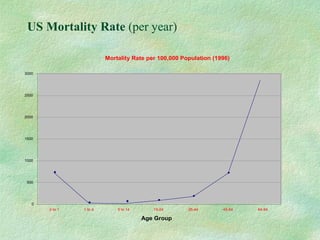
US Mortality Rate  (per year)
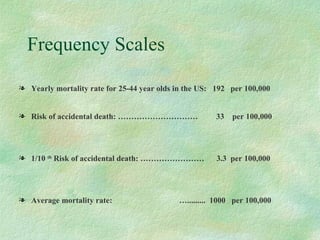
Frequency Scales Yearly mortality rate for 25-44 year olds in the US:  192  per 100,000  Risk of accidental death: …………………………  33  per 100,000 1/10  th  Risk of accidental death: ……………………  3.3  per 100,000 Average mortality rate:  ….........  1000  per 100,000
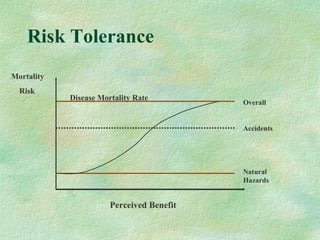
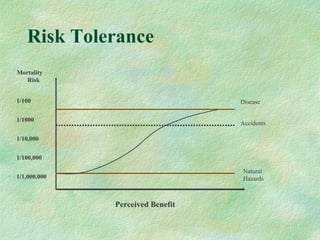
Risk Tolerance Mortality  Risk Natural Hazards Overall Accidents Perceived Benefit Disease Mortality Rate
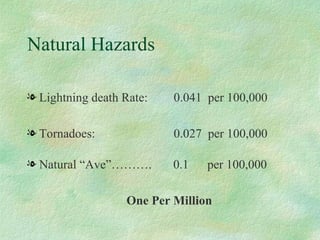
Natural Hazards Lightning death Rate:   0.041  per 100,000 Tornadoes:   0.027  per 100,000 Natural “Ave”……….  0.1  per 100,000 One Per Million
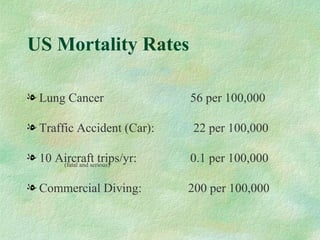
US Mortality Rates Lung Cancer    56 per 100,000 Traffic Accident (Car):    22 per 100,000 10 Aircraft trips/yr:     0.1 per 100,000 Commercial Diving:  200 per 100,000 (fatal and serious)
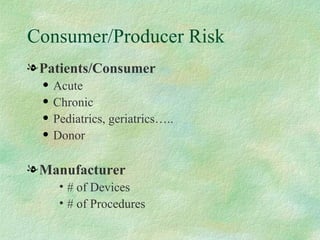
Consumer/Producer Risk Patients/Consumer Acute Chronic Pediatrics, geriatrics….. Donor Manufacturer # of Devices # of Procedures
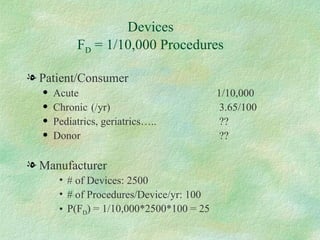
  Devices    F D  = 1/10,000 Procedures Patient/Consumer Acute    1/10,000 Chronic (/yr) 3.65/100 Pediatrics, geriatrics….. ?? Donor ?? Manufacturer # of Devices: 2500 # of Procedures/Device/yr: 100 P(F D ) = 1/10,000*2500*100 = 25
Risk Tolerance Mortality  Risk 1/100 1/1000 1/10,000 1/100,000 1/1,000,000 Natural Hazards Accidents Perceived Benefit Disease
Summary Systems, not Components Systematic failures hard to predict Manufacturers burden to determine acceptable risk levels, probability and severity Life Cycle Use environment

Probabilistic Risk Assessment

  • 1.
    Probabilistic Risk Assessment Design Requirements Test Programs Field Information Uncertainty, Legal & Regulatory
  • 2.
    Safety Safety: Freedomfrom unacceptable risk of harm Probability of a hazardous event : Probable, occasional, remote, improbable, incredible Severity of the consequence of the hazardous event: Negligible, marginal, moderate, major, critical
  • 3.
    Probability Labels Qualitativelabels signals a vague or uncertain probability Interpretation of Qualitative labels depends on context Users prefer quantitative data Quantitative data may result in unwarranted assumptions about precision of the data Interpretation unduly influenced by absolute numbers
  • 4.
    Types of RiskV oluntary Risk: Rock climbing, race car driving, horse jumping, smoking, diving I nvoluntary Risk: Natural disasters, sickness
  • 5.
    Risk and FearWoody Allen’s definition of major surgery: “Anything being done to me” Greater fear of Human made risks than natural risks Voluntary risk less threatening than other Highly personal
  • 6.
    US Mortality Rate (per year)
  • 7.
    Frequency Scales Yearlymortality rate for 25-44 year olds in the US: 192 per 100,000 Risk of accidental death: ………………………… 33 per 100,000 1/10 th Risk of accidental death: …………………… 3.3 per 100,000 Average mortality rate: …......... 1000 per 100,000
  • 8.
    Risk Tolerance Mortality Risk Natural Hazards Overall Accidents Perceived Benefit Disease Mortality Rate
  • 9.
    Natural Hazards Lightningdeath Rate: 0.041 per 100,000 Tornadoes: 0.027 per 100,000 Natural “Ave”………. 0.1 per 100,000 One Per Million
  • 10.
    US Mortality RatesLung Cancer 56 per 100,000 Traffic Accident (Car): 22 per 100,000 10 Aircraft trips/yr: 0.1 per 100,000 Commercial Diving: 200 per 100,000 (fatal and serious)
  • 11.
    Consumer/Producer Risk Patients/ConsumerAcute Chronic Pediatrics, geriatrics….. Donor Manufacturer # of Devices # of Procedures
  • 12.
    Devices F D = 1/10,000 Procedures Patient/Consumer Acute 1/10,000 Chronic (/yr) 3.65/100 Pediatrics, geriatrics….. ?? Donor ?? Manufacturer # of Devices: 2500 # of Procedures/Device/yr: 100 P(F D ) = 1/10,000*2500*100 = 25
  • 13.
    Risk Tolerance Mortality Risk 1/100 1/1000 1/10,000 1/100,000 1/1,000,000 Natural Hazards Accidents Perceived Benefit Disease
  • 14.
    Summary Systems, notComponents Systematic failures hard to predict Manufacturers burden to determine acceptable risk levels, probability and severity Life Cycle Use environment