Hasan Ahmed ID-13132052
Md. Asadur Rahman Khan ID -13132360
Abdullah Al Hadee ID13132361
Rubel Mia ID-13132802
Shah Emrm Shwon ID 13132157
Batch – 23rd
Dept. of Textile Engineering
City University
According to ISO,
“Quality is the fulfillment of specified requirements of the
product or service”
Quality Control
“Quality control is the operational techniques and activities that
are used to fulfill requirements for quality”
Technique
 Testing
 Inspection
Quality
“Visual examination or review of raw materials, partially
finished components of garments and completely finished
garments in relation to some standards, specifications, or
requirements, as well as measuring garments to check if they
meet the required measurements.”
Inspection Loop:
INSPECTION
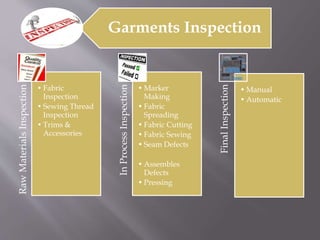
RawMaterialsInspection
• Fabric
Inspection
• Sewing Thread
Inspection
• Trims &
Accessories
InProcessInspection
• Marker
Making
• Fabric
Spreading
• Fabric Cutting
• Fabric Sewing
• Seam Defects
• Assembles
Defects
• Pressing
FinalInspection
• Manual
• Automatic
Garments Inspection
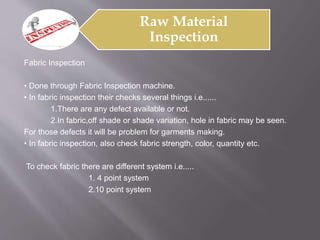
Fabric Inspection
• Done through Fabric Inspection machine.
• In fabric inspection their checks several things i.e......
1.There are any defect available or not.
2.In fabric,off shade or shade variation, hole in fabric may be seen.
For those defects it will be problem for garments making.
• In fabric inspection, also check fabric strength, color, quantity etc.
To check fabric there are different system i.e.....
1. 4 point system
2.10 point system
Raw Material
Inspection
Automatic Fabric
Inspection Machine
KONSAN FABRIC INSPECTION
REMASOSA FABRIC
INSPECTION
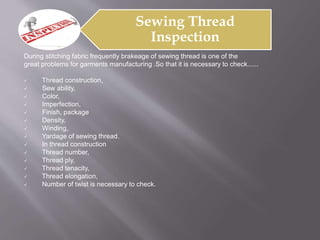
During stitching fabric frequently brakeage of sewing thread is one of the
great problems for garments manufacturing .So that it is necessary to check......
 Thread construction,
 Sew ability,
 Color,
 Imperfection,
 Finish, package
 Density,
 Winding,
 Yardage of sewing thread.
 In thread construction
 Thread number,
 Thread ply,
 Thread tenacity,
 Thread elongation,
 Number of twist is necessary to check.
Sewing Thread
Inspection
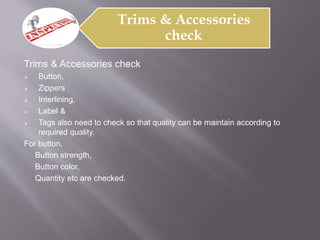
Trims & Accessories check
 Button,
 Zippers
 Interlining,
 Label &
 Tags also need to check so that quality can be maintain according to
required quality.
For button,
Button strength,
Button color,
Quantity etc are checked.
Trims & Accessories
check
 Inspecting different parts of garments before sewing are called in
process inspection.
In inprocess inspection following functions are inspected.........
 – marker making
 – fabric spreading
 – fabric cutting
 – sorting/ bundling
 – fabric sewing
 – seam defects
 – assembly defects
 – pressing/ finishing defects
In Process
Inspection
 Marking inspection Factors which must be checked........
It is necessary to check all the parts of garments pattern are in marker.....
• labeling or coding of pattern
• Pattern direction
• The entire pattern
• Pattern grain line
• Every pattern pieces dimension
• Fabric length and width
• Marker width
• Notches & drill marks
• Knife clearance
• Checks and stripes (mittering)
Marker Making
Inspection
 Spreading inspection Factors which must be checked........
• Fabric Nature
• Ply alignment
• Ply tension/slackness
• Bowing
• Splicing
• Grain-line
• Shade variation
• Selvedge alignment & tightness
• Fabric width
• Checks
• Static electricity
Fabric Spreading
Inspection
 Uneven Spreading
 Narrow Material
 Missed Sectional Breaks
 Improper Tension
 Mismatching Plaids
 Misdirected Napping
 Improper Matching of Face of
Material
Fabric Spreading
Defects
 Cutting inspection Factors/defects which must be
checked..........
• Frayed edge
• Fuzzy, ragged or serrated edges
• Ply to ply fusion
• Single edge fusion
• Pattern precision
• Notches & drillers
• Cutting Equipment precision
Fabric Cutting
Inspection
We should check this defect during cutting.........
 Marker or Perforator
 Misplaced Piece Rate Tickets or Bundle Members
 Drill Marks
 Opening Slits
 Improper Cutting
 Notches
 Oil Spots
 Improper Knife Sharpening
 Knife or Scissor Cut
Fabric Cutting Defects
Sewing inspection.......
 Most large & important section.
 Necessary to check all the machine operators work.
 Some common faults and problems must be considered
– Sewing defects
– Seaming defects
– Assembly defects
– Pressing or Finishing defects
Fabric Sewing
Inspection
Sewing inspection
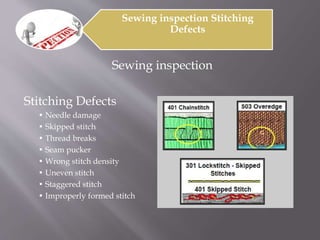
Stitching Defects
• Needle damage
• Skipped stitch
• Thread breaks
• Seam pucker
• Wrong stitch density
• Uneven stitch
• Staggered stitch
• Improperly formed stitch
Sewing inspection Stitching
Defects
Seaming defects:
• Uneven width
• Fault stitch line
• Back stitch must be given properly
• Twisting
• Check or strip matching
• Seam matching
• Wrong stitch face side or back side;
• Thread color shade variation.
Sewing Inspection
Assembly defects:
• Finished component of not accurate size.
• Garments not accurate in size.
• If any design skip to join.
• Component is not joining in right place.
• If lining is tight or loose.
• If parts direction is wrong.
Sewing Inspection
Sewing inspection Folding defects
• Garment is not folded to specification
• Garment not folded with proper material like cardboard, tissues or
other material.
• Incorrect pins or folds
• Garment not buttoned
• Label not showing
Sewing Inspection
 In final inspection generally inspect fully complete garments.
 Before final inspection there has no chance to check complete garments.
 It is important from the buyer to finally check.
 In final inspection normally garments size, form fitting, fabric faults are
checked.
Final Inspection
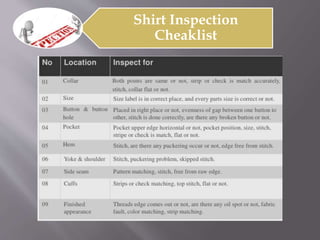
Shirt Inspection
Cheaklist
Knitted T-Shirt
 Normally inspection is the most important function for garments
product.
 In garments industry inspection should be given in every section which
was discussed before briefly.
 And should keep in mind that inspection is done by designated
responsible inspectors then only the right quality product will reach the
consumer.
 It becomes necessary to maintain the quality right from the production
stage in order to deliver a satisfactory final product to the consumer
with the right quality which in turn results in getting continuous orders
from the same customers.
Conclusion
Inspection

Inspection

  • 2.
    Hasan Ahmed ID-13132052 Md.Asadur Rahman Khan ID -13132360 Abdullah Al Hadee ID13132361 Rubel Mia ID-13132802 Shah Emrm Shwon ID 13132157 Batch – 23rd Dept. of Textile Engineering City University
  • 4.
    According to ISO, “Qualityis the fulfillment of specified requirements of the product or service” Quality Control “Quality control is the operational techniques and activities that are used to fulfill requirements for quality” Technique  Testing  Inspection Quality
  • 5.
    “Visual examination orreview of raw materials, partially finished components of garments and completely finished garments in relation to some standards, specifications, or requirements, as well as measuring garments to check if they meet the required measurements.” Inspection Loop: INSPECTION
  • 6.
    RawMaterialsInspection • Fabric Inspection • SewingThread Inspection • Trims & Accessories InProcessInspection • Marker Making • Fabric Spreading • Fabric Cutting • Fabric Sewing • Seam Defects • Assembles Defects • Pressing FinalInspection • Manual • Automatic Garments Inspection
  • 7.
    Fabric Inspection • Donethrough Fabric Inspection machine. • In fabric inspection their checks several things i.e...... 1.There are any defect available or not. 2.In fabric,off shade or shade variation, hole in fabric may be seen. For those defects it will be problem for garments making. • In fabric inspection, also check fabric strength, color, quantity etc. To check fabric there are different system i.e..... 1. 4 point system 2.10 point system Raw Material Inspection
  • 8.
    Automatic Fabric Inspection Machine KONSANFABRIC INSPECTION REMASOSA FABRIC INSPECTION
  • 9.
    During stitching fabricfrequently brakeage of sewing thread is one of the great problems for garments manufacturing .So that it is necessary to check......  Thread construction,  Sew ability,  Color,  Imperfection,  Finish, package  Density,  Winding,  Yardage of sewing thread.  In thread construction  Thread number,  Thread ply,  Thread tenacity,  Thread elongation,  Number of twist is necessary to check. Sewing Thread Inspection
  • 10.
    Trims & Accessoriescheck  Button,  Zippers  Interlining,  Label &  Tags also need to check so that quality can be maintain according to required quality. For button, Button strength, Button color, Quantity etc are checked. Trims & Accessories check
  • 11.
     Inspecting differentparts of garments before sewing are called in process inspection. In inprocess inspection following functions are inspected.........  – marker making  – fabric spreading  – fabric cutting  – sorting/ bundling  – fabric sewing  – seam defects  – assembly defects  – pressing/ finishing defects In Process Inspection
  • 12.
     Marking inspectionFactors which must be checked........ It is necessary to check all the parts of garments pattern are in marker..... • labeling or coding of pattern • Pattern direction • The entire pattern • Pattern grain line • Every pattern pieces dimension • Fabric length and width • Marker width • Notches & drill marks • Knife clearance • Checks and stripes (mittering) Marker Making Inspection
  • 13.
     Spreading inspectionFactors which must be checked........ • Fabric Nature • Ply alignment • Ply tension/slackness • Bowing • Splicing • Grain-line • Shade variation • Selvedge alignment & tightness • Fabric width • Checks • Static electricity Fabric Spreading Inspection
  • 14.
     Uneven Spreading Narrow Material  Missed Sectional Breaks  Improper Tension  Mismatching Plaids  Misdirected Napping  Improper Matching of Face of Material Fabric Spreading Defects
  • 15.
     Cutting inspectionFactors/defects which must be checked.......... • Frayed edge • Fuzzy, ragged or serrated edges • Ply to ply fusion • Single edge fusion • Pattern precision • Notches & drillers • Cutting Equipment precision Fabric Cutting Inspection
  • 16.
    We should checkthis defect during cutting.........  Marker or Perforator  Misplaced Piece Rate Tickets or Bundle Members  Drill Marks  Opening Slits  Improper Cutting  Notches  Oil Spots  Improper Knife Sharpening  Knife or Scissor Cut Fabric Cutting Defects
  • 17.
    Sewing inspection.......  Mostlarge & important section.  Necessary to check all the machine operators work.  Some common faults and problems must be considered – Sewing defects – Seaming defects – Assembly defects – Pressing or Finishing defects Fabric Sewing Inspection
  • 18.
    Sewing inspection Stitching Defects •Needle damage • Skipped stitch • Thread breaks • Seam pucker • Wrong stitch density • Uneven stitch • Staggered stitch • Improperly formed stitch Sewing inspection Stitching Defects
  • 19.
    Seaming defects: • Unevenwidth • Fault stitch line • Back stitch must be given properly • Twisting • Check or strip matching • Seam matching • Wrong stitch face side or back side; • Thread color shade variation. Sewing Inspection
  • 20.
    Assembly defects: • Finishedcomponent of not accurate size. • Garments not accurate in size. • If any design skip to join. • Component is not joining in right place. • If lining is tight or loose. • If parts direction is wrong. Sewing Inspection
  • 21.
    Sewing inspection Foldingdefects • Garment is not folded to specification • Garment not folded with proper material like cardboard, tissues or other material. • Incorrect pins or folds • Garment not buttoned • Label not showing Sewing Inspection
  • 22.
     In finalinspection generally inspect fully complete garments.  Before final inspection there has no chance to check complete garments.  It is important from the buyer to finally check.  In final inspection normally garments size, form fitting, fabric faults are checked. Final Inspection
  • 23.
  • 24.
  • 25.
     Normally inspectionis the most important function for garments product.  In garments industry inspection should be given in every section which was discussed before briefly.  And should keep in mind that inspection is done by designated responsible inspectors then only the right quality product will reach the consumer.  It becomes necessary to maintain the quality right from the production stage in order to deliver a satisfactory final product to the consumer with the right quality which in turn results in getting continuous orders from the same customers. Conclusion