QUALITY & SAFETY-VISION 2025
Manjunathan C.
RN RPN., M.Sc.(N)., M.Sc.,(CP)
Deputy Nursing Superintendent,
Apollo CBCC Cancer Care,
Apollo Hospitals International Ltd.
Introduction to Quality & Safety
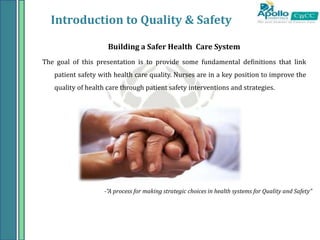
Building a Safer Health Care System
The goal of this presentation is to provide some fundamental definitions that link
patient safety with health care quality. Nurses are in a key position to improve the
quality of health care through patient safety interventions and strategies.
-“A process for making strategic choices in health systems for Quality and Safety”
Challenges specific to Nurses
in Quality and Safety Improvement
“Where We Today”
The challenges are,
 Budget
 Inadequate Nursing Staffs
 Facing growing demands to participate in more, often duplicative, quality
improvement activities
 Dealing with high administrative burden associated with these activities.
 Confronting traditional nursing education that does not always adequately prepare
nurses for evolving role in today’s contemporary setting
Progress -Quality and Safety Led by Staff
• Today the patient expectations of what Nurses and Doctors do and don’t do is
changing very quickly, Patient care is not about what is best for the physician or most
convenient for. It is about what is the best for our patients.
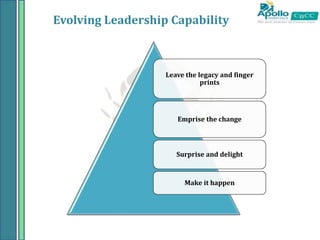
Evolving Leadership Capability
Leave the legacy and finger
prints
Emprise the change
Surprise and delight
Make it happen
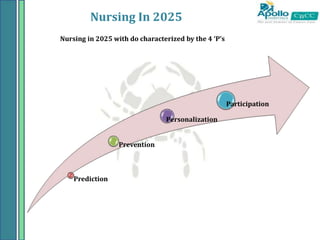
Nursing In 2025
Prediction
Prevention
Personalization
Participation
Nursing in 2025 with do characterized by the 4 ‘P’s
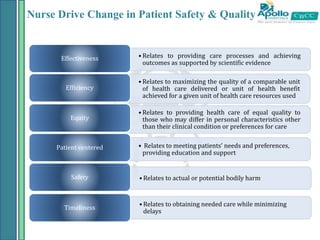
Nurse Drive Change in Patient Safety & Quality
• Relates to providing care processes and achieving
outcomes as supported by scientific evidence
Effectiveness
• Relates to maximizing the quality of a comparable unit
of health care delivered or unit of health benefit
achieved for a given unit of health care resources used
Efficiency
• Relates to providing health care of equal quality to
those who may differ in personal characteristics other
than their clinical condition or preferences for care
Equity
• Relates to meeting patients' needs and preferences,
providing education and support
Patient centered
• Relates to actual or potential bodily harmSafety
• Relates to obtaining needed care while minimizing
delays
Timeliness
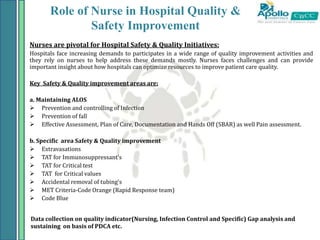
Role of Nurse in Hospital Quality &
Safety Improvement
Nurses are pivotal for Hospital Safety & Quality Initiatives:
Hospitals face increasing demands to participates in a wide range of quality improvement activities and
they rely on nurses to help address these demands mostly. Nurses faces challenges and can provide
important insight about how hospitals can optimize resources to improve patient care quality.
Key Safety & Quality improvement areas are:
a. Maintaining ALOS
 Prevention and controlling of Infection
 Prevention of fall
 Effective Assessment, Plan of Care, Documentation and Hands Off (SBAR) as well Pain assessment.
b. Specific area Safety & Quality improvement
 Extravasations
 TAT for Immunosuppressant's
 TAT for Critical test
 TAT for Critical values
 Accidental removal of tubing's
 MET Criteria-Code Orange (Rapid Response team)
 Code Blue
Data collection on quality indicator(Nursing, Infection Control and Specific) Gap analysis and
sustaining on basis of PDCA etc.
Quality & safety Improvement Program /
Demands Increasing
Hospitals are constantly being challenged to provide high-quality care despite ageing
populations, diminishing resources, and budgetary restraints. They also so have to
upgrade policies, SOPs, Manuals and Protocols to meet these demands.
1. EXTERNAL PROGRAMMES
• Accreditation (JCI, NABH, Bureau VERITAS and ISO 500001), regulatory bodies,
quality improvement, Medical speciality societies, State hospital associations and
health plans.
2. INTERNAL PROGRAMMES
Hospitals engage in variety of internal quality improvement activities based on patient
and employees feedback. Some of them are mentioned below
• Lean Six Sigma Projects
• Internal Clinical Audit
• AIDET
• SHHh
• Ward as a Unit Programmes
• Weekly process
….Continued
• Apollo Way
• Apollo Clinical Excellence
• Uniflow system
• SUD tracking
• IPSG & HIRA
• 360 degree audits
• Cross functional audits
• Open and Closed audits
• Case and data presentation audits
• Competencies, Annual Appraisal and trainings like Mandate, Induction and
preceptors etc.
• Others Like MOM, HICP,ESP,PFE.
“Safety & Quality is the reflection of team effort”
Various Pressure Drive Hospital
Participation Decision
The hospital itself require a quality accreditation certification to tie up with corporate
patients, TPA (Med sav, Apollo Munich, Max health), ONGC, CGHS, Maa Yojana, ECHS
(Cashless and Reimbursement).
To stand as a competitor in market, it is bound to show the important on quality progress.
Meeting the requirements from Local, National and International Bodies.
Additionally : Liabilities, Consumer act, Rights and Responsibilities of patients, Patient
education, these are highly pressured area to have accreditation
The pressure drives for reimbursement, This created strong financial incentives for
hospitals.
Demands Increase, So Does the role of
Nurses in Quality and Safety
Respondents described how vital nurses are to hospitals, how nursing care is the backbone
for the hospital growth
‘The nurses are heart and Soul’ of the hospitals. Nurses spend most of the time at the
patient bedside.
‘Nurses are the safety net’, They are right there, Real time, catching medication errors,
catching patient falls etc.,,
Cultures sets for Quality and Safety
Improvement
The supportive hospital culture is the key to make important advances in quality
Several strategies are
• Supportive hospital leadership
• Setting expectations for all staffs
• Holding staffs accountable for their individual roles
• Inspiring and using physician and nurses championship efforts
• Continuous and effective feedback to the staffs
• IMPORTANT is no blaming culture, instead promoting right at first time
• Self reporting culture
Engaging All Nurses in Quality & Safety
‘Emerging Specialization’
Involving Nurses in Quality and Safety Improvement activities , Preparing policies,
SOP’s and other legal documents such as MRD records, Statutory documents etc..
More over making them as a specialty nurses such as Stem Cell Transplant nurse,
Infusion Nurse, Tissue viability Nurse, Medication Management Nurse, Critical
Care Nurse, Chemotherapy Nurse, Radiation Nurse, Operation Theatre and
Dialysis Nurse,
"Nurses dispense comfort, compassion, and caring without even a prescription."
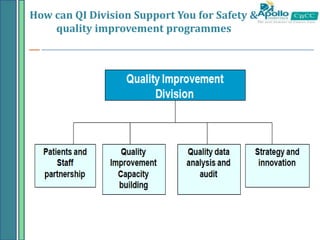
How can QI Division Support You for Safety &
quality improvement programmes
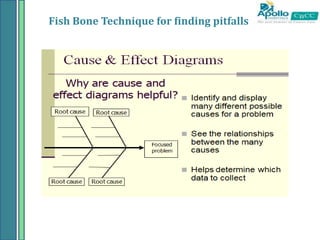
Fish Bone Technique for finding pitfalls
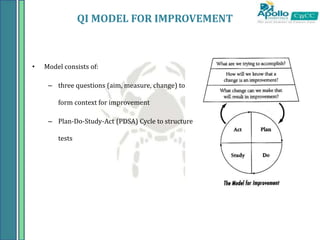
QI MODEL FOR IMPROVEMENT
• Model consists of:
– three questions (aim, measure, change) to
form context for improvement
– Plan-Do-Study-Act (PDSA) Cycle to structure
tests
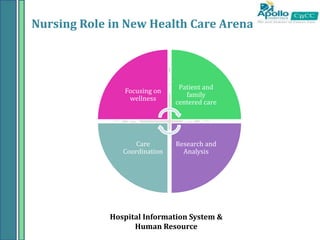
Nursing Role in New Health Care Arena
Focusing on
wellness
Patient and
family
centered care
Research and
Analysis
Care
Coordination
Hospital Information System &
Human Resource
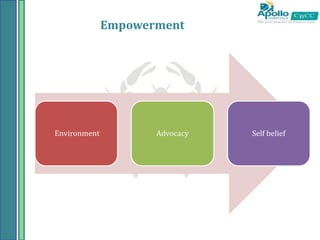
Empowerment
Environment Advocacy Self belief
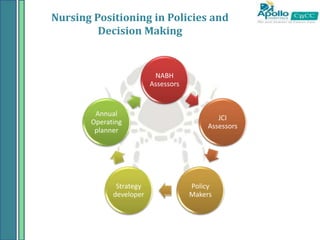
Nursing Positioning in Policies and
Decision Making
NABH
Assessors
JCI
Assessors
Policy
Makers
Strategy
developer
Annual
Operating
planner
“We have two jobs: Our job and
the job of improving our job”.
THANK YOU

Quality and Safety - Vision:2025

  • 1.
    QUALITY & SAFETY-VISION2025 Manjunathan C. RN RPN., M.Sc.(N)., M.Sc.,(CP) Deputy Nursing Superintendent, Apollo CBCC Cancer Care, Apollo Hospitals International Ltd.
  • 2.
    Introduction to Quality& Safety Building a Safer Health Care System The goal of this presentation is to provide some fundamental definitions that link patient safety with health care quality. Nurses are in a key position to improve the quality of health care through patient safety interventions and strategies. -“A process for making strategic choices in health systems for Quality and Safety”
  • 3.
    Challenges specific toNurses in Quality and Safety Improvement “Where We Today” The challenges are,  Budget  Inadequate Nursing Staffs  Facing growing demands to participate in more, often duplicative, quality improvement activities  Dealing with high administrative burden associated with these activities.  Confronting traditional nursing education that does not always adequately prepare nurses for evolving role in today’s contemporary setting
  • 4.
    Progress -Quality andSafety Led by Staff • Today the patient expectations of what Nurses and Doctors do and don’t do is changing very quickly, Patient care is not about what is best for the physician or most convenient for. It is about what is the best for our patients.
  • 5.
    Evolving Leadership Capability Leavethe legacy and finger prints Emprise the change Surprise and delight Make it happen
  • 6.
  • 7.
    Nurse Drive Changein Patient Safety & Quality • Relates to providing care processes and achieving outcomes as supported by scientific evidence Effectiveness • Relates to maximizing the quality of a comparable unit of health care delivered or unit of health benefit achieved for a given unit of health care resources used Efficiency • Relates to providing health care of equal quality to those who may differ in personal characteristics other than their clinical condition or preferences for care Equity • Relates to meeting patients' needs and preferences, providing education and support Patient centered • Relates to actual or potential bodily harmSafety • Relates to obtaining needed care while minimizing delays Timeliness
  • 8.
    Role of Nursein Hospital Quality & Safety Improvement Nurses are pivotal for Hospital Safety & Quality Initiatives: Hospitals face increasing demands to participates in a wide range of quality improvement activities and they rely on nurses to help address these demands mostly. Nurses faces challenges and can provide important insight about how hospitals can optimize resources to improve patient care quality. Key Safety & Quality improvement areas are: a. Maintaining ALOS  Prevention and controlling of Infection  Prevention of fall  Effective Assessment, Plan of Care, Documentation and Hands Off (SBAR) as well Pain assessment. b. Specific area Safety & Quality improvement  Extravasations  TAT for Immunosuppressant's  TAT for Critical test  TAT for Critical values  Accidental removal of tubing's  MET Criteria-Code Orange (Rapid Response team)  Code Blue Data collection on quality indicator(Nursing, Infection Control and Specific) Gap analysis and sustaining on basis of PDCA etc.
  • 9.
    Quality & safetyImprovement Program / Demands Increasing Hospitals are constantly being challenged to provide high-quality care despite ageing populations, diminishing resources, and budgetary restraints. They also so have to upgrade policies, SOPs, Manuals and Protocols to meet these demands. 1. EXTERNAL PROGRAMMES • Accreditation (JCI, NABH, Bureau VERITAS and ISO 500001), regulatory bodies, quality improvement, Medical speciality societies, State hospital associations and health plans. 2. INTERNAL PROGRAMMES Hospitals engage in variety of internal quality improvement activities based on patient and employees feedback. Some of them are mentioned below • Lean Six Sigma Projects • Internal Clinical Audit • AIDET • SHHh • Ward as a Unit Programmes • Weekly process
  • 10.
    ….Continued • Apollo Way •Apollo Clinical Excellence • Uniflow system • SUD tracking • IPSG & HIRA • 360 degree audits • Cross functional audits • Open and Closed audits • Case and data presentation audits • Competencies, Annual Appraisal and trainings like Mandate, Induction and preceptors etc. • Others Like MOM, HICP,ESP,PFE. “Safety & Quality is the reflection of team effort”
  • 11.
    Various Pressure DriveHospital Participation Decision The hospital itself require a quality accreditation certification to tie up with corporate patients, TPA (Med sav, Apollo Munich, Max health), ONGC, CGHS, Maa Yojana, ECHS (Cashless and Reimbursement). To stand as a competitor in market, it is bound to show the important on quality progress. Meeting the requirements from Local, National and International Bodies. Additionally : Liabilities, Consumer act, Rights and Responsibilities of patients, Patient education, these are highly pressured area to have accreditation The pressure drives for reimbursement, This created strong financial incentives for hospitals.
  • 12.
    Demands Increase, SoDoes the role of Nurses in Quality and Safety Respondents described how vital nurses are to hospitals, how nursing care is the backbone for the hospital growth ‘The nurses are heart and Soul’ of the hospitals. Nurses spend most of the time at the patient bedside. ‘Nurses are the safety net’, They are right there, Real time, catching medication errors, catching patient falls etc.,,
  • 13.
    Cultures sets forQuality and Safety Improvement The supportive hospital culture is the key to make important advances in quality Several strategies are • Supportive hospital leadership • Setting expectations for all staffs • Holding staffs accountable for their individual roles • Inspiring and using physician and nurses championship efforts • Continuous and effective feedback to the staffs • IMPORTANT is no blaming culture, instead promoting right at first time • Self reporting culture
  • 14.
    Engaging All Nursesin Quality & Safety ‘Emerging Specialization’ Involving Nurses in Quality and Safety Improvement activities , Preparing policies, SOP’s and other legal documents such as MRD records, Statutory documents etc.. More over making them as a specialty nurses such as Stem Cell Transplant nurse, Infusion Nurse, Tissue viability Nurse, Medication Management Nurse, Critical Care Nurse, Chemotherapy Nurse, Radiation Nurse, Operation Theatre and Dialysis Nurse, "Nurses dispense comfort, compassion, and caring without even a prescription."
  • 15.
    How can QIDivision Support You for Safety & quality improvement programmes
  • 16.
    Fish Bone Techniquefor finding pitfalls
  • 17.
    QI MODEL FORIMPROVEMENT • Model consists of: – three questions (aim, measure, change) to form context for improvement – Plan-Do-Study-Act (PDSA) Cycle to structure tests
  • 18.
    Nursing Role inNew Health Care Arena Focusing on wellness Patient and family centered care Research and Analysis Care Coordination Hospital Information System & Human Resource
  • 19.
  • 20.
    Nursing Positioning inPolicies and Decision Making NABH Assessors JCI Assessors Policy Makers Strategy developer Annual Operating planner
  • 23.
    “We have twojobs: Our job and the job of improving our job”. THANK YOU