Lecture 5
Continuous Quality Improvements
Quality Assurance in Hospital Management
Institute for Nile States Strategic Studies and
Researches
Lecture Objectives
After this lecture, you should be
able to understand:
◦ Continuous Quality improvements and Patient Safety & Satisfaction.
◦ Improving Quality through Nursing
◦ Improve Quality by Risk Management
CONTINUOUS QUALITY
IMPROVEMENTS AND PATIENT SAFETY
& SATISFACTION.
Objective 1/3
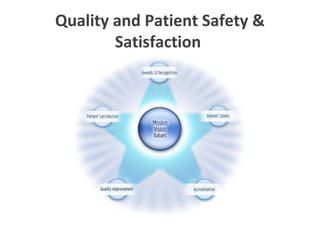
Quality and Patient Safety &
Satisfaction
Continuous Quality
Improvement
• Continuous Quality Improvement (CQI): is an organizational
process in which staff identify, plan, and implement ongoing
improvements in service delivery.
• CQI provides a vital way to assess and monitor the delivery
of services to ensure that they are consistent with an
organization’s best practice clinical principles.
• The primary goal of the Quality Improvement program is the
ongoing improvement of the delivery, quality, efficiency, and
outcome of patient care and services.
Quality Improvement Heroes
• Break down barriers between
departments;
• Management should learn their
responsibilities, and take on
leadership
• Improve constantly
• Institute a program of education
and self-improvement.
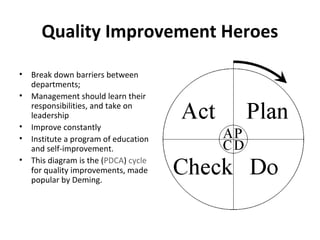
• This diagram is the (PDCA) cycle
for quality improvements, made
popular by Deming.
PDCA in the FOCUS Process
FOCUS on a particular issue.
• Find a process to improve
• Organize to improve a process
• Clarify what is known
• Understand variation
• Select a process improvement
IMPROVING QUALITY THROUGH
NURSING
Objective 2/3
Improving Quality through Nursing
• The quality of nursing is central to preventing errors in hospitals and
providing high-quality care.
• The impending gap between the need for nurses and the supply ,the
various ways that hospitals and other health organizations are reducing
nurse staffing and increasing nurse workloads. It was have demonstrated
an association between nurses’ workload and the number of deaths in
hospitals.
• It was have also shown an association between nurses’ education and the
number of deaths.
• highly dissatisfied nurses with their working conditions , lack of autonomy,
turnover and burnout. Studies have suggested that when nurses have
more control over their work, care improves and hospitals function better.
Functions of the quality improvement department
to improve nursing quality
• Develop mechanisms for using evidence-based practice to
improve quality of care
• Support nursing staff involvement in collaborative quality
initiatives that improve organizational performance and
patient outcomes
• Assist nursing staff to interpret and use data from internal
and external sources to improve care or resolve identified
problems
• Promote safe practices by infusing a culture of safety for both
patients and staff.
Functions of the quality improvement
department to improve nursing quality (cont.)
• Promote the use of an institutional set of core outcome
indicators to monitor and improve care
• Facilitate performance improvement efforts of department
and interdisciplinary teams
• Coordinate or conduct interdisciplinary performance
improvements that impact patient care delivery from multiple
services
• Provide education and consultation to internal and external
constituents regarding quality and outcomes management
activities
Functions of the quality improvement
department to improve nursing quality (cont.)
• Promote a scientific approach to problem-
solving in management and delivery of patient
care services
• Promote discussion and exchange of
information regarding status and progress of
evidence-based practice, and process
improvement projects.
Nursing scope of patient care
The scope of patient care services provided by
the department includes:
• Assessment of patients
• Planning, implementing, evaluating the
nursing plan of care
• Administration of medications
• Administration of treatments and therapies
• Patient and family education
IMPROVE QUALITY BY RISK
MANAGEMENT
Objective 3/3
Risk management
• Risk management is the human activity which
integrates recognition of risk, risk assessment,
developing strategies to manage it, and
preventing of risk using managerial resources.
• The strategies include transferring the risk to
another party, avoiding the risk, reducing the
negative effect of the risk, and accepting some
or all of the consequences of a particular risk
Steps in the risk management process
1. Identification of risk in a selected domain of interest
2. Planning the remainder of the process.
3. Mapping out the following: the social scope of risk
management, the identity and objectives of
stakeholders, and the basis upon which risks will be
evaluated, constraints.
4. Defining a framework for the activity and an agenda
for identification.
5. Developing an analysis of risks involved in the
process.
6. Mitigation of risks using available technological,
human and organizational resources
Potential risk treatments
• Avoidance (elimination) :Includes not performing an activity
that could carry risk
• Reduction ( mitigation): Involves methods that reduce the
severity of the loss
• Retention :Involves accepting the loss when it occurs. Self
insurance
• Transfer ( buying insurance) :Means causing another party to
accept the risk, typically by contract

Lesson 5

  • 1.
    Lecture 5 Continuous QualityImprovements Quality Assurance in Hospital Management Institute for Nile States Strategic Studies and Researches
  • 2.
    Lecture Objectives After thislecture, you should be able to understand: ◦ Continuous Quality improvements and Patient Safety & Satisfaction. ◦ Improving Quality through Nursing ◦ Improve Quality by Risk Management
  • 3.
    CONTINUOUS QUALITY IMPROVEMENTS ANDPATIENT SAFETY & SATISFACTION. Objective 1/3
  • 4.
    Quality and PatientSafety & Satisfaction
  • 5.
    Continuous Quality Improvement • ContinuousQuality Improvement (CQI): is an organizational process in which staff identify, plan, and implement ongoing improvements in service delivery. • CQI provides a vital way to assess and monitor the delivery of services to ensure that they are consistent with an organization’s best practice clinical principles. • The primary goal of the Quality Improvement program is the ongoing improvement of the delivery, quality, efficiency, and outcome of patient care and services.
  • 6.
    Quality Improvement Heroes •Break down barriers between departments; • Management should learn their responsibilities, and take on leadership • Improve constantly • Institute a program of education and self-improvement. • This diagram is the (PDCA) cycle for quality improvements, made popular by Deming.
  • 7.
    PDCA in theFOCUS Process FOCUS on a particular issue. • Find a process to improve • Organize to improve a process • Clarify what is known • Understand variation • Select a process improvement
  • 8.
  • 9.
    Improving Quality throughNursing • The quality of nursing is central to preventing errors in hospitals and providing high-quality care. • The impending gap between the need for nurses and the supply ,the various ways that hospitals and other health organizations are reducing nurse staffing and increasing nurse workloads. It was have demonstrated an association between nurses’ workload and the number of deaths in hospitals. • It was have also shown an association between nurses’ education and the number of deaths. • highly dissatisfied nurses with their working conditions , lack of autonomy, turnover and burnout. Studies have suggested that when nurses have more control over their work, care improves and hospitals function better.
  • 10.
    Functions of thequality improvement department to improve nursing quality • Develop mechanisms for using evidence-based practice to improve quality of care • Support nursing staff involvement in collaborative quality initiatives that improve organizational performance and patient outcomes • Assist nursing staff to interpret and use data from internal and external sources to improve care or resolve identified problems • Promote safe practices by infusing a culture of safety for both patients and staff.
  • 11.
    Functions of thequality improvement department to improve nursing quality (cont.) • Promote the use of an institutional set of core outcome indicators to monitor and improve care • Facilitate performance improvement efforts of department and interdisciplinary teams • Coordinate or conduct interdisciplinary performance improvements that impact patient care delivery from multiple services • Provide education and consultation to internal and external constituents regarding quality and outcomes management activities
  • 12.
    Functions of thequality improvement department to improve nursing quality (cont.) • Promote a scientific approach to problem- solving in management and delivery of patient care services • Promote discussion and exchange of information regarding status and progress of evidence-based practice, and process improvement projects.
  • 13.
    Nursing scope ofpatient care The scope of patient care services provided by the department includes: • Assessment of patients • Planning, implementing, evaluating the nursing plan of care • Administration of medications • Administration of treatments and therapies • Patient and family education
  • 14.
    IMPROVE QUALITY BYRISK MANAGEMENT Objective 3/3
  • 15.
    Risk management • Riskmanagement is the human activity which integrates recognition of risk, risk assessment, developing strategies to manage it, and preventing of risk using managerial resources. • The strategies include transferring the risk to another party, avoiding the risk, reducing the negative effect of the risk, and accepting some or all of the consequences of a particular risk
  • 16.
    Steps in therisk management process 1. Identification of risk in a selected domain of interest 2. Planning the remainder of the process. 3. Mapping out the following: the social scope of risk management, the identity and objectives of stakeholders, and the basis upon which risks will be evaluated, constraints. 4. Defining a framework for the activity and an agenda for identification. 5. Developing an analysis of risks involved in the process. 6. Mitigation of risks using available technological, human and organizational resources
  • 17.
    Potential risk treatments •Avoidance (elimination) :Includes not performing an activity that could carry risk • Reduction ( mitigation): Involves methods that reduce the severity of the loss • Retention :Involves accepting the loss when it occurs. Self insurance • Transfer ( buying insurance) :Means causing another party to accept the risk, typically by contract

Editor's Notes

  • #5 Quality Mission, vision and Values should be based on: Accreditation Awards & Recognition Patient Safety (which is the Highest Priority pillar) and this is by: Commitment to provide exceptional patient care and customer service throughout all our facilities. And To ensure expert medical care in the safest environment possible, in both an inpatient and outpatient setting. Patient Satisfaction (Another High priority pillar): As patients are demanding to be informed partners in decisions regarding their health. And patients now complain, demand, report and sue and have realized that the quality of nursing care is an important factor in patient outcomes. Quality Improvement (Also, one of the top priorities), and we can talk about it in more details
  • #6 Continuous Quality Improvement (CQI): is an organizational process in which staff identify, plan, and implement ongoing improvements in service delivery. CQI provides a vital way to assess and monitor the delivery of services to ensure that they are consistent with an organization’s best practice clinical principles. The primary goal of the Quality Improvement program is the ongoing improvement of the delivery, quality, efficiency, and outcome of patient care and services.
  • #7 W. Edwards Deming is best known for his management philosophy establishing quality, productivity, and competitive position. He has formulated 14 points of attention for managers, some of these points are more appropriate for service management. Break down barriers between departments; Management should learn their responsibilities, and take on leadership Improve constantly Institute a program of education and self-improvement. This diagram is the (PDCA) cycle for quality improvements, made popular by Deming. The philosophy is to keep improving the quality of an organization. It is defined by four iterative keys : Plan: Design or revise business process components to improve results Do: Implement the plan and measure its performance Check: Assess the measurements and report the results to decision makers Act: Decide on changes needed to improve the process The PDCA cycle is a way of continuously checking progress in each step of the FOCUS process.
  • #8 The PDCA cycle is a way of continuously checking progress in each step of the FOCUS process. Which is: Find a process to improve Organize to improve a process Clarify what is known Understand variation Select a process improvement
  • #10 The quality of nursing is central to preventing errors in hospitals and providing high-quality care. The impending gap between the need for nurses and the supply ,the various ways that hospitals and other health organizations are reducing nurse staffing and increasing nurse workloads. It was have demonstrated an association between nurses’ workload and the number of deaths in hospitals. It was have also shown an association between nurses’ education and the number of deaths. highly dissatisfied nurses with their working conditions , lack of autonomy, turnover and burnout. Studies have suggested that when nurses have more control over their work, care improves and hospitals function better.
  • #11 Functions of the quality improvement department to improve nursing quality : Develop mechanisms for using evidence-based practice to improve quality of care Support nursing staff involvement in collaborative quality initiatives that improve organizational performance and patient outcomes Assist nursing staff to interpret and use data from internal and external sources to improve care or resolve identified problems Promote safe practices by infusing a culture of safety for both patients and staff.
  • #12 Promote the use of an institutional set of core outcome indicators to monitor and improve care Facilitate performance improvement efforts of department and interdisciplinary teams Coordinate or conduct interdisciplinary performance improvements that impact patient care delivery from multiple services Provide education and consultation to internal and external constituents regarding quality and outcomes management activities
  • #13 Promote a scientific approach to problem-solving in management and delivery of patient care services Promote discussion and exchange of information regarding status and progress of evidence-based practice, and process improvement projects.
  • #14 The scope of patient care services provided by the department includes: Assessment of patients Planning, implementing, evaluating the nursing plan of care Administration of medications Administration of treatments and therapies Patient and family education
  • #16 By reducing the risk we improve Quality: Risk management is the human activity which integrates recognition of risk, risk assessment, developing strategies to manage it, and preventing of risk using managerial resources. The strategies include transferring the risk to another party, avoiding the risk, reducing the negative effect of the risk, and accepting some or all of the consequences of a particular risk
  • #17 Steps in the risk management processIdentification of risk in a selected domain of interest Planning the remainder of the process. Mapping out the following: the social scope of risk management, the identity and objectives of stakeholders, and the basis upon which risks will be evaluated, constraints. Defining a framework for the activity and an agenda for identification. Developing an analysis of risks involved in the process. Mitigation of risks using available technological, human and organizational resources
  • #18 Potential risk treatments: Avoidance (elimination) :Includes not performing an activity that could carry risk Reduction ( mitigation): Involves methods that reduce the severity of the loss Retention :Involves accepting the loss when it occurs. Self insurance Transfer ( buying insurance) :Means causing another party to accept the risk, typically by contract