DEVELOPING NURSING STANDARDS PROTOCOLS FOR VARIOUS UNITS.pdf
1.
COLLEGE OF NURSING,L.L.R.M MEDICAL
COLLEGE, MEERUT
ASSIGNMENT ON:
DEVELOPING NURSING STANDARDS/PROTOCOLS FOR
VARIOUS UNITS
SUBMITTED TO SUBMITTED BY
MS. SHWETA SINGH
M.SC NURSING II YEAR
COLLEGE OF SNURSING, COLLEGE OF NURSING,
L.L.R.M MEDICAL COLLEGE L.L.R.M MEDICAL COLLEGE
MEERUT MEERUT
SUBMITTED ON-
2.
INTRODUCTION
Nursing standards andprotocols are foundational elements in ensuring high-quality
and consistent patient care. These guidelines serve as a framework for nursing
practice, outlining responsibilities, processes, and expected outcomes. The
development of unit-specific standards is essential to address the unique needs and
challenges of each department within a healthcare facility. This assignment explores
the principles, steps, and applications of developing nursing standards and protocols
tailored to various units, ensuring alignment with evidence-based practices and
regulatory requirements.
OBJECTIVES
To establish clear, evidence-based guidelines that promote high-quality
patient care.
To address the specific needs of diverse nursing units, ensuring patient safety
and efficiency.
To enhance interdisciplinary collaboration and communication among
healthcare teams.
To align nursing practices with legal, ethical, and professional standards.s
PRINCIPLES OF DEVELOPING NURSING STANDARDS
1. Evidence-Based Practice (EBP):
o Utilize the latest research and clinical guidelines to inform protocol
development.
o Regularly review and update standards to incorporate new findings and
technologies.
3.
2. Compliance withRegulatory Standards:
o Align with national and international healthcare guidelines, such as
those from the World Health Organization (WHO), American Nurses
Association (ANA), and local regulatory bodies.
3. Interdisciplinary Collaboration:
o Engage input from nurses, physicians, and allied health professionals
to ensure comprehensive and practical protocols.
4. Cultural Competence:
o Address the cultural, linguistic, and individual needs of diverse patient
populations.
5. Ethical and Legal Considerations:
o Ensure that protocols uphold patient rights, confidentiality, and
informed consent.
UNIT-SPECIFIC PROTOCOLS
Each nursing unit has unique requirements based on patient demographics, medical
conditions, and operational demands. Below are examples of protocols tailored to
specific units:
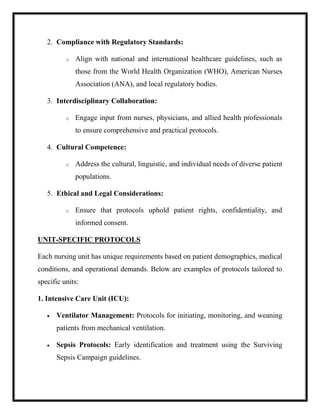
1. Intensive Care Unit (ICU):
Ventilator Management: Protocols for initiating, monitoring, and weaning
patients from mechanical ventilation.
Sepsis Protocols: Early identification and treatment using the Surviving
Sepsis Campaign guidelines.
4.
Emergency Response:Standardized procedures for managing cardiac arrests
and other life-threatening events.
2. Pediatric Unit:
Vaccination Guidelines: Age-specific immunization schedules and post-
vaccination care.
Family-Centered Care: Engaging families in decision-making and
providing child-friendly communication tools.
Pain Management: Use of non-pharmacological interventions alongside
medications.
3. Emergency Department (ED):
Triage Protocols: Rapid patient assessment and prioritization using
standardized scoring systems.
Trauma Care: Guidelines for managing polytrauma cases and stabilizing
critical patients.
Mental Health Crises: Protocols for de-escalation and managing psychiatric
emergencies.
4. Medical-Surgical Unit:
Post-Operative Care: Monitoring for complications, wound care, and pain
management.
Medication Administration: Safe practices for administering high-risk
medications.
Patient Education: Discharge planning and patient teaching for self-care.
5.
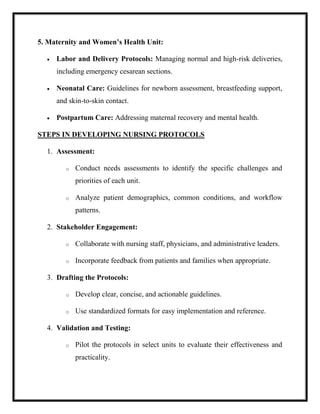
5. Maternity andWomen’s Health Unit:
Labor and Delivery Protocols: Managing normal and high-risk deliveries,
including emergency cesarean sections.
Neonatal Care: Guidelines for newborn assessment, breastfeeding support,
and skin-to-skin contact.
Postpartum Care: Addressing maternal recovery and mental health.
STEPS IN DEVELOPING NURSING PROTOCOLS
1. Assessment:
o Conduct needs assessments to identify the specific challenges and
priorities of each unit.
o Analyze patient demographics, common conditions, and workflow
patterns.
2. Stakeholder Engagement:
o Collaborate with nursing staff, physicians, and administrative leaders.
o Incorporate feedback from patients and families when appropriate.
3. Drafting the Protocols:
o Develop clear, concise, and actionable guidelines.
o Use standardized formats for easy implementation and reference.
4. Validation and Testing:
o Pilot the protocols in select units to evaluate their effectiveness and
practicality.
6.
o Collect dataand adjust the guidelines based on outcomes.
5. Implementation:
o Provide training sessions and educational materials to ensure staff
understanding and compliance.
o Integrate protocols into electronic health records (EHR) for
accessibility.
6. Monitoring and Evaluation:
o Establish metrics to assess adherence and outcomes.
o Schedule periodic reviews and updates to maintain relevance and
accuracy.
Challenges in Developing Nursing Standards
Resistance to change among staff.
Limited resources for training and implementation.
Balancing standardization with the need for flexibility in unique situations.
Keeping protocols up-to-date with rapidly evolving medical advancements.
7.
SUMMARY
In this assignment,I discussed The developing nursing standards/protocols for
various units includes the following key headings: Objectives, principles of
developing nursing standards, unit-specific protocols, steps in developing nursing
protocols and challenges in developing nursing standards
CONCLUSION
The development of nursing standards and protocols is a critical process that
enhances patient care, promotes safety, and ensures the efficiency of healthcare
delivery. By tailoring protocols to the specific needs of different units and adhering
to evidence-based practices, healthcare institutions can achieve higher standards of
care and better patient outcomes. Continuous collaboration, training, and evaluation
are essential to the successful implementation and sustainability of these guidelines.
8.
REFERENCES
1. American NursesAssociation. Nursing: Scope and Standards of Practice. 4th
ed. Silver Spring (MD): ANA; 2021.
2. Finkelman A. Professional Nursing Concepts: Competencies for Quality
Leadership. 4th ed. Burlington (MA): Jones & Bartlett Learning; 2019.
3. Melnyk BM, Fineout-Overholt E. Evidence-Based Practice in Nursing &
Healthcare: A Guide to Best Practice. 4th ed. Philadelphia: Wolters Kluwer;
2019.
4. Chaghari M, Saffari M, Ebadi A, Ameryoun A. Empowering education: A
new model for in-service training of nursing staff. J Adv Med Educ Prof.
2017;5(1):26-32.
5. World Health Organization. Guidelines for nursing care [Internet]. Geneva:
WHO; c2024 [cited 2024 Dec 14]. Available from: https://www.who.int
6. National Institute for Health and Care Excellence. Clinical guidelines and
protocols [Internet]. London: NICE; c2024 [cited 2024 Dec 14]. Available
from: https://www.nice.org.uk
7. Joint Commission. Standards for hospital accreditation [Internet]. Oakbrook
Terrace (IL): Joint Commission; c2024 [cited 2024 Dec 14]. Available from:
https://www.jointcommission.org





![REFERENCES
1. American Nurses Association. Nursing: Scope and Standards of Practice. 4th
ed. Silver Spring (MD): ANA; 2021.
2. Finkelman A. Professional Nursing Concepts: Competencies for Quality
Leadership. 4th ed. Burlington (MA): Jones & Bartlett Learning; 2019.
3. Melnyk BM, Fineout-Overholt E. Evidence-Based Practice in Nursing &
Healthcare: A Guide to Best Practice. 4th ed. Philadelphia: Wolters Kluwer;
2019.
4. Chaghari M, Saffari M, Ebadi A, Ameryoun A. Empowering education: A
new model for in-service training of nursing staff. J Adv Med Educ Prof.
2017;5(1):26-32.
5. World Health Organization. Guidelines for nursing care [Internet]. Geneva:
WHO; c2024 [cited 2024 Dec 14]. Available from: https://www.who.int
6. National Institute for Health and Care Excellence. Clinical guidelines and
protocols [Internet]. London: NICE; c2024 [cited 2024 Dec 14]. Available
from: https://www.nice.org.uk
7. Joint Commission. Standards for hospital accreditation [Internet]. Oakbrook
Terrace (IL): Joint Commission; c2024 [cited 2024 Dec 14]. Available from:
https://www.jointcommission.org](https://image.slidesharecdn.com/developingnursingstandardsprotocolsforvariousunits-250526053355-e4ff3bd3/85/DEVELOPING-NURSING-STANDARDS-PROTOCOLS-FOR-VARIOUS-UNITS-pdf-8-320.jpg)


