The document outlines the significance of marketing research in managerial decision-making, emphasizing its role in preventing costly marketing mistakes. It covers various topics, including research methods, types of data, qualitative and quantitative approaches, and practical applications of market analysis. Key case studies illustrate the consequences of neglecting research, showcasing the importance of understanding consumer behavior and market dynamics.
Introduction to marketing research, course objectives, and a detailed overview of topics covered.Examines failures like Beechcraft Starship and Electrolux due to lack of marketing research, emphasizing the importance of effective research.
Statistics on marketing errors and failures, highlighting the critical need for comprehensive marketing research.
Explanation of marketing definitions, concepts, orientation, and the marketing mix (4 P's and beyond).
Definition and importance of marketing research vs. market research, outlining types of research activities.
Common market research activities and a detailed overview of the research process from problem definition to reporting.
Categorization of market research into exploratory, descriptive, and causal types along with data sourcing.
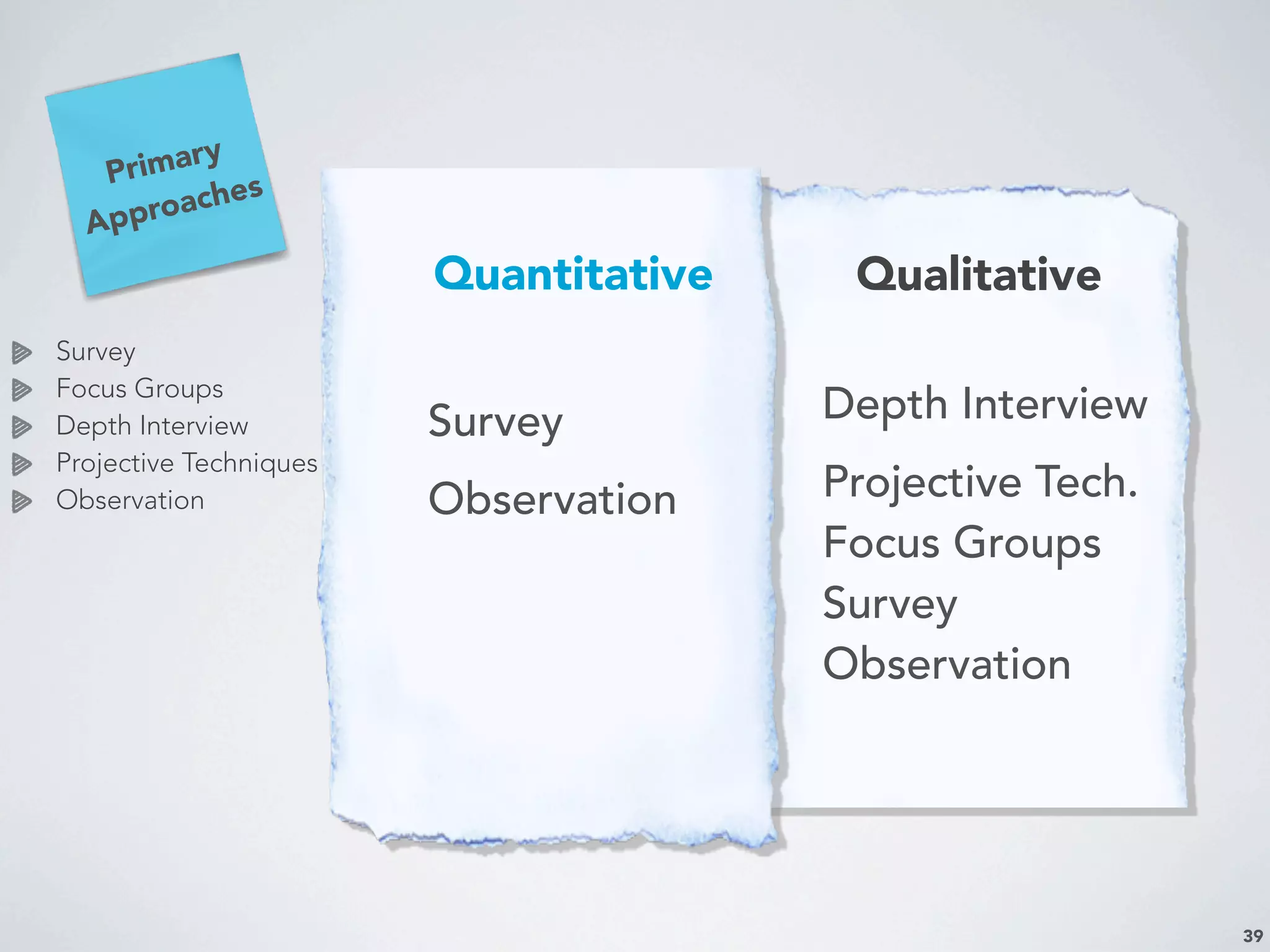
Focus groups, depth interviews, and projective techniques, including applications and advantages.
Depth interviews as a method for in-depth probing and understanding consumer behavior and attitudes.
Methods like word association and thematic apperception are used to understand deeper consumer motivations.
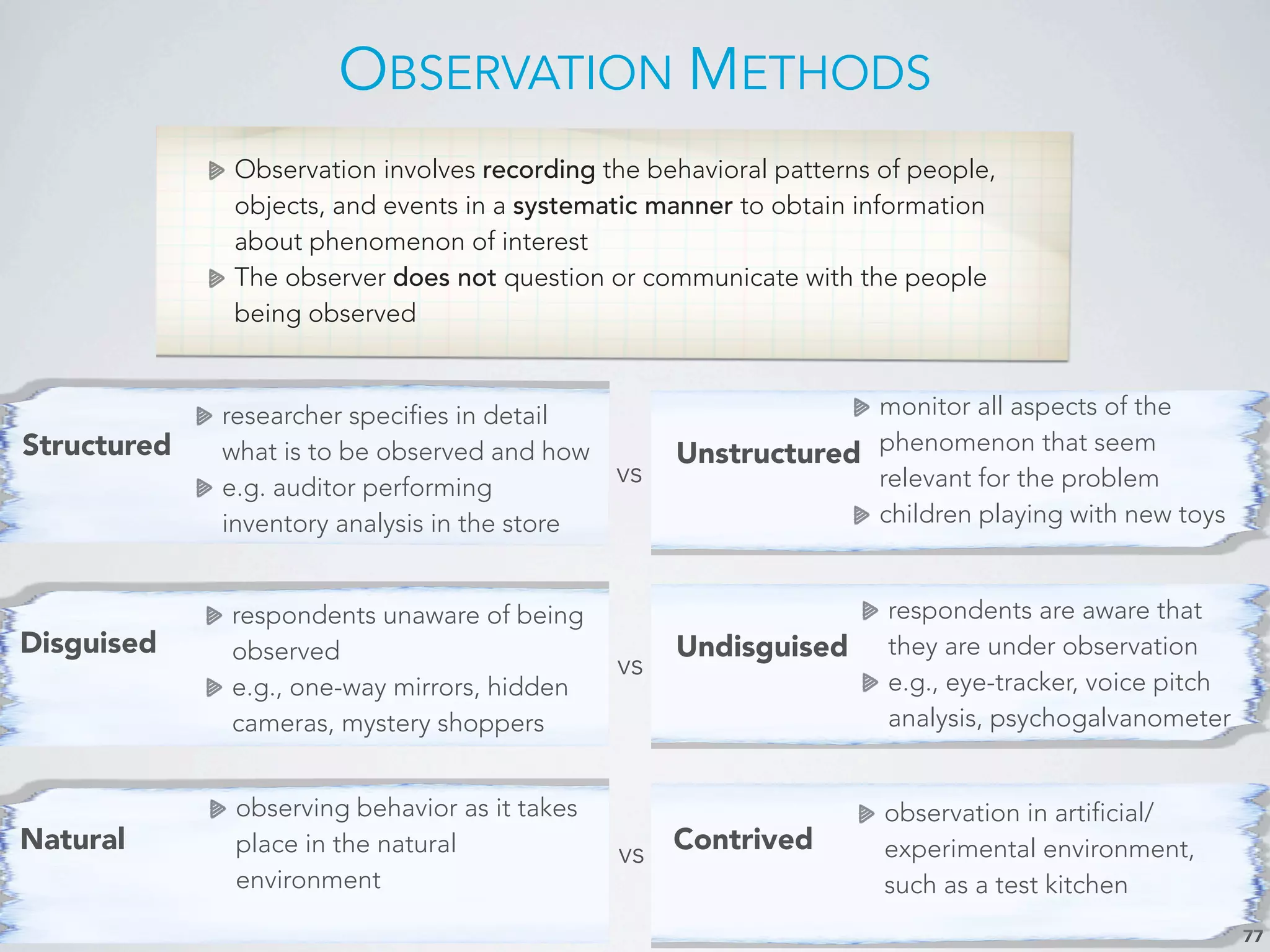
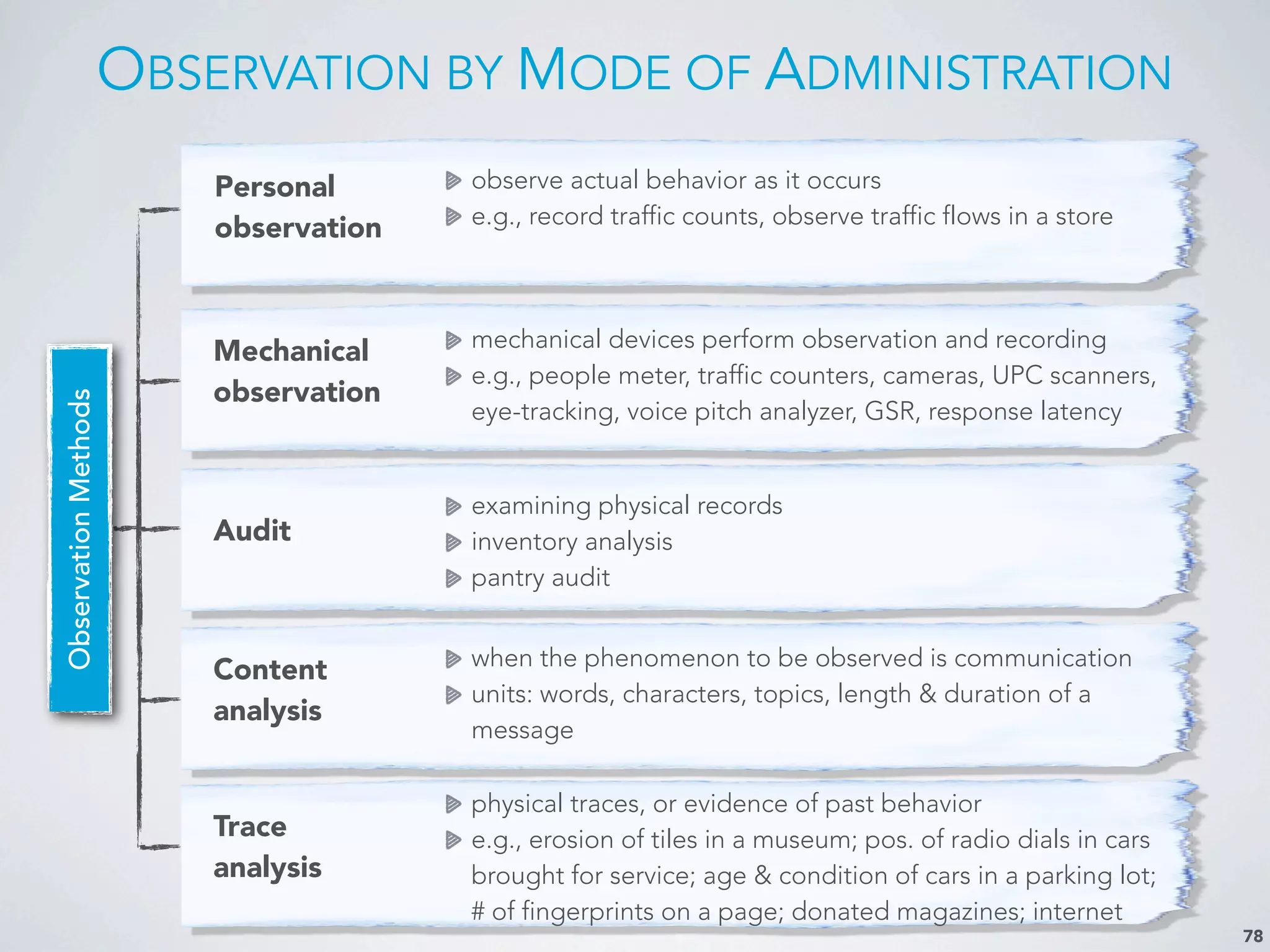
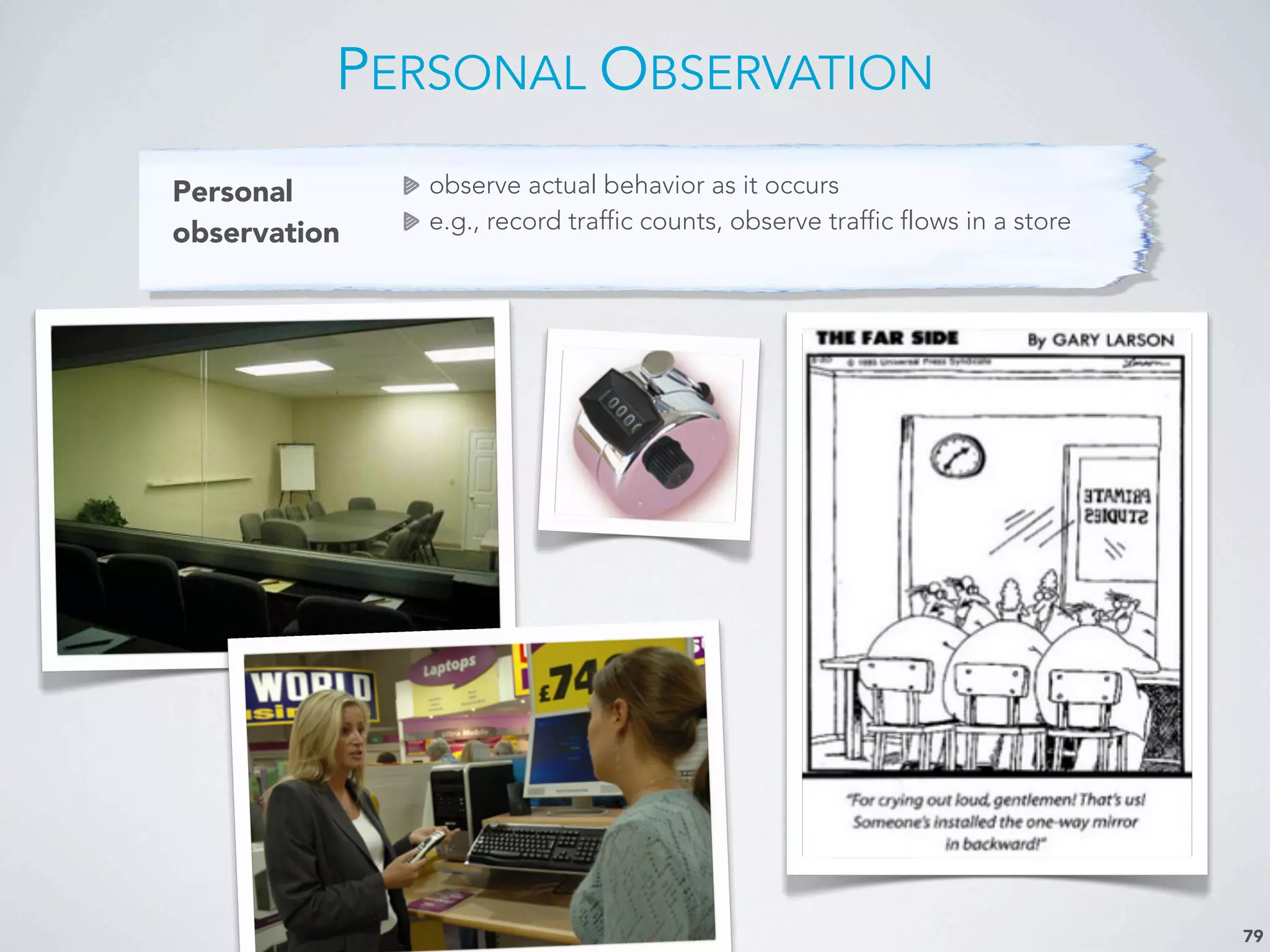
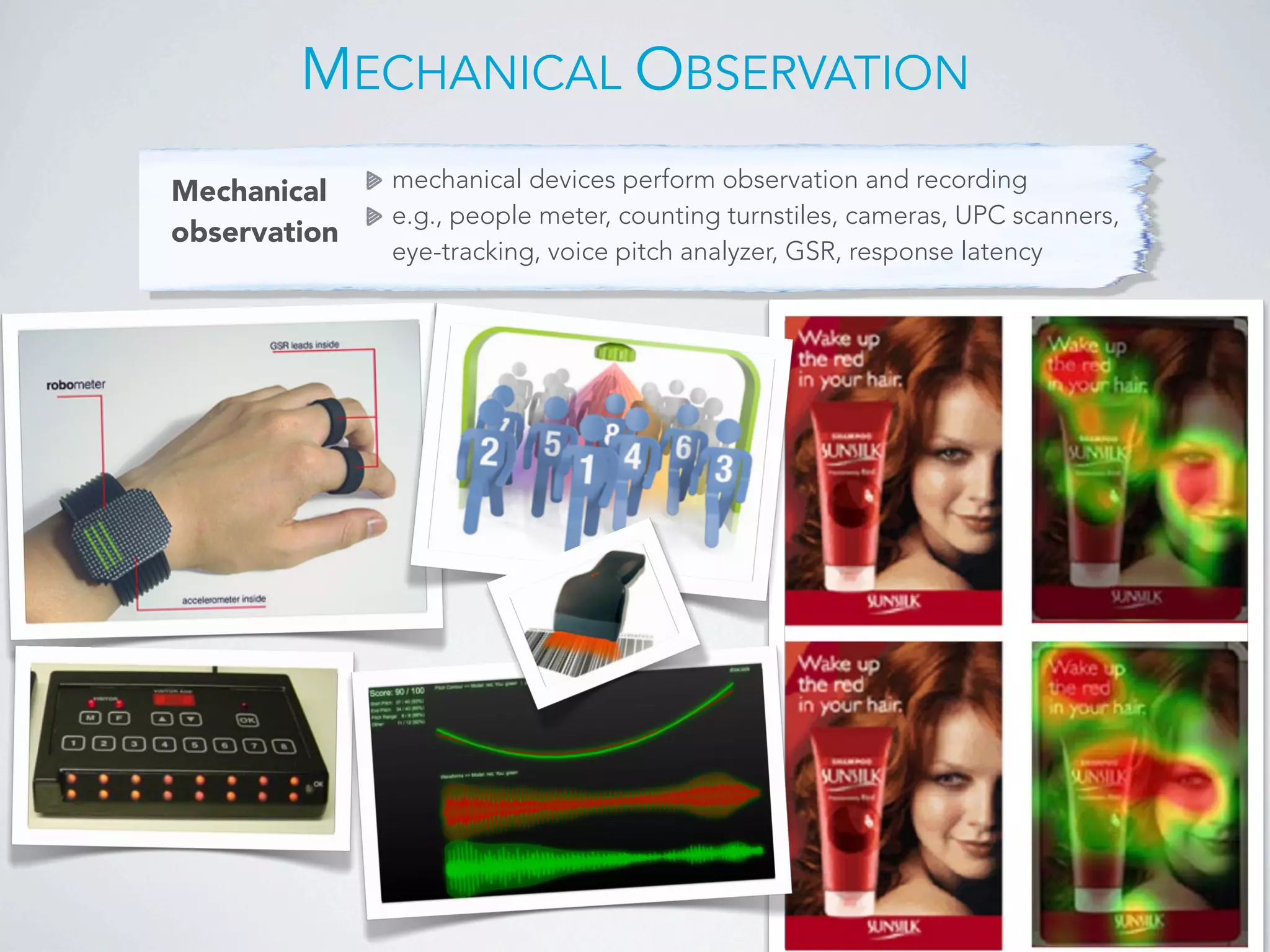
Detailed overview of various observation methods used in market research, distinguishing types and their applications.
Introduction to survey as a primary data collection technique, including measurement and scaling techniques.
Types of scales, measurement techniques, advantages, and disadvantages of different scaling methods.
Strategies for effective questionnaire design including question formulation, structure, and overcoming response issues.
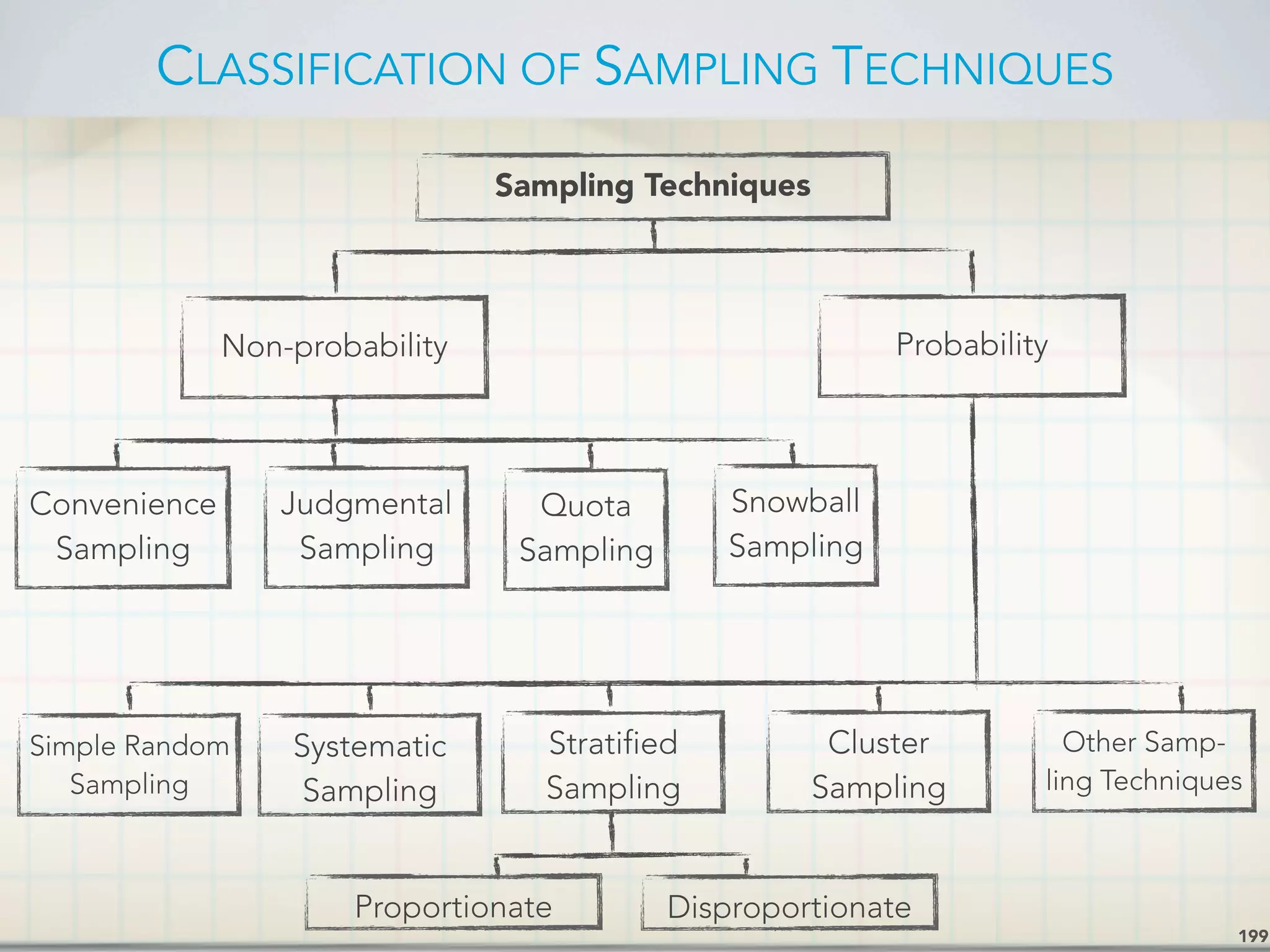
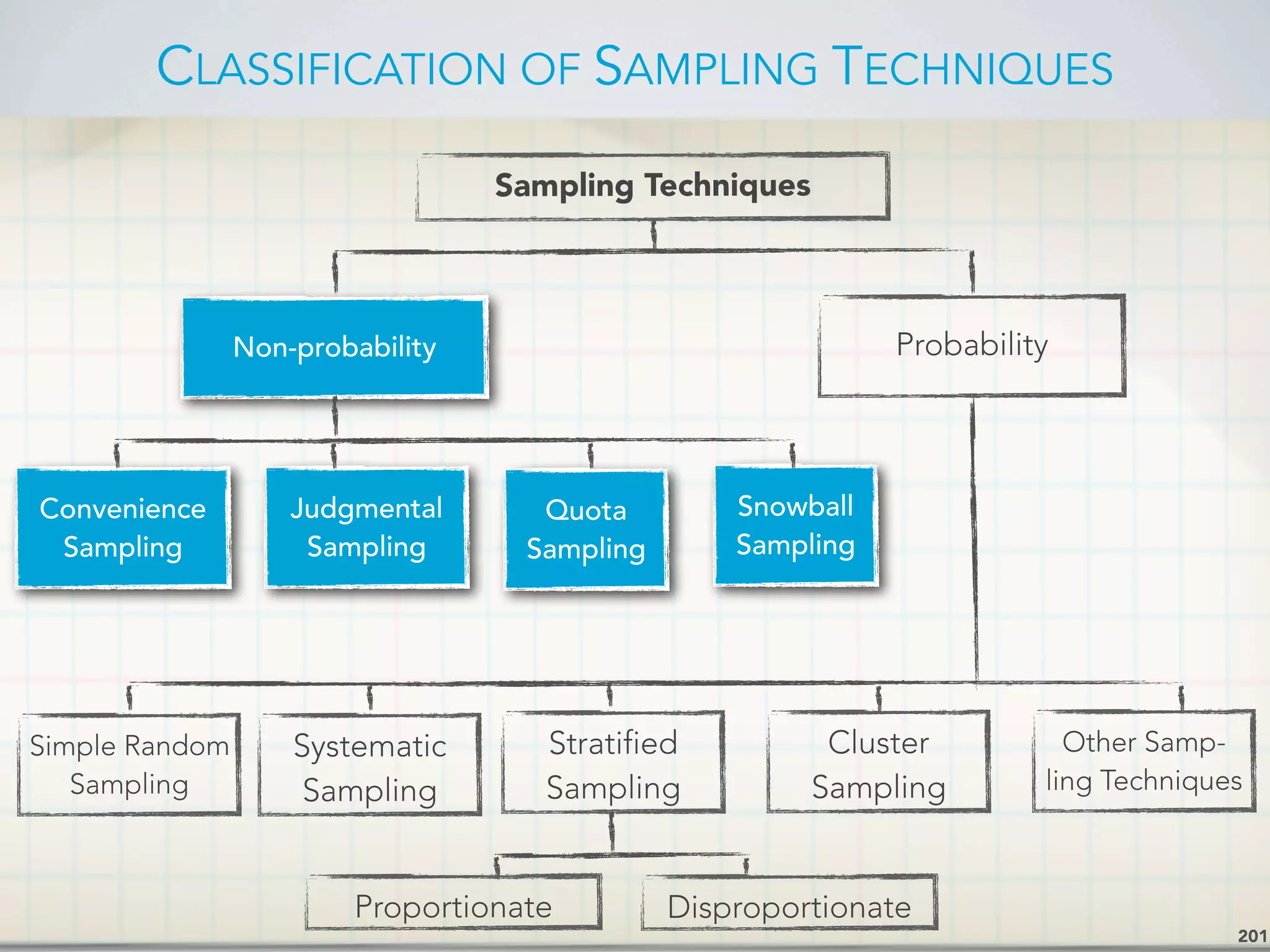
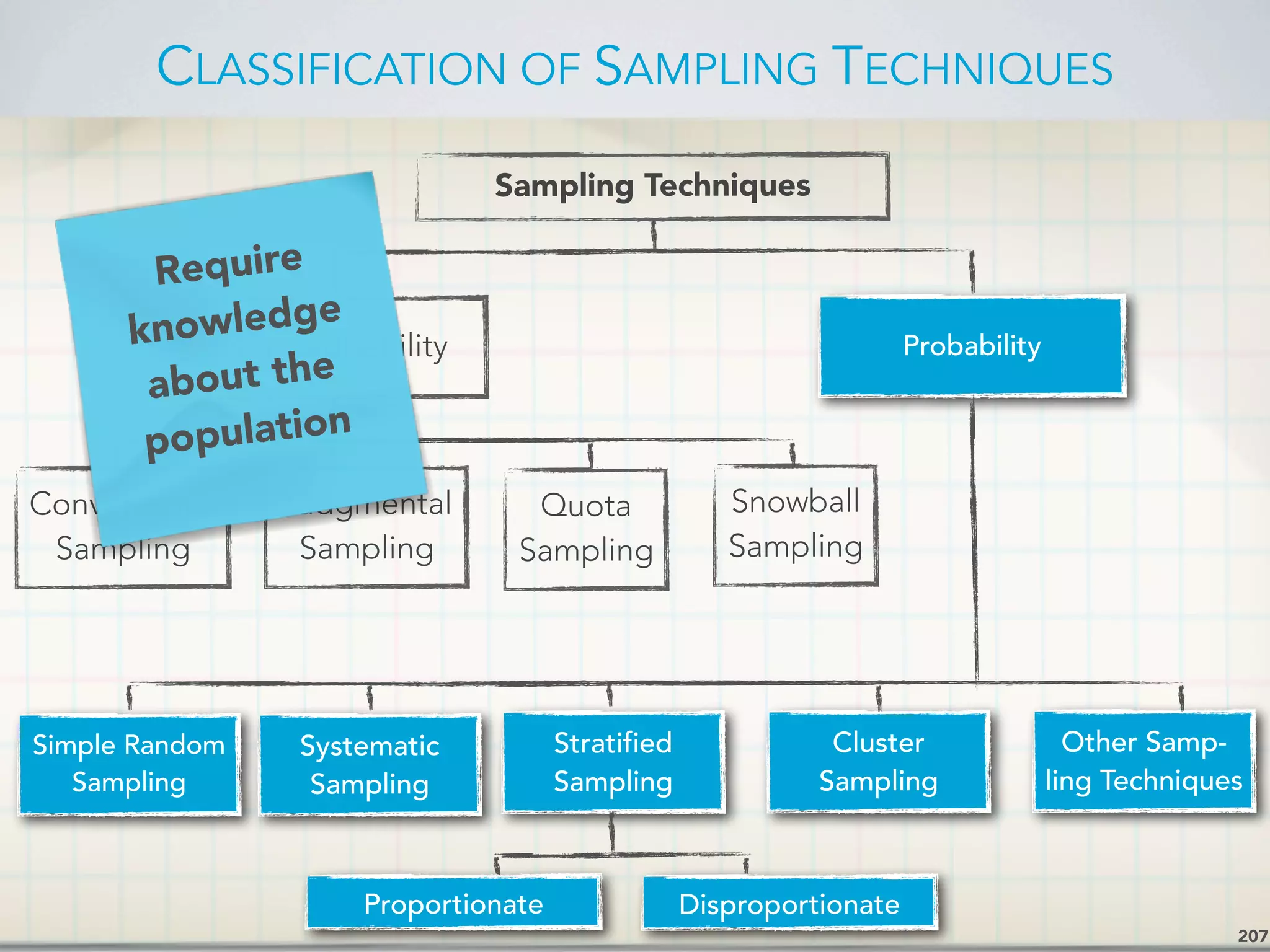
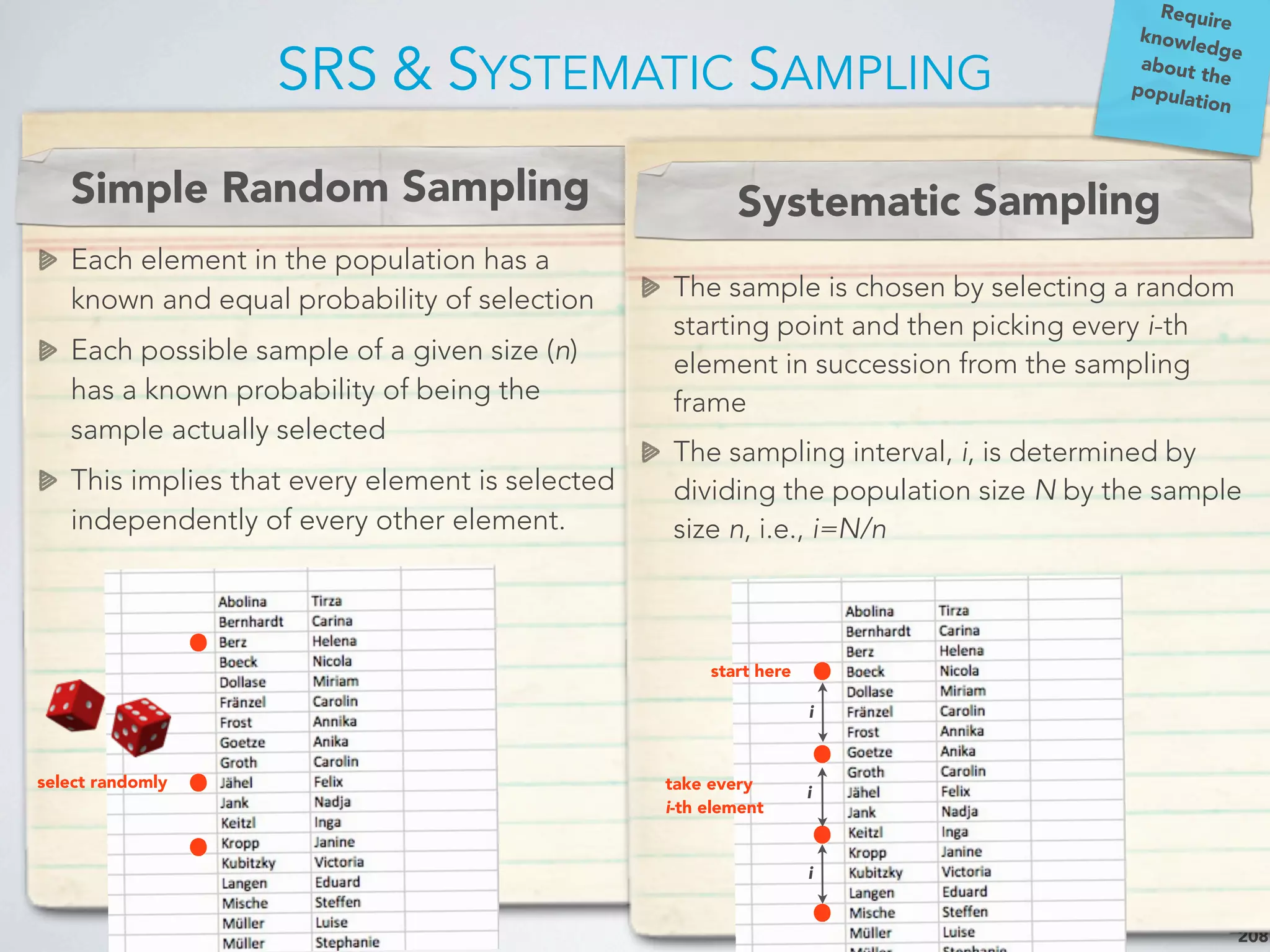
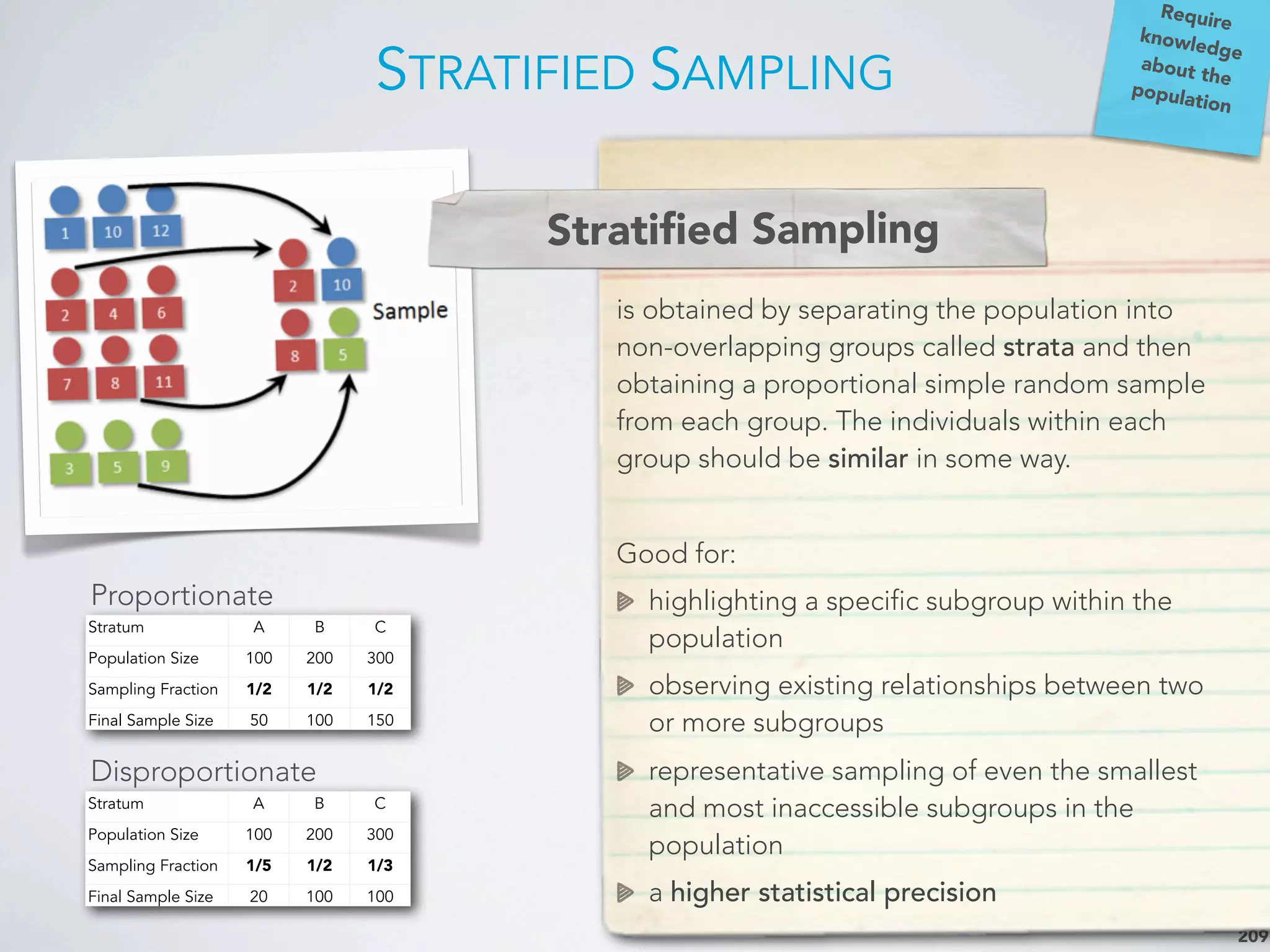
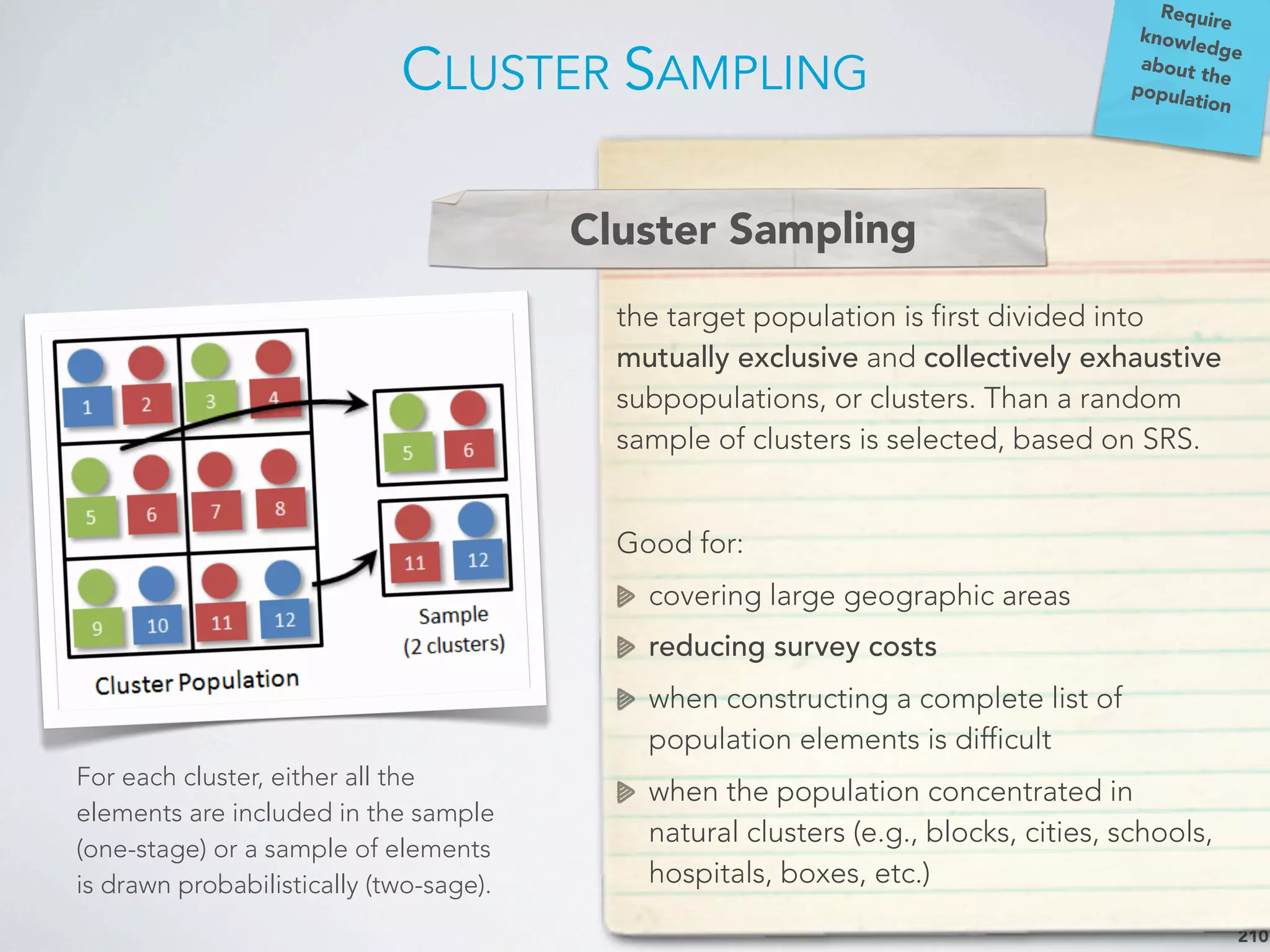
Overview of sampling strategies including non-probability and probability sampling types and their applications.
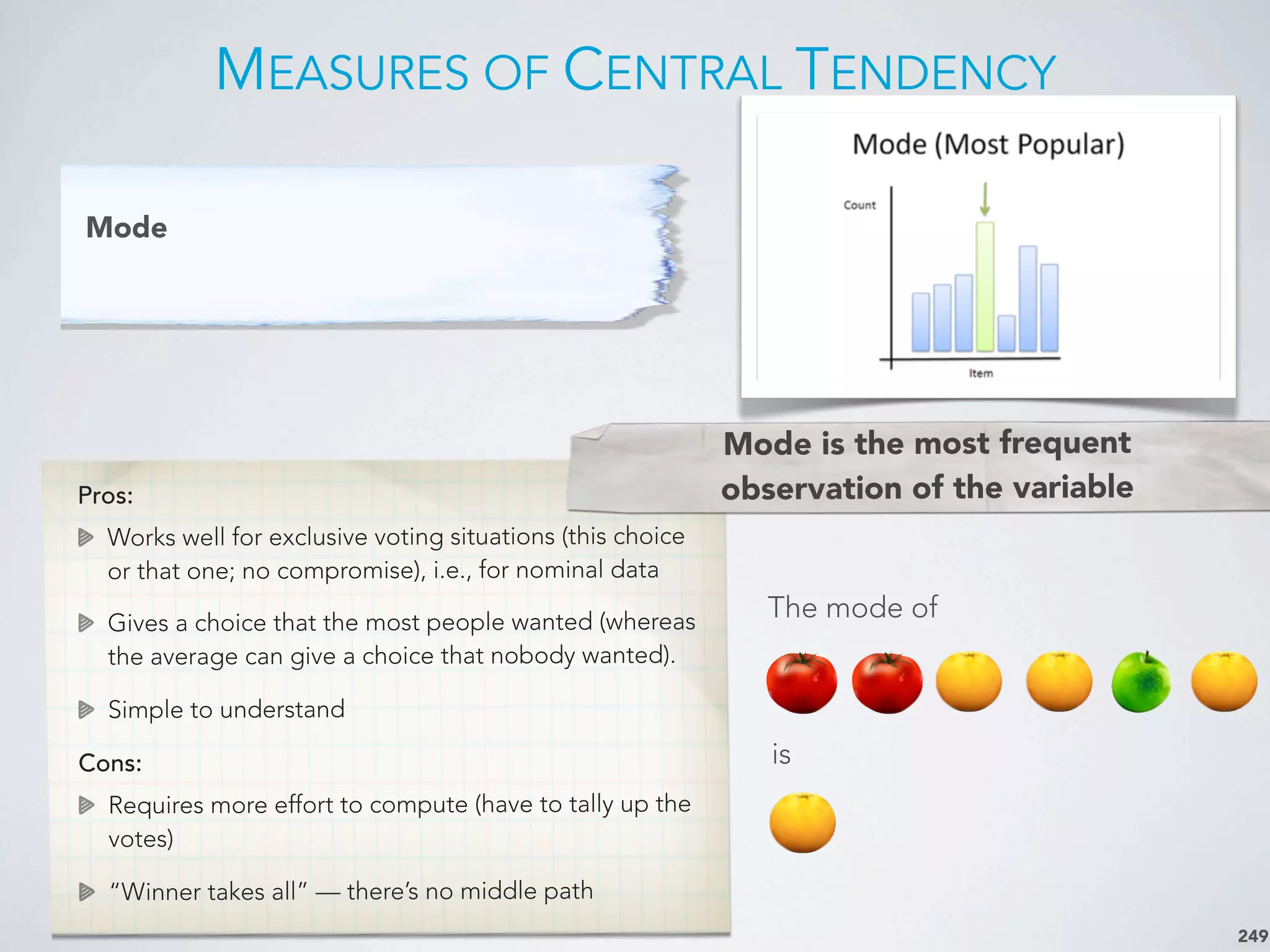
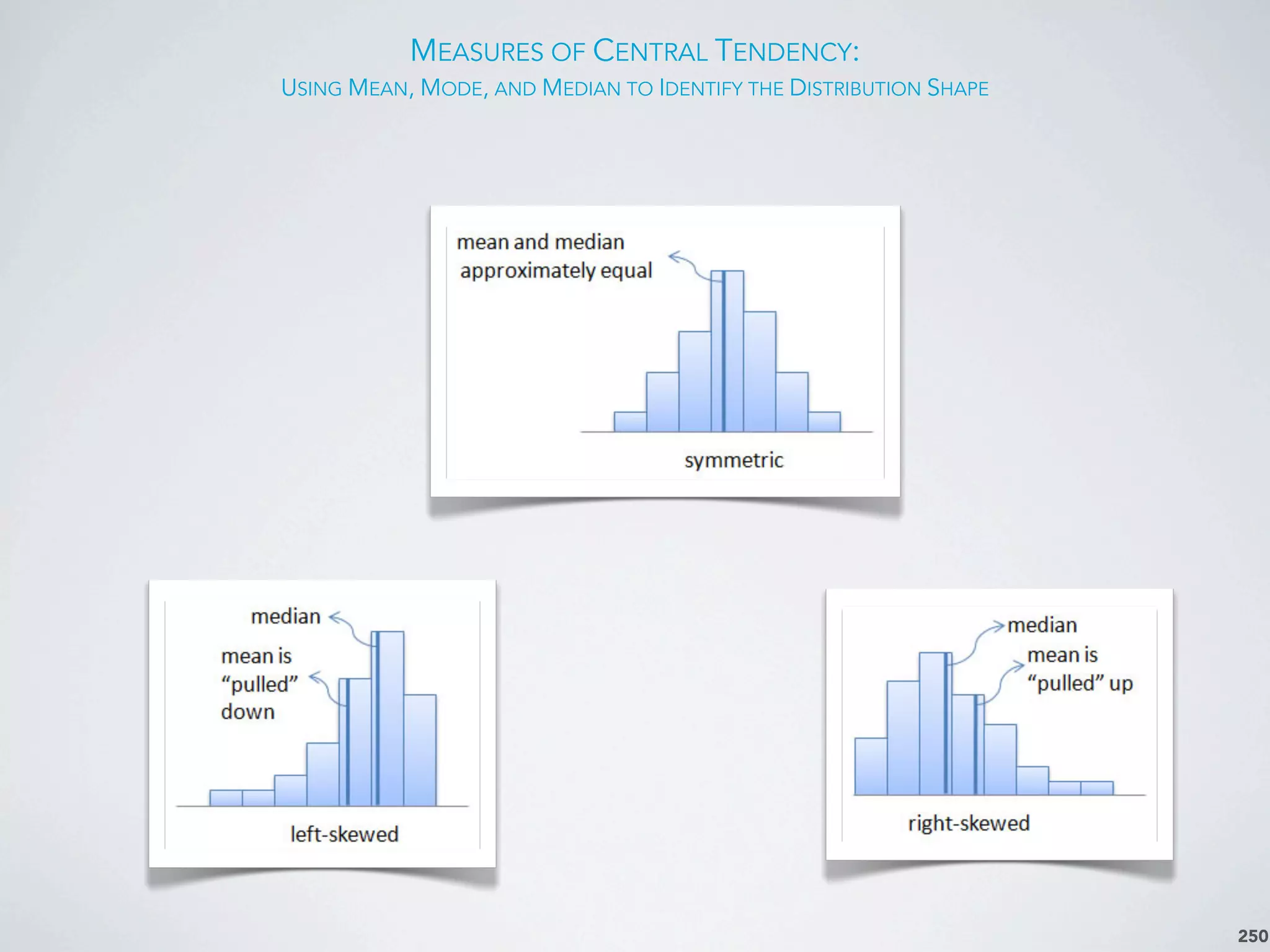
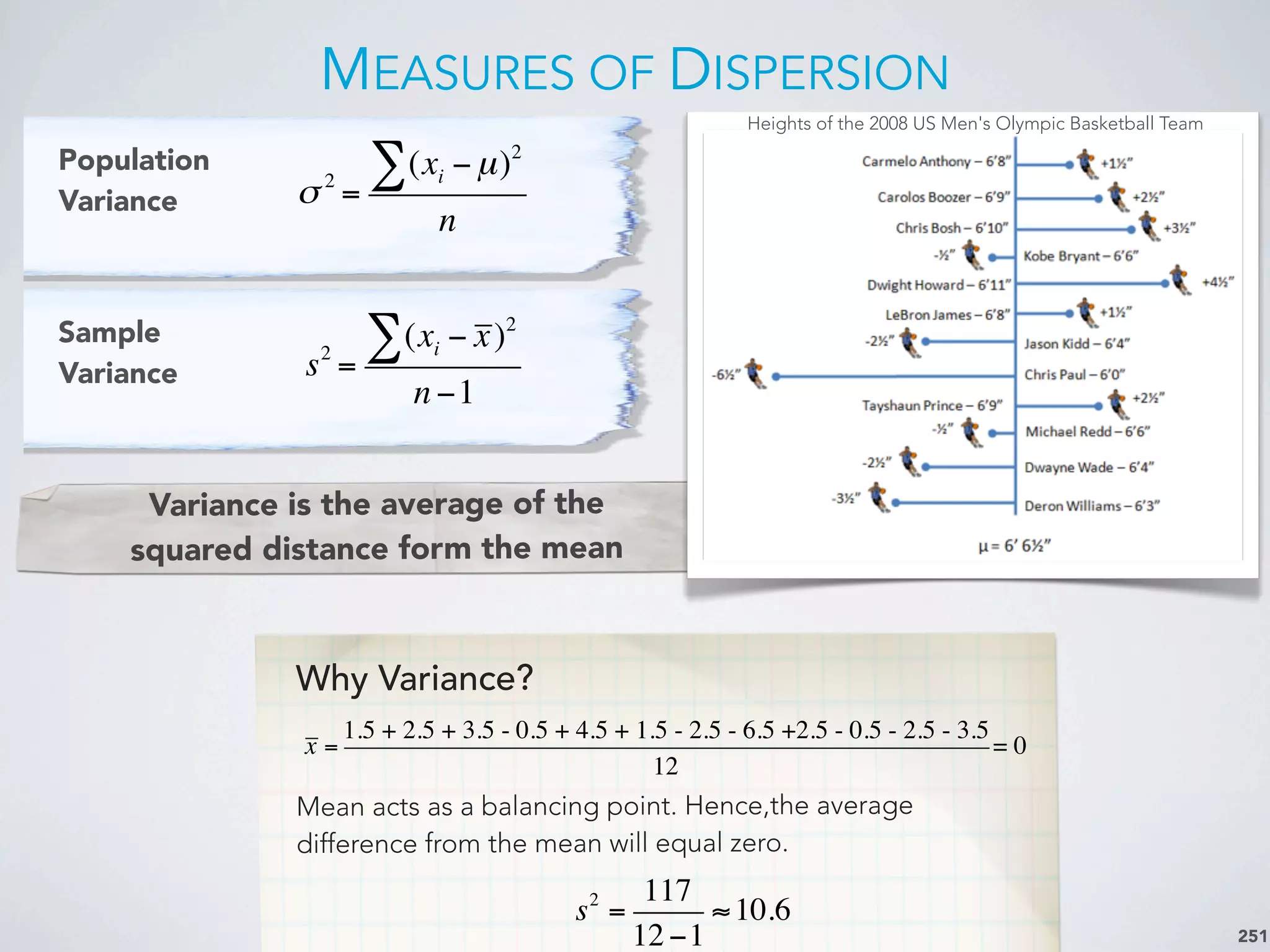
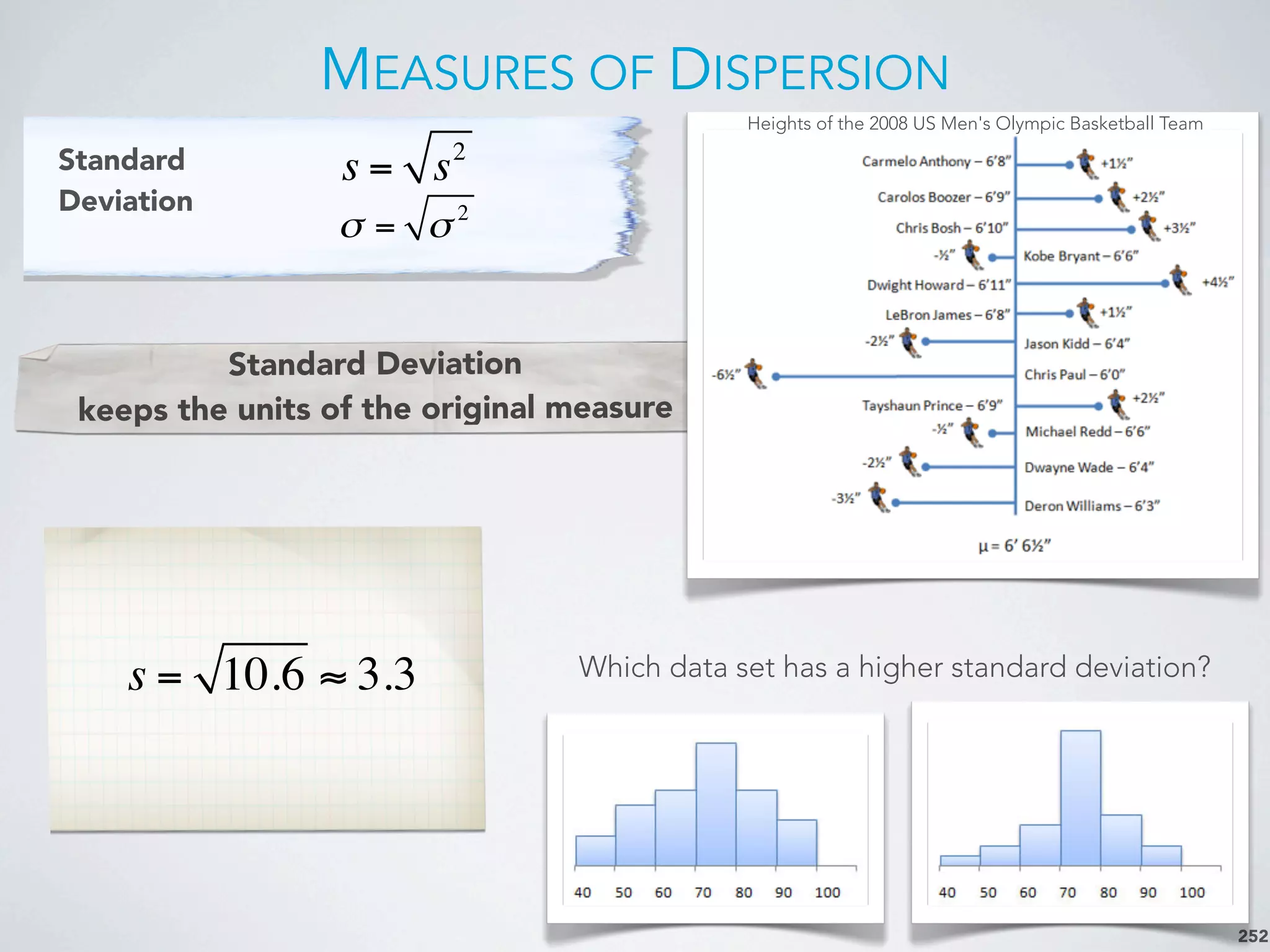
A concise overview of statistical methods used in data analysis, focusing on descriptive and inferential statistics.
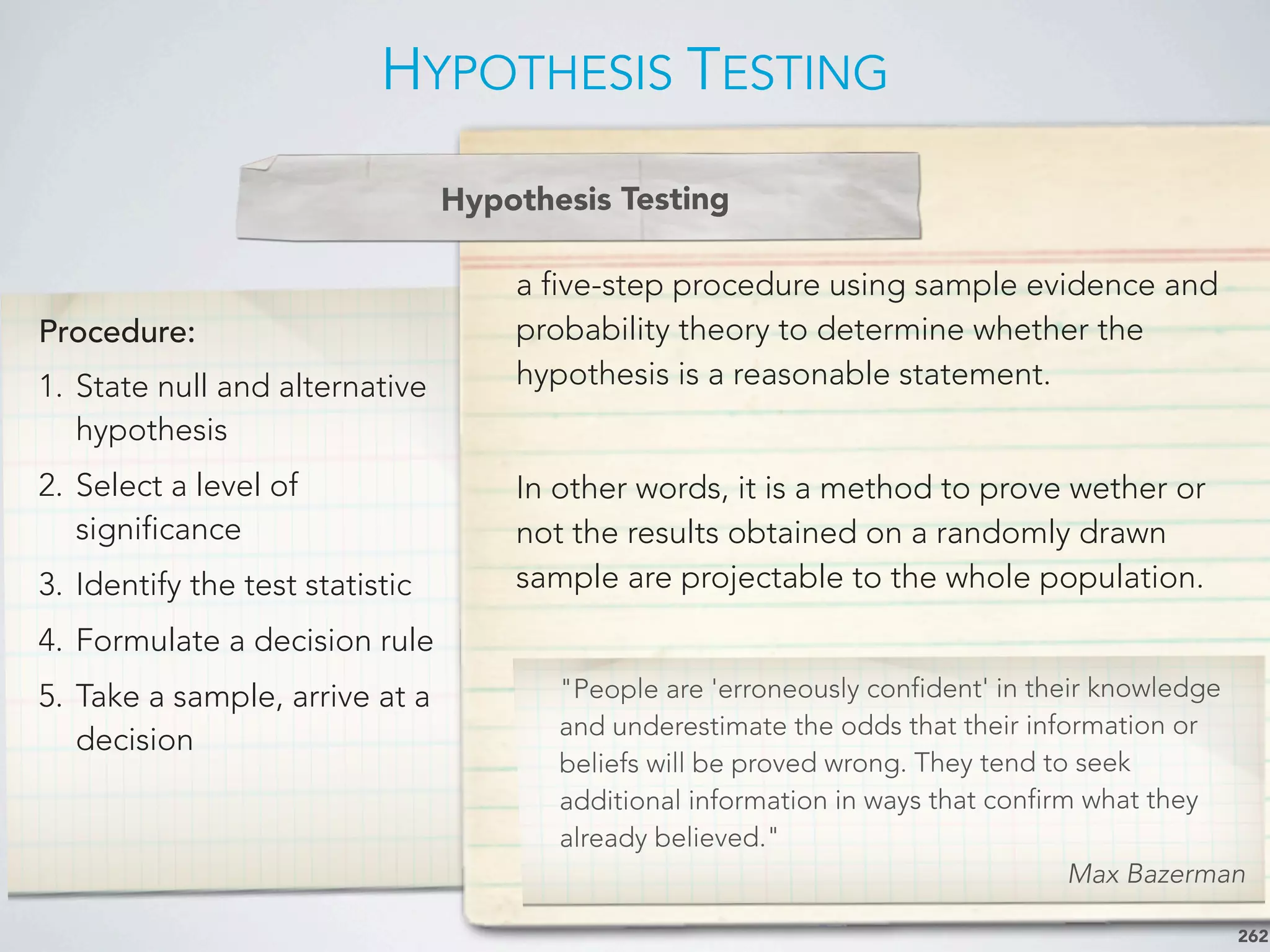
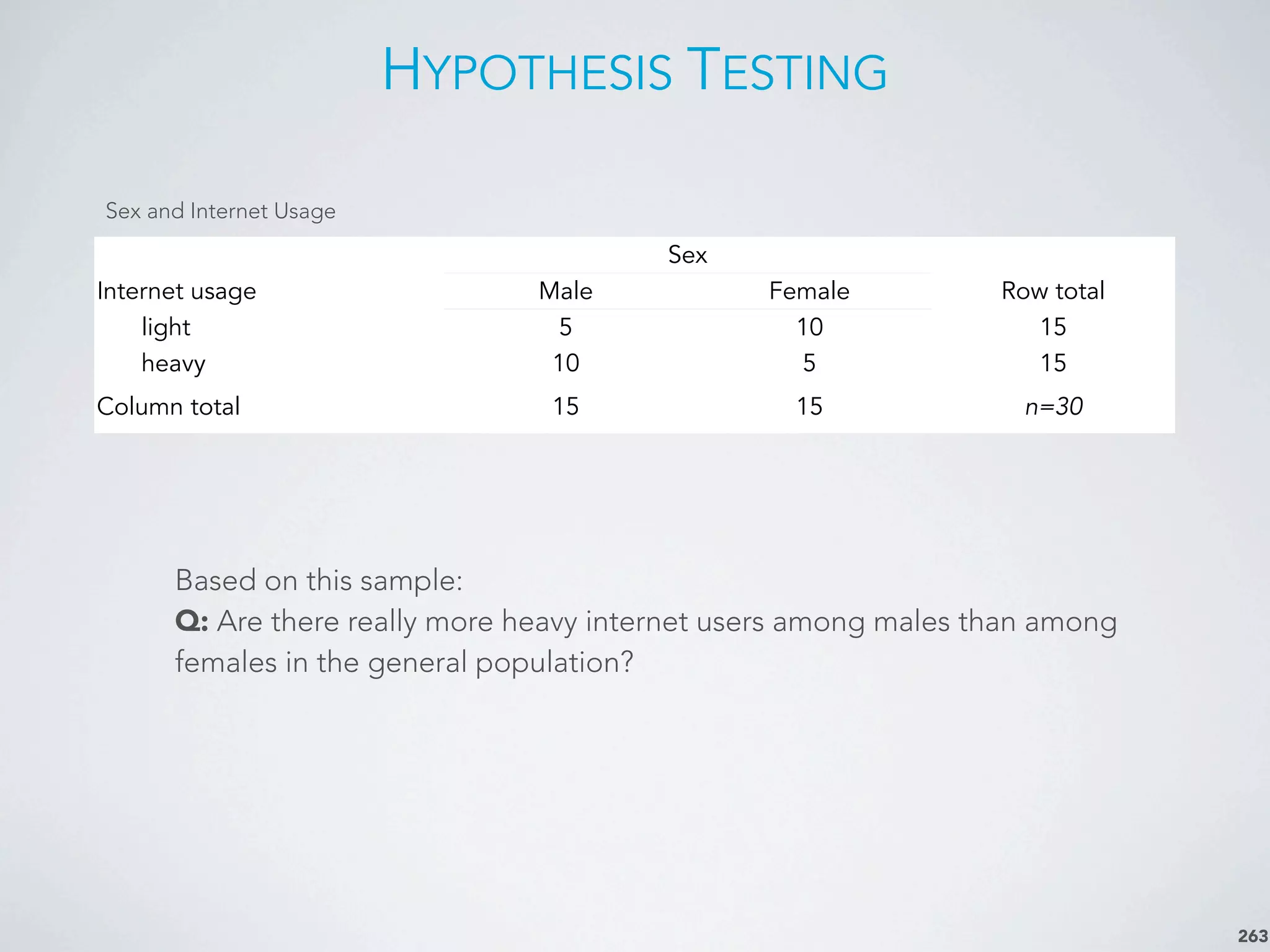
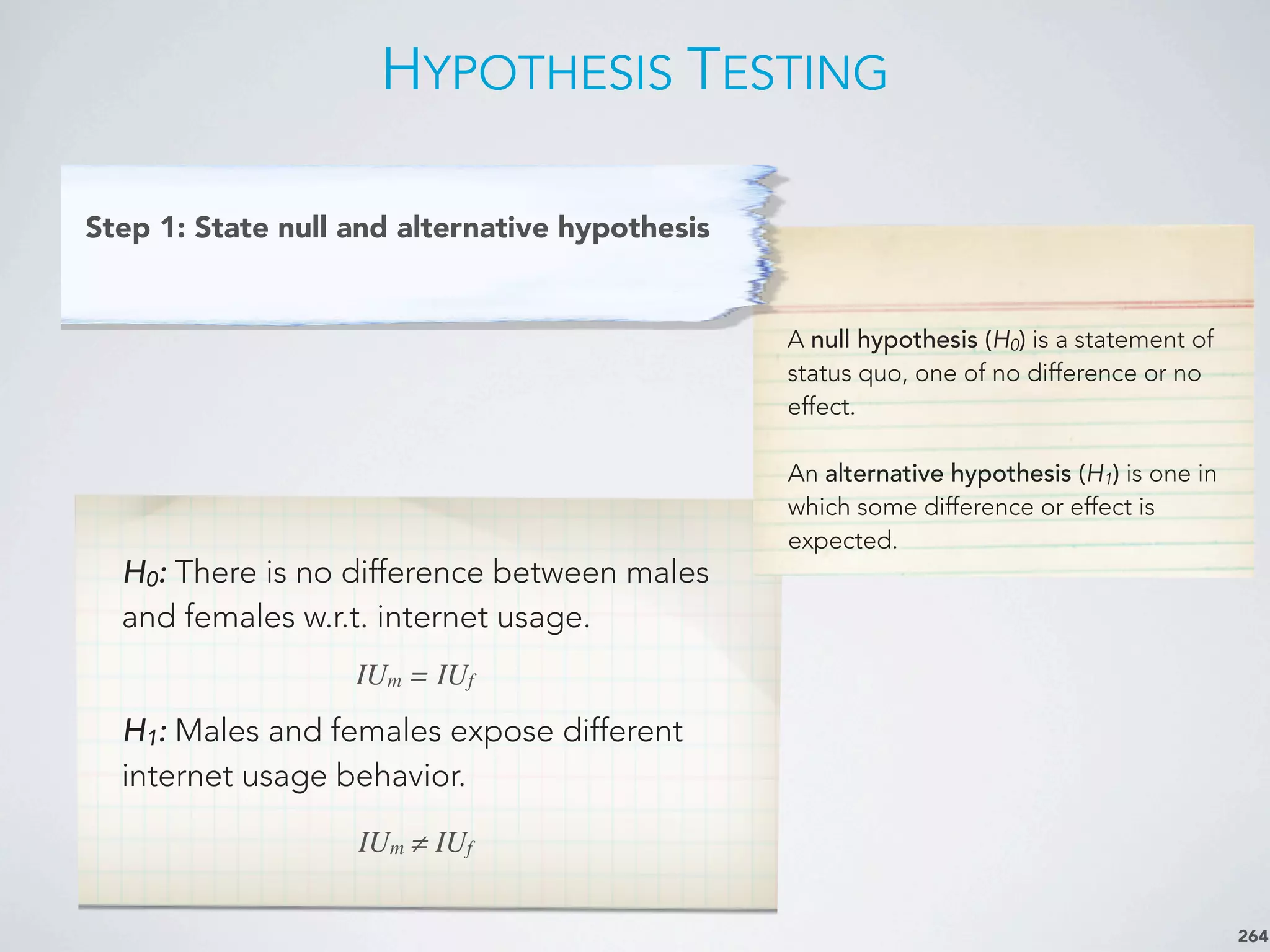
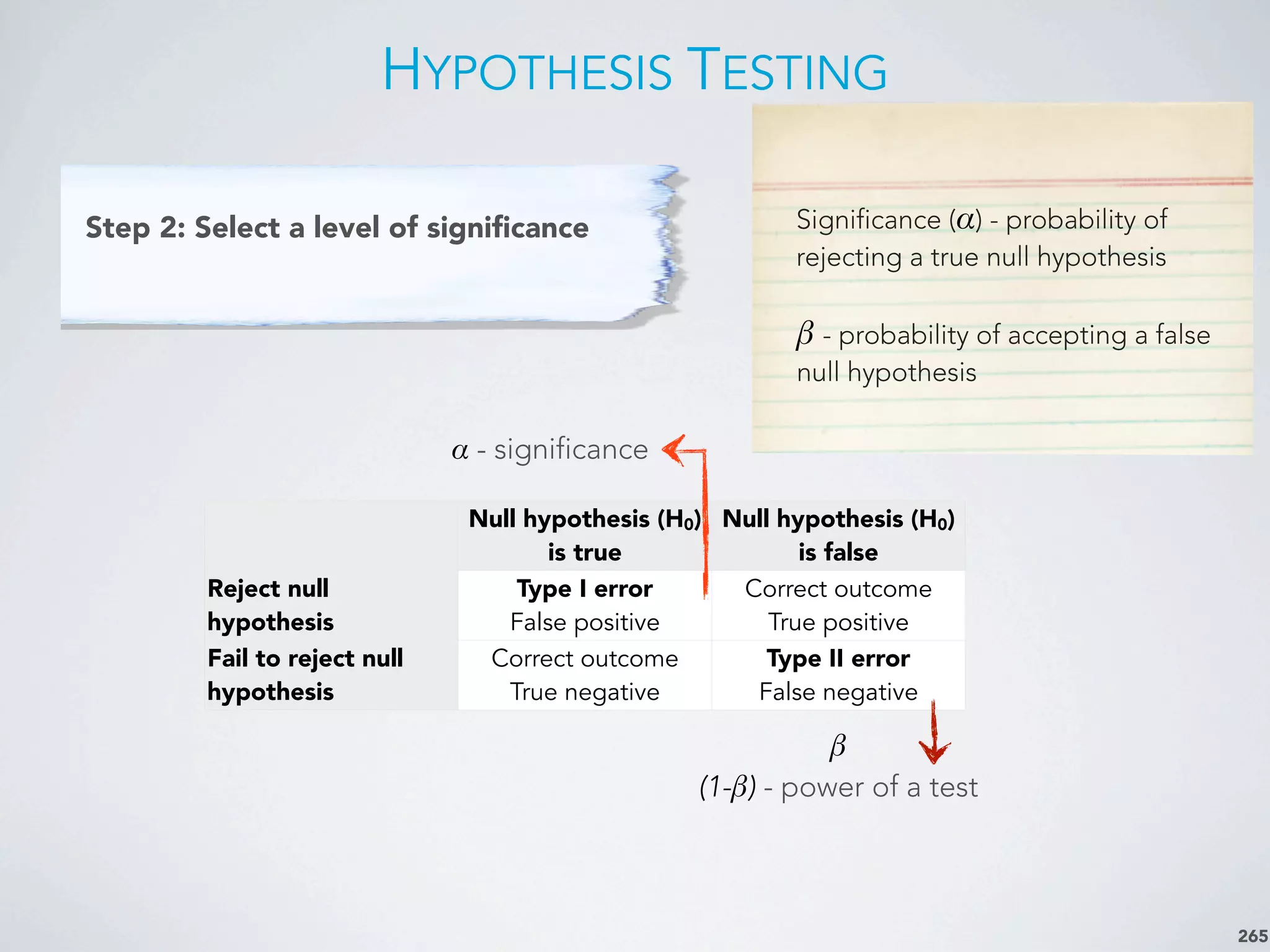
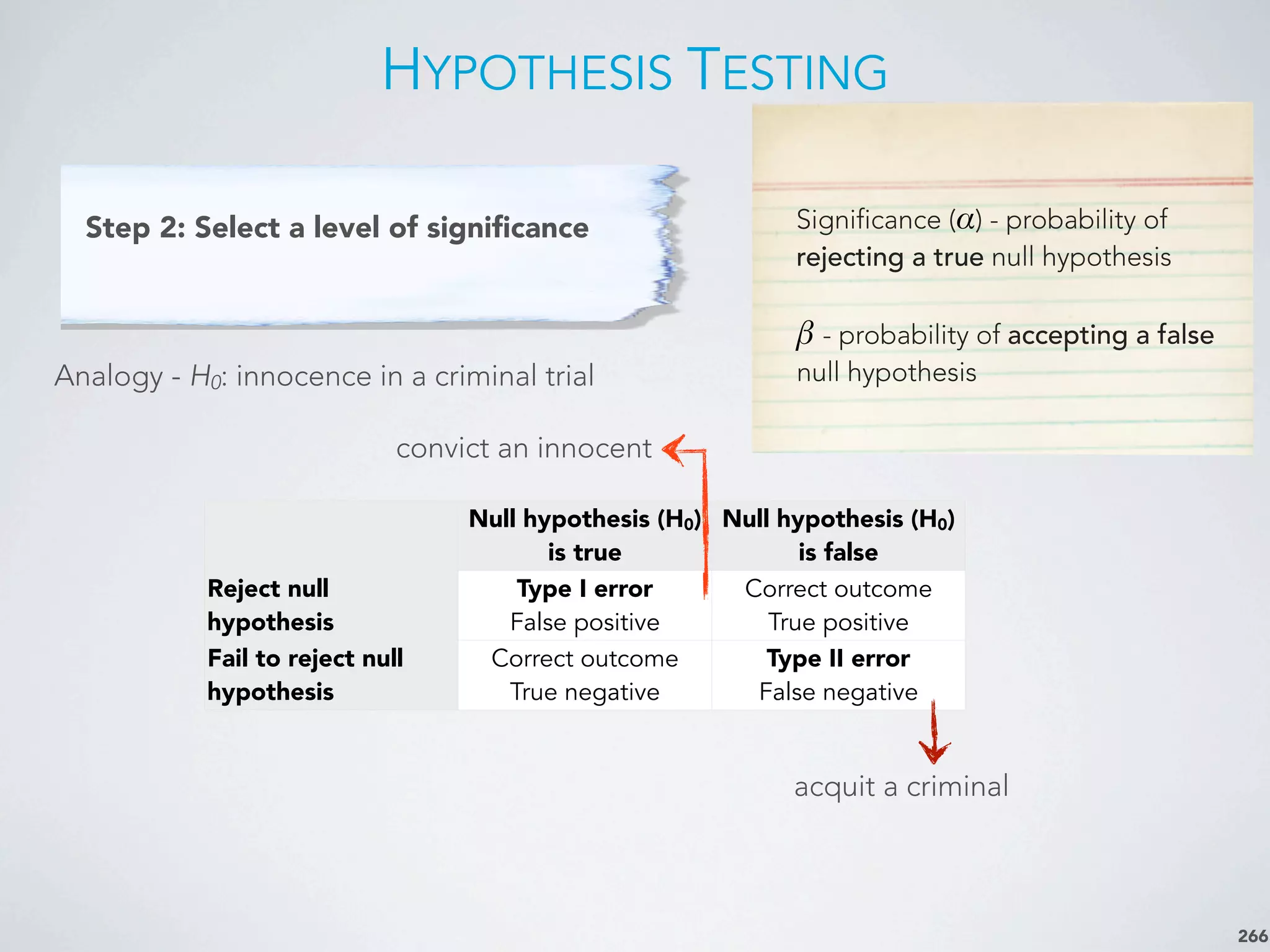
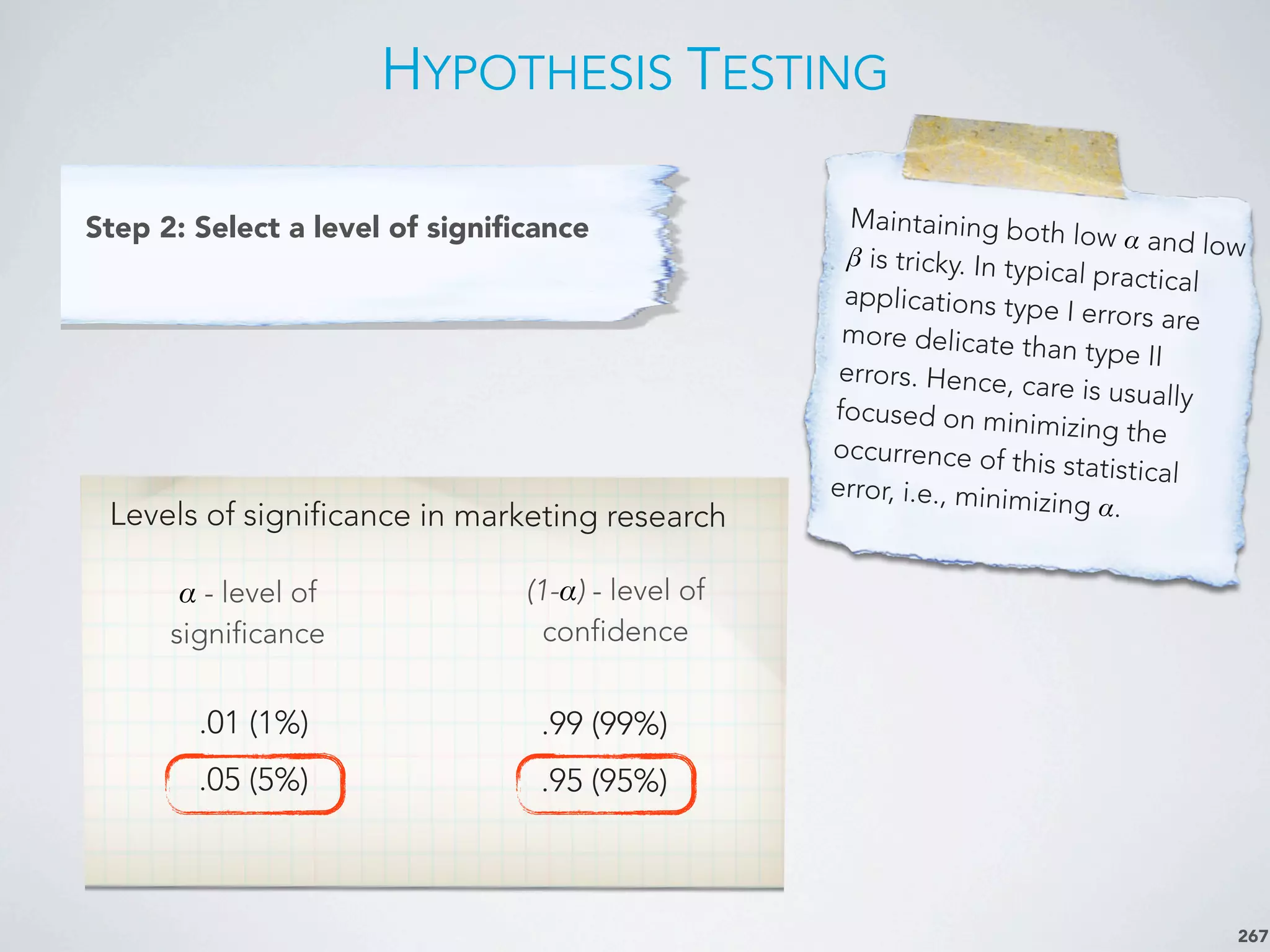
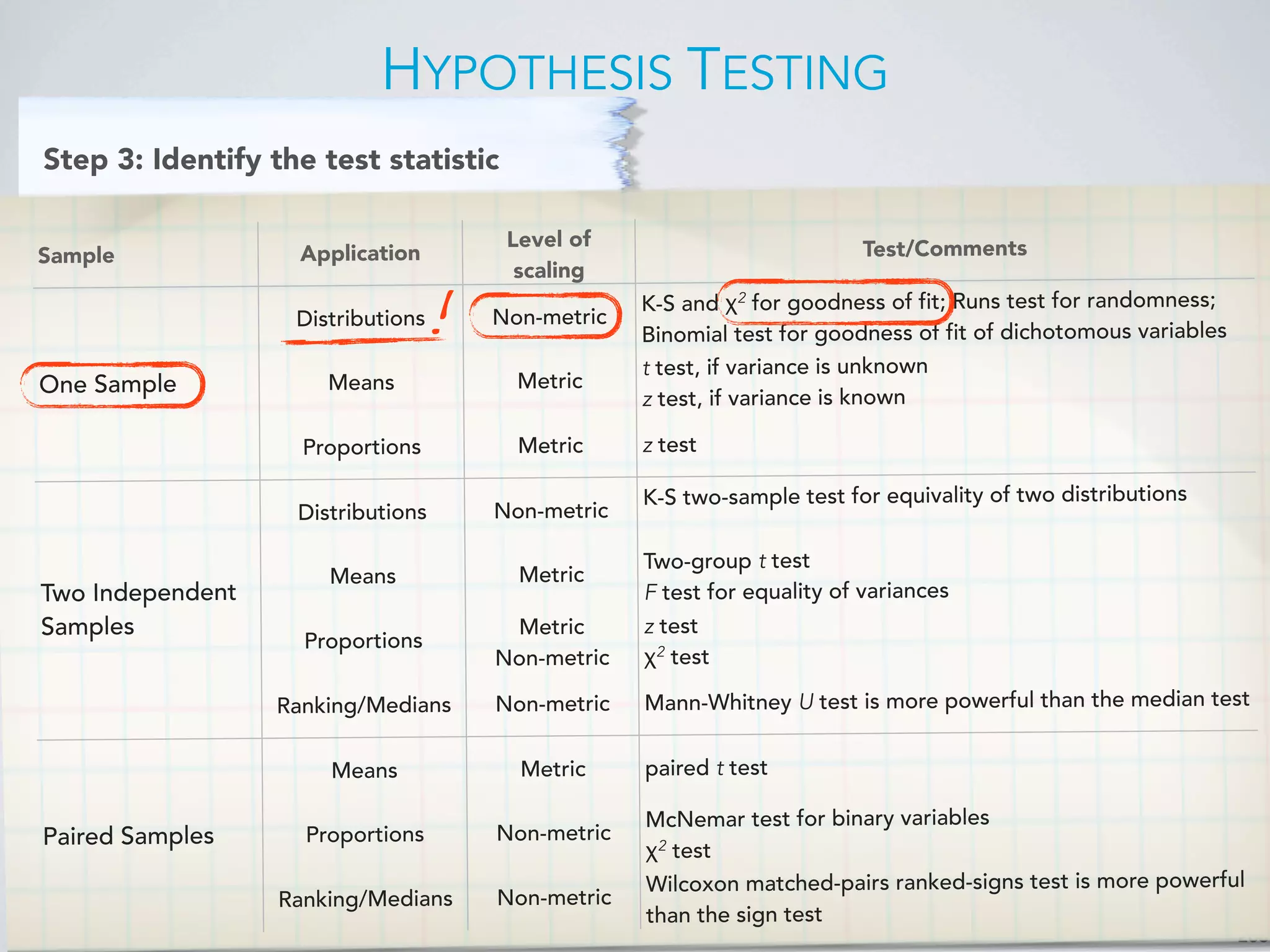
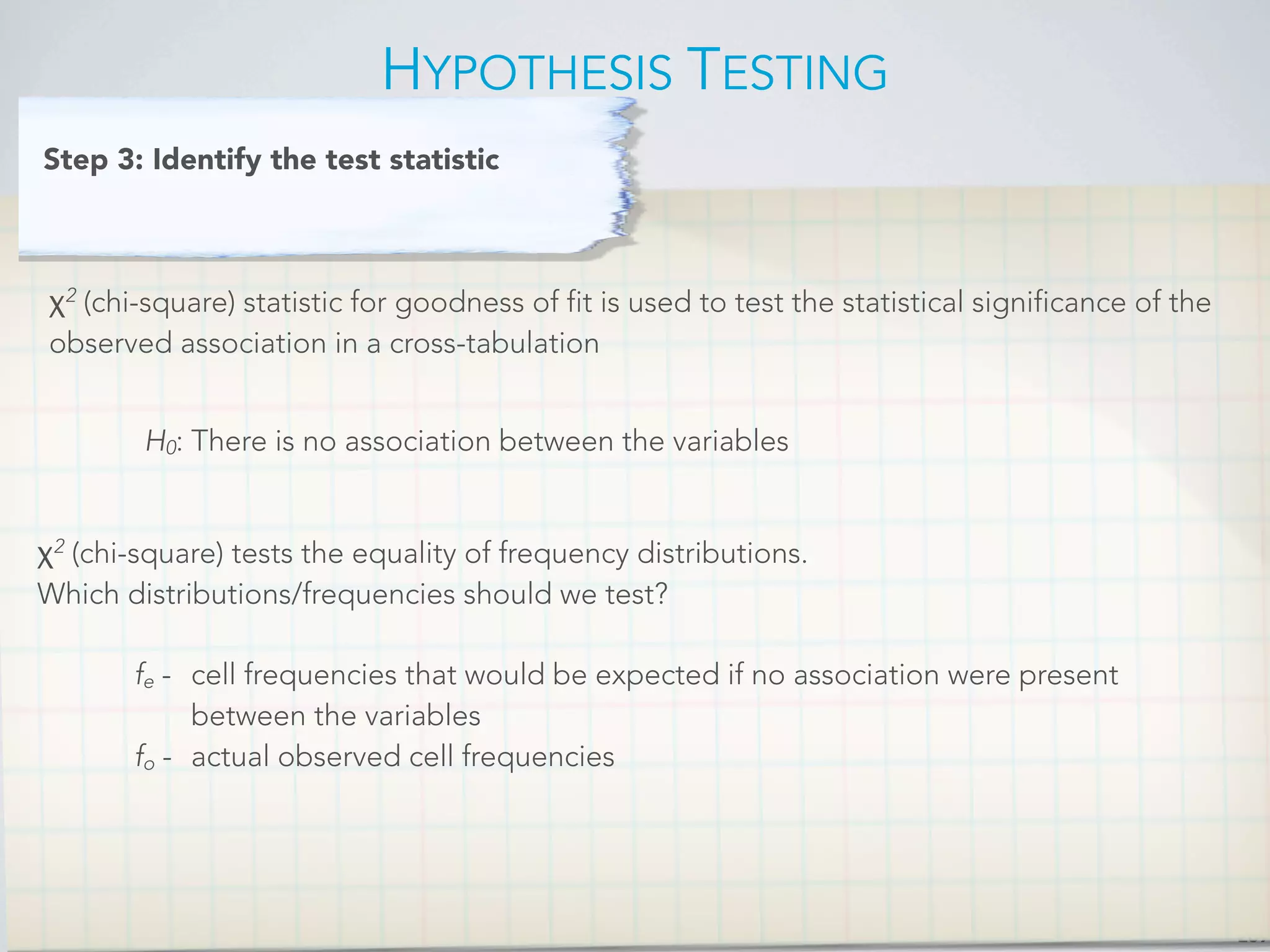
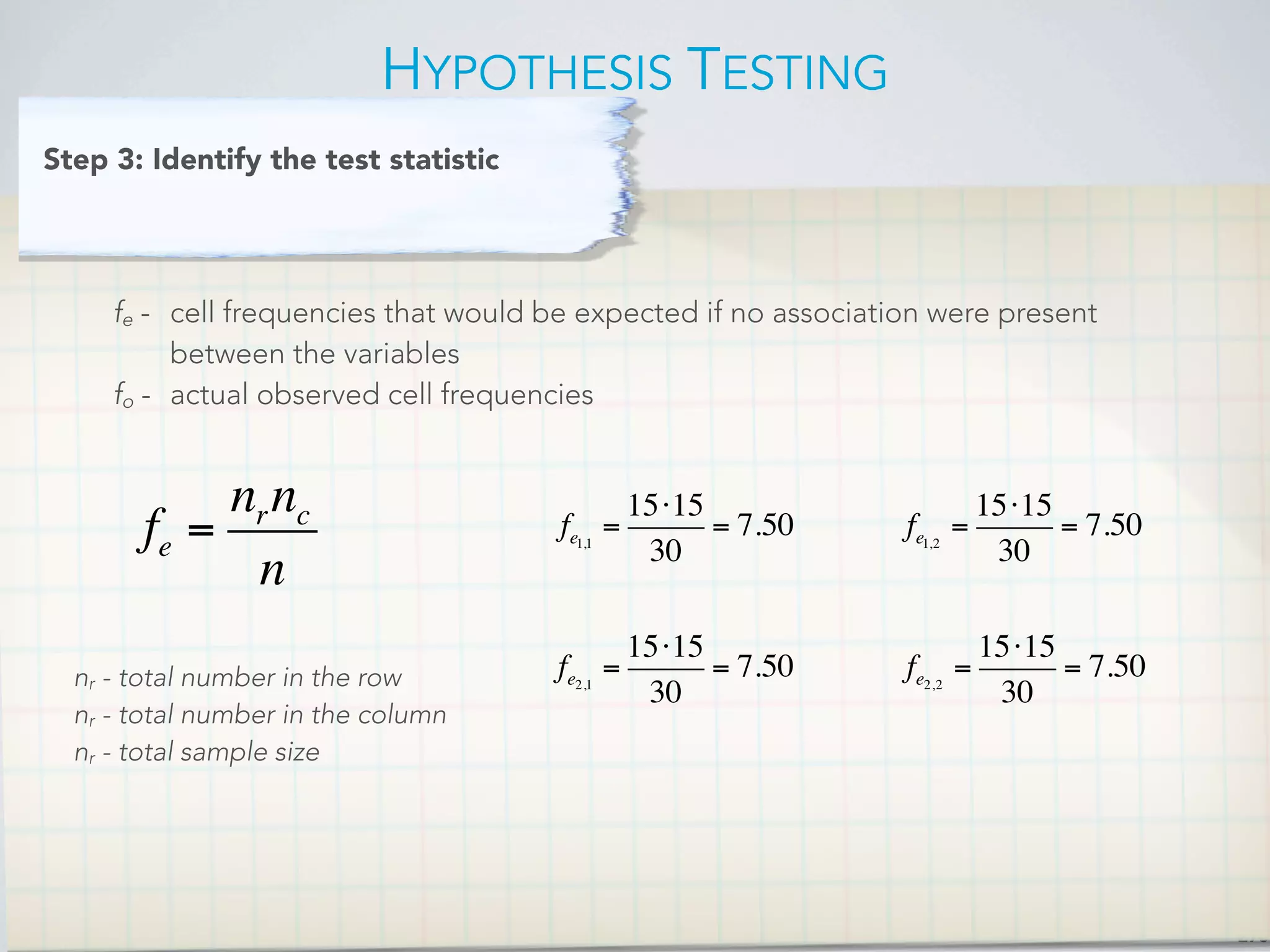
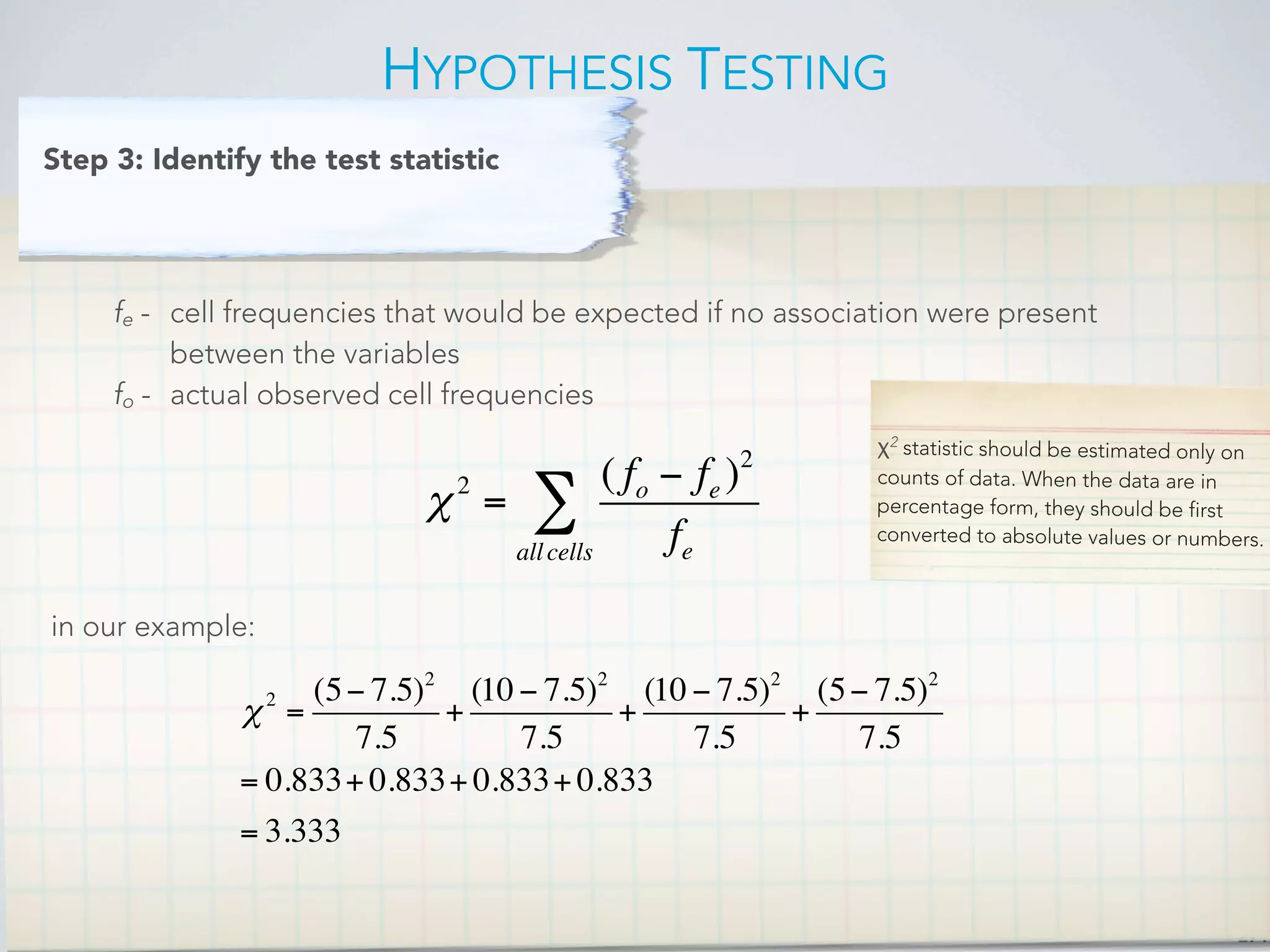
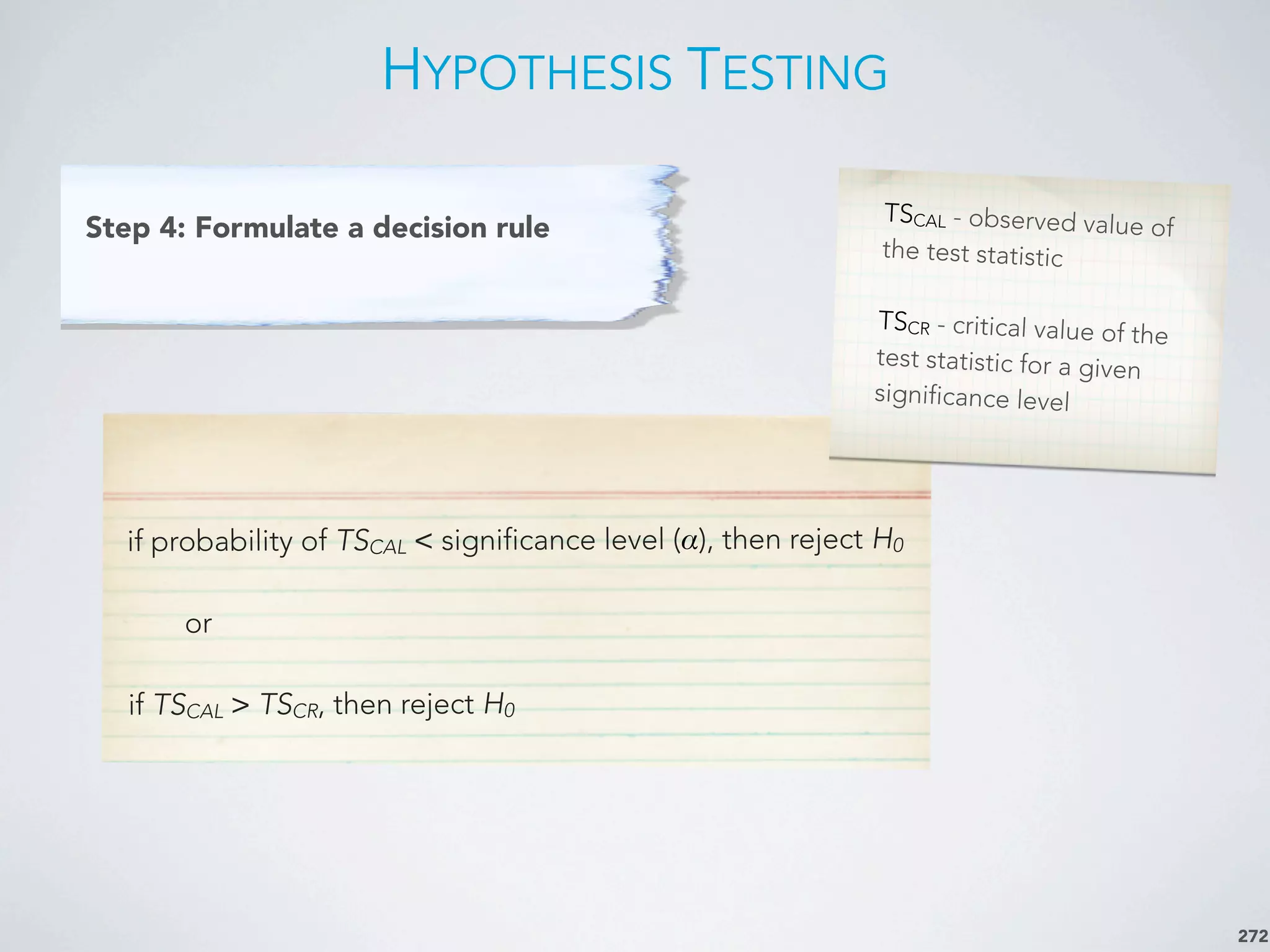
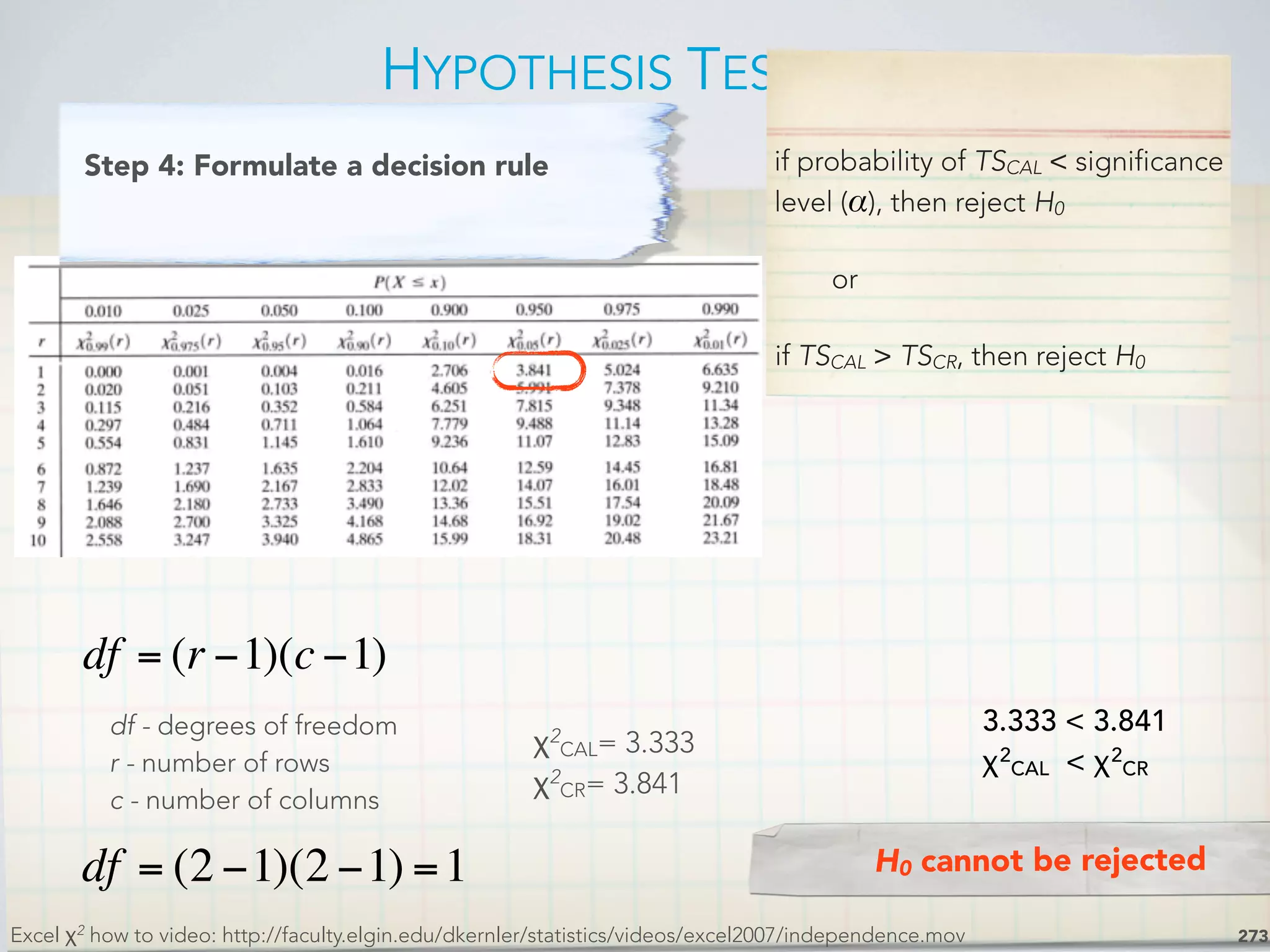
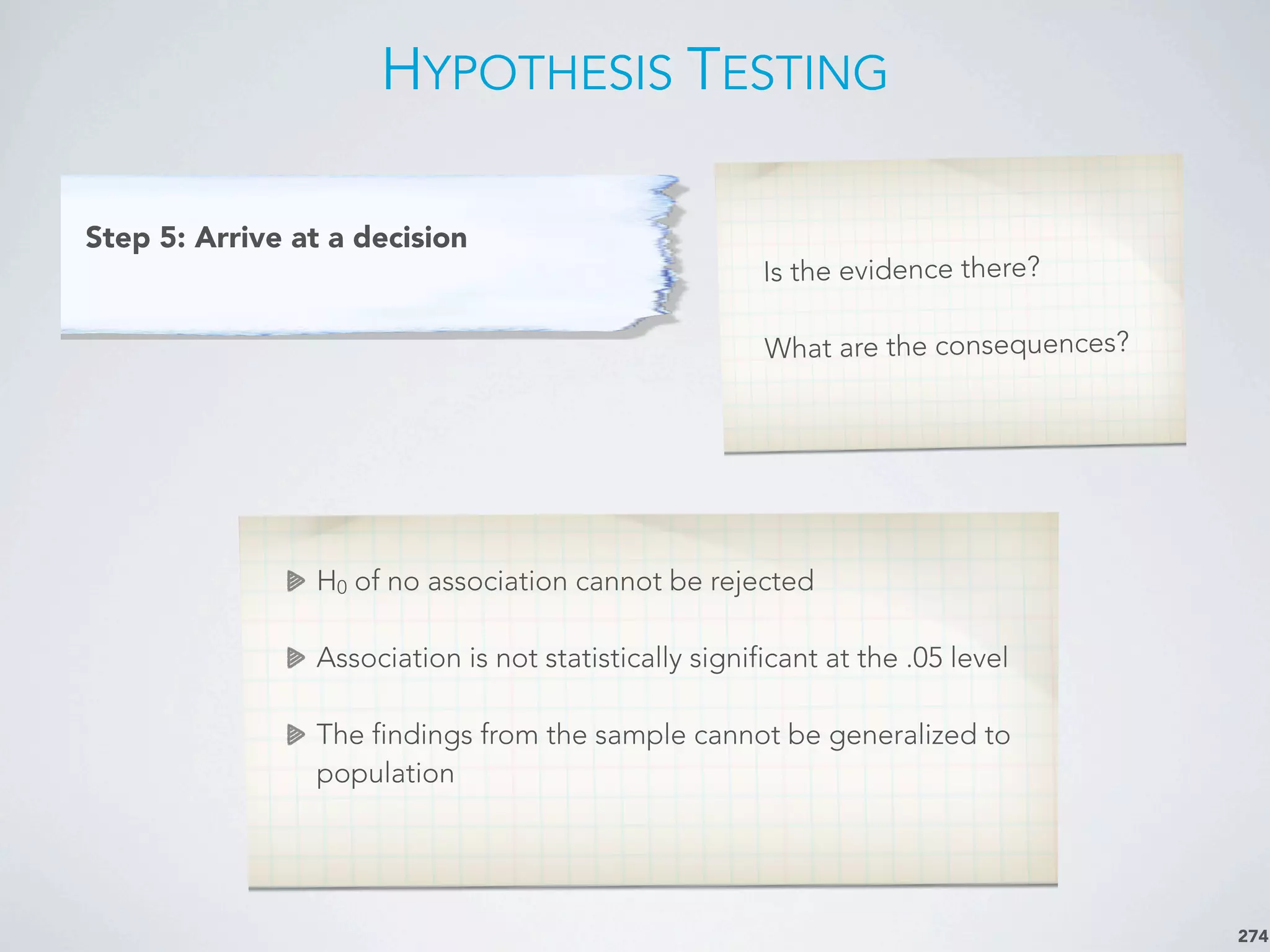
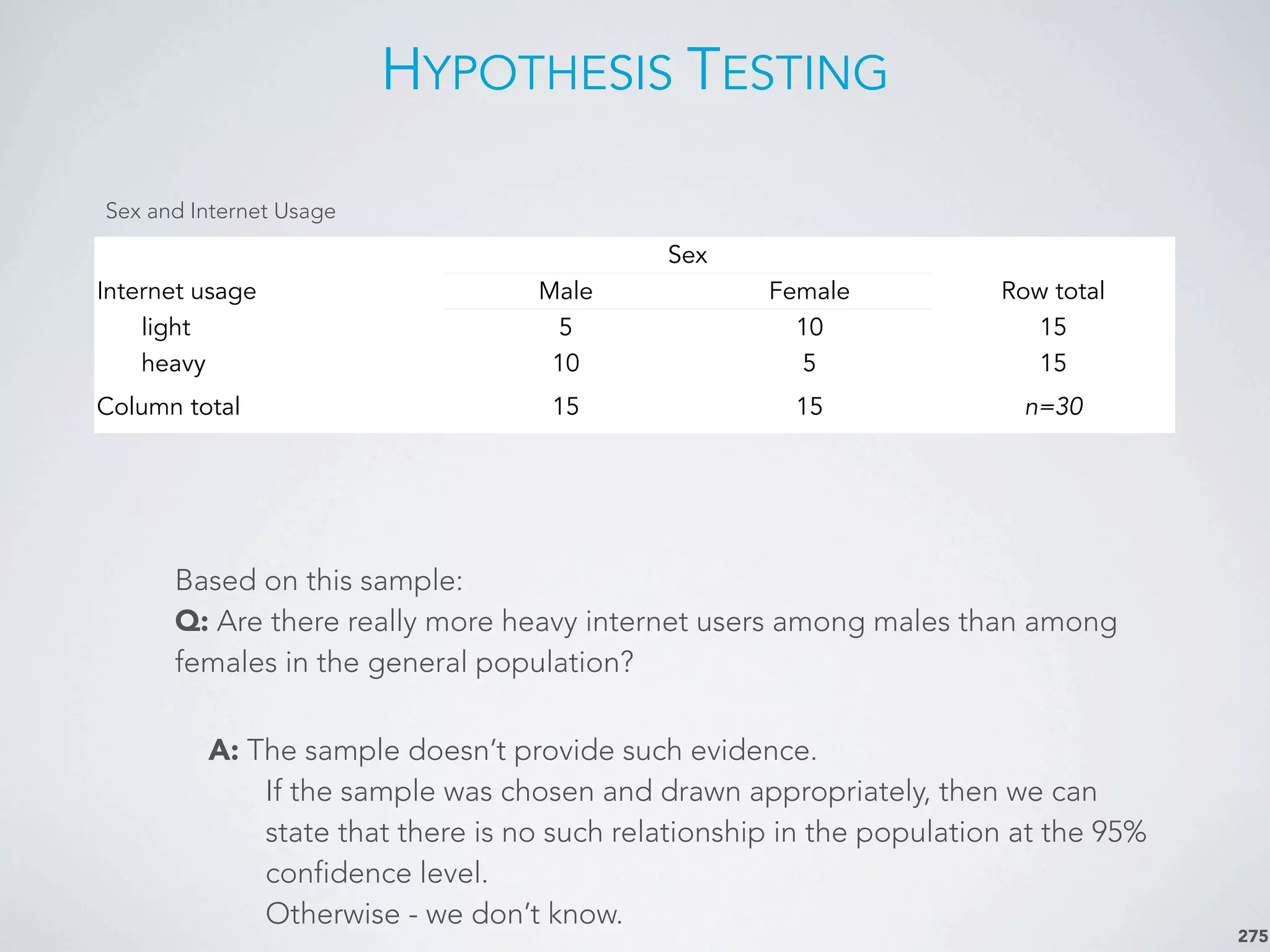
A step-by-step approach to hypothesis testing in marketing research, including significance levels and decision rules.
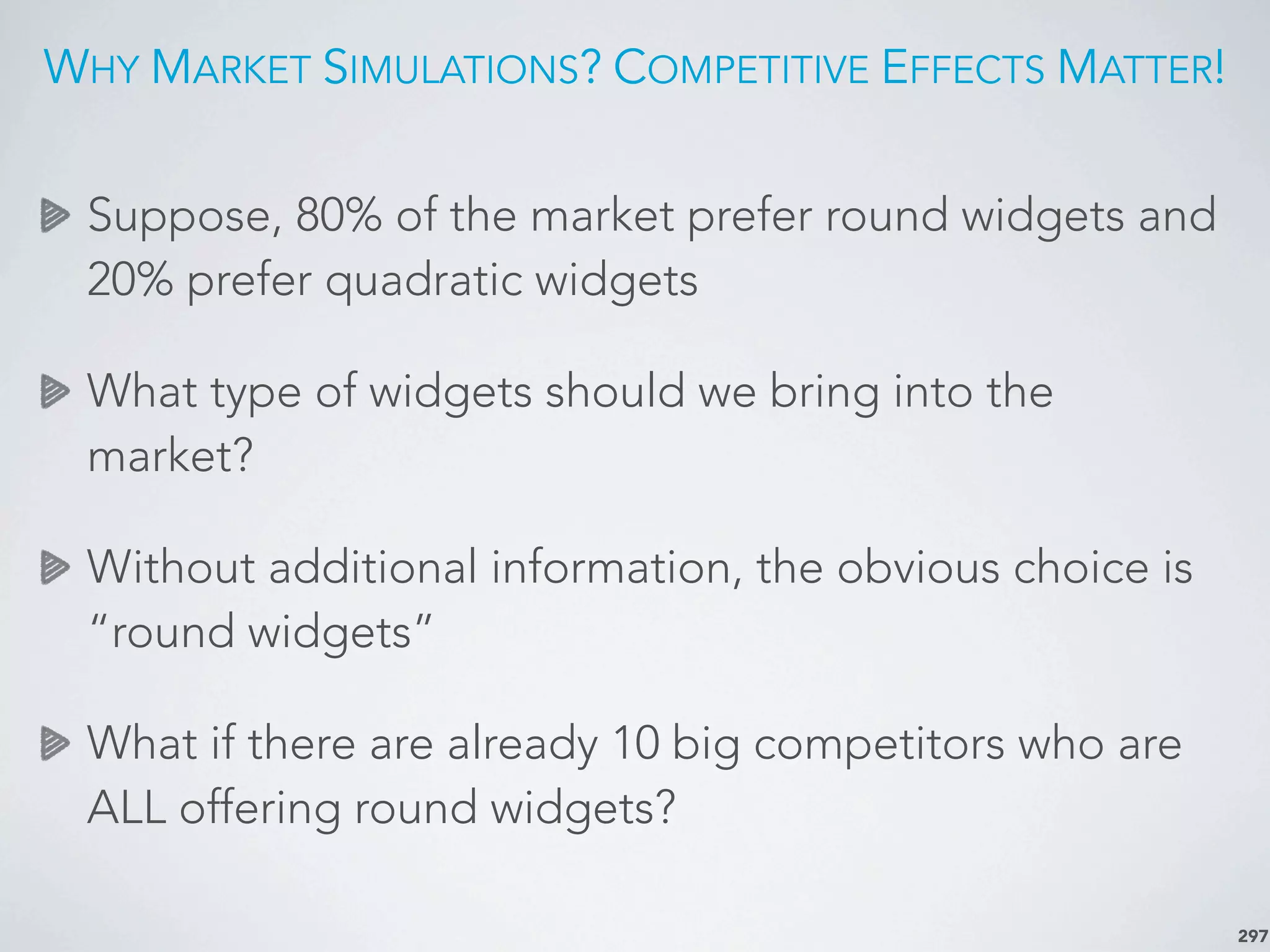
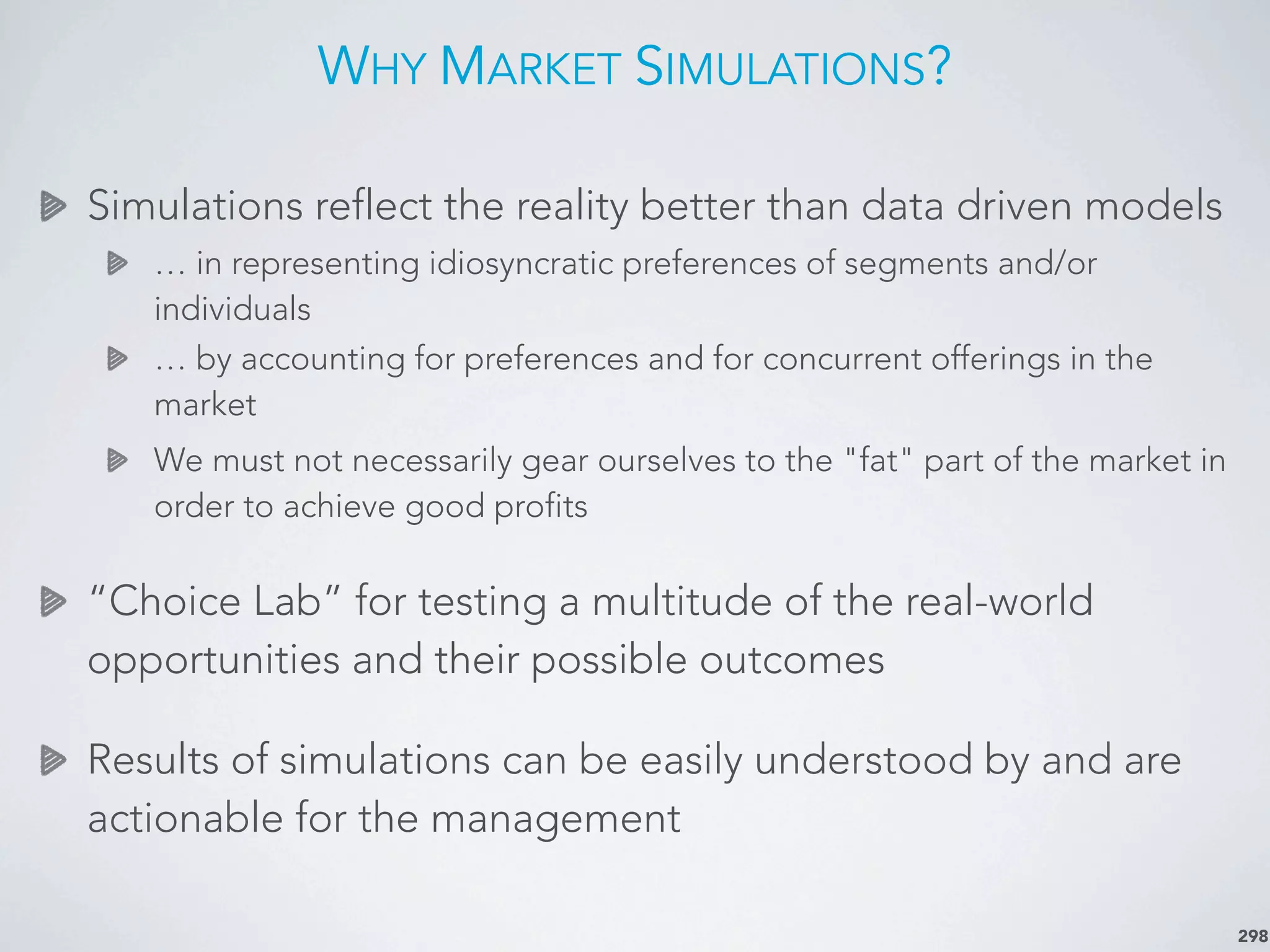
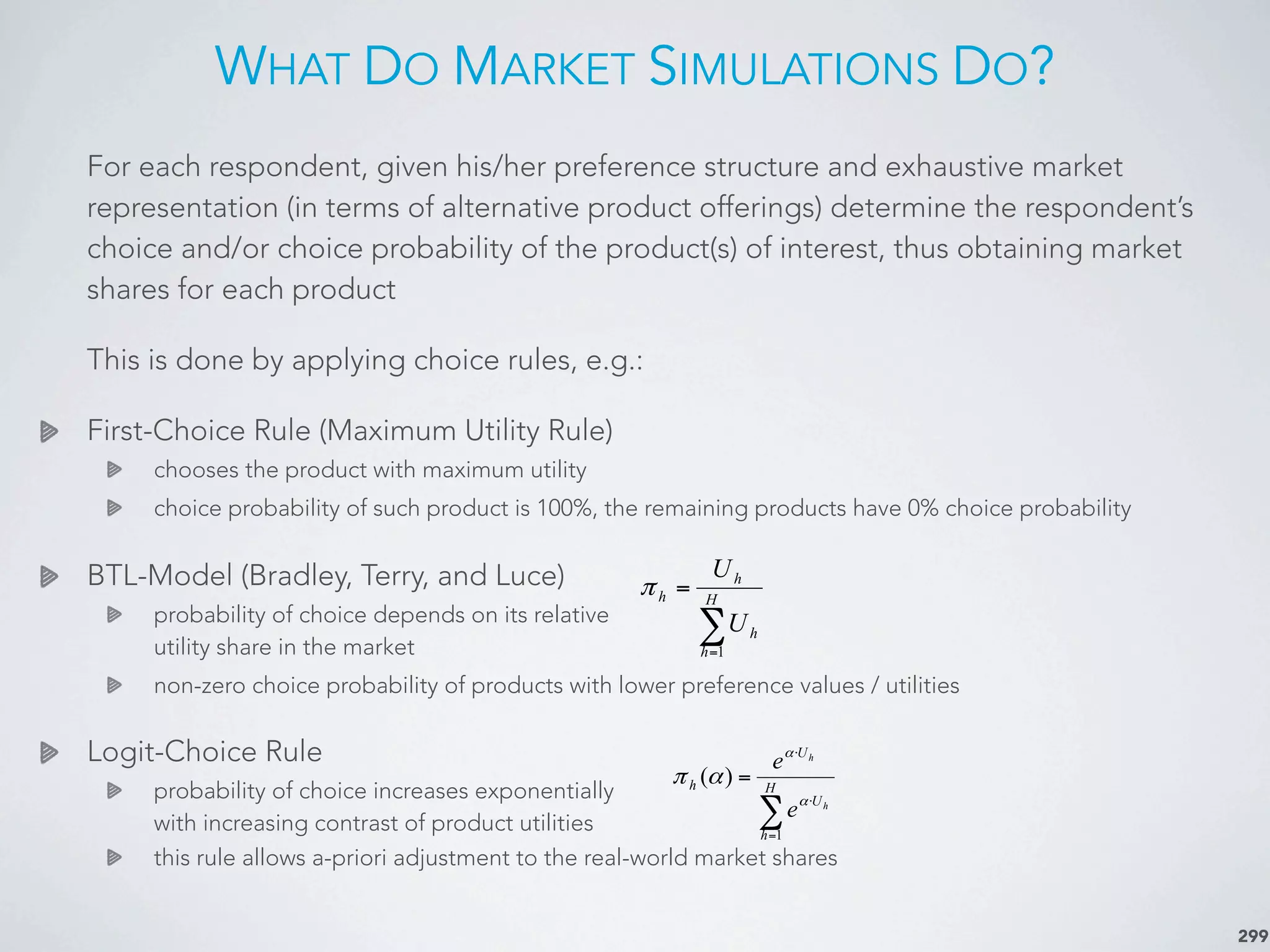
Overview of advanced techniques like conjoint analysis, market simulations, segmentation, and perceptual mapping.
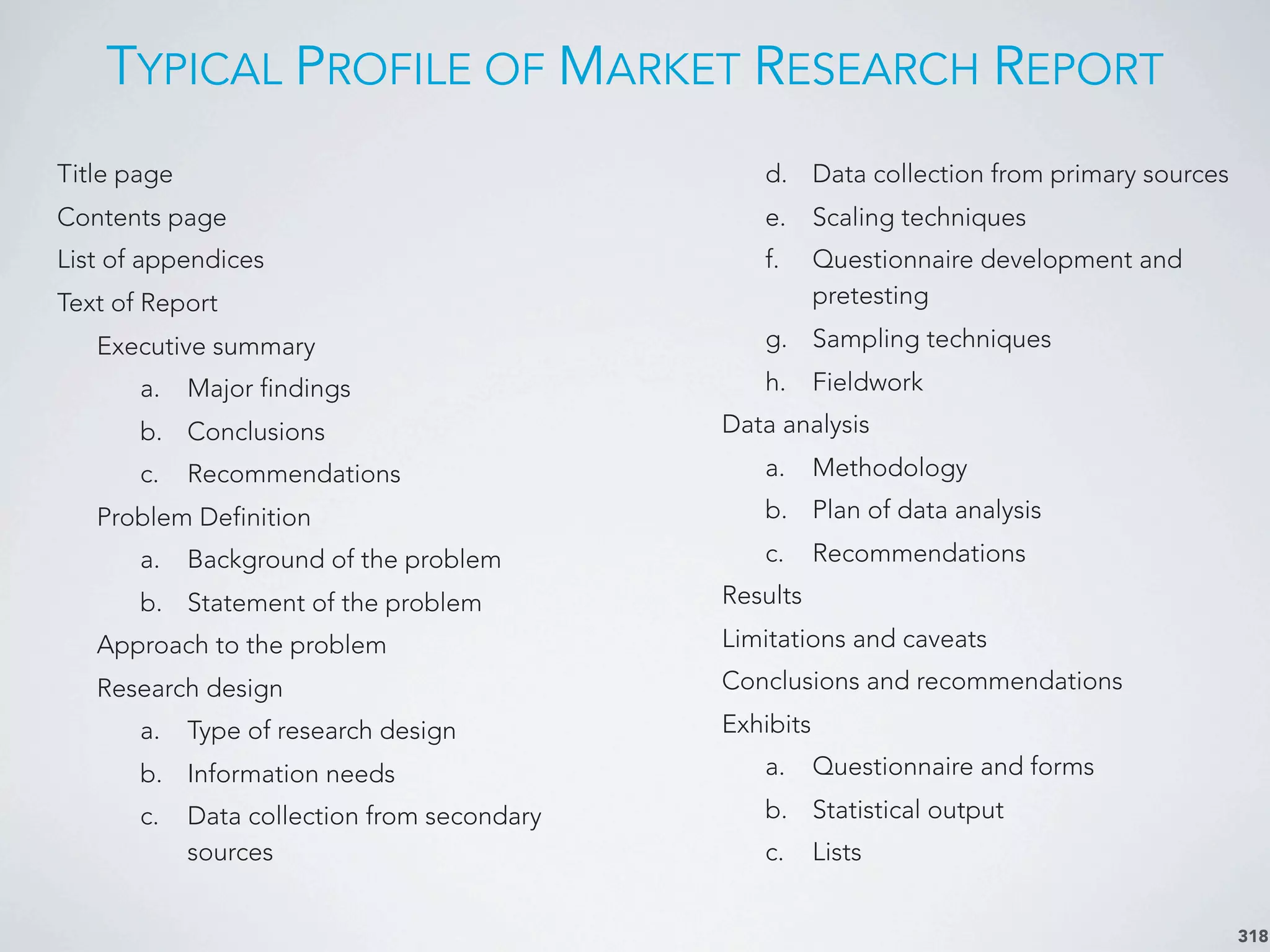
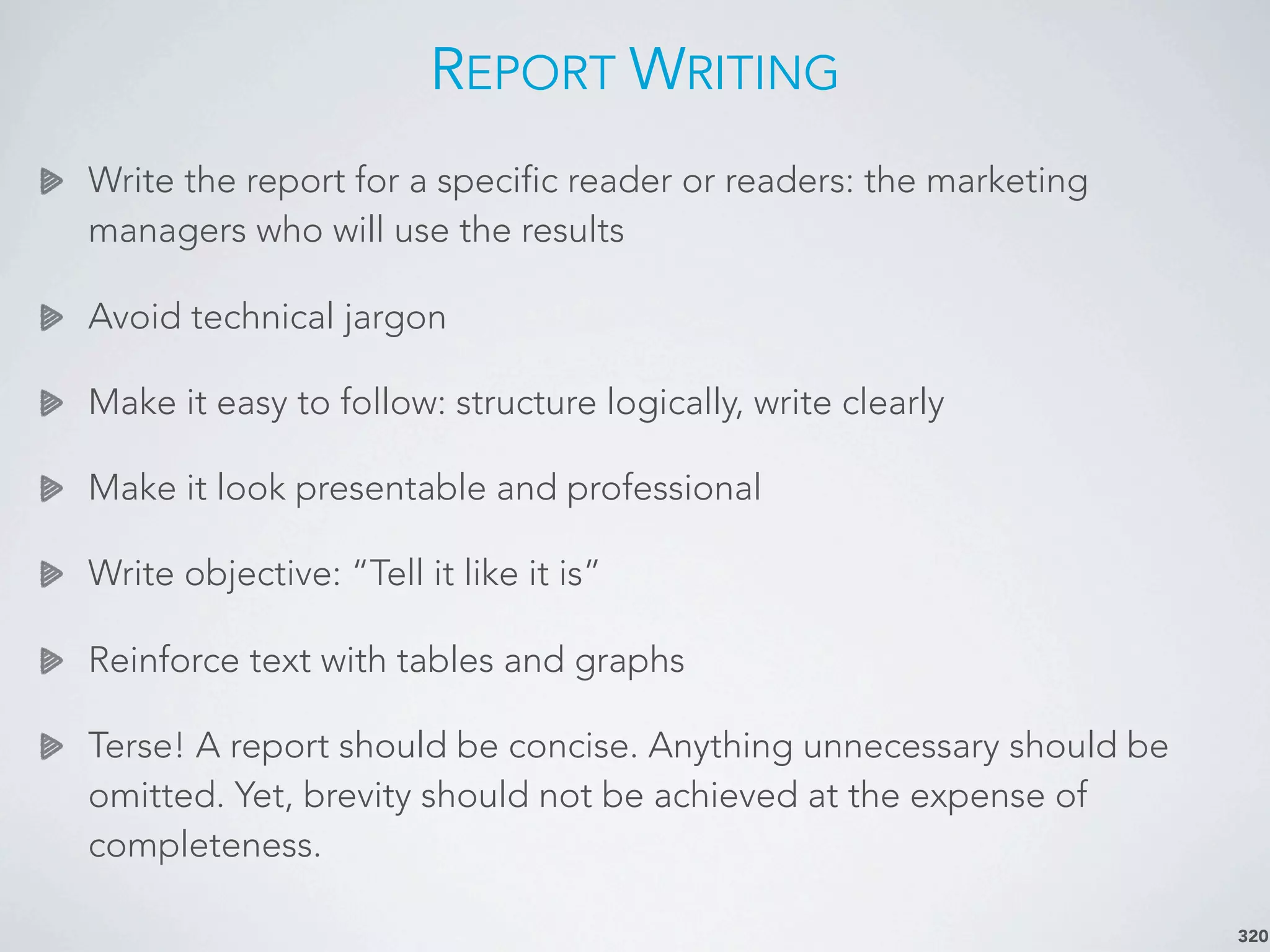
Structure and guidelines on writing effective marketing research reports for stakeholder communication.
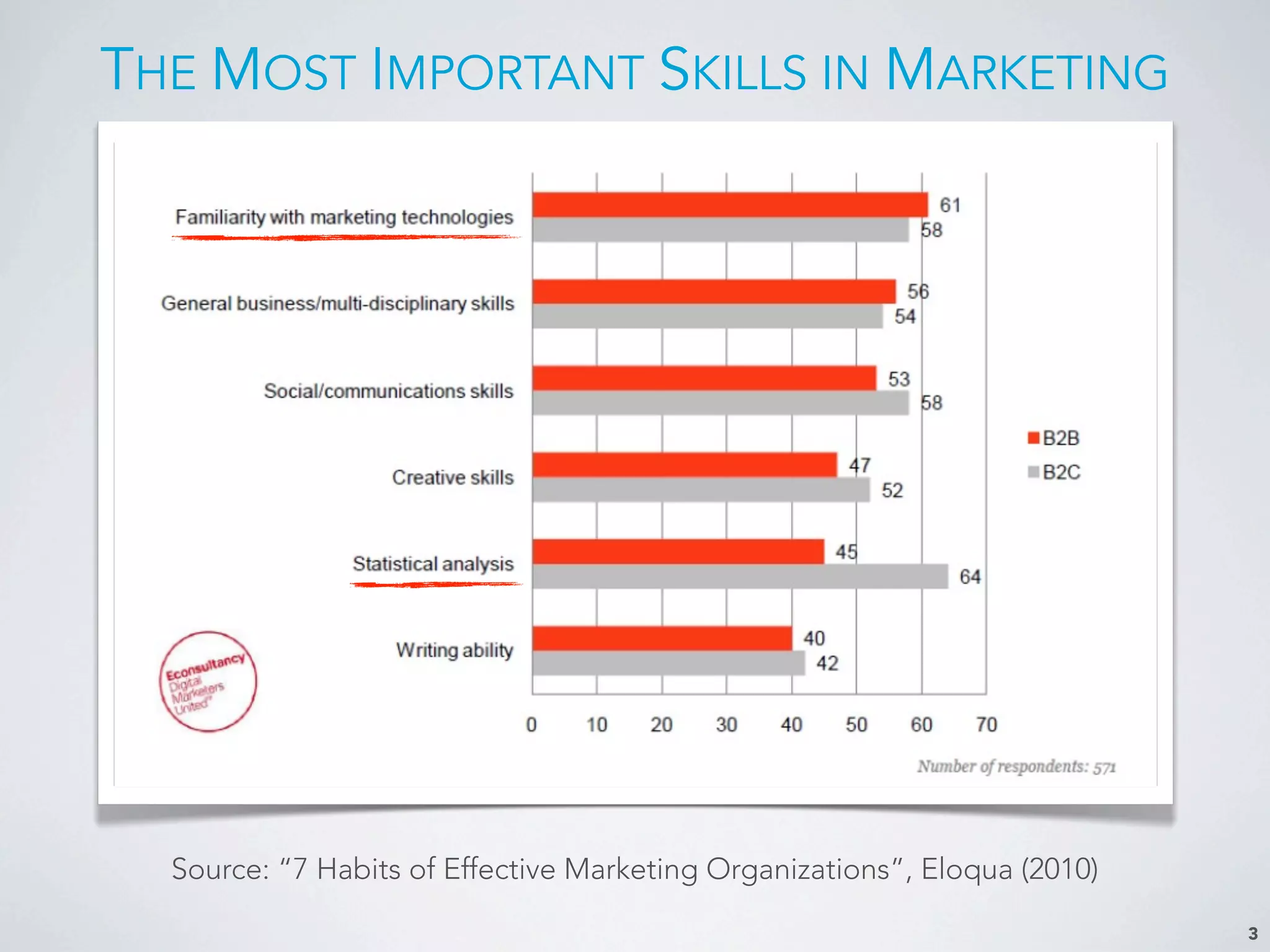
THE MOST IMPORTANTSKILLS IN MARKETING
3
Source: “7 Habits of Effective Marketing Organizations”, Eloqua (2010)
4.
COURSE OBJECTIVES
• Understandthe role of marketing research in shaping
managerial decisions
• Get an overview of classical activities in as well as
of practical tools and methods of marketing research
• Be able to implement marketing research studies,
analyze and interpret data, and present the results
4
5.
5
RECOMMENDED READING
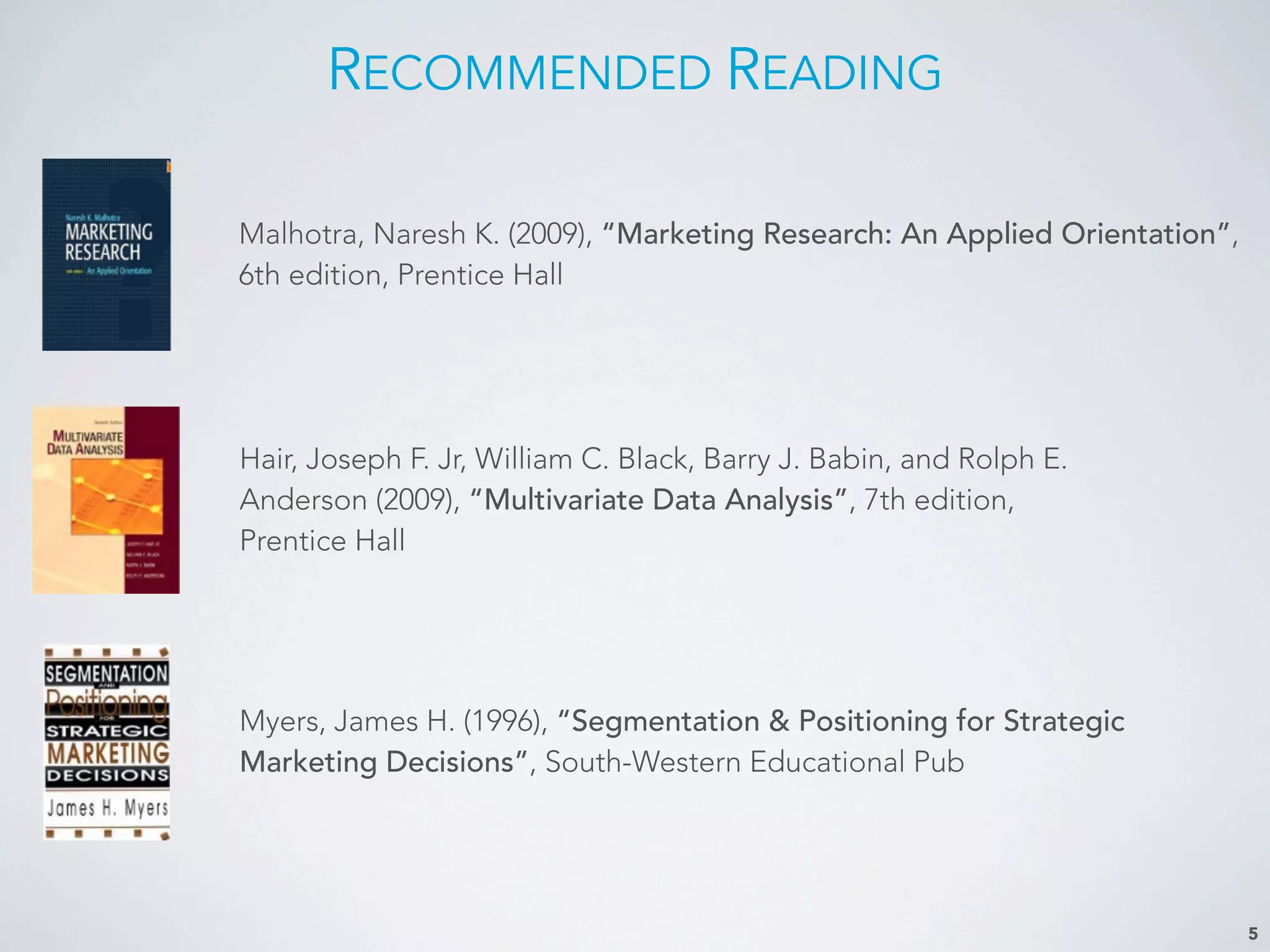
Malhotra, NareshK. (2009), “Marketing Research: An Applied Orientation”,
6th edition, Prentice Hall
Myers, James H. (1996), “Segmentation & Positioning for Strategic
Marketing Decisions”, South-Western Educational Pub
Hair, Joseph F. Jr, William C. Black, Barry J. Babin, and Rolph E.
Anderson (2009), “Multivariate Data Analysis”, 7th edition,
Prentice Hall
6.
NICE TO HAVE(READ)
6
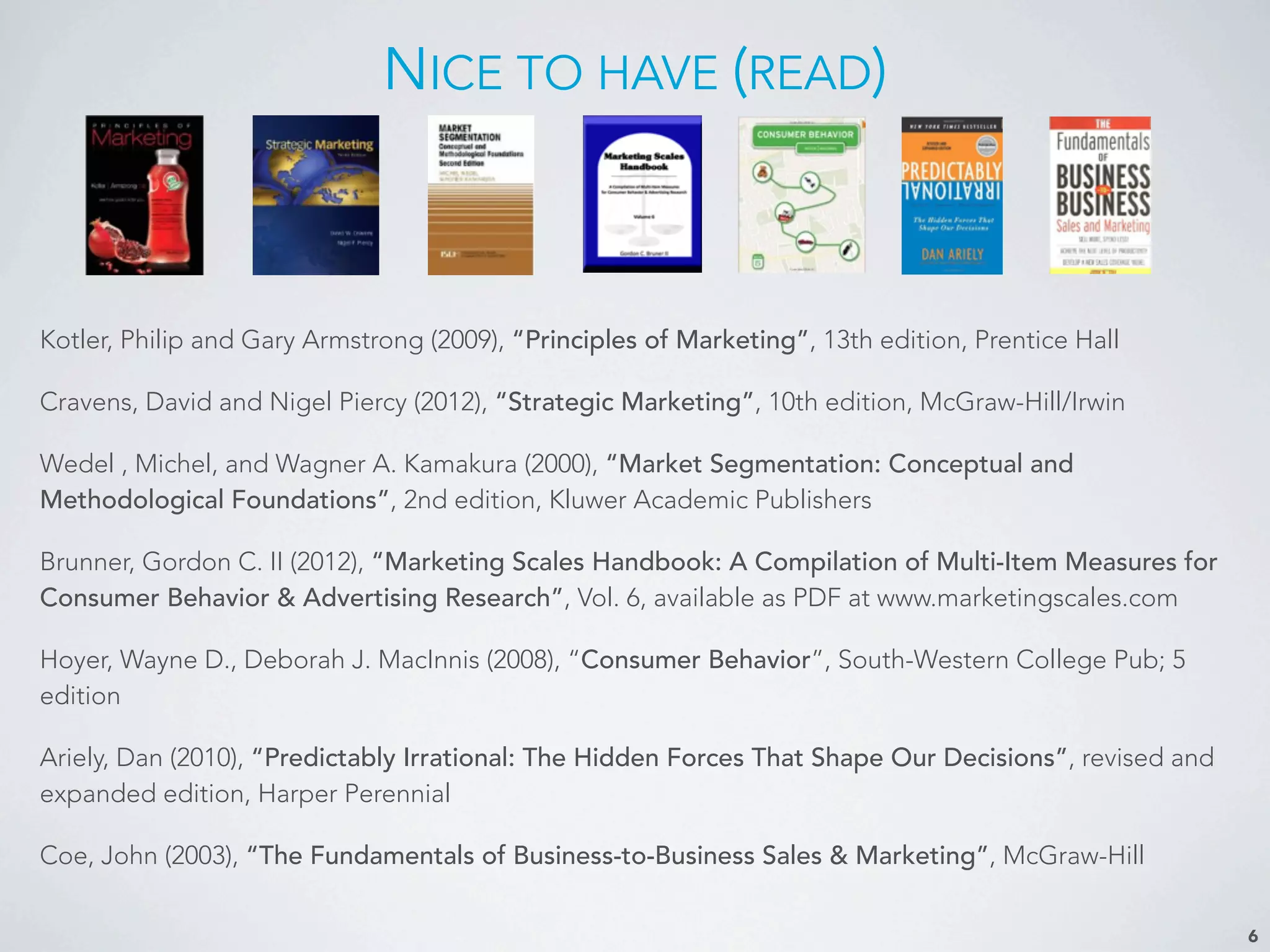
Kotler, Philip and Gary Armstrong (2009), “Principles of Marketing”, 13th edition, Prentice Hall
Cravens, David and Nigel Piercy (2012), “Strategic Marketing”, 10th edition, McGraw-Hill/Irwin
Wedel , Michel, and Wagner A. Kamakura (2000), “Market Segmentation: Conceptual and
Methodological Foundations”, 2nd edition, Kluwer Academic Publishers
Brunner, Gordon C. II (2012), “Marketing Scales Handbook: A Compilation of Multi-Item Measures for
Consumer Behavior & Advertising Research”, Vol. 6, available as PDF at www.marketingscales.com
Hoyer, Wayne D., Deborah J. MacInnis (2008), “Consumer Behavior”, South-Western College Pub; 5
edition
Ariely, Dan (2010), “Predictably Irrational: The Hidden Forces That Shape Our Decisions”, revised and
expanded edition, Harper Perennial
Coe, John (2003), “The Fundamentals of Business-to-Business Sales & Marketing”, McGraw-Hill
7.
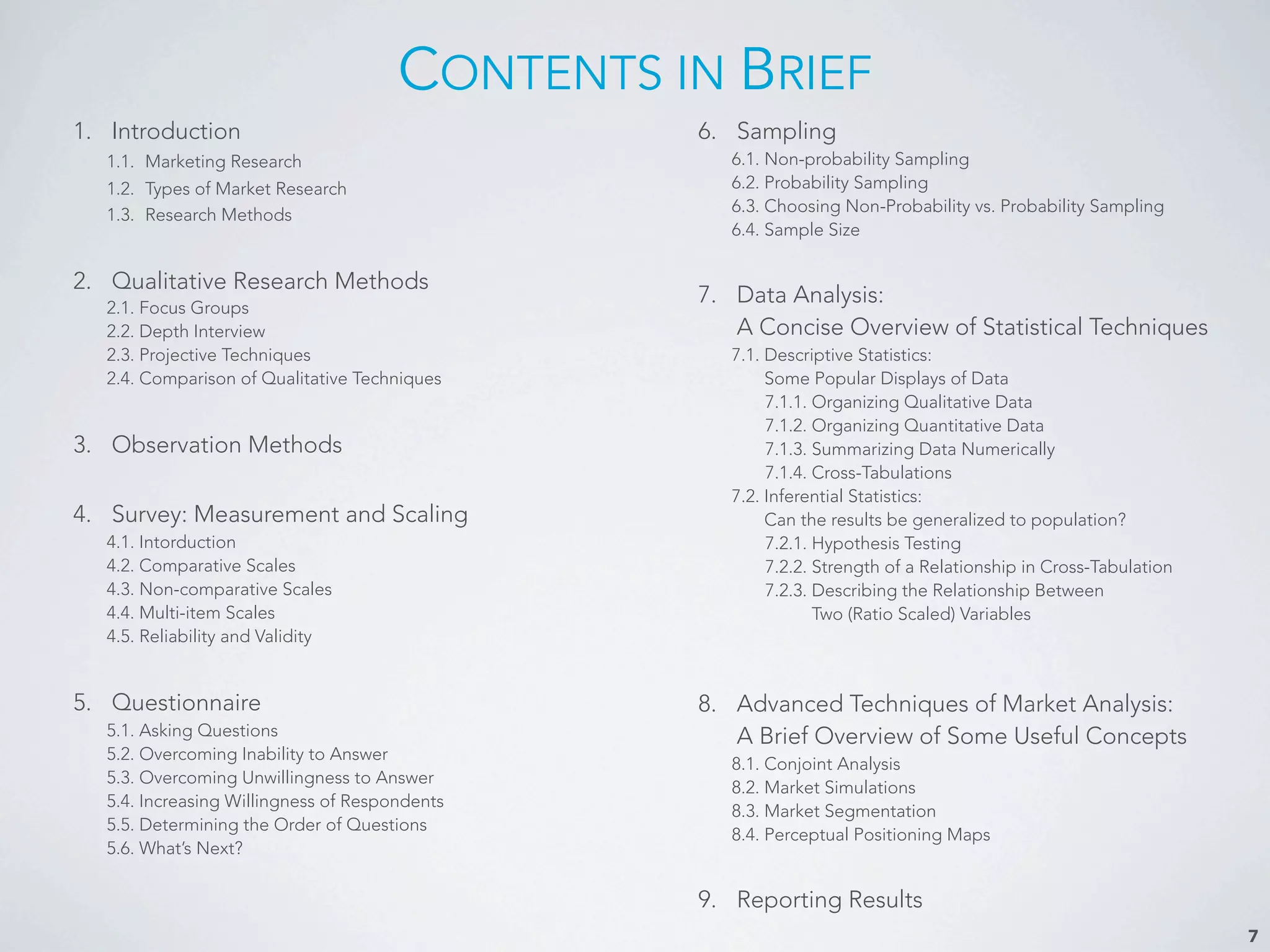
CONTENTS IN BRIEF
1.Introduction
1.1. Marketing Research
1.2. Types of Market Research
1.3. Research Methods
2. Qualitative Research Methods
2.1. Focus Groups
2.2. Depth Interview
2.3. Projective Techniques
2.4. Comparison of Qualitative Techniques
3. Observation Methods
4. Survey: Measurement and Scaling
4.1. Intorduction
4.2. Comparative Scales
4.3. Non-comparative Scales
4.4. Multi-item Scales
4.5. Reliability and Validity
5. Questionnaire
5.1. Asking Questions
5.2. Overcoming Inability to Answer
5.3. Overcoming Unwillingness to Answer
5.4. Increasing Willingness of Respondents
5.5. Determining the Order of Questions
5.6. What’s Next?
6. Sampling
6.1. Non-probability Sampling
6.2. Probability Sampling
6.3. Choosing Non-Probability vs. Probability Sampling
6.4. Sample Size
7. Data Analysis:
A Concise Overview of Statistical Techniques
7.1. Descriptive Statistics:
Some Popular Displays of Data
7.1.1. Organizing Qualitative Data
7.1.2. Organizing Quantitative Data
7.1.3. Summarizing Data Numerically
7.1.4. Cross-Tabulations
7.2. Inferential Statistics:
Can the results be generalized to population?
7.2.1. Hypothesis Testing
7.2.2. Strength of a Relationship in Cross-Tabulation
7.2.3. Describing the Relationship Between
Two (Ratio Scaled) Variables
8. Advanced Techniques of Market Analysis:
A Brief Overview of Some Useful Concepts
8.1. Conjoint Analysis
8.2. Market Simulations
8.3. Market Segmentation
8.4. Perceptual Positioning Maps
9. Reporting Results
7
CASE BEECHCRAFT STARSHIP
9
Firstcivilian aircraft with
- carbon fiber composite airframe
- canard (“duck”) design
- L-shaped wings with rudders in them
- Two turbo-prop engines mounted aft to pull
- R&D costs est. $500Mio
“For the pilot and passengers, it has really got everything...
...for the money, the performance just isn’t there...
...for $5Mio, you can buy a jet. Starship just doesn’t fit in today’s market”1
“The Starship was a $500Mio mistake because of a
lack of marketing research”2
1
Dennis Murphy, a sales person at Elliot Flying Services in Des Moines, Iowa
2
Russel Munson in “The Stock Market”, 1991
10.
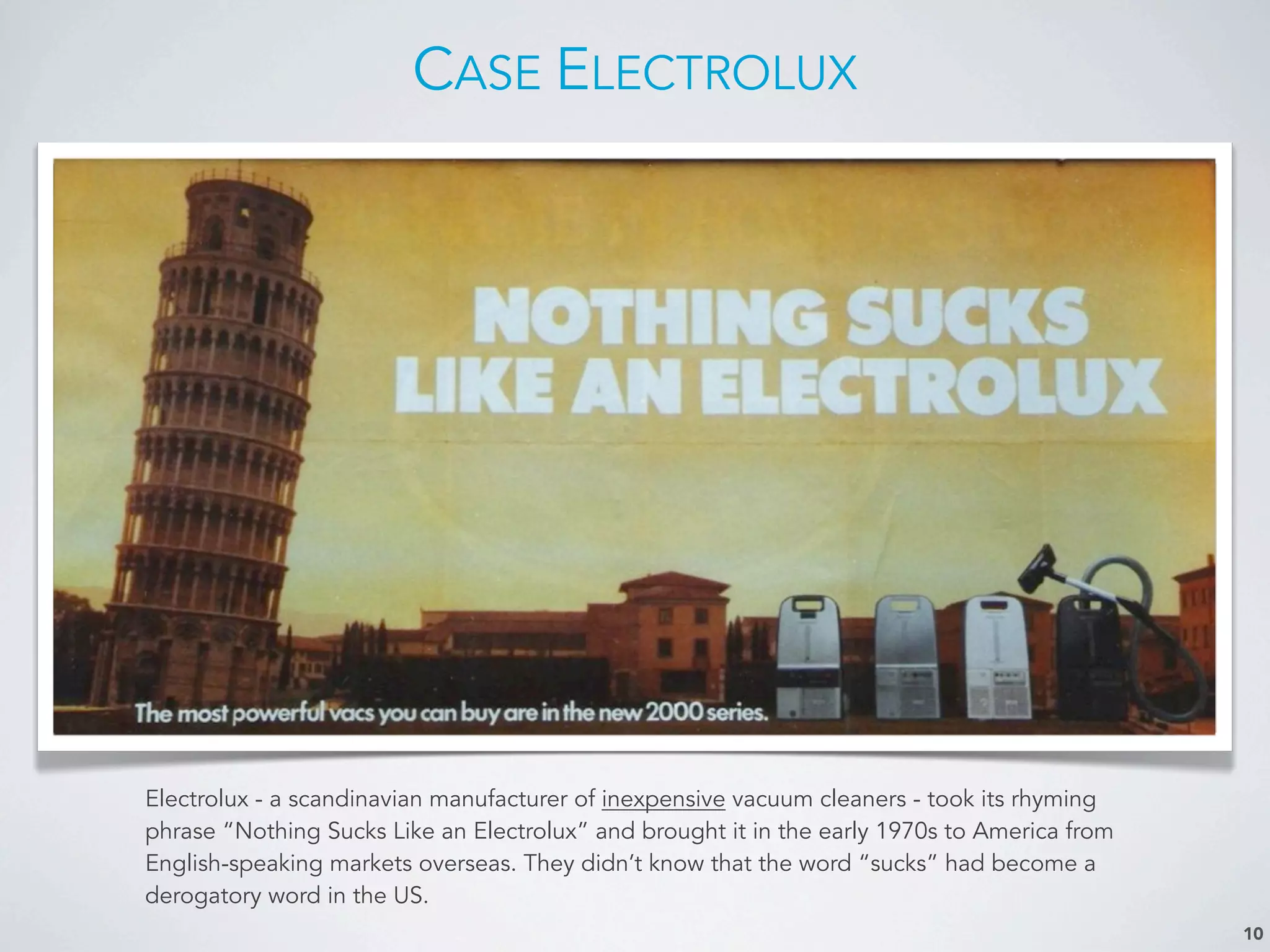
CASE ELECTROLUX
10
Electrolux -a scandinavian manufacturer of inexpensive vacuum cleaners - took its rhyming
phrase “Nothing Sucks Like an Electrolux” and brought it in the early 1970s to America from
English-speaking markets overseas. They didn’t know that the word “sucks” had become a
derogatory word in the US.
11.
CASE AMERICAN AIRLINES
11
AmericanAirlines launched a new
leather first class seats ad campaign
(1977-78) in the Mexican market:
"Fly in Leather" (vuela encuero)
meant "Fly Naked"
12.
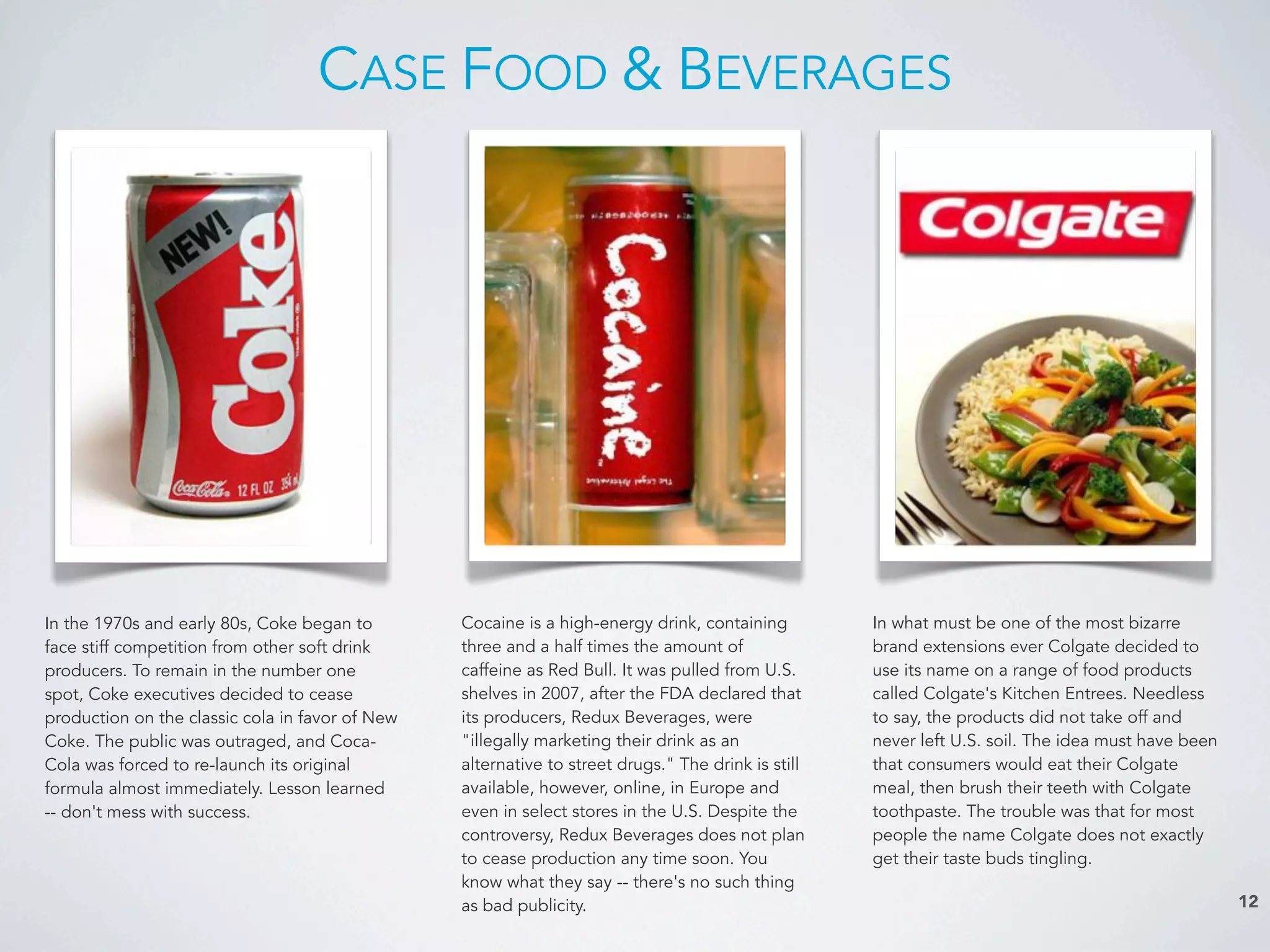
CASE FOOD &BEVERAGES
12
In what must be one of the most bizarre
brand extensions ever Colgate decided to
use its name on a range of food products
called Colgate's Kitchen Entrees. Needless
to say, the products did not take off and
never left U.S. soil. The idea must have been
that consumers would eat their Colgate
meal, then brush their teeth with Colgate
toothpaste. The trouble was that for most
people the name Colgate does not exactly
get their taste buds tingling.
In the 1970s and early 80s, Coke began to
face stiff competition from other soft drink
producers. To remain in the number one
spot, Coke executives decided to cease
production on the classic cola in favor of New
Coke. The public was outraged, and Coca-
Cola was forced to re-launch its original
formula almost immediately. Lesson learned
-- don't mess with success.
Cocaine is a high-energy drink, containing
three and a half times the amount of
caffeine as Red Bull. It was pulled from U.S.
shelves in 2007, after the FDA declared that
its producers, Redux Beverages, were
"illegally marketing their drink as an
alternative to street drugs." The drink is still
available, however, online, in Europe and
even in select stores in the U.S. Despite the
controversy, Redux Beverages does not plan
to cease production any time soon. You
know what they say -- there's no such thing
as bad publicity.
13.
RETURNS ON MARKETINGACTIONS
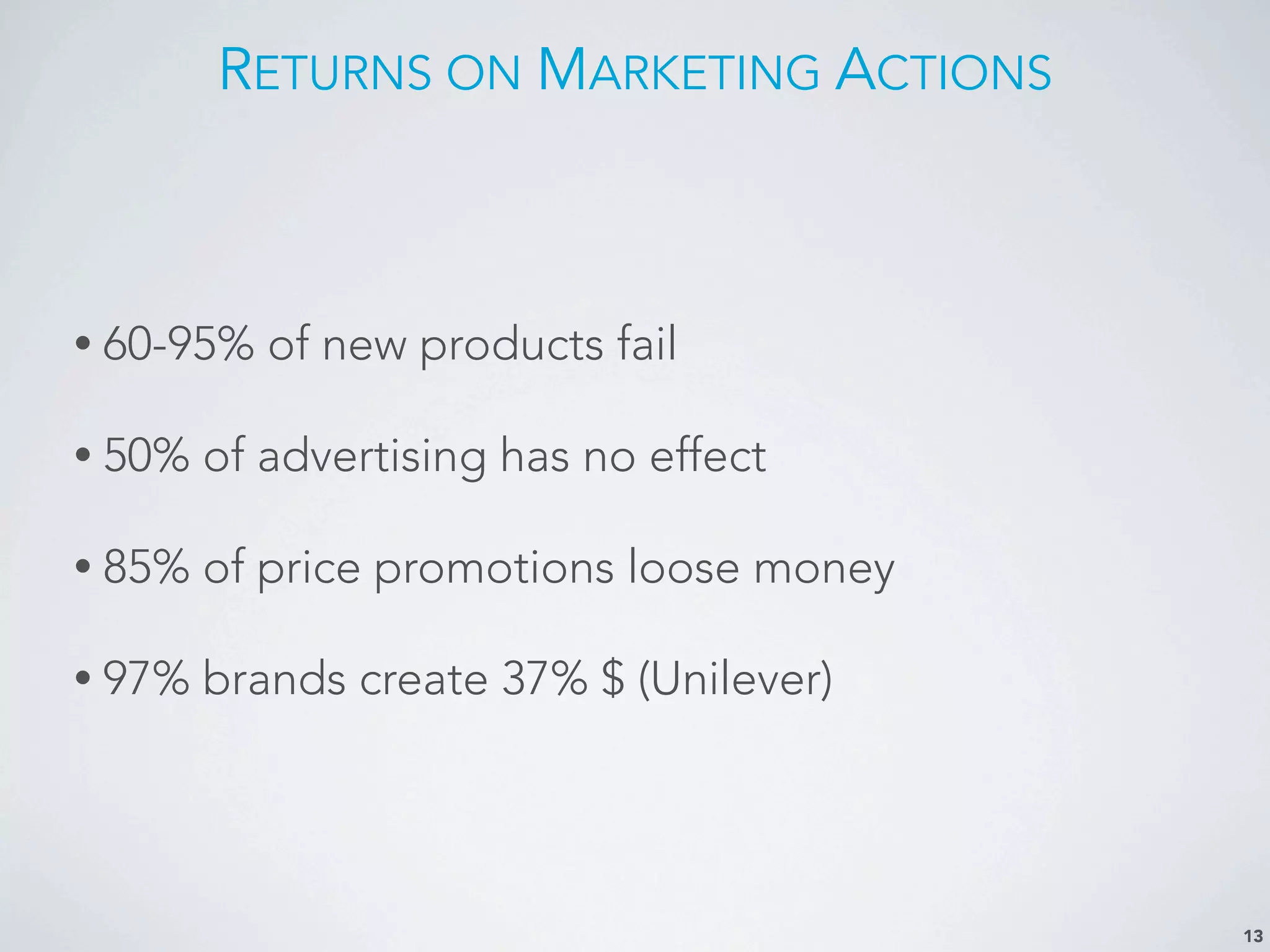
• 60-95% of new products fail
• 50% of advertising has no effect
• 85% of price promotions loose money
• 97% brands create 37% $ (Unilever)
13
RECALL
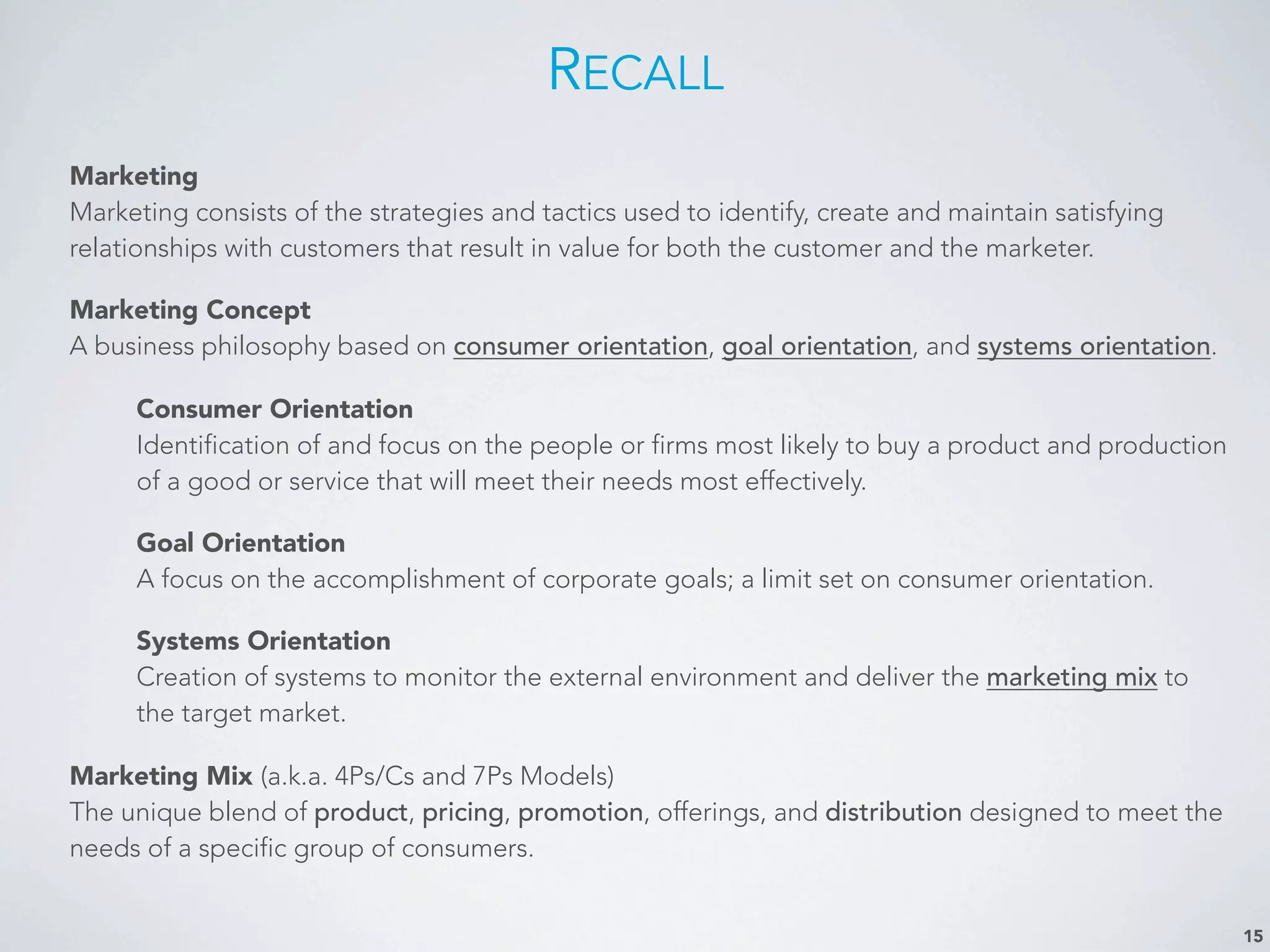
Marketing
Marketing consists ofthe strategies and tactics used to identify, create and maintain satisfying
relationships with customers that result in value for both the customer and the marketer.
Marketing Concept
A business philosophy based on consumer orientation, goal orientation, and systems orientation.
Consumer Orientation
Identification of and focus on the people or firms most likely to buy a product and production
of a good or service that will meet their needs most effectively.
Goal Orientation
A focus on the accomplishment of corporate goals; a limit set on consumer orientation.
Systems Orientation
Creation of systems to monitor the external environment and deliver the marketing mix to
the target market.
Marketing Mix (a.k.a. 4Ps/Cs and 7Ps Models)
The unique blend of product, pricing, promotion, offerings, and distribution designed to meet the
needs of a specific group of consumers.
15
MARKETING RESEARCH: ACONCISE DEFINITION
Marketing Research
The planning, collection, and analysis of data relevant
to marketing decision making and the communication
of the results of this analysis to management.
18
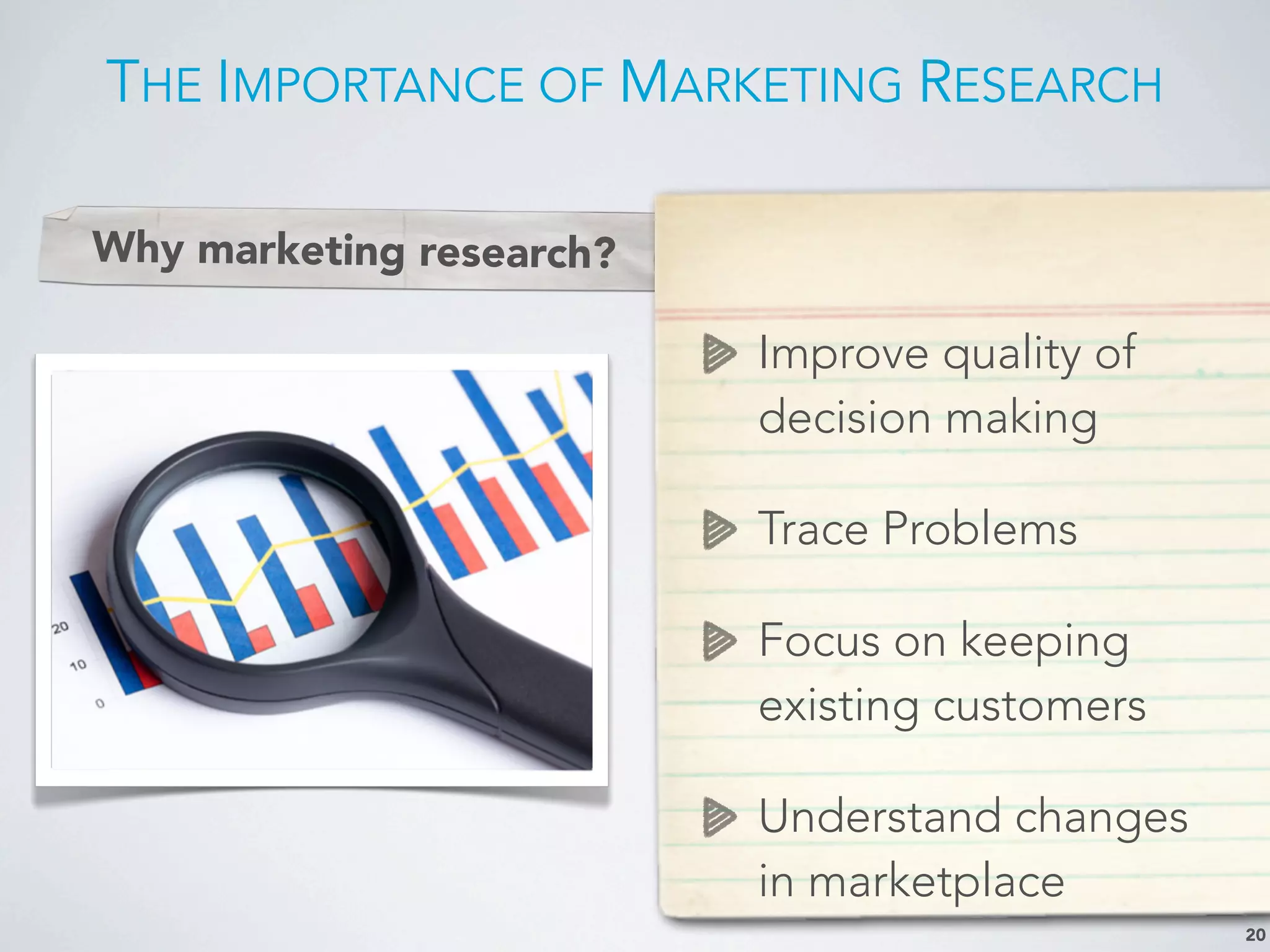
Why marketing research?
THEIMPORTANCE OF MARKETING RESEARCH
20
Improve quality of
decision making
Trace Problems
Focus on keeping
existing customers
Understand changes
in marketplace
21.
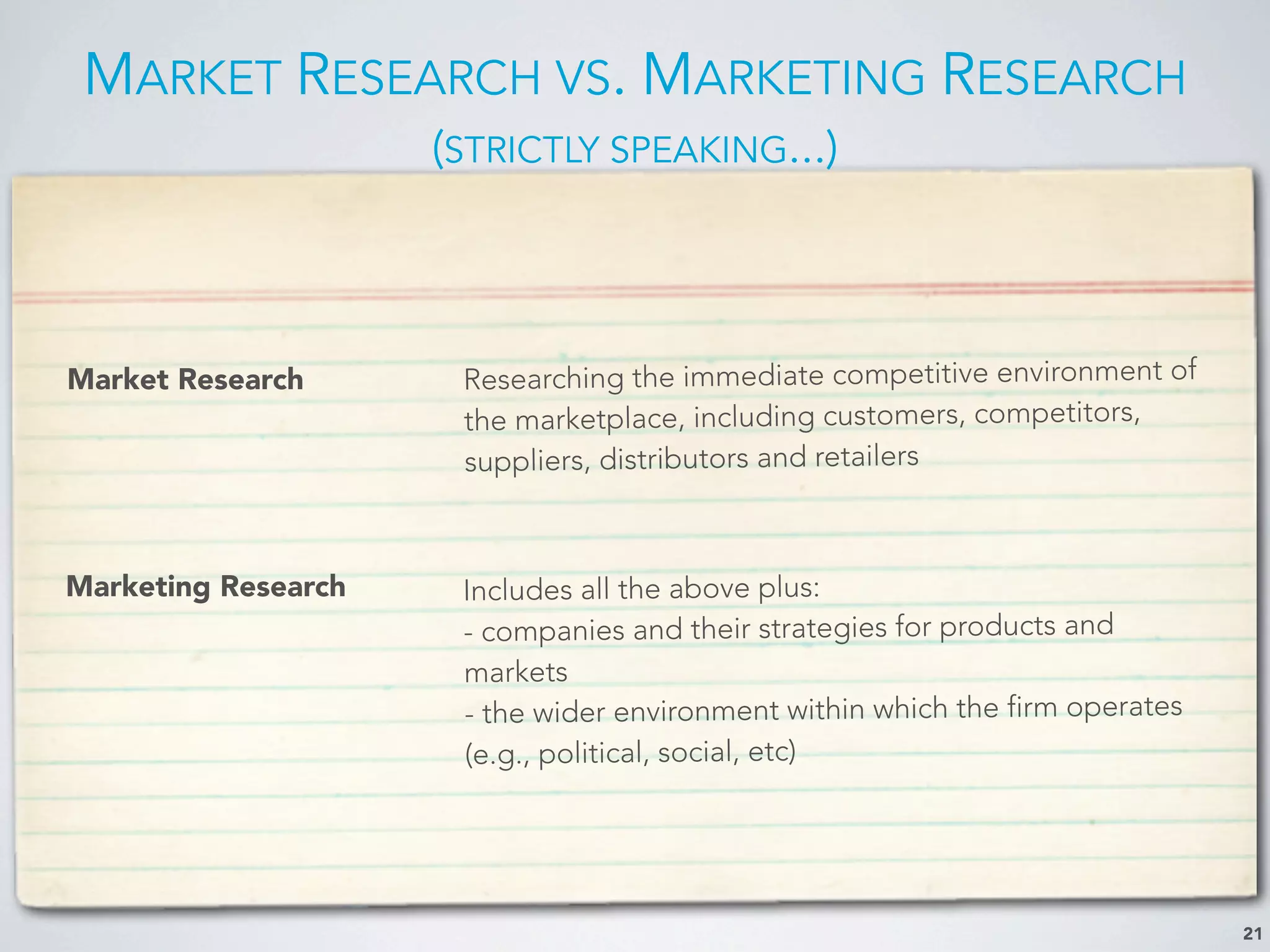
MARKET RESEARCH VS.MARKETING RESEARCH
(STRICTLY SPEAKING...)
21
Market Research
Marketing Research
Researching the immediate competitive environment of
the marketplace, including customers, competitors,
suppliers, distributors and retailers
Includes all the above plus:
- companies and their strategies for products and
markets
- the wider environment within which the firm operates
(e.g., political, social, etc)
22.
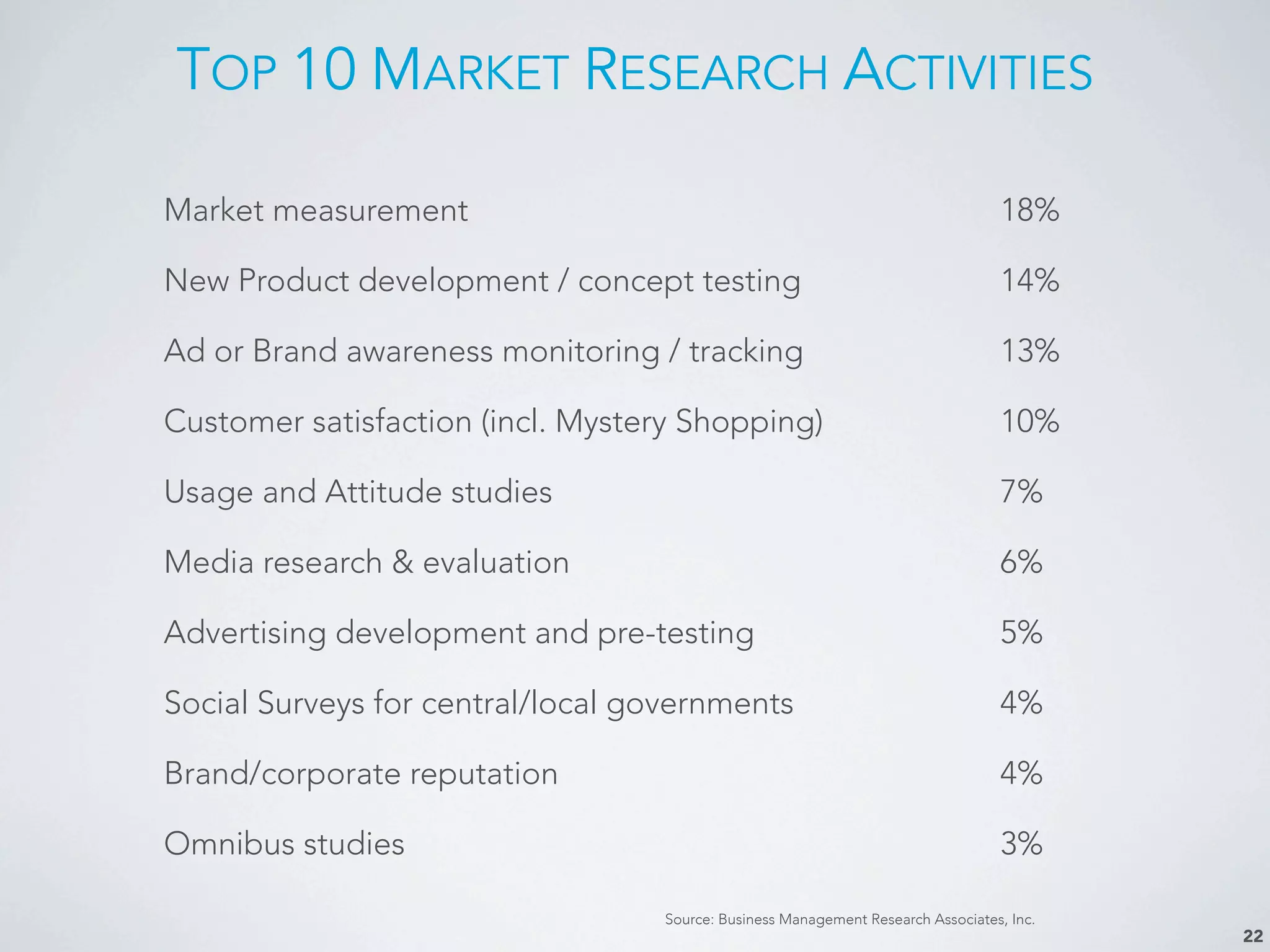
TOP 10 MARKETRESEARCH ACTIVITIES
22
Market measurement 18%
New Product development / concept testing 14%
Ad or Brand awareness monitoring / tracking 13%
Customer satisfaction (incl. Mystery Shopping) 10%
Usage and Attitude studies 7%
Media research & evaluation 6%
Advertising development and pre-testing 5%
Social Surveys for central/local governments 4%
Brand/corporate reputation 4%
Omnibus studies 3%
Source: Business Management Research Associates, Inc.
23.
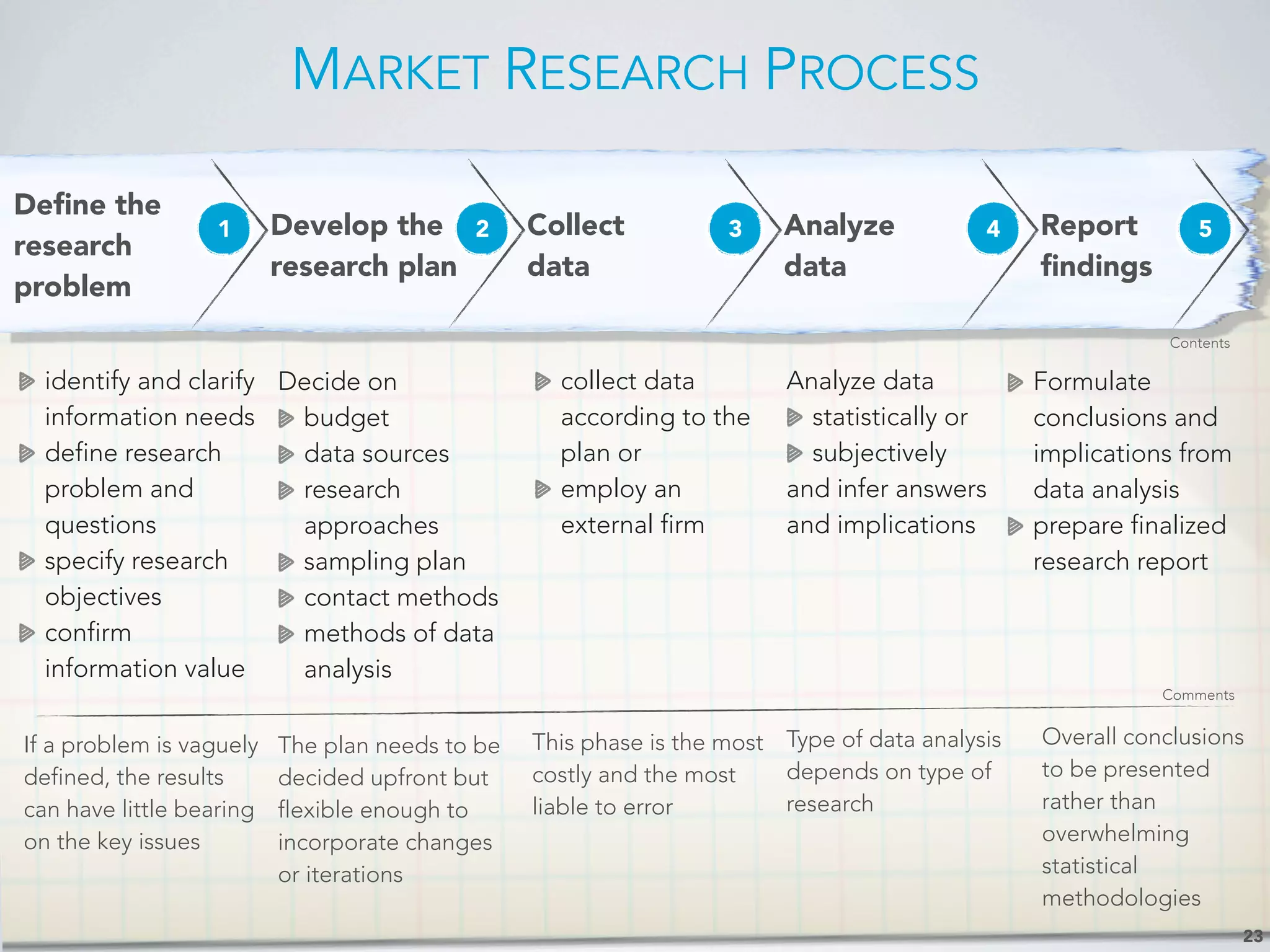
MARKET RESEARCH PROCESS
23
Definethe
research
problem
Decide on
budget
data sources
research
approaches
sampling plan
contact methods
methods of data
analysis
Develop the
research plan
Collect
data
Analyze
data
Report
findings
identify and clarify
information needs
define research
problem and
questions
specify research
objectives
confirm
information value
collect data
according to the
plan or
employ an
external firm
The plan needs to be
decided upfront but
flexible enough to
incorporate changes
or iterations
This phase is the most
costly and the most
liable to error
If a problem is vaguely
defined, the results
can have little bearing
on the key issues
Overall conclusions
to be presented
rather than
overwhelming
statistical
methodologies
Formulate
conclusions and
implications from
data analysis
prepare finalized
research report
Analyze data
statistically or
subjectively
and infer answers
and implications
1 2 3 4 5
Type of data analysis
depends on type of
research
Comments
Contents
24.
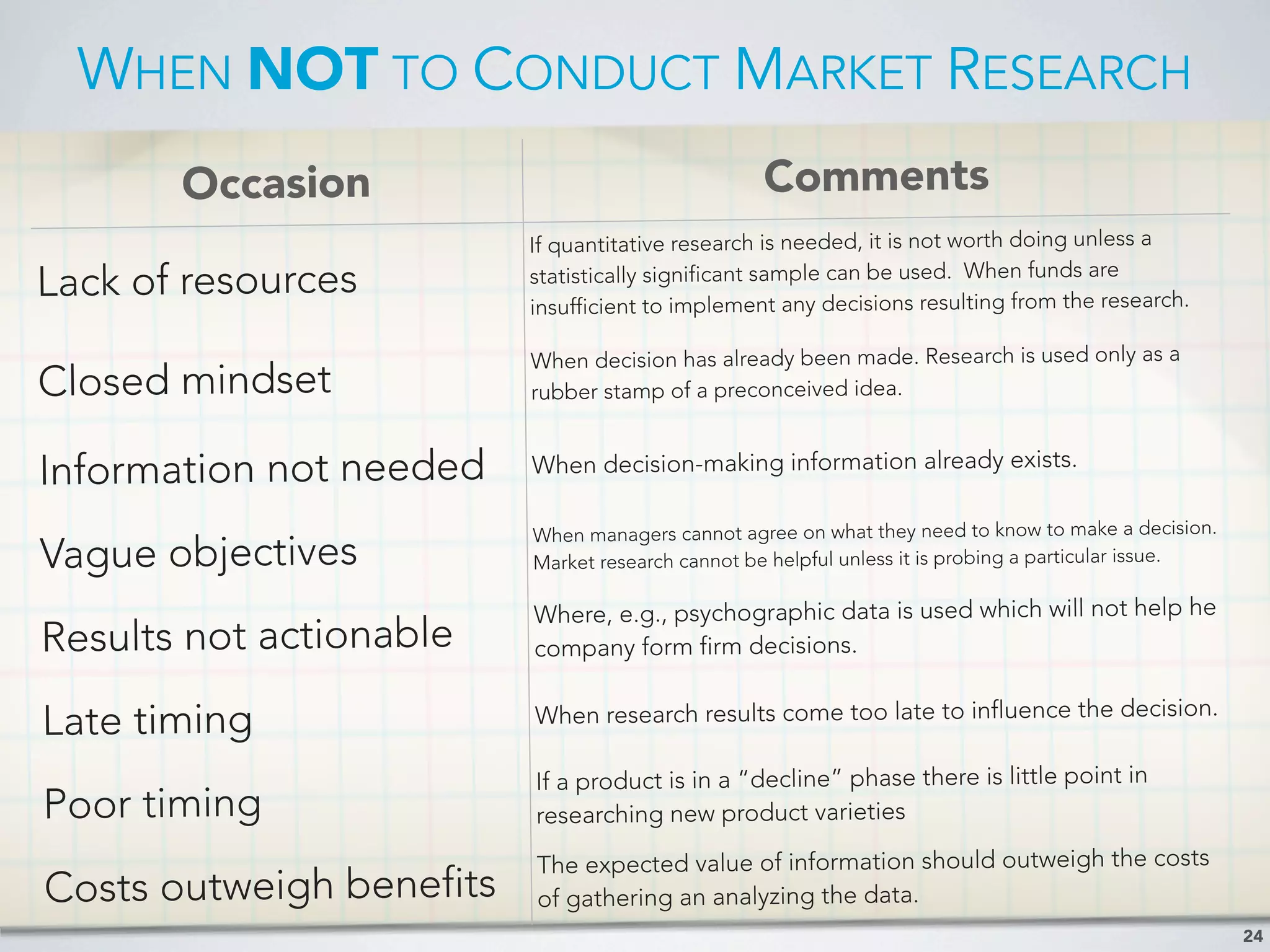
WHEN NOT TOCONDUCT MARKET RESEARCH
24
Occasion Comments
Lack of resources
If quantitative research is needed, it is not worth doing unless a
statistically significant sample can be used. When funds are
insufficient to implement any decisions resulting from the research.
Closed mindset
When decision has already been made. Research is used only as a
rubber stamp of a preconceived idea.
Information not needed When decision-making information already exists.
Vague objectives
When managers cannot agree on what they need to know to make a decision.
Market research cannot be helpful unless it is probing a particular issue.
Results not actionable
Where, e.g., psychographic data is used which will not help he
company form firm decisions.
Late timing When research results come too late to influence the decision.
Poor timing
If a product is in a “decline” phase there is little point in
researching new product varieties
Costs outweigh benefits
The expected value of information should outweigh the costs
of gathering an analyzing the data.
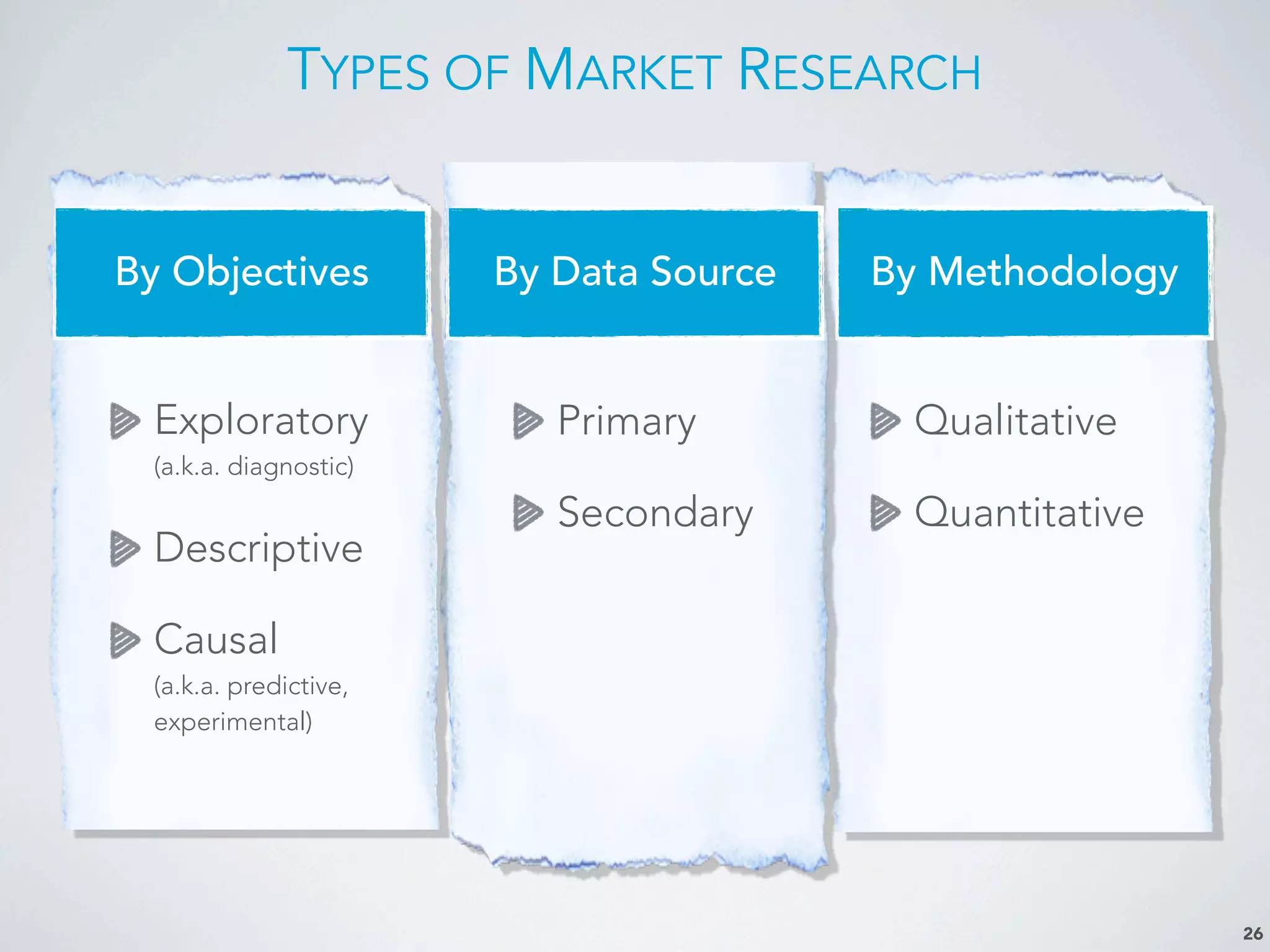
TYPES OF MARKETRESEARCH
26
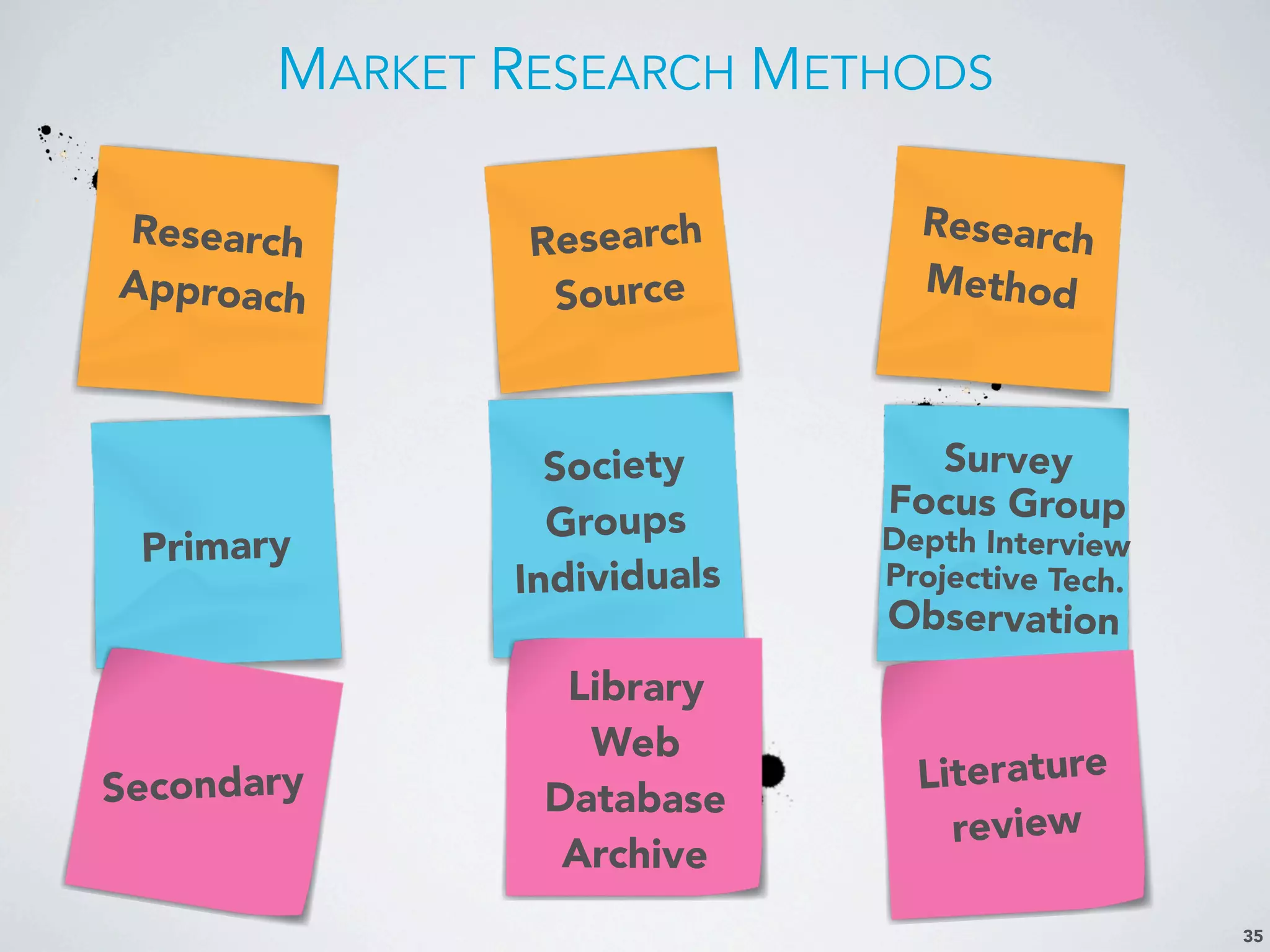
By Objectives By Data Source By Methodology
Exploratory
(a.k.a. diagnostic)
Descriptive
Causal
(a.k.a. predictive,
experimental)
Qualitative
Quantitative
Primary
Secondary
27.
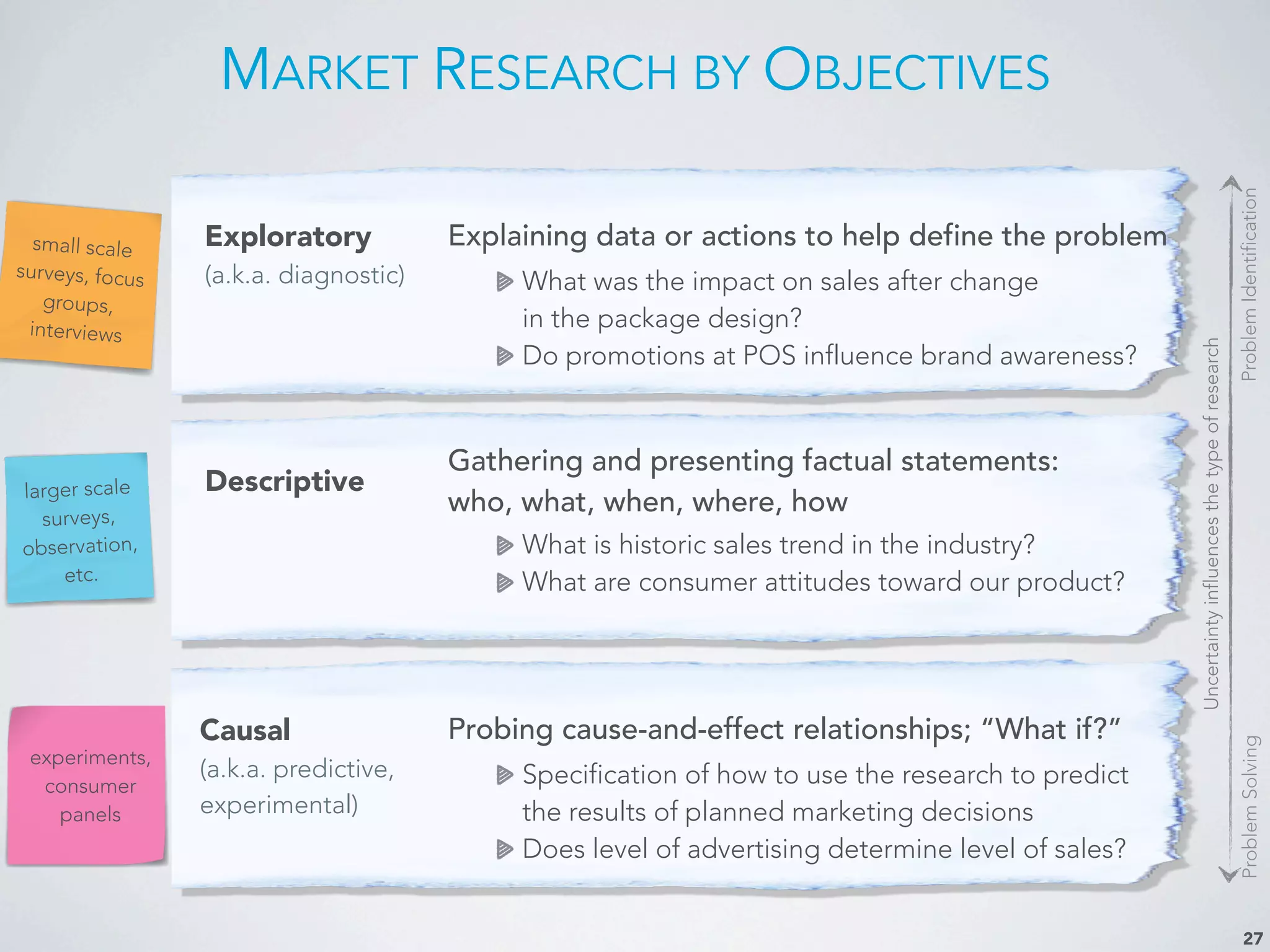
Exploratory
(a.k.a. diagnostic)
Explaining dataor actions to help define the problem
What was the impact on sales after change
in the package design?
Do promotions at POS influence brand awareness?
MARKET RESEARCH BY OBJECTIVES
27
Descriptive
Gathering and presenting factual statements:
who, what, when, where, how
What is historic sales trend in the industry?
What are consumer attitudes toward our product?
Causal
(a.k.a. predictive,
experimental)
Probing cause-and-effect relationships; “What if?”
Specification of how to use the research to predict
the results of planned marketing decisions
Does level of advertising determine level of sales?
small scale
surveys, focus
groups,
interviews
larger scale
surveys,
observation,
etc.
experiments,
consumer
panels
ProblemIdentificationProblemSolving
Uncertaintyinfluencesthetypeofresearch
28.
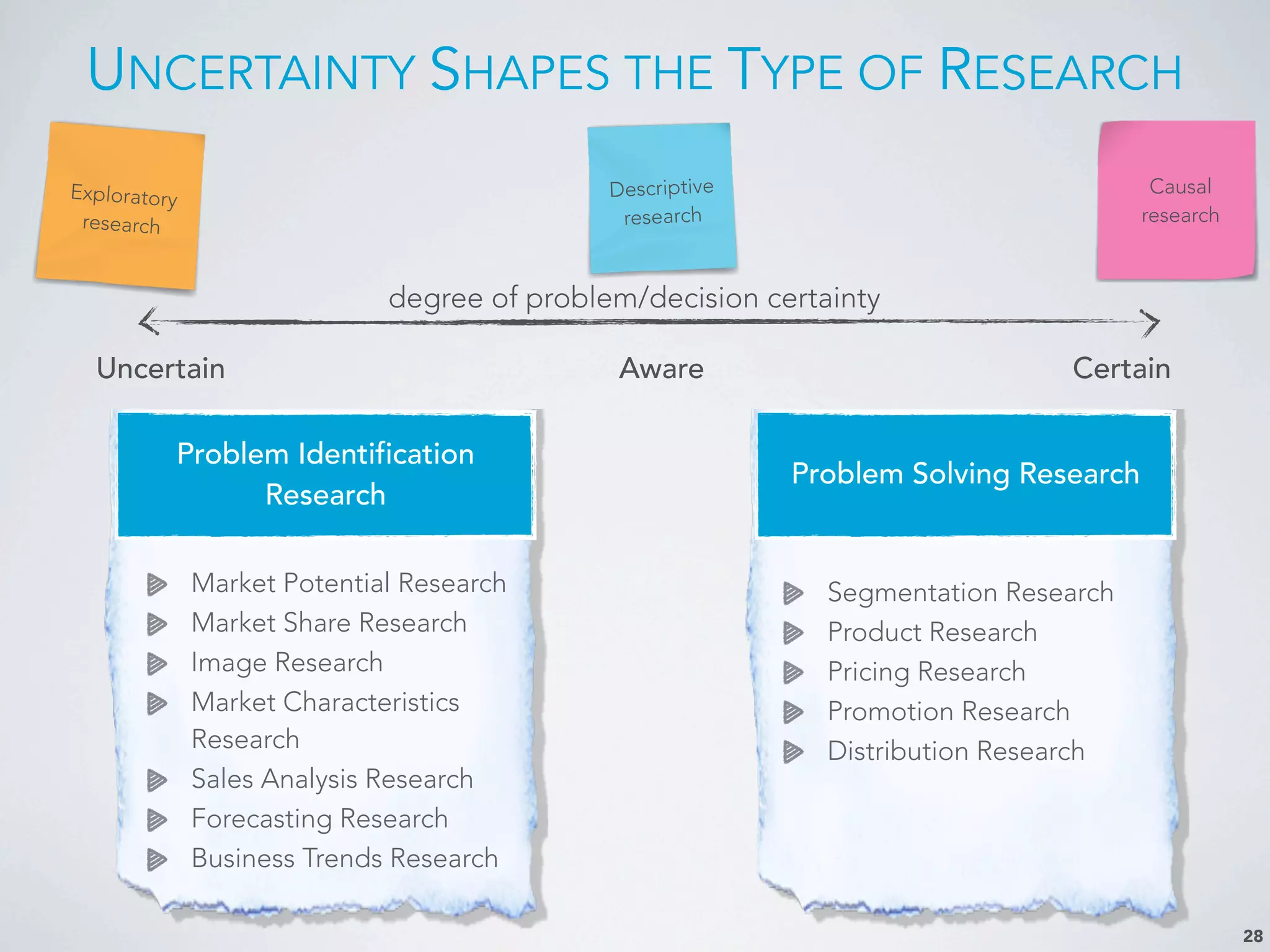
UNCERTAINTY SHAPES THETYPE OF RESEARCH
28
Problem Identification
Research
Problem Solving Research
Market Potential Research
Market Share Research
Image Research
Market Characteristics
Research
Sales Analysis Research
Forecasting Research
Business Trends Research
Segmentation Research
Product Research
Pricing Research
Promotion Research
Distribution Research
Exploratory
research
Descriptive
research
Causal
research
AwareUncertain Certain
degree of problem/decision certainty
29.
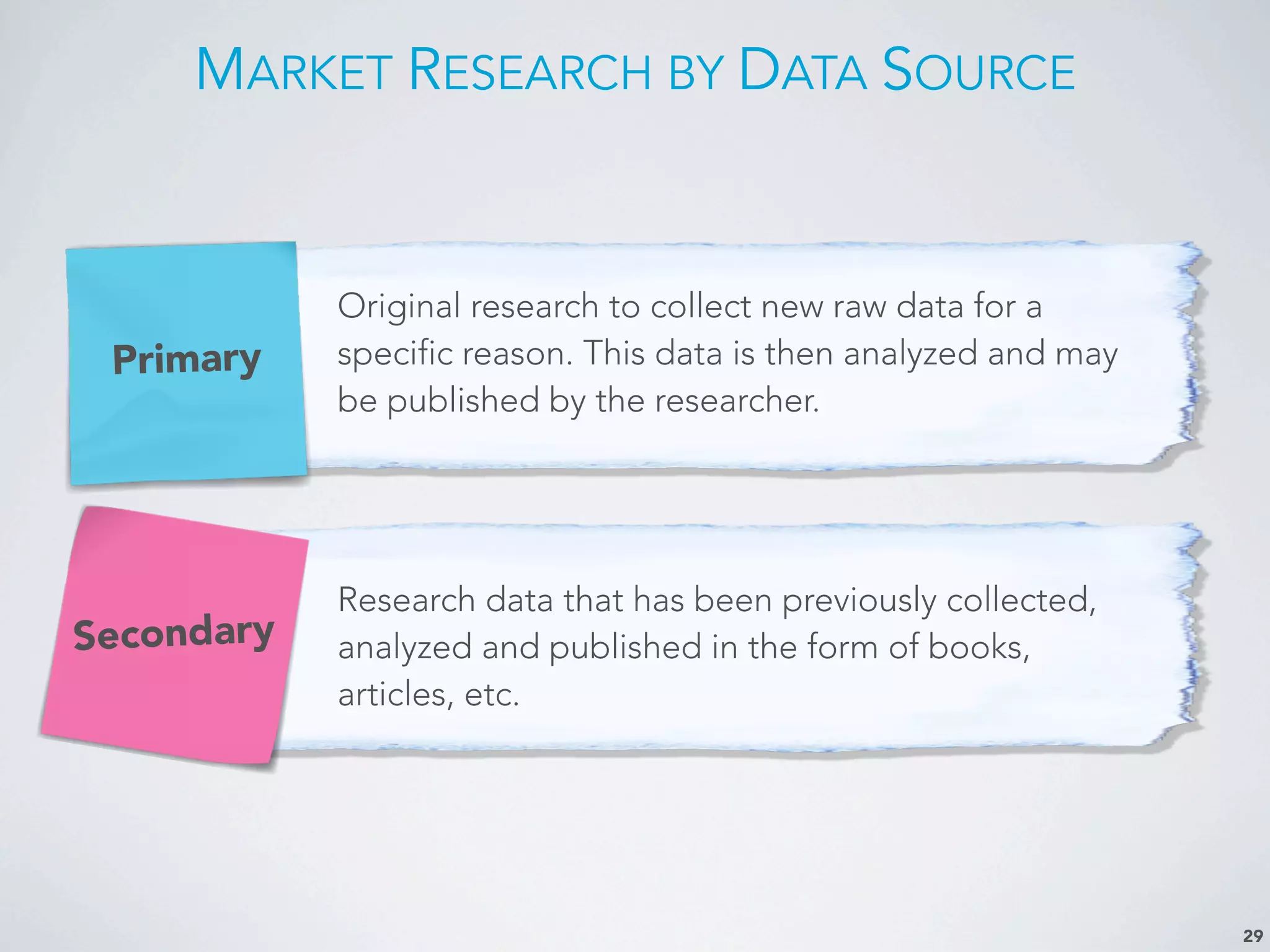
MARKET RESEARCH BYDATA SOURCE
29
Primary
Secondary
Original research to collect new raw data for a
specific reason. This data is then analyzed and may
be published by the researcher.
Research data that has been previously collected,
analyzed and published in the form of books,
articles, etc.
30.
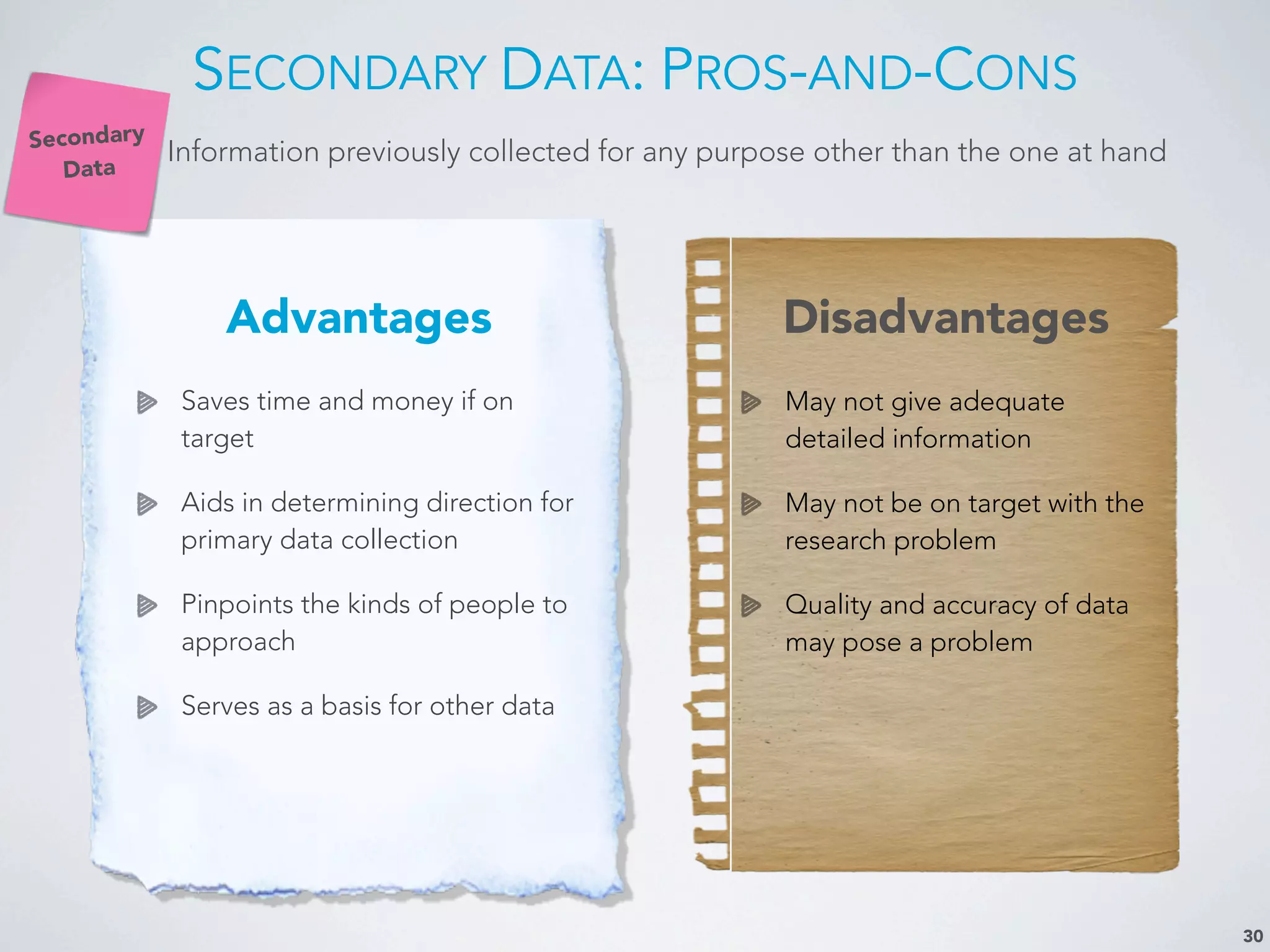
SECONDARY DATA: PROS-AND-CONS
30
Secondary
Data
AdvantagesDisadvantages
Saves time and money if on
target
Aids in determining direction for
primary data collection
Pinpoints the kinds of people to
approach
Serves as a basis for other data
May not give adequate
detailed information
May not be on target with the
research problem
Quality and accuracy of data
may pose a problem
Information previously collected for any purpose other than the one at hand
31.
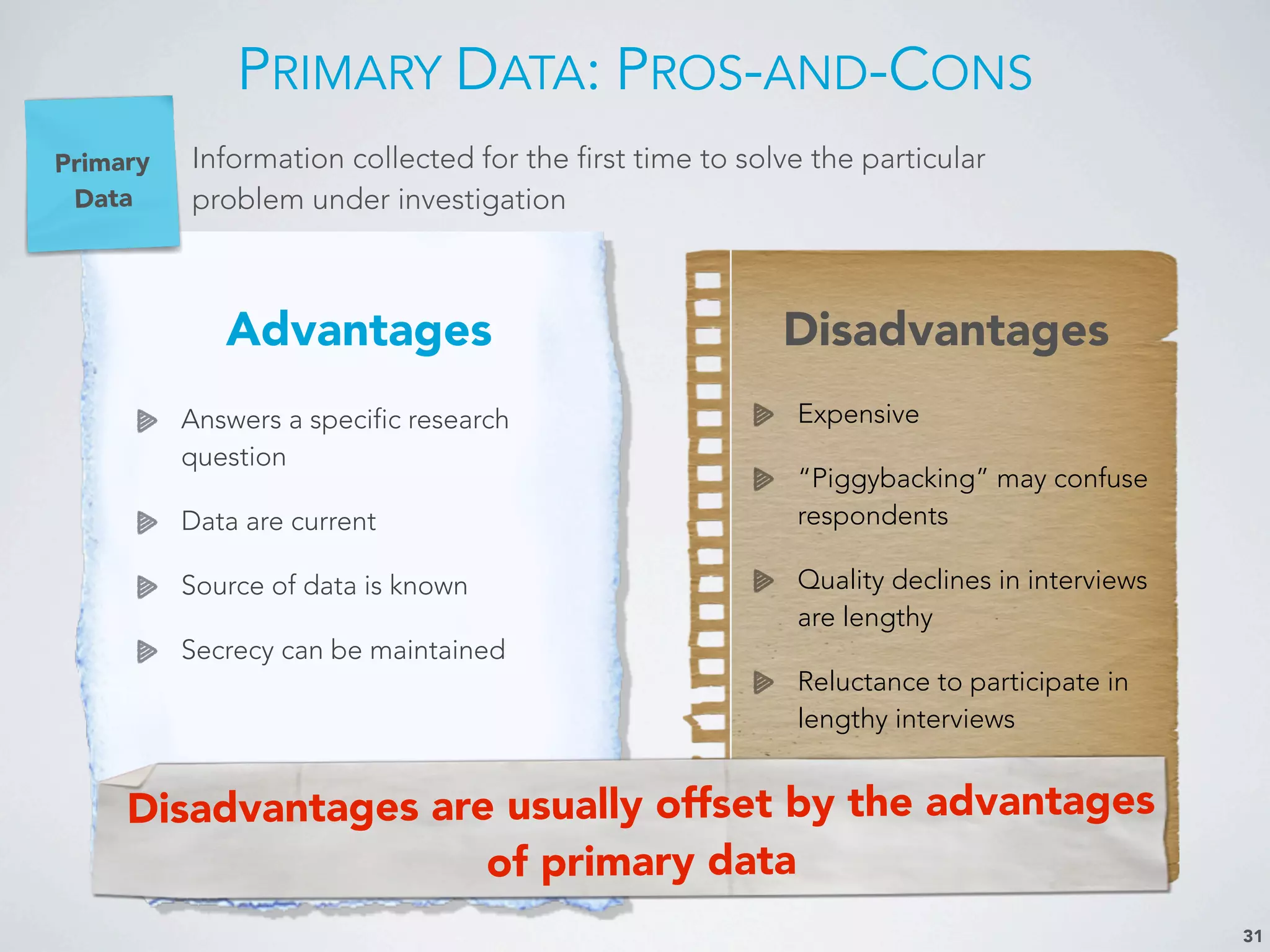
PRIMARY DATA: PROS-AND-CONS
31
AdvantagesDisadvantages
Answers a specific research
question
Data are current
Source of data is known
Secrecy can be maintained
Expensive
“Piggybacking” may confuse
respondents
Quality declines in interviews
are lengthy
Reluctance to participate in
lengthy interviews
Primary
Data
Information collected for the first time to solve the particular
problem under investigation
Disadvantages are usually offset by the advantages
of primary data
32.
Exploratory
research
Causal
research
Descriptive
research
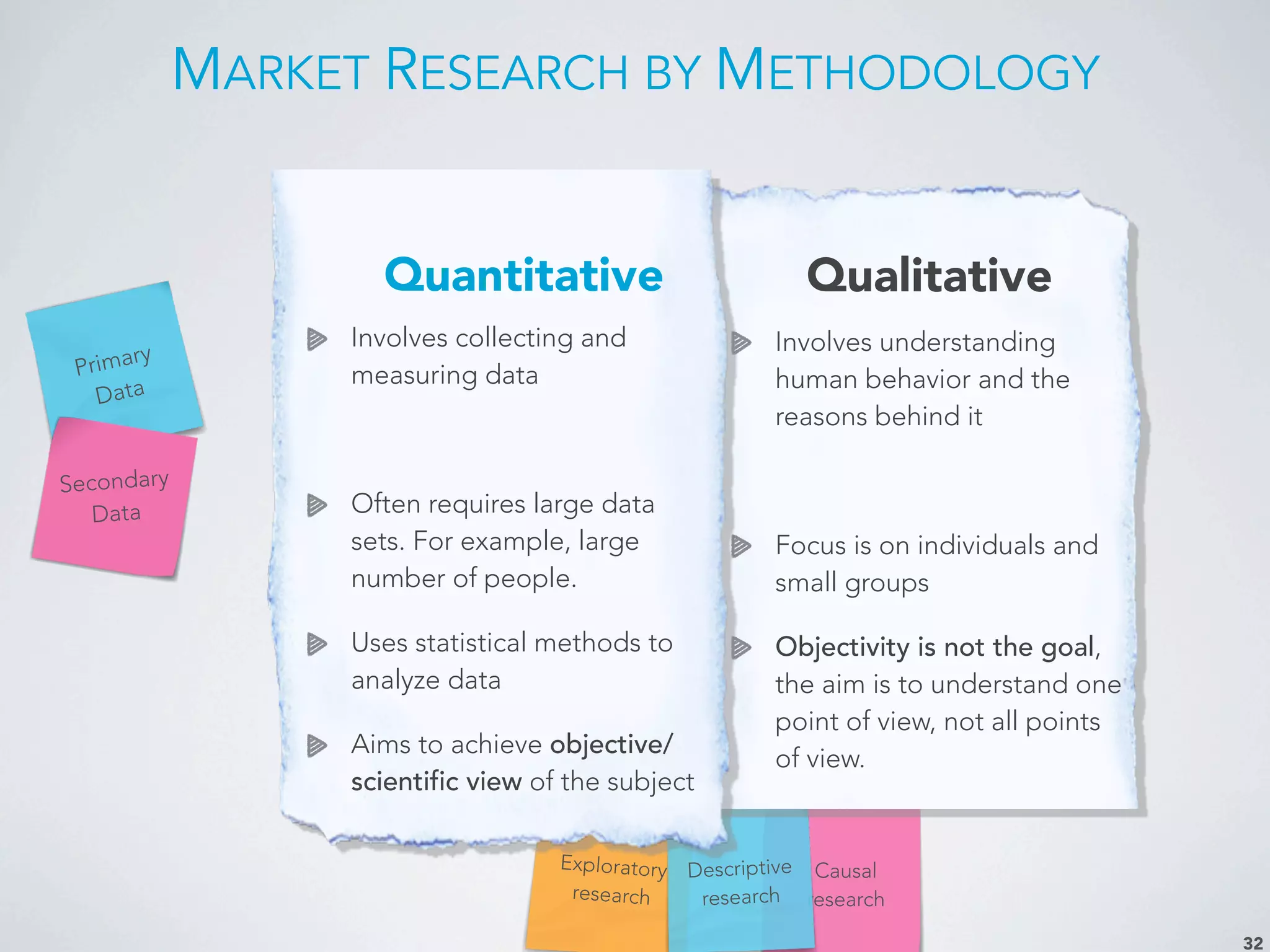
MARKET RESEARCH BYMETHODOLOGY
32
Qualitative
Involves understanding
human behavior and the
reasons behind it
Focus is on individuals and
small groups
Objectivity is not the goal,
the aim is to understand one
point of view, not all points
of view.
Primary
Data
Secondary
Data
Quantitative
Involves collecting and
measuring data
Often requires large data
sets. For example, large
number of people.
Uses statistical methods to
analyze data
Aims to achieve objective/
scientific view of the subject
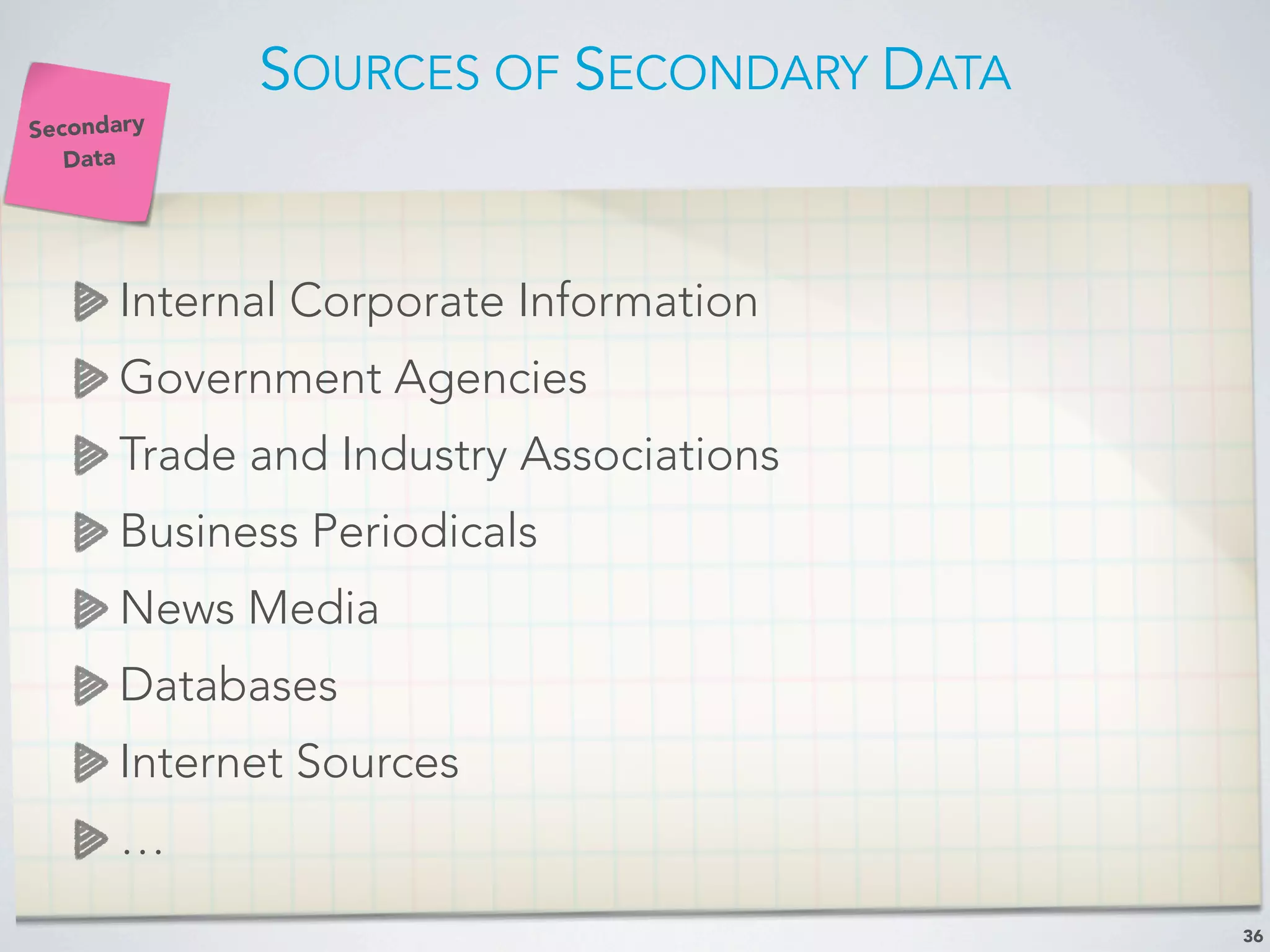
SOURCES OF SECONDARYDATA
Internal Corporate Information
Government Agencies
Trade and Industry Associations
Business Periodicals
News Media
Databases
Internet Sources
…
36
Secondary
Data
Secondary
Data
EVALUATING DATA SOURCES
38
CurrencyHow recent is the information?
Are there more recent updates available?
Is it current enough for your topic?
Reliability
Is content of the resource primarily opinion?
Is it balanced and evidenced?
Does the creator provide references or sources for the
data?
Authority
Who is the creator or author?
What are his/her credentials?
Is s/he an expert?
Who is the publisher os sponsor? Are they reputable?
Purpose /
Point of View
Is it promotional or educational material?
Are there advertisements on the website?
is this fact or opinion?
Who is the intended audience?
40Robson (1998), Visocky& Visocky (2009)
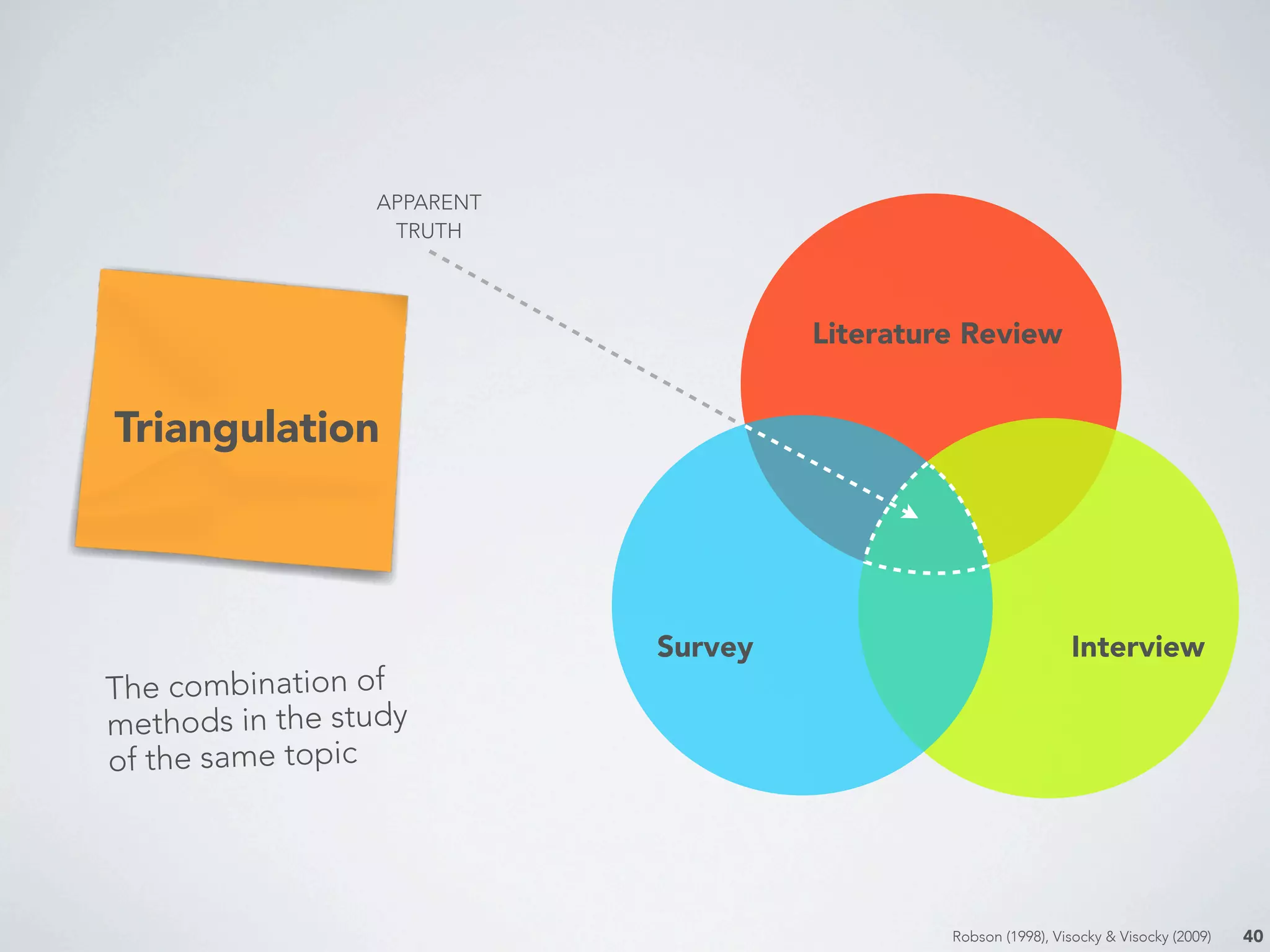
APPARENT
TRUTH
Literature Review
InterviewSurvey
Triangulation
The combination of
methods in the study
of the same topic
FOCUS GROUPS
44
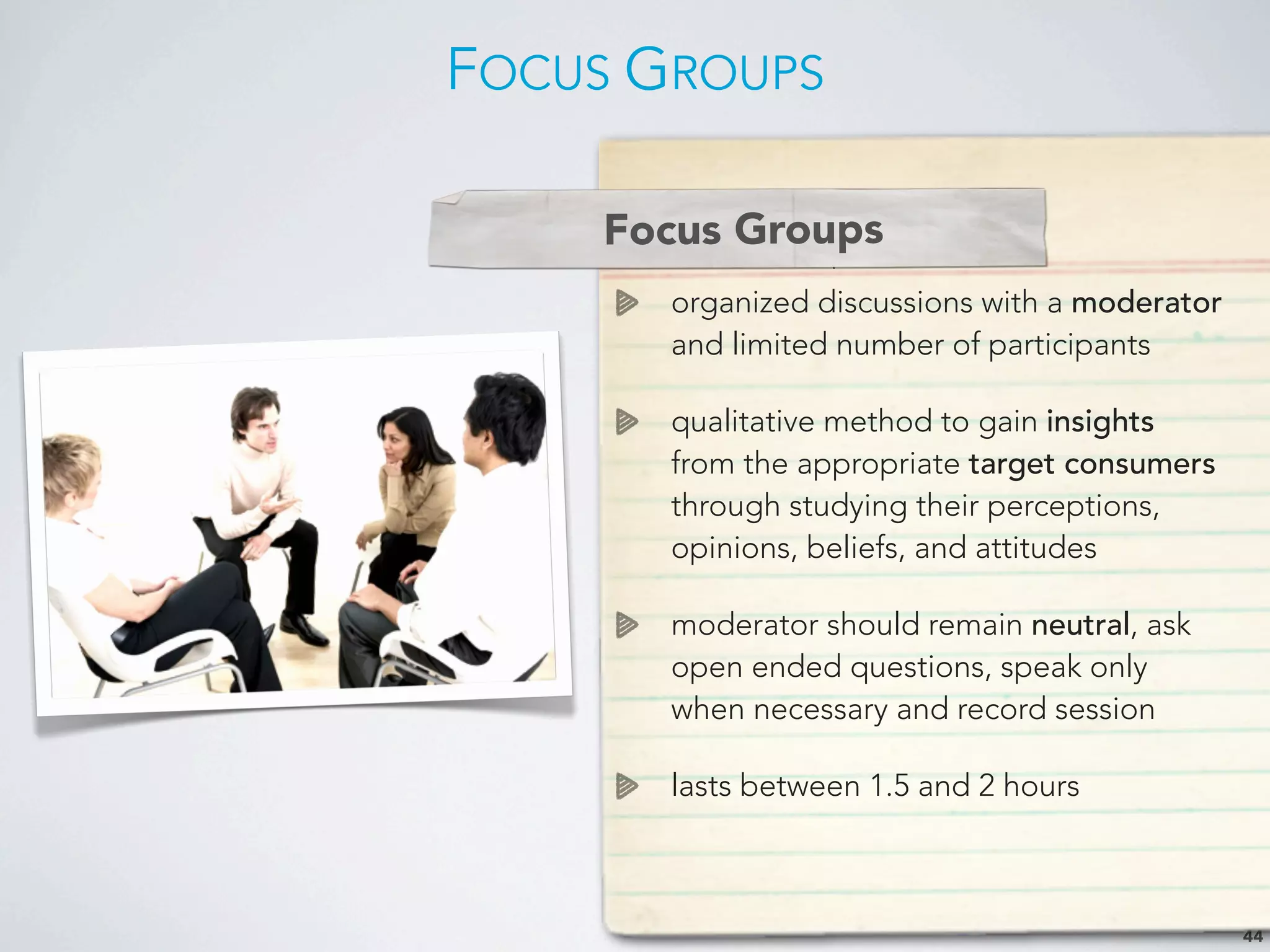
Focus Groups
organizeddiscussions with a moderator
and limited number of participants
qualitative method to gain insights
from the appropriate target consumers
through studying their perceptions,
opinions, beliefs, and attitudes
moderator should remain neutral, ask
open ended questions, speak only
when necessary and record session
lasts between 1.5 and 2 hours
Focus Groups
45.
FOCUS GROUPS
45
I’d liketo speak
with you all about your
opinions on...
------, -----. ----- !
------.
-----?
------!
----. ----?
http://www.youtube.com/watch?v=POF3m6ZNoiY
http://www.youtube.com/watch?v=cnV1pS7qVD8
46.
APPLICATIONS OF FOCUSGROUPS
46
Understanding consumers’ perception, preferences, and behaviors
concerning a product category
Obtaining impressions of new product concepts
Generating new ideas about older products
Developing creative concepts and copy material for advertisements
Securing price impressions
Obtaining preliminary consumer reaction to specific marketing programs
...
47.
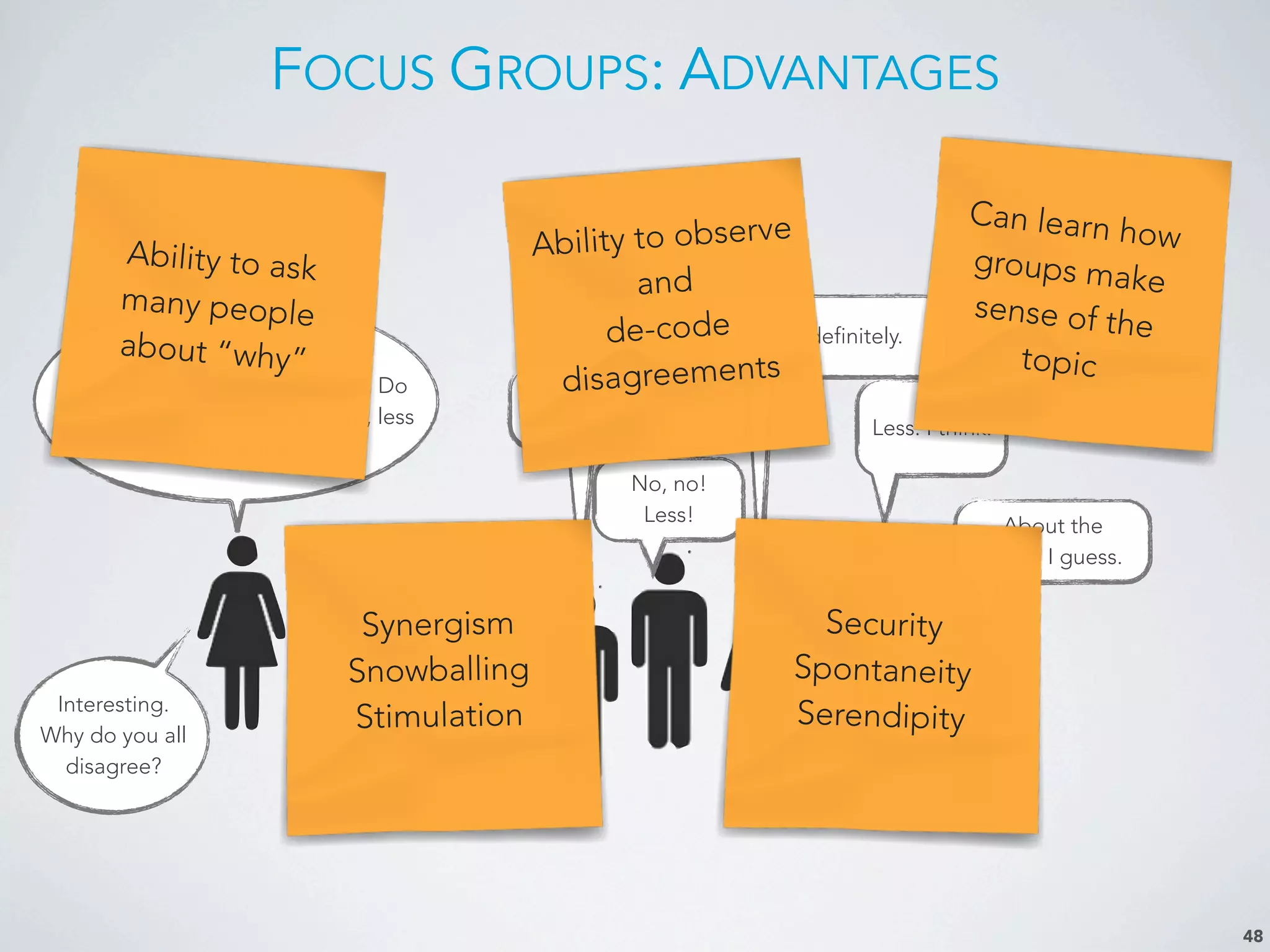
FOCUS GROUPS: ADVANTAGES
47
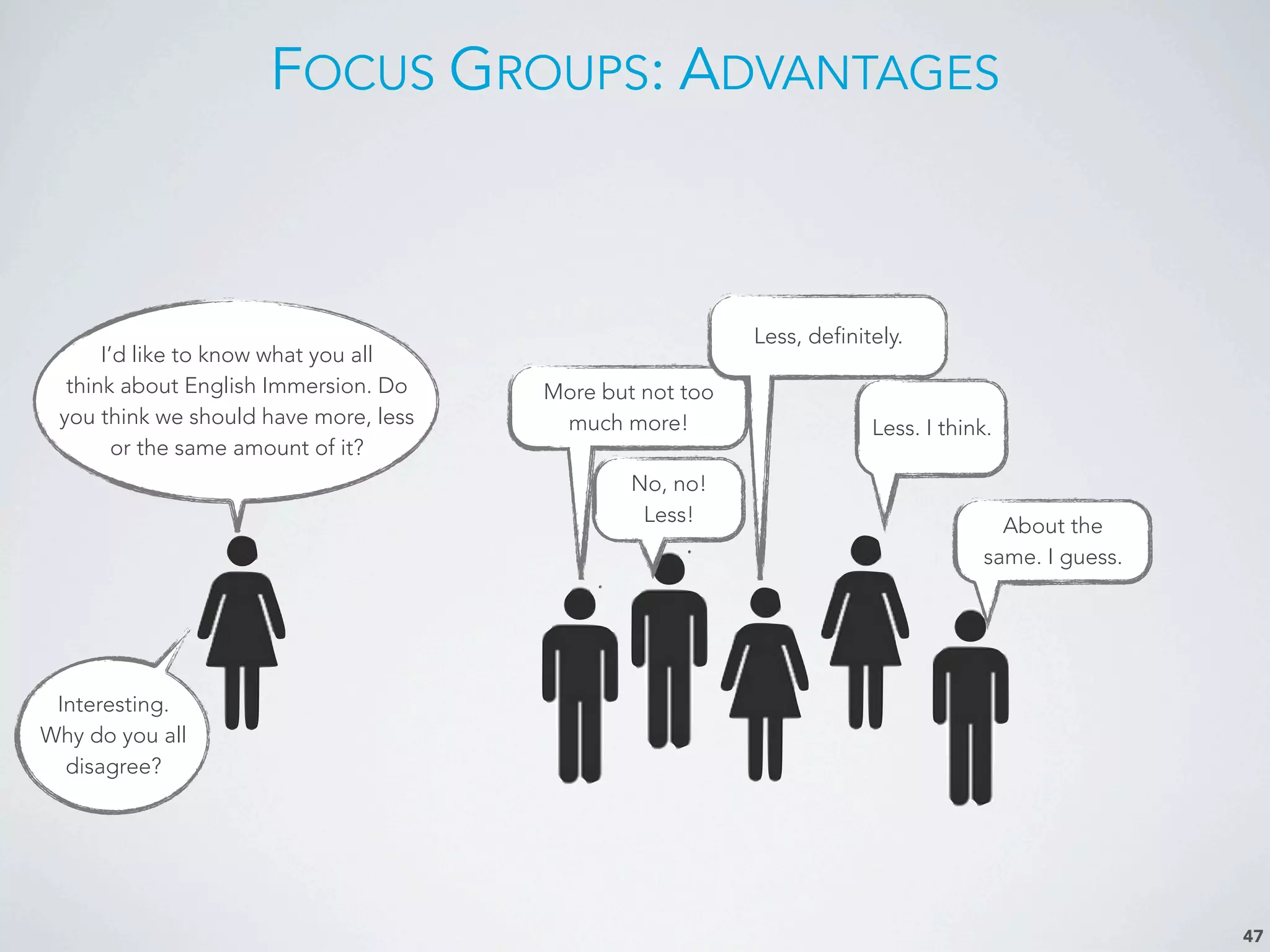
I’dlike to know what you all
think about English Immersion. Do
you think we should have more, less
or the same amount of it?
More but not too
much more!
About the
same. I guess.
Less. I think.
Less, definitely.
Interesting.
Why do you all
disagree?
No, no!
Less!
48.
FOCUS GROUPS: ADVANTAGES
48
I’dlike to know what you all
think about English Immersion. Do
you think we should have more, less
or the same amount of it?
More but not too
much more!
About the
same. I guess.
Less. I think.
Less, definitely.
Interesting.
Why do you all
disagree?
No, no!
Less!
Ability to ask
many people
about “why”
Ability to observe
and
de-code
disagreements
Can learn how
groups make
sense of the
topic
Synergism
Snowballing
Stimulation
Security
Spontaneity
Serendipity
49.
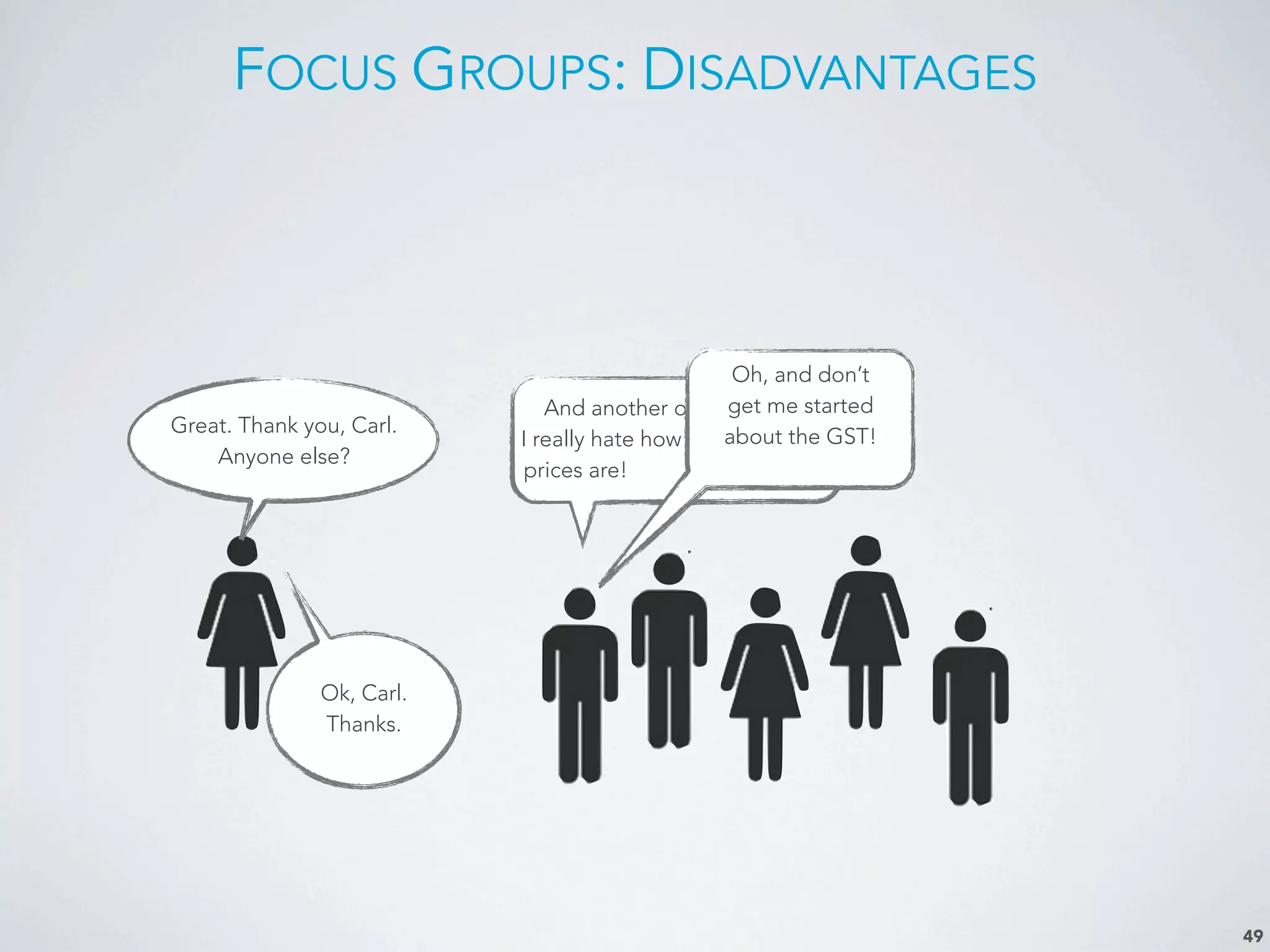
FOCUS GROUPS: DISADVANTAGES
49
Great.Thank you, Carl.
Anyone else?
And another one issue I’d l
I really hate how high gas
prices are!
Oh, and don’t
get me started
about the GST!
Ok, Carl.
Thanks.
50.
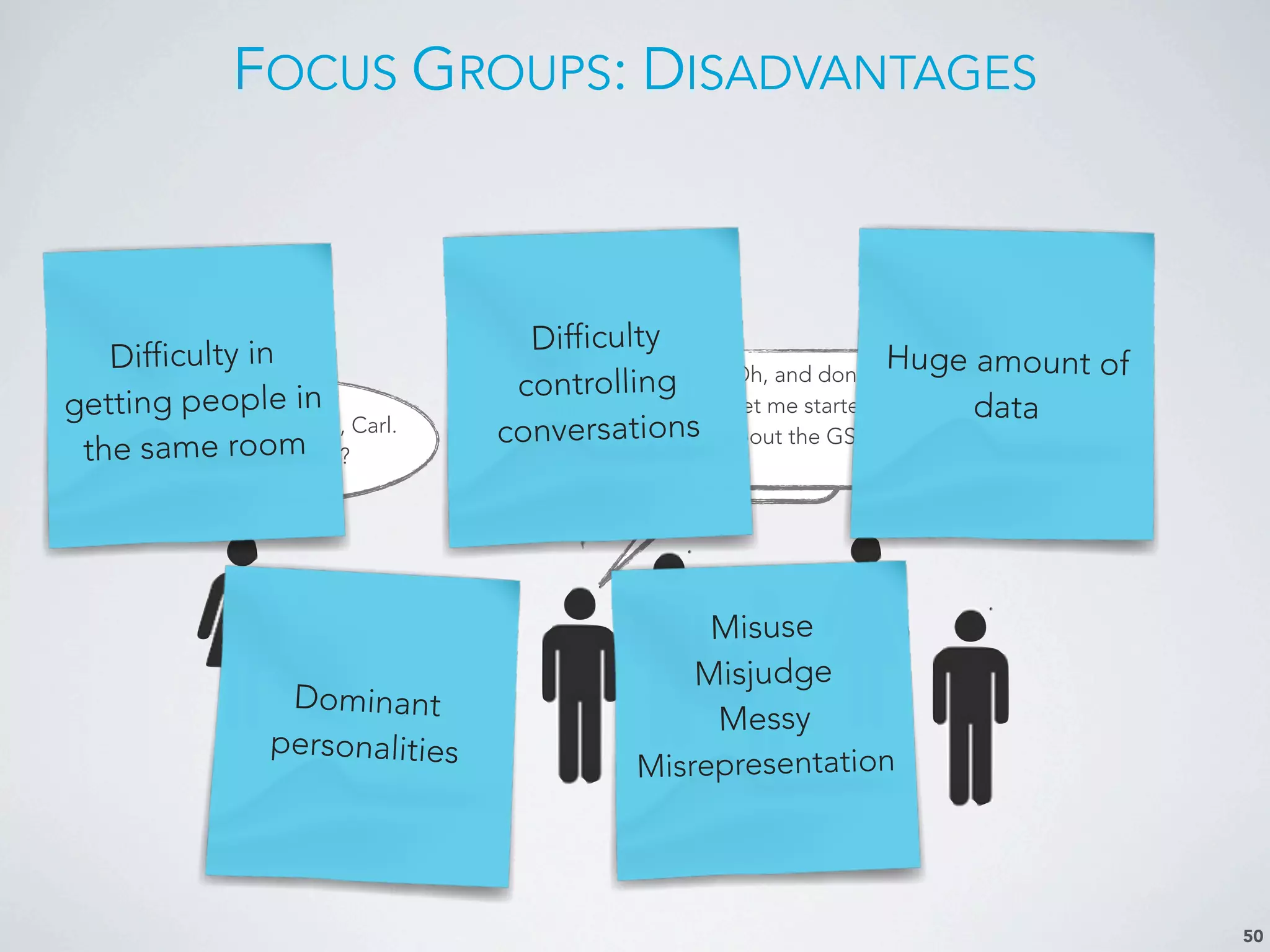
FOCUS GROUPS: DISADVANTAGES
50
Great.Thank you, Carl.
Anyone else?
And another one issue I’d l
I really hate how high gas
prices are!
Oh, and don’t
get me started
about the GST!
Ok, Carl.
Thanks.
Difficulty in
getting people in
the same room
Difficulty
controlling
conversations
Huge amount of
data
Dominant
personalities
Misuse
Misjudge
Messy
Misrepresentation
51.
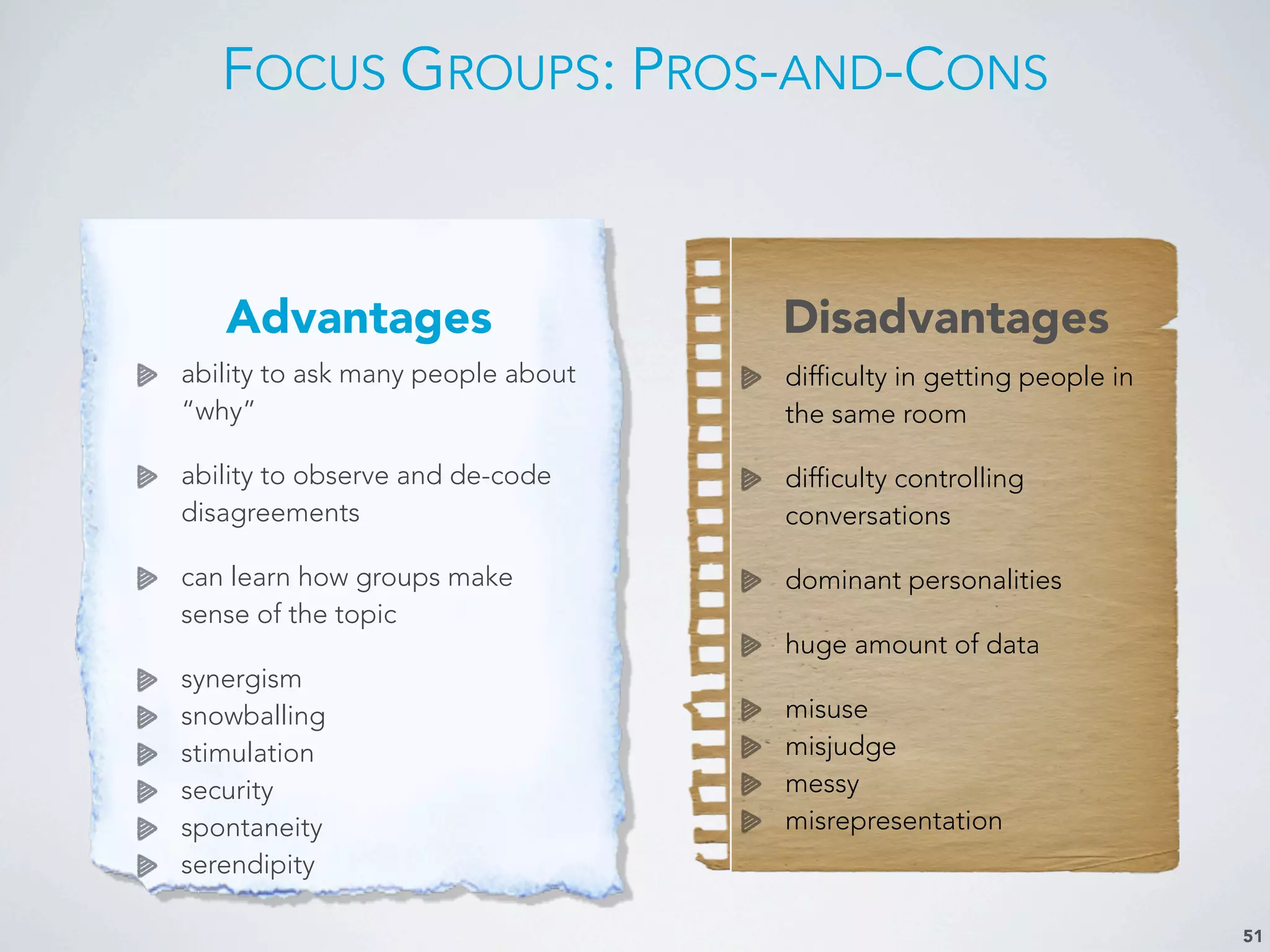
FOCUS GROUPS: PROS-AND-CONS
51
AdvantagesDisadvantages
ability to ask many people about
“why”
ability to observe and de-code
disagreements
can learn how groups make
sense of the topic
synergism
snowballing
stimulation
security
spontaneity
serendipity
difficulty in getting people in
the same room
difficulty controlling
conversations
dominant personalities
huge amount of data
misuse
misjudge
messy
misrepresentation
52.
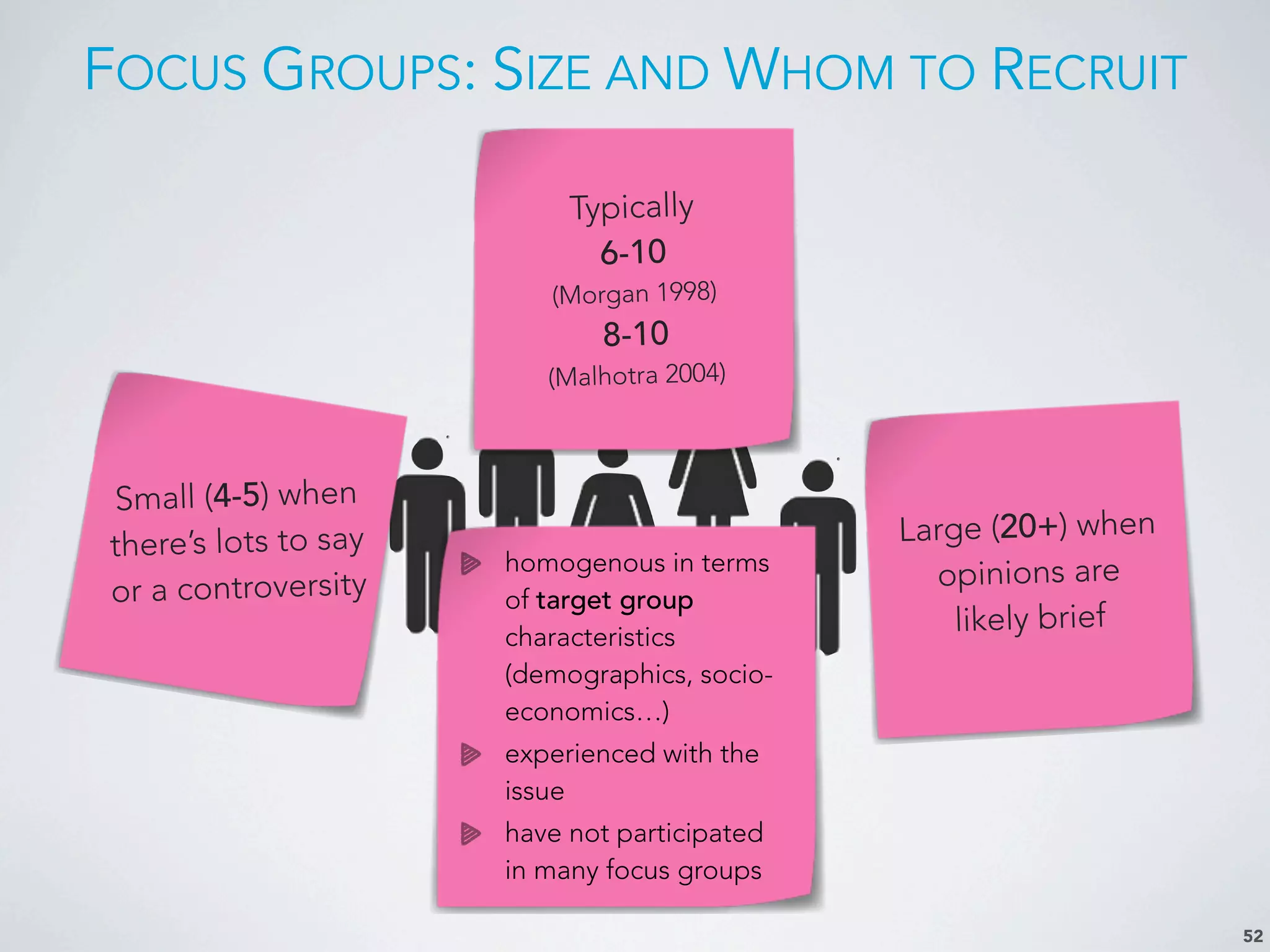
FOCUS GROUPS: SIZEAND WHOM TO RECRUIT
52
Typically
6-10
(Morgan 1998)
8-10
(Malhotra 2004)
Small (4-5) when
there’s lots to say
or a controversity
Large (20+) when
opinions are
likely brief
homogenous in terms
of target group
characteristics
(demographics, socio-
economics…)
experienced with the
issue
have not participated
in many focus groups
53.
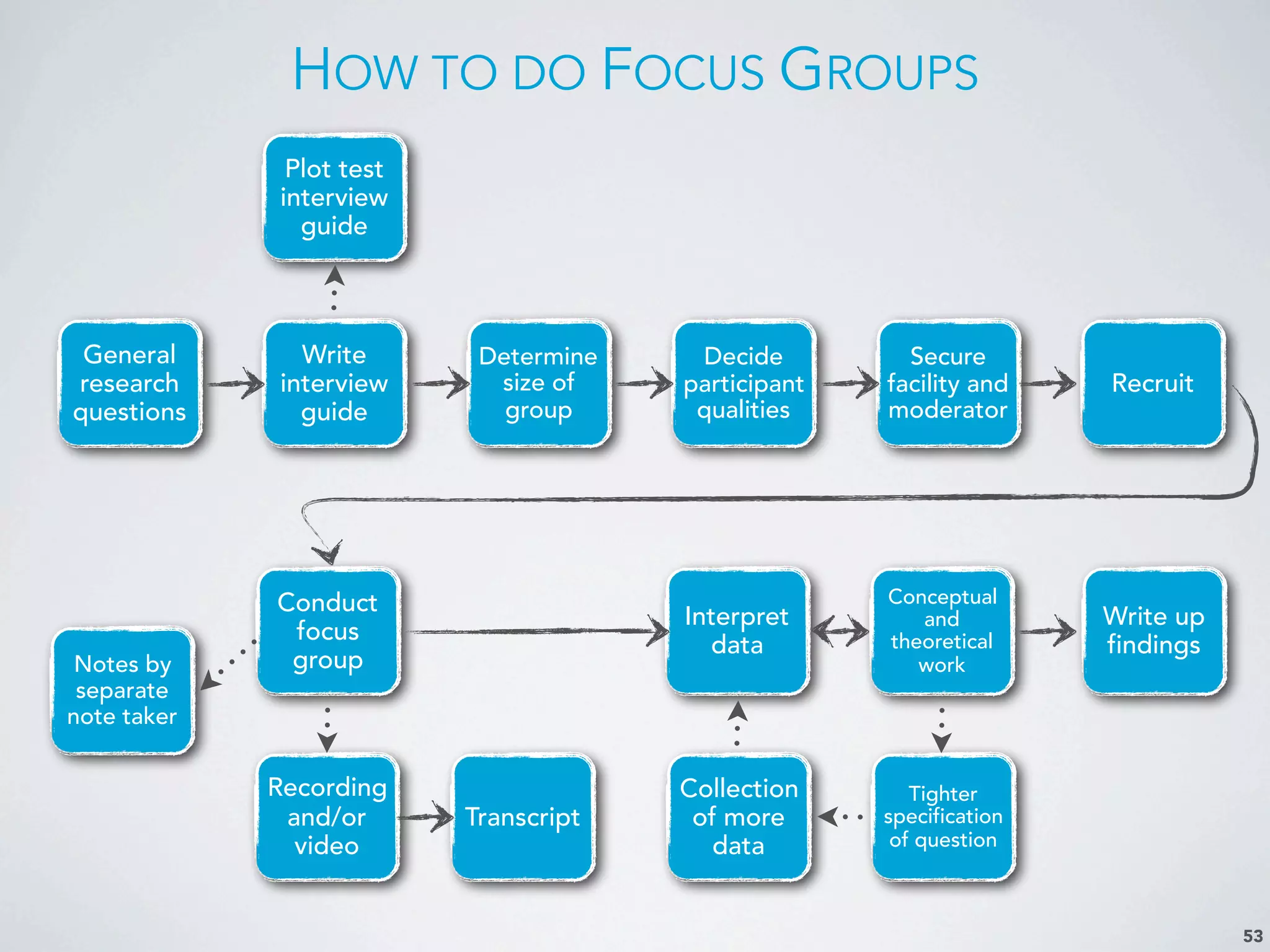
HOW TO DOFOCUS GROUPS
53
Plot test
interview
guide
General
research
questions
Write
interview
guide
Determine
size of
group
Decide
participant
qualities
Secure
facility and
moderator
Recruit
Notes by
separate
note taker
Conduct
focus
group
Interpret
data
Conceptual
and
theoretical
work
Write up
findings
Recording
and/or
video
Transcript
Collection
of more
data
Tighter
specification
of question
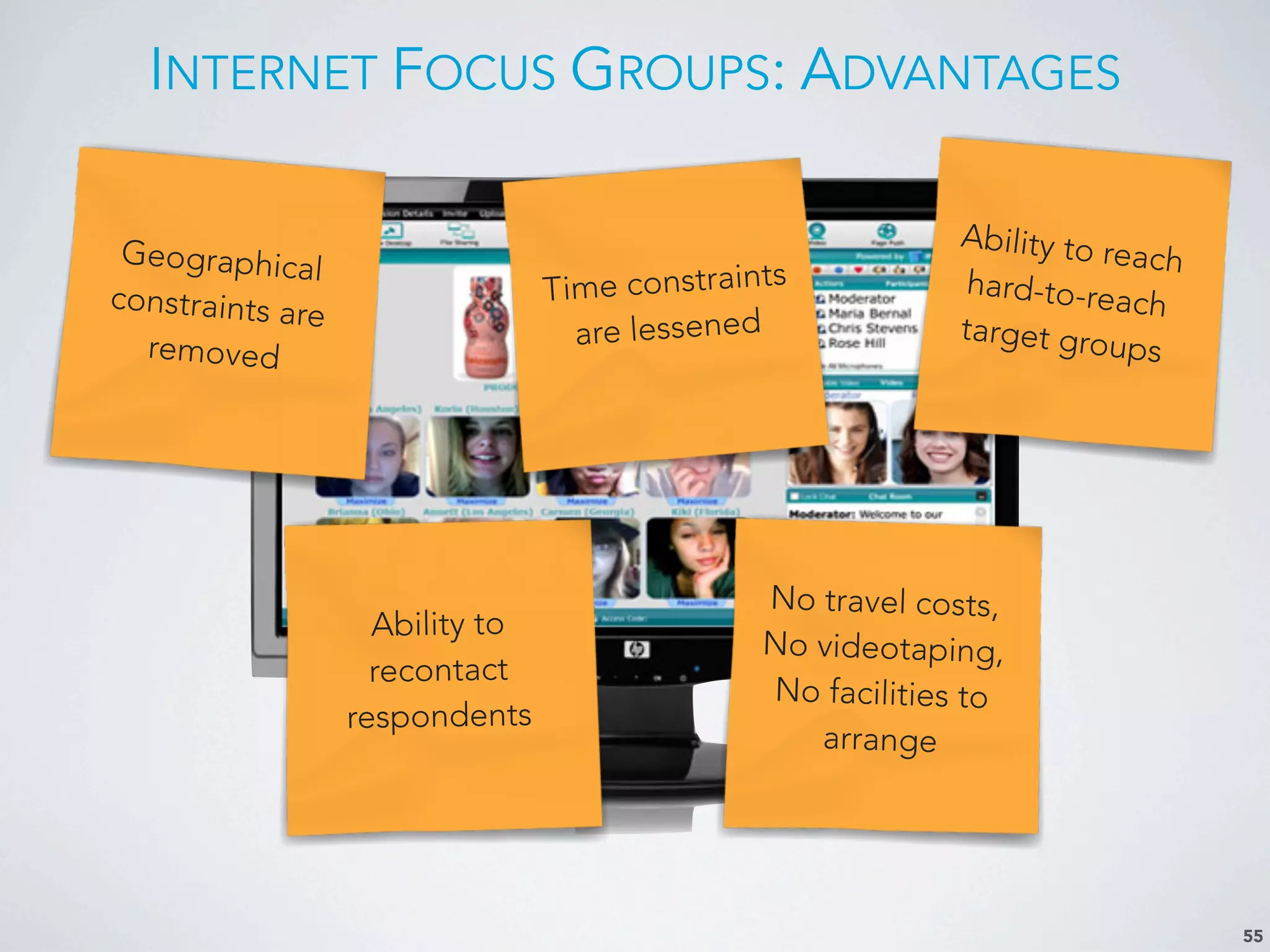
INTERNET FOCUS GROUPS:ADVANTAGES
55
Geographical
constraints are
removed
Time constraints
are lessened
Ability to reach
hard-to-reach
target groups
Ability to
recontact
respondents
No travel costs,
No videotaping,
No facilities to
arrange
56.
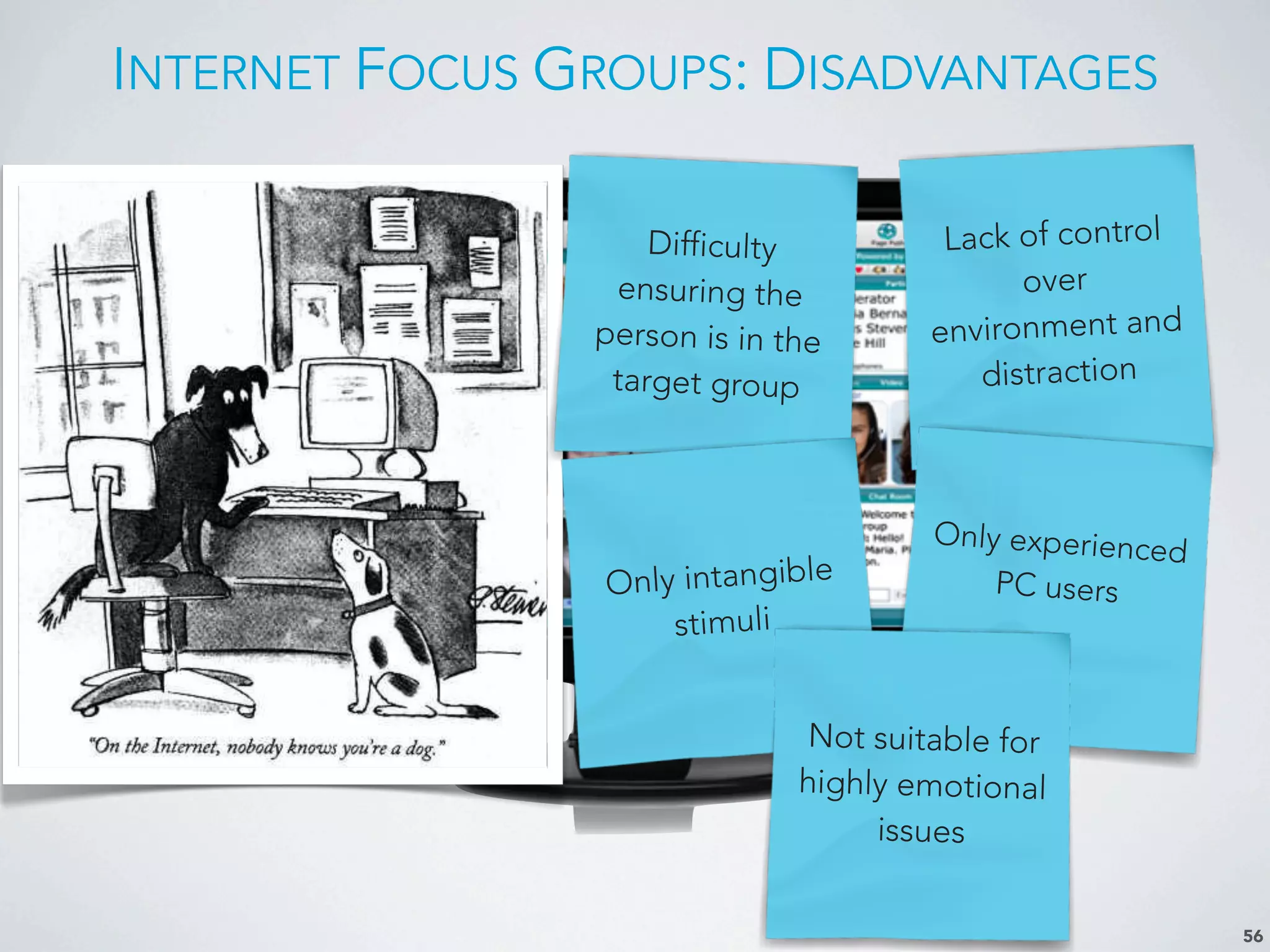
INTERNET FOCUS GROUPS:DISADVANTAGES
56
Difficulty
ensuring the
person is in the
target group
Lack of control
over
environment and
distraction
Only intangible
stimuli
Only experienced
PC users
Not suitable for
highly emotional
issues
57.
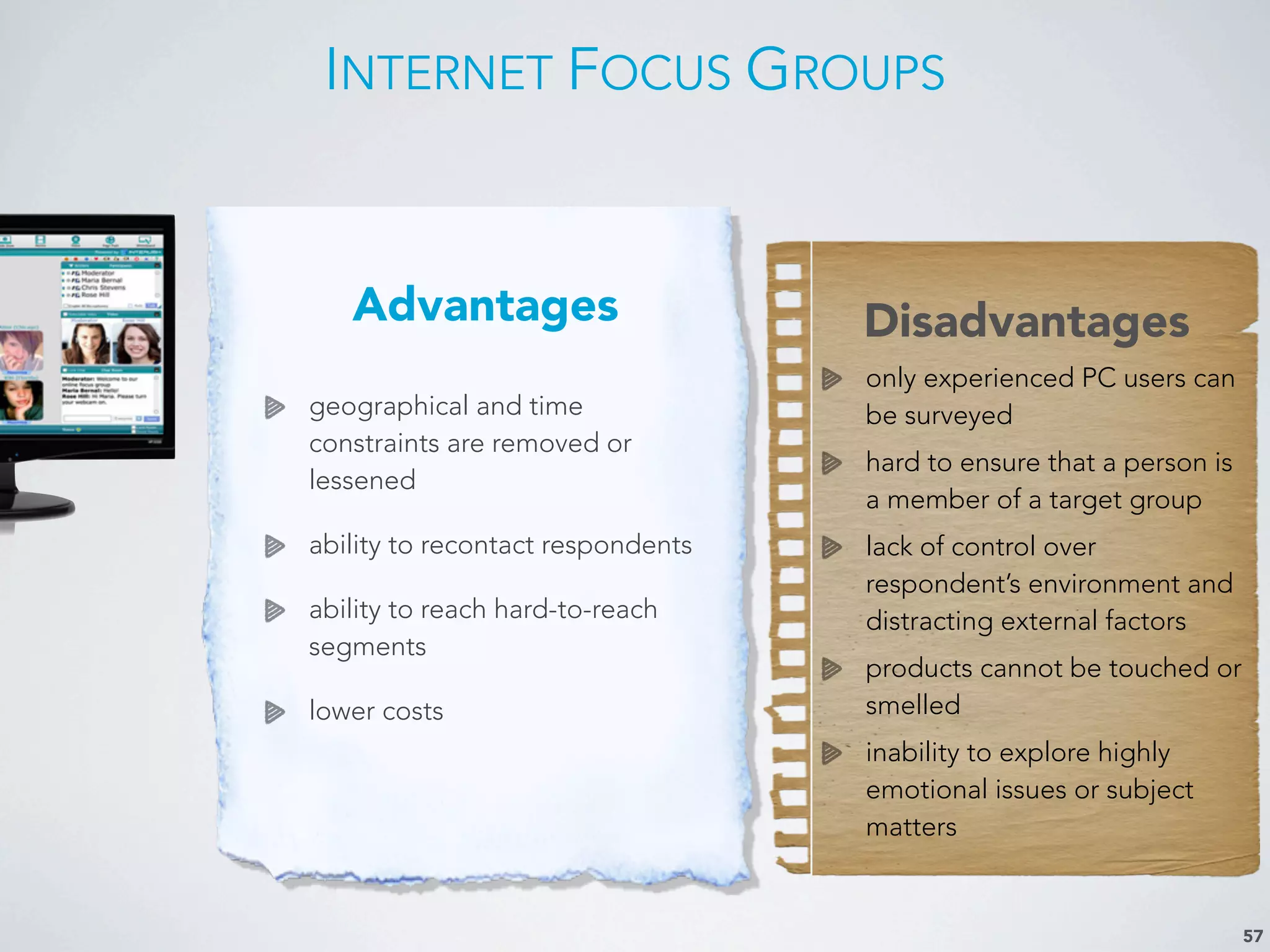
INTERNET FOCUS GROUPS
57
AdvantagesDisadvantages
geographical and time
constraints are removed or
lessened
ability to recontact respondents
ability to reach hard-to-reach
segments
lower costs
only experienced PC users can
be surveyed
hard to ensure that a person is
a member of a target group
lack of control over
respondent’s environment and
distracting external factors
products cannot be touched or
smelled
inability to explore highly
emotional issues or subject
matters
58.
INTERNET FOCUS GROUPS:USES
58
Banner ads,
Copy testing,
Concept testing,
Usability testing
esp. suitable for
companies in the
online business
Multimedia
evaluation;
Comparisons of
icons or graphics
DEPTH INTERVIEW
60
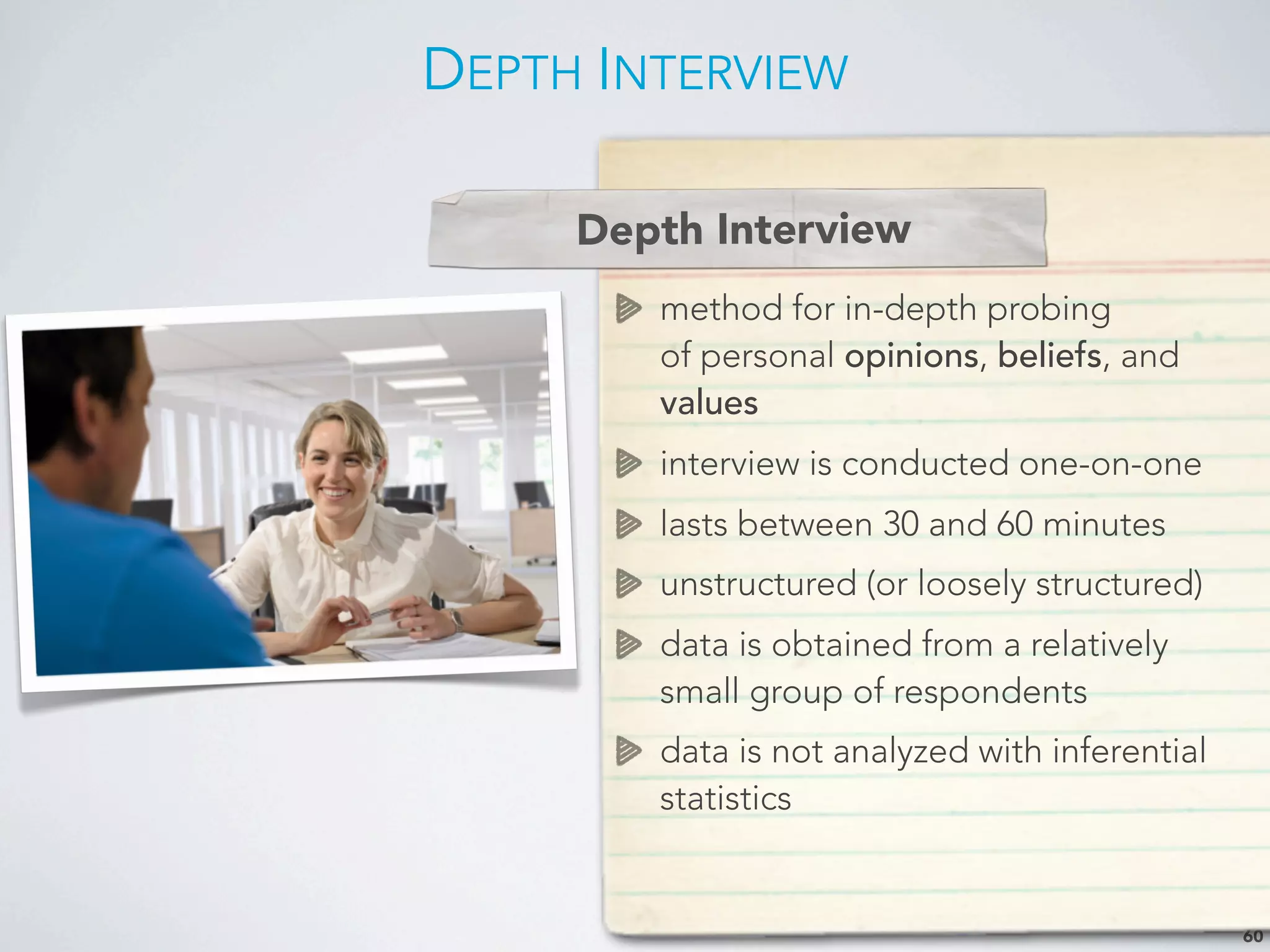
Depth Interview
methodfor in-depth probing
of personal opinions, beliefs, and
values
interview is conducted one-on-one
lasts between 30 and 60 minutes
unstructured (or loosely structured)
data is obtained from a relatively
small group of respondents
data is not analyzed with inferential
statistics
Depth Interview
61.
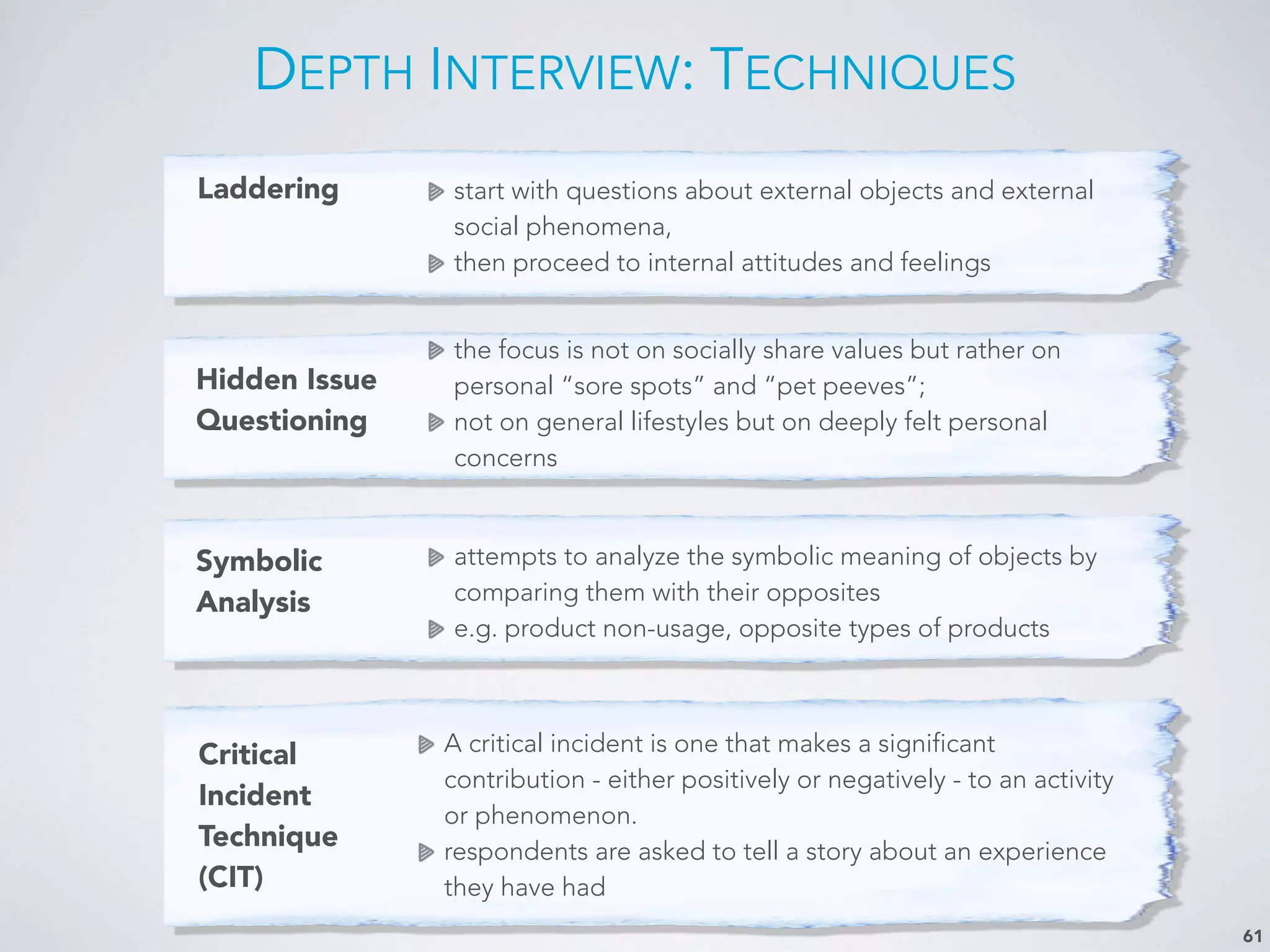
DEPTH INTERVIEW: TECHNIQUES
61
Ladderingstart with questions about external objects and external
social phenomena,
then proceed to internal attitudes and feelings
Critical
Incident
Technique
(CIT)
A critical incident is one that makes a significant
contribution - either positively or negatively - to an activity
or phenomenon.
respondents are asked to tell a story about an experience
they have had
Symbolic
Analysis
attempts to analyze the symbolic meaning of objects by
comparing them with their opposites
e.g. product non-usage, opposite types of products
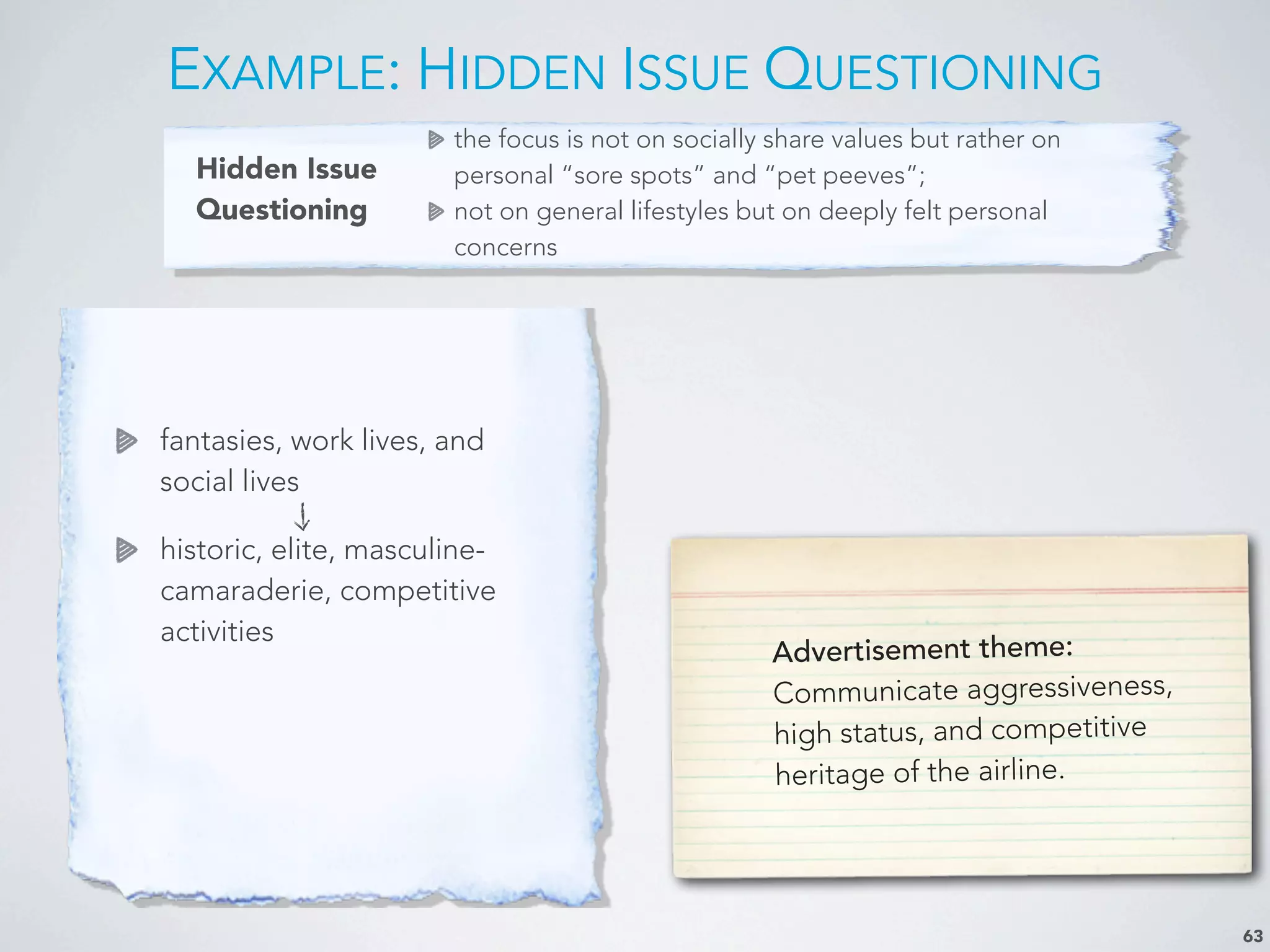
Hidden Issue
Questioning
the focus is not on socially share values but rather on
personal “sore spots” and “pet peeves”;
not on general lifestyles but on deeply felt personal
concerns
62.
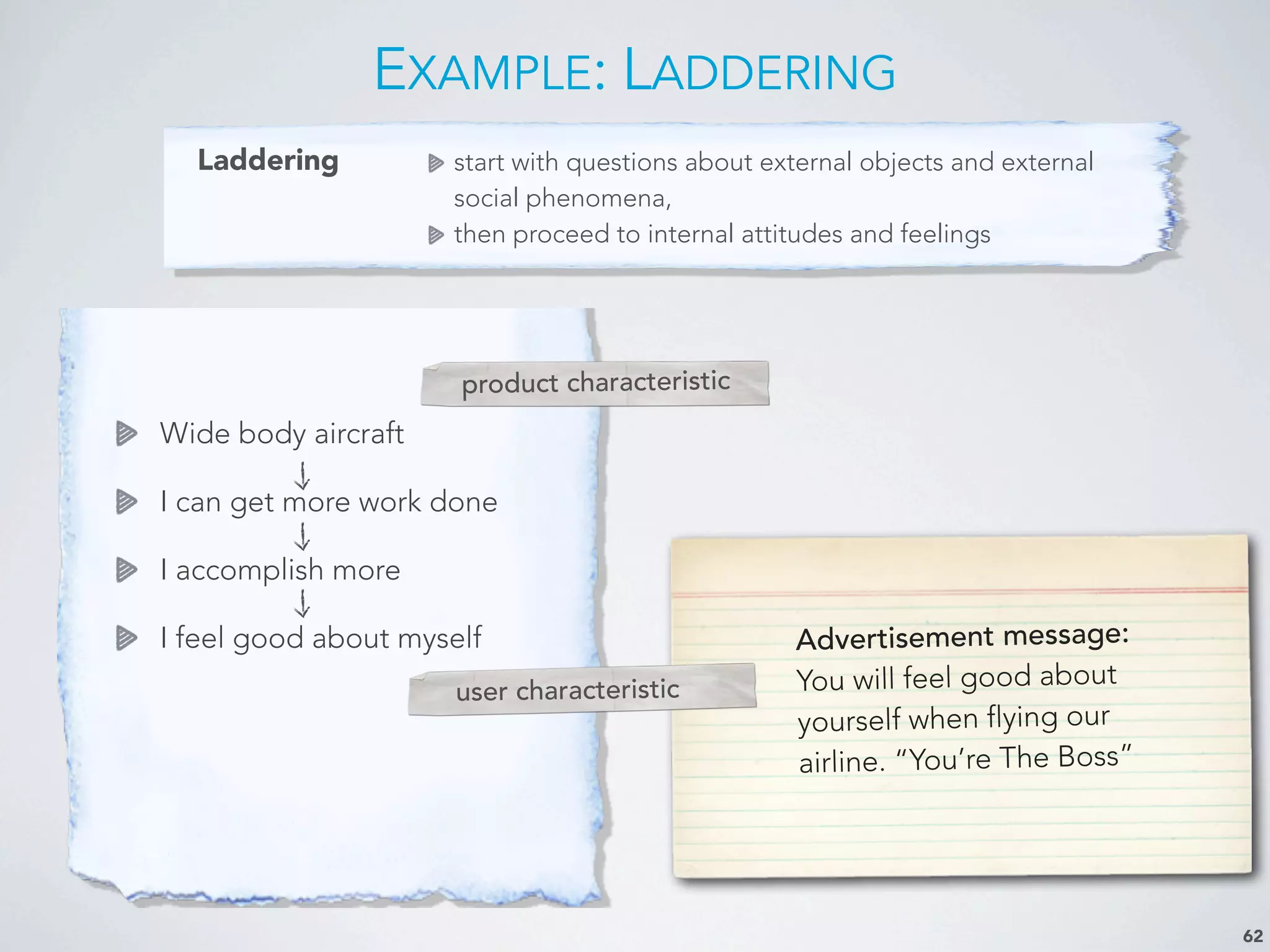
EXAMPLE: LADDERING
62
Laddering startwith questions about external objects and external
social phenomena,
then proceed to internal attitudes and feelings
Wide body aircraft
I can get more work done
I accomplish more
I feel good about myself
product characteristic
user characteristic
Advertisement message:
You will feel good about
yourself when flying our
airline. “You’re The Boss”
63.
Hidden Issue
Questioning
the focusis not on socially share values but rather on
personal “sore spots” and “pet peeves”;
not on general lifestyles but on deeply felt personal
concerns
EXAMPLE: HIDDEN ISSUE QUESTIONING
63
fantasies, work lives, and
social lives
historic, elite, masculine-
camaraderie, competitive
activities
Advertisement theme:
Communicate aggressiveness,
high status, and competitive
heritage of the airline.
64.
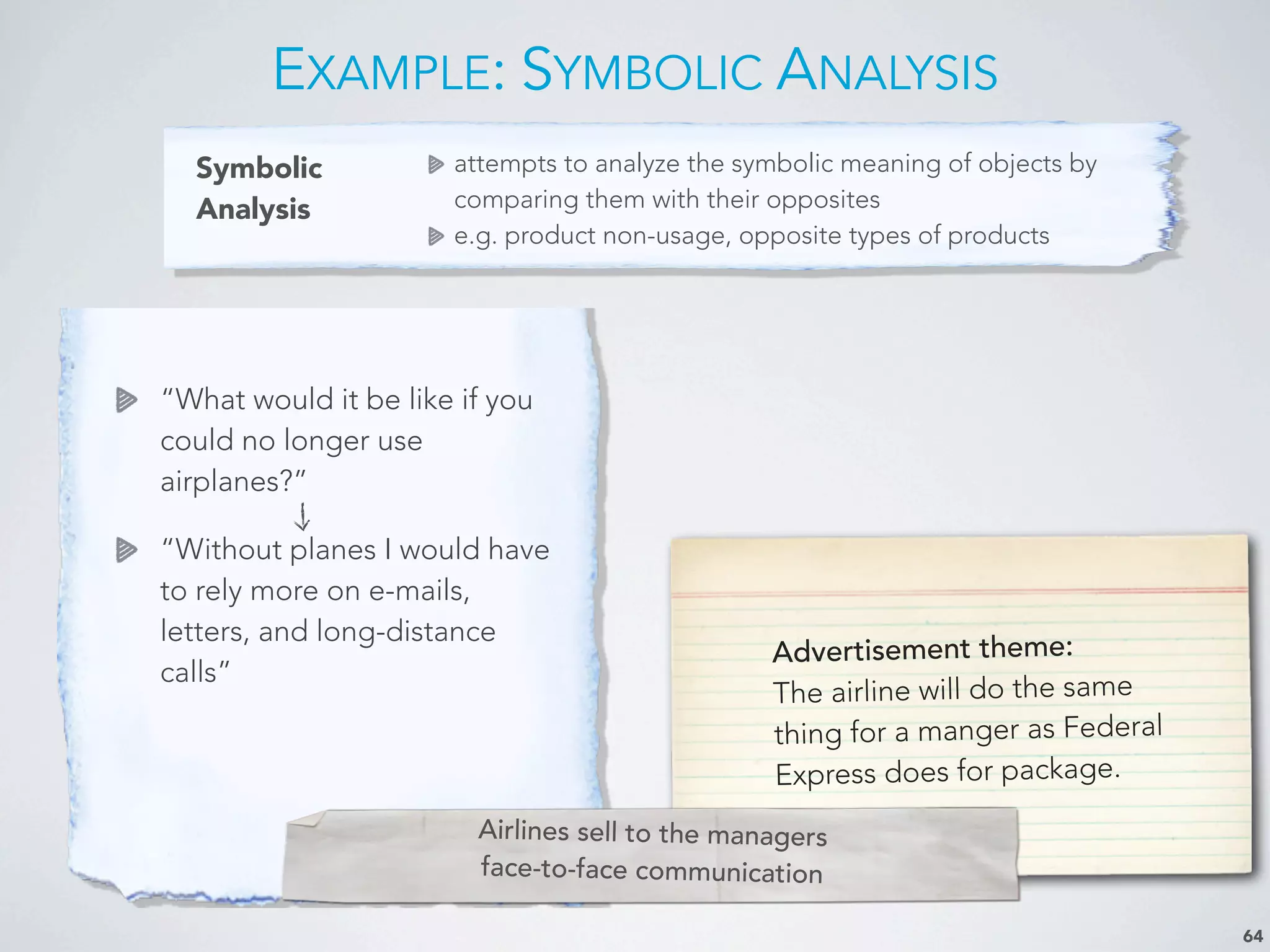
Symbolic
Analysis
attempts to analyzethe symbolic meaning of objects by
comparing them with their opposites
e.g. product non-usage, opposite types of products
EXAMPLE: SYMBOLIC ANALYSIS
64
“What would it be like if you
could no longer use
airplanes?”
“Without planes I would have
to rely more on e-mails,
letters, and long-distance
calls”
Advertisement theme:
The airline will do the same
thing for a manger as Federal
Express does for package.
Airlines sell to the managers
face-to-face communication
65.
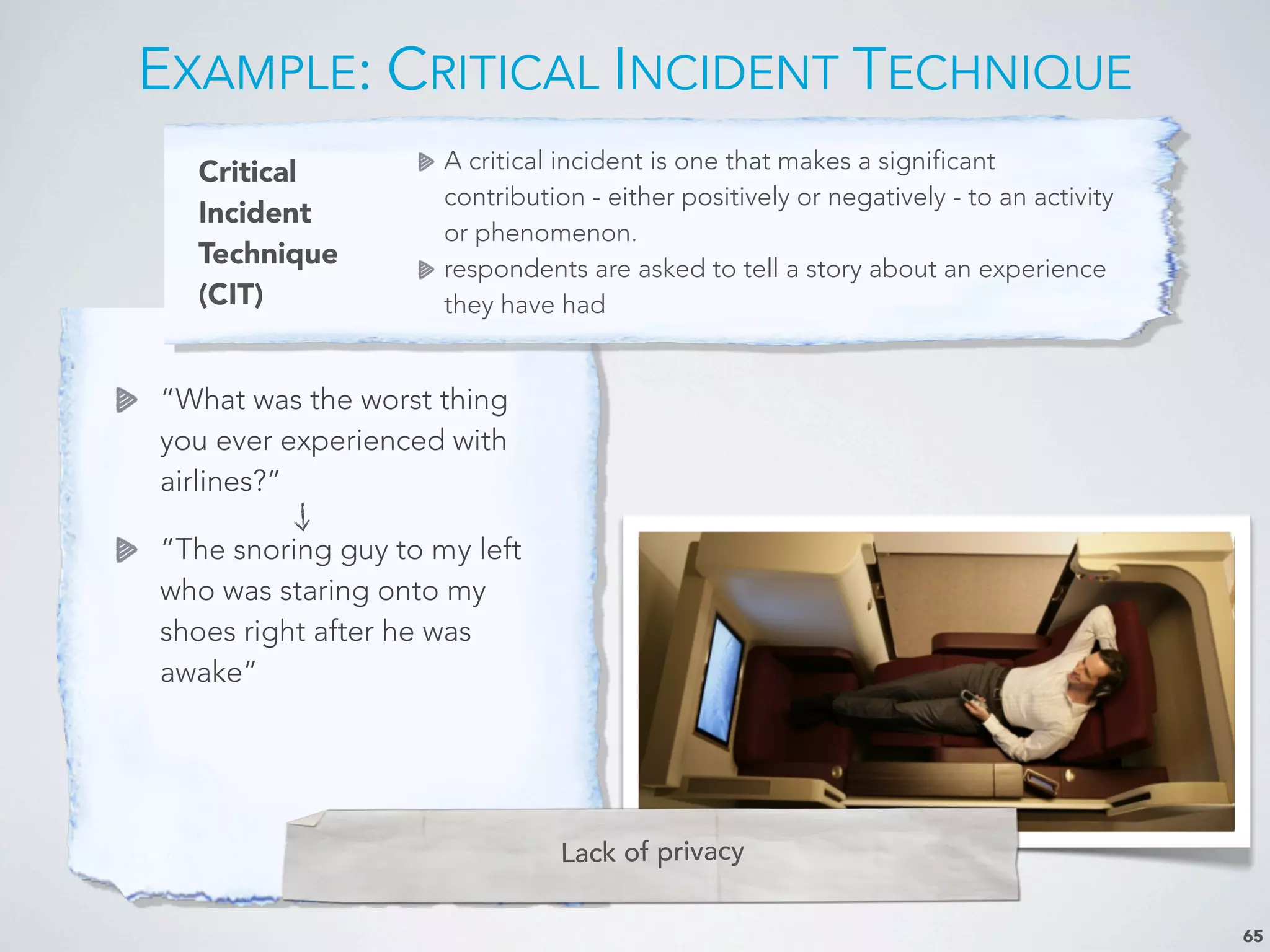
Critical
Incident
Technique
(CIT)
A critical incidentis one that makes a significant
contribution - either positively or negatively - to an activity
or phenomenon.
respondents are asked to tell a story about an experience
they have had
EXAMPLE: CRITICAL INCIDENT TECHNIQUE
65
“What was the worst thing
you ever experienced with
airlines?”
“The snoring guy to m
y left
who was staring onto my
shoes right after he was
awake”
Lack of privacy
66.
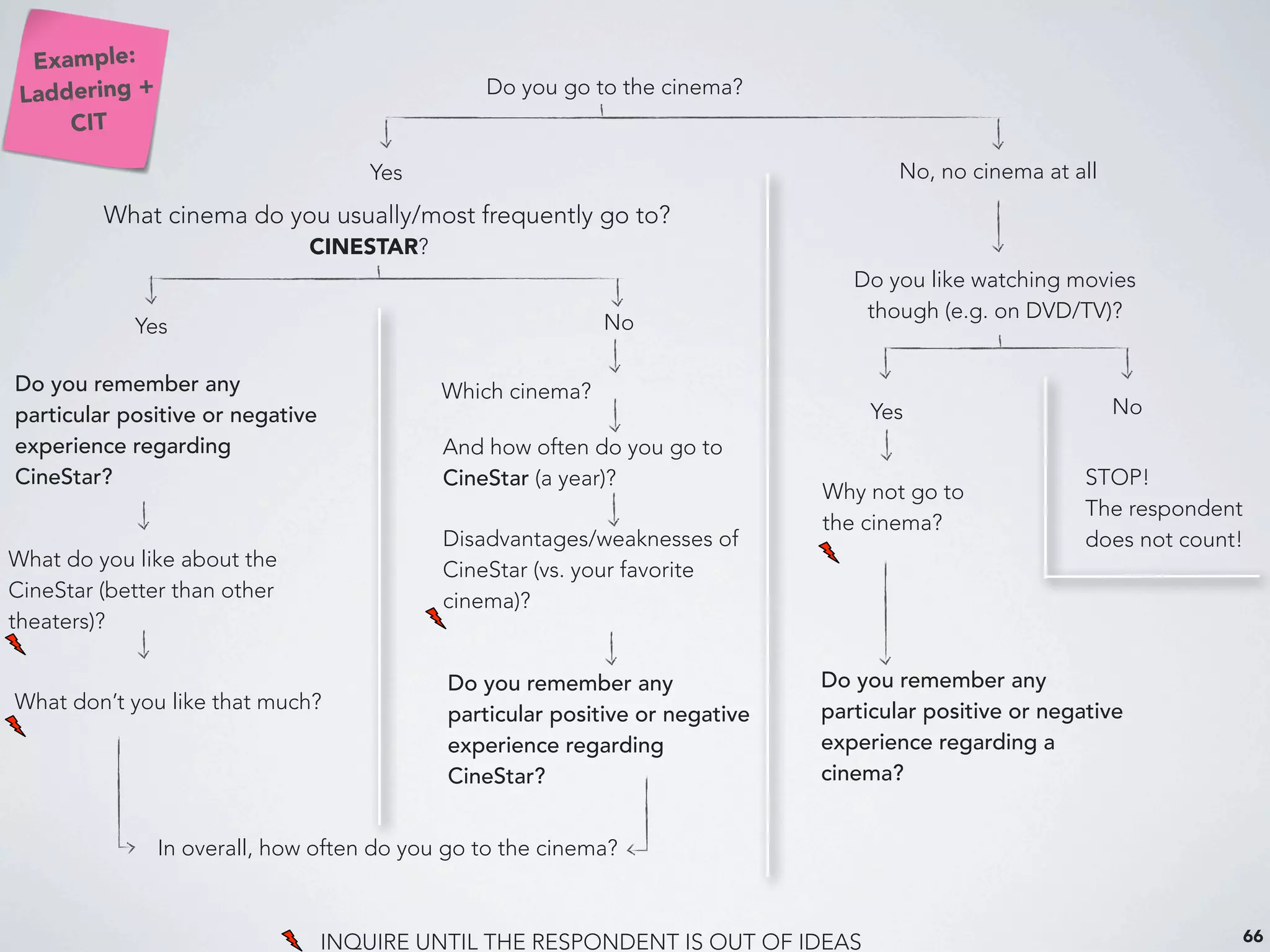
66
Do you goto the cinema?
Yes No, no cinema at all
What cinema do you usually/most frequently go to?
CINESTAR?
Yes No
Do you remember any
particular positive or negative
experience regarding
CineStar?
What do you like about the
CineStar (better than other
theaters)?
What don’t you like that much?
In overall, how often do you go to the cinema?
INQUIRE UNTIL THE RESPONDENT IS OUT OF IDEAS
Do you like watching movies
though (e.g. on DVD/TV)?
STOP!
The respondent
does not count!
Do you remember any
particular positive or negative
experience regarding a
cinema?
Why not go to
the cinema?
Yes No
Which cinema?
And how often do you go to
CineStar (a year)?
Disadvantages/weaknesses of
CineStar (vs. your favorite
cinema)?
Do you remember any
particular positive or negative
experience regarding
CineStar?
Example:
Laddering +
CIT
67.
DEPTH INTERVIEW: PROS-AND-CONS
67
AdvantagesDisadvantages
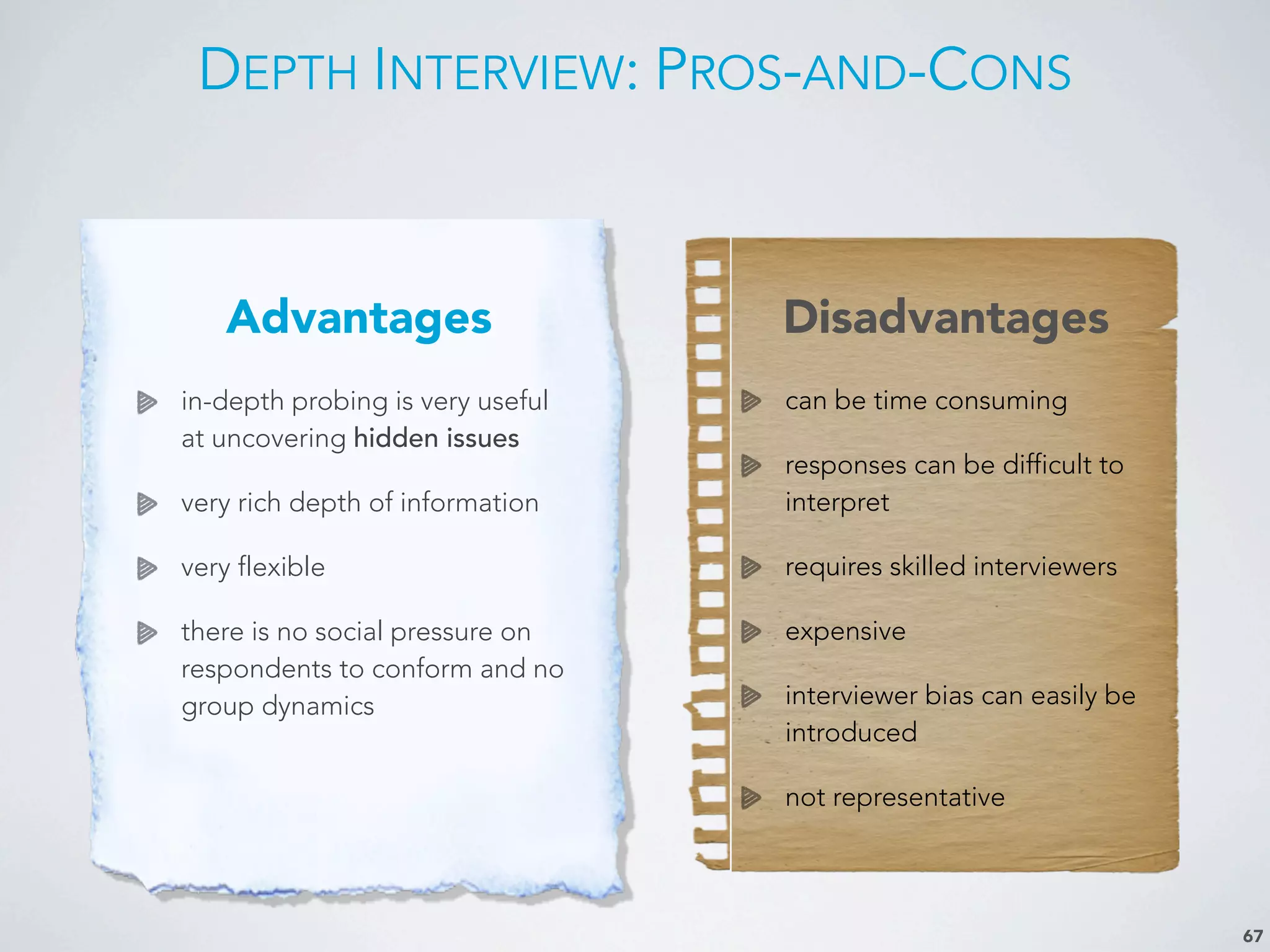
in-depth probing is very useful
at uncovering hidden issues
very rich depth of information
very flexible
there is no social pressure on
respondents to conform and no
group dynamics
can be time consuming
responses can be difficult to
interpret
requires skilled interviewers
expensive
interviewer bias can easily be
introduced
not representative
PROJECTIVE TECHNIQUES
69
Projective Techniques
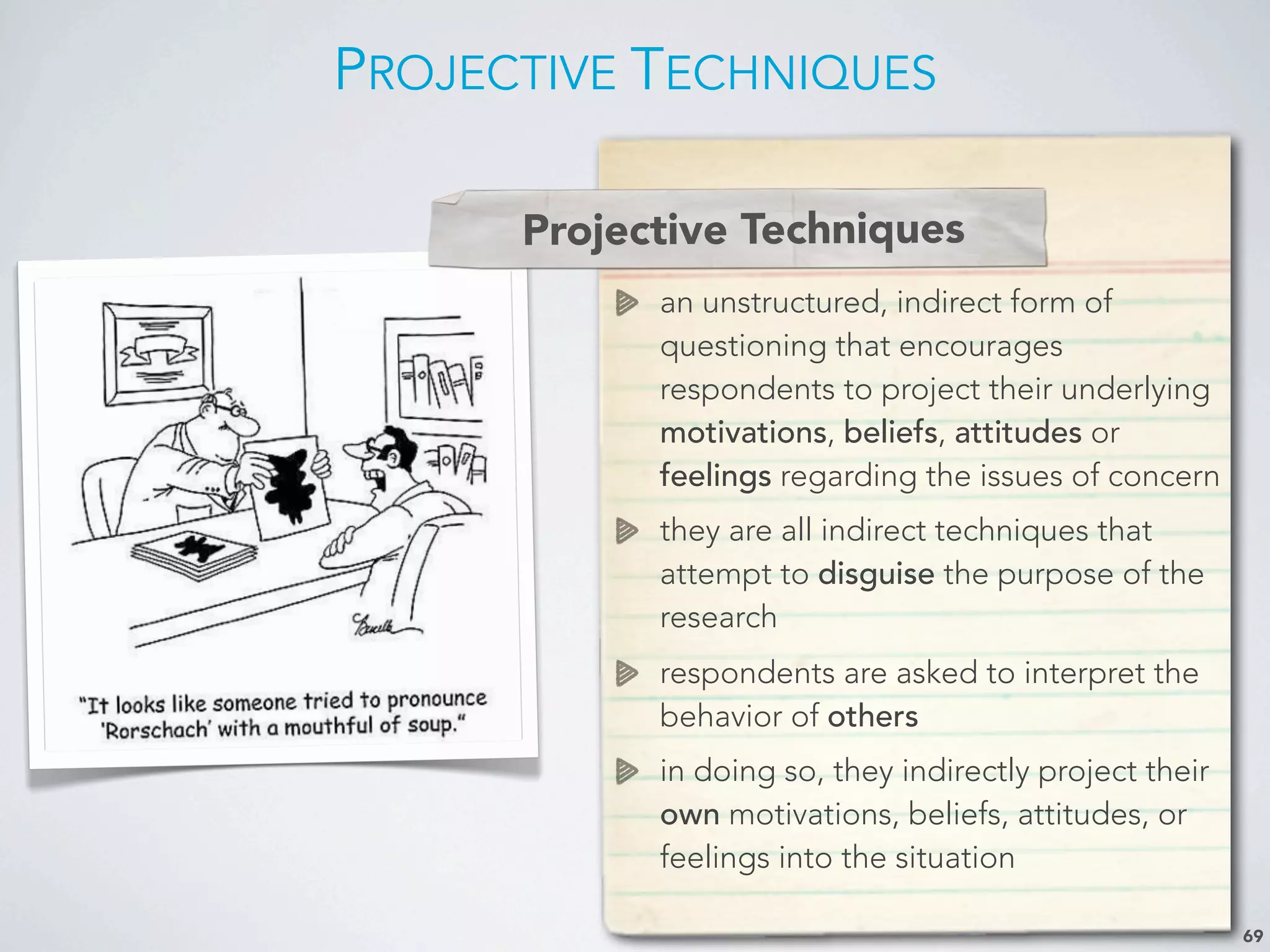
anunstructured, indirect form of
questioning that encourages
respondents to project their underlying
motivations, beliefs, attitudes or
feelings regarding the issues of concern
they are all indirect techniques that
attempt to disguise the purpose of the
research
respondents are asked to interpret the
behavior of others
in doing so, they indirectly project their
own motivations, beliefs, attitudes, or
feelings into the situation
Projective Techniques
70.
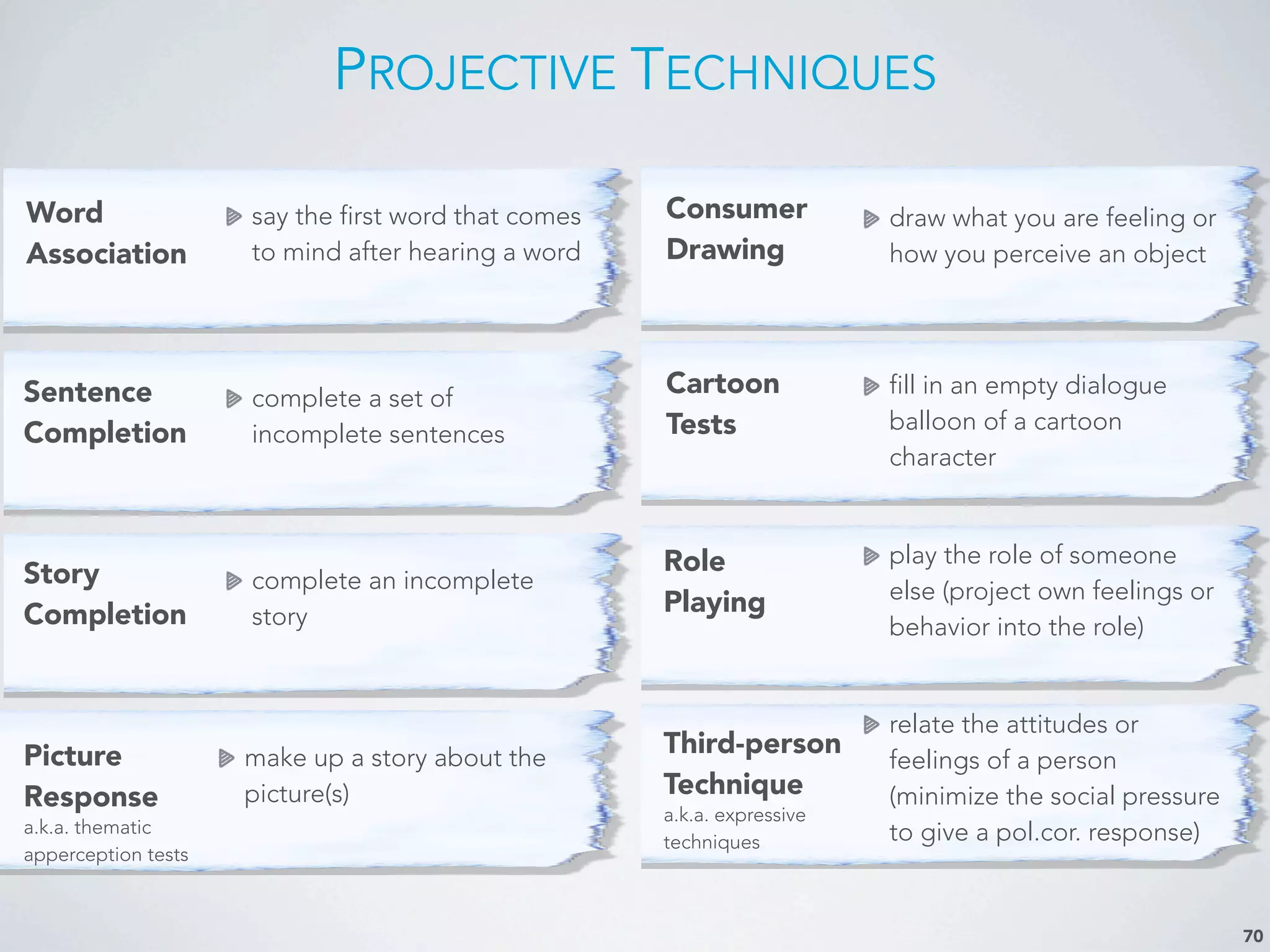
relate the attitudesor
feelings of a person
(minimize the social pressure
to give a pol.cor. response)
play the role of someone
else (project own feelings or
behavior into the role)
fill in an empty dialogue
balloon of a cartoon
character
make up a story about the
picture(s)
complete an incomplete
story
complete a set of
incomplete sentences
PROJECTIVE TECHNIQUES
70
Word
Association
Sentence
Completion
say the first word that comes
to mind after hearing a word
Story
Completion
Picture
Response
Cartoon
Tests
Role
Playing
Third-person
Technique
a.k.a. thematic
apperception tests
a.k.a. expressive
techniques
draw what you are feeling or
how you perceive an object
Consumer
Drawing
71.
Word
Association
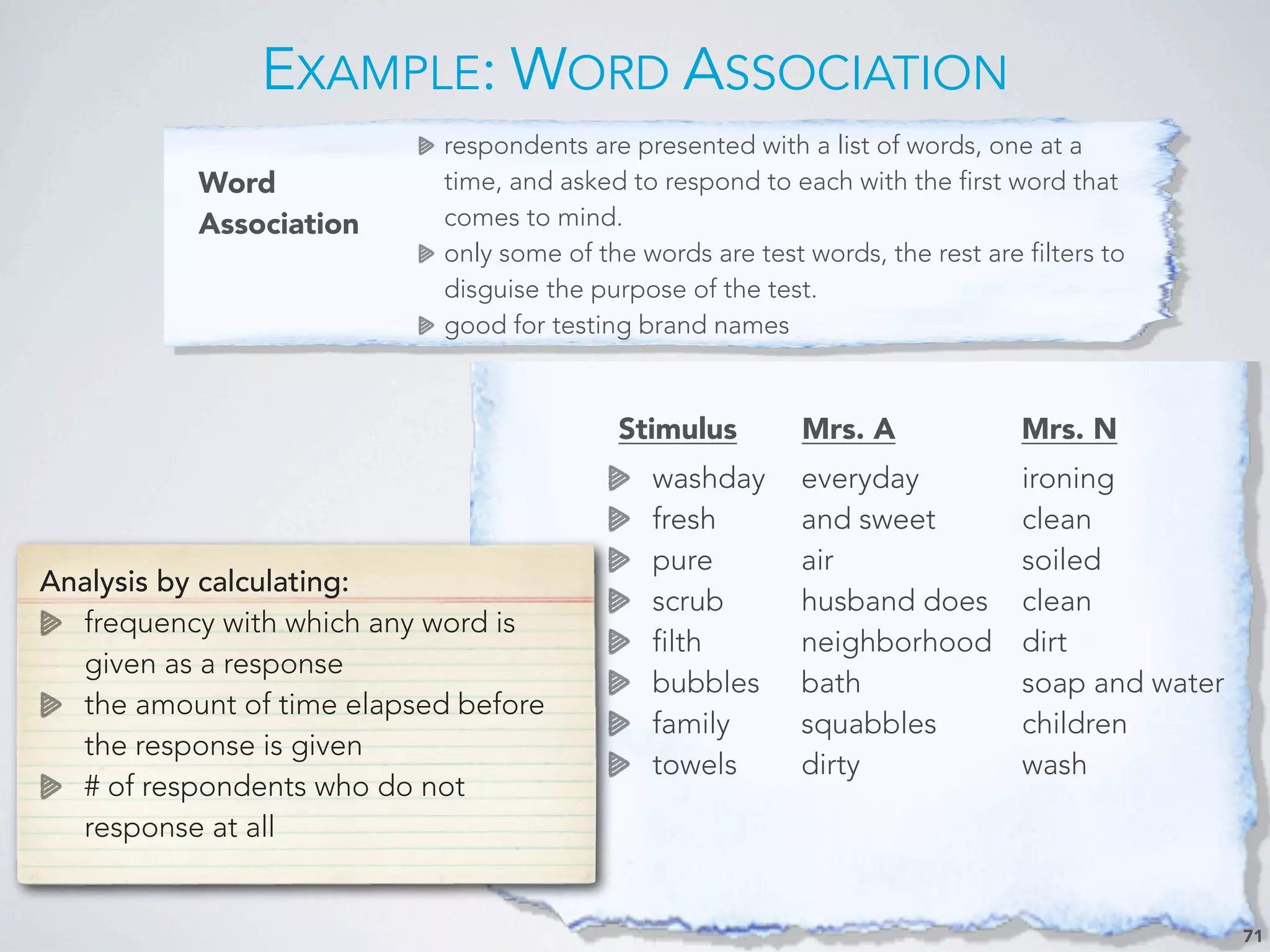
respondents are presentedwith a list of words, one at a
time, and asked to respond to each with the first word that
comes to mind.
only some of the words are test words, the rest are filters to
disguise the purpose of the test.
good for testing brand names
EXAMPLE: WORD ASSOCIATION
71
Analysis by calculating:
frequency with which any word is
given as a response
the amount of time elapsed before
the response is given
# of respondents who do not
response at all
washday
fresh
pure
scrub
filth
bubbles
family
towels
everyday
and sweet
air
husband does
neighborhood
bath
squabbles
dirty
ironing
clean
soiled
clean
dirt
soap and water
children
wash
Stimulus Mrs. A Mrs. N
72.
72
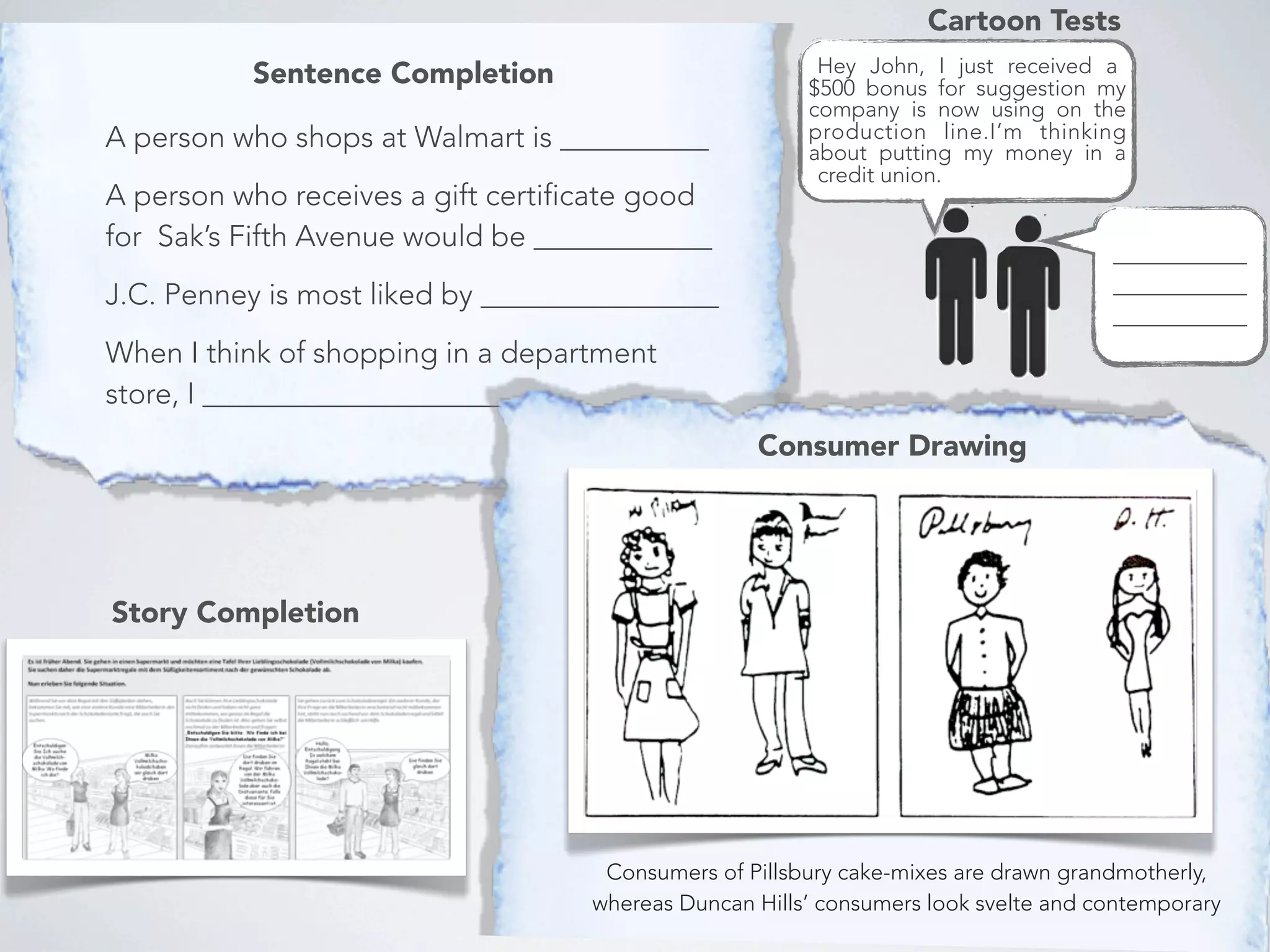
A person whoshops at Walmart is __________
A person who receives a gift certificate good
for Sak’s Fifth Avenue would be ____________
J.C. Penney is most liked by ________________
When I think of shopping in a department
store, I _____________________
Sentence Completion
Consumer Drawing
Consumers of Pillsbury cake-mixes are drawn grandmotherly,
whereas Duncan Hills’ consumers look svelte and contemporary
Story Completion
Hey John, I just received a
$500 bonus for suggestion my
company is now using on the
production line.I’m thinking
about putting my money in a
credit union.
Cartoon Tests
____________
____________
____________
73.
PROJECTIVE TECHNIQUES: PROS-AND-CONS
73
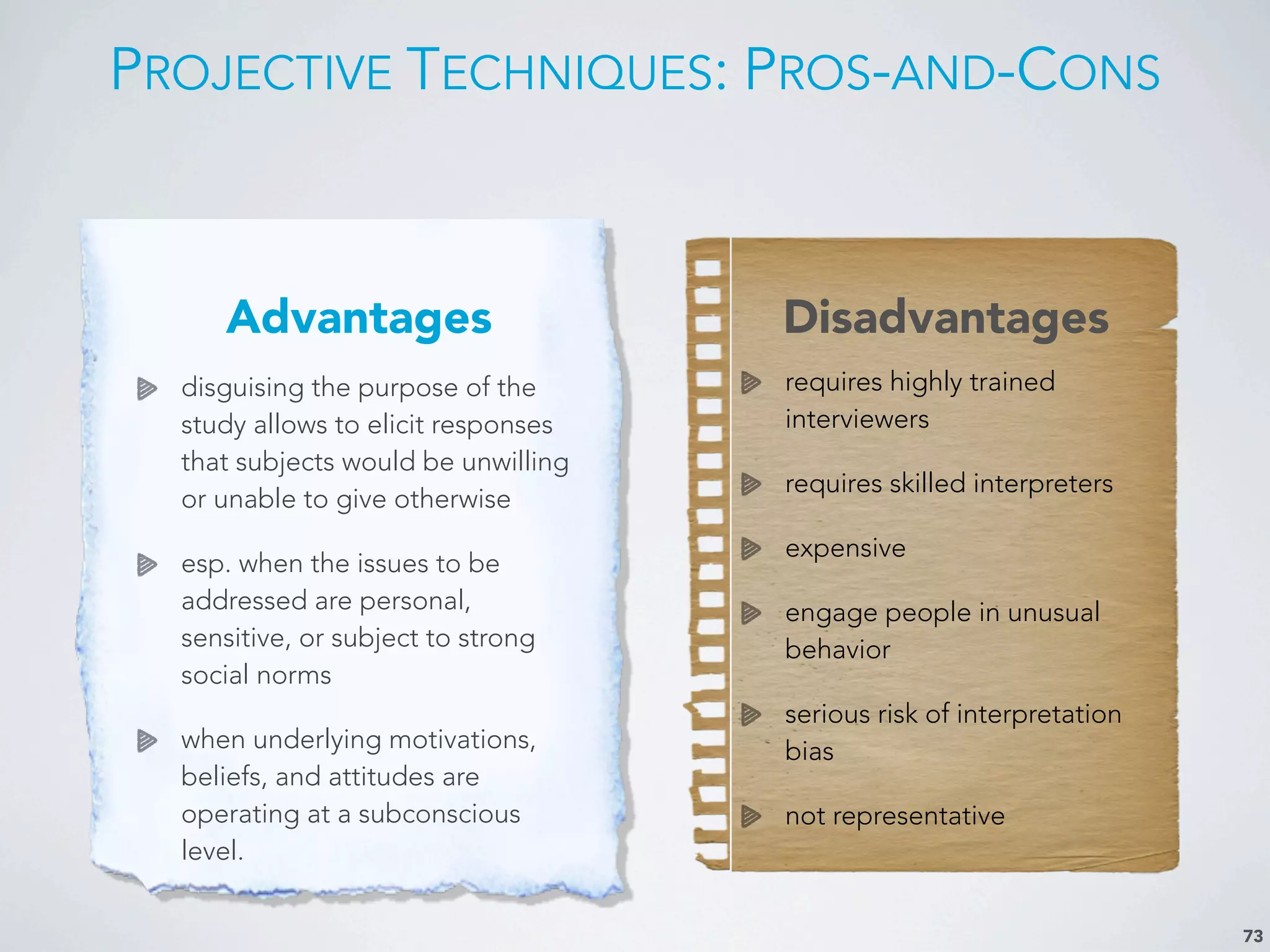
AdvantagesDisadvantages
disguising the purpose of the
study allows to elicit responses
that subjects would be unwilling
or unable to give otherwise
esp. when the issues to be
addressed are personal,
sensitive, or subject to strong
social norms
when underlying motivations,
beliefs, and attitudes are
operating at a subconscious
level.
requires highly trained
interviewers
requires skilled interpreters
expensive
engage people in unusual
behavior
serious risk of interpretation
bias
not representative
COMPARISON OF QUALITATIVETECHNIQUES
75
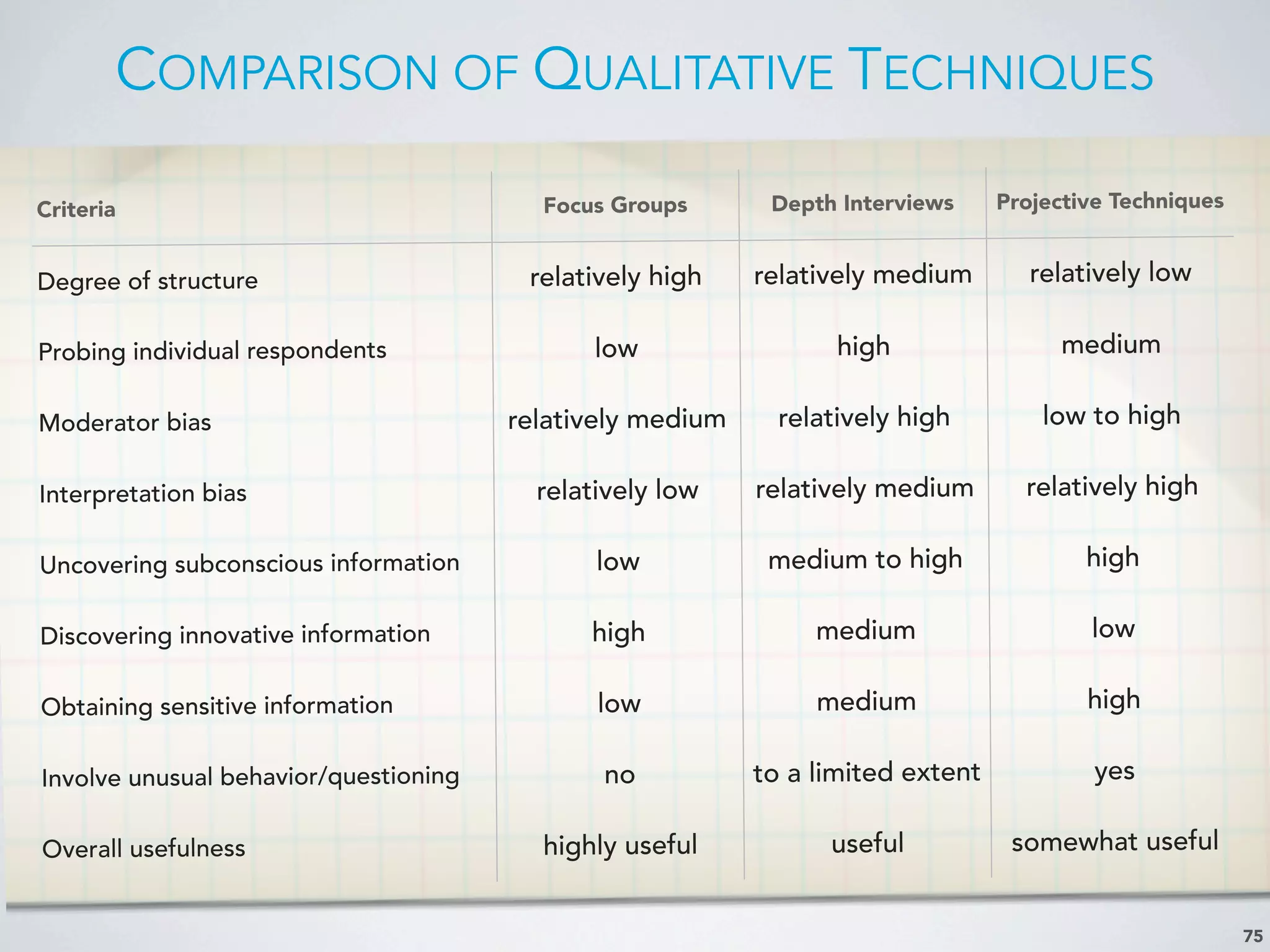
Criteria Focus Groups Depth Interviews Projective Techniques
Degree of structure relatively high relatively medium relatively low
Probing individual respondents low high medium
Moderator bias relatively medium relatively high low to high
Interpretation bias relatively low relatively medium relatively high
Uncovering subconscious information low medium to high high
Discovering innovative information high medium low
Obtaining sensitive information low medium high
Involve unusual behavior/questioning no to a limited extent yes
Overall usefulness highly useful useful somewhat useful
OBSERVATION METHODS
77
observation inartificial/
experimental environment,
such as a test kitchen
respondents are aware that
they are under observation
e.g., eye-tracker, voice pitch
analysis, psychogalvanometer
observing behavior as it takes
place in the natural
environment
respondents unaware of being
observed
e.g., one-way mirrors, hidden
cameras, mystery shoppers
Structured
Disguised
researcher specifies in detail
what is to be observed and how
e.g. auditor performing
inventory analysis in the store
Natural
Undisguised
Contrived
monitor all aspects of the
phenomenon that seem
relevant for the problem
children playing with new toys
Unstructured
vs
vs
vs
Observation involves recording the behavioral patterns of people,
objects, and events in a systematic manner to obtain information
about phenomenon of interest
The observer does not question or communicate with the people
being observed
78.
OBSERVATION BY MODEOF ADMINISTRATION
78
Personal
observation
observe actual behavior as it occurs
e.g., record traffic counts, observe traffic flows in a store
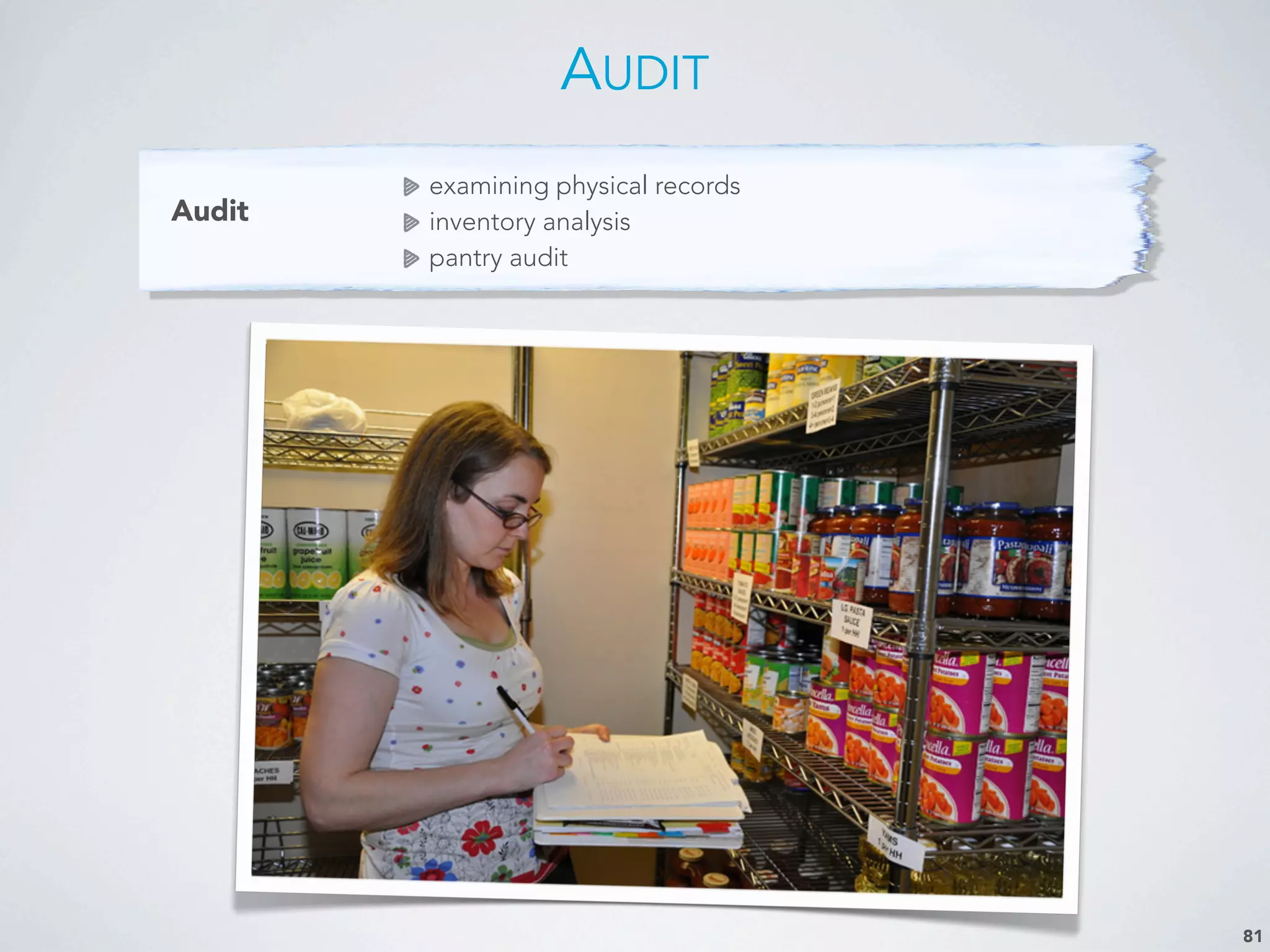
Audit
examining physical records
inventory analysis
pantry audit
Mechanical
observation
mechanical devices perform observation and recording
e.g., people meter, traffic counters, cameras, UPC scanners,
eye-tracking, voice pitch analyzer, GSR, response latency
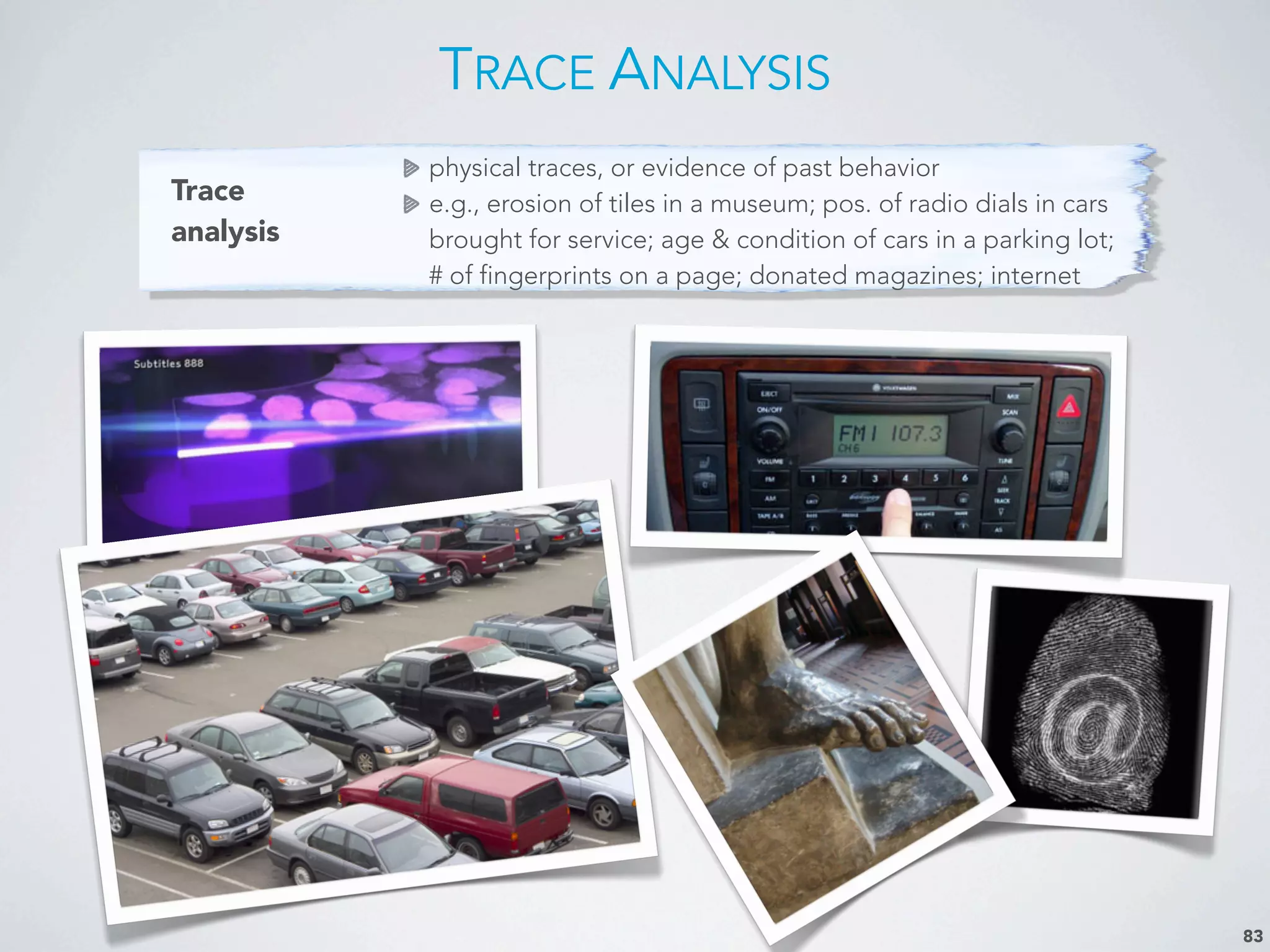
Trace
analysis
physical traces, or evidence of past behavior
e.g., erosion of tiles in a museum; pos. of radio dials in cars
brought for service; age & condition of cars in a parking lot;
# of fingerprints on a page; donated magazines; internet
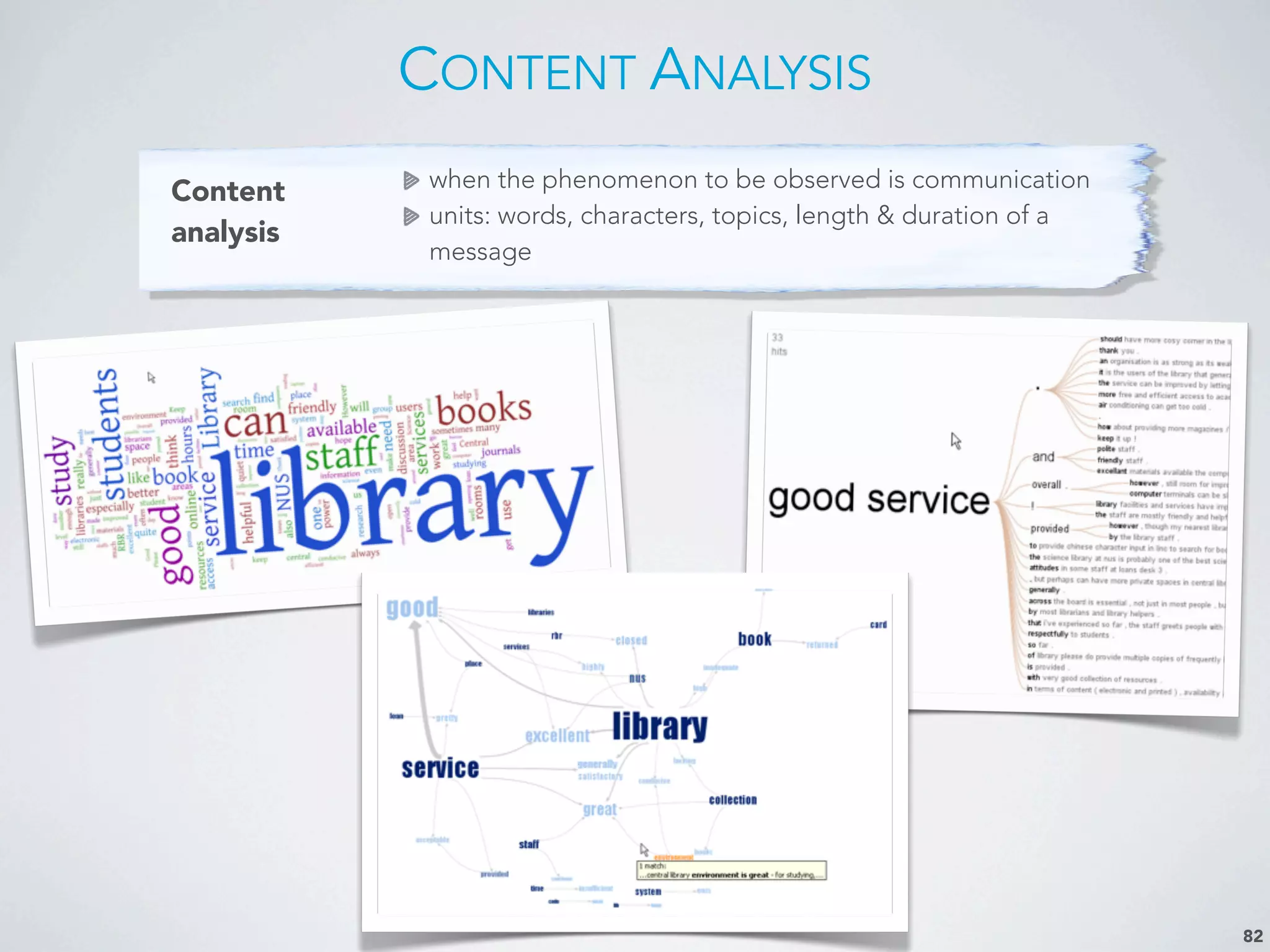
Content
analysis
when the phenomenon to be observed is communication
units: words, characters, topics, length & duration of a
message
ObservationMethods
Content
analysis
when the phenomenonto be observed is communication
units: words, characters, topics, length & duration of a
message
CONTENT ANALYSIS
82
83.
Trace
analysis
physical traces, orevidence of past behavior
e.g., erosion of tiles in a museum; pos. of radio dials in cars
brought for service; age & condition of cars in a parking lot;
# of fingerprints on a page; donated magazines; internet
TRACE ANALYSIS
83
84.
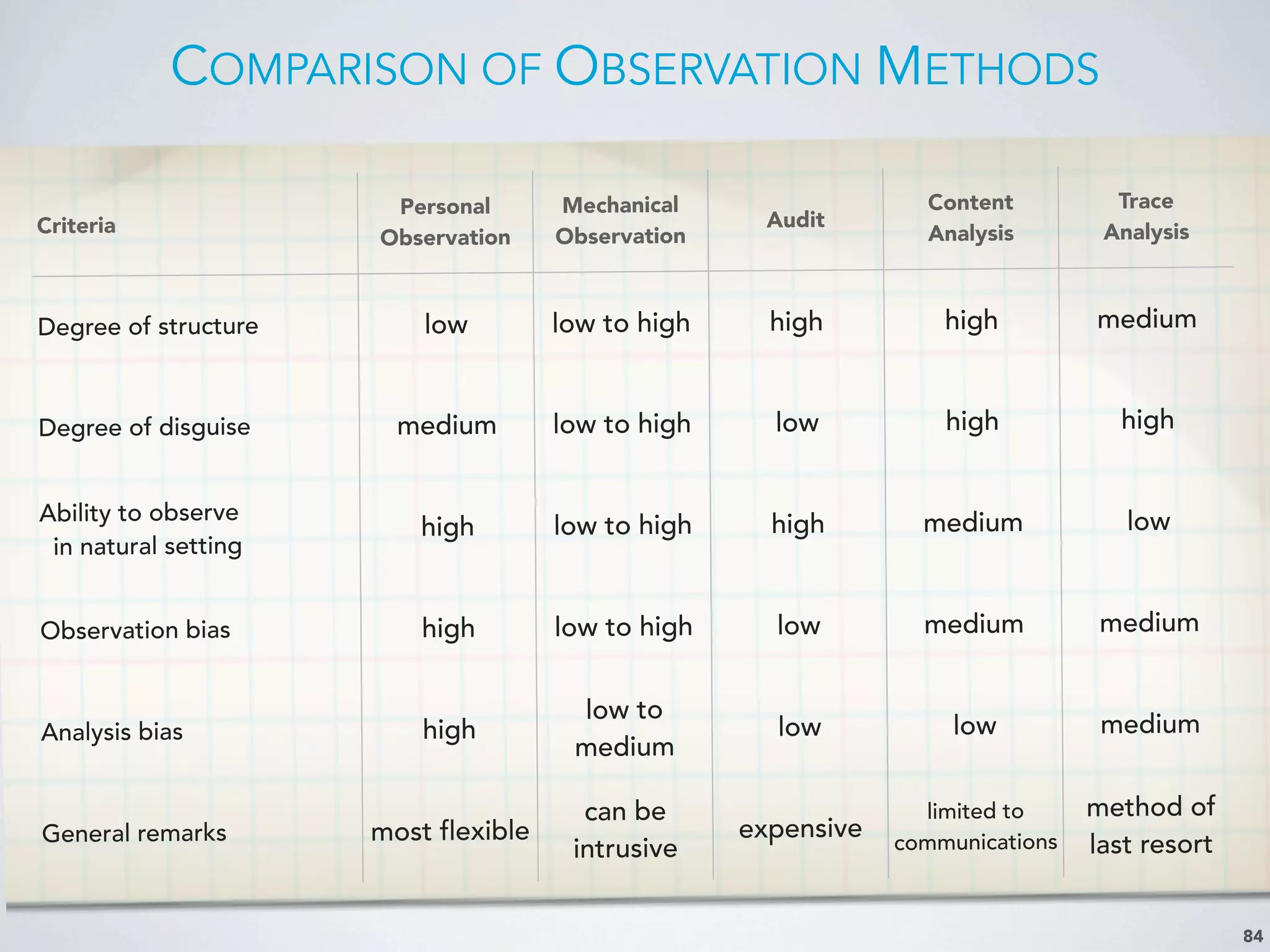
COMPARISON OF OBSERVATIONMETHODS
84
Criteria
Personal
Observation
Mechanical
Observation
Audit
Content
Analysis
Trace
Analysis
Degree of structure low low to high high high medium
Degree of disguise medium low to high low high high
Ability to observe
in natural setting
high low to high high medium low
Observation bias high low to high low medium medium
Analysis bias high
low to
medium
low low medium
General remarks most flexible
can be
intrusive
expensive
limited to
communications
method of
last resort
85.
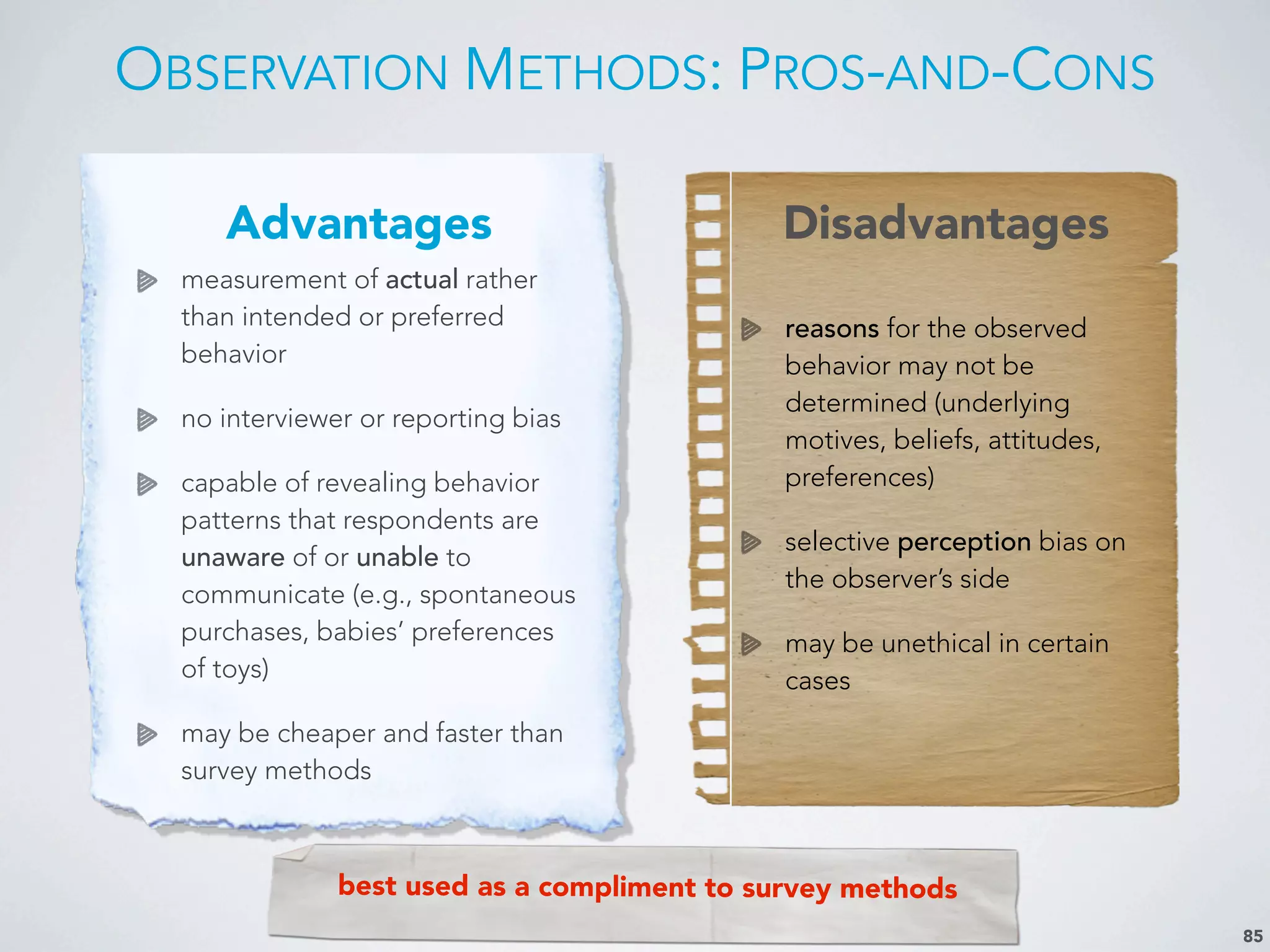
OBSERVATION METHODS: PROS-AND-CONS
85
AdvantagesDisadvantages
measurement of actual rather
than intended or preferred
behavior
no interviewer or reporting bias
capable of revealing behavior
patterns that respondents are
unaware of or unable to
communicate (e.g., spontaneous
purchases, babies’ preferences
of toys)
may be cheaper and faster than
survey methods
reasons for the observed
behavior may not be
determined (underlying
motives, beliefs, attitudes,
preferences)
selective perception bias on
the observer’s side
may be unethical in certain
cases
best used as a compliment to survey methods
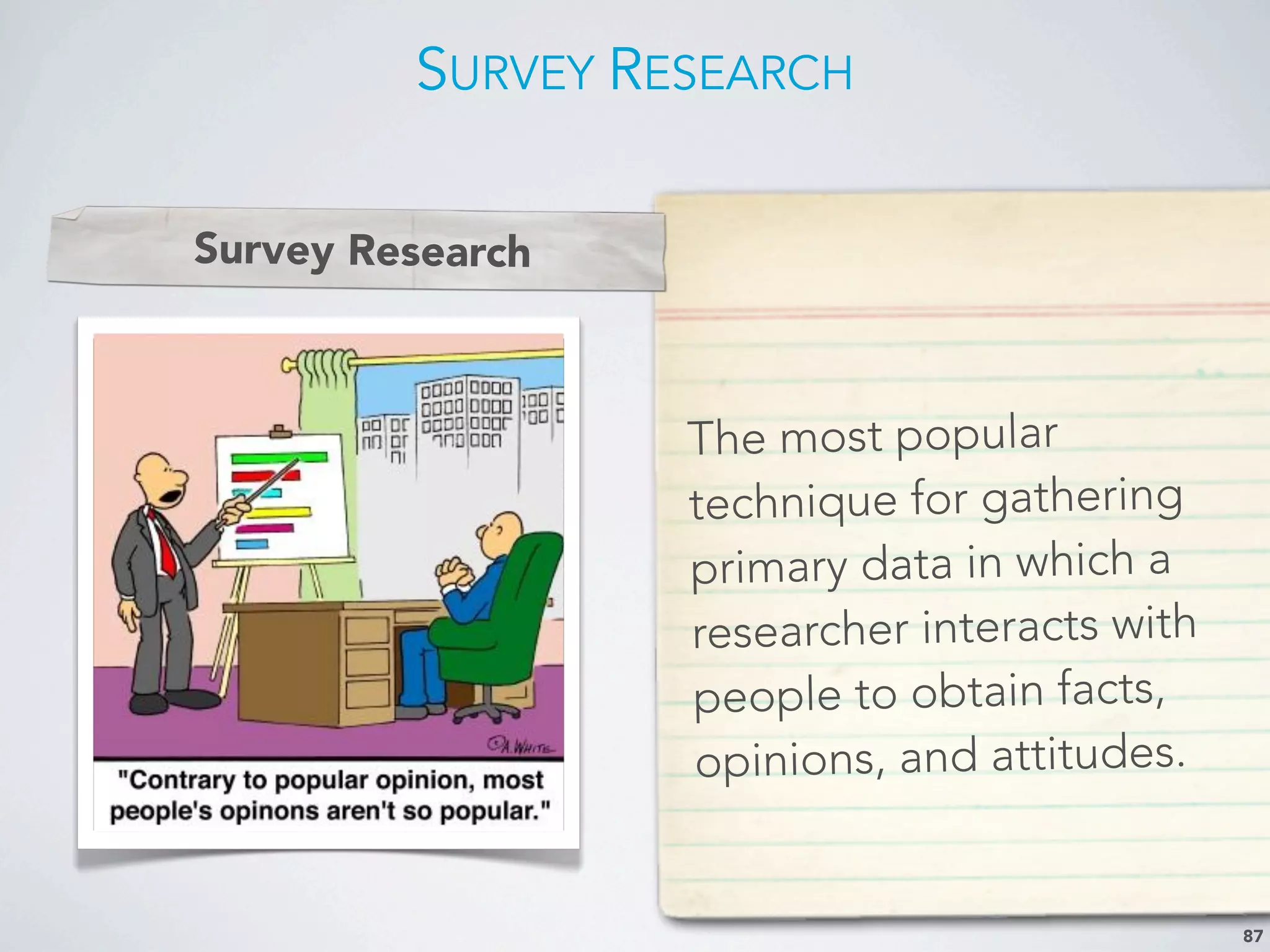
SURVEY RESEARCH
87
Improve qualityof
decision making
Trace Problems
Focus on keeping
existing customers
Understand changes
in marketplace
The most popular
technique for gathering
primary data in which a
researcher interacts with
people to obtain facts,
opinions, and attitudes.
Survey Research
MEASUREMENT
90
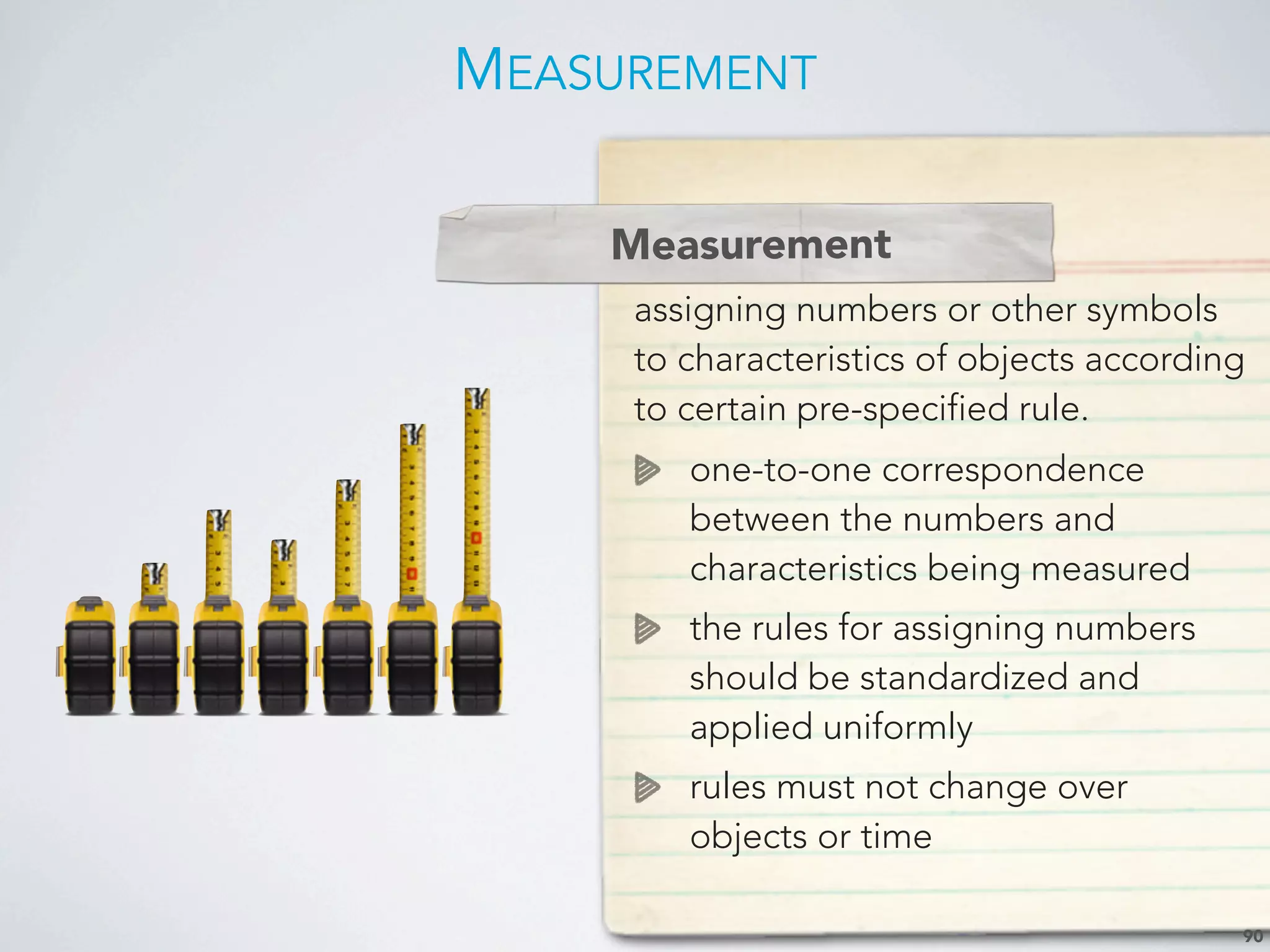
Measurement
assigning numbers orother symbols
to characteristics of objects according
to certain pre-specified rule.
one-to-one correspondence
between the numbers and
characteristics being measured
the rules for assigning numbers
should be standardized and
applied uniformly
rules must not change over
objects or time
Measurement
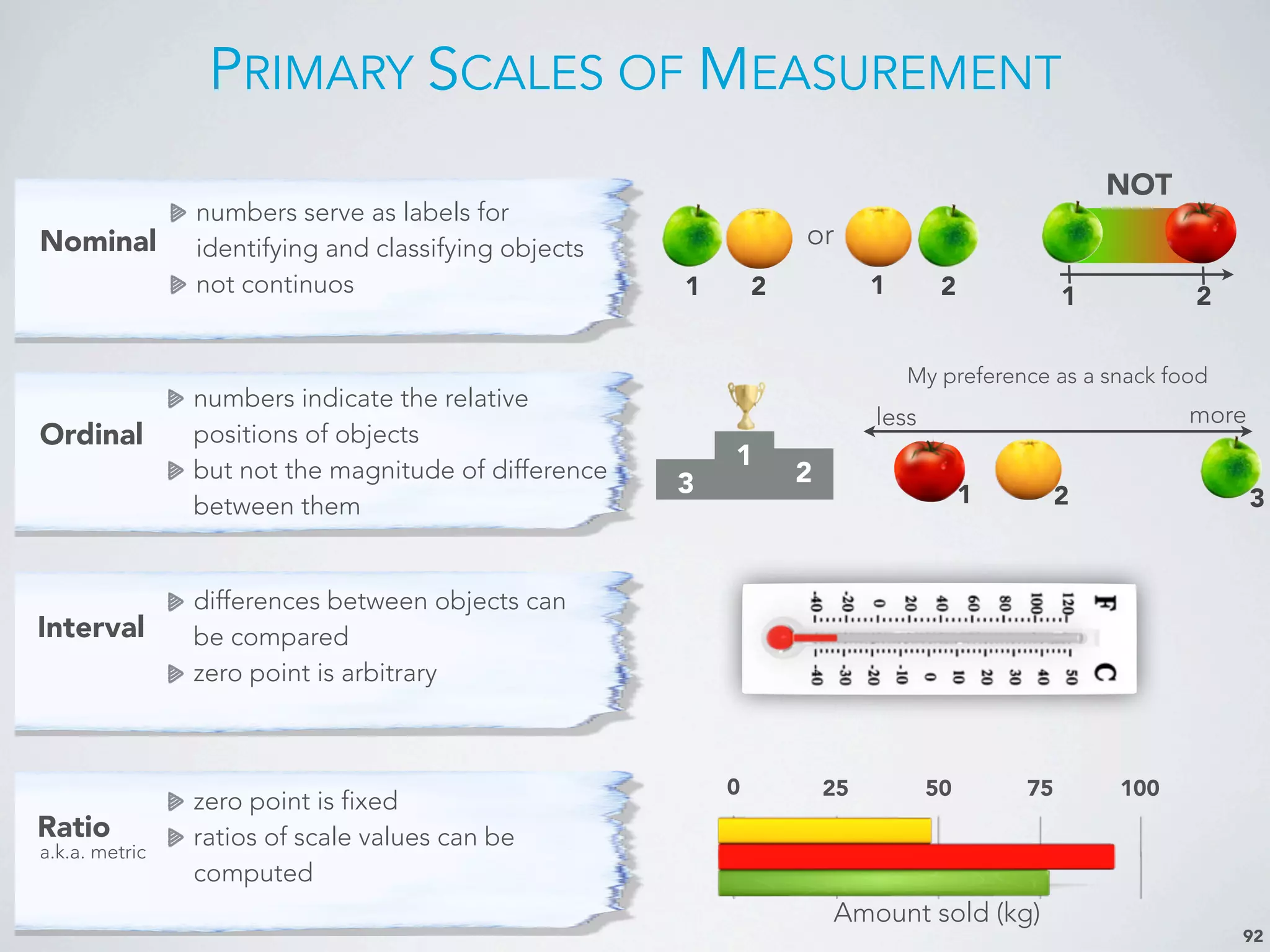
PRIMARY SCALES OFMEASUREMENT
92
differences between objects can
be compared
zero point is arbitrary
numbers indicate the relative
positions of objects
but not the magnitude of difference
between them
Ordinal
Interval
numbers serve as labels for
identifying and classifying objects
not continuos
Nominal
zero point is fixed
ratios of scale values can be
computed
Ratio
NOT
1 2
or
1 2 1 2
3
1
2
My preference as a snack food
less more
0 25 50 75 100
Amount sold (kg)
1 2 3
a.k.a. metric
93.
PRIMARY SCALES OFMEASUREMENT
93
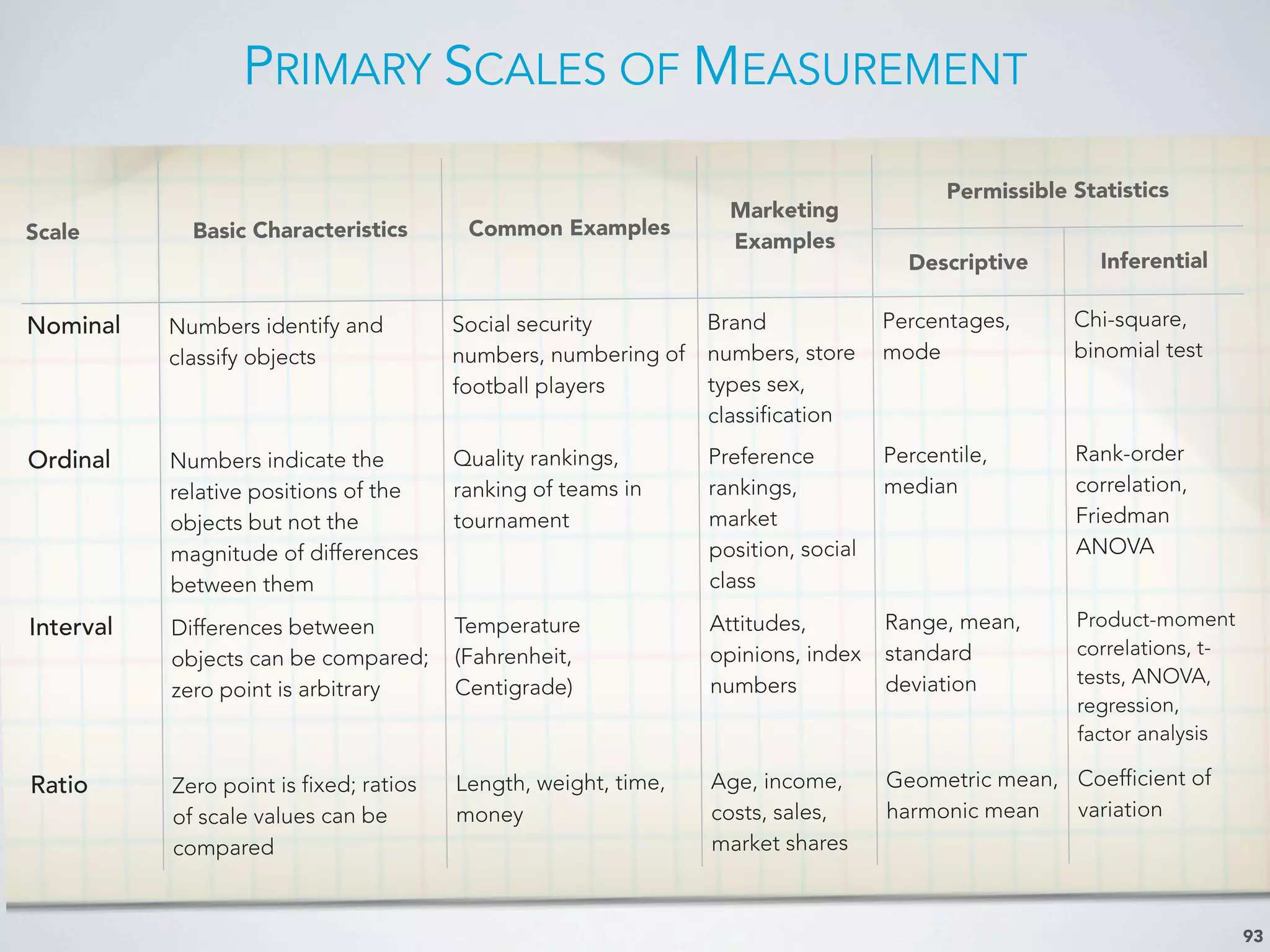
Scale Basic Characteristics Common Examples
Marketing
Examples
Permissible StatisticsPermissible Statistics
Scale Basic Characteristics Common Examples
Marketing
Examples
Descriptive Inferential
Nominal Numbers identify and
classify objects
Social security
numbers, numbering of
football players
Brand
numbers, store
types sex,
classification
Percentages,
mode
Chi-square,
binomial test
Ordinal Numbers indicate the
relative positions of the
objects but not the
magnitude of differences
between them
Quality rankings,
ranking of teams in
tournament
Preference
rankings,
market
position, social
class
Percentile,
median
Rank-order
correlation,
Friedman
ANOVA
Interval Differences between
objects can be compared;
zero point is arbitrary
Temperature
(Fahrenheit,
Centigrade)
Attitudes,
opinions, index
numbers
Range, mean,
standard
deviation
Product-moment
correlations, t-
tests, ANOVA,
regression,
factor analysis
Ratio Zero point is fixed; ratios
of scale values can be
compared
Length, weight, time,
money
Age, income,
costs, sales,
market shares
Geometric mean,
harmonic mean
Coefficient of
variation
94.
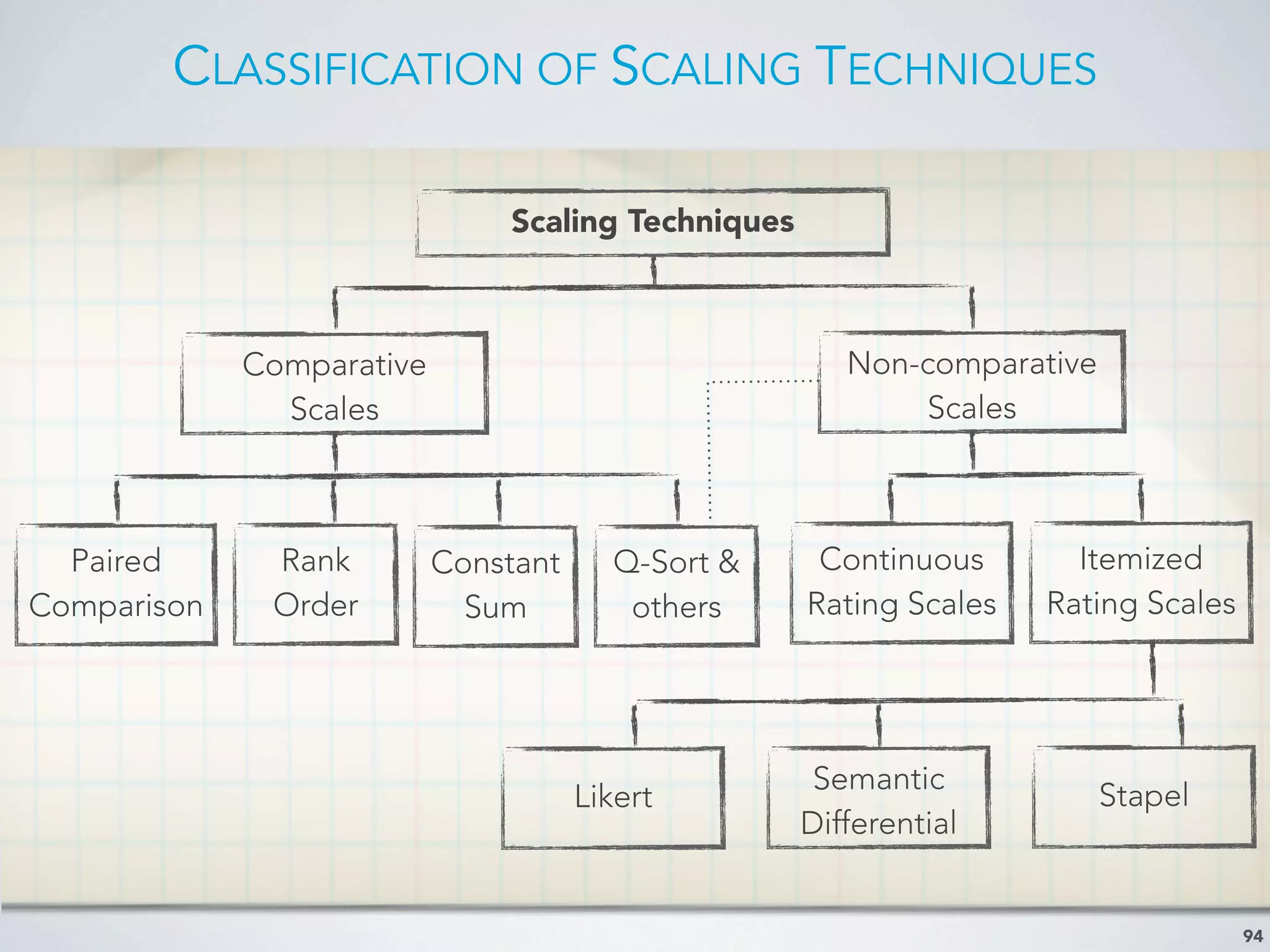
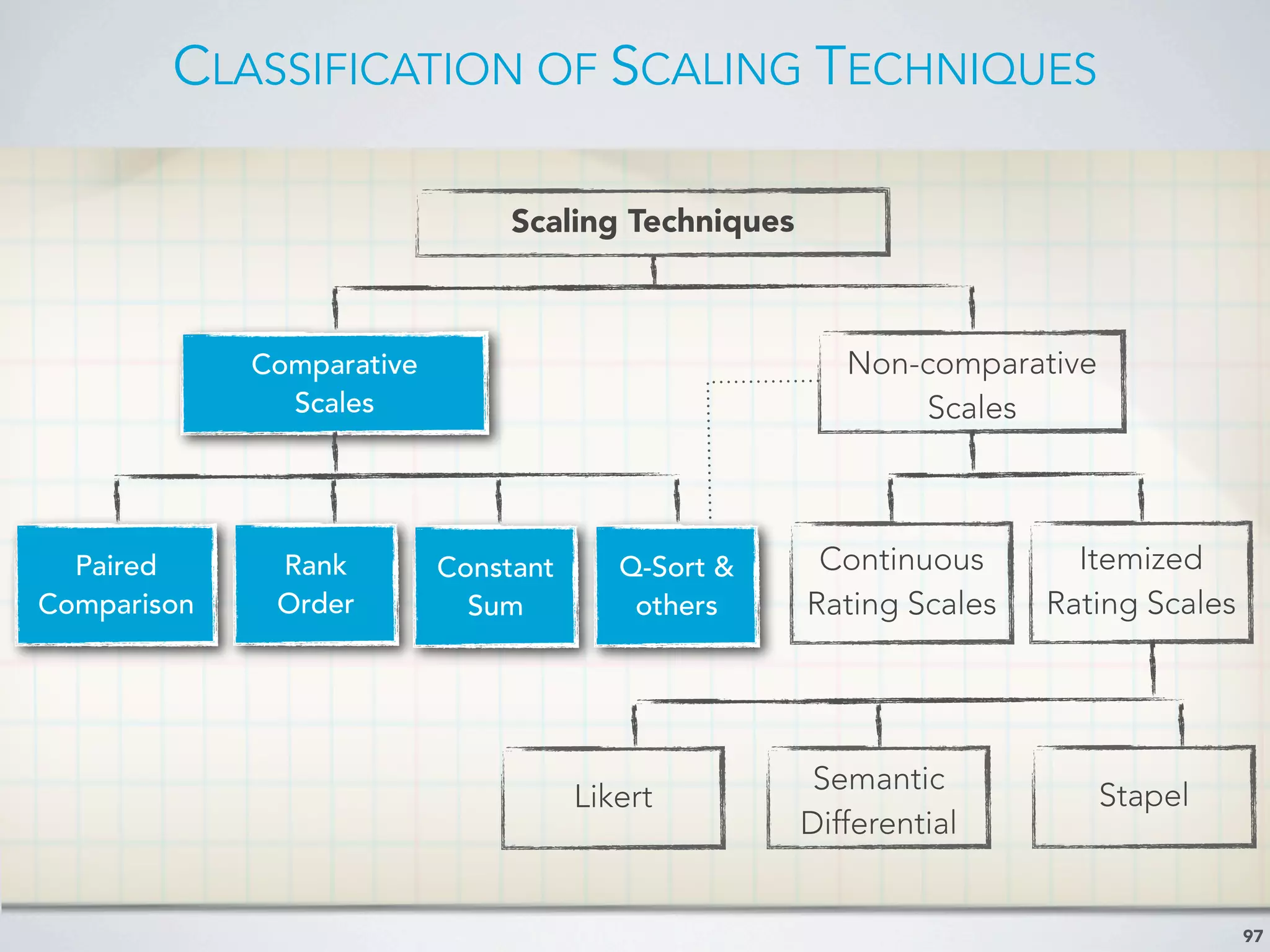
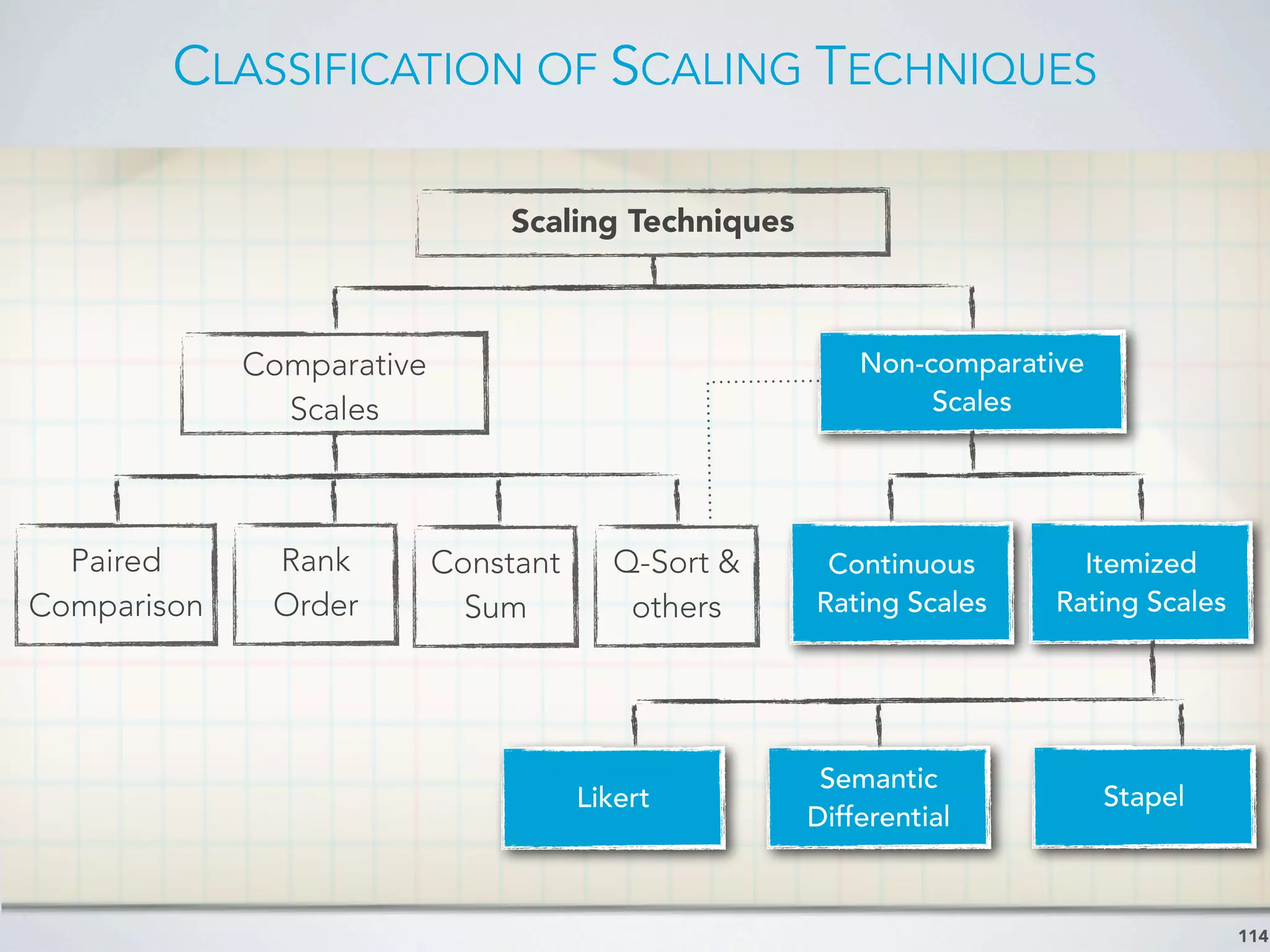
CLASSIFICATION OF SCALINGTECHNIQUES
94
Scaling Techniques
Comparative
Scales
Non-comparative
Scales
Paired
Comparison
Rank
Order
Constant
Sum
Q-Sort &
others
Continuous
Rating Scales
Itemized
Rating Scales
Likert
Semantic
Differential
Stapel
95.
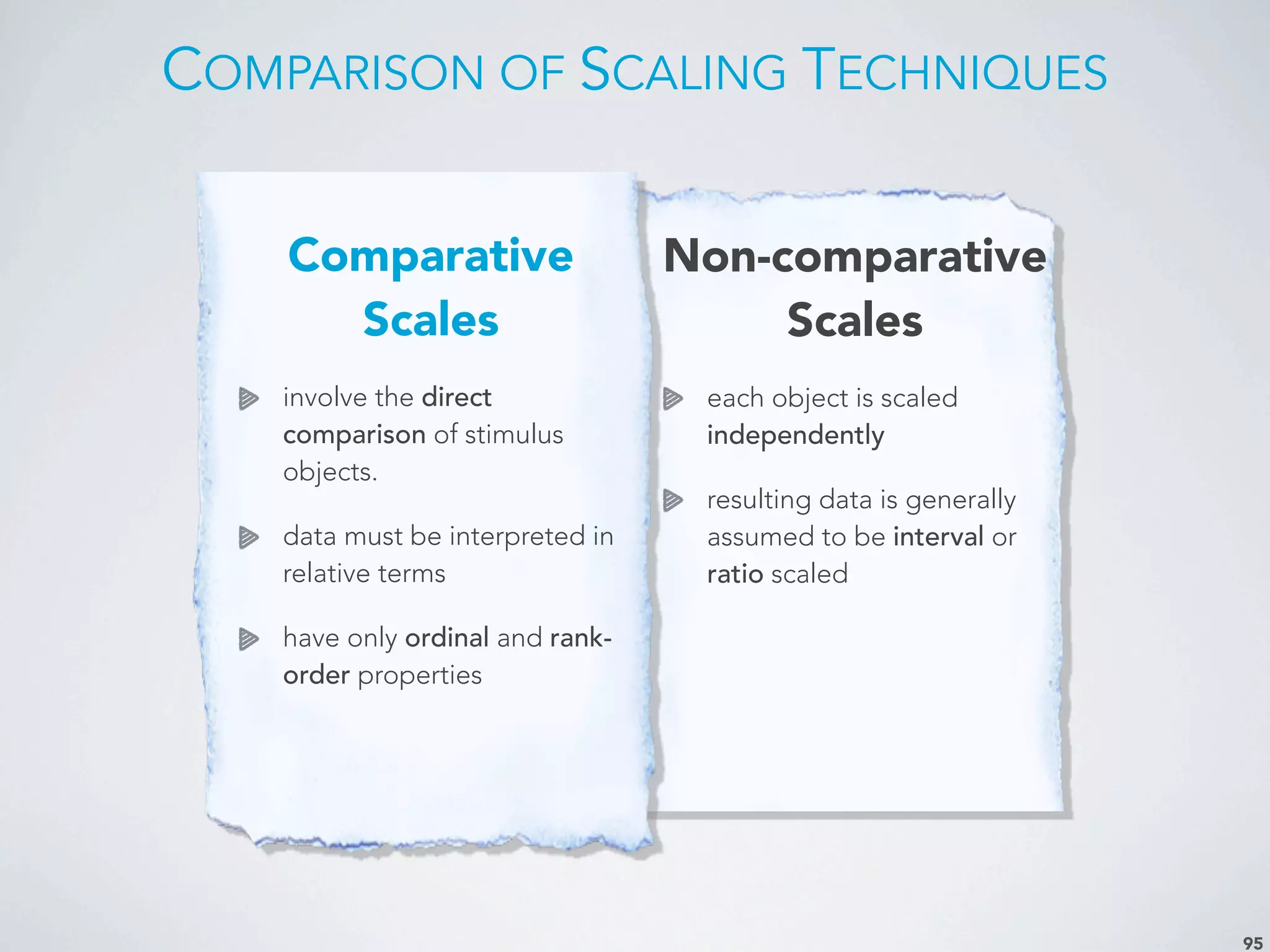
COMPARISON OF SCALINGTECHNIQUES
95
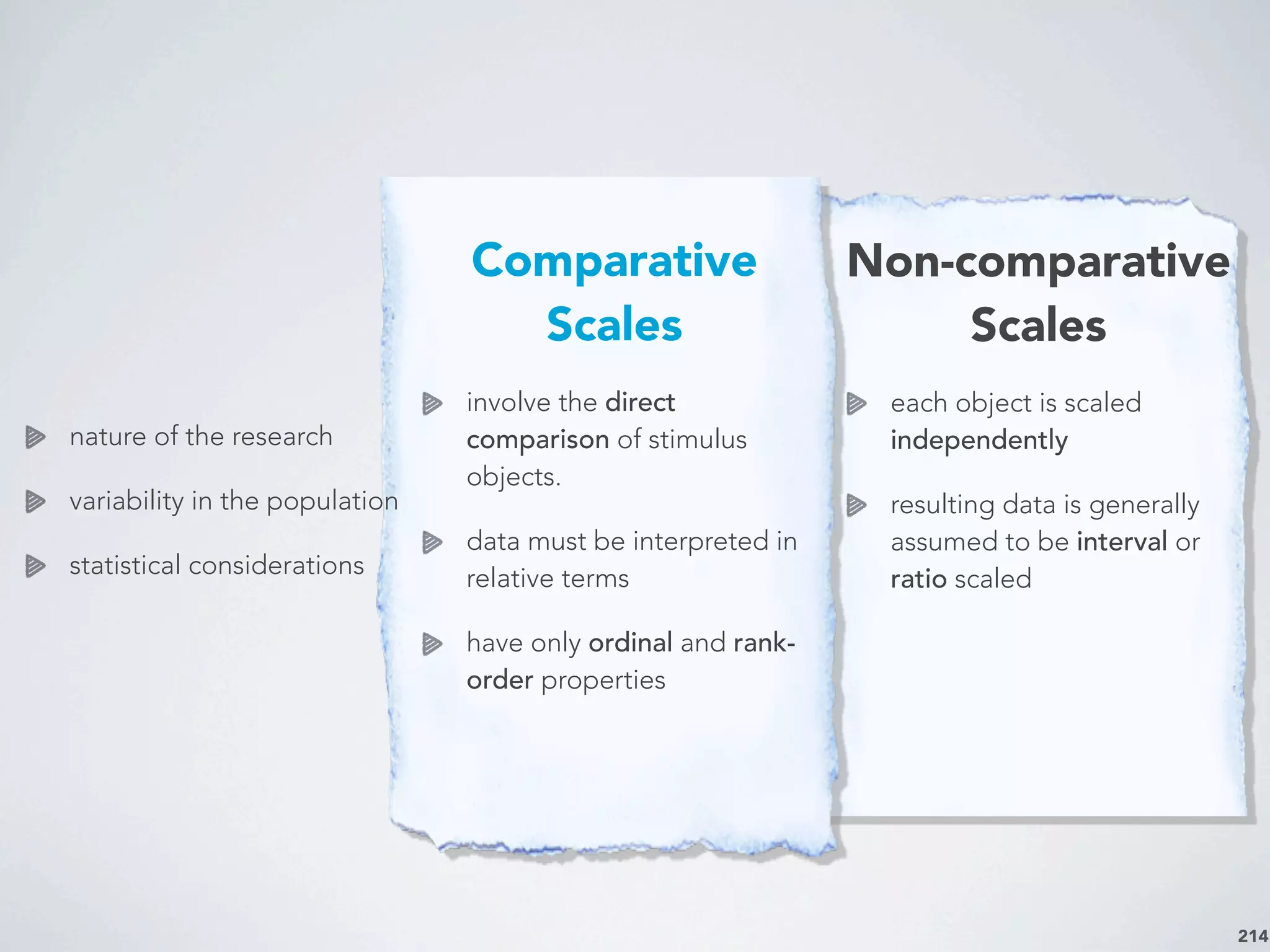
Non-comparative
Scales
each object is scaled
independently
resulting data is generally
assumed to be interval or
ratio scaled
Comparative
Scales
involve the direct
comparison of stimulus
objects.
data must be interpreted in
relative terms
have only ordinal and rank-
order properties
CLASSIFICATION OF SCALINGTECHNIQUES
97
Scaling Techniques
Comparative
Scales
Non-comparative
Scales
Paired
Comparison
Rank
Order
Constant
Sum
Q-Sort &
others
Continuous
Rating Scales
Itemized
Rating Scales
Likert
Semantic
Differential
Stapel
98.
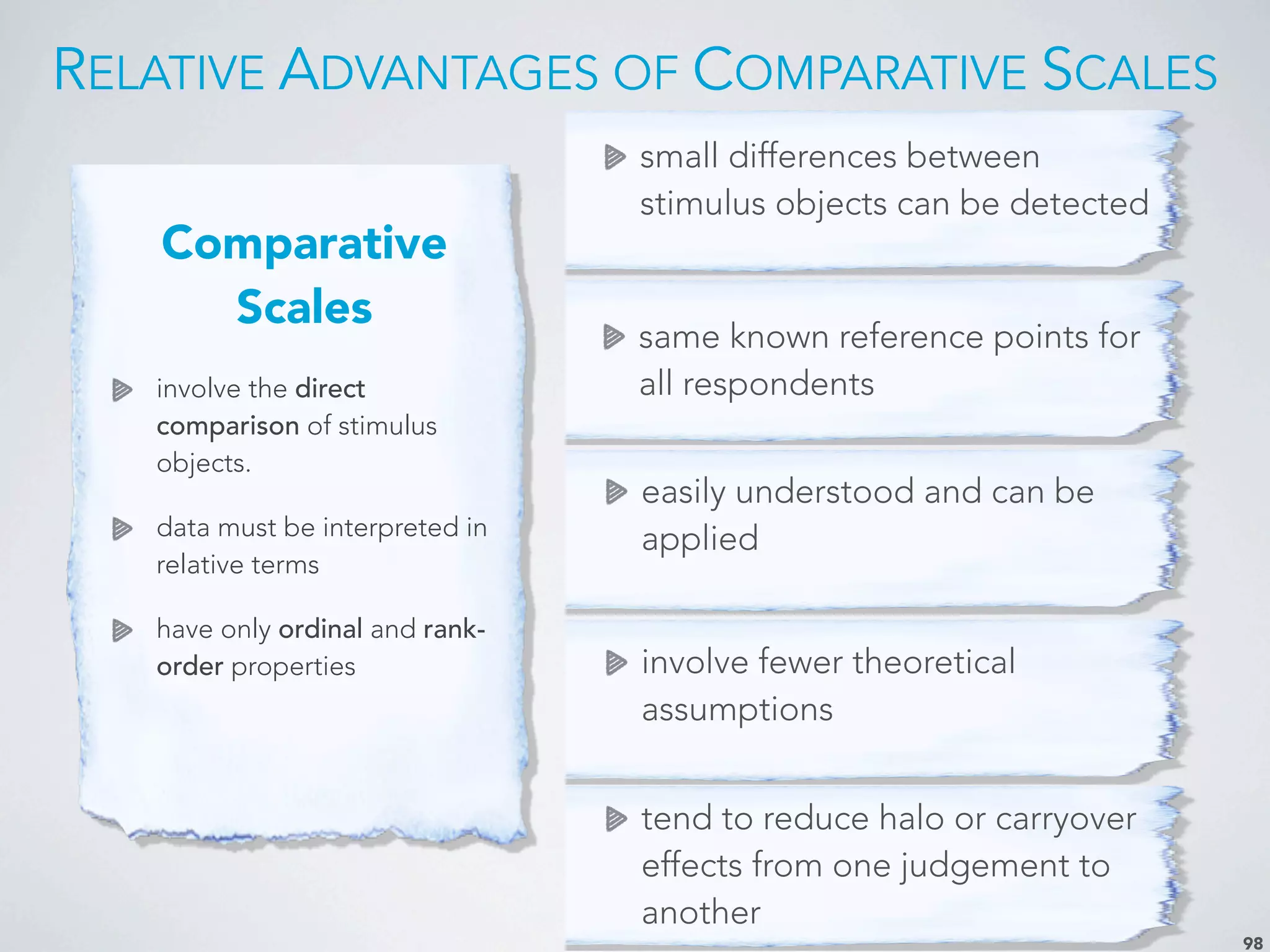
RELATIVE ADVANTAGES OFCOMPARATIVE SCALES
98
same known reference points for
all respondents
easily understood and can be
applied
small differences between
stimulus objects can be detected
involve fewer theoretical
assumptions
tend to reduce halo or carryover
effects from one judgement to
another
Comparative
Scales
involve the direct
comparison of stimulus
objects.
data must be interpreted in
relative terms
have only ordinal and rank-
order properties
99.
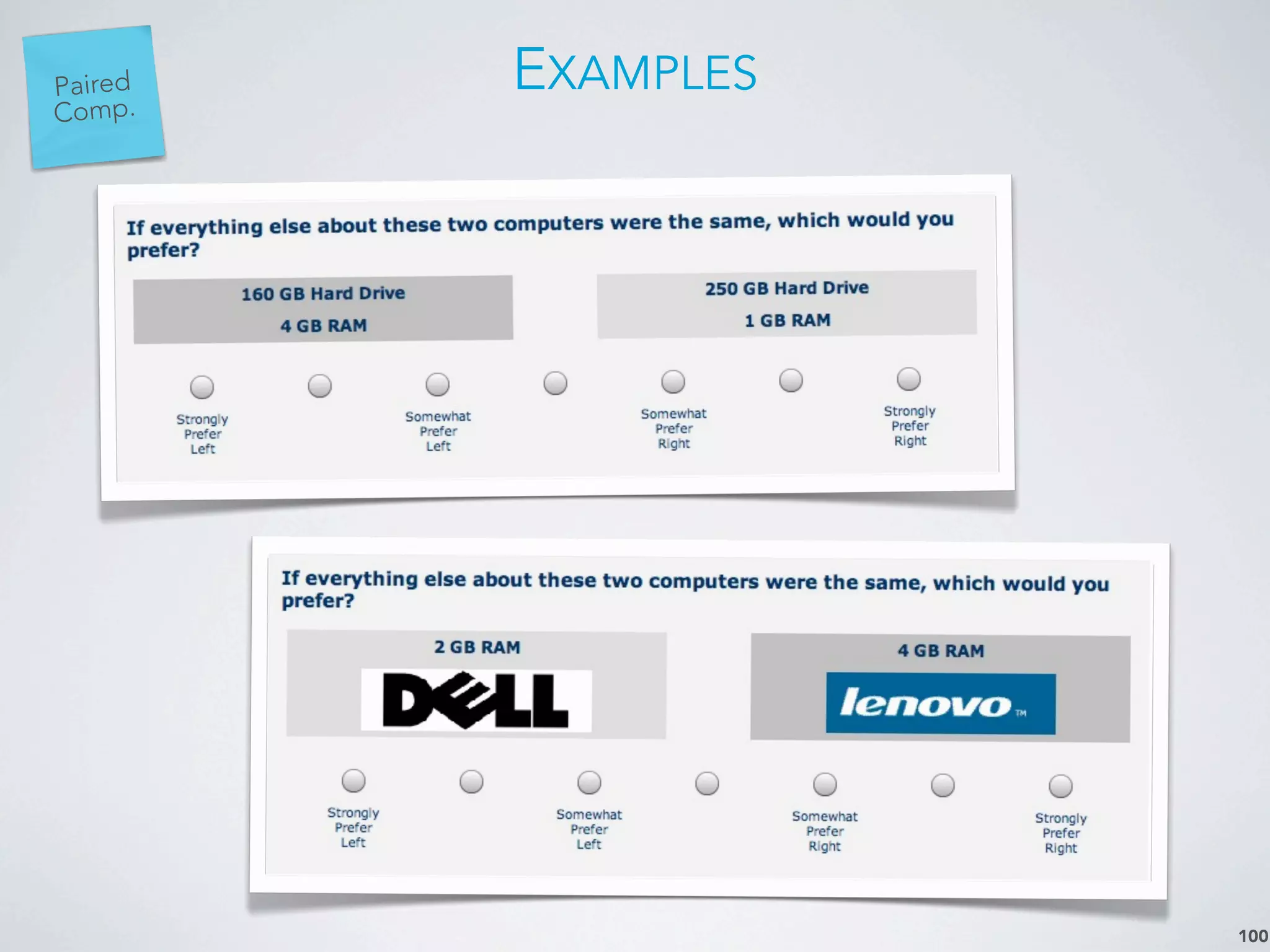
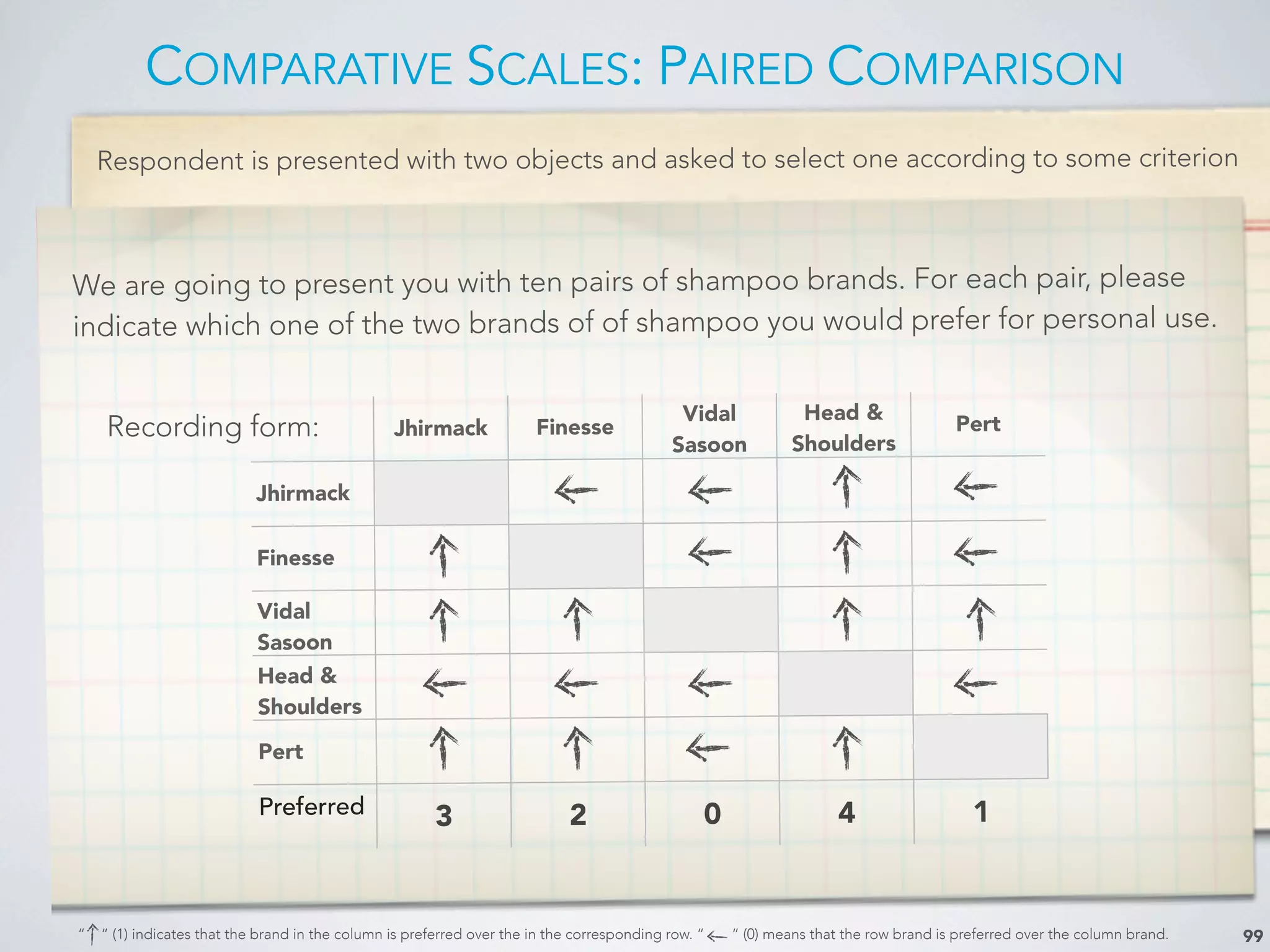
COMPARATIVE SCALES: PAIREDCOMPARISON
99
Jhirmack Finesse
Vidal
Sasoon
Head &
Shoulders
Pert
Jhirmack
Finesse
Vidal
Sasoon
Head &
Shoulders
Pert
Preferred 3 2 0 4 1
We are going to present you with ten pairs of shampoo brands. For each pair, please
indicate which one of the two brands of of shampoo you would prefer for personal use.
“ “ (1) indicates that the brand in the column is preferred over the in the corresponding row. “ “ (0) means that the row brand is preferred over the column brand.
Recording form:
Respondent is presented with two objects and asked to select one according to some criterion
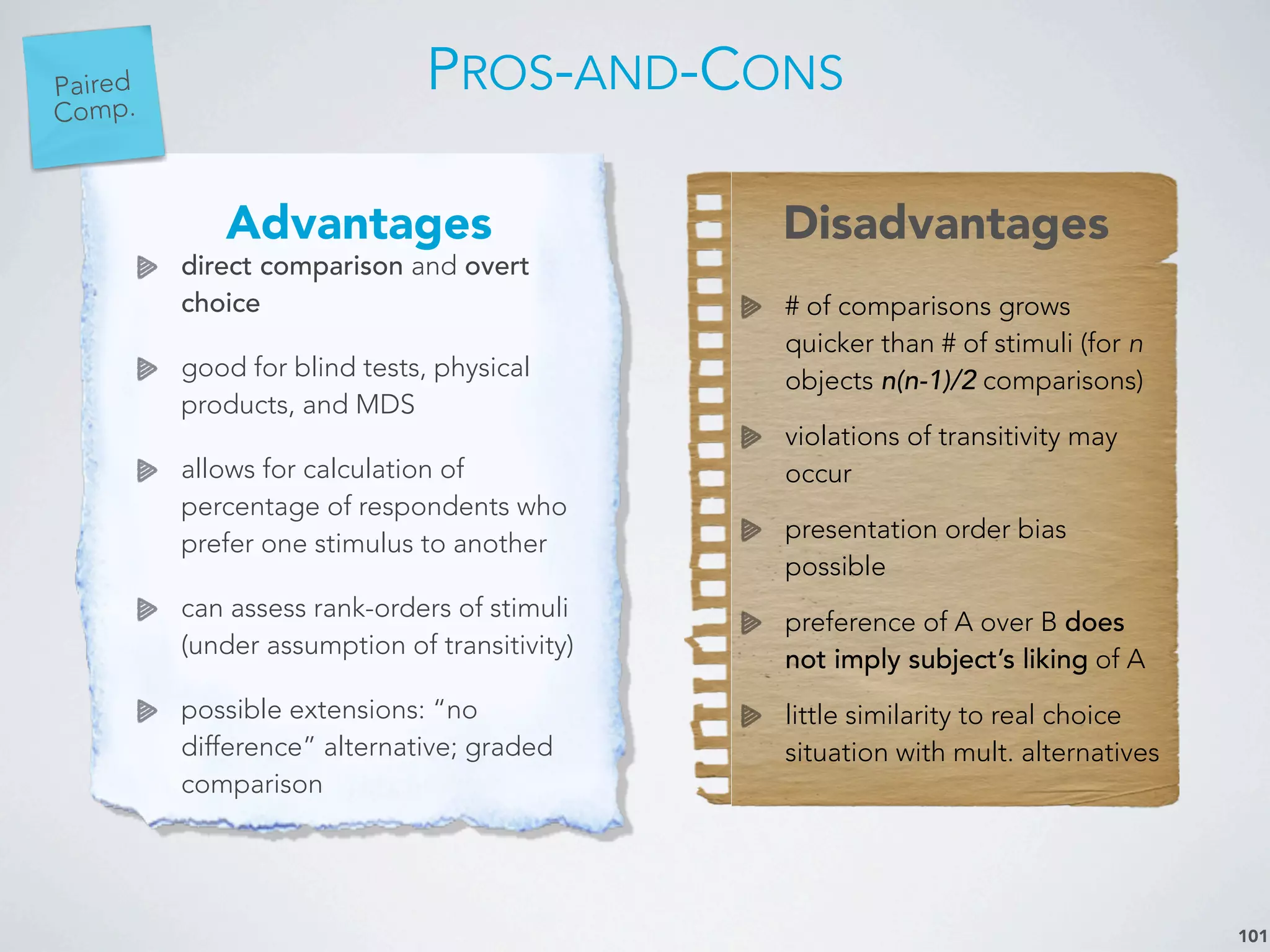
PROS-AND-CONS
101
Advantages Disadvantages
direct comparisonand overt
choice
good for blind tests, physical
products, and MDS
allows for calculation of
percentage of respondents who
prefer one stimulus to another
can assess rank-orders of stimuli
(under assumption of transitivity)
possible extensions: “no
difference” alternative; graded
comparison
# of comparisons grows
quicker than # of stimuli (for n
objects n(n-1)/2 comparisons)
violations of transitivity may
occur
presentation order bias
possible
preference of A over B does
not imply subject’s liking of A
little similarity to real choice
situation with mult. alternatives
Paired
Comp.
102.
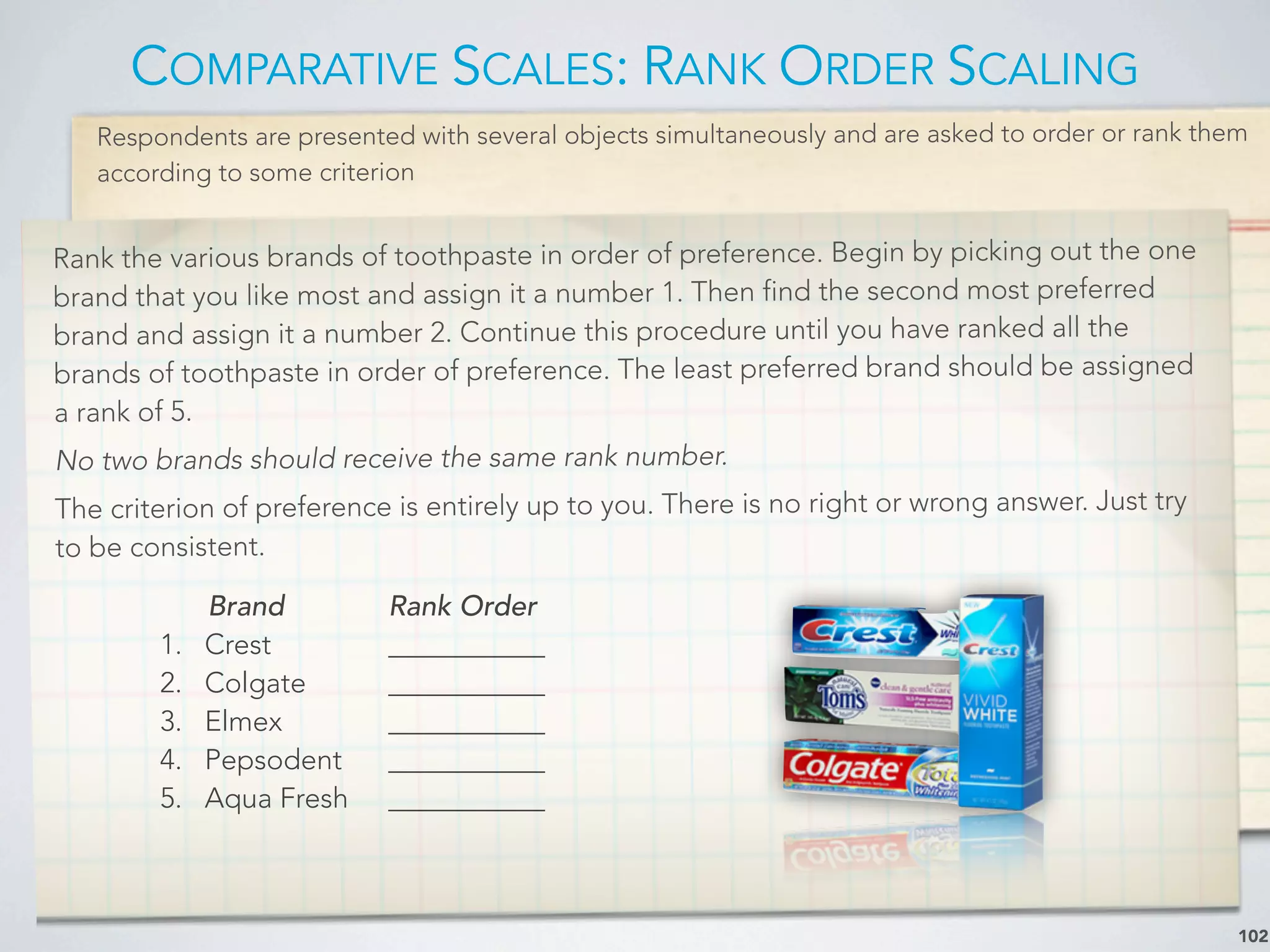
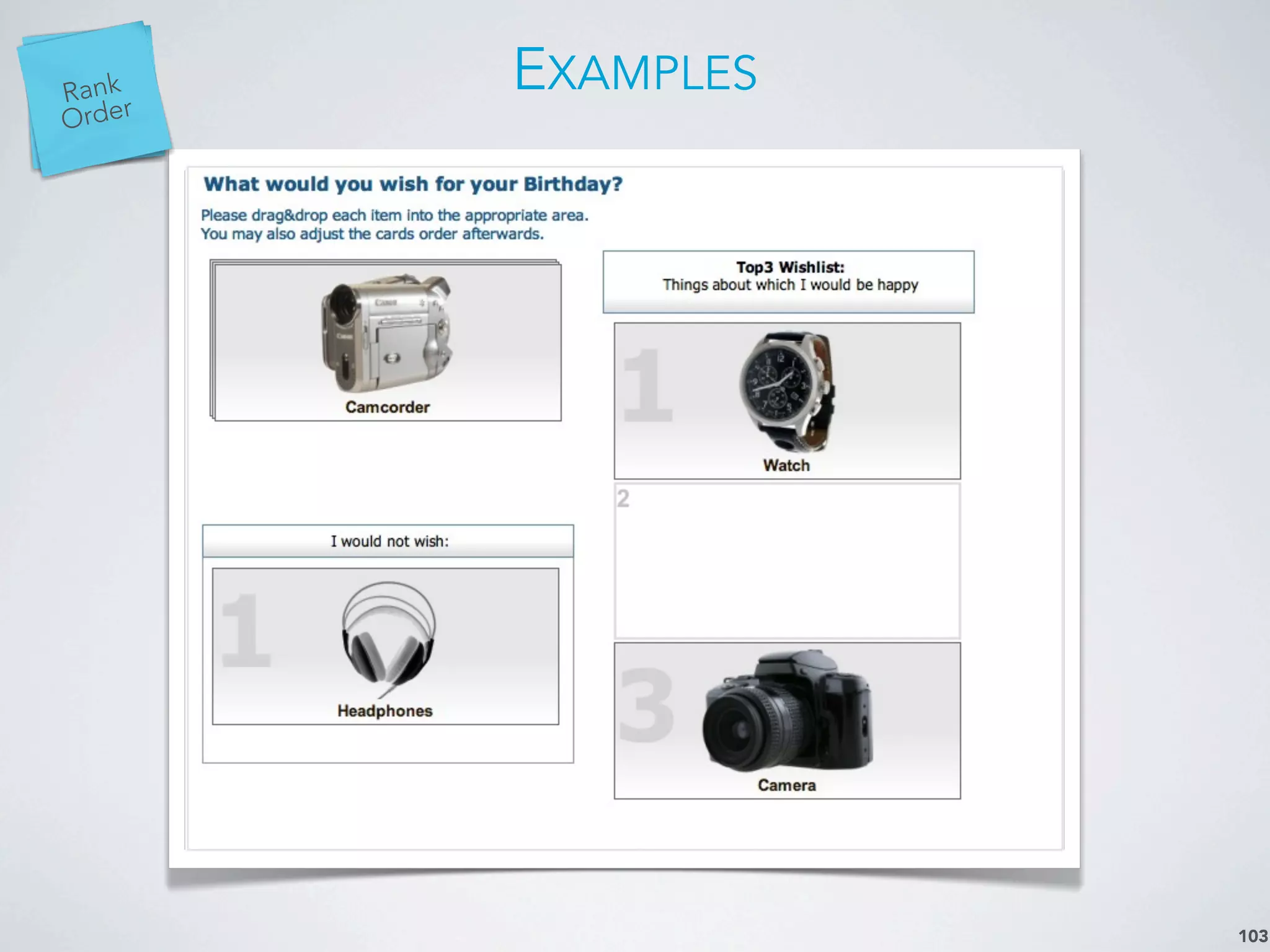
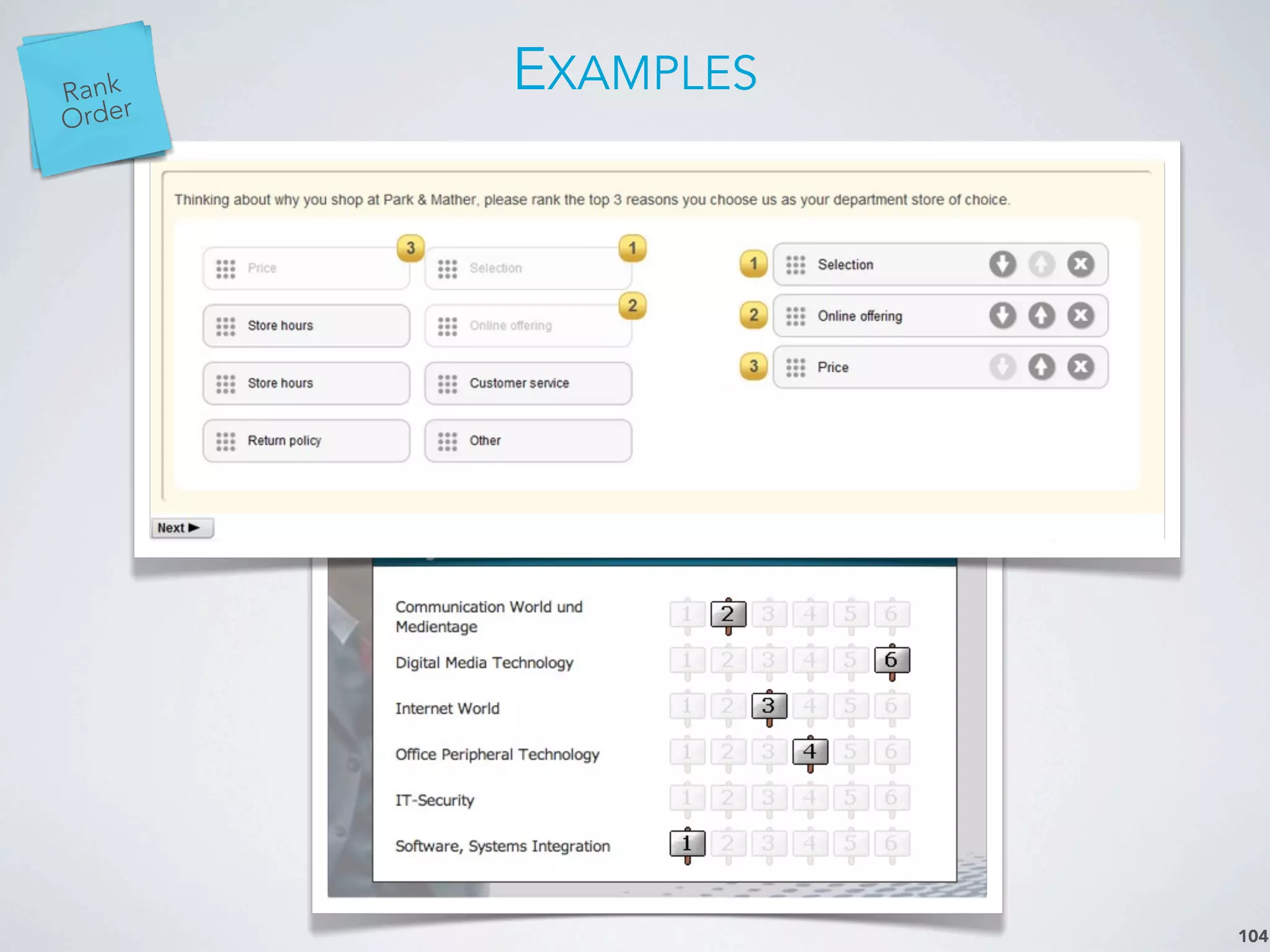
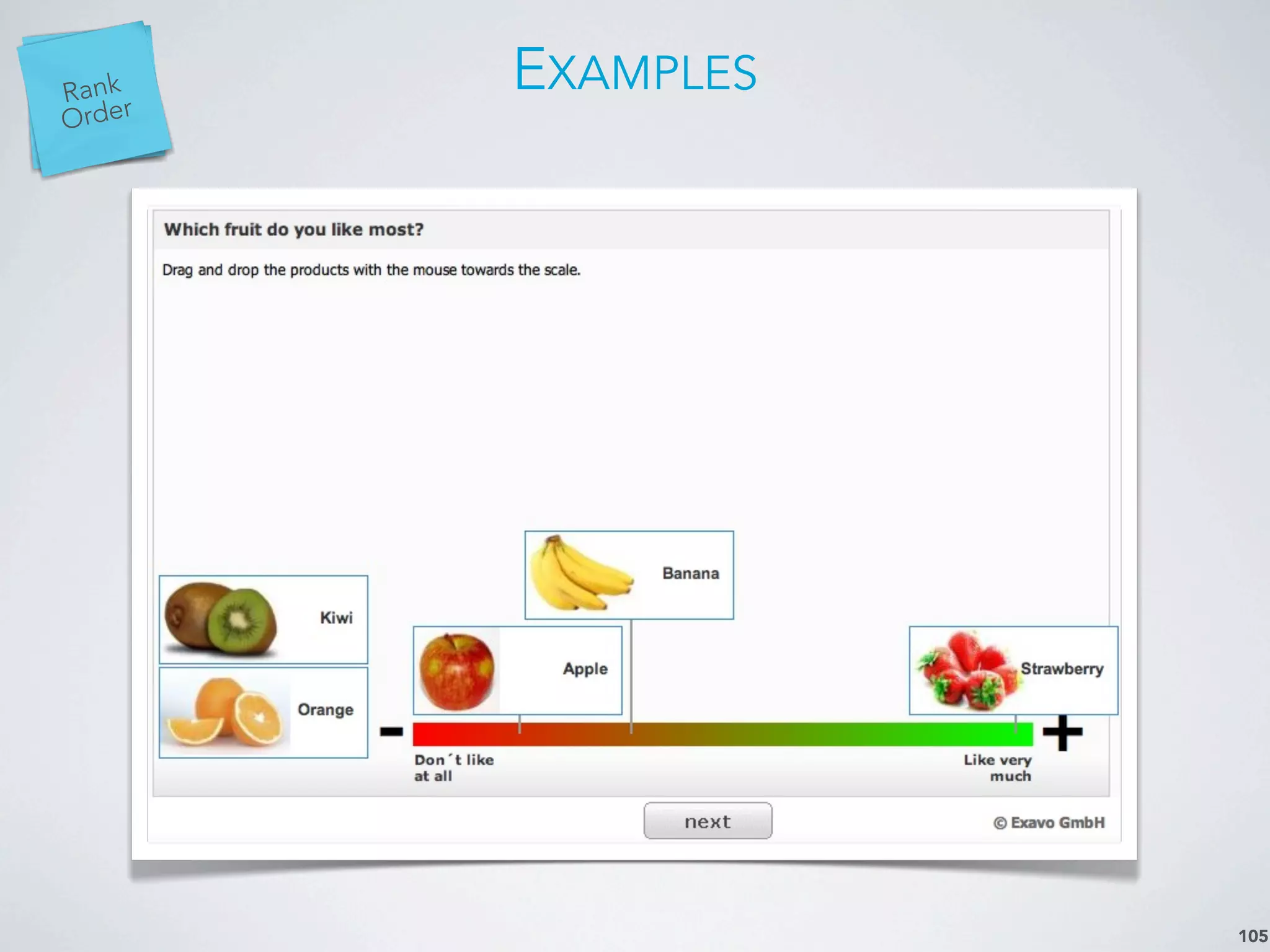
Respondents are presentedwith several objects simultaneously and are asked to order or rank them
according to some criterion
COMPARATIVE SCALES: RANK ORDER SCALING
102
Rank the various brands of toothpaste in order of preference. Begin by picking out the one
brand that you like most and assign it a number 1. Then find the second most preferred
brand and assign it a number 2. Continue this procedure until you have ranked all the
brands of toothpaste in order of preference. The least preferred brand should be assigned
a rank of 5.
No two brands should receive the same rank number.
The criterion of preference is entirely up to you. There is no right or wrong answer. Just try
to be consistent.
Brand Rank Order
1. Crest ___________
2. Colgate ___________
3. Elmex ___________
4. Pepsodent ___________
5. Aqua Fresh ___________
PROS-AND-CONS
106
Advantages Disadvantages
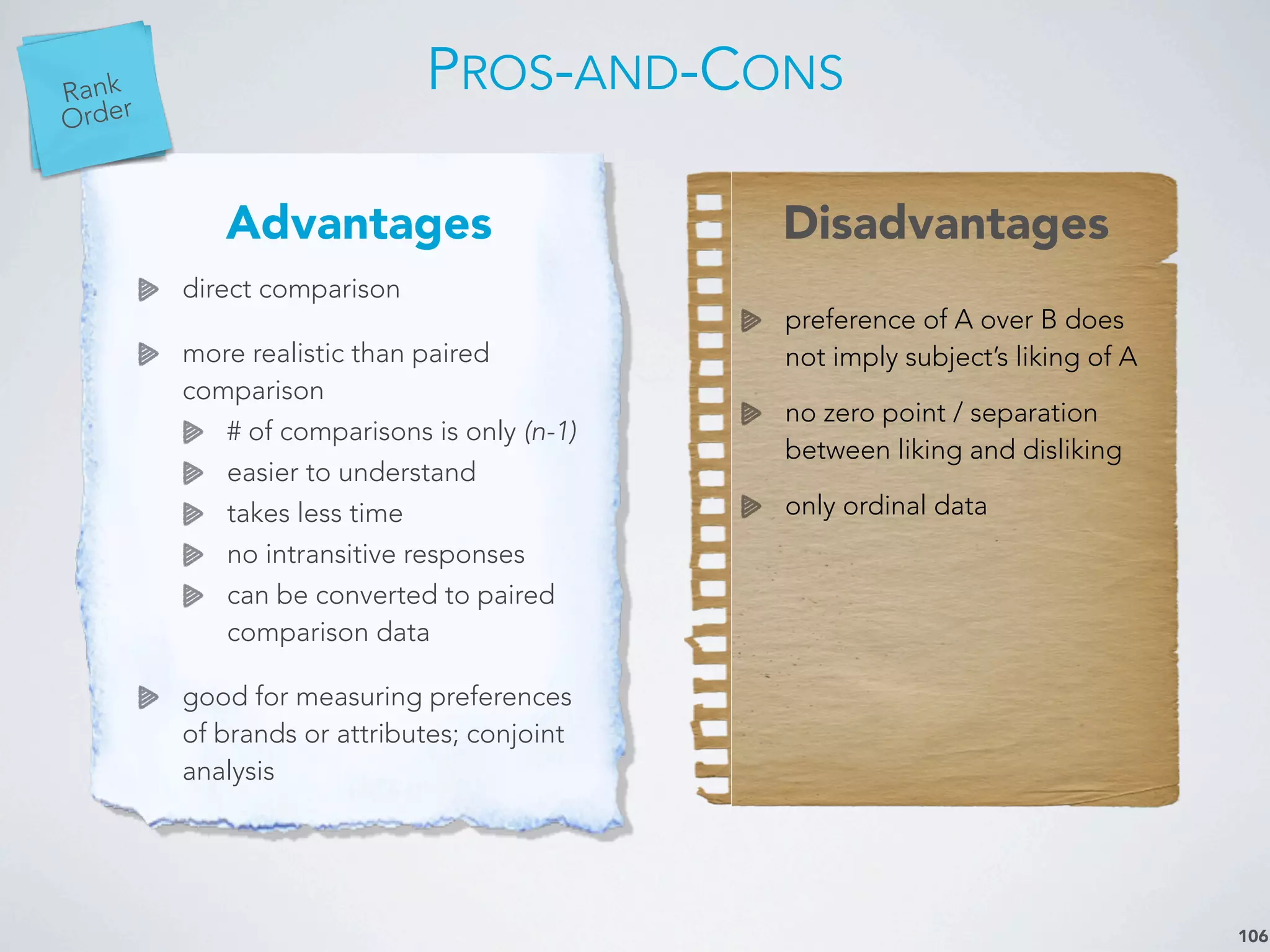
direct comparison
morerealistic than paired
comparison
# of comparisons is only (n-1)
easier to understand
takes less time
no intransitive responses
can be converted to paired
comparison data
good for measuring preferences
of brands or attributes; conjoint
analysis
preference of A over B does
not imply subject’s liking of A
no zero point / separation
between liking and disliking
only ordinal data
Paired
Comp.Rank
Order
107.
Respondents allocate aconstant sum of units (points, dollars, chips, %) among a set of stimulus
objects with respect to some criterion
COMPARATIVE SCALES: CONSTANT SUM SCALING
107
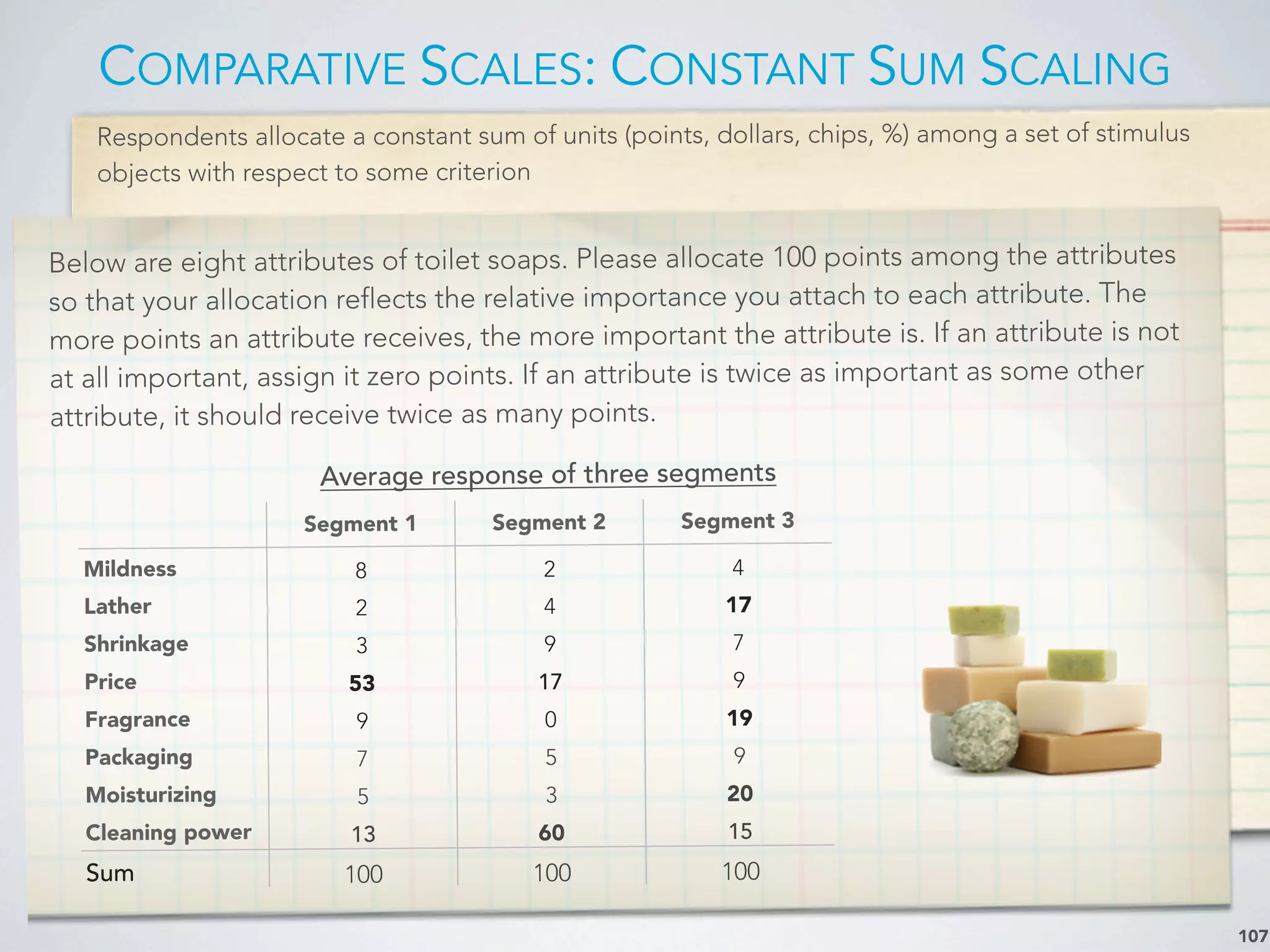
Below are eight attributes of toilet soaps. Please allocate 100 points among the attributes
so that your allocation reflects the relative importance you attach to each attribute. The
more points an attribute receives, the more important the attribute is. If an attribute is not
at all important, assign it zero points. If an attribute is twice as important as some other
attribute, it should receive twice as many points.
Segment 1 Segment 2 Segment 3
Mildness 8 2 4
Lather 2 4 17
Shrinkage 3 9 7
Price 53 17 9
Fragrance 9 0 19
Packaging 7 5 9
Moisturizing 5 3 20
Cleaning power 13 60 15
Sum 100 100 100
Average response of three segments
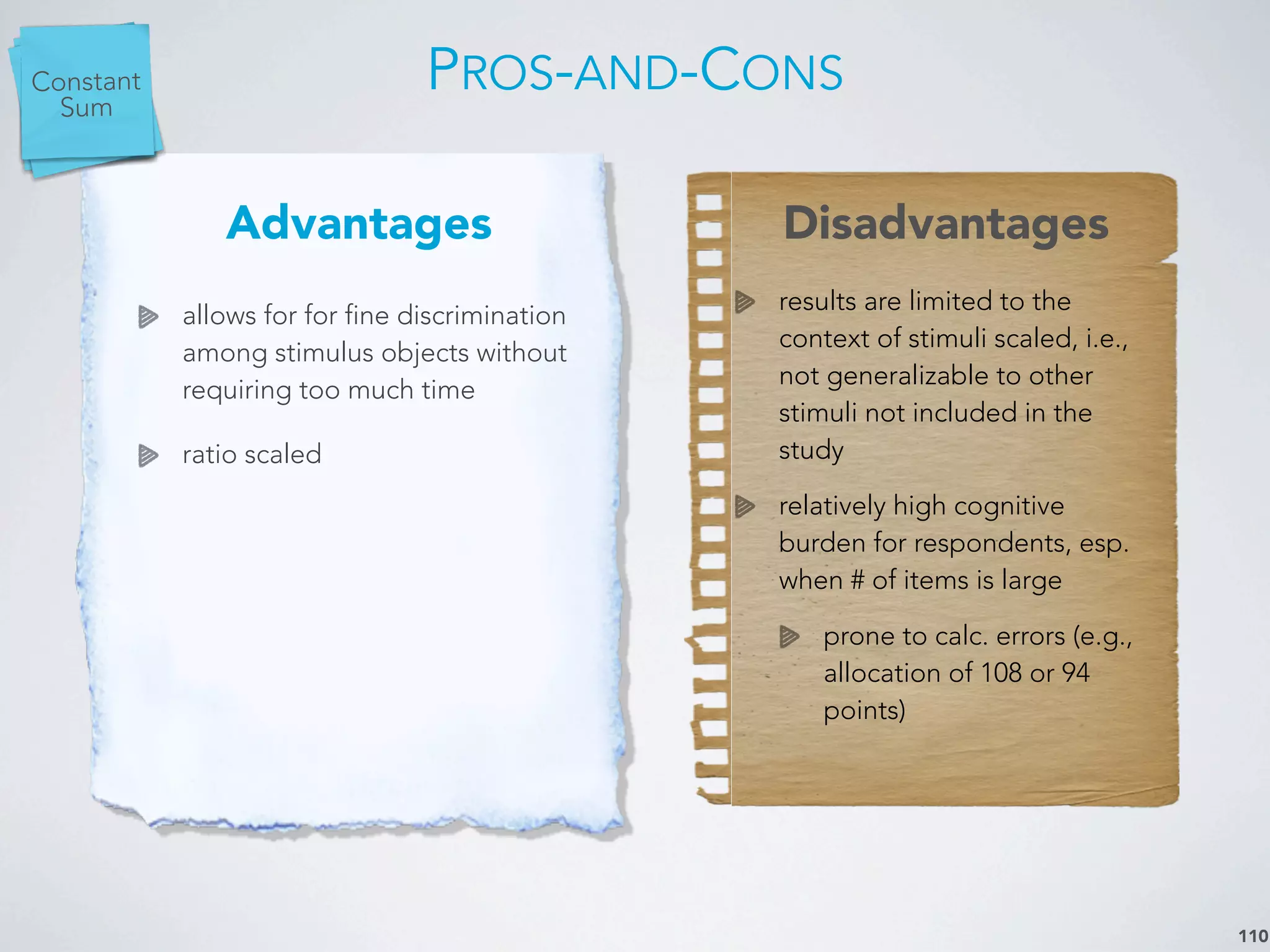
PROS-AND-CONS
110
Advantages Disadvantages
allows forfor fine discrimination
among stimulus objects without
requiring too much time
ratio scaled
results are limited to the
context of stimuli scaled, i.e.,
not generalizable to other
stimuli not included in the
study
relatively high cognitive
burden for respondents, esp.
when # of items is large
prone to calc. errors (e.g.,
allocation of 108 or 94
points)
Paired
Comp.Rank
Order
Constant
Sum
111.
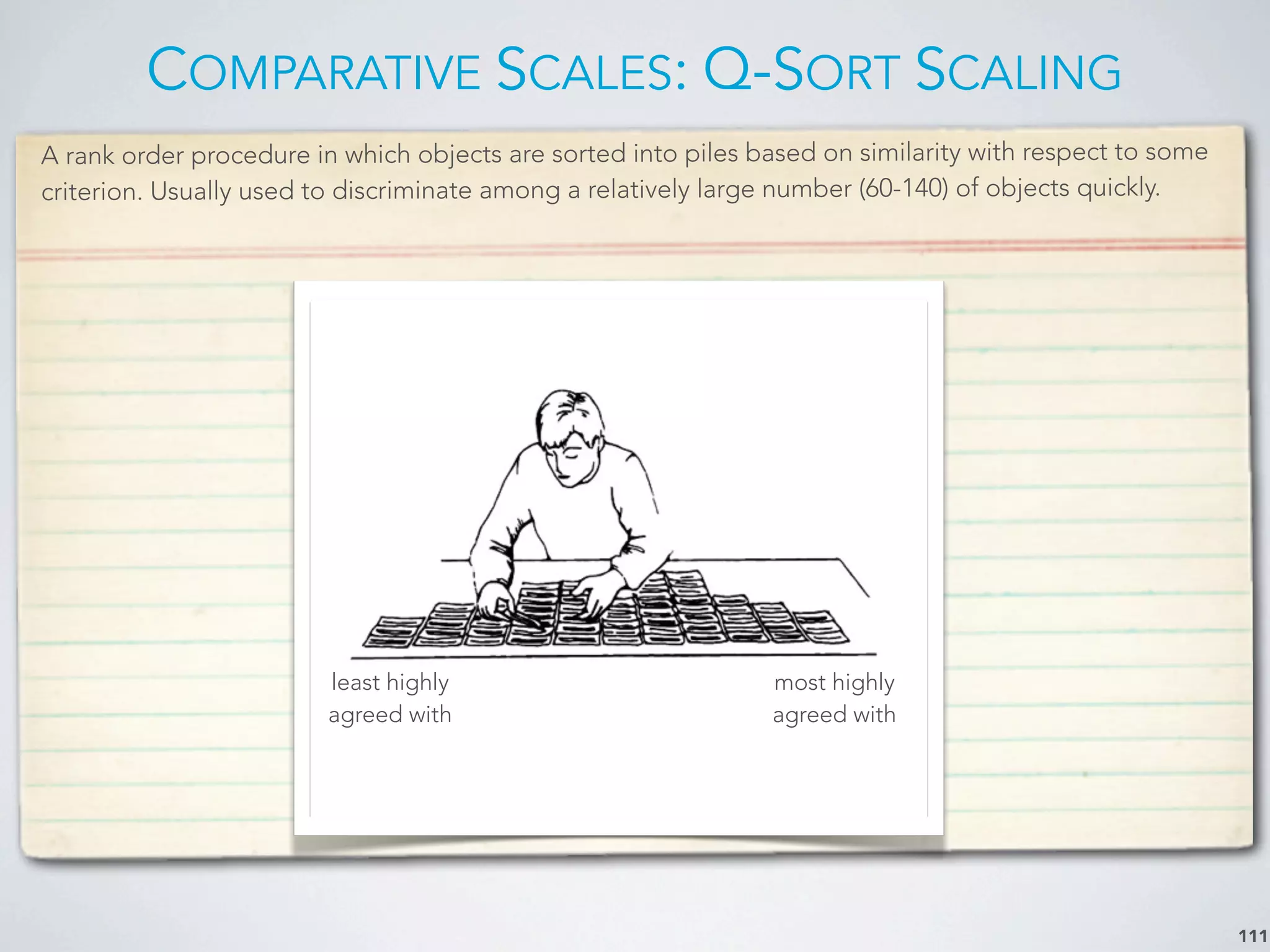
A rank orderprocedure in which objects are sorted into piles based on similarity with respect to some
criterion. Usually used to discriminate among a relatively large number (60-140) of objects quickly.
COMPARATIVE SCALES: Q-SORT SCALING
111
most highly
agreed with
least highly
agreed with
CLASSIFICATION OF SCALINGTECHNIQUES
114
Scaling Techniques
Comparative
Scales
Non-comparative
Scales
Paired
Comparison
Rank
Order
Constant
Sum
Q-Sort &
others
Continuous
Rating Scales
Itemized
Rating Scales
Likert
Semantic
Differential
Stapel
115.
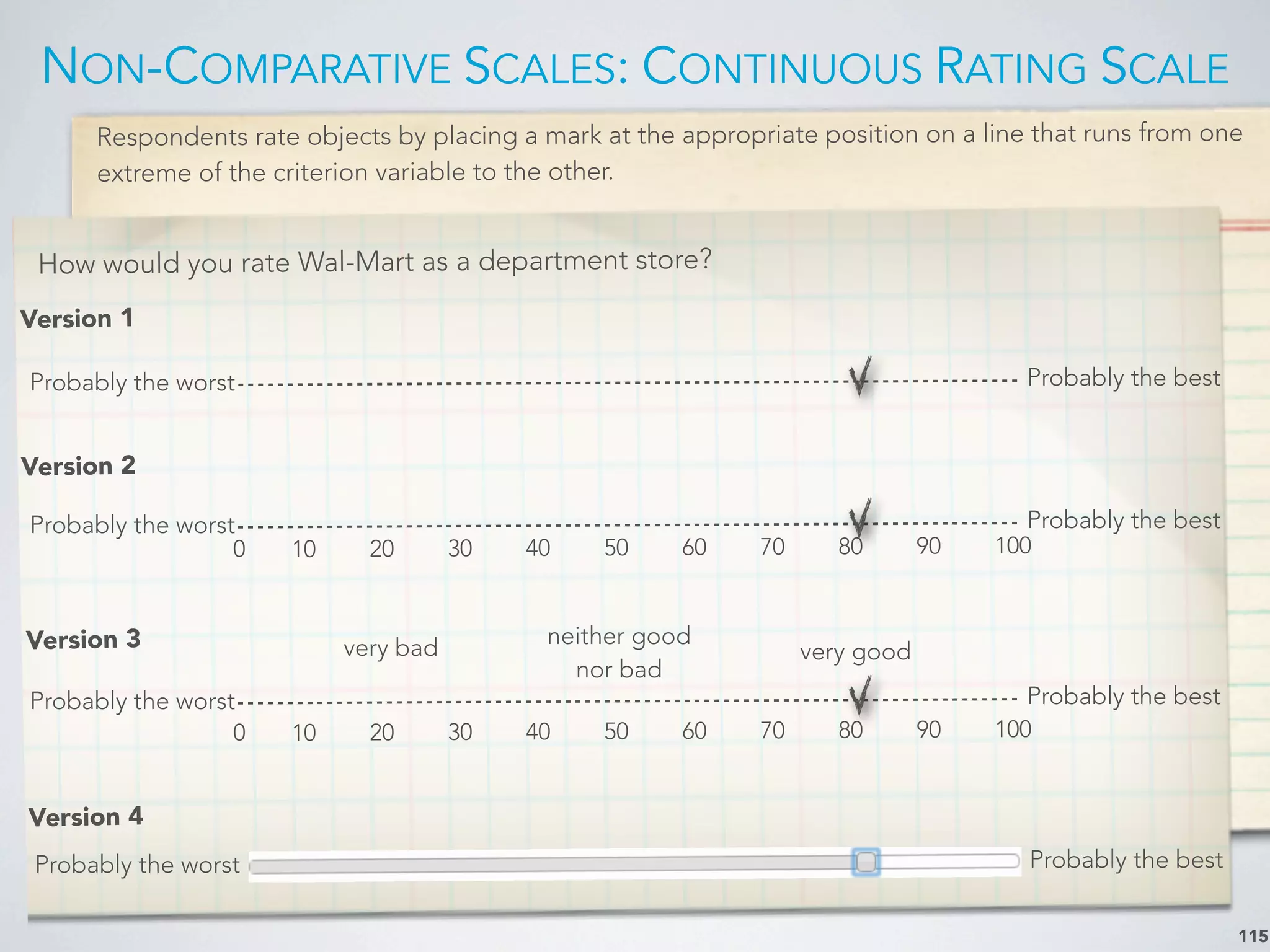
Respondents rate objectsby placing a mark at the appropriate position on a line that runs from one
extreme of the criterion variable to the other.
NON-COMPARATIVE SCALES: CONTINUOUS RATING SCALE
115
How would you rate Wal-Mart as a department store?
Probably the worst Probably the best
0 10 20 30 40 50 60 70 80 90 100
Probably the worst Probably the best
very bad neither good
nor bad
very good
0 10 20 30 40 50 60 70 80 90 100
Version 1
Version 2
Version 3
Version 4
Requires respondents toindicate a degree of agreement or disagreement with each of a series of
statements about the stimulus object within typically five to seven response categories.
ITEMIZED RATING SCALES: LIKERT SCALE
117
Listed below are different opinions about Sears. Please indicate how strongly you agree or
disagree with each by using the following scale:
Strongly
disagree Disagree
Neither
agree
nor
disagree Agree
Strongly
agree
1 Sears sells high-quality merchandise [1] [x] [3] [4] [5]
2 Sears has poor in-store service [1] [x] [3] [4] [5]
3 I like to shop in Sears [1] [2] [x] [4] [5]
4
Sears does not offer a good mix of different
brands within a product category
[1] [2] [3] [x] [5]
5 The credit policies at Sears are terrible [1] [2] [3] [x] [5]
6 Sears is where America shops [x] [2] [3] [4] [5]
7 I do not like advertising done by Sears [1] [2] [3] [x] [5]
8 Sears sells a wide variety of merchandise [1] [2] [3] [x] [5]
9 Sears charges fair prices [1] [x] [3] [4] [5]
1 = Strongly agree
2 = Disagree
3 = Neither agree nor disagree
4 = Agree
5 = Strongly agree
NOTICE the reversed scoring of items 2,4,5, and 7. Reverse the scale for these items prior analyzing to be consistent with the whole set of items, i.e. a higher score should
denote a more favorable attitude.
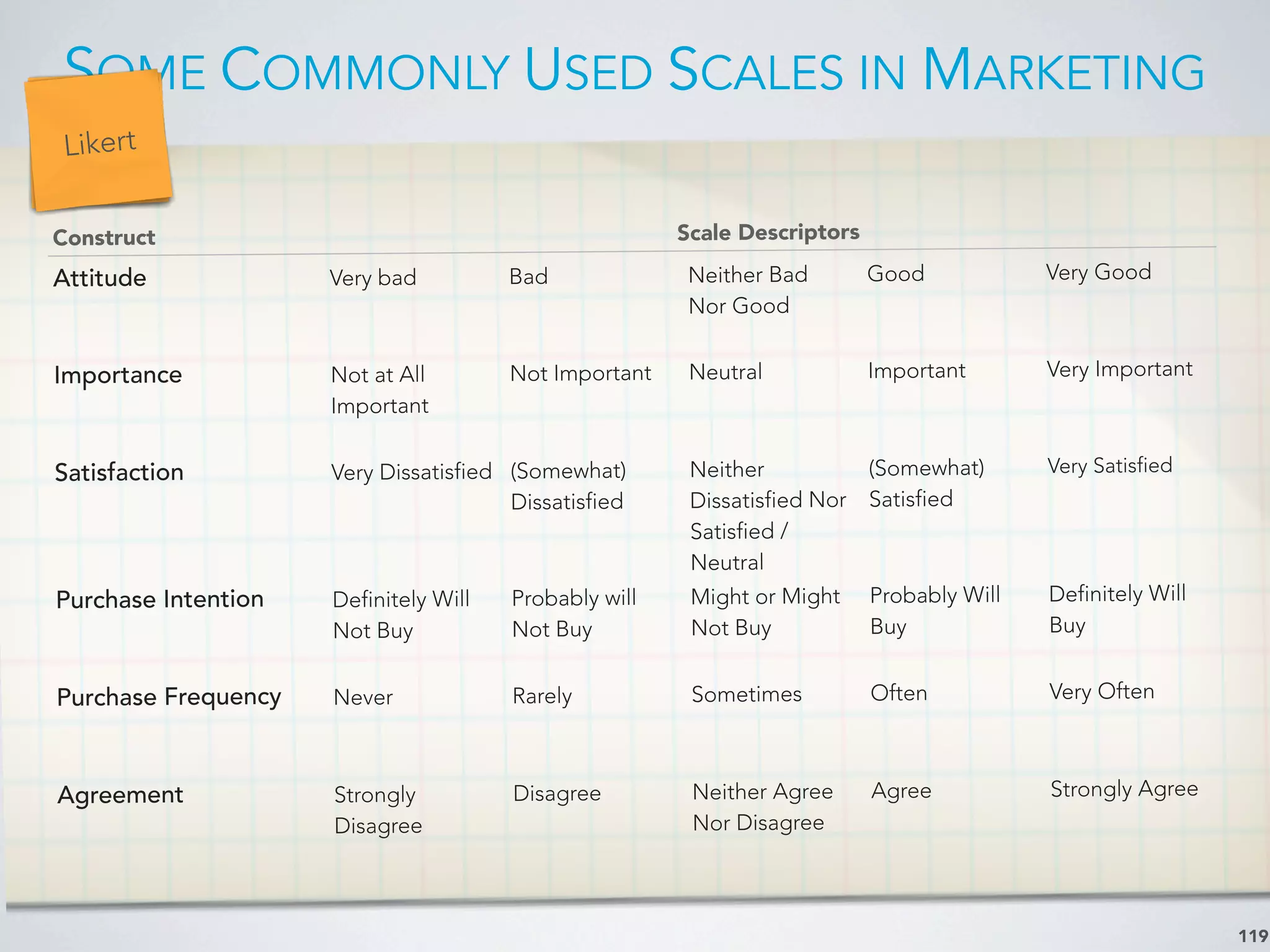
SOME COMMONLY USEDSCALES IN MARKETING
119
Construct Scale DescriptorsScale DescriptorsScale DescriptorsScale DescriptorsScale Descriptors
Attitude Very bad Bad Neither Bad
Nor Good
Good Very Good
Importance Not at All
Important
Not Important Neutral Important Very Important
Satisfaction Very Dissatisfied (Somewhat)
Dissatisfied
Neither
Dissatisfied Nor
Satisfied /
Neutral
(Somewhat)
Satisfied
Very Satisfied
Purchase Intention Definitely Will
Not Buy
Probably will
Not Buy
Might or Might
Not Buy
Probably Will
Buy
Definitely Will
Buy
Purchase Frequency Never Rarely Sometimes Often Very Often
Agreement Strongly
Disagree
Disagree Neither Agree
Nor Disagree
Agree Strongly Agree
Continuous
RatingLikert
120.
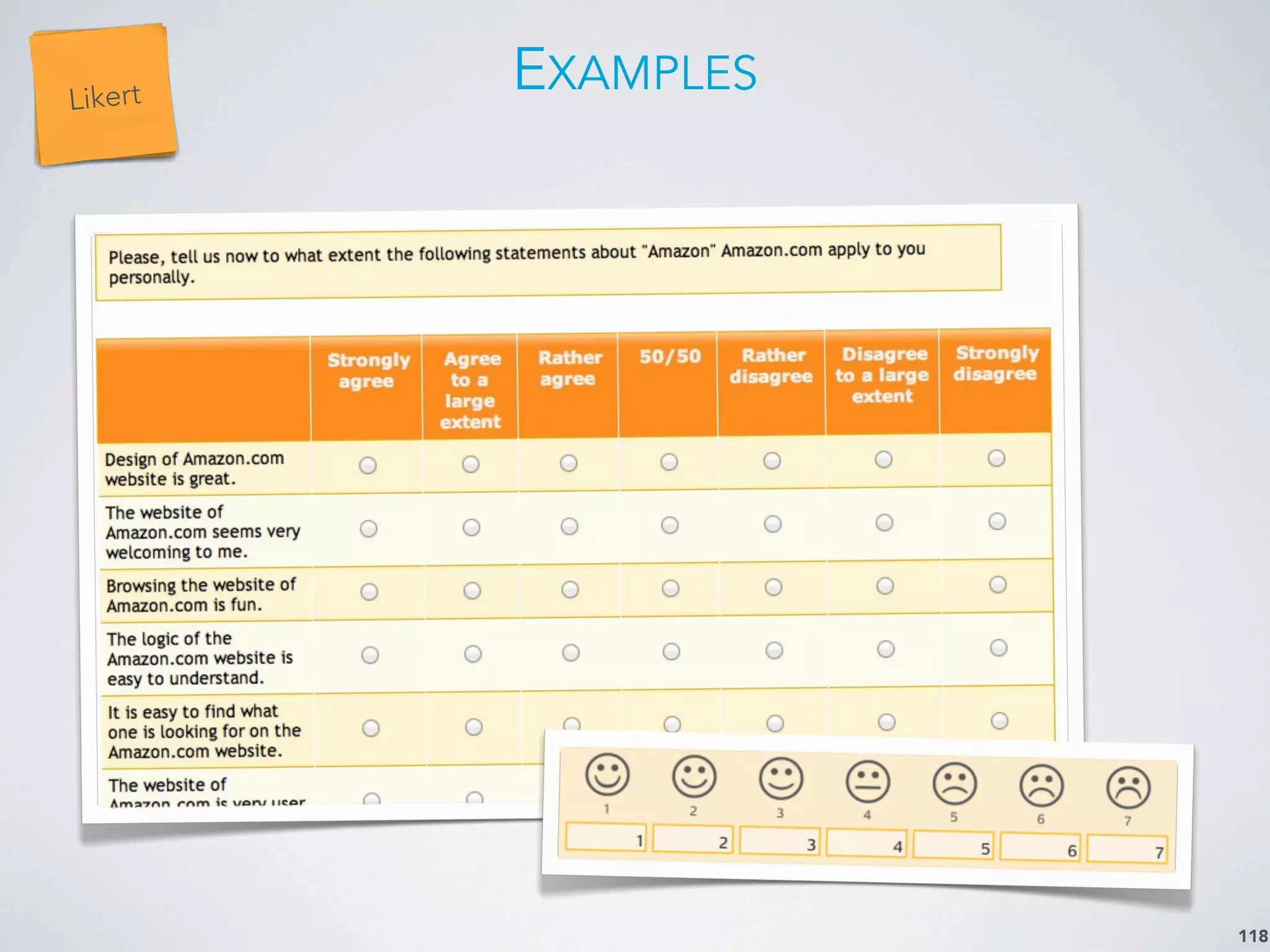
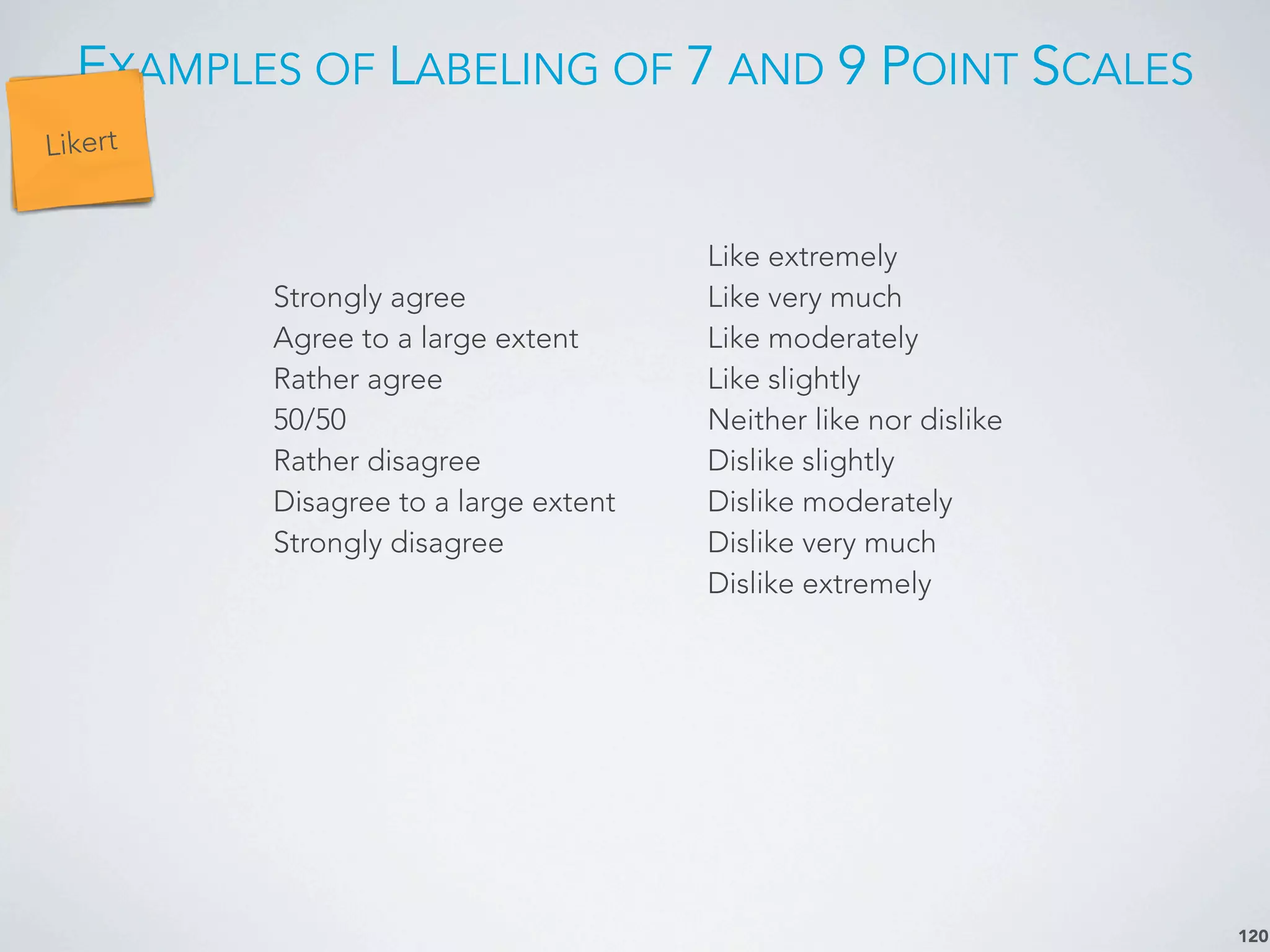
EXAMPLES OF LABELINGOF 7 AND 9 POINT SCALES
120
Strongly agree
Agree to a large extent
Rather agree
50/50
Rather disagree
Disagree to a large extent
Strongly disagree
Like extremely
Like very much
Like moderately
Like slightly
Neither like nor dislike
Dislike slightly
Dislike moderately
Dislike very much
Dislike extremely
Continuous
RatingLikert
121.
A rating scalewith end point associated with bipolar labels that have semantic meaning.
Respondents are to indicate how accurately or inaccurately each term describes the object.
ITEMIZED RATING SCALES: SEMANTIC DIFFERENTIAL
121
This part of the study measures what certain department stores mean to you by having you
judge them on a series of descriptive scales bounded at each end by one of two bipolar
adjectives. Please mark (X) the blank that best indicates how accurately one or the other
adjective describes what the store means to you. Please be sure to mark every scale; do not
omit any scale.
NOTE: The negative adjective sometimes appears at the left side of the scale and sometimes at the right. This controls the tendency of some respondents, particularly those
with very positive or very negative attitudes, to mark the right- or left-hand sides without reading the labels.
Powerful [ ] [ ] [ ] [ ] [X] [ ] [ ] Weak
Unreliable [ ] [ ] [ ] [ ] [ ] [X] [ ] Reliable
Modern [ ] [ ] [ ] [ ] [ ] [ ] [X] Old fashioned
Cold [ ] [ ] [ ] [ ] [ ] [X] [ ] Warm
Careful [ ] [X] [ ] [ ] [ ] [ ] [ ] Careless
Sears is:
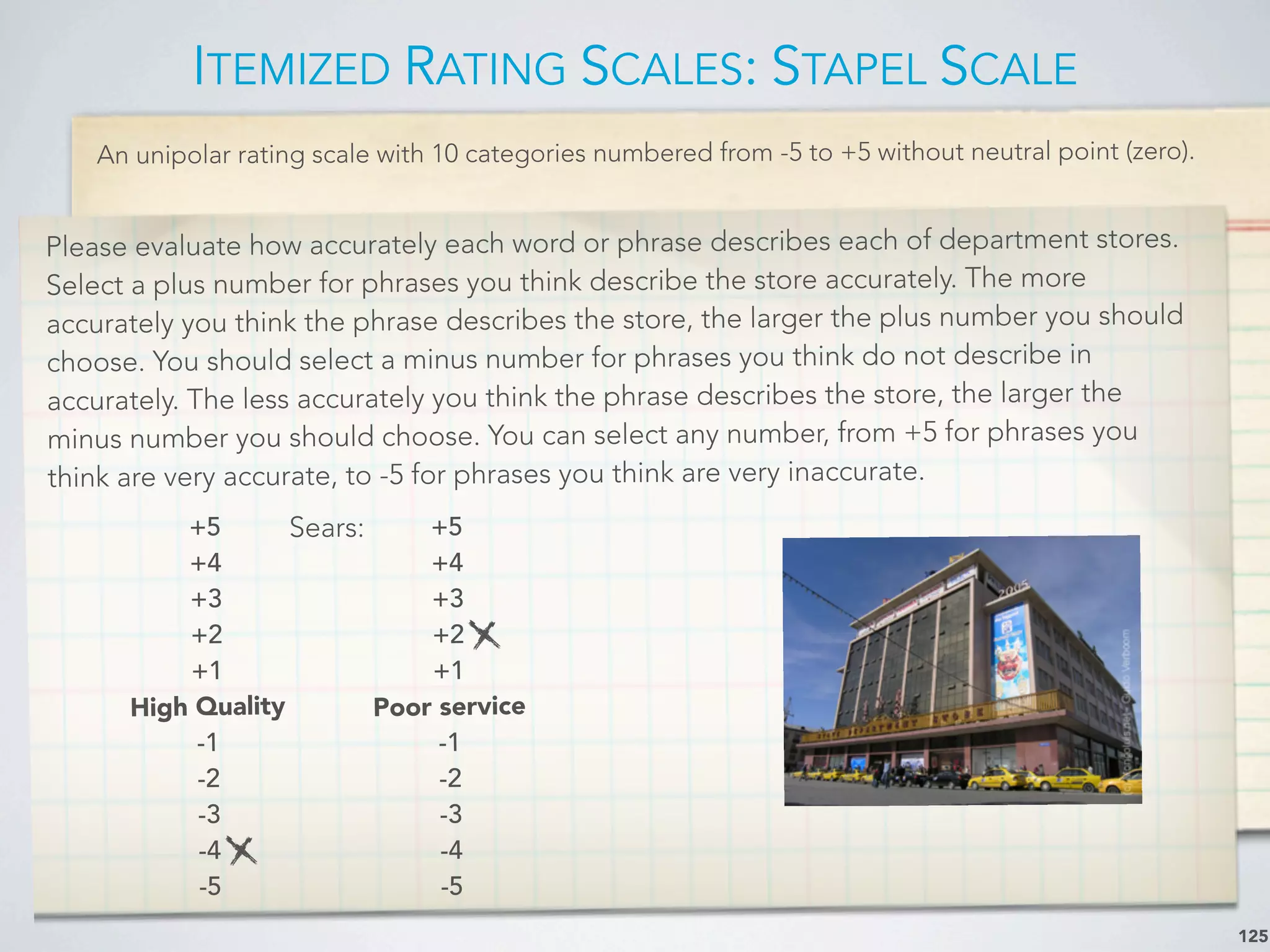
An unipolar ratingscale with 10 categories numbered from -5 to +5 without neutral point (zero).
ITEMIZED RATING SCALES: STAPEL SCALE
125
Please evaluate how accurately each word or phrase describes each of department stores.
Select a plus number for phrases you think describe the store accurately. The more
accurately you think the phrase describes the store, the larger the plus number you should
choose. You should select a minus number for phrases you think do not describe in
accurately. The less accurately you think the phrase describes the store, the larger the
minus number you should choose. You can select any number, from +5 for phrases you
think are very accurate, to -5 for phrases you think are very inaccurate.
Sears:+5
+4
+3
+2
+1
High Quality
-1
-2
-3
-4
-5
+5
+4
+3
+2
+1
Poor service
-1
-2
-3
-4
-5
126.
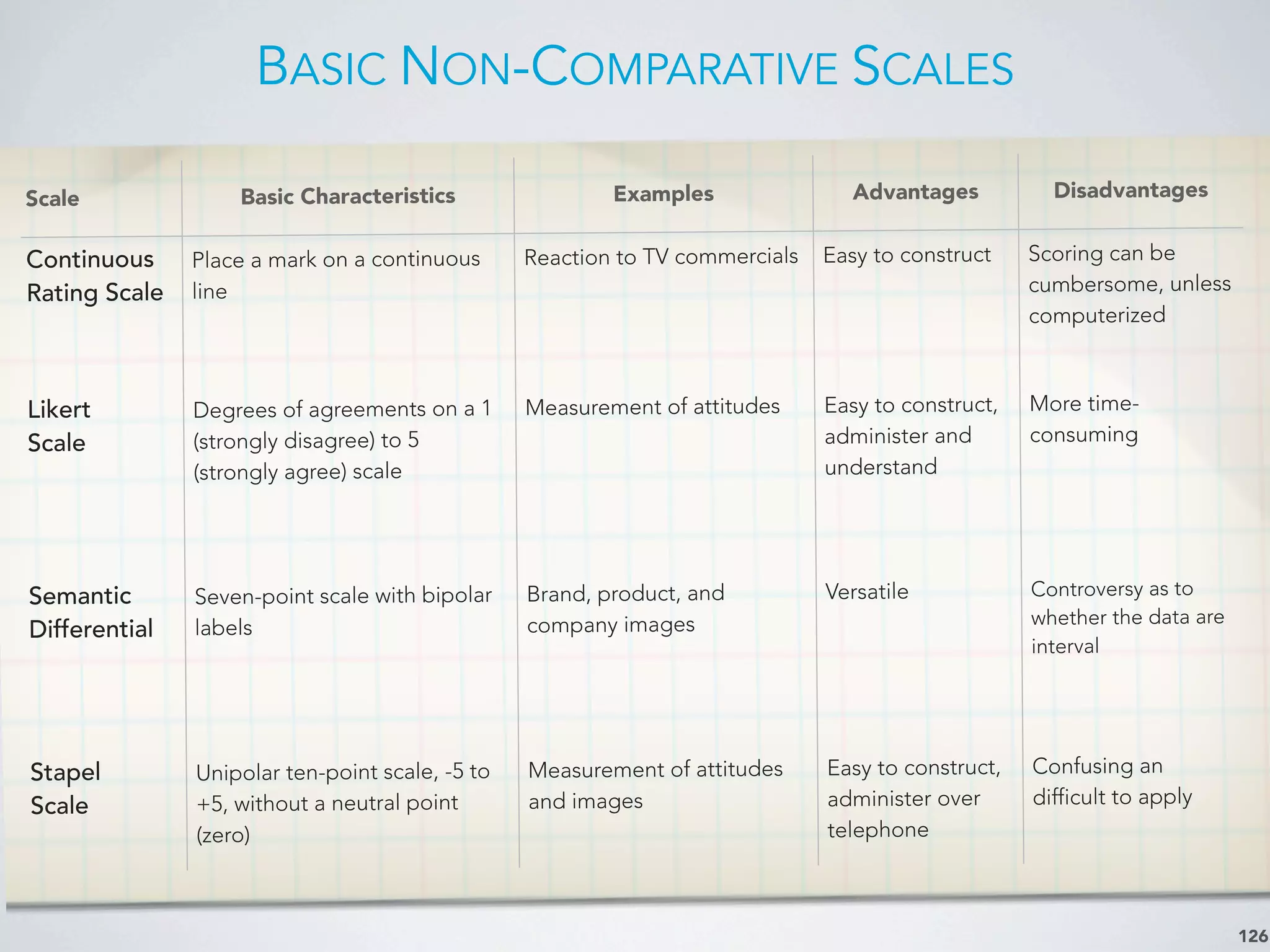
BASIC NON-COMPARATIVE SCALES
126
ScaleBasic Characteristics Examples Advantages Disadvantages
Continuous
Rating Scale
Place a mark on a continuous
line
Reaction to TV commercials Easy to construct Scoring can be
cumbersome, unless
computerized
Likert
Scale
Degrees of agreements on a 1
(strongly disagree) to 5
(strongly agree) scale
Measurement of attitudes Easy to construct,
administer and
understand
More time-
consuming
Semantic
Differential
Seven-point scale with bipolar
labels
Brand, product, and
company images
Versatile Controversy as to
whether the data are
interval
Stapel
Scale
Unipolar ten-point scale, -5 to
+5, without a neutral point
(zero)
Measurement of attitudes
and images
Easy to construct,
administer over
telephone
Confusing an
difficult to apply
127.
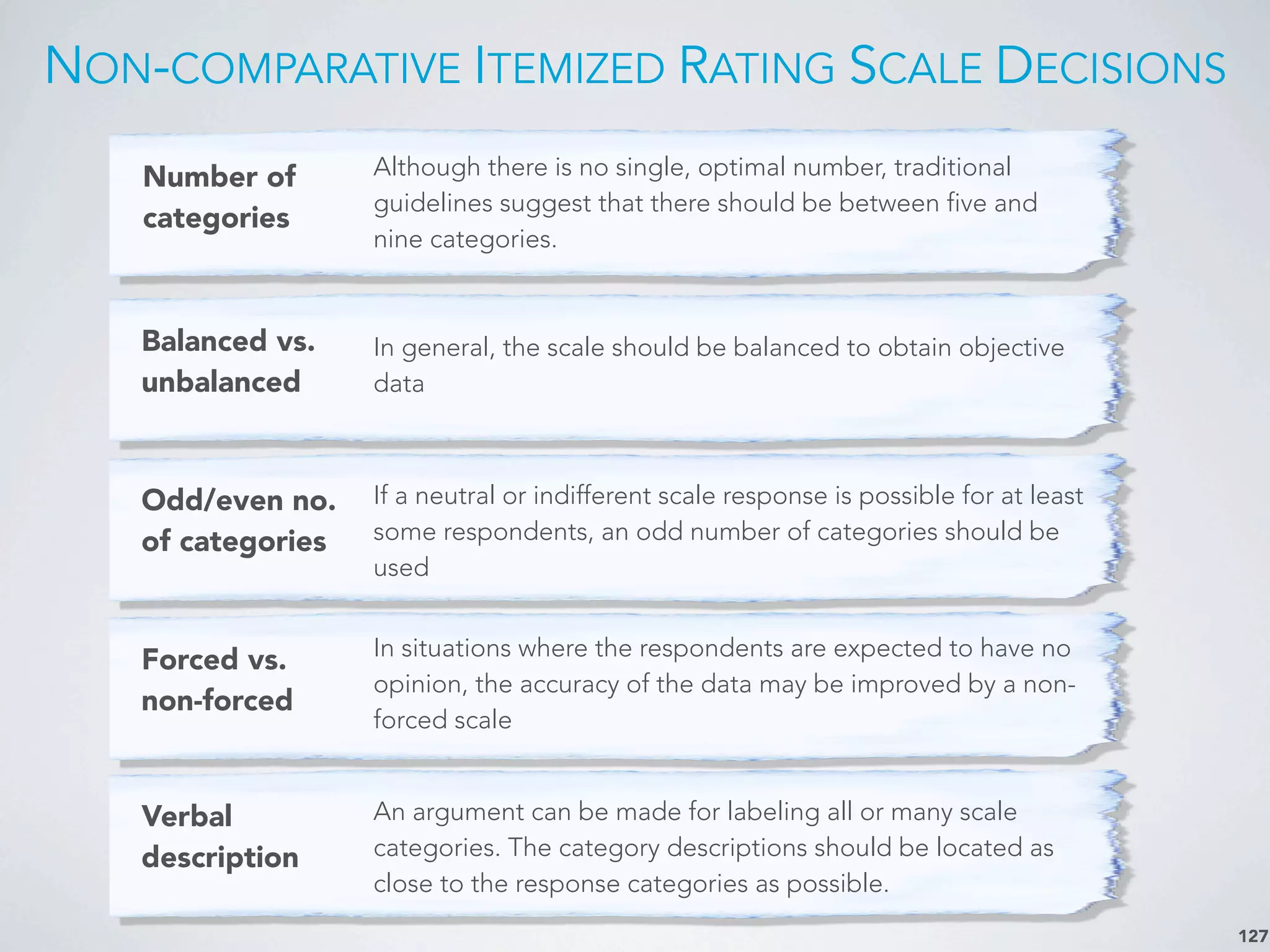
NON-COMPARATIVE ITEMIZED RATINGSCALE DECISIONS
127
Number of
categories
Although there is no single, optimal number, traditional
guidelines suggest that there should be between five and
nine categories.
Odd/even no.
of categories
If a neutral or indifferent scale response is possible for at least
some respondents, an odd number of categories should be
used
Balanced vs.
unbalanced
In general, the scale should be balanced to obtain objective
data
Verbal
description
An argument can be made for labeling all or many scale
categories. The category descriptions should be located as
close to the response categories as possible.
Forced vs.
non-forced
In situations where the respondents are expected to have no
opinion, the accuracy of the data may be improved by a non-
forced scale
128.
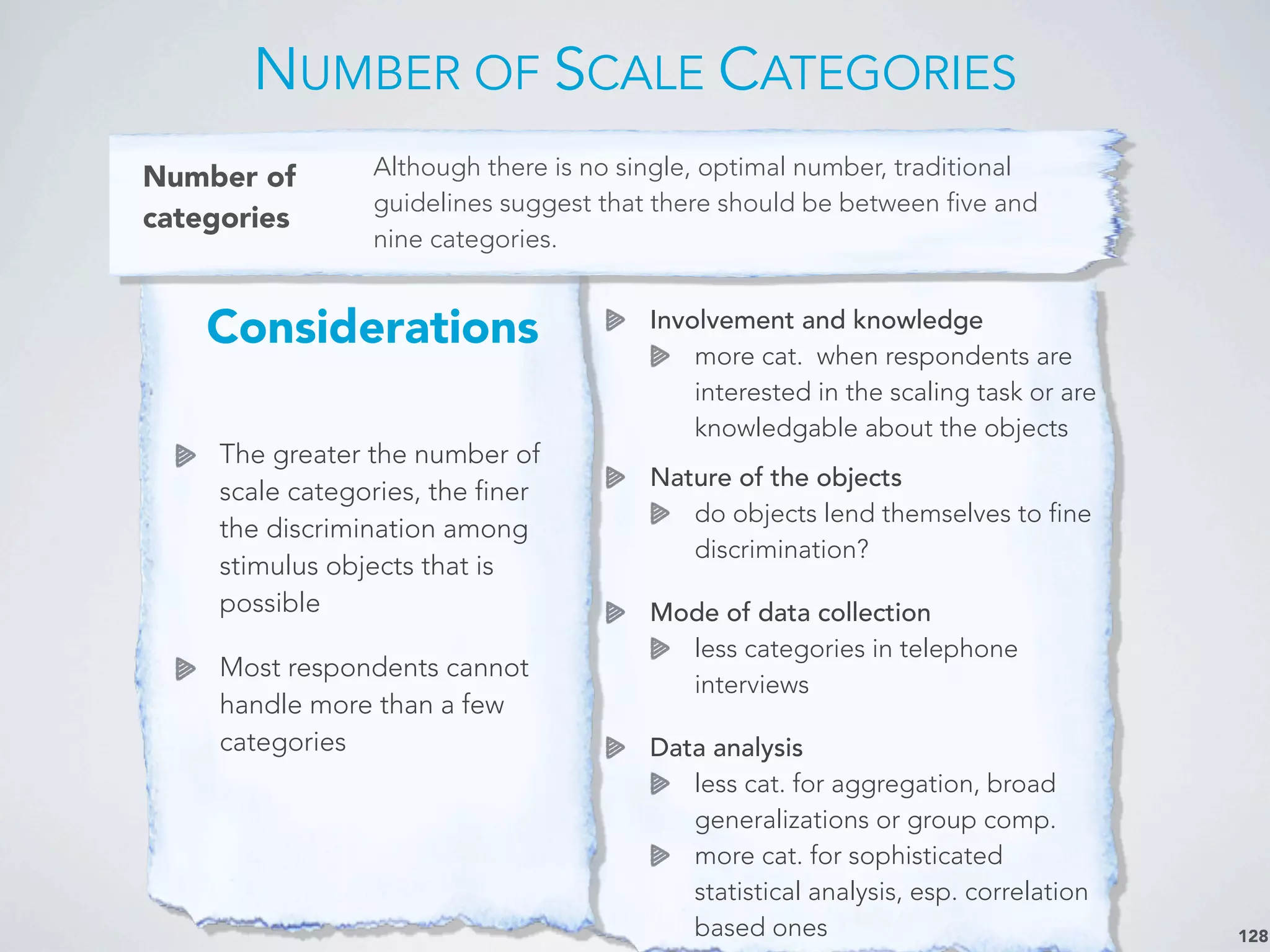
Involvement and knowledge
morecat. when respondents are
interested in the scaling task or are
knowledgable about the objects
Nature of the objects
do objects lend themselves to fine
discrimination?
Mode of data collection
less categories in telephone
interviews
Data analysis
less cat. for aggregation, broad
generalizations or group comp.
more cat. for sophisticated
statistical analysis, esp. correlation
based ones
Considerations
The greater the number of
scale categories, the finer
the discrimination among
stimulus objects that is
possible
Most respondents cannot
handle more than a few
categories
NUMBER OF SCALE CATEGORIES
128
Number of
categories
Although there is no single, optimal number, traditional
guidelines suggest that there should be between five and
nine categories.
129.
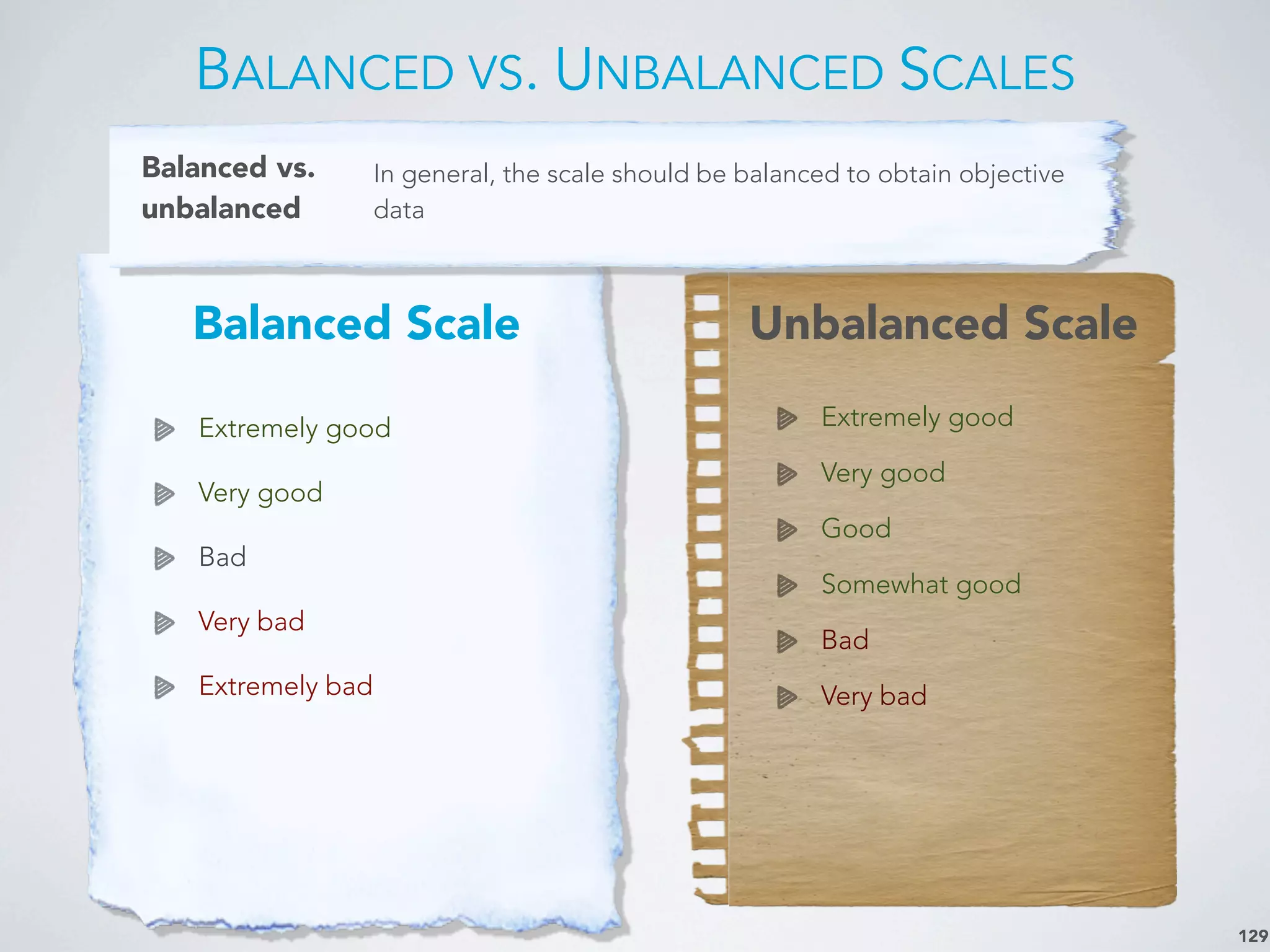
BALANCED VS. UNBALANCEDSCALES
129
Balanced Scale Unbalanced Scale
Extremely good
Very good
Bad
Very bad
Extremely bad
Extremely good
Very good
Good
Somewhat good
Bad
Very bad
Balanced vs.
unbalanced
In general, the scale should be balanced to obtain objective
data
130.
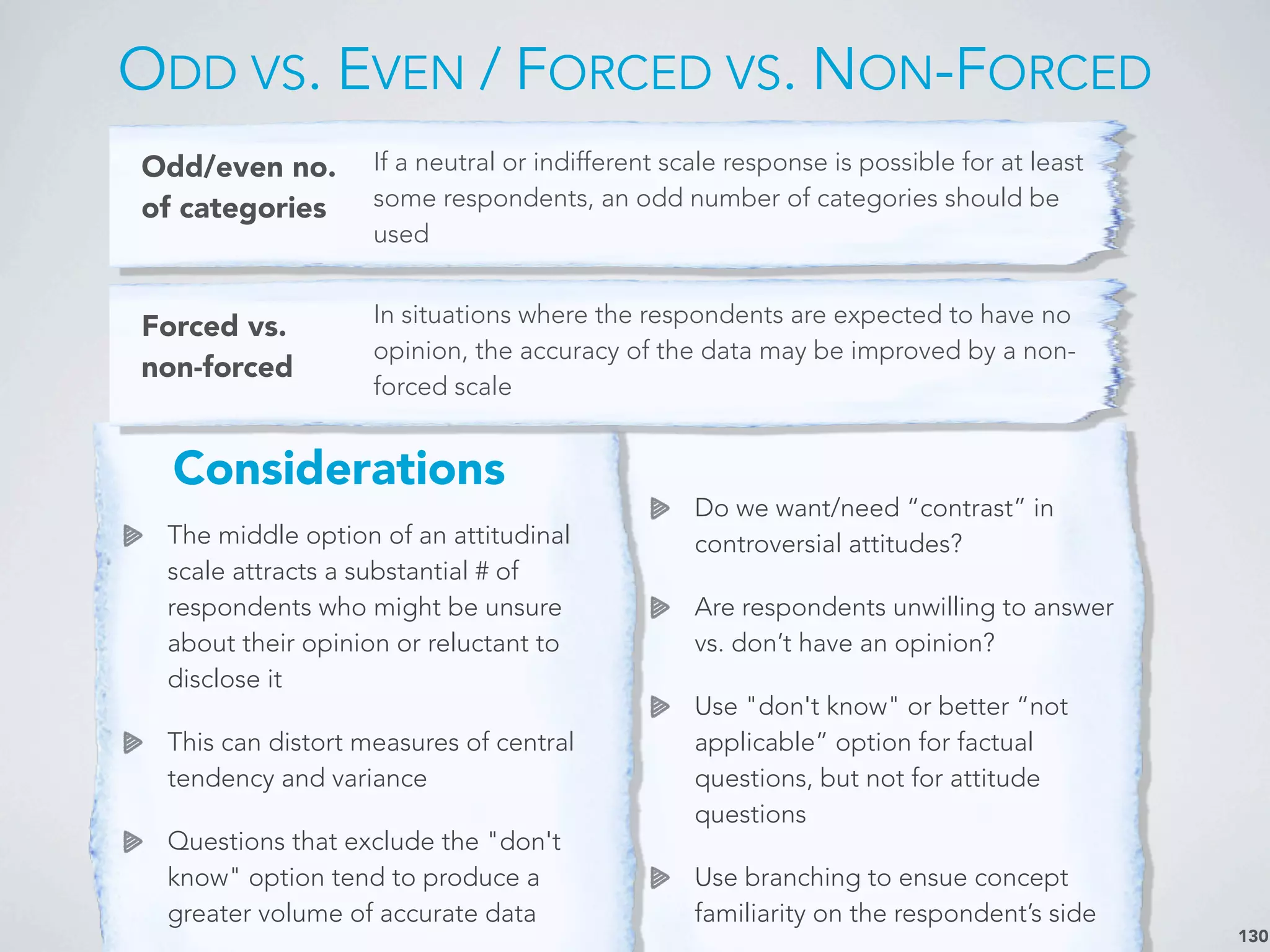
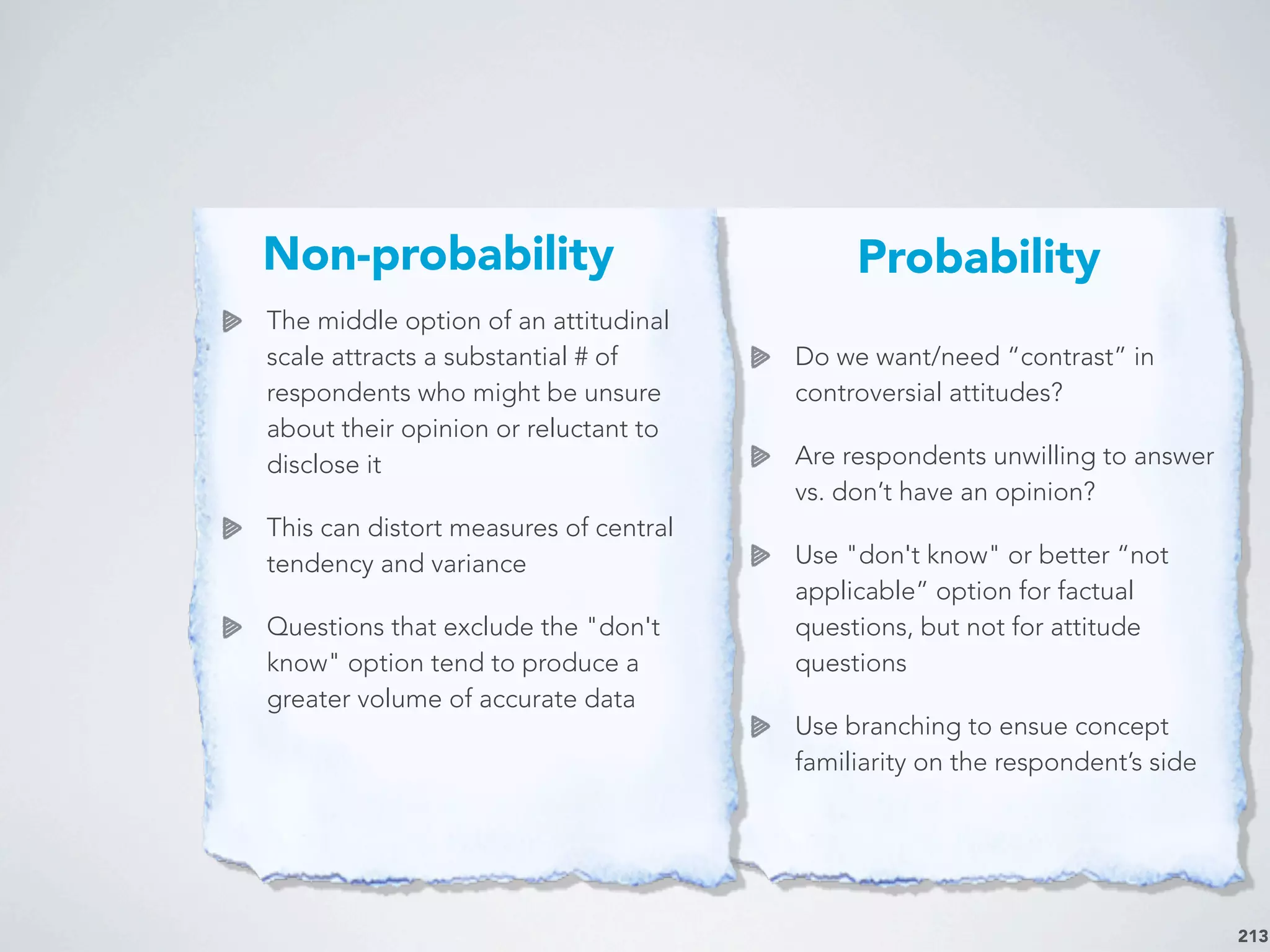
The middle optionof an attitudinal
scale attracts a substantial # of
respondents who might be unsure
about their opinion or reluctant to
disclose it
This can distort measures of central
tendency and variance
Questions that exclude the "don't
know" option tend to produce a
greater volume of accurate data
ODD VS. EVEN / FORCED VS. NON-FORCED
130
Odd/even no.
of categories
If a neutral or indifferent scale response is possible for at least
some respondents, an odd number of categories should be
used
Forced vs.
non-forced
In situations where the respondents are expected to have no
opinion, the accuracy of the data may be improved by a non-
forced scale
Do we want/need “contrast” in
controversial attitudes?
Are respondents unwilling to answer
vs. don’t have an opinion?
Use "don't know" or better “not
applicable” option for factual
questions, but not for attitude
questions
Use branching to ensue concept
familiarity on the respondent’s side
Considerations
131.
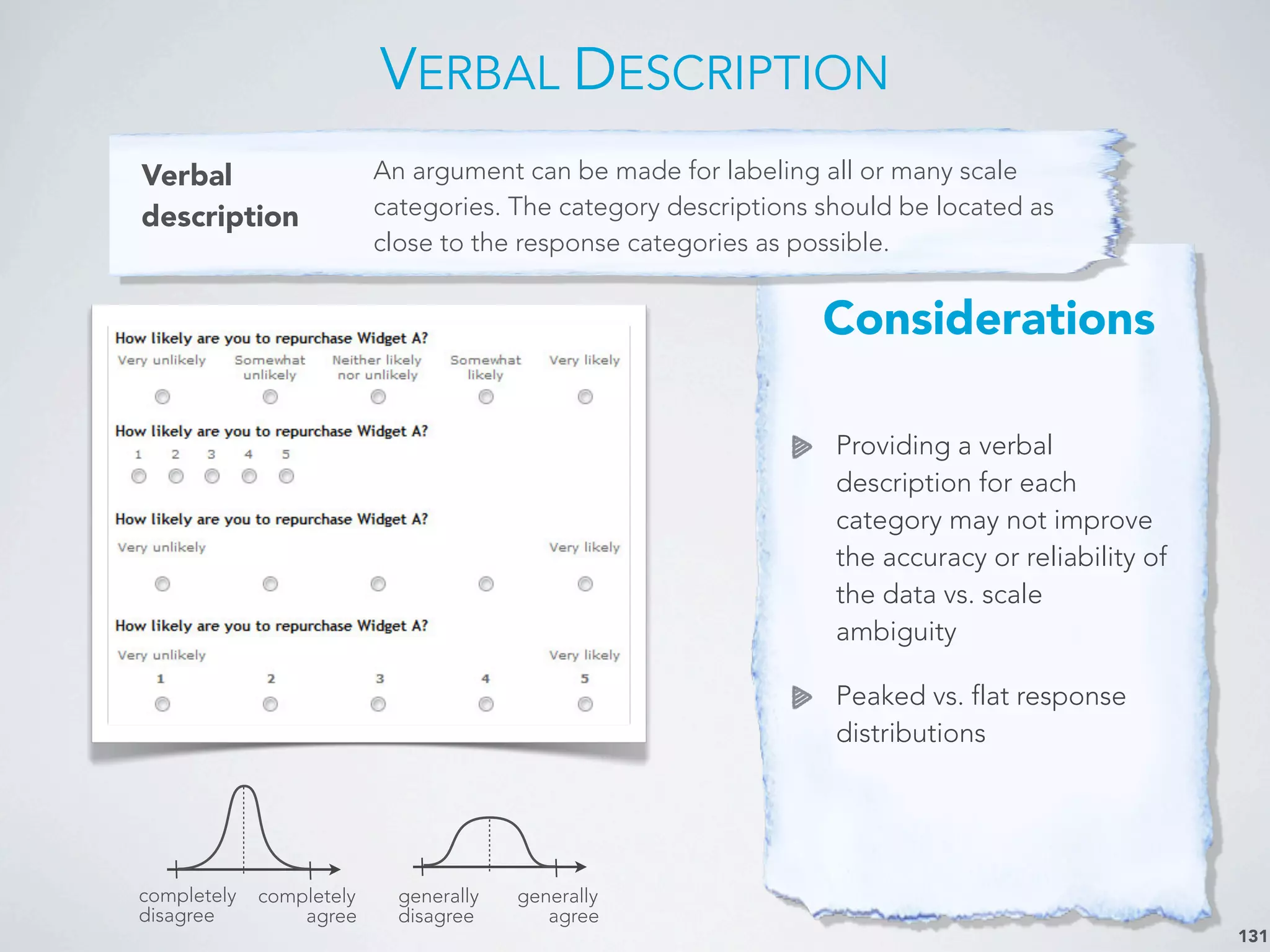
Considerations
Providing a verbal
descriptionfor each
category may not improve
the accuracy or reliability of
the data vs. scale
ambiguity
Peaked vs. flat response
distributions
VERBAL DESCRIPTION
131
Verbal
description
An argument can be made for labeling all or many scale
categories. The category descriptions should be located as
close to the response categories as possible.
completely
disagree
completely
agree
generally
disagree
generally
agree
LATENT CONSTRUCTS
133
A LatentConstruct
is a variable that cannot be observed or
measured directly but can be inferred from other
observable measurable variables.
Thus, the researcher must capture the
variable through questions representing the
presence/level of the variable in question.
A Latent Construct
satisfied [ ] [ ] [ ] [ ] [ ] [ ] [ ] dissatisfied
pleased [ ] [ ] [ ] [ ] [ ] [ ] [ ] displeased
favorable [ ] [ ] [ ] [ ] [ ] [ ] [ ] unfavorable
pleasant [ ] [ ] [ ] [ ] [ ] [ ] [ ] unpleasant
I like it very much [ ] [ ] [ ] [ ] [ ] [ ] [ ] I didn't like it at all
contented [ ] [ ] [ ] [ ] [ ] [ ] [ ] frustrated
delighted [ ] [ ] [ ] [ ] [ ] [ ] [ ] terrible
Please indicate how satisfied you were with your purchase of _____
by checking the space that best gives your answer.
α=.84
134.
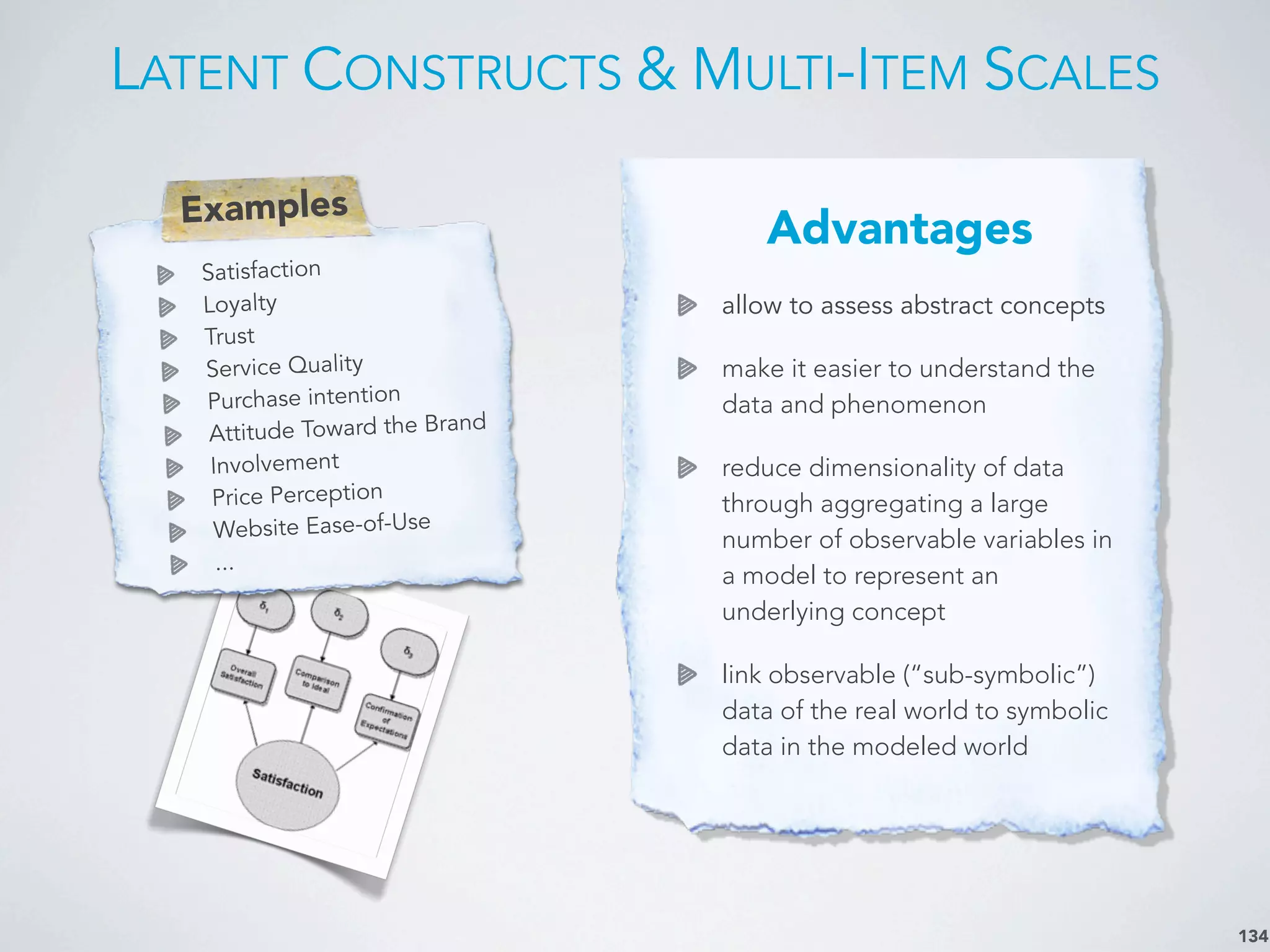
LATENT CONSTRUCTS &MULTI-ITEM SCALES
134
Advantages
allow to assess abstract concepts
make it easier to understand the
data and phenomenon
reduce dimensionality of data
through aggregating a large
number of observable variables in
a model to represent an
underlying concept
link observable (“sub-symbolic”)
data of the real world to symbolic
data in the modeled world
Satisfaction
Loyalty
Trust
Service Quality
Purchase intention
Attitude Toward the Brand
Involvement
Price Perception
Website Ease-of-Use
...
Examples
135.
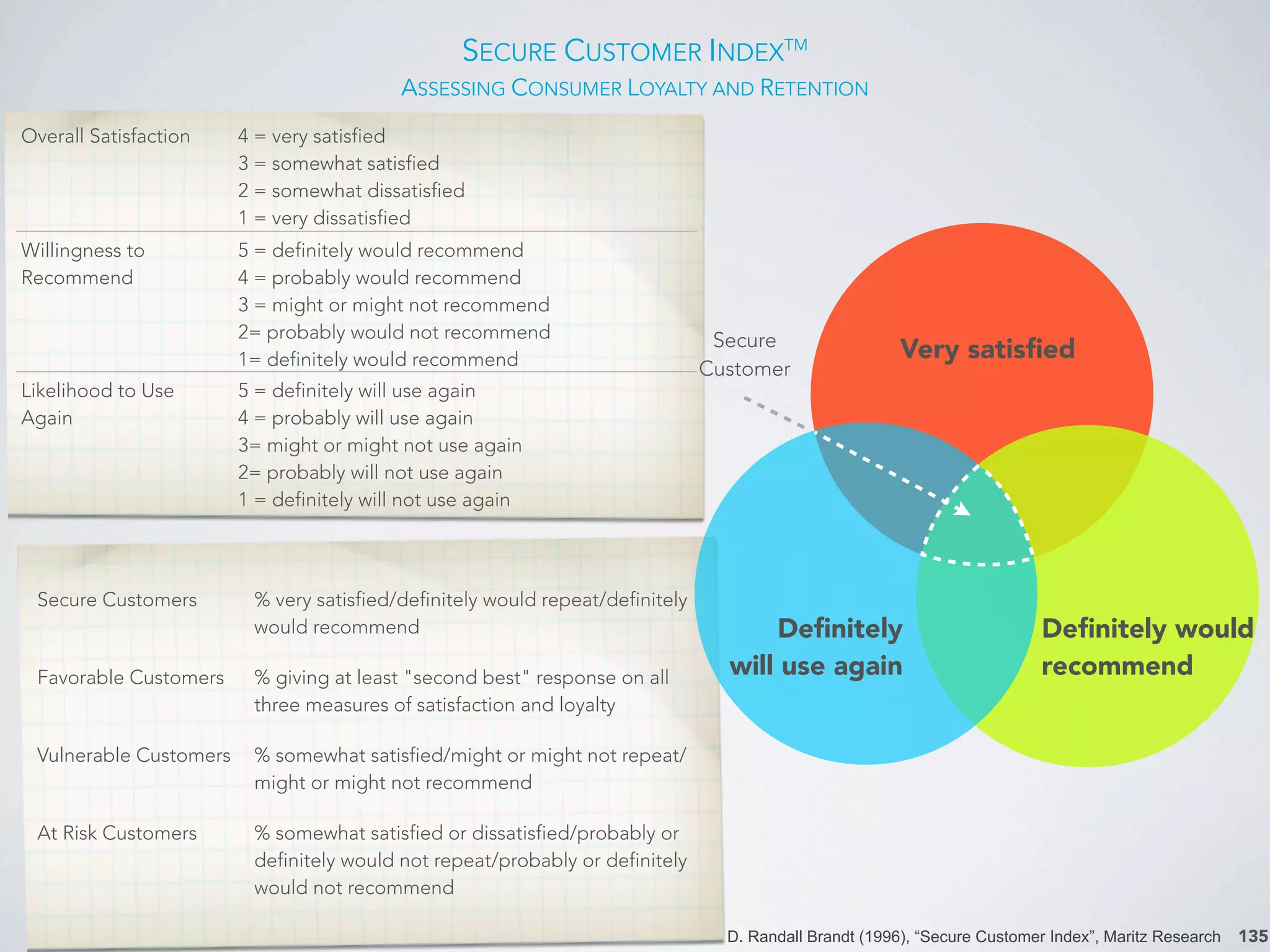
SECURE CUSTOMER INDEXTM
ASSESSINGCONSUMER LOYALTY AND RETENTION
135
Secure
Customer
Very satisfied
Definitely would
recommend
Definitely
will use again
D. Randall Brandt (1996), “Secure Customer Index”, Maritz Research
Secure Customers % very satisfied/definitely would repeat/definitely
would recommend
Favorable Customers % giving at least "second best" response on all
three measures of satisfaction and loyalty
Vulnerable Customers % somewhat satisfied/might or might not repeat/
might or might not recommend
At Risk Customers % somewhat satisfied or dissatisfied/probably or
definitely would not repeat/probably or definitely
would not recommend
Overall Satisfaction 4 = very satisfied
3 = somewhat satisfied
2 = somewhat dissatisfied
1 = very dissatisfied
Willingness to
Recommend
5 = definitely would recommend
4 = probably would recommend
3 = might or might not recommend
2= probably would not recommend
1= definitely would recommend
Likelihood to Use
Again
5 = definitely will use again
4 = probably will use again
3= might or might not use again
2= probably will not use again
1 = definitely will not use again
136.
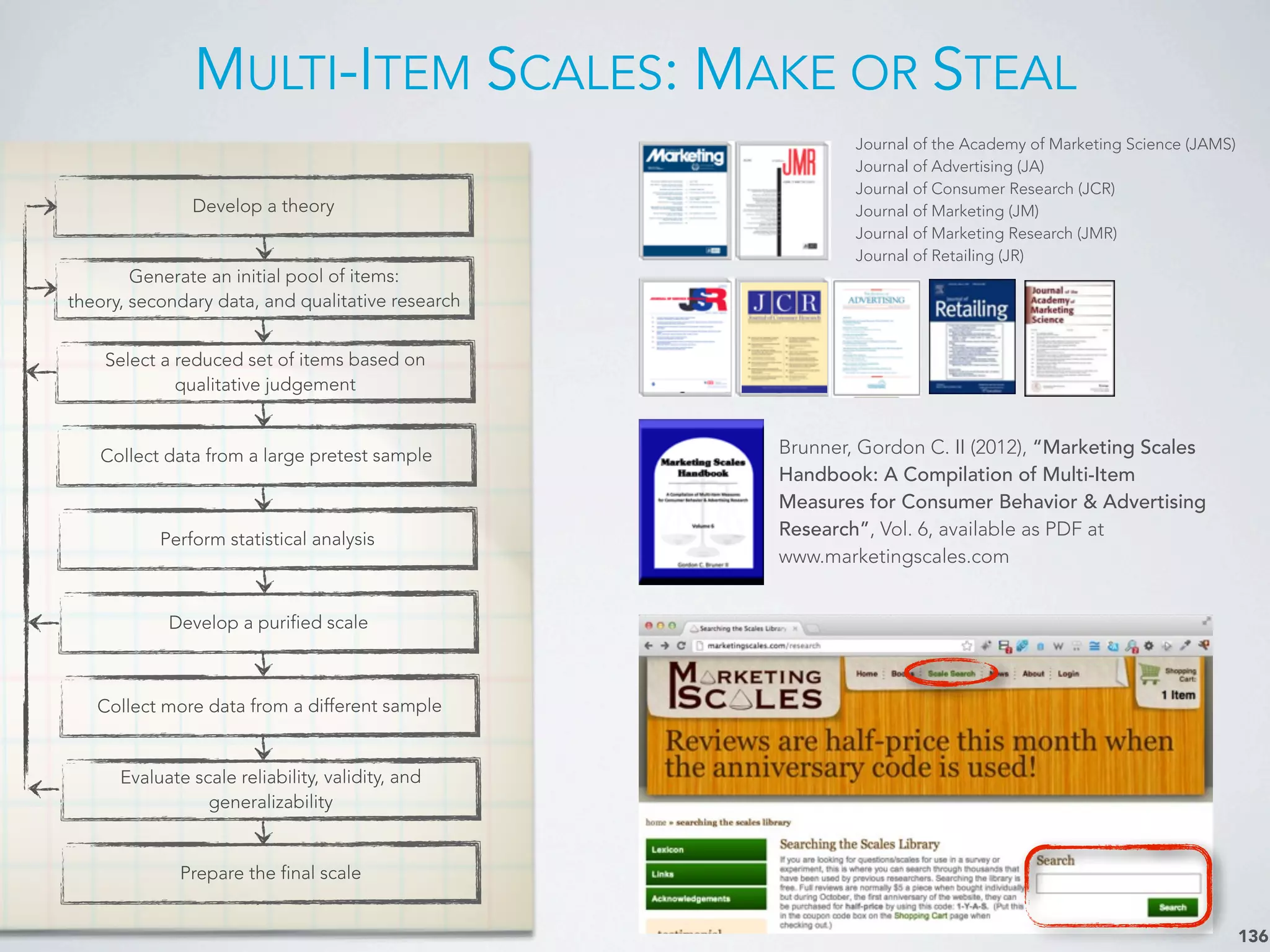
MULTI-ITEM SCALES: MAKEOR STEAL
136
Develop a theory
Generate an initial pool of items:
theory, secondary data, and qualitative research
Select a reduced set of items based on
qualitative judgement
Collect data from a large pretest sample
Perform statistical analysis
Develop a purified scale
Collect more data from a different sample
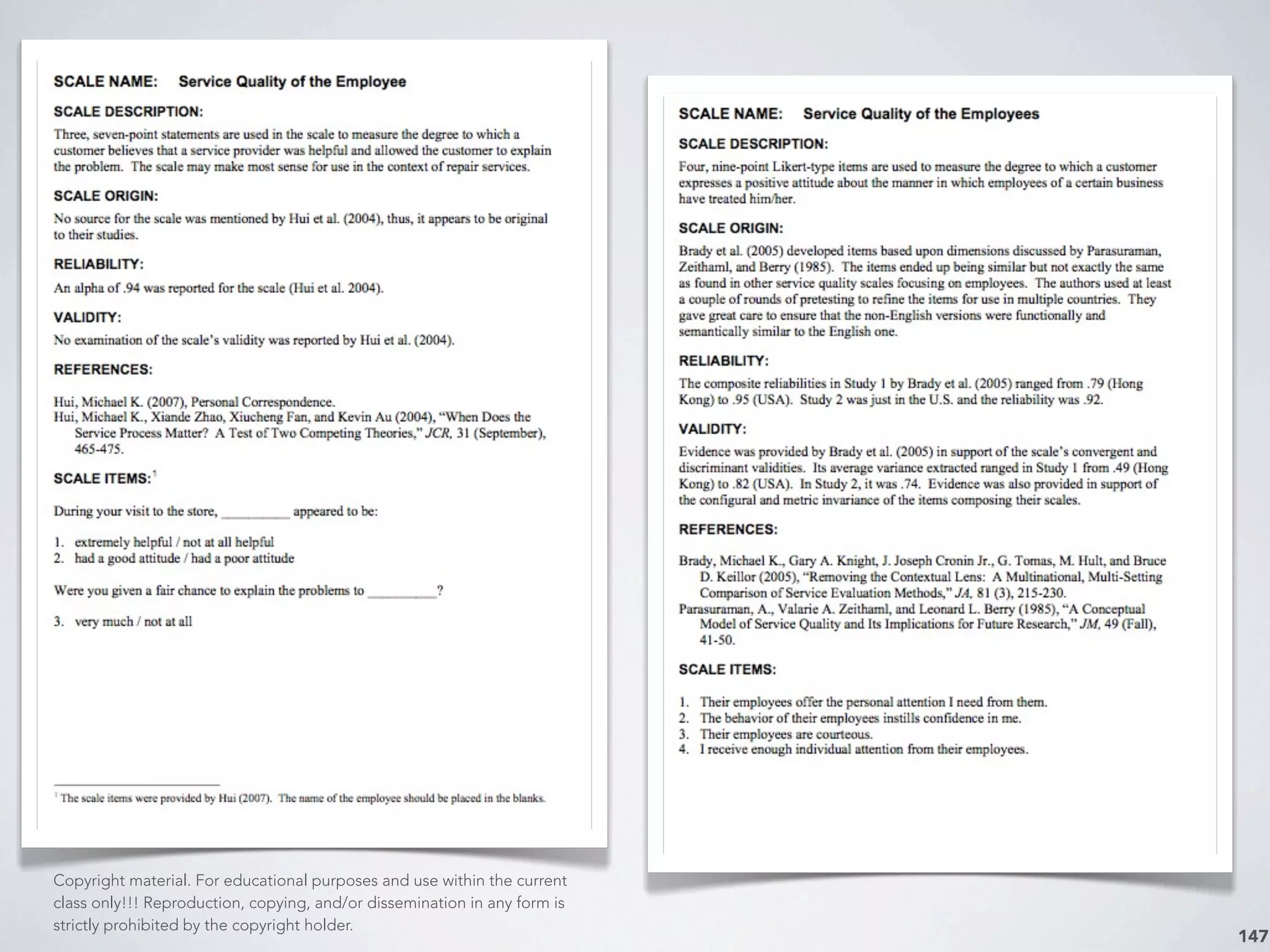
Evaluate scale reliability, validity, and
generalizability
Prepare the final scale
Brunner, Gordon C. II (2012), “Marketing Scales
Handbook: A Compilation of Multi-Item
Measures for Consumer Behavior & Advertising
Research”, Vol. 6, available as PDF at
www.marketingscales.com
Journal of the Academy of Marketing Science (JAMS)
Journal of Advertising (JA)
Journal of Consumer Research (JCR)
Journal of Marketing (JM)
Journal of Marketing Research (JMR)
Journal of Retailing (JR)
137.
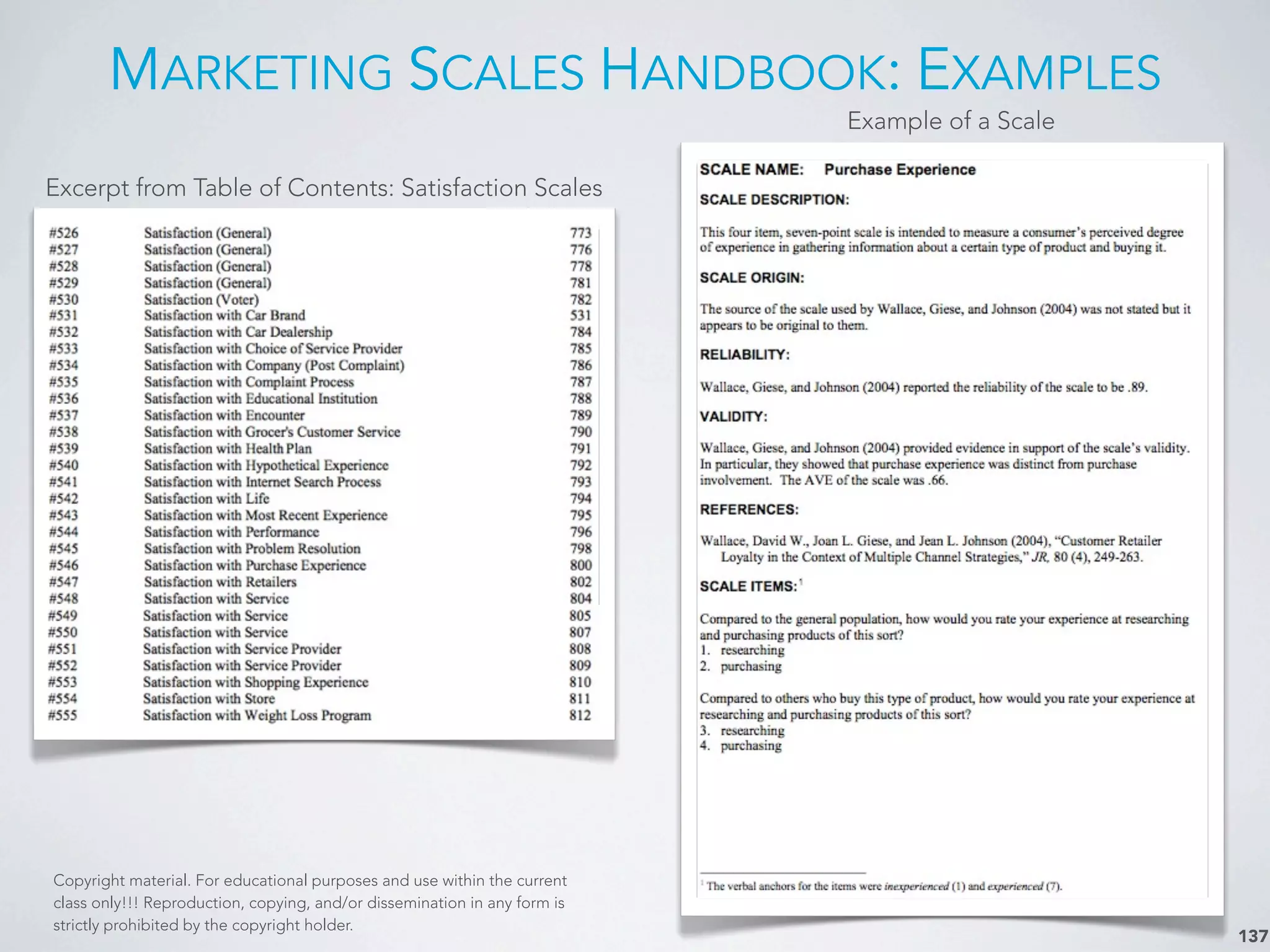
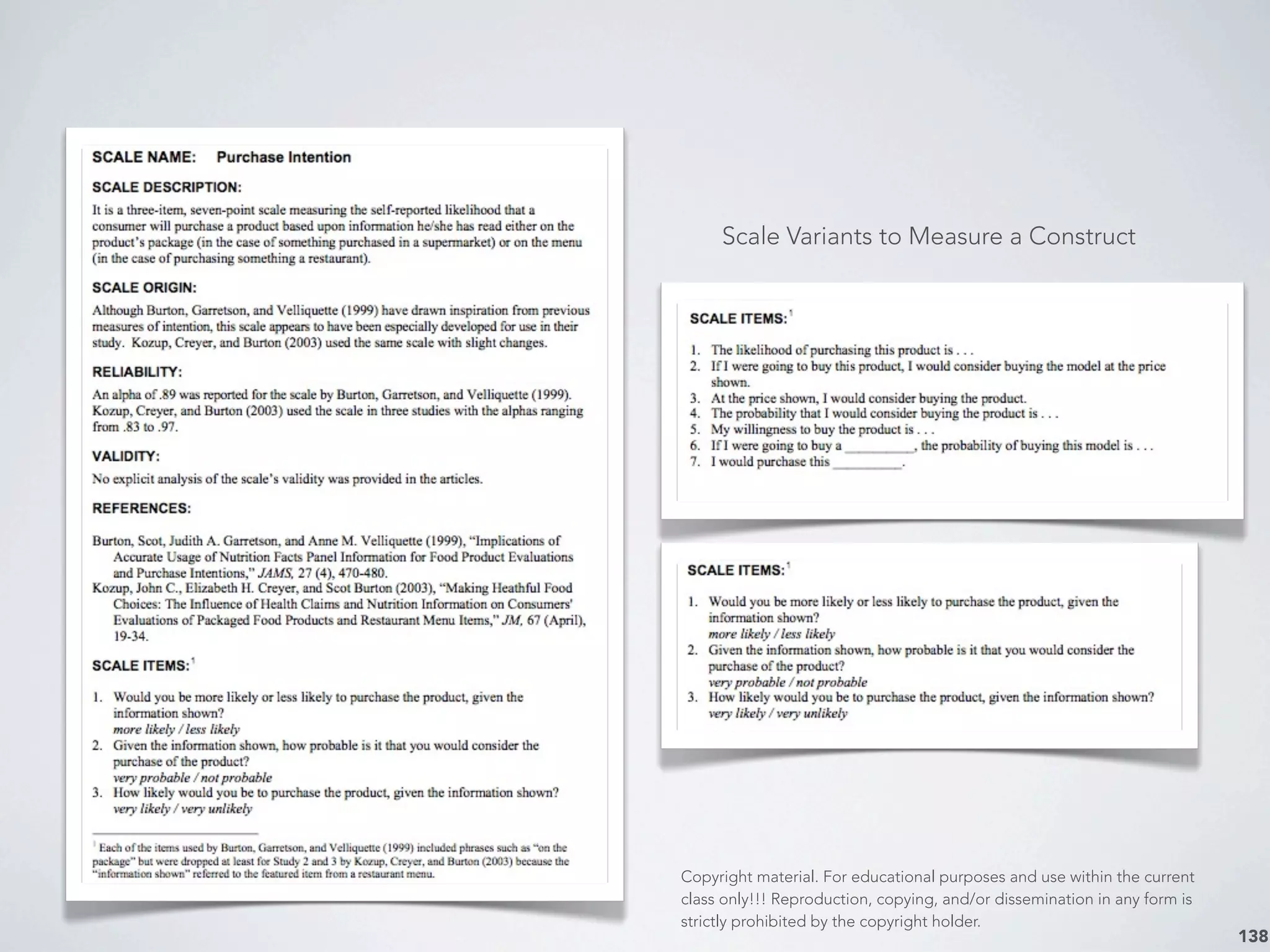
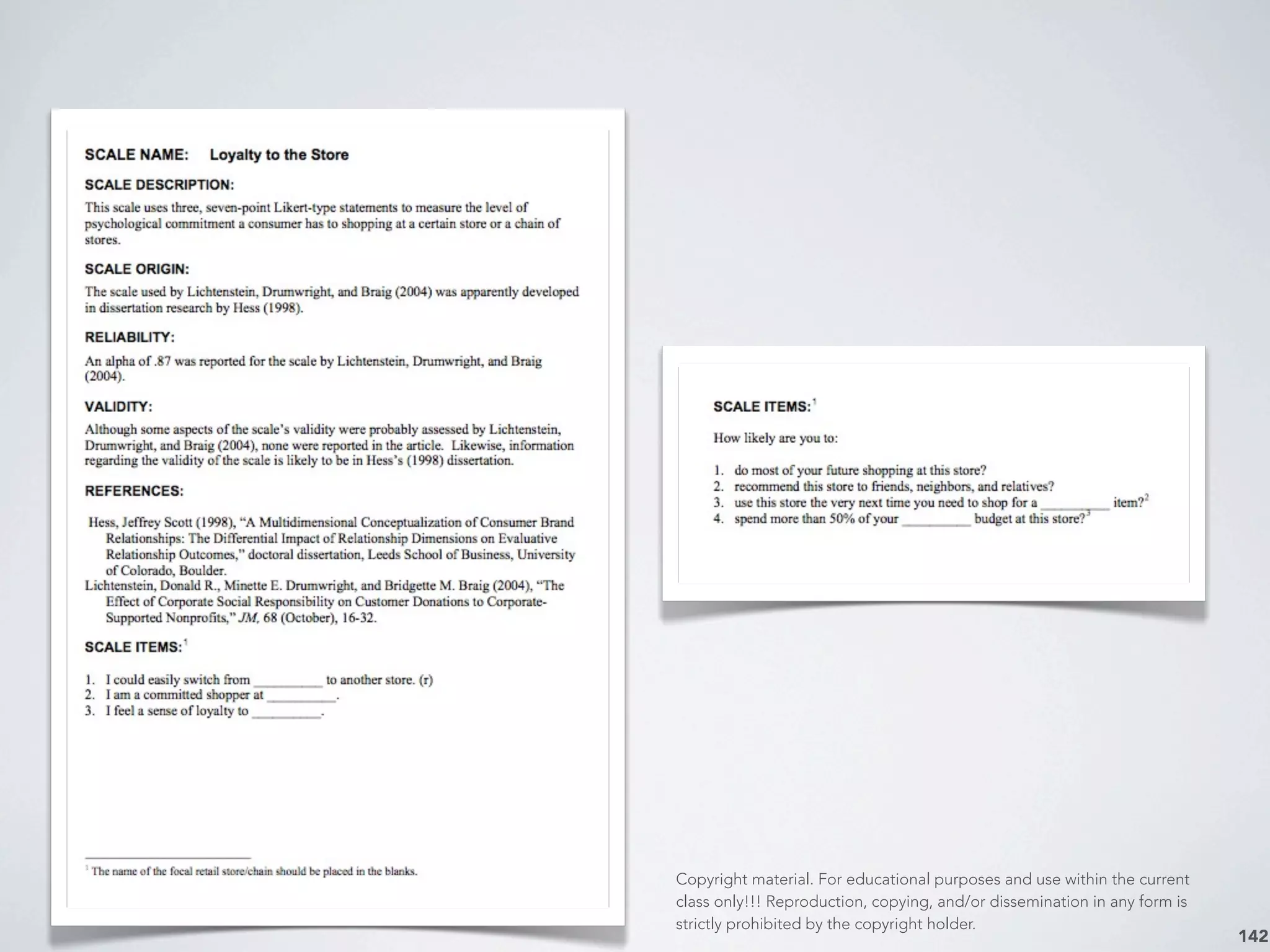
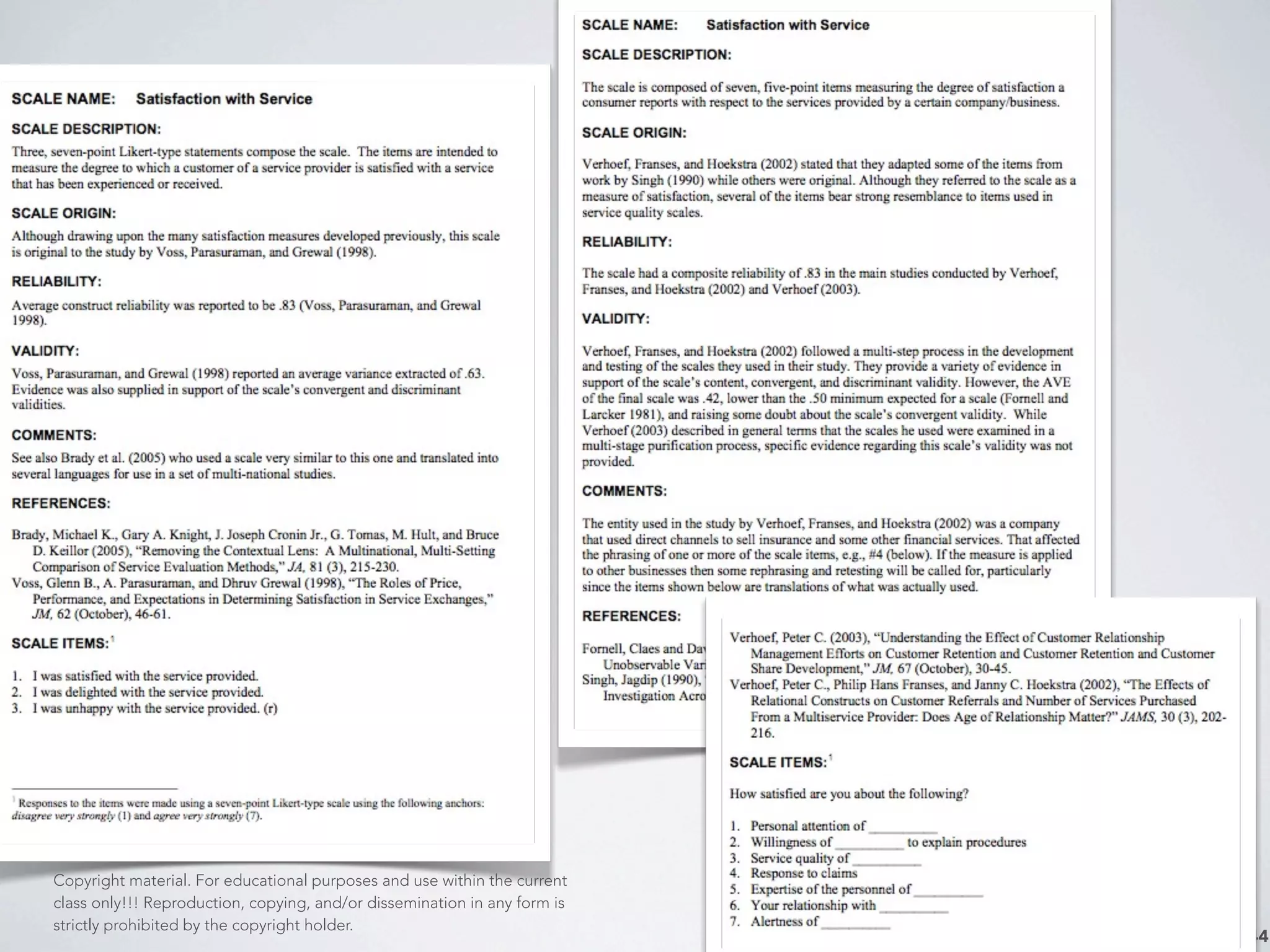
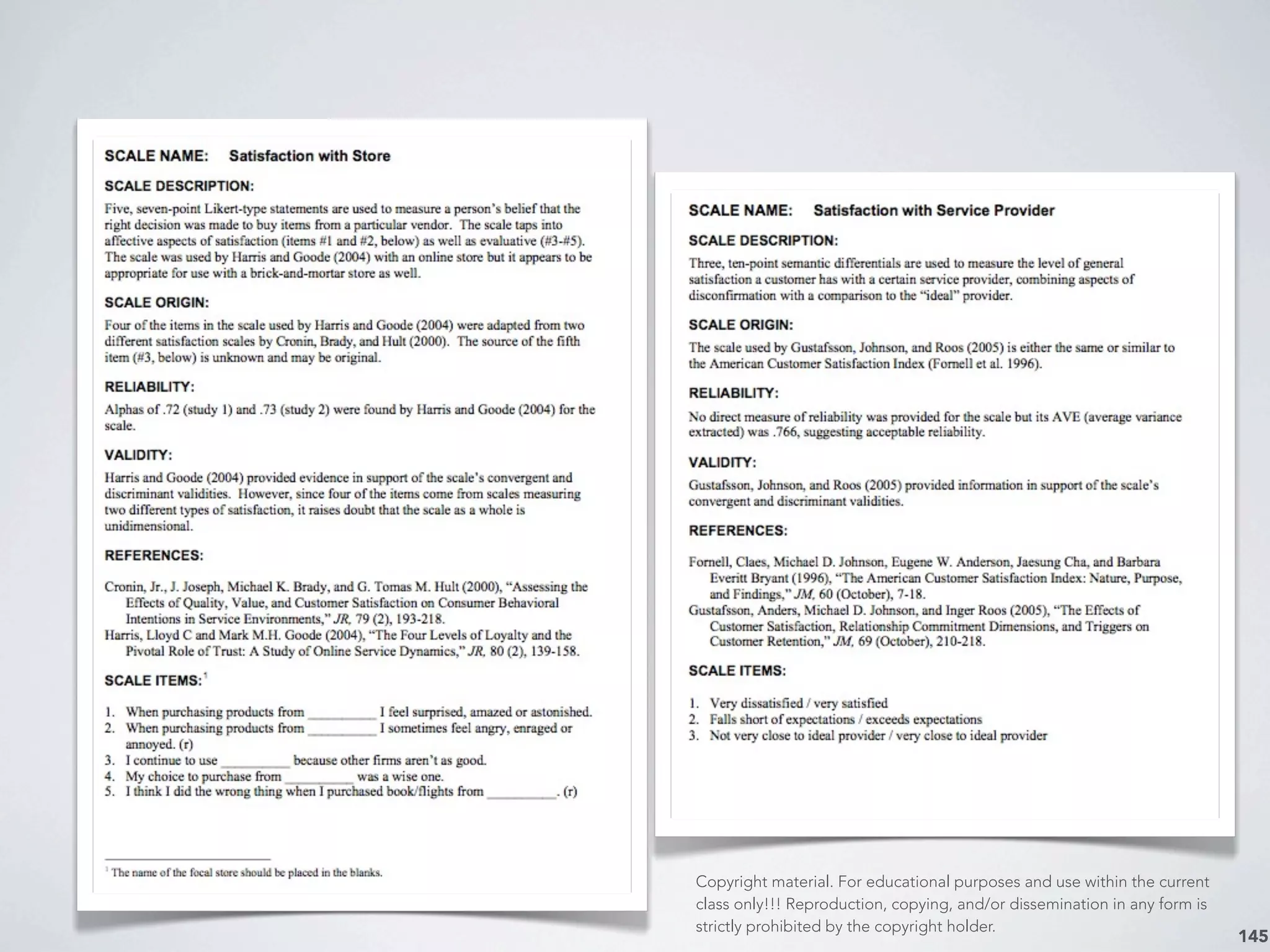
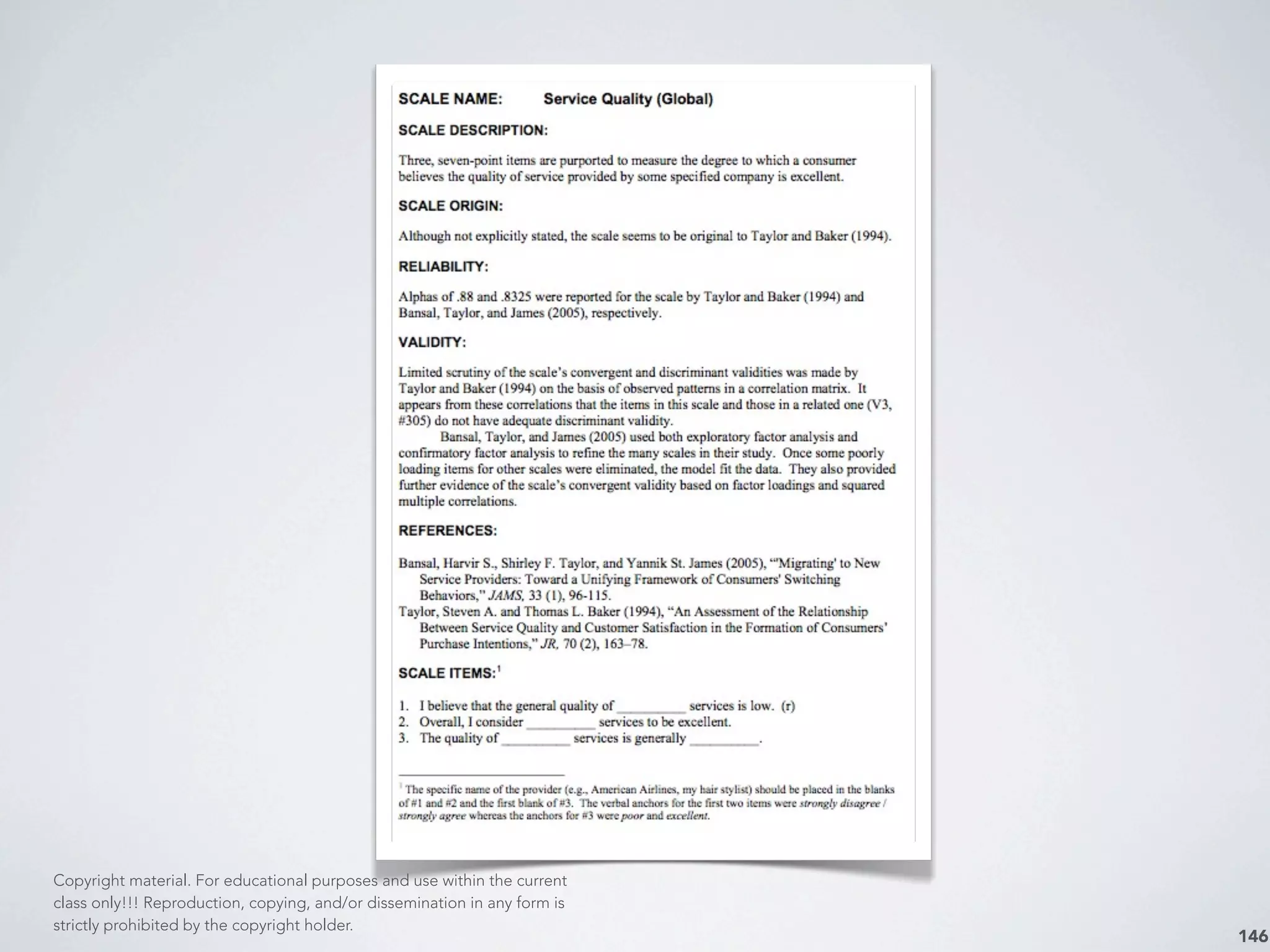
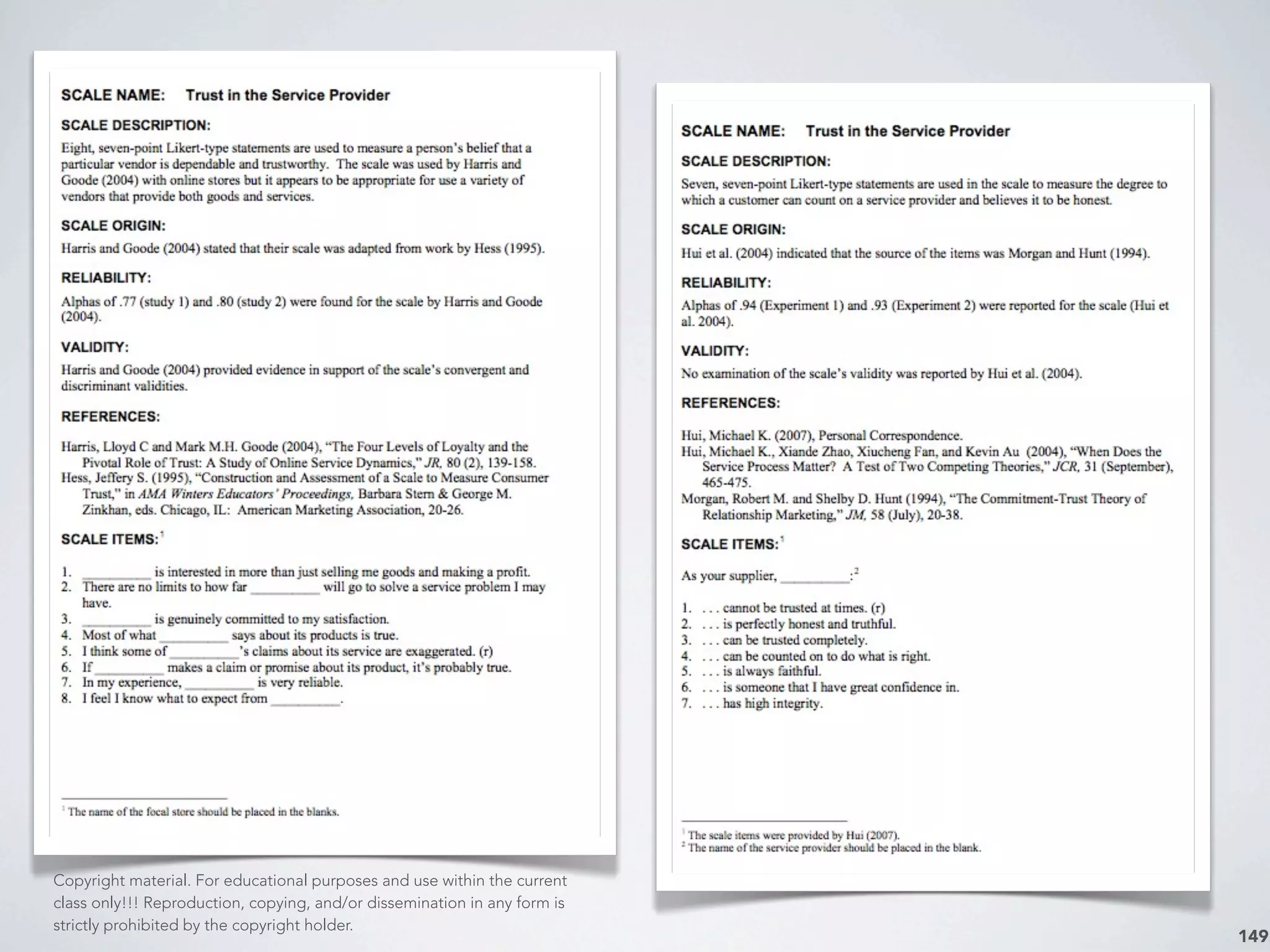
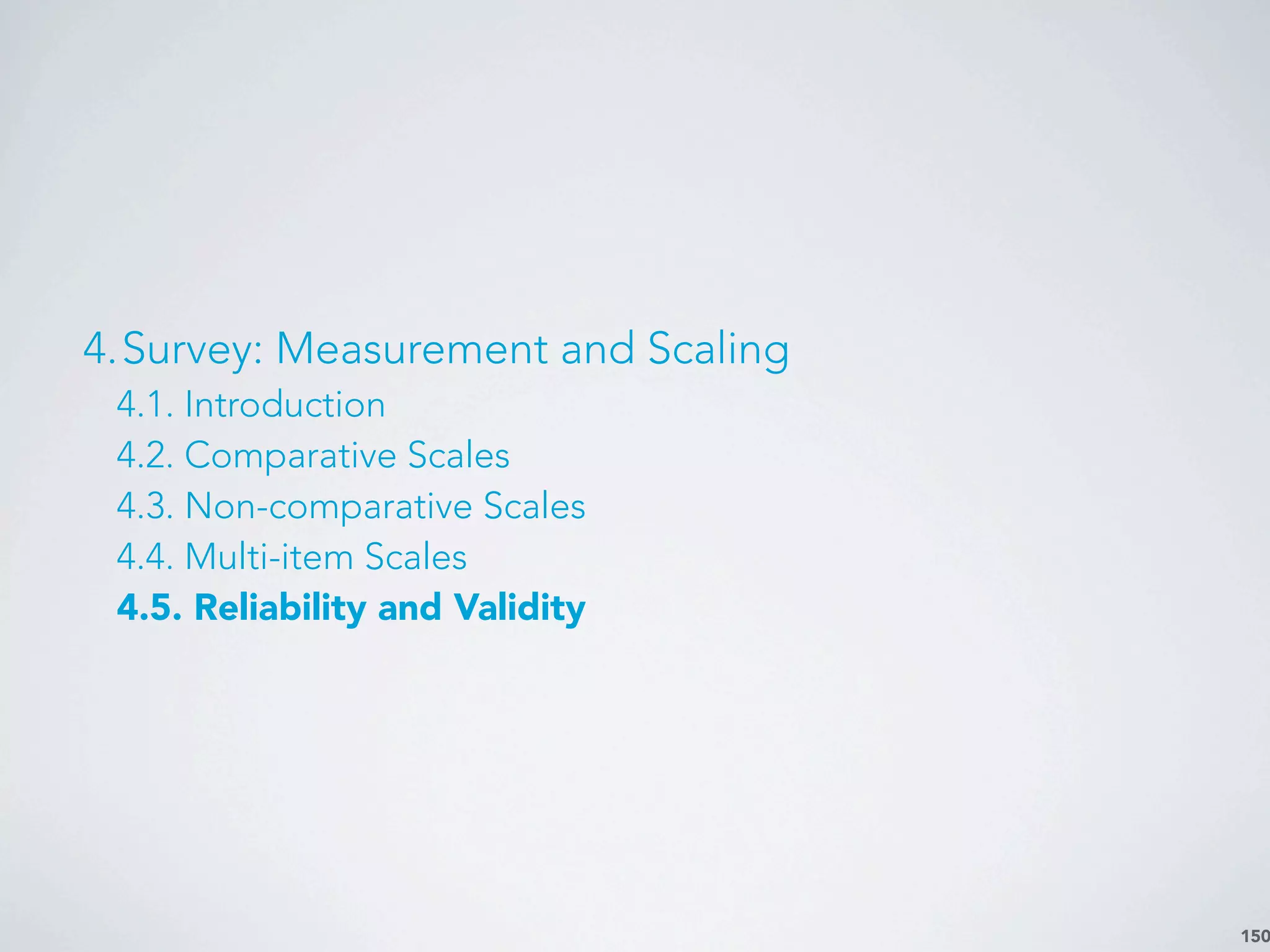
MARKETING SCALES HANDBOOK:EXAMPLES
137
Excerpt from Table of Contents: Satisfaction Scales
Example of a Scale
Copyright material. For educational purposes and use within the current
class only!!! Reproduction, copying, and/or dissemination in any form is
strictly prohibited by the copyright holder.
138.
138
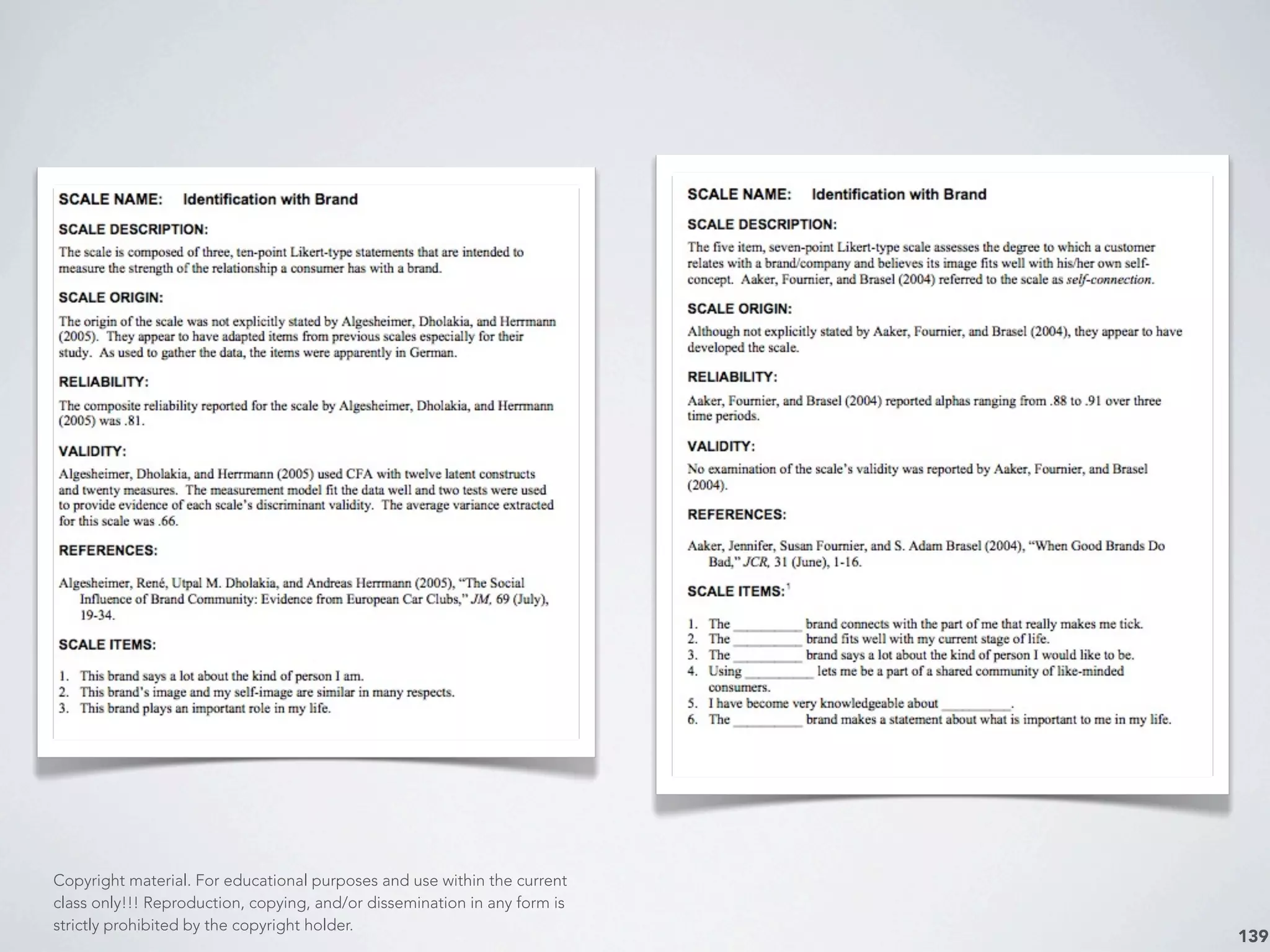
Scale Variants toMeasure a Construct
Copyright material. For educational purposes and use within the current
class only!!! Reproduction, copying, and/or dissemination in any form is
strictly prohibited by the copyright holder.
139.
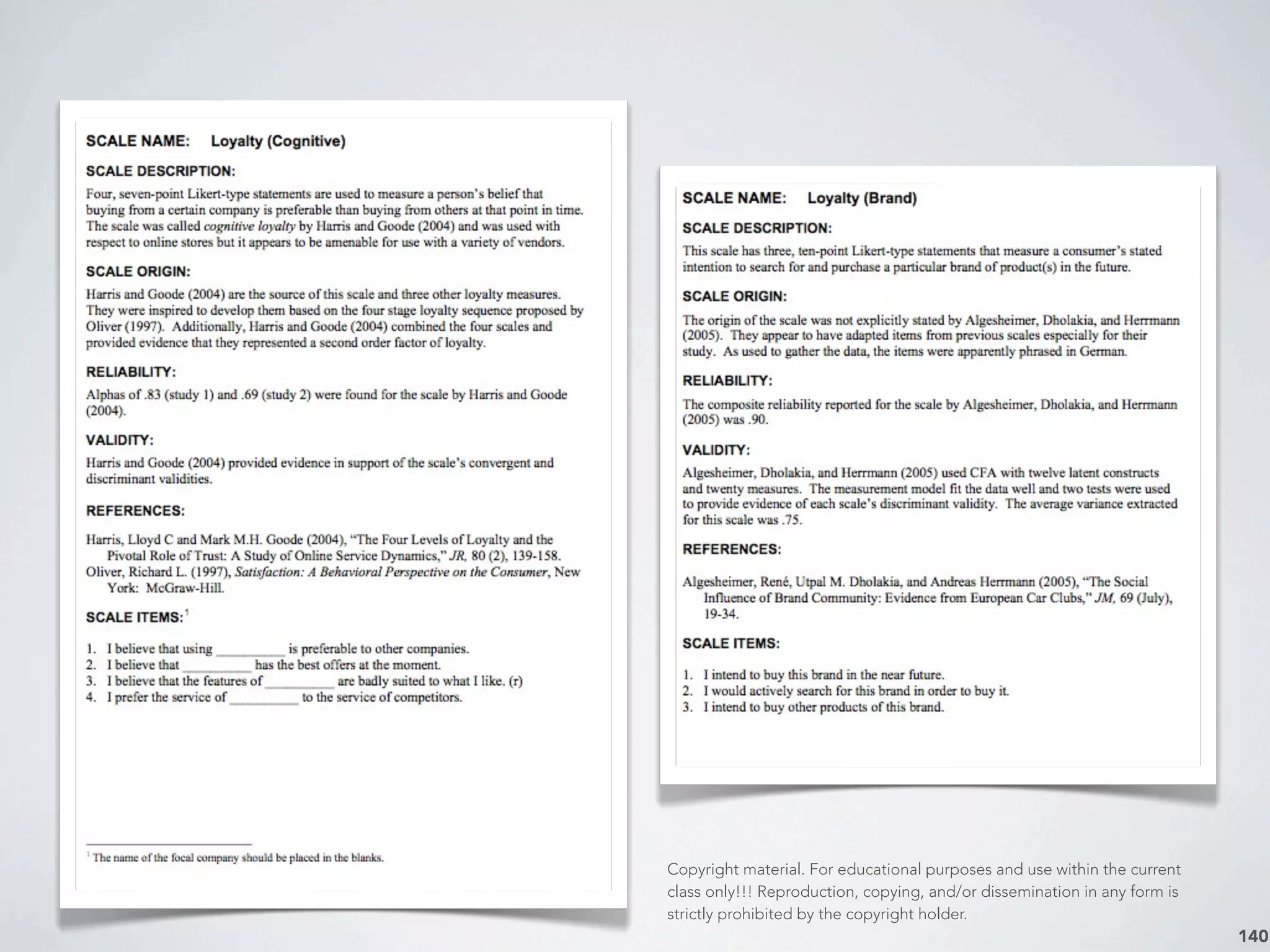
139
Copyright material. Foreducational purposes and use within the current
class only!!! Reproduction, copying, and/or dissemination in any form is
strictly prohibited by the copyright holder.
140.
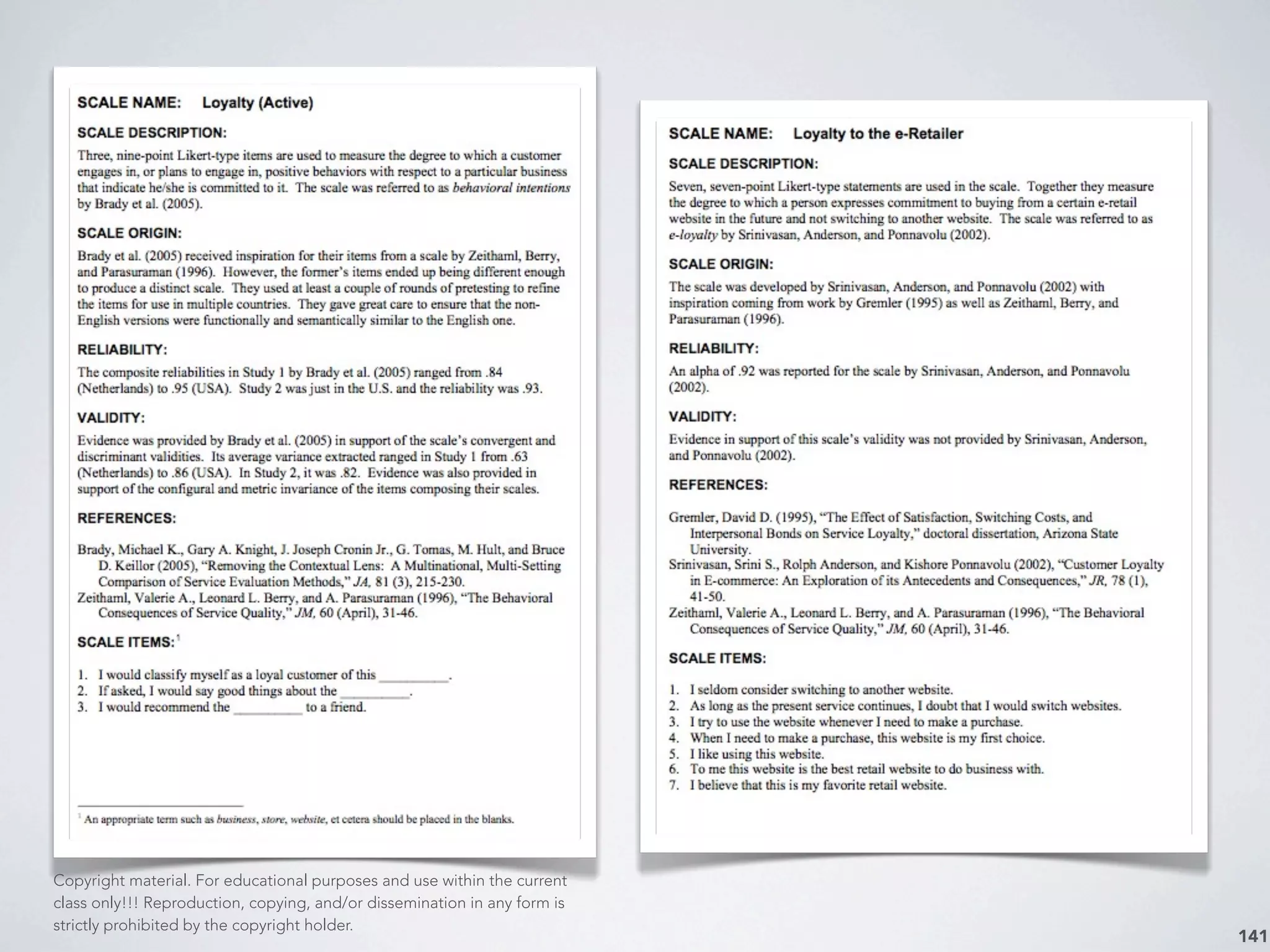
140
Copyright material. Foreducational purposes and use within the current
class only!!! Reproduction, copying, and/or dissemination in any form is
strictly prohibited by the copyright holder.
141.
141
Copyright material. Foreducational purposes and use within the current
class only!!! Reproduction, copying, and/or dissemination in any form is
strictly prohibited by the copyright holder.
142.
142
Copyright material. Foreducational purposes and use within the current
class only!!! Reproduction, copying, and/or dissemination in any form is
strictly prohibited by the copyright holder.
143.
143
Copyright material. Foreducational purposes and use within the current
class only!!! Reproduction, copying, and/or dissemination in any form is
strictly prohibited by the copyright holder.
144.
144
Copyright material. Foreducational purposes and use within the current
class only!!! Reproduction, copying, and/or dissemination in any form is
strictly prohibited by the copyright holder.
145.
145
Copyright material. Foreducational purposes and use within the current
class only!!! Reproduction, copying, and/or dissemination in any form is
strictly prohibited by the copyright holder.
146.
146
Copyright material. Foreducational purposes and use within the current
class only!!! Reproduction, copying, and/or dissemination in any form is
strictly prohibited by the copyright holder.
147.
147
Copyright material. Foreducational purposes and use within the current
class only!!! Reproduction, copying, and/or dissemination in any form is
strictly prohibited by the copyright holder.
148.
148
Copyright material. Foreducational purposes and use within the current
class only!!! Reproduction, copying, and/or dissemination in any form is
strictly prohibited by the copyright holder.
149.
149
Copyright material. Foreducational purposes and use within the current
class only!!! Reproduction, copying, and/or dissemination in any form is
strictly prohibited by the copyright holder.
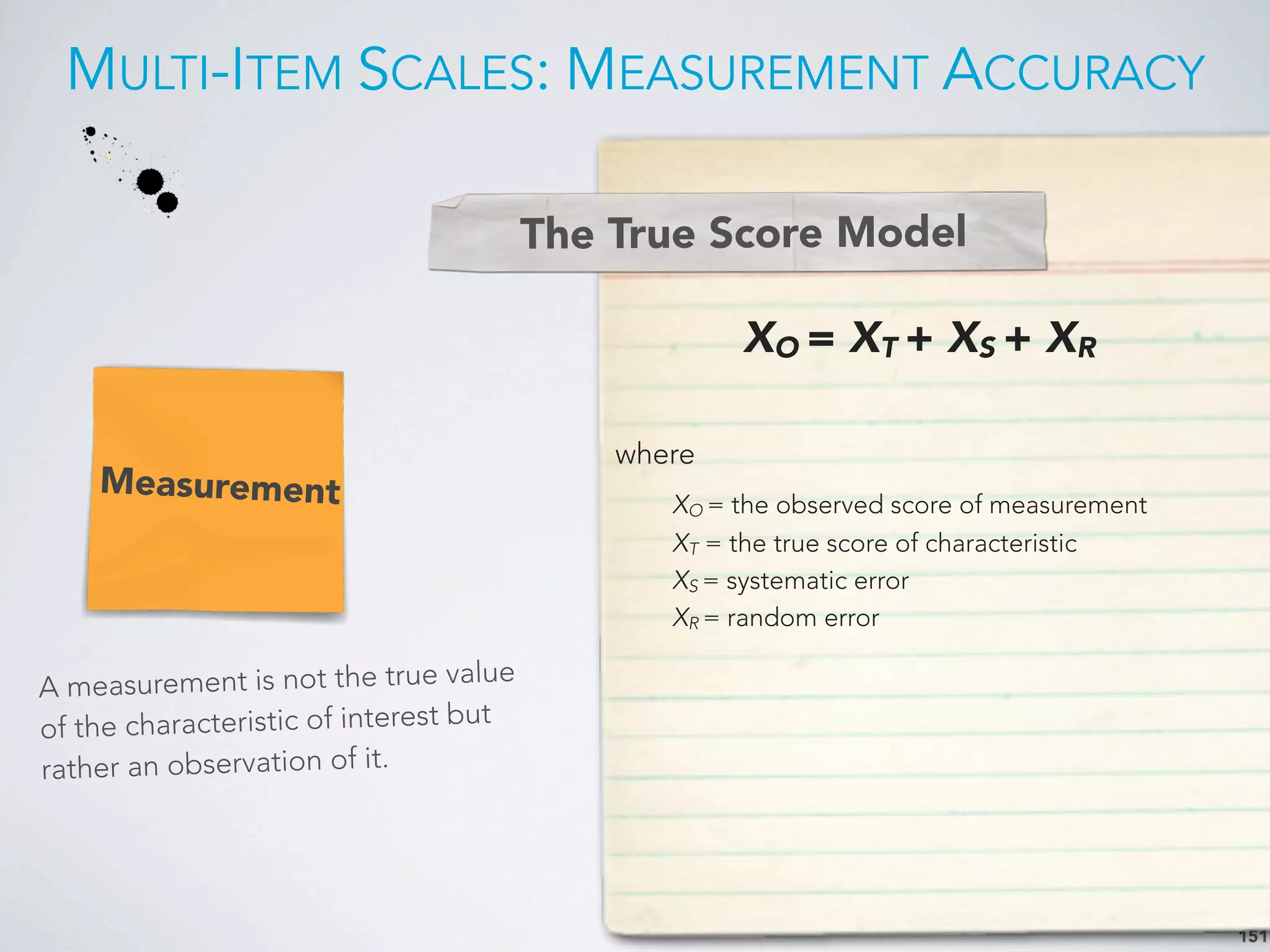
MULTI-ITEM SCALES: MEASUREMENTACCURACY
151
Measurement
A measurement is not the true value
of the characteristic of interest but
rather an observation of it.
XO = XT + XS + XR
where
XO = the observed score of measurement
XT = the true score of characteristic
XS = systematic error
XR = random error
The True Score Model
152.
RELIABILITY & VALIDITY
152
XO= XT + XS + XR
Reliability
extent to which a scale produces
consistent results in repeated
measurements
absence of random error ( XR → 0)
reliability of a multi-item scale is
denoted as Cronbach’s alpha
(0≥α≥1)
values of α≥0.7 are conside-
red satisfactory
Validity
extent to which differences in observed
scale scores reflect true differences
among objects on the characteristic
being measured
no measurement error
( XO → XT, XS → 0, XR → 0)
153.
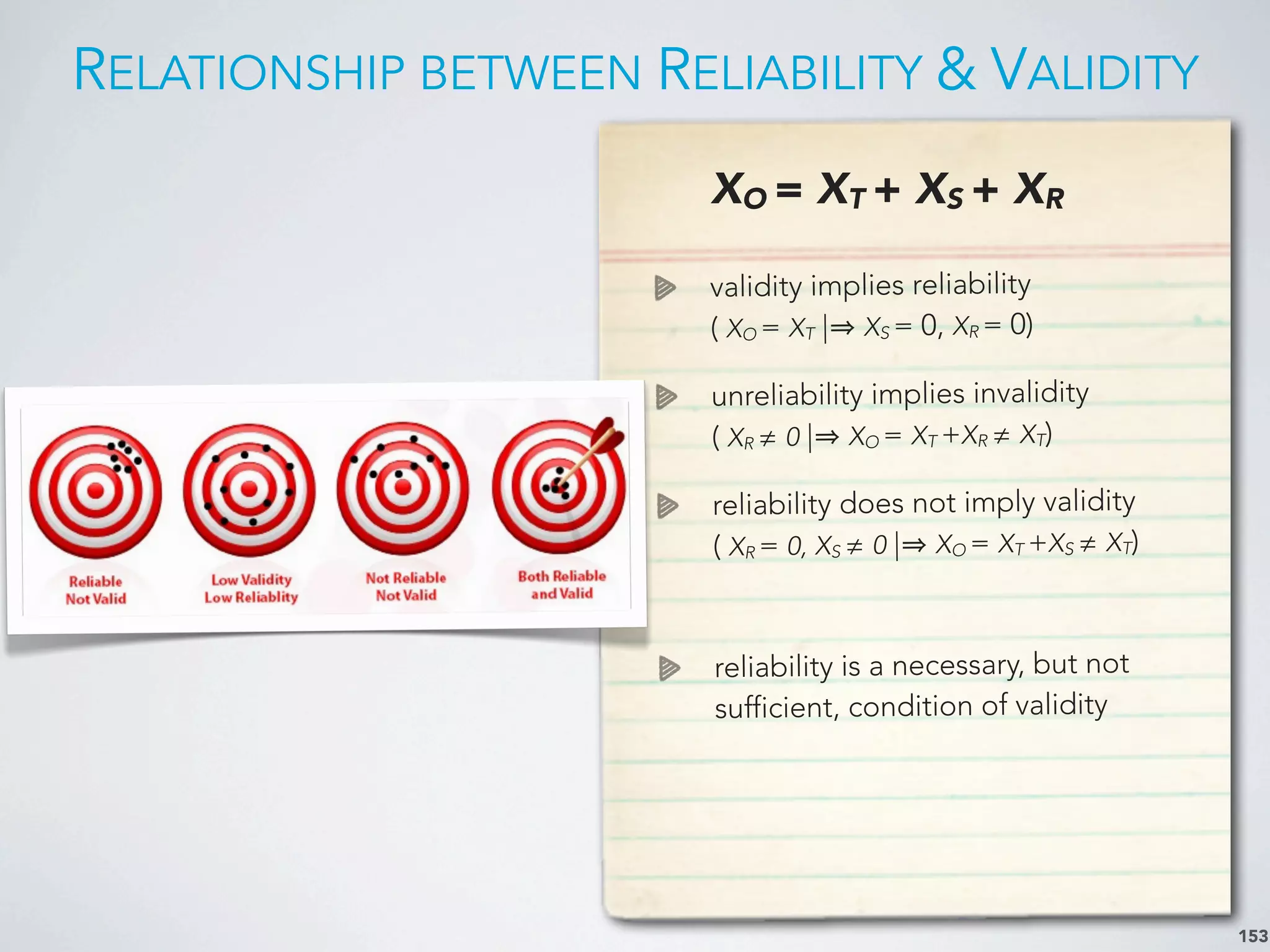
RELATIONSHIP BETWEEN RELIABILITY& VALIDITY
153
XO = XT + XS + XR
validity implies reliability
( XO = XT | XS = 0, XR = 0)
unreliability implies invalidity
( XR ≠ 0 | XO = XT +XR ≠ XT)
reliability does not imply validity
( XR = 0, XS ≠ 0 | XO = XT +XS ≠ XT)
reliability is a necessary, but not
sufficient, condition of validity
154.
“The purpose ofa scale is to allow us to represent
respondents with the highest accuracy and reliability.
We can’t have one without the other and still believe in
our data.”
Bart Gamble,
vice president,
client services,
Burke, Inc.
154
155.
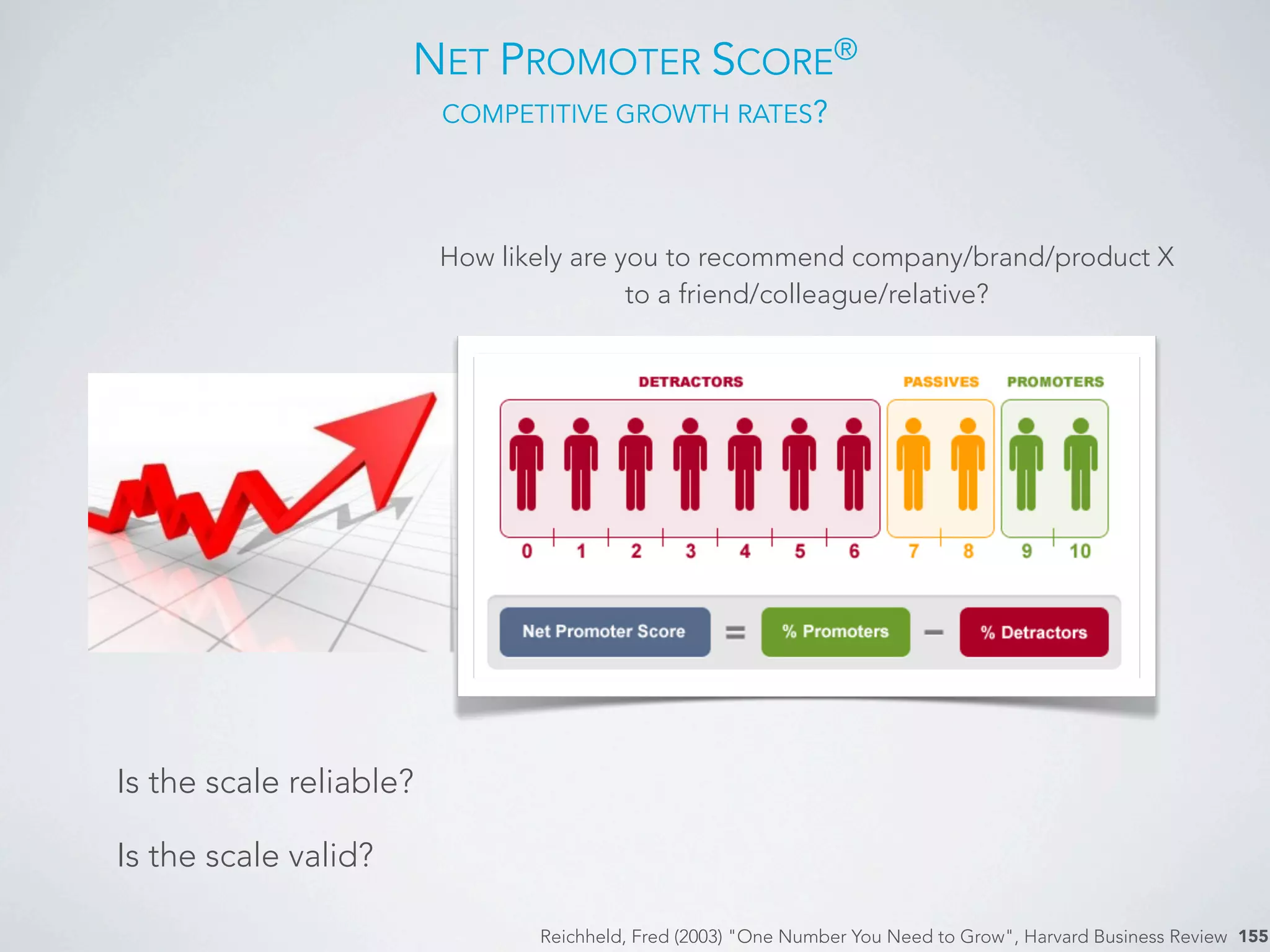
NET PROMOTER SCORE®
COMPETITIVEGROWTH RATES?
155
How likely are you to recommend company/brand/product X
to a friend/colleague/relative?
Reichheld, Fred (2003) "One Number You Need to Grow", Harvard Business Review
Is the scale valid?
Is the scale reliable?
156.
156
5.Questionnaire
5.1. Asking Questions
5.2.Overcoming Inability to Answer
5.3. Overcoming Unwillingness to Answer
5.4. Increasing Willingness of Respondents
5.5. Determining the Order of Questions
5.6. What’s Next?
157.
QUESTIONNAIRE
157
A Questionnaire
is aformalized set of questions for
obtaining information from respondents.
Objectives of a Questionnaire:
translate the information need into a set of
specific questions that the respondents can
and will answer
uplift, motivate, and encourage respondents
to become involved in the interview, to
cooperate, and to complete the interview
minimize response error
A Questionnaire
158.
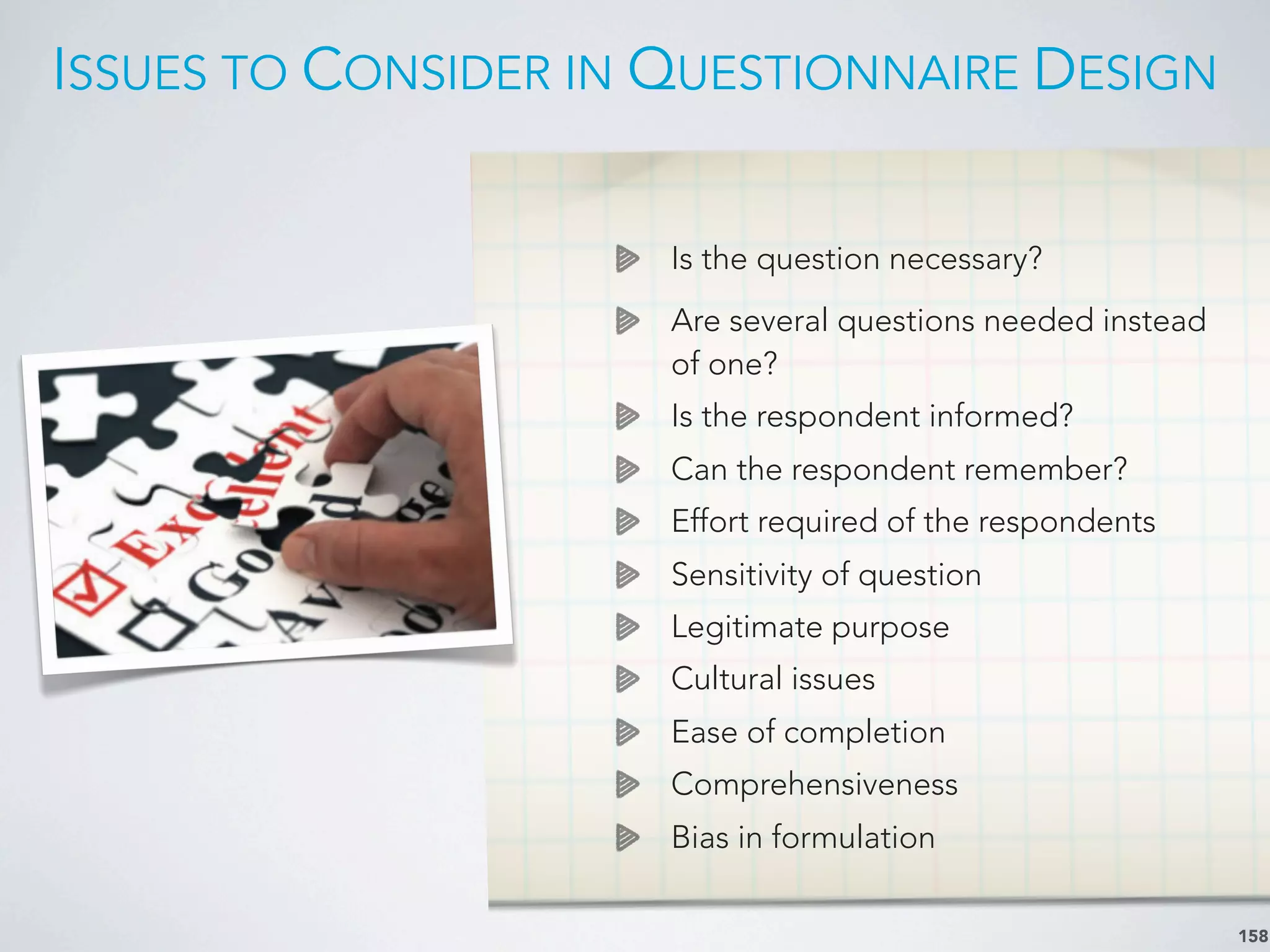
ISSUES TO CONSIDERIN QUESTIONNAIRE DESIGN
158
Is the question necessary?
Are several questions needed instead
of one?
Is the respondent informed?
Can the respondent remember?
Effort required of the respondents
Sensitivity of question
Legitimate purpose
Cultural issues
Ease of completion
Comprehensiveness
Bias in formulation
159.
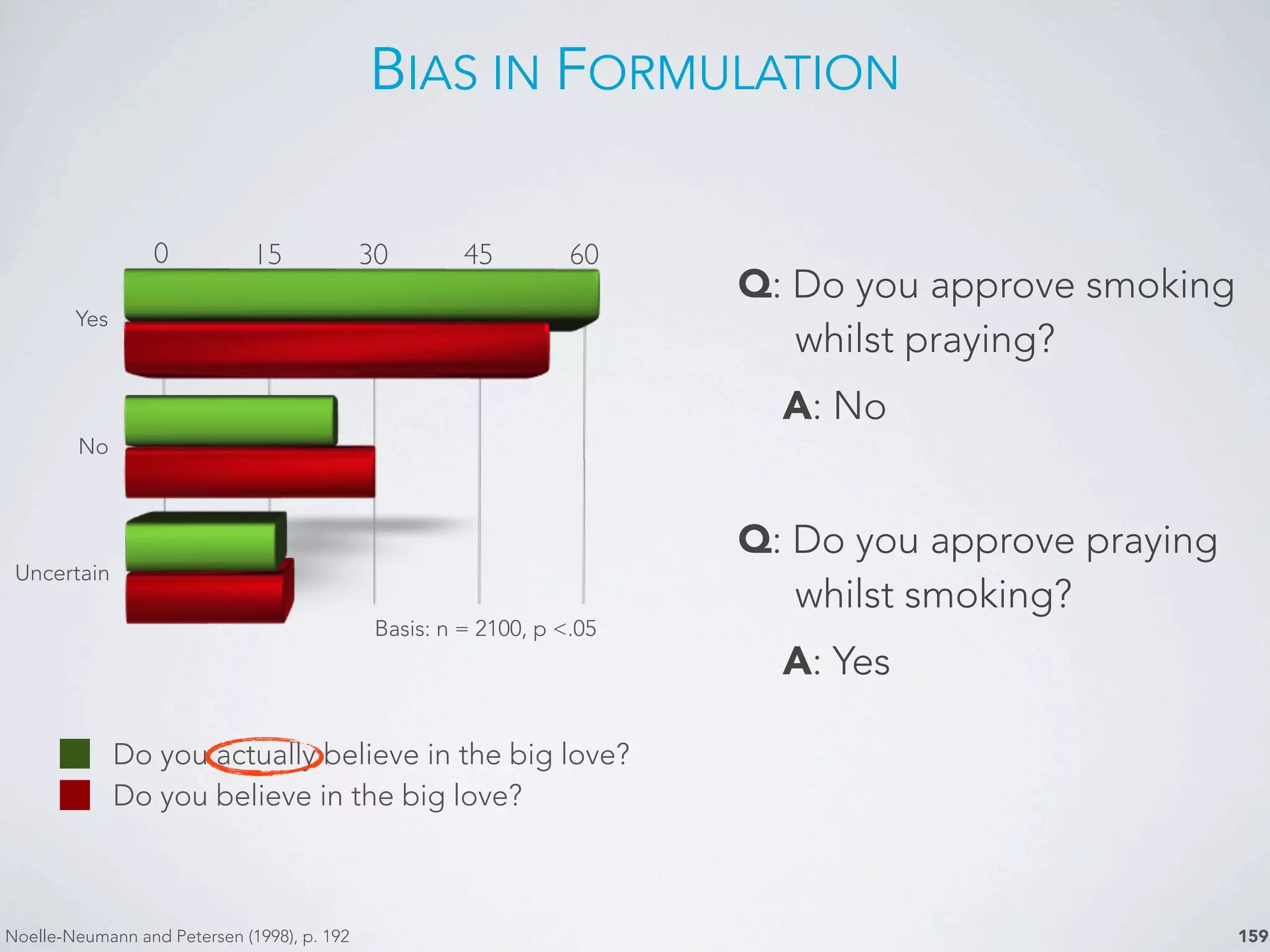
Do you actuallybelieve in the big love?
Do you believe in the big love?
BIAS IN FORMULATION
159
Q: Do you approve smoking
whilst praying?
A: No
Q: Do you approve praying
whilst smoking?
A: Yes
0 15 30 45 60
Yes
No
Uncertain
Basis: n = 2100, p <.05
Noelle-Neumann and Petersen (1998), p. 192
160.
160
5.Questionnaire
5.1. Asking Questions
5.2.Overcoming Inability to Answer
5.3. Overcoming Unwillingness to Answer
5.4. Increasing Willingness of Respondents
5.5. Determining the Order of Questions
5.6. What’s Next?
161.
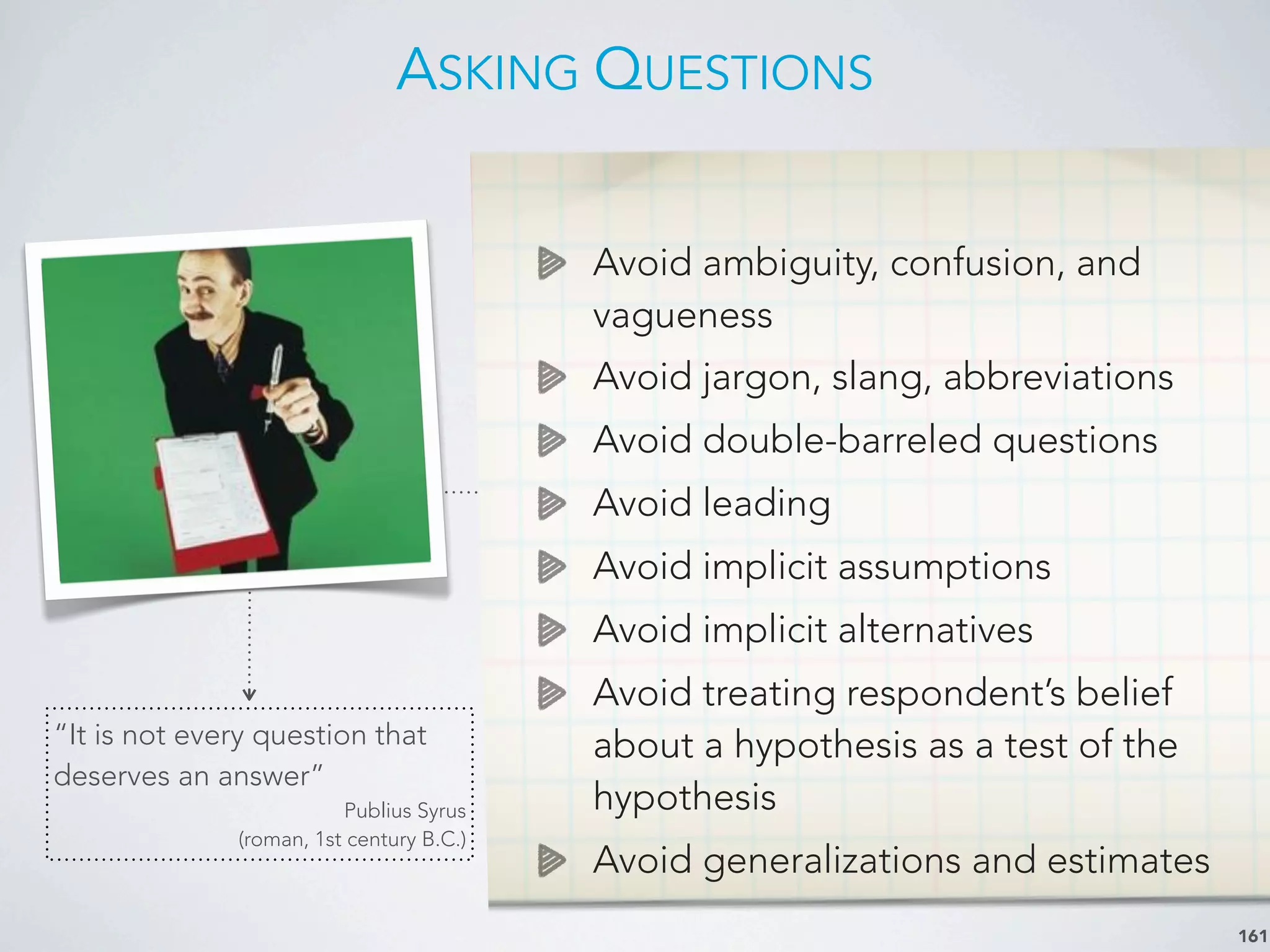
ASKING QUESTIONS
161
Avoid ambiguity,confusion, and
vagueness
Avoid jargon, slang, abbreviations
Avoid double-barreled questions
Avoid leading
Avoid implicit assumptions
Avoid implicit alternatives
Avoid treating respondent’s belief
about a hypothesis as a test of the
hypothesis
Avoid generalizations and estimates
“It is not every question that
deserves an answer”
Publius Syrus
(roman, 1st century B.C.)
162.
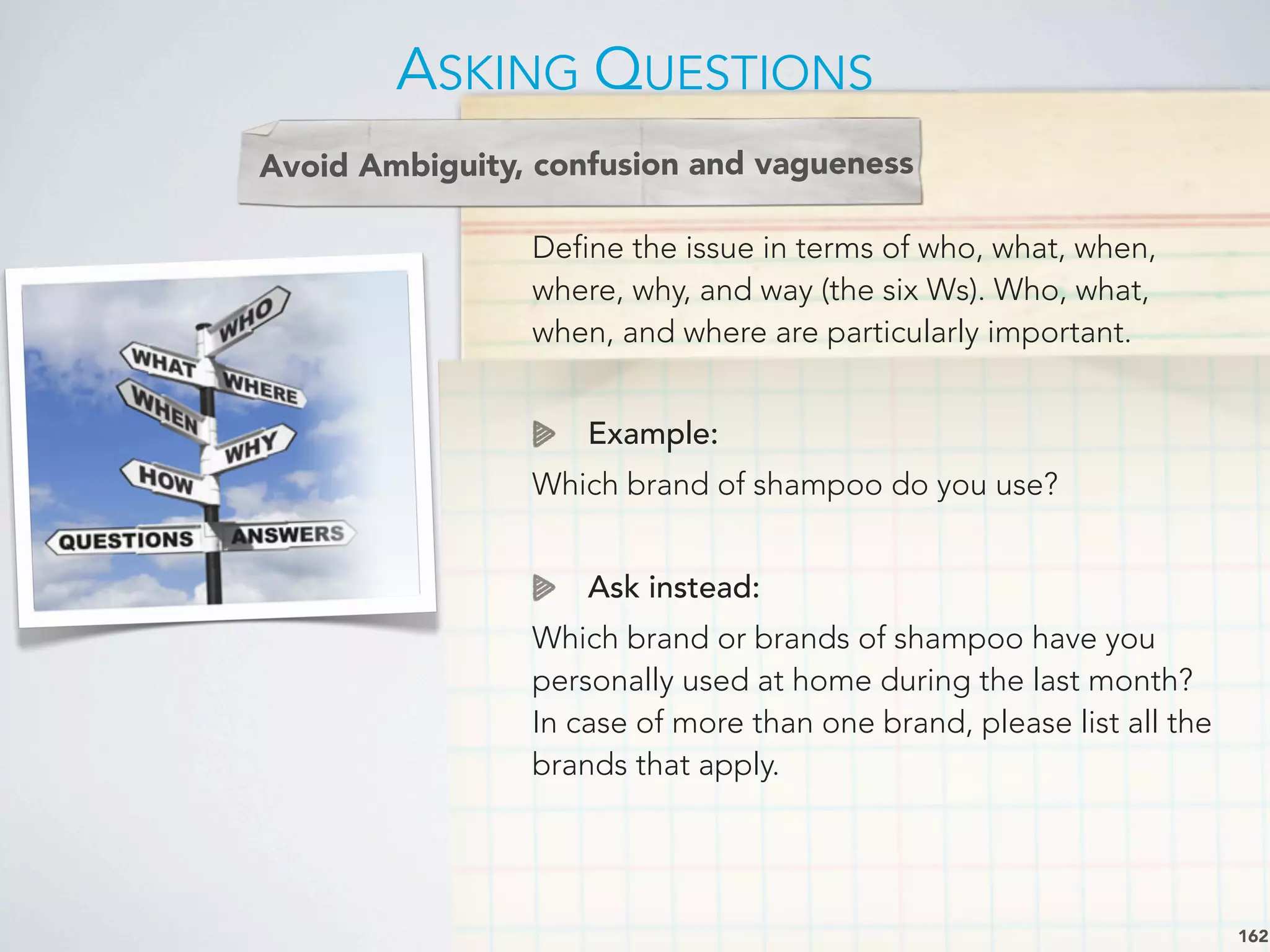
Define the issuein terms of who, what, when,
where, why, and way (the six Ws). Who, what,
when, and where are particularly important.
Example:
Which brand of shampoo do you use?
Ask instead:
Which brand or brands of shampoo have you
personally used at home during the last month?
In case of more than one brand, please list all the
brands that apply.
Avoid Ambiguity, confusion and vagueness
ASKING QUESTIONS
162
163.
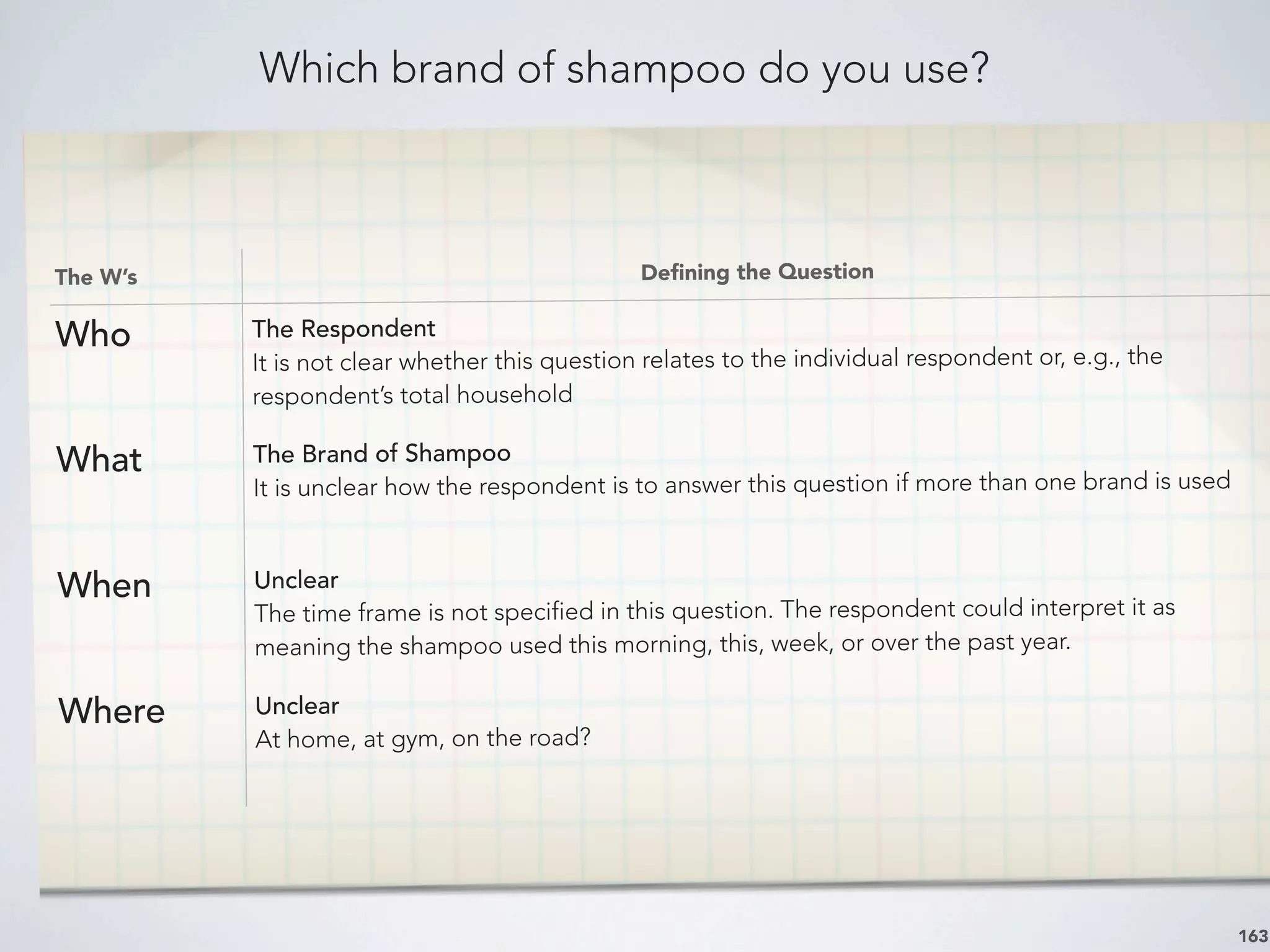
The W’s Definingthe Question
Who The Respondent
It is not clear whether this question relates to the individual respondent or, e.g., the
respondent’s total household
What The Brand of Shampoo
It is unclear how the respondent is to answer this question if more than one brand is used
When Unclear
The time frame is not specified in this question. The respondent could interpret it as
meaning the shampoo used this morning, this, week, or over the past year.
Where Unclear
At home, at gym, on the road?
163
Which brand of shampoo do you use?
164.
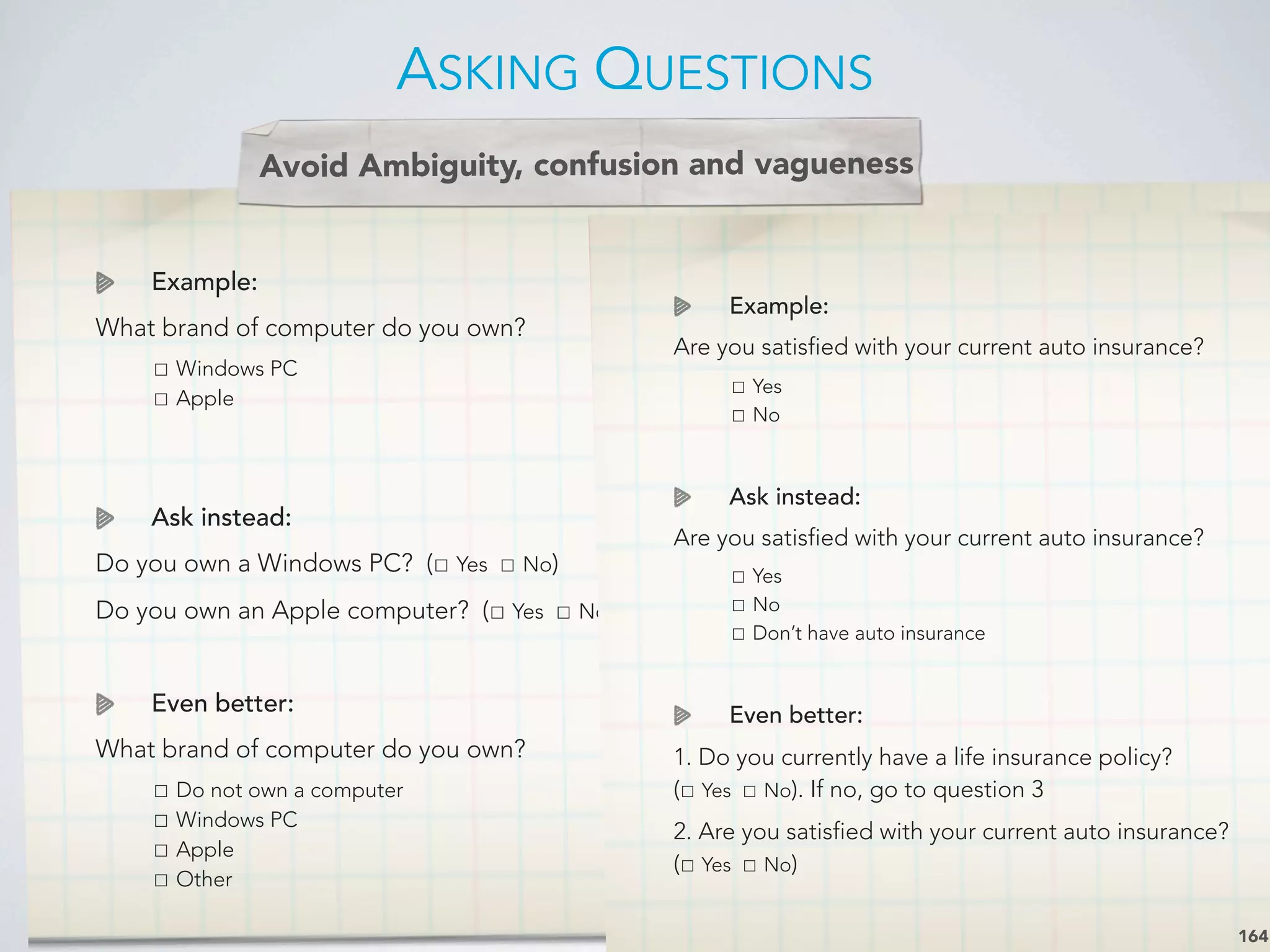
Example:
What brand ofcomputer do you own?
☐ Windows PC
☐ Apple
Ask instead:
Do you own a Windows PC? (☐ Yes ☐ No)
Do you own an Apple computer? (☐ Yes ☐ No)
Even better:
What brand of computer do you own?
☐ Do not own a computer
☐ Windows PC
☐ Apple
☐ Other
Avoid Ambiguity, confusion and vagueness
Example:
Are you satisfied with your current auto insurance?
☐ Yes
☐ No
Ask instead:
Are you satisfied with your current auto insurance?
☐ Yes
☐ No
☐ Don’t have auto insurance
Even better:
1. Do you currently have a life insurance policy?
(☐ Yes ☐ No). If no, go to question 3
2. Are you satisfied with your current auto insurance?
(☐ Yes ☐ No)
ASKING QUESTIONS
164
165.
Example:
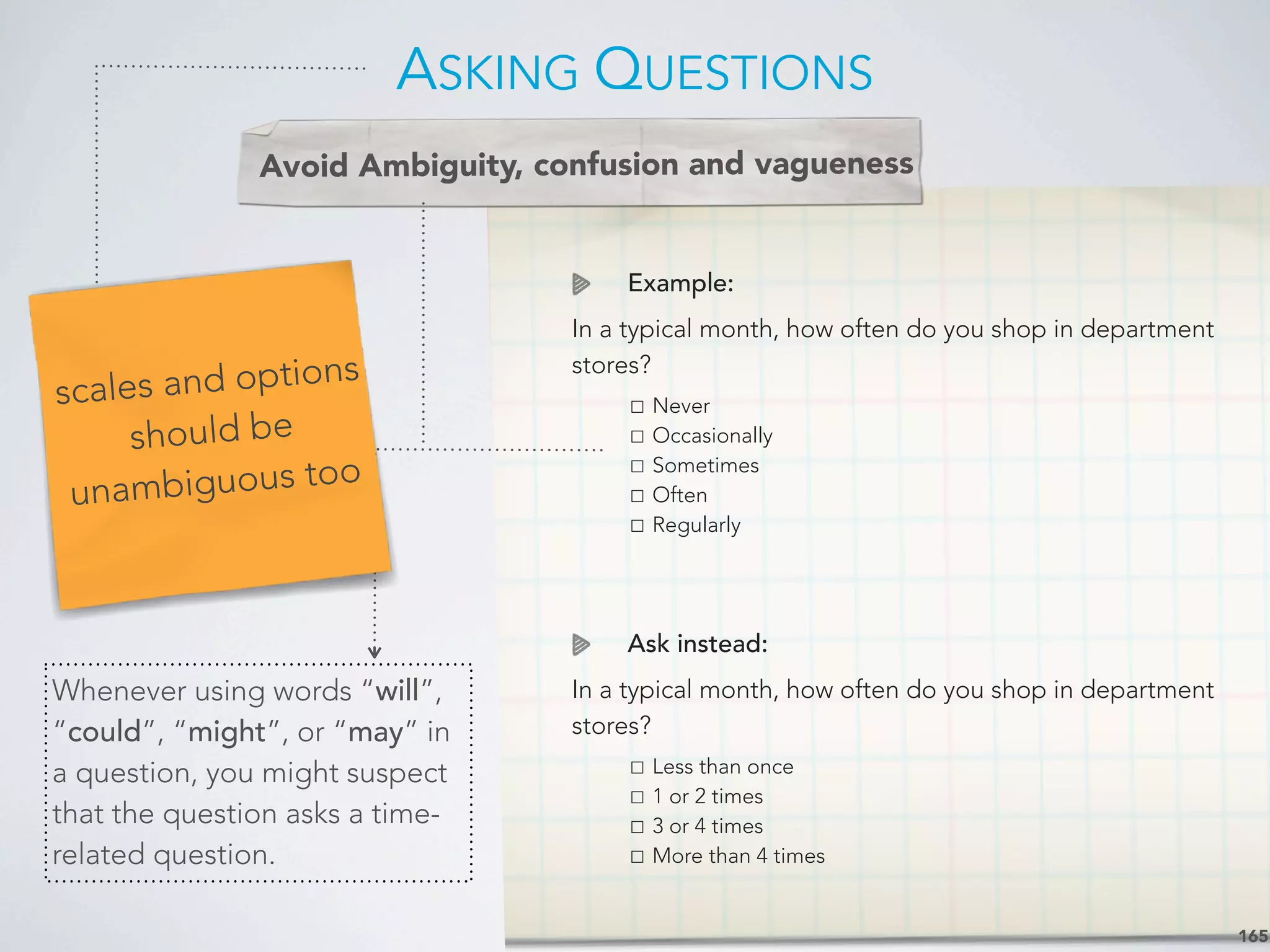
In a typicalmonth, how often do you shop in department
stores?
☐ Never
☐ Occasionally
☐ Sometimes
☐ Often
☐ Regularly
Ask instead:
In a typical month, how often do you shop in department
stores?
☐ Less than once
☐ 1 or 2 times
☐ 3 or 4 times
☐ More than 4 times
Avoid Ambiguity, confusion and vagueness
ASKING QUESTIONS
165
Whenever using words “will”,
“could”, “might”, or “may” in
a question, you might suspect
that the question asks a time-
related question.
scales and options
should be
unambiguous too
166.
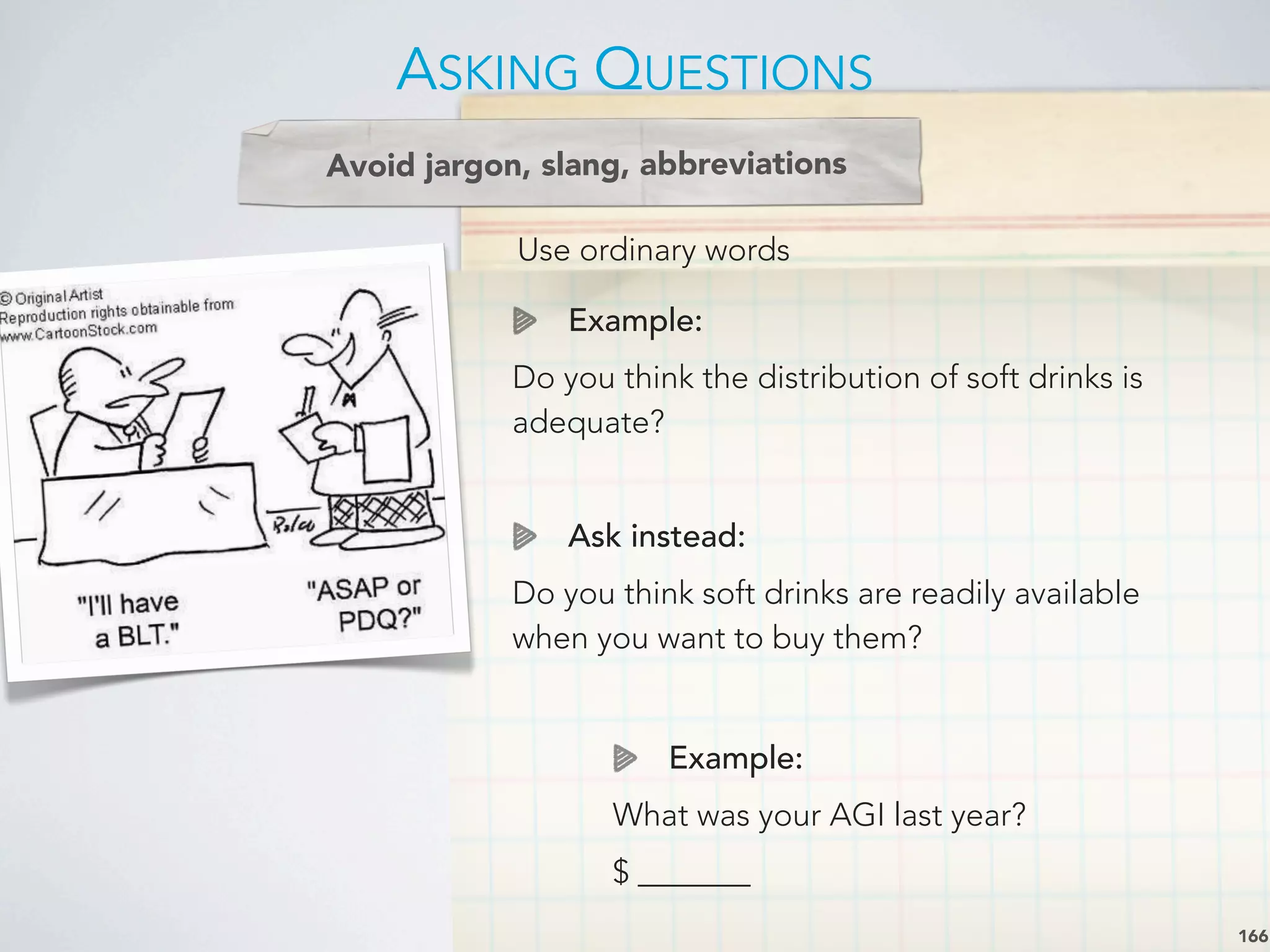
Use ordinary words
Avoidjargon, slang, abbreviations
Example:
Do you think the distribution of soft drinks is
adequate?
Ask instead:
Do you think soft drinks are readily available
when you want to buy them?
ASKING QUESTIONS
166
Example:
What was your AGI last year?
$ _______
167.
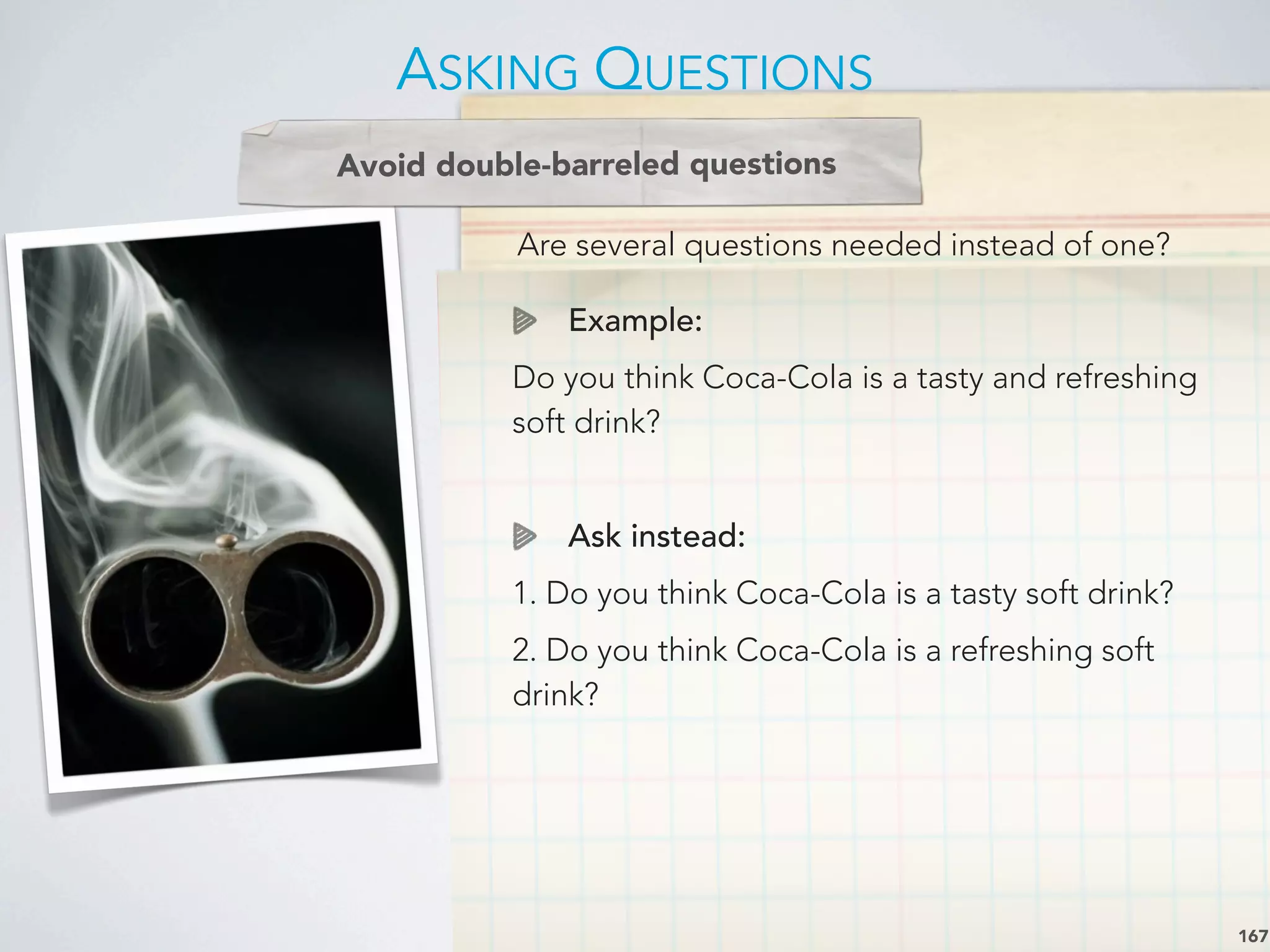
Are several questionsneeded instead of one?
Avoid double-barreled questions
Example:
Do you think Coca-Cola is a tasty and refreshing
soft drink?
Ask instead:
1. Do you think Coca-Cola is a tasty soft drink?
2. Do you think Coca-Cola is a refreshing soft
drink?
ASKING QUESTIONS
167
168.
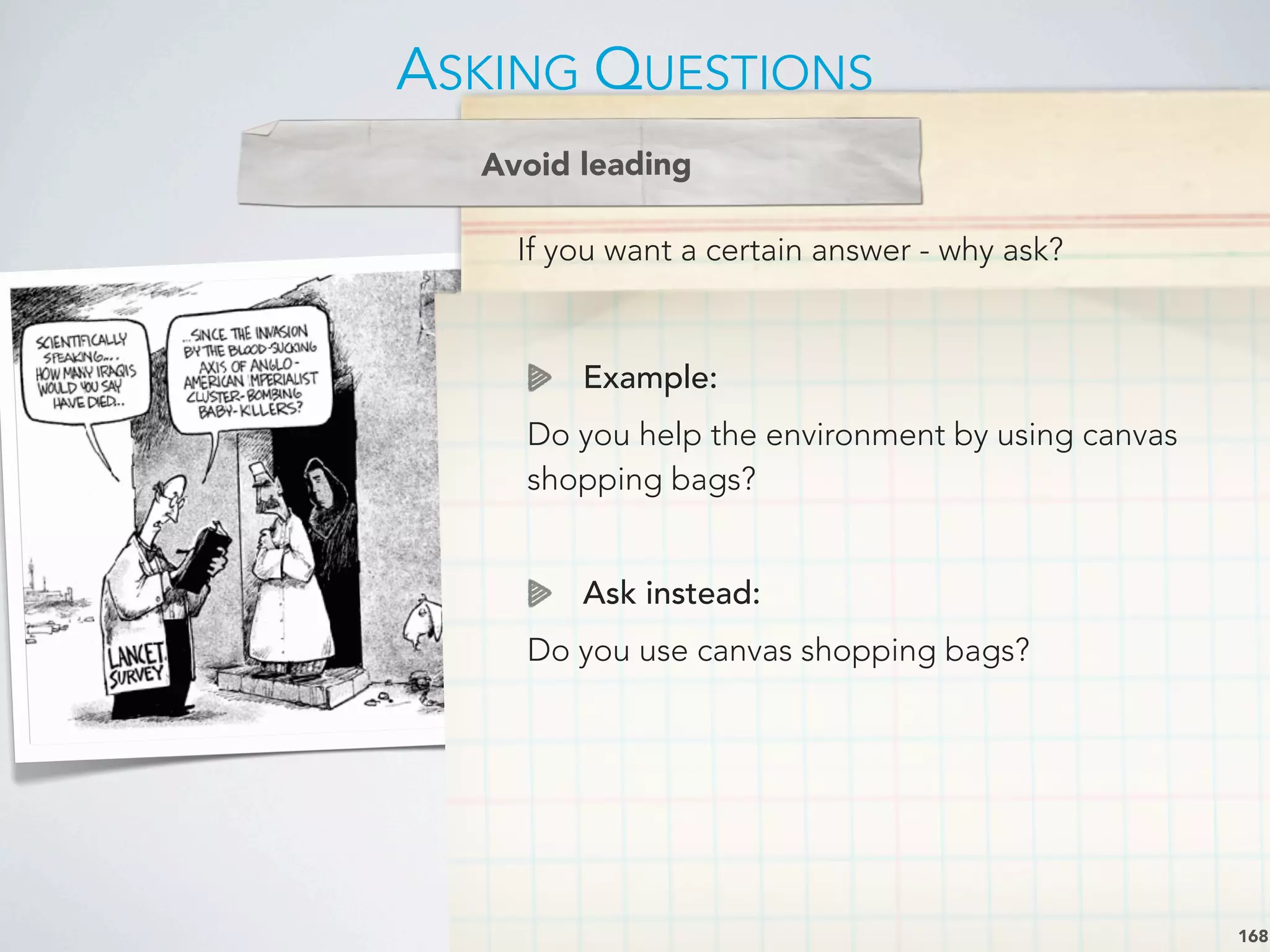
If you wanta certain answer - why ask?
Avoid leading
Example:
Do you help the environment by using canvas
shopping bags?
Ask instead:
Do you use canvas shopping bags?
ASKING QUESTIONS
168
169.
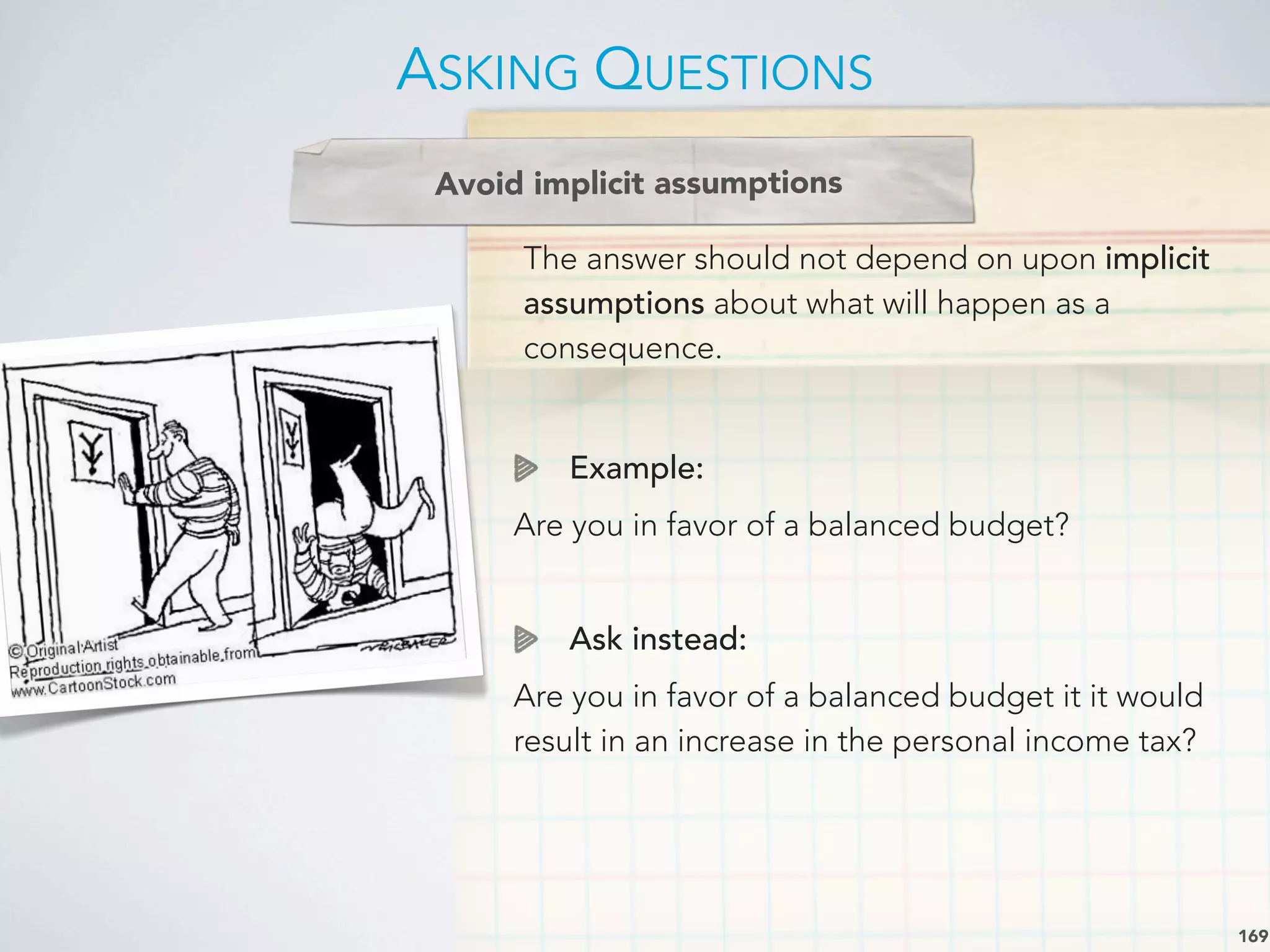
The answer shouldnot depend on upon implicit
assumptions about what will happen as a
consequence.
Example:
Are you in favor of a balanced budget?
Ask instead:
Are you in favor of a balanced budget it it would
result in an increase in the personal income tax?
ASKING QUESTIONS
169
Avoid implicit assumptions
170.
An alternative thatis not explicitly expressed in the
options is an implicit alternative.
ASKING QUESTIONS
170
Avoid implicit alternatives
Example:
Do you like to fly when traveling short distances?
Ask instead:
Do you like to fly when traveling short distances, or
would you rather drive?
171.
Beliefs are onlya biased representation of reality
Example:
Do you think more educated people wear fur
clothing?
Ask instead:
1. What is your education level?
2. Do you wear fur clothing?
ASKING QUESTIONS
171
Avoid treating beliefs as real facts
172.
Don’t task respondents’memory and math skills
Example:
What is the annual per capita expenditure on
groceries in your household?
Ask instead:
1. What is the monthly (or weekly) expenditure on
groceries in your household?
2. How many member are there in your household?
ASKING QUESTIONS
172
Avoid generalizations and estimates
173.
173
5.Questionnaire
5.1. Asking Questions
5.2.Overcoming Inability to Answer
5.3. Overcoming Unwillingness to Answer
5.4. Increasing Willingness of Respondents
5.5. Determining the Order of Questions
5.6. What’s Next?
174.
OVERCOMING INABILITY TOANSWER
174
Can the Respondent Remember?
Can the Respondent Articulate?
Is the Respondent Informed?
175.
Respondents will oftenanswer questions even
though they are not informed
Example:
Please indicate how strongly you agree or disagree with the
following statement:
“The National Bureau of Consumer Complaints provides an
effective means for consumers who have purchased a
defective product to obtain relief”
51.9% of the lawyers and 75% of the public expressed
their opinion, although there is no such entity as the
NBCC
Use Filter Questions
e.g. ask about familiarity and/or frequency of
patronage in a study of 10 department stores
Use “don’t know” Option
OVERCOMING INABILITY TO ANSWER
175
Is the Respondent Informed?
176.
The inability toremember leads to errors of
omission, telescoping, and creation
Example:
How many liters of soft drinks did you consume during
the last four weeks?
Ask instead:
How often do you consume soft drinks in a typical week?
☐ Less than once a week
☐ 1 to 3 times per week
☐ 4 or 6 times per week
☐ 7 or more times per week
Use aided recall approach (where appropriate)
“What brands of soft drinks do you remember being advertised
last night on TV?”
vs
“Which of these brands were advertised last night on TV?”
OVERCOMING INABILITY TO ANSWER
176
Can the Respondent Remember?
177.
If unable toarticulate their responses, respondents
are likely to ignore the question and quit the survey
Example:
If asked to describe the atmosphere of the
department store they would prefer to
patronage, most respondents may be unable to
phrase their answers.
Provide aids, e.g., pictures, maps,
descriptions
If the respondents are given alternative
descriptions of store atmosphere, they will be
able to indicate the one they like the best.
OVERCOMING INABILITY TO ANSWER
177
Can the Respondent Articulate?
178.
178
5.Questionnaire
5.1. Asking Questions
5.2.Overcoming Inability to Answer
5.3. Overcoming Unwillingness to Answer
5.4. Increasing Willingness of Respondents
5.5. Determining the Order of Questions
5.6. What’s Next?
179.
OVERCOMING UNWILLINGNESS TOANSWER
179
Most respondents are unwilling to
devote a lot of effort to provide information
respond to questions that they consider to
be inappropriate for the given context
divulge information they do not see as
serving a legitimate purpose
disclose sensitive information
Provide
context
Legitimate
purpose
Reduce
effort
180.
Minimize the effortrequired of respondents
Example:
Please list all the departments from which you purchased
merchandise on your most recent shopping to a department
store.
Ask instead:
In the list that follows, please check all the departments from
which you purchased merchandise on your most recent
shopping to a department store.
☐ Women’s dresses
☐ Men’s apparel
☐ Children’s apparel
☐ Cosmetics
…….
☐ Jewelry
☐ Other (please specify) _________________
OVERCOMING UNWILLINGNESS TO ANSWER
180
Reduce
effort
181.
Some questions mayseem appropriate in certain
contexts but not in others
Example:
Questions about personal hygiene habits may be
appropriate when asked in a survey sponsored by
the Medical Association, but not in one
sponsored by a fast-food restaurant
Provide context by making a statement:
“As a fast-food restaurant, we are very concerned
about providing a clean and hygienic environment
for our customers. Therefore, we would like to ask
you some questions related to personal hygiene.”
Provide
context
OVERCOMING UNWILLINGNESS TO ANSWER
181
182.
Explain why thedata is needed
Example:
Why should a firm marketing cereals want to
know the respondents’ age, income, and
occupation?
Legitimate the request information:
“To determine
how the consumption of cereals
vary among people of different ages, incomes,
and occupation, we need information on ...”
Legitimate
purpose
OVERCOMING UNWILLINGNESS TO ANSWER
182
183.
183
5.Questionnaire
5.1. Asking Questions
5.2.Overcoming Inability to Answer
5.3. Overcoming Unwillingness to Answer
5.4. Increasing Willingness of Respondents
5.5. Determining the Order of Questions
5.6. What’s Next?
184.
INCREASING WILLINGNESS OFRESPONDENTS
184
Place sensitive topics at the end of the
questionnaire
Preface questions with a statement that the
behavior is of interest in common
Ask the question using third-person
technique: phrase the question as if it
referred to other people
Hide the question in a group of other
questions
Provide response categories rather than
asking for specific figures
Sensitive Topics:
- money
- family life
- political and religious beliefs
- involvement in accidents
or crimes
185.
185
5.Questionnaire
5.1. Asking Questions
5.2.Overcoming Inability to Answer
5.3. Overcoming Unwillingness to Answer
5.4. Increasing Willingness of Respondents
5.5. Determining the Order of Questions
5.6. What’s Next?
186.
DETERMINING THE ORDEROF QUESTIONS
186
Opening Questions
The opening questions should be
interesting, simple, and non-threatening.
Type of Information
As a general guideline, basic information
should be obtained first, followed by
classification, and, finally, identification
information.
Difficult Questions
Difficult questions or questions which are
sensitive, embarrassing, complex, or dull,
should be placed late in the sequence.
187.
DETERMINING THE ORDEROF QUESTIONS
187
Effect on Subsequent Questions (funneling)
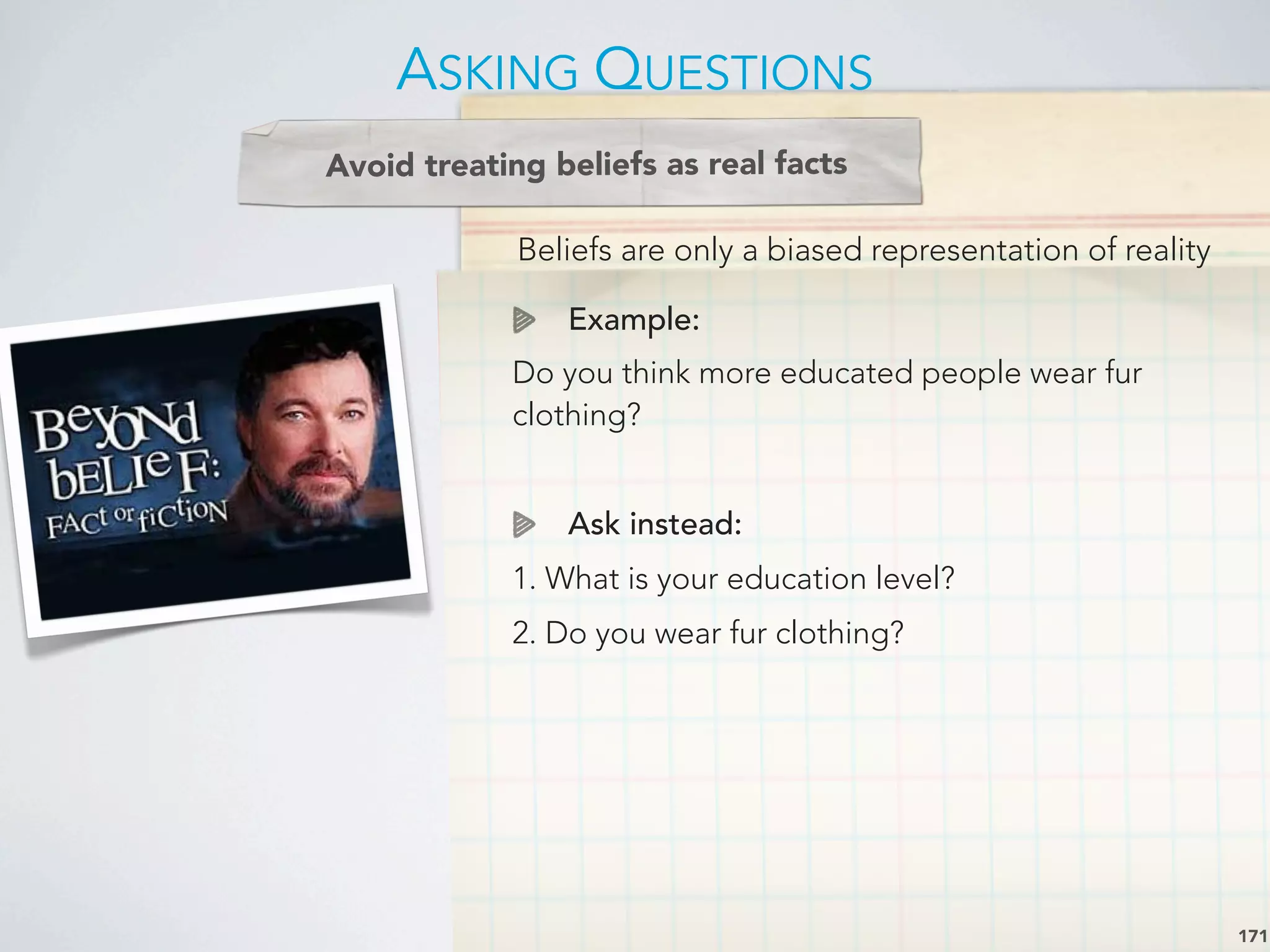
General questions should precede the specific
questions
1. What considerations are important to you in
selecting a department store?
2. In selecting a department store, how important
is convenience of location?
Logical Order / Branching Questions
The question being branched should be placed as
close as possible to the question causing the
branching.
The branching questions should be ordered so
that the respondents cannot anticipate what
additional information will be reuired.
188.
EXAMPLE: FLOWCHART OFA QUESTIONNAIRE
188
Introduction
Store
Charge
Card
Ownership of Store, Bank, and/or other Charge
Cards
Purchased products in a specific department store
during the last two months
How was payment made? Ever purchased products in a
departments store?
Bank
Charge
Card
Other
Charge
Card
Intention to use Store, Bank,
or Other Charge Cards
yes no
yes
no
Cash
Other
Credit
189.
189
5.Questionnaire
5.1. Asking Questions
5.2.Overcoming Inability to Answer
5.3. Overcoming Unwillingness to Answer
5.4. Increasing Willingness of Respondents
5.5. Determining the Order of Questions
5.6. What’s Next?
190.
What’s Next?
190
Introduction
Catch therespondents’ interest
Explain the reasons & objectives
Ask for their help
Tell that their support is valuable
Tell how much time it will last
Emphasize the anonymity
Incentivize
(non-monetary incentives)
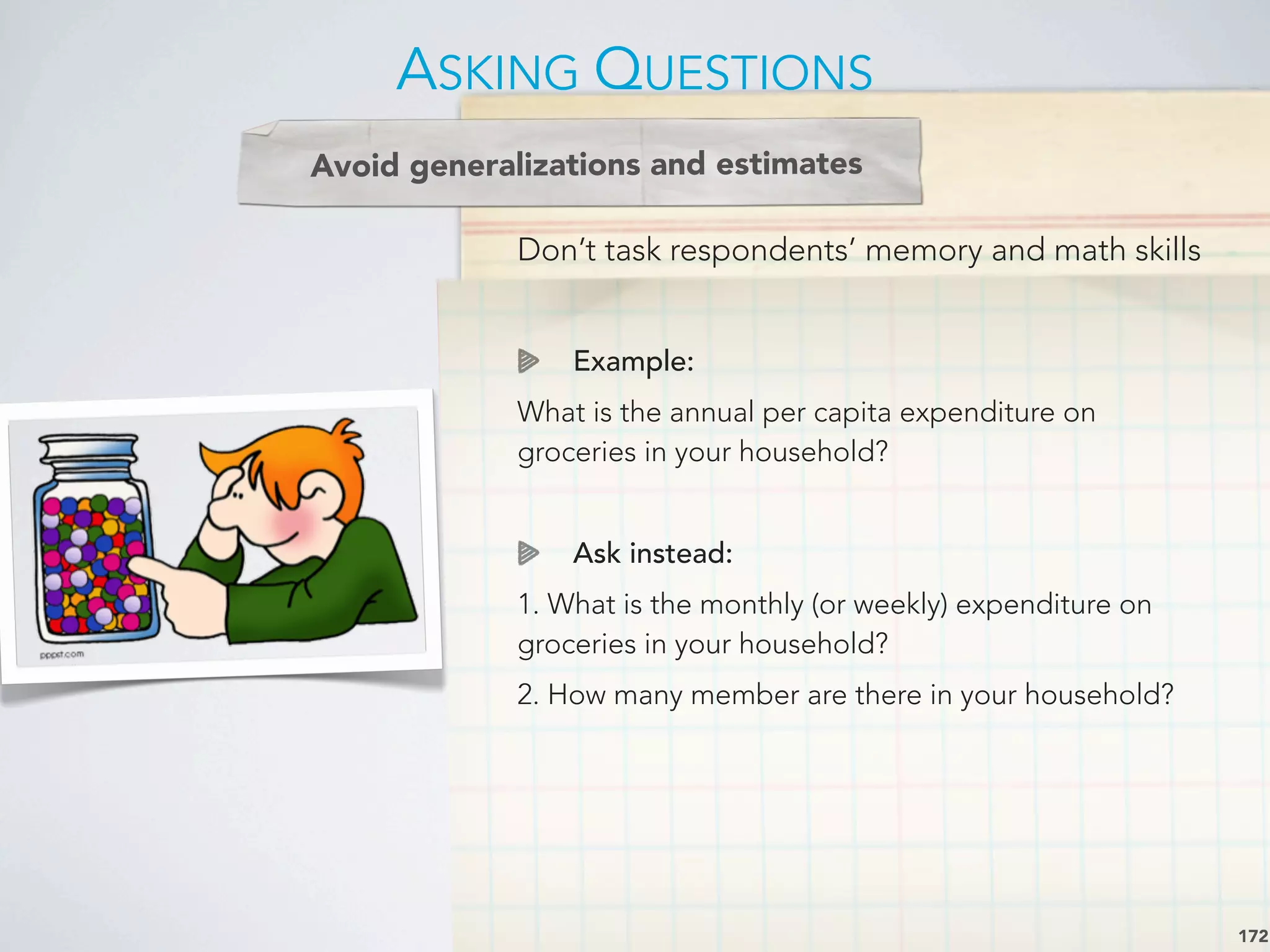
191.
What’s Next?
191
Pretest! Pretest!Pretest!!!
question content
wording
sequence
form and layout
question difficulty
instructions…
analysis procedures
192.
RECAP
192
1. Develop aflow chart of the information required based on the marketing
research problem
Once the entire sequence is laid out, the interrelationships should become
clear
Match up the actual data you would expect to collect from the
questionnaire against the information needs listed in the flow chart
Be specific in the objective for each area of information and data. You
should be able to write an objective for each area so specifically that it
guides your construction of the questions.
2. At this stage, put on your “critic’s” hat and go back over the flowchart and ask
Do I need to know it and know exactly what I am going to do with it? or
It would be nice to know it but I do not have to have it
194
The world’s mostfamous
newspaper error
President Harry Truman against
Thomas Dewey
Chicago Tribute prepared an
incorrect headline without first
getting accurate information
Reason?
→ bias
→ inaccurate opinion polls
SAMPLING
197
Population
the group ofpeople we wish to
understand. Populations are
often
segmented by demographic or
Sample
a subset of population
that represents the whole
Most research cannot test
everyone. Instead a sample
of the whole population is
selected and tested.
If this is done well, the
results can be applied to the
whole population.
This selection and testing of
a sample is called sampling.
If a sample is poorly chosen,
all the data may be useless.
198.
SAMPLING: TWO GENERALMETHODS
198
This relies on personal judgement of theresearcher (often on people available, e.g.,people passing in the street or walkingthrough a mall).
This may yield good estimates of populationcharacteristics, however, doesn’t allow forobjective evaluation of the precision ofsample results. That is, the results are notprojectable to the population.
Non-
probability
Sampling
Here, sampling units are selected by
chance, i.e., randomly.
This randomness allows applying
statistical techniques to determine the
precision of the sample estimates and
their confidence intervals. The results
are generalizable and projectable to
the population from which the sample
is drawn.
Probability
Sampling
199.
CLASSIFICATION OF SAMPLINGTECHNIQUES
199
Sampling Techniques
Non-probability Probability
Convenience
Sampling
Judgmental
Sampling
Quota
Sampling
Snowball
Sampling
Stratified
Sampling
Cluster
Sampling
Other Samp-
ling Techniques
Systematic
Sampling
Simple Random
Sampling
Proportionate Disproportionate
CLASSIFICATION OF SAMPLINGTECHNIQUES
201
Sampling Techniques
Non-probability Probability
Convenience
Sampling
Judgmental
Sampling
Quota
Sampling
Snowball
Sampling
Stratified
Sampling
Cluster
Sampling
Other Samp-
ling Techniques
Systematic
Sampling
Simple Random
Sampling
Proportionate Disproportionate
202.
CONVENIENCE SAMPLING
202
Depth Interview
attemptsto obtain a sample of convenient
respondents. Often, respondents are
selected because they happen to be in
the right place at right time.
students or members of social
organizations
mall intercept interviews without
qualifying the respondents
“people on the street” interviews
tear-out questionnaires in magazines
Convenience Sampling
203.
JUDGMENTAL SAMPLING
203
a formof convenience sampling in
which the population elements are
selected based on the judgement
of the researcher
test markets
purchase engineers selected in
industrial marketing research
mothers as diaper “users”
Judgmental Sampling
204.
Control
Characteristic
Population
Composition
Sample CompositionSample Composition
Control
Characteristic
PercentagePercentage Number
Sex
Male
Female
48
52
-------
100
48
52
-------
100
480
520
-------
1000
Age
18-30
31-45
45-60
Over 60
27
39
16
18
-------
100
27
39
16
18
-------
100
270
390
160
180
-------
1000
QUOTA SAMPLING
204
develop control categories, or quotas, of
population elements (e.g., sex, age, race,
income, company size, turnover, etc.) so that
the proportion of the elements possessing
these characteristics in the sample reflects
their distribution in the population.
The elements themselves are selected based
on convenience or judgment. The only
requirement, however, is that the elements
selected fit the control characteristics (quota).
Quota Sampling
Often used in
online
surveys
205.
SNOWBALL SAMPLING
205
an initialgroup of respondents is selected (usually)
at random.
After being interviewed, these respondents are
asked to identify others who belong to the target
population of interest.
Subsequent respondents are selected based on
the referrals.
Good for locating the desired characteristic in the
population:
reaching hard-to-reach respondents (e.g.,
government services, “food stamps”, drug users)
estimating characteristics that are rare in the
population
identifying buyer-seller pairs in industrial research
Snowball Sampling
Often used in
online
surveys
Very favored
by students
CLASSIFICATION OF SAMPLINGTECHNIQUES
207
Sampling Techniques
Non-probability Probability
Convenience
Sampling
Judgmental
Sampling
Quota
Sampling
Snowball
Sampling
Stratified
Sampling
Cluster
Sampling
Other Samp-
ling Techniques
Systematic
Sampling
Simple Random
Sampling
Proportionate Disproportionate
Require
knowledge
about the
population
208.
Each element inthe population has a
known and equal probability of selection
Each possible sample of a given size (n)
has a known probability of being the
sample actually selected
This implies that every element is selected
independently of every other element.
Simple Random Sampling
SRS & SYSTEMATIC SAMPLING
208
The sample is chosen by selecting a random
starting point and then picking every i-th
element in succession from the sampling
frame
The sampling interval, i, is determined by
dividing the population size N by the sample
size n, i.e., i=N/n
Systematic Sampling
Require
knowledge
about the
population
start here
take every
i-th element
select randomly
i
i
i
209.
STRATIFIED SAMPLING
209
is obtainedby separating the population into
non-overlapping groups called strata and then
obtaining a proportional simple random sample
from each group. The individuals within each
group should be similar in some way.
Good for:
highlighting a specific subgroup within the
population
observing existing relationships between two
or more subgroups
representative sampling of even the smallest
and most inaccessible subgroups in the
population
a higher statistical precision
Stratified Sampling
Proportionate
Stratum A B C
Population Size 100 200 300
Sampling Fraction 1/2 1/2 1/2
Final Sample Size 50 100 150
Stratum A B C
Population Size 100 200 300
Sampling Fraction 1/5 1/2 1/3
Final Sample Size 20 100 100
Disproportionate
Require
knowledge
about the
population
210.
CLUSTER SAMPLING
210
the targetpopulation is first divided into
mutually exclusive and collectively exhaustive
subpopulations, or clusters. Than a random
sample of clusters is selected, based on SRS.
Good for:
covering large geographic areas
reducing survey costs
when constructing a complete list of
population elements is difficult
when the population concentrated in
natural clusters (e.g., blocks, cities, schools,
hospitals, boxes, etc.)
Cluster Sampling
Require
knowledge
about the
population
For each cluster, either all the
elements are included in the sample
(one-stage) or a sample of elements
is drawn probabilistically (two-sage).
STRENGTHS AND WEAKNESSESOF BASIC SAMPLING TECHNIQUES
212
Technique Strengths Weaknesses
Non-probability Sampling
Convenience sampling Least expensive, least time consuming,
most convenient
Selection bias, sample not
representative, not recommended for
descriptive or causal research
Judgmental sampling Low cost, convenient, not time
consuming
Does not allow generalization, subjective
Quota sampling Sample can be controlled for certain
characteristics
Selection bias, no assurance of
representativeness
Snowball sampling Can estimate rare characteristics Time consuming in the field research
Probability Sampling
Simple random sampling (SRS) Easily understood, results projectable Difficult to construct sampling frame,
expensive, lower precision, no assurance
of representativeness
Systematic sampling Can increase representativeness, easier
to implement than SRS
Can decrease representativeness
Stratified sampling Includes all important subpopulations,
precision
Difficult to select relevant stratification
variables, not feasible to stratify on many
variables, expensive
Cluster sampling Easy to implement, cost effective Imprecise, difficult to compute and
interpret results
213.
213
The middle optionof an attitudinal
scale attracts a substantial # of
respondents who might be unsure
about their opinion or reluctant to
disclose it
This can distort measures of central
tendency and variance
Questions that exclude the "don't
know" option tend to produce a
greater volume of accurate data
Do we want/need “contrast” in
controversial attitudes?
Are respondents unwilling to answer
vs. don’t have an opinion?
Use "don't know" or better “not
applicable” option for factual
questions, but not for attitude
questions
Use branching to ensue concept
familiarity on the respondent’s side
Non-probability Probability
214.
214
Non-comparative
Scales
each object isscaled
independently
resulting data is generally
assumed to be interval or
ratio scaled
Comparative
Scales
involve the direct
comparison of stimulus
objects.
data must be interpreted in
relative terms
have only ordinal and rank-
order properties
nature of the research
variability in the population
statistical considerations
DETERMINING THE SAMPLESIZE
216
The sample size does not depend on the size of
the population being studied, but rather it
depends on qualitative factors of the research.
desired precision of estimates
knowledge of population parameters
number of variables
nature of the analysis
importance of the decision
incidence and completion rates
resource constraints
Determining the Sample Size
217.
SAMPLE SIZES USEDIN MARKETING RESEARCH STUDIES
217
Type of Study Minimum Size Typical Size
Problem identification research
(e.g., market potential)
500 1,000 - 2,000
Problem solving research
(e.g., pricing)
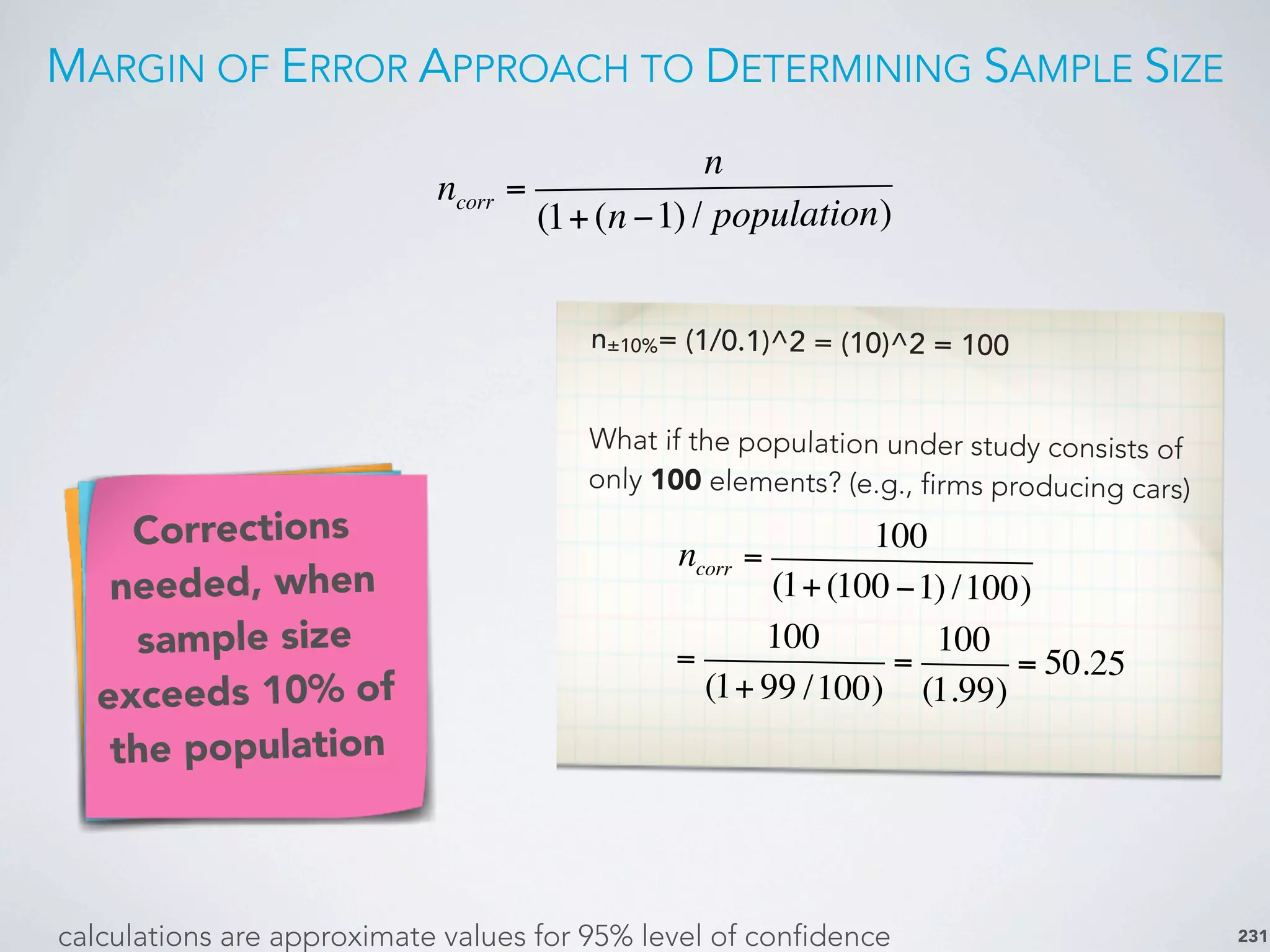
200 300 - 500
Product tests 200 300 - 500
Test-market studies 200 300 - 500
TV/Radio/Print advertising
(per commercial ad tested)
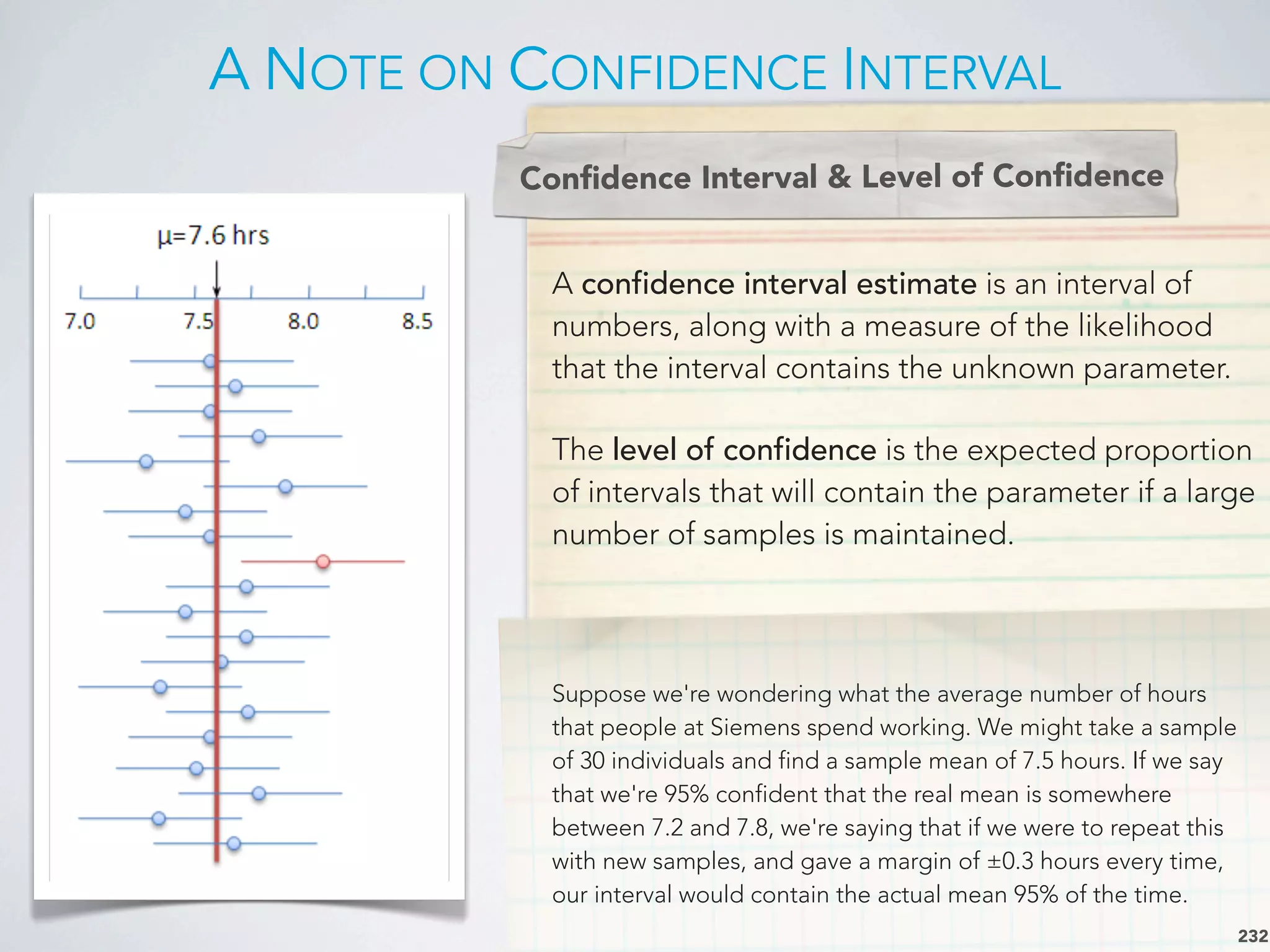
150 200 - 300
Test-market audits 10 stores 10 - 20 stores
Focus groups 6 groups 10 - 15 groups
MARGIN OF ERRORAPPROACH TO DETERMINING SAMPLE SIZE
219
What is your
primary daily
media
channel?
220.
MARGIN OF ERRORAPPROACH TO DETERMINING SAMPLE SIZE
220
What is your
primary daily
media
channel?
How accurate
is this statistic?
What is the
margin of
error?
The Margin of Error is the
measure of accuracy of a survey.
The smaller the margin of error,
the more accurate are the
estimates of a survey.
221.
MARGIN OF ERRORAPPROACH TO DETERMINING SAMPLE SIZE
221
Means
use this formula when evaluating estimatesof population means
Proportions
use this when evaluating estimates of
proportions
Means Proportions
E = z
σ
n
E = z
π(1−π)
n
x = real population parameter
x = sample statistic
E = margin of error
^
x = ˆx ± E
z = z-value for a given level of confidenceσ = standard deviation of a population parametern = sample size
z = z-value for a given level of confidence
π = estimate of the proportion in the population
n = sample size
222.
MARGIN OF ERRORAPPROACH TO DETERMINING SAMPLE SIZE
222
Means
use this formula when evaluating estimatesof population means
Proportions
use this when evaluating estimates of
proportions
Means Proportions
E = z
σ
n
E = z
π(1−π)
n
x = real population parameter
x = sample statistic
E = margin of error
^
x = ˆx ± E
z = z-value for a given level of confidenceσ = standard deviation of a population parametern = sample size
z = z-value for a given level of confidence
π = estimate of the proportion in the population
n = sample size
unlikely to be known
223.
MARGIN OF ERRORAPPROACH TO DETERMINING SAMPLE SIZE
223
Means
use this formula when evaluating estimatesof population means
Proportions
use this when evaluating estimates of
proportions
Means Proportions
E = z
σ
n
E = z
π(1−π)
n
x = real population parameter
x = sample statistic
E = margin of error
^
x = ˆx ± E
z = z-value for a given level of confidenceσ = standard deviation of a population parametern = sample size
z = z-value for a given level of confidence
π = estimate of the proportion in the population
n = sample size
unlikely to be known
has a maximum at π = .5
224.
MARGIN OF ERRORAPPROACH TO DETERMINING SAMPLE SIZE
224
maximum margin of error for 95%
level of confidence
Proportions
E = z
π(1−π)
n
x = real population parameter
x = sample statistic
E = margin of error
^
x = ˆx ± E
z-values
z = 1.96
for 95% level of confidence
z = 2.58
for 99% level of confidence
=1.96
0.5(1− 0.5)
n
≈
1
n
225.
MARGIN OF ERRORAPPROACH TO DETERMINING SAMPLE SIZE
225
What is your
primary daily
media
channel?
How accurate
is this statistic?
What is the
margin of
error?
Margin of Error = 1/√n
48,804 people in sample
√48,804 = 220.916
1/221 = 0.0045
*100 = 0.45%
x = 61% ± 0.45%
60.55% to 61.45%
x = ˆx ± E
calculations are approximate values for 95% level of confidence
226.
MARGIN OF ERRORAPPROACH TO DETERMINING SAMPLE SIZE
226
What is your
primary daily
media
channel?
How big should
the sample be
taking margin
of error of ±1%
into account?
Sample Size n = (1/Margin of Error)^2
n±1%= (1/0.01)^2 = (100)^2 = 10,000
n±2%= (1/0.02)^2 = (50)^2 = 2,500
n±5%= (1/0.05)^2 = (20)^2 = 400
n±10%= (1/0.1)^2 = (10)^2 = 100
n ≈
1
E
"
#
$
%
&
'
2
E ≈
1
n
calculations are approximate values for 95% level of confidence
227.
MARGIN OF ERRORAPPROACH TO DETERMINING SAMPLE SIZE
227
What is your
primary daily
media
channel?
calculations are approximate values for 95% level of confidence
Sample Size n = (1/Margin of Error)^2
Sample Size does not depend on population.
n±1%= (1/0.01)^2 = (100)^2 = 10,000
What if the population under study consists of
only 100 elements? (e.g., firms producing
cars)
Corrections
needed, when
sample size
exceeds 10% of
the population
228.
MARGIN OF ERRORAPPROACH TO DETERMINING SAMPLE SIZE
228
What is your
primary daily
media
channel?
calculations are approximate values for 95% level of confidence
Correction of the Sample Size
ncorr =
n
(1+(n −1) / population)
Corrections
needed, when
sample size
exceeds 10% of
the population
229.
MARGIN OF ERRORAPPROACH TO DETERMINING SAMPLE SIZE
229
What is your
primary daily
media
channel?
calculations are approximate values for 95% level of confidence
n±1%= (1/0.01)^2 = (100)^2 = 10,000
What if the population under study consists of
only 100 elements? (e.g., firms producing cars)
ncorr =
n
(1+(n −1) / population)
ncorr =
10,000
(1+(10,000 −1) /100)
=
10,000
(1+ 9,999 /100)
=
10,000
(100.99)
= 99.02
Corrections
needed, when
sample size
exceeds 10% of
the population
230.
MARGIN OF ERRORAPPROACH TO DETERMINING SAMPLE SIZE
230
What is your
primary daily
media
channel?
calculations are approximate values for 95% level of confidence
n±5%= (1/0.05)^2 = (20)^2 = 400
What if the population under study consists of
only 100 elements? (e.g., firms producing cars)
ncorr =
n
(1+(n −1) / population)
ncorr =
400
(1+(400 −1) /100)
=
400
(1+399 /100)
=
400
(4.99)
= 80.16
Corrections
needed, when
sample size
exceeds 10% of
the population
231.
MARGIN OF ERRORAPPROACH TO DETERMINING SAMPLE SIZE
231
What is your
primary daily
media
channel?
calculations are approximate values for 95% level of confidence
Corrections
needed, when
sample size
exceeds 10% of
the population
n±10%= (1/0.1)^2 = (10)^2 = 100
What if the population under study consists of
only 100 elements? (e.g., firms producing cars)
ncorr =
n
(1+(n −1) / population)
ncorr =
100
(1+(100 −1) /100)
=
100
(1+ 99 /100)
=
100
(1.99)
= 50.25
232.
A NOTE ONCONFIDENCE INTERVAL
232
A confidence interval estimate is an interval of
numbers, along with a measure of the likelihood
that the interval contains the unknown parameter.
The level of confidence is the expected proportion
of intervals that will contain the parameter if a large
number of samples is maintained.
Confidence Interval & Level of Confidence
Suppose we're wondering what the average number of hours
that people at Siemens spend working. We might take a sample
of 30 individuals and find a sample mean of 7.5 hours. If we say
that we're 95% confident that the real mean is somewhere
between 7.2 and 7.8, we're saying that if we were to repeat this
with new samples, and gave a margin of ±0.3 hours every time,
our interval would contain the actual mean 95% of the time.
233.
The higher theconfidence we
need, the wider the confidence
interval and the greater the
margin of error will be
CONFIDENCE INTERVAL, MARGIN OF ERROR, AND SAMPLE SIZE
233
maximum margin of error for 99%
level of confidence
E = z
π(1−π)
n
z-values
z = 1.96
for 95% level of confidence
z = 2.58
for 99% level of confidence
= 2.58
0.5(1− 0.5)
n
=
1.29
n
234.
The higher theconfidence we
need, the wider the confidence
interval and the greater the
margin of error will be
CONFIDENCE INTERVAL, MARGIN OF ERROR, AND SAMPLE SIZE
234
maximum margin of error for 99%
level of confidence
E = z
π(1−π)
n
z-values
z = 1.96
for 95% level of confidence
z = 2.58
for 99% level of confidence
= 2.58
0.5(1− 0.5)
n
=
1.29
n
To reduce the
margin of error
we have to
increase the
sample size
higher levels of confidence
require larger samples
smaller margins of error
require larger samples
235.
235
7.Data Analysis:
A ConciseOverview of Statistical Techniques
7.1. Descriptive Statistics:
Some Popular Displays of Data
7.1.1. Organizing Qualitative Data
7.1.2. Organizing Quantitative Data
7.1.3. Summarizing Data Numerically
7.1.4. Cross-Tabulations
7.2. Inferential Statistics:
Can the results be generalized to population?
7.2.1. Hypothesis Testing
7.2.2. Strength of a Relationship in Cross-Tabulation
7.2.3. Describing the Relationship Between
Two (Ratio Scaled) Variables
236.
TYPES OF STATISTICALDATA ANALYSIS
236
Inferential
Inferential statistics are
techniques that allow making
generalizations about a
population based on
random samples drawn from
the population.
Allow assessing causality and
quantifying relationships
between variables.
Descriptive
Descriptive statistics provide
simple summaries about the
sample and about the
observations that have been
made.
Include the numbers, tables,
charts, and graphs used to
describe, organize,
summarize, and present raw
data.
237.
237
7.Data Analysis:
A ConciseOverview of Statistical Techniques
7.1. Descriptive Statistics: Some Popular Displays of Data
7.1.1. Organizing Qualitative Data
7.1.2. Organizing Quantitative Data
7.1.3. Summarizing Data Numerically
7.1.4. Cross-Tabulations
7.2. Inferential Statistics:
Can the results be generalized to population?
238.
FREQUENCY AND RELATIVEFREQUENCY TABLES
238
Original Data
A frequency distribution lists each
category of data and the number of
occurrences for each category
The relative frequency is the
proportion (or percent) of
observations within a category
A relative frequency distribution lists
each category of data together with the
relative frequency of each category.
relative frequency =
frequency
sumof all frequencies
Excel how to video: http://faculty.elgin.edu/dkernler/statistics/videos/excel2007/freq-table-1.mov
239.
BAR GRAPHS
239
Original Data
BarGraphs / Bar Charts
1. heights can be frequency
or relative frequency
2. bars must not touch
Excel how to video: http://faculty.elgin.edu/dkernler/statistics/videos/excel2007/bar-graph.mov
240.
PIE CHARTS
240
Pie Charts
1.should always include the relative frequency
2. also should include labels, either directly or as a legend
Excel how to video: http://faculty.elgin.edu/dkernler/statistics/videos/excel2007/pie-chart.mov
241.
241
7.Data Analysis:
A ConciseOverview of Statistical Techniques
7.1. Descriptive Statistics: Some Popular Displays of Data
7.1.1. Organizing Qualitative Data
7.1.2. Organizing Quantitative Data
7.1.3. Summarizing Data Numerically
7.1.4. Cross-Tabulations
7.2. Inferential Statistics:
Can the results be generalized to population?
242.
TABLES
242
Original Data
A discretevariable is a quantitative
variable that has either a finite
number of possible values or a
countable number of values, i.e., 0,
1, 2, 3, ...
Original Data
Sometimes there are too many
values to make a row for each one.
In that case, we'll need to group
several values together.
Excel how to video: http://faculty.elgin.edu/dkernler/statistics/videos/excel2007/freq-table-2.mov
243.
Histogram
1. height ofrectangles is the frequency
or relative frequency of the class
2. widths of rectangles is the same and
they touch each other
HISTORGAM
243
Excel how to videos: http://faculty.elgin.edu/dkernler/statistics/videos/excel2007/histogram-single.mov
http://faculty.elgin.edu/dkernler/statistics/videos/excel2007/histogram-multi.mov
244.
FREQUENCY POLYGON
244
A frequencypolygon
is drawn by plotting a point above
each class midpoint and connecting
the points with a straight line.
(Class midpoints are found by average
successive lower class limits.)
245.
CUMULATIVE TABLES ANDOGIVES
245
Cumulative tables
show the sum of values up to and
including that particular category.
An ogive
is a graph that represents the
cumulative frequency or cumulative
relative frequency for the class.
Excel how to video: http://faculty.elgin.edu/dkernler/statistics/videos/excel2007/cumulative.mov
246.
246
7.Data Analysis:
A ConciseOverview of Statistical Techniques
7.1. Descriptive Statistics: Some Popular Displays of Data
7.1.1. Organizing Qualitative Data
7.1.2. Organizing Quantitative Data
7.1.3. Summarizing Data Numerically
7.1.4. Cross-Tabulations
7.2. Inferential Statistics:
Can the results be generalized to population?
247.
MEASURES OF CENTRALTENDENCY
247
Mean x =
x1 + x2 +...+ xn
n
=
xi∑
n
Pros:
It works well for lists that are simply combined (added)
together.
Easy to calculate: just add and divide.
It’s intuitive — it’s the number “in the middle”, pulled
up by large values and brought down by smaller ones.
Cons:
The average can be skewed by outliers — it doesn’t
deal well with wildly varying samples.
The average of 100, 200 and -300 is 0, which is
misleading.
Mean is the “center of gravity” -
like the balance point
248.
MEASURES OF CENTRALTENDENCY
248
Median
Pros:
Handles outliers well — often the most accurate
representation of a group
Splits data into two groups, each with the same
number of items
Cons:
Can be harder to calculate: you need to sort the
list first
Not as well-known; when you say “median”,
people may think you mean “average”
Median is the item in the middle
of a sorted list
x =
x(n+1)/2 forodd n
1
2
(xn/2 + xn/2+1) foreven n
!
"
#
$#
249.
MEASURES OF CENTRALTENDENCY
249
Mode
Pros:
Works well for exclusive voting situations (this choice
or that one; no compromise), i.e., for nominal data
Gives a choice that the most people wanted (whereas
the average can give a choice that nobody wanted).
Simple to understand
Cons:
Requires more effort to compute (have to tally up the
votes)
“Winner takes all” — there’s no middle path
Mode is the most frequent
observation of the variable
The mode of
is
250.
MEASURES OF CENTRALTENDENCY:
USING MEAN, MODE, AND MEDIAN TO IDENTIFY THE DISTRIBUTION SHAPE
250
251.
Variance is theaverage of the
squared distance form the mean
MEASURES OF DISPERSION
251
Population
Variance σ 2
=
(xi −µ)2
∑
n
Sample
Variance s2
=
(xi − x)2
∑
n −1
Why Variance?
Mean acts as a balancing point. Hence,the average
difference from the mean will equal zero.
x =
1.5 + 2.5 + 3.5 - 0.5 + 4.5 + 1.5 - 2.5 - 6.5 +2.5 - 0.5 - 2.5 - 3.5
12
= 0
s2
=
117
12 −1
≈10.6
Heights of the 2008 US Men's Olympic Basketball Team
252.
Standard Deviation
keeps theunits of the original measure
MEASURES OF DISPERSION
252
Standard
Deviation
s = 10.6 ≈ 3.3
s = s2
Which data set has a higher standard deviation?
Heights of the 2008 US Men's Olympic Basketball Team
σ = σ 2
254
7.Data Analysis:
A ConciseOverview of Statistical Techniques
7.1. Descriptive Statistics: Some Popular Displays of Data
7.1.1. Organizing Qualitative Data
7.1.2. Organizing Quantitative Data
7.1.3. Summarizing Data Numerically
7.1.4.Cross-Tabulations
7.2. Inferential Statistics:
Can the results be generalized to population?
255.
Examples:
How many brand-loyalusers
are males?
Is product use (heavy users,
medium users, light users, and
non-users) related to outdoor
activities (high, medium and
low)?
Is familiarity with a new
product related to age and
education levels?
Is product ownership related
to income (hight, medium, and
low)?
are tables that reflect the joint distribution of two
(or more) variables with a limited number of
categories or distinct values.
help to understand how one variable (e.g.,
brand loyalty) relates to another variable (e.g.,
sex)
a cross-tabulation table contains a cell for
every combination of categories of two (or
more) variables
CROSS-TABULATIONS
255
Cross-Tabulations
256.
CROSS-TABULATION
256
Ownership of ExpensiveAutomobiles by Education Level
Does education influence ownership of expensive automobiles?
EducationEducation
Own Expensive Automobile College Degree No College Degree
yes 32% 21%
no 68% 79%
Column total 100% 100%
Number of cases 250 750
CROSS-TABULATION
258
Ownership of ExpensiveAutomobiles by Education and Income Levels
Does education influence ownership of expensive automobiles?
IncomeIncomeIncomeIncome
Low Income EducationLow Income Education High Income EducationHigh Income Education
Own Expensive Automobile College Degree No College Degree College Degree No College Degree
yes 20% 20% 40% 40%
no 80% 80% 60% 60%
Column total 100% 100% 100% 100%
Number of cases 100 700 150 50
Does it?
259.
CROSS-TABULATION
259
Desire to TravelAbroad by Age
Does age influence desire to travel?
AgeAge
Desire to travel abroad Less than 45 45 or more
yes 50% 50%
no 50% 50%
Column total 100% 100%
Number of cases 500 500
Desire to Travel Abroad by Age and Sex
SexSexSexSex
Male ageMale age Female ageFemale age
Desire to travel abroad < 45 ≥ 45 < 45 ≥ 45
yes 60% 40% 35% 65%
no 40% 60% 65% 35%
Column total 100% 100% 100% 100%
Number of cases 300 300 200 200
260.
CROSS-TABULATION
260
Eating Frequency inFast-Food Restaurants by Family Size
Does family size influence frequency of eating in fast-food restaurants?
Eating Frequency in Fast-Food Restaurants by Family Size and Income
Eat frequency in fast-food
restaurants
Family SizeFamily SizeEat frequency in fast-food
restaurants Small Large
yes 50% 50%
no 50% 50%
Column total 100% 100%
Number of cases 500 500
IncomeIncomeIncomeIncome
Low incomeLow income High incomeHigh income
Eat frequency in fast-food
restaurants
Family SizeFamily Size Family SizeFamily SizeEat frequency in fast-food
restaurants Small Large Small Large
yes 50% 50% 50% 50%
no 50% 50% 50% 50%
Column total 100% 100% 100% 100%
Number of cases 250 250 250 250
261.
261
7.Data Analysis:
A ConciseOverview of Statistical Techniques
7.1. Descriptive Statistics: Some Popular Displays of Data
7.2. Inferential Statistics:
Can the results be generalized to population?
7.2.1. Hypothesis Testing
7.2.2. Strength of a Relationship in Cross-Tabulation
7.2.3. Describing the Relationship Between
Two (Ratio Scaled) Variables
262.
Procedure:
1. State nulland alternative
hypothesis
2. Select a level of
significance
3. Identify the test statistic
4. Formulate a decision rule
5. Take a sample, arrive at a
decision
a five-step procedure using sample evidence and
probability theory to determine whether the
hypothesis is a reasonable statement.
In other words, it is a method to prove wether or
not the results obtained on a randomly drawn
sample are projectable to the whole population.
HYPOTHESIS TESTING
262
Hypothesis Testing
"People are 'erroneously confident' in their knowledge
and underestimate the odds that their information or
beliefs will be proved wrong. They tend to seek
additional information in ways that confirm what they
already believed."
Max Bazerman
263.
HYPOTHESIS TESTING
263
SexSex
Internet usageMale Female Row total
light 5 10 15
heavy 10 5 15
Column total 15 15 n=30
Sex and Internet Usage
Based on this sample:
Q: Are there really more heavy internet users among males than among
females in the general population?
264.
A null hypothesis(H0) is a statement of
status quo, one of no difference or no
effect.
An alternative hypothesis (H1) is one in
which some difference or effect is
expected.
HYPOTHESIS TESTING
264
Step 1: State null and alternative hypothesis
H0: There is no difference between males
and females w.r.t. internet usage.
H1: Males and females expose different
internet usage behavior.
IUm = IUf
IUm ≠ IUf
265.
HYPOTHESIS TESTING
265
Step 2:Select a level of significance
Null hypothesis (H0)
is true
Null hypothesis (H0)
is false
Reject null
hypothesis
Fail to reject null
hypothesis
Type I error
False positive
Correct outcome
True positive
Correct outcome
True negative
Type II error
False negative
α - significance
β
(1-β) - power of a test
Significance (α) - probability of
rejecting a true null hypothesis
β - probability of accepting a false
null hypothesis
266.
HYPOTHESIS TESTING
266
Step 2:Select a level of significance
Null hypothesis (H0)
is true
Null hypothesis (H0)
is false
Reject null
hypothesis
Fail to reject null
hypothesis
Type I error
False positive
Correct outcome
True positive
Correct outcome
True negative
Type II error
False negative
convict an innocent
acquit a criminal
Analogy - H0: innocence in a criminal trial
Significance (α) - probability of
rejecting a true null hypothesis
β - probability of accepting a false
null hypothesis
267.
Levels of significancein marketing research
α - level of
significance
(1-α) - level of
confidence
.01 (1%) .99 (99%)
.05 (5%) .95 (95%)
HYPOTHESIS TESTING
267
Step 2: Select a level of significance Maintaining both low α and lowβ is tricky. In typical practicalapplications type I errors aremore delicate than type II
errors. Hence, care is usuallyfocused on minimizing the
occurrence of this statisticalerror, i.e., minimizing α.
268.
HYPOTHESIS TESTING
268
Step 3:Identify the test statistic
Sample Application
Level of
scaling
Test/Comments
One Sample
Distributions Non-metric
K-S and χ2 for goodness of fit; Runs test for randomness;
Binomial test for goodness of fit of dichotomous variables
One Sample Means Metric
t test, if variance is unknown
z test, if variance is known
One Sample
Proportions Metric z test
Two Independent
Samples
Distributions Non-metric
K-S two-sample test for equivality of two distributions
Two Independent
Samples
Means Metric
Two-group t test
F test for equality of variancesTwo Independent
Samples
Proportions
Metric
Non-metric
z test
χ2 test
Two Independent
Samples
Ranking/Medians Non-metric Mann-Whitney U test is more powerful than the median test
Paired Samples
Means Metric paired t test
Paired Samples Proportions Non-metric
McNemar test for binary variables
χ2 test
Paired Samples
Ranking/Medians Non-metric
Wilcoxon matched-pairs ranked-signs test is more powerful
than the sign test
!
269.
HYPOTHESIS TESTING
269
χ2
(chi-square) statisticfor goodness of fit is used to test the statistical significance of the
observed association in a cross-tabulation
Step 3: Identify the test statistic
H0: There is no association between the variables
χ2
(chi-square) tests the equality of frequency distributions.
Which distributions/frequencies should we test?
fe -
cell frequencies that would be expected if no association were present
between the variables
fo - actual observed cell frequencies
270.
HYPOTHESIS TESTING
270
Step 3:Identify the test statistic
fe -
cell frequencies that would be expected if no association were present
between the variables
fo - actual observed cell frequencies
fe =
nrnc
n
nr - total number in the row
nr - total number in the column
nr - total sample size
fe1,1
=
15⋅15
30
= 7.50 fe1,2
=
15⋅15
30
= 7.50
fe2,1
=
15⋅15
30
= 7.50 fe2,2
=
15⋅15
30
= 7.50
271.
HYPOTHESIS TESTING
271
Step 3:Identify the test statistic
fe -
cell frequencies that would be expected if no association were present
between the variables
fo - actual observed cell frequencies
χ2
=
( fo − fe )2
feallcells
∑
χ2
=
(5− 7.5)2
7.5
+
(10 − 7.5)2
7.5
+
(10 − 7.5)2
7.5
+
(5− 7.5)2
7.5
= 0.833+ 0.833+ 0.833+ 0.833
= 3.333
in our example:
χ2
statistic should be estimated only on
counts of data. When the data are in
percentage form, they should be first
converted to absolute values or numbers.
272.
if probability ofTSCAL < significance level (α), then reject H0
or
if TSCAL > TSCR, then reject H0
HYPOTHESIS TESTING
272
Step 4: Formulate a decision rule
TSCAL - observed value of
the test statistic
TSCR - critical value of the
test statistic for a given
significance level
273.
HYPOTHESIS TESTING
273Excel χ2
howto video: http://faculty.elgin.edu/dkernler/statistics/videos/excel2007/independence.mov
if probability of TSCAL < significance
level (α), then reject H0
or
if TSCAL > TSCR, then reject H0
Step 4: Formulate a decision rule
df - degrees of freedom
r - number of rows
c - number of columns
df = (r −1)(c −1)
df = (2 −1)(2 −1) =1
χ2
CAL= 3.333
χ2
CR= 3.841
3.333 < 3.841
χ2
CAL < χ2
CR
H0 cannot be rejected
274.
HYPOTHESIS TESTING
274
Step 5:Arrive at a decision
Is the evidence there?
What are the consequences?
H0 of no association cannot be rejected
Association is not statistically significant at the .05 level
The findings from the sample cannot be generalized to
population
275.
HYPOTHESIS TESTING
275
SexSex
Internet usageMale Female Row total
light 5 10 15
heavy 10 5 15
Column total 15 15 n=30
Sex and Internet Usage
A: The sample doesn’t provide such evidence.
If the sample was chosen and drawn appropriately, then we can
state that there is no such relationship in the population at the 95%
confidence level.
Otherwise - we don’t know.
Based on this sample:
Q: Are there really more heavy internet users among males than among
females in the general population?
276.
276
7.Data Analysis:
A ConciseOverview of Statistical Techniques
7.1. Descriptive Statistics: Some Popular Displays of Data
7.2. Inferential Statistics:
Can the results be generalized to population?
7.2.1. Hypothesis Testing
7.2.2. Strength of a Relationship in Cross-Tabulation
7.2.3. Describing the Relationship Between
Two (Ratio Scaled) Variables
277.
MEASURES OF STRENGTHOF ASSOCIATION BETWEEN VARIABLES
χ2
tests only the significance of an association and
provides no statements about its strength
Simple proof: doubling all values in the table doubles
χ2
Measures of the strength of association are:
Phi Coefficient
Contingency Coefficient
Cramer’s V
Lambda Coefficient
277
278.
PHI COEFFICIENT
The higherφ, the stronger the association between the variables
Values > .30 are considered substantial
Problems:
φ is not standardized, i.e., has a fixed upper limit of 1only for 2x2
tables; depends on table’s dimensions
φ values from different studies cannot be compared
278
n
2
χ
ϕ =
ϕ =
3.333
30
= 0.333
the association is not very strong
279.
CONTINGENCY COEFFICIENT
The higherCC, the stronger the association between the variables
Values > .30 are considered substantial
Although max. CC-value is limited by 1, it can be never achieved
Problems:
CC is not standardized, i.e., depends on table’s dimensions
CC values from different studies cannot be compared
279
the association is not very strong
n
CC
+
= 2
2
χ
χ
CC =
3.333
3.333+30
= 0.316
280.
CRAMER’S V
The higherV, the stronger the association between the variables
Values > .30 are considered substantial
maximum V-value is limited by 1, it can only be achieved in case of 2x2 tables
Problems:
V is not standardized, i.e., depends on table’s dimensions
V values from different studies cannot be compared
280
the association is not very strong
V =
χ2
n⋅(min(r,c)−1)
V =
3.333
30⋅1
= 0.333
281.
LAMBDA COEFFICIENT
Measures thepercentage improvement in predicting the value of
the dependent variable, given the value of the independent variable
Is standardized between 0 and 1 (1 indicates that the prediction can
be made without error, 0 means no improvement in prediction)
hence, can be compared among different studies
281
Knowledge of sex increases our predictive ability by
the proportion of 0.333, i.e., a 33.3% improvement
λ =
max
r
(nrc )− max
r
(nr )
c
∑
n − max
r
(nr )
per column sum of max.
row frequencies
max. among row totals
SexSex
Internet usage Male Female Row total
light 5 10 15
heavy 10 5 15
Column total 15 15 n=30
c=1 c=1
r=1
r=2
λ =
(10 +10)−15
30 −15
= 0.333
282.
282
7.Data Analysis:
A ConciseOverview of Statistical Techniques
7.1. Descriptive Statistics: Some Popular Displays of Data
7.2. Inferential Statistics:
Can the results be generalized to population?
7.2.1. Hypothesis Testing
7.2.2. Strength of a Relationship in Cross-Tabulation
7.2.3. Describing the Relationship Between
Two (Ratio Scaled) Variables
283.
unless we performa designedexperiment, we can only claim anassociation between the predictor and
response variables, not a causation.
TYPES OF RELATIONSHIPS
283
Linear
Nonlinear No relation
Linear
284.
Two linearly relatedvariables are positively
associated if an increase in one causes an increase
in the other.
Two linearly related variables are negatively
associated if an increase in one causes a decrease
in the other.
LINEAR CORRELATION
284
285.
LINEAR CORRELATION COEFFICIENT
285
Properties:
Thelinear correlation coefficient is
always between -1 and 1.
If r = +1, there is a perfect positive linear
relation between the two variables.
If r = -1, there is a perfect negative linear
relation between the two variables.
The closer r is to +1, the stronger is the
evidence of positive association
between the two variables.
The closer r is to -1, the stronger is the
evidence of negative association
between the two variables.
If r is close to 0, there is little or no
evidence of a linear relation between the
two variables - this does not mean there
is no relation, only that there is no linear
relation.
is a measure of the strength of the linear relationship
between two variables.
where
is the sample mean of the predictor variable
is the sample standard deviation of the predictor variable
is the sample mean of the response variable
is the sample standard deviation of the response variable
is the sample size
Linear Correlation Coefficient
r =
xi − x
Sx
"
#
$
%
&
'
yi − y
Sy
"
#
$$
%
&
''∑
n −1
x
Sx
y
Sy
n
286.
LINEAR CORRELATION COEFFICIENT
286
r=
xi − x
Sx
"
#
$
%
&
'
yi − y
Sy
"
#
$$
%
&
''∑
n −1
x = 73.5
Sx ≈12.77274
y = 84.5
Sy =17.16308
r = 0.99
x y y
x
287.
ORDINARY LEAST-SQUARES (OLS)REGRESSION
287
Examples:
Can variation in sales be
explained in terms of
variation in advertising
expenditure?
Can the variation in market
share be accounted for by
the size of the sales force?
Are consumer’s
perceptions of quality
determined by their
perceptions of price?
is a powerful and flexible procedure for analyzing
associative relationships between a metric
dependent and one or more independent
variables.
Determine wether the relationship exists
Quantify the strength of the relationship
Derive the mathematical model / equation of the
relationship
Predict the values of the dependent variable
Control for other independent variables when evaluating
the contributions of a specific variable or set of variables
Regression Analysis
288.
Quick and dirtyExcel trick:
right-click on any data point in the
scatter diagram and select "Add
Trendline...", then check the box
"Display Equation on chart"
ORDINARY LEAST-SQUARES (OLS) REGRESSION
288
Advertising
expenditure
€1,000
Sales
€1,000
Advertising
expenditure
€1,000
Sales
€1,000
40 377
60 507
70 555
110 779
150 869
160 818
190 862
200 817
What amount of goods will we sale if we spend €85,000 on advertising?
y"="2.8239x"+"352.07"
R²"="0.83639"
0"
100"
200"
300"
400"
500"
600"
700"
800"
900"
1000"
0" 50" 100" 150" 200" 250"
Sales
Advertising exp.
Advertising expenditure explains 83.6% of
the variance in sales
Each extra Euro spent on advertising gains
€2.82 on additional sales.
€85T ad spendings convert into
2.824*85T+352.07 = €240,383.57 sales
289.
289
8.Advanced Techniques ofMarket Analysis:
A Brief Overview of Some Useful Concepts
8.1. Conjoint Analysis
8.2. Market Simulations
8.3. Market Segmentation
8.4. Perceptual Positioning Maps
290.
290
8.Advanced Techniques ofMarket Analysis:
A Brief Overview of Some Useful Concepts
8.1. Conjoint Analysis
8.2. Market Simulations
8.3. Market Segmentation
8.4. Perceptual Positioning Maps
291.
CONJOINT ANALYSIS
291
is aset of techniques used in market research to
analyze attribute-based consumer preferences, i.e.,
to determine how people value different features
that make up an individual product or service.
Characteristics
Evaluation of holistic stimuli
Decompositional of preferences
Widely used in
Segmentation
New Product Development
Conjoint Analysis
?
CONJOINT ANALYSIS
Relative importanceof attributes CONsidered JOINTly can better be measured than
when considered in isolation:
Many consumers are unable to accurately determine the relative importance that they
place on product attributes
Individual attributes in isolation are perceived differently than in combinations found in a
product
Constructing the preferred combination of attributes tasks respondents’ cognitive skills
Attributes are all important
Social desirability of specific attributes and/or attribute levels as well as pronounced self-
concepts motivate respondents to stress some attributes and levels, even though their
actual preferences (e.g., environment-friendliness, wealth, deprecated importance of
price)
Some respondents can intentionally try to manipulate the research outcome through
providing “beneficial” answers (e.g., overemphasize the importance of price)
293
295
8.Advanced Techniques ofMarket Analysis:
A Brief Overview of Some Useful Concepts
8.1. Conjoint Analysis
8.2. Market Simulations
8.3. Market Segmentation
8.4. Perceptual Positioning Maps
296.
MARKET SIMULATIONS
296
ProductsProductsProducts
Blue RedYellow Choice
Respondent #1 50 40 10 Blue
Respondent #2 0 65 75 Yellow
Repondent #3 40 30 20 Blue
Average 30 45 35 Red
Given the following preferences, which product should we offer to this market?
Red exhibits the highest preference part-worth
But no one in the market prefers Red
297.
WHY MARKET SIMULATIONS?COMPETITIVE EFFECTS MATTER!
297
Suppose, 80% of the market prefer round widgets and
20% prefer quadratic widgets
What type of widgets should we bring into the
market?
Without additional information, the obvious choice is
“round widgets”
What if there are already 10 big competitors who are
ALL offering round widgets?
298.
WHY MARKET SIMULATIONS?
298
Simulationsreflect the reality better than data driven models
… in representing idiosyncratic preferences of segments and/or
individuals
… by accounting for preferences and for concurrent offerings in the
market
We must not necessarily gear ourselves to the "fat" part of the market in
order to achieve good profits
“Choice Lab” for testing a multitude of the real-world
opportunities and their possible outcomes
Results of simulations can be easily understood by and are
actionable for the management
299.
WHAT DO MARKETSIMULATIONS DO?
299
For each respondent, given his/her preference structure and exhaustive market
representation (in terms of alternative product offerings) determine the respondent’s
choice and/or choice probability of the product(s) of interest, thus obtaining market
shares for each product
This is done by applying choice rules, e.g.:
First-Choice Rule (Maximum Utility Rule)
chooses the product with maximum utility
choice probability of such product is 100%, the remaining products have 0% choice probability
BTL-Model (Bradley, Terry, and Luce)
probability of choice depends on its relative
utility share in the market
non-zero choice probability of products with lower preference values / utilities
Logit-Choice Rule
probability of choice increases exponentially
with increasing contrast of product utilities
this rule allows a-priori adjustment to the real-world market shares
∑=
= H
h
h
h
h
U
U
1
π
∑=
⋅
⋅
= H
h
U
U
h
h
h
e
e
1
)(
α
α
απ
300.
300
8.Advanced Techniques ofMarket Analysis:
A Brief Overview of Some Useful Concepts
8.1. Conjoint Analysis
8.2. Market Simulations
8.3. Market Segmentation
8.4. Perceptual Positioning Maps
301.
MARKET SEGMENTATION
301
is classificationof customers into homogenous
groups that allow development of efficient product
differentiation strategies to exploit these segments.
Market Segmentation
302.
EFFECTIVE MARKET SEGMENTATION
302
Sixsegmentation criteria determining the effectiveness and profitability of marketing
strategies
Identifiability
It must be possible to measure
Substantiality
It must be large enough to earn profit
Accessibility
It is possible to reach potential customers via the organization's promotion and distribution channel
Stability
It must be stable enough that it does not vanish after some time
Responsiveness
It responds consistently to a given market stimulus
Actionability
It is useful in deciding on the marketing mix
303.
MARKET SEGMENTATION
303
General Product-specific
Observable
Cultural,geographic,
demographic, and socio-
economic variables
User status, usage,
frequency, store loyalty
and patronage,
situations
Unobservable
Psychographic, values,
personality and life-style
Psychographics,
benefits, perceptions,
elasticities, attributes,
preferences, intention
Classification of Segmentation Bases
304.
BENEFIT SEGMENTATION
304
„…The Benefitspeople seek in products are the basic reasons for
the heterogeneity in their choice behavior, and benefits are thus the
most relevant basis for segmentation.”
(Haley 1968)
„… Benefits are preferred segmentation basis for general
understanding of a market and for making decisions about
positioning, new product concepts, advertising, and distribution
because of their actionability.“
(Wind 1978)
BENEFIT SEGMENTATION PARADOX
306
Whensegmenting on the basis of the benefits consumers want from a particular product/service
category, an analyst should make a clear distinction between basis variables that are important in
separating the total sample into homogenous segments and those that are important because they
are the benefits or features that the respondents in each segment want most. It is too easy to assume
that these are the same. Sometimes they are, but often they are not. The “drivers” may not vary
among different segments, i.e., may have no discriminant power at all, e.g., price, quality, etc.
307.
307
8.Advanced Techniques ofMarket Analysis:
A Brief Overview of Some Useful Concepts
8.1. Conjoint Analysis
8.2. Market Simulations
8.3. Market Segmentation
8.4. Perceptual Positioning Maps
308.
POSITIONING
308
refers to theproblem of differentiating one’s own
product/service/brand from other competing entries
in the marketplace.
… is the process by which marketers try to create an
image or identity in the minds of their prospective
market for its product, service, brand, or
organization.
... helps people to sort out and organize some of the
confusion in the marketplace.
Positioning
309.
PERCEPTUAL POSITIONING MAPS
309
showthe location (position) of competing products/
brands/companies in some kind of “virtual space”
that purports to represent the way consumers
perceive or evaluate an entire product/service
category.
pairwise distances between the alternatives correspond to
their perceived (un)similarities
vectors show the direction and strength of perceived
product characteristics
axes depict the product dimensions that differentiate
between the alternatives the best
Perceptual Positioning Maps
310.
PERCEPTUAL POSITIONING MAPS
310
Intensityof Competitive Rivalry
The nearer the brands, the more similar are they in the perception of consumers, i.e., the
more intense and more direct is the competition
Relatively strong
rivalry
Equal distance =>
equal intensity of
competitive rivalry
Relatively weak rivalry
311.
PERCEPTUAL POSITIONING MAPS
311
Perceptionof brands along different product attributes
The further the brand from the origin and the nearer it is to a certain vector, the more
pronounced is the corresponding attribute in this brand
The most popular
beer with men
The least popular
beer with men
312.
PERCEPTUAL POSITIONING MAPS
312
Relationshipbetween attributes
The smaller the angle, the higher is the pairwise correlation
Beers popular among
men tend to be heavy
Equal popularity among men;
Strong difference among women
Equal popularity
among women;
Strong difference
among men
Right angle =>
popularity among
men says absolutely
nothing about
popularity among
313.
PERCEPTUAL POSITIONING MAPS
313
Lengthof an attribute vector depicts its differentiation degree
The longer the vector, the stronger differentiates it between the beers
Consumers can
differentiate between
the beers along the
dimension “popular
with men” better
than along the
dimension “good
value”
Popularwithmen
Goodvalue
314.
PERCEPTUAL POSITIONING MAPS
314
Axesdifferentiate the strongest
Axes are virtual vectors that differentiate the strongest. Their labeling derives from the
adjacent attribute vectors.
Point in one
direction;
correlate both
numeric and w.r.t.
content
}}
315.
PERCEPTUAL POSITIONING MAPS
315
Combinationof Positioning wit Segmentation
Segment
B
Segment
A
Segment
C
Segment C’s
preferences are not
satisfied -> open
market opportunity
TYPICAL PROFILE OFMARKET RESEARCH REPORT
318
Title page
Contents page
List of appendices
Text of Report
Executive summary
a. Major findings
b. Conclusions
c. Recommendations
Problem Definition
a. Background of the problem
b. Statement of the problem
Approach to the problem
Research design
a. Type of research design
b. Information needs
c. Data collection from secondary
sources
d. Data collection from primary sources
e. Scaling techniques
f. Questionnaire development and
pretesting
g. Sampling techniques
h. Fieldwork
Data analysis
a. Methodology
b. Plan of data analysis
c. Recommendations
Results
Limitations and caveats
Conclusions and recommendations
Exhibits
a. Questionnaire and forms
b. Statistical output
c. Lists
319.
REPORT WRITING
“The readersof your reports are busy people; and very
few of them can balance a research report, a cup of
coffee, and a dictionary at one time”
“When it comes to marketing research, people would
rather live with a problem they cannot solve than
accept a solution they cannot understand”
319
320.
REPORT WRITING
Write thereport for a specific reader or readers: the marketing
managers who will use the results
Avoid technical jargon
Make it easy to follow: structure logically, write clearly
Make it look presentable and professional
Write objective: “Tell it like it is”
Reinforce text with tables and graphs
Terse! A report should be concise. Anything unnecessary should be
omitted. Yet, brevity should not be achieved at the expense of
completeness.
320