Research design
Research design
• A framework or blueprint for conducting the
research project.
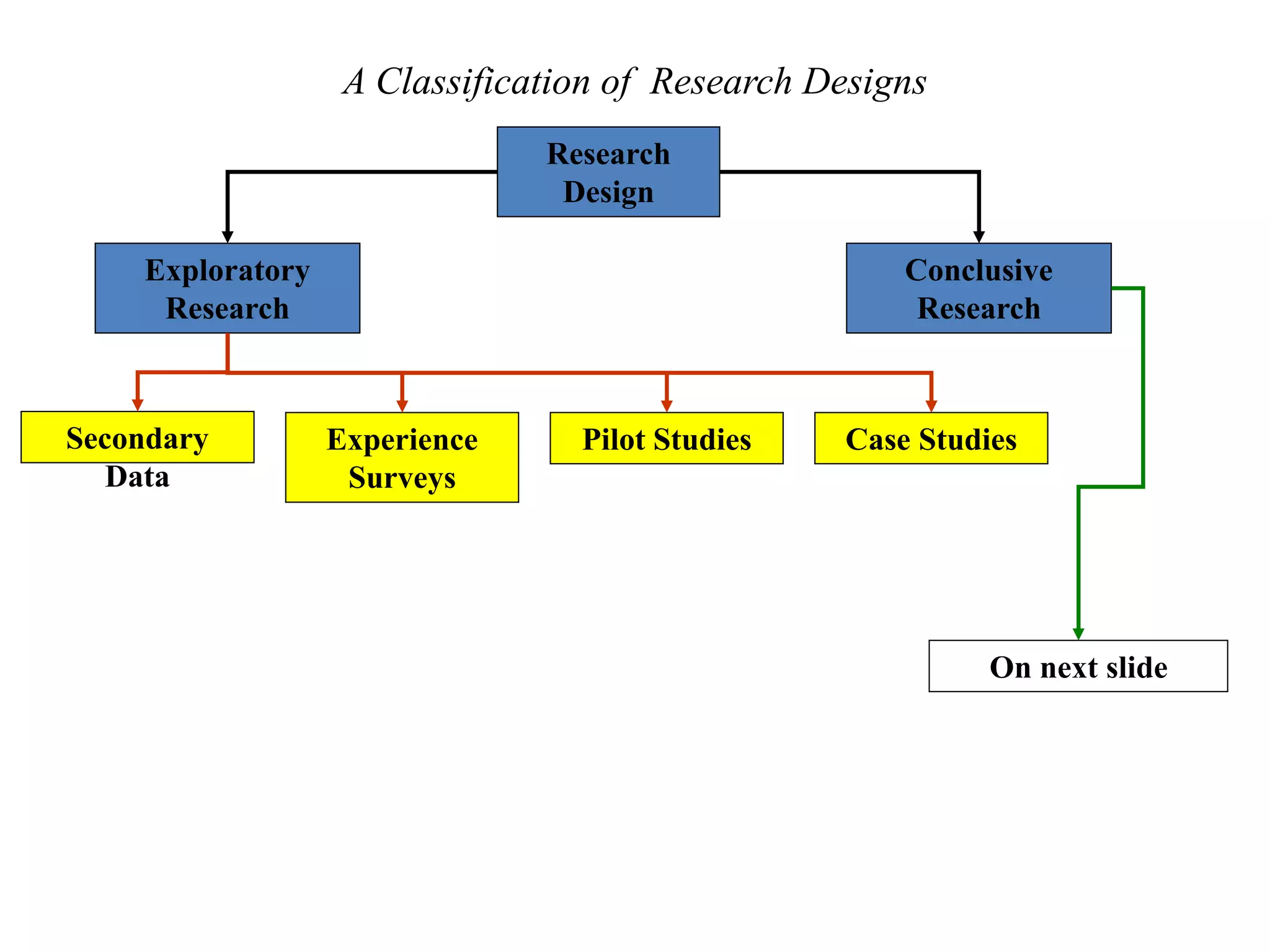
A Classification of Research Designs
Research
Design
Exploratory
Research
Conclusive
Research
Secondary
Data
Experience
Surveys
Pilot Studies Case Studies
On next slide
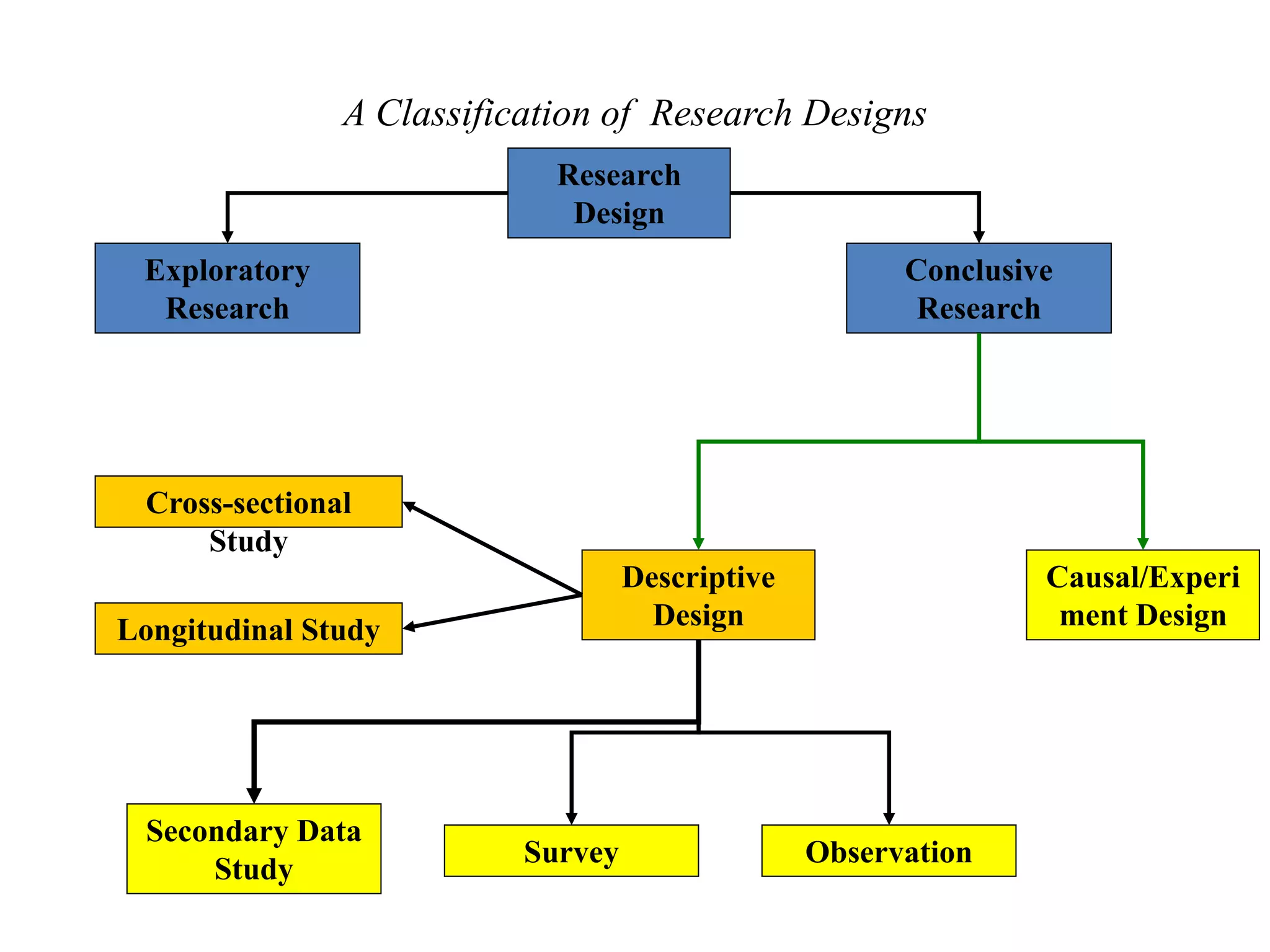
A Classification of Research Designs
Research
Design
Exploratory
Research
Conclusive
Research
Descriptive
Design
Causal/Experi
ment Design
Cross-sectional
Study
Longitudinal Study
Secondary Data
Study
Observation
Survey
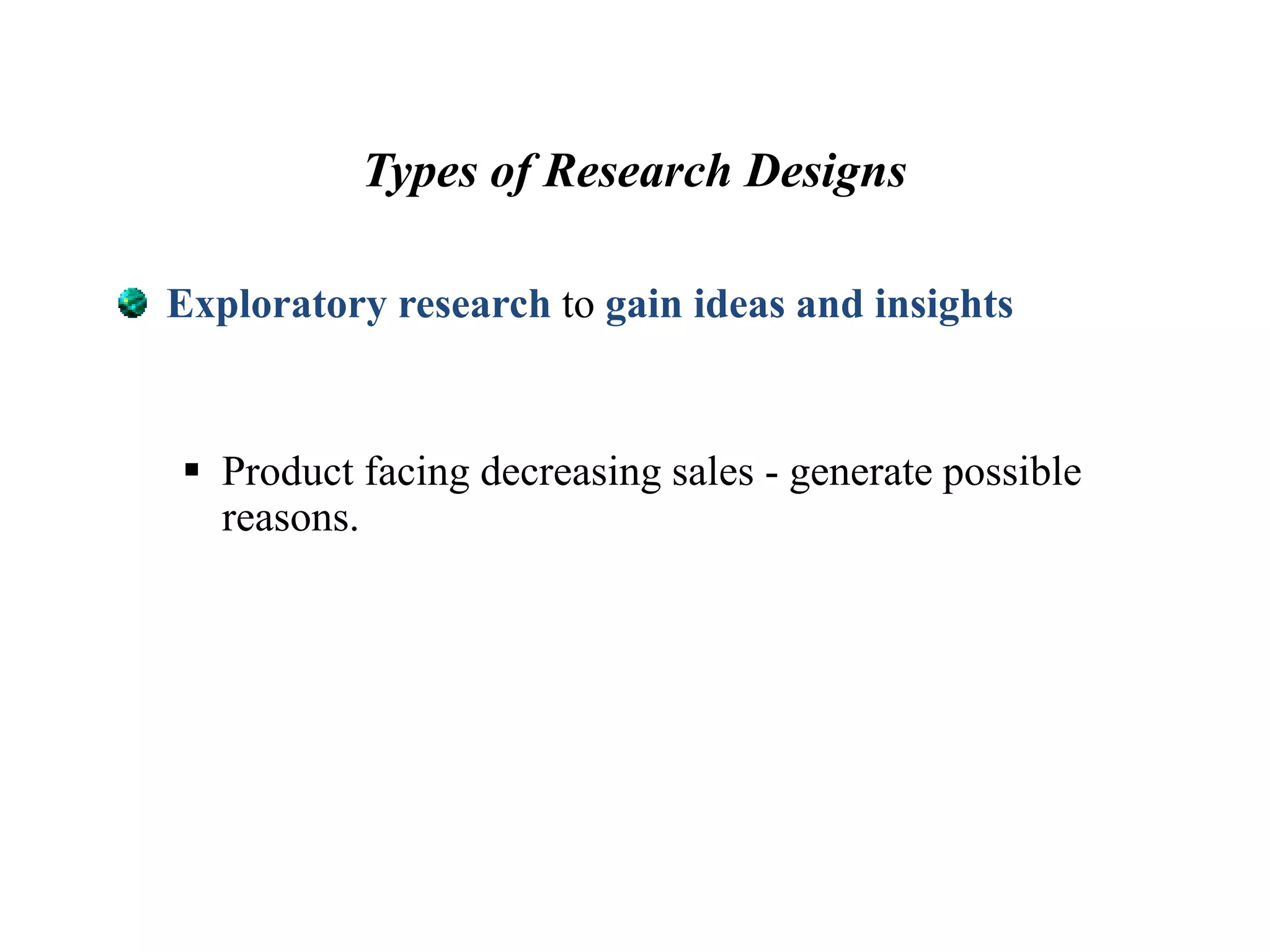
Types of Research Designs
Exploratory research to gain ideas and insights
 Product facing decreasing sales - generate possible
reasons.
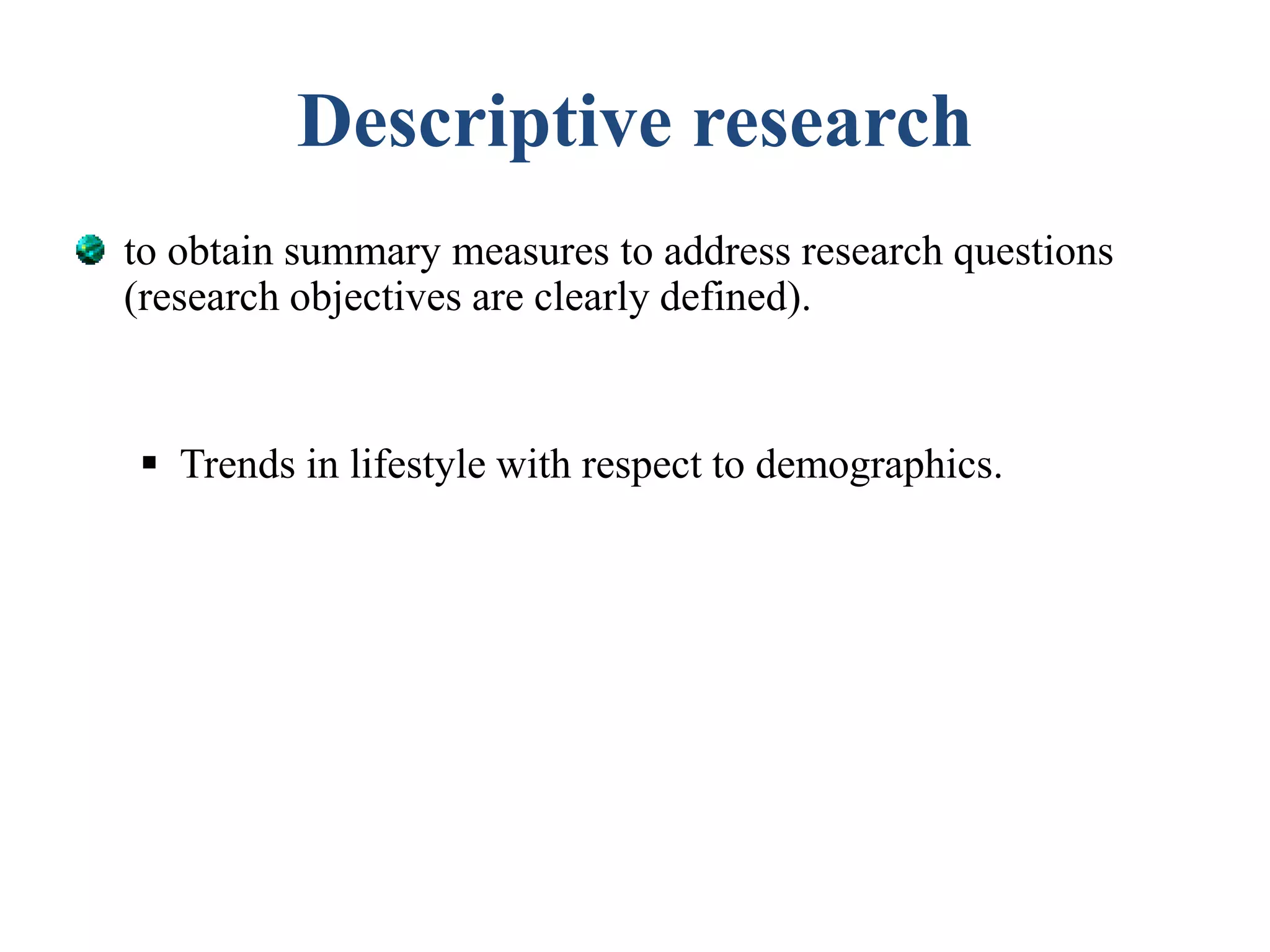
Descriptive research
to obtain summary measures to address research questions
(research objectives are clearly defined).
 Trends in lifestyle with respect to demographics.
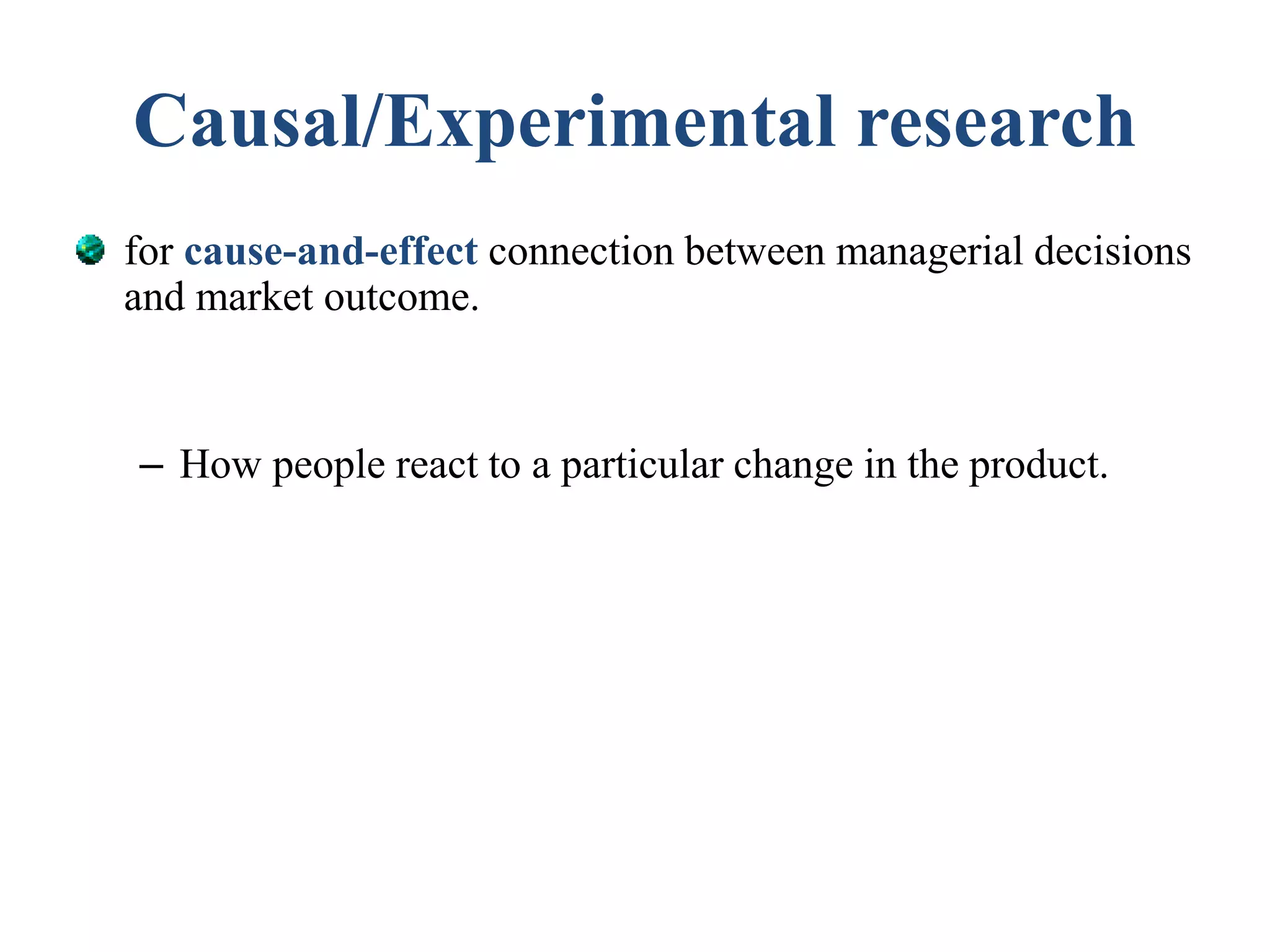
Causal/Experimental research
for cause-and-effect connection between managerial decisions
and market outcome.
– How people react to a particular change in the product.
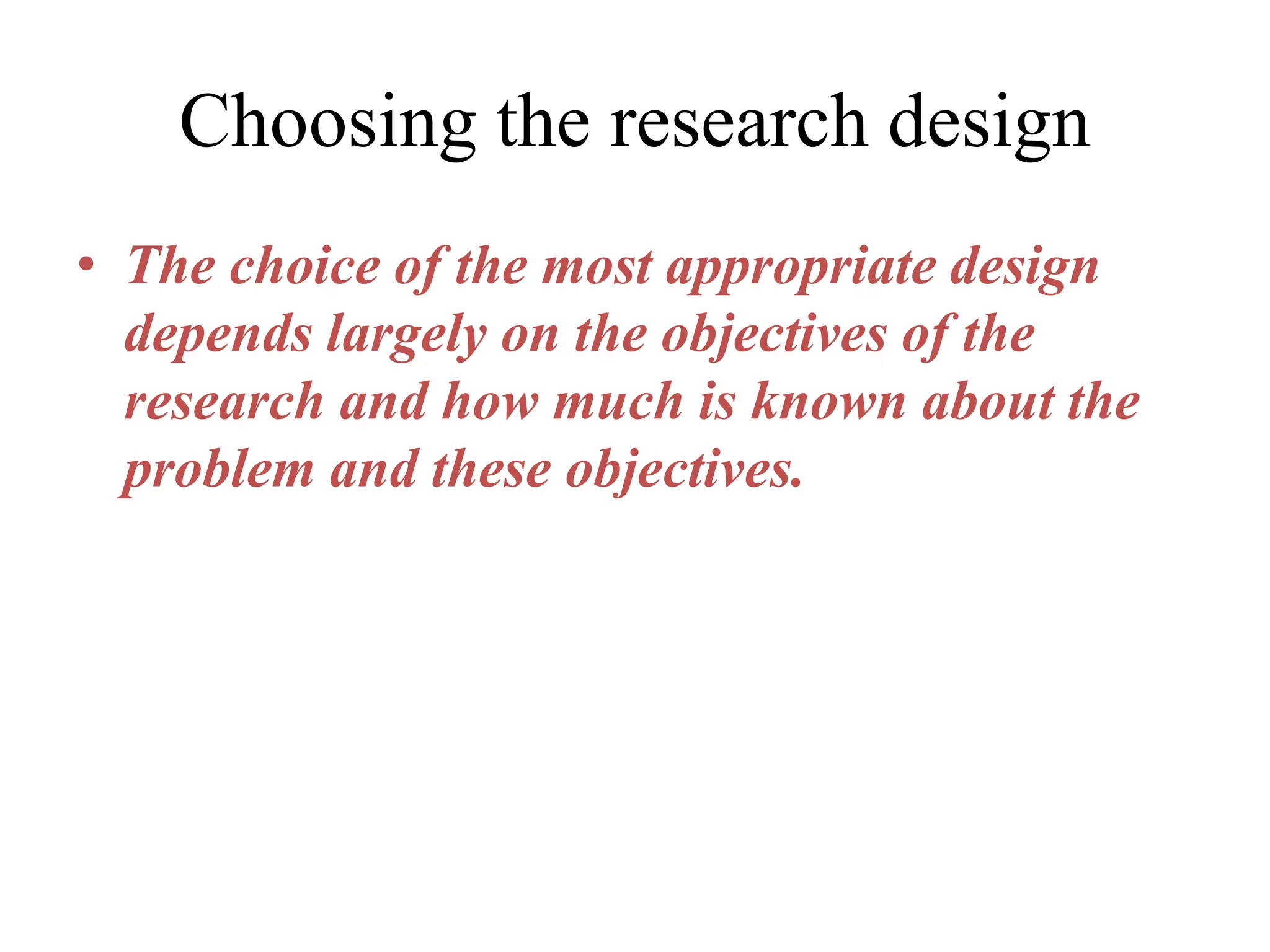
Choosing the research design
• The choice of the most appropriate design
depends largely on the objectives of the
research and how much is known about the
problem and these objectives.
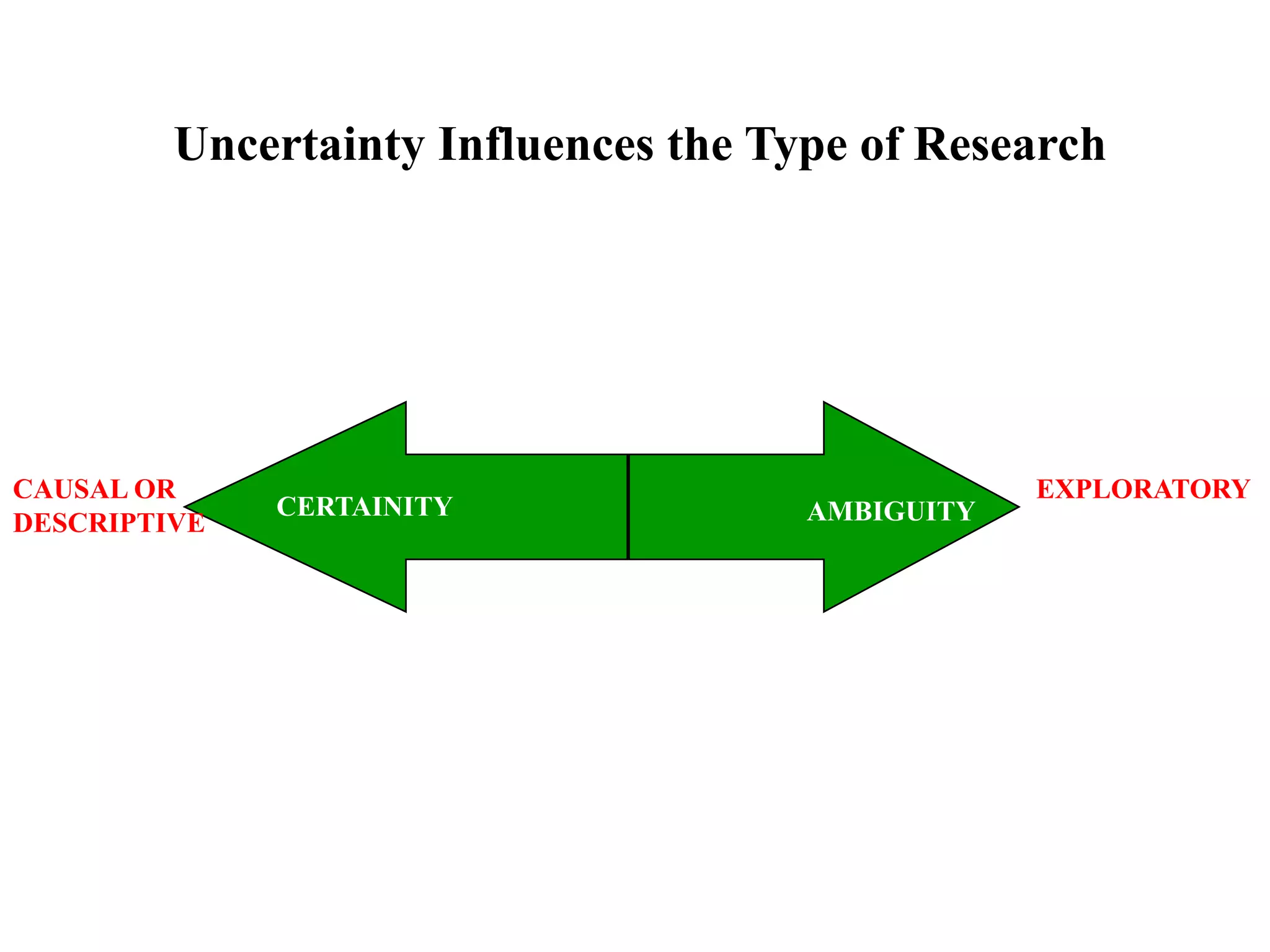
CERTAINITY AMBIGUITY
CAUSAL OR
DESCRIPTIVE
EXPLORATORY
Uncertainty Influences the Type of Research
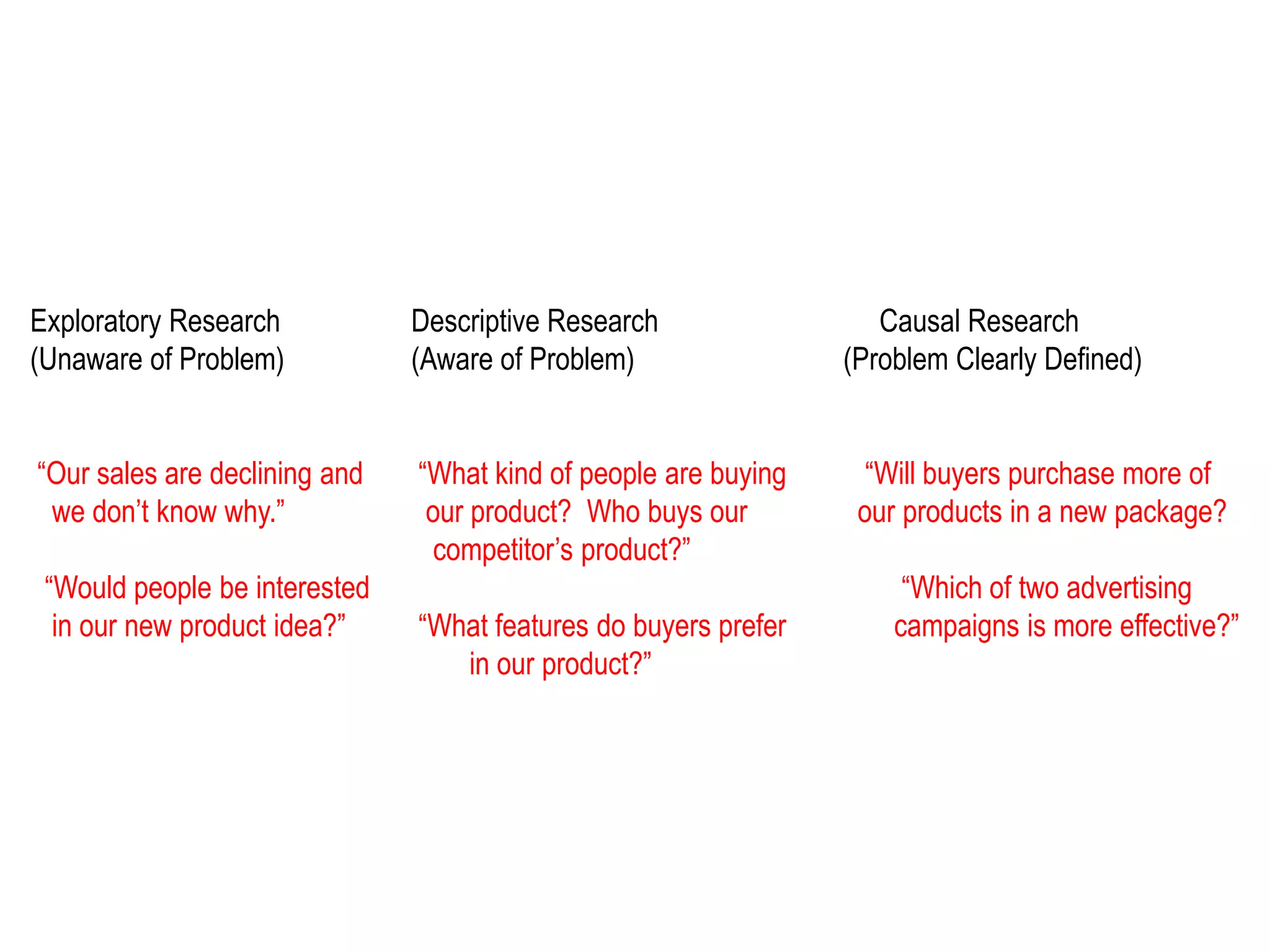
Exploratory Research Descriptive Research Causal Research
(Unaware of Problem) (Aware of Problem) (Problem Clearly Defined)
“Our sales are declining and “What kind of people are buying “Will buyers purchase more of
we don’t know why.” our product? Who buys our our products in a new package?
competitor’s product?”
“Would people be interested “Which of two advertising
in our new product idea?” “What features do buyers prefer campaigns is more effective?”
in our product?”
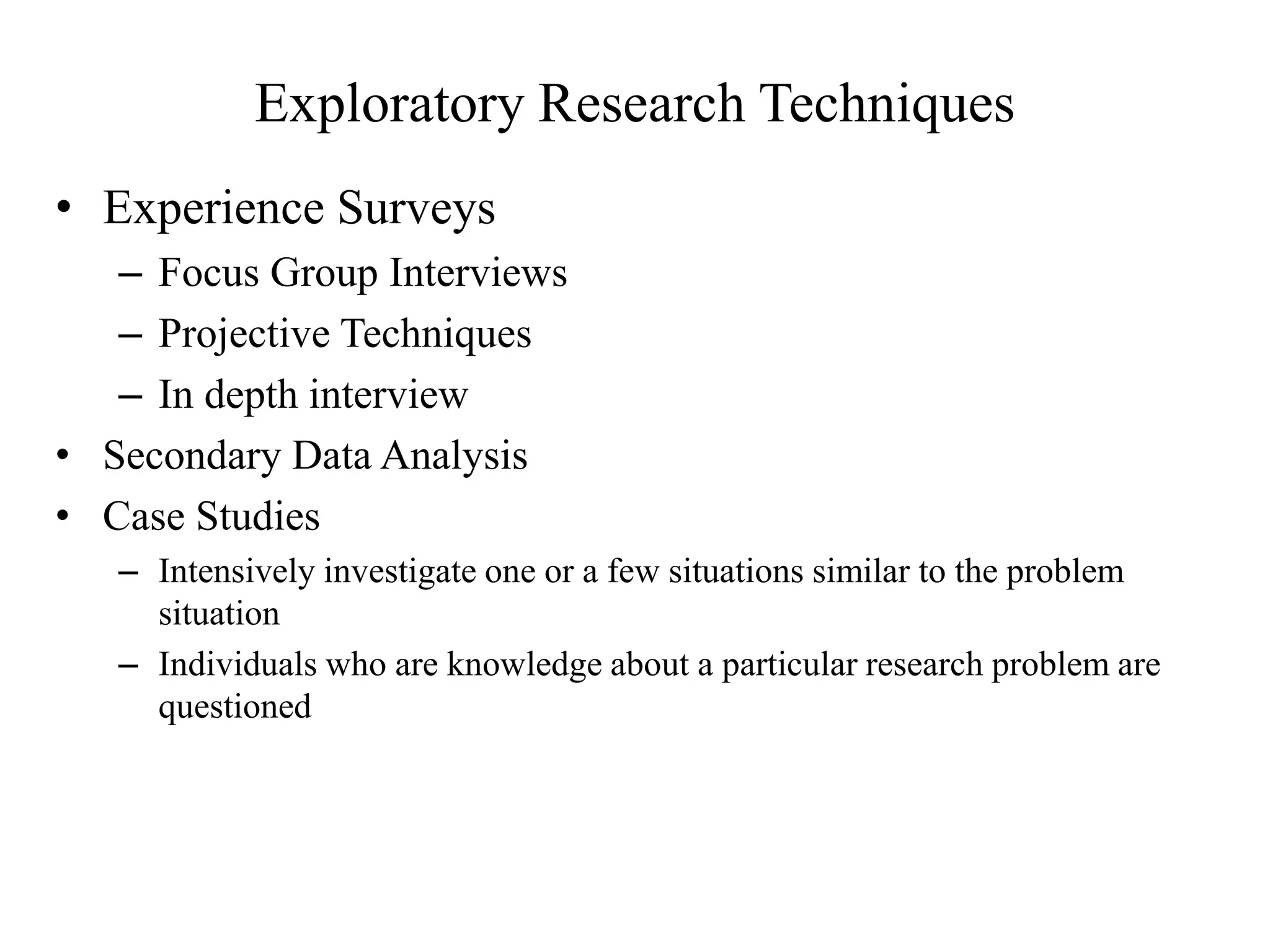
Exploratory Research Techniques
• Experience Surveys
– Focus Group Interviews
– Projective Techniques
– In depth interview
• Secondary Data Analysis
• Case Studies
– Intensively investigate one or a few situations similar to the problem
situation
– Individuals who are knowledge about a particular research problem are
questioned
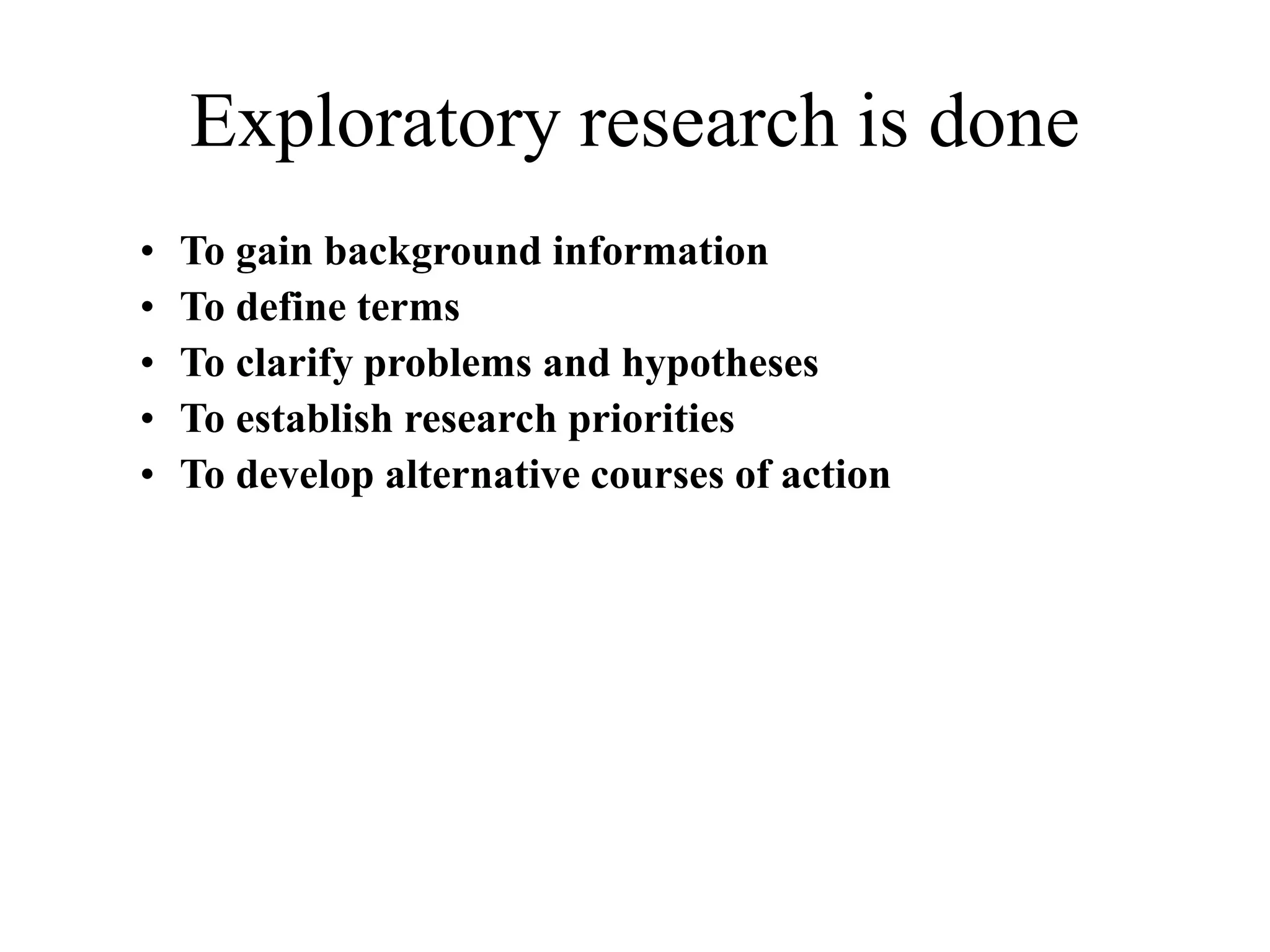
Exploratory research is done
• To gain background information
• To define terms
• To clarify problems and hypotheses
• To establish research priorities
• To develop alternative courses of action
Focus group interview
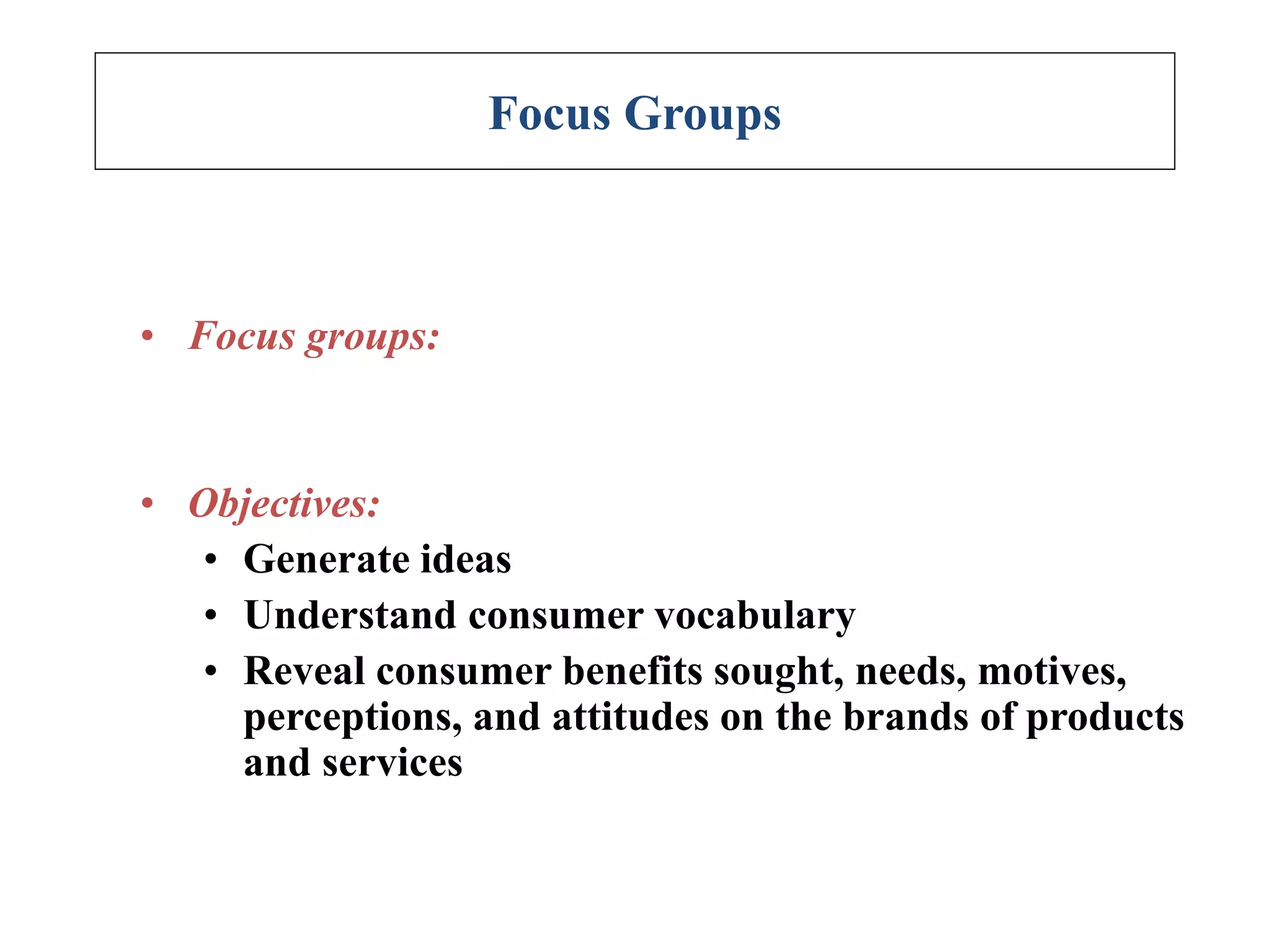
Focus Groups
• Focus groups:
• Objectives:
• Generate ideas
• Understand consumer vocabulary
• Reveal consumer benefits sought, needs, motives,
perceptions, and attitudes on the brands of products
and services
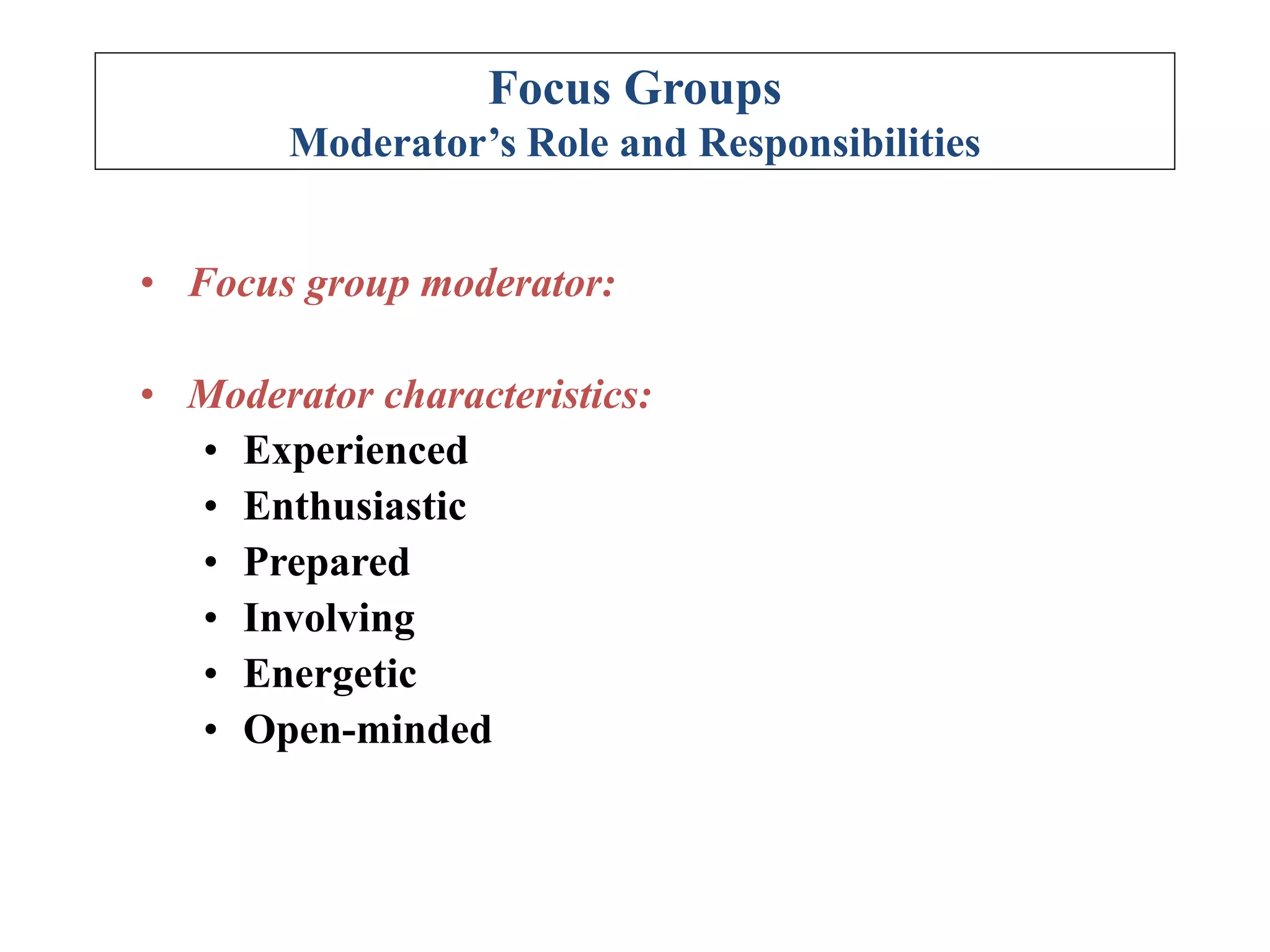
Focus Groups
Moderator’s Role and Responsibilities
• Focus group moderator:
• Moderator characteristics:
• Experienced
• Enthusiastic
• Prepared
• Involving
• Energetic
• Open-minded
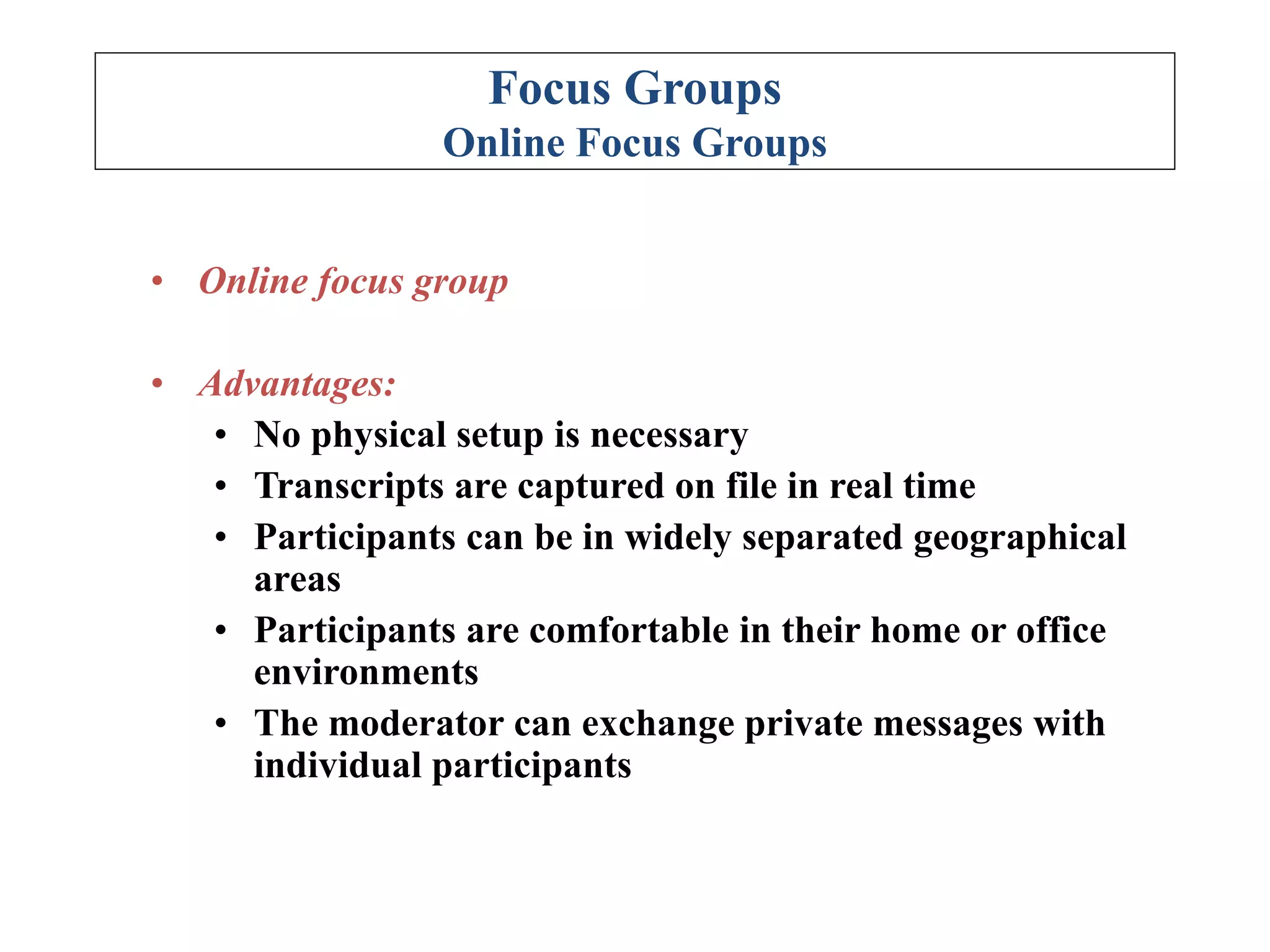
Focus Groups
Online Focus Groups
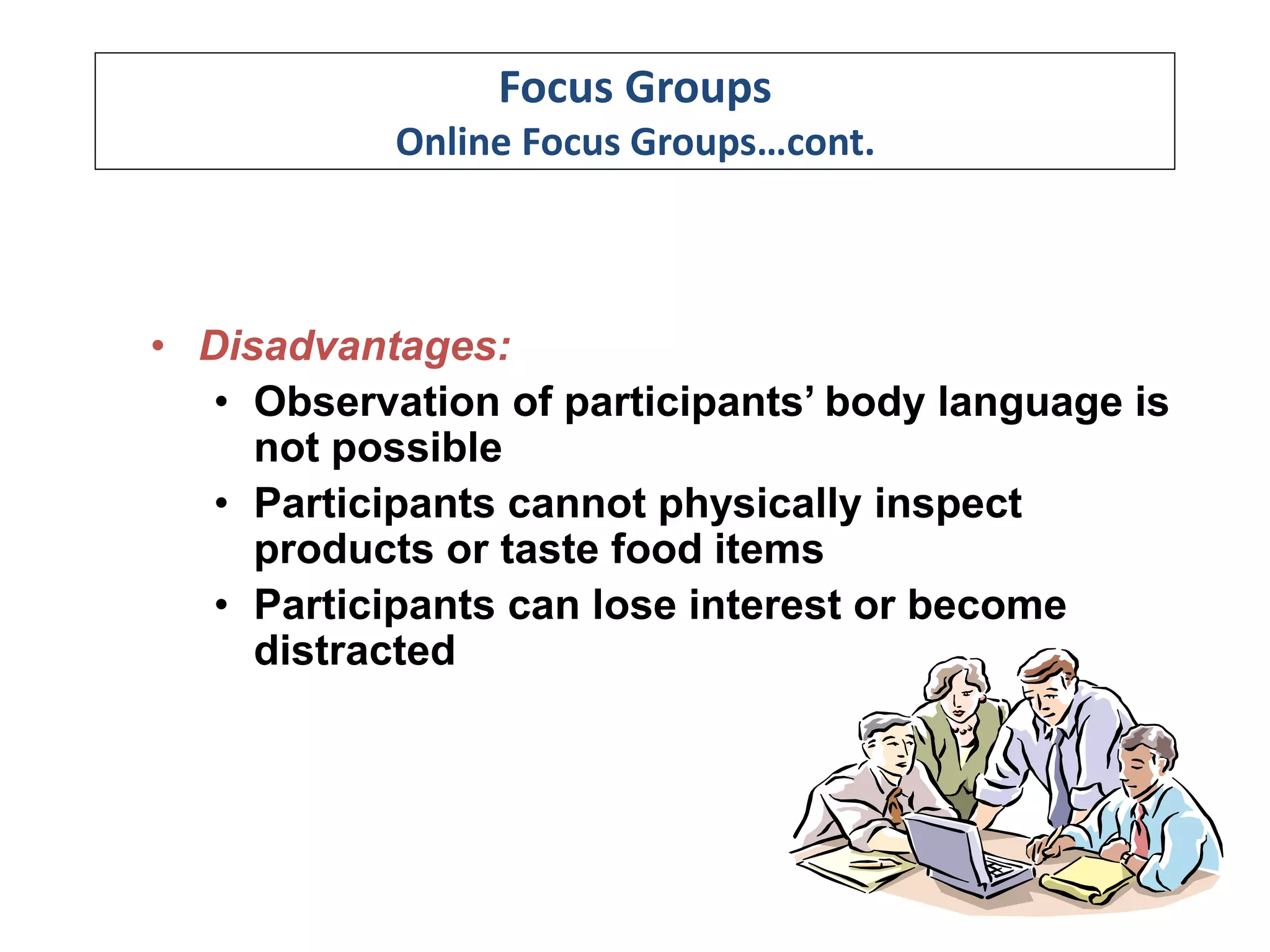
• Online focus group
• Advantages:
• No physical setup is necessary
• Transcripts are captured on file in real time
• Participants can be in widely separated geographical
areas
• Participants are comfortable in their home or office
environments
• The moderator can exchange private messages with
individual participants
Focus Groups
Online Focus Groups…cont.
• Disadvantages:
• Observation of participants’ body language is
not possible
• Participants cannot physically inspect
products or taste food items
• Participants can lose interest or become
distracted
Focus Groups – In General
• Advantages:
• Generation of fresh ideas
• Client interaction
• Versatility (many topics, other research
techniques may be used, product tests, etc.)
• May tap special respondents (drs., lawyers …)
• Disadvantages:
• Representative of the population?
• Interpretation is subjective
• High cost-per-participant ($150 - $200 each)
In-depth interview
• One to one
• Unstructured
In depth interview is done
• In pilot studies to generate ideas.
• To obtain greater depth of information on a
topic of interest
• To evaluate the impacts of interventions on
attitudes or beliefs
Projective techniques
• TAT
• Word association
• Story completion
• Sentence completion
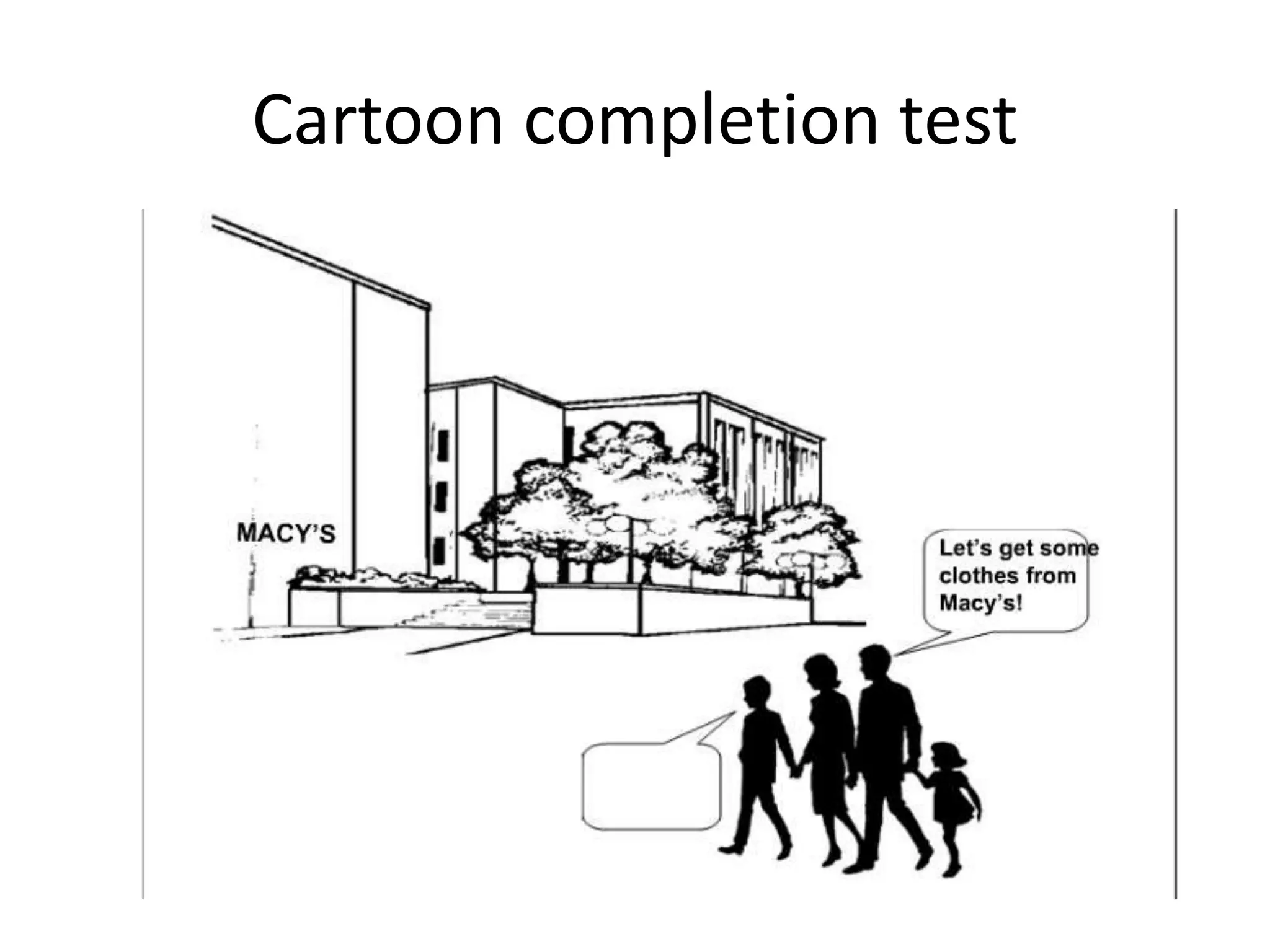
• Cartoon test
TAT
• See the picture and write a story
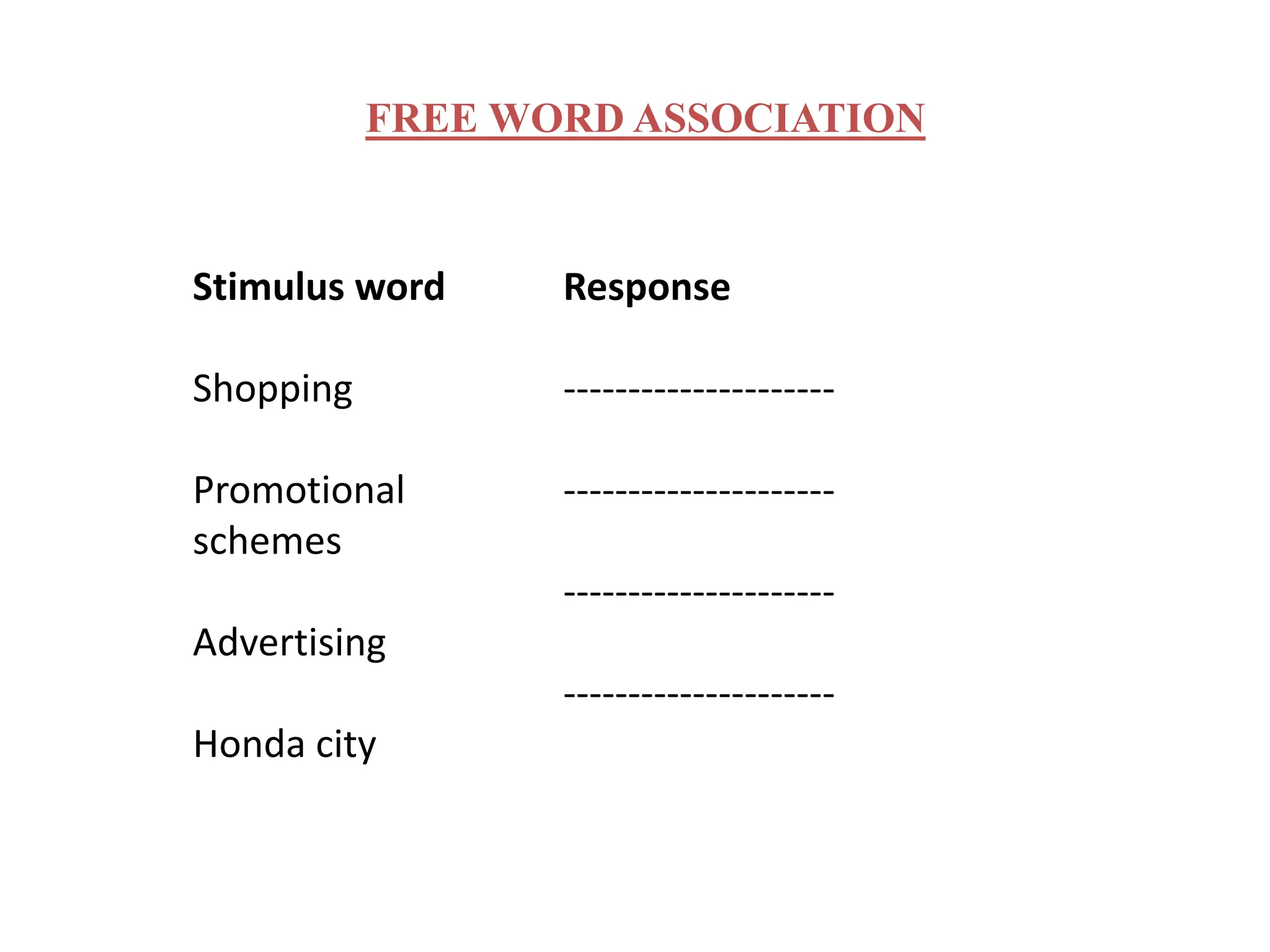
FREE WORD ASSOCIATION
Stimulus word
Shopping
Promotional
schemes
Advertising
Honda city
Response
---------------------
---------------------
---------------------
---------------------
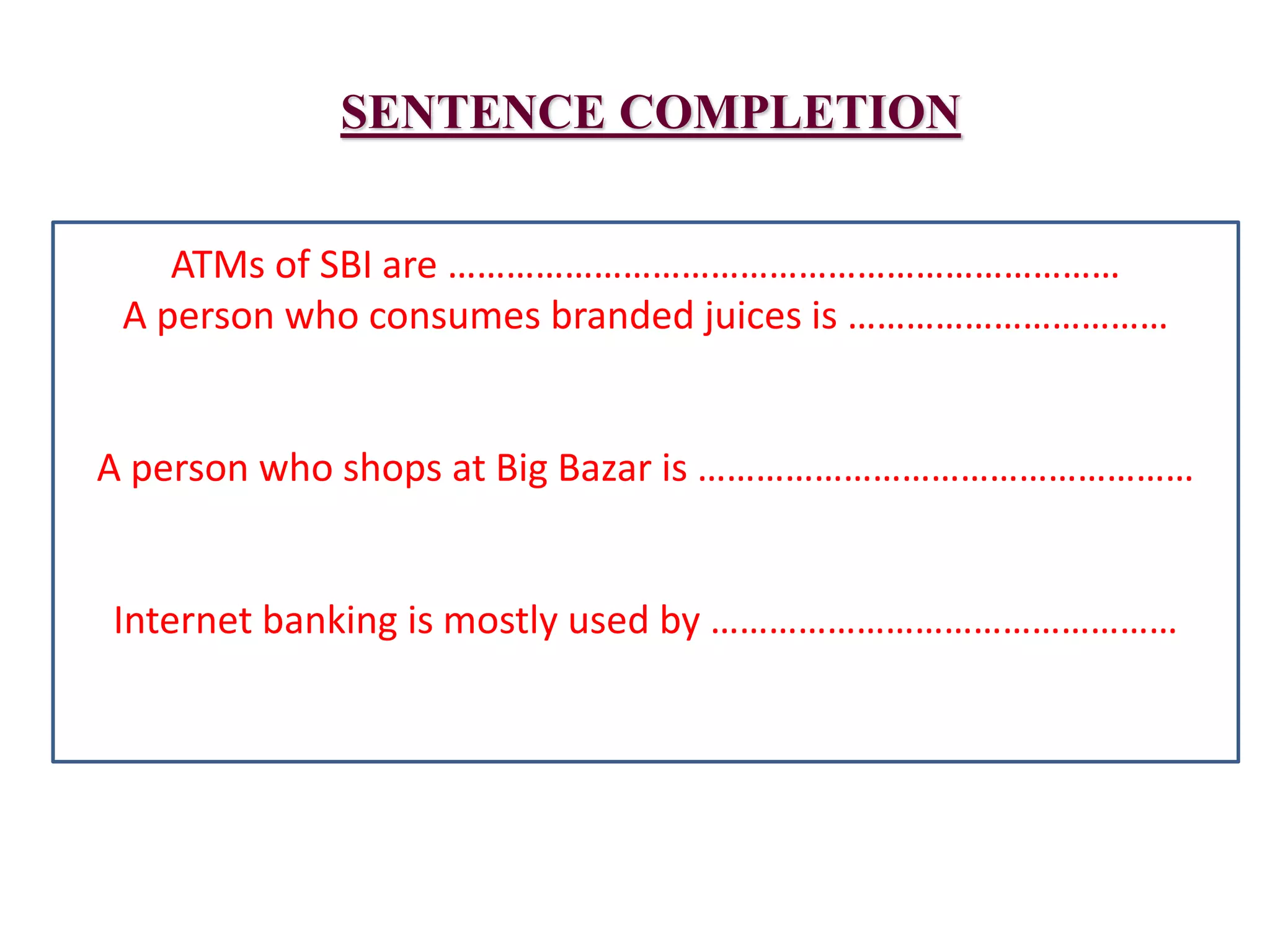
SENTENCE COMPLETION
ATMs of SBI are ……………………………………………………………
A person who consumes branded juices is ……………………………
A person who shops at Big Bazar is ……………………………………………
Internet banking is mostly used by …………………………………………
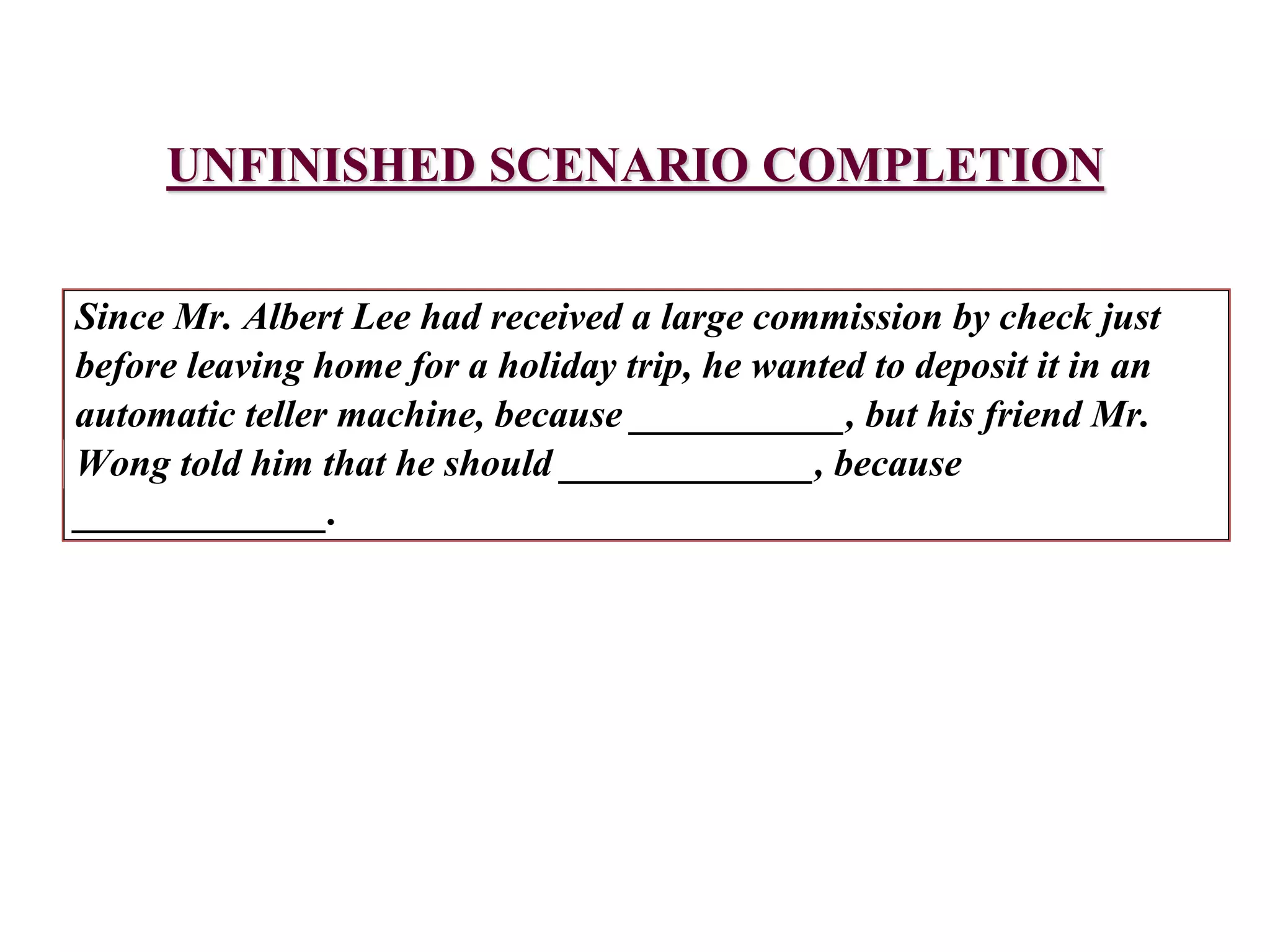
Since Mr. Albert Lee had received a large commission by check just
before leaving home for a holiday trip, he wanted to deposit it in an
automatic teller machine, because ___________, but his friend Mr.
Wong told him that he should _____________, because
_____________.
UNFINISHED SCENARIO COMPLETION
Cartoon completion test
Analysis of secondary data
• Advantages of secondary data
• Disadvantages of secondary data
• How many seats we need in Hostels for Male
and Female students?
• Does gender has something to do with
placement ratio?
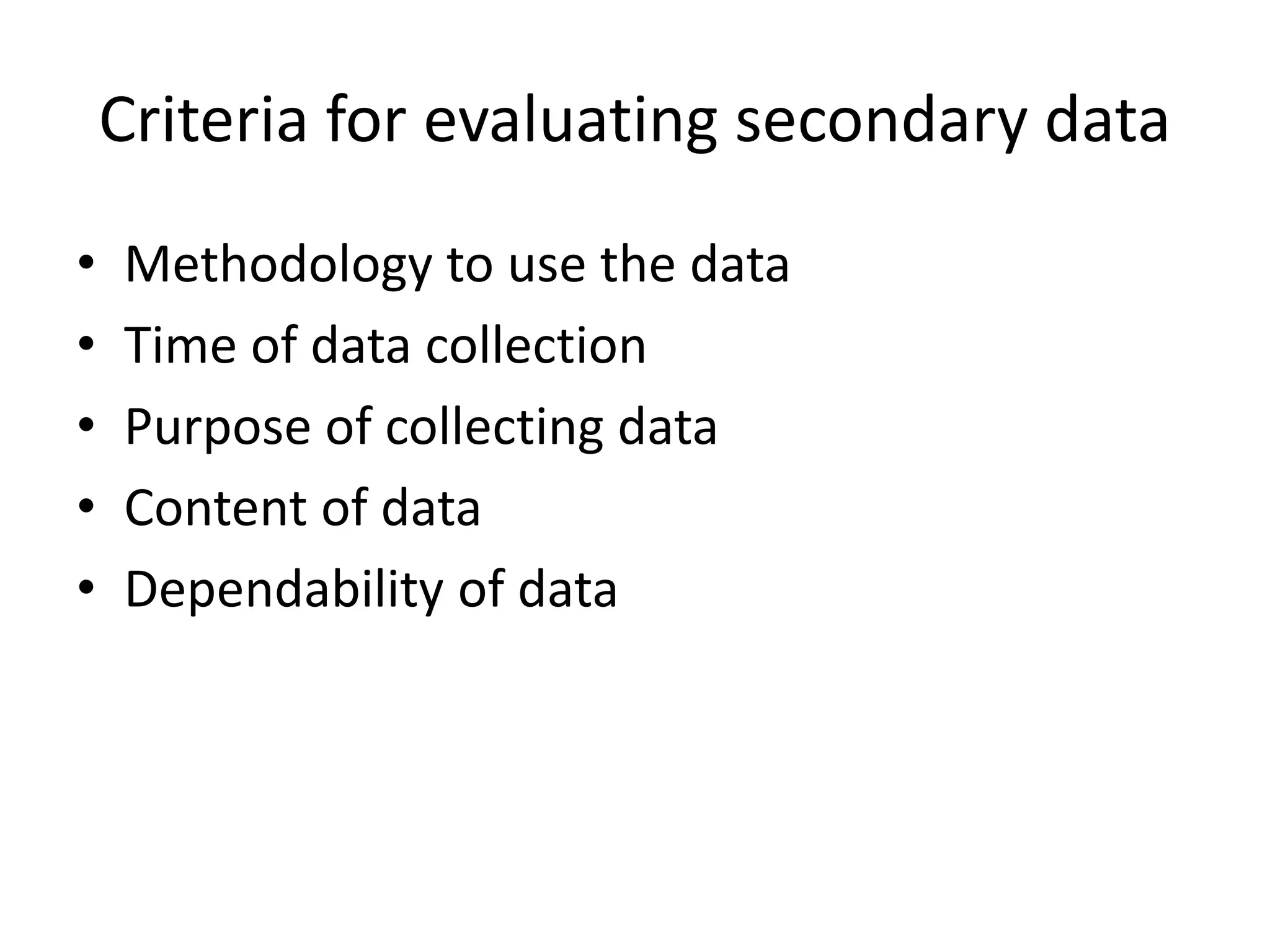
Criteria for evaluating secondary data
• Methodology to use the data
• Time of data collection
• Purpose of collecting data
• Content of data
• Dependability of data
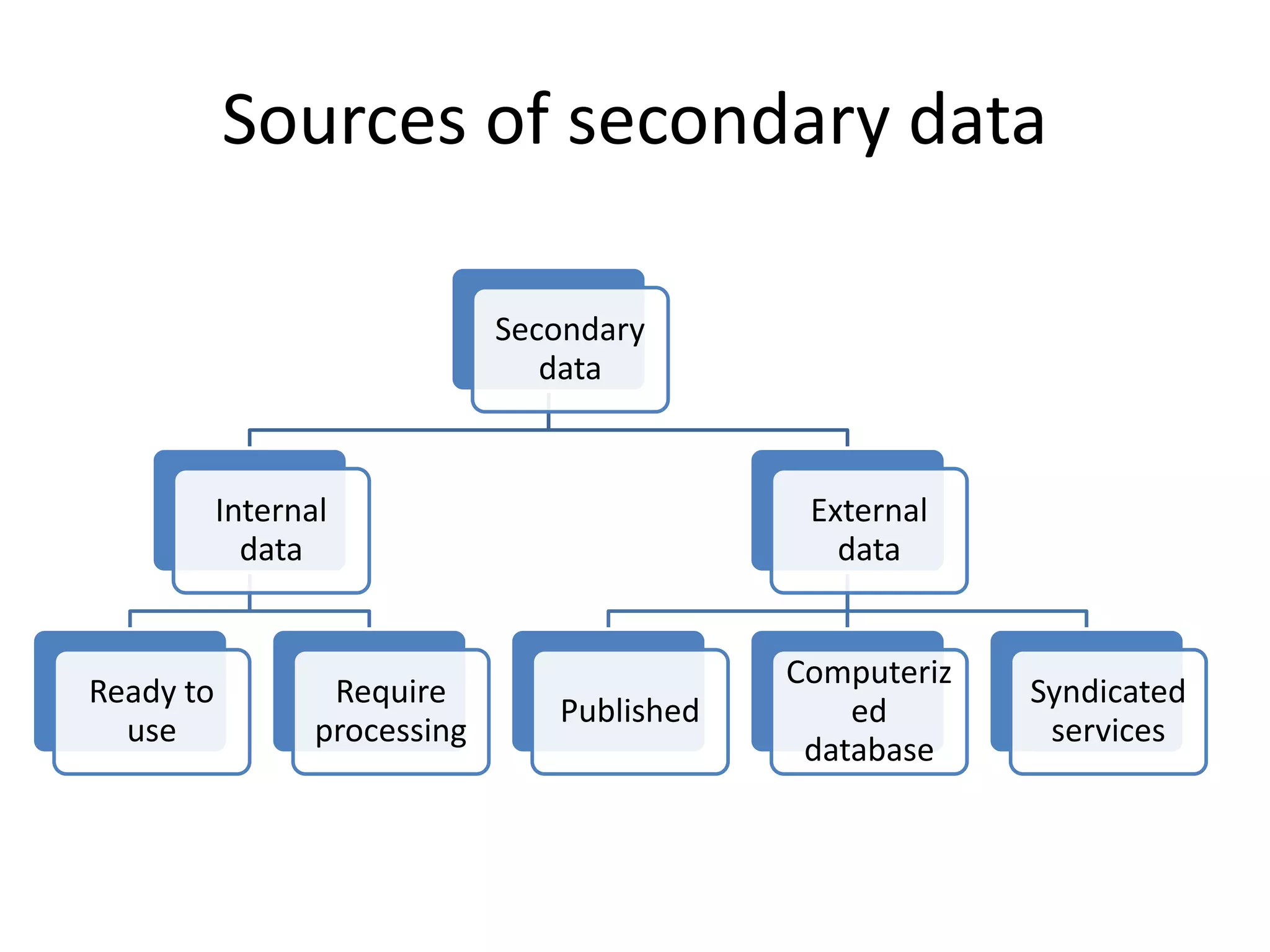
Sources of secondary data
Secondary
data
Internal
data
Ready to
use
Require
processing
External
data
Published
Computeriz
ed
database
Syndicated
services
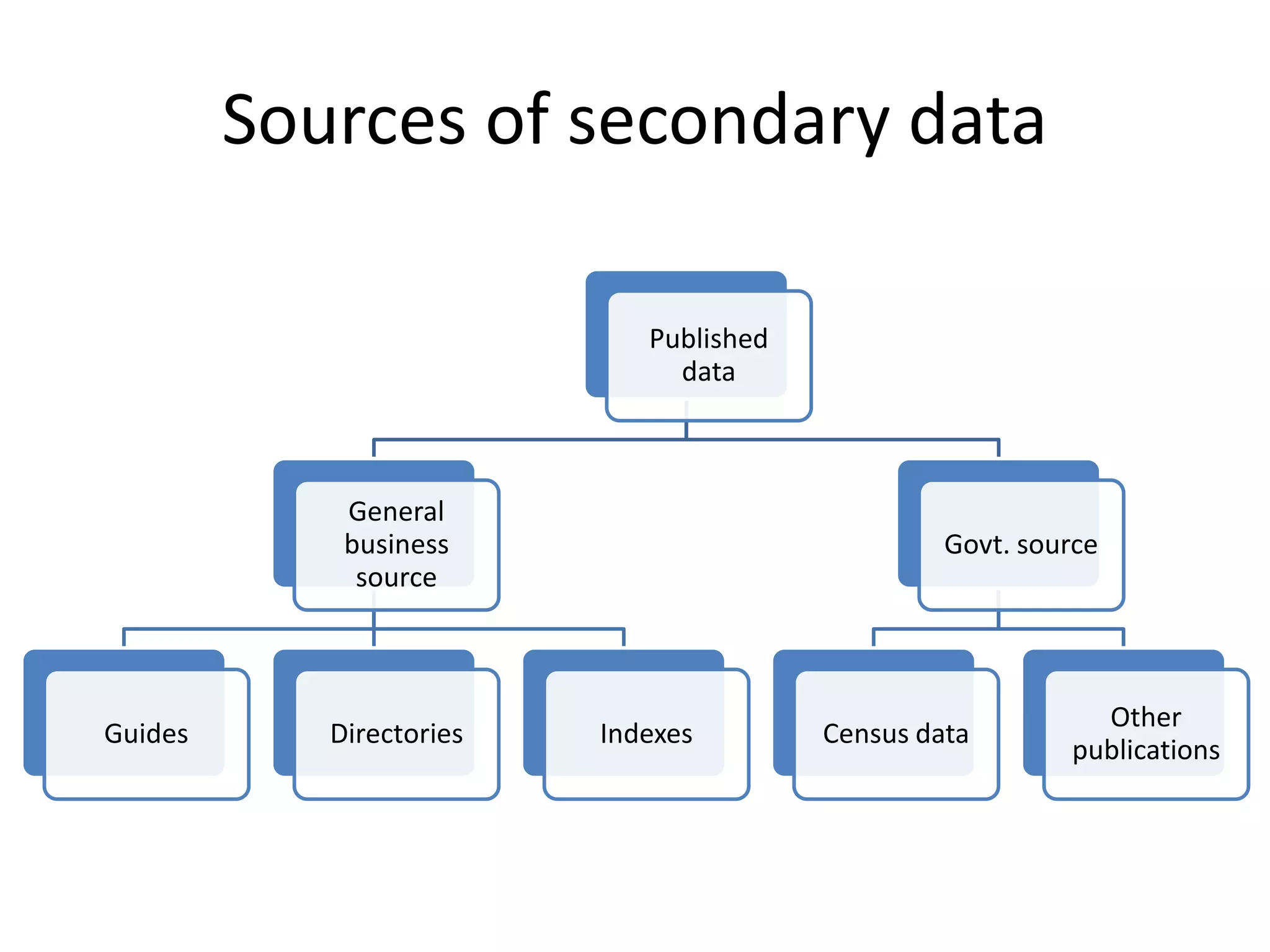
Sources of secondary data
Published
data
General
business
source
Guides Directories Indexes
Govt. source
Census data
Other
publications
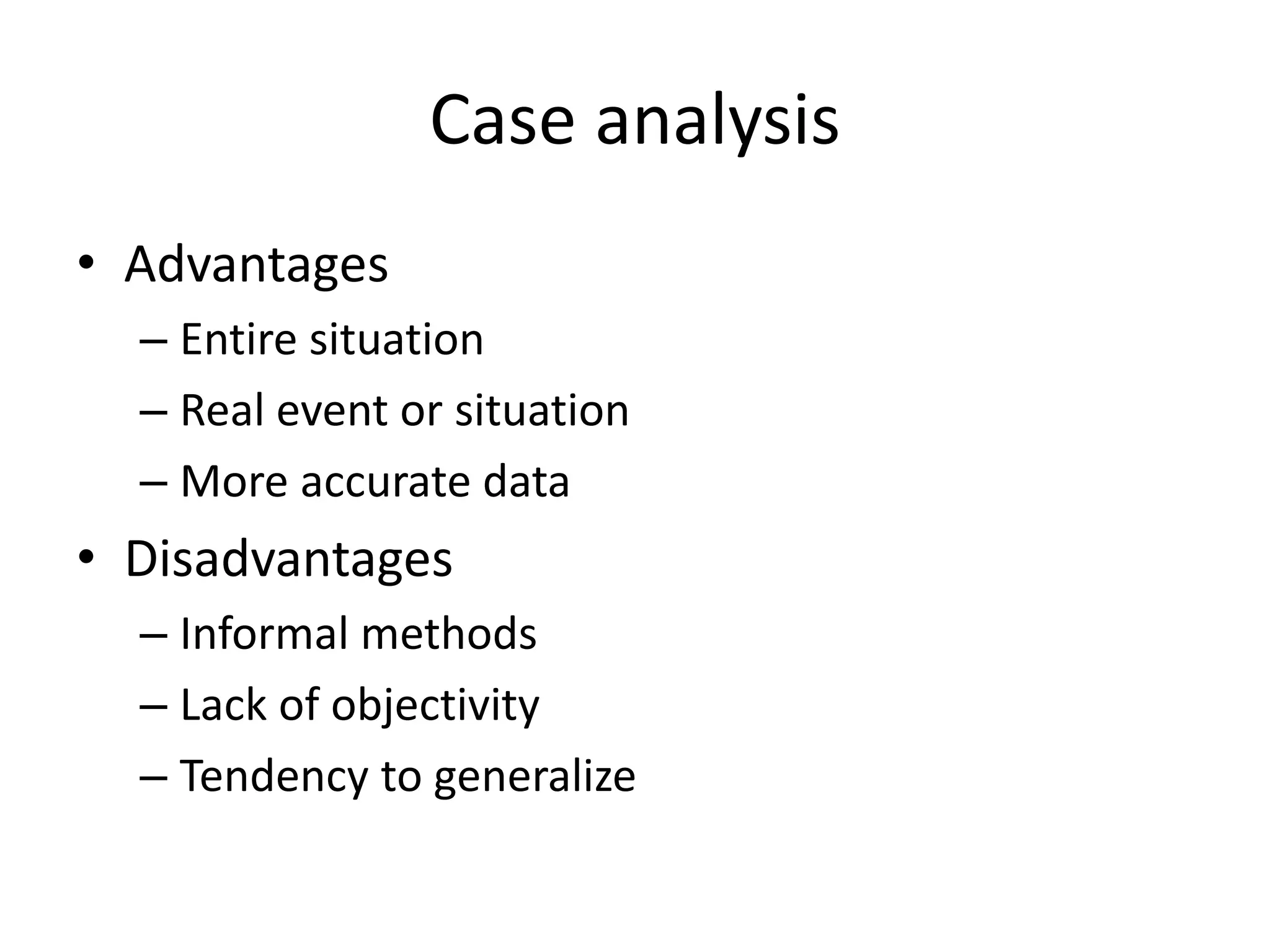
Case analysis
• Advantages
– Entire situation
– Real event or situation
– More accurate data
• Disadvantages
– Informal methods
– Lack of objectivity
– Tendency to generalize

Research design- Exploratory.pptx

  • 1.
  • 2.
    Research design • Aframework or blueprint for conducting the research project.
  • 3.
    A Classification ofResearch Designs Research Design Exploratory Research Conclusive Research Secondary Data Experience Surveys Pilot Studies Case Studies On next slide
  • 4.
    A Classification ofResearch Designs Research Design Exploratory Research Conclusive Research Descriptive Design Causal/Experi ment Design Cross-sectional Study Longitudinal Study Secondary Data Study Observation Survey
  • 5.
    Types of ResearchDesigns Exploratory research to gain ideas and insights  Product facing decreasing sales - generate possible reasons.
  • 6.
    Descriptive research to obtainsummary measures to address research questions (research objectives are clearly defined).  Trends in lifestyle with respect to demographics.
  • 7.
    Causal/Experimental research for cause-and-effectconnection between managerial decisions and market outcome. – How people react to a particular change in the product.
  • 8.
    Choosing the researchdesign • The choice of the most appropriate design depends largely on the objectives of the research and how much is known about the problem and these objectives.
  • 9.
  • 10.
    Exploratory Research DescriptiveResearch Causal Research (Unaware of Problem) (Aware of Problem) (Problem Clearly Defined) “Our sales are declining and “What kind of people are buying “Will buyers purchase more of we don’t know why.” our product? Who buys our our products in a new package? competitor’s product?” “Would people be interested “Which of two advertising in our new product idea?” “What features do buyers prefer campaigns is more effective?” in our product?”
  • 11.
    Exploratory Research Techniques •Experience Surveys – Focus Group Interviews – Projective Techniques – In depth interview • Secondary Data Analysis • Case Studies – Intensively investigate one or a few situations similar to the problem situation – Individuals who are knowledge about a particular research problem are questioned
  • 12.
    Exploratory research isdone • To gain background information • To define terms • To clarify problems and hypotheses • To establish research priorities • To develop alternative courses of action
  • 13.
  • 14.
    Focus Groups • Focusgroups: • Objectives: • Generate ideas • Understand consumer vocabulary • Reveal consumer benefits sought, needs, motives, perceptions, and attitudes on the brands of products and services
  • 15.
    Focus Groups Moderator’s Roleand Responsibilities • Focus group moderator: • Moderator characteristics: • Experienced • Enthusiastic • Prepared • Involving • Energetic • Open-minded
  • 16.
    Focus Groups Online FocusGroups • Online focus group • Advantages: • No physical setup is necessary • Transcripts are captured on file in real time • Participants can be in widely separated geographical areas • Participants are comfortable in their home or office environments • The moderator can exchange private messages with individual participants
  • 17.
    Focus Groups Online FocusGroups…cont. • Disadvantages: • Observation of participants’ body language is not possible • Participants cannot physically inspect products or taste food items • Participants can lose interest or become distracted
  • 18.
    Focus Groups –In General • Advantages: • Generation of fresh ideas • Client interaction • Versatility (many topics, other research techniques may be used, product tests, etc.) • May tap special respondents (drs., lawyers …) • Disadvantages: • Representative of the population? • Interpretation is subjective • High cost-per-participant ($150 - $200 each)
  • 19.
    In-depth interview • Oneto one • Unstructured
  • 20.
    In depth interviewis done • In pilot studies to generate ideas. • To obtain greater depth of information on a topic of interest • To evaluate the impacts of interventions on attitudes or beliefs
  • 21.
    Projective techniques • TAT •Word association • Story completion • Sentence completion • Cartoon test
  • 22.
    TAT • See thepicture and write a story
  • 23.
    FREE WORD ASSOCIATION Stimulusword Shopping Promotional schemes Advertising Honda city Response --------------------- --------------------- --------------------- ---------------------
  • 24.
    SENTENCE COMPLETION ATMs ofSBI are …………………………………………………………… A person who consumes branded juices is …………………………… A person who shops at Big Bazar is …………………………………………… Internet banking is mostly used by …………………………………………
  • 25.
    Since Mr. AlbertLee had received a large commission by check just before leaving home for a holiday trip, he wanted to deposit it in an automatic teller machine, because ___________, but his friend Mr. Wong told him that he should _____________, because _____________. UNFINISHED SCENARIO COMPLETION
  • 26.
  • 27.
    Analysis of secondarydata • Advantages of secondary data • Disadvantages of secondary data
  • 28.
    • How manyseats we need in Hostels for Male and Female students? • Does gender has something to do with placement ratio?
  • 29.
    Criteria for evaluatingsecondary data • Methodology to use the data • Time of data collection • Purpose of collecting data • Content of data • Dependability of data
  • 30.
    Sources of secondarydata Secondary data Internal data Ready to use Require processing External data Published Computeriz ed database Syndicated services
  • 31.
    Sources of secondarydata Published data General business source Guides Directories Indexes Govt. source Census data Other publications
  • 32.
    Case analysis • Advantages –Entire situation – Real event or situation – More accurate data • Disadvantages – Informal methods – Lack of objectivity – Tendency to generalize