•Group

4

•Rohith KR(1320827)
•Sharath MJ(1320807)
•Manav Sood(1320818)
•Anurag Deyasi(1320803)
•Eshan Shrivastava(1320810)
 Characteristics

of Depth Interviews (DI)
 Techniques and Applications DI
 Advantages and Disadvantages of DI
 Case Study
 Review on DI
The in-depth interview, while focused, is
discursive and allows the researcher and
respondent latitude to explore an issue
within the framework of a guided
conversation.
Requirement of detailed
information(thoughts, behaviors new issues).
 To answers the questions „What‟ and „How‟ .


For example, you may have measured an
increase in youth visits to a clinic, and through indepth interviews you find out that a
youth noted that she went to the clinic because she
saw a new sign outside of the clinic
advertising youth hours. You might also interview a
clinic staff member to find out their
perspective on the clinic‟s “youth friendliness.”
non – disguised Qualitative Research
Procedure
 One-to-one intense interviewing interaction
 Small number of respondents
 Structured & Unstructured
 Used to explore ideas, situations or
programs
A
 Conversational

and Engaging
 Non Disguised Qualitative Research
 Can Inductive or Deductive
 Open Ended Questions
 Seek understanding & Interpretation
 Record Reflections
 Exploring

the boundaries of a problem.
 Obtaining context for a problem or issue.
 Evaluating potential solutions.
 Managing the research process by
supporting the interpretation of results from
surveys and other quantitative methods.
 Interviewing

the faculty, staff, students, or
others at CUIM about their experiences or
expectations related to the program.
• Their thoughts on
 Program operations & innovations
 Processes followed
 Satisfactory Outcomes
 Changes they see within themselves as a result of
being associated with it








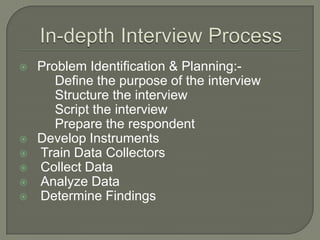
Problem Identification & Planning:Define the purpose of the interview
Structure the interview
Script the interview
Prepare the respondent
Develop Instruments
Train Data Collectors
Collect Data
Analyze Data
Determine Findings
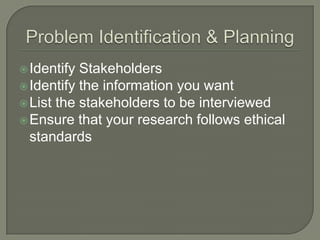
 Identify

Stakeholders
 Identify the information you want
 List the stakeholders to be interviewed
 Ensure that your research follows ethical
standards
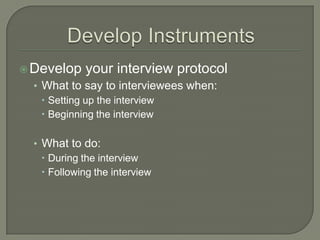
 Develop

your interview protocol

• What to say to interviewees when:
 Setting up the interview
 Beginning the interview
• What to do:
 During the interview
 Following the interview
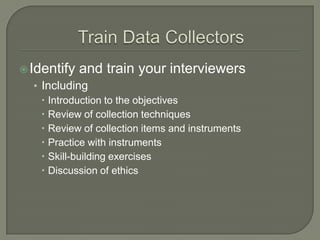
 Identify

and train your interviewers

• Including
 Introduction to the objectives
 Review of collection techniques
 Review of collection items and instruments
 Practice with instruments
 Skill-building exercises
 Discussion of ethics
 Set

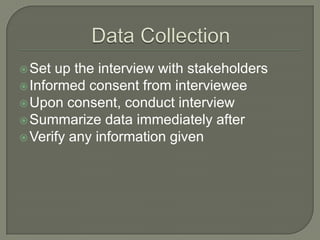
up the interview with stakeholders
 Informed consent from interviewee
 Upon consent, conduct interview
 Summarize data immediately after
 Verify any information given
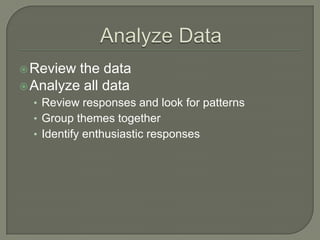
 Review

the data
 Analyze all data
• Review responses and look for patterns
• Group themes together

• Identify enthusiastic responses
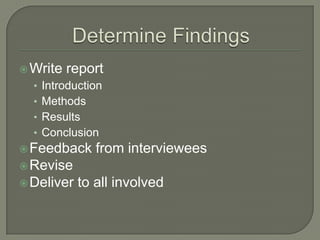
 Write

report

• Introduction
• Methods
• Results

• Conclusion
 Feedback

from interviewees

 Revise
 Deliver

to all involved
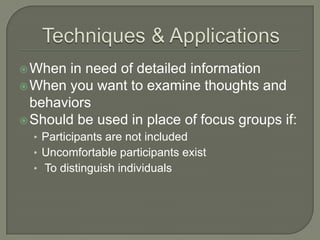
 When

in need of detailed information
 When you want to examine thoughts and
behaviors
 Should be used in place of focus groups if:
• Participants are not included
• Uncomfortable participants exist
• To distinguish individuals
 Provides

more information than surveys

• Participants are more enthusiastic than just

answering a survey
 Provides

relaxed atmosphere

• Better to talk one on one than to fill out a survey
 Able

to use direct conversation vs. indirect

• On the other hand a survey is indirect
 Bias

• Responses can be biased
 Time-intensive

• A extensive amount of time involved
 Training

• Interviewer must be properly trained
 Not-generalizable

• Cannot generalize from those findings
 You can group themes

• Due to small sampling and not using random samples
Reconnaissance Market Research or
ReconMR is a strong research agency
focused on enterprise clients‟ primary
research needs for strategic decisionmaking.
 Build

an Integrated healthcare delivery
system (IHDS)
 Needed a clearer picture of
• Issues

• Ongoing Trends
• Needs
• Competitors
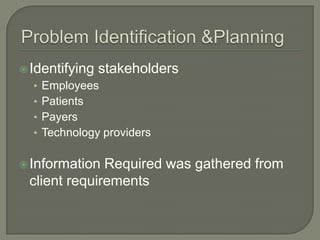
 Identifying

stakeholders

• Employees
• Patients
• Payers

• Technology providers
 Information

Required was gathered from
client requirements
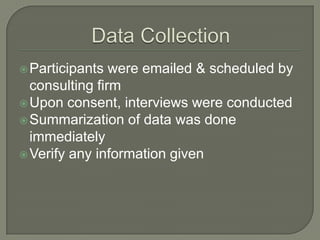
 Participants

were emailed & scheduled by
consulting firm
 Upon consent, interviews were conducted
 Summarization of data was done
immediately
 Verify any information given
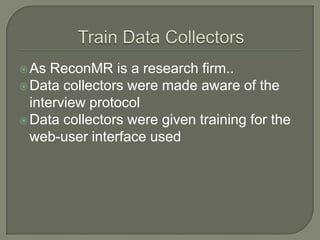
 As

ReconMR is a research firm..
 Data collectors were made aware of the
interview protocol
 Data collectors were given training for the
web-user interface used
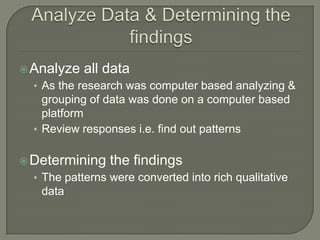
 Analyze

all data

• As the research was computer based analyzing &

grouping of data was done on a computer based
platform
• Review responses i.e. find out patterns
 Determining

the findings

• The patterns were converted into rich qualitative

data
 The

DI as a Computer assisted telephone
interview
 The DI was intense and One-to one
 Participants were predefined
 Contains factors & facts with rich
qualitative data which effects the decision
of the client
 Provided insights to macro trends of clients
industries
 Use

of collected information

• IHDS can leverage its strength on trends
• The interviews conducted informed the business

strategy recommendation
• Client can compare themselves with the
competitoirs
The Youth Attitude Tracking Study
(YATS)
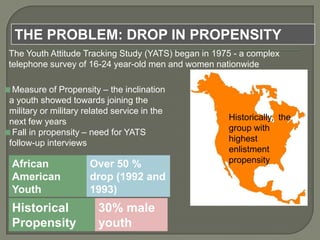
THE PROBLEM: DROP IN PROPENSITY
The Youth Attitude Tracking Study (YATS) began in 1975 - a complex
telephone survey of 16-24 year-old men and women nationwide
Measure of Propensity – the inclination
a youth showed towards joining the
military or military related service in the
next few years
Fall in propensity – need for YATS
follow-up interviews

African
American
Youth

Historical
Propensity

Over 50 %
drop (1992 and
1993)

30% male
youth

Historically, the
group with
highest
enlistment
propensity
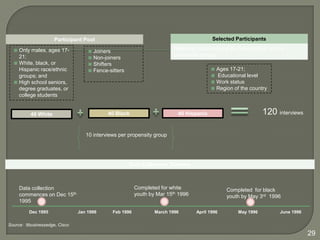
Selected Participants

Participant Pool
 Only males, ages 1721;
 White, black, or
Hispanic race/ethnic
groups; and
 High school seniors,
degree graduates, or
college students

Balanced quota among the 3race/ethnic and 4
propensity groups

 Joiners
 Non-joiners
 Shifters
 Fence-sitters

 Ages 17-21;
 Educational level
 Work status
 Region of the country

40 Black

40 White

120 interviews

40 Hispanic

10 interviews per propensity group

Data Collection Timeline

Completed for white
youth by Mar 15th 1996

Data collection
commences on Dec 15th
1995
Dec 1995

Jan 1996

Feb 1996

March 1996

Completed for black
youth by May 3rd 1996
April 1996

May 1996

June 1996

Source: Itbusinessedge, Cisco

29
Interview Process and Data Collection
Interview Process
 Standard set of questions, 45 minutes per interview
 Interviewer provided with personal characteristics to familiarize
with participants.
 All interviews were taped, with permission, and transcribed
 Each interview was
summarized in writing by the interviewer.

Each respondent was allowed to "tell
his story" in his own order and depth
with guidance from the interviewer

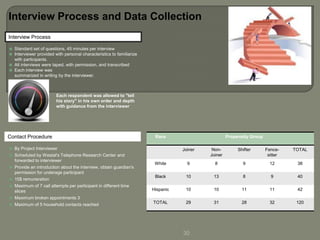
Contact Procedure

Race

 By Project Interviewer
 Scheduled by Westat's Telephone Research Center and
forwarded to interviewer
 Provide an introduction about the interview, obtain guardian's
permission for underage participant
 15$ remuneration
 Maximum of 7 call attempts per participant in different time
slices

Propensity Group
Joiner

NonJoiner

Shifter

Fencesitter

TOTAL

White

9

8

9

12

38

Black

10

13

8

9

40

Hispanic

10

10

11

11

42

TOTAL

29

31

28

32

120

 Maximum broken appointments 3
 Maximum of 5 household contacts reached

30
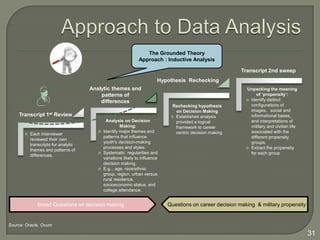
The Grounded Theory
Approach : Inductive Analysis
Transcript 2nd sweep
Hypothesis Rechecking
Analytic themes and
patterns of
differences
Transcript 1st Review

 Each interviewer
reviewed their own
transcripts for analytic
themes and patterns of
differences.

Analysis on Decision
Making:
 Identify major themes and
patterns that influence
youth's decision-making
processes and styles.
 Systematic regularities and
variations likely to influence
decision making.
 E.g.., age, race/ethnic
group, region, urban versus
rural residence,
socioeconomic status, and
college attendance.

Broad Questions on decision making

Rechecking hypothesis
on Decision Making
 Established analysis
provided a logical
framework to career
centric decision making

Unpacking the meaning
of ‘propensity’:
 Identify distinct
configurations of
images, social and
informational bases,
and interpretations of
military and civilian life
associated with the
different propensity
groups.
 Extract the propensity
for each group

Questions on career decision making & military propensity

Source: Oracle, Ovum

31
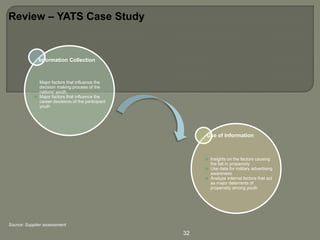
Review – YATS Case Study

Information Collection

 Major factors that influence the
decision making process of the
nations' youth.
 Major factors that influence the
career decisions of the participant
youth

Use of Information

 Insights on the factors causing
the fall in propensity
 Use data for military advertising
awareness
 Analyze internal factors that act
as major deterrents of
propensity among youth

Source: Supplier assessment

32

Depth interviews final

  • 1.
    •Group 4 •Rohith KR(1320827) •Sharath MJ(1320807) •ManavSood(1320818) •Anurag Deyasi(1320803) •Eshan Shrivastava(1320810)
  • 2.
     Characteristics of DepthInterviews (DI)  Techniques and Applications DI  Advantages and Disadvantages of DI  Case Study  Review on DI
  • 3.
    The in-depth interview,while focused, is discursive and allows the researcher and respondent latitude to explore an issue within the framework of a guided conversation.
  • 4.
    Requirement of detailed information(thoughts,behaviors new issues).  To answers the questions „What‟ and „How‟ .  For example, you may have measured an increase in youth visits to a clinic, and through indepth interviews you find out that a youth noted that she went to the clinic because she saw a new sign outside of the clinic advertising youth hours. You might also interview a clinic staff member to find out their perspective on the clinic‟s “youth friendliness.”
  • 5.
    non – disguisedQualitative Research Procedure  One-to-one intense interviewing interaction  Small number of respondents  Structured & Unstructured  Used to explore ideas, situations or programs A
  • 6.
     Conversational and Engaging Non Disguised Qualitative Research  Can Inductive or Deductive  Open Ended Questions  Seek understanding & Interpretation  Record Reflections
  • 7.
     Exploring the boundariesof a problem.  Obtaining context for a problem or issue.  Evaluating potential solutions.  Managing the research process by supporting the interpretation of results from surveys and other quantitative methods.
  • 8.
     Interviewing the faculty,staff, students, or others at CUIM about their experiences or expectations related to the program. • Their thoughts on  Program operations & innovations  Processes followed  Satisfactory Outcomes  Changes they see within themselves as a result of being associated with it
  • 9.
          Problem Identification &Planning:Define the purpose of the interview Structure the interview Script the interview Prepare the respondent Develop Instruments Train Data Collectors Collect Data Analyze Data Determine Findings
  • 10.
     Identify Stakeholders  Identifythe information you want  List the stakeholders to be interviewed  Ensure that your research follows ethical standards
  • 11.
     Develop your interviewprotocol • What to say to interviewees when:  Setting up the interview  Beginning the interview • What to do:  During the interview  Following the interview
  • 12.
     Identify and trainyour interviewers • Including  Introduction to the objectives  Review of collection techniques  Review of collection items and instruments  Practice with instruments  Skill-building exercises  Discussion of ethics
  • 13.
     Set up theinterview with stakeholders  Informed consent from interviewee  Upon consent, conduct interview  Summarize data immediately after  Verify any information given
  • 14.
     Review the data Analyze all data • Review responses and look for patterns • Group themes together • Identify enthusiastic responses
  • 15.
     Write report • Introduction •Methods • Results • Conclusion  Feedback from interviewees  Revise  Deliver to all involved
  • 16.
     When in needof detailed information  When you want to examine thoughts and behaviors  Should be used in place of focus groups if: • Participants are not included • Uncomfortable participants exist • To distinguish individuals
  • 17.
     Provides more informationthan surveys • Participants are more enthusiastic than just answering a survey  Provides relaxed atmosphere • Better to talk one on one than to fill out a survey  Able to use direct conversation vs. indirect • On the other hand a survey is indirect
  • 18.
     Bias • Responsescan be biased  Time-intensive • A extensive amount of time involved  Training • Interviewer must be properly trained  Not-generalizable • Cannot generalize from those findings  You can group themes • Due to small sampling and not using random samples
  • 19.
    Reconnaissance Market Researchor ReconMR is a strong research agency focused on enterprise clients‟ primary research needs for strategic decisionmaking.
  • 20.
     Build an Integratedhealthcare delivery system (IHDS)  Needed a clearer picture of • Issues • Ongoing Trends • Needs • Competitors
  • 21.
     Identifying stakeholders • Employees •Patients • Payers • Technology providers  Information Required was gathered from client requirements
  • 22.
     Participants were emailed& scheduled by consulting firm  Upon consent, interviews were conducted  Summarization of data was done immediately  Verify any information given
  • 23.
     As ReconMR isa research firm..  Data collectors were made aware of the interview protocol  Data collectors were given training for the web-user interface used
  • 24.
     Analyze all data •As the research was computer based analyzing & grouping of data was done on a computer based platform • Review responses i.e. find out patterns  Determining the findings • The patterns were converted into rich qualitative data
  • 25.
     The DI asa Computer assisted telephone interview  The DI was intense and One-to one  Participants were predefined  Contains factors & facts with rich qualitative data which effects the decision of the client  Provided insights to macro trends of clients industries
  • 26.
     Use of collectedinformation • IHDS can leverage its strength on trends • The interviews conducted informed the business strategy recommendation • Client can compare themselves with the competitoirs
  • 27.
    The Youth AttitudeTracking Study (YATS)
  • 28.
    THE PROBLEM: DROPIN PROPENSITY The Youth Attitude Tracking Study (YATS) began in 1975 - a complex telephone survey of 16-24 year-old men and women nationwide Measure of Propensity – the inclination a youth showed towards joining the military or military related service in the next few years Fall in propensity – need for YATS follow-up interviews African American Youth Historical Propensity Over 50 % drop (1992 and 1993) 30% male youth Historically, the group with highest enlistment propensity
  • 29.
    Selected Participants Participant Pool Only males, ages 1721;  White, black, or Hispanic race/ethnic groups; and  High school seniors, degree graduates, or college students Balanced quota among the 3race/ethnic and 4 propensity groups  Joiners  Non-joiners  Shifters  Fence-sitters  Ages 17-21;  Educational level  Work status  Region of the country 40 Black 40 White 120 interviews 40 Hispanic 10 interviews per propensity group Data Collection Timeline Completed for white youth by Mar 15th 1996 Data collection commences on Dec 15th 1995 Dec 1995 Jan 1996 Feb 1996 March 1996 Completed for black youth by May 3rd 1996 April 1996 May 1996 June 1996 Source: Itbusinessedge, Cisco 29
  • 30.
    Interview Process andData Collection Interview Process  Standard set of questions, 45 minutes per interview  Interviewer provided with personal characteristics to familiarize with participants.  All interviews were taped, with permission, and transcribed  Each interview was summarized in writing by the interviewer. Each respondent was allowed to "tell his story" in his own order and depth with guidance from the interviewer Contact Procedure Race  By Project Interviewer  Scheduled by Westat's Telephone Research Center and forwarded to interviewer  Provide an introduction about the interview, obtain guardian's permission for underage participant  15$ remuneration  Maximum of 7 call attempts per participant in different time slices Propensity Group Joiner NonJoiner Shifter Fencesitter TOTAL White 9 8 9 12 38 Black 10 13 8 9 40 Hispanic 10 10 11 11 42 TOTAL 29 31 28 32 120  Maximum broken appointments 3  Maximum of 5 household contacts reached 30
  • 31.
    The Grounded Theory Approach: Inductive Analysis Transcript 2nd sweep Hypothesis Rechecking Analytic themes and patterns of differences Transcript 1st Review  Each interviewer reviewed their own transcripts for analytic themes and patterns of differences. Analysis on Decision Making:  Identify major themes and patterns that influence youth's decision-making processes and styles.  Systematic regularities and variations likely to influence decision making.  E.g.., age, race/ethnic group, region, urban versus rural residence, socioeconomic status, and college attendance. Broad Questions on decision making Rechecking hypothesis on Decision Making  Established analysis provided a logical framework to career centric decision making Unpacking the meaning of ‘propensity’:  Identify distinct configurations of images, social and informational bases, and interpretations of military and civilian life associated with the different propensity groups.  Extract the propensity for each group Questions on career decision making & military propensity Source: Oracle, Ovum 31
  • 32.
    Review – YATSCase Study Information Collection  Major factors that influence the decision making process of the nations' youth.  Major factors that influence the career decisions of the participant youth Use of Information  Insights on the factors causing the fall in propensity  Use data for military advertising awareness  Analyze internal factors that act as major deterrents of propensity among youth Source: Supplier assessment 32

Editor's Notes

  • #30 Research Methodology:The above slide gives the analysis on integration of cloud platform with other emerging technology.The data was gathered from secondary sources and validated by industry experts.Sources:http://www.cio.de/fileserver/idgwpcionew/509-magic-quadrand-or-crm-customer-service-contact-centers.pdfhttp://ww1.prweb.com/prfiles/2013/03/21/10559601/Executive%20Guide%20to%20Cloud-Based%20Contact%20Centers%202013.pdfhttp://www.cisco.com/en/US/prod/collateral/voicesw/custcosw/ccaaasbrochure.pdfhttp://www.itbusinessedge.com/slideshows/tips-for-deploying-a-social-and-multichannel-cloud-contact-center-06.htmlhttp://www.slideshare.net/Salesforce/service-cloud-transforming-customer-service-22473809http://www.eweek.com/c/a/Mobile-and-Wireless/Social-Media-Mobile-Technology-Cloud-Converging-Gartner-124988/http://www.asiacloudforum.com/content/integration-cloud-mobile-and-social-media-way-forwardGartner – 15%http://www.crmsearch.com/call-center-social-media.phphttp://blog.incontact.com/blog/donna-fluss/integrating-social-media-contact-center-workflow
  • #31 Research Methodology:The above slide gives sourcing approaches by various participants of the contact center industry.The data was gathered from secondary sources and validated by industry experts.Supplier interactionSource:http://www.sitel.com/downloads/the_truth_about_global_sourcing_us_ltr_1-2010_2.pdfhttp://www.outsource2india.com/callcenter/pricing.asphttp://www.frost.com/prod/servlet/press-release.pag?docid=237030217https://www.alpineaccess.com/uploads/pdf/Downloadable_Assets/White%20Paper/Alpine_Access_Homeshore_vs_Offshore_WhitePaper_3-2012.PDF
  • #32 Research Methodology:The above slide gives the analysis on emergence of cloud platform as emerging technology and its application by various companies.The data was gathered from secondary sources and validated by industry experts.Sources:http://www.apdsi.pt/uploads/news/id487/IBM%20APDSI%20Novembro%202011%20Final.pdf –http://www.bpmwatch.com/news/unilever-outsources-global-hr-processes-to-accenture /http://www.unisys.com/unisys/news/detail.jsp?id=1120000970000610148
  • #33 Research Methodology:The above slide gives vendor-buyer dynamics in the contact center industry.The data was gathered from secondary sources and validated by industry experts.Source:http://kaulkin.com/connect/2012/11/29/crm-unwrapped-an-industry-adapts-to-market-conditions/Supplier InteractionPrimary Expert : PE3