Marketing Management –II (MK102)
Session 4
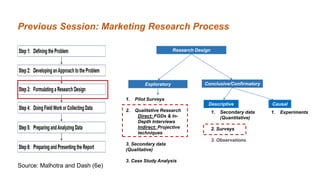
Previous Session: Marketing Research Process
Source: Malhotra and Dash (6e)
Conclusive/Confirmatory
Exploratory
Research Design
Descriptive Causal
1. Pilot Surveys
2. Qualitative Research
Direct: FGDs & In-
Depth Interviews
Indirect: Projective
techniques
3. Secondary data
(Qualitative)
3. Case Study Analysis
1. Secondary data
(Quantitative)
2. Surveys
3. Observations
1. Experiments
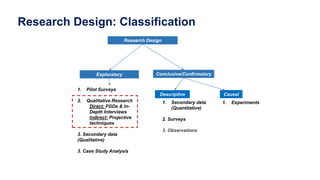
Research Design: Classification
Conclusive/Confirmatory
Exploratory
Research Design
Descriptive Causal
1. Pilot Surveys
2. Qualitative Research
Direct: FGDs & In-
Depth Interviews
Indirect: Projective
techniques
3. Secondary data
(Qualitative)
3. Case Study Analysis
1. Secondary data
(Quantitative)
2. Surveys
3. Observations
1. Experiments
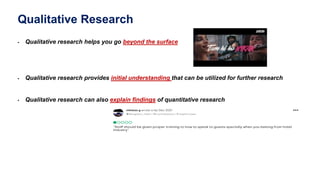
Qualitative Research
 Qualitative research helps you go beyond the surface
 Qualitative research provides initial understanding that can be utilized for further research
 Qualitative research can also explain findings of quantitative research
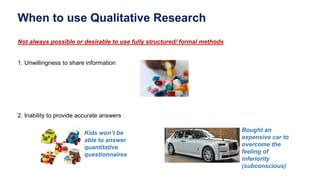
When to use Qualitative Research
Not always possible or desirable to use fully structured/ formal methods
1. Unwillingness to share information
2. Inability to provide accurate answers
Kids won’t be
able to answer
quantitative
questionnaires
Bought an
expensive car to
overcome the
feeling of
inferiority
(subconscious)
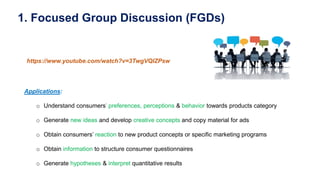
1. Focused Group Discussion (FGDs)
https://www.youtube.com/watch?v=3TwgVQIZPsw
Applications:
o Understand consumers’ preferences, perceptions & behavior towards products category
o Generate new ideas and develop creative concepts and copy material for ads
o Obtain consumers’ reaction to new product concepts or specific marketing programs
o Obtain information to structure consumer questionnaires
o Generate hypotheses & interpret quantitative results
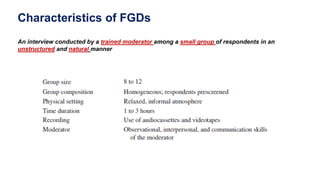
Characteristics of FGDs
An interview conducted by a trained moderator among a small group of respondents in an
unstructured and natural manner
Role of Moderator
https://www.youtube.com/watch?v=xjHZsEcSqwo&t=1s
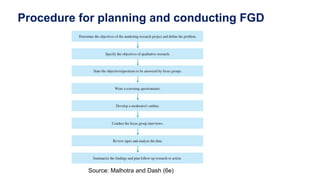
Procedure for planning and conducting FGD
Source: Malhotra and Dash (6e)
2. In-depth Interviews
An unstructured, direct, personal interview in which a single respondent is probed by a highly skilled
interviewer to uncover underlying motivations, beliefs, attitudes, and feelings on a topic
Applications:
o Sensory product consumption experiences (perfumes)
o Confidential, sensitive, or embarrassing topics (personal finance)
o Interviews with professional people and competitors
o Situations where strong social norms exist (attitude of college students toward sports)
o Detailed probing of the respondent (automobile purchase)
Applications:
o Sensory product consumption experiences (perfumes)
o Confidential, sensitive, or embarrassing topics (personal finance)
o Interviews with professional people and competitors
o Situations where strong social norms exist (attitude of college students toward sports)
o Detailed probing of the respondent (automobile purchase)
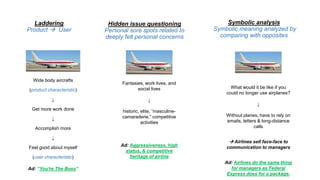
Laddering
Product  User
Hidden issue questioning
Personal sore spots related to
deeply felt personal concerns
Symbolic analysis
Symbolic meaning analyzed by
comparing with opposites
Wide body aircrafts
(product characteristic)
↓
Get more work done
↓
Accomplish more
↓
Feel good about myself
(user characteristic)
Ad: “You're The Boss”
Fantasies, work lives, and
social lives
↓
historic, elite, “masculine-
camaraderie,” competitive
activities
Ad: Aggressiveness, high
status, & competitive
heritage of airline
What would it be like if you
could no longer use airplanes?
↓
Without planes, have to rely on
emails, letters & long-distance
calls
 Airlines sell face-face to
communication to managers
Ad: Airlines do the same thing
for managers as Federal
Express does for a package.
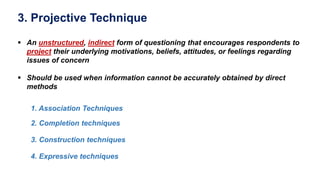
3. Projective Technique
 An unstructured, indirect form of questioning that encourages respondents to
project their underlying motivations, beliefs, attitudes, or feelings regarding
issues of concern
 Should be used when information cannot be accurately obtained by direct
methods
1. Association Techniques
2. Completion techniques
3. Construction techniques
4. Expressive techniques
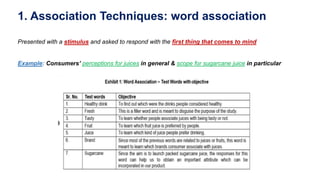
1. Association Techniques: word association
Presented with a stimulus and asked to respond with the first thing that comes to mind
Example: Consumers’ perceptions for juices in general & scope for sugarcane juice in particular
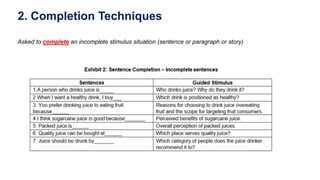
2. Completion Techniques
Asked to complete an incomplete stimulus situation (sentence or paragraph or story)
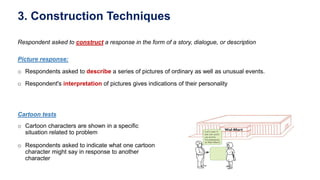
3. Construction Techniques
Respondent asked to construct a response in the form of a story, dialogue, or description
Cartoon tests
o Cartoon characters are shown in a specific
situation related to problem
o Respondents asked to indicate what one cartoon
character might say in response to another
character
Picture response:
o Respondents asked to describe a series of pictures of ordinary as well as unusual events.
o Respondent's interpretation of pictures gives indications of their personality
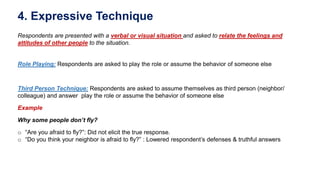
4. Expressive Technique
Respondents are presented with a verbal or visual situation and asked to relate the feelings and
attitudes of other people to the situation.
Role Playing: Respondents are asked to play the role or assume the behavior of someone else
Third Person Technique: Respondents are asked to assume themselves as third person (neighbor/
colleague) and answer play the role or assume the behavior of someone else
Example
Why some people don’t fly?
o “Are you afraid to fly?”: Did not elicit the true response.
o “Do you think your neighbor is afraid to fly?” : Lowered respondent’s defenses & truthful answers
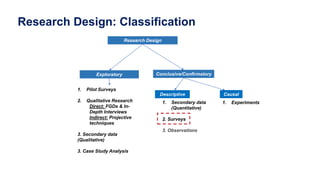
Research Design: Classification
Conclusive/Confirmatory
Exploratory
Research Design
Descriptive Causal
1. Pilot Surveys
2. Qualitative Research
Direct: FGDs & In-
Depth Interviews
Indirect: Projective
techniques
3. Secondary data
(Qualitative)
3. Case Study Analysis
1. Secondary data
(Quantitative)
2. Surveys
3. Observations
1. Experiments
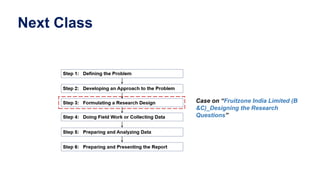
Next Class
Case on “Fruitzone India Limited (B
&C)_Designing the Research
Questions”

marketing - MK102_Session 4_2023_Final.pdf

  • 1.
    Marketing Management –II(MK102) Session 4
  • 2.
    Previous Session: MarketingResearch Process Source: Malhotra and Dash (6e) Conclusive/Confirmatory Exploratory Research Design Descriptive Causal 1. Pilot Surveys 2. Qualitative Research Direct: FGDs & In- Depth Interviews Indirect: Projective techniques 3. Secondary data (Qualitative) 3. Case Study Analysis 1. Secondary data (Quantitative) 2. Surveys 3. Observations 1. Experiments
  • 3.
    Research Design: Classification Conclusive/Confirmatory Exploratory ResearchDesign Descriptive Causal 1. Pilot Surveys 2. Qualitative Research Direct: FGDs & In- Depth Interviews Indirect: Projective techniques 3. Secondary data (Qualitative) 3. Case Study Analysis 1. Secondary data (Quantitative) 2. Surveys 3. Observations 1. Experiments
  • 4.
    Qualitative Research  Qualitativeresearch helps you go beyond the surface  Qualitative research provides initial understanding that can be utilized for further research  Qualitative research can also explain findings of quantitative research
  • 5.
    When to useQualitative Research Not always possible or desirable to use fully structured/ formal methods 1. Unwillingness to share information 2. Inability to provide accurate answers Kids won’t be able to answer quantitative questionnaires Bought an expensive car to overcome the feeling of inferiority (subconscious)
  • 6.
    1. Focused GroupDiscussion (FGDs) https://www.youtube.com/watch?v=3TwgVQIZPsw Applications: o Understand consumers’ preferences, perceptions & behavior towards products category o Generate new ideas and develop creative concepts and copy material for ads o Obtain consumers’ reaction to new product concepts or specific marketing programs o Obtain information to structure consumer questionnaires o Generate hypotheses & interpret quantitative results
  • 7.
    Characteristics of FGDs Aninterview conducted by a trained moderator among a small group of respondents in an unstructured and natural manner
  • 8.
  • 9.
    Procedure for planningand conducting FGD Source: Malhotra and Dash (6e)
  • 10.
    2. In-depth Interviews Anunstructured, direct, personal interview in which a single respondent is probed by a highly skilled interviewer to uncover underlying motivations, beliefs, attitudes, and feelings on a topic Applications: o Sensory product consumption experiences (perfumes) o Confidential, sensitive, or embarrassing topics (personal finance) o Interviews with professional people and competitors o Situations where strong social norms exist (attitude of college students toward sports) o Detailed probing of the respondent (automobile purchase) Applications: o Sensory product consumption experiences (perfumes) o Confidential, sensitive, or embarrassing topics (personal finance) o Interviews with professional people and competitors o Situations where strong social norms exist (attitude of college students toward sports) o Detailed probing of the respondent (automobile purchase)
  • 11.
    Laddering Product  User Hiddenissue questioning Personal sore spots related to deeply felt personal concerns Symbolic analysis Symbolic meaning analyzed by comparing with opposites Wide body aircrafts (product characteristic) ↓ Get more work done ↓ Accomplish more ↓ Feel good about myself (user characteristic) Ad: “You're The Boss” Fantasies, work lives, and social lives ↓ historic, elite, “masculine- camaraderie,” competitive activities Ad: Aggressiveness, high status, & competitive heritage of airline What would it be like if you could no longer use airplanes? ↓ Without planes, have to rely on emails, letters & long-distance calls  Airlines sell face-face to communication to managers Ad: Airlines do the same thing for managers as Federal Express does for a package.
  • 12.
    3. Projective Technique An unstructured, indirect form of questioning that encourages respondents to project their underlying motivations, beliefs, attitudes, or feelings regarding issues of concern  Should be used when information cannot be accurately obtained by direct methods 1. Association Techniques 2. Completion techniques 3. Construction techniques 4. Expressive techniques
  • 13.
    1. Association Techniques:word association Presented with a stimulus and asked to respond with the first thing that comes to mind Example: Consumers’ perceptions for juices in general & scope for sugarcane juice in particular
  • 14.
    2. Completion Techniques Askedto complete an incomplete stimulus situation (sentence or paragraph or story)
  • 15.
    3. Construction Techniques Respondentasked to construct a response in the form of a story, dialogue, or description Cartoon tests o Cartoon characters are shown in a specific situation related to problem o Respondents asked to indicate what one cartoon character might say in response to another character Picture response: o Respondents asked to describe a series of pictures of ordinary as well as unusual events. o Respondent's interpretation of pictures gives indications of their personality
  • 16.
    4. Expressive Technique Respondentsare presented with a verbal or visual situation and asked to relate the feelings and attitudes of other people to the situation. Role Playing: Respondents are asked to play the role or assume the behavior of someone else Third Person Technique: Respondents are asked to assume themselves as third person (neighbor/ colleague) and answer play the role or assume the behavior of someone else Example Why some people don’t fly? o “Are you afraid to fly?”: Did not elicit the true response. o “Do you think your neighbor is afraid to fly?” : Lowered respondent’s defenses & truthful answers
  • 17.
    Research Design: Classification Conclusive/Confirmatory Exploratory ResearchDesign Descriptive Causal 1. Pilot Surveys 2. Qualitative Research Direct: FGDs & In- Depth Interviews Indirect: Projective techniques 3. Secondary data (Qualitative) 3. Case Study Analysis 1. Secondary data (Quantitative) 2. Surveys 3. Observations 1. Experiments
  • 18.
    Next Class Case on“Fruitzone India Limited (B &C)_Designing the Research Questions”