Engaging All Learners
Qualicum/Parksville	
  
Faye	
  Brownlie	
  and	
  Leyton	
  Schnellert	
  
November	
  16th,	
  2011	
  
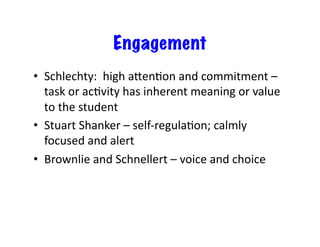
Engagement
•  Schlechty:	
  	
  high	
  aDenEon	
  and	
  commitment	
  –	
  
task	
  or	
  acEvity	
  has	
  inherent	
  meaning	
  or	
  value	
  
to	
  the	
  student	
  
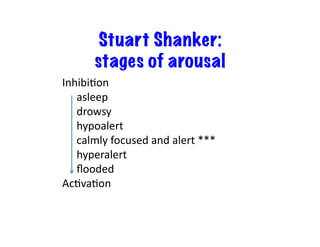
•  Stuart	
  Shanker	
  –	
  self-­‐regulaEon;	
  calmly	
  
focused	
  and	
  alert	
  
•  Brownlie	
  and	
  Schnellert	
  –	
  voice	
  and	
  choice	
  
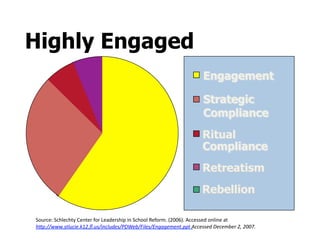
Highly Engaged
Source:	
  Schlechty	
  Center	
  for	
  Leadership	
  in	
  School	
  Reform.	
  (2006).	
  Accessed	
  online	
  at	
  
h"p://www.stlucie.k12.fl.us/includes/PDWeb/Files/Engagement.ppt	
  Accessed	
  December	
  2,	
  2007.	


  Product	


  Focus	
  
Clear	
  Goals	
  
&	
  Criteria	
  
No	
  Fault	
  
Prac3ce	
  
Organiza3on	
  of	
  
Knowledge	
  
Novelty	
  &	
  Variety	
  
Relevant	
  
	
  Content	
  
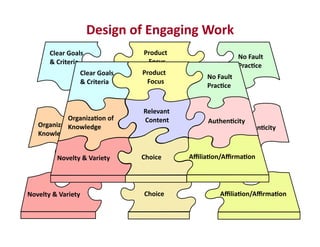
Design	
  of	
  Engaging	
  Work	
  
Authen3city	
  
Choice	
   Affilia3on/Affirma3on	


  Product	


  Focus	
  
Clear	
  Goals	
  
&	
  Criteria	
  
No	
  Fault	
  
Prac3ce	
  
Organiza3on	
  of	
  
Knowledge	
  
Novelty	
  &	
  Variety	
  
Relevant	
  
	
  Content	
   Authen3city	
  
Choice	
   Affilia3on/Affirma3on	
  
Stuart Shanker:
stages of arousal
InhibiEon	
  
	
  asleep	
  
	
  drowsy	
  
	
  hypoalert	
  
	
  calmly	
  focused	
  and	
  alert	
  ***	
  
	
  hyperalert	
  
	
  flooded	
  
AcEvaEon	
  
Frameworks
It’s All About Thinking – Brownlie & Schnellert, 2009
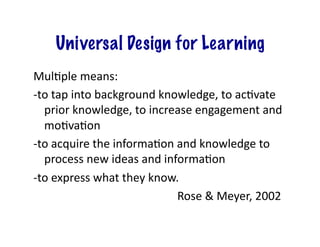
Universal Design for Learning
MulEple	
  means:	
  
-­‐to	
  tap	
  into	
  background	
  knowledge,	
  to	
  acEvate	
  
prior	
  knowledge,	
  to	
  increase	
  engagement	
  and	
  
moEvaEon	
  
-­‐to	
  acquire	
  the	
  informaEon	
  and	
  knowledge	
  to	
  
process	
  new	
  ideas	
  and	
  informaEon	
  
-­‐to	
  express	
  what	
  they	
  know.	


  Rose	
  &	
  Meyer,	
  2002	
  
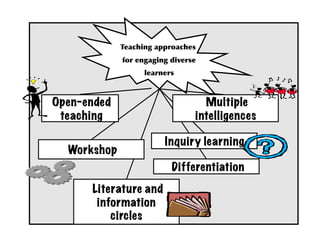
Teaching	
 approaches	


 for	
 engaging	
 diverse	
 
	
 learners	
  
Differentiation
Literature and
information
circles
Open-ended
teaching
Inquiry learning
Multiple
intelligences
Workshop
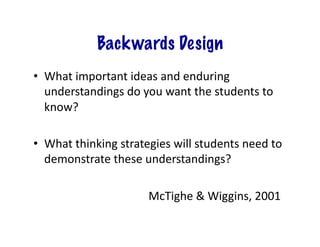
Backwards Design
•  What	
  important	
  ideas	
  and	
  enduring	
  
understandings	
  do	
  you	
  want	
  the	
  students	
  to	
  
know?	
  
•  What	
  thinking	
  strategies	
  will	
  students	
  need	
  to	
  
demonstrate	
  these	
  understandings?	


  McTighe	
  &	
  Wiggins,	
  2001	
  
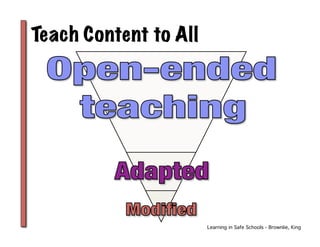
Teach Content to All	
  
 Learning in Safe Schools - Brownlie, King"
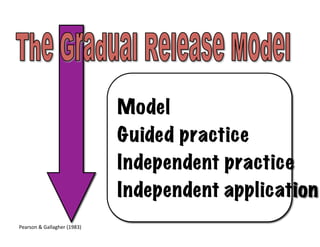
Model
Guided practice
Independent practice
Independent application	
  
Pearson	
  &	
  Gallagher	
  (1983)	
  
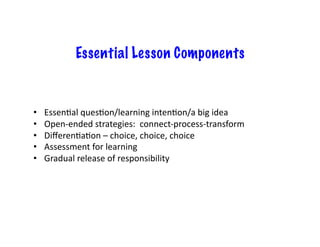
Essential Lesson Components
•  EssenEal	
  quesEon/learning	
  intenEon/a	
  big	
  idea	
  
•  Open-­‐ended	
  strategies:	
  	
  connect-­‐process-­‐transform	
  
•  DifferenEaEon	
  –	
  choice,	
  choice,	
  choice	
  
•  Assessment	
  for	
  learning	
  
•  Gradual	
  release	
  of	
  responsibility	
  
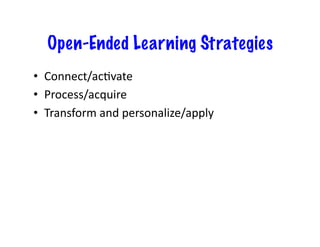
Open-Ended Learning Strategies
•  Connect/acEvate	
  
•  Process/acquire	
  
•  Transform	
  and	
  personalize/apply	
  
Assessment for Learning
Purpose	
   Guide	
  learning,	
  inform	
  instrucEon	
  
Audience	
  	
   Teachers	
  and	
  students	
  
Timing	
  	
   On-­‐going,	
  minute	
  by	
  minute,	
  day	
  by	
  day	
  
Form	
  	
   DescripEve	
  Feedback	
  
¶what’s	
  working?	
  
•what’s	
  not?	
  
•what’s	
  next?	
  
Black	
  &	
  Wiliam,	
  1998	
   Hahe	
  &	
  Timperley,	
  2007	
  
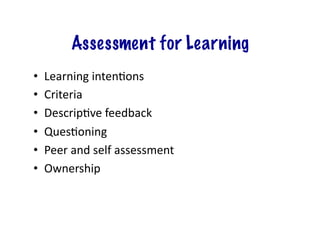
Assessment for Learning
•  Learning	
  intenEons	
  
•  Criteria	
  
•  DescripEve	
  feedback	
  
•  QuesEoning	
  
•  Peer	
  and	
  self	
  assessment	
  
•  Ownership	
  
Examples
How	
  does	
  sehng	
  impact	
  what	
  
happens?	
  
As	
  I	
  traveled	
  from	
  the	
  city	
  
toward	
  the	
  country	
  
old	
  age	
  fell	
  off	
  my	
  shoulders.	
  
As	
  I	
  traveled	
  from	
  the	
  city	
  
toward	
  the	
  country	
  
old	
  age	
  fell	
  off	
  my	
  shoulders.	


  Salah	
  Fa’iq	
  
translated	
  by	
  Byrne	
  &	
  Jayyusi	
  
the	
  flag	
  of	
  childhood	
  
	
  poems	
  from	
  the	
  middle	
  east	
  
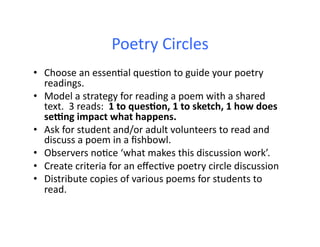
Poetry	
  Circles	
  
•  Choose	
  an	
  essenEal	
  quesEon	
  to	
  guide	
  your	
  poetry	
  
readings.	
  
•  Model	
  a	
  strategy	
  for	
  reading	
  a	
  poem	
  with	
  a	
  shared	
  
text.	
  	
  3	
  reads:	
  	
  1	
  to	
  ques3on,	
  1	
  to	
  sketch,	
  1	
  how	
  does	
  
seKng	
  impact	
  what	
  happens.	
  
•  Ask	
  for	
  student	
  and/or	
  adult	
  volunteers	
  to	
  read	
  and	
  
discuss	
  a	
  poem	
  in	
  a	
  fishbowl.	
  
•  Observers	
  noEce	
  ‘what	
  makes	
  this	
  discussion	
  work’.	
  
•  Create	
  criteria	
  for	
  an	
  effecEve	
  poetry	
  circle	
  discussion	
  
•  Distribute	
  copies	
  of	
  various	
  poems	
  for	
  students	
  to	
  
read.	
  
•  Using	
  a	
  similar	
  strategy	
  (read	
  and	
  quesEon,	
  read	
  
and	
  sketch,	
  read	
  and	
  highlight	
  powerful	
  
language),	
  students	
  independently	
  read	
  their	
  
chosen	
  poem.	
  
•  Form	
  poetry	
  circles	
  of	
  students	
  reading	
  the	
  same	
  
poem.	
  
•  Students	
  discuss	
  their	
  poems,	
  keeping	
  the	
  criteria	
  
for	
  an	
  effecEve	
  poetry	
  circle	
  discussion	
  in	
  mind.	
  
•  Students	
  self-­‐assess	
  with	
  the	
  criteria.	
  
•  Students	
  write	
  in	
  response	
  to	
  their	
  poem	
  and	
  the	
  
essenEal	
  quesEon.	
  
Sample	
  poems	
  from	
  Nancie	
  Atwell’s	
  Naming	
  the	
  World	
  
•  ConnecEons	


•  EmoEons	


•  image	
  
•  Opinions	
  
•  Response	
  style	
  
•  RelaEng	
  self	
  to	
  poem	
  
•  Showing	
  how	
  the	
  poem	
  changes	
  your	
  thinking	
  
•  Explaining	
  why	
  you	
  feel	
  the	
  way	
  you	
  do	
  about	
  the	
  
poem	
  and	
  how	
  you	
  think	
  the	
  author	
  feels	
  about	
  
his/her	
  subject	
  
•  CommenEng	
  on	
  the	
  image	
  formed	
  in	


  your	
  mind	
  upon	
  reading	
  the	
  poem	
  
•  Expressing	
  likes	
  and	
  dislikes	
  about	
  poem,	
  with	
  
evidence	
  
•  Asking	
  quesEons	
  of	
  the	
  poem	
  or	
  the	
  poet	
  
•  Using	
  descripEve	
  words	
  
•  Using	
  quotes	
  from	
  the	
  poem	
  
•  SuggesEng	
  improvements	
  to	
  the	
  poem,	
  if	
  needed	
  
Personal	
  inquiry	
  within	
  an	
  inquiry	
  unit	
  
•  Provide	
  students	
  with	
  mini	
  booklets	
  to	
  use	
  to	
  
record	
  any	
  quesEons	
  that	
  they	
  have	
  during	
  a	
  unit.	
  	
  
•  This	
  helps	
  to	
  build	
  students’	
  own	
  inquiry	
  
quesEons	
  and	
  sets	
  the	
  stage	
  for	
  more	
  generaEng	
  
their	
  own	
  thinking	
  later	
  in	
  the	
  unit.	
  	
  
•  	
  Once	
  a	
  week	
  or	
  so	
  the	
  class	
  engages	
  in	
  a	
  
discussion	
  about	
  what	
  they	
  were	
  wondering,	
  
what	
  they	
  have	
  learned	
  so	
  far	
  about	
  these	
  
quesEons	
  and	
  what	
  new	
  quesEons	
  are	
  emerging.	
  	
  
See	
  Student	
  Diversity	
  (2006);	
  It’s	
  All	
  About	
  Thinking	
  in	
  Science	
  and	
  Math	
  (2010)	
  
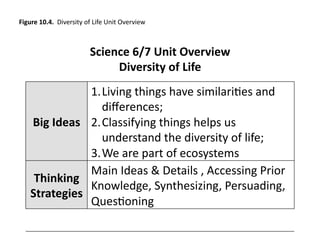
Science	
  6/7	
  Unit	
  Overview	
  
Diversity	
  of	
  Life	
  
Big	
  Ideas	
  	
  
1. Living	
  things	
  have	
  similariEes	
  and	
  
differences;	
  	
  
2. Classifying	
  things	
  helps	
  us	
  
understand	
  the	
  diversity	
  of	
  life;	
  	
  
3. We	
  are	
  part	
  of	
  ecosystems	
  
Thinking	
  
Strategies	
  
Main	
  Ideas	
  &	
  Details	
  ,	
  Accessing	
  Prior	
  
Knowledge,	
  Synthesizing,	
  Persuading,	
  
QuesEoning	
  	
  
Figure	
  10.4.	
  	
  Diversity	
  of	
  Life	
  Unit	
  Overview	
  	
  
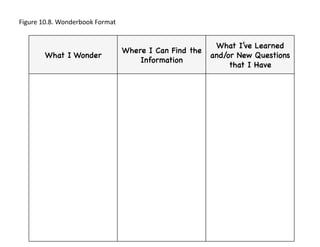
What I Wonder
Where I Can Find the
Information
What I’ve Learned
and/or New Questions
that I Have
Figure	
  10.8.	
  Wonderbook	
  Format	
  	
  
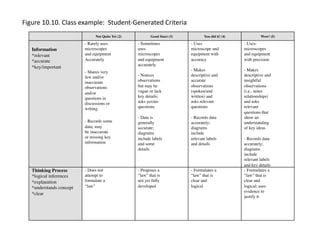
Not Quite Yet (2) Good Start (3) You did it! (4) Wow! (5)
Information
*relevant
*accurate
*key/important
- Rarely uses 	

microscopes 	

and equipment 	

Accurately	

- Shares very 	

few and/or 	

inaccurate 	

observations 	

and/or 	

questions in 	

discussions or 	

writing 	

- Records some 	

data; may 	

be inaccurate 	

or missing key 	

information
- Sometimes 	

uses 	

microscopes 	

and equipment 	

accurately
- Notices 	

observations 	

but may be 	

vague or lack 	

key details; 	

asks yes/no 	

questions
- Data is 	

generally 	

accurate; 	

diagrams 	

include labels 	

and some 	

details
- Uses 	

microscope and 	

equipment with 	

accuracy
- Makes 	

descriptive and 	

accurate 	

observations 	

(spoken/and 	

written) and 	

asks relevant 	

questions
- Records data 	

accurately; 	

diagrams 	

include 	

relevant labels 	

and details
- Uses- 	

microscopes 	

and equipment 	

with precision
- Makes 	

descriptive and 	

insightful 	

observations 	

(i.e.. notes 	

relationships) 	

and asks 	

relevant 	

questions that 	

show an 	

understanding 	

of key ideas
- Records data 	

accurately; 	

diagrams 	

include 	

relevant labels 	

and key details
Thinking Process
*logical inferences
*explanation
*understands concept
*clear	

- Does not 	

attempt to 	

formulate a 	

“law”
- Proposes a 	

“law” that is 	

not yet fully 	

developed
- Formulates a 	

“law” that is 	

clear and 	

logical
- Formulates a 	

“law” that is 	

clear and 	

logical; uses 	

evidence to 	

justify it
Figure	
  10.10.	
  Class	
  example:	
  	
  Student-­‐Generated	
  Criteria	
  
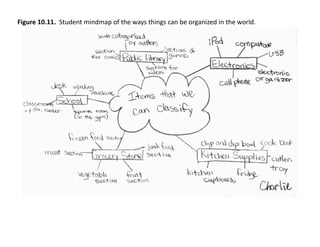
Figure	
  10.11.	
  	
  Student	
  mindmap	
  of	
  the	
  ways	
  things	
  can	
  be	
  organized	
  in	
  the	
  world.	
  	
  
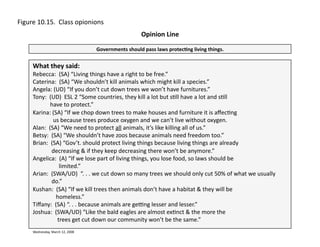
Figure	
  10.15.	
  	
  Class	
  opionions	
  
Opinion	
  Line	
  
Governments	
  should	
  pass	
  laws	
  protec3ng	
  living	
  things.	
  
What	
  they	
  said:	
  
Rebecca:	
  	
  (SA)	
  “Living	
  things	
  have	
  a	
  right	
  to	
  be	
  free.”	
  
Caterina:	
  	
  (SA)	
  “We	
  shouldn’t	
  kill	
  animals	
  which	
  might	
  kill	
  a	
  species.”	
  
Angela:	
  (UD)	
  “If	
  you	
  don’t	
  cut	
  down	
  trees	
  we	
  won’t	
  have	
  furnitures.”	
  
Tony:	
  	
  (UD)	
  	
  ESL	
  2	
  “Some	
  countries,	
  they	
  kill	
  a	
  lot	
  but	
  sEll	
  have	
  a	
  lot	
  and	
  sEll	


  have	
  to	
  protect.”	
  
Karina:	
  (SA)	
  “If	
  we	
  chop	
  down	
  trees	
  to	
  make	
  houses	
  and	
  furniture	
  it	
  is	
  affecEng	


  us	
  because	
  trees	
  produce	
  oxygen	
  and	
  we	
  can’t	
  live	
  without	
  oxygen.	
  
Alan:	
  	
  (SA)	
  “We	
  need	
  to	
  protect	
  all	
  animals,	
  it’s	
  like	
  killing	
  all	
  of	
  us.”	
  
Betsy:	
  	
  (SA)	
  “We	
  shouldn’t	
  have	
  zoos	
  because	
  animals	
  need	
  freedom	
  too.”	
  
Brian:	
  	
  (SA)	
  “Gov’t.	
  should	
  protect	
  living	
  things	
  because	
  living	
  things	
  are	
  already	


  decreasing	
  &	
  if	
  they	
  keep	
  decreasing	
  there	
  won’t	
  be	
  anymore.”	
  
Angelica:	
  	
  (A)	
  “If	
  we	
  lose	
  part	
  of	
  living	
  things,	
  you	
  lose	
  food,	
  so	
  laws	
  should	
  be	


  limited.”	
  
Arian:	
  	
  (SWA/UD)	
  	
  “.	
  .	
  .	
  we	
  cut	
  down	
  so	
  many	
  trees	
  we	
  should	
  only	
  cut	
  50%	
  of	
  what	
  we	
  usually	


  do.”	
  
Kushan:	
  	
  (SA)	
  “If	
  we	
  kill	
  trees	
  then	
  animals	
  don’t	
  have	
  a	
  habitat	
  &	
  they	
  will	
  be	


  homeless.”	
  
Tiffany:	
  	
  (SA)	
  “.	
  .	
  .	
  because	
  animals	
  are	
  gehng	
  lesser	
  and	
  lesser.”	
  
Joshua:	
  	
  (SWA/UD)	
  “Like	
  the	
  bald	
  eagles	
  are	
  almost	
  exEnct	
  &	
  the	
  more	
  the	


  trees	
  get	
  cut	
  down	
  our	
  community	
  won’t	
  be	
  the	
  same.”	
  
Wednesday,	
  March	
  12,	
  2008	
  
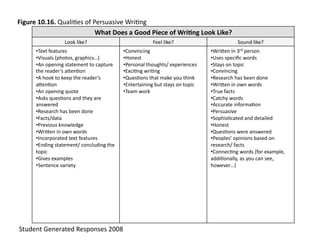
Figure	
  10.16.	
  QualiEes	
  of	
  Persuasive	
  WriEng	
  	
  
What	
  Does	
  a	
  Good	
  Piece	
  of	
  Wri3ng	
  Look	
  Like?	
  
Look	
  like?	
   Feel	
  like?	
   Sound	
  like?	
  
• Text	
  features	
  
• Visuals	
  (photos,	
  graphics…)	
  
• An	
  opening	
  statement	
  to	
  capture	
  
the	
  reader’s	
  aDenEon	
  
• A	
  hook	
  to	
  keep	
  the	
  reader’s	
  
aDenEon	
  
• An	
  opening	
  quote	
  
• Asks	
  quesEons	
  and	
  they	
  are	
  
answered	
  
• Research	
  has	
  been	
  done	
  
• Facts/data	
  
• Previous	
  knowledge	
  
• WriDen	
  in	
  own	
  words	
  
• Incorporated	
  text	
  features	
  
• Ending	
  statement/	
  concluding	
  the	
  
topic	
  
• Gives	
  examples	
  
• Sentence	
  variety	
  
• Convincing	
  
• Honest	
  
• Personal	
  thoughts/	
  experiences	
  
• ExciEng	
  wriEng	
  
• QuesEons	
  that	
  make	
  you	
  think	
  
• Entertaining	
  but	
  stays	
  on	
  topic	
  
• Team	
  work	
  
• WriDen	
  in	
  3rd	
  person	
  
• Uses	
  specific	
  words	
  
• Stays	
  on	
  topic	
  
• Convincing	
  
• Research	
  has	
  been	
  done	
  
• WriDen	
  in	
  own	
  words	
  
• True	
  facts	
  
• Catchy	
  words	
  
• Accurate	
  informaEon	
  
• Persuasive	
  
• SophisEcated	
  and	
  detailed	
  
• Honest	
  
• QuesEons	
  were	
  answered	
  
• Peoples’	
  opinions	
  based	
  on	
  
research/	
  facts	
  
• ConnecEng	
  words	
  (for	
  example,	
  
addiEonally,	
  as	
  you	
  can	
  see,	
  
however…)	
  
Student	
  Generated	
  Responses	
  2008	
  
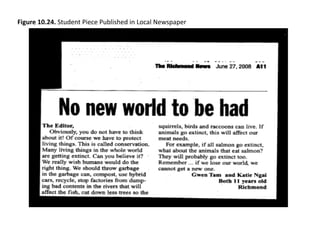
Figure	
  10.24.	
  Student	
  Piece	
  Published	
  in	
  Local	
  Newspaper	
  
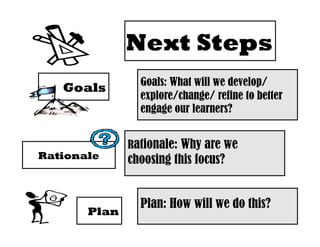
Goals
Plan
Rationale
Next Steps
Goals: What will we develop/
explore/change/ refine to better
engage our learners?	
  
Rationale: Why are we
choosing this focus?	
  
Plan: How will we do this?	
  
Bennett, B. & Rolheiser, C. (2001). Beyond Monet: The artful science of instructional integration.
Bookation.
Brown, A., Cocking, R., & Bransford, J., Eds. (2000). How people learn: Brain, mind, experience, &
school. National Academy Press.
Brownlie, F. Feniak, C. & Schnellert, L. (2006). Student Diversity, 2nd ed., Pembroke Publishers.
Brownlie, F. & Schnellert, L. (2009). It’s all about thinking: Collaborating to support all learners in
Humanities, Social Studies and English., Pembroke Publishers.
Brownlie, F. (2005) Grand Conversations, Portage & Main Press.
Brownlie, F. & King, J. (2000). Learning in Safe Schools. Pembroke Publishers..
Buehl, D. (2001). Classroom strategies for interactive learning, IRA.
Daniels, H. & Bizar, M. (2005).Teaching the best practice way: Methods that matter, K-12
Pembroke Publishers.
Gregory, K., Cameron, C. & and Davies, A. (2000). Setting and using criteria: For use in middle
and secondary classrooms, Connections Publishing, BC, Canada.
Lenz, B.K., Deschler, D.D. & Kissam, B.R. (2004). Teaching content to all: Evidence-based
inclusive practices in middle and secondary schools. Boston: Allyn & Bacon.
Marzano, R., Pickering, D., & Pollack, J. (2001). Classroom instruction that works: Research-based
strategies for increasing student achievement ASCD.
Schnellert, L., Datoo, M. Ediger, K. & Panas, J. (2009). Pulling together: Integrating inquiry,
assessment and instruction in today’s English classroom, Pembroke Publishers.
Tomlinson, C. & McTighe, J. (2006). Integrating Differentiated Instruction and Understanding by
Design. ASCD.
Vygotsky, L. S. (1978). Mind and society: The development of higher mental processes.
Cambridge, MA: Harvard University Press.
Wilhelm, J. (2007). Engaging readers and writers with inquiry. New York: Scholastic.

Qualicum engagement.novpptx

  • 1.
    Engaging All Learners Qualicum/Parksville   Faye  Brownlie  and  Leyton  Schnellert   November  16th,  2011  
  • 2.
    Engagement •  Schlechty:    high  aDenEon  and  commitment  –   task  or  acEvity  has  inherent  meaning  or  value   to  the  student   •  Stuart  Shanker  –  self-­‐regulaEon;  calmly   focused  and  alert   •  Brownlie  and  Schnellert  –  voice  and  choice  
  • 3.
    Highly Engaged Source:  Schlechty  Center  for  Leadership  in  School  Reform.  (2006).  Accessed  online  at   h"p://www.stlucie.k12.fl.us/includes/PDWeb/Files/Engagement.ppt  Accessed  December  2,  2007.  
  • 4.
           Product                  Focus   Clear  Goals   &  Criteria   No  Fault   Prac3ce   Organiza3on  of   Knowledge   Novelty  &  Variety   Relevant    Content   Design  of  Engaging  Work   Authen3city   Choice   Affilia3on/Affirma3on          Product                  Focus   Clear  Goals   &  Criteria   No  Fault   Prac3ce   Organiza3on  of   Knowledge   Novelty  &  Variety   Relevant    Content   Authen3city   Choice   Affilia3on/Affirma3on  
  • 5.
    Stuart Shanker: stages ofarousal InhibiEon    asleep    drowsy    hypoalert    calmly  focused  and  alert  ***    hyperalert    flooded   AcEvaEon  
  • 6.
    Frameworks It’s All AboutThinking – Brownlie & Schnellert, 2009
  • 7.
    Universal Design forLearning MulEple  means:   -­‐to  tap  into  background  knowledge,  to  acEvate   prior  knowledge,  to  increase  engagement  and   moEvaEon   -­‐to  acquire  the  informaEon  and  knowledge  to   process  new  ideas  and  informaEon   -­‐to  express  what  they  know.                        Rose  &  Meyer,  2002  
  • 8.
    Teaching approaches for engaging diverse learners   Differentiation Literature and information circles Open-ended teaching Inquiry learning Multiple intelligences Workshop
  • 9.
    Backwards Design •  What  important  ideas  and  enduring   understandings  do  you  want  the  students  to   know?   •  What  thinking  strategies  will  students  need  to   demonstrate  these  understandings?                      McTighe  &  Wiggins,  2001  
  • 10.
    Teach Content toAll    Learning in Safe Schools - Brownlie, King"
  • 11.
    Model Guided practice Independent practice Independentapplication   Pearson  &  Gallagher  (1983)  
  • 12.
    Essential Lesson Components • EssenEal  quesEon/learning  intenEon/a  big  idea   •  Open-­‐ended  strategies:    connect-­‐process-­‐transform   •  DifferenEaEon  –  choice,  choice,  choice   •  Assessment  for  learning   •  Gradual  release  of  responsibility  
  • 13.
    Open-Ended Learning Strategies • Connect/acEvate   •  Process/acquire   •  Transform  and  personalize/apply  
  • 14.
    Assessment for Learning Purpose   Guide  learning,  inform  instrucEon   Audience     Teachers  and  students   Timing     On-­‐going,  minute  by  minute,  day  by  day   Form     DescripEve  Feedback   ¶what’s  working?   •what’s  not?   •what’s  next?   Black  &  Wiliam,  1998   Hahe  &  Timperley,  2007  
  • 15.
    Assessment for Learning • Learning  intenEons   •  Criteria   •  DescripEve  feedback   •  QuesEoning   •  Peer  and  self  assessment   •  Ownership  
  • 16.
  • 17.
    How  does  sehng  impact  what   happens?  
  • 18.
    As  I  traveled  from  the  city   toward  the  country   old  age  fell  off  my  shoulders.  
  • 19.
    As  I  traveled  from  the  city   toward  the  country   old  age  fell  off  my  shoulders.        Salah  Fa’iq   translated  by  Byrne  &  Jayyusi   the  flag  of  childhood    poems  from  the  middle  east  
  • 20.
    Poetry  Circles   • Choose  an  essenEal  quesEon  to  guide  your  poetry   readings.   •  Model  a  strategy  for  reading  a  poem  with  a  shared   text.    3  reads:    1  to  ques3on,  1  to  sketch,  1  how  does   seKng  impact  what  happens.   •  Ask  for  student  and/or  adult  volunteers  to  read  and   discuss  a  poem  in  a  fishbowl.   •  Observers  noEce  ‘what  makes  this  discussion  work’.   •  Create  criteria  for  an  effecEve  poetry  circle  discussion   •  Distribute  copies  of  various  poems  for  students  to   read.  
  • 21.
    •  Using  a  similar  strategy  (read  and  quesEon,  read   and  sketch,  read  and  highlight  powerful   language),  students  independently  read  their   chosen  poem.   •  Form  poetry  circles  of  students  reading  the  same   poem.   •  Students  discuss  their  poems,  keeping  the  criteria   for  an  effecEve  poetry  circle  discussion  in  mind.   •  Students  self-­‐assess  with  the  criteria.   •  Students  write  in  response  to  their  poem  and  the   essenEal  quesEon.   Sample  poems  from  Nancie  Atwell’s  Naming  the  World  
  • 22.
    •  ConnecEons                 •  EmoEons         •  image   •  Opinions   •  Response  style   •  RelaEng  self  to  poem   •  Showing  how  the  poem  changes  your  thinking   •  Explaining  why  you  feel  the  way  you  do  about  the   poem  and  how  you  think  the  author  feels  about   his/her  subject   •  CommenEng  on  the  image  formed  in                    your  mind  upon  reading  the  poem   •  Expressing  likes  and  dislikes  about  poem,  with   evidence   •  Asking  quesEons  of  the  poem  or  the  poet   •  Using  descripEve  words   •  Using  quotes  from  the  poem   •  SuggesEng  improvements  to  the  poem,  if  needed  
  • 23.
    Personal  inquiry  within  an  inquiry  unit   •  Provide  students  with  mini  booklets  to  use  to   record  any  quesEons  that  they  have  during  a  unit.     •  This  helps  to  build  students’  own  inquiry   quesEons  and  sets  the  stage  for  more  generaEng   their  own  thinking  later  in  the  unit.     •   Once  a  week  or  so  the  class  engages  in  a   discussion  about  what  they  were  wondering,   what  they  have  learned  so  far  about  these   quesEons  and  what  new  quesEons  are  emerging.     See  Student  Diversity  (2006);  It’s  All  About  Thinking  in  Science  and  Math  (2010)  
  • 24.
    Science  6/7  Unit  Overview   Diversity  of  Life   Big  Ideas     1. Living  things  have  similariEes  and   differences;     2. Classifying  things  helps  us   understand  the  diversity  of  life;     3. We  are  part  of  ecosystems   Thinking   Strategies   Main  Ideas  &  Details  ,  Accessing  Prior   Knowledge,  Synthesizing,  Persuading,   QuesEoning     Figure  10.4.    Diversity  of  Life  Unit  Overview    
  • 25.
    What I Wonder WhereI Can Find the Information What I’ve Learned and/or New Questions that I Have Figure  10.8.  Wonderbook  Format    
  • 26.
    Not Quite Yet(2) Good Start (3) You did it! (4) Wow! (5) Information *relevant *accurate *key/important - Rarely uses microscopes and equipment Accurately - Shares very few and/or inaccurate observations and/or questions in discussions or writing - Records some data; may be inaccurate or missing key information - Sometimes uses microscopes and equipment accurately - Notices observations but may be vague or lack key details; asks yes/no questions - Data is generally accurate; diagrams include labels and some details - Uses microscope and equipment with accuracy - Makes descriptive and accurate observations (spoken/and written) and asks relevant questions - Records data accurately; diagrams include relevant labels and details - Uses- microscopes and equipment with precision - Makes descriptive and insightful observations (i.e.. notes relationships) and asks relevant questions that show an understanding of key ideas - Records data accurately; diagrams include relevant labels and key details Thinking Process *logical inferences *explanation *understands concept *clear - Does not attempt to formulate a “law” - Proposes a “law” that is not yet fully developed - Formulates a “law” that is clear and logical - Formulates a “law” that is clear and logical; uses evidence to justify it Figure  10.10.  Class  example:    Student-­‐Generated  Criteria  
  • 27.
    Figure  10.11.    Student  mindmap  of  the  ways  things  can  be  organized  in  the  world.    
  • 28.
    Figure  10.15.    Class  opionions   Opinion  Line   Governments  should  pass  laws  protec3ng  living  things.   What  they  said:   Rebecca:    (SA)  “Living  things  have  a  right  to  be  free.”   Caterina:    (SA)  “We  shouldn’t  kill  animals  which  might  kill  a  species.”   Angela:  (UD)  “If  you  don’t  cut  down  trees  we  won’t  have  furnitures.”   Tony:    (UD)    ESL  2  “Some  countries,  they  kill  a  lot  but  sEll  have  a  lot  and  sEll                            have  to  protect.”   Karina:  (SA)  “If  we  chop  down  trees  to  make  houses  and  furniture  it  is  affecEng                              us  because  trees  produce  oxygen  and  we  can’t  live  without  oxygen.   Alan:    (SA)  “We  need  to  protect  all  animals,  it’s  like  killing  all  of  us.”   Betsy:    (SA)  “We  shouldn’t  have  zoos  because  animals  need  freedom  too.”   Brian:    (SA)  “Gov’t.  should  protect  living  things  because  living  things  are  already                            decreasing  &  if  they  keep  decreasing  there  won’t  be  anymore.”   Angelica:    (A)  “If  we  lose  part  of  living  things,  you  lose  food,  so  laws  should  be                                      limited.”   Arian:    (SWA/UD)    “.  .  .  we  cut  down  so  many  trees  we  should  only  cut  50%  of  what  we  usually                                                            do.”   Kushan:    (SA)  “If  we  kill  trees  then  animals  don’t  have  a  habitat  &  they  will  be                                  homeless.”   Tiffany:    (SA)  “.  .  .  because  animals  are  gehng  lesser  and  lesser.”   Joshua:    (SWA/UD)  “Like  the  bald  eagles  are  almost  exEnct  &  the  more  the                                      trees  get  cut  down  our  community  won’t  be  the  same.”   Wednesday,  March  12,  2008  
  • 29.
    Figure  10.16.  QualiEes  of  Persuasive  WriEng     What  Does  a  Good  Piece  of  Wri3ng  Look  Like?   Look  like?   Feel  like?   Sound  like?   • Text  features   • Visuals  (photos,  graphics…)   • An  opening  statement  to  capture   the  reader’s  aDenEon   • A  hook  to  keep  the  reader’s   aDenEon   • An  opening  quote   • Asks  quesEons  and  they  are   answered   • Research  has  been  done   • Facts/data   • Previous  knowledge   • WriDen  in  own  words   • Incorporated  text  features   • Ending  statement/  concluding  the   topic   • Gives  examples   • Sentence  variety   • Convincing   • Honest   • Personal  thoughts/  experiences   • ExciEng  wriEng   • QuesEons  that  make  you  think   • Entertaining  but  stays  on  topic   • Team  work   • WriDen  in  3rd  person   • Uses  specific  words   • Stays  on  topic   • Convincing   • Research  has  been  done   • WriDen  in  own  words   • True  facts   • Catchy  words   • Accurate  informaEon   • Persuasive   • SophisEcated  and  detailed   • Honest   • QuesEons  were  answered   • Peoples’  opinions  based  on   research/  facts   • ConnecEng  words  (for  example,   addiEonally,  as  you  can  see,   however…)   Student  Generated  Responses  2008  
  • 30.
    Figure  10.24.  Student  Piece  Published  in  Local  Newspaper  
  • 31.
    Goals Plan Rationale Next Steps Goals: Whatwill we develop/ explore/change/ refine to better engage our learners?   Rationale: Why are we choosing this focus?   Plan: How will we do this?  
  • 32.
    Bennett, B. &Rolheiser, C. (2001). Beyond Monet: The artful science of instructional integration. Bookation. Brown, A., Cocking, R., & Bransford, J., Eds. (2000). How people learn: Brain, mind, experience, & school. National Academy Press. Brownlie, F. Feniak, C. & Schnellert, L. (2006). Student Diversity, 2nd ed., Pembroke Publishers. Brownlie, F. & Schnellert, L. (2009). It’s all about thinking: Collaborating to support all learners in Humanities, Social Studies and English., Pembroke Publishers. Brownlie, F. (2005) Grand Conversations, Portage & Main Press. Brownlie, F. & King, J. (2000). Learning in Safe Schools. Pembroke Publishers.. Buehl, D. (2001). Classroom strategies for interactive learning, IRA. Daniels, H. & Bizar, M. (2005).Teaching the best practice way: Methods that matter, K-12 Pembroke Publishers. Gregory, K., Cameron, C. & and Davies, A. (2000). Setting and using criteria: For use in middle and secondary classrooms, Connections Publishing, BC, Canada. Lenz, B.K., Deschler, D.D. & Kissam, B.R. (2004). Teaching content to all: Evidence-based inclusive practices in middle and secondary schools. Boston: Allyn & Bacon. Marzano, R., Pickering, D., & Pollack, J. (2001). Classroom instruction that works: Research-based strategies for increasing student achievement ASCD. Schnellert, L., Datoo, M. Ediger, K. & Panas, J. (2009). Pulling together: Integrating inquiry, assessment and instruction in today’s English classroom, Pembroke Publishers. Tomlinson, C. & McTighe, J. (2006). Integrating Differentiated Instruction and Understanding by Design. ASCD. Vygotsky, L. S. (1978). Mind and society: The development of higher mental processes. Cambridge, MA: Harvard University Press. Wilhelm, J. (2007). Engaging readers and writers with inquiry. New York: Scholastic.