L.A.N.D.S
Learning Across New Dimensions
In Science

Quail Necropsy
Bobwhite Quail Facts
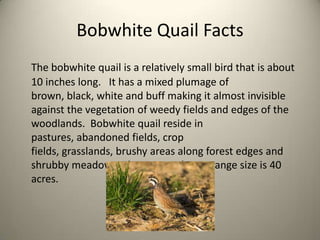
The bobwhite quail is a relatively small bird that is about
10 inches long. It has a mixed plumage of
brown, black, white and buff making it almost invisible
against the vegetation of weedy fields and edges of the
woodlands. Bobwhite quail reside in
pastures, abandoned fields, crop
fields, grasslands, brushy areas along forest edges and
shrubby meadows. The average home range size is 40
acres.
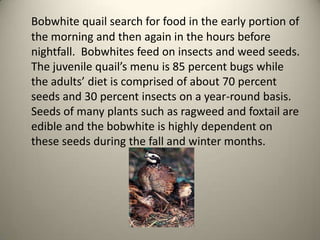
Bobwhite quail search for food in the early portion of
the morning and then again in the hours before
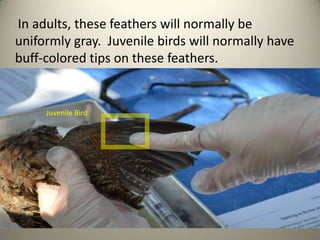
nightfall. Bobwhites feed on insects and weed seeds.
The juvenile quail’s menu is 85 percent bugs while
the adults’ diet is comprised of about 70 percent
seeds and 30 percent insects on a year-round basis.
Seeds of many plants such as ragweed and foxtail are
edible and the bobwhite is highly dependent on
these seeds during the fall and winter months.
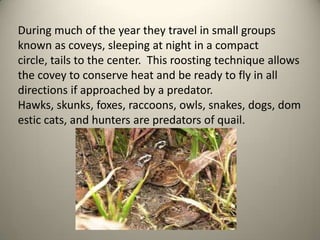
During much of the year they travel in small groups
known as coveys, sleeping at night in a compact
circle, tails to the center. This roosting technique allows
the covey to conserve heat and be ready to fly in all
directions if approached by a predator.
Hawks, skunks, foxes, raccoons, owls, snakes, dogs, dom
estic cats, and hunters are predators of quail.
In the spring, May through September, the male selects a
territory in which to nest and the female is responsible
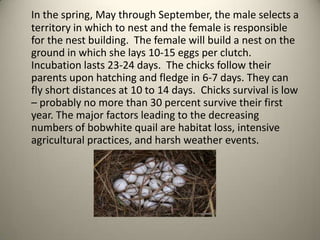
for the nest building. The female will build a nest on the
ground in which she lays 10-15 eggs per clutch.
Incubation lasts 23-24 days. The chicks follow their
parents upon hatching and fledge in 6-7 days. They can
fly short distances at 10 to 14 days. Chicks survival is low
– probably no more than 30 percent survive their first
year. The major factors leading to the decreasing
numbers of bobwhite quail are habitat loss, intensive
agricultural practices, and harsh weather events.
Getting to Know Your Quail
Key Questions

• Is your quail male or female?
• Is it an adult or juvenile?
• Is your quail a carnivore, herbivore,
or omnivore?
• What external features show you this?
• Do quail spend more time walking or
flying?
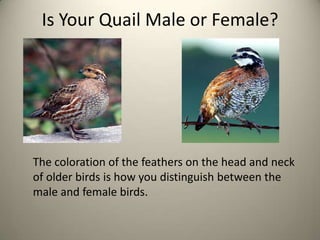
Is Your Quail Male or Female?

The coloration of the feathers on the head and neck
of older birds is how you distinguish between the
male and female birds.
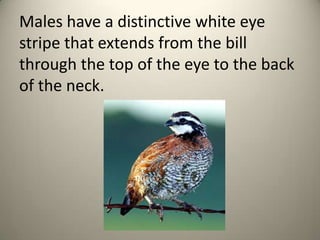
Males have a distinctive white eye
stripe that extends from the bill
through the top of the eye to the back
of the neck.
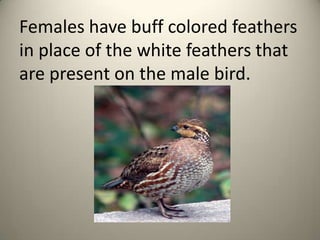
Females have buff colored feathers
in place of the white feathers that
are present on the male bird.
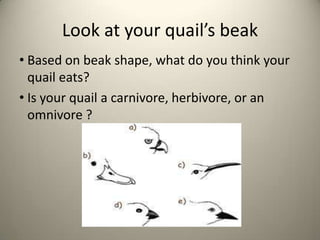
Look at your quail’s beak
• Based on beak shape, what do you think your
quail eats?
• Is your quail a carnivore, herbivore, or an
omnivore ?
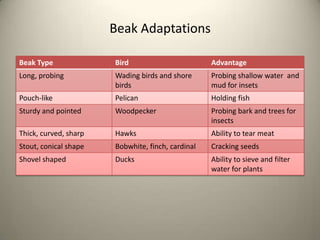
Beak Adaptations
Beak Type

Bird

Advantage

Long, probing

Wading birds and shore
birds

Probing shallow water and
mud for insets

Pouch-like

Pelican

Holding fish

Sturdy and pointed

Woodpecker

Probing bark and trees for
insects

Thick, curved, sharp

Hawks

Ability to tear meat

Stout, conical shape

Bobwhite, finch, cardinal

Cracking seeds

Shovel shaped

Ducks

Ability to sieve and filter
water for plants
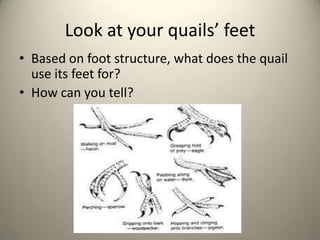
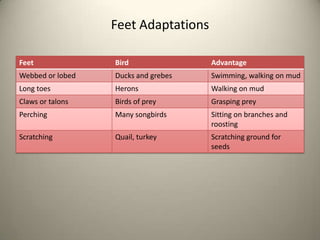
Look at your quails’ feet
• Based on foot structure, what does the quail
use its feet for?
• How can you tell?
Feet Adaptations
Feet

Bird

Advantage

Webbed or lobed

Ducks and grebes

Swimming, walking on mud

Long toes

Herons

Walking on mud

Claws or talons

Birds of prey

Grasping prey

Perching

Many songbirds

Sitting on branches and
roosting

Scratching

Quail, turkey

Scratching ground for
seeds
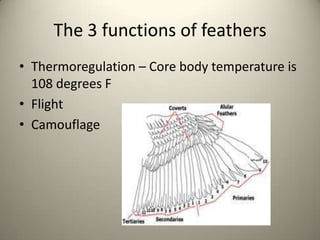
The 3 functions of feathers
• Thermoregulation – Core body temperature is
108 degrees F
• Flight
• Camouflage
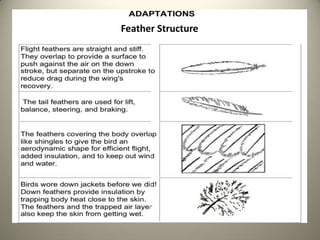
Feather Structure
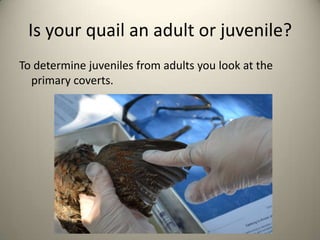
Is your quail an adult or juvenile?
To determine juveniles from adults you look at the
primary coverts.
In adults, these feathers will normally be
uniformly gray. Juvenile birds will normally have
buff-colored tips on these feathers.

Juvenile Bird
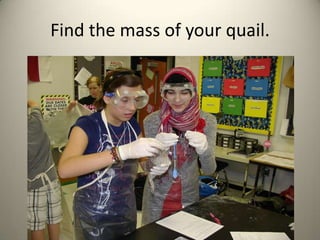
Find the mass of your quail.
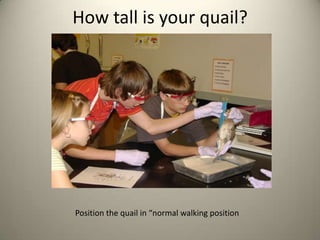
How tall is your quail?

Position the quail in “normal walking position
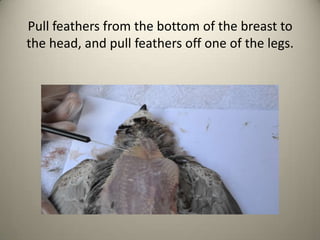
Pull feathers from the bottom of the breast to
the head, and pull feathers off one of the legs.
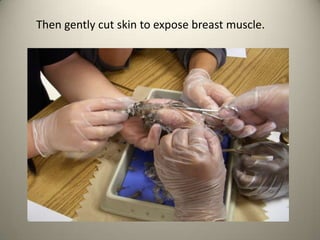
Then gently cut skin to expose breast muscle.
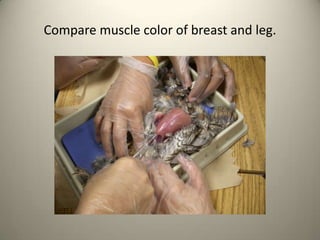
Compare muscle color of breast and leg.
LIGHT MEAT VS DARK MEAT
Have you ever wondered why the breast meat on your
Thanksgiving turkey is light and the leg meat is dark?
Light meat does not have a good supply of blood rich in oxygen.
These muscles can react quickly, but soon tire. A turkey's quick
burst of flight relies on the rapid power of their "light" breast
muscle although they cannot fly at great distances.

Dark meat is muscle with a greater blood supply (more myoglobin)
and a supply of fat. These muscles can work steadily for a long time
without tiring. The dark meat of turkey thighs tells us turkeys are
good runners and walkers.

Is your quail a walker or a flier?
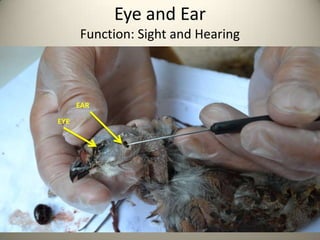
Eye and Ear
Function: Sight and Hearing

EAR
EYE
Vision is the major sense by which birds
perceive their environment.
A quail’s eyes are located on the side of the
head. Does this make them a predator or
prey?
Eyes in the front, I hunt
Eyes on the side, I hide
Birds hear over a range of frequencies
slightly greater than that of people. This
allows them to detect, locate, and home
in on a food source. Their keen sense of
hearing also protects them from
predators.
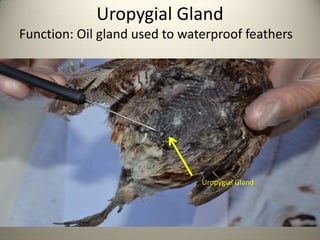
Uropygial Gland
Function: Oil gland used to waterproof feathers

Uropygial Gland
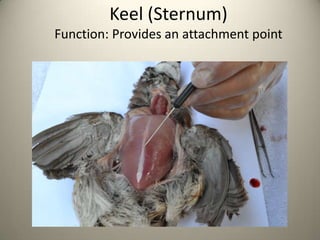
Keel (Sternum)
Function: Provides an attachment point
Now let’s follow the path
of a seed as it is consumed
and digested by the quail.
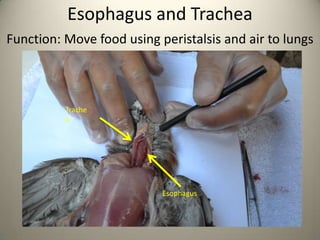
Esophagus and Trachea
Function: Move food using peristalsis and air to lungs

Trache
a

Esophagus
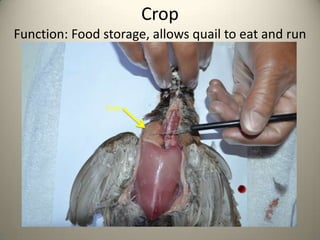
Crop
Function: Food storage, allows quail to eat and run

Crop
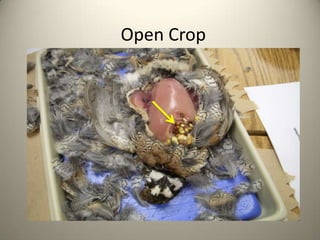
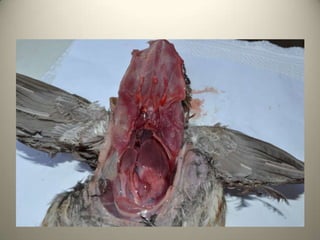
Open Crop
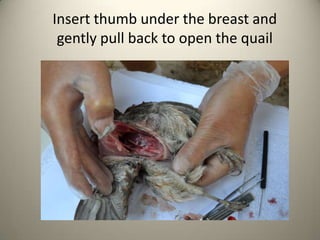
Insert thumb under the breast and
gently pull back to open the quail
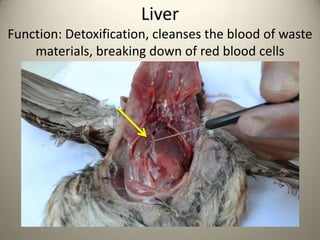
Liver
Function: Detoxification, cleanses the blood of waste
materials, breaking down of red blood cells
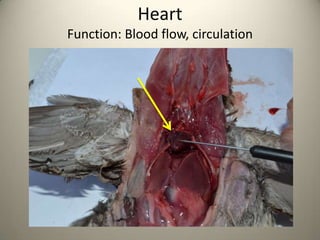
Heart
Function: Blood flow, circulation
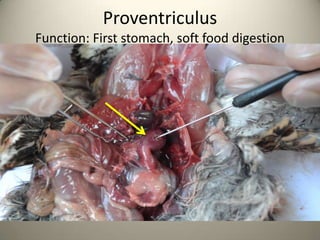
Proventriculus
Function: First stomach, soft food digestion
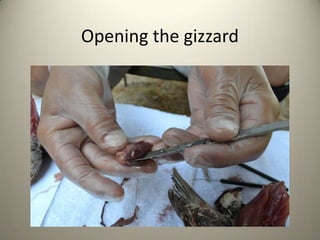
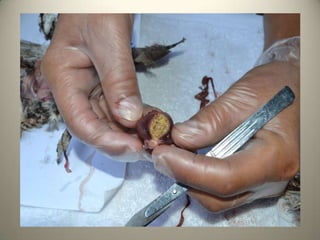
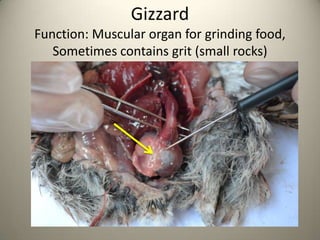
Gizzard
Function: Muscular organ for grinding food,
Sometimes contains grit (small rocks)
Opening the gizzard
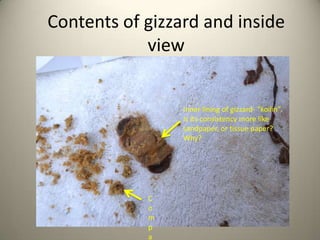
Contents of gizzard and inside
view

Inner lining of gizzard- “koilin”.
Is its consistency more like
sandpaper, or tissue paper?
Why?

C
o
m
p
a
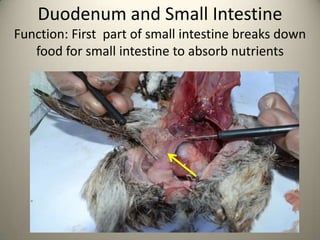
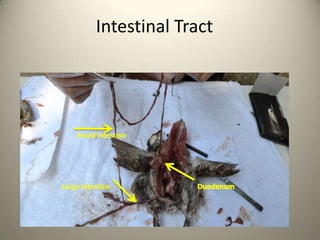
Duodenum and Small Intestine
Function: First part of small intestine breaks down
food for small intestine to absorb nutrients
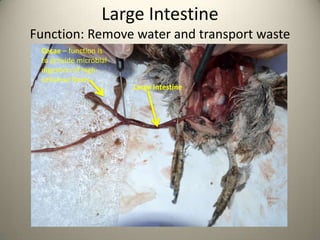
Large Intestine
Function: Remove water and transport waste
Cecae – function is
to provide microbial
digestion of highcellulose foods

Large Intestine
Intestinal Tract

Small Intestine

Large Intestine
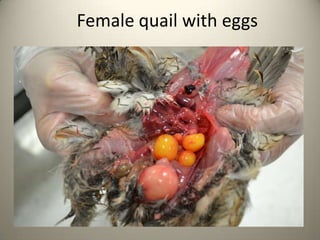
Female quail with eggs
Clean up
•Dispose of all bird parts in trash bin
•Wash and dry dissecting pan and all utensils
•Dispose of gloves in trash bin
•Fold aprons neatly
•Leave your lab table organized and cleaner then you found it
Let’s Review
•How big is the bobwhite quail?
•What is the bobwhite quail’s habitat?
•How can you tell the difference in the male and female?
•What does the bobwhite quail eat?
•How many eggs does the female lay?
•Name some predators of the bobwhite quail.
•Is the bobwhite quail a predator or prey and how can you tell?
•How can you tell whether the quail is a walker or a flier?
•What is the food storage pouch called?
•What is the name of the first stomach?
•What is the name of the second stomach?
•What did the inside of the second stomach feel like and how
does this aid in digestion?
Final Thoughts for Consideration
The state of Texas is fortunate to have some of the best quail
hunting in the habitat range of the bobwhite. Hunterlandowner relationships are important in Texas, as any quail
hunter knows. The birds themselves belong to the people of
the state, but most of the land on which they reside belongs to
individuals. The bobwhite's potential as a game bird depends
on land use practices carried out by these landowners.
We must all be good stewards of the land and promote land
stewardship practices in order to preserve the habitat for the
bobwhite quail.
This program funded by the
Texas Wildlife Association
Foundation and the Leonard
Family Foundation.
TEKS Covered
SCIENCE: 7.1AB 7.2BD 7.4AB
7.10C 7.12ABC 7.13AB
BIOLOGY:

1AB 2FGH 10AC 12B
AG: 6C 12B
Quailnecropsy

Quailnecropsy

  • 1.
    L.A.N.D.S Learning Across NewDimensions In Science Quail Necropsy
  • 2.
    Bobwhite Quail Facts Thebobwhite quail is a relatively small bird that is about 10 inches long. It has a mixed plumage of brown, black, white and buff making it almost invisible against the vegetation of weedy fields and edges of the woodlands. Bobwhite quail reside in pastures, abandoned fields, crop fields, grasslands, brushy areas along forest edges and shrubby meadows. The average home range size is 40 acres.
  • 3.
    Bobwhite quail searchfor food in the early portion of the morning and then again in the hours before nightfall. Bobwhites feed on insects and weed seeds. The juvenile quail’s menu is 85 percent bugs while the adults’ diet is comprised of about 70 percent seeds and 30 percent insects on a year-round basis. Seeds of many plants such as ragweed and foxtail are edible and the bobwhite is highly dependent on these seeds during the fall and winter months.
  • 4.
    During much ofthe year they travel in small groups known as coveys, sleeping at night in a compact circle, tails to the center. This roosting technique allows the covey to conserve heat and be ready to fly in all directions if approached by a predator. Hawks, skunks, foxes, raccoons, owls, snakes, dogs, dom estic cats, and hunters are predators of quail.
  • 5.
    In the spring,May through September, the male selects a territory in which to nest and the female is responsible for the nest building. The female will build a nest on the ground in which she lays 10-15 eggs per clutch. Incubation lasts 23-24 days. The chicks follow their parents upon hatching and fledge in 6-7 days. They can fly short distances at 10 to 14 days. Chicks survival is low – probably no more than 30 percent survive their first year. The major factors leading to the decreasing numbers of bobwhite quail are habitat loss, intensive agricultural practices, and harsh weather events.
  • 6.
    Getting to KnowYour Quail Key Questions • Is your quail male or female? • Is it an adult or juvenile? • Is your quail a carnivore, herbivore, or omnivore? • What external features show you this? • Do quail spend more time walking or flying?
  • 7.
    Is Your QuailMale or Female? The coloration of the feathers on the head and neck of older birds is how you distinguish between the male and female birds.
  • 8.
    Males have adistinctive white eye stripe that extends from the bill through the top of the eye to the back of the neck.
  • 9.
    Females have buffcolored feathers in place of the white feathers that are present on the male bird.
  • 10.
    Look at yourquail’s beak • Based on beak shape, what do you think your quail eats? • Is your quail a carnivore, herbivore, or an omnivore ?
  • 11.
    Beak Adaptations Beak Type Bird Advantage Long,probing Wading birds and shore birds Probing shallow water and mud for insets Pouch-like Pelican Holding fish Sturdy and pointed Woodpecker Probing bark and trees for insects Thick, curved, sharp Hawks Ability to tear meat Stout, conical shape Bobwhite, finch, cardinal Cracking seeds Shovel shaped Ducks Ability to sieve and filter water for plants
  • 12.
    Look at yourquails’ feet • Based on foot structure, what does the quail use its feet for? • How can you tell?
  • 13.
    Feet Adaptations Feet Bird Advantage Webbed orlobed Ducks and grebes Swimming, walking on mud Long toes Herons Walking on mud Claws or talons Birds of prey Grasping prey Perching Many songbirds Sitting on branches and roosting Scratching Quail, turkey Scratching ground for seeds
  • 14.
    The 3 functionsof feathers • Thermoregulation – Core body temperature is 108 degrees F • Flight • Camouflage
  • 15.
  • 16.
    Is your quailan adult or juvenile? To determine juveniles from adults you look at the primary coverts.
  • 17.
    In adults, thesefeathers will normally be uniformly gray. Juvenile birds will normally have buff-colored tips on these feathers. Juvenile Bird
  • 18.
    Find the massof your quail.
  • 19.
    How tall isyour quail? Position the quail in “normal walking position
  • 21.
    Pull feathers fromthe bottom of the breast to the head, and pull feathers off one of the legs.
  • 22.
    Then gently cutskin to expose breast muscle.
  • 23.
    Compare muscle colorof breast and leg.
  • 24.
    LIGHT MEAT VSDARK MEAT Have you ever wondered why the breast meat on your Thanksgiving turkey is light and the leg meat is dark? Light meat does not have a good supply of blood rich in oxygen. These muscles can react quickly, but soon tire. A turkey's quick burst of flight relies on the rapid power of their "light" breast muscle although they cannot fly at great distances. Dark meat is muscle with a greater blood supply (more myoglobin) and a supply of fat. These muscles can work steadily for a long time without tiring. The dark meat of turkey thighs tells us turkeys are good runners and walkers. Is your quail a walker or a flier?
  • 25.
    Eye and Ear Function:Sight and Hearing EAR EYE
  • 26.
    Vision is themajor sense by which birds perceive their environment. A quail’s eyes are located on the side of the head. Does this make them a predator or prey? Eyes in the front, I hunt Eyes on the side, I hide
  • 27.
    Birds hear overa range of frequencies slightly greater than that of people. This allows them to detect, locate, and home in on a food source. Their keen sense of hearing also protects them from predators.
  • 28.
    Uropygial Gland Function: Oilgland used to waterproof feathers Uropygial Gland
  • 29.
  • 30.
    Now let’s followthe path of a seed as it is consumed and digested by the quail.
  • 31.
    Esophagus and Trachea Function:Move food using peristalsis and air to lungs Trache a Esophagus
  • 32.
    Crop Function: Food storage,allows quail to eat and run Crop
  • 33.
  • 34.
    Insert thumb underthe breast and gently pull back to open the quail
  • 36.
    Liver Function: Detoxification, cleansesthe blood of waste materials, breaking down of red blood cells
  • 37.
  • 38.
  • 39.
    Gizzard Function: Muscular organfor grinding food, Sometimes contains grit (small rocks)
  • 40.
  • 42.
    Contents of gizzardand inside view Inner lining of gizzard- “koilin”. Is its consistency more like sandpaper, or tissue paper? Why? C o m p a
  • 43.
    Duodenum and SmallIntestine Function: First part of small intestine breaks down food for small intestine to absorb nutrients
  • 44.
    Large Intestine Function: Removewater and transport waste Cecae – function is to provide microbial digestion of highcellulose foods Large Intestine
  • 45.
  • 46.
  • 47.
    Clean up •Dispose ofall bird parts in trash bin •Wash and dry dissecting pan and all utensils •Dispose of gloves in trash bin •Fold aprons neatly •Leave your lab table organized and cleaner then you found it
  • 48.
    Let’s Review •How bigis the bobwhite quail? •What is the bobwhite quail’s habitat? •How can you tell the difference in the male and female? •What does the bobwhite quail eat? •How many eggs does the female lay? •Name some predators of the bobwhite quail. •Is the bobwhite quail a predator or prey and how can you tell?
  • 49.
    •How can youtell whether the quail is a walker or a flier? •What is the food storage pouch called? •What is the name of the first stomach? •What is the name of the second stomach? •What did the inside of the second stomach feel like and how does this aid in digestion?
  • 50.
    Final Thoughts forConsideration The state of Texas is fortunate to have some of the best quail hunting in the habitat range of the bobwhite. Hunterlandowner relationships are important in Texas, as any quail hunter knows. The birds themselves belong to the people of the state, but most of the land on which they reside belongs to individuals. The bobwhite's potential as a game bird depends on land use practices carried out by these landowners. We must all be good stewards of the land and promote land stewardship practices in order to preserve the habitat for the bobwhite quail.
  • 51.
    This program fundedby the Texas Wildlife Association Foundation and the Leonard Family Foundation.
  • 52.
    TEKS Covered SCIENCE: 7.1AB7.2BD 7.4AB 7.10C 7.12ABC 7.13AB BIOLOGY: 1AB 2FGH 10AC 12B AG: 6C 12B

Editor's Notes

  • #7 TEKSSCIENCE: 7.1AB 7.2BD 7.4AB 7.10C 7.12ABC 7.13ABBIOLOGY: 1AB 2FGH 10AC 1A 12B ALGEBRA: 1B MATH: 6.2ABC 6.8ABD 6.11AD 7.2AB 7.13AD 8.1B 8.2D 8.14AD
  • #48 After students clean up, bring students back together to review.
  • #49 Size: 8-10 inches longHabitat: Open woodlands, river bottoms, hardwood forests, open pinelandsMale: Has the white on its headFemale: Has a buff-colored headDiet: Weed seeds, berries, grain, insectsClutch size: 10-15 eggsPredators: Skunks, raccoons, domestic cats, snakes, dogs, owls, foxes, humansPrey: Eyes on the side, I hide
  • #50 Walker: Dark meat on the legs means increased blood flowFood Storage Pouch: CropFirst Stomach: ProventriculusSecond Stomach: GizzardGizzard: rough like sand paper, helps in grinding up food