Structured composite problem in direct
Hilbert sums
Farid Benmouffok
Department of Mathematics,
North Carolina State University
Advisor: Patrick L. Combettes
March 21, 2018
Farid Benmouffok Structured composite problem in direct Hilbert sums 1/7
Standard convex composite problem
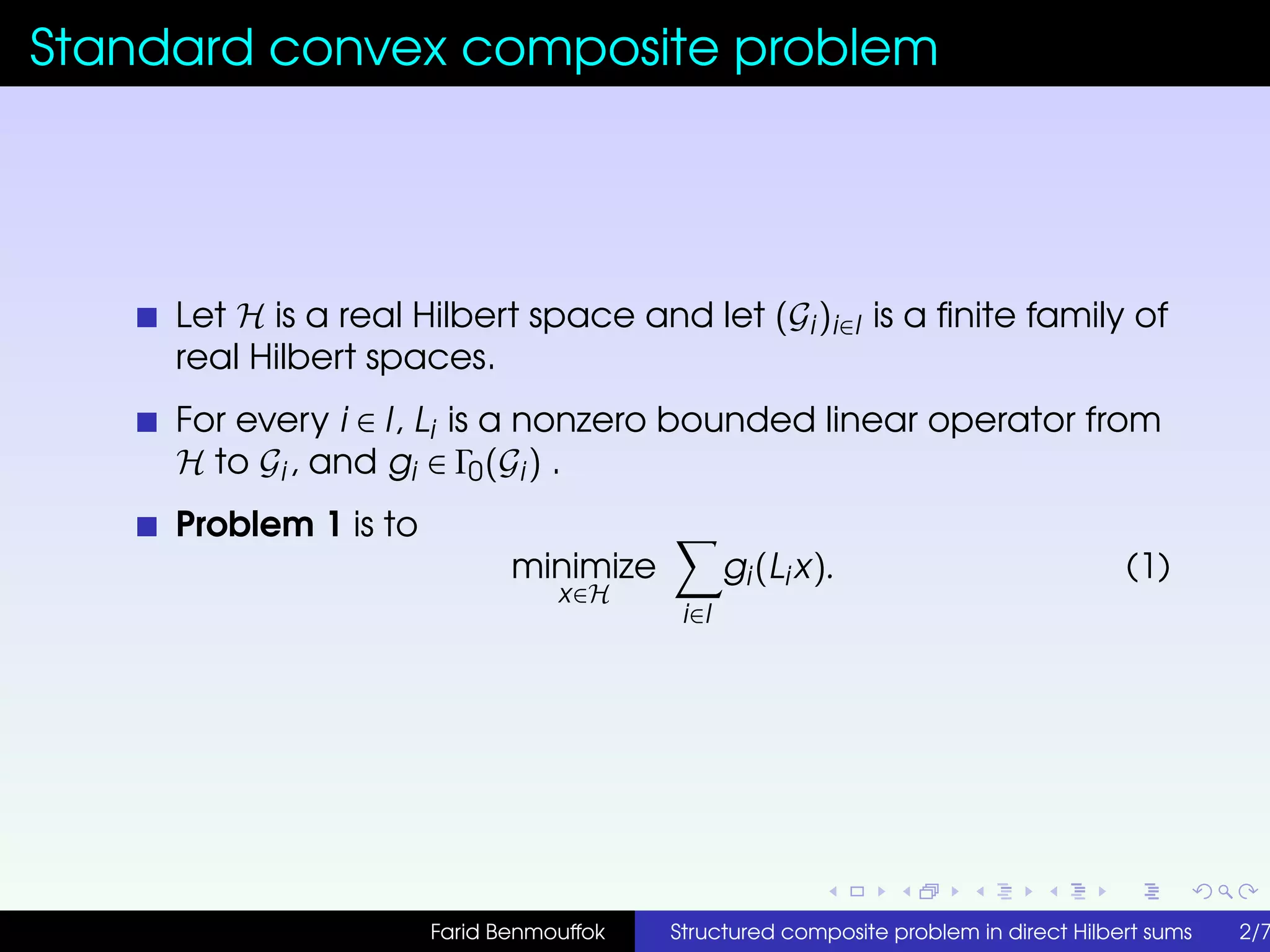
Let H is a real Hilbert space and let (Gi)i∈I is a finite family of
real Hilbert spaces.
For every i ∈ I, Li is a nonzero bounded linear operator from
H to Gi, and gi ∈ Γ0(Gi) .
Problem 1 is to
minimize
x∈H
i∈I
gi(Lix). (1)
Farid Benmouffok Structured composite problem in direct Hilbert sums 2/7
Structured problem
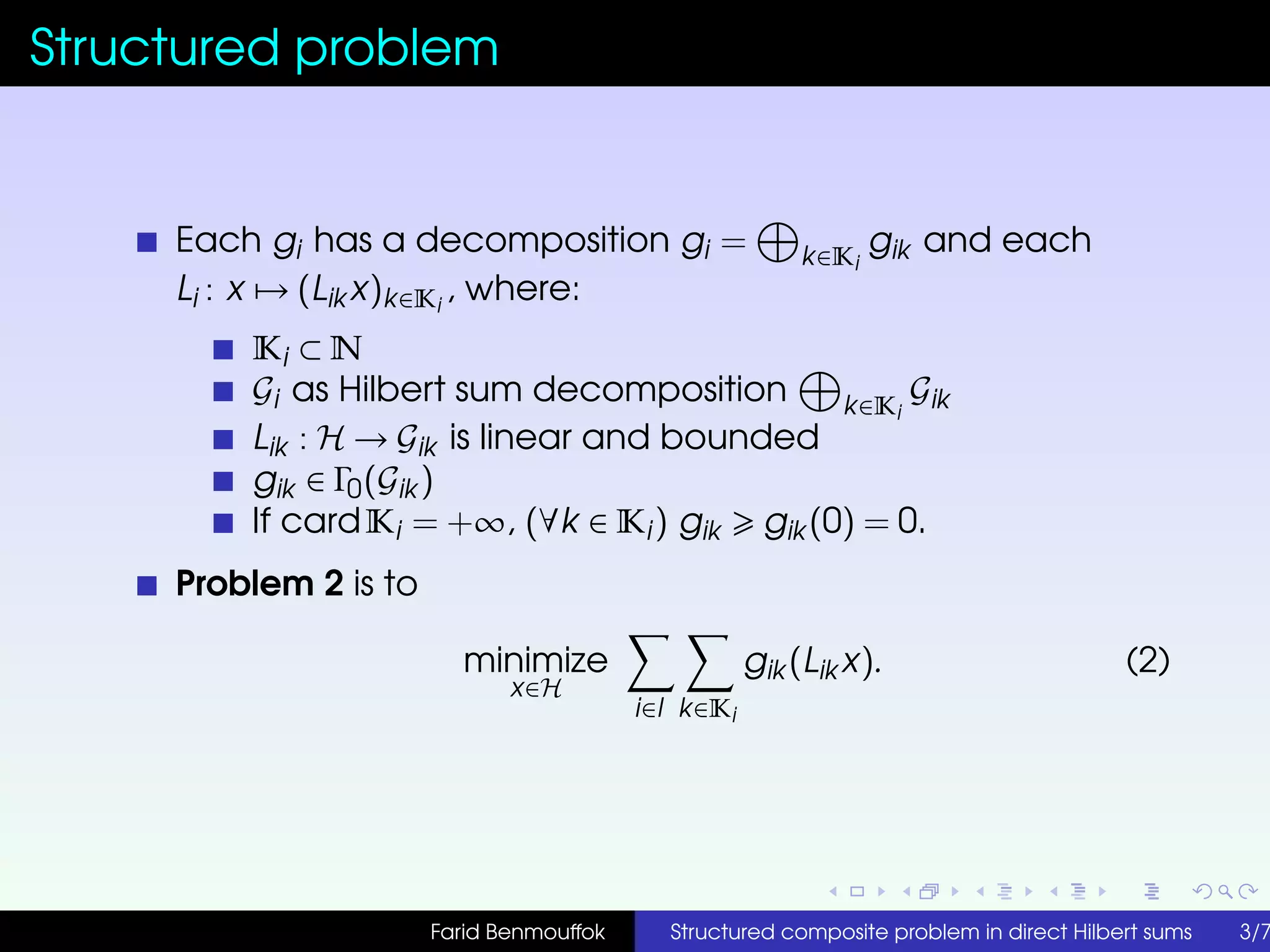
Each gi has a decomposition gi = k∈Ki
gik and each
Li : x → (Lik x)k∈Ki
, where:
Ki ⊂ N
Gi as Hilbert sum decomposition k∈Ki
Gik
Lik : H → Gik is linear and bounded
gik ∈ Γ0(Gik )
If cardKi = +∞, (∀k ∈ Ki) gik gik (0) = 0.
Problem 2 is to
minimize
x∈H
i∈I k∈Ki
gik (Lik x). (2)
Farid Benmouffok Structured composite problem in direct Hilbert sums 3/7
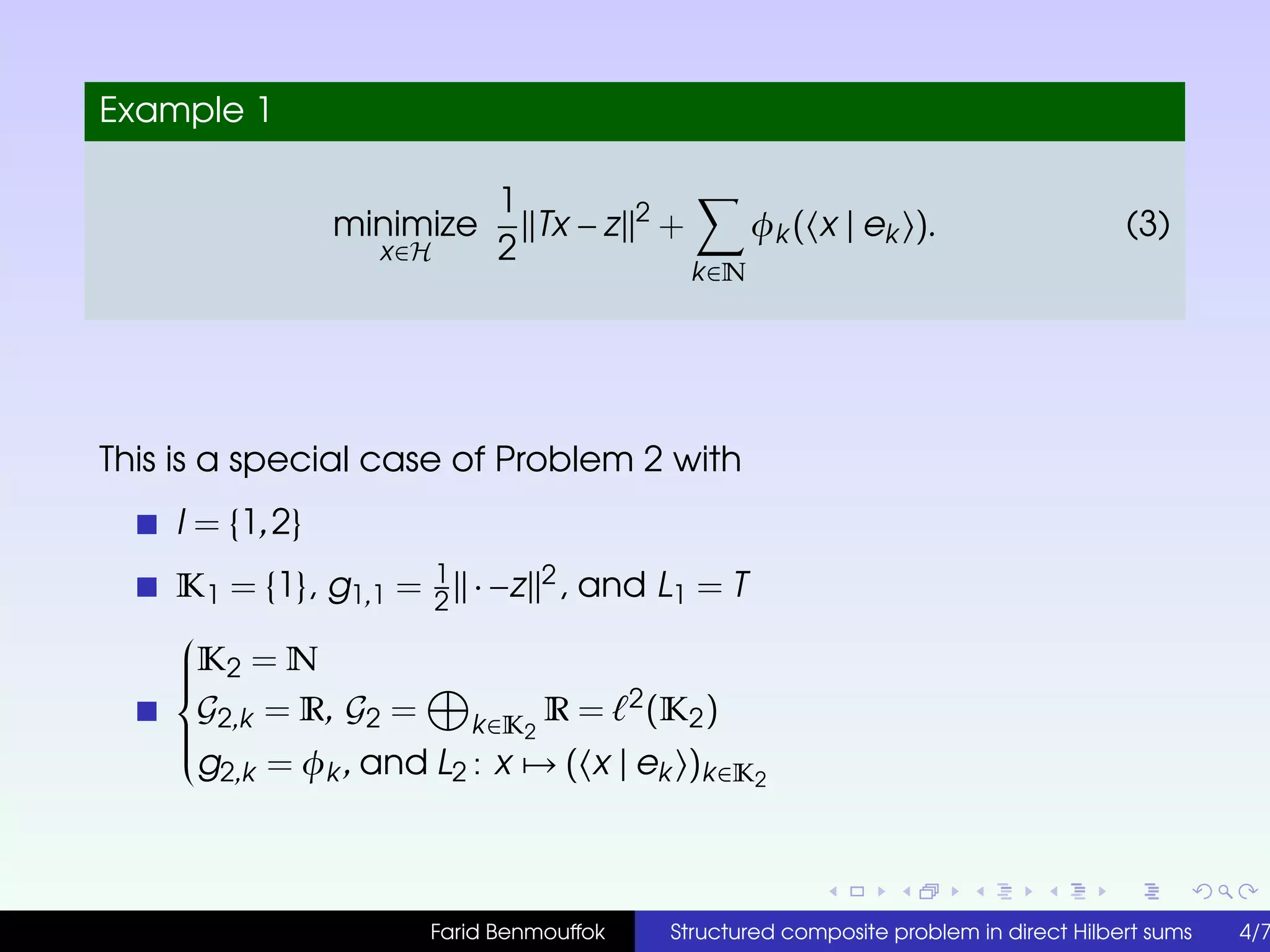
Example 1
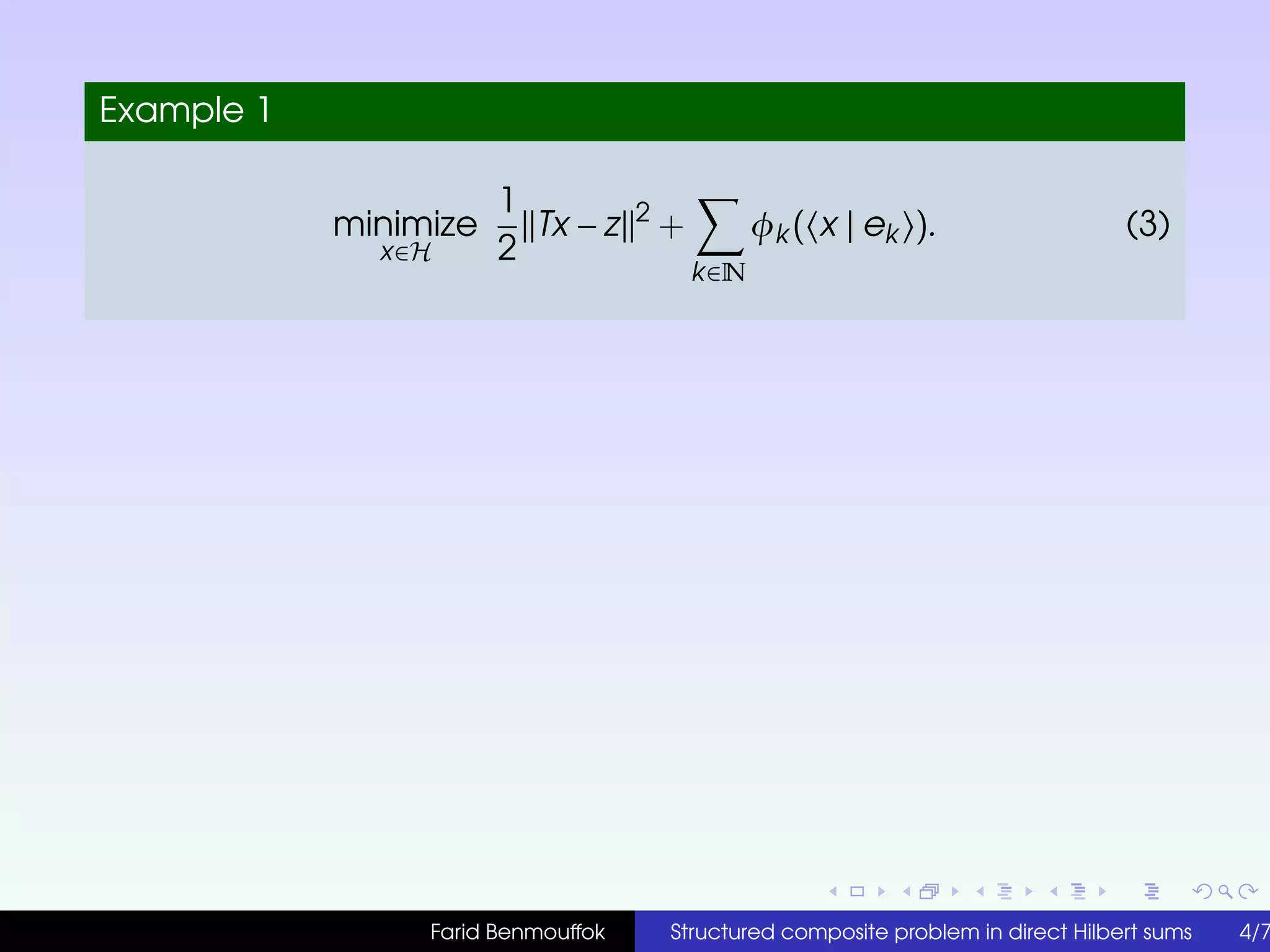
minimize
x∈H
1
2
Tx − z 2
+
k∈N
φk ( x | ek ). (3)
Farid Benmouffok Structured composite problem in direct Hilbert sums 4/7
Example 1
minimize
x∈H
1
2
Tx − z 2
+
k∈N
φk ( x | ek ). (3)
This is a special case of Problem 2 with
I = {1,2}
K1 = {1}, g1,1 = 1
2
· −z 2, and L1 = T



K2 = N
G2,k = R, G2 = k∈K2
R = 2(K2)
g2,k = φk , and L2 : x → ( x | ek )k∈K2
Farid Benmouffok Structured composite problem in direct Hilbert sums 4/7
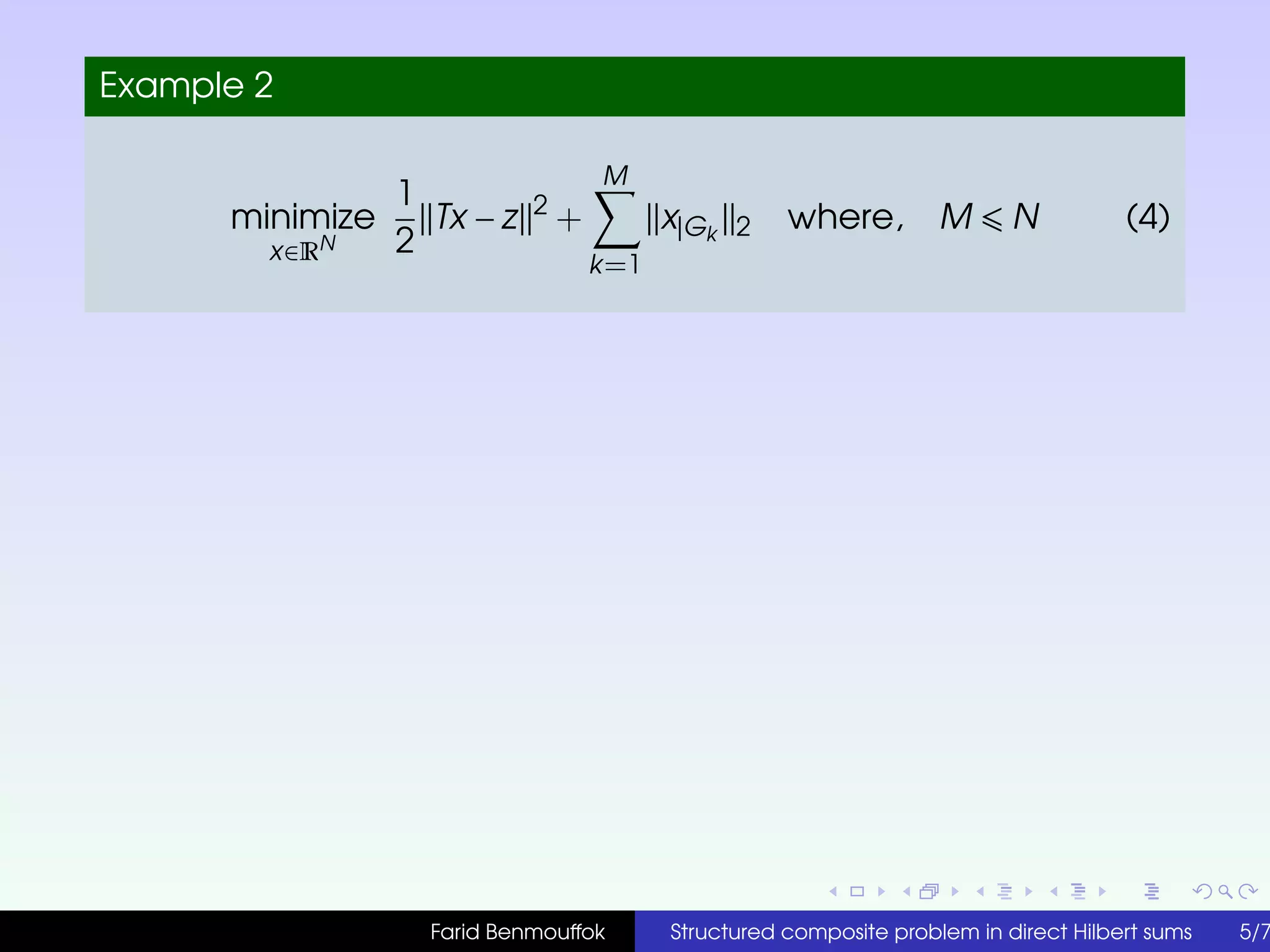
Example 2
minimize
x∈RN
1
2
Tx − z 2
+
M
k=1
x|Gk 2 where, M N (4)
Farid Benmouffok Structured composite problem in direct Hilbert sums 5/7
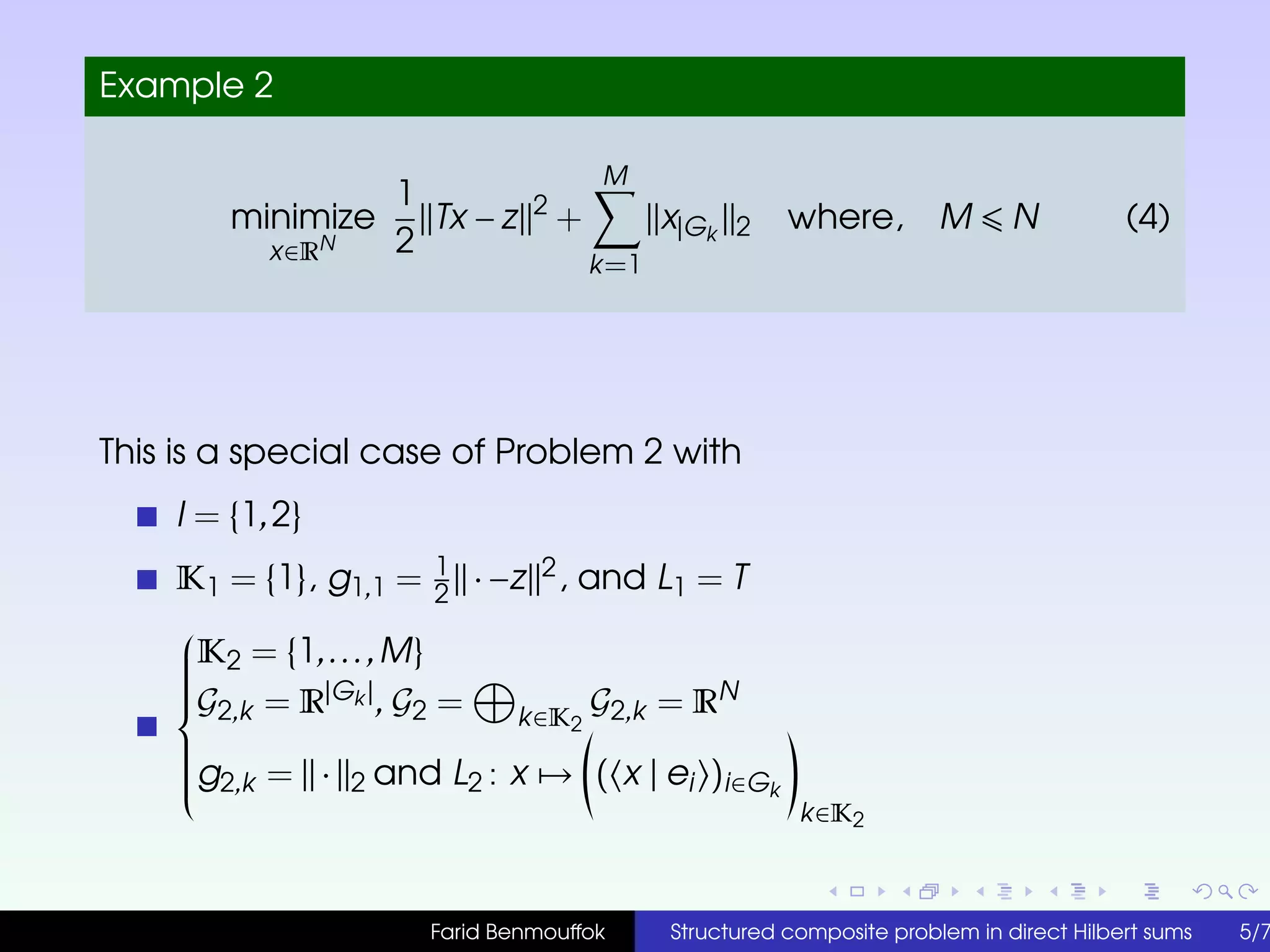
Example 2
minimize
x∈RN
1
2
Tx − z 2
+
M
k=1
x|Gk 2 where, M N (4)
This is a special case of Problem 2 with
I = {1,2}
K1 = {1}, g1,1 = 1
2
· −z 2, and L1 = T



K2 = {1,...,M}
G2,k = R|Gk |, G2 = k∈K2
G2,k = RN
g2,k = · 2 and L2 : x → ( x | ei )i∈Gk
k∈K2
Farid Benmouffok Structured composite problem in direct Hilbert sums 5/7
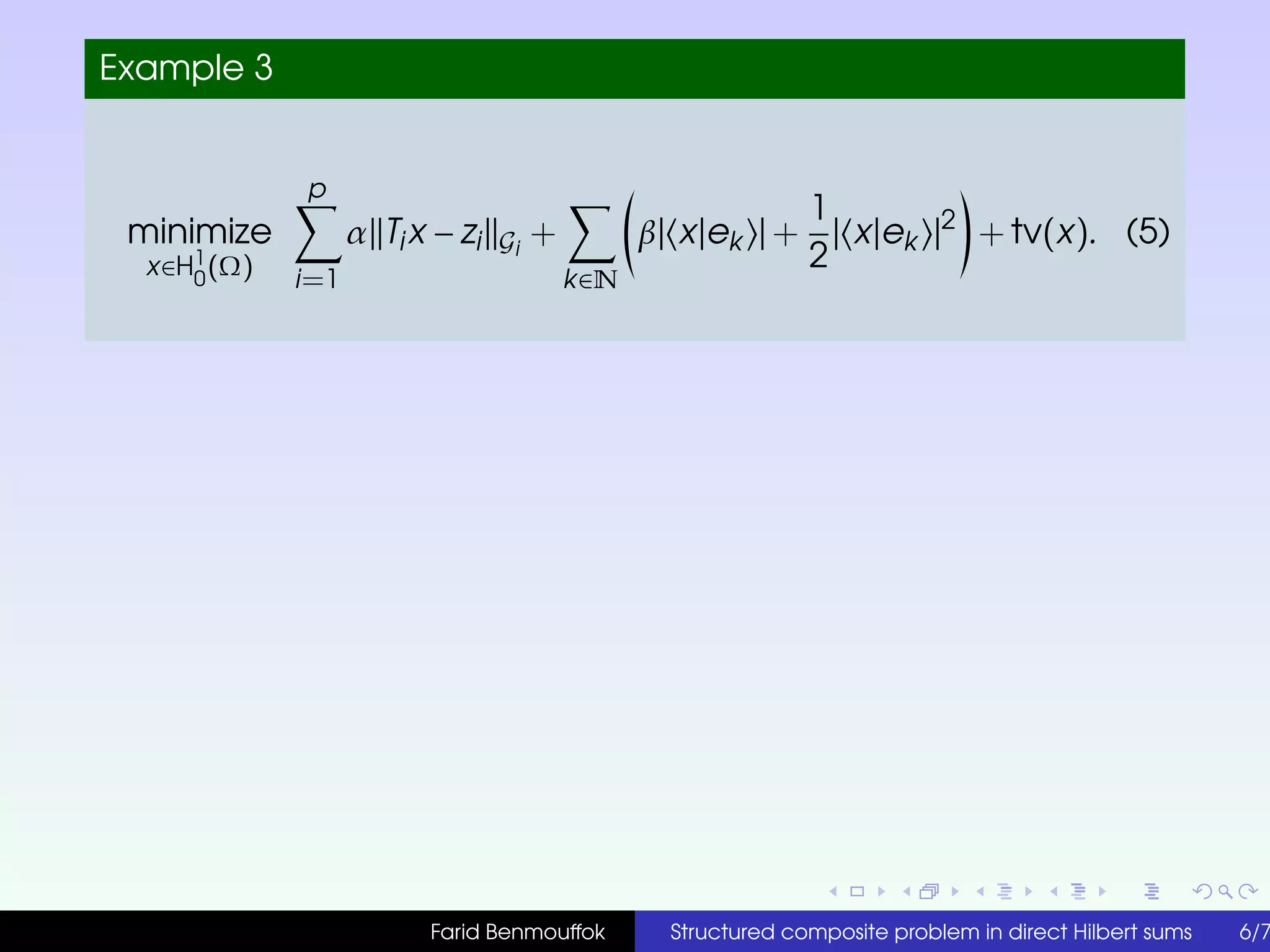
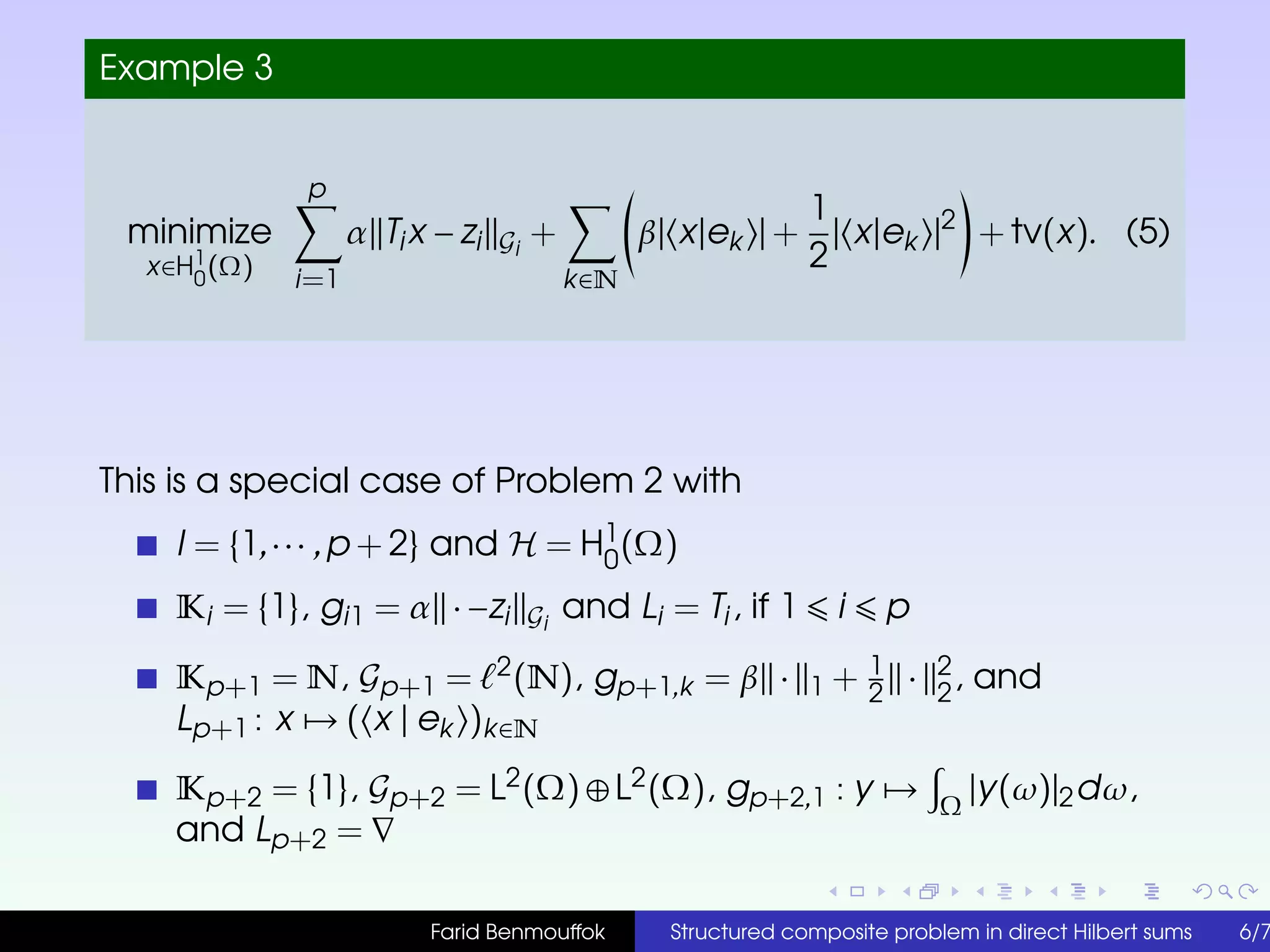
Example 3
minimize
x∈H1
0
(Ω)
p
i=1
α Tix − zi Gi
+
k∈N
β| x|ek | +
1
2
| x|ek |2
+ tv(x). (5)
Farid Benmouffok Structured composite problem in direct Hilbert sums 6/7
Example 3
minimize
x∈H1
0
(Ω)
p
i=1
α Tix − zi Gi
+
k∈N
β| x|ek | +
1
2
| x|ek |2
+ tv(x). (5)
This is a special case of Problem 2 with
I = {1,··· ,p + 2} and H = H1
0
(Ω)
Ki = {1}, gi1 = α · −zi Gi
and Li = Ti, if 1 i p
Kp+1 = N, Gp+1 = 2(N), gp+1,k = β · 1 + 1
2
· 2
2
, and
Lp+1 : x → ( x | ek )k∈N
Kp+2 = {1}, Gp+2 = L2(Ω) ⊕ L2(Ω), gp+2,1 : y → Ω
|y(ω)|2dω,
and Lp+2 =
Farid Benmouffok Structured composite problem in direct Hilbert sums 6/7
Open problems
A prevalent viewpoint in modern proximal splitting algorithms is
that to activate each function gik appearing in the model there
are two options:
If gik is smooth, i.e, real-valued and differentiable
everywhere with a Lipschitzian gradient, then use gik ;
otherwise, use gik ◦ Lik proximally, i.e, via its proximity
operator
If Lik L∗
ik = αId, then we have an explicit expression of
the proximity operator of gik ◦ Lik ;
otherwise, we can use the splitting algorithm to gik
and Lik separately, [Combettes and Eckstein 2018].
Question 1: Develop an efficient distributed block iterative
method to solve the Problem 2
Question 2: Extention to maximally monotone inclusion of
the form
0 ∈
i∈I k∈Ki
L∗
ik ◦ Aik ◦ Lik (6)
Farid Benmouffok Structured composite problem in direct Hilbert sums 7/7

QMC: Operator Splitting Workshop, Structured Composite Problems in Direct Hilbert Sums - Farid Benmouffok, Mar 21, 2018

  • 1.
    Structured composite problemin direct Hilbert sums Farid Benmouffok Department of Mathematics, North Carolina State University Advisor: Patrick L. Combettes March 21, 2018 Farid Benmouffok Structured composite problem in direct Hilbert sums 1/7
  • 2.
    Standard convex compositeproblem Let H is a real Hilbert space and let (Gi)i∈I is a finite family of real Hilbert spaces. For every i ∈ I, Li is a nonzero bounded linear operator from H to Gi, and gi ∈ Γ0(Gi) . Problem 1 is to minimize x∈H i∈I gi(Lix). (1) Farid Benmouffok Structured composite problem in direct Hilbert sums 2/7
  • 3.
    Structured problem Each gihas a decomposition gi = k∈Ki gik and each Li : x → (Lik x)k∈Ki , where: Ki ⊂ N Gi as Hilbert sum decomposition k∈Ki Gik Lik : H → Gik is linear and bounded gik ∈ Γ0(Gik ) If cardKi = +∞, (∀k ∈ Ki) gik gik (0) = 0. Problem 2 is to minimize x∈H i∈I k∈Ki gik (Lik x). (2) Farid Benmouffok Structured composite problem in direct Hilbert sums 3/7
  • 4.
    Example 1 minimize x∈H 1 2 Tx −z 2 + k∈N φk ( x | ek ). (3) Farid Benmouffok Structured composite problem in direct Hilbert sums 4/7
  • 5.
    Example 1 minimize x∈H 1 2 Tx −z 2 + k∈N φk ( x | ek ). (3) This is a special case of Problem 2 with I = {1,2} K1 = {1}, g1,1 = 1 2 · −z 2, and L1 = T    K2 = N G2,k = R, G2 = k∈K2 R = 2(K2) g2,k = φk , and L2 : x → ( x | ek )k∈K2 Farid Benmouffok Structured composite problem in direct Hilbert sums 4/7
  • 6.
    Example 2 minimize x∈RN 1 2 Tx −z 2 + M k=1 x|Gk 2 where, M N (4) Farid Benmouffok Structured composite problem in direct Hilbert sums 5/7
  • 7.
    Example 2 minimize x∈RN 1 2 Tx −z 2 + M k=1 x|Gk 2 where, M N (4) This is a special case of Problem 2 with I = {1,2} K1 = {1}, g1,1 = 1 2 · −z 2, and L1 = T    K2 = {1,...,M} G2,k = R|Gk |, G2 = k∈K2 G2,k = RN g2,k = · 2 and L2 : x → ( x | ei )i∈Gk k∈K2 Farid Benmouffok Structured composite problem in direct Hilbert sums 5/7
  • 8.
    Example 3 minimize x∈H1 0 (Ω) p i=1 α Tix− zi Gi + k∈N β| x|ek | + 1 2 | x|ek |2 + tv(x). (5) Farid Benmouffok Structured composite problem in direct Hilbert sums 6/7
  • 9.
    Example 3 minimize x∈H1 0 (Ω) p i=1 α Tix− zi Gi + k∈N β| x|ek | + 1 2 | x|ek |2 + tv(x). (5) This is a special case of Problem 2 with I = {1,··· ,p + 2} and H = H1 0 (Ω) Ki = {1}, gi1 = α · −zi Gi and Li = Ti, if 1 i p Kp+1 = N, Gp+1 = 2(N), gp+1,k = β · 1 + 1 2 · 2 2 , and Lp+1 : x → ( x | ek )k∈N Kp+2 = {1}, Gp+2 = L2(Ω) ⊕ L2(Ω), gp+2,1 : y → Ω |y(ω)|2dω, and Lp+2 = Farid Benmouffok Structured composite problem in direct Hilbert sums 6/7
  • 10.
    Open problems A prevalentviewpoint in modern proximal splitting algorithms is that to activate each function gik appearing in the model there are two options: If gik is smooth, i.e, real-valued and differentiable everywhere with a Lipschitzian gradient, then use gik ; otherwise, use gik ◦ Lik proximally, i.e, via its proximity operator If Lik L∗ ik = αId, then we have an explicit expression of the proximity operator of gik ◦ Lik ; otherwise, we can use the splitting algorithm to gik and Lik separately, [Combettes and Eckstein 2018]. Question 1: Develop an efficient distributed block iterative method to solve the Problem 2 Question 2: Extention to maximally monotone inclusion of the form 0 ∈ i∈I k∈Ki L∗ ik ◦ Aik ◦ Lik (6) Farid Benmouffok Structured composite problem in direct Hilbert sums 7/7