Welcome
Enhancing Data Quality in Clinical Trials:Best
Practices and Quality Control Measures
S.Vignesh
M.Tech(Biotechnology)
CLS_111/062023
10/18/2022
www.clinosol.com | follow us on social media
@clinosolresearch
1
Index
 Data quality Management
 Characteristics of Data Quality
 Key Features of Data Quality Management
 Data Quality Management in Clinical Research
 Regulatory and Policy Basis for Data Quality Management
 Elements of Data Management Form
 Quality Control in Clinical Trials
10/18/2022
www.clinosol.com | follow us on social media
@clinosolresearch
2
Data Quality Management
Data quality management (DQM) is a formal process for managing the quality, validity and integrity of
the research data captured throughout the study from the time it is collected, stored and transformed
(processed) through analysis and publication. This is achieved via two processes referred to as Quality
Assurance and Quality Control .
DQM starts with a data management plan that is specified in the protocol, as a component of the data
safety monitoring plan and approved by the IRB and sponsor, as applicable, before the protocol starts.
DQM includes the organization and retention of key study documentation, known collectively as the
Regulatory File. The Regulatory File is organized and retained to support monitoring and auditing by
ICs, IRBs, the HRPP, Sponsors or Contract Research Organizations and regulatory authorities.
10/18/2022
www.clinosol.com | follow us on social media
@clinosolresearch
3
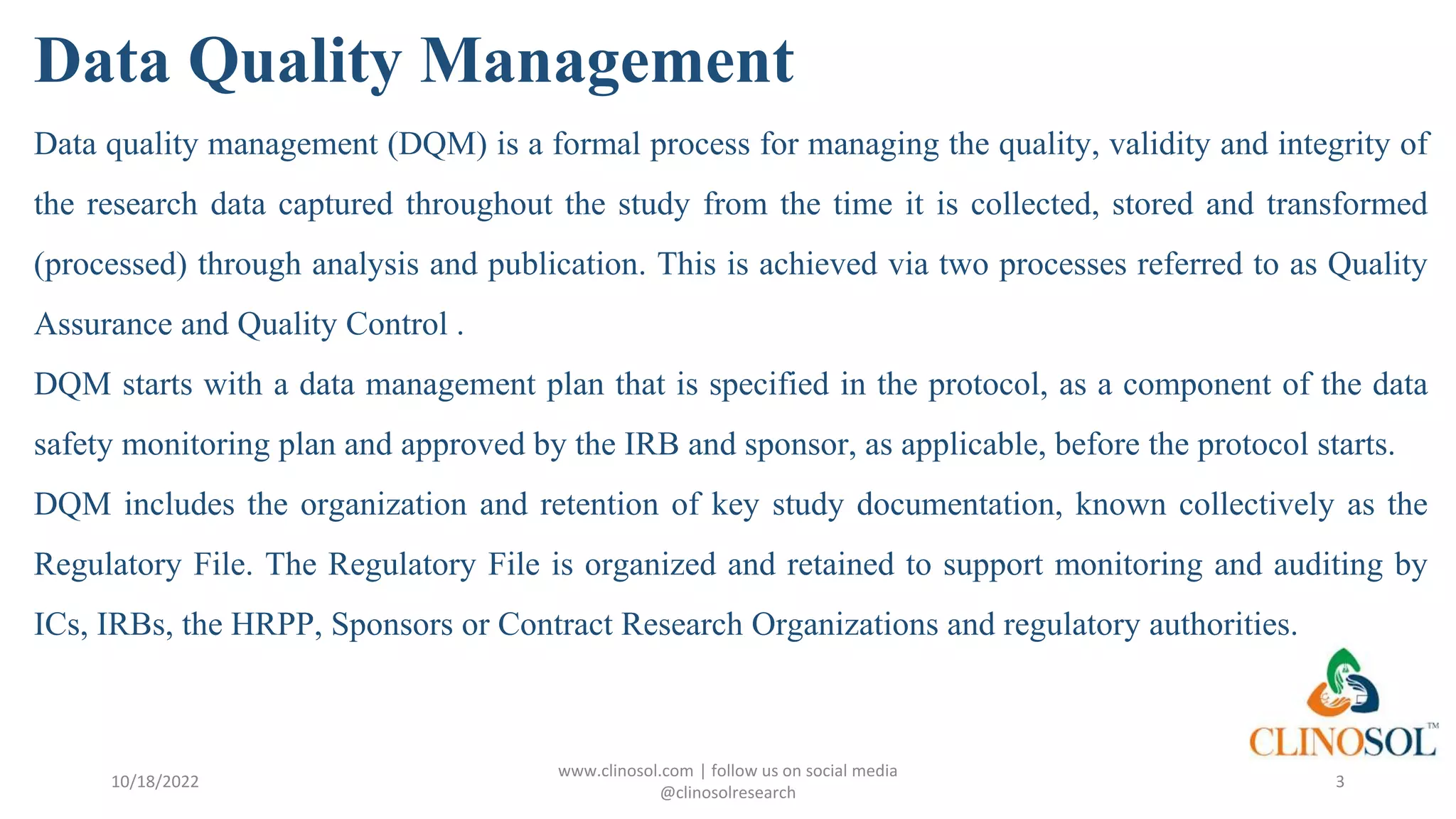
Characteristics of Data Quality
Data quality is crucial as it assesses whether information can serve its purpose in a particular
context
• Accuracy
• Completeness
• Reliability
• Relevance
• Timeliness
10/18/2022
www.clinosol.com | follow us on social media
@clinosolresearch
4
Characteristic How it’s measured
Accuracy Is the information correct in every detail
Completeness How comprehensive is the information
Reliability Does the information contradict other trusted resources
Relevance Do you really need this information
Timeliness How up- to-date is information? Can it be used for real-time
reporting
Key features of Data Quality Management
A good DQM makes use of a system that has various features that will help in
improving the trustworthiness of organizational data. Let us outline the various features
of a good Data Quality Management
Data cleansing corrects unknown data types, duplicate records, as well as substandard
data representations. Data cleansing ensures that data standardization rules that are
needed to enable analysis and insights from your data sets are followed. The data
cleansing process also establishes hierarchies and makes data customizable to fit an
organization’s unique data requirements.
10/18/2022
www.clinosol.com | follow us on social media
@clinosolresearch
5
Contd..,
Data profiling is the process of monitoring and cleansing data. Data profiling is used to
• Validate available data against the standard statistical measures,
• Create data relationships
• Verify the available data against matching descriptions
• The data profiling process establishes trends that help in discovering, understanding
and exposing inconsistencies in the data, for any corrections and adjustments
10/18/2022
www.clinosol.com | follow us on social media
@clinosolresearch
6
Data Quality Management in Clinical Research
• All research results in the production of data that must be processed and analyzed to
support or refute the study hypothesis
• The data must be of sufficient quality and integrity to support the endpoint analyses
• The data used to support marketing applications for FDA-regulated research must be
accurate and validated
• FDA E6 Good Clinical Practice (GCP) standards will be used as the basis of this
course
• Following best practices for data management is a continuous process that utilizes
quality control (QC)/quality improvement (QI) methodology
10/18/2022
www.clinosol.com | follow us on social media
@clinosolresearch
7
Regulatory and Policy Basis for Data Quality
Management
Below is a list of regulations, policy and guidance regarding data quality management
FDA GCP Guidelines: Below are a selected list of sections from the FDA E6 Guidelines that may be of
interest:
• Investigator Responsibilities
• Sponsor Responsibilities
• Essential Documents for the Conduct of a Clinical Trial
NIH Policy:
• SOP 15 - Research Regulated by the Food and Drug Administration (FDA): General Procedures for Both
IND and IDE Applications
• SOP 17 - Data and Safety Monitoring
• SOP 19 - Investigator Responsibilities
10/18/2022
www.clinosol.com | follow us on social media
@clinosolresearch
8
Elements of Data Management Form
• Specification of the data to be collected on the protocol
• Case Report Forms (CRFs) to be developed
• Establishment of desired best practices (QA) for:
• Collecting source documentation (raw data)
• Extracting research data from the source data to complete the Case Report Forms (CRFs)/data management
system
• Maintaining confidentiality of data
• Plans for secure storage of data with limited data access
• Processes for Quality control (QC) of data and the specification of processes for corrections of incorrect data
• How data will be transformed (processed) to prepare it for analysis
• Quality assurance processes and timing for raw and transformed data
10/18/2022
www.clinosol.com | follow us on social media
@clinosolresearch
9
Quality Control in Clinical Trials
Quality Control in human clinical trials means the procedures which ensure the protection of
human subjects from research risk, reliability of the data, and thereby assuring internal
consistency. This has been developed since the 1970s in the US, by establishing various
regulations, which are now called GCP.
Good clinical practice (GCP):
It is an international ethical and scientific quality standard for designing, conducting,
recording, and reporting trials that involve the participation of human subjects. Since 1997,
the ICH-GCP E6(R2) guidelines have been a requirement for conducting human clinical trials,
which should be used as documentation to the authorities.
10/18/2022
www.clinosol.com | follow us on social media
@clinosolresearch
10
Contd.,
GCP clinical trials adherence to quality standards during the clinical trial process assures that the data and
the reported results are credible and accurate and that the rights, integrity, and confidentiality of the trial
subjects are protected.
The Quality Challenge:
The ongoing challenge in managing the quality of clinical data is to continually monitor data collection
procedures and data management practices at every level of the study. Maintaining accuracy and quality
throughout clinical studies is a continual, dynamic process.
Although study requirements are carefully set forth initially in detailed documents such as an approved
clinical protocol, A clinical trial data management plan, and an accompanying project plan, expectations
and requirements can change during a study. This ongoing process requires revising mechanisms and
communicating these revisions clearly to all investigators and support staff.
10/18/2022
www.clinosol.com | follow us on social media
@clinosolresearch
11
Improvement of Data Quality
Gathering high-quality, reliable, and statistically sound data is the goal for every clinical trial, and
effective data management is essential to ensuring accurate data collection, entry, reports, and
validation. As a critical phase of the clinical research process, it’s important to establish and
maintain organization-wide standards for data management to ensure consistency across all
individuals and teams involved.
• Ensure data is “fit for purpose”
• Identify critical data points
• Establish detailed standard operating procedures (SOPs)
• Invest in staff education
• Find the right system for your operational needs
10/18/2022
www.clinosol.com | follow us on social media
@clinosolresearch
12
References
• https://www.precisely.com/blog/data-quality/5-characteristics-of-data-quality
• https://www.dqlabs.ai/blog/what-is-data-quality-management/
• https://oir.nih.gov/system/files/media/file/2021-08/data_quality_management-
2015_05_15.pdf
• https://www.advarra.com/blog/improve-data-quality-with-5-fundamentals-of-
clinical-data-management/
10/18/2022
www.clinosol.com | follow us on social media
@clinosolresearch
13
Thank You!
www.clinosol.com
(India | Canada)
9121151622/623/624
info@clinosol.com
10/18/2022
www.clinosol.com | follow us on social media
@clinosolresearch
14

Enhancing Data Quality in Clinical Trials: Best Practices and Quality Control Measures

  • 1.
    Welcome Enhancing Data Qualityin Clinical Trials:Best Practices and Quality Control Measures S.Vignesh M.Tech(Biotechnology) CLS_111/062023 10/18/2022 www.clinosol.com | follow us on social media @clinosolresearch 1
  • 2.
    Index  Data qualityManagement  Characteristics of Data Quality  Key Features of Data Quality Management  Data Quality Management in Clinical Research  Regulatory and Policy Basis for Data Quality Management  Elements of Data Management Form  Quality Control in Clinical Trials 10/18/2022 www.clinosol.com | follow us on social media @clinosolresearch 2
  • 3.
    Data Quality Management Dataquality management (DQM) is a formal process for managing the quality, validity and integrity of the research data captured throughout the study from the time it is collected, stored and transformed (processed) through analysis and publication. This is achieved via two processes referred to as Quality Assurance and Quality Control . DQM starts with a data management plan that is specified in the protocol, as a component of the data safety monitoring plan and approved by the IRB and sponsor, as applicable, before the protocol starts. DQM includes the organization and retention of key study documentation, known collectively as the Regulatory File. The Regulatory File is organized and retained to support monitoring and auditing by ICs, IRBs, the HRPP, Sponsors or Contract Research Organizations and regulatory authorities. 10/18/2022 www.clinosol.com | follow us on social media @clinosolresearch 3
  • 4.
    Characteristics of DataQuality Data quality is crucial as it assesses whether information can serve its purpose in a particular context • Accuracy • Completeness • Reliability • Relevance • Timeliness 10/18/2022 www.clinosol.com | follow us on social media @clinosolresearch 4 Characteristic How it’s measured Accuracy Is the information correct in every detail Completeness How comprehensive is the information Reliability Does the information contradict other trusted resources Relevance Do you really need this information Timeliness How up- to-date is information? Can it be used for real-time reporting
  • 5.
    Key features ofData Quality Management A good DQM makes use of a system that has various features that will help in improving the trustworthiness of organizational data. Let us outline the various features of a good Data Quality Management Data cleansing corrects unknown data types, duplicate records, as well as substandard data representations. Data cleansing ensures that data standardization rules that are needed to enable analysis and insights from your data sets are followed. The data cleansing process also establishes hierarchies and makes data customizable to fit an organization’s unique data requirements. 10/18/2022 www.clinosol.com | follow us on social media @clinosolresearch 5
  • 6.
    Contd.., Data profiling isthe process of monitoring and cleansing data. Data profiling is used to • Validate available data against the standard statistical measures, • Create data relationships • Verify the available data against matching descriptions • The data profiling process establishes trends that help in discovering, understanding and exposing inconsistencies in the data, for any corrections and adjustments 10/18/2022 www.clinosol.com | follow us on social media @clinosolresearch 6
  • 7.
    Data Quality Managementin Clinical Research • All research results in the production of data that must be processed and analyzed to support or refute the study hypothesis • The data must be of sufficient quality and integrity to support the endpoint analyses • The data used to support marketing applications for FDA-regulated research must be accurate and validated • FDA E6 Good Clinical Practice (GCP) standards will be used as the basis of this course • Following best practices for data management is a continuous process that utilizes quality control (QC)/quality improvement (QI) methodology 10/18/2022 www.clinosol.com | follow us on social media @clinosolresearch 7
  • 8.
    Regulatory and PolicyBasis for Data Quality Management Below is a list of regulations, policy and guidance regarding data quality management FDA GCP Guidelines: Below are a selected list of sections from the FDA E6 Guidelines that may be of interest: • Investigator Responsibilities • Sponsor Responsibilities • Essential Documents for the Conduct of a Clinical Trial NIH Policy: • SOP 15 - Research Regulated by the Food and Drug Administration (FDA): General Procedures for Both IND and IDE Applications • SOP 17 - Data and Safety Monitoring • SOP 19 - Investigator Responsibilities 10/18/2022 www.clinosol.com | follow us on social media @clinosolresearch 8
  • 9.
    Elements of DataManagement Form • Specification of the data to be collected on the protocol • Case Report Forms (CRFs) to be developed • Establishment of desired best practices (QA) for: • Collecting source documentation (raw data) • Extracting research data from the source data to complete the Case Report Forms (CRFs)/data management system • Maintaining confidentiality of data • Plans for secure storage of data with limited data access • Processes for Quality control (QC) of data and the specification of processes for corrections of incorrect data • How data will be transformed (processed) to prepare it for analysis • Quality assurance processes and timing for raw and transformed data 10/18/2022 www.clinosol.com | follow us on social media @clinosolresearch 9
  • 10.
    Quality Control inClinical Trials Quality Control in human clinical trials means the procedures which ensure the protection of human subjects from research risk, reliability of the data, and thereby assuring internal consistency. This has been developed since the 1970s in the US, by establishing various regulations, which are now called GCP. Good clinical practice (GCP): It is an international ethical and scientific quality standard for designing, conducting, recording, and reporting trials that involve the participation of human subjects. Since 1997, the ICH-GCP E6(R2) guidelines have been a requirement for conducting human clinical trials, which should be used as documentation to the authorities. 10/18/2022 www.clinosol.com | follow us on social media @clinosolresearch 10
  • 11.
    Contd., GCP clinical trialsadherence to quality standards during the clinical trial process assures that the data and the reported results are credible and accurate and that the rights, integrity, and confidentiality of the trial subjects are protected. The Quality Challenge: The ongoing challenge in managing the quality of clinical data is to continually monitor data collection procedures and data management practices at every level of the study. Maintaining accuracy and quality throughout clinical studies is a continual, dynamic process. Although study requirements are carefully set forth initially in detailed documents such as an approved clinical protocol, A clinical trial data management plan, and an accompanying project plan, expectations and requirements can change during a study. This ongoing process requires revising mechanisms and communicating these revisions clearly to all investigators and support staff. 10/18/2022 www.clinosol.com | follow us on social media @clinosolresearch 11
  • 12.
    Improvement of DataQuality Gathering high-quality, reliable, and statistically sound data is the goal for every clinical trial, and effective data management is essential to ensuring accurate data collection, entry, reports, and validation. As a critical phase of the clinical research process, it’s important to establish and maintain organization-wide standards for data management to ensure consistency across all individuals and teams involved. • Ensure data is “fit for purpose” • Identify critical data points • Establish detailed standard operating procedures (SOPs) • Invest in staff education • Find the right system for your operational needs 10/18/2022 www.clinosol.com | follow us on social media @clinosolresearch 12
  • 13.
    References • https://www.precisely.com/blog/data-quality/5-characteristics-of-data-quality • https://www.dqlabs.ai/blog/what-is-data-quality-management/ •https://oir.nih.gov/system/files/media/file/2021-08/data_quality_management- 2015_05_15.pdf • https://www.advarra.com/blog/improve-data-quality-with-5-fundamentals-of- clinical-data-management/ 10/18/2022 www.clinosol.com | follow us on social media @clinosolresearch 13
  • 14.
    Thank You! www.clinosol.com (India |Canada) 9121151622/623/624 info@clinosol.com 10/18/2022 www.clinosol.com | follow us on social media @clinosolresearch 14