VOLTAGE STABILITY IMPROVEMENTOF STADALONE SEIG BASED WIND
PLANT USING SVC AND GCSC
DEPARTMENT OF ELECTRICALAND ELECTRONICS ENGINEERING
VNRVJIET
Presented by
K.BHANUTEJA - 21071A0230
B.SHIVANI - 21071A0207
T.UDAY VENKAT - 21071A0261
K.KIRAN KUMAR - 20071A0226
Under the Guidance of
Dr. Venu Yarlagadda
Associate Professor
2.
CONTENTS
• Literature Review
•Problem Identification / Motivation of the Project
• Applications
• Objective of the Project
• Abstract
• Methodology
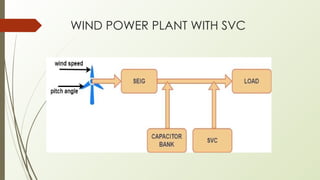
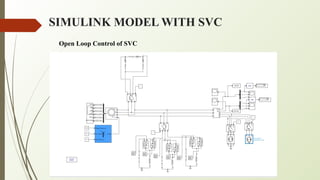
• Wind power plant model with SVC
• Stativ Var Compensator (SVC)
• Gate Controlled Series Capacitor (GCSC)
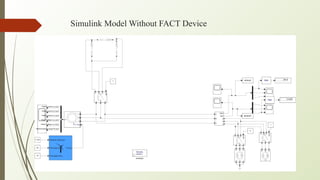
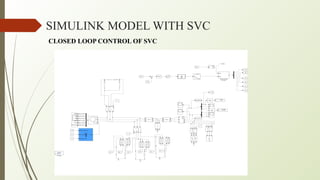
• Simulink Model Without FACT Device
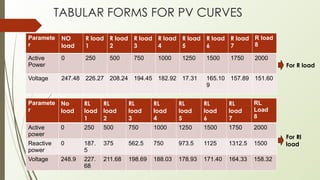
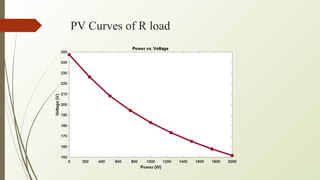
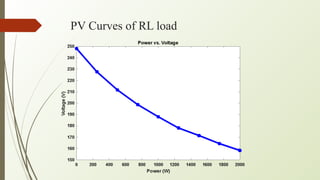
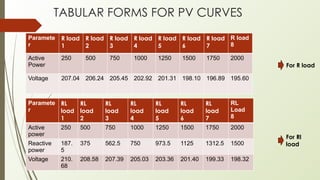
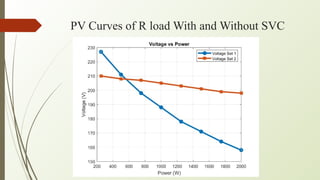
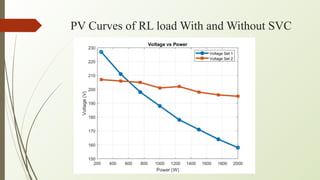
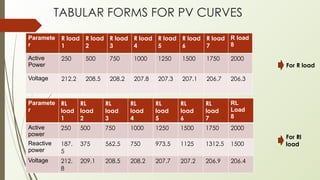
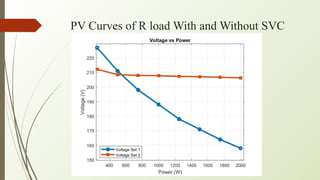
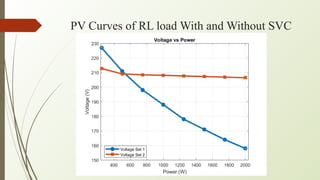
• PV Curves of R load and RL load
• References
3.
LITERATURE REVIEW
DETAILS OFPAPER MY OBSERVATION
Mitigation of Harmonics in WES Using
Hybrid FACTS Controller, 2022 IEEE 2nd
International Conference on Sustainable
Energy and Future Electric Transportation,
04-06 August 2022, Hyderabad
Authors: Venu Yarlagadda , N Alekhya,Annapurna
karthika G. , Madhuvani G. , K Haritha , T Hemanth Rao
This Paper discusses the integration of a Hybrid FACTS Controller,
consisting of a multi-level DSTATCOM and D-GCSC, into wind energy
systems (WES) for effective harmonic mitigation and voltage stabilization
against load disturbances. The analysis reveals a significant reduction in Total
Harmonic Distortion (THD) values when employing the hybrid system,
making it compliant with IEEE standards for quality. The study contrasts
three system configurations—using a capacitor bank, a multi-level
DSTATCOM, and the hybrid compensator—demonstrating the hybrid
solution's superior performance in reducing harmonics and ensuring voltage
stability.
Voltage Stability of Isolated Self Excited
Induction Generator (SEIG) for Variable
Speed Applications using Matlab/Simulink,
International Journal of Engineering and
Advanced Technology (IJEAT) ISSN: 2249–
8958, Volume-1 Issue-3, February 2012.
Authors :K. Kalyan raj, E. Swati, Ch. Ravindra
This paper explores the voltage stability of Self-Excited Induction Generators
(SEIG) for variable speed applications, emphasizing their significance in
renewable energy systems like wind energy. It identifies poor voltage
regulation as a primary challenge associated with SEIGs and discusses
various voltage control strategies, including the use of capacitor banks,
power electronic converters, and advanced control techniques to enhance
system performance. The study presents analyses and simulations using
Matlab/Simulink to evaluate the effectiveness of these control methods in
maintaining voltage stability under varying operational conditions.
Problem Identification
Background:
• SEIGsin Wind Plants: Used for their simplicity and reliability, but face voltage instability issues.
Current Issues:
• Voltage Instability due to fluctuating wind speeds.
• Load Sensitivity causing inconsistent voltage levels.
• Reactive Power Requirement leading to further instability.
Impact:
• Inefficient power generation, potential equipment damage, and unreliable power supply.
Need for a Solution:
• Dynamic voltage stabilization is essential for reliable wind energy systems.
6.
Motivation of theProject
Increasing Demand for Renewable Energy:
• Global shift towards sustainable energy sources like wind power.
• Critical need for reliable off-grid power solutions in remote areas.
Challenges with SEIGs in Wind Energy Systems:
• Voltage instability and power quality issues hinder the effectiveness of SEIGs in standalone wind plants.
Potential of Static Var Compensator (SVC):
• SVCs can dynamically stabilize voltage, improving system efficiency and reliability.
Contribution to the Field of Renewable Energy:
• Innovative approach that could lead to more stable and efficient standalone renewable energy systems.
• Potential for broader impact and scalability in the renewable energy sector.
7.
Applications of theProject
Remote and Off-Grid Power Systems:
• Reliable power supply for rural electrification and isolated communities.
Wind Energy Conversion Systems (WECS):
• Application in standalone wind plants and microgrids.
Renewable Energy Integration:
• Hybrid systems combining wind with other renewables; better grid integration.
Industrial and Commercial Applications:
• Power quality improvement for industries; cost-effective solutions for remote businesses.
Research and Development:
• Foundation for further research; development of advanced controllers.
8.
Objectives
Improve Voltage Stabilityin SEIG-Fed Wind Plants:
• Dynamic voltage control for consistent power delivery.
Enhance Power Quality:
• Reduction of voltage fluctuations and harmonic mitigation.
Optimize Reactive Power Management:
• Efficient reactive power support and optimal capacitor sizing.
Develop a Scalable Solution for Remote Energy Systems:
• Adaptable and cost-effective solution for off-grid areas.
Contribute to the Advancement of Renewable Energy Technology:
• Innovation in SEIG applications and platform for further research.
9.
ABSTRACT
Voltage stability iscrucial for standalone Self-Excited Induction Generator (SEIG) systems,
especially in wind power generation. These systems often struggle with voltage fluctuations
and instability due to varying wind speeds and changes in load. To tackle these challenges,
our study looks into how we can improve voltage stability by integrating a Static VAR
Compensator (SVC) and a Gate-Controlled Series Capacitor (GCSC) in SEIG-based wind
power plants. The SVC is designed to provide dynamic reactive power support, helping to
keep voltage levels steady even when loads fluctuate. On the other hand, the GCSC plays a
key role in managing reactive power flow better and boosting the transient stability of the
system. We’ve modeled and simulated the coordinated operation of these two components
to see how they affect voltage stability. Our findings show a notable enhancement in
voltage profiles, a reduction in harmonic distortions, and overall improved reliability of the
system. This approach not only strengthens the voltage stability of standalone SEIG wind
power systems but also makes them more dependable for use in remote and off-grid
locations. Additionally, the methodology we developed could potentially be adapted for
hybrid renewable energy systems in the future.
10.
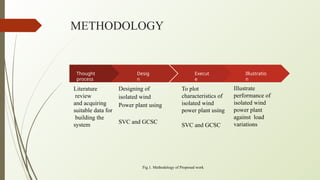
METHODOLOGY
Fig.1. Methodology ofProposed work
Thought
process
Literature
review
and acquiring
suitable data for
building the
system
Execut
e
To plot
characteristics of
isolated wind
power plant using
SVC and GCSC
Illustratio
n
Illustrate
performance of
isolated wind
power plant
against load
variations
Desig
n
Designing of
isolated wind
Power plant using
SVC and GCSC
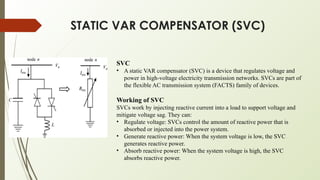
STATIC VAR COMPENSATOR(SVC)
SVC
• A static VAR compensator (SVC) is a device that regulates voltage and
power in high-voltage electricity transmission networks. SVCs are part of
the flexible AC transmission system (FACTS) family of devices.
Working of SVC
SVCs work by injecting reactive current into a load to support voltage and
mitigate voltage sag. They can:
• Regulate voltage: SVCs control the amount of reactive power that is
absorbed or injected into the power system.
• Generate reactive power: When the system voltage is low, the SVC
generates reactive power.
• Absorb reactive power: When the system voltage is high, the SVC
absorbs reactive power.
13.
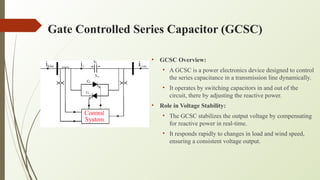
Gate Controlled SeriesCapacitor (GCSC)
• GCSC Overview:
• A GCSC is a power electronics device designed to control
the series capacitance in a transmission line dynamically.
• It operates by switching capacitors in and out of the
circuit, there by adjusting the reactive power.
• Role in Voltage Stability:
• The GCSC stabilizes the output voltage by compensating
for reactive power in real-time.
• It responds rapidly to changes in load and wind speed,
ensuring a consistent voltage output.
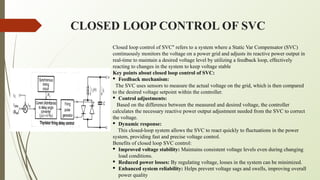
CLOSED LOOP CONTROLOF SVC
Closed loop control of SVC" refers to a system where a Static Var Compensator (SVC)
continuously monitors the voltage on a power grid and adjusts its reactive power output in
real-time to maintain a desired voltage level by utilizing a feedback loop, effectively
reacting to changes in the system to keep voltage stable
Key points about closed loop control of SVC:
· Feedback mechanism:
The SVC uses sensors to measure the actual voltage on the grid, which is then compared
to the desired voltage setpoint within the controller.
· Control adjustments:
Based on the difference between the measured and desired voltage, the controller
calculates the necessary reactive power output adjustment needed from the SVC to correct
the voltage.
· Dynamic response:
This closed-loop system allows the SVC to react quickly to fluctuations in the power
system, providing fast and precise voltage control.
Benefits of closed loop SVC control:
· Improved voltage stability: Maintains consistent voltage levels even during changing
load conditions.
· Reduced power losses: By regulating voltage, losses in the system can be minimized.
· Enhanced system reliability: Helps prevent voltage sags and swells, improving overall
power quality
PLAN OF PROJECT
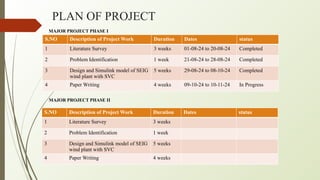
S.NODescription of Project Work Duration Dates status
1 Literature Survey 3 weeks 01-08-24 to 20-08-24 Completed
2 Problem Identification 1 week 21-08-24 to 28-08-24 Completed
3 Design and Simulink model of SEIG
wind plant with SVC
5 weeks 29-08-24 to 08-10-24 Completed
4 Paper Writing 4 weeks 09-10-24 to 10-11-24 In Progress
S.NO Description of Project Work Duration Dates status
1 Literature Survey 3 weeks
2 Problem Identification 1 week
3 Design and Simulink model of SEIG
wind plant with SVC
5 weeks
4 Paper Writing 4 weeks
MAJOR PROJECT PHASE I
MAJOR PROJECT PHASE II
28.
REFERENCES
[1] Venu Yarlagadda, Garikapati Annapurna Karthika, Giriprasad Ambati, and Chava Suneel Kumar “Wind
Energy System Using Self Excited Induction Generator with Hybrid FACTS Device for Load Voltage
Control”,Springer, 2022.
[2] Venu Yarlagadda, B. Devulal , Chava Sunil Kumar ,Giriprasad Ambati ,Srinivasa Rao Jalluri , Annapurna
Karthika Garikapati “Influence of Hybrid FACTS Device and STATCOM on Power Quality Improvement of
Wind Farm” J. Electrical Systems 20-10s (2024):104-115
[3] Venu Yarlagadda, R.Geshmakumari, J. Viswanatha Rao, Lakshminarayana Gadupudi “Mitigation of
Harmonics in Distributed System with D-GCSC fed Loads using closed loop control of DSTATCOM” 2022
IEEE Fourth International Conference on Advances in Electronics, Computers and Communications (ICAECC).
[4] Venu Yarlagadda ,Madhuvani Gowrabathuni, Nuthalapati Alekhya ,Korrapati Haritha ,Annapurna Karthika
Garikapati, Theegala Hemanth Rao “Mitigation of Harmonics in WES Using Hybrid FACTS Controller” 2022
IEEE 2nd International Conference on Sustainable Energy and Future Electric Transportation (SeFeT).
[5] Venu Yarlagadda ,Madhuvani Gowrabathuni, Nuthalapati Alekhya ,Korrapati Haritha ,Annapurna Karthika
Garikapati, Theegala Hemanth Rao “FFT Analysis and Harmonics Mitigation in WES using Multi-Level
DSTATCOM”, 2022 2nd Asian Conference on Innovation in Technology (ASIANCON) Pune, India. Aug 26-28,
2022.
[6] Mhamdi Taoufik a,Barhoumi Abdelhamid b , Sbita Lassad c “Stand-alone self-excited induction generator
driven by a wind turbine”, Alexandria Engineering Journal (2018) 57, 781–786.





![REFERENCES
[1] Venu Yarlagadda , Garikapati Annapurna Karthika, Giriprasad Ambati, and Chava Suneel Kumar “Wind
Energy System Using Self Excited Induction Generator with Hybrid FACTS Device for Load Voltage
Control”,Springer, 2022.
[2] Venu Yarlagadda, B. Devulal , Chava Sunil Kumar ,Giriprasad Ambati ,Srinivasa Rao Jalluri , Annapurna
Karthika Garikapati “Influence of Hybrid FACTS Device and STATCOM on Power Quality Improvement of
Wind Farm” J. Electrical Systems 20-10s (2024):104-115
[3] Venu Yarlagadda, R.Geshmakumari, J. Viswanatha Rao, Lakshminarayana Gadupudi “Mitigation of
Harmonics in Distributed System with D-GCSC fed Loads using closed loop control of DSTATCOM” 2022
IEEE Fourth International Conference on Advances in Electronics, Computers and Communications (ICAECC).
[4] Venu Yarlagadda ,Madhuvani Gowrabathuni, Nuthalapati Alekhya ,Korrapati Haritha ,Annapurna Karthika
Garikapati, Theegala Hemanth Rao “Mitigation of Harmonics in WES Using Hybrid FACTS Controller” 2022
IEEE 2nd International Conference on Sustainable Energy and Future Electric Transportation (SeFeT).
[5] Venu Yarlagadda ,Madhuvani Gowrabathuni, Nuthalapati Alekhya ,Korrapati Haritha ,Annapurna Karthika
Garikapati, Theegala Hemanth Rao “FFT Analysis and Harmonics Mitigation in WES using Multi-Level
DSTATCOM”, 2022 2nd Asian Conference on Innovation in Technology (ASIANCON) Pune, India. Aug 26-28,
2022.
[6] Mhamdi Taoufik a,Barhoumi Abdelhamid b , Sbita Lassad c “Stand-alone self-excited induction generator
driven by a wind turbine”, Alexandria Engineering Journal (2018) 57, 781–786.](https://image.slidesharecdn.com/batch3voltagestability-250509022207-0a32d2a7/85/BATCH_3_VOLTAGE_STABILITYhghgjhcvkkjmh-pptx-28-320.jpg)
![[7] H.P.Tiwari and J.K. Diwedi “Minimum Capacitance Requirment for Self-Excited Induction Generator”,
INDIAN INSTITUTE OF TECHNOLOGY, KHARAGPUR 721302, DECEMBER 27-29, 2002.
[8] Anamika Kumari, Dr. A. G. Thosar , S. S. Mopari “Determination of Excitation Capacitance of a Three Phase
Self Excited Induction Generator”, International Journal of Advanced Research in Electrical, Electronics and
Instrumentation Engineering (An ISO 3297: 2007 Certified Organization) Vol. 4, Issue 5, May 2015
[9] Igbinovia, S. O , Ubeku, E.U and Osayi, F.S “Self Excited Induction Generators Performance Evaluation”,
International Journal of Engineering Research and Technology. ISSN 0974-3154 Volume 7, Number 2 (2014), pp.
93-104 © International Research Publication House.
[10] K. Kalyan raj, E. Swati, Ch. Ravindra “Voltage Stability of Isolated Self Excited Induction Generator (SEIG)
for Variable Speed Applications using Matlab/Simulink”, International Journal of Engineering and Advanced
Technology (IJEAT) ISSN: 2249–8958, Volume-1 Issue-3, February 2012.
[11] S. Ratheesh and Jeba Vins M “Control of self-excited induction generator based wind turbine using current
and voltage control approaches”, AL-QADISIYAH JOURNAL FOR ENGINEERING SCIENCES 16 (2023) 209–
217
[12] Giribabu Dyanamina , Sanjay Kumar Kakodia “SEIG voltage regulation with STATCOM Regulator using
Fuzzy logic controller”, 2021 International Conference on Sustainable Energy and Future Electric Transportation
(SEFET).](https://image.slidesharecdn.com/batch3voltagestability-250509022207-0a32d2a7/85/BATCH_3_VOLTAGE_STABILITYhghgjhcvkkjmh-pptx-29-320.jpg)


