Question 2- How does your media
product represent particular social
groups?
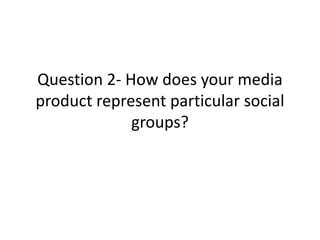
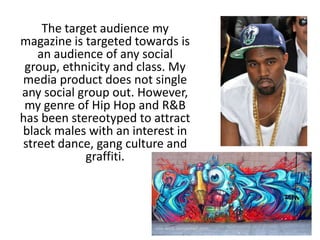
The target audience my
magazine is targeted towards is
an audience of any social
group, ethnicity and class. My
media product does not single
any social group out. However,
my genre of Hip Hop and R&B
has been stereotyped to attract
black males with an interest in
street dance, gang culture and
graffiti.
My genre has recently been associated with more
mainstream music, however its audience is entirely
diverse. I showed this in my media product as I used
models of different race and social groups. My main
model(front cover) is a white female who’s social
group is very mainstream, with interests in fashion,
music and beauty. Whereas, my next
model(contents page) is a mixed race male, with
interests in partying, music also and fits more too
the stereotype of my chosen genre. This therefore,
makes my media product racially diverse and not
targeted towards a specific race.
I did, however use mise en scene in
my media product that reflected the
stereotype of my genre by relating to
gang culture and street relations. This
was shown in the use of props such
as the gold chain used in my front
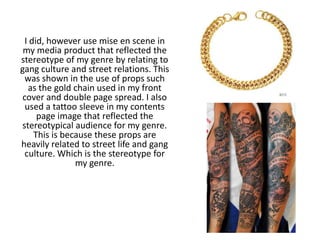
cover and double page spread. I also
used a tattoo sleeve in my contents
page image that reflected the
stereotypical audience for my genre.
This is because these props are
heavily related to street life and gang
culture. Which is the stereotype for
my genre.
I dealt with the issue of gender by using female
and male models. I used 1 female and 2 male
models. I used the female model as my main
model to balance out the fact there is only one
female and two males. I also dealt with the issue
of gender in my colour scheme by using a bright
pink too attract girls but neutralizing it by using
black white and grey, to again balance out the
targeting of genders. Making the media product
suitable for both genders.
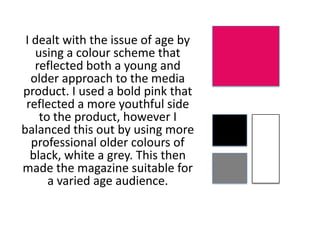
I dealt with the issue of age by
using a colour scheme that
reflected both a young and
older approach to the media
product. I used a bold pink that
reflected a more youthful side
to the product, however I
balanced this out by using more
professional older colours of
black, white a grey. This then
made the magazine suitable for
a varied age audience.
I dealt with the issue of social class as I made my
product price £2.00. This made the magazine
suitable to any social class as it is cheaper than
average music magazines and so is more likely to
be bought by younger audiences also. This again
balances out my audience and makes the social
classes in my audience more varied.

evaluation question 2

  • 1.
    Question 2- Howdoes your media product represent particular social groups?
  • 2.
    The target audiencemy magazine is targeted towards is an audience of any social group, ethnicity and class. My media product does not single any social group out. However, my genre of Hip Hop and R&B has been stereotyped to attract black males with an interest in street dance, gang culture and graffiti.
  • 3.
    My genre hasrecently been associated with more mainstream music, however its audience is entirely diverse. I showed this in my media product as I used models of different race and social groups. My main model(front cover) is a white female who’s social group is very mainstream, with interests in fashion, music and beauty. Whereas, my next model(contents page) is a mixed race male, with interests in partying, music also and fits more too the stereotype of my chosen genre. This therefore, makes my media product racially diverse and not targeted towards a specific race.
  • 4.
    I did, howeveruse mise en scene in my media product that reflected the stereotype of my genre by relating to gang culture and street relations. This was shown in the use of props such as the gold chain used in my front cover and double page spread. I also used a tattoo sleeve in my contents page image that reflected the stereotypical audience for my genre. This is because these props are heavily related to street life and gang culture. Which is the stereotype for my genre.
  • 5.
    I dealt withthe issue of gender by using female and male models. I used 1 female and 2 male models. I used the female model as my main model to balance out the fact there is only one female and two males. I also dealt with the issue of gender in my colour scheme by using a bright pink too attract girls but neutralizing it by using black white and grey, to again balance out the targeting of genders. Making the media product suitable for both genders.
  • 6.
    I dealt withthe issue of age by using a colour scheme that reflected both a young and older approach to the media product. I used a bold pink that reflected a more youthful side to the product, however I balanced this out by using more professional older colours of black, white a grey. This then made the magazine suitable for a varied age audience.
  • 7.
    I dealt withthe issue of social class as I made my product price £2.00. This made the magazine suitable to any social class as it is cheaper than average music magazines and so is more likely to be bought by younger audiences also. This again balances out my audience and makes the social classes in my audience more varied.