Evaluation
Questions
 In what ways does your media product use, develop or
challenge forms and conventions of real media products?
 How does your media product represent particular social
groups?
 What kind of media institution might distribute your media
product and why?
 Who would be the audience for your media product?
 How did you attract or address your audience?
 What have you learnt about technologies from the process
of constructing this product?
 Looking back at your preliminary task, what do you feel you
have learn in the progression from it to the full product?
In what ways does your media product use, or develop or challenge forms and
conventions of real media products?
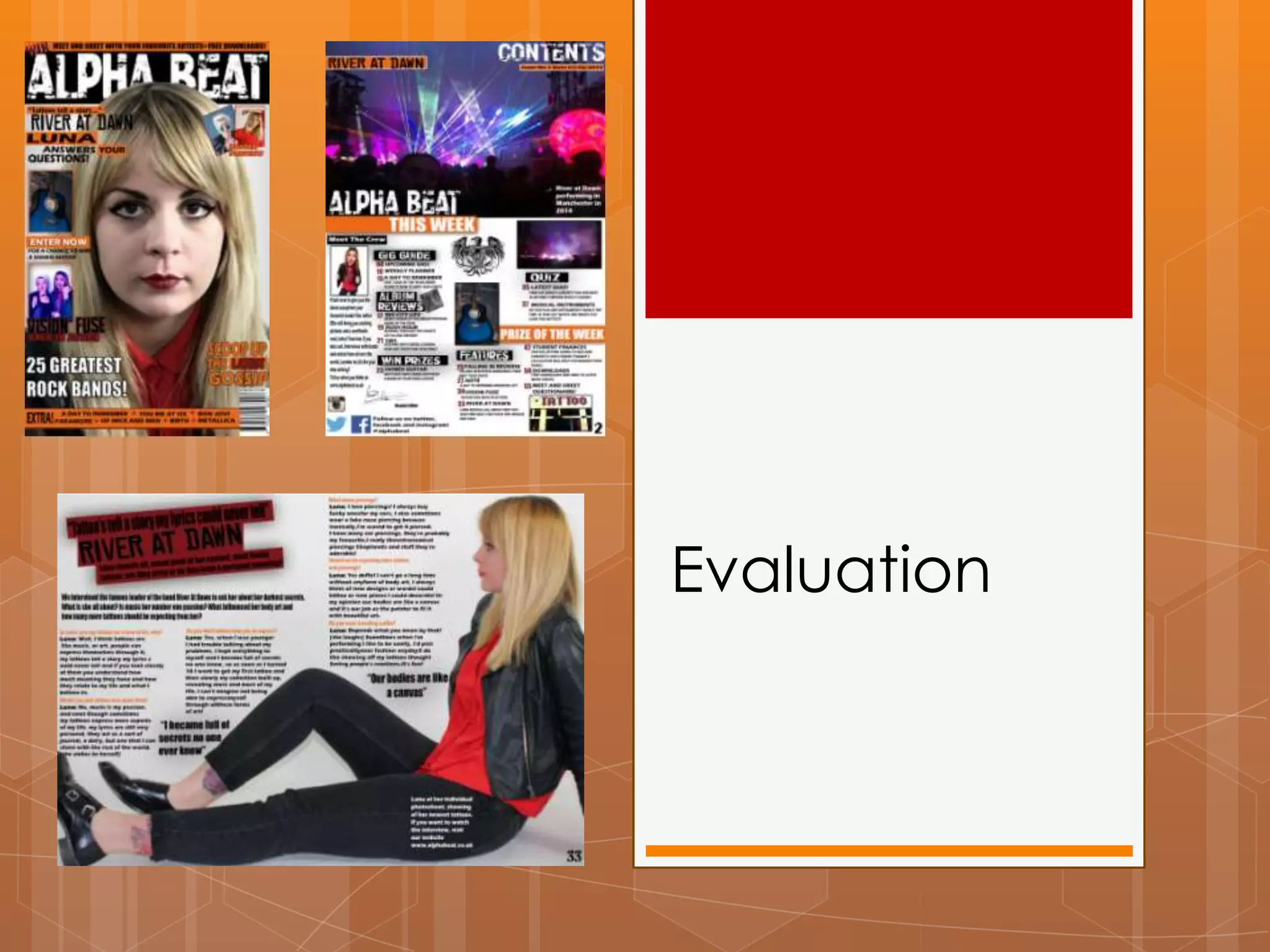
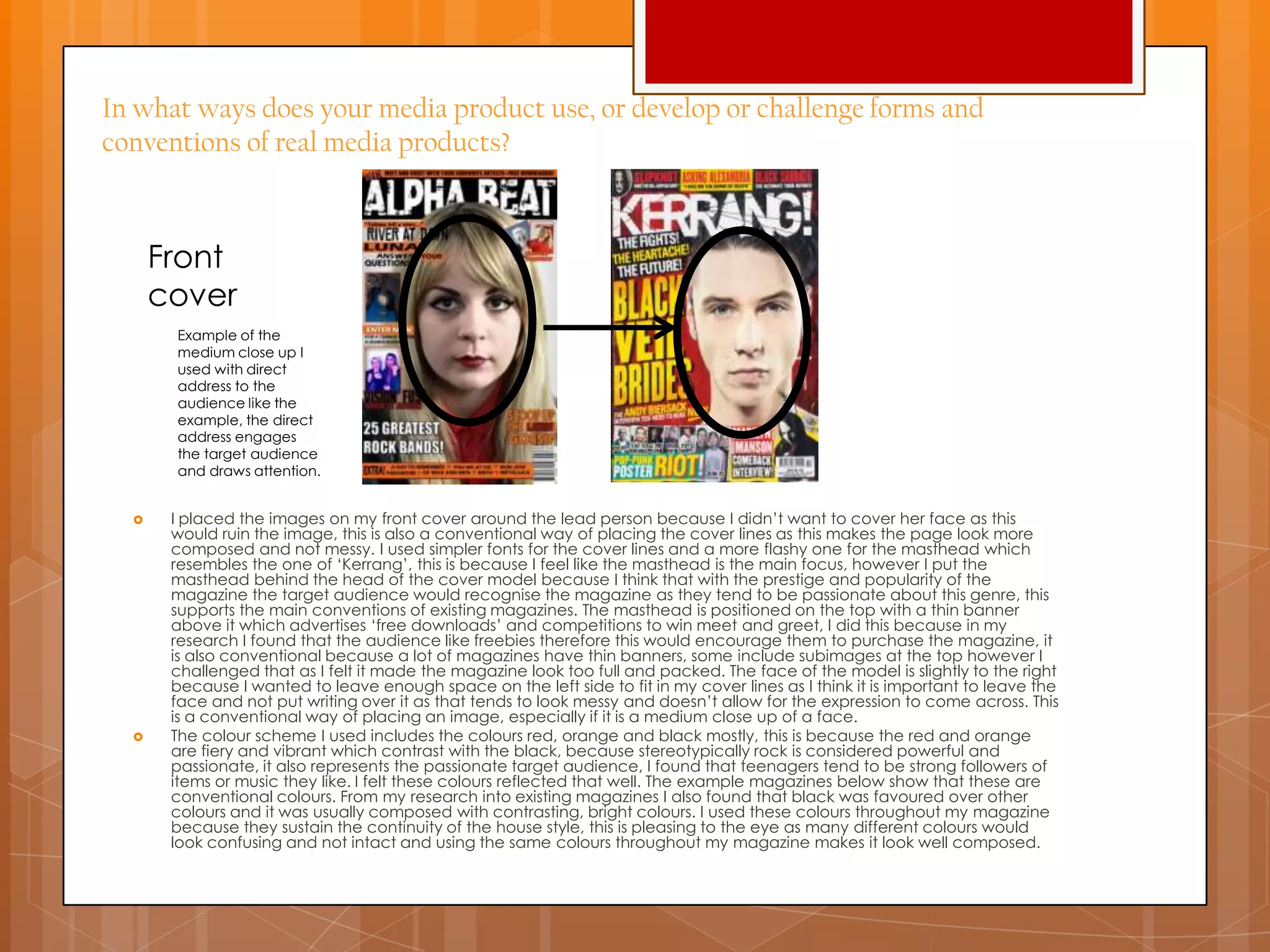
 I placed the images on my front cover around the lead person because I didn‟t want to cover her face as this
would ruin the image, this is also a conventional way of placing the cover lines as this makes the page look more
composed and not messy. I used simpler fonts for the cover lines and a more flashy one for the masthead which
resembles the one of „Kerrang‟, this is because I feel like the masthead is the main focus, however I put the
masthead behind the head of the cover model because I think that with the prestige and popularity of the
magazine the target audience would recognise the magazine as they tend to be passionate about this genre, this
supports the main conventions of existing magazines. The masthead is positioned on the top with a thin banner
above it which advertises „free downloads‟ and competitions to win meet and greet, I did this because in my
research I found that the audience like freebies therefore this would encourage them to purchase the magazine, it
is also conventional because a lot of magazines have thin banners, some include subimages at the top however I
challenged that as I felt it made the magazine look too full and packed. The face of the model is slightly to the right
because I wanted to leave enough space on the left side to fit in my cover lines as I think it is important to leave the
face and not put writing over it as that tends to look messy and doesn‟t allow for the expression to come across. This
is a conventional way of placing an image, especially if it is a medium close up of a face.
 The colour scheme I used includes the colours red, orange and black mostly, this is because the red and orange
are fiery and vibrant which contrast with the black, because stereotypically rock is considered powerful and
passionate, it also represents the passionate target audience, I found that teenagers tend to be strong followers of
items or music they like. I felt these colours reflected that well. The example magazines below show that these are
conventional colours. From my research into existing magazines I also found that black was favoured over other
colours and it was usually composed with contrasting, bright colours. I used these colours throughout my magazine
because they sustain the continuity of the house style, this is pleasing to the eye as many different colours would
look confusing and not intact and using the same colours throughout my magazine makes it look well composed.
Example of the
medium close up I
used with direct
address to the
audience like the
example, the direct
address engages
the target audience
and draws attention.
Front
cover
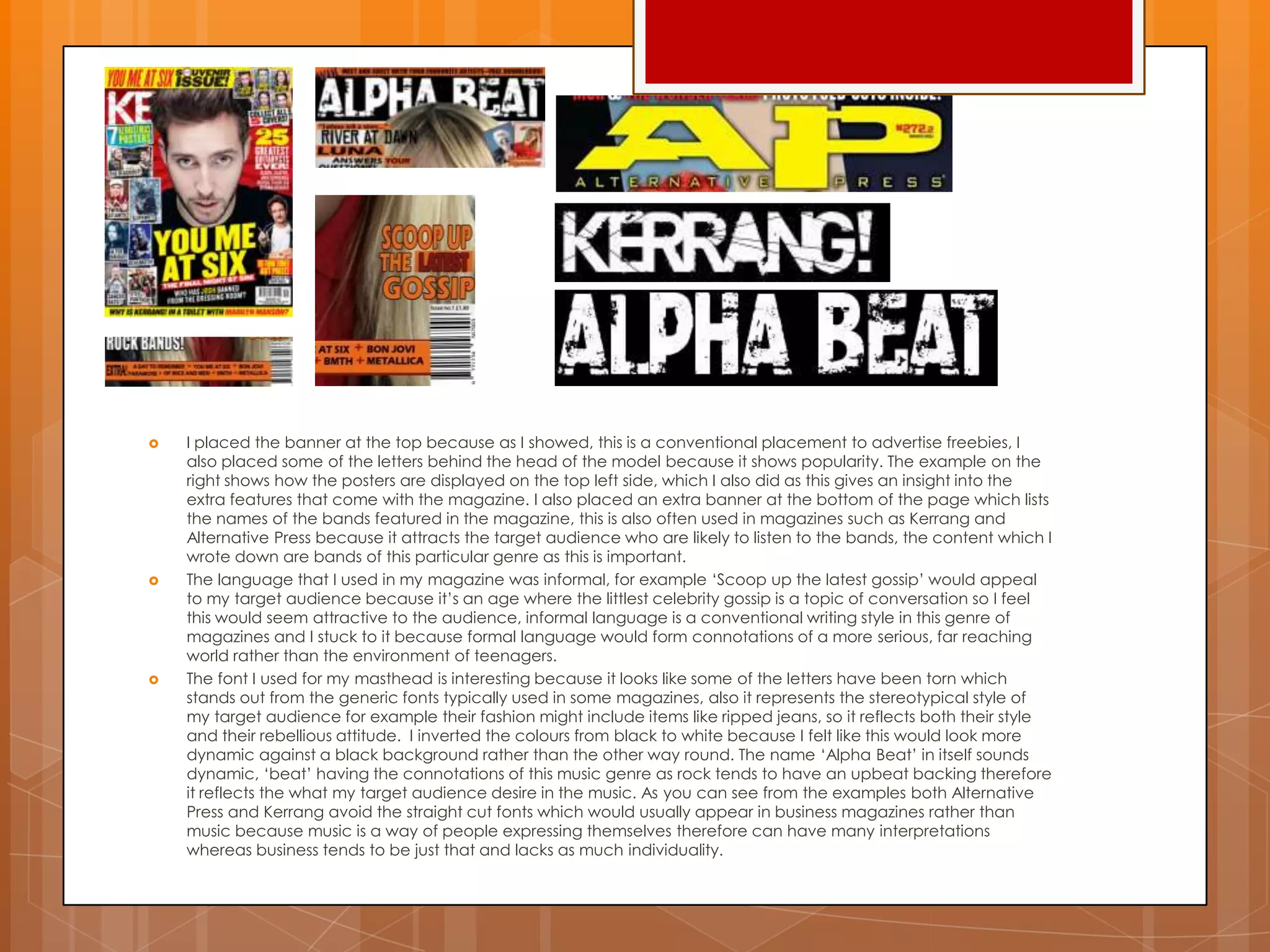
 I placed the banner at the top because as I showed, this is a conventional placement to advertise freebies, I
also placed some of the letters behind the head of the model because it shows popularity. The example on the
right shows how the posters are displayed on the top left side, which I also did as this gives an insight into the
extra features that come with the magazine. I also placed an extra banner at the bottom of the page which lists
the names of the bands featured in the magazine, this is also often used in magazines such as Kerrang and
Alternative Press because it attracts the target audience who are likely to listen to the bands, the content which I
wrote down are bands of this particular genre as this is important.
 The language that I used in my magazine was informal, for example „Scoop up the latest gossip‟ would appeal
to my target audience because it‟s an age where the littlest celebrity gossip is a topic of conversation so I feel
this would seem attractive to the audience, informal language is a conventional writing style in this genre of
magazines and I stuck to it because formal language would form connotations of a more serious, far reaching
world rather than the environment of teenagers.
 The font I used for my masthead is interesting because it looks like some of the letters have been torn which
stands out from the generic fonts typically used in some magazines, also it represents the stereotypical style of
my target audience for example their fashion might include items like ripped jeans, so it reflects both their style
and their rebellious attitude. I inverted the colours from black to white because I felt like this would look more
dynamic against a black background rather than the other way round. The name „Alpha Beat‟ in itself sounds
dynamic, „beat‟ having the connotations of this music genre as rock tends to have an upbeat backing therefore
it reflects the what my target audience desire in the music. As you can see from the examples both Alternative
Press and Kerrang avoid the straight cut fonts which would usually appear in business magazines rather than
music because music is a way of people expressing themselves therefore can have many interpretations
whereas business tends to be just that and lacks as much individuality.
 When I carried out my research I found a list of conventions used throughout the range of products of this
genre, for example all magazines included: a barcode, the date, issue number and a wide range of
photographs. I influenced my own product on magazines such as Kerrang, Alternative Press and Rock Sound
therefore many conventions I noticed in this genre, which is Rock, I have used in my own work.
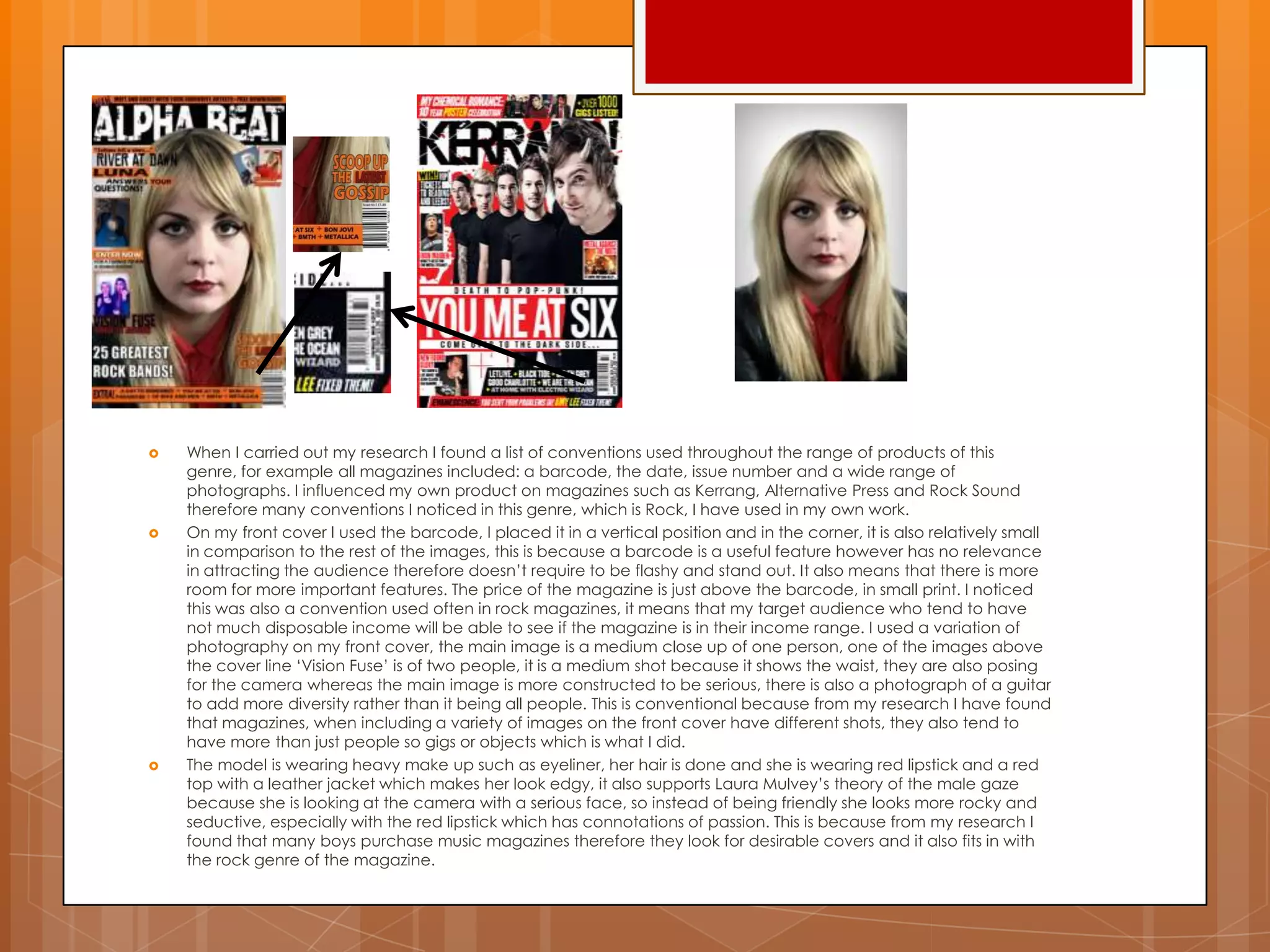
 On my front cover I used the barcode, I placed it in a vertical position and in the corner, it is also relatively small
in comparison to the rest of the images, this is because a barcode is a useful feature however has no relevance
in attracting the audience therefore doesn‟t require to be flashy and stand out. It also means that there is more
room for more important features. The price of the magazine is just above the barcode, in small print. I noticed
this was also a convention used often in rock magazines, it means that my target audience who tend to have
not much disposable income will be able to see if the magazine is in their income range. I used a variation of
photography on my front cover, the main image is a medium close up of one person, one of the images above
the cover line „Vision Fuse‟ is of two people, it is a medium shot because it shows the waist, they are also posing
for the camera whereas the main image is more constructed to be serious, there is also a photograph of a guitar
to add more diversity rather than it being all people. This is conventional because from my research I have found
that magazines, when including a variety of images on the front cover have different shots, they also tend to
have more than just people so gigs or objects which is what I did.
 The model is wearing heavy make up such as eyeliner, her hair is done and she is wearing red lipstick and a red
top with a leather jacket which makes her look edgy, it also supports Laura Mulvey‟s theory of the male gaze
because she is looking at the camera with a serious face, so instead of being friendly she looks more rocky and
seductive, especially with the red lipstick which has connotations of passion. This is because from my research I
found that many boys purchase music magazines therefore they look for desirable covers and it also fits in with
the rock genre of the magazine.
Contents
Page
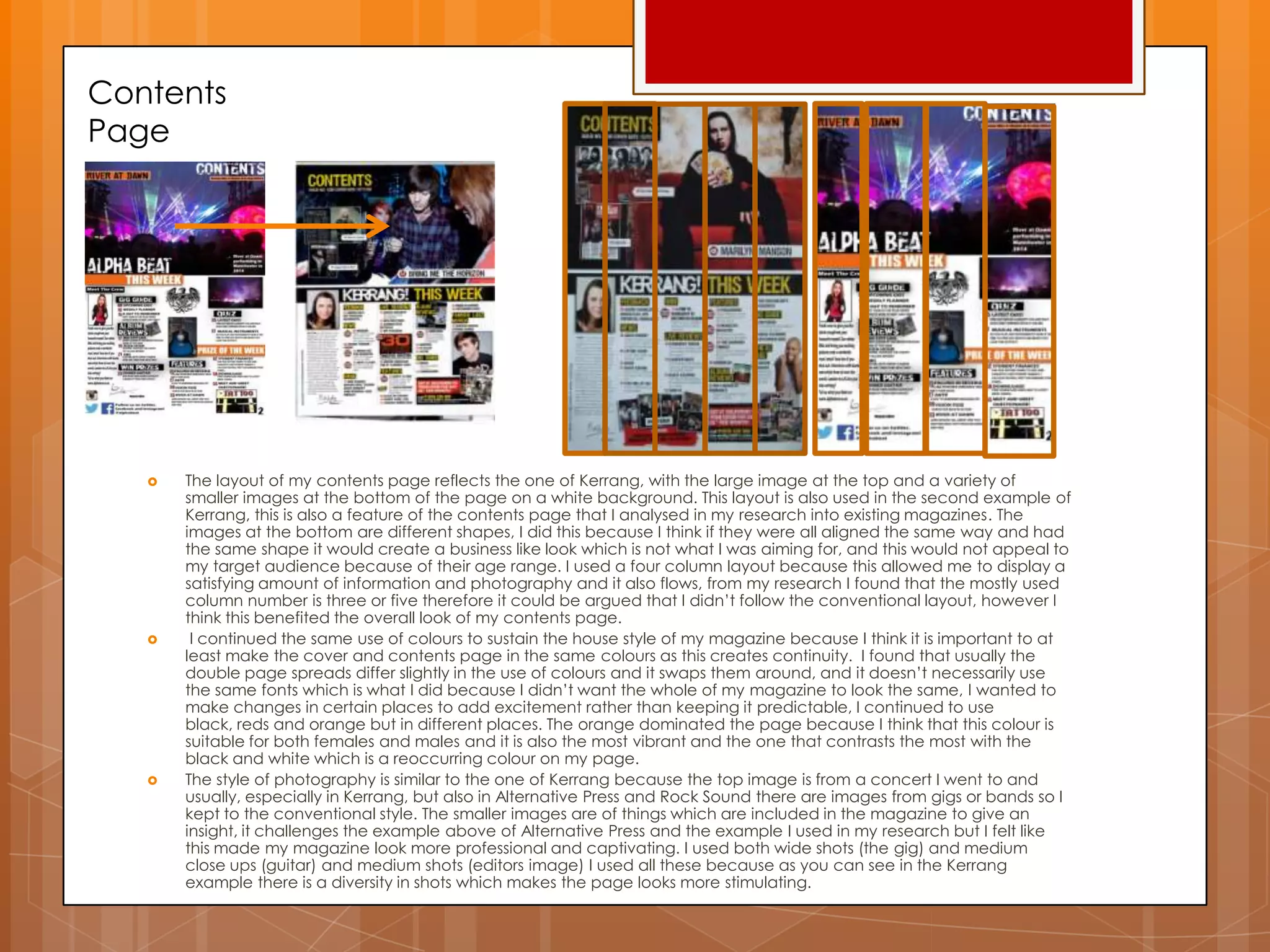
 The layout of my contents page reflects the one of Kerrang, with the large image at the top and a variety of
smaller images at the bottom of the page on a white background. This layout is also used in the second example of
Kerrang, this is also a feature of the contents page that I analysed in my research into existing magazines. The
images at the bottom are different shapes, I did this because I think if they were all aligned the same way and had
the same shape it would create a business like look which is not what I was aiming for, and this would not appeal to
my target audience because of their age range. I used a four column layout because this allowed me to display a
satisfying amount of information and photography and it also flows, from my research I found that the mostly used
column number is three or five therefore it could be argued that I didn‟t follow the conventional layout, however I
think this benefited the overall look of my contents page.
 I continued the same use of colours to sustain the house style of my magazine because I think it is important to at
least make the cover and contents page in the same colours as this creates continuity. I found that usually the
double page spreads differ slightly in the use of colours and it swaps them around, and it doesn‟t necessarily use
the same fonts which is what I did because I didn‟t want the whole of my magazine to look the same, I wanted to
make changes in certain places to add excitement rather than keeping it predictable, I continued to use
black, reds and orange but in different places. The orange dominated the page because I think that this colour is
suitable for both females and males and it is also the most vibrant and the one that contrasts the most with the
black and white which is a reoccurring colour on my page.
 The style of photography is similar to the one of Kerrang because the top image is from a concert I went to and
usually, especially in Kerrang, but also in Alternative Press and Rock Sound there are images from gigs or bands so I
kept to the conventional style. The smaller images are of things which are included in the magazine to give an
insight, it challenges the example above of Alternative Press and the example I used in my research but I felt like
this made my magazine look more professional and captivating. I used both wide shots (the gig) and medium
close ups (guitar) and medium shots (editors image) I used all these because as you can see in the Kerrang
example there is a diversity in shots which makes the page looks more stimulating.
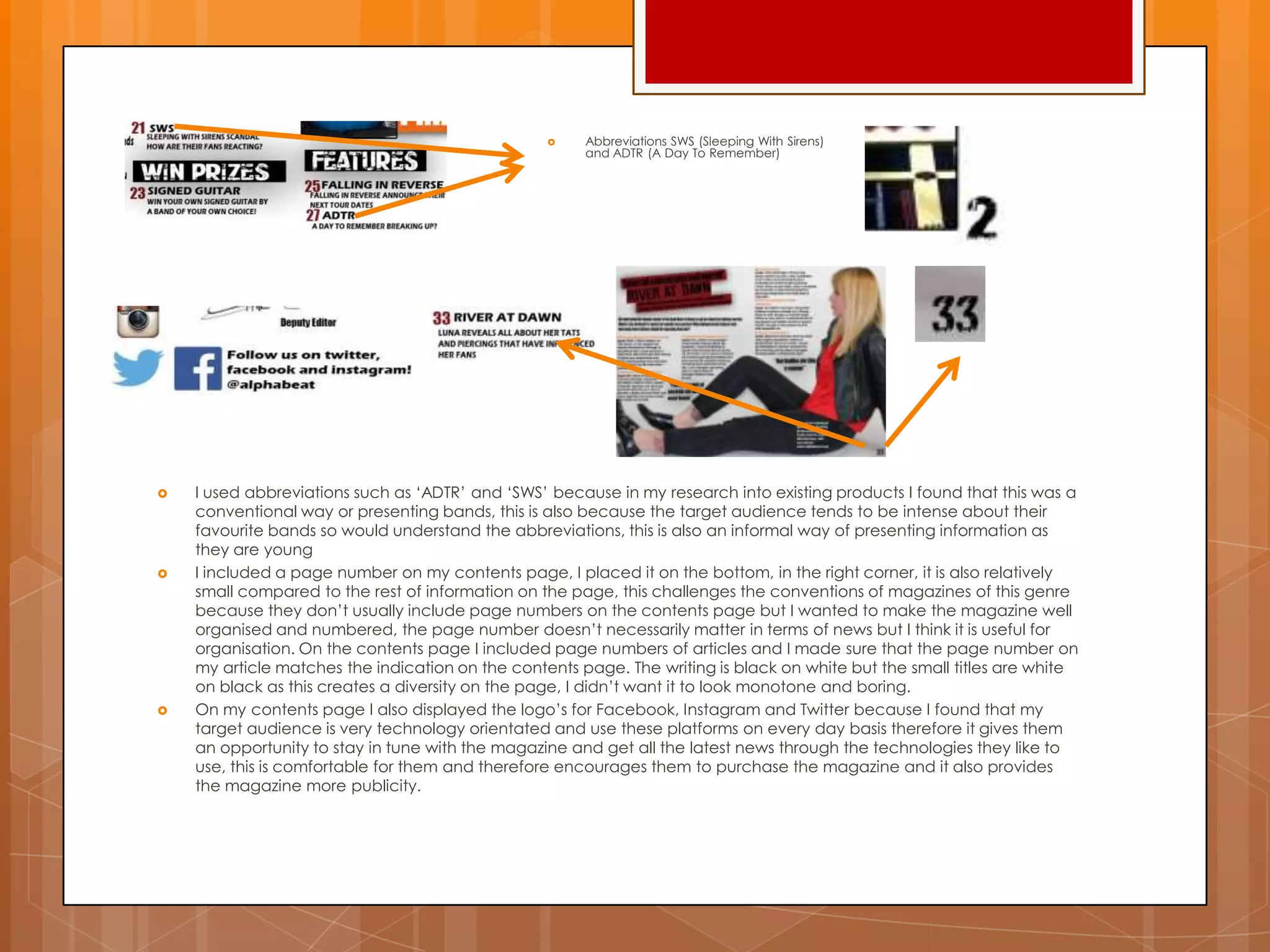
 I used abbreviations such as „ADTR‟ and „SWS‟ because in my research into existing products I found that this was a
conventional way or presenting bands, this is also because the target audience tends to be intense about their
favourite bands so would understand the abbreviations, this is also an informal way of presenting information as
they are young
 I included a page number on my contents page, I placed it on the bottom, in the right corner, it is also relatively
small compared to the rest of information on the page, this challenges the conventions of magazines of this genre
because they don‟t usually include page numbers on the contents page but I wanted to make the magazine well
organised and numbered, the page number doesn‟t necessarily matter in terms of news but I think it is useful for
organisation. On the contents page I included page numbers of articles and I made sure that the page number on
my article matches the indication on the contents page. The writing is black on white but the small titles are white
on black as this creates a diversity on the page, I didn‟t want it to look monotone and boring.
 On my contents page I also displayed the logo‟s for Facebook, Instagram and Twitter because I found that my
target audience is very technology orientated and use these platforms on every day basis therefore it gives them
an opportunity to stay in tune with the magazine and get all the latest news through the technologies they like to
use, this is comfortable for them and therefore encourages them to purchase the magazine and it also provides
the magazine more publicity.
 Abbreviations SWS (Sleeping With Sirens)
and ADTR (A Day To Remember)
Double
Page
Spread
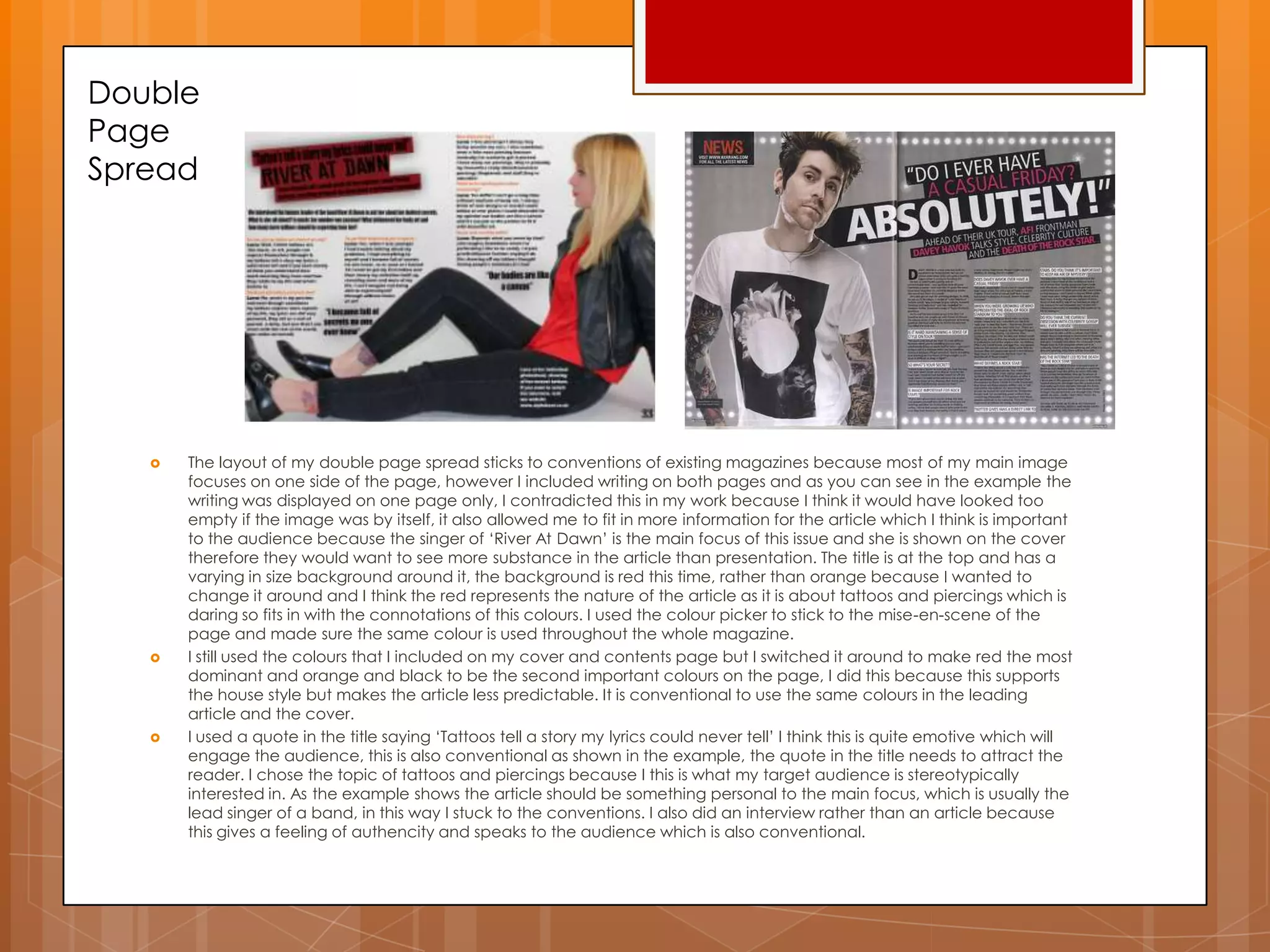
 The layout of my double page spread sticks to conventions of existing magazines because most of my main image
focuses on one side of the page, however I included writing on both pages and as you can see in the example the
writing was displayed on one page only, I contradicted this in my work because I think it would have looked too
empty if the image was by itself, it also allowed me to fit in more information for the article which I think is important
to the audience because the singer of „River At Dawn‟ is the main focus of this issue and she is shown on the cover
therefore they would want to see more substance in the article than presentation. The title is at the top and has a
varying in size background around it, the background is red this time, rather than orange because I wanted to
change it around and I think the red represents the nature of the article as it is about tattoos and piercings which is
daring so fits in with the connotations of this colours. I used the colour picker to stick to the mise-en-scene of the
page and made sure the same colour is used throughout the whole magazine.
 I still used the colours that I included on my cover and contents page but I switched it around to make red the most
dominant and orange and black to be the second important colours on the page, I did this because this supports
the house style but makes the article less predictable. It is conventional to use the same colours in the leading
article and the cover.
 I used a quote in the title saying „Tattoos tell a story my lyrics could never tell‟ I think this is quite emotive which will
engage the audience, this is also conventional as shown in the example, the quote in the title needs to attract the
reader. I chose the topic of tattoos and piercings because I this is what my target audience is stereotypically
interested in. As the example shows the article should be something personal to the main focus, which is usually the
lead singer of a band, in this way I stuck to the conventions. I also did an interview rather than an article because
this gives a feeling of authencity and speaks to the audience which is also conventional.
 The language I used is also informal because the target audience is young and I wanted to appeal to them
rather than sounding patronising and serious. I used words such as „deffo‟ and the interview was cheeky and
entertaining.
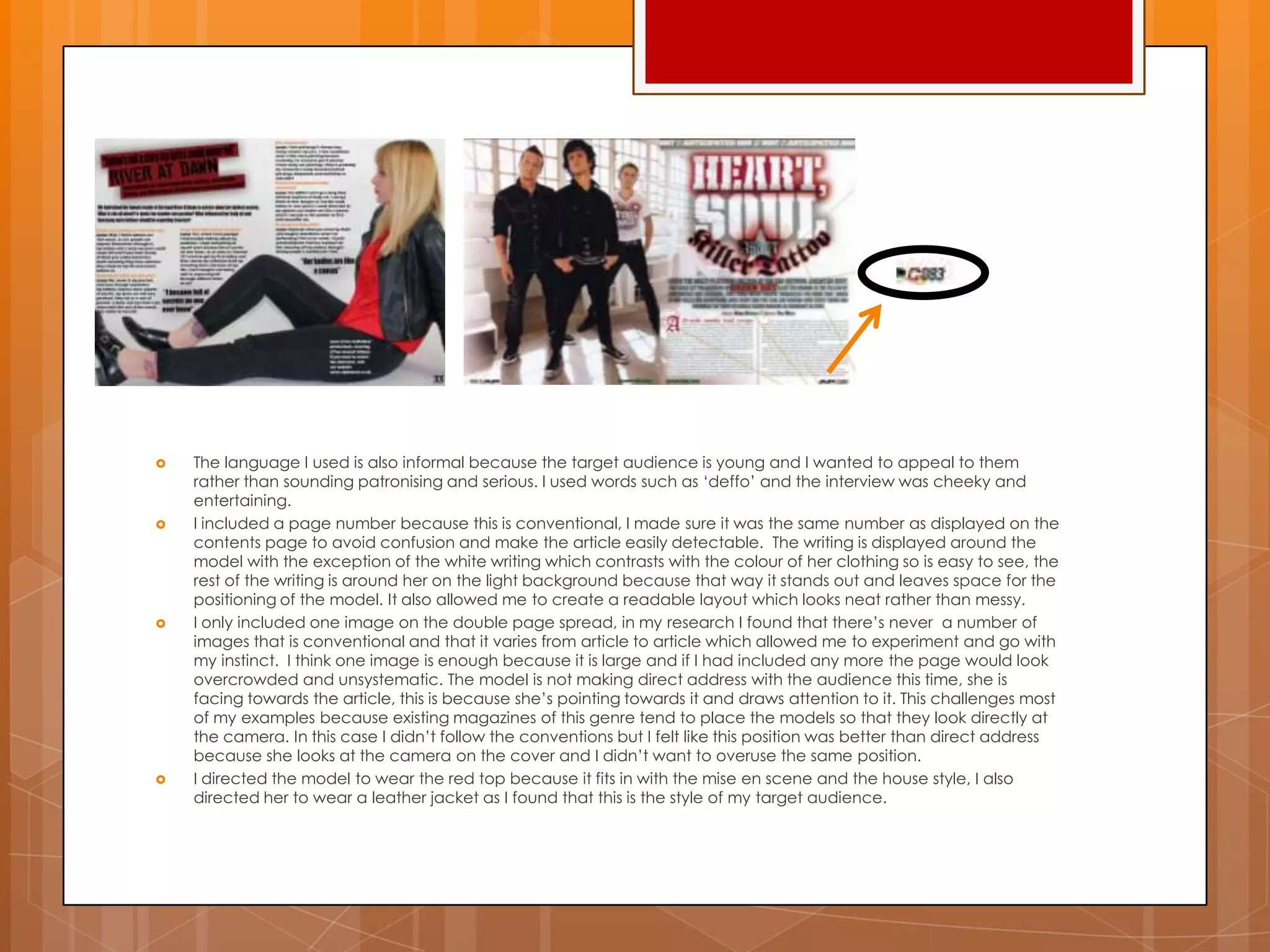
 I included a page number because this is conventional, I made sure it was the same number as displayed on the
contents page to avoid confusion and make the article easily detectable. The writing is displayed around the
model with the exception of the white writing which contrasts with the colour of her clothing so is easy to see, the
rest of the writing is around her on the light background because that way it stands out and leaves space for the
positioning of the model. It also allowed me to create a readable layout which looks neat rather than messy.
 I only included one image on the double page spread, in my research I found that there‟s never a number of
images that is conventional and that it varies from article to article which allowed me to experiment and go with
my instinct. I think one image is enough because it is large and if I had included any more the page would look
overcrowded and unsystematic. The model is not making direct address with the audience this time, she is
facing towards the article, this is because she‟s pointing towards it and draws attention to it. This challenges most
of my examples because existing magazines of this genre tend to place the models so that they look directly at
the camera. In this case I didn‟t follow the conventions but I felt like this position was better than direct address
because she looks at the camera on the cover and I didn‟t want to overuse the same position.
 I directed the model to wear the red top because it fits in with the mise en scene and the house style, I also
directed her to wear a leather jacket as I found that this is the style of my target audience.
How does your media product represent particular social groups?
 In my magazine I only included white British models; this is because in today‟s society, especially in the rock
genre you tend to see more white artists which is reflected in my magazine because I wanted to follow the
conventional display of models. It will also appeal more to my audience which are British therefore they are able
to identify with the models displayed in my magazine. Some of the models photographed are around the ages
of 15-20, this is because the larger percentage of my target audience will be this age, however from my
research I found that older generations also purchase rock magazines, this is why I included a model who is in
her 30‟s because she will appeal more to the minority of the audience and I wanted to target everyone rather
than focus on a specific age range because this will make them feel more involved and they will be able to
relate to each of the models. The main focus model is 18, this is because nowadays a lot of the popular music
which my target audience listens to is around this age, it is easier for younger adults to gain popularity and I
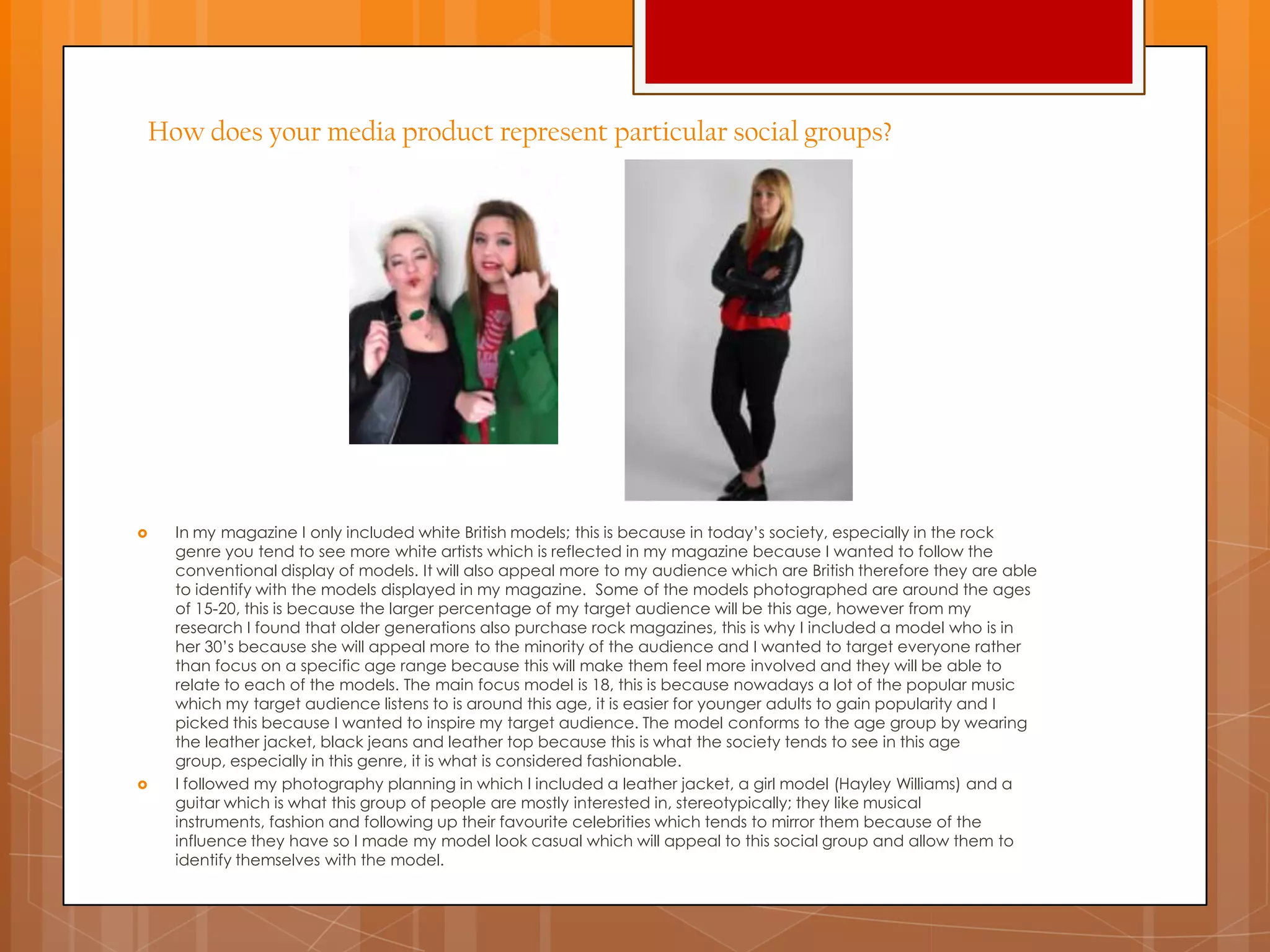
picked this because I wanted to inspire my target audience. The model conforms to the age group by wearing
the leather jacket, black jeans and leather top because this is what the society tends to see in this age
group, especially in this genre, it is what is considered fashionable.
 I followed my photography planning in which I included a leather jacket, a girl model (Hayley Williams) and a
guitar which is what this group of people are mostly interested in, stereotypically; they like musical
instruments, fashion and following up their favourite celebrities which tends to mirror them because of the
influence they have so I made my model look casual which will appeal to this social group and allow them to
identify themselves with the model.
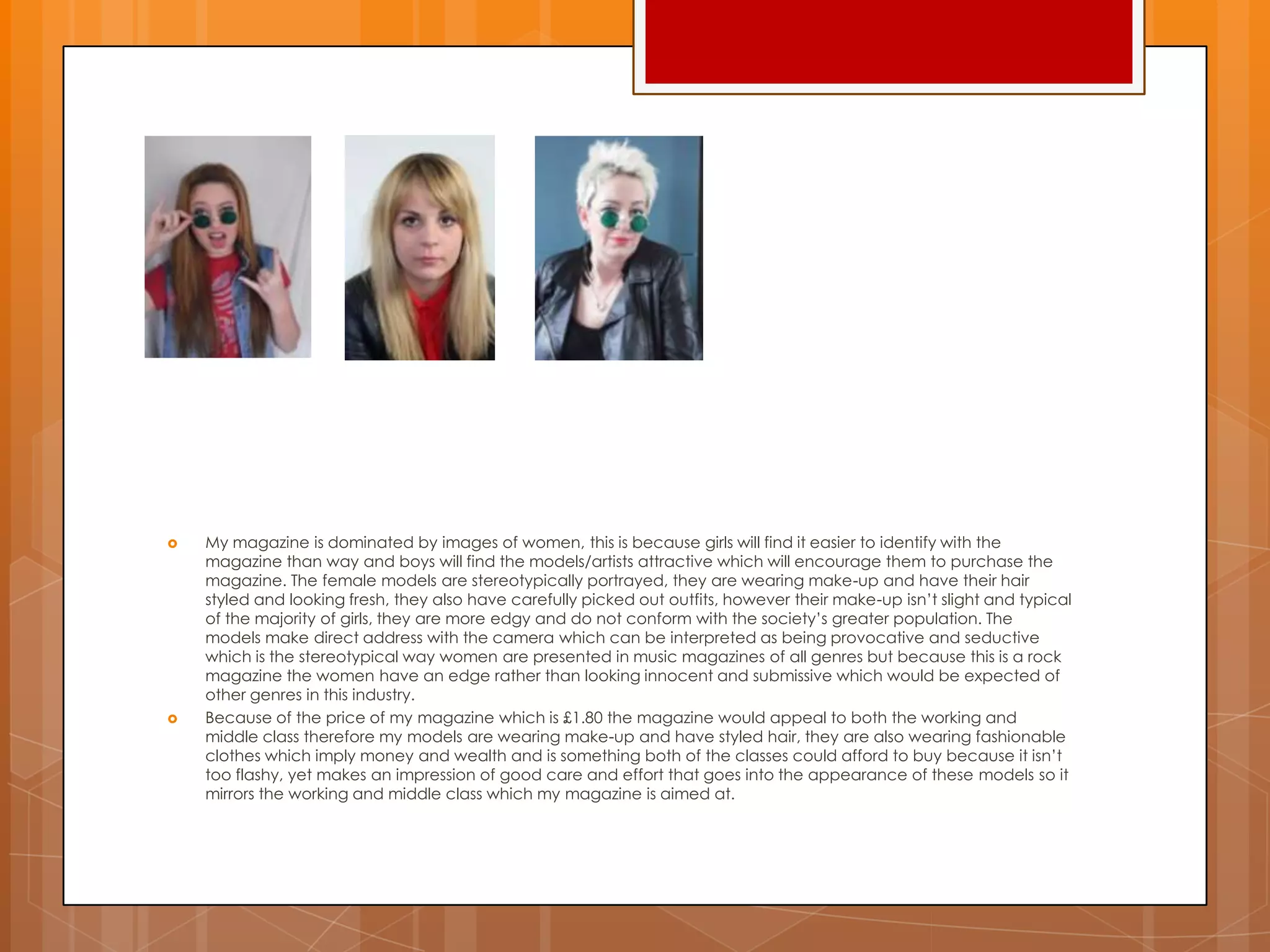
 My magazine is dominated by images of women, this is because girls will find it easier to identify with the
magazine than way and boys will find the models/artists attractive which will encourage them to purchase the
magazine. The female models are stereotypically portrayed, they are wearing make-up and have their hair
styled and looking fresh, they also have carefully picked out outfits, however their make-up isn‟t slight and typical
of the majority of girls, they are more edgy and do not conform with the society‟s greater population. The
models make direct address with the camera which can be interpreted as being provocative and seductive
which is the stereotypical way women are presented in music magazines of all genres but because this is a rock
magazine the women have an edge rather than looking innocent and submissive which would be expected of
other genres in this industry.
 Because of the price of my magazine which is £1.80 the magazine would appeal to both the working and
middle class therefore my models are wearing make-up and have styled hair, they are also wearing fashionable
clothes which imply money and wealth and is something both of the classes could afford to buy because it isn‟t
too flashy, yet makes an impression of good care and effort that goes into the appearance of these models so it
mirrors the working and middle class which my magazine is aimed at.
What kind of media institution might distribute your media product and why?
 My research shows that Bauer Media distribute many magazines, including Kerrang and this being my main
influence I think Bauer Media would be appropriate for the distribution of Alpha Beat. This is because they stem
out and have many connections which would make Alpha Beat an easily accessible and publicised product. I
would rather Alpha Beat was distributed by Bauer media than be an independent product because they have
popularity and are well known, they are also advertised on many platforms and would make my magazine easily
accessible.
 From my publisher research I found that Kerrang, which is distributed by Bauer media has both a magazine and
a radio station which means with the help of Bauer Alpha Beat would be able to stem out into a variety of
platforms suitable for my target audience as I know that with the use of phones, teenagers are able to access
many different platforms. Also, because their radio plays music such as Bring Me The Horizon and The Prodigy
which is the specific genre for my magazine I know they have experience which means they would be able to
make Alpha Beat as popular as Kerrang.
 From my research I also found that Bauer works with 80 influential brand names such as heat which also means
that Alpha Beat would gain a lot of publicity through advertising and they are familiar with advertising through
other social networking websites which is what I did in my magazine also.
 Kerrang has the price of £2.20 which reflects the price of my magazine which is just below that as I am targeting
my magazine at a young audience with not much disposable income, this is another reason why I would pick
this institution because they must understand the needs of younger and older audiences and the difference
between an audience with a lot of income and ones with not much income therefore they will be able to fullfill
the needs of my target audience. The statistics also show that they have a high circulation rate which is what I
want to aim for with Alpha Beat as this would increase the success rate of the magazine.
Who would be the audience for your media product?
Age
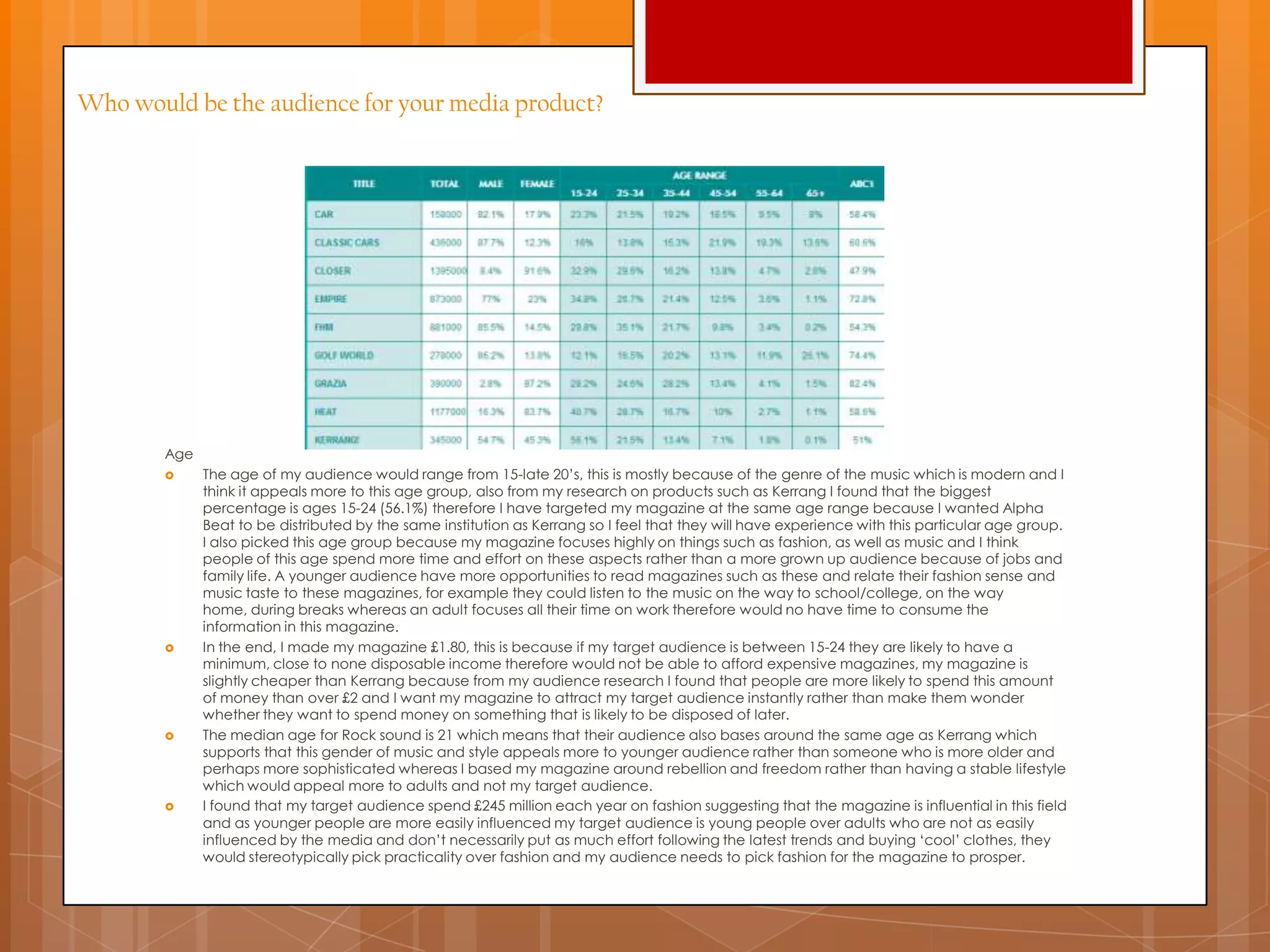
 The age of my audience would range from 15-late 20‟s, this is mostly because of the genre of the music which is modern and I
think it appeals more to this age group, also from my research on products such as Kerrang I found that the biggest
percentage is ages 15-24 (56.1%) therefore I have targeted my magazine at the same age range because I wanted Alpha
Beat to be distributed by the same institution as Kerrang so I feel that they will have experience with this particular age group.
I also picked this age group because my magazine focuses highly on things such as fashion, as well as music and I think
people of this age spend more time and effort on these aspects rather than a more grown up audience because of jobs and
family life. A younger audience have more opportunities to read magazines such as these and relate their fashion sense and
music taste to these magazines, for example they could listen to the music on the way to school/college, on the way
home, during breaks whereas an adult focuses all their time on work therefore would no have time to consume the
information in this magazine.
 In the end, I made my magazine £1.80, this is because if my target audience is between 15-24 they are likely to have a
minimum, close to none disposable income therefore would not be able to afford expensive magazines, my magazine is
slightly cheaper than Kerrang because from my audience research I found that people are more likely to spend this amount
of money than over £2 and I want my magazine to attract my target audience instantly rather than make them wonder
whether they want to spend money on something that is likely to be disposed of later.
 The median age for Rock sound is 21 which means that their audience also bases around the same age as Kerrang which
supports that this gender of music and style appeals more to younger audience rather than someone who is more older and
perhaps more sophisticated whereas I based my magazine around rebellion and freedom rather than having a stable lifestyle
which would appeal more to adults and not my target audience.
 I found that my target audience spend £245 million each year on fashion suggesting that the magazine is influential in this field
and as younger people are more easily influenced my target audience is young people over adults who are not as easily
influenced by the media and don‟t necessarily put as much effort following the latest trends and buying „cool‟ clothes, they
would stereotypically pick practicality over fashion and my audience needs to pick fashion for the magazine to prosper.
Gender
 The graph above shows that the dominant gender that buys magazines such as Kerrang is male, however it is close to being
50/50 therefore I targeted my magazine at both girls and boys because this means that my magazine will have a wider, more
diverse audience which makes it more interesting and allows me to write about things both girls and boys like rather than
focusing on only one gender. I made the colours so that they don‟t define which gender the magazine is targeted on
because I wanted both of them to feel included and I know that both girls and boys like colours such as orange, red and
black. For the magazine Rock Sound 78% of the audience is female and because Rock Sound is the same genre as Alpha
Beat I made sure I took this into account and included features which would appeal to girls just as much as boys.
 I made the girl model wear make up and fashionable clothes, I also did her hair so it is nicely presented which would appeal
to both of the genders because girls would identify with the model whereas boys would look at the model as an object of
desire, according to the male gaze theory. In the magazine, I included instruments such as the guitar because I think both girls
and boys tend to play this instrument whereas for example drums are associated more with boys.
 The bands in my magazine feature both men and women therefore there isn‟t a more favourable gender and they are both
equal, just like my target audience.
Class and interests
 The class of my target audience would be middle class, this is why I made my magazine a relatively low price because I
wanted to make it easy for people to access rather than it being something expensive and something the audience would
have to save up for as I wanted it to feel casual because this would make them happier than if they had to go out of their
way to purchase it.
 From my audience research I found that my target audience have hobbies such as listening to music, shopping, going out
and have very active lifestyles therefore I made sure my magazine has features such as opportunities to go to gigs and win
prizes as this would appeal to them more than it would to an older generation. My magazine would also appeal to all races
and nationalities because there isn‟t a specific nationality I wanted to focus my magazine on, this gives it a wider variety of
audiences and emphasizes equality.
 Because of the age of my target audience they are likely to be in education such as schools, colleges and universities. I
picked this age because people who are in education and are often stressed tend to find peace in reading therefore I
wanted to provide them with something entertaining and interesting and something that will keep them up to date with
festivals and events which could help them to further relax which is important if you are in education.
How did you attract or address your audience?
 Photography- I wanted the images in my magazine to appeal to the teenagers in the market. On my cover I
instructed the model to look directly into the camera, this is because not only is this conventional but I think this
connection with the audience would attract them. Because it is a close up you can clearly see the models
expression, she looks inviting and her make up is representable of the genre because of the eyeliner and the
dark lipstick which would appeal to my target audience, The model on the cover is also in the same range as
my target audience therefore, because they will be able to relate to the figure it will appeal more to them.
 The image I used on my double page spread is the same girl because she is the focus of the magazine therefore
they will see a familiar face and want to read on and buy the magazine. She is wearing shiny shoes which will
appeal to the female audience and a leather jacket and black jeans which could appeal to the male
audience, she is also wearing a red top which has connotations of passion and attraction, it‟s also bright
therefore will draw people in and engage them to read the article. I made sure that the jeans the model was
wearing were high enough to display her tattoos because I think this would appeal to my target audience as it is
a something you see a lot in this particular genre so she is representable of real artists in the industry.
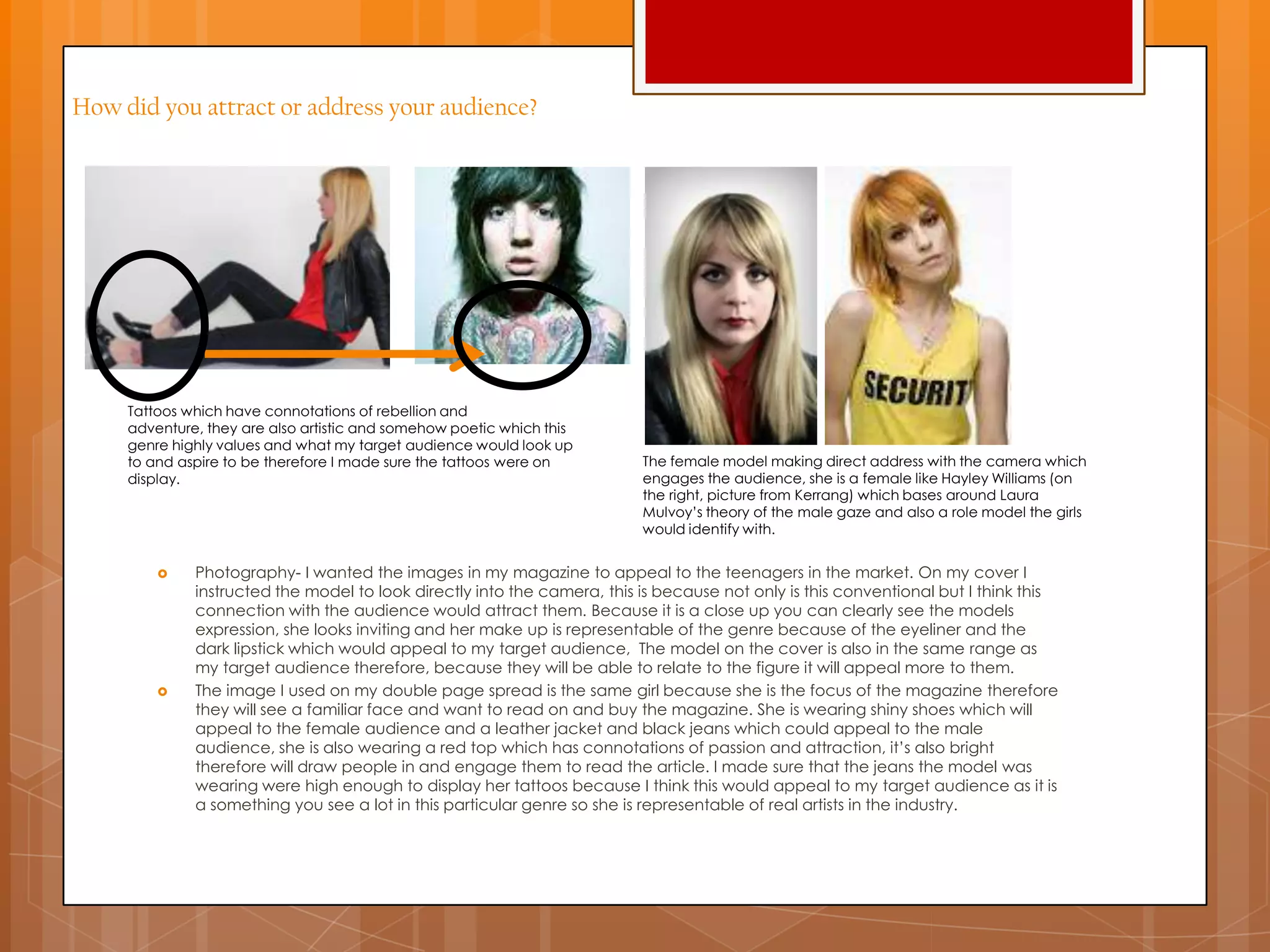
Tattoos which have connotations of rebellion and
adventure, they are also artistic and somehow poetic which this
genre highly values and what my target audience would look up
to and aspire to be therefore I made sure the tattoos were on
display.
The female model making direct address with the camera which
engages the audience, she is a female like Hayley Williams (on
the right, picture from Kerrang) which bases around Laura
Mulvoy‟s theory of the male gaze and also a role model the girls
would identify with.
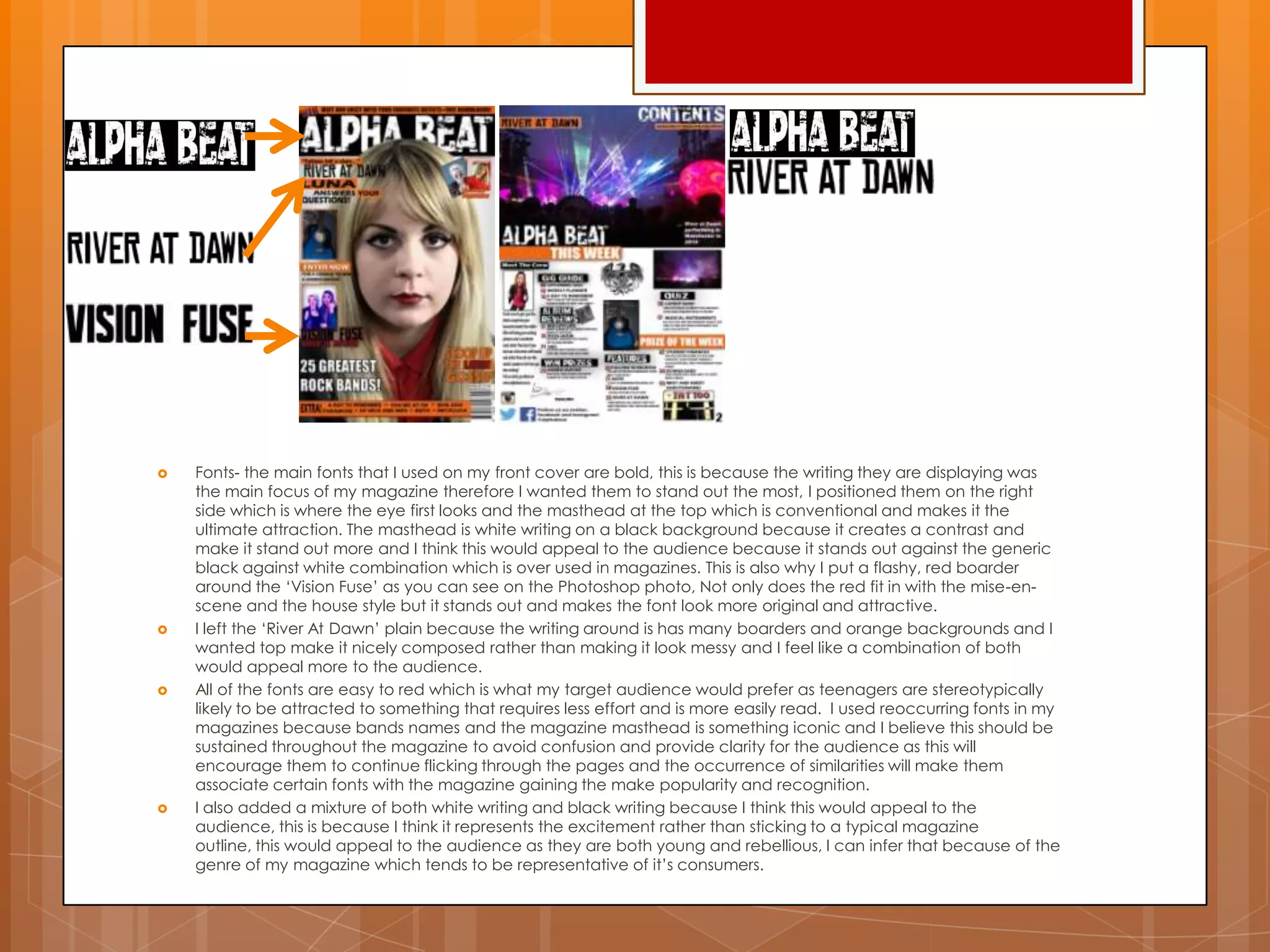
 Fonts- the main fonts that I used on my front cover are bold, this is because the writing they are displaying was
the main focus of my magazine therefore I wanted them to stand out the most, I positioned them on the right
side which is where the eye first looks and the masthead at the top which is conventional and makes it the
ultimate attraction. The masthead is white writing on a black background because it creates a contrast and
make it stand out more and I think this would appeal to the audience because it stands out against the generic
black against white combination which is over used in magazines. This is also why I put a flashy, red boarder
around the „Vision Fuse‟ as you can see on the Photoshop photo, Not only does the red fit in with the mise-en-
scene and the house style but it stands out and makes the font look more original and attractive.
 I left the „River At Dawn‟ plain because the writing around is has many boarders and orange backgrounds and I
wanted top make it nicely composed rather than making it look messy and I feel like a combination of both
would appeal more to the audience.
 All of the fonts are easy to red which is what my target audience would prefer as teenagers are stereotypically
likely to be attracted to something that requires less effort and is more easily read. I used reoccurring fonts in my
magazines because bands names and the magazine masthead is something iconic and I believe this should be
sustained throughout the magazine to avoid confusion and provide clarity for the audience as this will
encourage them to continue flicking through the pages and the occurrence of similarities will make them
associate certain fonts with the magazine gaining the make popularity and recognition.
 I also added a mixture of both white writing and black writing because I think this would appeal to the
audience, this is because I think it represents the excitement rather than sticking to a typical magazine
outline, this would appeal to the audience as they are both young and rebellious, I can infer that because of the
genre of my magazine which tends to be representative of it‟s consumers.
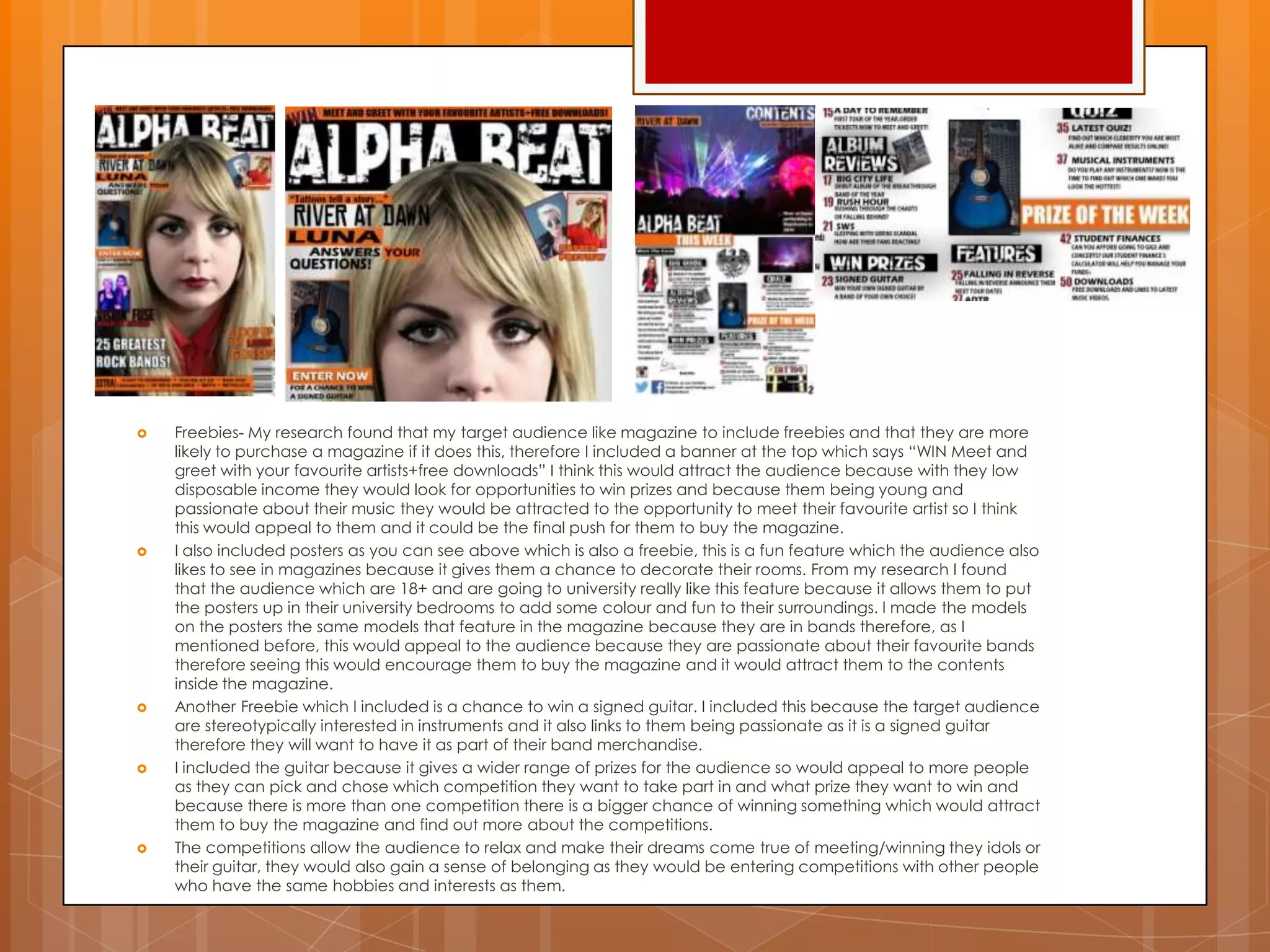
 Freebies- My research found that my target audience like magazine to include freebies and that they are more
likely to purchase a magazine if it does this, therefore I included a banner at the top which says “WIN Meet and
greet with your favourite artists+free downloads” I think this would attract the audience because with they low
disposable income they would look for opportunities to win prizes and because them being young and
passionate about their music they would be attracted to the opportunity to meet their favourite artist so I think
this would appeal to them and it could be the final push for them to buy the magazine.
 I also included posters as you can see above which is also a freebie, this is a fun feature which the audience also
likes to see in magazines because it gives them a chance to decorate their rooms. From my research I found
that the audience which are 18+ and are going to university really like this feature because it allows them to put
the posters up in their university bedrooms to add some colour and fun to their surroundings. I made the models
on the posters the same models that feature in the magazine because they are in bands therefore, as I
mentioned before, this would appeal to the audience because they are passionate about their favourite bands
therefore seeing this would encourage them to buy the magazine and it would attract them to the contents
inside the magazine.
 Another Freebie which I included is a chance to win a signed guitar. I included this because the target audience
are stereotypically interested in instruments and it also links to them being passionate as it is a signed guitar
therefore they will want to have it as part of their band merchandise.
 I included the guitar because it gives a wider range of prizes for the audience so would appeal to more people
as they can pick and chose which competition they want to take part in and what prize they want to win and
because there is more than one competition there is a bigger chance of winning something which would attract
them to buy the magazine and find out more about the competitions.
 The competitions allow the audience to relax and make their dreams come true of meeting/winning they idols or
their guitar, they would also gain a sense of belonging as they would be entering competitions with other people
who have the same hobbies and interests as them.
 Gratification theory- this theory focuses on why people engage in media, it has four elements:
information, personal identity, entertainment and social interaction.
 Teenagers would read the magazine for information about their favourite bands or artists and this is why my
magazine would appeal to them, because it includes interviews which are personal and relate to their career.
My magazine also includes „ Latest gossip‟ which would provide the target audience with more current
information which they could relate to and share on social networking websites which is another way of passing
down information.
 They would be attracted to the magazine because they could identify with the celebrities and relate to their
problems, because of their age group and being in a stressful stage of their life it would help them to feel a sense
of belonging and they would be able to not only engage with personal issues but also with the fashion included
in the magazine, this is because I specifically directed the models to dress the way I think my target audience
dresses therefore the magazine would appear more identifiable to them.
 The magazine also includes entertaining aspects, for example they would find the gossip entertaining as well as a
source of information. They would enjoy entering competitions and having a chance to win something music
related which is their hobby. The magazine includes many stories and columns which the audience can read
and enjoy.
 Because the magazine is directed at such a wide spectrum of people it is likely that the target audience are
surrounded by people with similar hobbies and interests so together they could discuss each issue and talk about
what they liked most and least and express themselves around others. They would bring people together and
perhaps acts as a gate for people to make new friends who share their enthusiasm for the genre which leads to
social interaction which is both entertaining and allows the audience to identify with people with the same
problems therefore all of the aspects link together.
Identification+relatable
Entertaining
Information
 Writing style- I used informal language in my magazine to address the audience because they are young and
would enjoy reading something which is on their level rather than making them feel like they are being taught
something and spoke to in a patronising manner. I also used abbreviations in my magazine because this is
informal and would understand all the information just by looking at the band abbreviations. For example I used
„ADTR‟ for the band „A Day To Remember‟ and „BMTH‟ for „Bring Me The Horizon‟ and „SWS‟ for „Sleeping With
Sirens‟ I also used words such as „Scoop up the latest gossip‟ which would appeal to my target audience
because they are stereotypically surrounded by gossip therefore will be attracted to this and scoop up founds
informal rather than academic. Scoop up also adds to the drama because it sounds more exciting that „read
the latest gossip‟, the dramatic approach will appeal to the target audience because they will find it exciting
and something to look forward to reading, it makes it sounds like „juicy‟ gossip rather than something boring.
 I used exclamation marks which could be associated with enthusiasm and energy which is representative of my
target audience because they are young and lively, it is also informal and relaxed because it is a way in which
teenagers comminute through social media and how they express themselves therefore it would be a familiar
style for them and make them feel like a part of the magazine and have a sense of involvement. The test is
structured in columns to provide clarity and easy reading for the audience. Also the sentences aren‟t very long
they address quickly and to the point rather than dragging on because I didn‟t want the writing to look like an
essay because that would provide school like connotations and this magazine is aimed for spare, relaxing time.
 My target audience are mostly teenagers therefore I included logos of platforms such as Facebook, Twitter and
Instagram because they are the most used social networking websites used by teenagers therefore it will attract
them because it gives them an opportunity to keep up to date other ways than through a paper copy of the
magazine and this will appeal to them as teenagers are thought to spend a lot of their time on their phones
therefore it will be more easily accessible for them.
„SWS‟-Sleeping
With Sirens
„ADTR‟-A Day
To Remember
What have you learnt about technologies from the process of constructing this
product?
 Photoshop
 Slideshare
 Blogger
 PowerPoint
 SLR cameras
 Sribd
 Usb sticks
 YouTube
 Microsoft word
 Adobe Premiere Project
Photoshop
I used Photoshop to produce my magazine cover, contents page and the double page
spread, I could have used Adobe InDesign, however I felt like Photoshop would produce a
better final effect as I was able to manipulate the image and insert fonts from DaFont, make
the fonts different colours, picked out from the mise en scene to match. because I
experimented a lot with Photoshop when I made my cover I was able to produce good a
quality work contents page and double spread and compose it exactly how I imagined it in
my head whereas because I wasn‟t familiar with InDesign I would have been stuck to reflect
the vision. I learned how to insert images, how to correct images to make them look better
quality, how to move the contents about and how to manipulate the brightness, contrast and
exposure of pictures. I also learned how to remove background on images or make them
transparent which was useful because I wanted the cover lines, masthead and other features
to be on the same background.
Slideshare
I used a website called slideshare which
is useful for sharing PowerPoint
presentations,. With this, I learned how to
use an embedded code to include a
PowerPoint presentation on my blog
which makes it easier to view than if I
included a link to open in a new tab.
Slideshare also shows the amount of
views on my presentation and allows
people to leave comments so they
could leave feedback to help me
improve on my presentations, it also
meant that I could view other people‟s
presentations if I wanted inspiration.
Scribd is a website which allows you to share
Microsoft Word documents and use a code to
embed your work onto your blog, which like
SlideShare makes it easier for the viewer to access the
work rather than having to open a new tab and
waste time, it taught me that there are different ways
of sharing written work than writing it directly on the
blog or using SlideShare to create a PowerPoint
presentation.
Microsoft Word
I used Microsoft Word to produce
work such as my magazine
pitch, I used word because it
allowed me to easily write about
my magazine and keeps the
word clear and organised. With
websites such as Scribd I was able
to put this work directly onto my
blog.
Blogger is a platform which allows you to display your
work in a blog form, you can put information directly
onto it or use codes like I did with SlideShare and
Scribd, it also allows you to place pictures directly
onto the blog, I used it to display all of my
information, starting from research, then planning and
then the production and finally the evaluation. The
URL to my blog is judykulpa.blogspot.com which is
simple and easy to remember, I could change the
layout of my blog to make the information look more
engaging rather than plain.
I used YouTube to upload my interview during the
audience research stage because this allowed me to
use a code and put the video directly onto my blog.
YouTube is simple to use and I was able to leave tags
on my video so it was easier to find. YouTube also
allows people to leave feedback, positive or
negative. I never used this platform to upload videos
before but I quickly learned how to use it.
Screenshot of my blog displaying
the work I have uploaded with a
screenshot of my YouTube video for
my interview with a potential
audience below.
PowerPoint
I used PowerPoint to set out my photography and layout
planning, the research into existing products and the colour
schemes. PowerPoint helped me to layout my work neatly and
make it presentable, I used this over word because I wanted to
show a step by step process instead of showing everything in
one document, it make the portrayal of my work more
organised. I learned how to change the design of my
presentations to fit in with the house style of my magazine
therefore it all fits together and forms a pleasant composition
to the eye.
Cameras
I used SLR cameras to capture my images because I wanted
them to be good quality, I have various images which I took in
the photography studio and a mixture of location images as
this makes the magazine look more professional because this is
a conventional way of placing images in the magazine, The
cover of my magazine includes more studio photographs as I
found this is what often appears on the cover and the
contents page has more location images. When I used the
cameras, I took many photos because I wanted to experiment
with the focus and positioning of the model, I had to make
sure there was enough headspace also. I also took
photographs of both people and objects because I wanted a
good variety to pick from for my final product.
USB Stick
I used a USB stick to save all my work on and access it every
lesson, for further reassurance I emailed myself the most
important pieces of work such as the production and
presentations because they took time and effort. I learned
that UCB sticks are a simple, portable way of storing
information, I also learned that a lot of the time they tend to be
unreliable and crash and that it was it is important to support
your work on another platform.
Adobe Premiere Project
I used the Adobe Premiere Project to edit my interview video.
This is because I filmed it in sections and I wanted it to be
uploaded as one video therefore I had to edit all the questions
into one video to make it flow. I learned how to do this as I‟ve
never used this programme, I know how to use Final cut
however, which helped me to understand the workings of this
program and allowed me to work my way through the video.
 Originally I had a simple style sheet with fonts and colours used on word, however during the process and with
more knowledge of Photoshop I discovered that there are many different ways of displaying my information
rather than simple fonts, I learned that there are ways of making the fonts more „snazzy‟ and appealing to an
audience and that you can make fonts look original rather than cheap and unprofessional which makes the
magazine look more established and well made. So my preliminary task included fonts which I would have put
on my first style sheet but through development of my skills I made a style sheet which included more developed
fonts that are more representable of the genre.
 I also developed a colour scheme which was appropriate to the genre so during the process I learned how to
link the connotations of colours to the right genre and styles of magazines which I didn‟t do in my college
magazine, my college magazine included random colours which I thought were „pretty‟ whereas thought went
into picking the colours for my final magazine.
 I learned how to plan properly and create flat plans and layout plans for my magazine which made the
production stage easier whereas with the college magazine I planned as I went along rather than before hand
which made the task seem more complicated and difficult because I spent a long time deciding on
placement, fonts and colours whereas with my plans I already had the ideas in my head therefore the job went
more smoothly.
Looking back at your preliminary task, what do you feel you have learn in the
progression from it to the full product?
 I improved in the planning of photographs because in my preliminary task I only took one photograph without
thinking about the headspace or room for writing whereas in my final task I took a variety of photographs to
experiment with lighting and positioning which gave me more appreciation to how the planning stage is.
 Furthermore, I evaluated most of my photographs to point out the positives and negatives to make the picking
stage easier which then meant that during the production stage I already had the images I wanted to use and
could forget about the images I didn‟t want to use, but I was able to always go back to the old ones if I wanted
to throw a new image in.
 I also improved on planning my cover lines and masthead, the college magazine is simple called the „College
Mag‟ which is very generic and not imaginative, it‟s straight cut. My final magazine is called „Alpha Beat‟ which is
an improvement because I could have gone along the same lines and called it a „Music Mag‟ but I thought
outside of the box and thought of something original but still music related, something that will make the target
audience think about the name rather than seeing it and forgetting about it.
 I also improved my research skills and going outside the usual websites to look for information, I researched the
conventions of magazines which you can see isn‟t displayed on the college mag as the only convention is
includes is the barcode, the rest is random and doesn‟t look professional; the colours don‟t match and they
don‟t particular stand out or create a nice contrasts which would be engaging, instead it‟s very plain which is
not conventional, it looks amateur whereas my final magazine includes all the conventions I researched and
sometimes challenges the usual conventions to create a better, more effective look which I thought was suitable
for my magazine and would appeal to my target audience.
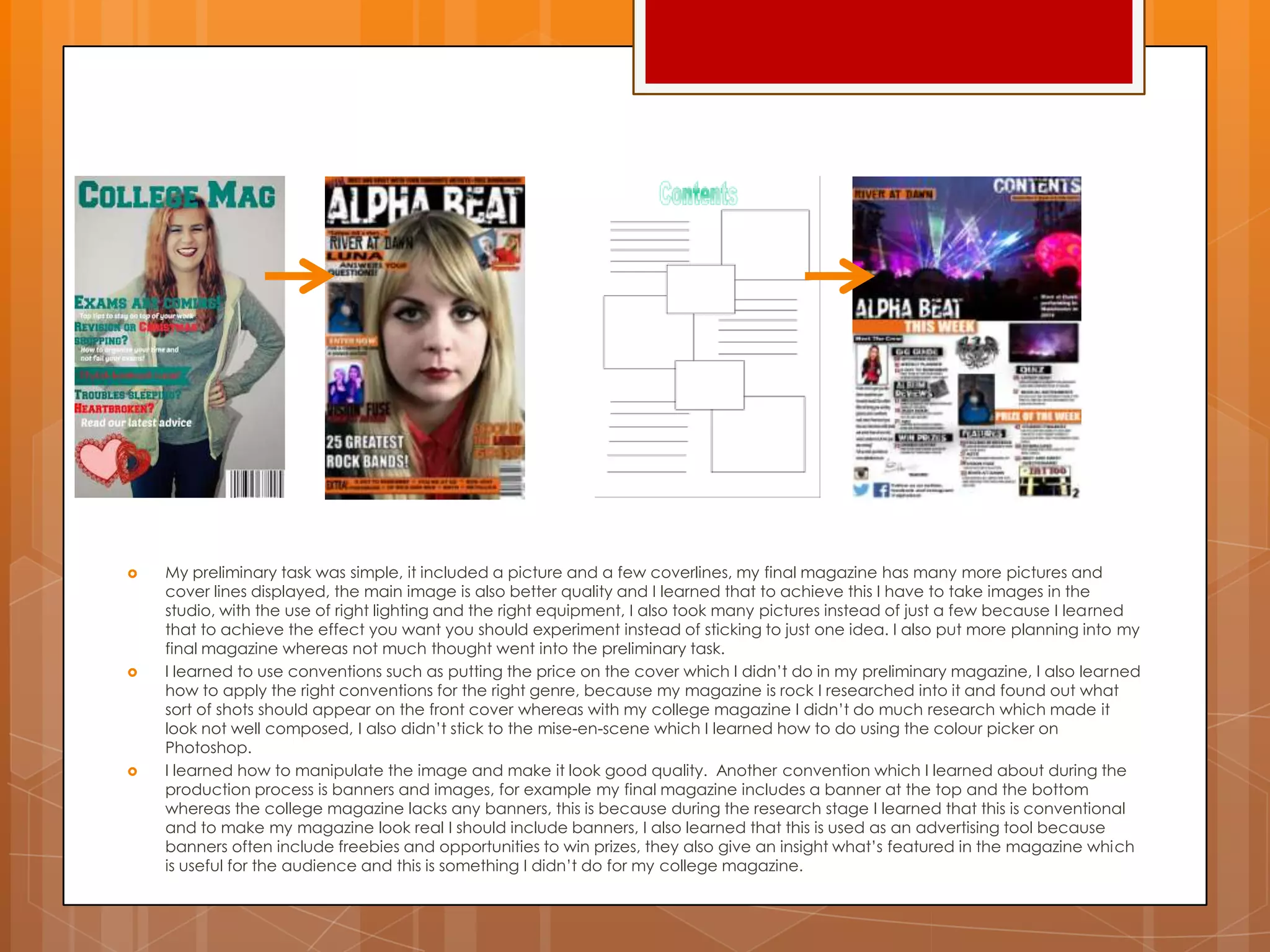
 My preliminary task was simple, it included a picture and a few coverlines, my final magazine has many more pictures and
cover lines displayed, the main image is also better quality and I learned that to achieve this I have to take images in the
studio, with the use of right lighting and the right equipment, I also took many pictures instead of just a few because I learned
that to achieve the effect you want you should experiment instead of sticking to just one idea. I also put more planning into my
final magazine whereas not much thought went into the preliminary task.
 I learned to use conventions such as putting the price on the cover which I didn‟t do in my preliminary magazine, I also learned
how to apply the right conventions for the right genre, because my magazine is rock I researched into it and found out what
sort of shots should appear on the front cover whereas with my college magazine I didn‟t do much research which made it
look not well composed, I also didn‟t stick to the mise-en-scene which I learned how to do using the colour picker on
Photoshop.
 I learned how to manipulate the image and make it look good quality. Another convention which I learned about during the
production process is banners and images, for example my final magazine includes a banner at the top and the bottom
whereas the college magazine lacks any banners, this is because during the research stage I learned that this is conventional
and to make my magazine look real I should include banners, I also learned that this is used as an advertising tool because
banners often include freebies and opportunities to win prizes, they also give an insight what‟s featured in the magazine which
is useful for the audience and this is something I didn‟t do for my college magazine.
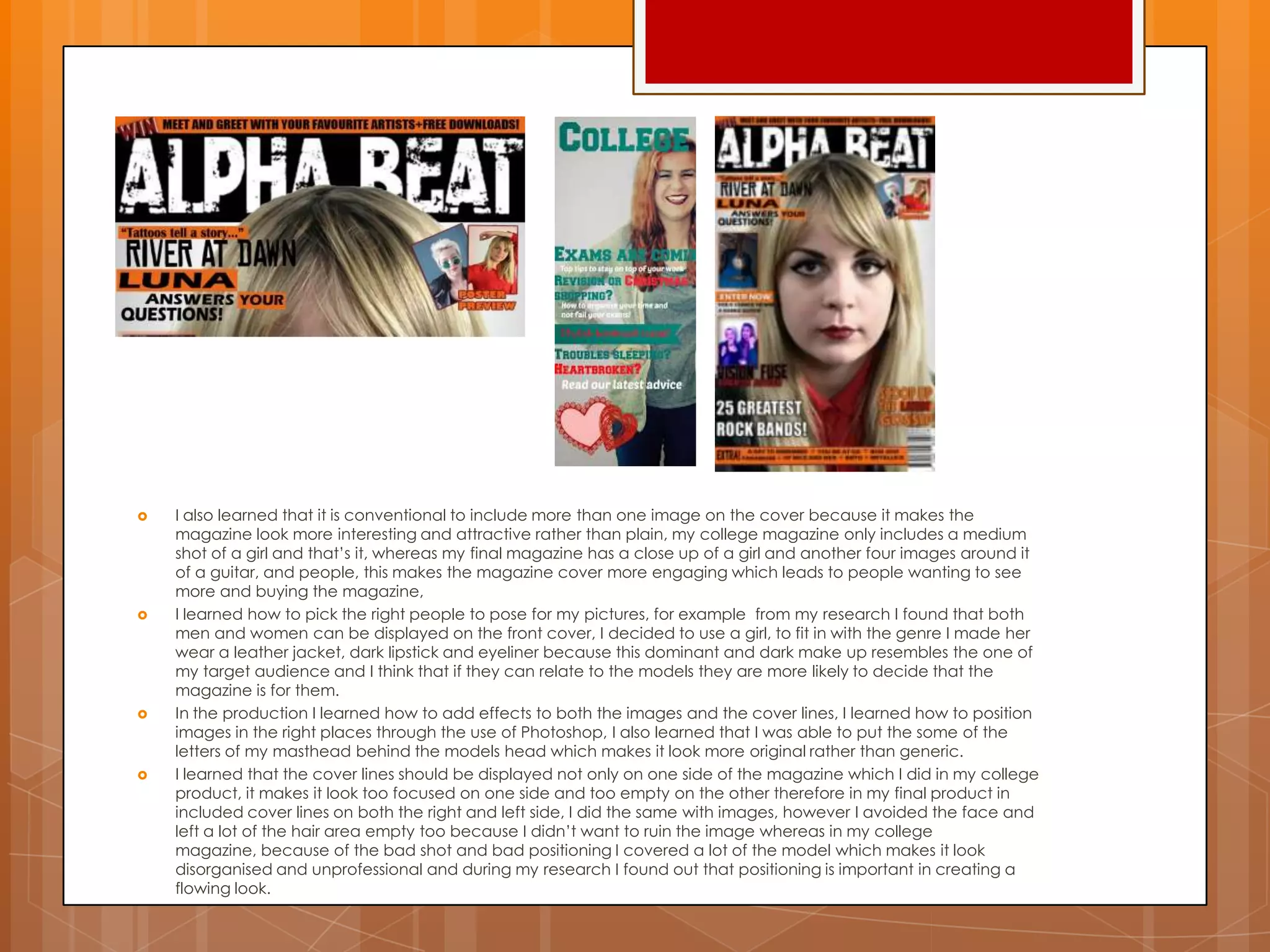
 I also learned that it is conventional to include more than one image on the cover because it makes the
magazine look more interesting and attractive rather than plain, my college magazine only includes a medium
shot of a girl and that‟s it, whereas my final magazine has a close up of a girl and another four images around it
of a guitar, and people, this makes the magazine cover more engaging which leads to people wanting to see
more and buying the magazine,
 I learned how to pick the right people to pose for my pictures, for example from my research I found that both
men and women can be displayed on the front cover, I decided to use a girl, to fit in with the genre I made her
wear a leather jacket, dark lipstick and eyeliner because this dominant and dark make up resembles the one of
my target audience and I think that if they can relate to the models they are more likely to decide that the
magazine is for them.
 In the production I learned how to add effects to both the images and the cover lines, I learned how to position
images in the right places through the use of Photoshop, I also learned that I was able to put the some of the
letters of my masthead behind the models head which makes it look more original rather than generic.
 I learned that the cover lines should be displayed not only on one side of the magazine which I did in my college
product, it makes it look too focused on one side and too empty on the other therefore in my final product in
included cover lines on both the right and left side, I did the same with images, however I avoided the face and
left a lot of the hair area empty too because I didn‟t want to ruin the image whereas in my college
magazine, because of the bad shot and bad positioning I covered a lot of the model which makes it look
disorganised and unprofessional and during my research I found out that positioning is important in creating a
flowing look.

Evaluation

  • 1.
  • 2.
    Questions  In whatways does your media product use, develop or challenge forms and conventions of real media products?  How does your media product represent particular social groups?  What kind of media institution might distribute your media product and why?  Who would be the audience for your media product?  How did you attract or address your audience?  What have you learnt about technologies from the process of constructing this product?  Looking back at your preliminary task, what do you feel you have learn in the progression from it to the full product?
  • 3.
    In what waysdoes your media product use, or develop or challenge forms and conventions of real media products?  I placed the images on my front cover around the lead person because I didn‟t want to cover her face as this would ruin the image, this is also a conventional way of placing the cover lines as this makes the page look more composed and not messy. I used simpler fonts for the cover lines and a more flashy one for the masthead which resembles the one of „Kerrang‟, this is because I feel like the masthead is the main focus, however I put the masthead behind the head of the cover model because I think that with the prestige and popularity of the magazine the target audience would recognise the magazine as they tend to be passionate about this genre, this supports the main conventions of existing magazines. The masthead is positioned on the top with a thin banner above it which advertises „free downloads‟ and competitions to win meet and greet, I did this because in my research I found that the audience like freebies therefore this would encourage them to purchase the magazine, it is also conventional because a lot of magazines have thin banners, some include subimages at the top however I challenged that as I felt it made the magazine look too full and packed. The face of the model is slightly to the right because I wanted to leave enough space on the left side to fit in my cover lines as I think it is important to leave the face and not put writing over it as that tends to look messy and doesn‟t allow for the expression to come across. This is a conventional way of placing an image, especially if it is a medium close up of a face.  The colour scheme I used includes the colours red, orange and black mostly, this is because the red and orange are fiery and vibrant which contrast with the black, because stereotypically rock is considered powerful and passionate, it also represents the passionate target audience, I found that teenagers tend to be strong followers of items or music they like. I felt these colours reflected that well. The example magazines below show that these are conventional colours. From my research into existing magazines I also found that black was favoured over other colours and it was usually composed with contrasting, bright colours. I used these colours throughout my magazine because they sustain the continuity of the house style, this is pleasing to the eye as many different colours would look confusing and not intact and using the same colours throughout my magazine makes it look well composed. Example of the medium close up I used with direct address to the audience like the example, the direct address engages the target audience and draws attention. Front cover
  • 4.
     I placedthe banner at the top because as I showed, this is a conventional placement to advertise freebies, I also placed some of the letters behind the head of the model because it shows popularity. The example on the right shows how the posters are displayed on the top left side, which I also did as this gives an insight into the extra features that come with the magazine. I also placed an extra banner at the bottom of the page which lists the names of the bands featured in the magazine, this is also often used in magazines such as Kerrang and Alternative Press because it attracts the target audience who are likely to listen to the bands, the content which I wrote down are bands of this particular genre as this is important.  The language that I used in my magazine was informal, for example „Scoop up the latest gossip‟ would appeal to my target audience because it‟s an age where the littlest celebrity gossip is a topic of conversation so I feel this would seem attractive to the audience, informal language is a conventional writing style in this genre of magazines and I stuck to it because formal language would form connotations of a more serious, far reaching world rather than the environment of teenagers.  The font I used for my masthead is interesting because it looks like some of the letters have been torn which stands out from the generic fonts typically used in some magazines, also it represents the stereotypical style of my target audience for example their fashion might include items like ripped jeans, so it reflects both their style and their rebellious attitude. I inverted the colours from black to white because I felt like this would look more dynamic against a black background rather than the other way round. The name „Alpha Beat‟ in itself sounds dynamic, „beat‟ having the connotations of this music genre as rock tends to have an upbeat backing therefore it reflects the what my target audience desire in the music. As you can see from the examples both Alternative Press and Kerrang avoid the straight cut fonts which would usually appear in business magazines rather than music because music is a way of people expressing themselves therefore can have many interpretations whereas business tends to be just that and lacks as much individuality.
  • 5.
     When Icarried out my research I found a list of conventions used throughout the range of products of this genre, for example all magazines included: a barcode, the date, issue number and a wide range of photographs. I influenced my own product on magazines such as Kerrang, Alternative Press and Rock Sound therefore many conventions I noticed in this genre, which is Rock, I have used in my own work.  On my front cover I used the barcode, I placed it in a vertical position and in the corner, it is also relatively small in comparison to the rest of the images, this is because a barcode is a useful feature however has no relevance in attracting the audience therefore doesn‟t require to be flashy and stand out. It also means that there is more room for more important features. The price of the magazine is just above the barcode, in small print. I noticed this was also a convention used often in rock magazines, it means that my target audience who tend to have not much disposable income will be able to see if the magazine is in their income range. I used a variation of photography on my front cover, the main image is a medium close up of one person, one of the images above the cover line „Vision Fuse‟ is of two people, it is a medium shot because it shows the waist, they are also posing for the camera whereas the main image is more constructed to be serious, there is also a photograph of a guitar to add more diversity rather than it being all people. This is conventional because from my research I have found that magazines, when including a variety of images on the front cover have different shots, they also tend to have more than just people so gigs or objects which is what I did.  The model is wearing heavy make up such as eyeliner, her hair is done and she is wearing red lipstick and a red top with a leather jacket which makes her look edgy, it also supports Laura Mulvey‟s theory of the male gaze because she is looking at the camera with a serious face, so instead of being friendly she looks more rocky and seductive, especially with the red lipstick which has connotations of passion. This is because from my research I found that many boys purchase music magazines therefore they look for desirable covers and it also fits in with the rock genre of the magazine.
  • 6.
    Contents Page  The layoutof my contents page reflects the one of Kerrang, with the large image at the top and a variety of smaller images at the bottom of the page on a white background. This layout is also used in the second example of Kerrang, this is also a feature of the contents page that I analysed in my research into existing magazines. The images at the bottom are different shapes, I did this because I think if they were all aligned the same way and had the same shape it would create a business like look which is not what I was aiming for, and this would not appeal to my target audience because of their age range. I used a four column layout because this allowed me to display a satisfying amount of information and photography and it also flows, from my research I found that the mostly used column number is three or five therefore it could be argued that I didn‟t follow the conventional layout, however I think this benefited the overall look of my contents page.  I continued the same use of colours to sustain the house style of my magazine because I think it is important to at least make the cover and contents page in the same colours as this creates continuity. I found that usually the double page spreads differ slightly in the use of colours and it swaps them around, and it doesn‟t necessarily use the same fonts which is what I did because I didn‟t want the whole of my magazine to look the same, I wanted to make changes in certain places to add excitement rather than keeping it predictable, I continued to use black, reds and orange but in different places. The orange dominated the page because I think that this colour is suitable for both females and males and it is also the most vibrant and the one that contrasts the most with the black and white which is a reoccurring colour on my page.  The style of photography is similar to the one of Kerrang because the top image is from a concert I went to and usually, especially in Kerrang, but also in Alternative Press and Rock Sound there are images from gigs or bands so I kept to the conventional style. The smaller images are of things which are included in the magazine to give an insight, it challenges the example above of Alternative Press and the example I used in my research but I felt like this made my magazine look more professional and captivating. I used both wide shots (the gig) and medium close ups (guitar) and medium shots (editors image) I used all these because as you can see in the Kerrang example there is a diversity in shots which makes the page looks more stimulating.
  • 7.
     I usedabbreviations such as „ADTR‟ and „SWS‟ because in my research into existing products I found that this was a conventional way or presenting bands, this is also because the target audience tends to be intense about their favourite bands so would understand the abbreviations, this is also an informal way of presenting information as they are young  I included a page number on my contents page, I placed it on the bottom, in the right corner, it is also relatively small compared to the rest of information on the page, this challenges the conventions of magazines of this genre because they don‟t usually include page numbers on the contents page but I wanted to make the magazine well organised and numbered, the page number doesn‟t necessarily matter in terms of news but I think it is useful for organisation. On the contents page I included page numbers of articles and I made sure that the page number on my article matches the indication on the contents page. The writing is black on white but the small titles are white on black as this creates a diversity on the page, I didn‟t want it to look monotone and boring.  On my contents page I also displayed the logo‟s for Facebook, Instagram and Twitter because I found that my target audience is very technology orientated and use these platforms on every day basis therefore it gives them an opportunity to stay in tune with the magazine and get all the latest news through the technologies they like to use, this is comfortable for them and therefore encourages them to purchase the magazine and it also provides the magazine more publicity.  Abbreviations SWS (Sleeping With Sirens) and ADTR (A Day To Remember)
  • 8.
    Double Page Spread  The layoutof my double page spread sticks to conventions of existing magazines because most of my main image focuses on one side of the page, however I included writing on both pages and as you can see in the example the writing was displayed on one page only, I contradicted this in my work because I think it would have looked too empty if the image was by itself, it also allowed me to fit in more information for the article which I think is important to the audience because the singer of „River At Dawn‟ is the main focus of this issue and she is shown on the cover therefore they would want to see more substance in the article than presentation. The title is at the top and has a varying in size background around it, the background is red this time, rather than orange because I wanted to change it around and I think the red represents the nature of the article as it is about tattoos and piercings which is daring so fits in with the connotations of this colours. I used the colour picker to stick to the mise-en-scene of the page and made sure the same colour is used throughout the whole magazine.  I still used the colours that I included on my cover and contents page but I switched it around to make red the most dominant and orange and black to be the second important colours on the page, I did this because this supports the house style but makes the article less predictable. It is conventional to use the same colours in the leading article and the cover.  I used a quote in the title saying „Tattoos tell a story my lyrics could never tell‟ I think this is quite emotive which will engage the audience, this is also conventional as shown in the example, the quote in the title needs to attract the reader. I chose the topic of tattoos and piercings because I this is what my target audience is stereotypically interested in. As the example shows the article should be something personal to the main focus, which is usually the lead singer of a band, in this way I stuck to the conventions. I also did an interview rather than an article because this gives a feeling of authencity and speaks to the audience which is also conventional.
  • 9.
     The languageI used is also informal because the target audience is young and I wanted to appeal to them rather than sounding patronising and serious. I used words such as „deffo‟ and the interview was cheeky and entertaining.  I included a page number because this is conventional, I made sure it was the same number as displayed on the contents page to avoid confusion and make the article easily detectable. The writing is displayed around the model with the exception of the white writing which contrasts with the colour of her clothing so is easy to see, the rest of the writing is around her on the light background because that way it stands out and leaves space for the positioning of the model. It also allowed me to create a readable layout which looks neat rather than messy.  I only included one image on the double page spread, in my research I found that there‟s never a number of images that is conventional and that it varies from article to article which allowed me to experiment and go with my instinct. I think one image is enough because it is large and if I had included any more the page would look overcrowded and unsystematic. The model is not making direct address with the audience this time, she is facing towards the article, this is because she‟s pointing towards it and draws attention to it. This challenges most of my examples because existing magazines of this genre tend to place the models so that they look directly at the camera. In this case I didn‟t follow the conventions but I felt like this position was better than direct address because she looks at the camera on the cover and I didn‟t want to overuse the same position.  I directed the model to wear the red top because it fits in with the mise en scene and the house style, I also directed her to wear a leather jacket as I found that this is the style of my target audience.
  • 10.
    How does yourmedia product represent particular social groups?  In my magazine I only included white British models; this is because in today‟s society, especially in the rock genre you tend to see more white artists which is reflected in my magazine because I wanted to follow the conventional display of models. It will also appeal more to my audience which are British therefore they are able to identify with the models displayed in my magazine. Some of the models photographed are around the ages of 15-20, this is because the larger percentage of my target audience will be this age, however from my research I found that older generations also purchase rock magazines, this is why I included a model who is in her 30‟s because she will appeal more to the minority of the audience and I wanted to target everyone rather than focus on a specific age range because this will make them feel more involved and they will be able to relate to each of the models. The main focus model is 18, this is because nowadays a lot of the popular music which my target audience listens to is around this age, it is easier for younger adults to gain popularity and I picked this because I wanted to inspire my target audience. The model conforms to the age group by wearing the leather jacket, black jeans and leather top because this is what the society tends to see in this age group, especially in this genre, it is what is considered fashionable.  I followed my photography planning in which I included a leather jacket, a girl model (Hayley Williams) and a guitar which is what this group of people are mostly interested in, stereotypically; they like musical instruments, fashion and following up their favourite celebrities which tends to mirror them because of the influence they have so I made my model look casual which will appeal to this social group and allow them to identify themselves with the model.
  • 11.
     My magazineis dominated by images of women, this is because girls will find it easier to identify with the magazine than way and boys will find the models/artists attractive which will encourage them to purchase the magazine. The female models are stereotypically portrayed, they are wearing make-up and have their hair styled and looking fresh, they also have carefully picked out outfits, however their make-up isn‟t slight and typical of the majority of girls, they are more edgy and do not conform with the society‟s greater population. The models make direct address with the camera which can be interpreted as being provocative and seductive which is the stereotypical way women are presented in music magazines of all genres but because this is a rock magazine the women have an edge rather than looking innocent and submissive which would be expected of other genres in this industry.  Because of the price of my magazine which is £1.80 the magazine would appeal to both the working and middle class therefore my models are wearing make-up and have styled hair, they are also wearing fashionable clothes which imply money and wealth and is something both of the classes could afford to buy because it isn‟t too flashy, yet makes an impression of good care and effort that goes into the appearance of these models so it mirrors the working and middle class which my magazine is aimed at.
  • 12.
    What kind ofmedia institution might distribute your media product and why?  My research shows that Bauer Media distribute many magazines, including Kerrang and this being my main influence I think Bauer Media would be appropriate for the distribution of Alpha Beat. This is because they stem out and have many connections which would make Alpha Beat an easily accessible and publicised product. I would rather Alpha Beat was distributed by Bauer media than be an independent product because they have popularity and are well known, they are also advertised on many platforms and would make my magazine easily accessible.  From my publisher research I found that Kerrang, which is distributed by Bauer media has both a magazine and a radio station which means with the help of Bauer Alpha Beat would be able to stem out into a variety of platforms suitable for my target audience as I know that with the use of phones, teenagers are able to access many different platforms. Also, because their radio plays music such as Bring Me The Horizon and The Prodigy which is the specific genre for my magazine I know they have experience which means they would be able to make Alpha Beat as popular as Kerrang.  From my research I also found that Bauer works with 80 influential brand names such as heat which also means that Alpha Beat would gain a lot of publicity through advertising and they are familiar with advertising through other social networking websites which is what I did in my magazine also.  Kerrang has the price of £2.20 which reflects the price of my magazine which is just below that as I am targeting my magazine at a young audience with not much disposable income, this is another reason why I would pick this institution because they must understand the needs of younger and older audiences and the difference between an audience with a lot of income and ones with not much income therefore they will be able to fullfill the needs of my target audience. The statistics also show that they have a high circulation rate which is what I want to aim for with Alpha Beat as this would increase the success rate of the magazine.
  • 13.
    Who would bethe audience for your media product? Age  The age of my audience would range from 15-late 20‟s, this is mostly because of the genre of the music which is modern and I think it appeals more to this age group, also from my research on products such as Kerrang I found that the biggest percentage is ages 15-24 (56.1%) therefore I have targeted my magazine at the same age range because I wanted Alpha Beat to be distributed by the same institution as Kerrang so I feel that they will have experience with this particular age group. I also picked this age group because my magazine focuses highly on things such as fashion, as well as music and I think people of this age spend more time and effort on these aspects rather than a more grown up audience because of jobs and family life. A younger audience have more opportunities to read magazines such as these and relate their fashion sense and music taste to these magazines, for example they could listen to the music on the way to school/college, on the way home, during breaks whereas an adult focuses all their time on work therefore would no have time to consume the information in this magazine.  In the end, I made my magazine £1.80, this is because if my target audience is between 15-24 they are likely to have a minimum, close to none disposable income therefore would not be able to afford expensive magazines, my magazine is slightly cheaper than Kerrang because from my audience research I found that people are more likely to spend this amount of money than over £2 and I want my magazine to attract my target audience instantly rather than make them wonder whether they want to spend money on something that is likely to be disposed of later.  The median age for Rock sound is 21 which means that their audience also bases around the same age as Kerrang which supports that this gender of music and style appeals more to younger audience rather than someone who is more older and perhaps more sophisticated whereas I based my magazine around rebellion and freedom rather than having a stable lifestyle which would appeal more to adults and not my target audience.  I found that my target audience spend £245 million each year on fashion suggesting that the magazine is influential in this field and as younger people are more easily influenced my target audience is young people over adults who are not as easily influenced by the media and don‟t necessarily put as much effort following the latest trends and buying „cool‟ clothes, they would stereotypically pick practicality over fashion and my audience needs to pick fashion for the magazine to prosper.
  • 14.
    Gender  The graphabove shows that the dominant gender that buys magazines such as Kerrang is male, however it is close to being 50/50 therefore I targeted my magazine at both girls and boys because this means that my magazine will have a wider, more diverse audience which makes it more interesting and allows me to write about things both girls and boys like rather than focusing on only one gender. I made the colours so that they don‟t define which gender the magazine is targeted on because I wanted both of them to feel included and I know that both girls and boys like colours such as orange, red and black. For the magazine Rock Sound 78% of the audience is female and because Rock Sound is the same genre as Alpha Beat I made sure I took this into account and included features which would appeal to girls just as much as boys.  I made the girl model wear make up and fashionable clothes, I also did her hair so it is nicely presented which would appeal to both of the genders because girls would identify with the model whereas boys would look at the model as an object of desire, according to the male gaze theory. In the magazine, I included instruments such as the guitar because I think both girls and boys tend to play this instrument whereas for example drums are associated more with boys.  The bands in my magazine feature both men and women therefore there isn‟t a more favourable gender and they are both equal, just like my target audience. Class and interests  The class of my target audience would be middle class, this is why I made my magazine a relatively low price because I wanted to make it easy for people to access rather than it being something expensive and something the audience would have to save up for as I wanted it to feel casual because this would make them happier than if they had to go out of their way to purchase it.  From my audience research I found that my target audience have hobbies such as listening to music, shopping, going out and have very active lifestyles therefore I made sure my magazine has features such as opportunities to go to gigs and win prizes as this would appeal to them more than it would to an older generation. My magazine would also appeal to all races and nationalities because there isn‟t a specific nationality I wanted to focus my magazine on, this gives it a wider variety of audiences and emphasizes equality.  Because of the age of my target audience they are likely to be in education such as schools, colleges and universities. I picked this age because people who are in education and are often stressed tend to find peace in reading therefore I wanted to provide them with something entertaining and interesting and something that will keep them up to date with festivals and events which could help them to further relax which is important if you are in education.
  • 15.
    How did youattract or address your audience?  Photography- I wanted the images in my magazine to appeal to the teenagers in the market. On my cover I instructed the model to look directly into the camera, this is because not only is this conventional but I think this connection with the audience would attract them. Because it is a close up you can clearly see the models expression, she looks inviting and her make up is representable of the genre because of the eyeliner and the dark lipstick which would appeal to my target audience, The model on the cover is also in the same range as my target audience therefore, because they will be able to relate to the figure it will appeal more to them.  The image I used on my double page spread is the same girl because she is the focus of the magazine therefore they will see a familiar face and want to read on and buy the magazine. She is wearing shiny shoes which will appeal to the female audience and a leather jacket and black jeans which could appeal to the male audience, she is also wearing a red top which has connotations of passion and attraction, it‟s also bright therefore will draw people in and engage them to read the article. I made sure that the jeans the model was wearing were high enough to display her tattoos because I think this would appeal to my target audience as it is a something you see a lot in this particular genre so she is representable of real artists in the industry. Tattoos which have connotations of rebellion and adventure, they are also artistic and somehow poetic which this genre highly values and what my target audience would look up to and aspire to be therefore I made sure the tattoos were on display. The female model making direct address with the camera which engages the audience, she is a female like Hayley Williams (on the right, picture from Kerrang) which bases around Laura Mulvoy‟s theory of the male gaze and also a role model the girls would identify with.
  • 16.
     Fonts- themain fonts that I used on my front cover are bold, this is because the writing they are displaying was the main focus of my magazine therefore I wanted them to stand out the most, I positioned them on the right side which is where the eye first looks and the masthead at the top which is conventional and makes it the ultimate attraction. The masthead is white writing on a black background because it creates a contrast and make it stand out more and I think this would appeal to the audience because it stands out against the generic black against white combination which is over used in magazines. This is also why I put a flashy, red boarder around the „Vision Fuse‟ as you can see on the Photoshop photo, Not only does the red fit in with the mise-en- scene and the house style but it stands out and makes the font look more original and attractive.  I left the „River At Dawn‟ plain because the writing around is has many boarders and orange backgrounds and I wanted top make it nicely composed rather than making it look messy and I feel like a combination of both would appeal more to the audience.  All of the fonts are easy to red which is what my target audience would prefer as teenagers are stereotypically likely to be attracted to something that requires less effort and is more easily read. I used reoccurring fonts in my magazines because bands names and the magazine masthead is something iconic and I believe this should be sustained throughout the magazine to avoid confusion and provide clarity for the audience as this will encourage them to continue flicking through the pages and the occurrence of similarities will make them associate certain fonts with the magazine gaining the make popularity and recognition.  I also added a mixture of both white writing and black writing because I think this would appeal to the audience, this is because I think it represents the excitement rather than sticking to a typical magazine outline, this would appeal to the audience as they are both young and rebellious, I can infer that because of the genre of my magazine which tends to be representative of it‟s consumers.
  • 17.
     Freebies- Myresearch found that my target audience like magazine to include freebies and that they are more likely to purchase a magazine if it does this, therefore I included a banner at the top which says “WIN Meet and greet with your favourite artists+free downloads” I think this would attract the audience because with they low disposable income they would look for opportunities to win prizes and because them being young and passionate about their music they would be attracted to the opportunity to meet their favourite artist so I think this would appeal to them and it could be the final push for them to buy the magazine.  I also included posters as you can see above which is also a freebie, this is a fun feature which the audience also likes to see in magazines because it gives them a chance to decorate their rooms. From my research I found that the audience which are 18+ and are going to university really like this feature because it allows them to put the posters up in their university bedrooms to add some colour and fun to their surroundings. I made the models on the posters the same models that feature in the magazine because they are in bands therefore, as I mentioned before, this would appeal to the audience because they are passionate about their favourite bands therefore seeing this would encourage them to buy the magazine and it would attract them to the contents inside the magazine.  Another Freebie which I included is a chance to win a signed guitar. I included this because the target audience are stereotypically interested in instruments and it also links to them being passionate as it is a signed guitar therefore they will want to have it as part of their band merchandise.  I included the guitar because it gives a wider range of prizes for the audience so would appeal to more people as they can pick and chose which competition they want to take part in and what prize they want to win and because there is more than one competition there is a bigger chance of winning something which would attract them to buy the magazine and find out more about the competitions.  The competitions allow the audience to relax and make their dreams come true of meeting/winning they idols or their guitar, they would also gain a sense of belonging as they would be entering competitions with other people who have the same hobbies and interests as them.
  • 18.
     Gratification theory-this theory focuses on why people engage in media, it has four elements: information, personal identity, entertainment and social interaction.  Teenagers would read the magazine for information about their favourite bands or artists and this is why my magazine would appeal to them, because it includes interviews which are personal and relate to their career. My magazine also includes „ Latest gossip‟ which would provide the target audience with more current information which they could relate to and share on social networking websites which is another way of passing down information.  They would be attracted to the magazine because they could identify with the celebrities and relate to their problems, because of their age group and being in a stressful stage of their life it would help them to feel a sense of belonging and they would be able to not only engage with personal issues but also with the fashion included in the magazine, this is because I specifically directed the models to dress the way I think my target audience dresses therefore the magazine would appear more identifiable to them.  The magazine also includes entertaining aspects, for example they would find the gossip entertaining as well as a source of information. They would enjoy entering competitions and having a chance to win something music related which is their hobby. The magazine includes many stories and columns which the audience can read and enjoy.  Because the magazine is directed at such a wide spectrum of people it is likely that the target audience are surrounded by people with similar hobbies and interests so together they could discuss each issue and talk about what they liked most and least and express themselves around others. They would bring people together and perhaps acts as a gate for people to make new friends who share their enthusiasm for the genre which leads to social interaction which is both entertaining and allows the audience to identify with people with the same problems therefore all of the aspects link together. Identification+relatable Entertaining Information
  • 19.
     Writing style-I used informal language in my magazine to address the audience because they are young and would enjoy reading something which is on their level rather than making them feel like they are being taught something and spoke to in a patronising manner. I also used abbreviations in my magazine because this is informal and would understand all the information just by looking at the band abbreviations. For example I used „ADTR‟ for the band „A Day To Remember‟ and „BMTH‟ for „Bring Me The Horizon‟ and „SWS‟ for „Sleeping With Sirens‟ I also used words such as „Scoop up the latest gossip‟ which would appeal to my target audience because they are stereotypically surrounded by gossip therefore will be attracted to this and scoop up founds informal rather than academic. Scoop up also adds to the drama because it sounds more exciting that „read the latest gossip‟, the dramatic approach will appeal to the target audience because they will find it exciting and something to look forward to reading, it makes it sounds like „juicy‟ gossip rather than something boring.  I used exclamation marks which could be associated with enthusiasm and energy which is representative of my target audience because they are young and lively, it is also informal and relaxed because it is a way in which teenagers comminute through social media and how they express themselves therefore it would be a familiar style for them and make them feel like a part of the magazine and have a sense of involvement. The test is structured in columns to provide clarity and easy reading for the audience. Also the sentences aren‟t very long they address quickly and to the point rather than dragging on because I didn‟t want the writing to look like an essay because that would provide school like connotations and this magazine is aimed for spare, relaxing time.  My target audience are mostly teenagers therefore I included logos of platforms such as Facebook, Twitter and Instagram because they are the most used social networking websites used by teenagers therefore it will attract them because it gives them an opportunity to keep up to date other ways than through a paper copy of the magazine and this will appeal to them as teenagers are thought to spend a lot of their time on their phones therefore it will be more easily accessible for them. „SWS‟-Sleeping With Sirens „ADTR‟-A Day To Remember
  • 20.
    What have youlearnt about technologies from the process of constructing this product?  Photoshop  Slideshare  Blogger  PowerPoint  SLR cameras  Sribd  Usb sticks  YouTube  Microsoft word  Adobe Premiere Project Photoshop I used Photoshop to produce my magazine cover, contents page and the double page spread, I could have used Adobe InDesign, however I felt like Photoshop would produce a better final effect as I was able to manipulate the image and insert fonts from DaFont, make the fonts different colours, picked out from the mise en scene to match. because I experimented a lot with Photoshop when I made my cover I was able to produce good a quality work contents page and double spread and compose it exactly how I imagined it in my head whereas because I wasn‟t familiar with InDesign I would have been stuck to reflect the vision. I learned how to insert images, how to correct images to make them look better quality, how to move the contents about and how to manipulate the brightness, contrast and exposure of pictures. I also learned how to remove background on images or make them transparent which was useful because I wanted the cover lines, masthead and other features to be on the same background. Slideshare I used a website called slideshare which is useful for sharing PowerPoint presentations,. With this, I learned how to use an embedded code to include a PowerPoint presentation on my blog which makes it easier to view than if I included a link to open in a new tab. Slideshare also shows the amount of views on my presentation and allows people to leave comments so they could leave feedback to help me improve on my presentations, it also meant that I could view other people‟s presentations if I wanted inspiration.
  • 21.
    Scribd is awebsite which allows you to share Microsoft Word documents and use a code to embed your work onto your blog, which like SlideShare makes it easier for the viewer to access the work rather than having to open a new tab and waste time, it taught me that there are different ways of sharing written work than writing it directly on the blog or using SlideShare to create a PowerPoint presentation. Microsoft Word I used Microsoft Word to produce work such as my magazine pitch, I used word because it allowed me to easily write about my magazine and keeps the word clear and organised. With websites such as Scribd I was able to put this work directly onto my blog. Blogger is a platform which allows you to display your work in a blog form, you can put information directly onto it or use codes like I did with SlideShare and Scribd, it also allows you to place pictures directly onto the blog, I used it to display all of my information, starting from research, then planning and then the production and finally the evaluation. The URL to my blog is judykulpa.blogspot.com which is simple and easy to remember, I could change the layout of my blog to make the information look more engaging rather than plain. I used YouTube to upload my interview during the audience research stage because this allowed me to use a code and put the video directly onto my blog. YouTube is simple to use and I was able to leave tags on my video so it was easier to find. YouTube also allows people to leave feedback, positive or negative. I never used this platform to upload videos before but I quickly learned how to use it. Screenshot of my blog displaying the work I have uploaded with a screenshot of my YouTube video for my interview with a potential audience below.
  • 22.
    PowerPoint I used PowerPointto set out my photography and layout planning, the research into existing products and the colour schemes. PowerPoint helped me to layout my work neatly and make it presentable, I used this over word because I wanted to show a step by step process instead of showing everything in one document, it make the portrayal of my work more organised. I learned how to change the design of my presentations to fit in with the house style of my magazine therefore it all fits together and forms a pleasant composition to the eye. Cameras I used SLR cameras to capture my images because I wanted them to be good quality, I have various images which I took in the photography studio and a mixture of location images as this makes the magazine look more professional because this is a conventional way of placing images in the magazine, The cover of my magazine includes more studio photographs as I found this is what often appears on the cover and the contents page has more location images. When I used the cameras, I took many photos because I wanted to experiment with the focus and positioning of the model, I had to make sure there was enough headspace also. I also took photographs of both people and objects because I wanted a good variety to pick from for my final product. USB Stick I used a USB stick to save all my work on and access it every lesson, for further reassurance I emailed myself the most important pieces of work such as the production and presentations because they took time and effort. I learned that UCB sticks are a simple, portable way of storing information, I also learned that a lot of the time they tend to be unreliable and crash and that it was it is important to support your work on another platform. Adobe Premiere Project I used the Adobe Premiere Project to edit my interview video. This is because I filmed it in sections and I wanted it to be uploaded as one video therefore I had to edit all the questions into one video to make it flow. I learned how to do this as I‟ve never used this programme, I know how to use Final cut however, which helped me to understand the workings of this program and allowed me to work my way through the video.
  • 23.
     Originally Ihad a simple style sheet with fonts and colours used on word, however during the process and with more knowledge of Photoshop I discovered that there are many different ways of displaying my information rather than simple fonts, I learned that there are ways of making the fonts more „snazzy‟ and appealing to an audience and that you can make fonts look original rather than cheap and unprofessional which makes the magazine look more established and well made. So my preliminary task included fonts which I would have put on my first style sheet but through development of my skills I made a style sheet which included more developed fonts that are more representable of the genre.  I also developed a colour scheme which was appropriate to the genre so during the process I learned how to link the connotations of colours to the right genre and styles of magazines which I didn‟t do in my college magazine, my college magazine included random colours which I thought were „pretty‟ whereas thought went into picking the colours for my final magazine.  I learned how to plan properly and create flat plans and layout plans for my magazine which made the production stage easier whereas with the college magazine I planned as I went along rather than before hand which made the task seem more complicated and difficult because I spent a long time deciding on placement, fonts and colours whereas with my plans I already had the ideas in my head therefore the job went more smoothly. Looking back at your preliminary task, what do you feel you have learn in the progression from it to the full product?
  • 24.
     I improvedin the planning of photographs because in my preliminary task I only took one photograph without thinking about the headspace or room for writing whereas in my final task I took a variety of photographs to experiment with lighting and positioning which gave me more appreciation to how the planning stage is.  Furthermore, I evaluated most of my photographs to point out the positives and negatives to make the picking stage easier which then meant that during the production stage I already had the images I wanted to use and could forget about the images I didn‟t want to use, but I was able to always go back to the old ones if I wanted to throw a new image in.  I also improved on planning my cover lines and masthead, the college magazine is simple called the „College Mag‟ which is very generic and not imaginative, it‟s straight cut. My final magazine is called „Alpha Beat‟ which is an improvement because I could have gone along the same lines and called it a „Music Mag‟ but I thought outside of the box and thought of something original but still music related, something that will make the target audience think about the name rather than seeing it and forgetting about it.  I also improved my research skills and going outside the usual websites to look for information, I researched the conventions of magazines which you can see isn‟t displayed on the college mag as the only convention is includes is the barcode, the rest is random and doesn‟t look professional; the colours don‟t match and they don‟t particular stand out or create a nice contrasts which would be engaging, instead it‟s very plain which is not conventional, it looks amateur whereas my final magazine includes all the conventions I researched and sometimes challenges the usual conventions to create a better, more effective look which I thought was suitable for my magazine and would appeal to my target audience.
  • 25.
     My preliminarytask was simple, it included a picture and a few coverlines, my final magazine has many more pictures and cover lines displayed, the main image is also better quality and I learned that to achieve this I have to take images in the studio, with the use of right lighting and the right equipment, I also took many pictures instead of just a few because I learned that to achieve the effect you want you should experiment instead of sticking to just one idea. I also put more planning into my final magazine whereas not much thought went into the preliminary task.  I learned to use conventions such as putting the price on the cover which I didn‟t do in my preliminary magazine, I also learned how to apply the right conventions for the right genre, because my magazine is rock I researched into it and found out what sort of shots should appear on the front cover whereas with my college magazine I didn‟t do much research which made it look not well composed, I also didn‟t stick to the mise-en-scene which I learned how to do using the colour picker on Photoshop.  I learned how to manipulate the image and make it look good quality. Another convention which I learned about during the production process is banners and images, for example my final magazine includes a banner at the top and the bottom whereas the college magazine lacks any banners, this is because during the research stage I learned that this is conventional and to make my magazine look real I should include banners, I also learned that this is used as an advertising tool because banners often include freebies and opportunities to win prizes, they also give an insight what‟s featured in the magazine which is useful for the audience and this is something I didn‟t do for my college magazine.
  • 26.
     I alsolearned that it is conventional to include more than one image on the cover because it makes the magazine look more interesting and attractive rather than plain, my college magazine only includes a medium shot of a girl and that‟s it, whereas my final magazine has a close up of a girl and another four images around it of a guitar, and people, this makes the magazine cover more engaging which leads to people wanting to see more and buying the magazine,  I learned how to pick the right people to pose for my pictures, for example from my research I found that both men and women can be displayed on the front cover, I decided to use a girl, to fit in with the genre I made her wear a leather jacket, dark lipstick and eyeliner because this dominant and dark make up resembles the one of my target audience and I think that if they can relate to the models they are more likely to decide that the magazine is for them.  In the production I learned how to add effects to both the images and the cover lines, I learned how to position images in the right places through the use of Photoshop, I also learned that I was able to put the some of the letters of my masthead behind the models head which makes it look more original rather than generic.  I learned that the cover lines should be displayed not only on one side of the magazine which I did in my college product, it makes it look too focused on one side and too empty on the other therefore in my final product in included cover lines on both the right and left side, I did the same with images, however I avoided the face and left a lot of the hair area empty too because I didn‟t want to ruin the image whereas in my college magazine, because of the bad shot and bad positioning I covered a lot of the model which makes it look disorganised and unprofessional and during my research I found out that positioning is important in creating a flowing look.