Download to read offline
![IOSR Journal of Computer Engineering (IOSR-JCE)
e-ISSN: 2278-0661, p- ISSN: 2278-8727Volume 12, Issue 5 (Jul. - Aug. 2013), PP 97-102
www.iosrjournals.org
www.iosrjournals.org 97 | Page
Script Identification for printed document images at text-line
level using DCT and PCA
Monali Jindal1
, Dr. Naveen Hemrajani2
1
(Computer Science and Engineering Department, Suresh Gyan Vihar University, Jagatpura, Jaipur, India)
2
(Computer Science and Engineering Department, Suresh Gyan Vihar University, Jagatpura, Jaipur, India)
Abstract : The progress of information technology and the wide reach of the Internet are drastically changing
all fields of activity in modern days. As a result, a very large number of people would be required to interact
more frequently with computer systems. To develop the human–machine interaction more effective in such
situations, it is desirable to have systems capable of handling inputs in a variety of forms such as
printed/handwritten paper documents. In a multi-lingual country like India, where more than 22 official
languages and 12 different scripts are used for these languages. it is an utmost essential & complicated for
designing an OCR system and it became more difficult if the document consist of multiple languages so for an
automated multilingual environment such document processing systems relying on OCR would clearly need to
identify the script type of the document files, so that specific tool of OCR can be selected.
In this paper, a script identification approach for Indian scripts is proposed at text-line level. It is a
Visual appearance-based script recognition method. The recognition is based upon features extracted using
Discrete Cosine Transform (DCT) and Principal Component Analysis (PCA) algorithm and for further
extraction we use Modified-KNN. The proposed method is tested on printed document images in 11 major
Indian languages, 95% recognition accuracy is obtained.
Keywords: PCA,DCT,Modified- KNN,OCR
I. Introduction
The progress of information technology and Internet has drastically changed all fields of activity in
modern days. As a result, very large gathering is required to interact more frequently with computer systems.
The image of the written text may be sensed "off line" from a piece of paper by optical scanning (optical
character recognition).
1.1 Optical Character Recognition: One interesting and challenging field of research in pattern recognition is
Optical Character Recognition (OCR).
1.2 OCR in Multi Script Environment: A document containing text information in more than one script is
called a multi-script document.
1.3 Automatic Script Identification: Automatic script identification is crucial to meet the growing demand for
electronic processing of volumes of documents written in many different scripts.
1.4 Script Recognition Methodologies: Script identification relies on the fact that each script has unique spatial
distribution and visual attributes that make it possible to distinguish it from other scripts.
1.5 Script Recognition & Indic Script: A natural way to identify the script in which a document is written may
be on the basis of its visual appearance as seen at a glance by a casual observer without really analyzing the
character patterns in the document. A survey of offline cursive script word recognition is presented in [1]. The
approaches are classified into three categories: segmentation-free methods; segmentation-based methods and the
perception-oriented approach. [2]. Chain code based representation and manipulation of hand written images is
reported in [3][4]
II. Discrete Cosine Transform (Dct)
The discrete cosine transform (DCT) concentrates energy into lower order coefficients. A DCT shows a
bounded sequence of the data points in terms of a sum of cosine functions oscillating at different frequencies.
The use of the cosine functions instead of the sine functions is essential for the compression techniques as
cosine functions give much more efficiency.
The DCT divides the image into parts in context to the difference in the image visual quality. DCT
reduces the correlations of the image data. After the autocorrelation each transform coefficient can be converted
independently without losing compression efficiency. For the images we use 2- dimensional DCT in the form of](https://image.slidesharecdn.com/q012597102-140430234848-phpapp02/85/Script-Identification-for-printed-document-images-at-text-line-level-using-DCT-and-PCA-1-320.jpg)
![Script Identification for printed document images at text-line level using DCT and PCA
www.iosrjournals.org 98 | Page
matrix . The dct2 function calculates the 2- dimensional cosine transform of an image. It is used in the
image and the video compression applications.
III. Principal Component Analysis
Principal component analysis follows a protocol by which we can remove the covariance structure of a
set of variables. The direction in which a data varies is seen in particular. If variation in data set is caused due to
some natural property or due to random experimental error, then it can be called off as normally distributed. [11]
Thus we see a distribution by Hyper-Ellipse (as shown in the diagram shown below).
In the first figure the principal direction in which the data varies is shown by U axis. We can see that they are
only non zero because of experimental noise. One of the major example where PCA finds is used are:-
Face Recognition has wide usage of Principal component analysis, primarily for reducing the number of
variables.
EXPLANATION:- Let's consider the 2D image where we have an input image and we want to compare that
image with a set of data base images to see the best fit[11].
HYPOTHETICAL SITUATION is that we consider that the image are all of same resolution and framed
correspondingly (Face is appearing at the same place and same scale).
Typically in 2D face images the pixels are not usually in correspondence which is to say a given pixel[xi,yi]
may be part of the nose in one image, whereas the same [xi,yi] can be part of his in the other image.[11]
Figure 1: (a) Data Representation Before PCA (b) Data Representation After PCA
IV. Modified K-Nearest Neighbour (KNN) Classifier
K-Nearest Neighbour is also called as non-parametric classifier. Here probability of later probability is
calculated from the frequency of nearest neighbour of the pattern which is not known to us. The important
concept behind K-nearest neighbour classification is that similar observation is categorised to similar cases. A
KNN classifier is taken into consideration for recognition proposes in which normal distance is and not the very
common Euclidean distance as normal distance is simple and fast.
This can be shown mathematically as
Training Feature Vector
Where
Test feature vector
For Euclidian distance
For normal distance](https://image.slidesharecdn.com/q012597102-140430234848-phpapp02/85/Script-Identification-for-printed-document-images-at-text-line-level-using-DCT-and-PCA-2-320.jpg)
![Script Identification for printed document images at text-line level using DCT and PCA
www.iosrjournals.org 99 | Page
Figure 2: Proposed Script Identification System
V. Literature Review
5.1 STRUCTURE-Based Script Recognition:
Script classes differ from one another in terms of Stroke structure and connections, and the associated
writing style. One of the methods of script recognition is to extract connected components in a document [5][6]
and later analysing the shapes and structure that we can get to know the internal morphological character of
script used.
5.1.1 Text line-wise script identification:
Pal and Chaudhuri have reported majority of the work on Indian language identification. The earliest
work we have found on text line method is identification in Indian documents was reported by Pal and
Chaudhuri in [7]. This method takes projection profile, statistical and topological features, and stroke features
for decision tree-based classification of printed Latin, Urdu, Devnagari and Bengali script-lines. Later, they
proposed an automatic system for identification of Latin, Chinese, Arabic, Devnagari and Bengali text lines in
printed documents [8].
Based on all these structural characteristics the identification rates obtained were respectively 97.32%,
98.65%, 97.53%, 96.05% and 97.12% for Latin, Chinese, Arabic, Devnagari and Bengali scripts, with an overall
accuracy of 97.33%. A more generalized scheme for script-line identification in printed multi-script documents
that can classify as many as twelve Indian scripts, viz. Devnagari, Bengali, Latin, Gujrati, Kannada, Kashmiri is
available in [9].
5.2 APPEARANCE-Based Script Recognition:
Scripts majorly differ from each other by the shape of individual characters and the way they are
grouped in words and sentences. One of the natural ways of identifying a script is on the basis of visual
appearence, by giving a glance or by casual observer without analyzing the character patterns.
5.2.1 Page-wise script identification methods:
Visual appearance is mostly linked with texture; block of text corresponding to each script class creates
a distinct pattern. In the first step of this method, a uniform text-block on which texture analysis can be
performed is produced from the input document image via method given in [12][13]. Texture features are then
extracted from the text-block using a 16-channel Gabor filter with channels at a fixed radial frequency of 16
Cycles/sec and at sixteen equally spaced orientations.](https://image.slidesharecdn.com/q012597102-140430234848-phpapp02/85/Script-Identification-for-printed-document-images-at-text-line-level-using-DCT-and-PCA-3-320.jpg)
![Script Identification for printed document images at text-line level using DCT and PCA
www.iosrjournals.org 100 | Page
The average response of all channels provides a characteristic measure for script that is robust to noise
but rotation dependent.
5.2.2 Script identification at paragraph and text-block level:
In the year 2006 G.D. Joshi, S. Garg, and J. Sivaswamy[10], proposed a technique using log-Gabor
alters and then classified to different script classes using a KNN classifier. Script identification in Indian printed
documents using oriented local energy features was performed in [7]. Local energy is summarised as the sum of
squared responses of a pair of conjugate symmetric Gabor filters.
The distribution of energy differs across differently oriented channels of a Gabor filter differs from one
script to other. Following figure illustrates how different Indian scripts are classified using these features in two
levels of hierarchy.
VI. Problem Statement & Work Done
In a multi-script multi-lingual country like India (India has 18 major regional languages derived from
12 different scripts ), a document page like bus reservation forms, question papers, language translation books
and money-order forms may contain text lines in more than one script/language forms..
In order to reach a larger cross section of people, it is necessary that a document should be composed
of text contents in different languages.
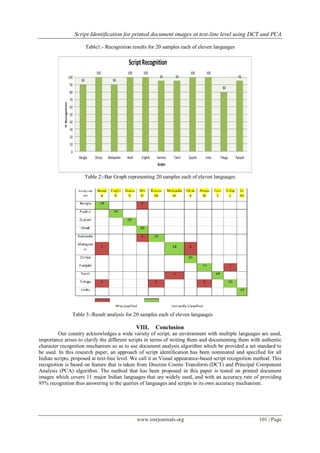
VII. Experimental Results And Analysis
Figure .3: Example of text-line image of each Language](https://image.slidesharecdn.com/q012597102-140430234848-phpapp02/85/Script-Identification-for-printed-document-images-at-text-line-level-using-DCT-and-PCA-4-320.jpg)
![Script Identification for printed document images at text-line level using DCT and PCA
www.iosrjournals.org 102 | Page
References
[1] Ta Steinherz, Ehud Rivlin, Nathan Intrator, Offline cursive script word recognition: a survey, International journal on Document
Analysis and Recognition, IJDAR (1999) 2: 90-110.
[2] Debashis Ghosh, Tulika Dube, and Adamane P. Shivaprasad, Script Recognition—A Review, IEEE Transactions On Pattern
Analysis And Machine Intelligence, Vol. 32, No. 12, December 2010
[3] S Madhvanath, G Kim, V Govindaraju, .Chaincode Contour Processing for Handwritten Word Recognition. IEEE transactions on
pattern analysis and machine intelligence, 1996, Vol 21 , No 9, pg 928 . 932.
[4] U. Pal and B. B. Chaudhuri, Indian script character recognition: a survey Pattern Recognition, Volume 37, Issue 9, September 2004,
Pages 1887-1899.
[5] F. Coulmas, The Blackwell Encyclopedia of Writing Systems, Blackwell Publishers, Oxford, 1996.
[6] C. Ronse and P.A. Devijver, Connected Components in Binary Images: The Detection Problem, John Wiley & Sons, New York,
1984.
[7] U. Pal and B.B. Chaudhuri, “Script Line Separation from Indian Multi-script Documents,” Proc. Int’l Conf. Document Analysis &
Recognition, Bangalore, pp. 406-409, Sep. 1999.
[8] U. Pal and B.B. Chaudhuri, “Identification of Different Script Lines from Multi-script Documents,” Image & Vision Computing,
vol. 20, no. 13-14, pp. 945-954, Dec. 2002.
[9] U. Pal, S. Sinha, and B.B. Chaudhuri, “Multi-script Line Identification from Indian Documents,” Proc. Int’l Conf. Document
Analysis & Recognition, Edinburgh, pp. 880-884, Aug. 2003.
[10] In 2006 G.D. Joshi, S. Garg, and J. Sivaswamy, “Script and Nature Differentiation for Arabic and Latin Text Images,” Proc. Int’l
Workshop Frontiers in Handwriting Recognition, Niagra, pp. 309-313, Aug. 2002.
[11] DOC493: Intelligent Data Analysis and Probabilistic Interference Lecture 15.
[12] D. Ghosh and A.P. Shivaprasad, “An Analytic Approach for Generation of Artificial Handprinted Character Database from Given
Generative Models,” Pattern Recognition, vol. 32, no. 6, pp. 907-920, Jun. 1999.
[13] C.L. Tan, P.Y. Leong, and S. He, “Language Identification in Multilingual Documents,” Proc. Int’l Symp. Intelligent Multimedia &
Distance Education, Baden-Baden, pp. 59-64, Aug. 1999.](https://image.slidesharecdn.com/q012597102-140430234848-phpapp02/85/Script-Identification-for-printed-document-images-at-text-line-level-using-DCT-and-PCA-6-320.jpg)

This document summarizes a research paper that proposes a script identification approach for Indian scripts at the text-line level of printed documents. The approach uses visual appearance-based recognition by extracting features from text lines using Discrete Cosine Transform (DCT) and Principal Component Analysis (PCA). These features are classified using a Modified K-Nearest Neighbor algorithm. The method achieves 95% accuracy in recognizing 11 major Indian languages and discusses the importance of script identification in multilingual environments like India for applications such as optical character recognition.


