Types Of Operator In Python
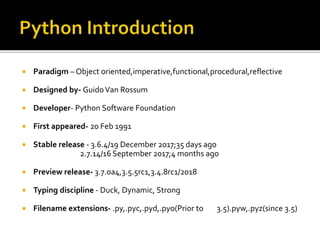
 Paradigm – Object oriented,imperative,functional,procedural,reflective
 Designed by- GuidoVan Rossum
 Developer- Python Software Foundation
 First appeared- 20 Feb 1991
 Stable release - 3.6.4/19 December 2017;35 days ago
2.7.14/16 September 2017;4 months ago
 Preview release- 3.7.0a4,3.5.5rc1,3.4.8rc1/2018
 Typing discipline - Duck, Dynamic, Strong
 Filename extensions- .py,.pyc,.pyd,.pyo(Prior to 3.5).pyw,.pyz(since 3.5)
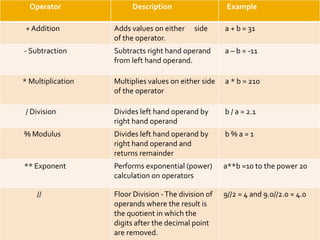
Operator Description Example
+ Addition Adds values on either side
of the operator.
a + b = 31
- Subtraction Subtracts right hand operand
from left hand operand.
a – b = -11
* Multiplication Multiplies values on either side
of the operator
a * b = 210
/ Division Divides left hand operand by
right hand operand
b / a = 2.1
% Modulus Divides left hand operand by
right hand operand and
returns remainder
b % a = 1
** Exponent Performs exponential (power)
calculation on operators
a**b =10 to the power 20
// Floor Division -The division of
operands where the result is
the quotient in which the
digits after the decimal point
are removed.
9//2 = 4 and 9.0//2.0 = 4.0
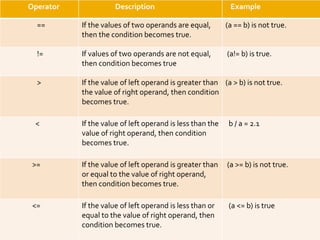
Operator Description Example
== If the values of two operands are equal,
then the condition becomes true.
(a == b) is not true.
!= If values of two operands are not equal,
then condition becomes true
(a!= b) is true.
> If the value of left operand is greater than
the value of right operand, then condition
becomes true.
(a > b) is not true.
< If the value of left operand is less than the
value of right operand, then condition
becomes true.
b / a = 2.1
>= If the value of left operand is greater than
or equal to the value of right operand,
then condition becomes true.
(a >= b) is not true.
<= If the value of left operand is less than or
equal to the value of right operand, then
condition becomes true.
(a <= b) is true
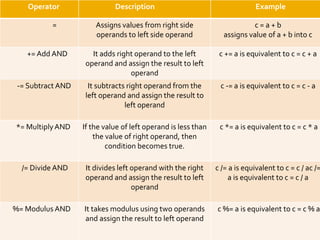
Operator Description Example
= Assigns values from right side
operands to left side operand
c = a + b
assigns value of a + b into c
+= Add AND It adds right operand to the left
operand and assign the result to left
operand
c += a is equivalent to c = c + a
-= Subtract AND It subtracts right operand from the
left operand and assign the result to
left operand
c -= a is equivalent to c = c - a
*= MultiplyAND If the value of left operand is less than
the value of right operand, then
condition becomes true.
c *= a is equivalent to c = c * a
/= Divide AND It divides left operand with the right
operand and assign the result to left
operand
c /= a is equivalent to c = c / ac /=
a is equivalent to c = c / a
%= Modulus AND It takes modulus using two operands
and assign the result to left operand
c %= a is equivalent to c = c % a
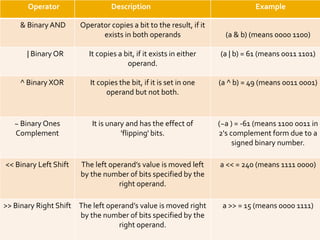
Operator Description Example
& Binary AND Operator copies a bit to the result, if it
exists in both operands (a & b) (means 0000 1100)
| Binary OR It copies a bit, if it exists in either
operand.
(a | b) = 61 (means 0011 1101)
^ Binary XOR It copies the bit, if it is set in one
operand but not both.
(a ^ b) = 49 (means 0011 0001)
~ Binary Ones
Complement
It is unary and has the effect of
'flipping' bits.
(~a ) = -61 (means 1100 0011 in
2's complement form due to a
signed binary number.
<< Binary Left Shift The left operand’s value is moved left
by the number of bits specified by the
right operand.
a << = 240 (means 1111 0000)
>> Binary Right Shift The left operand’s value is moved right
by the number of bits specified by the
right operand.
a >> = 15 (means 0000 1111)
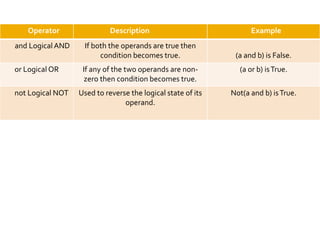
Operator Description Example
and LogicalAND If both the operands are true then
condition becomes true. (a and b) is False.
or Logical OR If any of the two operands are non-
zero then condition becomes true.
(a or b) isTrue.
not Logical NOT Used to reverse the logical state of its
operand.
Not(a and b) isTrue.
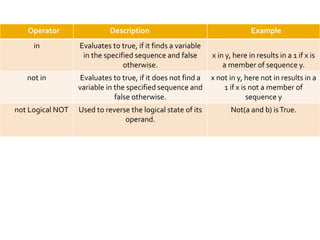
Operator Description Example
in Evaluates to true, if it finds a variable
in the specified sequence and false
otherwise.
x in y, here in results in a 1 if x is
a member of sequence y.
not in Evaluates to true, if it does not find a
variable in the specified sequence and
false otherwise.
x not in y, here not in results in a
1 if x is not a member of
sequence y
not Logical NOT Used to reverse the logical state of its
operand.
Not(a and b) isTrue.
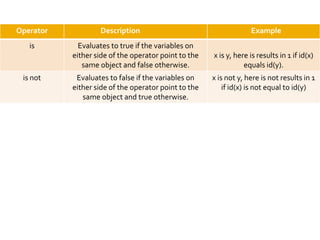
Operator Description Example
is Evaluates to true if the variables on
either side of the operator point to the
same object and false otherwise.
x is y, here is results in 1 if id(x)
equals id(y).
is not Evaluates to false if the variables on
either side of the operator point to the
same object and true otherwise.
x is not y, here is not results in 1
if id(x) is not equal to id(y)
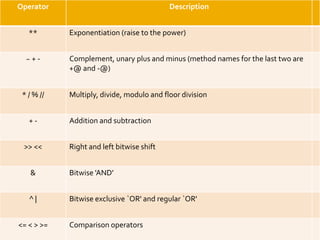
Operator Description
** Exponentiation (raise to the power)
~ + - Complement, unary plus and minus (method names for the last two are
+@ and -@)
* / % // Multiply, divide, modulo and floor division
+ - Addition and subtraction
>> << Right and left bitwise shift
& Bitwise 'AND'
^ | Bitwise exclusive `OR' and regular `OR'
<= < > >= Comparison operators
 Founded in 2014,IQ enrolled over 5798 student
trainings world wide, helping the needs of
corporate clients and individuals
 IQ offers FlexibleTraining LiveVirtual online &
One to One trainings Sessions.
 IQ offers trainings over 400Technical courses
 IQ deliversTrainings by Subject Matter Experts
with over 10 years of Experience and
professional working in MNC companies
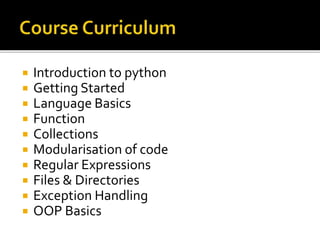
 Introduction to python
 Getting Started
 Language Basics
 Function
 Collections
 Modularisation of code
 Regular Expressions
 Files & Directories
 Exception Handling
 OOP Basics
 Python is an essential component to become a
Data Scientist, the “Sexiest job” of the 21st
Century (Harvard Business Review).
 According to theTIOBE index, Python is one of
the most popular programming languages in the
world.
 Due to high demand and shortage of skilled
professionals,
 Python offers a hugely rewarding career with a
data science
 professional earning up to $150,000 per year
(Pay Scale Human Capital).
 Web Developers
 Full Stack Developers
 UI developers andTechnical Leads
 QAs,Architects andTechnical Project
Managers.
Certification
Preparation
Job Support
Interview
Help
Lifetime
Access and
24/7 Support
ThankYou!
Get In touch
Call:-
+17325938450 &
+19043042519
info@iqtrainings.com

Python tutorials for beginners | IQ Online Training

  • 1.
  • 2.
     Paradigm –Object oriented,imperative,functional,procedural,reflective  Designed by- GuidoVan Rossum  Developer- Python Software Foundation  First appeared- 20 Feb 1991  Stable release - 3.6.4/19 December 2017;35 days ago 2.7.14/16 September 2017;4 months ago  Preview release- 3.7.0a4,3.5.5rc1,3.4.8rc1/2018  Typing discipline - Duck, Dynamic, Strong  Filename extensions- .py,.pyc,.pyd,.pyo(Prior to 3.5).pyw,.pyz(since 3.5)
  • 3.
    Operator Description Example +Addition Adds values on either side of the operator. a + b = 31 - Subtraction Subtracts right hand operand from left hand operand. a – b = -11 * Multiplication Multiplies values on either side of the operator a * b = 210 / Division Divides left hand operand by right hand operand b / a = 2.1 % Modulus Divides left hand operand by right hand operand and returns remainder b % a = 1 ** Exponent Performs exponential (power) calculation on operators a**b =10 to the power 20 // Floor Division -The division of operands where the result is the quotient in which the digits after the decimal point are removed. 9//2 = 4 and 9.0//2.0 = 4.0
  • 4.
    Operator Description Example ==If the values of two operands are equal, then the condition becomes true. (a == b) is not true. != If values of two operands are not equal, then condition becomes true (a!= b) is true. > If the value of left operand is greater than the value of right operand, then condition becomes true. (a > b) is not true. < If the value of left operand is less than the value of right operand, then condition becomes true. b / a = 2.1 >= If the value of left operand is greater than or equal to the value of right operand, then condition becomes true. (a >= b) is not true. <= If the value of left operand is less than or equal to the value of right operand, then condition becomes true. (a <= b) is true
  • 5.
    Operator Description Example =Assigns values from right side operands to left side operand c = a + b assigns value of a + b into c += Add AND It adds right operand to the left operand and assign the result to left operand c += a is equivalent to c = c + a -= Subtract AND It subtracts right operand from the left operand and assign the result to left operand c -= a is equivalent to c = c - a *= MultiplyAND If the value of left operand is less than the value of right operand, then condition becomes true. c *= a is equivalent to c = c * a /= Divide AND It divides left operand with the right operand and assign the result to left operand c /= a is equivalent to c = c / ac /= a is equivalent to c = c / a %= Modulus AND It takes modulus using two operands and assign the result to left operand c %= a is equivalent to c = c % a
  • 6.
    Operator Description Example &Binary AND Operator copies a bit to the result, if it exists in both operands (a & b) (means 0000 1100) | Binary OR It copies a bit, if it exists in either operand. (a | b) = 61 (means 0011 1101) ^ Binary XOR It copies the bit, if it is set in one operand but not both. (a ^ b) = 49 (means 0011 0001) ~ Binary Ones Complement It is unary and has the effect of 'flipping' bits. (~a ) = -61 (means 1100 0011 in 2's complement form due to a signed binary number. << Binary Left Shift The left operand’s value is moved left by the number of bits specified by the right operand. a << = 240 (means 1111 0000) >> Binary Right Shift The left operand’s value is moved right by the number of bits specified by the right operand. a >> = 15 (means 0000 1111)
  • 7.
    Operator Description Example andLogicalAND If both the operands are true then condition becomes true. (a and b) is False. or Logical OR If any of the two operands are non- zero then condition becomes true. (a or b) isTrue. not Logical NOT Used to reverse the logical state of its operand. Not(a and b) isTrue.
  • 8.
    Operator Description Example inEvaluates to true, if it finds a variable in the specified sequence and false otherwise. x in y, here in results in a 1 if x is a member of sequence y. not in Evaluates to true, if it does not find a variable in the specified sequence and false otherwise. x not in y, here not in results in a 1 if x is not a member of sequence y not Logical NOT Used to reverse the logical state of its operand. Not(a and b) isTrue.
  • 9.
    Operator Description Example isEvaluates to true if the variables on either side of the operator point to the same object and false otherwise. x is y, here is results in 1 if id(x) equals id(y). is not Evaluates to false if the variables on either side of the operator point to the same object and true otherwise. x is not y, here is not results in 1 if id(x) is not equal to id(y)
  • 10.
    Operator Description ** Exponentiation(raise to the power) ~ + - Complement, unary plus and minus (method names for the last two are +@ and -@) * / % // Multiply, divide, modulo and floor division + - Addition and subtraction >> << Right and left bitwise shift & Bitwise 'AND' ^ | Bitwise exclusive `OR' and regular `OR' <= < > >= Comparison operators
  • 11.
     Founded in2014,IQ enrolled over 5798 student trainings world wide, helping the needs of corporate clients and individuals  IQ offers FlexibleTraining LiveVirtual online & One to One trainings Sessions.  IQ offers trainings over 400Technical courses  IQ deliversTrainings by Subject Matter Experts with over 10 years of Experience and professional working in MNC companies
  • 12.
     Introduction topython  Getting Started  Language Basics  Function  Collections  Modularisation of code  Regular Expressions  Files & Directories  Exception Handling  OOP Basics
  • 13.
     Python isan essential component to become a Data Scientist, the “Sexiest job” of the 21st Century (Harvard Business Review).  According to theTIOBE index, Python is one of the most popular programming languages in the world.  Due to high demand and shortage of skilled professionals,  Python offers a hugely rewarding career with a data science  professional earning up to $150,000 per year (Pay Scale Human Capital).
  • 14.
     Web Developers Full Stack Developers  UI developers andTechnical Leads  QAs,Architects andTechnical Project Managers.
  • 15.
  • 16.
    ThankYou! Get In touch Call:- +17325938450& +19043042519 info@iqtrainings.com