RUBY
OPERATORS
Hoang Quan(BlazingRockStorm)
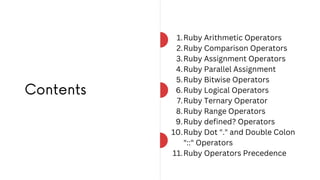
Contents
Ruby Arithmetic Operators
1.
Ruby Comparison Operators
2.
Ruby Assignment Operators
3.
Ruby Parallel Assignment
4.
Ruby Bitwise Operators
5.
Ruby Logical Operators
6.
Ruby Ternary Operator
7.
Ruby Range Operators
8.
Ruby defined? Operators
9.
Ruby Dot "." and Double Colon
"::" Operators
10.
Ruby Operators Precedence
11.
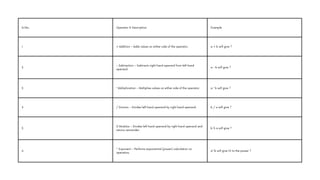
Arithmetic Operators
Sr.No. Operator & Description Example
1 + Addition − Adds values on either side of the operator. a + b will give ?
2
− Subtraction − Subtracts right hand operand from left hand
operand.
a - b will give ?
3 * Multiplication − Multiplies values on either side of the operator. a * b will give ?
4 / Division − Divides left hand operand by right hand operand. b / a will give ?
5
% Modulus − Divides left hand operand by right hand operand and
returns remainder.
b % a will give ?
6
** Exponent − Performs exponential (power) calculation on
operators.
a**b will give 10 to the power ?
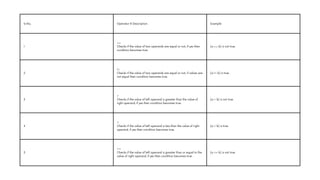
Comparison Operators
Sr.No. Operator & Description Example
1
==
Checks if the value of two operands are equal or not, if yes then
condition becomes true.
(a == b) is not true.
2
!=
Checks if the value of two operands are equal or not, if values are
not equal then condition becomes true.
(a != b) is true.
3
>
Checks if the value of left operand is greater than the value of
right operand, if yes then condition becomes true.
(a > b) is not true.
4
<
Checks if the value of left operand is less than the value of right
operand, if yes then condition becomes true.
(a < b) is true.
5
>=
Checks if the value of left operand is greater than or equal to the
value of right operand, if yes then condition becomes true.
(a >= b) is not true.
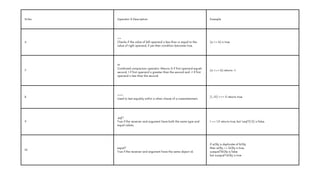
Sr.No. Operator & Description Example
6
<=
Checks if the value of left operand is less than or equal to the
value of right operand, if yes then condition becomes true.
(a <= b) is true.
7
⇔
Combined comparison operator. Returns 0 if first operand equals
second, 1 if first operand is greater than the second and -1 if first
operand is less than the second.
(a <=> b) returns -1.
8
===
Used to test equality within a when clause of a casestatement.
(1...10) === 5 returns true.
9
.eql?
True if the receiver and argument have both the same type and
equal values.
1 == 1.0 returns true, but 1.eql?(1.0) is false.
10
equal?
True if the receiver and argument have the same object id.
if aObj is duplicate of bObj
then aObj == bObj is true,
a.equal?bObj is false
but a.equal?aObj is true
Assignment Operators
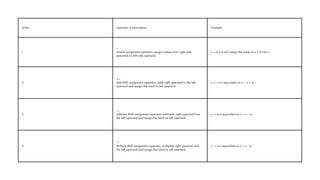
Sr.No. Operator & Description Example
1
=
Simple assignment operator, assigns values from right side
operands to left side operand.
c = a + b will assign the value of a + b into c
2
+=
Add AND assignment operator, adds right operand to the left
operand and assign the result to left operand.
c += a is equivalent to c = c + a
3
-=
Subtract AND assignment operator, subtracts right operand from
the left operand and assign the result to left operand.
c -= a is equivalent to c = c - a
4
*=
Multiply AND assignment operator, multiplies right operand with
the left operand and assign the result to left operand.
c *= a is equivalent to c = c * a
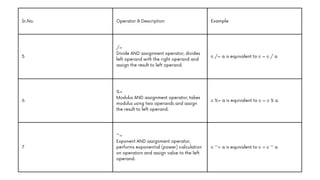
Sr.No. Operator & Description Example
5
/=
Divide AND assignment operator, divides
left operand with the right operand and
assign the result to left operand.
c /= a is equivalent to c = c / a
6
%=
Modulus AND assignment operator, takes
modulus using two operands and assign
the result to left operand.
c %= a is equivalent to c = c % a
7
**=
Exponent AND assignment operator,
performs exponential (power) calculation
on operators and assign value to the left
operand.
c **= a is equivalent to c = c ** a
Parallel Assignment
Parallel Assignment
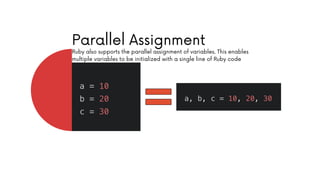
Ruby also supports the parallel assignment of variables. This enables
multiple variables to be initialized with a single line of Ruby code
Parallel Assignment
Parallel assignment is also useful for swapping the values held in two
variables −
Bitwise Operators
Bitwise Operators
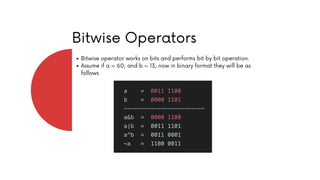
Bitwise operator works on bits and performs bit by bit operation.
Assume if a = 60; and b = 13; now in binary format they will be as
follows
Sr.No. Operator & Description Example
1
&
Binary AND Operator copies a bit to the result if it exists in both
operands.
(a & b) will give 12, which is 0000 1100
2
|
Binary OR Operator copies a bit if it exists in either operand.
(a | b) will give 61, which is 0011 1101
3
^
Binary XOR Operator copies the bit if it is set in one operand but
not both.
(a ^ b) will give 49, which is 0011 0001
Sr.No. Operator & Description Example
4
~
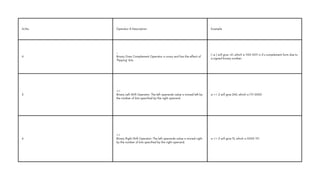
Binary Ones Complement Operator is unary and has the effect of
'flipping' bits.
(~a ) will give -61, which is 1100 0011 in 2's complement form due to
a signed binary number.
5
<<
Binary Left Shift Operator. The left operands value is moved left by
the number of bits specified by the right operand.
a << 2 will give 240, which is 1111 0000
6
>>
Binary Right Shift Operator. The left operands value is moved right
by the number of bits specified by the right operand.
a >> 2 will give 15, which is 0000 1111
Logical Operators
Sr.No. Operator & Description Example
1
and
Called Logical AND operator. If both the operands are true, then
the condition becomes true.
(a and b) is true.
2
or
Called Logical OR Operator. If any of the two operands are non
zero, then the condition becomes true.
(a or b) is true.
3
&&
Called Logical AND operator. If both the operands are non zero,
then the condition becomes true.
(a && b) is true.
Sr.No. Operator & Description Example
4
||
Called Logical OR Operator. If any of the two operands are non
zero, then the condition becomes true.
(a || b) is true.
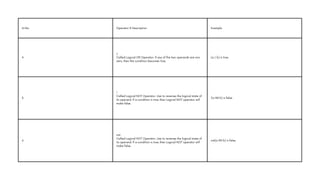
5
!
Called Logical NOT Operator. Use to reverses the logical state of
its operand. If a condition is true, then Logical NOT operator will
make false.
!(a && b) is false.
6
not
Called Logical NOT Operator. Use to reverses the logical state of
its operand. If a condition is true, then Logical NOT operator will
make false.
not(a && b) is false.
Ternary Operator
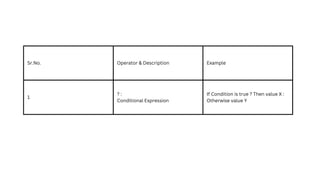
Sr.No. Operator & Description Example
1
? :
Conditional Expression
If Condition is true ? Then value X :
Otherwise value Y
Range Operators
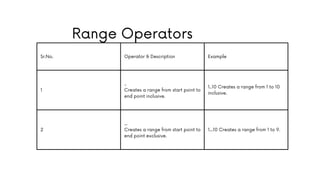
Sr.No. Operator & Description Example
1
..
Creates a range from start point to
end point inclusive.
1..10 Creates a range from 1 to 10
inclusive.
2
...
Creates a range from start point to
end point exclusive.
1...10 Creates a range from 1 to 9.
Range Operators
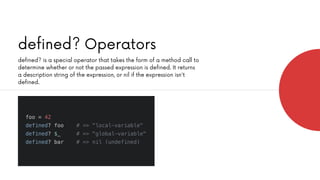
defined? Operators
defined? Operators
defined? is a special operator that takes the form of a method call to
determine whether or not the passed expression is defined. It returns
a description string of the expression, or nil if the expression isn't
defined.
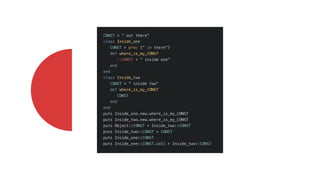
Dot "." and Double Colon
"::" Operators
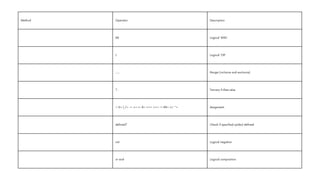
Operators Precedence
Method Operator Description
&& Logical 'AND'
|| Logical 'OR'
.. ... Range (inclusive and exclusive)
? : Ternary if-then-else
= %= { /= -= += |= &= >>= <<= *= &&= ||= **= Assignment
defined? Check if specified symbol defined
not Logical negation
or and Logical composition
Thank you!
ありがとうございます!

04. Ruby Operators Slides - Ruby Core Teaching

  • 1.
  • 2.
    Contents Ruby Arithmetic Operators 1. RubyComparison Operators 2. Ruby Assignment Operators 3. Ruby Parallel Assignment 4. Ruby Bitwise Operators 5. Ruby Logical Operators 6. Ruby Ternary Operator 7. Ruby Range Operators 8. Ruby defined? Operators 9. Ruby Dot "." and Double Colon "::" Operators 10. Ruby Operators Precedence 11.
  • 3.
  • 4.
    Sr.No. Operator &Description Example 1 + Addition − Adds values on either side of the operator. a + b will give ? 2 − Subtraction − Subtracts right hand operand from left hand operand. a - b will give ? 3 * Multiplication − Multiplies values on either side of the operator. a * b will give ? 4 / Division − Divides left hand operand by right hand operand. b / a will give ? 5 % Modulus − Divides left hand operand by right hand operand and returns remainder. b % a will give ? 6 ** Exponent − Performs exponential (power) calculation on operators. a**b will give 10 to the power ?
  • 5.
  • 6.
    Sr.No. Operator &Description Example 1 == Checks if the value of two operands are equal or not, if yes then condition becomes true. (a == b) is not true. 2 != Checks if the value of two operands are equal or not, if values are not equal then condition becomes true. (a != b) is true. 3 > Checks if the value of left operand is greater than the value of right operand, if yes then condition becomes true. (a > b) is not true. 4 < Checks if the value of left operand is less than the value of right operand, if yes then condition becomes true. (a < b) is true. 5 >= Checks if the value of left operand is greater than or equal to the value of right operand, if yes then condition becomes true. (a >= b) is not true.
  • 7.
    Sr.No. Operator &Description Example 6 <= Checks if the value of left operand is less than or equal to the value of right operand, if yes then condition becomes true. (a <= b) is true. 7 ⇔ Combined comparison operator. Returns 0 if first operand equals second, 1 if first operand is greater than the second and -1 if first operand is less than the second. (a <=> b) returns -1. 8 === Used to test equality within a when clause of a casestatement. (1...10) === 5 returns true. 9 .eql? True if the receiver and argument have both the same type and equal values. 1 == 1.0 returns true, but 1.eql?(1.0) is false. 10 equal? True if the receiver and argument have the same object id. if aObj is duplicate of bObj then aObj == bObj is true, a.equal?bObj is false but a.equal?aObj is true
  • 8.
  • 9.
    Sr.No. Operator &Description Example 1 = Simple assignment operator, assigns values from right side operands to left side operand. c = a + b will assign the value of a + b into c 2 += Add AND assignment operator, adds right operand to the left operand and assign the result to left operand. c += a is equivalent to c = c + a 3 -= Subtract AND assignment operator, subtracts right operand from the left operand and assign the result to left operand. c -= a is equivalent to c = c - a 4 *= Multiply AND assignment operator, multiplies right operand with the left operand and assign the result to left operand. c *= a is equivalent to c = c * a
  • 10.
    Sr.No. Operator &Description Example 5 /= Divide AND assignment operator, divides left operand with the right operand and assign the result to left operand. c /= a is equivalent to c = c / a 6 %= Modulus AND assignment operator, takes modulus using two operands and assign the result to left operand. c %= a is equivalent to c = c % a 7 **= Exponent AND assignment operator, performs exponential (power) calculation on operators and assign value to the left operand. c **= a is equivalent to c = c ** a
  • 11.
  • 12.
    Parallel Assignment Ruby alsosupports the parallel assignment of variables. This enables multiple variables to be initialized with a single line of Ruby code
  • 13.
    Parallel Assignment Parallel assignmentis also useful for swapping the values held in two variables −
  • 14.
  • 15.
    Bitwise Operators Bitwise operatorworks on bits and performs bit by bit operation. Assume if a = 60; and b = 13; now in binary format they will be as follows
  • 16.
    Sr.No. Operator &Description Example 1 & Binary AND Operator copies a bit to the result if it exists in both operands. (a & b) will give 12, which is 0000 1100 2 | Binary OR Operator copies a bit if it exists in either operand. (a | b) will give 61, which is 0011 1101 3 ^ Binary XOR Operator copies the bit if it is set in one operand but not both. (a ^ b) will give 49, which is 0011 0001
  • 17.
    Sr.No. Operator &Description Example 4 ~ Binary Ones Complement Operator is unary and has the effect of 'flipping' bits. (~a ) will give -61, which is 1100 0011 in 2's complement form due to a signed binary number. 5 << Binary Left Shift Operator. The left operands value is moved left by the number of bits specified by the right operand. a << 2 will give 240, which is 1111 0000 6 >> Binary Right Shift Operator. The left operands value is moved right by the number of bits specified by the right operand. a >> 2 will give 15, which is 0000 1111
  • 18.
  • 19.
    Sr.No. Operator &Description Example 1 and Called Logical AND operator. If both the operands are true, then the condition becomes true. (a and b) is true. 2 or Called Logical OR Operator. If any of the two operands are non zero, then the condition becomes true. (a or b) is true. 3 && Called Logical AND operator. If both the operands are non zero, then the condition becomes true. (a && b) is true.
  • 20.
    Sr.No. Operator &Description Example 4 || Called Logical OR Operator. If any of the two operands are non zero, then the condition becomes true. (a || b) is true. 5 ! Called Logical NOT Operator. Use to reverses the logical state of its operand. If a condition is true, then Logical NOT operator will make false. !(a && b) is false. 6 not Called Logical NOT Operator. Use to reverses the logical state of its operand. If a condition is true, then Logical NOT operator will make false. not(a && b) is false.
  • 21.
  • 22.
    Sr.No. Operator &Description Example 1 ? : Conditional Expression If Condition is true ? Then value X : Otherwise value Y
  • 23.
  • 24.
    Sr.No. Operator &Description Example 1 .. Creates a range from start point to end point inclusive. 1..10 Creates a range from 1 to 10 inclusive. 2 ... Creates a range from start point to end point exclusive. 1...10 Creates a range from 1 to 9. Range Operators
  • 25.
  • 26.
    defined? Operators defined? isa special operator that takes the form of a method call to determine whether or not the passed expression is defined. It returns a description string of the expression, or nil if the expression isn't defined.
  • 27.
    Dot "." andDouble Colon "::" Operators
  • 29.
  • 30.
    Method Operator Description &&Logical 'AND' || Logical 'OR' .. ... Range (inclusive and exclusive) ? : Ternary if-then-else = %= { /= -= += |= &= >>= <<= *= &&= ||= **= Assignment defined? Check if specified symbol defined not Logical negation or and Logical composition
  • 31.