PYTHON
CREATED BY
RADHIKA ADROJA
What Is Python ?
 Python is a popular programming Language. python is
dynamic,high-level ,interpreated programming language .
 It was created by Guido Van Rossum and released in 1991.
 It is simple and easy to learn and provides lost of high-level data
structures.
 It is used for :
1) web development (server-side),
2)software development,
3)mathematics,
4)system scripting.
Why Python?
 Python works on different platforms (Windows, Mac, Linux, Raspberry Pi, etc).
 Python has a simple syntax similar to the English language.
 Python allows a developer to write programs with fewer lines than some other
programming languages.
 Python runs on an interpreter system, means that the code can be executed as
soon as it is written. It helps to provide a prototype very quickly.
 Python can be treated in a procedural way, an object-oriented way or a functional
way.
Application Of python
Python is used in various software domains some application areas are given below:
 Web and Internet Development
 Games
 Scientific and computational applications
 Language development
 Image processing and graphic design applications
 Enterprise and business applications development
 Operating systems
 GUI based desktop applications
Advantages of Python
 Interpreted: Python is an interpreted language. It does not require prior
compilation of code and executes instructions directly.
 Free and open source: It is an open source project which is publicly available to
reuse. It can be downloaded free of cost.
 Portable: Python programs can run on cross platforms without affecting its
performance.
 Extensible: It is very flexible and extensible with any module.
 Object-oriented: Python allows to implement the Object Oriented concepts to
build application solution.
 Built-in data structure: Tuple, List, and Dictionary are useful integrated data
structures provided by the language.
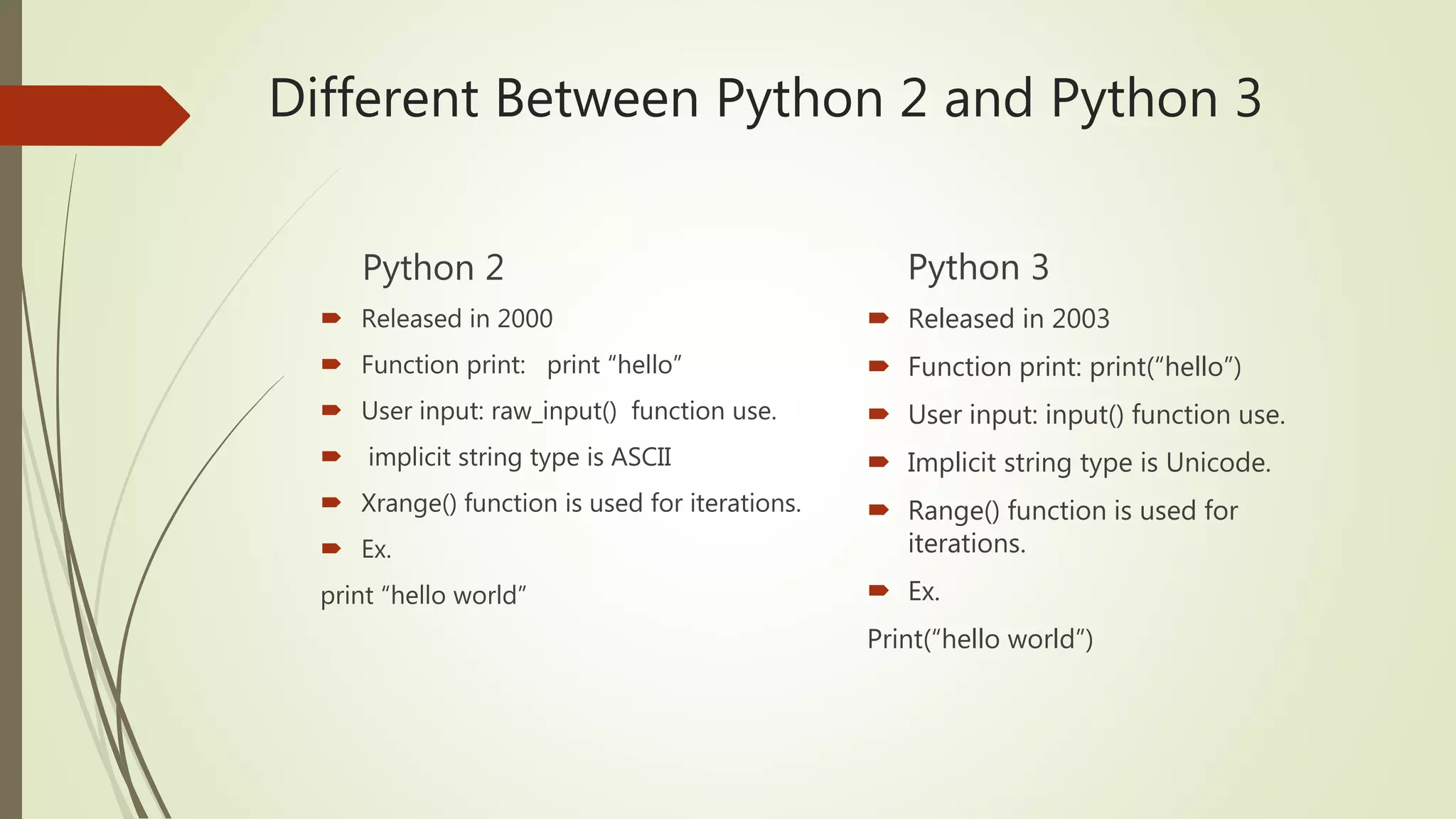
Different Between Python 2 and Python 3
Python 2
 Released in 2000
 Function print: print “hello”
 User input: raw_input() function use.
 implicit string type is ASCII
 Xrange() function is used for iterations.
 Ex.
print “hello world”
Python 3
 Released in 2003
 Function print: print(“hello”)
 User input: input() function use.
 Implicit string type is Unicode.
 Range() function is used for
iterations.
 Ex.
Print(“hello world”)
Python comments
 Comments can be used to explain Python code.
 Comments can be used to make the code more readable.
 Comments can be used to prevent execution when testing code.
 Comments start with # .
 Ex.
#this is example
Print(“hello world”)
Python basic

Python basic

  • 1.
  • 2.
    What Is Python?  Python is a popular programming Language. python is dynamic,high-level ,interpreated programming language .  It was created by Guido Van Rossum and released in 1991.  It is simple and easy to learn and provides lost of high-level data structures.  It is used for : 1) web development (server-side), 2)software development, 3)mathematics, 4)system scripting.
  • 3.
    Why Python?  Pythonworks on different platforms (Windows, Mac, Linux, Raspberry Pi, etc).  Python has a simple syntax similar to the English language.  Python allows a developer to write programs with fewer lines than some other programming languages.  Python runs on an interpreter system, means that the code can be executed as soon as it is written. It helps to provide a prototype very quickly.  Python can be treated in a procedural way, an object-oriented way or a functional way.
  • 4.
    Application Of python Pythonis used in various software domains some application areas are given below:  Web and Internet Development  Games  Scientific and computational applications  Language development  Image processing and graphic design applications  Enterprise and business applications development  Operating systems  GUI based desktop applications
  • 5.
    Advantages of Python Interpreted: Python is an interpreted language. It does not require prior compilation of code and executes instructions directly.  Free and open source: It is an open source project which is publicly available to reuse. It can be downloaded free of cost.  Portable: Python programs can run on cross platforms without affecting its performance.  Extensible: It is very flexible and extensible with any module.  Object-oriented: Python allows to implement the Object Oriented concepts to build application solution.  Built-in data structure: Tuple, List, and Dictionary are useful integrated data structures provided by the language.
  • 6.
    Different Between Python2 and Python 3 Python 2  Released in 2000  Function print: print “hello”  User input: raw_input() function use.  implicit string type is ASCII  Xrange() function is used for iterations.  Ex. print “hello world” Python 3  Released in 2003  Function print: print(“hello”)  User input: input() function use.  Implicit string type is Unicode.  Range() function is used for iterations.  Ex. Print(“hello world”)
  • 7.
    Python comments  Commentscan be used to explain Python code.  Comments can be used to make the code more readable.  Comments can be used to prevent execution when testing code.  Comments start with # .  Ex. #this is example Print(“hello world”)