Python Programming History
Origins and
Conception
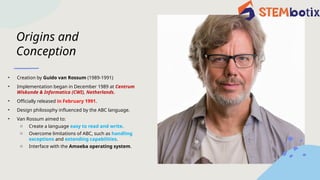
• Creation by Guido van Rossum (1989-1991)
• Implementation began in December 1989 at Centrum
Wiskunde & Informatica (CWI), Netherlands.
• Officially released in February 1991.
• Design philosophy influenced by the ABC language.
• Van Rossum aimed to:
o Create a language easy to read and write.
o Overcome limitations of ABC, such as handling
exceptions and extending capabilities.
o Interface with the Amoeba operating system.
Early Development
and Features
• Python 1.0 Release (1991)
• included several key features that
distinguished it from other languages
of the time
o Exception handling
o Functions and modules
o Dynamic typing
o Automatic memory management
Early Development and
Features
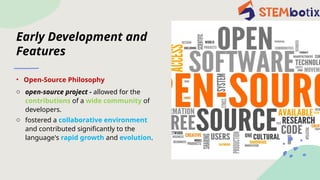
• Open-Source Philosophy
o open-source project - allowed for the
contributions of a wide community of
developers.
o fostered a collaborative environment
and contributed significantly to the
language's rapid growth and evolution.
Evolution and Major Releases
• Python 2.0 Release (2000)
• Introduced in 2000 with new features:
• List comprehensions: Concise list creation.
• Garbage collection: Automated memory management
• Unicode support: Improved handling of international text.
• Python 3.0 Release (2008)
• Released in December 2008 as "Python 3000" or "Py3k":
• Print function: Changed to a function from a statement.
• Integer division: Division operator (/) always returns a floating-point number.
• Text and data handling: Enhanced Unicode support, clearer distinction between binary data and
text.
Evolution and Major Releases
• Transition from Python 2 to Python 3
• Significant transition with backward-incompatible changes:
• Required codebase refactoring.
• Dual maintenance of Python 2 and Python 3 versions.
• Python 2.7 marked the end of the 2.x series.
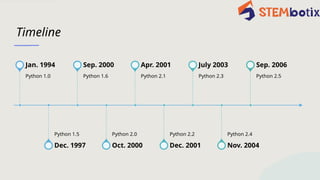
Timeline
Python 1.0
Jan. 1994
Python 1.5
Dec. 1997
Python 1.6
Sep. 2000
Python 2.0
Oct. 2000
Python 2.1
Apr. 2001
Python 2.2
Dec. 2001
Python 2.3
July 2003
Python 2.4
Nov. 2004
Python 2.5
Sep. 2006
Timeline
Python 3.0
Dec. 2008
Python 3.1
June 2009
Python 3.2
Feb. 2011
Python 3.4
Mar. 2014
Python 3.5
Sep. 2015
Python 3.6
Dec. 2016
Python 3.7
June 2018
Python 3.7.3
Mar. 2019
Python 3.x Enhancements
● Python 3.5 (2015): Python 3.5 introduced several new features that improved the language’s
capabilities:
○ Introduced asynchronous I/O support.
○ Allowed for static type checking.
○ Introduced the @ operator for matrix multiplication.
● Python 3.6 (2016): Python 3.6 added:
○ Formatted string literals (f-strings)
○ Improved readability of large numbers.
● Python 3.7 (2018): Python 3.7 included:
○ Simplified the creation of classes used to store data.
○ Improved support for forward references and better performance.
Python 3.x Enhancements
● Python 3.8 (2019) and 3.9 (2020):
○ Allowed assignments within expressions.
○ Enabled function arguments to be positional-only, enhancing API design.
● Python 3.10 (2021) and 3.11 (2022): Further refined the language with features like:
○ Introduced a more expressive and concise way to handle conditional logic.
○ Improved diagnostics for syntax and runtime errors.
Python’s Impact and Popularity
 Versatility and Use Cases
•Python is widely used across various domains:
•Web Development:
•Data Science and Machine Learning
•Automation and Scripting:
 Educational Adoption
•Python is simple and readable
 Community and Ecosystem
•large and active community:
•rich ecosystem of libraries, frameworks, and tools.
•Enhances capabilities and maintains relevance in the evolving tech landscape.
Key Influences and Future Direction
 Philosophical Influence
•Python's design philosophy, "Zen of Python" by Tim Peters:
•Emphasizes readability, simplicity, and explicit code.
 Ongoing Development
•Python evolves through:
•Active Python Enhancement Proposal (PEP) process for new features.
•Guided by the Python Software Foundation (PSF) for growth and maintenance.
Key Influences and Future Direction
 Anticipated Trends
•Future of Python likely includes:
•Enhancements in performance.
•Greater support for concurrent and parallel programming.
•Expansion in data science, AI, and scientific computing.
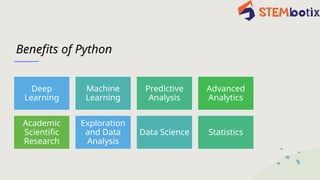
Benefits of Python
Deep
Learning
Machine
Learning
Predictive
Analysis
Advanced
Analytics
Academic
Scientific
Research
Exploration
and Data
Analysis
Data Science Statistics
Thank You

A brief History of Python Programming Language- English

  • 1.
  • 2.
    Origins and Conception • Creationby Guido van Rossum (1989-1991) • Implementation began in December 1989 at Centrum Wiskunde & Informatica (CWI), Netherlands. • Officially released in February 1991. • Design philosophy influenced by the ABC language. • Van Rossum aimed to: o Create a language easy to read and write. o Overcome limitations of ABC, such as handling exceptions and extending capabilities. o Interface with the Amoeba operating system.
  • 3.
    Early Development and Features •Python 1.0 Release (1991) • included several key features that distinguished it from other languages of the time o Exception handling o Functions and modules o Dynamic typing o Automatic memory management
  • 4.
    Early Development and Features •Open-Source Philosophy o open-source project - allowed for the contributions of a wide community of developers. o fostered a collaborative environment and contributed significantly to the language's rapid growth and evolution.
  • 5.
    Evolution and MajorReleases • Python 2.0 Release (2000) • Introduced in 2000 with new features: • List comprehensions: Concise list creation. • Garbage collection: Automated memory management • Unicode support: Improved handling of international text. • Python 3.0 Release (2008) • Released in December 2008 as "Python 3000" or "Py3k": • Print function: Changed to a function from a statement. • Integer division: Division operator (/) always returns a floating-point number. • Text and data handling: Enhanced Unicode support, clearer distinction between binary data and text.
  • 6.
    Evolution and MajorReleases • Transition from Python 2 to Python 3 • Significant transition with backward-incompatible changes: • Required codebase refactoring. • Dual maintenance of Python 2 and Python 3 versions. • Python 2.7 marked the end of the 2.x series.
  • 7.
    Timeline Python 1.0 Jan. 1994 Python1.5 Dec. 1997 Python 1.6 Sep. 2000 Python 2.0 Oct. 2000 Python 2.1 Apr. 2001 Python 2.2 Dec. 2001 Python 2.3 July 2003 Python 2.4 Nov. 2004 Python 2.5 Sep. 2006
  • 8.
    Timeline Python 3.0 Dec. 2008 Python3.1 June 2009 Python 3.2 Feb. 2011 Python 3.4 Mar. 2014 Python 3.5 Sep. 2015 Python 3.6 Dec. 2016 Python 3.7 June 2018 Python 3.7.3 Mar. 2019
  • 9.
    Python 3.x Enhancements ●Python 3.5 (2015): Python 3.5 introduced several new features that improved the language’s capabilities: ○ Introduced asynchronous I/O support. ○ Allowed for static type checking. ○ Introduced the @ operator for matrix multiplication. ● Python 3.6 (2016): Python 3.6 added: ○ Formatted string literals (f-strings) ○ Improved readability of large numbers. ● Python 3.7 (2018): Python 3.7 included: ○ Simplified the creation of classes used to store data. ○ Improved support for forward references and better performance.
  • 10.
    Python 3.x Enhancements ●Python 3.8 (2019) and 3.9 (2020): ○ Allowed assignments within expressions. ○ Enabled function arguments to be positional-only, enhancing API design. ● Python 3.10 (2021) and 3.11 (2022): Further refined the language with features like: ○ Introduced a more expressive and concise way to handle conditional logic. ○ Improved diagnostics for syntax and runtime errors.
  • 11.
    Python’s Impact andPopularity  Versatility and Use Cases •Python is widely used across various domains: •Web Development: •Data Science and Machine Learning •Automation and Scripting:  Educational Adoption •Python is simple and readable  Community and Ecosystem •large and active community: •rich ecosystem of libraries, frameworks, and tools. •Enhances capabilities and maintains relevance in the evolving tech landscape.
  • 12.
    Key Influences andFuture Direction  Philosophical Influence •Python's design philosophy, "Zen of Python" by Tim Peters: •Emphasizes readability, simplicity, and explicit code.  Ongoing Development •Python evolves through: •Active Python Enhancement Proposal (PEP) process for new features. •Guided by the Python Software Foundation (PSF) for growth and maintenance.
  • 13.
    Key Influences andFuture Direction  Anticipated Trends •Future of Python likely includes: •Enhancements in performance. •Greater support for concurrent and parallel programming. •Expansion in data science, AI, and scientific computing.
  • 14.
  • 15.