Application Development
Using Python
18CS55
Prof. Ananda Kumar H N
Dept. of CSE
MIT MYSORE
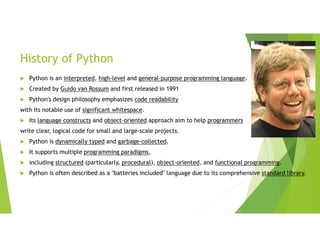
History of Python
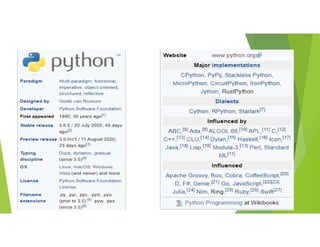
 Python is an interpreted, high-level and general-purpose programming language.
 Created by Guido van Rossum and first released in 1991
 Python's design philosophy emphasizes code readability
with its notable use of significant whitespace.
 Its language constructs and object-oriented approach aim to help programmers
write clear, logical code for small and large-scale projects.
 Python is dynamically typed and garbage-collected.
 It supports multiple programming paradigms,
 including structured (particularly, procedural), object-oriented, and functional programming.
 Python is often described as a "batteries included" language due to its comprehensive standard library.
 Python was created in the late 1980s as a successor to the ABC language.
 Python 2.0, released in 2000, introduced features like list comprehensions and a garbage collection
system with reference counting.
 Python 3.0, released in 2008, was a major revision of the language that is not completely backward-
compatible, and much Python 2 code does not run unmodified on Python 3.
 The Python 2 language was officially discontinued in 2020 (first planned for 2015),
 "Python 2.7.18 is the last Python 2.7 release and therefore the last Python 2 release.
 No more security patches or other improvements will be released for it.[31][32] With Python 2's end-of-
life, only Python 3.5.x and later are supported.
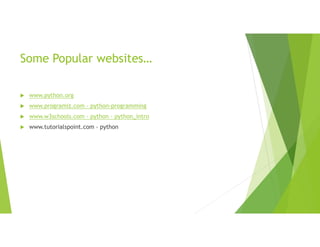
Some Popular websites…
 www.python.org
 www.programiz.com › python-programming
 www.w3schools.com › python › python_intro
 www.tutorialspoint.com › python
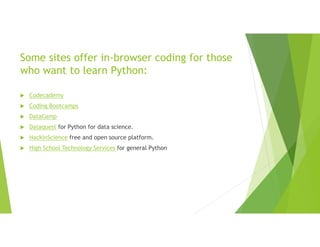
Some sites offer in-browser coding for those
who want to learn Python:
 Codecademy
 Coding Bootcamps
 DataCamp
 Dataquest for Python for data science.
 HackInScience free and open source platform.
 High School Technology Services for general Python
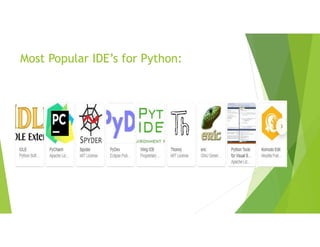
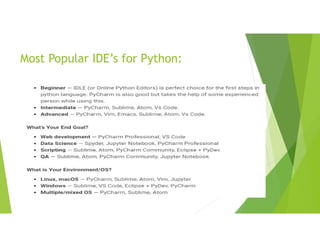
Most Popular IDE’s for Python:
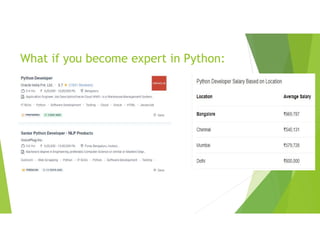
What if you become expert in Python:

Python for beginners

  • 1.
    Application Development Using Python 18CS55 Prof.Ananda Kumar H N Dept. of CSE MIT MYSORE
  • 7.
    History of Python Python is an interpreted, high-level and general-purpose programming language.  Created by Guido van Rossum and first released in 1991  Python's design philosophy emphasizes code readability with its notable use of significant whitespace.  Its language constructs and object-oriented approach aim to help programmers write clear, logical code for small and large-scale projects.  Python is dynamically typed and garbage-collected.  It supports multiple programming paradigms,  including structured (particularly, procedural), object-oriented, and functional programming.  Python is often described as a "batteries included" language due to its comprehensive standard library.
  • 8.
     Python wascreated in the late 1980s as a successor to the ABC language.  Python 2.0, released in 2000, introduced features like list comprehensions and a garbage collection system with reference counting.  Python 3.0, released in 2008, was a major revision of the language that is not completely backward- compatible, and much Python 2 code does not run unmodified on Python 3.  The Python 2 language was officially discontinued in 2020 (first planned for 2015),  "Python 2.7.18 is the last Python 2.7 release and therefore the last Python 2 release.  No more security patches or other improvements will be released for it.[31][32] With Python 2's end-of- life, only Python 3.5.x and later are supported.
  • 9.
    Some Popular websites… www.python.org  www.programiz.com › python-programming  www.w3schools.com › python › python_intro  www.tutorialspoint.com › python
  • 10.
    Some sites offerin-browser coding for those who want to learn Python:  Codecademy  Coding Bootcamps  DataCamp  Dataquest for Python for data science.  HackInScience free and open source platform.  High School Technology Services for general Python
  • 11.
  • 12.
  • 13.
    What if youbecome expert in Python: