Chaubey Colony, Raipur (C.G.)
A
Presentation
On
 Introduction.
 Life of Bhaskaracharya.
 His contribution in Mathematics.
 Legacy of Bhaskaracharya.
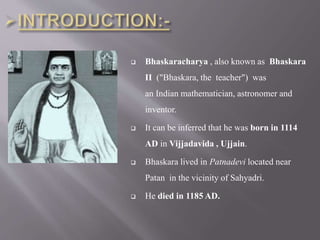
 Bhaskaracharya , also known as Bhaskara
II ("Bhaskara, the teacher") was
an Indian mathematician, astronomer and
inventor.
 It can be inferred that he was born in 1114
AD in Vijjadavida , Ujjain.
 Bhaskara lived in Patnadevi located near
Patan in the vicinity of Sahyadri.
 He died in 1185 AD.
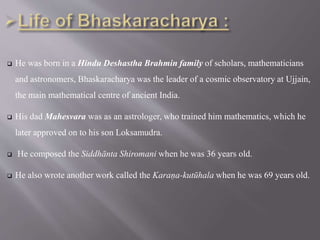
 He was born in a Hindu Deshastha Brahmin family of scholars, mathematicians
and astronomers, Bhaskaracharya was the leader of a cosmic observatory at Ujjain,
the main mathematical centre of ancient India.
 His dad Mahesvara was as an astrologer, who trained him mathematics, which he
later approved on to his son Loksamudra.
 He composed the Siddhānta Shiromani when he was 36 years old.
 He also wrote another work called the Karaṇa-kutūhala when he was 69 years old.
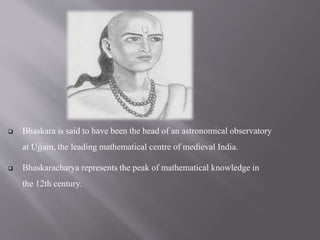
 Bhaskara is said to have been the head of an astronomical observatory
at Ujjain, the leading mathematical centre of medieval India.
 Bhaskaracharya represents the peak of mathematical knowledge in
the 12th century.
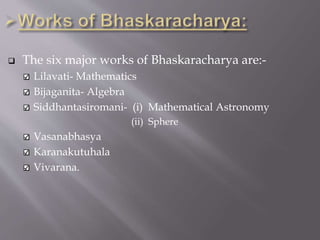
 The six major works of Bhaskaracharya are:-
Lilavati- Mathematics
Bijaganita- Algebra
Siddhantasiromani- (i) Mathematical Astronomy
(ii) Sphere
Vasanabhasya
Karanakutuhala
Vivarana.
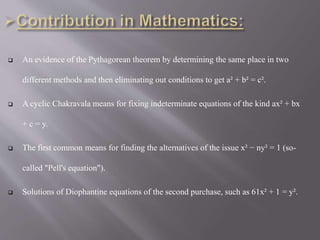
 An evidence of the Pythagorean theorem by determining the same place in two
different methods and then eliminating out conditions to get a² + b² = c².
 A cyclic Chakravala means for fixing indeterminate equations of the kind ax² + bx
+ c = y.
 The first common means for finding the alternatives of the issue x² − ny² = 1 (so-
called "Pell's equation").
 Solutions of Diophantine equations of the second purchase, such as 61x² + 1 = y².
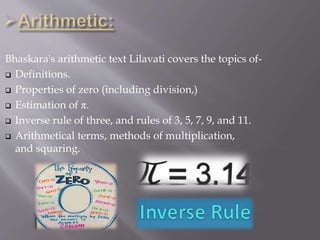
Bhaskara's arithmetic text Lilavati covers the topics of-
 Definitions.
 Properties of zero (including division,)
 Estimation of π.
 Inverse rule of three, and rules of 3, 5, 7, 9, and 11.
 Arithmetical terms, methods of multiplication,
and squaring.
 Positive and negative numbers.
 Determining unknown quantities.
 Solutions of indeterminate equations of the second, third and
fourth degree.
 Quadratic equations with more than one unknown.
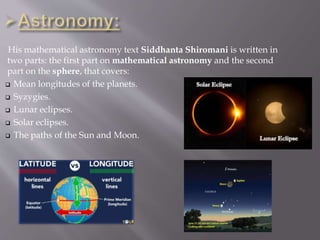
His mathematical astronomy text Siddhanta Shiromani is written in
two parts: the first part on mathematical astronomy and the second
part on the sphere, that covers:
 Mean longitudes of the planets.
 Syzygies.
 Lunar eclipses.
 Solar eclipses.
 The paths of the Sun and Moon.
 A number of institutes and colleges in India are named after
him, including Bhaskaracharya Pratishthana in
Pune, Bhaskaracharya College of Applied Sciences in Delhi.
 On 20 November 1981 the ISRO launched the Bhaskara II
satellite honoring the mathematician and astronomer.
 Invis Multimedia released Bhaskaracharya, an Indian
documentary short on the mathematician in 2015.
MacTutor

BHASKARACHARYA PPT, Presentation on Bhaskaracharya

  • 1.
  • 2.
  • 3.
     Introduction.  Lifeof Bhaskaracharya.  His contribution in Mathematics.  Legacy of Bhaskaracharya.
  • 4.
     Bhaskaracharya ,also known as Bhaskara II ("Bhaskara, the teacher") was an Indian mathematician, astronomer and inventor.  It can be inferred that he was born in 1114 AD in Vijjadavida , Ujjain.  Bhaskara lived in Patnadevi located near Patan in the vicinity of Sahyadri.  He died in 1185 AD.
  • 5.
     He wasborn in a Hindu Deshastha Brahmin family of scholars, mathematicians and astronomers, Bhaskaracharya was the leader of a cosmic observatory at Ujjain, the main mathematical centre of ancient India.  His dad Mahesvara was as an astrologer, who trained him mathematics, which he later approved on to his son Loksamudra.  He composed the Siddhānta Shiromani when he was 36 years old.  He also wrote another work called the Karaṇa-kutūhala when he was 69 years old.
  • 6.
     Bhaskara issaid to have been the head of an astronomical observatory at Ujjain, the leading mathematical centre of medieval India.  Bhaskaracharya represents the peak of mathematical knowledge in the 12th century.
  • 7.
     The sixmajor works of Bhaskaracharya are:- Lilavati- Mathematics Bijaganita- Algebra Siddhantasiromani- (i) Mathematical Astronomy (ii) Sphere Vasanabhasya Karanakutuhala Vivarana.
  • 8.
     An evidenceof the Pythagorean theorem by determining the same place in two different methods and then eliminating out conditions to get a² + b² = c².  A cyclic Chakravala means for fixing indeterminate equations of the kind ax² + bx + c = y.  The first common means for finding the alternatives of the issue x² − ny² = 1 (so- called "Pell's equation").  Solutions of Diophantine equations of the second purchase, such as 61x² + 1 = y².
  • 9.
    Bhaskara's arithmetic textLilavati covers the topics of-  Definitions.  Properties of zero (including division,)  Estimation of π.  Inverse rule of three, and rules of 3, 5, 7, 9, and 11.  Arithmetical terms, methods of multiplication, and squaring.
  • 10.
     Positive andnegative numbers.  Determining unknown quantities.  Solutions of indeterminate equations of the second, third and fourth degree.  Quadratic equations with more than one unknown.
  • 11.
    His mathematical astronomytext Siddhanta Shiromani is written in two parts: the first part on mathematical astronomy and the second part on the sphere, that covers:  Mean longitudes of the planets.  Syzygies.  Lunar eclipses.  Solar eclipses.  The paths of the Sun and Moon.
  • 12.
     A numberof institutes and colleges in India are named after him, including Bhaskaracharya Pratishthana in Pune, Bhaskaracharya College of Applied Sciences in Delhi.  On 20 November 1981 the ISRO launched the Bhaskara II satellite honoring the mathematician and astronomer.  Invis Multimedia released Bhaskaracharya, an Indian documentary short on the mathematician in 2015.
  • 14.