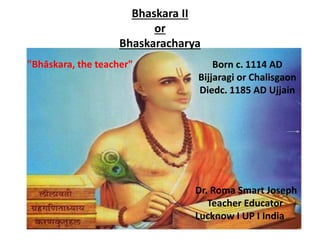
Bhaskara II
or
Bhaskaracharya
"Bhāskara, the teacher"​ Born c. 1114 AD
Bijjaragi or Chalisgaon
Diedc. 1185 AD Ujjain
Dr. Roma Smart Joseph
Teacher Educator
Lucknow I UP I India
Bhaskara II or Bhaskaracharya
• He was born on 1114 AD at Bijapur , Karnataka .
• Famous for his book – Siddharta Siromani ( divided
into following 4 parts)
• i) Leelavati - Arithmetic
• ii) Bijaganita – Algebra
• iii) Goladnayaya– Sphere celestial globe
• iv) Grahaganita – Maths of planets
• He also wrote another treatise named Karaṇā
Kautūhala
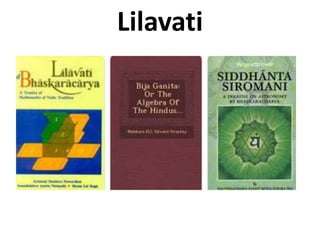
Lilavati
Read it for free
Bhaskara II or Bhaskaracharya
Līlāvatī
The first section Līlāvatī (also known
as pāṭīgaṇita or aṅkagaṇita), named after his
daughter, consists of 277 verses (13 chapters).
It covers calculations, progressions, measurement,
permutations, and other topics.
Bhaskara II or Bhaskaracharya
Bijaganita
The second section Bījagaṇita(Algebra) has 213 verses
(12 chapters).
It discusses zero, infinity, positive and negative
numbers, and indeterminate equations using
a kuṭṭaka method.
In particular, he also solved the {displaystyle
61x^{2}+1=y^{2}} case that was to elude Fermat and
his European contemporaries centuries later.
Bhaskara II or Bhaskaracharya
Grahagaṇita
The third section Grahagaṇita, deals with the
motion of planets.
It consists of 451 verses.
Bhāskara also stated that at its highest point a
planet's instantaneous speed is zero.
Bhaskara's contributions to
Mathematics
Mathematics
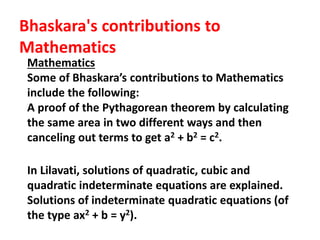
Some of Bhaskara’s contributions to Mathematics
include the following:
A proof of the Pythagorean theorem by calculating
the same area in two different ways and then
canceling out terms to get a2 + b2 = c2.
In Lilavati, solutions of quadratic, cubic and
quadratic indeterminate equations are explained.
Solutions of indeterminate quadratic equations (of
the type ax2 + b = y2).
Bhaskara's contributions to
Mathematics
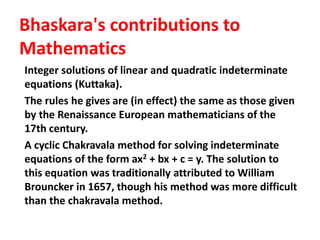
Integer solutions of linear and quadratic indeterminate
equations (Kuttaka).
The rules he gives are (in effect) the same as those given
by the Renaissance European mathematicians of the
17th century.
A cyclic Chakravala method for solving indeterminate
equations of the form ax2 + bx + c = y. The solution to
this equation was traditionally attributed to William
Brouncker in 1657, though his method was more difficult
than the chakravala method.
Bhaskara's contributions to
Mathematics
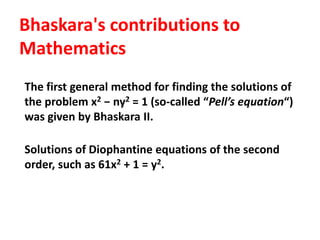
The first general method for finding the solutions of
the problem x2 − ny2 = 1 (so-called “Pell’s equation“)
was given by Bhaskara II.
Solutions of Diophantine equations of the second
order, such as 61x2 + 1 = y2.
Bhaskara's contributions to
Mathematics
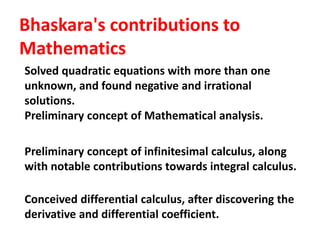
Solved quadratic equations with more than one
unknown, and found negative and irrational
solutions.
Preliminary concept of Mathematical analysis.
Preliminary concept of infinitesimal calculus, along
with notable contributions towards integral calculus.
Conceived differential calculus, after discovering the
derivative and differential coefficient.
Bhaskara's contributions to
Mathematics
Stated Rolle’s theorem, a special case of one of the
most important theorems in analysis, the mean
value theorem. Traces of the general mean value
theorem are also found in his works.
Calculated the derivatives of trigonometric functions
and formulae.
Bhaskara's contributions to
Mathematics
In Siddhanta Shiromani, Bhaskara developed
spherical trigonometry along with a number of other
trigonometric results.
Bhaskara’s arithmetic text Leelavati covers the topics
of definitions, arithmetical terms, interest
computation, arithmetical and geometrical
progressions, plane geometry, solid geometry, the
shadow of the gnomon, methods to solve
indeterminate equations, and combinations.
Bhaskara's contributions to
Mathematics
Lilavati is divided into 13 chapters and covers many
branches of mathematics, arithmetic, algebra,
geometry, and a little trigonometry and
mensuration.
More specifically the contents include:
Definitions.
Bhaskara's contributions to
Mathematics
Properties of zero (including division, and rules of
operations with zero).
Further extensive numerical work, including use of
negative numbers and surds.
Estimation of π.
Arithmetical terms, methods of multiplication, and
squaring.
Bhaskara's contributions to
Mathematics
Inverse rule of three, and rules of 3, 5, 7, 9, and 11.
Problems involving interest and interest
computation.
Indeterminate equations (Kuttaka), integer solutions
(first and second order).
Bhaskara's contributions to
Mathematics
Algebra
His Bijaganita (“Algebra”) was a work in twelve
chapters.
It was the first text to recognize that a positive
number has two square roots (a positive and
negative square root).
Bijaganita is effectively a treatise on algebra and
contains the following topics:
Positive and negative numbers.
Zero.
Bhaskara's contributions to
Mathematics
The ‘unknown’ (includes determining unknown
quantities).
Determining unknown quantities.
Surds (includes evaluating surds).
Kuttaka (for solving indeterminate equations and
Diophantine equations).
Simple equations (indeterminate of second, third
and fourth degree).
Simple equations with more than one unknown.
Bhaskara's contributions to
Mathematics
Indeterminate quadratic equations (of the type ax2 +
b = y2).
Solutions of indeterminate equations of the second,
third and fourth degree.
Quadratic equations.
Quadratic equations with more than one unknown.
Operations with products of several unknowns.
Bhaskara derived a cyclic, chakravala method for
solving indeterminate quadratic equations of the
form ax2 + bx + c = y.
Bhaskara's contributions to
Mathematics
Trigonometry
The Siddhanta Shiromani (written in 1150)
demonstrates Bhaskara’s knowledge of
trigonometry, including the sine table and
relationships between different trigonometric
functions.
He also discovered spherical trigonometry, along
with other interesting trigonometrical results.
In particular Bhaskara seemed more interested in
trigonometry for its own sake than his predecessors
who saw it only as a tool for calculation.
Bhaskara's contributions to
Mathematics
Calculus
His work, the Siddhanta Shiromani, is an
astronomical treatise and contains many theories
not found in earlier works.
Preliminary concepts of infinitesimal calculus and
mathematical analysis, along with a number of
results in trigonometry, differential calculus and
integral calculus that are found in the work are of
particular interest.
Bhaskara's contributions to
Mathematics
Evidence suggests Bhaskara was acquainted with
some ideas of differential calculus.
Bhaskara has also explainedthe ‘differential calculus‘
and suggests the differential coefficient vanishes at
an extremum value of the function, indicating
knowledge of the concept of ‘infinitesimals‘.
Bhaskara's contributions to
Mathematics
There is evidence of an early form of Rolle’s theorem
in his work
Bhaskara uses this result to work out the position
angle of the ecliptic, a quantity required for
accurately predicting the time of an eclipse.
He was aware that when a variable attains the
maximum value, its differential vanishes.
Bhaskara's contributions to
Mathematics
He also showed that when a planet is at its farthest
from the earth, or at its closest, the equation of the
centre (measure of how far a planet is from the
position in which it is predicted to be, by assuming it
is to move uniformly) vanishes.
He therefore concluded that for some intermediate
position the differential of the equation of the
centre is equal to zero.
THANK YOU
for ACTIVE
LEARNing...

Indian Mathematician Bhaskara II

  • 1.
    Bhaskara II or Bhaskaracharya "Bhāskara, theteacher"​ Born c. 1114 AD Bijjaragi or Chalisgaon Diedc. 1185 AD Ujjain Dr. Roma Smart Joseph Teacher Educator Lucknow I UP I India
  • 2.
    Bhaskara II orBhaskaracharya • He was born on 1114 AD at Bijapur , Karnataka . • Famous for his book – Siddharta Siromani ( divided into following 4 parts) • i) Leelavati - Arithmetic • ii) Bijaganita – Algebra • iii) Goladnayaya– Sphere celestial globe • iv) Grahaganita – Maths of planets • He also wrote another treatise named Karaṇā Kautūhala
  • 3.
  • 4.
  • 5.
    Bhaskara II orBhaskaracharya Līlāvatī The first section Līlāvatī (also known as pāṭīgaṇita or aṅkagaṇita), named after his daughter, consists of 277 verses (13 chapters). It covers calculations, progressions, measurement, permutations, and other topics.
  • 6.
    Bhaskara II orBhaskaracharya Bijaganita The second section Bījagaṇita(Algebra) has 213 verses (12 chapters). It discusses zero, infinity, positive and negative numbers, and indeterminate equations using a kuṭṭaka method. In particular, he also solved the {displaystyle 61x^{2}+1=y^{2}} case that was to elude Fermat and his European contemporaries centuries later.
  • 7.
    Bhaskara II orBhaskaracharya Grahagaṇita The third section Grahagaṇita, deals with the motion of planets. It consists of 451 verses. Bhāskara also stated that at its highest point a planet's instantaneous speed is zero.
  • 8.
    Bhaskara's contributions to Mathematics Mathematics Someof Bhaskara’s contributions to Mathematics include the following: A proof of the Pythagorean theorem by calculating the same area in two different ways and then canceling out terms to get a2 + b2 = c2. In Lilavati, solutions of quadratic, cubic and quadratic indeterminate equations are explained. Solutions of indeterminate quadratic equations (of the type ax2 + b = y2).
  • 9.
    Bhaskara's contributions to Mathematics Integersolutions of linear and quadratic indeterminate equations (Kuttaka). The rules he gives are (in effect) the same as those given by the Renaissance European mathematicians of the 17th century. A cyclic Chakravala method for solving indeterminate equations of the form ax2 + bx + c = y. The solution to this equation was traditionally attributed to William Brouncker in 1657, though his method was more difficult than the chakravala method.
  • 10.
    Bhaskara's contributions to Mathematics Thefirst general method for finding the solutions of the problem x2 − ny2 = 1 (so-called “Pell’s equation“) was given by Bhaskara II. Solutions of Diophantine equations of the second order, such as 61x2 + 1 = y2.
  • 11.
    Bhaskara's contributions to Mathematics Solvedquadratic equations with more than one unknown, and found negative and irrational solutions. Preliminary concept of Mathematical analysis. Preliminary concept of infinitesimal calculus, along with notable contributions towards integral calculus. Conceived differential calculus, after discovering the derivative and differential coefficient.
  • 12.
    Bhaskara's contributions to Mathematics StatedRolle’s theorem, a special case of one of the most important theorems in analysis, the mean value theorem. Traces of the general mean value theorem are also found in his works. Calculated the derivatives of trigonometric functions and formulae.
  • 13.
    Bhaskara's contributions to Mathematics InSiddhanta Shiromani, Bhaskara developed spherical trigonometry along with a number of other trigonometric results. Bhaskara’s arithmetic text Leelavati covers the topics of definitions, arithmetical terms, interest computation, arithmetical and geometrical progressions, plane geometry, solid geometry, the shadow of the gnomon, methods to solve indeterminate equations, and combinations.
  • 14.
    Bhaskara's contributions to Mathematics Lilavatiis divided into 13 chapters and covers many branches of mathematics, arithmetic, algebra, geometry, and a little trigonometry and mensuration. More specifically the contents include: Definitions.
  • 15.
    Bhaskara's contributions to Mathematics Propertiesof zero (including division, and rules of operations with zero). Further extensive numerical work, including use of negative numbers and surds. Estimation of π. Arithmetical terms, methods of multiplication, and squaring.
  • 16.
    Bhaskara's contributions to Mathematics Inverserule of three, and rules of 3, 5, 7, 9, and 11. Problems involving interest and interest computation. Indeterminate equations (Kuttaka), integer solutions (first and second order).
  • 17.
    Bhaskara's contributions to Mathematics Algebra HisBijaganita (“Algebra”) was a work in twelve chapters. It was the first text to recognize that a positive number has two square roots (a positive and negative square root). Bijaganita is effectively a treatise on algebra and contains the following topics: Positive and negative numbers. Zero.
  • 18.
    Bhaskara's contributions to Mathematics The‘unknown’ (includes determining unknown quantities). Determining unknown quantities. Surds (includes evaluating surds). Kuttaka (for solving indeterminate equations and Diophantine equations). Simple equations (indeterminate of second, third and fourth degree). Simple equations with more than one unknown.
  • 19.
    Bhaskara's contributions to Mathematics Indeterminatequadratic equations (of the type ax2 + b = y2). Solutions of indeterminate equations of the second, third and fourth degree. Quadratic equations. Quadratic equations with more than one unknown. Operations with products of several unknowns. Bhaskara derived a cyclic, chakravala method for solving indeterminate quadratic equations of the form ax2 + bx + c = y.
  • 20.
    Bhaskara's contributions to Mathematics Trigonometry TheSiddhanta Shiromani (written in 1150) demonstrates Bhaskara’s knowledge of trigonometry, including the sine table and relationships between different trigonometric functions. He also discovered spherical trigonometry, along with other interesting trigonometrical results. In particular Bhaskara seemed more interested in trigonometry for its own sake than his predecessors who saw it only as a tool for calculation.
  • 21.
    Bhaskara's contributions to Mathematics Calculus Hiswork, the Siddhanta Shiromani, is an astronomical treatise and contains many theories not found in earlier works. Preliminary concepts of infinitesimal calculus and mathematical analysis, along with a number of results in trigonometry, differential calculus and integral calculus that are found in the work are of particular interest.
  • 22.
    Bhaskara's contributions to Mathematics Evidencesuggests Bhaskara was acquainted with some ideas of differential calculus. Bhaskara has also explainedthe ‘differential calculus‘ and suggests the differential coefficient vanishes at an extremum value of the function, indicating knowledge of the concept of ‘infinitesimals‘.
  • 23.
    Bhaskara's contributions to Mathematics Thereis evidence of an early form of Rolle’s theorem in his work Bhaskara uses this result to work out the position angle of the ecliptic, a quantity required for accurately predicting the time of an eclipse. He was aware that when a variable attains the maximum value, its differential vanishes.
  • 24.
    Bhaskara's contributions to Mathematics Healso showed that when a planet is at its farthest from the earth, or at its closest, the equation of the centre (measure of how far a planet is from the position in which it is predicted to be, by assuming it is to move uniformly) vanishes. He therefore concluded that for some intermediate position the differential of the equation of the centre is equal to zero.
  • 25.