PYROLYSIS
PRESENTED BY- T.GOPINADH
WHAT IS PYROLYSIS ?
Pyrolysis is the heating of an organic material, such as biomass, coal etc... in the absence
of oxygen.
Pyrolysis is a common technique used to convert plastic waste into energy, in the form of
solid, liquid, gaseous fuels.
The thermal degradation of plastic waste at different temp (300-900degC) in the absence
of oxygen, to produce liquid oil.
WHAT IS THE MAIN PURPOSE OF PYROLYSIS?
• Pyrolysis is one of the technology available to convert biomass to an intermediate liquid
product, that can be reused to drop the oxygenated fuel additives and petrochemicals
replacements.
• To find out the gas compositions of CO,H2 from the sample provided.
• To know the CV (Calorific value) ,ASH Percentage present in the sample.
PYROLYSIS PRODUCTS..
Pyrolysis involves a breakdown of large complex molecules into several smaller
molecules. Its product is classified into three principal types:
1. Liquid (tars, heavier hydrocarbons, and water)
2. Solid (mostly char or carbon)
3. Gas (e.g., CO2, H2O, CO, C2H2, C2H4, C2H6, C6H6).
PYROLYSIS PRODUCTS..
The product of pyrolysis depends upon the design of pyrolizer, the physical and chemical
characteristics of the bio-mass, and important operations parameters such as,
 Heating rate
 Final temp rate (Pyrolysis temp)
 Residence time in the reaction zone
CLASSIFICATION OF PYROLYSIS..
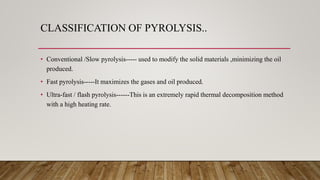
• Conventional /Slow pyrolysis----- used to modify the solid materials ,minimizing the oil
produced.
• Fast pyrolysis-----It maximizes the gases and oil produced.
• Ultra-fast / flash pyrolysis------This is an extremely rapid thermal decomposition method
with a high heating rate.
CLASSIFICATION OF PYROLYSIS (CONTD..)
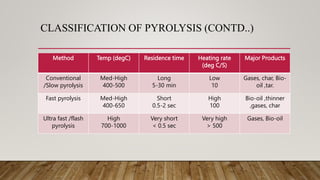
Method Temp (degC) Residence time Heating rate
(deg C/S)
Major Products
Conventional
/Slow pyrolysis
Med-High
400-500
Long
5-30 min
Low
10
Gases, char, Bio-
oil ,tar.
Fast pyrolysis Med-High
400-650
Short
0.5-2 sec
High
100
Bio-oil ,thinner
,gases, char
Ultra fast /flash
pyrolysis
High
700-1000
Very short
< 0.5 sec
Very high
> 500
Gases, Bio-oil
PYROLYSIS PROCESS…
• Firstly we have to fill the material in the retarder and also we have to give the proper pipe
connections.
• After completion of all the setup ,we have to conduct the leak test(To find the issues)
• If, no issues found after the completion of leak test bubbles formed in the three bubbler
jars.
PYROLYSIS PROCESS (CONTD)…
Firstly, we have to give the heat to furnace, starting the temp range from 100 degC.
Then we will observe the temp values of retord reactor and furnace in the control panel as
T1and T2.
Then, the heat is increased slowly, we have to note down the values of T1,T2 and S.P(Set
Point Temp) in the log book.
PYROLYSIS PROCESS (CONTD)…
 We are giving the pure nitrogen gas to retorder ,in this pyrolysis will be occurred with the presence
of heat through the heating element.
 In the reactor there is a multi-stage packings such as, steel mesh sample, Bío-mass sample.
 After, we are controlling the pyrolysis temp with the help of PID temp then, we will notice that the
gas will come into the bubbler. And we can see the bubbles will form in the bubbler. Then, we will
confirm that the gas is passing through the lines.
 Then, we are analyzing the composition of gas through the online gas analyzer name as GC(Gas
Chromatography).
 To, analyze the gas we have to maintain the flow rate of 1.5 l/min, and we are using the the nitrogen
gas to maintain the mentioned flow rate.
ADVANTAGES AND DIS-ADVANTAGES OF
PYROLYSIS..
• It prevents hazardous waste from reaching landfills.
• It has no emission of toxic gases
• Syngas from biomass can be used to generate electric and thermal energy.
• It requires high operational and investment costs.
• Air purification is necessary to treat flue gases from the pyrolysis.
TYPES OF PYROLYSIS.
1. Fixed or moving bed
2. Bubbling fluidized bed
3. Circulating fluidized bed (CFB)
4. Ultra rapid reactor
5. Rotating cone
6. Ablative reactor
7. Vacuum reactor
TYPES OF PYROLYSIS..
Fixed Bed
 It’s a batch type reactor, the thermal decomposition of a heat is supplied from the
external source (or) inside the combustion of a bed.
 A sweep gas is inserted into the chamber, sweep means inert gas without oxygen
 It’s a slowly pyrolysis process, the temp and heating rate will give slowly to get the
good results.
TYPES OF PYROLYSIS (CONTD)…
Bubbling bed pyrolizer
• Crushed bio-mass (2-6 mm) is fed into the bubbling bed of hot sand (or) other solids.
• The bed is fluidized by an inert gas such as recycled flue gas.
• Intense mixing of inert bed solids (sand is commonly used) offers good and uniform
temperature control. It also provides high heat transfer to biomass solids.
• The pyrolysis products would typically contain about 70-75% liquid on dry wood feed.
TYPES OF PYROLYSIS (CONTD)…
 CFD pyrolizer
• A CFD pyrolizer, works on the same principle as the bubbling fluidized bed except that the bed is
highly expanded and solids. It continuously recycle around an external loop comprising a cyclone
and loop seal.
• It provides good temperature control and mixing around the entire height of the unit.
• A major advantage of this system is that char entrained from the reactor is easily separated and
burnt in an external fluidized bed.
• The combustion heat is transferred to the inert bed solids that are recycled to the reactor by means
of a loop seal.
TYPES OF PYROLYSIS (CONTD)…
Ultrarapid Pyrolizer
• In this ,high heating rate and short residence time in the pyrolysis zone are two key requirements of
high liquid yield.
• The inert gas nitrogen is heated at 100 deg C above the reactor temperature and injected at very
high velocity into the reactor to bombard a stream of biomass injected in the reactor.
• The pyrolysis product leaves the reactor from the bottom and is immediately cooled to suppress a
secondary reaction or cracking of the oil vapor. This process is therefore able to maximize the liquid
yield during pyrolysis.
PRODUCTION OF LIQUID THROUGH
PYROLYSIS…
• Pyrolysis is one of several means of production of liquid fuel from biomass
• The maximum yield of organic liquid (pyrolytic oil or bio-oil) from thermal decomposition may be
increased to as high as 70% (dry weight) if the biomass is rapidly heated to an intermediate
temperature and if a short residence time in the pyrolysis zone is allowed to reduce secondary
reactions.
• A slower heating rate, a lower temperature, and a longer residence time maximize the yield of solid
char.
• A higher heating rate, a higher temperature, and a shorter residence time maximize the gas yield.
• A higher heating rate, an intermediate temperature, and a shorter residence time maximize the liquid
yield.
BIO CHAR..
• Charcoal, also known as biochar, is a preferred product of slow pyrolysis at a moderate temperature.
• Benefits of bio char..
• Reduces nutrient losses in soils
• Reduces fertilizer use
• Enhances marginal soil productivity
• Carbon negative emission
QUALITY OF BIO-CHAR..
The quality of biochar is defined by its following characteristics:-
 The BET or internal surface area
 pH of the char
 Carbon recovery in char.
THE END

PYROLYSIS PROCESS- THERMOCHEMICAL METHOD

  • 1.
  • 2.
    WHAT IS PYROLYSIS? Pyrolysis is the heating of an organic material, such as biomass, coal etc... in the absence of oxygen. Pyrolysis is a common technique used to convert plastic waste into energy, in the form of solid, liquid, gaseous fuels. The thermal degradation of plastic waste at different temp (300-900degC) in the absence of oxygen, to produce liquid oil.
  • 3.
    WHAT IS THEMAIN PURPOSE OF PYROLYSIS? • Pyrolysis is one of the technology available to convert biomass to an intermediate liquid product, that can be reused to drop the oxygenated fuel additives and petrochemicals replacements. • To find out the gas compositions of CO,H2 from the sample provided. • To know the CV (Calorific value) ,ASH Percentage present in the sample.
  • 4.
    PYROLYSIS PRODUCTS.. Pyrolysis involvesa breakdown of large complex molecules into several smaller molecules. Its product is classified into three principal types: 1. Liquid (tars, heavier hydrocarbons, and water) 2. Solid (mostly char or carbon) 3. Gas (e.g., CO2, H2O, CO, C2H2, C2H4, C2H6, C6H6).
  • 5.
    PYROLYSIS PRODUCTS.. The productof pyrolysis depends upon the design of pyrolizer, the physical and chemical characteristics of the bio-mass, and important operations parameters such as,  Heating rate  Final temp rate (Pyrolysis temp)  Residence time in the reaction zone
  • 6.
    CLASSIFICATION OF PYROLYSIS.. •Conventional /Slow pyrolysis----- used to modify the solid materials ,minimizing the oil produced. • Fast pyrolysis-----It maximizes the gases and oil produced. • Ultra-fast / flash pyrolysis------This is an extremely rapid thermal decomposition method with a high heating rate.
  • 7.
    CLASSIFICATION OF PYROLYSIS(CONTD..) Method Temp (degC) Residence time Heating rate (deg C/S) Major Products Conventional /Slow pyrolysis Med-High 400-500 Long 5-30 min Low 10 Gases, char, Bio- oil ,tar. Fast pyrolysis Med-High 400-650 Short 0.5-2 sec High 100 Bio-oil ,thinner ,gases, char Ultra fast /flash pyrolysis High 700-1000 Very short < 0.5 sec Very high > 500 Gases, Bio-oil
  • 8.
    PYROLYSIS PROCESS… • Firstlywe have to fill the material in the retarder and also we have to give the proper pipe connections. • After completion of all the setup ,we have to conduct the leak test(To find the issues) • If, no issues found after the completion of leak test bubbles formed in the three bubbler jars.
  • 9.
    PYROLYSIS PROCESS (CONTD)… Firstly,we have to give the heat to furnace, starting the temp range from 100 degC. Then we will observe the temp values of retord reactor and furnace in the control panel as T1and T2. Then, the heat is increased slowly, we have to note down the values of T1,T2 and S.P(Set Point Temp) in the log book.
  • 10.
    PYROLYSIS PROCESS (CONTD)… We are giving the pure nitrogen gas to retorder ,in this pyrolysis will be occurred with the presence of heat through the heating element.  In the reactor there is a multi-stage packings such as, steel mesh sample, Bío-mass sample.  After, we are controlling the pyrolysis temp with the help of PID temp then, we will notice that the gas will come into the bubbler. And we can see the bubbles will form in the bubbler. Then, we will confirm that the gas is passing through the lines.  Then, we are analyzing the composition of gas through the online gas analyzer name as GC(Gas Chromatography).  To, analyze the gas we have to maintain the flow rate of 1.5 l/min, and we are using the the nitrogen gas to maintain the mentioned flow rate.
  • 11.
    ADVANTAGES AND DIS-ADVANTAGESOF PYROLYSIS.. • It prevents hazardous waste from reaching landfills. • It has no emission of toxic gases • Syngas from biomass can be used to generate electric and thermal energy. • It requires high operational and investment costs. • Air purification is necessary to treat flue gases from the pyrolysis.
  • 12.
    TYPES OF PYROLYSIS. 1.Fixed or moving bed 2. Bubbling fluidized bed 3. Circulating fluidized bed (CFB) 4. Ultra rapid reactor 5. Rotating cone 6. Ablative reactor 7. Vacuum reactor
  • 13.
    TYPES OF PYROLYSIS.. FixedBed  It’s a batch type reactor, the thermal decomposition of a heat is supplied from the external source (or) inside the combustion of a bed.  A sweep gas is inserted into the chamber, sweep means inert gas without oxygen  It’s a slowly pyrolysis process, the temp and heating rate will give slowly to get the good results.
  • 14.
    TYPES OF PYROLYSIS(CONTD)… Bubbling bed pyrolizer • Crushed bio-mass (2-6 mm) is fed into the bubbling bed of hot sand (or) other solids. • The bed is fluidized by an inert gas such as recycled flue gas. • Intense mixing of inert bed solids (sand is commonly used) offers good and uniform temperature control. It also provides high heat transfer to biomass solids. • The pyrolysis products would typically contain about 70-75% liquid on dry wood feed.
  • 15.
    TYPES OF PYROLYSIS(CONTD)…  CFD pyrolizer • A CFD pyrolizer, works on the same principle as the bubbling fluidized bed except that the bed is highly expanded and solids. It continuously recycle around an external loop comprising a cyclone and loop seal. • It provides good temperature control and mixing around the entire height of the unit. • A major advantage of this system is that char entrained from the reactor is easily separated and burnt in an external fluidized bed. • The combustion heat is transferred to the inert bed solids that are recycled to the reactor by means of a loop seal.
  • 16.
    TYPES OF PYROLYSIS(CONTD)… Ultrarapid Pyrolizer • In this ,high heating rate and short residence time in the pyrolysis zone are two key requirements of high liquid yield. • The inert gas nitrogen is heated at 100 deg C above the reactor temperature and injected at very high velocity into the reactor to bombard a stream of biomass injected in the reactor. • The pyrolysis product leaves the reactor from the bottom and is immediately cooled to suppress a secondary reaction or cracking of the oil vapor. This process is therefore able to maximize the liquid yield during pyrolysis.
  • 17.
    PRODUCTION OF LIQUIDTHROUGH PYROLYSIS… • Pyrolysis is one of several means of production of liquid fuel from biomass • The maximum yield of organic liquid (pyrolytic oil or bio-oil) from thermal decomposition may be increased to as high as 70% (dry weight) if the biomass is rapidly heated to an intermediate temperature and if a short residence time in the pyrolysis zone is allowed to reduce secondary reactions. • A slower heating rate, a lower temperature, and a longer residence time maximize the yield of solid char. • A higher heating rate, a higher temperature, and a shorter residence time maximize the gas yield. • A higher heating rate, an intermediate temperature, and a shorter residence time maximize the liquid yield.
  • 18.
    BIO CHAR.. • Charcoal,also known as biochar, is a preferred product of slow pyrolysis at a moderate temperature. • Benefits of bio char.. • Reduces nutrient losses in soils • Reduces fertilizer use • Enhances marginal soil productivity • Carbon negative emission
  • 19.
    QUALITY OF BIO-CHAR.. Thequality of biochar is defined by its following characteristics:-  The BET or internal surface area  pH of the char  Carbon recovery in char.
  • 20.