http://www.youtube.com/watch?v=SaGCieW1_dc
Stages of Death
Pallor mortis
Algor mortis
Rigor mortis
Livor mortis
Putrefaction
Decomposition
Skeletonization
Material that is subject to putrefaction is
called putrescible.
Putrefaction is the decomposition of human and
animal proteins, especially by anaerobic
microorganisms, described as putrefying
bacteria. These processes release gases that are
the chief source of the unmistakably putrid odor
of decaying human and animal tissue.
The general stages of decomposition are coupled with
two stages of chemical decomposition: autolysis and
putrefaction. These two stages contribute to the
chemical process of decomposition, which breaks
down the main components of the body.
Oxygen present in the body is quickly depleted
by the aerobic organisms found within. This
creates an ideal environment for the
proliferation of anaerobic organisms.
Anaerobic organisms, originating in the
gastrointestinal tract and respiratory
system, begin to transform
carbohydrates, lipids, and proteins, to yield
organic acids (propionic acid, lactic acid) and
gases (methane, hydrogen sulfide, ammonia).
The process of microbial proliferation within a
body is referred to as putrefaction and leads to
the second stage of decomposition, known as
bloat..
Here's basically what happens.
During putrefaction the body begins to show more obvious signs of
decay, including changes in color and odor, and significant bloating.
Chemical processes produce gases which cause facial swelling, as well as
gases which fill the abdomen and force fecal matter out of the body. The
abdomen will then turn green from the bacterial interaction with hemoglobin.
They will enter the veins causing red streaking which later changes to green
marbelization of the skin. Large variety of insects increasingly infest the body.
As it goes on there will be darking color of the body, the rupturing of the
abdomen, and the escape of abdominal gases from bloating.
This rupture opens the cavities to all kinds of insects and scavengers. This
stage lasts approximately ten to twenty days, until the bones become visible.
The next part is called Butyric fermentation, in which the body begins to dry
and preserve itself. Odors fade, and the body forms an adipocere, or “grave
wax” layer. Organs and tissues reduce and wither. After the organs and
tissues are gone, the final stage of skeletonization begins.
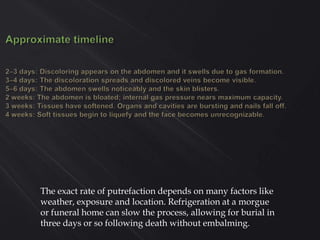
The exact rate of putrefaction depends on many factors like
weather, exposure and location. Refrigeration at a morgue
or funeral home can slow the process, allowing for burial in
three days or so following death without embalming.
putrefaction /pu•tre•fac•tion/ (pu″trĕ-
fak´shun)
enzymatic decomposition, especially of proteins, with the production of
foul-smelling compounds, such as hydrogen sulfide, ammonia, and
mercaptans.putrefac´tive
Decomposition of organic matter,
especially protein, by microorganisms,
resulting in production of foul-smelling
matter
the decay of enzymes, especially
proteins, that produces foul-smelling
compounds, such as ammonia, hydrogen
sulfide, and mercaptans. putrefactive, adj.
n the rotting of matter through the use of
enzymes, producing substances such as
ammonia, mercaptans, and hydrogen
sulfide.
enzymatic decomposition, especially of
proteins, with the production of foul-
smelling compounds, such as hydrogen
sulfide, ammonia and mercaptans. Called
also decomposition.
: the decomposition of organic matter;
especially : the typically anaerobic splitting
of proteins by bacteria and fungi with the
formation of foul-smelling incompletely
oxidized products
Why is this term important to this class?
What Does it have to do with Chemistry?
This is a chemical process.
In terms of chemistry and more specifically, thermodynamics, all organic tissue is a stored
source of chemical energy and when it is not maintained by our body, it will break down into
simpler products. The breakdown of proteins in a decomposing carcass is a spontaneous
process but one that is accelerated as the anaerobic microorganisms, already in the digestive
tract when it was alive, consume and digest the proteins that comprise the cells. As these
proteins are digested, the tissues of the body are left in a weakened state. Proteins are
broken down into smaller components and these are excreted by the bacteria. The excreted
components, which include gases and amines such as putrescine and cadaverine, carry the
putrid odor. The gases are initially constrained within the cavities but diffuse though
adjacent tissues and into the circulatory system. Once in the blood vessels, the gases can then
spread to other all through the body. The result bloating. The increased pressure of gases
also weakens and separate tissues. Eventually some part of the body will rupture so gases
can escape. Once the bacteria consume all proteins, putrefaction is over and it progresses into
the next stage: skeletonization.
How is this term related to embalming?
Embalming is the practice of delaying decomposition by using chemicals to repel insects, and slow
down bacterial putrefaction by either killing existing bacteria in or on the body themselves or by
"fixing" cellular proteins, which means that they cannot act as a nutrient source for subsequent
bacterial infections. Putrefaction is very important to us for many reasons. Here are Three.
First- The hole process of embalming is designed to stop those anaerobic microorganisms that
cause putrefaction and decomposition. If we didn’t have to worry about them, we would not have
to embalm.
Second- If putrefaction and decomposition have already stated, it makes our job a lot more
difficult. You may not be able to preserve the body
depending on the extent ot the decomp and you will
have to know what chemicals to use and the amount,
because the normal mixture will not work.
Third- There is the matter of cosmetic restoration. The body can be bloated, discolored, and even
ruptured and parts missing. You must decide if the body is safe to be vied, and you are not putting
others at a health risk; and if this is an image that the family need be put through.
These are just a few of the things you have to think about, and there are many others. Other
examples are what P.P.E.’s are needed, if masks and respirators are needed for the smell. Other
related fields also have to think about this and where the body lays, like if on furniture, may be
ruined or have to be destroyed.
What I find interesting
about this subject?
Various sciences study the decomposition of bodies under the general rubric of
forensics because the usual motive for such studies is to determine the time and cause
of death for legal purposes:
Forensic taphonomy specifically studies the processes of decomposition in order to apply the
biological and chemical principles to forensic cases in order to determine post-mortem interval
(PMI), post-burial interval as well as to locate clandestine graves.
Forensic pathology studies the clues to the cause of death found in the corpse as a medical
phenomenon.
Forensic entomology studies the insects and other vermin found in corpses; the sequence in which
they appear, the kinds of insects, and where they are found in their life cycle are clues that can shed
light on the time of death, the length of a corpse's exposure, and whether the corpse was moved.
Forensic anthropology is the branch of physical anthropology that studies skeletons and human
remains, usually to seek clues as to the identity, race, and sex of their former owner.
The University of Tennessee Anthropological Research Facility (better known as the Body Farm) in
Knoxville, Tennessee has a number of bodies laid out in various situations in a fenced-in plot near
the medical center. Scientists at the Body Farm study how the human body decays in various
circumstances to gain a better understanding of decomposition.
This is, in my opinion, amazing. I do not
understand exactly how they do it, but to
be able to look at what insects are on a
body, where it is located, and its condition
and then be able to tell me approximately
when they died is mind boggling!
Is there anything I don’t
understand about all this?
Videos
http://www.ebaumsworld.com/video/watch/81108016/
http://www.youtube.com/watch?feature=player_embedded&v=R1CD6gNmhr0
Jonas: Mosby's Dictionary of Complementary and Alternative Medicine. (c) 2005,
Elsevier.
Wiki: http://en.wikipedia.org/wiki/Putrefaction
Miller-Keane Encyclopedia and Dictionary of Medicine, Nursing, and Allied
Health, Seventh Edition. 2003 by Saunders, an imprint of Elsevier, Inc.
Mosby's Dental Dictionary, 2nd edition. 2008 Elsevier, Inc.
Mosby's Medical Dictionary, 8th edition. 2009, Elsevier.
The American Heritage® Medical Dictionary Copyright 2007, Published by
Houghton Mifflin Company. All rights reserved.
Embalming History, Theory, and Practice 5th edition. Robert G. Mayer Copyright
2012 by the McGraw-Hill Companies, Inc.
Works Cited
The Columbia Electronic Encyclopedia 2004.
Licensed from Columbia University Press

Putrefaction pp

  • 1.
  • 2.
    Stages of Death Pallormortis Algor mortis Rigor mortis Livor mortis Putrefaction Decomposition Skeletonization Material that is subject to putrefaction is called putrescible.
  • 3.
    Putrefaction is thedecomposition of human and animal proteins, especially by anaerobic microorganisms, described as putrefying bacteria. These processes release gases that are the chief source of the unmistakably putrid odor of decaying human and animal tissue. The general stages of decomposition are coupled with two stages of chemical decomposition: autolysis and putrefaction. These two stages contribute to the chemical process of decomposition, which breaks down the main components of the body.
  • 4.
    Oxygen present inthe body is quickly depleted by the aerobic organisms found within. This creates an ideal environment for the proliferation of anaerobic organisms. Anaerobic organisms, originating in the gastrointestinal tract and respiratory system, begin to transform carbohydrates, lipids, and proteins, to yield organic acids (propionic acid, lactic acid) and gases (methane, hydrogen sulfide, ammonia). The process of microbial proliferation within a body is referred to as putrefaction and leads to the second stage of decomposition, known as bloat..
  • 5.
    Here's basically whathappens. During putrefaction the body begins to show more obvious signs of decay, including changes in color and odor, and significant bloating. Chemical processes produce gases which cause facial swelling, as well as gases which fill the abdomen and force fecal matter out of the body. The abdomen will then turn green from the bacterial interaction with hemoglobin. They will enter the veins causing red streaking which later changes to green marbelization of the skin. Large variety of insects increasingly infest the body. As it goes on there will be darking color of the body, the rupturing of the abdomen, and the escape of abdominal gases from bloating. This rupture opens the cavities to all kinds of insects and scavengers. This stage lasts approximately ten to twenty days, until the bones become visible. The next part is called Butyric fermentation, in which the body begins to dry and preserve itself. Odors fade, and the body forms an adipocere, or “grave wax” layer. Organs and tissues reduce and wither. After the organs and tissues are gone, the final stage of skeletonization begins.
  • 6.
    The exact rateof putrefaction depends on many factors like weather, exposure and location. Refrigeration at a morgue or funeral home can slow the process, allowing for burial in three days or so following death without embalming.
  • 7.
    putrefaction /pu•tre•fac•tion/ (pu″trĕ- fak´shun) enzymaticdecomposition, especially of proteins, with the production of foul-smelling compounds, such as hydrogen sulfide, ammonia, and mercaptans.putrefac´tive Decomposition of organic matter, especially protein, by microorganisms, resulting in production of foul-smelling matter the decay of enzymes, especially proteins, that produces foul-smelling compounds, such as ammonia, hydrogen sulfide, and mercaptans. putrefactive, adj. n the rotting of matter through the use of enzymes, producing substances such as ammonia, mercaptans, and hydrogen sulfide. enzymatic decomposition, especially of proteins, with the production of foul- smelling compounds, such as hydrogen sulfide, ammonia and mercaptans. Called also decomposition. : the decomposition of organic matter; especially : the typically anaerobic splitting of proteins by bacteria and fungi with the formation of foul-smelling incompletely oxidized products
  • 8.
    Why is thisterm important to this class? What Does it have to do with Chemistry? This is a chemical process. In terms of chemistry and more specifically, thermodynamics, all organic tissue is a stored source of chemical energy and when it is not maintained by our body, it will break down into simpler products. The breakdown of proteins in a decomposing carcass is a spontaneous process but one that is accelerated as the anaerobic microorganisms, already in the digestive tract when it was alive, consume and digest the proteins that comprise the cells. As these proteins are digested, the tissues of the body are left in a weakened state. Proteins are broken down into smaller components and these are excreted by the bacteria. The excreted components, which include gases and amines such as putrescine and cadaverine, carry the putrid odor. The gases are initially constrained within the cavities but diffuse though adjacent tissues and into the circulatory system. Once in the blood vessels, the gases can then spread to other all through the body. The result bloating. The increased pressure of gases also weakens and separate tissues. Eventually some part of the body will rupture so gases can escape. Once the bacteria consume all proteins, putrefaction is over and it progresses into the next stage: skeletonization.
  • 9.
    How is thisterm related to embalming? Embalming is the practice of delaying decomposition by using chemicals to repel insects, and slow down bacterial putrefaction by either killing existing bacteria in or on the body themselves or by "fixing" cellular proteins, which means that they cannot act as a nutrient source for subsequent bacterial infections. Putrefaction is very important to us for many reasons. Here are Three. First- The hole process of embalming is designed to stop those anaerobic microorganisms that cause putrefaction and decomposition. If we didn’t have to worry about them, we would not have to embalm. Second- If putrefaction and decomposition have already stated, it makes our job a lot more difficult. You may not be able to preserve the body depending on the extent ot the decomp and you will have to know what chemicals to use and the amount, because the normal mixture will not work.
  • 10.
    Third- There isthe matter of cosmetic restoration. The body can be bloated, discolored, and even ruptured and parts missing. You must decide if the body is safe to be vied, and you are not putting others at a health risk; and if this is an image that the family need be put through. These are just a few of the things you have to think about, and there are many others. Other examples are what P.P.E.’s are needed, if masks and respirators are needed for the smell. Other related fields also have to think about this and where the body lays, like if on furniture, may be ruined or have to be destroyed.
  • 11.
    What I findinteresting about this subject?
  • 12.
    Various sciences studythe decomposition of bodies under the general rubric of forensics because the usual motive for such studies is to determine the time and cause of death for legal purposes: Forensic taphonomy specifically studies the processes of decomposition in order to apply the biological and chemical principles to forensic cases in order to determine post-mortem interval (PMI), post-burial interval as well as to locate clandestine graves. Forensic pathology studies the clues to the cause of death found in the corpse as a medical phenomenon. Forensic entomology studies the insects and other vermin found in corpses; the sequence in which they appear, the kinds of insects, and where they are found in their life cycle are clues that can shed light on the time of death, the length of a corpse's exposure, and whether the corpse was moved. Forensic anthropology is the branch of physical anthropology that studies skeletons and human remains, usually to seek clues as to the identity, race, and sex of their former owner. The University of Tennessee Anthropological Research Facility (better known as the Body Farm) in Knoxville, Tennessee has a number of bodies laid out in various situations in a fenced-in plot near the medical center. Scientists at the Body Farm study how the human body decays in various circumstances to gain a better understanding of decomposition.
  • 13.
    This is, inmy opinion, amazing. I do not understand exactly how they do it, but to be able to look at what insects are on a body, where it is located, and its condition and then be able to tell me approximately when they died is mind boggling! Is there anything I don’t understand about all this?
  • 14.
  • 15.
    Jonas: Mosby's Dictionaryof Complementary and Alternative Medicine. (c) 2005, Elsevier. Wiki: http://en.wikipedia.org/wiki/Putrefaction Miller-Keane Encyclopedia and Dictionary of Medicine, Nursing, and Allied Health, Seventh Edition. 2003 by Saunders, an imprint of Elsevier, Inc. Mosby's Dental Dictionary, 2nd edition. 2008 Elsevier, Inc. Mosby's Medical Dictionary, 8th edition. 2009, Elsevier. The American Heritage® Medical Dictionary Copyright 2007, Published by Houghton Mifflin Company. All rights reserved. Embalming History, Theory, and Practice 5th edition. Robert G. Mayer Copyright 2012 by the McGraw-Hill Companies, Inc. Works Cited The Columbia Electronic Encyclopedia 2004. Licensed from Columbia University Press