WELCOME
OUR PRESENTATION
Our Topic
PDA (pushdown automaton)
GROUP MEMBER
NAME S.ID
Zaheer Raihan
Shah Alam Shagor
011151053
011151052
Pushdown Automaton
(PDA)
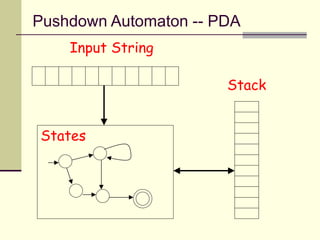
A Pushdown Automaton is a nondeterministic
finite state automaton (NFA) that permits
ε-transitions and a stack.
Pushdown Automaton -- PDA
Input String
Stack
States
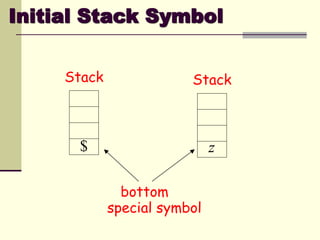
Initial Stack Symbol
Stack
$
Stack
z
bottom
special symbol
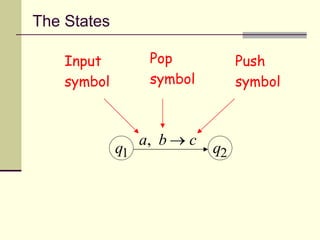
The States
q1 q2
a, b  c
Input
symbol
Pop
symbol
Push
symbol
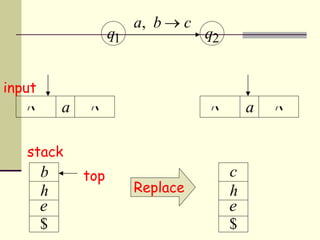
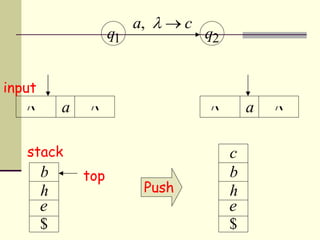
q1 q2
a, b  c
a 
b top
input
stack
a 
Replace
e
h
$
e
h
$
c
q1 q2
a,   c
a  a 
Push
b
e
h
$
e
h
$
b
c
top
input
stack
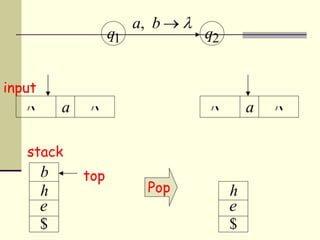
q1 q2
a, b  
a  a 
Pop
b
e
h
$
e
h
$
top
input
stack
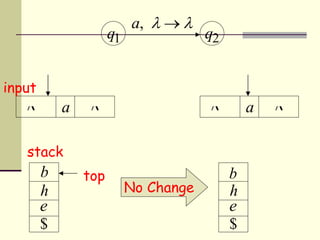
q1 q2
a,   
a  a 
No Change
b
e
h
$
e
h
$
btop
input
stack
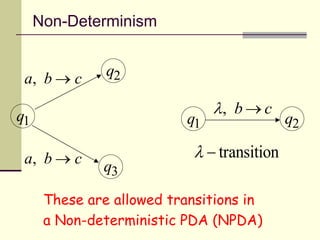
Non-Determinism
q1
q2a, b  c
q3
a, b  c
q1 q2
, b  c
transition
These are allowed transitions in
a Non-deterministic PDA (NPDA)
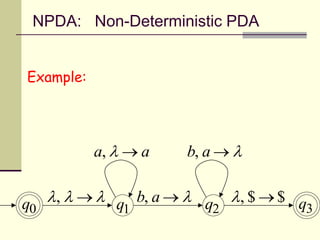
NPDA: Non-Deterministic PDA
Example:
,   
a,   a
b, a  q0 q1 q2 q3
b, a  
, $  $
a,   a
b, a  
0q q1 q2 q3
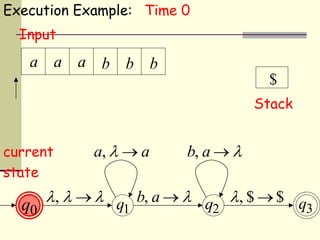
Execution Example:
Input
a a a b b b
current
state
b, a  
Time 0
,    , $  $
Stack
$
a,   a
b, a  q0 q1 q2 q3
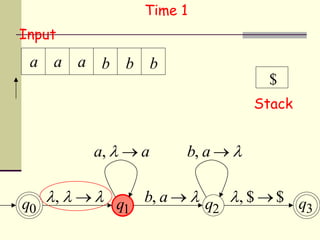
Input
a a a b b b
b, a  
Time 1
,    , $  $
Stack
$
a,   a
b, a  q0 q1 q2 q3
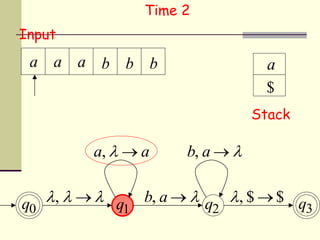
Input
Stack
a a a b b b
$
a
b, a  
Time 2
,    , $  $
a,   a
b, a  q0 q1 q2 q3
Input
Stack
a a a b b b
$
a
a
b, a  
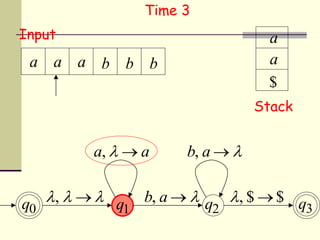
Time 3
,    , $  $
a,   a
b, a  q0 q1 q2 q3
Input
Stack
a a a b b b
$
a
a
a
b, a  
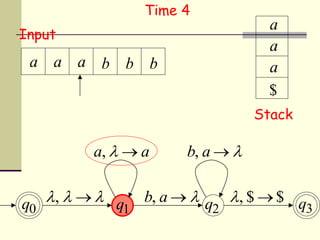
Time 4
,    , $  $
a,   a
b, a  q0 q1 q2 q3
Input
a a a b b b
Stack
$
a
a
a
b, a  
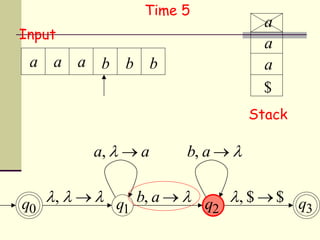
Time 5
,    , $  $
a,   a
b, a  q0 q1 q2 q3
Input
a a a b b b
$
a
Stack
b, a  
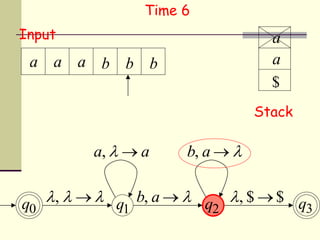
Time 6
,    , $  $
a
a,   a
b, a  q0 q1 q2 q3
Input
a a a b b b
$
Stack
b, a  
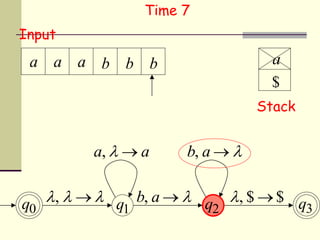
Time 7
,    , $  $
a
a,   a
b, a  q0 q1 q2 q3
Input
a a a b b b
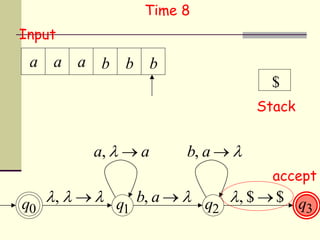
b, a  
Time 8
accept
,    , $  $
$
Stack
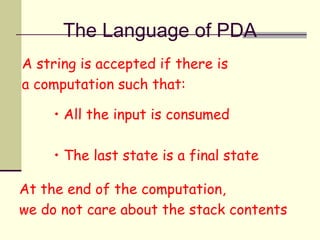
A string is accepted if there is
a computation such that:
• All the input is consumed
• The last state is a final state
At the end of the computation,
we do not care about the stack contents
The Language of PDA
ANY
QUESTION
????????
THE
END

PDA (pushdown automaton)

  • 1.
  • 2.
  • 3.
    GROUP MEMBER NAME S.ID ZaheerRaihan Shah Alam Shagor 011151053 011151052
  • 4.
    Pushdown Automaton (PDA) A PushdownAutomaton is a nondeterministic finite state automaton (NFA) that permits ε-transitions and a stack.
  • 5.
    Pushdown Automaton --PDA Input String Stack States
  • 6.
  • 7.
    The States q1 q2 a,b  c Input symbol Pop symbol Push symbol
  • 8.
    q1 q2 a, b c a  b top input stack a  Replace e h $ e h $ c
  • 9.
    q1 q2 a,  c a  a  Push b e h $ e h $ b c top input stack
  • 10.
    q1 q2 a, b  a  a  Pop b e h $ e h $ top input stack
  • 11.
    q1 q2 a,   a  a  No Change b e h $ e h $ btop input stack
  • 12.
    Non-Determinism q1 q2a, b c q3 a, b  c q1 q2 , b  c transition These are allowed transitions in a Non-deterministic PDA (NPDA)
  • 13.
    NPDA: Non-Deterministic PDA Example: ,   a,   a b, a  q0 q1 q2 q3 b, a   , $  $
  • 14.
    a,  a b, a   0q q1 q2 q3 Execution Example: Input a a a b b b current state b, a   Time 0 ,    , $  $ Stack $
  • 15.
    a,  a b, a  q0 q1 q2 q3 Input a a a b b b b, a   Time 1 ,    , $  $ Stack $
  • 16.
    a,  a b, a  q0 q1 q2 q3 Input Stack a a a b b b $ a b, a   Time 2 ,    , $  $
  • 17.
    a,  a b, a  q0 q1 q2 q3 Input Stack a a a b b b $ a a b, a   Time 3 ,    , $  $
  • 18.
    a,  a b, a  q0 q1 q2 q3 Input Stack a a a b b b $ a a a b, a   Time 4 ,    , $  $
  • 19.
    a,  a b, a  q0 q1 q2 q3 Input a a a b b b Stack $ a a a b, a   Time 5 ,    , $  $
  • 20.
    a,  a b, a  q0 q1 q2 q3 Input a a a b b b $ a Stack b, a   Time 6 ,    , $  $ a
  • 21.
    a,  a b, a  q0 q1 q2 q3 Input a a a b b b $ Stack b, a   Time 7 ,    , $  $ a
  • 22.
    a,  a b, a  q0 q1 q2 q3 Input a a a b b b b, a   Time 8 accept ,    , $  $ $ Stack
  • 23.
    A string isaccepted if there is a computation such that: • All the input is consumed • The last state is a final state At the end of the computation, we do not care about the stack contents The Language of PDA
  • 24.
  • 25.