Outlines
Turing Machineas a Model of Computation
Two-Stack PDA is Equivalent to TM
Linear Bound Automata with One Stack
Linear Bound Automata with Two Stacks
TM Simulate Two-Stack PDA
2
3.
Turing Machine
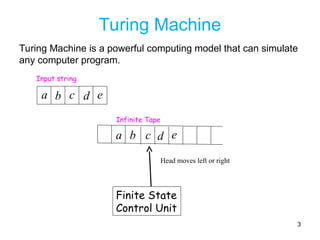
Turing Machineis a powerful computing model that can simulate
any computer program.
Finite State
Control Unit
a b c d e
Input string
Infinite Tape
e
d
c
b
a
Head moves left or right
3
4.
The Turing Machine
Hopcroftand Ullman [1] defined a one-tape Turing machine as
sextuples (Q, Γ, ∑, , q0, F) where:
•Q is a finite set of states.
•Γ is a finite set of the tape alphabet/symbols contain a special symbol B
that represent a blank.
•Σ is a subset of Γ – {B} called input alphabet.
= Q x Γ Q x Γ x {L,R} is a partial function called the transition function,
where L is left shift, R is right shift.
•q0 is the initial state.
•F is the set of final or accepting states.
4
5.
Turing Machineis a model of computation.
Equivalent versions of Turing machine have the same power
as the standard Turing machine.
− Two way Turing Machine
− Multitrack Turing Machine
− Multitape Turing Machine
− Non-deterministic Turing Machine
Any machine that simulates any computer program can
be considered as model of computation.
Undecidable Problem can be apply to any computational
model (not restricted to the Turing machine).
Turing Machine as Model of Computation
5
6.
Two-Stack PDA
ATuring machine can accept languages not accepted
by any PDA with one stack.
The strength of pushdown automata can be increased by
adding additional (extra) stacks.
Actually, a PDA with two stacks has the same
computation power as a Turing Machine.
6
Two-Stack PDA
k-Stack PDAis also called k-stack machine.
Adding more than two stacks to multistack machine does
not increase the power of computation.
Theorem (8.13) (Hopcroft and Ullman [1]):
If a language L is accepted by a Turing machine, then L
is accepted by a two-stack machine.
8
9.
Two-Stack PDA
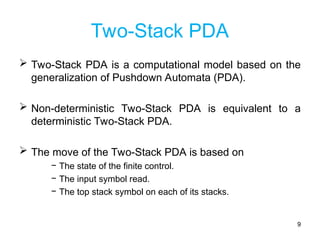
Two-StackPDA is a computational model based on the
generalization of Pushdown Automata (PDA).
Non-deterministic Two-Stack PDA is equivalent to a
deterministic Two-Stack PDA.
The move of the Two-Stack PDA is based on
− The state of the finite control.
− The input symbol read.
− The top stack symbol on each of its stacks.
9
10.
Turing Machine Two-StackPDA Machine
A move of Turing machine includes:
A. Change state
B. Write a tape symbol in the
cell scanned
C. Move the head left or right.
A move of two-stack PDA includes:
A. Change state
B. The input symbol read
C. Replace the symbol of
each stack with a string of
zero or more stack symbol
How does the Two-Stack PDA simulate the TM tape ?
10
11.
Two-Stack PDA SimulateTM
How does the Two-Stack PDA simulate the TM tape ?
The idea is that the first stack can hold what is to the left of the head,
while the second stack holds what is to the right of the head.
When we want to get a symbol which is in the first stack , we will pop all
the content in the first stack above that symbol and push these content
in the second stack.
In this way we can access any symbol stored in the stack without losing
any content.
This allows to simulate the tape of TM M , where the TM head is
corresponding to the heads of the two stacks of the Two-Stack PDA .
11
12.
M Tape
c de
a a
a b b
b
b
b
a
#
a
Stack1
#
d
e
a
b
c
Stack2
12
TM M
Two-Stack PDA S
13.
M replaces Xby Y and moves right
S pop X from stack2 and push Y to stack1
Stack1 Stack2
Move right
M Tape
X
Push
X
Pop
#
d
e
a
b
c
b
b
#
a
c d e
Y a
a b b b
Y
13
14.
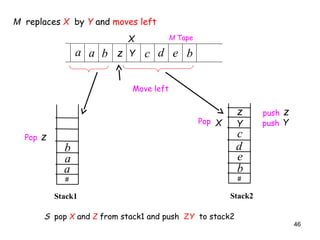
M replaces Xby Y and moves left
S pop X and Z from stack1 and push ZY to stack2
Stack1 Stack2
M Tape
X
c d e
a b
a b
z
#
b d
e
b
#
a
c
a
Y
z
Move left
push
Pop z
z
push
Pop X
14
Y
Y
15.
Pushdown Automata
Sudkamp [2]defined A pushdown automata (PDA) as a
sextuple (Q, , , , q0, F), where
Q is a finite set of states
is a finite set of input symbols, called input alphabet
is a finite set of stack symbols, called stack alphabet
q0 Q, is the start state
F Q, is the set of final states
: Q ( { }) ( { }) to the set of all subsets of
Q ( { }), a (partial) transition function
15
PDA
The transition is of the form:
[qj, B] (qi, a, A),
where
qi is the current state
a is the current input symbol
A is the current top of the stack symbol
qj is the new state
B is the new top of the stack symbol
qi q
j
a A/B qi q
j
a A/
qi qj
a /
17
18.
There are twocriteria for string acceptance by PDA.
First Criteria (final state and empty stack)
An input string x is accepted by the PDA if the PDA stops at a
final state and the stack is empty. Otherwise, the input string is
rejected.
Second Criteria (final state only)
An input string x is accepted by the PDA if the PDA stops at a final
state no matter what symbols in the stacks.
Accepting Criteria
Let L be a language accepted by a PDA M (Q, , , , q0, F)
with acceptance defined by final state. Then there is a PDA
that accepts L by final state and empty stack.
18
19.
Context-Free Grammar (CFG)
Productions
v
u
One variable
String of variables
and terminals
A language L is context-free if there exists a CFG G such that L = L(G).
Theorem:
Let L be a context-free language, then there is a PDA that accepts L.
19
20.
The language {}
n n
a b is context-free:
S aSb
S
If (n > 0) , the context-free grammar as follow:
|
|
S aAB aB
A aAB aB
B b
If (n 0) , the context-free grammar as follow:
20
21.
PDA
Example (Sudkamp [2])PDA accepts the language L = { an
bn
|n 0}. The
stack is used to record the number of a’s
Computational Trace
[q0, aaabbb , ]
|- [q0, aabbb, A]
|- [q0, abbb, AA]
|- [q0, bbb, AAA]
|- [q1, bb, AA]
|- [q1, b, A]
|- [q1, , ]
M = {q0 , q1 }
= {a, b }
= {A}
F = {q0 , q1 }
(q0, a, ) = { [q0 , A] }
(q0, b, A) = { [q1 , ] }
(q1, b, A) = { [q1 , ] }
q0
>
a /A b A/
q1
b A/
21
22.
Pushdown Automata isnon-deterministic
q0
>
a /A b A/
q1
b A/
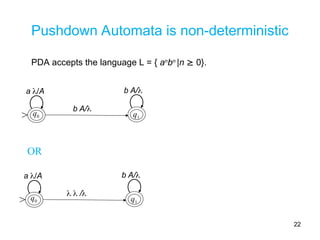
PDA accepts the language L = { an
bn
|n 0}.
q0
>
a /A b A/
q1
/
OR
22
23.
PDA
Example 8.1.1 (Sudkamp[2]) A PDA accept the language L= {wcwR
|w ={a,b}*}. The
stack is used to record the string w. stack symbols A and B represent the input a
and b respectively.
(q0, a, ) = { [q0 , A] }
(q0, b, ) = { [q0 , B] }
(q0, c, ) = { [q1 , ] }
(q1, a, A) = { [q1 , ] }
(q1, b, b) = { [q1 , ] }
Q = {q0 , q1 }
= {a, b ,c }
= {A ,B}
F = { q1 }
b /B
> q0 q1
c /
a /A a A/
b B/
23
24.
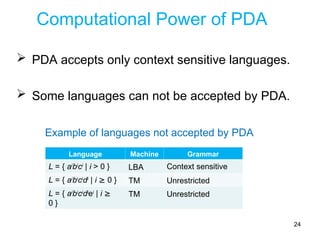
Example of languagesnot accepted by PDA
Language Machine Grammar
L = { ai
bi
ci
| i > 0 } LBA Context sensitive
L = { ai
bi
ci
di
| i 0 } TM Unrestricted
L = { ai
bi
ci
di
ei
| i
0 }
TM Unrestricted
24
PDA accepts only context sensitive languages.
Some languages can not be accepted by PDA.
Computational Power of PDA
25.
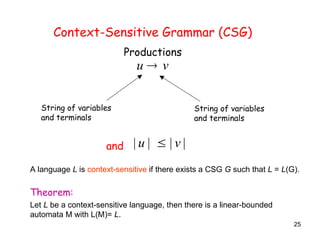
Context-Sensitive Grammar (CSG)
and|
|
|
| v
u
Productions
v
u
String of variables
and terminals
String of variables
and terminals
Theorem:
Let L be a context-sensitive language, then there is a linear-bounded
automata M with L(M)= L.
A language L is context-sensitive if there exists a CSG G such that L = L(G).
25
26.
The language {| 0}
n n n
a b c n is context-sensitive:
aaA
aa
aB
Bb
bB
Bbcc
Ac
bA
Ab
aAbc
abc
S
|
|
It can be generated by a context-sensitive grammar
26
27.
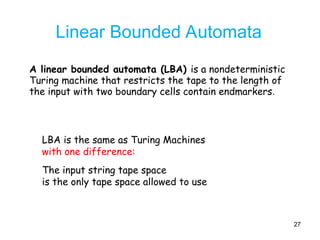
Linear Bounded Automata
Alinear bounded automata (LBA) is a nondeterministic
Turing machine that restricts the tape to the length of
the input with two boundary cells contain endmarkers.
LBA is the same as Turing Machines
with one difference:
The input string tape space
is the only tape space allowed to use
27
28.
[ ]
a bc d e
Left-end
marker
Input string
Right-end
marker
All computation is done between end markers
Linear Bounded Automaton (LBA)
Finite State
Control Unit
28
29.
Unrestricted Grammars
Productions
v
u
Stringof variables
and terminals
String of variables
and terminals
A language L is recursively enumerable if and only if L
is generated by an unrestricted grammar.
Theorem:
29
Two-Stack PDA
Definition 8.6.1Sudkamp [2] A two-stack PDA is a
sextuple (Q, , , , q0, F), where Q, , , q0, and F are the
same as in a one-stack PDA. The transition function as follow:
: Q ( { }) ( { }) ( { }) to the set of all
subsets of Q ( { }) ( { })
The two stacks of the PDA are independent.
one stack: two stack:
Two-Stack PDA accepts any language that accepted by a
Turing Machine.
qi qj
a A/ qi q
j
a A/ /B/C
32
33.
Two-Stack PDAs
Two-Stack PDAaccepts the language L= { ai
bi
ci
| i 0 }
q0
> / / q2
q1
a /A / c / B/
c / B/
b A/ /B
b A/ /B
OR
q0
> q2
q1
a /A / c / B/
c / B/
b A/ /B
b A/ /B
33
34.
Example 8.6.1 (Sudkamp[2]) A Two-Stack PDA M accepts L = { ai
bi
ci
| i 0 }
q0
> / / q2
q1
a /A / c / B/
c / B/
b A/ /B
b A/ /B
Computational Trace
[q0, aabbcc, , ] |- [q0, abbcc, A, ]
|- [q0, bbcc, AA, ]
|- [q1, bcc, A, B]
|- [q1, cc, , BB]
|- [q2, c, , B]
|- [q2, , , ]
34
Q = {q0 , q1 , q2}
= {a, b ,c }
= {A ,B}
F = { q2 }
35.
Two-Stack PDAs
Example 8.6.2(Sudkamp [2]) A Two-Stack PDA M accepts the language L =
{ ai
bi
ci
di
| i 0 }
q0
> / / q3
q2
a /A /
d C/ /
b A/ /B
q1
b A/ /B c /C B/ c /C B/
d C/ /
i) Processing a pushes A onto stack 1.
ii) Processing b pops A and pushes B onto stack 2.
iii) Processing c pops B and pushes C onto stack 1.
iv) Processing d pops C.
The computations of M process the strings of L in the following manner:
35
36.
Two-Stack PDA
Theorem 8.13(Hopcroft and Ullman [1])
If a language L is accepted by a Turing machine, L is
accepted by a Two-Stack machine.
36
37.
Theorem Proof
The ideais that the first stack can hold what is
to the left of the head, while the second stack
holds what is to the right of the head,
neglecting all the infinite blank symbols beyond
the leftmost and rightmost of the head.
The proof is taken from (Hopcroft and Ullman [1])
37
38.
Proof Cont’d
Let’s Lbe L(M) for some one tape TM M, two-
stack machine S, simulating a one-tape TM M as
the following:
1. S begins with a bottom-of-stack marker
on each stack, this marker considered the
start symbol for the stacks, and must not
appear elsewhere on the stacks. The marker
indicates that the stack is empty.
38
39.
Proof Cont’d
2. Supposethat w$ is on the input of S. S
copies the input w onto its first stack, and
stops to copy when reading the endmarker
on the input.
3. S pops each symbol in turn from its first
stack and pushes it onto its second stack.
The first stack of S is empty. The second
stack holds w, with the left end of w is at
the top.
39
40.
Proof Cont’d
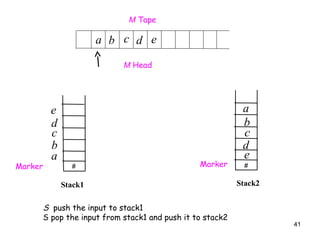
4. Ssimulated the first state of M. The empty
first stack indicates the fact that M has a
blank to the left of cell scanned by the tape.
S has a second stack holding w indicates
the tape head point to the left most symbol
in the string w ( see the following diagram).
40
41.
c d e
MTape
Stack1 Stack2
b
#
a b
d
e
a
b
#
a
c
c
e
d
M Head
Marker Marker
S push the input to stack1
S pop the input from stack1 and push it to stack2
41
42.
Proof Cont’d
5. Ssimulates a move of M as follows:
a) S knows the state of M, say q, because S
simulates the state of M in its own finite control.
b) S knows the symbol X scanned by the head of
M; it’s at the top of the second stack. If the second
stack contains only the bottom of stack marker ,
this means that M’s head has just scanned a
blank.
c) So, S knows the next move of M.
42
43.
Proof Cont’d
d) Thenext state of M is recorded in a component
of S’s finite control, instead of the previous
state.
e) If M replaces X by Y and moves right, then S
pushes Y onto its first stack, representing the fact
that Y is now at the left of M’s head (see the
following diagram).
43
44.
M replaces Xby Y and moves right
S pop X from stack2 and push Y to stack1
Stack1 Stack2
Move right
M Tape
X
Push
X
Pop
#
d
e
a
b
c
b
b
#
a
Y
c d e
Y a
a b b b
Y
44
45.
Proof Cont’d
f) IfM replace X by Y and moves left, S pops the
top of the first stack , say Z, then replaces X by
ZY on the second stack. This represents what used
to be one position left of the head is now at the head
(see the following diagram).
45
46.
M replaces Xby Y and moves left
S pop X and Z from stack1 and push ZY to stack2
Stack1 Stack2
M Tape
X
c d e
a b
a b
z
#
b d
e
b
#
a
c
a
Y
z
Move left
push
Pop z
z
push
Pop X
46
Y
Y
47.
Proof Cont’d
6. Saccepts if the new state of M is accepting.
Otherwise, S simulates another move of
M in the same manner.
47
48.
TM can SimulateTwo-Stack PDA
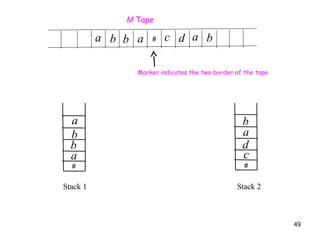
Pushdown automata is non-deterministic. Therefore, we choose a non-
deterministic Turing machine M to simulate the Two-Stack PDA.
We split the tape of the turing machine into two half.
We place a marker symbol in the tape to indicate the border between
the two half.
The part of the tape left from the marker simulate one stack.
The part of the tape right from the marker simulate the second stack.
The bottom of the stack is the marker.
-We can simulate the two stacks using two-tape Truing machine such
that every tape simulates one stack.
48
49.
c d
M Tape
Stack1 Stack 2
b
#
a a
a b b b
b
a
d
a
b
#
a c
Marker indicates the two border of the tape
#
49
50.
Question : Doesthe Two-Stack PDA simulate the computer?
Answer: yes
Since TM simulates a computer (proven in the course text book)
AND Two-Stack PDA simulates a TM (proven in Hopcroft and Ullman [1])
Thus , Two-Stack PDA can simulate the computer.
50
51.
References
1- Hopcroft J, Motwani R, Ullman J , “Introduction to Automata Theory,
Languages and Computation”, Addison Wesley, 2nd
edition , 2001.
2- T. A. Sudkamp , “Language and Machine: An Introduction to the
Theory of Computer Science” Addison-Wesley , 2nd
edition , 1997.
51

![The Turing Machine
Hopcroft and Ullman [1] defined a one-tape Turing machine as
sextuples (Q, Γ, ∑, , q0, F) where:
•Q is a finite set of states.
•Γ is a finite set of the tape alphabet/symbols contain a special symbol B
that represent a blank.
•Σ is a subset of Γ – {B} called input alphabet.
= Q x Γ Q x Γ x {L,R} is a partial function called the transition function,
where L is left shift, R is right shift.
•q0 is the initial state.
•F is the set of final or accepting states.
4](https://image.slidesharecdn.com/2-stack-pda-2nd-250729081327-23599caa/85/2-stack-Push-Down-Automata-PDA-_TOComp-ppt-4-320.jpg)


![Two-Stack PDA
k-Stack PDA is also called k-stack machine.
Adding more than two stacks to multistack machine does
not increase the power of computation.
Theorem (8.13) (Hopcroft and Ullman [1]):
If a language L is accepted by a Turing machine, then L
is accepted by a two-stack machine.
8](https://image.slidesharecdn.com/2-stack-pda-2nd-250729081327-23599caa/85/2-stack-Push-Down-Automata-PDA-_TOComp-ppt-8-320.jpg)


![Pushdown Automata
Sudkamp [2] defined A pushdown automata (PDA) as a
sextuple (Q, , , , q0, F), where
Q is a finite set of states
is a finite set of input symbols, called input alphabet
is a finite set of stack symbols, called stack alphabet
q0 Q, is the start state
F Q, is the set of final states
: Q ( { }) ( { }) to the set of all subsets of
Q ( { }), a (partial) transition function
15](https://image.slidesharecdn.com/2-stack-pda-2nd-250729081327-23599caa/85/2-stack-Push-Down-Automata-PDA-_TOComp-ppt-15-320.jpg)

![PDA
The transition is of the form:
[qj, B] (qi, a, A),
where
qi is the current state
a is the current input symbol
A is the current top of the stack symbol
qj is the new state
B is the new top of the stack symbol
qi q
j
a A/B qi q
j
a A/
qi qj
a /
17](https://image.slidesharecdn.com/2-stack-pda-2nd-250729081327-23599caa/85/2-stack-Push-Down-Automata-PDA-_TOComp-ppt-17-320.jpg)


![PDA
Example (Sudkamp [2]) PDA accepts the language L = { an
bn
|n 0}. The
stack is used to record the number of a’s
Computational Trace
[q0, aaabbb , ]
|- [q0, aabbb, A]
|- [q0, abbb, AA]
|- [q0, bbb, AAA]
|- [q1, bb, AA]
|- [q1, b, A]
|- [q1, , ]
M = {q0 , q1 }
= {a, b }
= {A}
F = {q0 , q1 }
(q0, a, ) = { [q0 , A] }
(q0, b, A) = { [q1 , ] }
(q1, b, A) = { [q1 , ] }
q0
>
a /A b A/
q1
b A/
21](https://image.slidesharecdn.com/2-stack-pda-2nd-250729081327-23599caa/85/2-stack-Push-Down-Automata-PDA-_TOComp-ppt-21-320.jpg)
![PDA
Example 8.1.1 (Sudkamp [2]) A PDA accept the language L= {wcwR
|w ={a,b}*}. The
stack is used to record the string w. stack symbols A and B represent the input a
and b respectively.
(q0, a, ) = { [q0 , A] }
(q0, b, ) = { [q0 , B] }
(q0, c, ) = { [q1 , ] }
(q1, a, A) = { [q1 , ] }
(q1, b, b) = { [q1 , ] }
Q = {q0 , q1 }
= {a, b ,c }
= {A ,B}
F = { q1 }
b /B
> q0 q1
c /
a /A a A/
b B/
23](https://image.slidesharecdn.com/2-stack-pda-2nd-250729081327-23599caa/85/2-stack-Push-Down-Automata-PDA-_TOComp-ppt-23-320.jpg)

![[ ]
a b c d e
Left-end
marker
Input string
Right-end
marker
All computation is done between end markers
Linear Bounded Automaton (LBA)
Finite State
Control Unit
28](https://image.slidesharecdn.com/2-stack-pda-2nd-250729081327-23599caa/85/2-stack-Push-Down-Automata-PDA-_TOComp-ppt-28-320.jpg)


![Two-Stack PDA
Definition 8.6.1 Sudkamp [2] A two-stack PDA is a
sextuple (Q, , , , q0, F), where Q, , , q0, and F are the
same as in a one-stack PDA. The transition function as follow:
: Q ( { }) ( { }) ( { }) to the set of all
subsets of Q ( { }) ( { })
The two stacks of the PDA are independent.
one stack: two stack:
Two-Stack PDA accepts any language that accepted by a
Turing Machine.
qi qj
a A/ qi q
j
a A/ /B/C
32](https://image.slidesharecdn.com/2-stack-pda-2nd-250729081327-23599caa/85/2-stack-Push-Down-Automata-PDA-_TOComp-ppt-32-320.jpg)

![Example 8.6.1 (Sudkamp [2]) A Two-Stack PDA M accepts L = { ai
bi
ci
| i 0 }
q0
> / / q2
q1
a /A / c / B/
c / B/
b A/ /B
b A/ /B
Computational Trace
[q0, aabbcc, , ] |- [q0, abbcc, A, ]
|- [q0, bbcc, AA, ]
|- [q1, bcc, A, B]
|- [q1, cc, , BB]
|- [q2, c, , B]
|- [q2, , , ]
34
Q = {q0 , q1 , q2}
= {a, b ,c }
= {A ,B}
F = { q2 }](https://image.slidesharecdn.com/2-stack-pda-2nd-250729081327-23599caa/85/2-stack-Push-Down-Automata-PDA-_TOComp-ppt-34-320.jpg)
![Two-Stack PDAs
Example 8.6.2 (Sudkamp [2]) A Two-Stack PDA M accepts the language L =
{ ai
bi
ci
di
| i 0 }
q0
> / / q3
q2
a /A /
d C/ /
b A/ /B
q1
b A/ /B c /C B/ c /C B/
d C/ /
i) Processing a pushes A onto stack 1.
ii) Processing b pops A and pushes B onto stack 2.
iii) Processing c pops B and pushes C onto stack 1.
iv) Processing d pops C.
The computations of M process the strings of L in the following manner:
35](https://image.slidesharecdn.com/2-stack-pda-2nd-250729081327-23599caa/85/2-stack-Push-Down-Automata-PDA-_TOComp-ppt-35-320.jpg)
![Two-Stack PDA
Theorem 8.13 (Hopcroft and Ullman [1])
If a language L is accepted by a Turing machine, L is
accepted by a Two-Stack machine.
36](https://image.slidesharecdn.com/2-stack-pda-2nd-250729081327-23599caa/85/2-stack-Push-Down-Automata-PDA-_TOComp-ppt-36-320.jpg)
![Theorem Proof
The idea is that the first stack can hold what is
to the left of the head, while the second stack
holds what is to the right of the head,
neglecting all the infinite blank symbols beyond
the leftmost and rightmost of the head.
The proof is taken from (Hopcroft and Ullman [1])
37](https://image.slidesharecdn.com/2-stack-pda-2nd-250729081327-23599caa/85/2-stack-Push-Down-Automata-PDA-_TOComp-ppt-37-320.jpg)






![Question : Does the Two-Stack PDA simulate the computer?
Answer: yes
Since TM simulates a computer (proven in the course text book)
AND Two-Stack PDA simulates a TM (proven in Hopcroft and Ullman [1])
Thus , Two-Stack PDA can simulate the computer.
50](https://image.slidesharecdn.com/2-stack-pda-2nd-250729081327-23599caa/85/2-stack-Push-Down-Automata-PDA-_TOComp-ppt-50-320.jpg)


