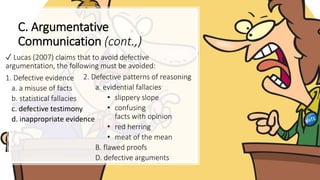
Argumentative communication relies on sound proof and reasoning, using logical appeals. It aims to persuade an audience on a particular issue or position. Effective argumentation avoids defective evidence, such as statistical fallacies or inappropriate facts. It also avoids flawed patterns of reasoning like slippery slopes, red herrings, or confusing facts with opinions. The best example of argumentative communication is a debate, where participants logically defend their stance to an audience.












![Health optimizing physical_education[1] BY GLADYS ALOYON](https://cdn.slidesharecdn.com/ss_thumbnails/healthoptimizingphysicaleducation1-190714081143-thumbnail.jpg?width=640&height=640&fit=bounds)


