MEDIA AND INFORMATION LITERACY
QUARTER 1 – MODULE 5: CODES,
CONVENTIONS, AND LANGUAGE OF
MEDIA
AFTER GOING THROUGH THIS MODULE, YOU ARE
EXPECTED TO:
1. DEFINE CODES, CONVENTIONS, AND LANGUAGE OF
MEDIA.
2. IDENTIFY THE CODES AND CONVENTIONS
PRESENTED.
3. USE THE CODES AND CONVENTIONS OF MEDIA IN
PRESENTING AN ISSUE.
WHAT I KNOW
DIRECTIONS: Read the following
questions. Encircle the letter of
the correct
answer.
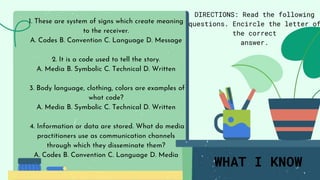
1. These are system of signs which create meaning
to the receiver.
A. Codes B. Convention C. Language D. Message
2. It is a code used to tell the story.
A. Media B. Symbolic C. Technical D. Written
3. Body language, clothing, colors are examples of
what code?
A. Media B. Symbolic C. Technical D. Written
4. Information or data are stored. What do media
practitioners use as communication channels
through which they disseminate them?
A. Codes B. Convention C. Language D. Media
WHAT I KNOW
DIRECTIONS: Read the following
questions. Encircle the letter of
the correct
answer.
5. In movies, what colors are usually used to
symbolize evil?
A. Black and Blue B. Black and Gray C. Black and
Red D. Black and White
6. Sounds and lightings are examples of what kind
of code?
A. Media B. Symbolic C. Technical D. Written
7. Sound is one of the most commonly used codes
in media. When a movie scene has a sound of a
wind, what does it signify?
A. Something awful will happen
B. Something memorable will happen
C. Something terrifying will happen
D. Something unpredictable will happen
WHAT I KNOW
DIRECTIONS: Read the following
questions. Encircle the letter of
the correct
answer.
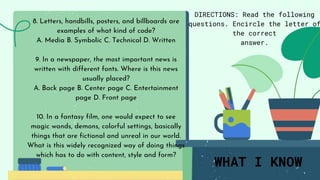
8. Letters, handbills, posters, and billboards are
examples of what kind of code?
A. Media B. Symbolic C. Technical D. Written
9. In a newspaper, the most important news is
written with different fonts. Where is this news
usually placed?
A. Back page B. Center page C. Entertainment
page D. Front page
10. In a fantasy film, one would expect to see
magic wands, demons, colorful settings, basically
things that are fictional and unreal in our world.
What is this widely recognized way of doing things
which has to do with content, style and form?
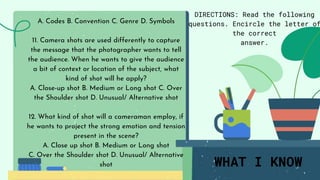
WHAT I KNOW
DIRECTIONS: Read the following
questions. Encircle the letter of
the correct
answer.
A. Codes B. Convention C. Genre D. Symbols
11. Camera shots are used differently to capture
the message that the photographer wants to tell
the audience. When he wants to give the audience
a bit of context or location of the subject, what
kind of shot will he apply?
A. Close-up shot B. Medium or Long shot C. Over
the Shoulder shot D. Unusual/ Alternative shot
12. What kind of shot will a cameraman employ, if
he wants to project the strong emotion and tension
present in the scene?
A. Close up shot B. Medium or Long shot
C. Over the Shoulder shot D. Unusual/ Alternative
shot
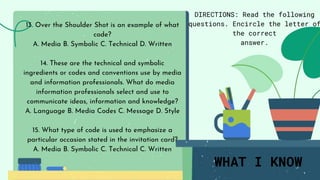
WHAT I KNOW
DIRECTIONS: Read the following
questions. Encircle the letter of
the correct
answer.
13. Over the Shoulder Shot is an example of what
code?
A. Media B. Symbolic C. Technical D. Written
14. These are the technical and symbolic
ingredients or codes and conventions use by media
and information professionals. What do media
information professionals select and use to
communicate ideas, information and knowledge?
A. Language B. Media Codes C. Message D. Style
15. What type of code is used to emphasize a
particular occasion stated in the invitation card?
A. Media B. Symbolic C. Technical C. Written
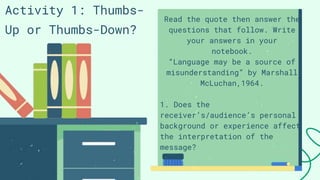
Activity 1: Thumbs-
Up or Thumbs-Down?
Read the quote then answer the
questions that follow. Write
your answers in your
notebook.
“Language may be a source of
misunderstanding” by Marshall
McLuchan,1964.
1. Does the
receiver’s/audience’s personal
background or experience affect
the interpretation of the
message?
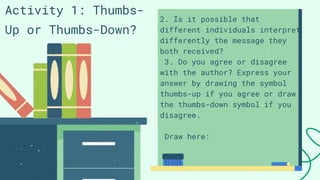
Activity 1: Thumbs-
Up or Thumbs-Down?
2. Is it possible that
different individuals interpret
differently the message they
both received?
3. Do you agree or disagree
with the author? Express your
answer by drawing the symbol
thumbs-up if you agree or draw
the thumbs-down symbol if you
disagree.
Draw here:
Directions: List down two (2) most
commonly used signs and symbols and
two (2) most commonly misunderstood
signs and symbols in the community
ACTIVITY 2: LOOK AROUND ME
Most Commonly Used Signs and Symbols
Why are these symbols commonly used?
Most Commonly Misunderstood Signs and
Symbols
Why are these symbols commonly
misunderstood?
ACTIVITY 2: LOOK AROUND ME
Recall your encounter/experience
with signs, symbols, and signage
using the guide questions below:
1. How were you helped by the sign,
symbol, signage that you followed?
2. How were you misled by the
signs, symbols, signage that you
followed?
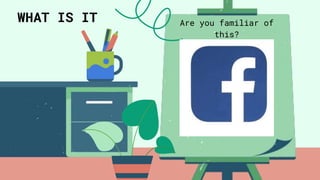
WHAT IS IT Are you familiar of
this?
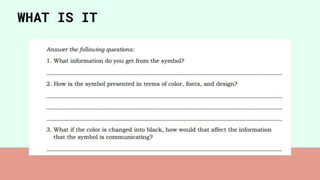
WHAT IS IT
Language pertains to the
technical and symbolic
ingredients or codes
and conventions that media
and information professionals
may select and use in an
effort to communicate ideas,
information and knowledge.
Media language are the codes,
conventions, formats, symbols
and narrative structure that
indicate the meaning of media
messages to an audience. •
Messages are the information
sent from a source to a
receiver.
ACTIVITY 3 ALL AROUND ME
Your task is to identify five (5) signs or symbols in your community
that are used to convey information (ex. directions, locations, etc.)
Give the meaning or purpose of each symbol. Write your answer on the
table provided for you.
ACTIVITY 3 ALL AROUND ME
Now that you have identified symbols and their meaning or purpose,
answer the questions below using your answer on the table as your
reference.
1. How are the symbols usually presented?
2. How are these symbols presented in terms of fonts, images,
colors, design
and others?
3. How important is using symbols to convey a message or
information?
ACTIVITY 3 ALL AROUND ME
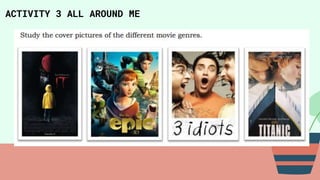
Answer the following questions:
1. What kind of movie does each picture show?
2. What are the elements that helped you identify its kind?
The elements that helped you
identify what kind of movie each
picture shows are the codes and
conventions of media. Media codes
and conventions are like the
building blocks of all the media
around us which generally have an
agreed meaning, or connotation to
their audience (Young, 2017).
There are three (3) types of media
codes: symbolic codes, technical
codes, and written codes.
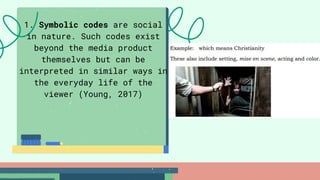
1. Symbolic codes are social
in nature. Such codes exist
beyond the media product
themselves but can be
interpreted in similar ways in
the everyday life of the
viewer (Young, 2017)
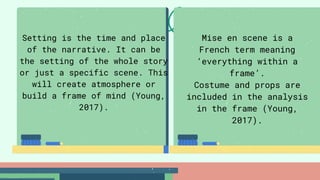
Setting is the time and place
of the narrative. It can be
the setting of the whole story
or just a specific scene. This
will create atmosphere or
build a frame of mind (Young,
2017).
Mise en scene is a
French term meaning
‘everything within a
frame’.
Costume and props are
included in the analysis
in the frame (Young,
2017).
Acting is how an actor portray
a character that will lead to
character development and
tension making through facial
expression, body language and
vocal qualities (Young, 2017).
Color is used to connect
connotation to specific
scenes, characters or
object. Red, for instance,
is typically seen as a
color of passion, danger,
romance, or violence. Green
is connected with nature or
sickness, blue with calm or
depression. Purple is seen
to be connected with
royalty (Young, R. 2017).
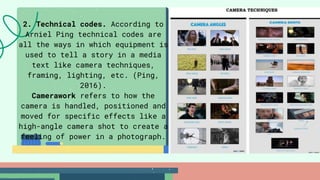
2. Technical codes. According to
Arniel Ping technical codes are
all the ways in which equipment is
used to tell a story in a media
text like camera techniques,
framing, lighting, etc. (Ping,
2016).
Camerawork refers to how the
camera is handled, positioned and
moved for specific effects like a
high-angle camera shot to create a
feeling of power in a photograph.
Lighting. According to Robert
Young lighting is the
manipulation of natural or
artificial light to
selectively highlight specific
elements of the scene( Young,
2017)
Audio is the expressive or
naturalistic use of sound.
It includes dialogue,
sound effects and music.
According to Chris
Constantine(Constantine,
2010) music often defines
a scene. An example is the
use of ominous music to
communicate danger in
films.
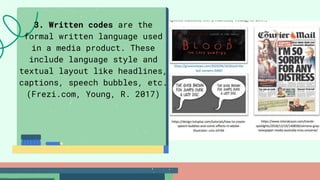
3. Written codes are the
formal written language used
in a media product. These
include language style and
textual layout like headlines,
captions, speech bubbles, etc.
(Frezi.com, Young, R. 2017)
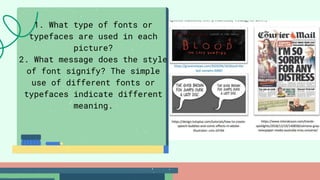
1. What type of fonts or
typefaces are used in each
picture?
2. What message does the style
of font signify? The simple
use of different fonts or
typefaces indicate different
meaning.
According to Robert Young,
conventions are the accepted
ways of using media codes.
There are three different
types of conventions: form
conventions, story conventions
and genre convention (Young,
R. 2017).
1. Form conventions are
the expected ways on how
media codes are arranged.
In newspapers for example,
the most important news
will be at the front page
while sports news is found
at the back page.
Newspapers also contain
masthead.
2. Story conventions are
common narrative structures
and understandings in story
telling media products like
cause and effect, character
construction and point of
view.
3. Genre conventions are
the common use of tropes,
characters, settings or
themes in a particular
type of medium. They can
be formal or thematic.
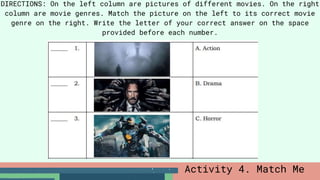
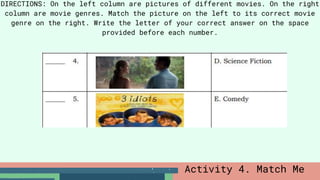
DIRECTIONS: On the left column are pictures of different movies. On the right
column are movie genres. Match the picture on the left to its correct movie
genre on the right. Write the letter of your correct answer on the space
provided before each number.
Activity 4. Match Me
DIRECTIONS: On the left column are pictures of different movies. On the right
column are movie genres. Match the picture on the left to its correct movie
genre on the right. Write the letter of your correct answer on the space
provided before each number.
Activity 4. Match Me
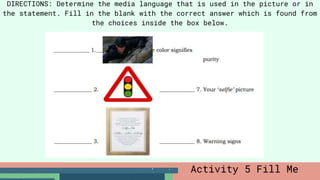
DIRECTIONS: Determine the media language that is used in the picture or in
the statement. Fill in the blank with the correct answer which is found from
the choices inside the box below.
Activity 5 Fill Me
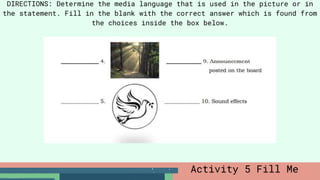
DIRECTIONS: Determine the media language that is used in the picture or in
the statement. Fill in the blank with the correct answer which is found from
the choices inside the box below.
Activity 5 Fill Me
Let us remember:
• Language pertains to the technical and symbolic ingredients or
codes and conventions that media and information professionals
may select and use in an effort to communicate ideas,
information and knowledge.
• Media language are the codes, conventions, formats, symbols
and narrative structure that indicate the meaning of media
messages to an audience.
• Messages are the information sent from a source to a receiver.
• Symbolic codes are social in nature. Such codes exist beyond
the media product themselves but can be interpreted in similar
ways in the everyday life of the viewer
• Technical codes are all the ways in which equipment is used to
tell a story in a media text like camera techniques, framing,
lighting, etc
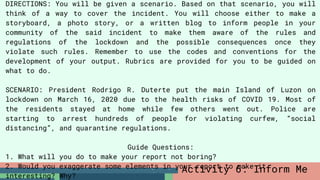
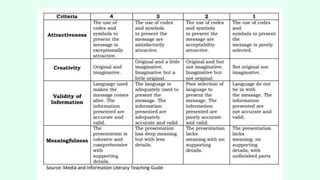
DIRECTIONS: You will be given a scenario. Based on that scenario, you will
think of a way to cover the incident. You will choose either to make a
storyboard, a photo story, or a written blog to inform people in your
community of the said incident to make them aware of the rules and
regulations of the lockdown and the possible consequences once they
violate such rules. Remember to use the codes and conventions for the
development of your output. Rubrics are provided for you to be guided on
what to do.
SCENARIO: President Rodrigo R. Duterte put the main Island of Luzon on
lockdown on March 16, 2020 due to the health risks of COVID 19. Most of
the residents stayed at home while few others went out. Police are
starting to arrest hundreds of people for violating curfew, “social
distancing”, and quarantine regulations.
Guide Questions:
1. What will you do to make your report not boring?
2. Would you exaggerate some elements in your report to make it
interesting? Why?
Activity 6: Inform Me
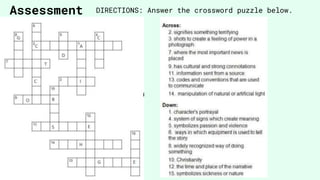
Assessment DIRECTIONS: Answer the crossword puzzle below.
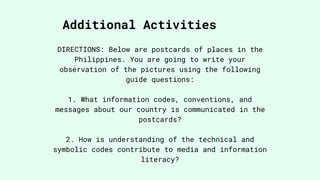
Additional Activities
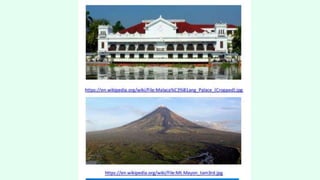
DIRECTIONS: Below are postcards of places in the
Philippines. You are going to write your
observation of the pictures using the following
guide questions:
1. What information codes, conventions, and
messages about our country is communicated in the
postcards?
2. How is understanding of the technical and
symbolic codes contribute to media and information
literacy?
Q 1 Module-5-Codes-Conventions-and-Language-of-Media.pptx

Q 1 Module-5-Codes-Conventions-and-Language-of-Media.pptx

  • 1.
    MEDIA AND INFORMATIONLITERACY QUARTER 1 – MODULE 5: CODES, CONVENTIONS, AND LANGUAGE OF MEDIA
  • 2.
    AFTER GOING THROUGHTHIS MODULE, YOU ARE EXPECTED TO: 1. DEFINE CODES, CONVENTIONS, AND LANGUAGE OF MEDIA. 2. IDENTIFY THE CODES AND CONVENTIONS PRESENTED. 3. USE THE CODES AND CONVENTIONS OF MEDIA IN PRESENTING AN ISSUE.
  • 3.
    WHAT I KNOW DIRECTIONS:Read the following questions. Encircle the letter of the correct answer. 1. These are system of signs which create meaning to the receiver. A. Codes B. Convention C. Language D. Message 2. It is a code used to tell the story. A. Media B. Symbolic C. Technical D. Written 3. Body language, clothing, colors are examples of what code? A. Media B. Symbolic C. Technical D. Written 4. Information or data are stored. What do media practitioners use as communication channels through which they disseminate them? A. Codes B. Convention C. Language D. Media
  • 4.
    WHAT I KNOW DIRECTIONS:Read the following questions. Encircle the letter of the correct answer. 5. In movies, what colors are usually used to symbolize evil? A. Black and Blue B. Black and Gray C. Black and Red D. Black and White 6. Sounds and lightings are examples of what kind of code? A. Media B. Symbolic C. Technical D. Written 7. Sound is one of the most commonly used codes in media. When a movie scene has a sound of a wind, what does it signify? A. Something awful will happen B. Something memorable will happen C. Something terrifying will happen D. Something unpredictable will happen
  • 5.
    WHAT I KNOW DIRECTIONS:Read the following questions. Encircle the letter of the correct answer. 8. Letters, handbills, posters, and billboards are examples of what kind of code? A. Media B. Symbolic C. Technical D. Written 9. In a newspaper, the most important news is written with different fonts. Where is this news usually placed? A. Back page B. Center page C. Entertainment page D. Front page 10. In a fantasy film, one would expect to see magic wands, demons, colorful settings, basically things that are fictional and unreal in our world. What is this widely recognized way of doing things which has to do with content, style and form?
  • 6.
    WHAT I KNOW DIRECTIONS:Read the following questions. Encircle the letter of the correct answer. A. Codes B. Convention C. Genre D. Symbols 11. Camera shots are used differently to capture the message that the photographer wants to tell the audience. When he wants to give the audience a bit of context or location of the subject, what kind of shot will he apply? A. Close-up shot B. Medium or Long shot C. Over the Shoulder shot D. Unusual/ Alternative shot 12. What kind of shot will a cameraman employ, if he wants to project the strong emotion and tension present in the scene? A. Close up shot B. Medium or Long shot C. Over the Shoulder shot D. Unusual/ Alternative shot
  • 7.
    WHAT I KNOW DIRECTIONS:Read the following questions. Encircle the letter of the correct answer. 13. Over the Shoulder Shot is an example of what code? A. Media B. Symbolic C. Technical D. Written 14. These are the technical and symbolic ingredients or codes and conventions use by media and information professionals. What do media information professionals select and use to communicate ideas, information and knowledge? A. Language B. Media Codes C. Message D. Style 15. What type of code is used to emphasize a particular occasion stated in the invitation card? A. Media B. Symbolic C. Technical C. Written
  • 8.
    Activity 1: Thumbs- Upor Thumbs-Down? Read the quote then answer the questions that follow. Write your answers in your notebook. “Language may be a source of misunderstanding” by Marshall McLuchan,1964. 1. Does the receiver’s/audience’s personal background or experience affect the interpretation of the message?
  • 9.
    Activity 1: Thumbs- Upor Thumbs-Down? 2. Is it possible that different individuals interpret differently the message they both received? 3. Do you agree or disagree with the author? Express your answer by drawing the symbol thumbs-up if you agree or draw the thumbs-down symbol if you disagree. Draw here:
  • 10.
    Directions: List downtwo (2) most commonly used signs and symbols and two (2) most commonly misunderstood signs and symbols in the community ACTIVITY 2: LOOK AROUND ME Most Commonly Used Signs and Symbols Why are these symbols commonly used? Most Commonly Misunderstood Signs and Symbols Why are these symbols commonly misunderstood?
  • 11.
    ACTIVITY 2: LOOKAROUND ME Recall your encounter/experience with signs, symbols, and signage using the guide questions below: 1. How were you helped by the sign, symbol, signage that you followed? 2. How were you misled by the signs, symbols, signage that you followed?
  • 12.
    WHAT IS ITAre you familiar of this?
  • 13.
  • 14.
    Language pertains tothe technical and symbolic ingredients or codes and conventions that media and information professionals may select and use in an effort to communicate ideas, information and knowledge.
  • 15.
    Media language arethe codes, conventions, formats, symbols and narrative structure that indicate the meaning of media messages to an audience. • Messages are the information sent from a source to a receiver.
  • 16.
    ACTIVITY 3 ALLAROUND ME Your task is to identify five (5) signs or symbols in your community that are used to convey information (ex. directions, locations, etc.) Give the meaning or purpose of each symbol. Write your answer on the table provided for you.
  • 17.
    ACTIVITY 3 ALLAROUND ME Now that you have identified symbols and their meaning or purpose, answer the questions below using your answer on the table as your reference. 1. How are the symbols usually presented? 2. How are these symbols presented in terms of fonts, images, colors, design and others? 3. How important is using symbols to convey a message or information?
  • 18.
    ACTIVITY 3 ALLAROUND ME
  • 19.
    ACTIVITY 3 ALLAROUND ME Answer the following questions: 1. What kind of movie does each picture show? 2. What are the elements that helped you identify its kind?
  • 20.
    The elements thathelped you identify what kind of movie each picture shows are the codes and conventions of media. Media codes and conventions are like the building blocks of all the media around us which generally have an agreed meaning, or connotation to their audience (Young, 2017). There are three (3) types of media codes: symbolic codes, technical codes, and written codes.
  • 21.
    1. Symbolic codesare social in nature. Such codes exist beyond the media product themselves but can be interpreted in similar ways in the everyday life of the viewer (Young, 2017)
  • 22.
    Setting is thetime and place of the narrative. It can be the setting of the whole story or just a specific scene. This will create atmosphere or build a frame of mind (Young, 2017). Mise en scene is a French term meaning ‘everything within a frame’. Costume and props are included in the analysis in the frame (Young, 2017).
  • 23.
    Acting is howan actor portray a character that will lead to character development and tension making through facial expression, body language and vocal qualities (Young, 2017). Color is used to connect connotation to specific scenes, characters or object. Red, for instance, is typically seen as a color of passion, danger, romance, or violence. Green is connected with nature or sickness, blue with calm or depression. Purple is seen to be connected with royalty (Young, R. 2017).
  • 24.
    2. Technical codes.According to Arniel Ping technical codes are all the ways in which equipment is used to tell a story in a media text like camera techniques, framing, lighting, etc. (Ping, 2016). Camerawork refers to how the camera is handled, positioned and moved for specific effects like a high-angle camera shot to create a feeling of power in a photograph.
  • 25.
    Lighting. According toRobert Young lighting is the manipulation of natural or artificial light to selectively highlight specific elements of the scene( Young, 2017) Audio is the expressive or naturalistic use of sound. It includes dialogue, sound effects and music. According to Chris Constantine(Constantine, 2010) music often defines a scene. An example is the use of ominous music to communicate danger in films.
  • 26.
    3. Written codesare the formal written language used in a media product. These include language style and textual layout like headlines, captions, speech bubbles, etc. (Frezi.com, Young, R. 2017)
  • 27.
    1. What typeof fonts or typefaces are used in each picture? 2. What message does the style of font signify? The simple use of different fonts or typefaces indicate different meaning.
  • 28.
    According to RobertYoung, conventions are the accepted ways of using media codes. There are three different types of conventions: form conventions, story conventions and genre convention (Young, R. 2017). 1. Form conventions are the expected ways on how media codes are arranged. In newspapers for example, the most important news will be at the front page while sports news is found at the back page. Newspapers also contain masthead.
  • 29.
    2. Story conventionsare common narrative structures and understandings in story telling media products like cause and effect, character construction and point of view. 3. Genre conventions are the common use of tropes, characters, settings or themes in a particular type of medium. They can be formal or thematic.
  • 30.
    DIRECTIONS: On theleft column are pictures of different movies. On the right column are movie genres. Match the picture on the left to its correct movie genre on the right. Write the letter of your correct answer on the space provided before each number. Activity 4. Match Me
  • 31.
    DIRECTIONS: On theleft column are pictures of different movies. On the right column are movie genres. Match the picture on the left to its correct movie genre on the right. Write the letter of your correct answer on the space provided before each number. Activity 4. Match Me
  • 32.
    DIRECTIONS: Determine themedia language that is used in the picture or in the statement. Fill in the blank with the correct answer which is found from the choices inside the box below. Activity 5 Fill Me
  • 33.
    DIRECTIONS: Determine themedia language that is used in the picture or in the statement. Fill in the blank with the correct answer which is found from the choices inside the box below. Activity 5 Fill Me
  • 34.
    Let us remember: •Language pertains to the technical and symbolic ingredients or codes and conventions that media and information professionals may select and use in an effort to communicate ideas, information and knowledge. • Media language are the codes, conventions, formats, symbols and narrative structure that indicate the meaning of media messages to an audience. • Messages are the information sent from a source to a receiver. • Symbolic codes are social in nature. Such codes exist beyond the media product themselves but can be interpreted in similar ways in the everyday life of the viewer • Technical codes are all the ways in which equipment is used to tell a story in a media text like camera techniques, framing, lighting, etc
  • 35.
    DIRECTIONS: You willbe given a scenario. Based on that scenario, you will think of a way to cover the incident. You will choose either to make a storyboard, a photo story, or a written blog to inform people in your community of the said incident to make them aware of the rules and regulations of the lockdown and the possible consequences once they violate such rules. Remember to use the codes and conventions for the development of your output. Rubrics are provided for you to be guided on what to do. SCENARIO: President Rodrigo R. Duterte put the main Island of Luzon on lockdown on March 16, 2020 due to the health risks of COVID 19. Most of the residents stayed at home while few others went out. Police are starting to arrest hundreds of people for violating curfew, “social distancing”, and quarantine regulations. Guide Questions: 1. What will you do to make your report not boring? 2. Would you exaggerate some elements in your report to make it interesting? Why? Activity 6: Inform Me
  • 37.
    Assessment DIRECTIONS: Answerthe crossword puzzle below.
  • 38.
    Additional Activities DIRECTIONS: Beloware postcards of places in the Philippines. You are going to write your observation of the pictures using the following guide questions: 1. What information codes, conventions, and messages about our country is communicated in the postcards? 2. How is understanding of the technical and symbolic codes contribute to media and information literacy?