communication
argumentative
Presentation by Group 3
Argumentative Communication: Key Points
Definition & Importance: Key for decision-making and
conflict resolution in various contexts.
Core Components: Claims, evidence, reasoning, and
counterarguments.
Effective Techniques: Use logic, emotional appeals, and
credibility.
Key objective of the presentation
Critical Thinking: Evaluates arguments and aids decision-
making.
Examples: Debates, speeches, and written arguments.
Common Mistakes: Fallacies and emotional manipulation.
Audience Participation: Activities to improve
argumentative skills.
Key Takeaways: Apply argumentative principles daily.
Key objective of the presentation
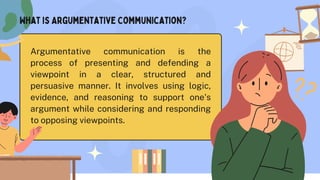
Argumentative communication is the
process of presenting and defending a
viewpoint in a clear, structured and
persuasive manner. It involves using logic,
evidence, and reasoning to support one's
argument while considering and responding
to opposing viewpoints.
What is Argumentative Communication?
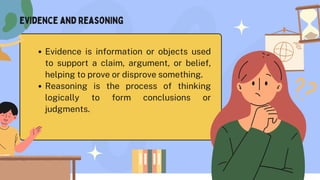
Evidence is information or objects used
to support a claim, argument, or belief,
helping to prove or disprove something.
Reasoning is the process of thinking
logically to form conclusions or
judgments.
evidence and reasoning
Misuse of facts - occurs when an
argument asserts a falsehood
1.
Inappropriate evidence - presented
unsuitable proofs when having
argumentative communication.
2.
Defective Evidence
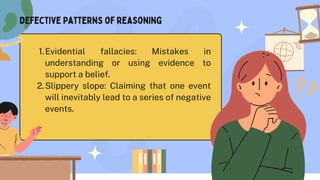
Evidential fallacies: Mistakes in
understanding or using evidence to
support a belief.
1.
Slippery slope: Claiming that one event
will inevitably lead to a series of negative
events.
2.
Defective Patterns of reasoning
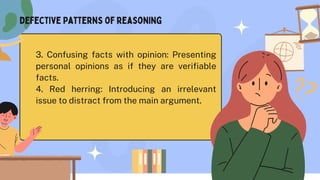
3. Confusing facts with opinion: Presenting
personal opinions as if they are verifiable
facts.
4. Red herring: Introducing an irrelevant
issue to distract from the main argument.
Defective Patterns of reasoning
The arguer takes a lacks of evidence for a
conclusion as if that conclusion is definitely
wrong.
Flawed proofs
An argument is a statement or set of
statements presented to support or oppose
a particular idea or claim.
argument
Logical Arguments: Use facts, logic, and reasoning to persuade;
common in academic, legal, and scientific contexts.
Emotional Arguments: Appeal to emotions like empathy or fear, often
using vivid language and personal stories; common in advertising and
politics.
Ethical Arguments: Appeal to morals and values, emphasizing fairness
and justice; often used in social justice and environmental discussions.
types of argument
Clarity and structure
Use of evidence and logic
Respectful tone and engagement
characteristics of an argument
techniques in argumentative communication
1. Persuasive Strategies: Persuasive
strategies are techniques used to influence
people's beliefs, attitudes, or behaviors.
2. Debate and Counterarguments Debate: A
debate is a formal discussion about a
particular topic where opposing arguments
are presented.
techniques in argumentative communication
3. Avoid Fallacies: Avoiding logical fallacies
is crucial for clear, effective, and ethical
discourse.
Real-Life Applications of Argumentative Communication
1. In the Workplace: (Negotiations,
leadership, teamwork)
2. In Politics & Media: (Debates, news, social
media discourse)
3. In Personal Relationships: (Conflict
resolution, decision-making)
conclusion
Argumentative communication is the process of
defending a viewpoint using logic, evidence, and
reasoning while addressing opposing views. It’s crucial in
contexts like work, politics, and personal relationships
for decision-making and conflict resolution. Effective
communication requires clarity, structure, and avoiding
fallacies, promoting informed and constructive dialogue.
Thank
You

ARGUMENTATIVE COMMUNICATION AND ITS CONCEPTS

  • 1.
  • 2.
    Argumentative Communication: KeyPoints Definition & Importance: Key for decision-making and conflict resolution in various contexts. Core Components: Claims, evidence, reasoning, and counterarguments. Effective Techniques: Use logic, emotional appeals, and credibility. Key objective of the presentation
  • 3.
    Critical Thinking: Evaluatesarguments and aids decision- making. Examples: Debates, speeches, and written arguments. Common Mistakes: Fallacies and emotional manipulation. Audience Participation: Activities to improve argumentative skills. Key Takeaways: Apply argumentative principles daily. Key objective of the presentation
  • 4.
    Argumentative communication isthe process of presenting and defending a viewpoint in a clear, structured and persuasive manner. It involves using logic, evidence, and reasoning to support one's argument while considering and responding to opposing viewpoints. What is Argumentative Communication?
  • 5.
    Evidence is informationor objects used to support a claim, argument, or belief, helping to prove or disprove something. Reasoning is the process of thinking logically to form conclusions or judgments. evidence and reasoning
  • 6.
    Misuse of facts- occurs when an argument asserts a falsehood 1. Inappropriate evidence - presented unsuitable proofs when having argumentative communication. 2. Defective Evidence
  • 7.
    Evidential fallacies: Mistakesin understanding or using evidence to support a belief. 1. Slippery slope: Claiming that one event will inevitably lead to a series of negative events. 2. Defective Patterns of reasoning
  • 8.
    3. Confusing factswith opinion: Presenting personal opinions as if they are verifiable facts. 4. Red herring: Introducing an irrelevant issue to distract from the main argument. Defective Patterns of reasoning
  • 9.
    The arguer takesa lacks of evidence for a conclusion as if that conclusion is definitely wrong. Flawed proofs
  • 10.
    An argument isa statement or set of statements presented to support or oppose a particular idea or claim. argument
  • 11.
    Logical Arguments: Usefacts, logic, and reasoning to persuade; common in academic, legal, and scientific contexts. Emotional Arguments: Appeal to emotions like empathy or fear, often using vivid language and personal stories; common in advertising and politics. Ethical Arguments: Appeal to morals and values, emphasizing fairness and justice; often used in social justice and environmental discussions. types of argument
  • 12.
    Clarity and structure Useof evidence and logic Respectful tone and engagement characteristics of an argument
  • 13.
    techniques in argumentativecommunication 1. Persuasive Strategies: Persuasive strategies are techniques used to influence people's beliefs, attitudes, or behaviors. 2. Debate and Counterarguments Debate: A debate is a formal discussion about a particular topic where opposing arguments are presented.
  • 14.
    techniques in argumentativecommunication 3. Avoid Fallacies: Avoiding logical fallacies is crucial for clear, effective, and ethical discourse.
  • 15.
    Real-Life Applications ofArgumentative Communication 1. In the Workplace: (Negotiations, leadership, teamwork) 2. In Politics & Media: (Debates, news, social media discourse) 3. In Personal Relationships: (Conflict resolution, decision-making)
  • 16.
    conclusion Argumentative communication isthe process of defending a viewpoint using logic, evidence, and reasoning while addressing opposing views. It’s crucial in contexts like work, politics, and personal relationships for decision-making and conflict resolution. Effective communication requires clarity, structure, and avoiding fallacies, promoting informed and constructive dialogue.

  • 17.