Introduction to Environmental Health UERMMMC NSTP – CWTS II Unit 3 – Part III Feb. 2008
Outline of the Presentation Environmental Health Water Quality Food Quality and Sanitation Occupational Health Pollutants vs. Toxicants  Air, Water, and Soil Contamination Major Industrial Wastes Air Quality Major Sources of Air Pollution Common Air Pollutants Effects of Air Pollution on Health Environmental Health Program Environmental Sanitation Environmental Health Services Excreta and Waste Disposal Food Sanitation Hospital Waste Management
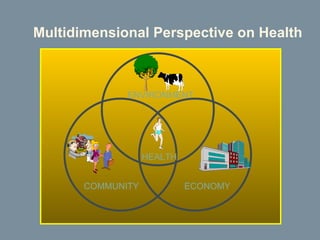
Multidimensional Perspective on Health ENVIRONMENT HEALTH COMMUNITY ECONOMY
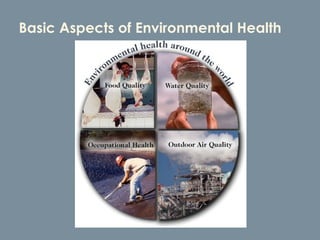
Basic Aspects of Environmental Health
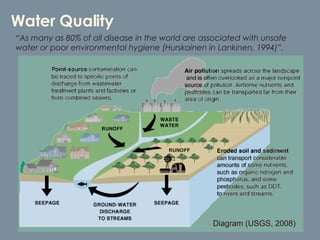
Water Quality “ As many as 80% of all disease in the world are associated with unsafe water or poor environmental hygiene (Hurskainen in Lankinen, 1994)”. Diagram (USGS, 2008)
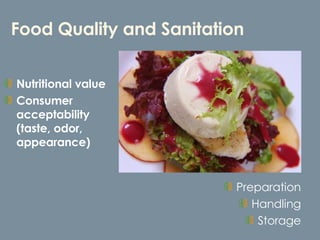
Food Quality and Sanitation Nutritional value Consumer acceptability (taste, odor, appearance) Preparation Handling Storage
Occupational Health Pollutants - chemicals or matter that contaminate various environmental media such as air, soil, water, plants and animals, and have the potential to cause harm to human health or the environment.  Toxicants - pollutants with the potential to act as poisons dependent upon several variables of exposure including magnitude (concentration or dose), route (inhalation, oral or dermal) and duration (acute or chronic).
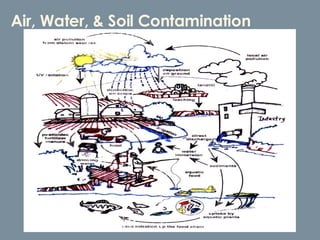
Air, Water, & Soil Contamination
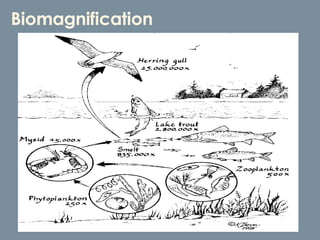
Biomagnification
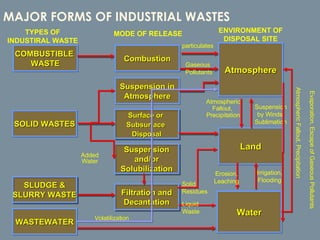
MAJOR FORMS OF INDUSTRIAL WASTES COMBUSTIBLE  WASTE SOLID WASTES SLUDGE & SLURRY WASTE WASTEWATER Combustion Suspension in Atmosphere Surface or  Subsurface  Disposal Suspension and/or Solubilization Filtration and Decantation Atmosphere Land Water TYPES OF INDUSTIRAL WASTE MODE OF RELEASE ENVIRONMENT OF DISPOSAL SITE particulates Gaseous Pollutants Added Water Volatilization Solid Residues Liquid  Waste Erosion, Leaching Irrigation, Flooding Atmospheric Fallout,  Precipitation Suspension by Winds, Sublimation Evaporation, Escape of Gaseous Pollutants Atmospheric Fallout, Precipitation
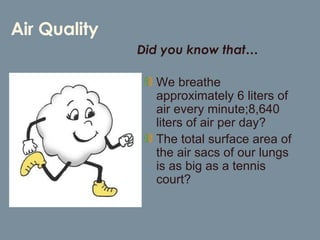
Air Quality We breathe approximately 6 liters of air every minute;8,640 liters of air per day? The total surface area of the air sacs of our lungs is as big as a tennis court? Did you know that…
Why is air pollution a major environmental and occupational health problem ?
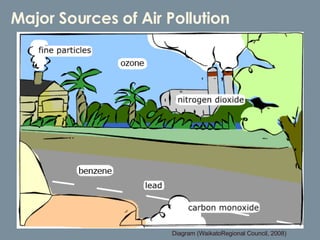
Major Sources of Air Pollution Diagram (WaikatoRegional Council, 2008)
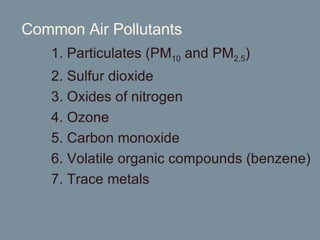
Common Air Pollutants 1. Particulates (PM 10  and PM 2.5 ) 2. Sulfur dioxide 3. Oxides of nitrogen 4. Ozone 5. Carbon monoxide 6. Volatile organic compounds (benzene) 7. Trace metals
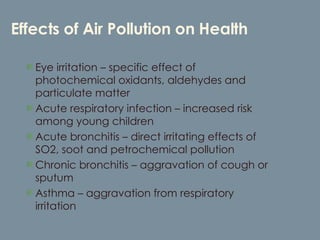
Effects of Air Pollution on Health Eye irritation – specific effect of photochemical oxidants, aldehydes and particulate matter Acute respiratory infection – increased risk among young children Acute bronchitis – direct irritating effects of SO2, soot and petrochemical pollution Chronic bronchitis – aggravation of cough or sputum Asthma – aggravation from respiratory irritation
Decreased lung functions Reduced exercise performance Exacerbation of symptoms with chronic obstructive pulmonary disease (COPD) Headache – carbon monoxide causing more than 10% carboxyhaemoglobin Lead toxicity – add to body burden Deaths – fine particulate increasing mortality in heart and lung disease Effects of Air Pollution on Health
RULE OF 1000 “…states that a pollutant released indoors is 1000 times more likely to reach peoples lungs than a pollutant released outdoors.” World Health Organization, 1997  In urban areas most people spend more than 70% of their time indoors at work, at home, or at school.
Environmental Health Program Environmental Sanitation  It is the  prevention and control  of diseases by eliminating or controlling the  environmental factors  which may form links in  disease transmission .  It is the  study of all factors  in man’s physical environment which may  exercise a deleterious effect on his health, well-being and survival.
Importance of Environmental Sanitation It promotes health  It prevents disease transmission It eliminates breeding places of insects and rodents that may be carrier of diseases It improves the quality of life
Environmental Health Program Components of Environmental Sanitation Water Supply Sanitation Solid Waste Management Food Sanitation Insect and Vermin Control Excreta and Sewerage Disposal Housing and Public Places Sanitation Environmental Protection Hospital Waste Management
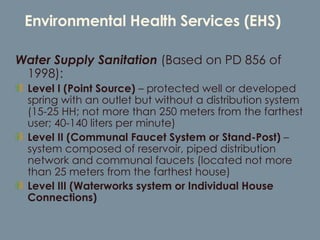
Environmental Health Services (EHS) Water Supply Sanitation   (Based on PD 856 of 1998): Level I (Point Source)  – protected well or developed spring with an outlet but without a distribution system (15-25 HH; not more than 250 meters from the farthest user; 40-140 liters per minute) Level II (Communal Faucet System or Stand-Post)  – system composed of reservoir, piped distribution network and communal faucets (located not more than 25 meters from the farthest house) Level III (Waterworks system or Individual House Connections)
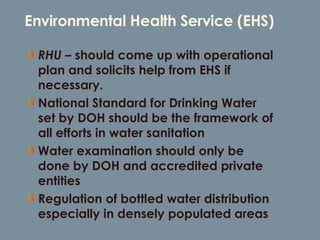
Environmental Health Service (EHS) RHU –  should come up with operational plan and solicits help from EHS if necessary. National Standard for Drinking Water set by DOH should be the framework of all efforts in water sanitation Water examination should only be done by DOH and accredited private entities Regulation of bottled water distribution especially in densely populated areas
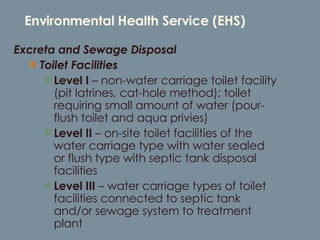
Environmental Health Service (EHS) Excreta and Sewage Disposal  Toilet Facilities Level I  – non-water carriage toilet facility (pit latrines, cat-hole method); toilet requiring small amount of water (pour-flush toilet and aqua privies) Level II  – on-site toilet facilities of the water carriage type with water sealed or flush type with septic tank disposal facilities Level III  – water carriage types of toilet facilities connected to septic tank and/or sewage system to treatment plant
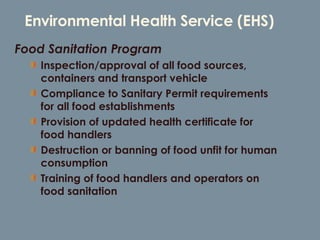
Environmental Health Service (EHS) Food Sanitation Program Inspection/approval of all food sources, containers and transport vehicle Compliance to Sanitary Permit requirements for all food establishments Provision of updated health certificate for food handlers Destruction or banning of food unfit for human consumption  Training of food handlers and operators on food sanitation
Environmental Health Service (EHS) Food Establishment shall be rated and classified as follows:  Class A  – Excellent Class B  – Very satisfactory Class C  – Satisfactory Regulation of  ambulant food vendors Household food sanitation (through IEC activities)
Environmental Health Service (EHS) Hospital Waste Management All newly constructed/authorized and existing government and private hospitals shall prepare and implement HWM Program as a requirement of registration/renewal of licenses The use of appropriate technology and indigenous resources  Training of all hospital personnel on HWM Public information campaign  on health hazards and nosocomial infection Incinerators should not be used anymore (Clean Air Act)
The End
Individual Output Answer the following on ½ crosswise yellow sheet (answers only): Differentiate pollutants from toxicants. Differentiate bioaccumulation from biomagnification. Differentiate the 3 levels of water supply sanitation. Differentiate the 3 levels of toilet facilities.

Introduction to Environmental Health

  • 1.
    Introduction to EnvironmentalHealth UERMMMC NSTP – CWTS II Unit 3 – Part III Feb. 2008
  • 2.
    Outline of thePresentation Environmental Health Water Quality Food Quality and Sanitation Occupational Health Pollutants vs. Toxicants Air, Water, and Soil Contamination Major Industrial Wastes Air Quality Major Sources of Air Pollution Common Air Pollutants Effects of Air Pollution on Health Environmental Health Program Environmental Sanitation Environmental Health Services Excreta and Waste Disposal Food Sanitation Hospital Waste Management
  • 3.
    Multidimensional Perspective onHealth ENVIRONMENT HEALTH COMMUNITY ECONOMY
  • 4.
    Basic Aspects ofEnvironmental Health
  • 5.
    Water Quality “As many as 80% of all disease in the world are associated with unsafe water or poor environmental hygiene (Hurskainen in Lankinen, 1994)”. Diagram (USGS, 2008)
  • 6.
    Food Quality andSanitation Nutritional value Consumer acceptability (taste, odor, appearance) Preparation Handling Storage
  • 7.
    Occupational Health Pollutants- chemicals or matter that contaminate various environmental media such as air, soil, water, plants and animals, and have the potential to cause harm to human health or the environment. Toxicants - pollutants with the potential to act as poisons dependent upon several variables of exposure including magnitude (concentration or dose), route (inhalation, oral or dermal) and duration (acute or chronic).
  • 8.
    Air, Water, &Soil Contamination
  • 9.
  • 10.
    MAJOR FORMS OFINDUSTRIAL WASTES COMBUSTIBLE WASTE SOLID WASTES SLUDGE & SLURRY WASTE WASTEWATER Combustion Suspension in Atmosphere Surface or Subsurface Disposal Suspension and/or Solubilization Filtration and Decantation Atmosphere Land Water TYPES OF INDUSTIRAL WASTE MODE OF RELEASE ENVIRONMENT OF DISPOSAL SITE particulates Gaseous Pollutants Added Water Volatilization Solid Residues Liquid Waste Erosion, Leaching Irrigation, Flooding Atmospheric Fallout, Precipitation Suspension by Winds, Sublimation Evaporation, Escape of Gaseous Pollutants Atmospheric Fallout, Precipitation
  • 11.
    Air Quality Webreathe approximately 6 liters of air every minute;8,640 liters of air per day? The total surface area of the air sacs of our lungs is as big as a tennis court? Did you know that…
  • 12.
    Why is airpollution a major environmental and occupational health problem ?
  • 13.
    Major Sources ofAir Pollution Diagram (WaikatoRegional Council, 2008)
  • 14.
    Common Air Pollutants1. Particulates (PM 10 and PM 2.5 ) 2. Sulfur dioxide 3. Oxides of nitrogen 4. Ozone 5. Carbon monoxide 6. Volatile organic compounds (benzene) 7. Trace metals
  • 15.
    Effects of AirPollution on Health Eye irritation – specific effect of photochemical oxidants, aldehydes and particulate matter Acute respiratory infection – increased risk among young children Acute bronchitis – direct irritating effects of SO2, soot and petrochemical pollution Chronic bronchitis – aggravation of cough or sputum Asthma – aggravation from respiratory irritation
  • 16.
    Decreased lung functionsReduced exercise performance Exacerbation of symptoms with chronic obstructive pulmonary disease (COPD) Headache – carbon monoxide causing more than 10% carboxyhaemoglobin Lead toxicity – add to body burden Deaths – fine particulate increasing mortality in heart and lung disease Effects of Air Pollution on Health
  • 17.
    RULE OF 1000“…states that a pollutant released indoors is 1000 times more likely to reach peoples lungs than a pollutant released outdoors.” World Health Organization, 1997 In urban areas most people spend more than 70% of their time indoors at work, at home, or at school.
  • 18.
    Environmental Health ProgramEnvironmental Sanitation It is the prevention and control of diseases by eliminating or controlling the environmental factors which may form links in disease transmission . It is the study of all factors in man’s physical environment which may exercise a deleterious effect on his health, well-being and survival.
  • 19.
    Importance of EnvironmentalSanitation It promotes health It prevents disease transmission It eliminates breeding places of insects and rodents that may be carrier of diseases It improves the quality of life
  • 20.
    Environmental Health ProgramComponents of Environmental Sanitation Water Supply Sanitation Solid Waste Management Food Sanitation Insect and Vermin Control Excreta and Sewerage Disposal Housing and Public Places Sanitation Environmental Protection Hospital Waste Management
  • 21.
    Environmental Health Services(EHS) Water Supply Sanitation (Based on PD 856 of 1998): Level I (Point Source) – protected well or developed spring with an outlet but without a distribution system (15-25 HH; not more than 250 meters from the farthest user; 40-140 liters per minute) Level II (Communal Faucet System or Stand-Post) – system composed of reservoir, piped distribution network and communal faucets (located not more than 25 meters from the farthest house) Level III (Waterworks system or Individual House Connections)
  • 22.
    Environmental Health Service(EHS) RHU – should come up with operational plan and solicits help from EHS if necessary. National Standard for Drinking Water set by DOH should be the framework of all efforts in water sanitation Water examination should only be done by DOH and accredited private entities Regulation of bottled water distribution especially in densely populated areas
  • 23.
    Environmental Health Service(EHS) Excreta and Sewage Disposal Toilet Facilities Level I – non-water carriage toilet facility (pit latrines, cat-hole method); toilet requiring small amount of water (pour-flush toilet and aqua privies) Level II – on-site toilet facilities of the water carriage type with water sealed or flush type with septic tank disposal facilities Level III – water carriage types of toilet facilities connected to septic tank and/or sewage system to treatment plant
  • 24.
    Environmental Health Service(EHS) Food Sanitation Program Inspection/approval of all food sources, containers and transport vehicle Compliance to Sanitary Permit requirements for all food establishments Provision of updated health certificate for food handlers Destruction or banning of food unfit for human consumption Training of food handlers and operators on food sanitation
  • 25.
    Environmental Health Service(EHS) Food Establishment shall be rated and classified as follows: Class A – Excellent Class B – Very satisfactory Class C – Satisfactory Regulation of ambulant food vendors Household food sanitation (through IEC activities)
  • 26.
    Environmental Health Service(EHS) Hospital Waste Management All newly constructed/authorized and existing government and private hospitals shall prepare and implement HWM Program as a requirement of registration/renewal of licenses The use of appropriate technology and indigenous resources Training of all hospital personnel on HWM Public information campaign on health hazards and nosocomial infection Incinerators should not be used anymore (Clean Air Act)
  • 27.
  • 28.
    Individual Output Answerthe following on ½ crosswise yellow sheet (answers only): Differentiate pollutants from toxicants. Differentiate bioaccumulation from biomagnification. Differentiate the 3 levels of water supply sanitation. Differentiate the 3 levels of toilet facilities.