Delivering DevOps style production values
While Doubling Performance at Zurich Insurance
DRD-4229
Wednesday 25th February 2015
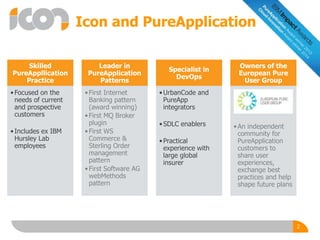
Icon and PureApplication
Skilled
PureAppllication
Practice
•Focused on the
needs of current
and prospective
customers
•Includes ex IBM
Hursley Lab
employees
Leader in
PureApplication
Patterns
•First Internet
Banking pattern
(award winning)
•First MQ Broker
plugin
•First WS
Commerce &
Sterling Order
management
pattern
•First Software AG
webMethods
pattern
Specialist in
DevOps
•UrbanCode and
PureApp
integrators
•SDLC enablers
•Practical
experience with
large global
insurer
Owners of the
European Pure
User Group
•An independent
community for
PureApplication
customers to
share user
experiences,
exchange best
practices and help
shape future plans
2
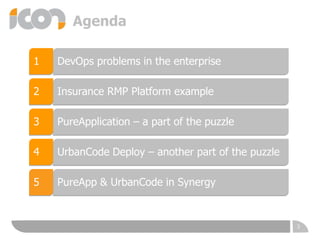
Agenda
3
DevOps problems in the enterprise
Insurance RMP Platform example
PureApplication – a part of the puzzle
UrbanCode Deploy – another part of the puzzle
PureApp & UrbanCode in Synergy
1
2
3
4
5
3
DEVOPS:
PROBLEMS IN THE ENTERPRISE
4
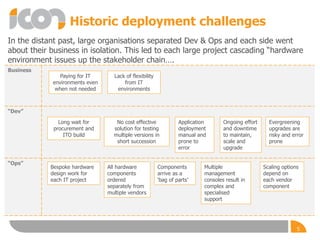
Historic deployment challenges
Business
“Dev”
“Ops”
Bespoke hardware
design work for
each IT project
All hardware
components
ordered
separately from
multiple vendors
Components
arrive as a
‘bag of parts’
Application
deployment
manual and
prone to
error
Multiple
management
consoles result in
complex and
specialised
support
Scaling options
depend on
each vendor
component
Ongoing effort
and downtime
to maintain,
scale and
upgrade
No cost effective
solution for testing
multiple versions in
short succession
Evergreening
upgrades are
risky and error
prone
Long wait for
procurement and
ITO build
Paying for IT
environments even
when not needed
Lack of flexibility
from IT
environments
5
In the distant past, large organisations separated Dev & Ops and each side went
about their business in isolation. This led to each large project cascading “hardware
environment issues up the stakeholder chain….
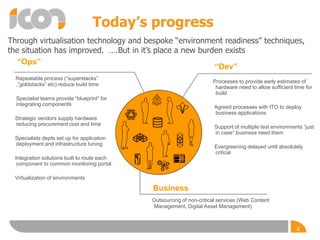
Today’s progress
Repeatable process (“superstacks”
,”goldstacks” etc) reduce build time
Specialist teams provide “blueprint” for
integrating components
Strategic vendors supply hardware
reducing procurement cost and time
Specialists depts set up for application
deployment and infrastructure tuning
Integration solutions built to route each
component to common monitoring portal
Virtualization of environments
“Ops”
Processes to provide early estimates of
hardware need to allow sufficient time for
build
Agreed processes with ITO to deploy
business applications
Support of multiple test environments “just
in case” business need them
Evergreening delayed until absolutely
critical
“Dev”
Business
Outsourcing of non-critical services (Web Content
Management, Digital Asset Management)
6
Through virtualisation technology and bespoke “environment readiness” techniques,
the situation has improved. ….But in it’s place a new burden exists
7
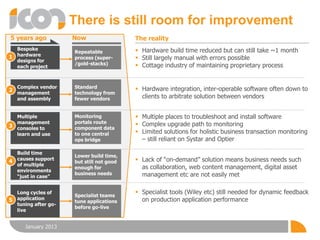
There is still room for improvement
The reality5 years ago Now
 Hardware integration, inter-operable software often down to
clients to arbitrate solution between vendors
Standard
technology from
fewer vendors
Complex vendor
management
and assembly
2
 Specialist tools (Wiley etc) still needed for dynamic feedback
on production application performance
Long cycles of
application
tuning after go-
live
Specialist teams
tune applications
before go-live
5
 Multiple places to troubleshoot and install software
 Complex upgrade path to monitoring
 Limited solutions for holistic business transaction monitoring
– still reliant on Systar and Optier
Multiple
management
consoles to
learn and use
Monitoring
portals route
component data
to one central
ops bridge
3
 Hardware build time reduced but can still take ~1 month
 Still largely manual with errors possible
 Cottage industry of maintaining proprietary process
Repeatable
process (super-
/gold-stacks)
Bespoke
hardware
designs for
each project
1
 Lack of “on-demand” solution means business needs such
as collaboration, web content management, digital asset
management etc are not easily met
Build time
causes support
of multiple
environments
“just in case”
Lower build time,
but still not good
enough for
business needs
4
January 2013
8
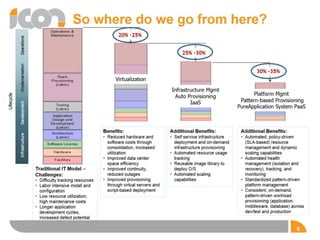
So where do we go from here?
9
Traditional IT Model –
Challenges:
• Difficulty tracking resources
• Labor intensive install and
configuration
• Low resource utilization;
high maintenance costs
• Longer application
development cycles,
increased defect potential
Benefits:
• Reduced hardware and
software costs through
consolidation, increased
utilization
• Improved data center
space efficiency
• Improved continuity,
reduced outages
• Improved provisioning
through virtual servers and
script-based deployment
Additional Benefits:
• Self service infrastructure
deployment and on-demand
infrastructure provisioning
• Automated resource usage
tracking
• Reusable image library to
deploy O/S
• Automated scaling
capabilities
Additional Benefits:
• Automated, policy-driven
(SLA-based) resource
management and dynamic
scaling capabilities
• Automated health
management (isolation and
recovery), tracking, and
monitoring
• Standardized pattern-driven
platform management
• Consistent, on-demand,
pattern-driven workload
provisioning (application,
middleware, database) across
dev/test and production
InfrastructureDevelopmentImplementationOperations
Infrastructure Mgmt
Auto Provisioning
IaaS
20% -25%
25% -30%
Platform Mgmt
Pattern-based Provisioning
PureApplication System PaaS
30% -35%
Virtualization
Lifecycle
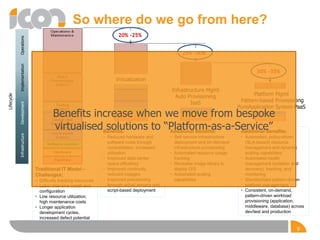
Benefits increase when we move from bespoke
virtualised solutions to “Platform-as-a-Service”
CREATING A TRANSFORMATION
PureApplication
10
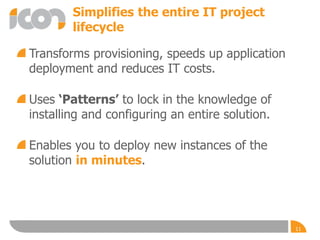
Simplifies the entire IT project
lifecycle
Transforms provisioning, speeds up application
deployment and reduces IT costs.
Uses ‘Patterns’ to lock in the knowledge of
installing and configuring an entire solution.
Enables you to deploy new instances of the
solution in minutes.
11
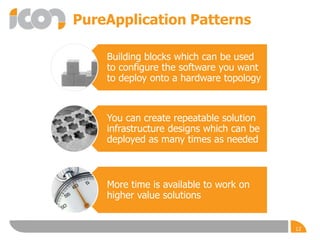
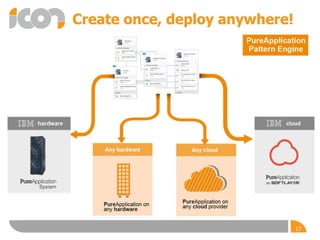
PureApplication Patterns
Building blocks which can be used
to configure the software you want
to deploy onto a hardware topology
You can create repeatable solution
infrastructure designs which can be
deployed as many times as needed
More time is available to work on
higher value solutions
12
13
14
15
16
USING PUREAPPLICATION &
URBANCODE DEPLOY
Zurich Insurance: Risk Management Platform
17
The client: Risk Management
Department at Large Global Insurer
The challenge: Needed to accelerate
the deployment of their Risk
Management Platform
18
• Spin up the multiple dev/test/prod environments on demand and
manage them easier.
• Use the POC as a cloud-provider bake-off
Setting the scene
THE CUSTOMERS PERSPECTIVE
PureApplication
19
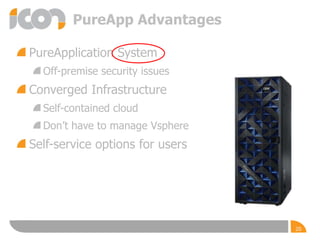
PureApp Advantages
PureApplication System
Off-premise security issues
Converged Infrastructure
Self-contained cloud
Don’t have to manage Vsphere
Self-service options for users
20
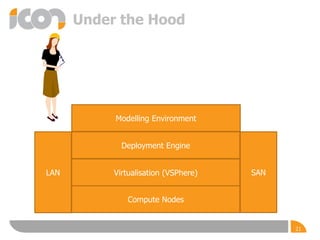
Under the Hood
21
LAN
Compute Nodes
SANVirtualisation (VSPhere)
Deployment Engine
Modelling Environment
AN OVERVIEW
Risk Management Platform
22
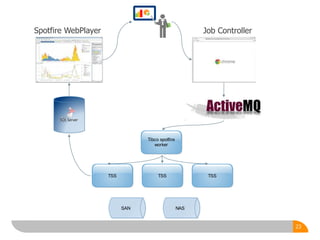
23
Tibco spotfire
worker
TSSTSSTSS
NASSAN
Spotfire WebPlayer Job Controller
24
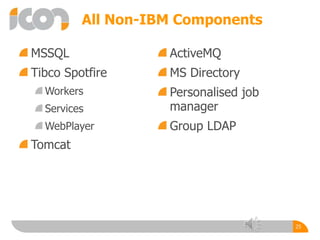
All Non-IBM Components
MSSQL
Tibco Spotfire
Workers
Services
WebPlayer
Tomcat
25
ActiveMQ
MS Directory
Personalised job
manager
Group LDAP
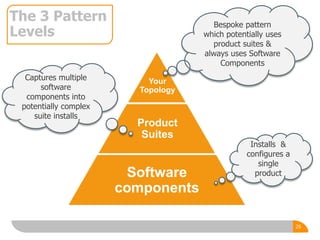
Your
Topology
Product
Suites
Software
components
The 3 Pattern
Levels
Installs &
configures a
single
product
Captures multiple
software
components into
potentially complex
suite installs
Bespoke pattern
which potentially uses
product suites &
always uses Software
Components
26
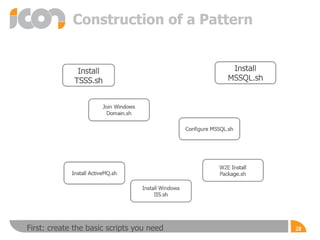
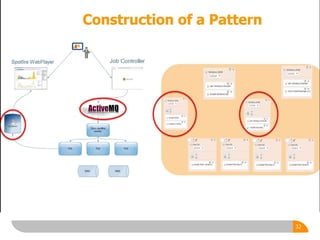
27First: create the basic scripts you need
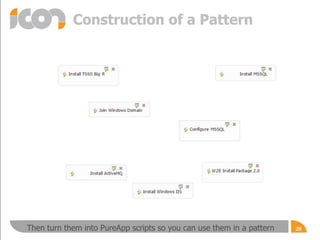
28Then turn them into PureApp scripts so you can use them in a pattern
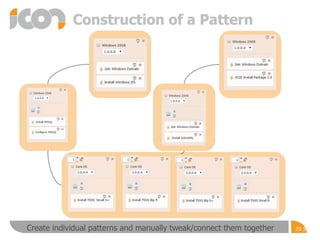
29Create individual patterns and manually tweak/connect them together
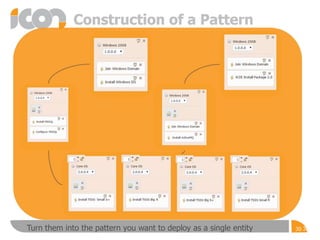
30Turn them into the pattern you want to deploy as a single entity
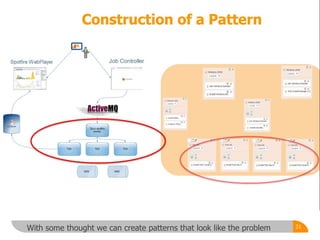
31With some thought we can create patterns that look like the problem
32
Urbancode Deploy
An unknown piece of the puzzle
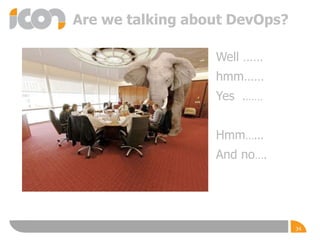
Are we talking about DevOps?
Well ……
hmm……
Yes .……
Hmm…...
And no….
34
35There’s no clear definition of “devops” but we all have our own ideas
Agile Development and
Delivery
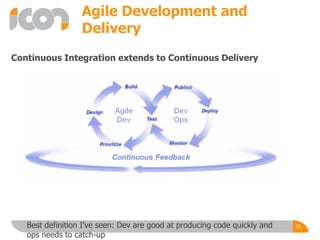
Continuous Integration extends to Continuous Delivery
36Best definition I’ve seen: Dev are good at producing code quickly and
ops needs to catch-up
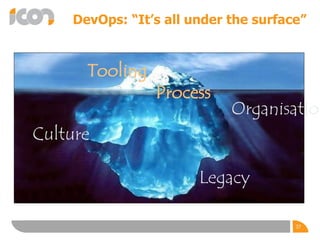
DevOps: “It’s all under the surface”
37
Organisation
Culture
Legacy
Tooling
Process
Zurich’s Perspective
Zurich had no knowledge of Urbancode
Zurich had, what could be called,
a “devops problem”
Probably just a “hmm, couldn’t this be better”
Icon introduced Urbancode under umbrella of
PureApp
Zurich then found that urbancode could be a
winner across all their platforms
38
39
UrbanCode walkthrough
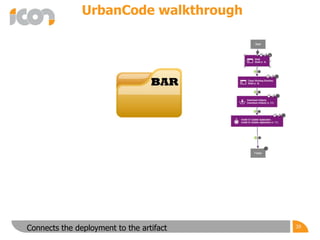
Connects the deployment to the artifact
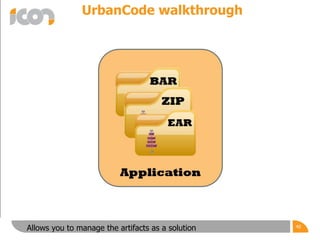
40Allows you to manage the artifacts as a solution
UrbanCode walkthrough
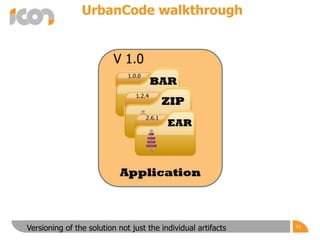
41Versioning of the solution not just the individual artifacts
UrbanCode walkthrough
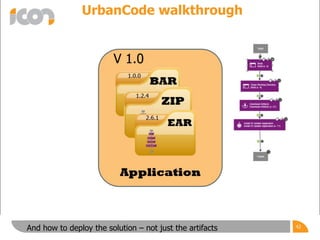
42And how to deploy the solution – not just the artifacts
UrbanCode walkthrough
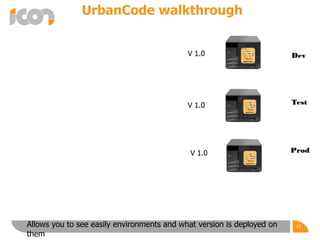
43Allows you to see easily environments and what version is deployed on
them
UrbanCode walkthrough
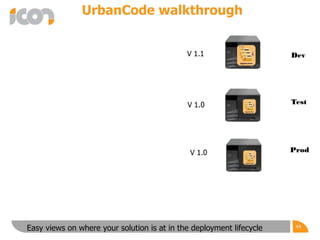
44Easy views on where your solution is at in the deployment lifecycle
UrbanCode walkthrough
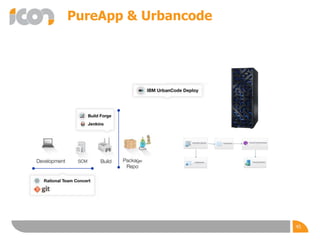
PureApp & Urbancode
45
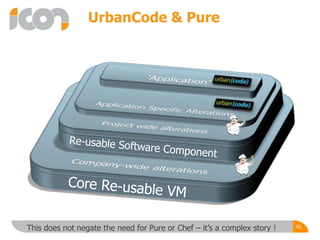
UrbanCode & Pure
46This does not negate the need for Pure or Chef – it’s a complex story !
PATTERN INSTANTIATION METHODS
How to get a topology into Urbancode
47
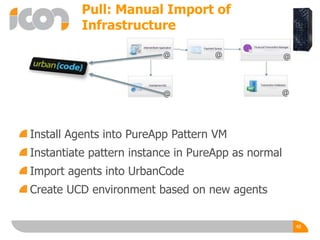
Pull: Manual Import of
Infrastructure
48
@ @
@ @
@
Install Agents into PureApp Pattern VM
Instantiate pattern instance in PureApp as normal
Import agents into UrbanCode
Create UCD environment based on new agents
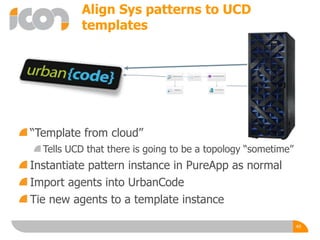
Align Sys patterns to UCD
templates
49
“Template from cloud”
Tells UCD that there is going to be a topology “sometime”
Instantiate pattern instance in PureApp as normal
Import agents into UrbanCode
Tie new agents to a template instance
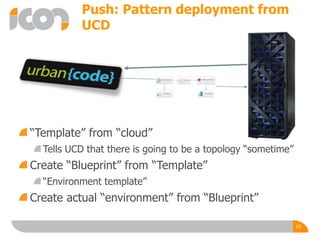
Push: Pattern deployment from
UCD
50
“Template” from “cloud”
Tells UCD that there is going to be a topology “sometime”
Create “Blueprint” from “Template”
“Environment template”
Create actual “environment” from “Blueprint”
KEY CHALLENGE
Faster deploy a large risk modelling platform
The results:
• Reduced downtime, introduced new
DevOps style production values, and
sped up computation times (by a
factor of 2+).
51
• Our risk management PureApplication pattern worked in
synergy with IBM’s UrbanCode
• Deployed the overall solution rapidly and consistently
• Using two core IBM deployment products in synergy
52
Questions?
53

PureApplication: Devops and Urbancode

  • 1.
    Delivering DevOps styleproduction values While Doubling Performance at Zurich Insurance DRD-4229 Wednesday 25th February 2015
  • 2.
    Icon and PureApplication Skilled PureAppllication Practice •Focusedon the needs of current and prospective customers •Includes ex IBM Hursley Lab employees Leader in PureApplication Patterns •First Internet Banking pattern (award winning) •First MQ Broker plugin •First WS Commerce & Sterling Order management pattern •First Software AG webMethods pattern Specialist in DevOps •UrbanCode and PureApp integrators •SDLC enablers •Practical experience with large global insurer Owners of the European Pure User Group •An independent community for PureApplication customers to share user experiences, exchange best practices and help shape future plans 2
  • 3.
    Agenda 3 DevOps problems inthe enterprise Insurance RMP Platform example PureApplication – a part of the puzzle UrbanCode Deploy – another part of the puzzle PureApp & UrbanCode in Synergy 1 2 3 4 5 3
  • 4.
  • 5.
    Historic deployment challenges Business “Dev” “Ops” Bespokehardware design work for each IT project All hardware components ordered separately from multiple vendors Components arrive as a ‘bag of parts’ Application deployment manual and prone to error Multiple management consoles result in complex and specialised support Scaling options depend on each vendor component Ongoing effort and downtime to maintain, scale and upgrade No cost effective solution for testing multiple versions in short succession Evergreening upgrades are risky and error prone Long wait for procurement and ITO build Paying for IT environments even when not needed Lack of flexibility from IT environments 5 In the distant past, large organisations separated Dev & Ops and each side went about their business in isolation. This led to each large project cascading “hardware environment issues up the stakeholder chain….
  • 6.
    Today’s progress Repeatable process(“superstacks” ,”goldstacks” etc) reduce build time Specialist teams provide “blueprint” for integrating components Strategic vendors supply hardware reducing procurement cost and time Specialists depts set up for application deployment and infrastructure tuning Integration solutions built to route each component to common monitoring portal Virtualization of environments “Ops” Processes to provide early estimates of hardware need to allow sufficient time for build Agreed processes with ITO to deploy business applications Support of multiple test environments “just in case” business need them Evergreening delayed until absolutely critical “Dev” Business Outsourcing of non-critical services (Web Content Management, Digital Asset Management) 6 Through virtualisation technology and bespoke “environment readiness” techniques, the situation has improved. ….But in it’s place a new burden exists
  • 7.
    7 There is stillroom for improvement The reality5 years ago Now  Hardware integration, inter-operable software often down to clients to arbitrate solution between vendors Standard technology from fewer vendors Complex vendor management and assembly 2  Specialist tools (Wiley etc) still needed for dynamic feedback on production application performance Long cycles of application tuning after go- live Specialist teams tune applications before go-live 5  Multiple places to troubleshoot and install software  Complex upgrade path to monitoring  Limited solutions for holistic business transaction monitoring – still reliant on Systar and Optier Multiple management consoles to learn and use Monitoring portals route component data to one central ops bridge 3  Hardware build time reduced but can still take ~1 month  Still largely manual with errors possible  Cottage industry of maintaining proprietary process Repeatable process (super- /gold-stacks) Bespoke hardware designs for each project 1  Lack of “on-demand” solution means business needs such as collaboration, web content management, digital asset management etc are not easily met Build time causes support of multiple environments “just in case” Lower build time, but still not good enough for business needs 4 January 2013
  • 8.
  • 9.
    So where dowe go from here? 9 Traditional IT Model – Challenges: • Difficulty tracking resources • Labor intensive install and configuration • Low resource utilization; high maintenance costs • Longer application development cycles, increased defect potential Benefits: • Reduced hardware and software costs through consolidation, increased utilization • Improved data center space efficiency • Improved continuity, reduced outages • Improved provisioning through virtual servers and script-based deployment Additional Benefits: • Self service infrastructure deployment and on-demand infrastructure provisioning • Automated resource usage tracking • Reusable image library to deploy O/S • Automated scaling capabilities Additional Benefits: • Automated, policy-driven (SLA-based) resource management and dynamic scaling capabilities • Automated health management (isolation and recovery), tracking, and monitoring • Standardized pattern-driven platform management • Consistent, on-demand, pattern-driven workload provisioning (application, middleware, database) across dev/test and production InfrastructureDevelopmentImplementationOperations Infrastructure Mgmt Auto Provisioning IaaS 20% -25% 25% -30% Platform Mgmt Pattern-based Provisioning PureApplication System PaaS 30% -35% Virtualization Lifecycle Benefits increase when we move from bespoke virtualised solutions to “Platform-as-a-Service”
  • 10.
  • 11.
    Simplifies the entireIT project lifecycle Transforms provisioning, speeds up application deployment and reduces IT costs. Uses ‘Patterns’ to lock in the knowledge of installing and configuring an entire solution. Enables you to deploy new instances of the solution in minutes. 11
  • 12.
    PureApplication Patterns Building blockswhich can be used to configure the software you want to deploy onto a hardware topology You can create repeatable solution infrastructure designs which can be deployed as many times as needed More time is available to work on higher value solutions 12
  • 13.
  • 14.
  • 15.
  • 16.
  • 17.
    USING PUREAPPLICATION & URBANCODEDEPLOY Zurich Insurance: Risk Management Platform 17
  • 18.
    The client: RiskManagement Department at Large Global Insurer The challenge: Needed to accelerate the deployment of their Risk Management Platform 18 • Spin up the multiple dev/test/prod environments on demand and manage them easier. • Use the POC as a cloud-provider bake-off Setting the scene
  • 19.
  • 20.
    PureApp Advantages PureApplication System Off-premisesecurity issues Converged Infrastructure Self-contained cloud Don’t have to manage Vsphere Self-service options for users 20
  • 21.
    Under the Hood 21 LAN ComputeNodes SANVirtualisation (VSPhere) Deployment Engine Modelling Environment
  • 22.
  • 23.
  • 24.
  • 25.
    All Non-IBM Components MSSQL TibcoSpotfire Workers Services WebPlayer Tomcat 25 ActiveMQ MS Directory Personalised job manager Group LDAP
  • 26.
    Your Topology Product Suites Software components The 3 Pattern Levels Installs& configures a single product Captures multiple software components into potentially complex suite installs Bespoke pattern which potentially uses product suites & always uses Software Components 26
  • 27.
    27First: create thebasic scripts you need
  • 28.
    28Then turn theminto PureApp scripts so you can use them in a pattern
  • 29.
    29Create individual patternsand manually tweak/connect them together
  • 30.
    30Turn them intothe pattern you want to deploy as a single entity
  • 31.
    31With some thoughtwe can create patterns that look like the problem
  • 32.
  • 33.
    Urbancode Deploy An unknownpiece of the puzzle
  • 34.
    Are we talkingabout DevOps? Well …… hmm…… Yes .…… Hmm…... And no…. 34
  • 35.
    35There’s no cleardefinition of “devops” but we all have our own ideas
  • 36.
    Agile Development and Delivery ContinuousIntegration extends to Continuous Delivery 36Best definition I’ve seen: Dev are good at producing code quickly and ops needs to catch-up
  • 37.
    DevOps: “It’s allunder the surface” 37 Organisation Culture Legacy Tooling Process
  • 38.
    Zurich’s Perspective Zurich hadno knowledge of Urbancode Zurich had, what could be called, a “devops problem” Probably just a “hmm, couldn’t this be better” Icon introduced Urbancode under umbrella of PureApp Zurich then found that urbancode could be a winner across all their platforms 38
  • 39.
    39 UrbanCode walkthrough Connects thedeployment to the artifact
  • 40.
    40Allows you tomanage the artifacts as a solution UrbanCode walkthrough
  • 41.
    41Versioning of thesolution not just the individual artifacts UrbanCode walkthrough
  • 42.
    42And how todeploy the solution – not just the artifacts UrbanCode walkthrough
  • 43.
    43Allows you tosee easily environments and what version is deployed on them UrbanCode walkthrough
  • 44.
    44Easy views onwhere your solution is at in the deployment lifecycle UrbanCode walkthrough
  • 45.
  • 46.
    UrbanCode & Pure 46Thisdoes not negate the need for Pure or Chef – it’s a complex story !
  • 47.
    PATTERN INSTANTIATION METHODS Howto get a topology into Urbancode 47
  • 48.
    Pull: Manual Importof Infrastructure 48 @ @ @ @ @ Install Agents into PureApp Pattern VM Instantiate pattern instance in PureApp as normal Import agents into UrbanCode Create UCD environment based on new agents
  • 49.
    Align Sys patternsto UCD templates 49 “Template from cloud” Tells UCD that there is going to be a topology “sometime” Instantiate pattern instance in PureApp as normal Import agents into UrbanCode Tie new agents to a template instance
  • 50.
    Push: Pattern deploymentfrom UCD 50 “Template” from “cloud” Tells UCD that there is going to be a topology “sometime” Create “Blueprint” from “Template” “Environment template” Create actual “environment” from “Blueprint”
  • 51.
    KEY CHALLENGE Faster deploya large risk modelling platform The results: • Reduced downtime, introduced new DevOps style production values, and sped up computation times (by a factor of 2+). 51 • Our risk management PureApplication pattern worked in synergy with IBM’s UrbanCode • Deployed the overall solution rapidly and consistently • Using two core IBM deployment products in synergy
  • 52.
  • 53.