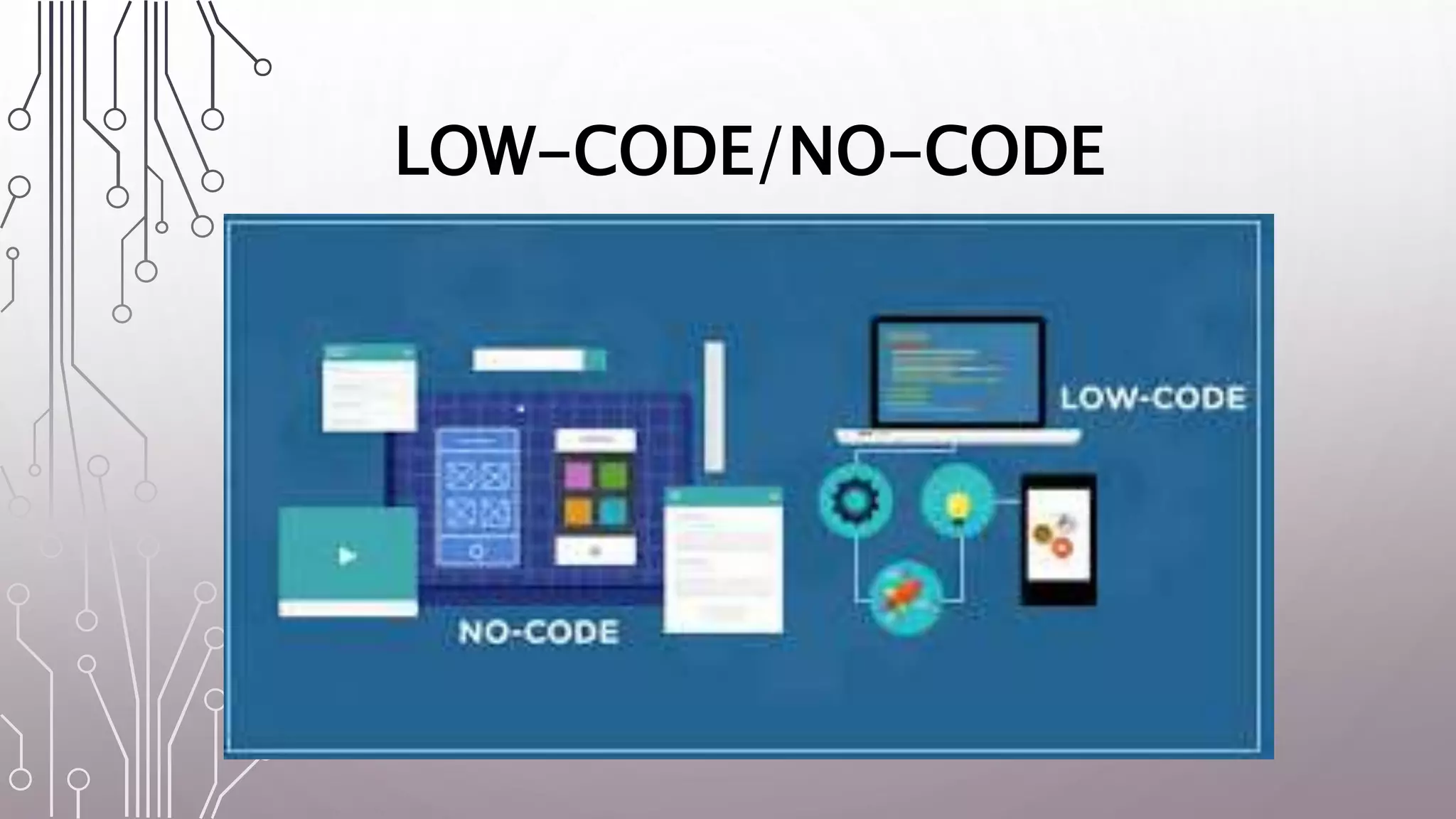
LOW-CODE/NO-CODE
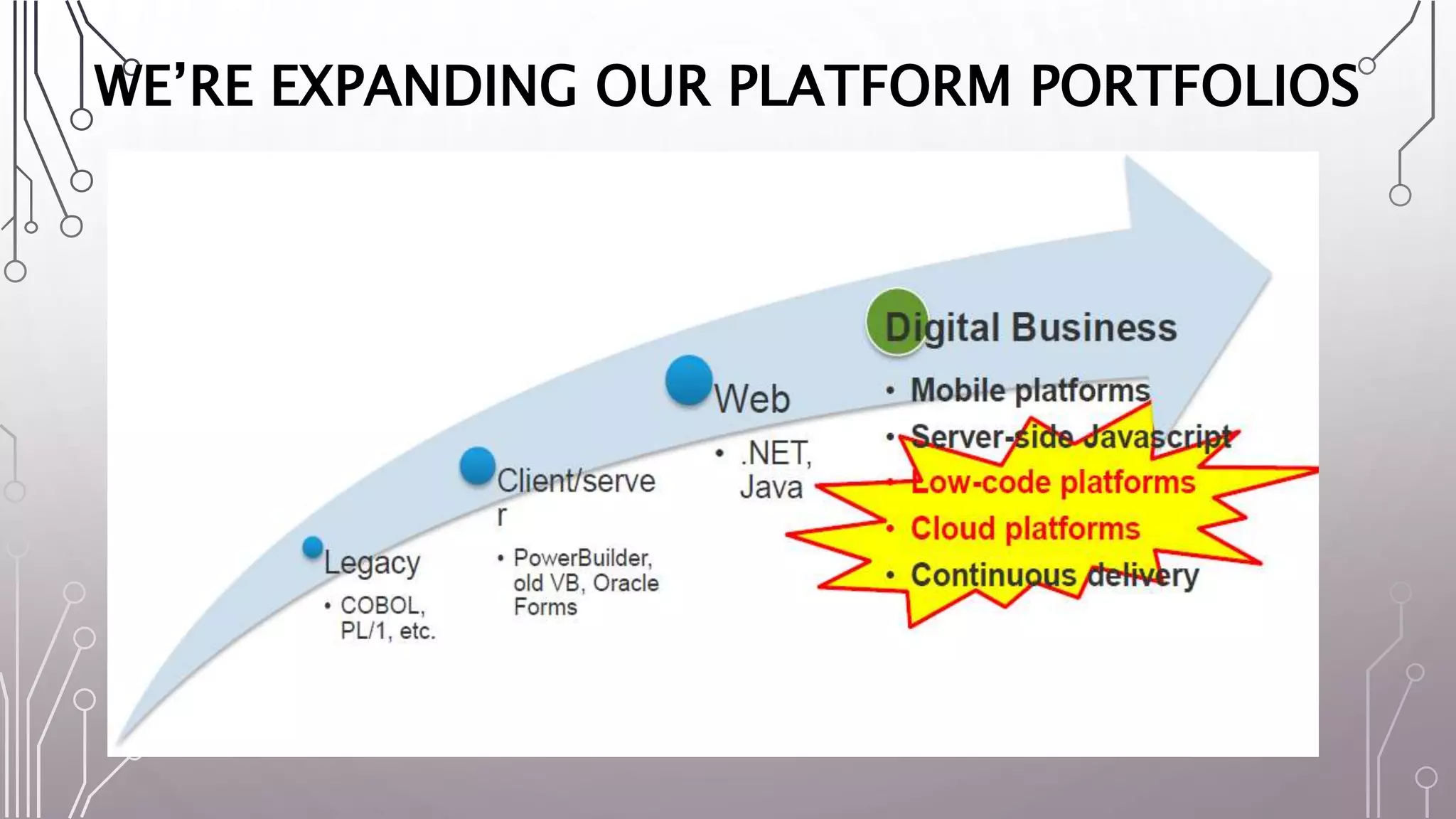
WE’RE EXPANDING OUR PLATFORM PORTFOLIOS
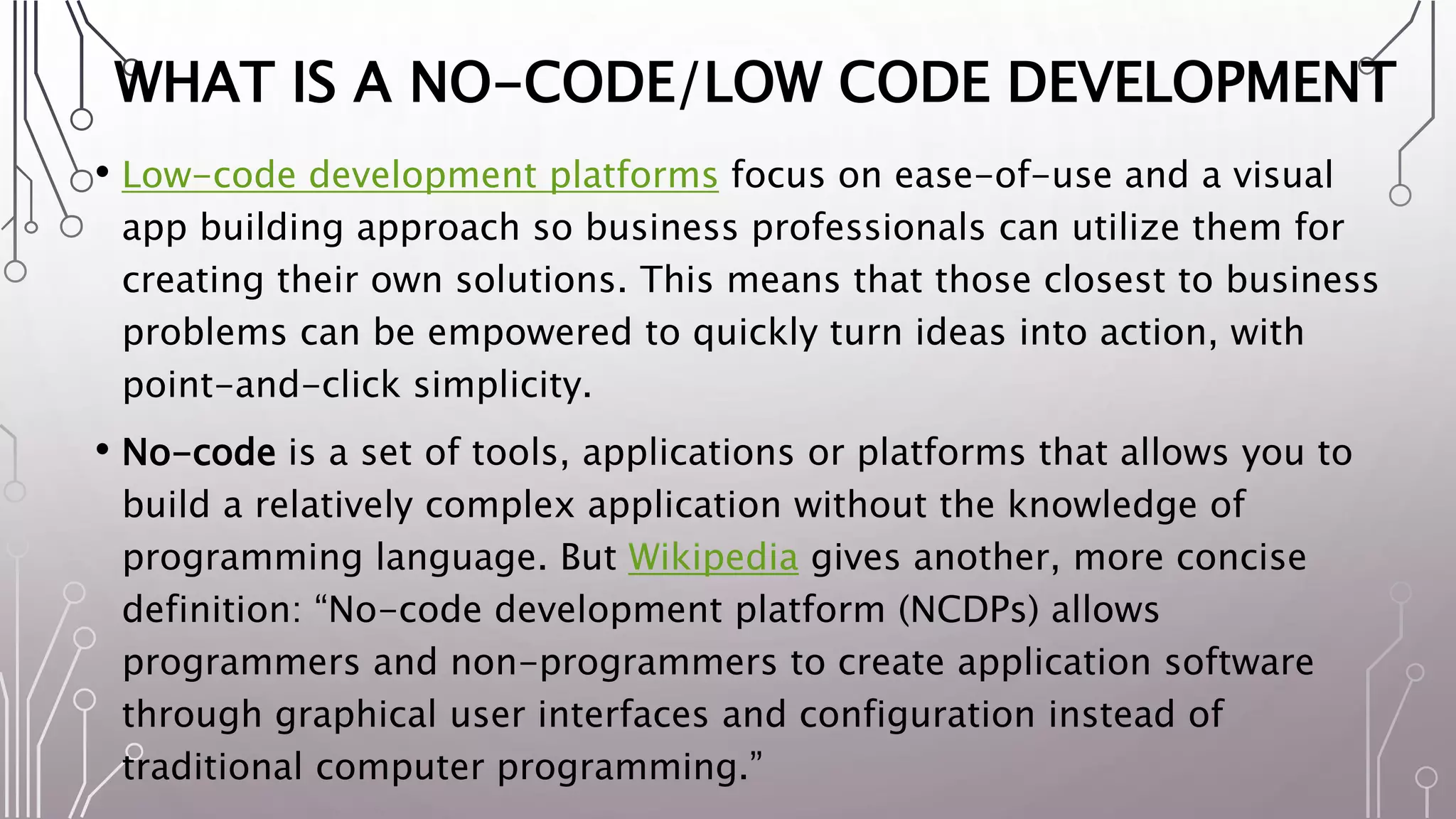
WHAT IS A NO-CODE/LOW CODE DEVELOPMENT
• Low-code development platforms focus on ease-of-use and a visual
app building approach so business professionals can utilize them for
creating their own solutions. This means that those closest to business
problems can be empowered to quickly turn ideas into action, with
point-and-click simplicity.
• No-code is a set of tools, applications or platforms that allows you to
build a relatively complex application without the knowledge of
programming language. But Wikipedia gives another, more concise
definition: “No-code development platform (NCDPs) allows
programmers and non-programmers to create application software
through graphical user interfaces and configuration instead of
traditional computer programming.”
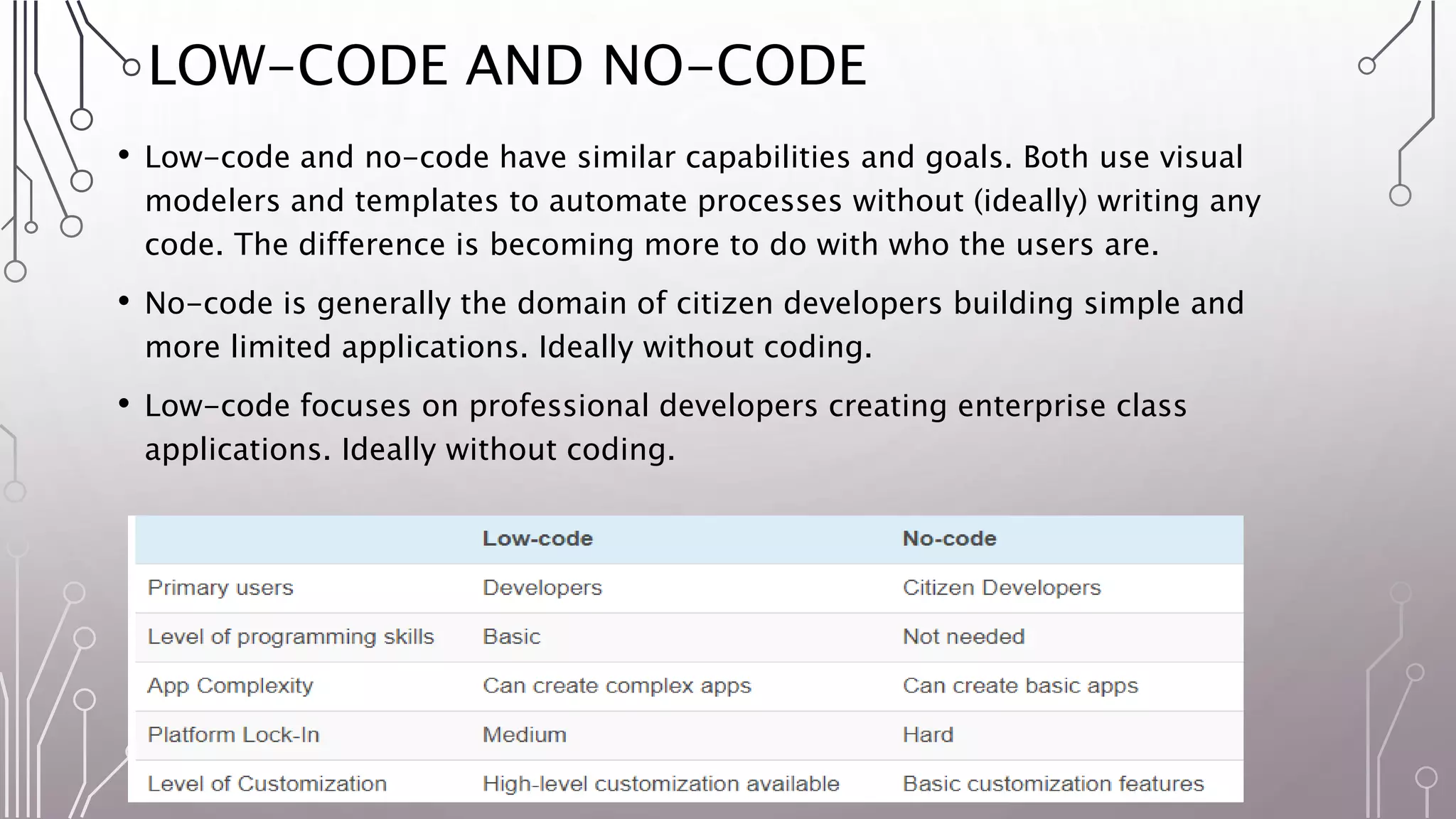
LOW-CODE AND NO-CODE
• Low-code and no-code have similar capabilities and goals. Both use visual
modelers and templates to automate processes without (ideally) writing any
code. The difference is becoming more to do with who the users are.
• No-code is generally the domain of citizen developers building simple and
more limited applications. Ideally without coding.
• Low-code focuses on professional developers creating enterprise class
applications. Ideally without coding.
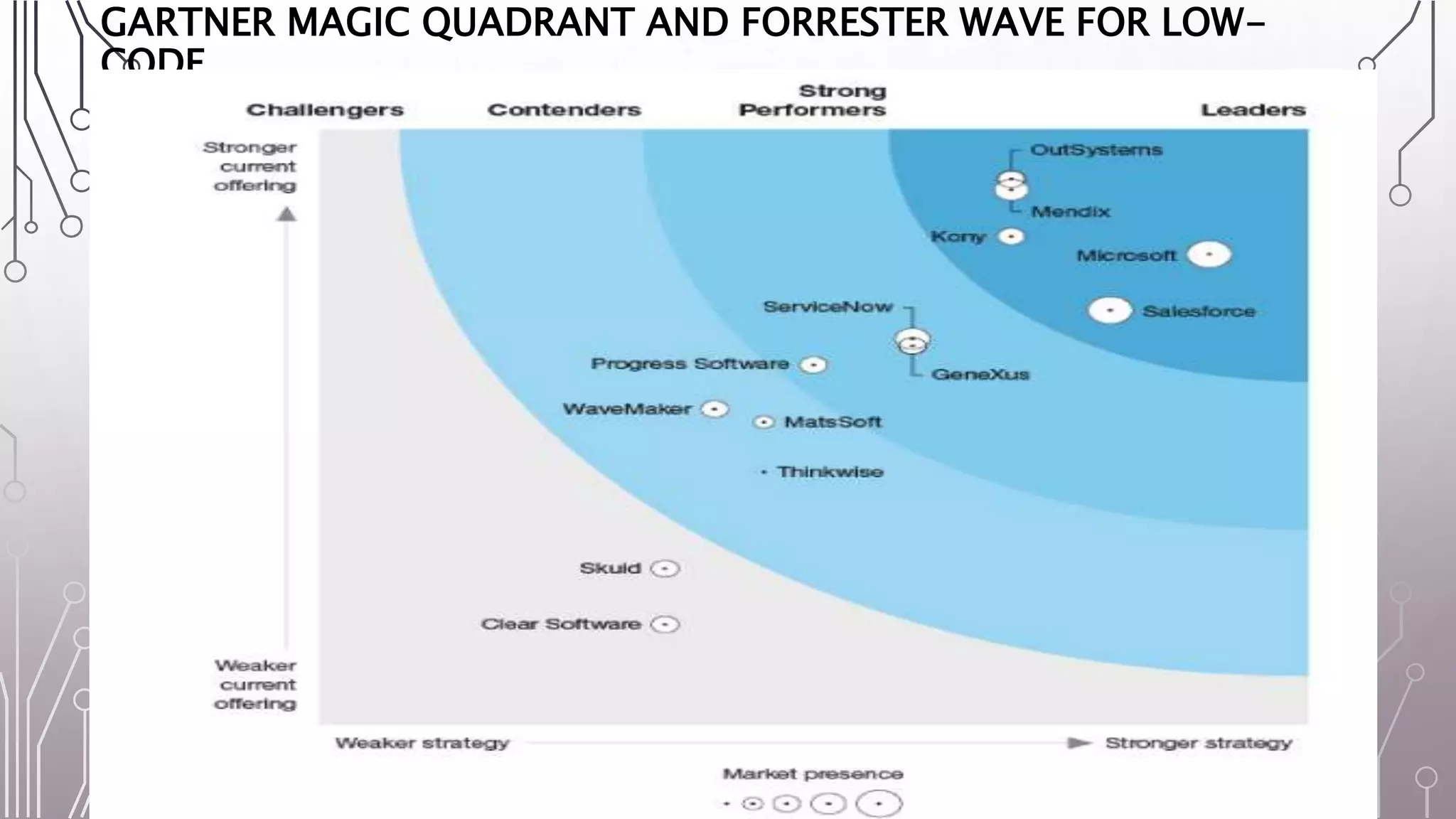
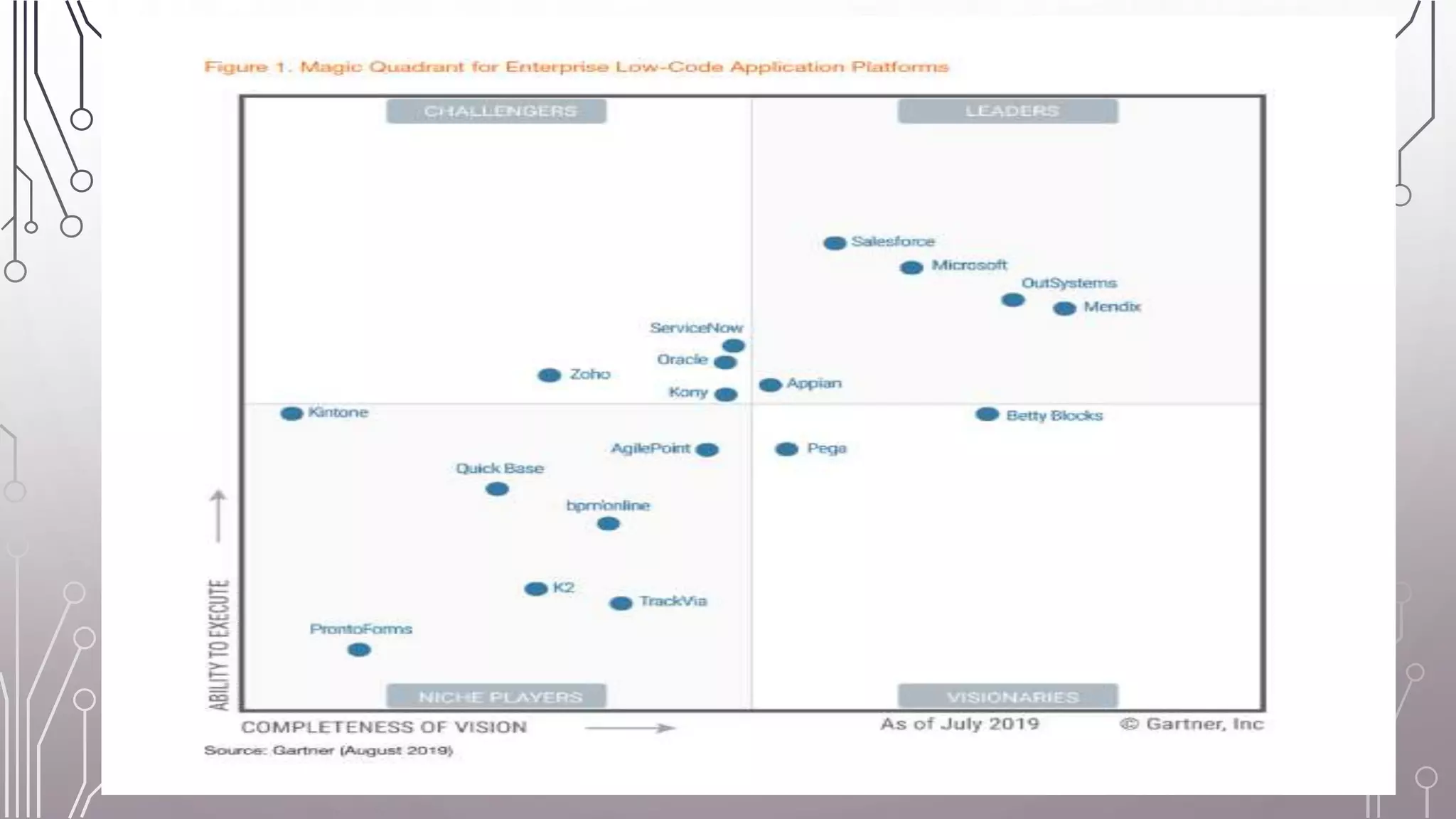
GARTNER MAGIC QUADRANT AND FORRESTER WAVE FOR LOW-
CODE
POTENTIAL LOW CODE BENEFITS
• Low-code platforms may significantly speed up software development. Leading to faster
ROI and increased productivity.
• Low-code platforms can be self-documenting. They provide a graphical representation
of the processes they are performing. This can substantially reduce the need for external
documentation.
• Low code reduces testing. Templates and components are pretested and used by many
companies, in many scenarios.
• Tooling includes visual modelers, pre-built modules and templates typically supported
by drag and drop environments.
• One click application delivery. Simplified and accelerated deployment.
• Support for several third-generation languages for customisation beyond a platform’s
existing capabilities.
• Ability for citizen developers to create (simple) applications without coding. But be
mindful: low-code does not always mean ‘fit for non-technical’ users.
POTENTIAL LOW CODE DRAWBACKS
• Vendor lock-in may present significant problems depending on your
situation. Portability across platforms can be difficult or impossible
without a full rewrite.
• Pricing models can be complex and opaque. None of the vendors in
the Forrester Wave scored highly in this regard.
• Visual components and model driven logic trade ease of use and
speed of development. This may currently be less flexible than code-
based platforms although the gap is closing as low-code platforms
evolve.
• Hand development may be required to integrate LC/NC apps with
other systems.
• Complexity and controllability limitations of apps may not meet some
long-term business objectives.
WHAT ARE THE ANALYSTS PREDICTING?
• By 2024, three quarters of large enterprises will be using at least
four low-code development tools for both IT application
development and citizen development initiatives. [Gartner]
• By 2024, low-code application development will be responsible for
more than 65% of all application development activity. [Gartner]
• By 2020, at least 50 percent of all new business applications will be
created with high-productivity toolsets, such as lowcode and no-
code application development platforms.[Gartner]
• The global Low-Code Development Platform Market is Set to Reach
USD 53.0 billion by 2024, Observing a CAGR of 80.0% during 2019–
2024. [VynZ Research]
• Through 2021, market demand for app development will grow at
least five times faster than the IT capacity to deliver it. [Gartner]
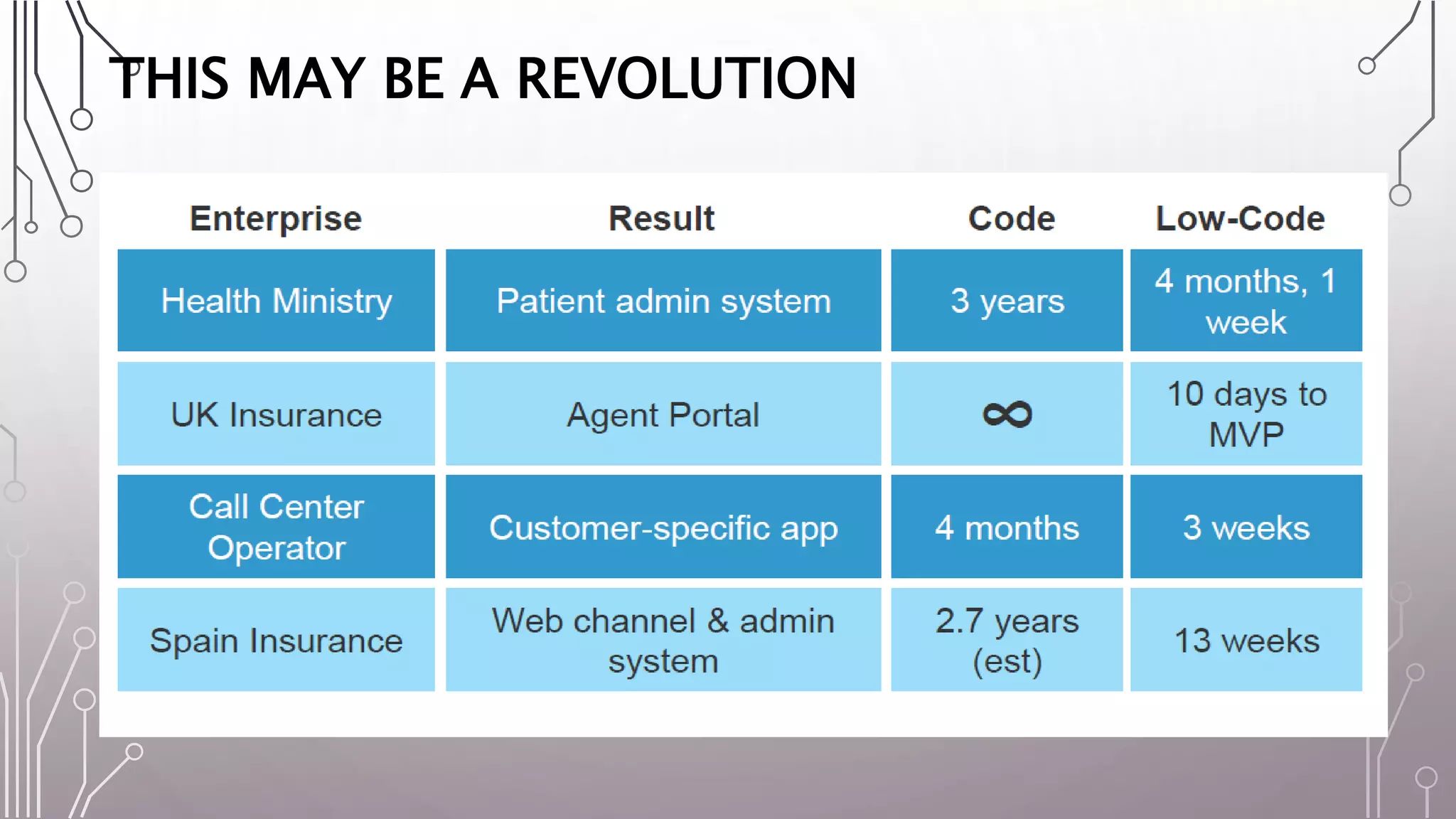
THIS MAY BE A REVOLUTION
WHAT IS MENDIX?
• The Mendix Platform is designed to accelerate enterprise app delivery
across your entire application development lifecycle, from ideation to
development, deployment, and the ongoing management of your
application portfolio in the cloud or on premises.
• Mendix offers both no code (visual-modelling) and low code (highly
extensible, integrated tooling to support crossfunctional teams
working collaboratively).
• Business-domain experts such as analysts and citizen developers can
work alongside expert developers to achieve much greater levels of
business agility and consequently accelerated delivery.
• the platform's cloud-native architecture and automation tools support
the deployment, management, and monitoring of highly-available
enterprise-grade applications.
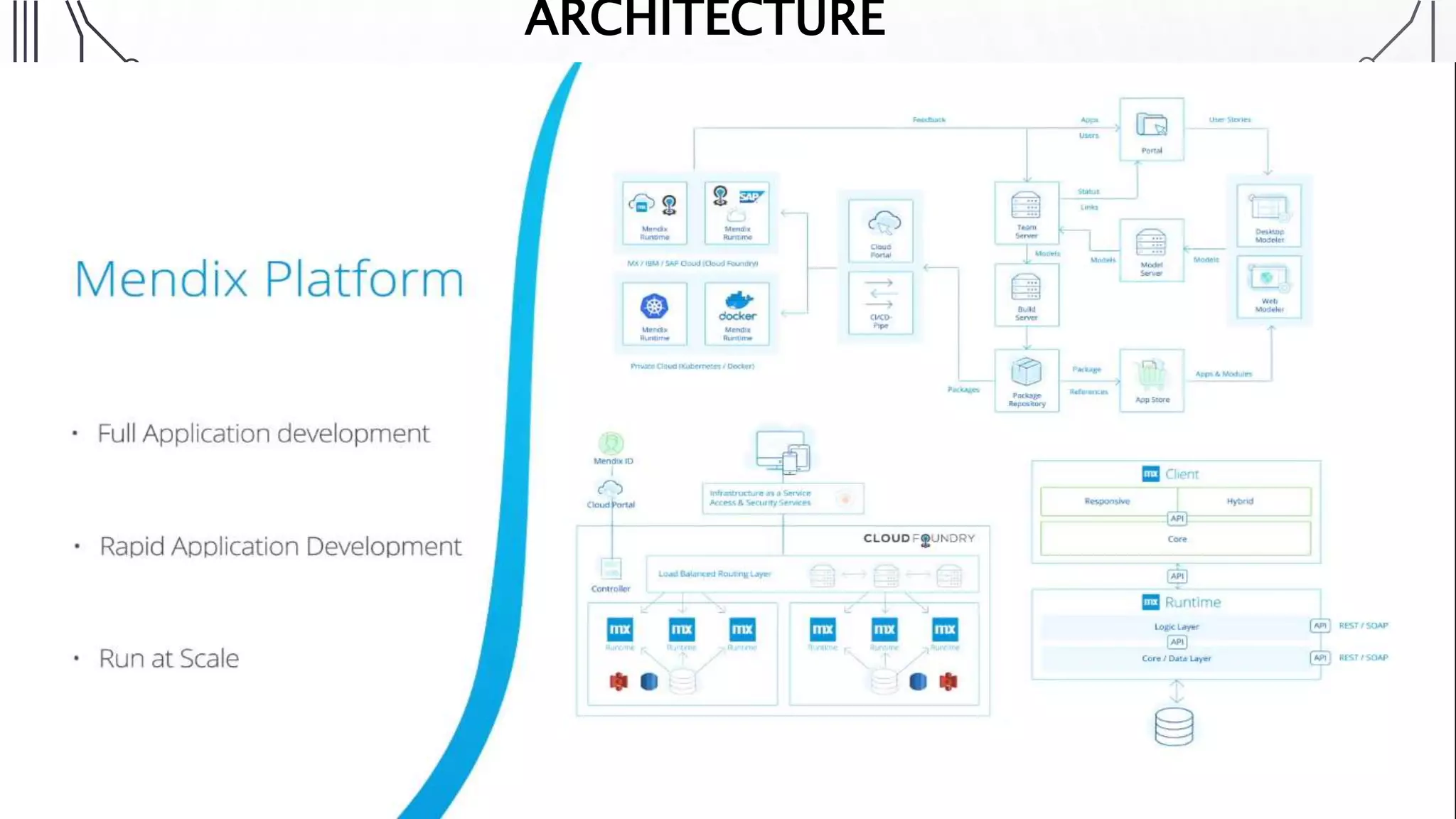
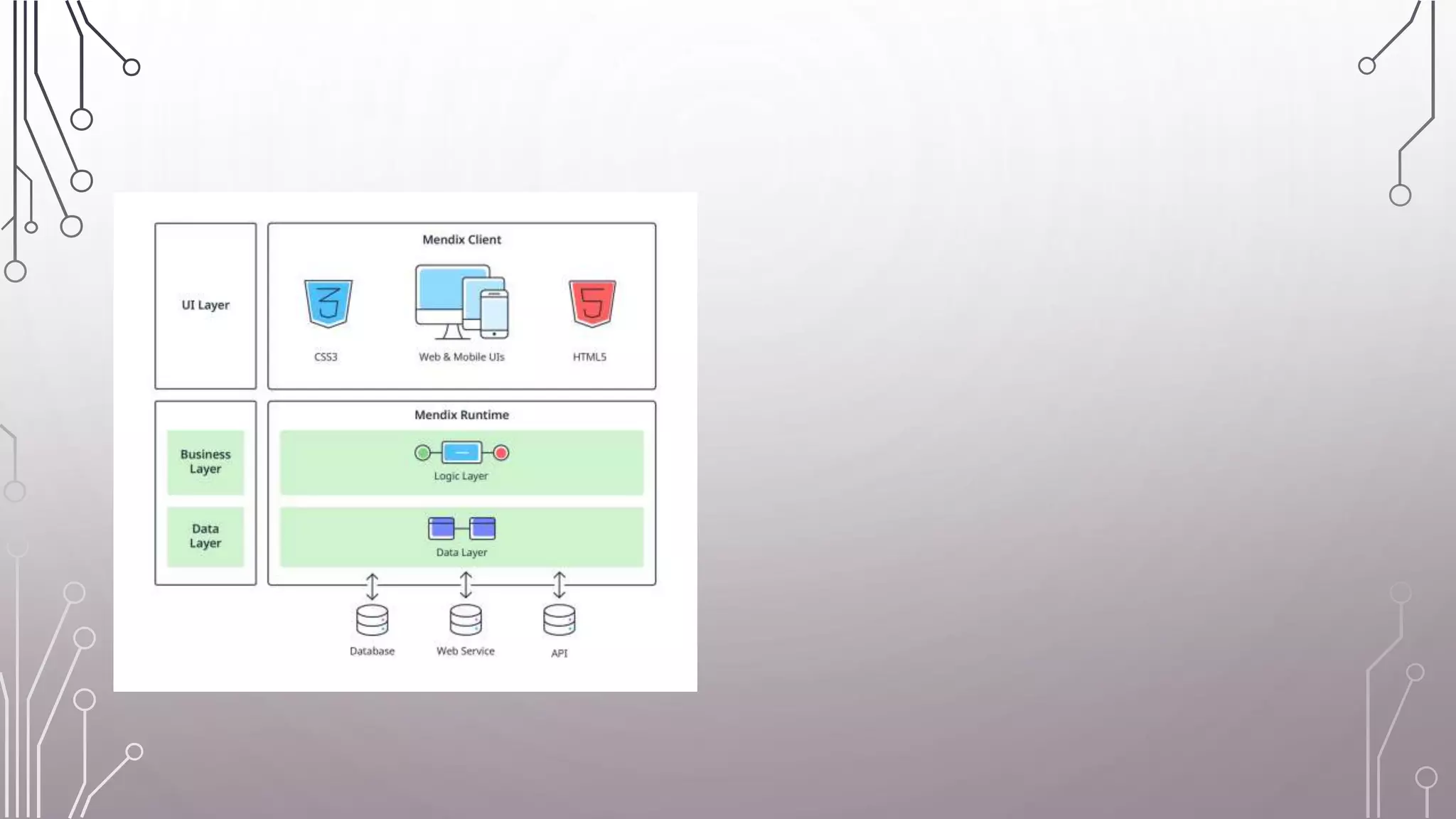
ARCHITECTURE
KEY ARCHITECTURAL PRINCIPLES
• The Mendix Platform is architected for the demands of
enterprise-ready applications, which are applications that are
maintainable, highly performant, and scalable, and can cope with
the complex nature of enterprise systems.
• Model-driven development
• Model interpretation over code generation
• Microservices, containers, and deployment standardization
• Statelessness
• Openness and extensibility
• Twelve-Factor App principles
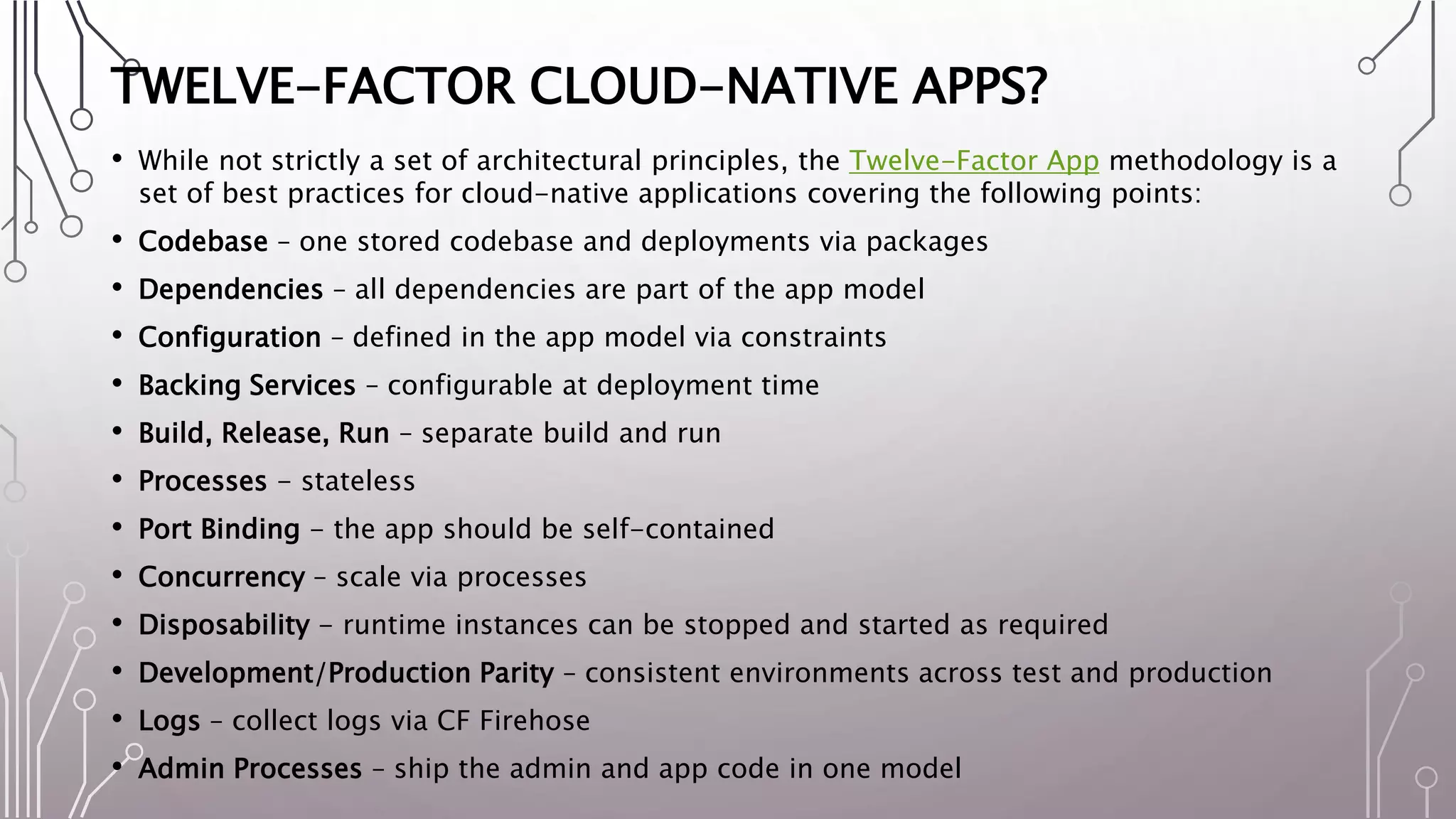
TWELVE-FACTOR CLOUD-NATIVE APPS?
• While not strictly a set of architectural principles, the Twelve-Factor App methodology is a
set of best practices for cloud-native applications covering the following points:
• Codebase – one stored codebase and deployments via packages
• Dependencies – all dependencies are part of the app model
• Configuration – defined in the app model via constraints
• Backing Services – configurable at deployment time
• Build, Release, Run – separate build and run
• Processes - stateless
• Port Binding - the app should be self-contained
• Concurrency – scale via processes
• Disposability - runtime instances can be stopped and started as required
• Development/Production Parity – consistent environments across test and production
• Logs – collect logs via CF Firehose
• Admin Processes – ship the admin and app code in one model
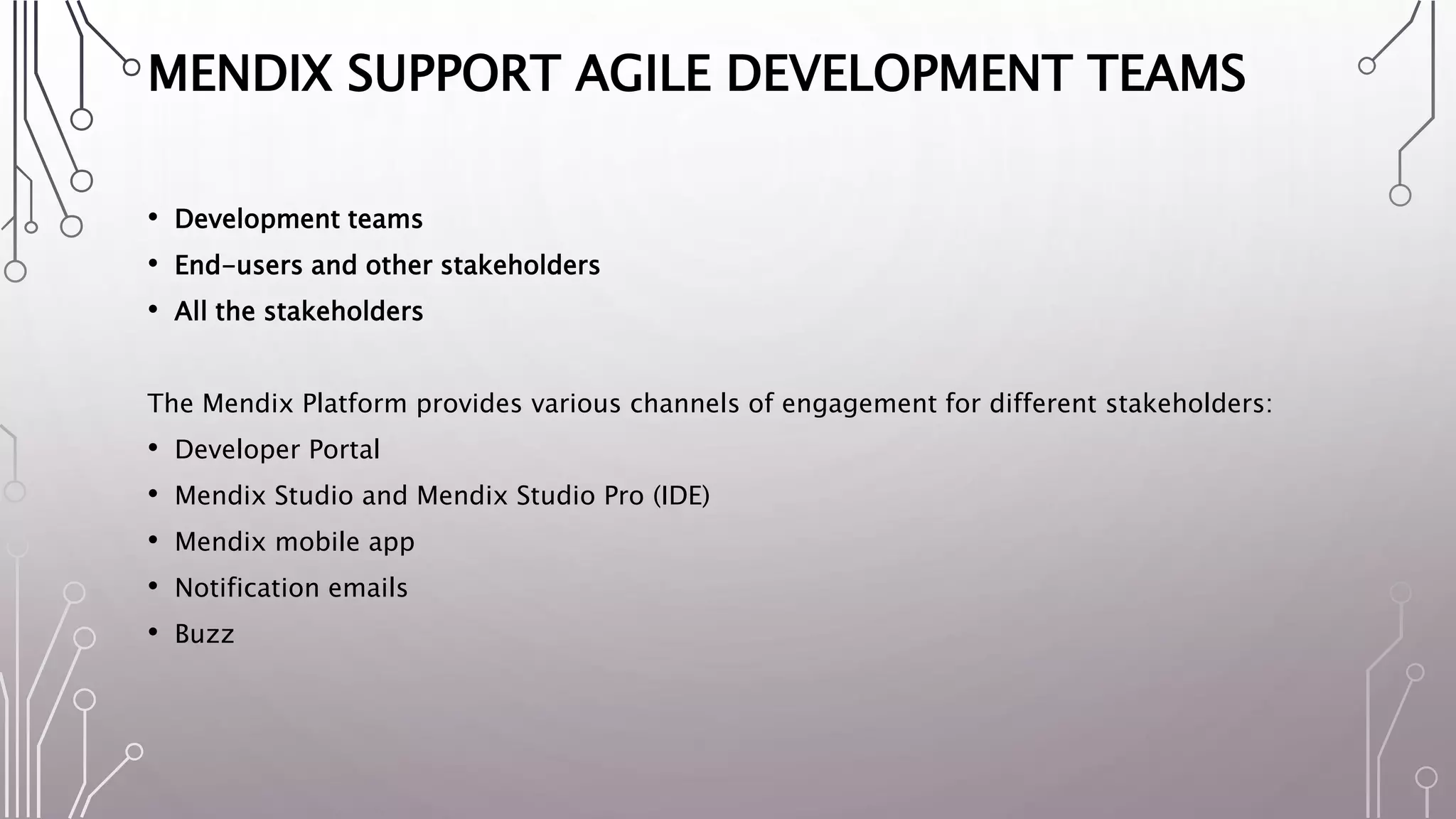
MENDIX SUPPORT AGILE DEVELOPMENT TEAMS
• Development teams
• End-users and other stakeholders
• All the stakeholders
The Mendix Platform provides various channels of engagement for different stakeholders:
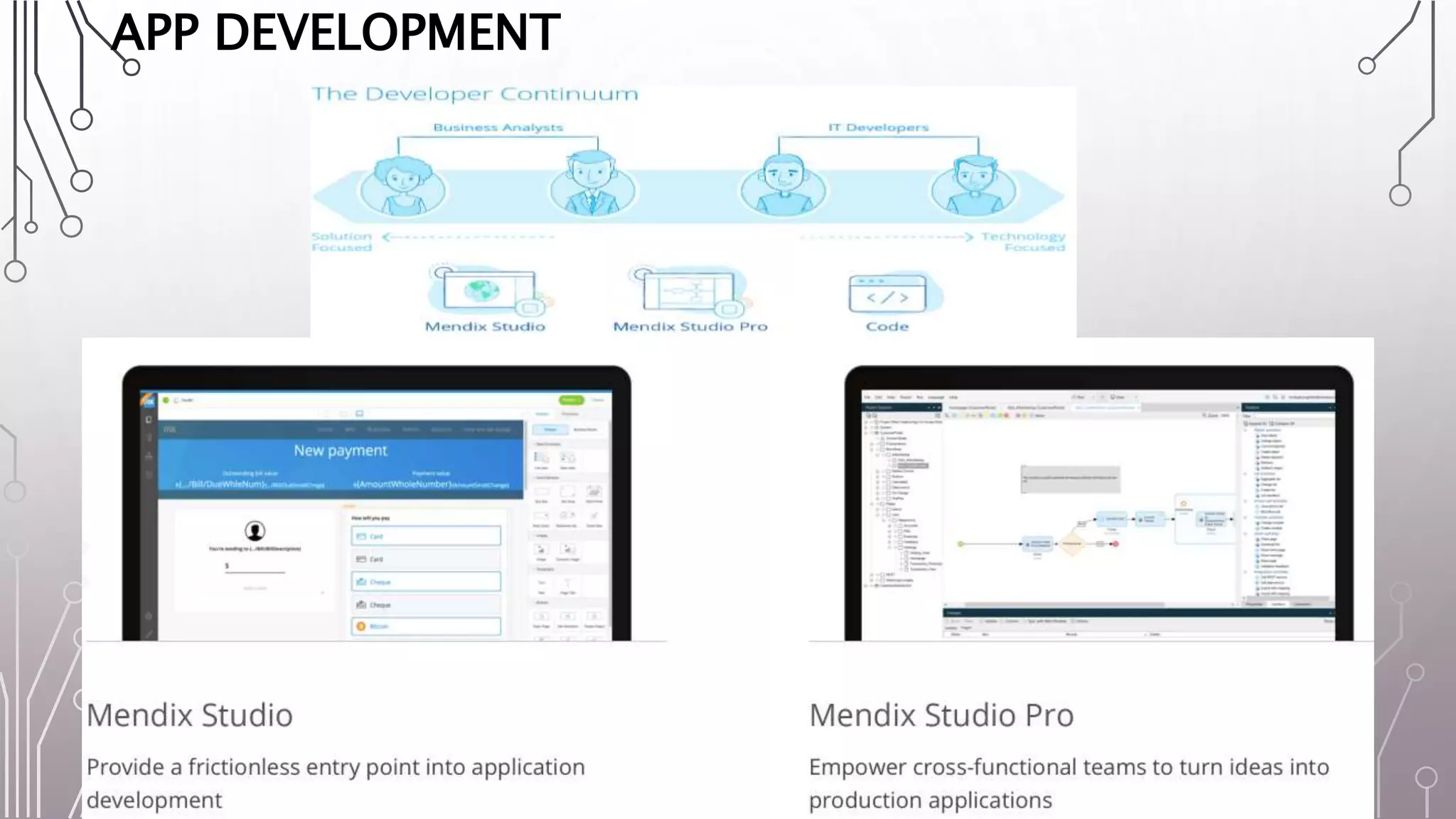
• Developer Portal
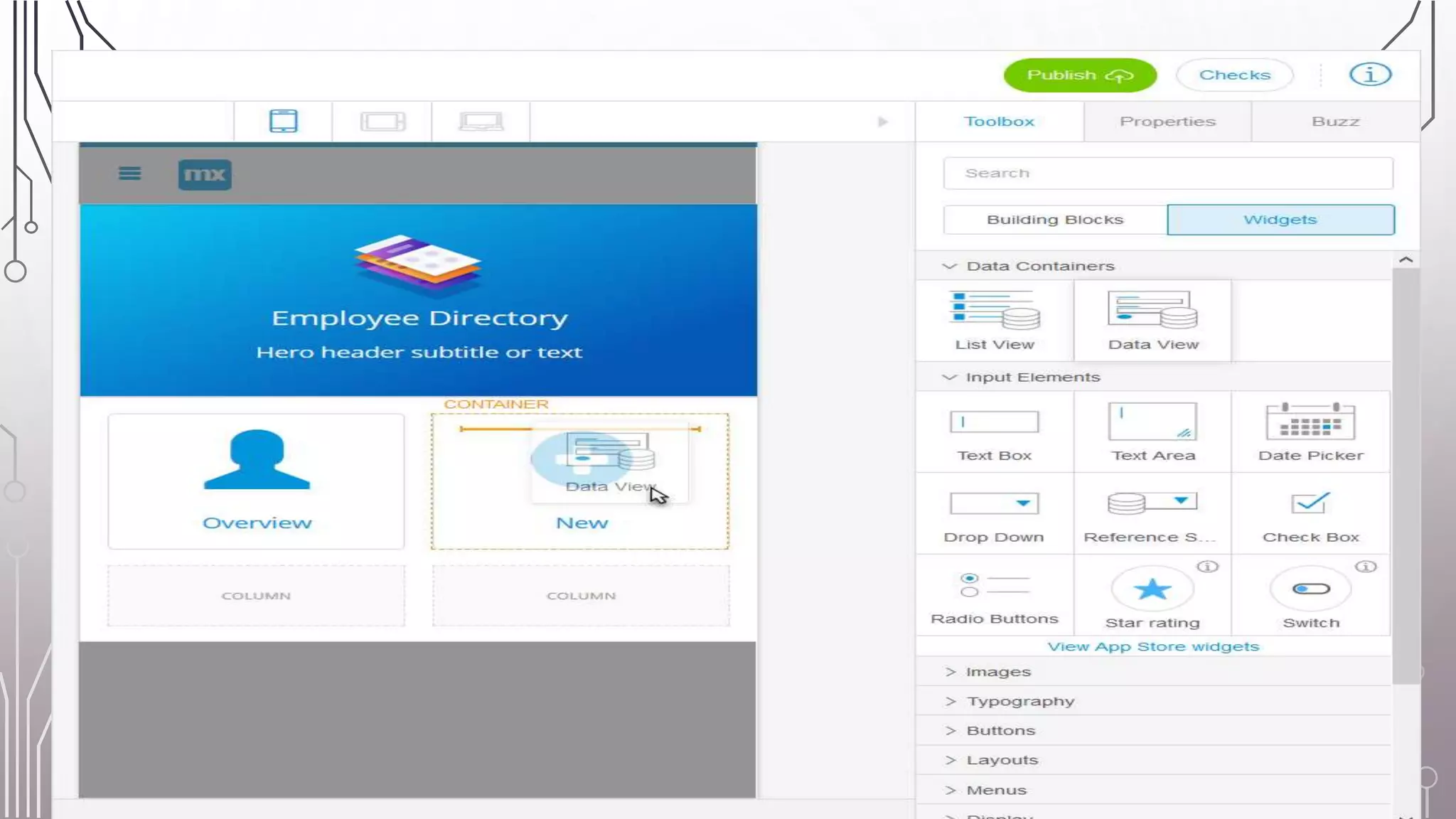
• Mendix Studio and Mendix Studio Pro (IDE)
• Mendix mobile app
• Notification emails
• Buzz
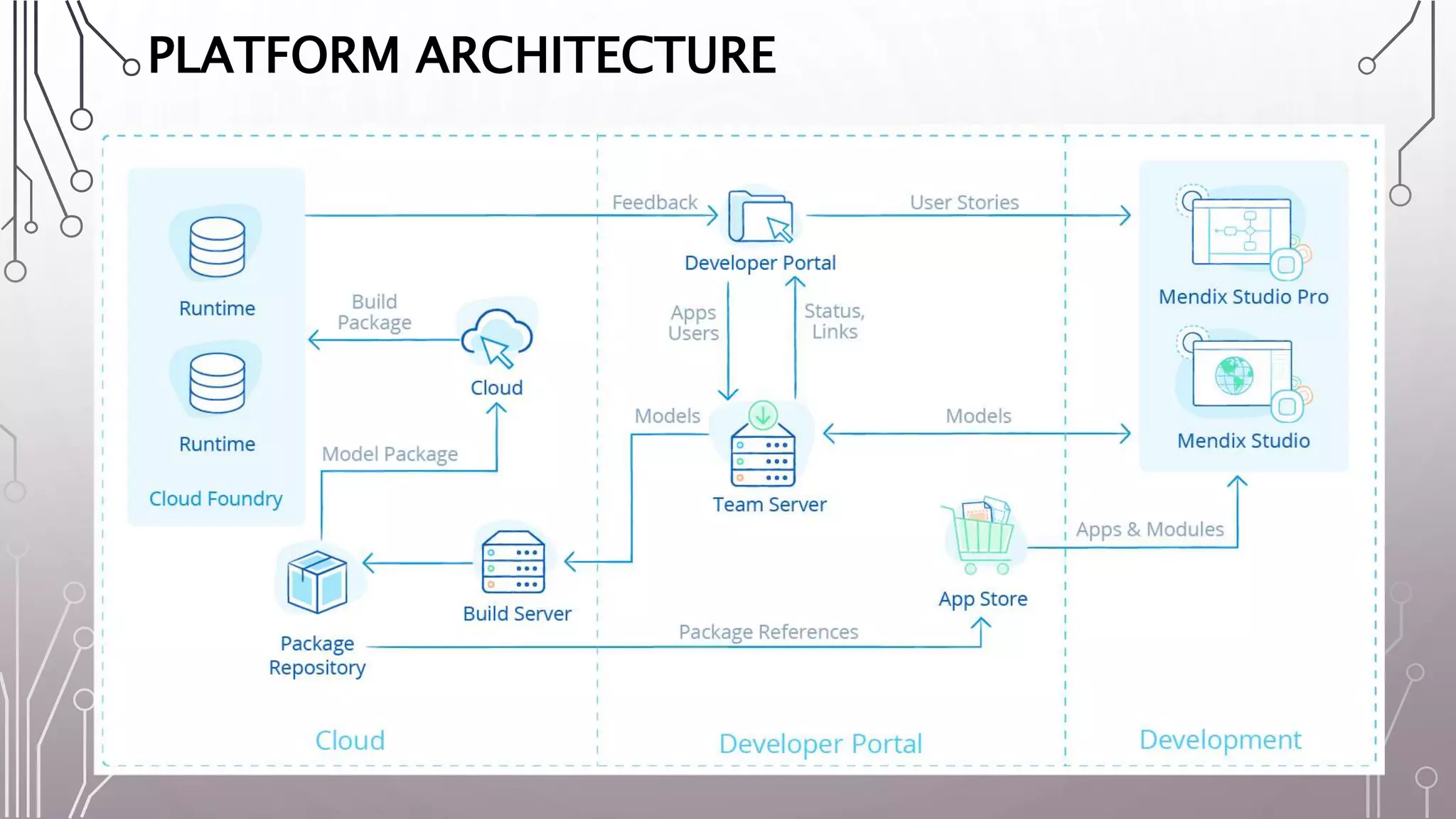
PLATFORM ARCHITECTURE
APP DEVELOPMENT
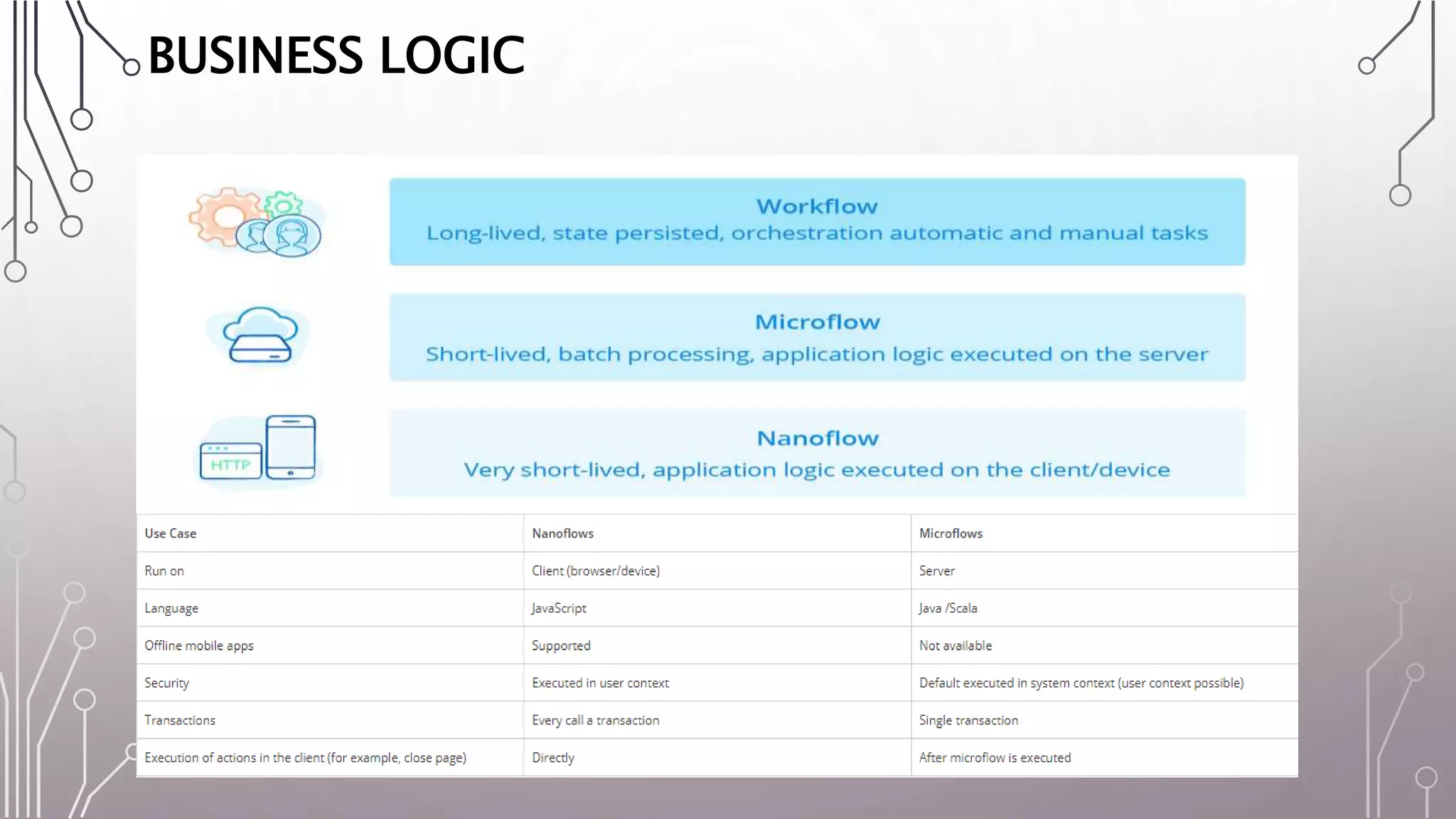
BUSINESS LOGIC
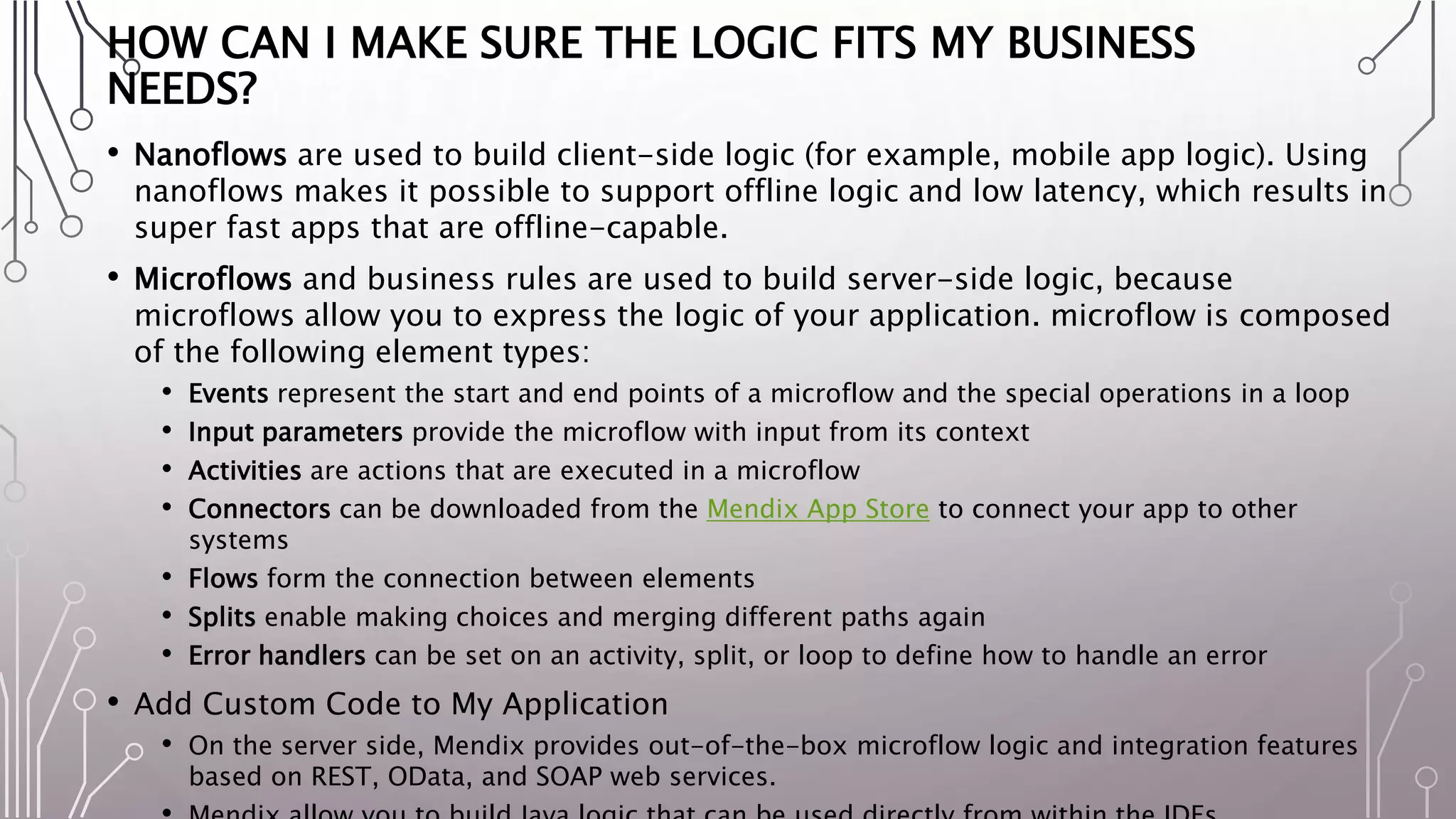
HOW CAN I MAKE SURE THE LOGIC FITS MY BUSINESS
NEEDS?
• Nanoflows are used to build client-side logic (for example, mobile app logic). Using
nanoflows makes it possible to support offline logic and low latency, which results in
super fast apps that are offline-capable.
• Microflows and business rules are used to build server-side logic, because
microflows allow you to express the logic of your application. microflow is composed
of the following element types:
• Events represent the start and end points of a microflow and the special operations in a loop
• Input parameters provide the microflow with input from its context
• Activities are actions that are executed in a microflow
• Connectors can be downloaded from the Mendix App Store to connect your app to other
systems
• Flows form the connection between elements
• Splits enable making choices and merging different paths again
• Error handlers can be set on an activity, split, or loop to define how to handle an error
• Add Custom Code to My Application
• On the server side, Mendix provides out-of-the-box microflow logic and integration features
based on REST, OData, and SOAP web services.
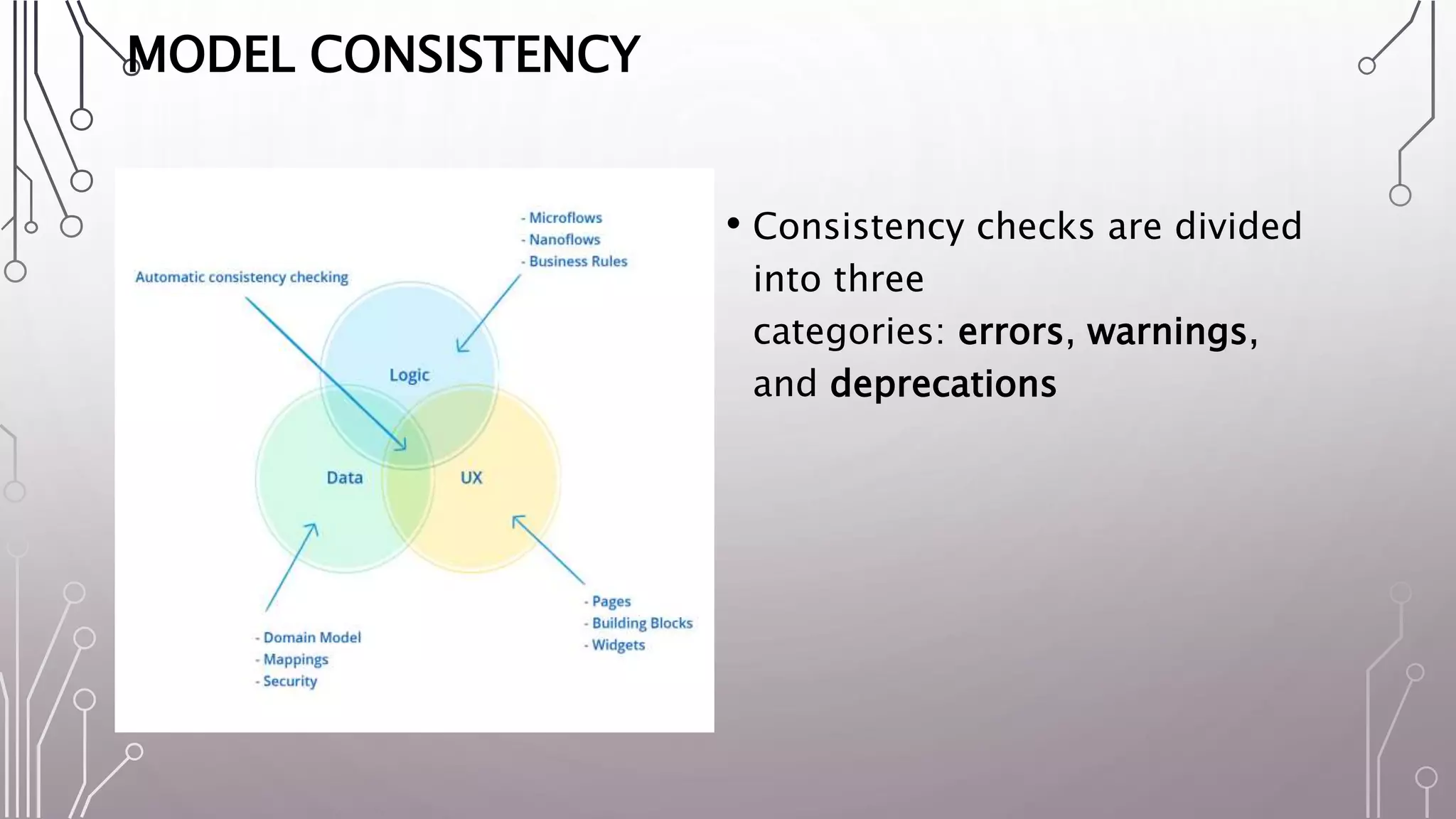
MODEL CONSISTENCY
• Consistency checks are divided
into three
categories: errors, warnings,
and deprecations
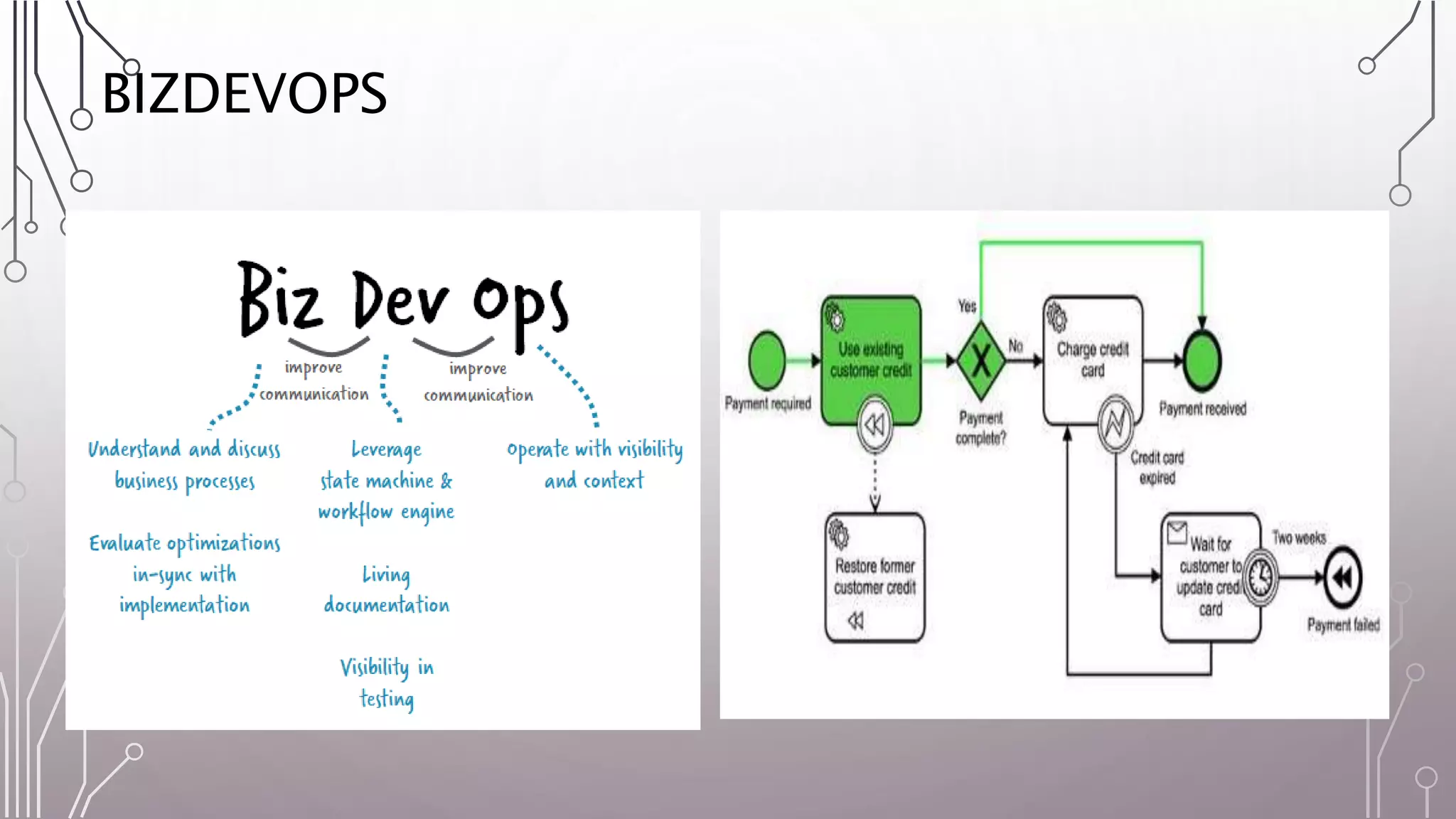
BIZDEVOPS
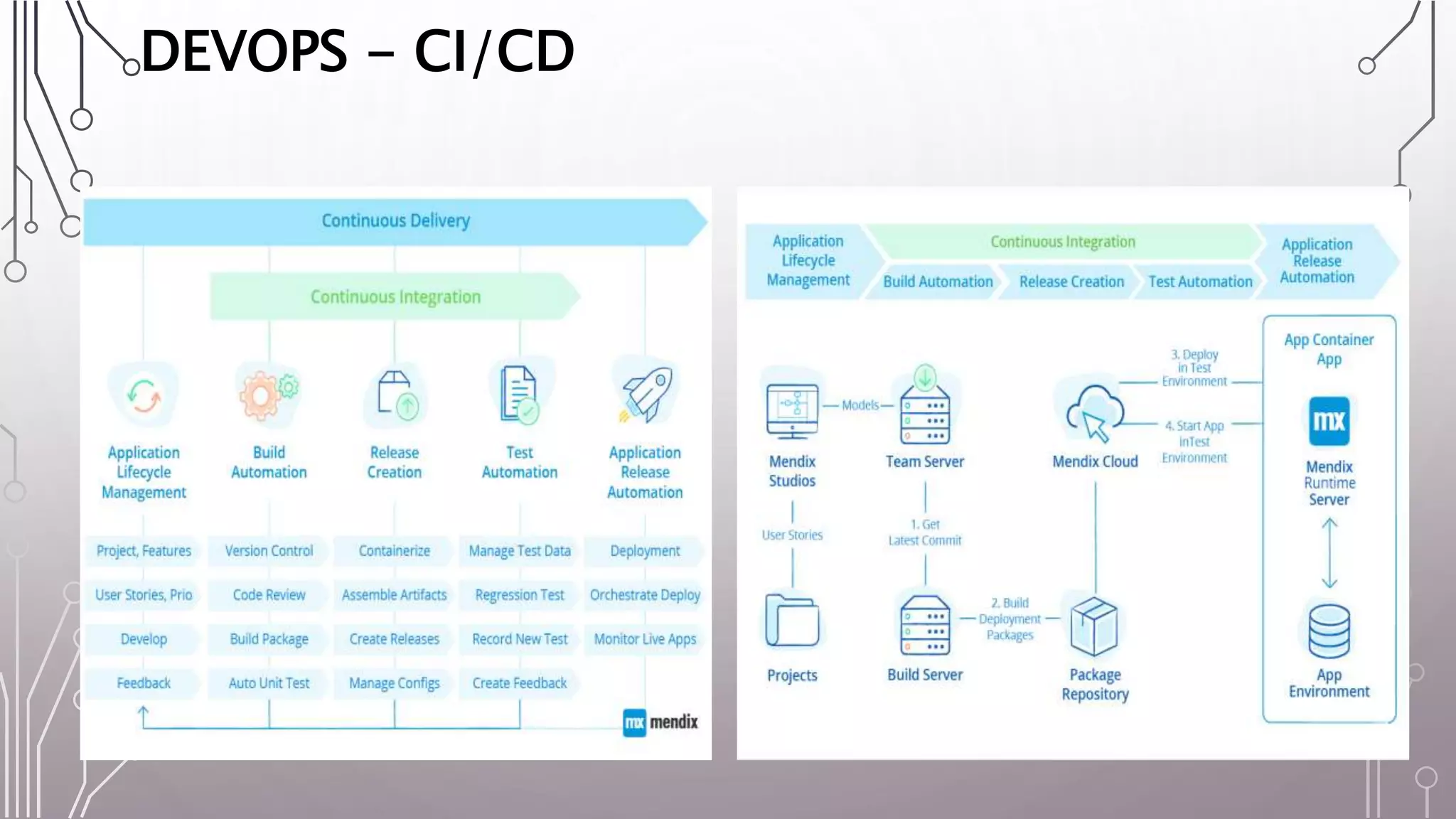
DEVOPS - CI/CD
DEPLOYMENT
• Mendix applications run on the platform's cloud-native stateless
runtime architecture that conforms to Twelve-Factor App principles
with support for modern cloud platforms such as Docker, Kubernetes
and Cloud Foundry.
• Mendix apps benefit from auto-scaling, auto-provisioning, auto-
healing, low infrastructure overhead, CI/CD, and cloud interoperability
out of the box.
• Mendix applications run on a variety of deployment options, including
public cloud, virtual private cloud, private cloud, hybrid cloud, multi
cloud, and traditional (virtual) servers.
• Mendix applications are packaged and deployed to the cloud provider
of your choice using our one-click deployment.
• Mendix also supports the creation of build packs for deployment on
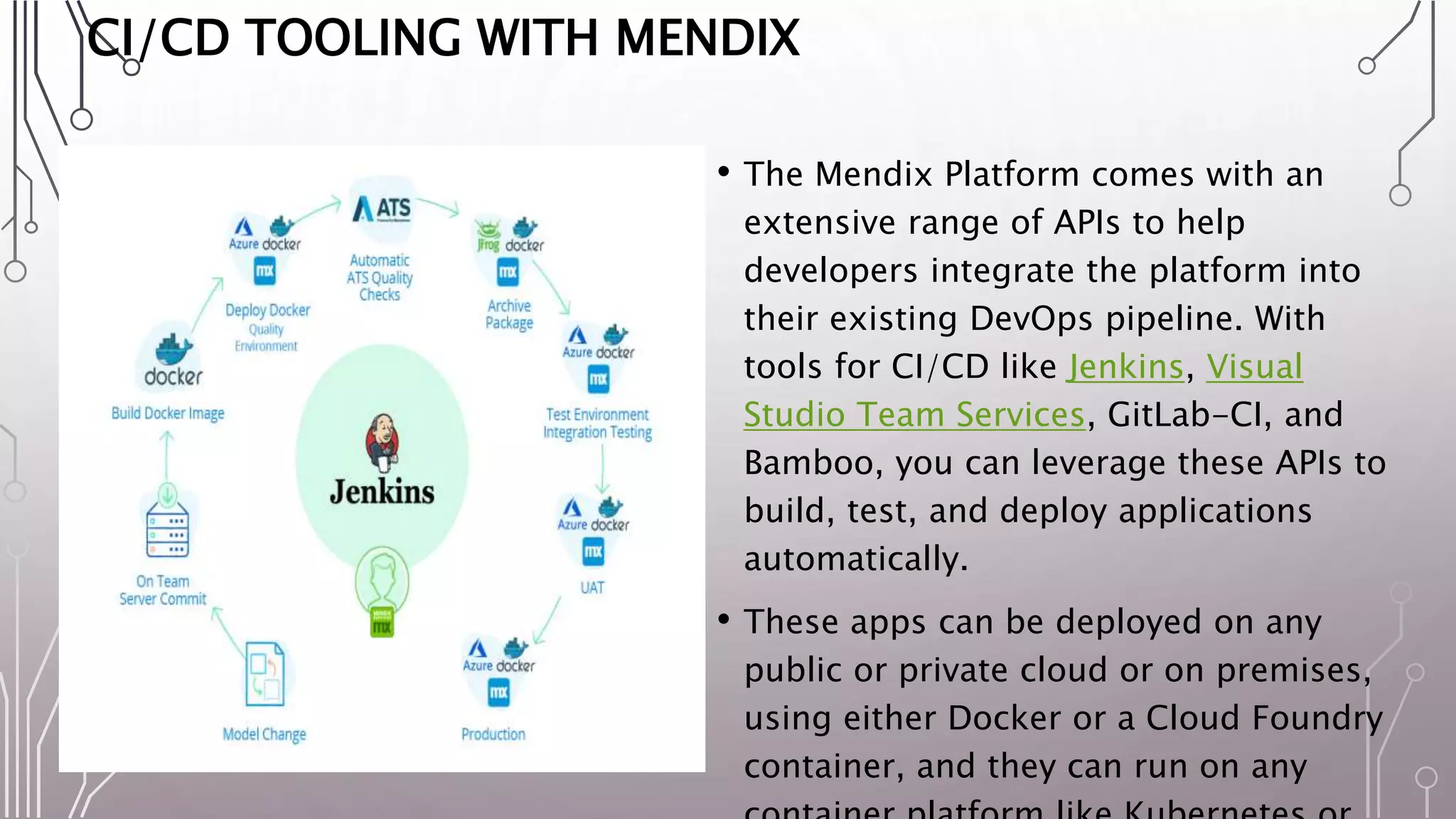
CI/CD TOOLING WITH MENDIX
• The Mendix Platform comes with an
extensive range of APIs to help
developers integrate the platform into
their existing DevOps pipeline. With
tools for CI/CD like Jenkins, Visual
Studio Team Services, GitLab-CI, and
Bamboo, you can leverage these APIs to
build, test, and deploy applications
automatically.
• These apps can be deployed on any
public or private cloud or on premises,
using either Docker or a Cloud Foundry
container, and they can run on any
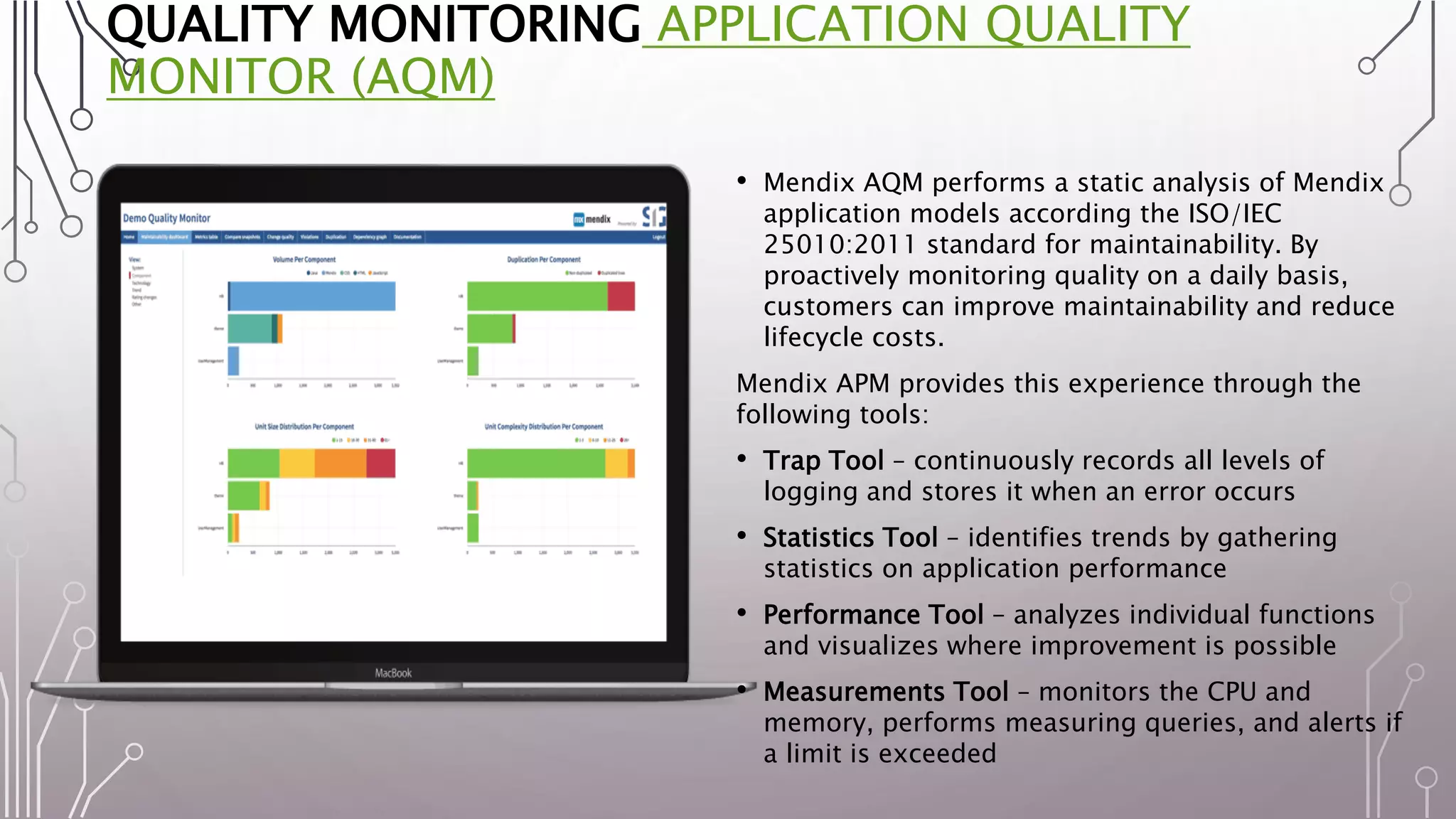
QUALITY MONITORING APPLICATION QUALITY
MONITOR (AQM)
• Mendix AQM performs a static analysis of Mendix
application models according the ISO/IEC
25010:2011 standard for maintainability. By
proactively monitoring quality on a daily basis,
customers can improve maintainability and reduce
lifecycle costs.
Mendix APM provides this experience through the
following tools:
• Trap Tool – continuously records all levels of
logging and stores it when an error occurs
• Statistics Tool – identifies trends by gathering
statistics on application performance
• Performance Tool – analyzes individual functions
and visualizes where improvement is possible
• Measurements Tool – monitors the CPU and
memory, performs measuring queries, and alerts if
a limit is exceeded
INTEGRATION
• Mendix supports connections to other apps and services through
industry-standard interfaces and protocols such as REST, SOAP, JDBC,
and OData. The platform offers many solutions for ensuring that new
applications can both consume and expose data and services in
heterogeneous environments
• There are several ways that we enable integration, ranging from
consuming and exposing REST APIs, SOAP web services, and OData.
• Mendix Platform with integrations such as Kafka event streams, Redis,
MQTT, Slack, Twitter, and Salesforce. Many connectors already exist in
the Mendix App Store.
• data mapping functionality that automatically maps incoming
message structures (such as JSON, WSDL, or XML) in order to create
DATA MANAGEMENT
• The data required to build new enterprise applications is derived from
many sources, such as existing SQL databases, service calls, web APIs,
and local application-specific databases.
• Mendix applications sit on top of their own SQL database, which is
created and managed by the platform and without the need for a
dedicated database administrator.
• For integration purposes, Mendix supports integration with any
database via the JDBC protocol.
• Mendix provides a comprehensive security DSL that enables your team
to create fine-grained security controls across your application's
navigation, UI, logic, and data.
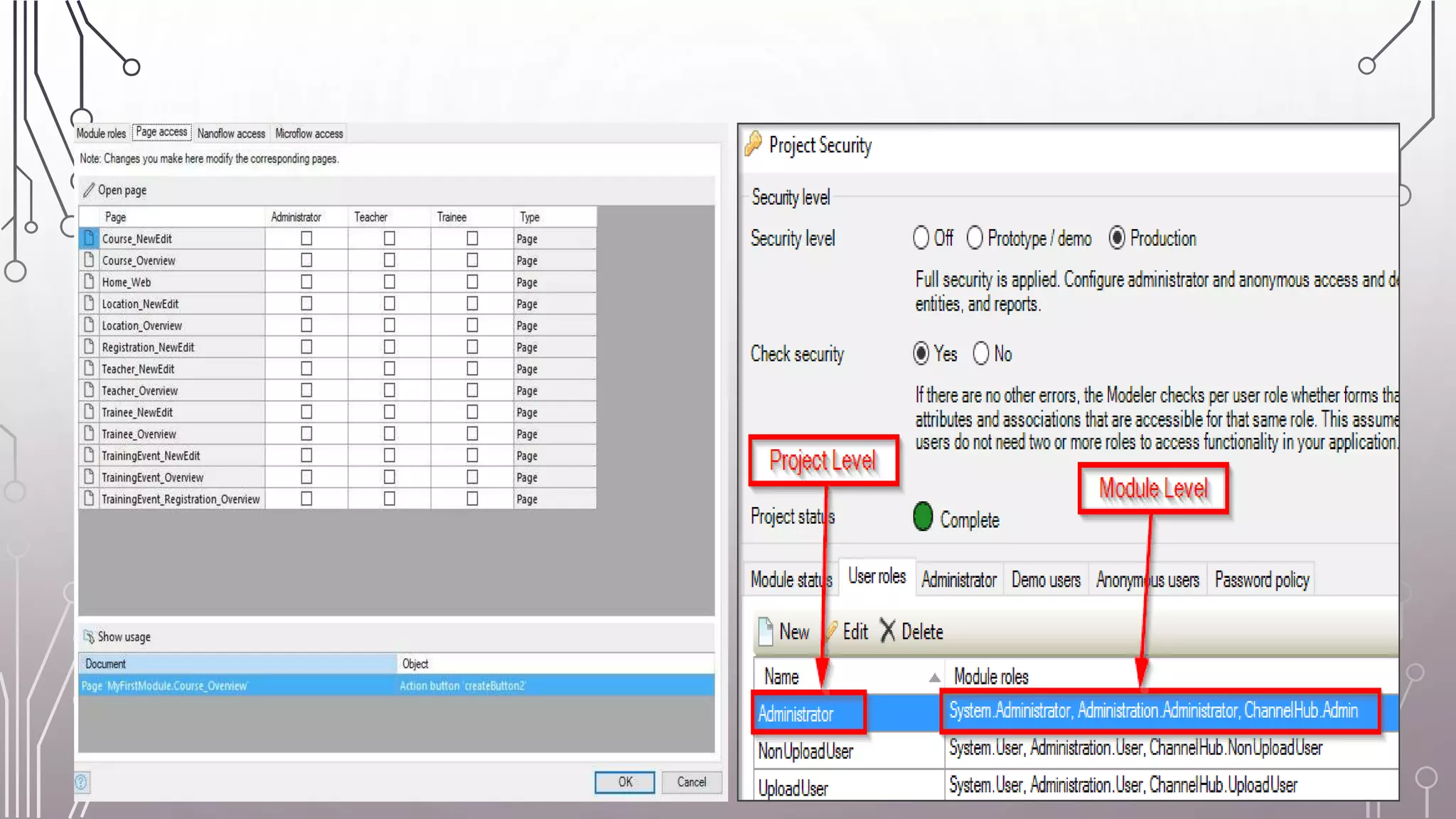
DATA SECURITY
• Data security in Mendix is handled by defining the data access rules on your entities.
Per entity, you can define who can see what data and who can create or delete data.
• You can use the Encryption module available in the App Store to encrypt your Mendix
application data. You can encrypt your data with the Advanced Encryption Standard
(AES).
Mendix Security Basics
Authentication
• Standard protocols like OpenID, SAML and configure single sign-on (SSO).
• You can use the Mendix SSO module so users can log in using their Mendix
account.
Authorization
• Project Security and the Module Security.
• Project level you configure general security settings like password policy.
WHICH CLOUD PROVIDERS CAN I USE?
Mendix supports all the major cloud providers:
• IBM Cloud
• SAP Cloud Platform
• Microsoft Azure
• Amazon Web Services (AWS)
• Red Hat OpenShift
• Google Cloud Platform
Mendix offers formal partnerships with IBM, SAP, Microsoft, Google,
Redhat and AWS
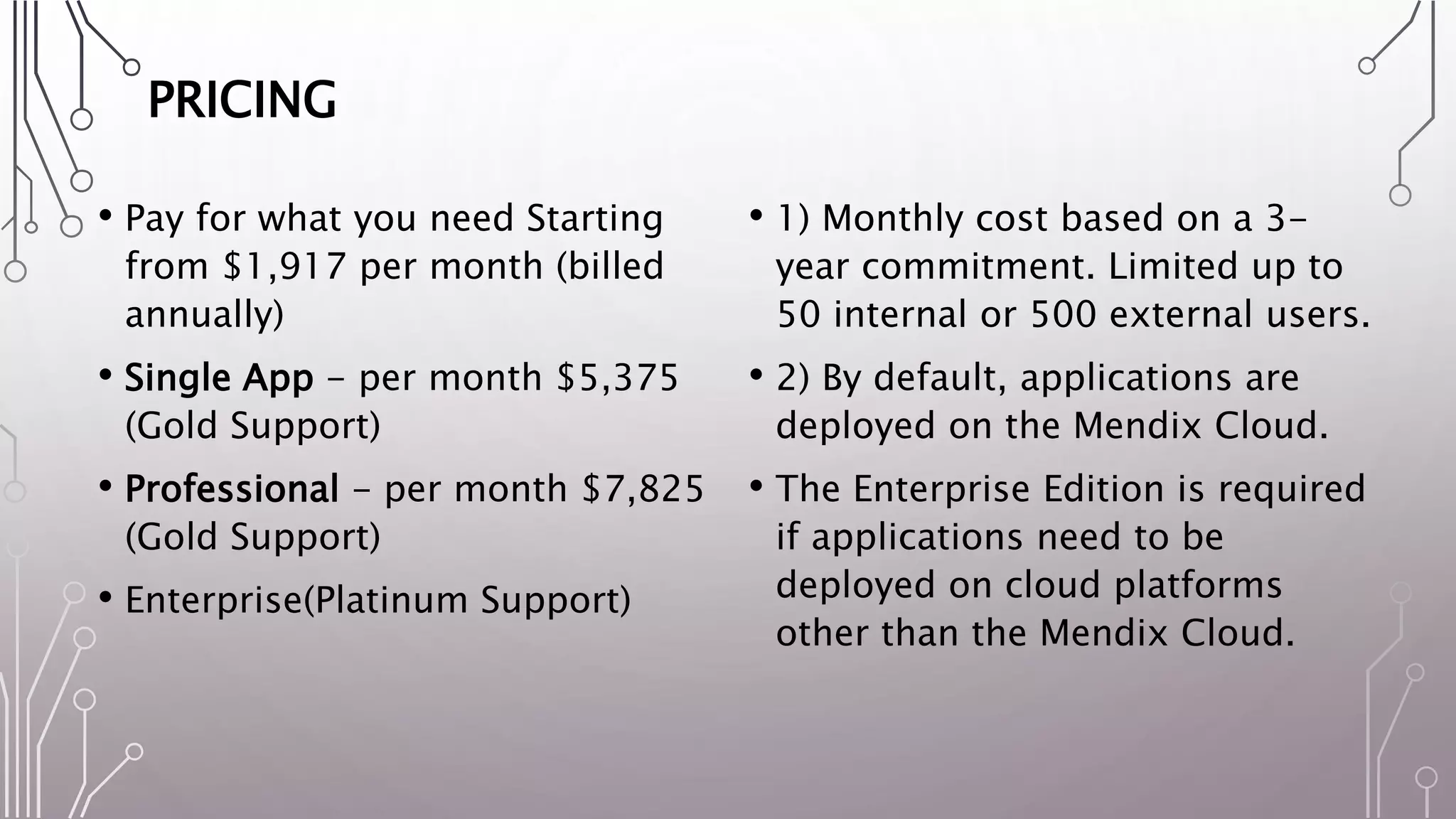
PRICING
• Pay for what you need Starting
from $1,917 per month (billed
annually)
• Single App - per month $5,375
(Gold Support)
• Professional - per month $7,825
(Gold Support)
• Enterprise(Platinum Support)
• 1) Monthly cost based on a 3-
year commitment. Limited up to
50 internal or 500 external users.
• 2) By default, applications are
deployed on the Mendix Cloud.
• The Enterprise Edition is required
if applications need to be
deployed on cloud platforms
other than the Mendix Cloud.

Mendix Platform

  • 1.
  • 2.
    WE’RE EXPANDING OURPLATFORM PORTFOLIOS
  • 3.
    WHAT IS ANO-CODE/LOW CODE DEVELOPMENT • Low-code development platforms focus on ease-of-use and a visual app building approach so business professionals can utilize them for creating their own solutions. This means that those closest to business problems can be empowered to quickly turn ideas into action, with point-and-click simplicity. • No-code is a set of tools, applications or platforms that allows you to build a relatively complex application without the knowledge of programming language. But Wikipedia gives another, more concise definition: “No-code development platform (NCDPs) allows programmers and non-programmers to create application software through graphical user interfaces and configuration instead of traditional computer programming.”
  • 4.
    LOW-CODE AND NO-CODE •Low-code and no-code have similar capabilities and goals. Both use visual modelers and templates to automate processes without (ideally) writing any code. The difference is becoming more to do with who the users are. • No-code is generally the domain of citizen developers building simple and more limited applications. Ideally without coding. • Low-code focuses on professional developers creating enterprise class applications. Ideally without coding.
  • 5.
    GARTNER MAGIC QUADRANTAND FORRESTER WAVE FOR LOW- CODE
  • 7.
    POTENTIAL LOW CODEBENEFITS • Low-code platforms may significantly speed up software development. Leading to faster ROI and increased productivity. • Low-code platforms can be self-documenting. They provide a graphical representation of the processes they are performing. This can substantially reduce the need for external documentation. • Low code reduces testing. Templates and components are pretested and used by many companies, in many scenarios. • Tooling includes visual modelers, pre-built modules and templates typically supported by drag and drop environments. • One click application delivery. Simplified and accelerated deployment. • Support for several third-generation languages for customisation beyond a platform’s existing capabilities. • Ability for citizen developers to create (simple) applications without coding. But be mindful: low-code does not always mean ‘fit for non-technical’ users.
  • 8.
    POTENTIAL LOW CODEDRAWBACKS • Vendor lock-in may present significant problems depending on your situation. Portability across platforms can be difficult or impossible without a full rewrite. • Pricing models can be complex and opaque. None of the vendors in the Forrester Wave scored highly in this regard. • Visual components and model driven logic trade ease of use and speed of development. This may currently be less flexible than code- based platforms although the gap is closing as low-code platforms evolve. • Hand development may be required to integrate LC/NC apps with other systems. • Complexity and controllability limitations of apps may not meet some long-term business objectives.
  • 9.
    WHAT ARE THEANALYSTS PREDICTING? • By 2024, three quarters of large enterprises will be using at least four low-code development tools for both IT application development and citizen development initiatives. [Gartner] • By 2024, low-code application development will be responsible for more than 65% of all application development activity. [Gartner] • By 2020, at least 50 percent of all new business applications will be created with high-productivity toolsets, such as lowcode and no- code application development platforms.[Gartner] • The global Low-Code Development Platform Market is Set to Reach USD 53.0 billion by 2024, Observing a CAGR of 80.0% during 2019– 2024. [VynZ Research] • Through 2021, market demand for app development will grow at least five times faster than the IT capacity to deliver it. [Gartner]
  • 10.
    THIS MAY BEA REVOLUTION
  • 11.
    WHAT IS MENDIX? •The Mendix Platform is designed to accelerate enterprise app delivery across your entire application development lifecycle, from ideation to development, deployment, and the ongoing management of your application portfolio in the cloud or on premises. • Mendix offers both no code (visual-modelling) and low code (highly extensible, integrated tooling to support crossfunctional teams working collaboratively). • Business-domain experts such as analysts and citizen developers can work alongside expert developers to achieve much greater levels of business agility and consequently accelerated delivery. • the platform's cloud-native architecture and automation tools support the deployment, management, and monitoring of highly-available enterprise-grade applications.
  • 13.
  • 14.
    KEY ARCHITECTURAL PRINCIPLES •The Mendix Platform is architected for the demands of enterprise-ready applications, which are applications that are maintainable, highly performant, and scalable, and can cope with the complex nature of enterprise systems. • Model-driven development • Model interpretation over code generation • Microservices, containers, and deployment standardization • Statelessness • Openness and extensibility • Twelve-Factor App principles
  • 15.
    TWELVE-FACTOR CLOUD-NATIVE APPS? •While not strictly a set of architectural principles, the Twelve-Factor App methodology is a set of best practices for cloud-native applications covering the following points: • Codebase – one stored codebase and deployments via packages • Dependencies – all dependencies are part of the app model • Configuration – defined in the app model via constraints • Backing Services – configurable at deployment time • Build, Release, Run – separate build and run • Processes - stateless • Port Binding - the app should be self-contained • Concurrency – scale via processes • Disposability - runtime instances can be stopped and started as required • Development/Production Parity – consistent environments across test and production • Logs – collect logs via CF Firehose • Admin Processes – ship the admin and app code in one model
  • 16.
    MENDIX SUPPORT AGILEDEVELOPMENT TEAMS • Development teams • End-users and other stakeholders • All the stakeholders The Mendix Platform provides various channels of engagement for different stakeholders: • Developer Portal • Mendix Studio and Mendix Studio Pro (IDE) • Mendix mobile app • Notification emails • Buzz
  • 17.
  • 19.
  • 21.
  • 23.
    HOW CAN IMAKE SURE THE LOGIC FITS MY BUSINESS NEEDS? • Nanoflows are used to build client-side logic (for example, mobile app logic). Using nanoflows makes it possible to support offline logic and low latency, which results in super fast apps that are offline-capable. • Microflows and business rules are used to build server-side logic, because microflows allow you to express the logic of your application. microflow is composed of the following element types: • Events represent the start and end points of a microflow and the special operations in a loop • Input parameters provide the microflow with input from its context • Activities are actions that are executed in a microflow • Connectors can be downloaded from the Mendix App Store to connect your app to other systems • Flows form the connection between elements • Splits enable making choices and merging different paths again • Error handlers can be set on an activity, split, or loop to define how to handle an error • Add Custom Code to My Application • On the server side, Mendix provides out-of-the-box microflow logic and integration features based on REST, OData, and SOAP web services.
  • 24.
    MODEL CONSISTENCY • Consistencychecks are divided into three categories: errors, warnings, and deprecations
  • 25.
  • 26.
  • 27.
    DEPLOYMENT • Mendix applicationsrun on the platform's cloud-native stateless runtime architecture that conforms to Twelve-Factor App principles with support for modern cloud platforms such as Docker, Kubernetes and Cloud Foundry. • Mendix apps benefit from auto-scaling, auto-provisioning, auto- healing, low infrastructure overhead, CI/CD, and cloud interoperability out of the box. • Mendix applications run on a variety of deployment options, including public cloud, virtual private cloud, private cloud, hybrid cloud, multi cloud, and traditional (virtual) servers. • Mendix applications are packaged and deployed to the cloud provider of your choice using our one-click deployment. • Mendix also supports the creation of build packs for deployment on
  • 28.
    CI/CD TOOLING WITHMENDIX • The Mendix Platform comes with an extensive range of APIs to help developers integrate the platform into their existing DevOps pipeline. With tools for CI/CD like Jenkins, Visual Studio Team Services, GitLab-CI, and Bamboo, you can leverage these APIs to build, test, and deploy applications automatically. • These apps can be deployed on any public or private cloud or on premises, using either Docker or a Cloud Foundry container, and they can run on any
  • 29.
    QUALITY MONITORING APPLICATIONQUALITY MONITOR (AQM) • Mendix AQM performs a static analysis of Mendix application models according the ISO/IEC 25010:2011 standard for maintainability. By proactively monitoring quality on a daily basis, customers can improve maintainability and reduce lifecycle costs. Mendix APM provides this experience through the following tools: • Trap Tool – continuously records all levels of logging and stores it when an error occurs • Statistics Tool – identifies trends by gathering statistics on application performance • Performance Tool – analyzes individual functions and visualizes where improvement is possible • Measurements Tool – monitors the CPU and memory, performs measuring queries, and alerts if a limit is exceeded
  • 30.
    INTEGRATION • Mendix supportsconnections to other apps and services through industry-standard interfaces and protocols such as REST, SOAP, JDBC, and OData. The platform offers many solutions for ensuring that new applications can both consume and expose data and services in heterogeneous environments • There are several ways that we enable integration, ranging from consuming and exposing REST APIs, SOAP web services, and OData. • Mendix Platform with integrations such as Kafka event streams, Redis, MQTT, Slack, Twitter, and Salesforce. Many connectors already exist in the Mendix App Store. • data mapping functionality that automatically maps incoming message structures (such as JSON, WSDL, or XML) in order to create
  • 31.
    DATA MANAGEMENT • Thedata required to build new enterprise applications is derived from many sources, such as existing SQL databases, service calls, web APIs, and local application-specific databases. • Mendix applications sit on top of their own SQL database, which is created and managed by the platform and without the need for a dedicated database administrator. • For integration purposes, Mendix supports integration with any database via the JDBC protocol. • Mendix provides a comprehensive security DSL that enables your team to create fine-grained security controls across your application's navigation, UI, logic, and data.
  • 32.
    DATA SECURITY • Datasecurity in Mendix is handled by defining the data access rules on your entities. Per entity, you can define who can see what data and who can create or delete data. • You can use the Encryption module available in the App Store to encrypt your Mendix application data. You can encrypt your data with the Advanced Encryption Standard (AES). Mendix Security Basics Authentication • Standard protocols like OpenID, SAML and configure single sign-on (SSO). • You can use the Mendix SSO module so users can log in using their Mendix account. Authorization • Project Security and the Module Security. • Project level you configure general security settings like password policy.
  • 34.
    WHICH CLOUD PROVIDERSCAN I USE? Mendix supports all the major cloud providers: • IBM Cloud • SAP Cloud Platform • Microsoft Azure • Amazon Web Services (AWS) • Red Hat OpenShift • Google Cloud Platform Mendix offers formal partnerships with IBM, SAP, Microsoft, Google, Redhat and AWS
  • 35.
    PRICING • Pay forwhat you need Starting from $1,917 per month (billed annually) • Single App - per month $5,375 (Gold Support) • Professional - per month $7,825 (Gold Support) • Enterprise(Platinum Support) • 1) Monthly cost based on a 3- year commitment. Limited up to 50 internal or 500 external users. • 2) By default, applications are deployed on the Mendix Cloud. • The Enterprise Edition is required if applications need to be deployed on cloud platforms other than the Mendix Cloud.